Best Java Websites of 2026 (20 Real-World Examples)
Java-associated websites, original public-design reviews, and practical application planning
These 20 website examples connect public design with separately sourced Java services, frameworks, runtime distributions and open-source projects. They are useful references without implying that every pictured homepage is implemented in Java or shares one current stack.
Java is a programming language within a wider runtime and library ecosystem. A company’s public website can be unrelated to the Java service or framework described in an engineering source. A product such as a search server, identity system or runtime distribution also has a different responsibility from an editor-facing CMS. Keep those distinctions visible when learning from the collection.
Netflix, LinkedIn, PayPal, eBay and Amazon open with recognizable names and narrowly identified evidence. Several associations are historical: LinkedIn’s Rest.li project is archived, and the eBay source describes a dated framework migration. Amazon’s Corretto documentation establishes a runtime distribution, not the architecture of its retail homepage. Later examples offer more direct project-level references for particular Java application responsibilities.
Before the examples
What makes good Java website development in 2026?
Name the application before its framework
Describe a complete user or service interaction, the data it changes and the systems it depends on. A Java application should have an explicit responsibility rather than inherit the scope of a corporate technology story. Distinguish a new requirement from an existing system that needs maintenance or a bounded migration.
Separate source, runtime and distribution choices
The Java learning reference distinguishes the language, application organization and JVM topics. During implementation, document the JDK distribution, supported release, dependencies and packaging separately. A runtime download is not a complete deployment plan, and an attractive framework homepage does not resolve compatibility with the organization’s existing systems.
Dev.java’s JVM material introduces monitoring and diagnostic tools. Use that as a route into the actual service’s resource, failure and support requirements. A framework choice does not remove the need to inspect slow requests, dependency failures, memory behavior and the information operators need to investigate them.
Use the screenshots for information-design and interface lessons, then follow the cited primary source for the specific Java association. Framework source, runtime documentation and a historical corporate case provide different evidence; none automatically describes the pictured page’s current backend.
We start with five recognizable brands or organizations: Netflix, LinkedIn Learning, PayPal, eBay, Amazon. Each attribution applies to the named website property, not every product or website belonging to its organization. This is a curated reading sequence, not a measured ranking.
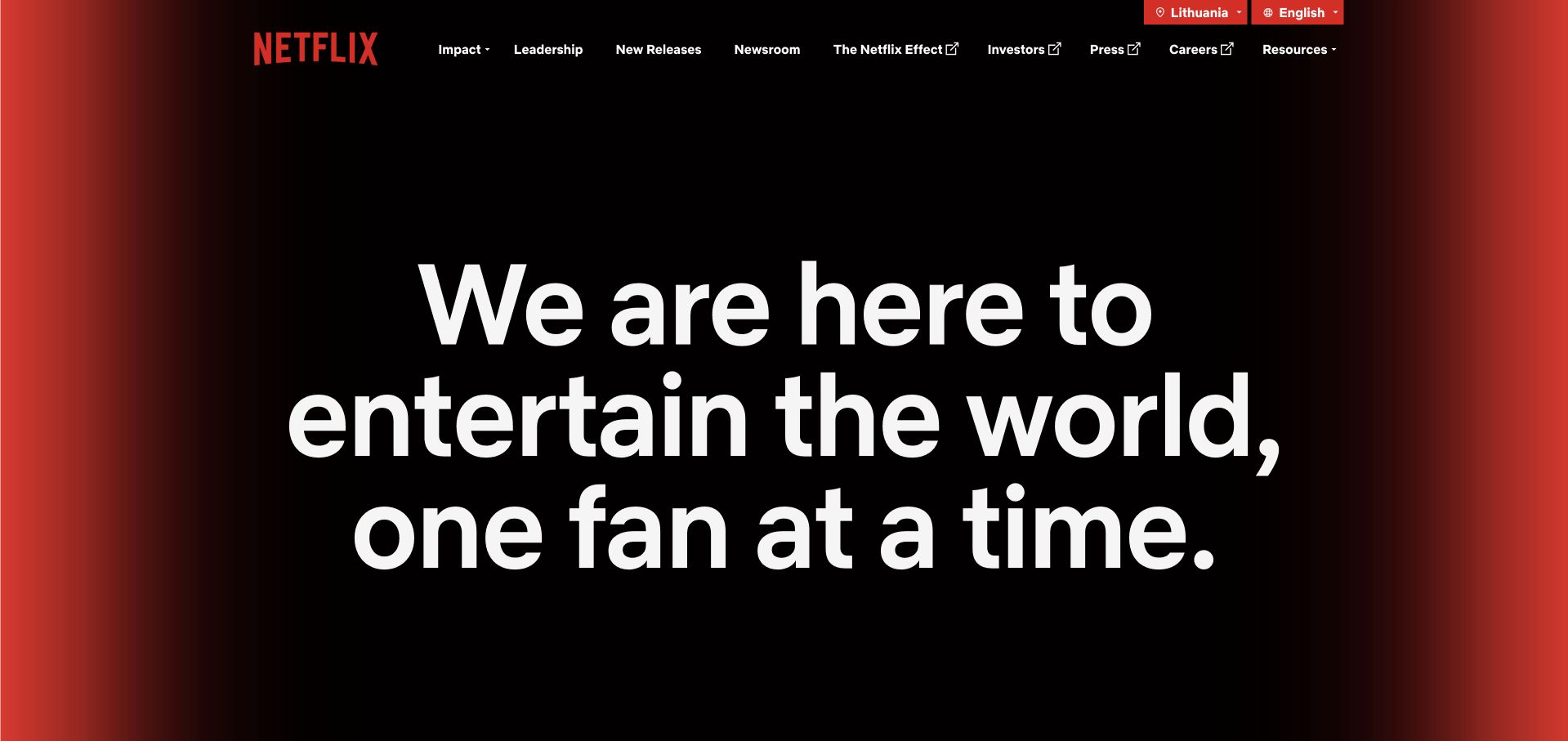
Netflix’s company site gives an entertainment statement a large typographic stage, with corporate destinations in the header. The black-to-red environment creates continuity with the consumer brand without presenting a logged-in catalog or subscription workflow. A company needs several kinds of public entrance. The Java association here is Netflix’s maintained DGS GraphQL framework; its documentation supports that specific project, not a conclusion that this pictured company page or every Netflix service runs on Java.
What you can learn
Keep the company introduction, consumer experience and engineering evidence distinct. Each can reinforce the others without pretending to be the same system. A useful technical example identifies the actual framework and workload, while the public page still gives press, applicants and other professional readers a clear next destination.
Pros
The compact corporate navigation provides direct routes for readers who are not evaluating a streaming subscription.
The strong typographic treatment remains recognizable without needing a dense product interface or autoplay film.
Cons & considerations
The broad introduction does not answer practical product or engineering questions without deeper supporting pages.
Large display type needs careful responsive handling so a short message does not become an unnecessarily long mobile opening.
Platform source: Official Java engineering or project evidence. Netflix-maintained Java GraphQL server framework. The cited engineering, project or customer source establishes only the named language association. It does not establish the marketing page runtime, every company system, current deployment continuity or independent performance results. Platform evidence is separate from the direct website screenshot and is not a complete current infrastructure audit.
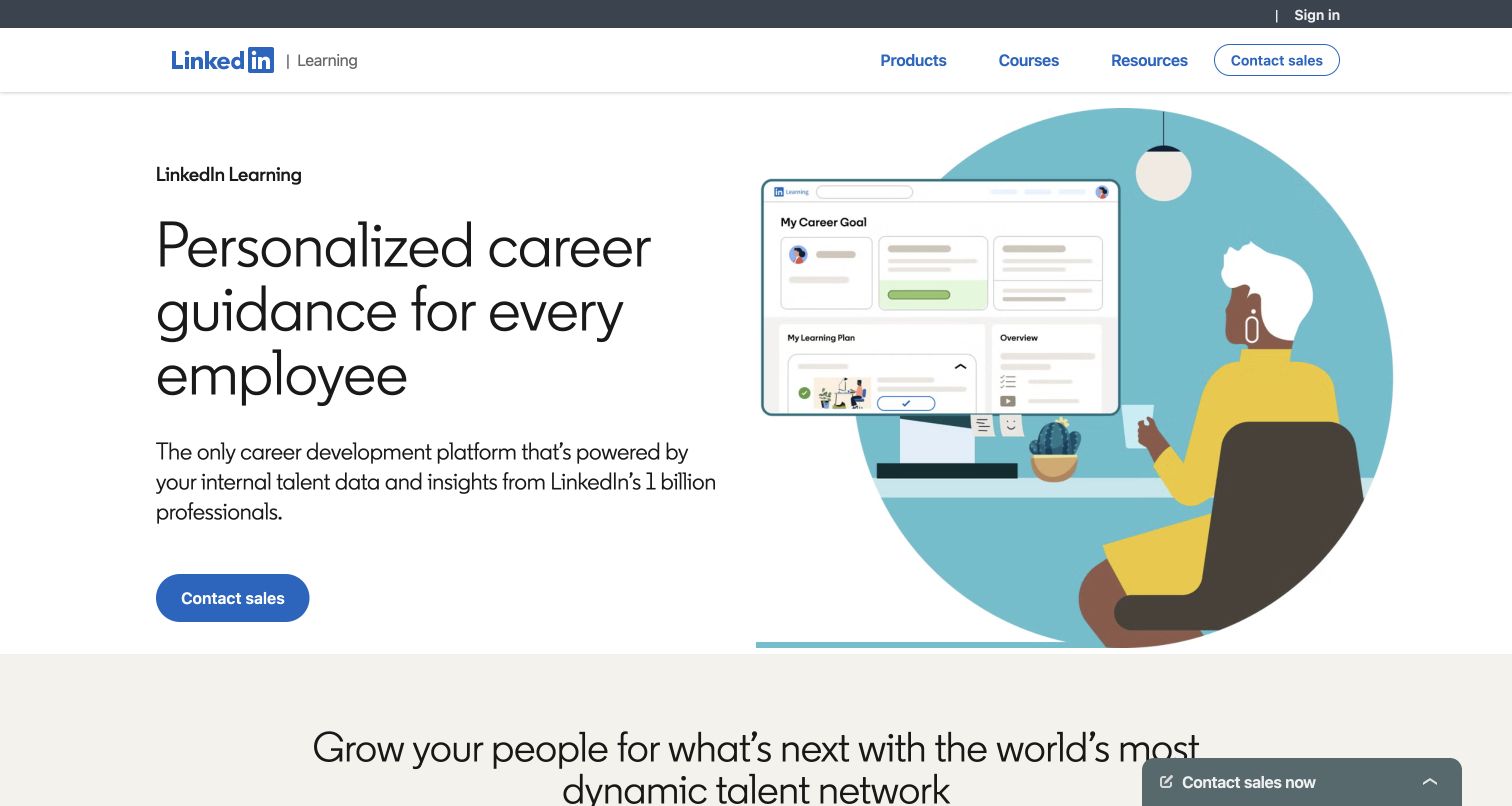
LinkedIn Learning pairs its career-development proposition with an illustrated learning interface and a clearly separated sales action. The blue-and-white system feels related to the wider LinkedIn brand while keeping the organizational learning use case explicit. Product, course and resource navigation support readers who need more detail before contacting anyone. The Java evidence is LinkedIn’s Rest.li framework, archived in 2026; that historical source does not identify the runtime of this separate Learning page or every service in the LinkedIn platform.
What you can learn
Connect a business outcome to a recognizable product surface before introducing implementation detail. Non-technical buyers need to understand the learning and administration workflow, while engineers need a separate, precisely scoped technical source. Do not let the parent company’s framework history become an unsupported claim about the page being reviewed.
Pros
A clear organizational use case gives the enterprise page a different purpose from a general course catalog.
The product illustration provides context for a broad career-development message without overwhelming the first screen.
Cons & considerations
The sales-led route may leave simple pricing and implementation questions unanswered at the opening.
A small interface illustration cannot establish learner accessibility, content quality or the actual administration experience.
Platform source: Official Java engineering or project evidence. Historical LinkedIn Java REST service framework, deprecated and archived in 2026; not the pictured Learning-page runtime. The cited engineering, project or customer source establishes only the named language association. It does not establish the marketing page runtime, every company system, current deployment continuity or independent performance results. Platform evidence is separate from the direct website screenshot and is not a complete current infrastructure audit.
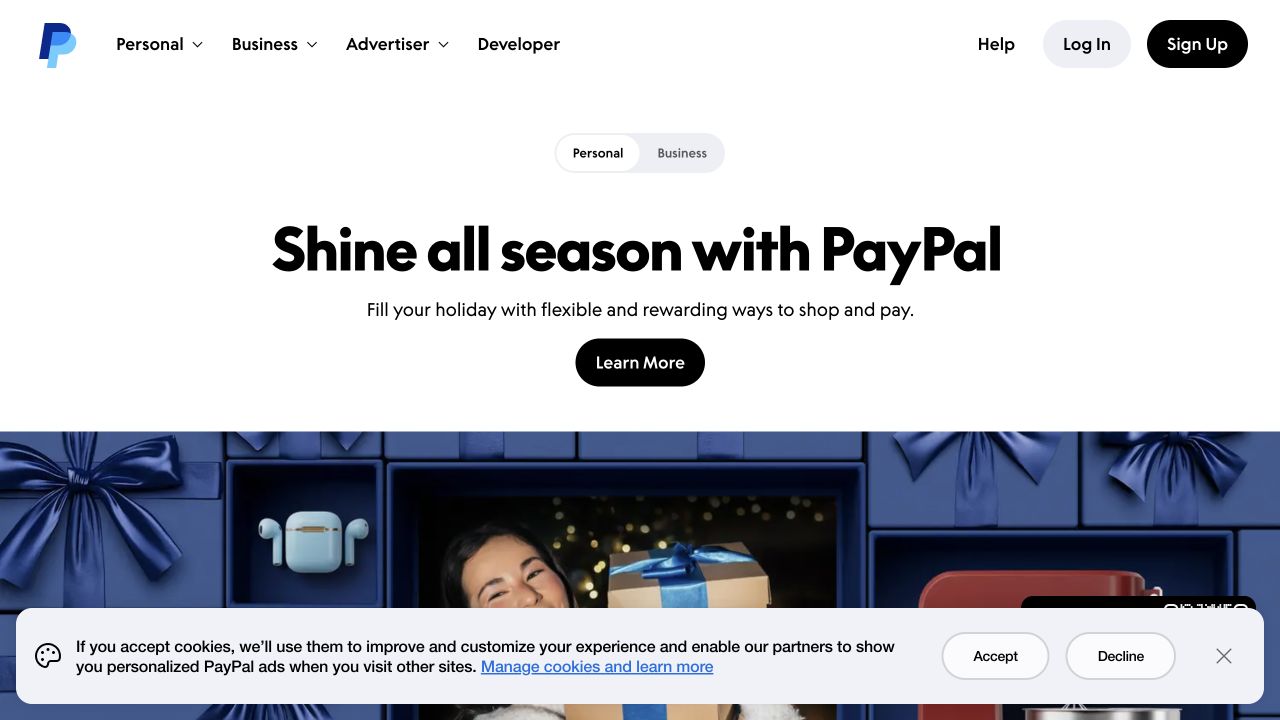
PayPal gives returning visitors familiar account controls and uses the main page to introduce a shopping message. The audience switch, explanation and action create a simple sequence before the promotional image begins. That division serves people with different levels of familiarity. Java is named as a first-class application language in a published PayPal platform case; the source does not establish the current implementation of this campaign page or its payment flow.
What you can learn
Keep repeat tasks stable while allowing campaign content to change. A customer returning to an account and a visitor evaluating a service should not have to follow the same introduction. Technical architecture evidence belongs to the named platform or service, not automatically to every public page carrying the brand.
Pros
Login and registration remain easy to distinguish from the seasonal acquisition story below the header.
The Personal and Business switch makes the intended audience visible without a long introductory choice screen.
Cons & considerations
A time-sensitive campaign needs a maintained route to evergreen product information and applicable terms.
The captured consent strip covers part of the lower visual and adds another decision around the first task.
Platform source: Official Java engineering or project evidence. Java identified as a first-class application language in a 2020 platform case. The cited engineering, project or customer source establishes only the named language association. It does not establish the marketing page runtime, every company system, current deployment continuity or independent performance results. Platform evidence is separate from the direct website screenshot and is not a complete current infrastructure audit.
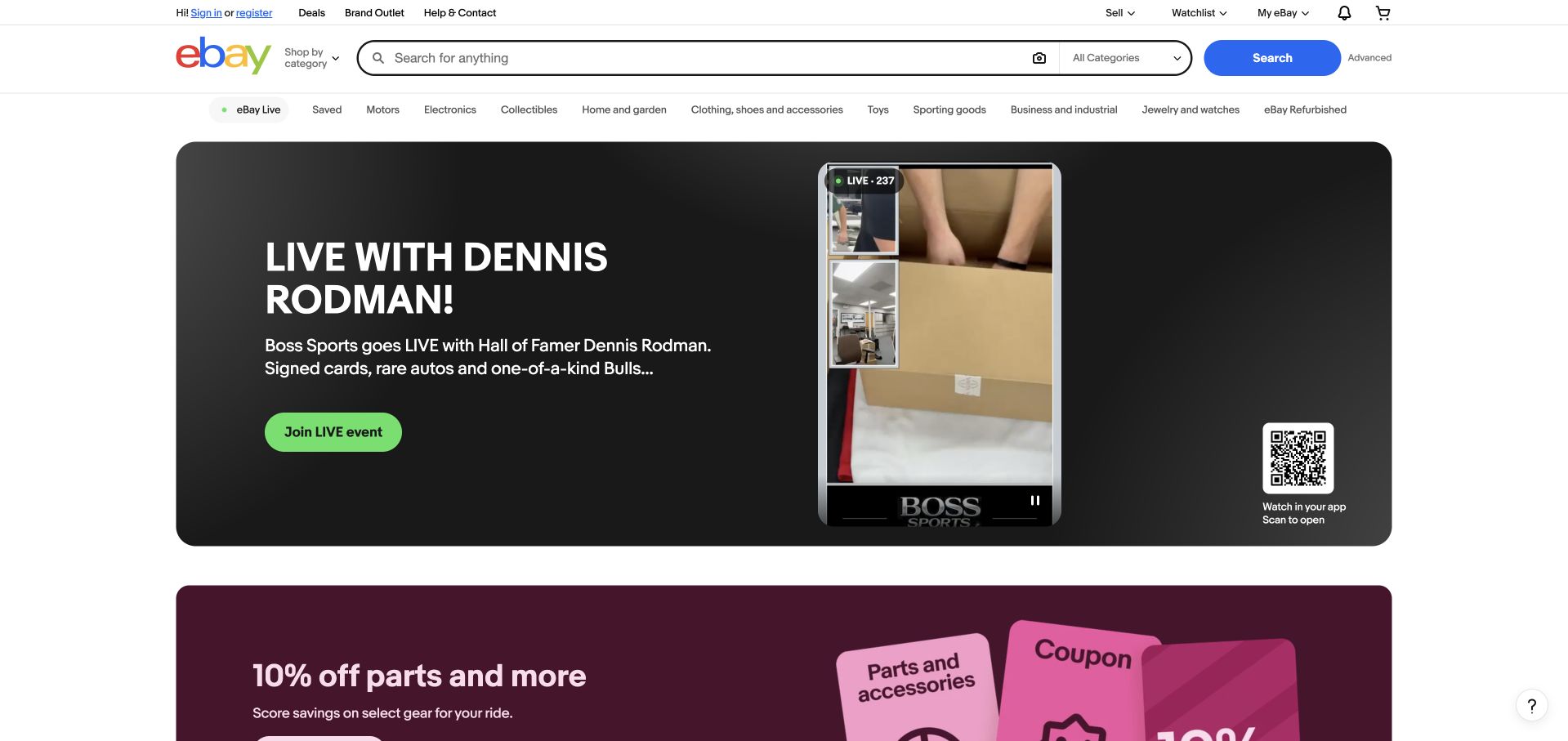
eBay’s familiar search and category controls remain above a large live-shopping promotion, with additional offer cards beginning below it. The design lets an event dominate the editorial space without making it the only way to use the marketplace. This separation is especially useful for a site where repeat visitors often arrive with a precise item in mind. eBay’s Java source is a historical framework-migration account involving Spring; it does not establish the complete current stack of the pictured campaign or every marketplace service.
What you can learn
Keep the persistent utility of a marketplace independent from its changing promotional content. Search, categories and account access should remain predictable even when a campaign is visually assertive. When describing the implementation, distinguish a dated migration account from a current observation of the public source.
Pros
A prominent search field supports known-item shopping before the visitor encounters the main campaign.
The bounded promotional panel gives a temporary event its own clear visual area without replacing navigation.
Cons & considerations
Several narrow utility rows and promotional cards make the first screen visually dense.
Live-event imagery and copy require timely updates and should not become a stale substitute for ordinary product discovery.
Platform source: Official Java engineering or project evidence. Historical Java/Spring application-framework migration account from 2020. The cited engineering, project or customer source establishes only the named language association. It does not establish the marketing page runtime, every company system, current deployment continuity or independent performance results. Platform evidence is separate from the direct website screenshot and is not a complete current infrastructure audit.
Amazon’s retail opening puts search and category navigation above colorful promotional panels. The page prioritizes shopping utility and offers rather than a company introduction. Distinct cards give merchandise stories their own space, although they create a busy first impression. The Java association here is Amazon Corretto, the documented OpenJDK distribution; it is not evidence that this retail homepage or every service behind a purchase is implemented in Java.
What you can learn
Protect the primary search task when a catalog is too broad for a single introductory narrative. Promotional cards can support discovery, but they should not obscure location, account state or the path to a known item. Keep a company’s runtime product separate from unverified claims about its retail architecture.
Pros
The persistent search field gives a direct route through a catalog that would be impossible to explain in one hero.
Distinct promotional panels make several shopping themes visible without one lengthy campaign narrative.
Cons & considerations
The high density of navigation and offers can make the first screen tiring for unfamiliar visitors.
A regional promotional view cannot establish price, availability, delivery eligibility or the quality of a completed purchase.
Platform source: Official Java engineering or project evidence. Amazon Corretto OpenJDK distribution; not a retail-homepage backend assertion. The cited engineering, project or customer source establishes only the named language association. It does not establish the marketing page runtime, every company system, current deployment continuity or independent performance results. Platform evidence is separate from the direct website screenshot and is not a complete current infrastructure audit.
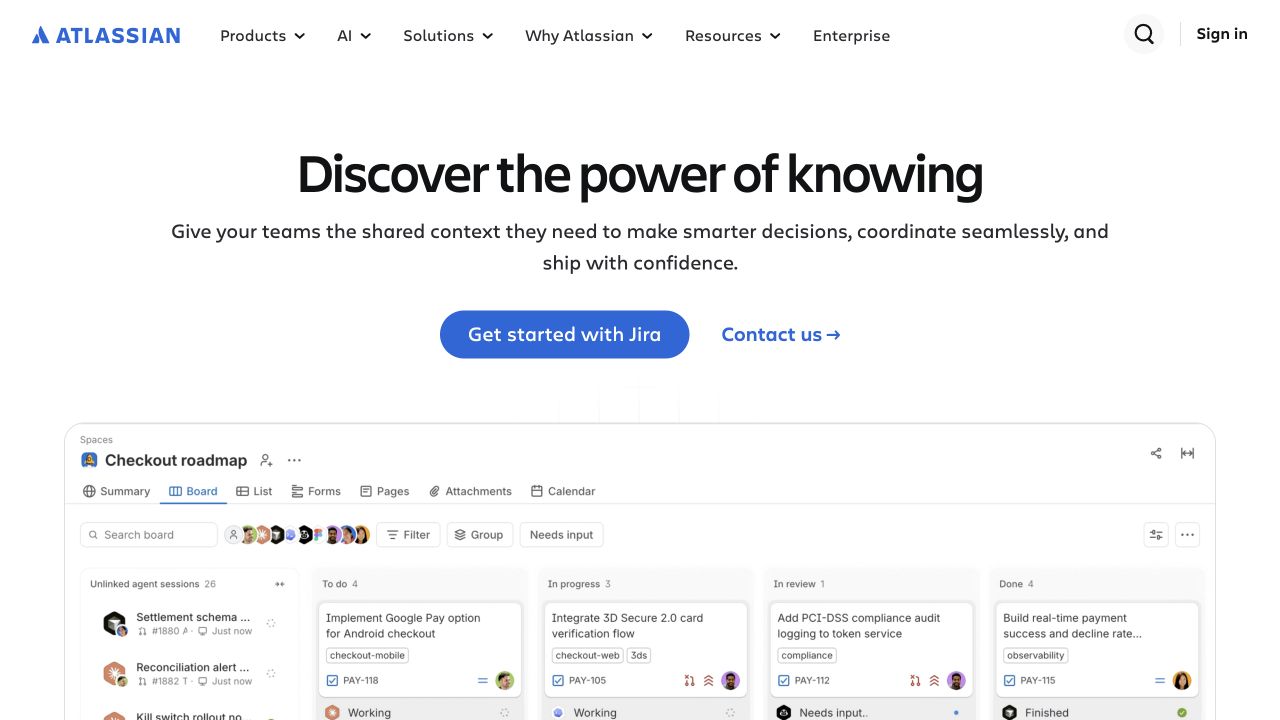
Atlassian uses a broad team-oriented statement above a large project-board interface, with a clear Jira starting action and a separate contact route. The familiar board gives the abstract promise a recognizable working context. Product and enterprise navigation remain available for visitors evaluating a wider software portfolio. The Java evidence concerns documented Jira server APIs; it does not identify the implementation of this marketing page, establish every cloud service’s runtime or imply that all Atlassian products share the same architecture.
What you can learn
Pair a team-level outcome with a concrete work surface, then identify the product actually responsible for that workflow. A broad portfolio needs explicit boundaries between related tools, deployment options and integration points. Technical evaluators should be able to find product-specific documentation without treating the corporate headline as an architecture diagram.
Pros
The project-board image gives a broad collaboration proposition a tangible operational setting.
Separate starting and contact actions support independent exploration and a more assisted evaluation.
Cons & considerations
A portfolio-wide headline can obscure which product a visitor should investigate for a specific need.
The cropped board cannot establish configuration effort, permission behavior or the accessibility of the actual application.
Platform source: Official Java engineering or project evidence. Jira server Java API documentation. The cited engineering, project or customer source establishes only the named language association. It does not establish the marketing page runtime, every company system, current deployment continuity or independent performance results. Platform evidence is separate from the direct website screenshot and is not a complete current infrastructure audit.
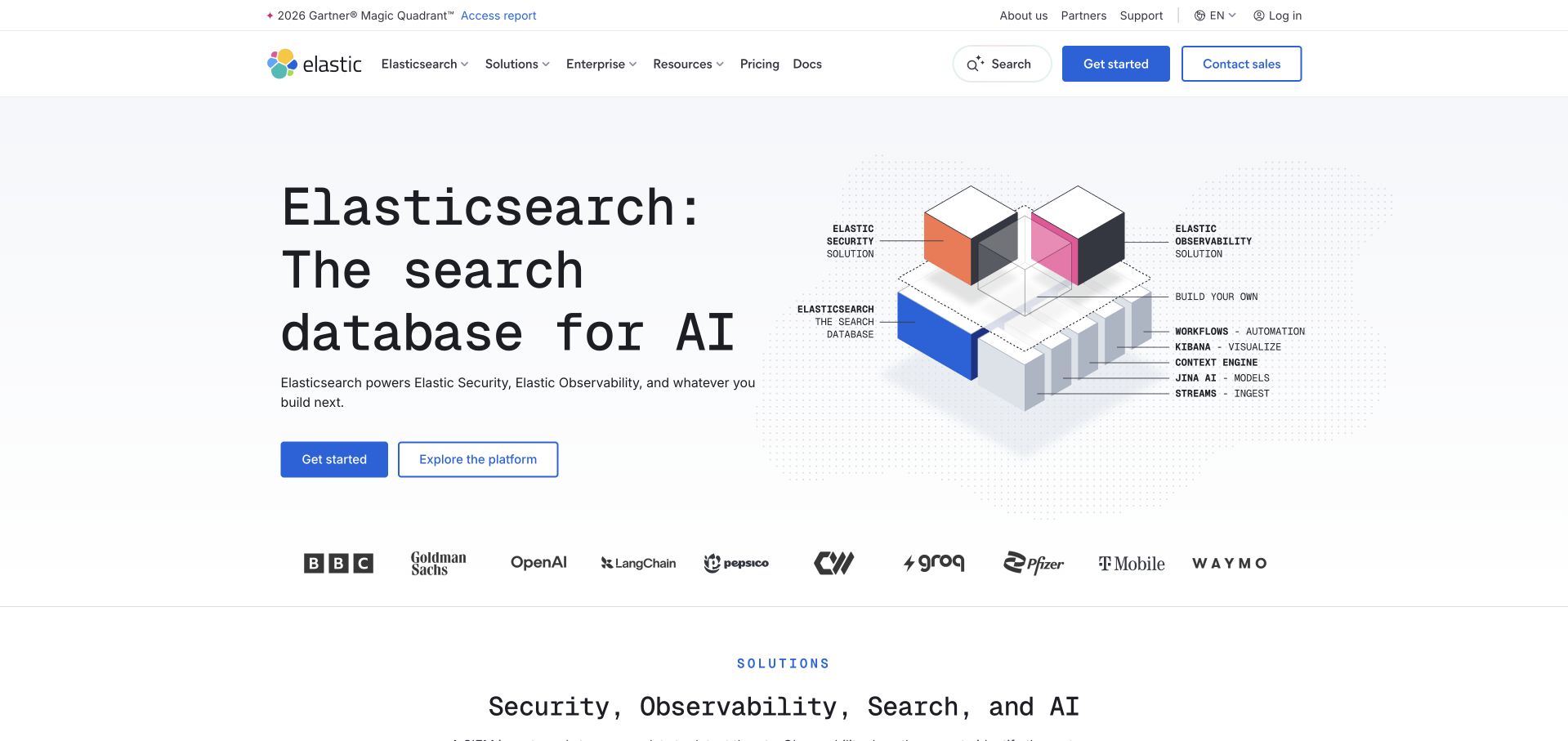
Elastic’s public page uses a strong product-category statement with multiple routes into search, observability and security material. The structured header and promotional context make clear that the offer spans several technical audiences rather than one simple search box. This is most useful as a study in organizing a broad data platform. The official Elasticsearch source establishes a Java implementation association; it does not prove that the pictured marketing page or every Elastic-branded component is served by the same runtime.
What you can learn
Organize a broad technical portfolio around the outcomes visitors are evaluating, but keep the underlying product names explicit. A buyer comparing search infrastructure should not have to infer which capabilities belong to a different application. Connect architecture, licensing and deployment questions to the appropriate product documentation rather than the general brand page.
Pros
Visible product families help different technical audiences find a relevant evaluation route.
The explicit search category provides more practical orientation than a purely abstract data-platform slogan.
Cons & considerations
Several product families and promotional messages can compete before a visitor chooses a specific task.
A portfolio overview cannot establish the resources, operating effort or retrieval quality required for an individual deployment.
Platform source: Official Java engineering or project evidence. Java Elasticsearch implementation maintained by Elastic. The cited engineering, project or customer source establishes only the named language association. It does not establish the marketing page runtime, every company system, current deployment continuity or independent performance results. Platform evidence is separate from the direct website screenshot and is not a complete current infrastructure audit.
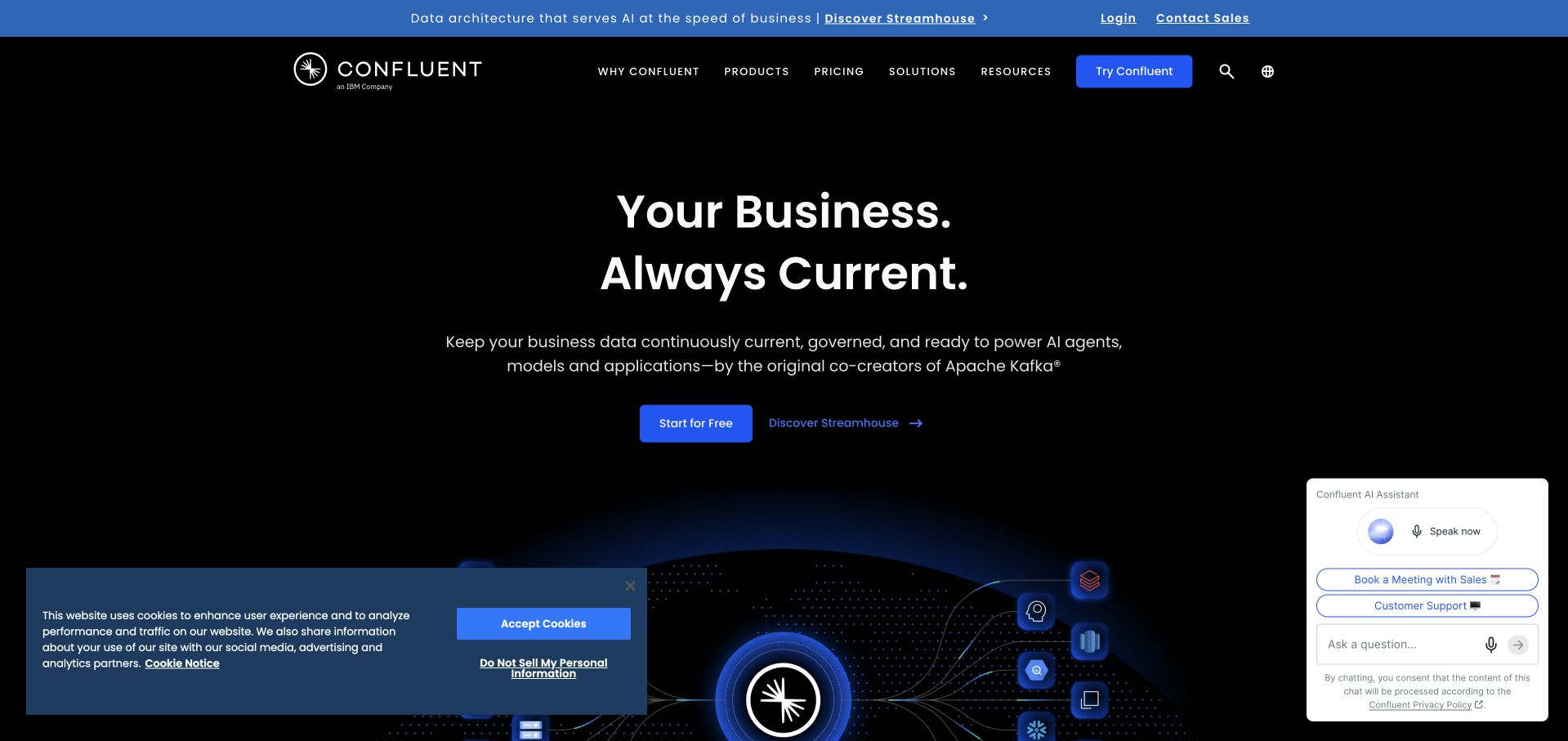
Confluent’s public opening combines a data-streaming proposition with visible product and resource routes. Announcement material adds a current editorial layer, while the main introduction presents a broader platform rather than a single developer download. The design is useful for studying how an infrastructure category is made approachable to organizational evaluators. Its official Schema Registry project provides the scoped Java association; it does not establish the runtime of this public page or every component in the wider commercial platform.
What you can learn
Explain what moves through an infrastructure product and why a team needs it, then distinguish its component services. A streaming-platform homepage should lead toward real integration, schema and operating guidance rather than assuming a broad data narrative is sufficient for implementation. Keep examples tied to the relevant system and deployment option.
Pros
A clear infrastructure category gives a reader an initial frame for the wider product portfolio.
Product and resource navigation support technical investigation without making a sales conversation the only next step.
Cons & considerations
An announcement strip and multiple platform messages can dilute the first practical explanation.
The public overview cannot establish connector compatibility, operating cost or delivery guarantees for a particular data flow.
Platform source: Official Java engineering or project evidence. Java schema-registry service implementation. The cited engineering, project or customer source establishes only the named language association. It does not establish the marketing page runtime, every company system, current deployment continuity or independent performance results. Platform evidence is separate from the direct website screenshot and is not a complete current infrastructure audit.
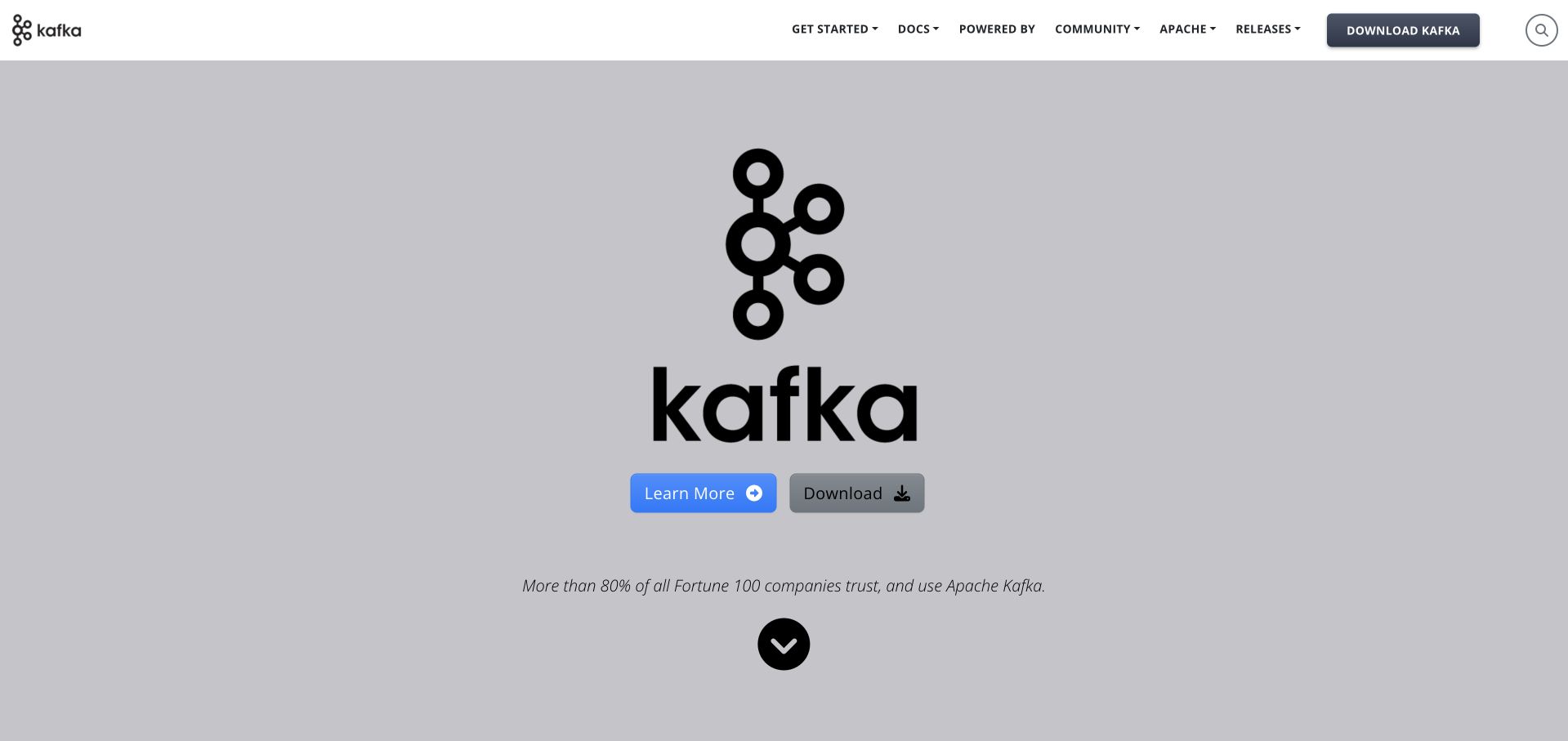
Apache Kafka’s homepage centers a large project mark above direct learning and download actions. Getting-started and documentation routes remain in the header, offering practical alternatives to the sparse introduction. The public presentation emphasizes the software and its ecosystem instead of a commercial signup funnel. The official source establishes Java and Scala in the project; it does not mean that a Kafka user’s entire application, every client library or this public website is implemented in Java.
What you can learn
Keep the project definition, quickstart and reference material close together. Infrastructure users need to distinguish the server, client and operational environment before copying a deployment pattern. A useful project homepage invites that investigation instead of allowing familiarity with the brand to substitute for understanding the work involved.
Pros
Getting-started and documentation routes are visible before a visitor has to navigate commercial offers or registration.
The project identity makes a technically specific infrastructure category the center of the introduction.
Cons & considerations
The logo-led opening gives a newcomer little immediate explanation of the project’s actual event-streaming role.
Ecosystem examples need workload and date context rather than being treated as universal architecture recommendations.
Platform source: Official Java engineering or project evidence. Java and Scala distributed event-streaming project. The cited engineering, project or customer source establishes only the named language association. It does not establish the marketing page runtime, every company system, current deployment continuity or independent performance results. Platform evidence is separate from the direct website screenshot and is not a complete current infrastructure audit.
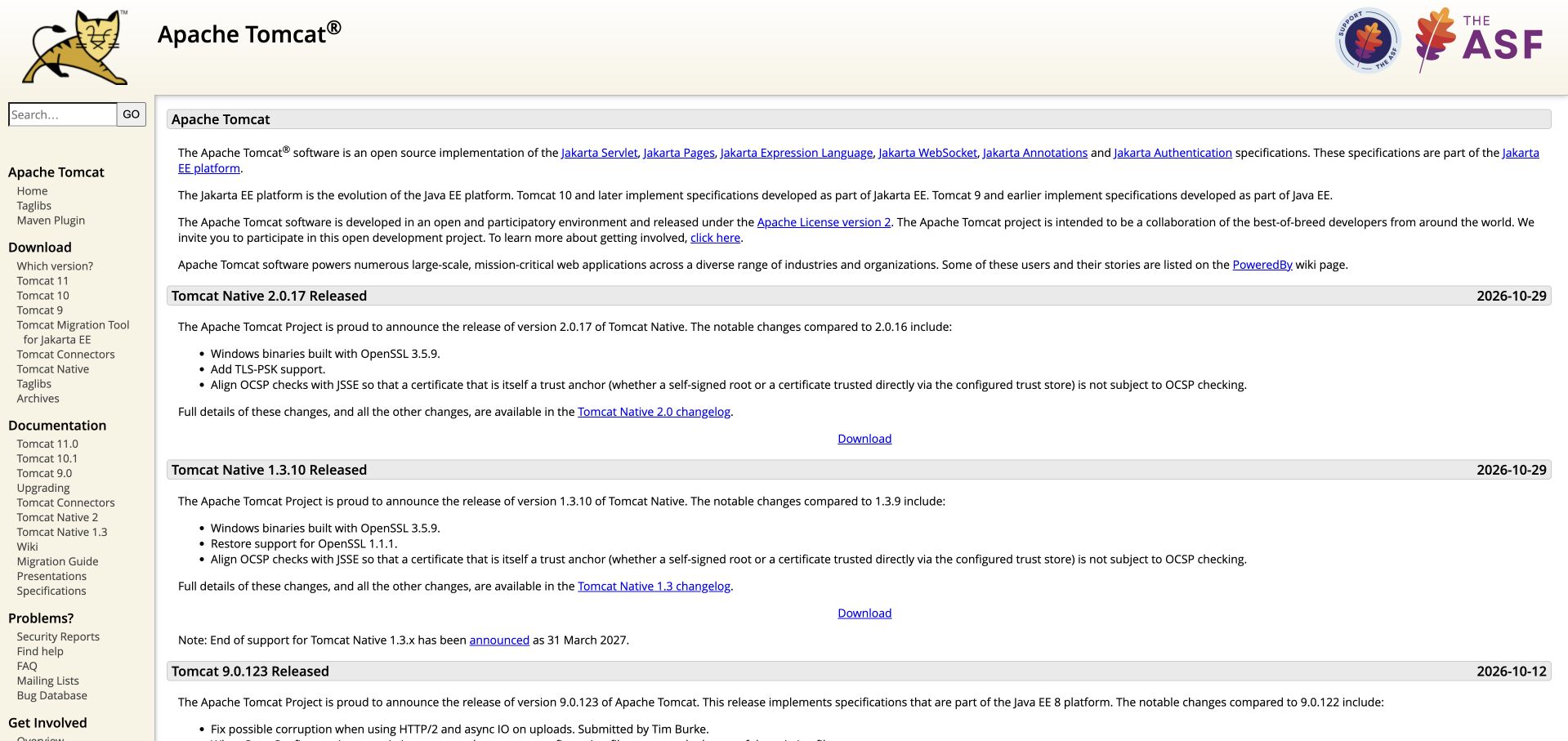
Apache Tomcat places a project introduction above release announcements, with a documentation and download rail on the left. The layout prioritizes maintenance over a promotional hero. Dates, versions and support destinations make the page a working reference rather than a corporate statement. The official build instructions establish the Java server project; they do not identify the technology of every hosted application or guarantee compatibility between unrelated Tomcat and Java versions.
What you can learn
Design for the reader’s maintenance task when release and compatibility information are the main reason to visit. Make supported-version guidance, migration notes and security material easy to distinguish. A dense reference layout can be appropriate, but its reading order and small-screen behavior deserve the same care as a visually ambitious marketing page.
Pros
Release announcements and dates are visible without forcing the reader through a separate promotional introduction.
The persistent documentation rail provides direct routes for experienced users with a known server-management task.
Cons & considerations
Small type and a long link rail can be difficult to scan or use on narrow displays.
Several concurrent release families require careful explanation so newcomers do not choose a version by recency alone.
Platform source: Official Java engineering or project evidence. Java HTTP server and servlet-container implementation. The cited engineering, project or customer source establishes only the named language association. It does not establish the marketing page runtime, every company system, current deployment continuity or independent performance results. Platform evidence is separate from the direct website screenshot and is not a complete current infrastructure audit.
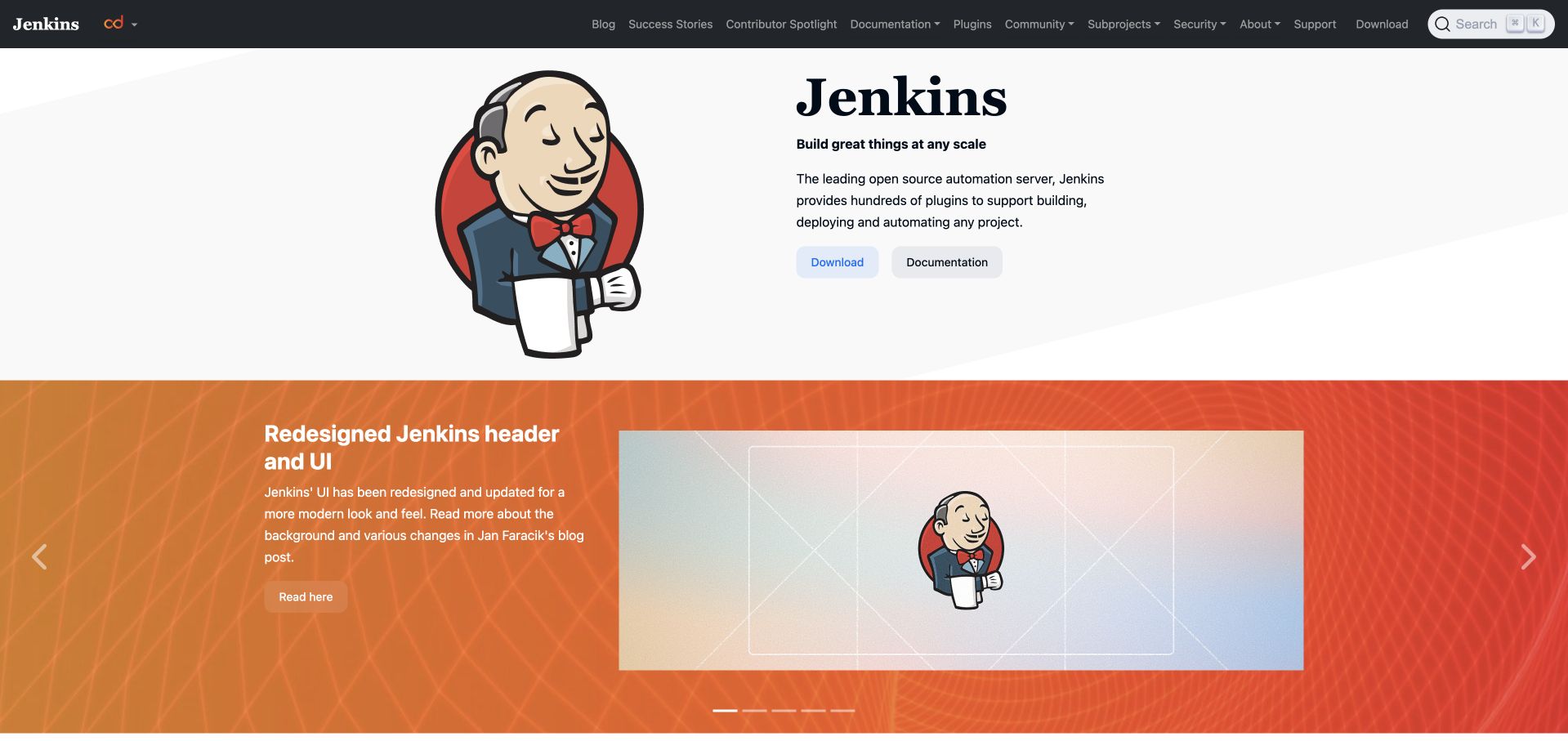
Jenkins pairs its familiar butler illustration with a concise automation-server description and direct download and documentation actions. A large news panel begins below, showing ongoing work on the project and its interface. The composition balances project personality with a usable technical entrance. The official installation guide establishes the Java runtime requirement for Jenkins; it does not mean the public homepage, every plugin or the software built by a Jenkins job is implemented in Java.
What you can learn
Use a recognizable project identity to help orientation, but keep the practical installation and reference routes explicit. A continuously maintained operational tool also needs a visible path to supported runtime requirements, upgrade guidance and plugin compatibility. Community news should supplement those tasks rather than become the only route into the product.
Pros
Download and documentation actions sit directly beside the first explanation of the project.
The distinctive illustration gives a mature operational tool a memorable identity without obscuring its category.
Cons & considerations
The large news panel can push more practical setup and maintenance guidance below the opening.
A short automation-server description cannot convey the ongoing work needed to secure and maintain an installation.
Platform source: Official Java engineering or project evidence. Java automation-server runtime requirement. The cited engineering, project or customer source establishes only the named language association. It does not establish the marketing page runtime, every company system, current deployment continuity or independent performance results. Platform evidence is separate from the direct website screenshot and is not a complete current infrastructure audit.
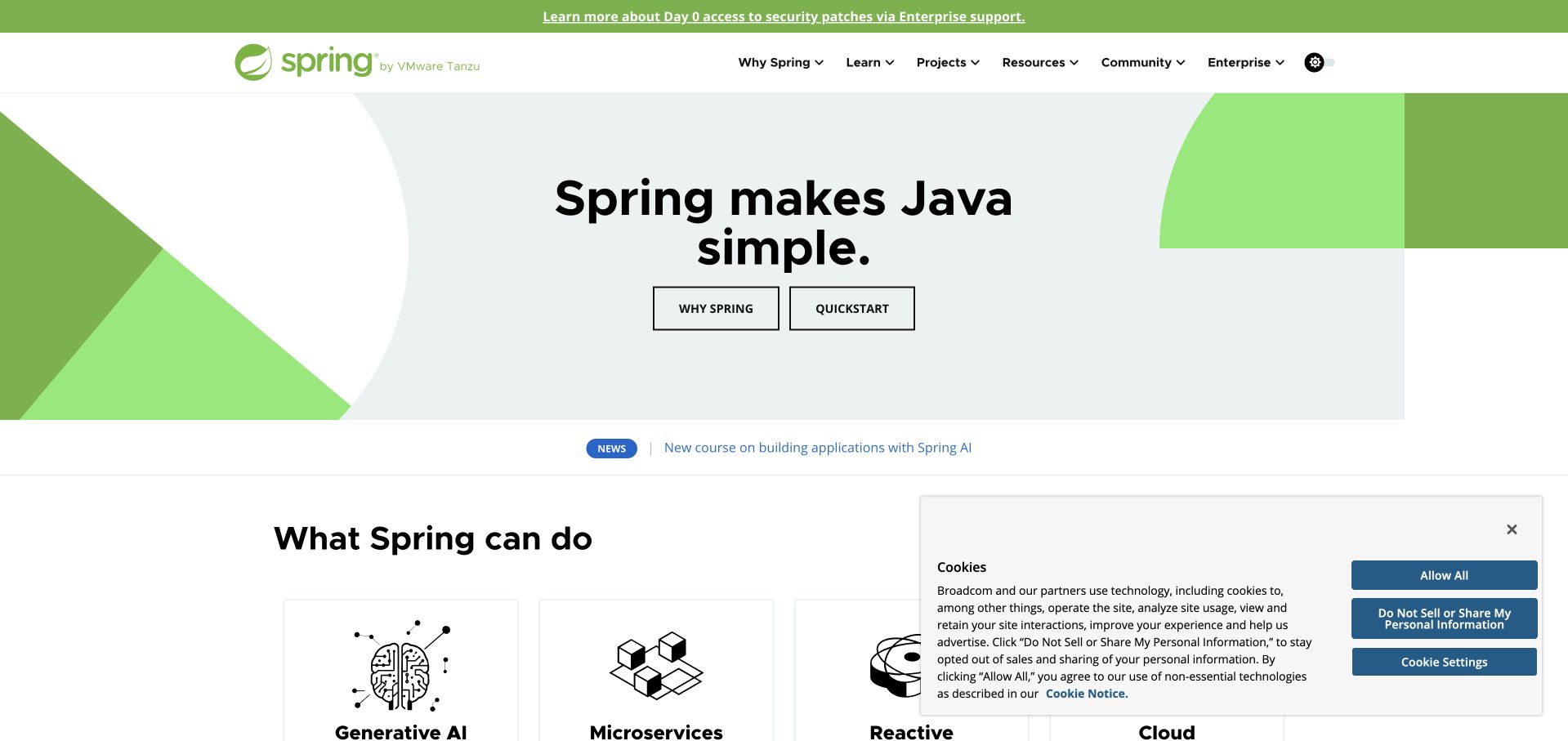
Spring’s green-and-white opening uses a short Java-focused proposition and two simple learning actions. A capability section begins below, introducing areas such as microservices and reactive applications without making them all part of the first sentence. The familiar product and learning navigation supports a much broader ecosystem behind the restrained hero. The official Spring Framework source establishes the Java association; it does not identify the language serving this marketing page or establish every dependency and deployment choice for a Spring application.
What you can learn
Give a large framework ecosystem one manageable starting point, then expose specialist paths. Distinguish the core framework from related products and support services so a newcomer can understand which decision comes first. A concise quickstart should lead toward secure configuration, testing and deployment rather than being mistaken for production readiness.
Pros
The quickstart provides a concrete first step beneath a deliberately short framework introduction.
The follow-on capability section helps readers explore different application areas without crowding the opening headline.
Cons & considerations
The promise of simplicity needs practical examples and should not become a universal estimate of project effort.
The captured cookie panel and support announcement add decisions around an otherwise focused introduction.
Platform source: Official Java engineering or project evidence. Java application framework. The cited engineering, project or customer source establishes only the named language association. It does not establish the marketing page runtime, every company system, current deployment continuity or independent performance results. Platform evidence is separate from the direct website screenshot and is not a complete current infrastructure audit.
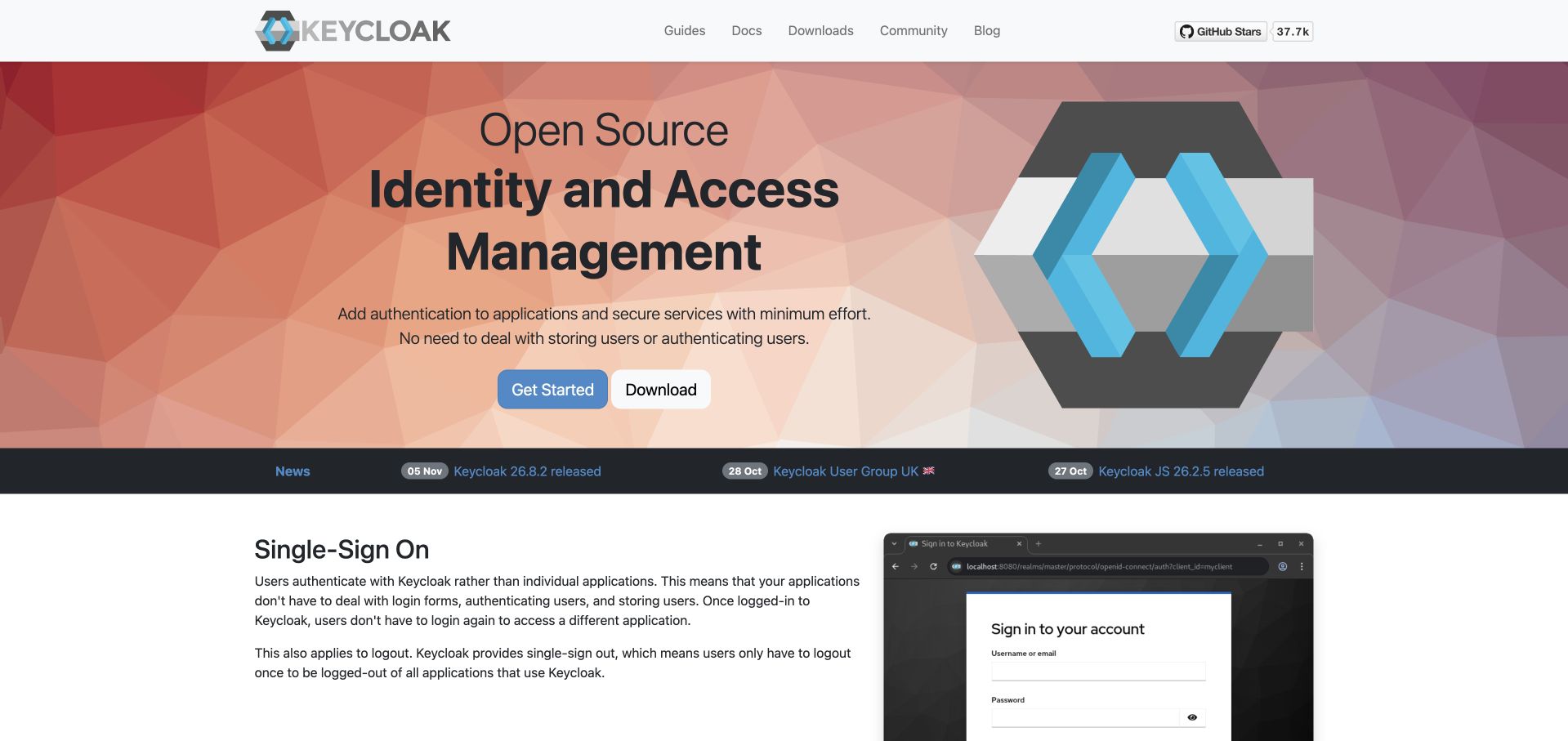
Keycloak’s homepage names identity and access management directly, with getting-started and download actions below a large geometric brand mark. The next section introduces single sign-on beside an example login interface, connecting the infrastructure category to something a user recognizes. Release information remains visible between those sections. The official source establishes a Java identity-server implementation; it does not prove the security configuration, regulatory suitability or runtime of every application connected to a Keycloak deployment.
What you can learn
Explain the identity problem in plain terms before introducing configuration detail. A recognizable login example can orient a non-specialist, but the implementation still needs careful consideration of sessions, recovery, access policies and deployment ownership. Keep the introductory project page separate from any claim that an installation is secure by default.
Pros
The explicit category definition helps a newcomer understand the project before encountering identity-specific configuration terms.
A login-interface example gives single sign-on a concrete user-facing context.
Cons & considerations
A simple introduction cannot communicate the operational and security responsibilities of running an identity service.
The decorative background and multiple release notices need careful contrast and reading-order checks on smaller screens.
Platform source: Official Java engineering or project evidence. Java identity-server implementation. The cited engineering, project or customer source establishes only the named language association. It does not establish the marketing page runtime, every company system, current deployment continuity or independent performance results. Platform evidence is separate from the direct website screenshot and is not a complete current infrastructure audit.
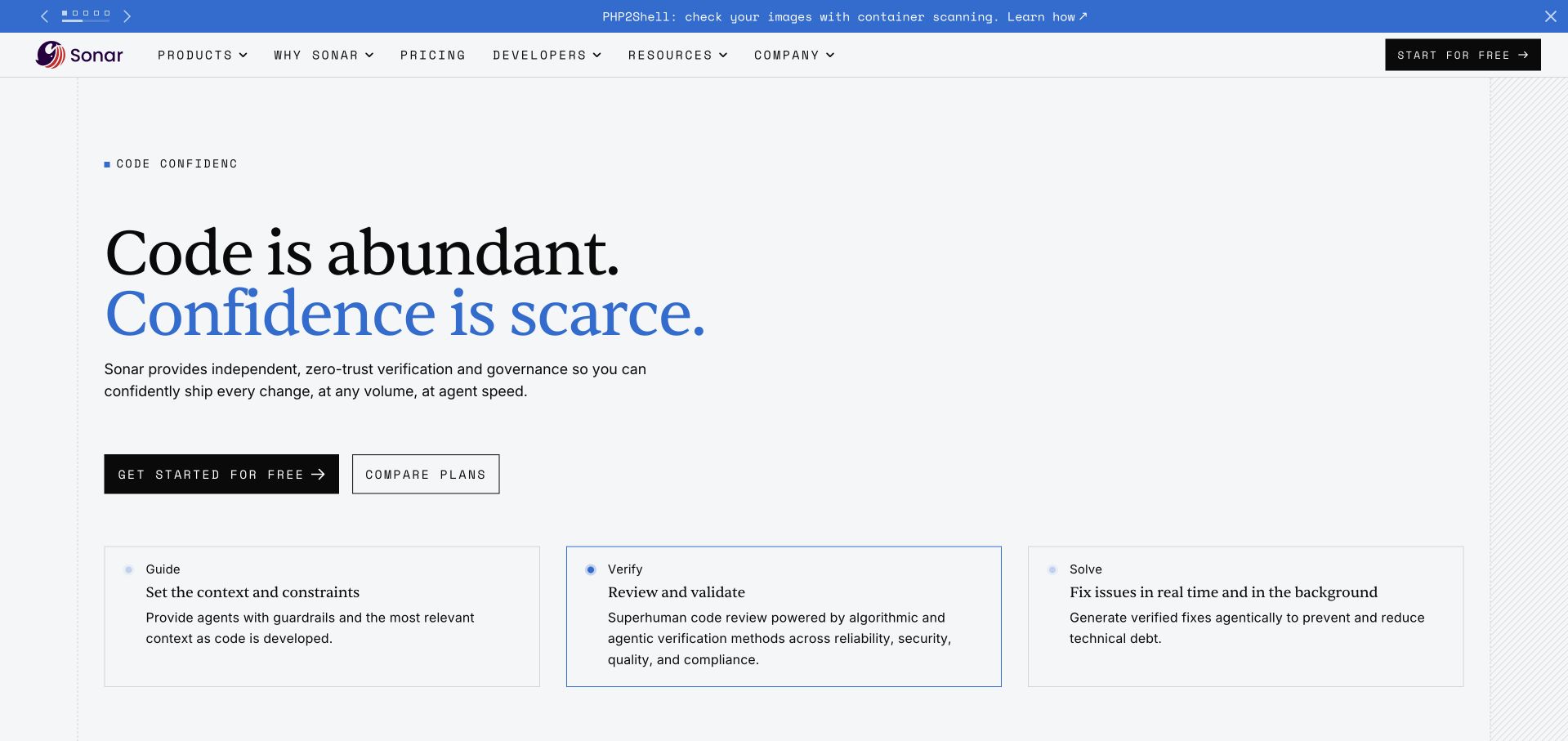
Sonar contrasts abundant code with the need for confidence, then organizes its product story into guidance, verification and repair stages. A light background and blue accent make those stages easier to scan than a dense dashboard. Trial and plan-comparison routes offer different evaluation paths. The Java source concerns components of SonarQube’s server project; it does not establish the runtime of the public marketing page or guarantee the correctness of every code review or suggested change.
What you can learn
Explain where a quality tool enters the development workflow and what a person still needs to decide. Dividing guidance, review and repair can make a broad platform more understandable, provided the boundaries are real. Claims about confidence should lead toward supported rules, coverage and review practices rather than imply automatic correctness.
Pros
The staged explanation makes a broad quality proposition easier to relate to actual development work.
Separate trial and comparison actions support both experimentation and a more deliberate buying evaluation.
Cons & considerations
Broad trust language needs specific evidence about what is checked and what remains outside the tool’s scope.
The opening cannot establish false-positive behavior, repository suitability or the quality of a particular recommended fix.
Platform source: Official Java engineering or project evidence. Java components of the SonarQube server. The cited engineering, project or customer source establishes only the named language association. It does not establish the marketing page runtime, every company system, current deployment continuity or independent performance results. Platform evidence is separate from the direct website screenshot and is not a complete current infrastructure audit.
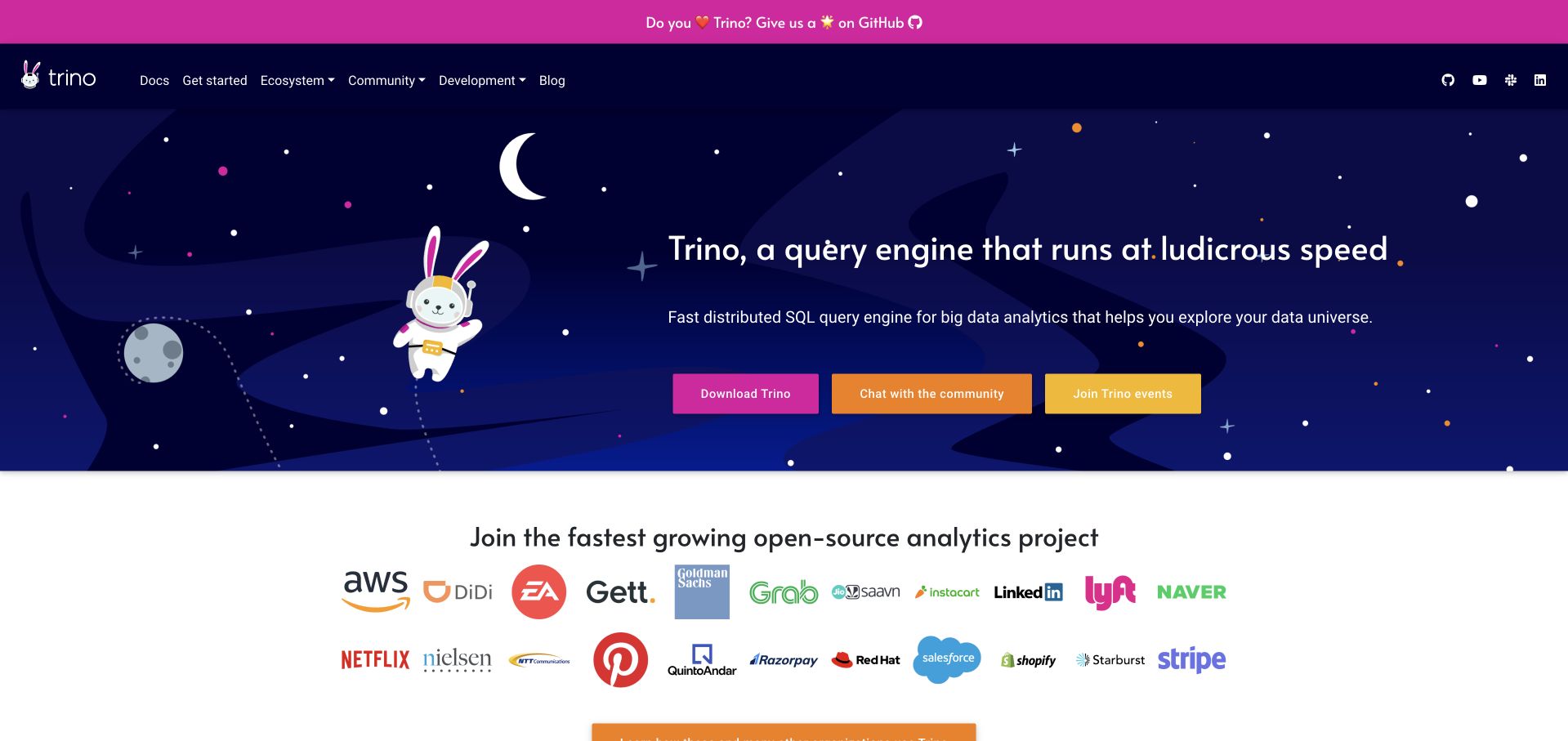
Trino’s space-themed opening combines a recognizable mascot with a direct distributed-query explanation. Download, community and event actions give readers several ways to continue, while a logo row introduces wider adoption context below. The playful environment makes an infrastructure subject approachable without entirely replacing its technical category. The official project establishes a Java SQL query-engine implementation; the public page does not prove the language of connected data systems or independently validate the performance implications of its introductory wording.
What you can learn
A memorable project identity can make a difficult infrastructure category less intimidating, but preserve a precise explanation of the task. Put the first technical step beside the community route. Adoption logos should lead to appropriately scoped context rather than imply identical workloads, configurations or results across organizations.
Pros
The recognizable mascot and visual theme make the project easier to distinguish from generic data-platform marketing.
Download and community actions acknowledge both practical implementation and the need for shared learning.
Cons & considerations
Several brightly colored actions can compete before the reader chooses the most relevant first task.
Speed-oriented language requires workload-specific testing and should not be read as a guarantee for every query.
Platform source: Official Java engineering or project evidence. Java distributed SQL query-engine implementation. The cited engineering, project or customer source establishes only the named language association. It does not establish the marketing page runtime, every company system, current deployment continuity or independent performance results. Platform evidence is separate from the direct website screenshot and is not a complete current infrastructure audit.
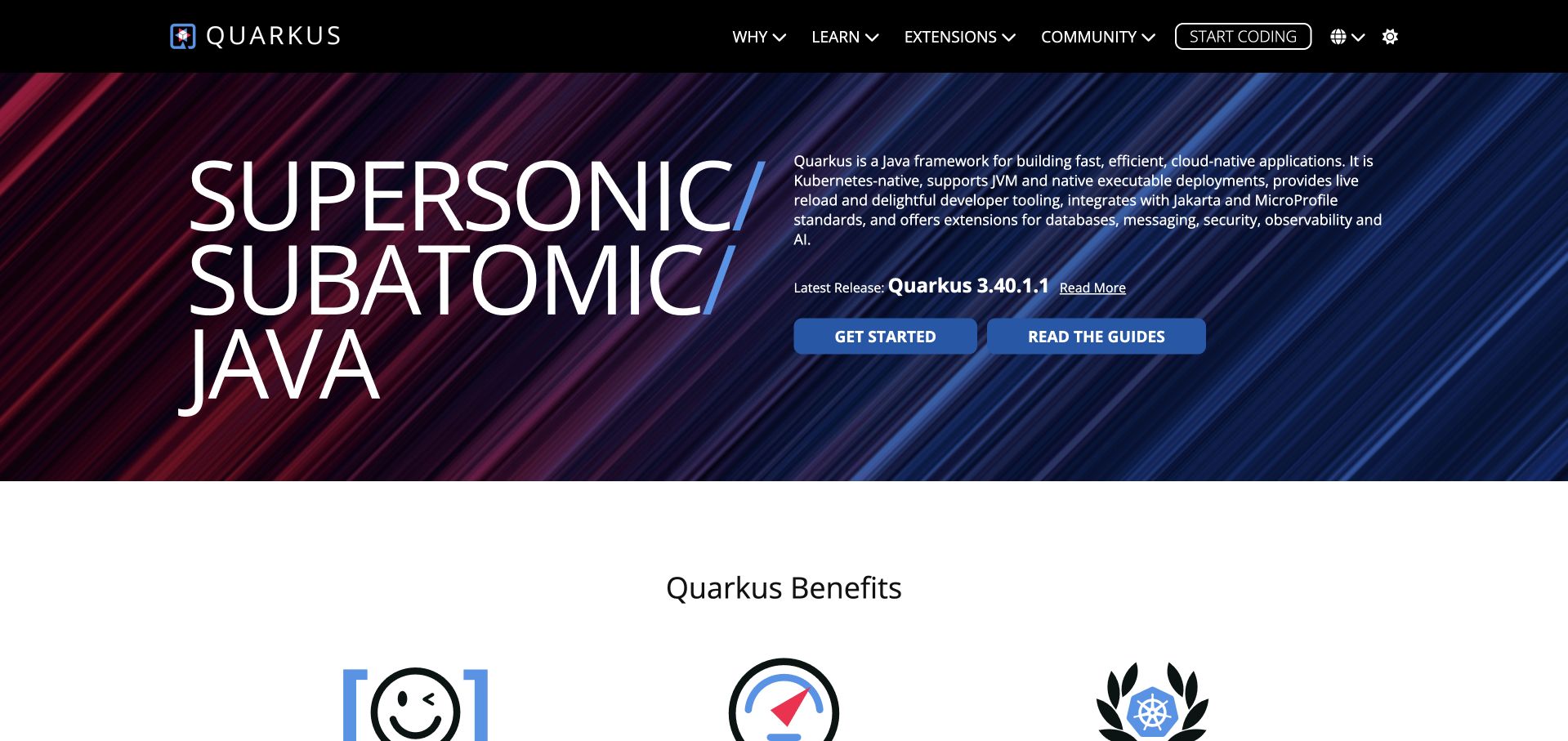
Quarkus gives its opening a dramatic diagonal color treatment and a very large Java-oriented identity. A compact explanatory paragraph beside it names the application-framework role, with starting and guide actions directly below. Benefits begin in a separate light section, creating a clear transition from brand statement to evaluation. The official project establishes the Java framework and its JVM or native deployment context; the marketing presentation does not establish universal startup, memory or throughput results for an application.
What you can learn
Let an expressive framework identity attract attention, but place a precise definition next to it. Developers need to distinguish the language, framework, packaging choice and deployment environment. A deployment-oriented claim becomes useful when the guide explains the tradeoffs and provides a realistic testing route rather than a borrowed benchmark.
Pros
The explanatory paragraph supplies a concrete framework category beside the more expressive introductory statement.
Starting and guide actions provide practical routes before the broader benefits section begins.
Cons & considerations
The dramatic headline and background can overshadow smaller explanatory text at some screen sizes.
Native and JVM deployment options require application-specific evaluation; their tradeoffs are not resolved by the hero’s positioning.
Platform source: Official Java engineering or project evidence. Java application framework with JVM and native deployment options. The cited engineering, project or customer source establishes only the named language association. It does not establish the marketing page runtime, every company system, current deployment continuity or independent performance results. Platform evidence is separate from the direct website screenshot and is not a complete current infrastructure audit.
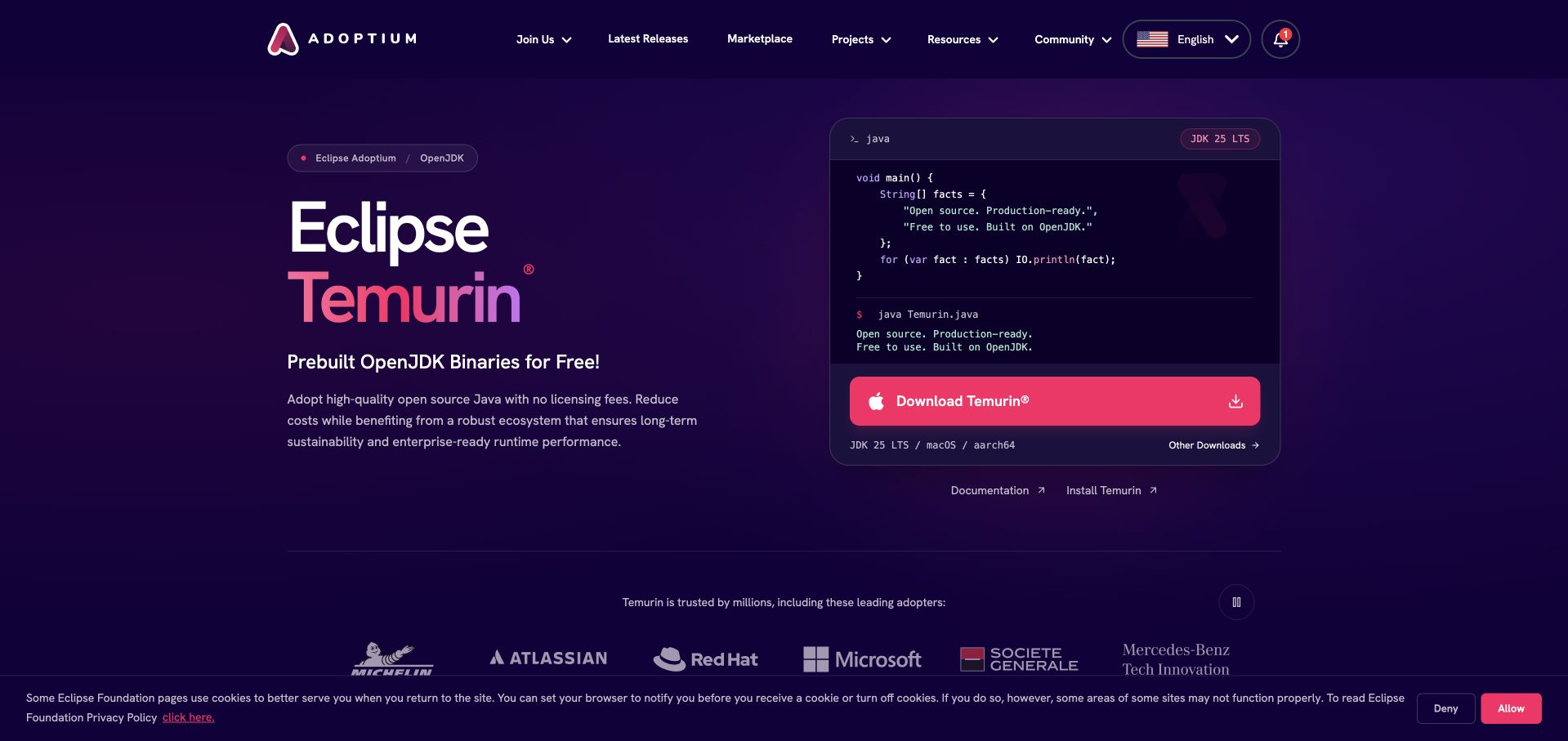
Eclipse Adoptium’s dark opening presents Temurin beside a compact code-style panel and a prominent download control. Platform and architecture details sit near the action, making the first decision more concrete than a generic software-download button. The broader project and resource navigation remains available for readers evaluating support and provenance. The official Temurin page establishes an OpenJDK distribution; it is not evidence that this public website or every application using the runtime has the same implementation or support arrangement.
What you can learn
Make the selected artifact and platform visible before a download begins. Runtime users need a clear distinction between a project, a distribution, a version and any commercial support. A polished download interface should lead toward compatibility and release information rather than encouraging people to select solely by the most prominent button.
Pros
Platform context near the download action helps make a technically important choice more explicit.
The project navigation provides routes beyond the immediate artifact for readers evaluating the wider ecosystem.
Cons & considerations
Automatic platform selection still needs an obvious way to choose another architecture or target environment.
A short distribution overview cannot establish compatibility, update policy or support terms for a particular application.
Platform source: Official Java engineering or project evidence. Eclipse Temurin OpenJDK runtime distribution. The cited engineering, project or customer source establishes only the named language association. It does not establish the marketing page runtime, every company system, current deployment continuity or independent performance results. Platform evidence is separate from the direct website screenshot and is not a complete current infrastructure audit.
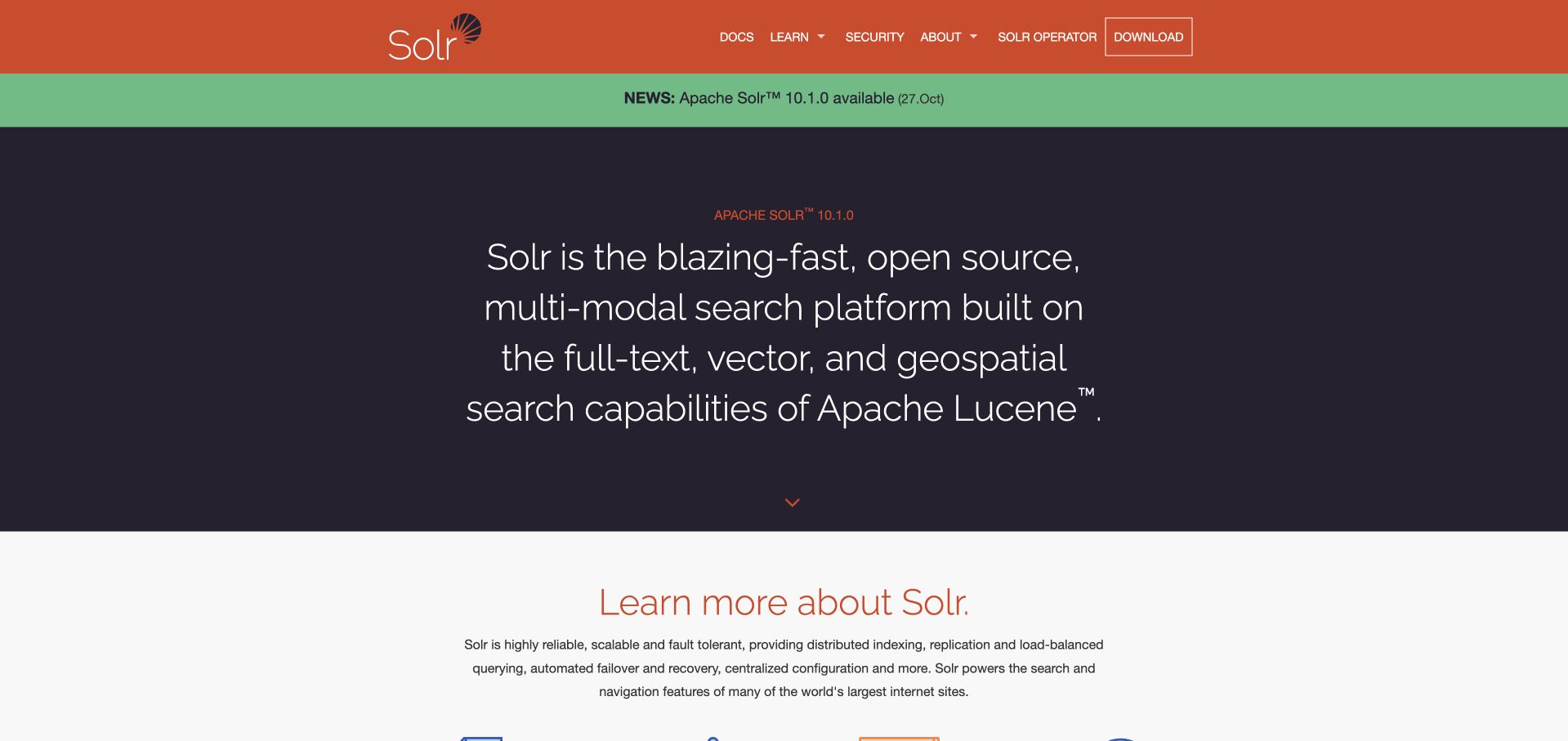
Apache Solr pairs orange navigation with a dark panel naming its search capabilities. A release announcement remains above the explanation, while a lighter section begins a more detailed introduction. The page gives the project a clear hierarchy without turning it into a commercial signup flow. The official source establishes its Java search-platform implementation; that does not identify the runtime of this documentation site or the complete architecture of applications using Solr.
What you can learn
State the infrastructure category and the task it supports before introducing the project’s breadth. A useful search-platform introduction should lead toward indexing, querying and operation as distinct areas of work. Release visibility is helpful, but readers also need guidance about compatibility, upgrades and the specific features their deployment will actually use.
Pros
The strong transition from dark introduction to light explanation makes the page’s reading sequence easy to recognize.
A visible release announcement connects the overview to maintained software without replacing the core definition.
Cons & considerations
Several search categories in one sentence may still require examples for readers unfamiliar with the terminology.
The overview cannot establish relevance quality, resource requirements or operational suitability for an individual index.
Platform source: Official Java engineering or project evidence. Java search-platform implementation. The cited engineering, project or customer source establishes only the named language association. It does not establish the marketing page runtime, every company system, current deployment continuity or independent performance results. Platform evidence is separate from the direct website screenshot and is not a complete current infrastructure audit.
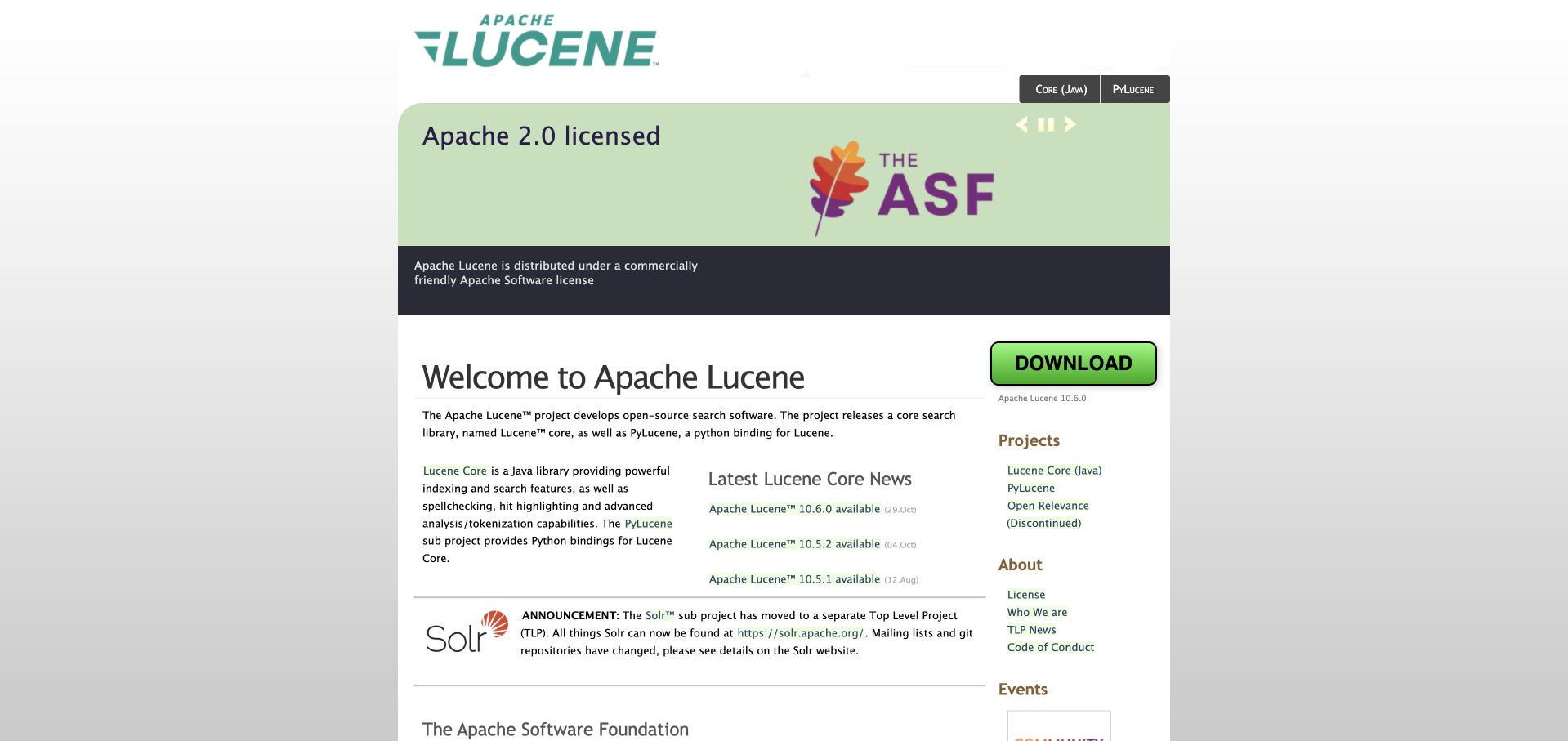
Apache Lucene’s compact homepage presents a project introduction, release news and a direct download route within a narrow traditional layout. Core Java and PyLucene links make two related entry points visible, while the main text identifies a library rather than a hosted search product. This is useful context for readers who might otherwise confuse related names in the search ecosystem. The official source establishes the Java library implementation; it does not mean a finished application’s public website runs on Java.
What you can learn
Make the level of abstraction explicit. A search library, a search server and a hosted service require different integration and operating work. A project homepage should help the reader understand which one they are choosing, then connect installation and release information to the appropriate reference material.
Pros
The introduction distinguishes the library role instead of presenting every search-related capability as a complete managed service.
Release news and download navigation are easy to locate in a compact reference-oriented page.
Cons & considerations
The narrow layout and small text leave limited room for approachable demonstrations or visual learning.
A library-level introduction cannot establish the quality, indexing behavior or accessibility of an application built around it.
Platform source: Official Java engineering or project evidence. Java search-library implementation. The cited engineering, project or customer source establishes only the named language association. It does not establish the marketing page runtime, every company system, current deployment continuity or independent performance results. Platform evidence is separate from the direct website screenshot and is not a complete current infrastructure audit.
Neo4j’s dark homepage uses a network of bright connected points beside a large knowledge-oriented statement. A short starting action and a separate explanatory route give the visual concept somewhere practical to lead. Customer logos below add broader context without needing another large product illustration. The official source establishes Java in the graph-database core; the network imagery does not prove the public page’s runtime, the architecture of every product or the quality of an application’s resulting answers.
What you can learn
Use a conceptual visual to orient a reader, then explain the data model and the task in concrete terms. A graph image is not a schema or an implementation plan. Connect the introduction to representative queries, integration requirements and operational choices before asking a team to choose an architecture.
Pros
The connected-point visual gives an abstract relationship-oriented data model an immediately recognizable motif.
Starting and explanatory actions offer different depths of engagement beneath the large brand statement.
Cons & considerations
A broad knowledge-and-AI proposition needs specific boundaries around database, retrieval and application responsibilities.
The captured consent panel overlaps the customer context and adds another layer to the opening.
Visible tech stack
Earlier / documented evidence
Java
Platform source: Official Java engineering or project evidence. Java graph-database core project. The cited engineering, project or customer source establishes only the named language association. It does not establish the marketing page runtime, every company system, current deployment continuity or independent performance results. Platform evidence is separate from the direct website screenshot and is not a complete current infrastructure audit.
Kegan has 15+ years of experience working with small businesses, Fortune 500 companies, and everything in between. No development job is too big or too small: he brings the same hands-on attention to a focused improvement, a complete website, or a custom application.
For Java projects, he can help with content architecture, custom functionality, system integrations, testing, and maintainable handover. He works directly with clients on scope, design, implementation, testing, and handover, with an emphasis on clear communication and a system that remains practical to maintain after launch.
Show 3 other Java developersHide other Java developers
Choose an application boundary rather than a brand-sized stack
A conventional service or business application
Start with authentication, authorization, data ownership and the actual work performed by a request. Compare an established framework with a smaller implementation against those needs. Keep the browser interface and publishing workflow as deliberate choices rather than assuming a Java backend requires one particular frontend.
A maintenance or modernization project
Inventory the existing runtime, framework, dependencies, integrations and operational assumptions before planning a migration. Write compatibility tests around important behavior. A supported upgrade and a bounded refactor may address the problem more safely than a complete rewrite; make the tradeoff explicit instead of treating modernization as an aesthetic objective.
An infrastructure product used by the website
Search, identity, query and automation tools in this collection are not interchangeable application frameworks. Evaluate each product’s actual role, interfaces and operating needs. A Java-based service can support a site whose public content is published elsewhere, and its implementation language does not transfer to every connected system.
From references to requirements
Plan compatibility, security and handover together
Capture real behavior before changing code
List the user journeys, integration messages and scheduled work that must keep functioning. Include invalid data, repeated operations and uncertain external outcomes. Document which behavior is contractual, which is a known defect and which the project is intentionally changing so tests do not accidentally preserve or remove the wrong thing.
Review application-level security decisions
Use the official security material as a reference path, but identify the application’s actual permission checks, secret ownership and data exposure. A cryptography API or identity dependency cannot decide the business rules. Test denied access and safe error reporting alongside the successful workflow.
Choose compatible runtime and dependency versions during implementation, then verify a clean build and deployment in a suitable test environment. Include resource limits, diagnostics, database changes and rollback. The handover should explain how the next maintainer updates the service and recognizes a failed release without relying on undocumented local setup.
A useful handover demonstration
Ask the actual team to carry out its routine job: publish a realistic update, correct a mistake, preview a narrow screen, and identify who owns an integration failure. For a library or frontend framework, also ask who maintains the content source and deployment. A polished screenshot does not answer those operational questions.
Beyond the screenshot
Java application and modernization checklist
Name the application responsibility and data owner.
Separate public design from the documented Java workload.
Inventory runtime, distribution and framework choices.
Choose compatible supported dependencies during implementation.
Record current behavior and intentional changes.
Test authorization and invalid-input paths.
Plan external timeouts and repeated operations.
Make diagnostics useful without exposing sensitive values.
Measure representative resource and response behavior.
Verify database and integration compatibility.
Rehearse clean deployment and rollback.
Assign maintenance, upgrades and handover ownership.
Test with real content, a keyboard, a small screen, slow or failed requests, and the people who will maintain the system. These are planning checks, not an accessibility, security, performance, or search-ranking certification.
Sources & editorial method
How this Java collection was reviewed
Twenty distinct public website source pages were independently reviewed for this collection. Screenshots are direct browser captures, with actual source URLs, dates, timestamps where known, dimensions and attribution retained. Existing source-page captures were inspected and reused without changing their original capture dates. New screenshots were captured November 9 UTC during the November 8, 2026 Pacific research session. Private account screens, transient blank shells and challenge pages were excluded. Official engineering, runtime, repository and project sources establish only the named language or workload association; historical and archived projects remain qualified. They do not establish current marketing-homepage runtime, a full corporate technology inventory, independent performance results or service-quality endorsement. Original reviews describe visible public design, not private account workflows. A separate bounded public source audit records additional supported technologies before publication. Images and trademarks belong to their owners.
Every image is an unmodified capture from the actual website, with its source and capture date. Some captures are reused from our shared catalog; their dates remain the original capture dates. None comes from a vendor gallery or a generated reconstruction. Moving imagery and live content can change.
Technology attribution uses public page assets or metadata, official platform documentation, or a cited first-party project case study. Documentary and framework-relationship evidence is identified where used; it is not a complete current backend inventory. A CMS image CDN alone does not establish a full CMS deployment. A library’s presence does not prove which individual controls use it, and a platform label does not establish AI authorship.
The composition notes, lessons, pros and tradeoffs are original editorial observations. We have not measured conversion, traffic, security, performance or accessibility conformance. Website owners retain their brands and imagery; these examples are not our client portfolio. Written, Edited and Curated are independent records, not dates advanced by a build. See our editorial standards or suggest a correction.
Questions worth asking
Java website development FAQs
Are these public homepages proven Java applications?
No. The examples have precisely scoped Java project, product or engineering evidence. A runtime distribution or internal service does not identify the technology behind a separate marketing or retail page.
Is Java the same thing as JavaScript?
No. They are different languages and ecosystems. A browser page containing JavaScript is not evidence of a Java backend. The guide uses official project or engineering sources for the Java association rather than inferring it from browser code.
Does an old corporate example make its framework a good new choice?
No. Check the project’s current support, maintenance and compatibility before using it. Historical cases remain useful context, but an archived framework is not presented here as a recommendation for a new application.
Does using a Java identity or search service make the entire website Java?
No. That service has a specific role and can support a website implemented with unrelated publishing and frontend technology. Name the individual component instead of assigning one language to every connected system.
What matters most in a Java modernization brief?
A clear reason for change, an inventory of existing behavior, compatible supported dependencies, representative tests and an operating plan. Include migration, diagnostics and rollback rather than defining success only as compiling on a new runtime.
Borrow a useful public design pattern and keep the Java evidence attached to the actual project it describes. The strongest application brief explains behavior, compatibility and ownership before selecting a framework.