Best .NET Websites of 2026 (20 Real-World Examples)
Twenty public properties with genuine screenshots, original design reviews and dated ASP.NET-family evidence; no inferred C# implementation or runtime version.
.NET websites can serve very different audiences: developers, museum visitors, families, customers and professional communities. The useful comparison is how each public page organizes information and makes a next step clear. These examples carry a qualified .NET association through retained ASP.NET-family response evidence, with the original observation and capture dates preserved.
A development platform does not prescribe a visual style. Start with the people using the site, the content they need and the tasks that require a dependable response. Then decide which application model, publishing system and integrations can support that work. A clear homepage is only the beginning: ownership, error handling and content maintenance determine whether the experience remains useful after launch.
The opening properties are Microsoft .NET, AXA UK, Carlsberg Group, the Rijksmuseum and the University of Chicago. Every example has a retained broad public-source audit with an ASP.NET response-header or recognized cookie-name signal. These observations support an ASP.NET-family relationship within the wider .NET ecosystem. They do not identify C#, ASP.NET Core, a runtime version, a specific CMS, private applications or every page operated by the organization.
Before the examples
What makes good .NET website development in 2026?
Start with the actual visitor task
Identify what someone needs to accomplish before deciding which components to build. A museum visitor looking for tickets, a parent finding a center and a developer installing a framework need different information and different recovery paths. Write those tasks in ordinary language. Give the highest-priority action a clear place, while preserving useful routes for people who are researching, returning or arriving from an unexpected page. The platform should support this structure rather than define it.
Separate the public website from connected applications
A single header can link to publishing, accounts, payments and specialist services that have different owners and technical foundations. Make those boundaries explicit in the project brief. Decide what information passes between systems, what the visitor sees during a handoff and who responds when a dependency fails. An ASP.NET-family marker on a public response is a limited observation. It should never be used to infer the implementation or protections of a linked private system.
Microsoft documents .NET as a broader application platform and ASP.NET Core as its web framework. Older ASP.NET applications also remain a distinct consideration. For a new project, examine the actual hosting, maintenance and integration requirements before selecting a model. For an existing site, establish its supported dependencies and migration constraints from the code and operating documentation. A familiar brand example or response header cannot make that decision for a different project.
These twenty reviews assess genuine earlier public-page captures, reused with their original dates and independent collection-specific analysis. The broad source audits are retained unchanged. Technology scope is limited to the dated public ASP.NET signals and their .NET-family relationship; private applications and current runtime versions were not inspected.
We start with five recognizable brands or organizations: Microsoft .NET, AXA UK, Carlsberg Group, Rijksmuseum, University of Chicago. Each attribution applies to the named website property, not every product or website belonging to its organization. This is a curated reading sequence, not a measured ranking.
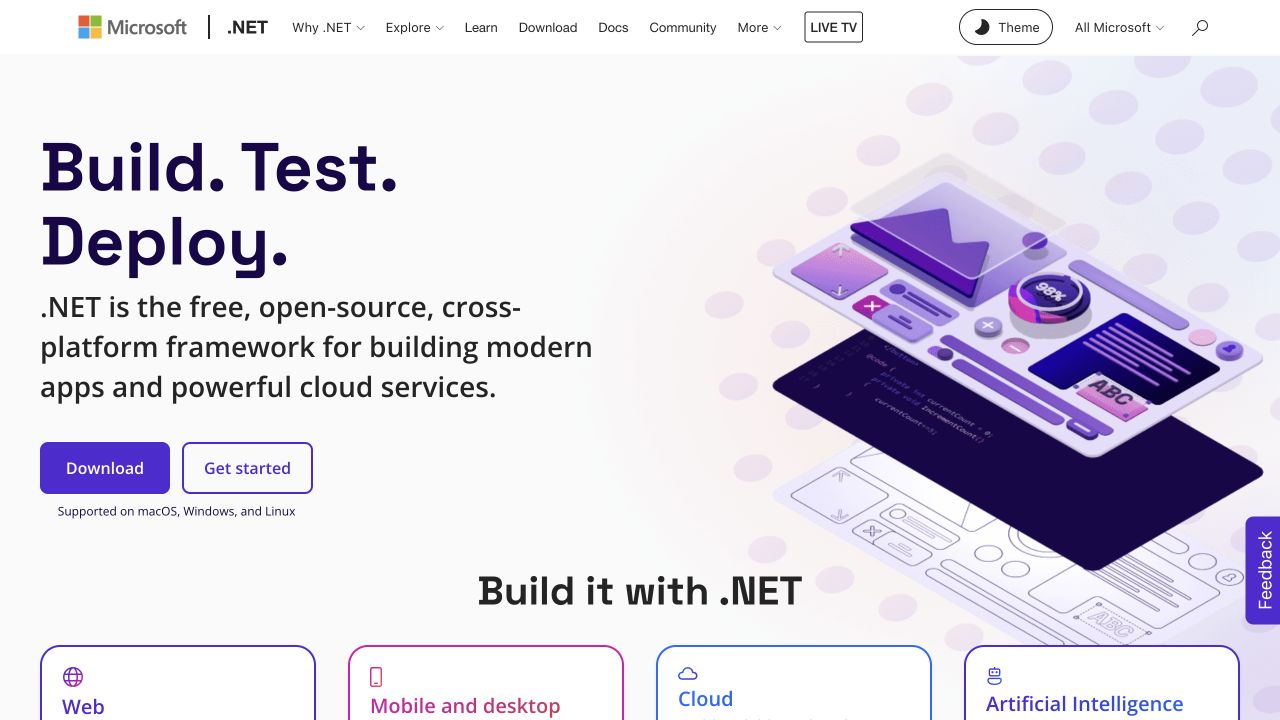
Microsoft’s .NET homepage turns a broad development platform into a small set of understandable decisions. The captured hero places a short action sequence above Download and Get started, while application categories begin immediately below. The purple illustration gives the otherwise abstract platform a recognizable visual identity without replacing its explanation. This is useful for a .NET project that must welcome both first-time evaluators and returning developers: the first screen gives those visitors different routes while keeping the main proposition legible.
What you can learn
Plan the first useful action for each audience before organizing the navigation by internal product names. A documentation library, installation flow and platform overview serve different needs. Their separation can remain clear even when they share a common header, design language and technical foundation.
Pros
Two distinct primary actions accommodate installation and guided learning without requiring a long preliminary explanation.
The beginning of the application categories shows the platform’s breadth through concrete destinations.
Cons & considerations
The dense header needs careful priority decisions when the same content is presented on smaller screens.
The retained ASP.NET response signal does not establish the implementation of every documentation or download destination.
Platform source: Dated public ASP.NET evidence; qualified .NET-family relationship. x-powered-by response header identifies ASP.NET on the exact public source response, observed 2026-11-03. This is a dated ASP.NET-family association within the .NET ecosystem, not proof of C#, ASP.NET Core, a runtime version, a specific CMS, private applications or other properties. Public response identifiers can be indirect; no complete backend inventory is claimed. Platform evidence is separate from the direct website screenshot and is not a complete current infrastructure audit.
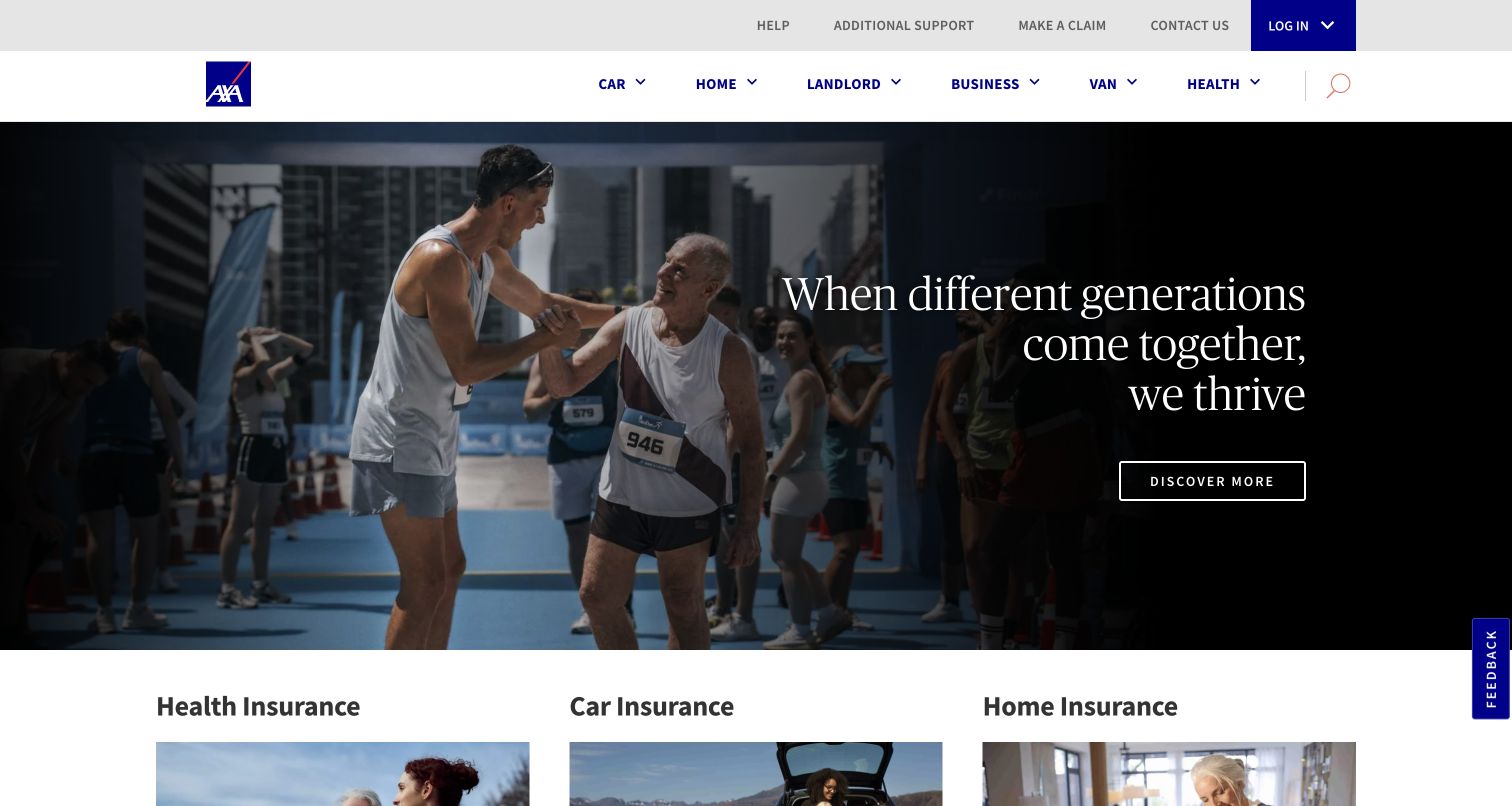
AXA UK uses a two-level header to separate service support from insurance categories. Help, claims and account access sit above the product navigation, so an existing customer does not have to work through the campaign message to find assistance. The captured hero supplies a human story, with health, car and home categories visible below it. The useful .NET planning reference is the separation of public discovery and returning-customer tasks, without assumptions about linked private systems.
What you can learn
Map the journeys of existing and prospective customers separately. Shared navigation should make both routes visible, but each destination needs its own information, validation and ownership. An ASP.NET-family signal on the public homepage is only evidence about that sampled response; it cannot identify a claims system or customer account backend.
Pros
Help and claims remain visible independently of the rotating or changing promotional material.
Product categories use familiar terms that reduce the need to understand the company’s organization.
Cons & considerations
The large campaign panel postpones detailed product comparison until visitors choose a category or scroll.
A recognized cookie name provides qualified platform-family evidence, not a verified runtime version or programming language.
Platform source: Dated public ASP.NET evidence; qualified .NET-family relationship. Recognized cookie name (values discarded) on the exact public source response, observed 2026-11-03. This is a dated ASP.NET-family association within the .NET ecosystem, not proof of C#, ASP.NET Core, a runtime version, a specific CMS, private applications or other properties. Public response identifiers can be indirect; no complete backend inventory is claimed. Platform evidence is separate from the direct website screenshot and is not a complete current infrastructure audit.
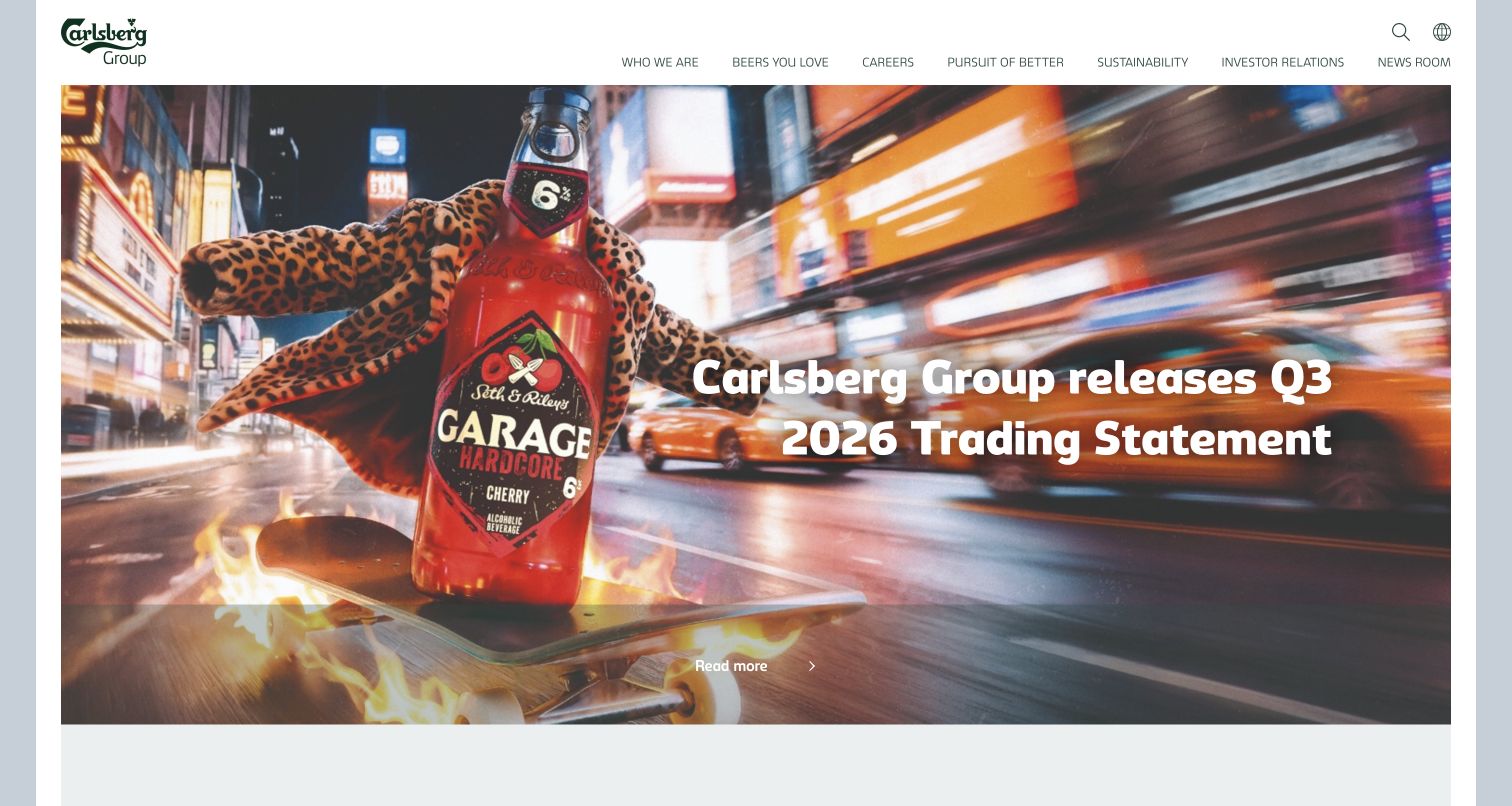
Carlsberg Group’s captured homepage combines a restrained corporate menu with a vivid product photograph and a prominent quarterly trading statement. The pairing gives a formal announcement visual energy without hiding its purpose behind a vague campaign headline. Careers, sustainability, investor relations and the newsroom remain separate navigation choices. A .NET publishing team can study how this first screen accommodates several institutional audiences while allowing the current editorial priority to occupy most of the available space.
What you can learn
Treat the homepage feature as an editorial slot with a clear owner, destination and expiry rule. Structured publishing should make it easy to replace a time-sensitive announcement without disturbing permanent audience routes. Preserve the distinction between corporate information and individual product websites when planning content permissions and integration boundaries.
Pros
The statement’s subject is explicit even though the presentation uses highly expressive product imagery.
Persistent audience links keep investor and employment tasks discoverable beside a changing homepage feature.
Cons & considerations
White text over a detailed photograph requires careful treatment across every permitted image crop.
The retained response-header evidence supports an ASP.NET-family association without establishing the specific CMS or .NET generation.
Platform source: Dated public ASP.NET evidence; qualified .NET-family relationship. x-powered-by response header identifies ASP.NET on the exact public source response, observed 2026-11-03. This is a dated ASP.NET-family association within the .NET ecosystem, not proof of C#, ASP.NET Core, a runtime version, a specific CMS, private applications or other properties. Public response identifiers can be indirect; no complete backend inventory is claimed. Platform evidence is separate from the direct website screenshot and is not a complete current infrastructure audit.
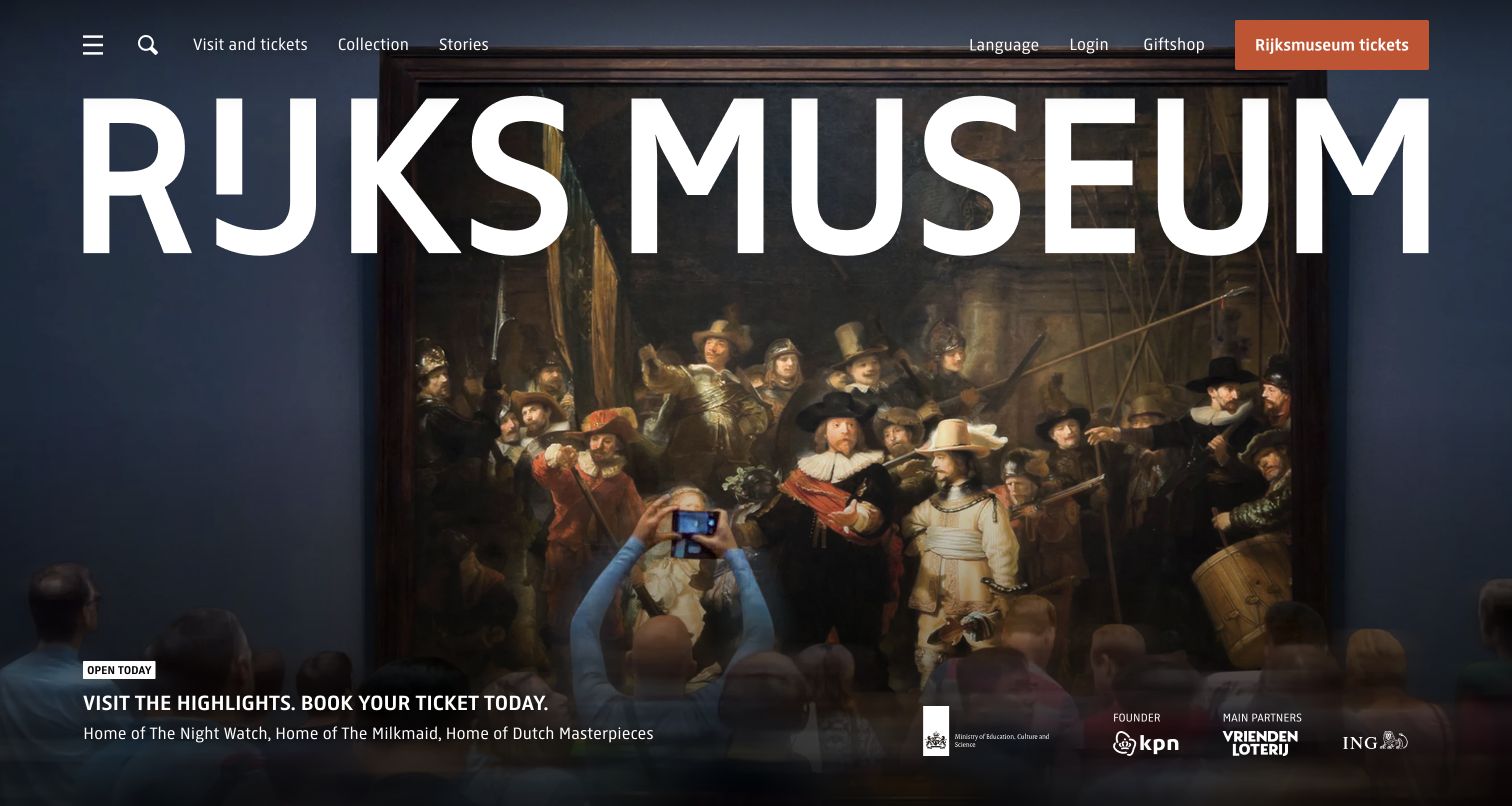
The Rijksmuseum homepage gives a major artwork nearly the whole opening screen, with the museum’s oversized wordmark supplying identity across the image. Ticket access remains a distinct colored button in the header, while collection and story links support visitors who are browsing remotely. The layout shows how a content-rich .NET-associated property can lead with its material and still expose a practical transaction route. The retained capture is a dated design reference, not a current exhibition or booking inventory.
What you can learn
Decide which essential visitor action must survive the most expressive page design. Keep that action recognizable and independently accessible, then let editorial imagery establish the character of the institution. Ticketing, collections and membership may require different systems even when the public site presents them as a coherent experience.
Pros
A visually distinct ticket button gives practical intent a clear route through a dramatic first screen.
Collection and story navigation supports online exploration alongside planning a physical visit.
Cons & considerations
Large lettering and image overlays need deliberate crop and contrast checks across content variations.
The public ASP.NET header does not verify the separate ticketing service or identify a language or runtime version.
Platform source: Dated public ASP.NET evidence; qualified .NET-family relationship. x-powered-by response header identifies ASP.NET on the exact public source response, observed 2026-11-03. This is a dated ASP.NET-family association within the .NET ecosystem, not proof of C#, ASP.NET Core, a runtime version, a specific CMS, private applications or other properties. Public response identifiers can be indirect; no complete backend inventory is claimed. Platform evidence is separate from the direct website screenshot and is not a complete current infrastructure audit.
The University of Chicago’s captured homepage surrounds a research-led hero with two layers of institutional navigation. Academics, research and admissions sit in the main row, while news, careers, visits and directory access occupy a slimmer utility layer. A laboratory scene gives the university’s positioning a concrete setting instead of relying only on a slogan. For a .NET-associated project, this shows how identity-led content can coexist with stable routes for visitors with specific tasks.
What you can learn
Keep broad institutional themes separate from practical shortcuts. A prospective student, researcher and staff member should not need the same route through the site. Define those audience needs in the content model and navigation before choosing interactive components or connecting departmental systems to a shared presentation layer.
Pros
The main navigation labels correspond to recognizable institutional functions rather than internal software terminology.
Utility links provide direct access to frequently needed information outside the hero’s editorial story.
Cons & considerations
Two navigation rows can become crowded when translations or additional departmental priorities are introduced.
The retained ASP.NET cookie signal applies to the public response and does not identify private university applications.
Platform source: Dated public ASP.NET evidence; qualified .NET-family relationship. Recognized cookie name (values discarded) on the exact public source response, observed 2026-11-03. This is a dated ASP.NET-family association within the .NET ecosystem, not proof of C#, ASP.NET Core, a runtime version, a specific CMS, private applications or other properties. Public response identifiers can be indirect; no complete backend inventory is claimed. Platform evidence is separate from the direct website screenshot and is not a complete current infrastructure audit.
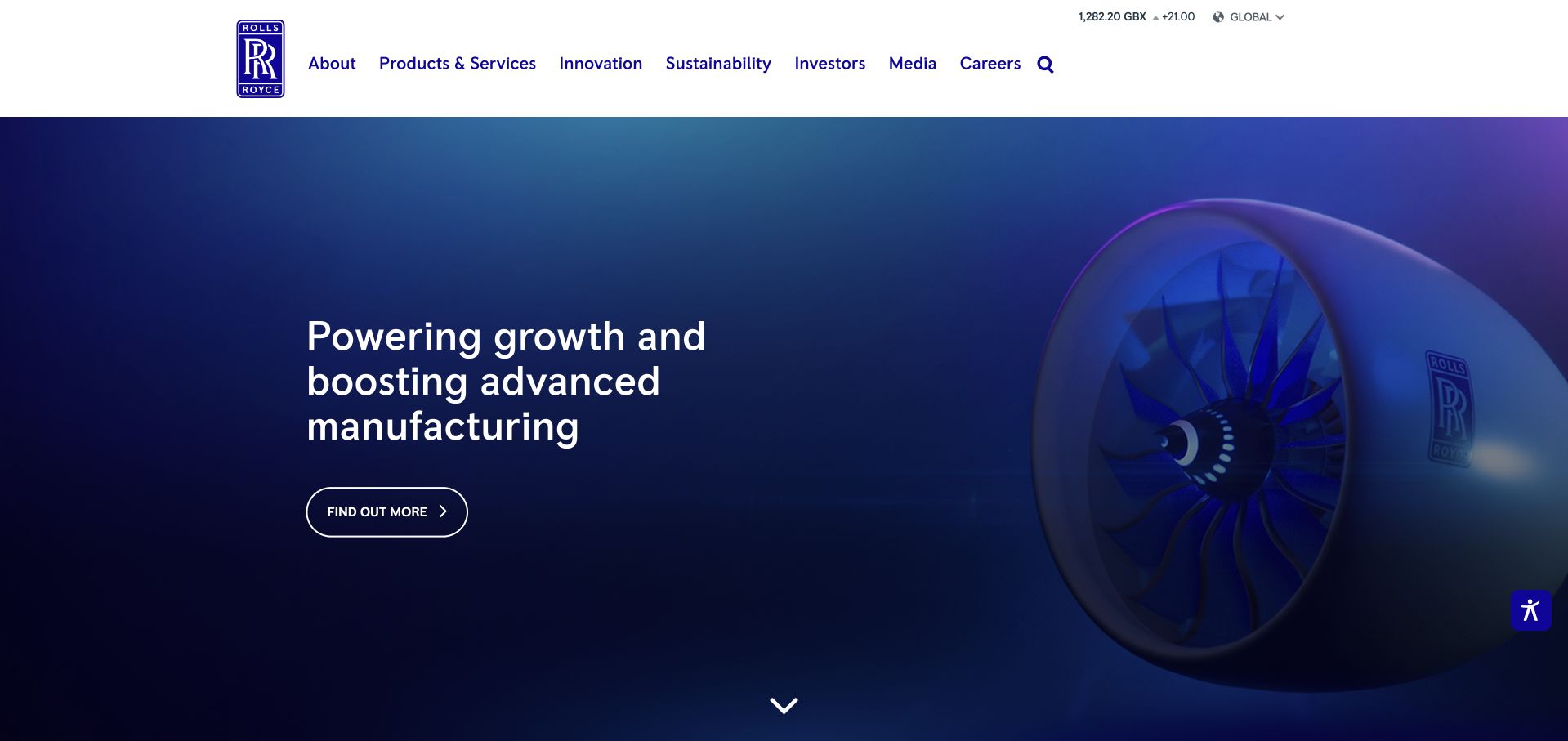
Rolls-Royce’s public homepage uses a large engine image and a brief manufacturing message to introduce an extensive industrial business. The dark blue treatment keeps the technical subject visually coherent with the brand, while the white header separates products, innovation, sustainability and investor information. The retained capture concerns the aerospace and power-systems company, not the similarly named motor-car website. The useful .NET planning lesson is the clear subject and division between commercial, technical and institutional information.
What you can learn
Use the opening image to establish the actual business being discussed, then give each audience a purposeful next destination. Technical depth can follow on dedicated pages. A large organization’s public site should not imply that its careers, investor or operational systems share one backend merely because their links appear together.
Pros
A single recognizable engineering subject gives the otherwise broad corporate message a concrete visual anchor.
The header separates product information from innovation, sustainability and investor material without competing hero buttons.
Cons & considerations
A general introductory statement still requires specific supporting material after the visitor chooses a destination.
The dated ASP.NET-family cookie observation does not establish the company’s internal systems or current runtime version.
Platform source: Dated public ASP.NET evidence; qualified .NET-family relationship. Recognized cookie name (values discarded) on the exact public source response, observed 2026-11-09. This is a dated ASP.NET-family association within the .NET ecosystem, not proof of C#, ASP.NET Core, a runtime version, a specific CMS, private applications or other properties. Public response identifiers can be indirect; no complete backend inventory is claimed. Platform evidence is separate from the direct website screenshot and is not a complete current infrastructure audit.
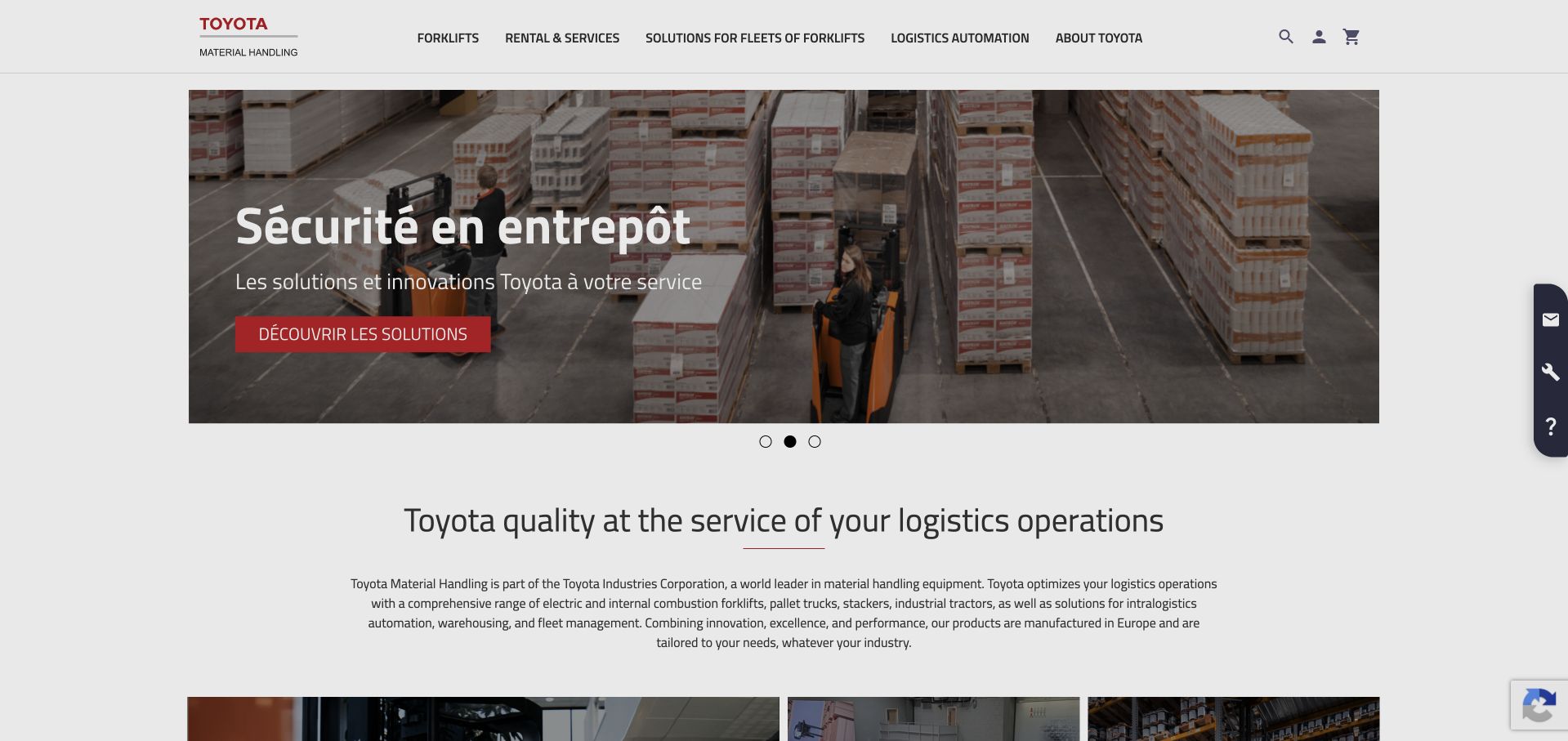
Toyota Material Handling France places a warehouse scene beneath navigation for forklifts, rental, fleet solutions and logistics automation. The photograph makes the equipment’s working environment clear, while the hero links to safety-related solutions rather than presenting an isolated machine on a blank background. A short company introduction follows the feature. For a .NET catalog, this connects structured product categories with the operational problems that prompt customers to investigate them.
What you can learn
Organize a technical catalog around both product families and the jobs customers are trying to accomplish. Keep those relationships explicit in the content model so a safety article, service page and product record can connect without duplicating descriptions. Country-specific language and service details also need clear ownership when a wider brand operates multiple sites.
Pros
The warehouse image gives immediate context for the equipment and associated services being introduced.
Distinct rental, fleet and automation links accommodate several stages of a business customer’s decision.
Cons & considerations
The captured mix of navigation and hero languages illustrates why localization needs review at the whole-page level.
The ASP.NET response header applies to this French public property, not every Toyota website or application.
Platform source: Dated public ASP.NET evidence; qualified .NET-family relationship. x-powered-by response header identifies ASP.NET on the exact public source response, observed 2026-11-09. This is a dated ASP.NET-family association within the .NET ecosystem, not proof of C#, ASP.NET Core, a runtime version, a specific CMS, private applications or other properties. Public response identifiers can be indirect; no complete backend inventory is claimed. Platform evidence is separate from the direct website screenshot and is not a complete current infrastructure audit.
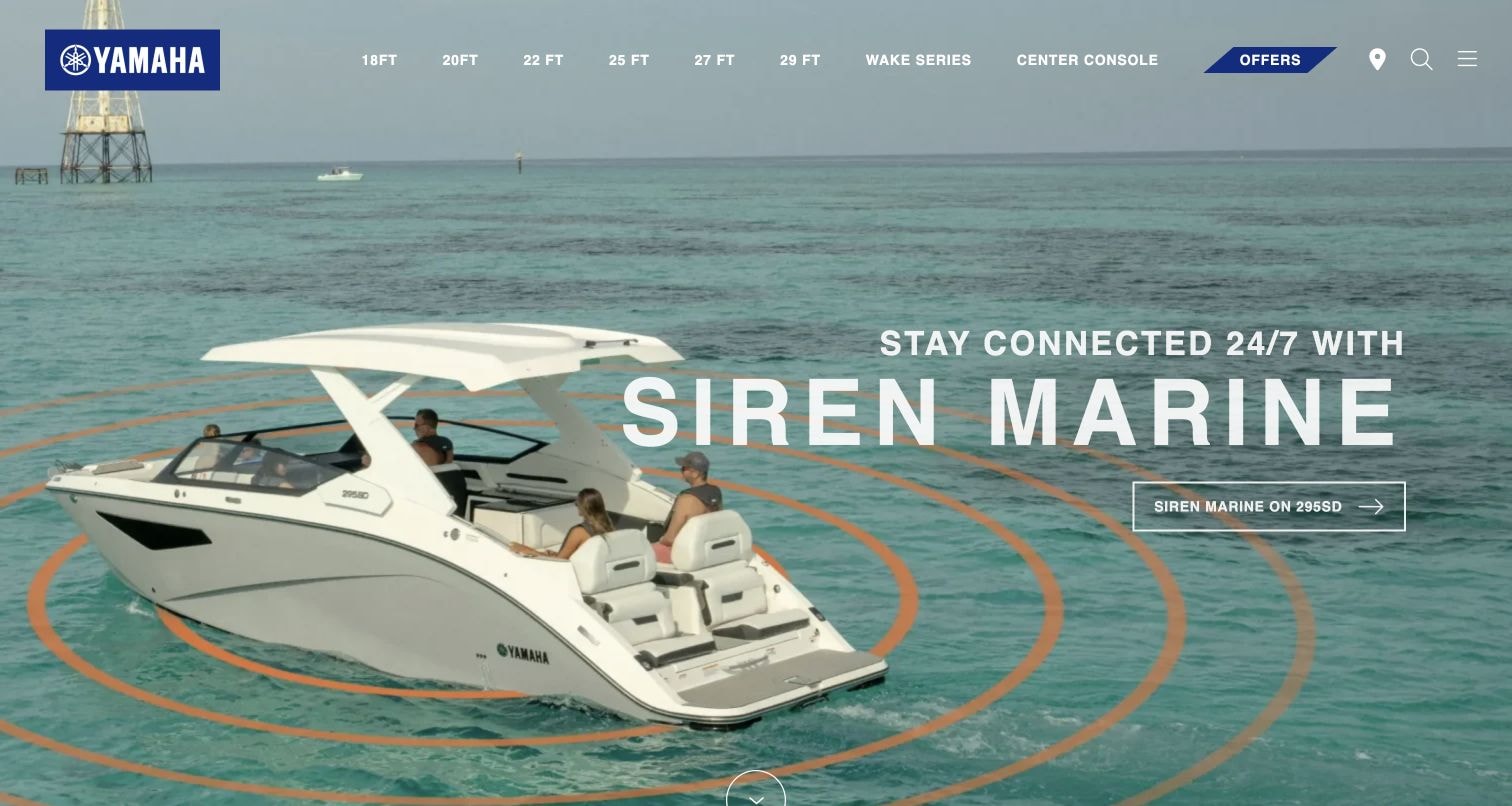
Yamaha Boats keeps model-length categories in the header above a full-width scene of a boat on the water. The captured promotion focuses on a named marine feature, with a specific model reference in its call to action. It gives the product atmosphere without abandoning a structured path into the range. Teams planning a .NET-associated catalog can study this relationship between emotionally engaging photography, a prominent product capability and navigation that reflects how prospective buyers compare available options.
What you can learn
Make catalog categories correspond to meaningful buying criteria and keep promotional features attached to the appropriate product records. A feature-led landing page needs a clear destination and accurate supporting details. It should not become an isolated campaign that leaves visitors uncertain which models include the capability or where to find current specifications.
Pros
Model-length navigation provides a concrete browsing structure directly above the promotional photograph.
The hero’s model-specific action connects the broad lifestyle image to a narrower product destination.
Cons & considerations
Detailed product comparisons are not visible in the captured first screen and need a well-organized continuation.
The retained ASP.NET header supports the pictured public property only, without proving its configuration or connected systems.
Platform source: Dated public ASP.NET evidence; qualified .NET-family relationship. x-powered-by response header identifies ASP.NET on the exact public source response, observed 2026-11-03. This is a dated ASP.NET-family association within the .NET ecosystem, not proof of C#, ASP.NET Core, a runtime version, a specific CMS, private applications or other properties. Public response identifiers can be indirect; no complete backend inventory is claimed. Platform evidence is separate from the direct website screenshot and is not a complete current infrastructure audit.
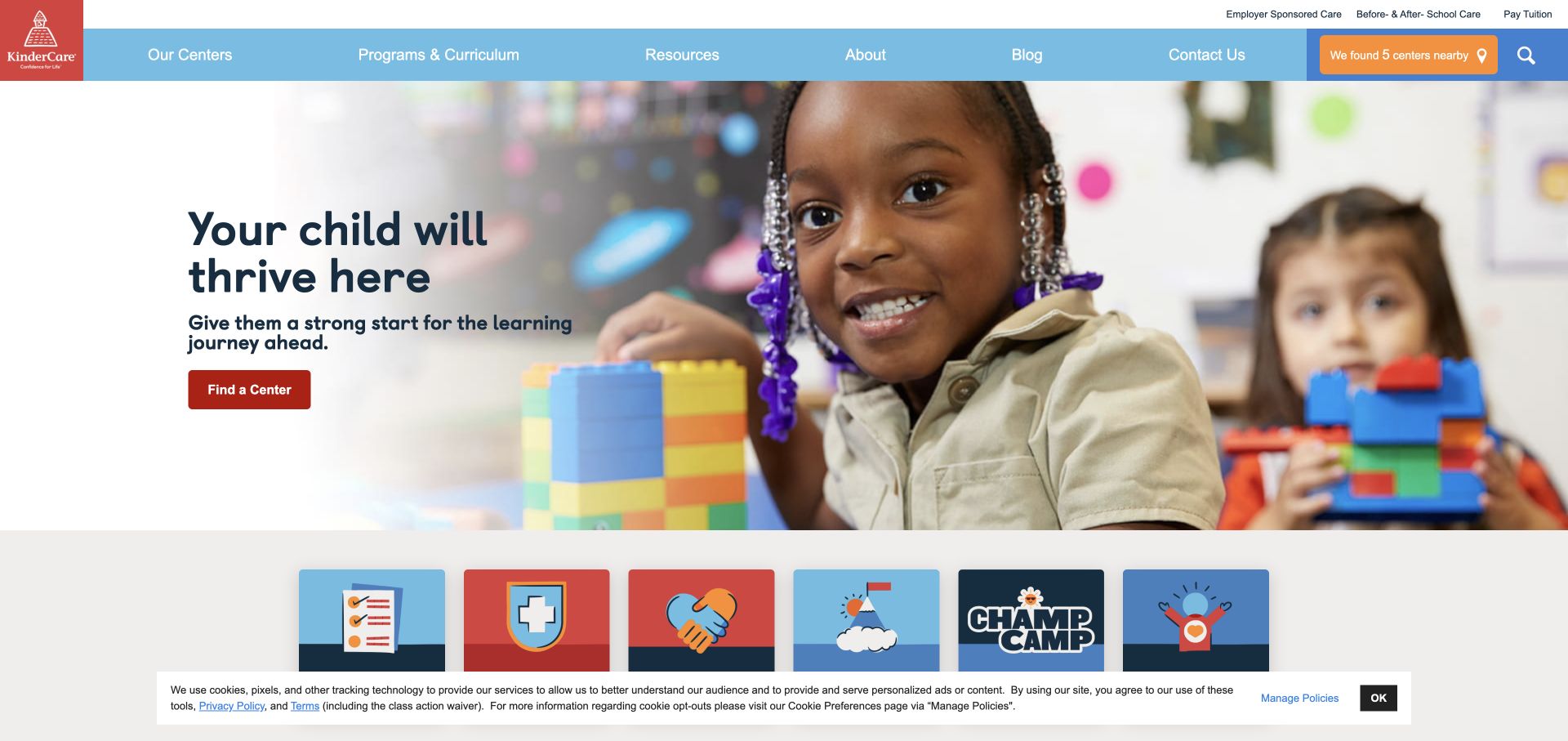
KinderCare combines a large classroom photograph with a short promise and a clear center-finding button. The header repeats the location-oriented task beside programs, resources and contact information, making the next step visible in more than one place. Smaller illustrated cards begin below the hero. This is a useful .NET-associated service reference because the national brand presentation quickly leads toward a local decision, while the navigation preserves routes for parents who first need information about the program or curriculum.
What you can learn
Plan how a visitor moves from a broad brand promise to an individual location record. Location content needs consistent fields, useful contact information and a clear update process. A reassuring homepage cannot compensate for stale center details or an unclear handoff when a family is ready to ask about availability.
Pros
The primary button states a concrete local task rather than a generic invitation to learn more.
Program and resource links allow research to continue before a visitor chooses a particular center.
Cons & considerations
The retained consent notice occupies the lower edge of the capture and competes with supporting content.
The public ASP.NET cookie-name signal does not verify enrollment, payment or other private service implementations.
Platform source: Dated public ASP.NET evidence; qualified .NET-family relationship. Recognized cookie name (values discarded) on the exact public source response, observed 2026-11-03. This is a dated ASP.NET-family association within the .NET ecosystem, not proof of C#, ASP.NET Core, a runtime version, a specific CMS, private applications or other properties. Public response identifiers can be indirect; no complete backend inventory is claimed. Platform evidence is separate from the direct website screenshot and is not a complete current infrastructure audit.
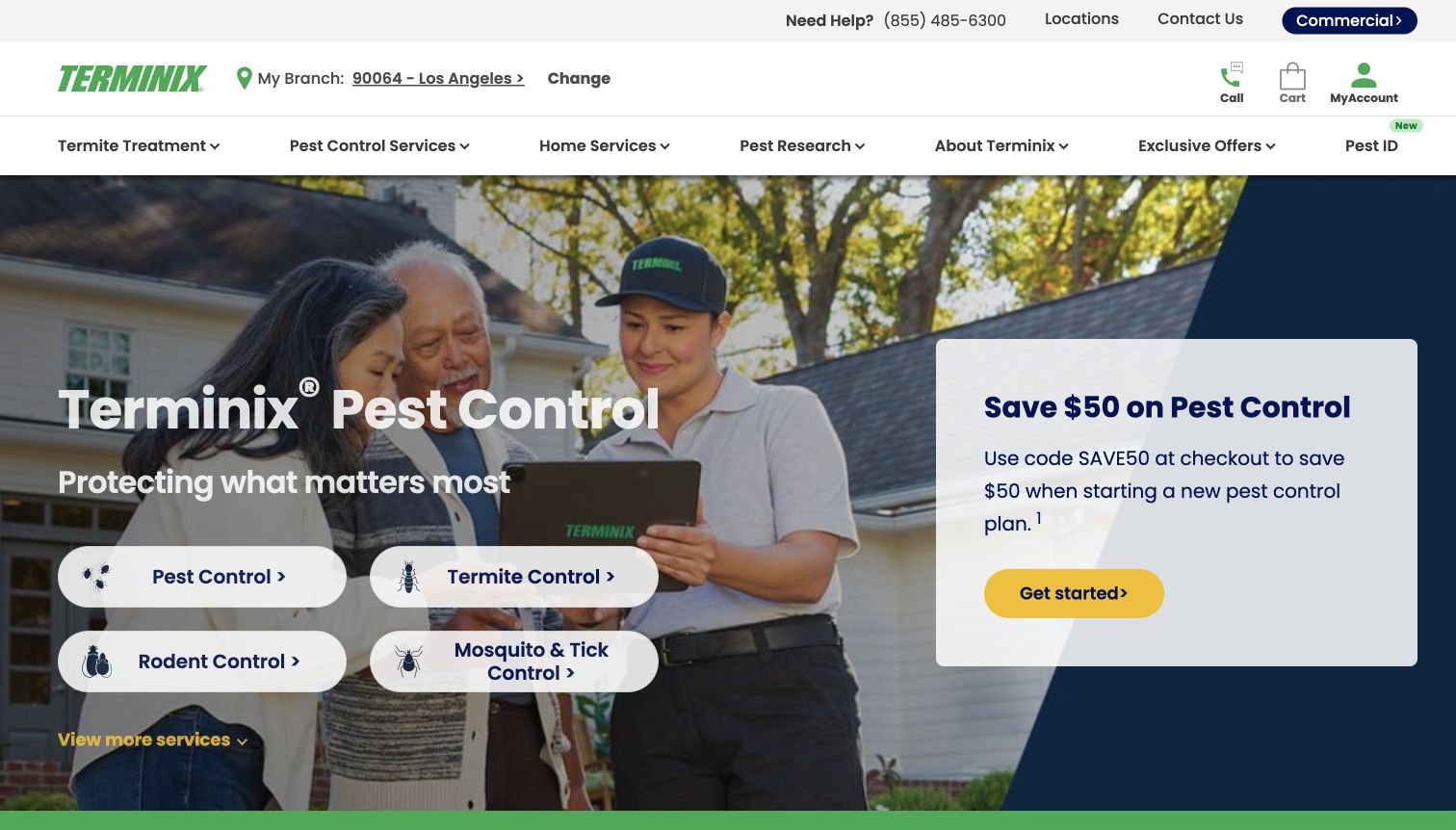
Terminix’s captured homepage gives common pest categories their own large buttons while showing the selected branch in the header. A separate promotional card sits beside the service introduction, and account, cart and contact tools remain above it. The page is useful for a .NET-associated service project because it presents both the customer’s immediate problem and the geographic context needed to route that problem. The saved offer is a dated design reference, not current pricing.
What you can learn
Keep service selection, location and promotional terms as separate content concerns. A visitor should understand which service they are choosing and which area will handle the request before entering a longer process. The application should also have an explicit fallback when the location cannot be resolved or a branch does not provide that service.
Pros
Large category buttons make common service needs easy to identify without reading a long introduction.
Visible branch context helps connect a national brand presentation with a local service destination.
Cons & considerations
Several competing actions and the offer panel increase the importance of a clear priority on smaller screens.
The retained ASP.NET cookie signal does not prove the implementation of the account or checkout destinations.
Platform source: Dated public ASP.NET evidence; qualified .NET-family relationship. Recognized cookie name (values discarded) on the exact public source response, observed 2026-11-03. This is a dated ASP.NET-family association within the .NET ecosystem, not proof of C#, ASP.NET Core, a runtime version, a specific CMS, private applications or other properties. Public response identifiers can be indirect; no complete backend inventory is claimed. Platform evidence is separate from the direct website screenshot and is not a complete current infrastructure audit.
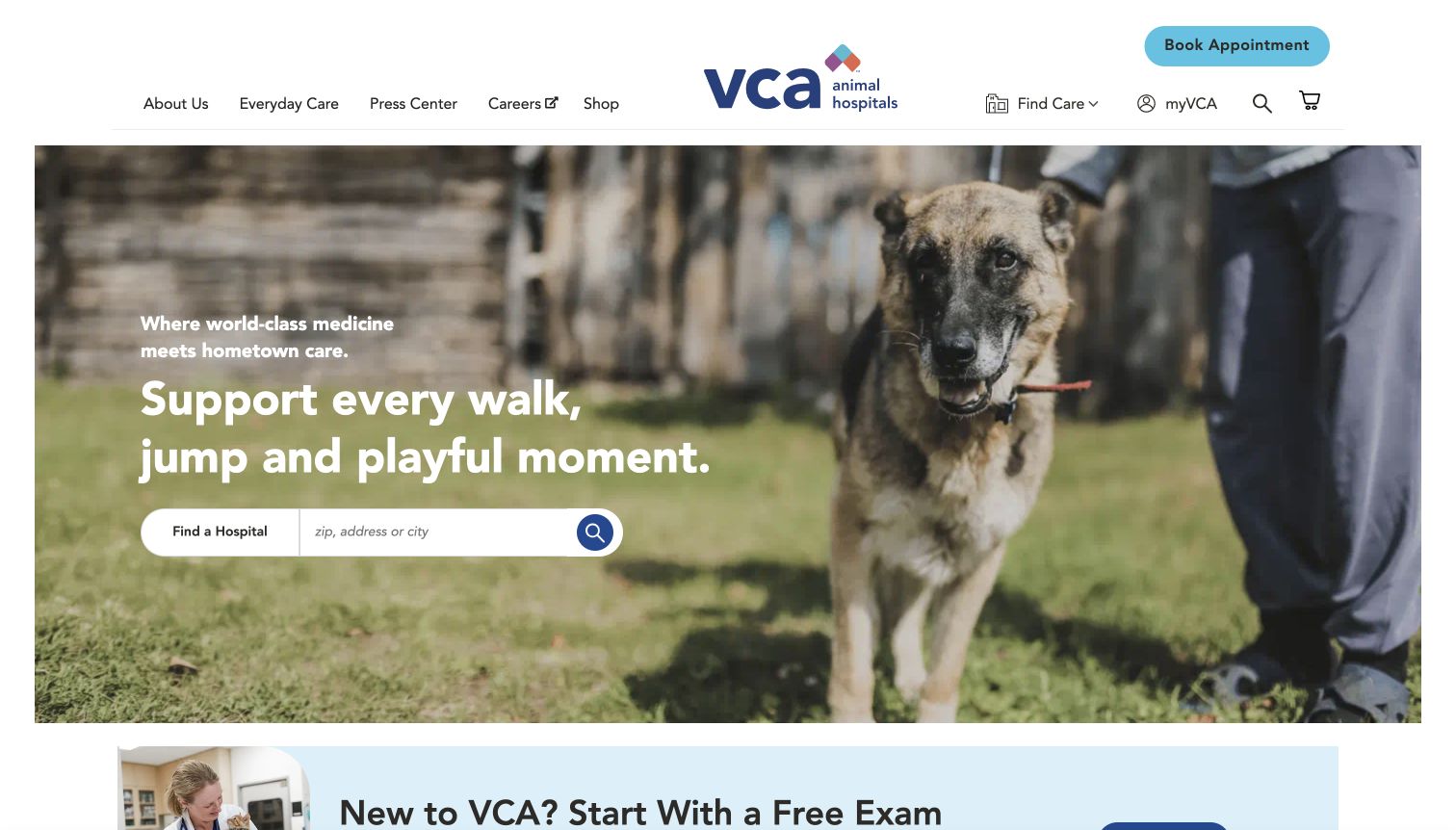
VCA Animal Hospitals places a location-search field inside a large photograph of a dog outdoors. The friendly visual tone sits alongside practical links for appointments, care search and account access, while the central logo keeps the identity clear. For a .NET-associated location network, the useful pattern is the connection between reassuring presentation and a specific search task. The public screenshot establishes the page’s visible design; it does not provide evidence about clinical systems, appointment availability or the quality of veterinary services.
What you can learn
Design the search entry and the location records as one journey. Make the accepted input clear, then ensure the results explain where each destination is and what service information is available. Sensitive or urgent tasks need clear escalation routes and should not depend on a broad marketing promise alone.
Pros
The location field is positioned within the main introduction rather than concealed behind a menu.
Appointment and account routes remain distinct from the page’s general explanation of everyday care.
Cons & considerations
The large photograph leaves detailed service distinctions for later steps in the visitor journey.
An ASP.NET-family cookie signal on this public page does not identify private care or account software.
Platform source: Dated public ASP.NET evidence; qualified .NET-family relationship. Recognized cookie name (values discarded) on the exact public source response, observed 2026-11-03. This is a dated ASP.NET-family association within the .NET ecosystem, not proof of C#, ASP.NET Core, a runtime version, a specific CMS, private applications or other properties. Public response identifiers can be indirect; no complete backend inventory is claimed. Platform evidence is separate from the direct website screenshot and is not a complete current infrastructure audit.
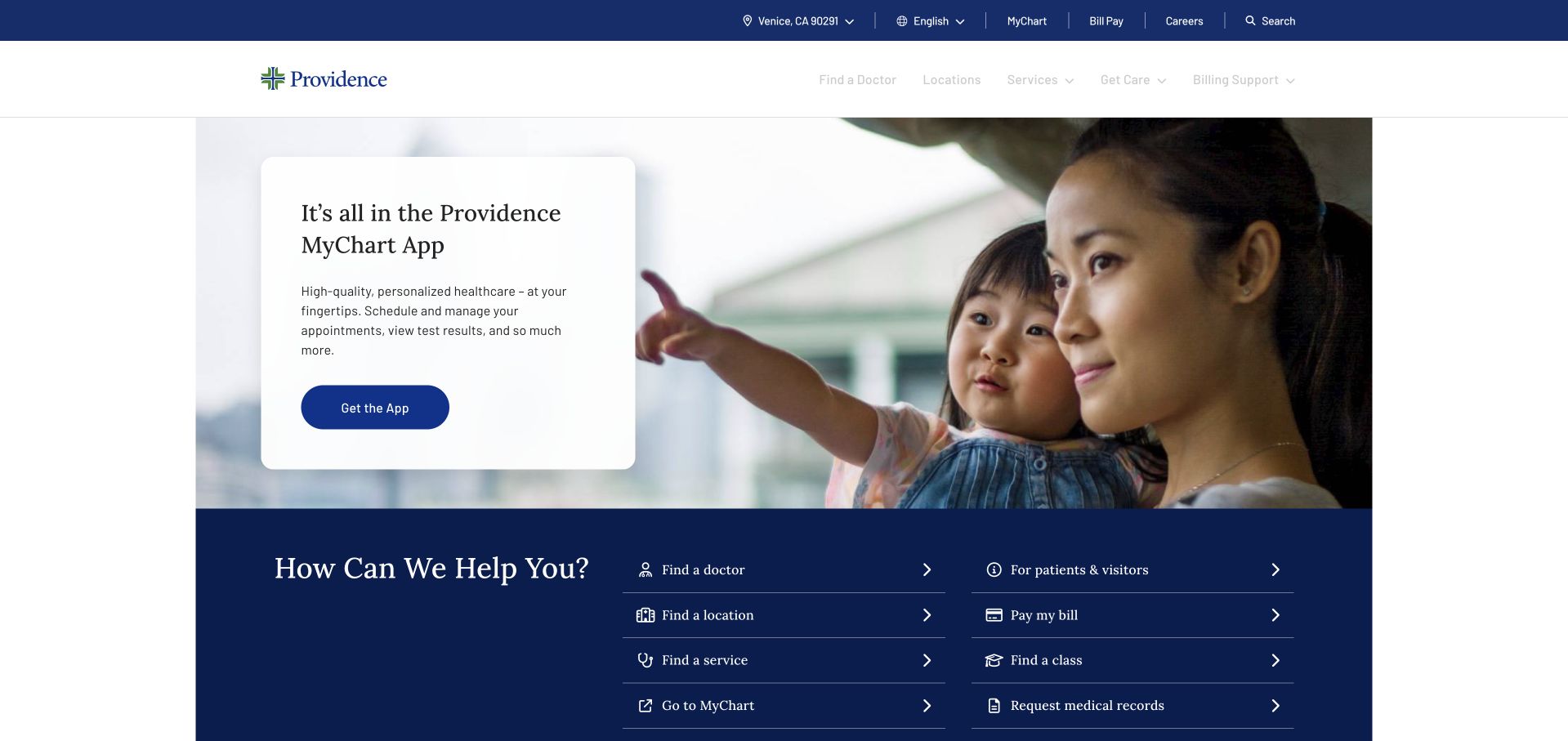
Providence’s captured homepage promotes its patient app in a white card against a family photograph, then immediately follows with a dark task directory. Doctor search, locations, billing and medical records are presented as separate choices. The transition gives the promotional story a bounded place while recognizing that many visitors arrive with a practical need. For a .NET-associated service website, this connects a changing campaign to stable routes without claiming knowledge of the linked private systems.
What you can learn
Maintain the important task directory independently of the campaign schedule. Every linked service needs a clear label, an accountable owner and an explanation of any move to another application. Public-page evidence cannot establish the technology, security or behavior of a patient portal simply because a prominent link points toward it.
Pros
A compact set of task links gives returning visitors a route beyond the current promotional message.
The contrasting directory section creates a clear boundary between storytelling and practical navigation.
Cons & considerations
The captured header labels are faint against white, an important consideration when applying this visual approach.
The retained ASP.NET cookie observation does not verify MyChart, billing or other private healthcare applications.
Platform source: Dated public ASP.NET evidence; qualified .NET-family relationship. Recognized cookie name (values discarded) on the exact public source response, observed 2026-11-09. This is a dated ASP.NET-family association within the .NET ecosystem, not proof of C#, ASP.NET Core, a runtime version, a specific CMS, private applications or other properties. Public response identifiers can be indirect; no complete backend inventory is claimed. Platform evidence is separate from the direct website screenshot and is not a complete current infrastructure audit.
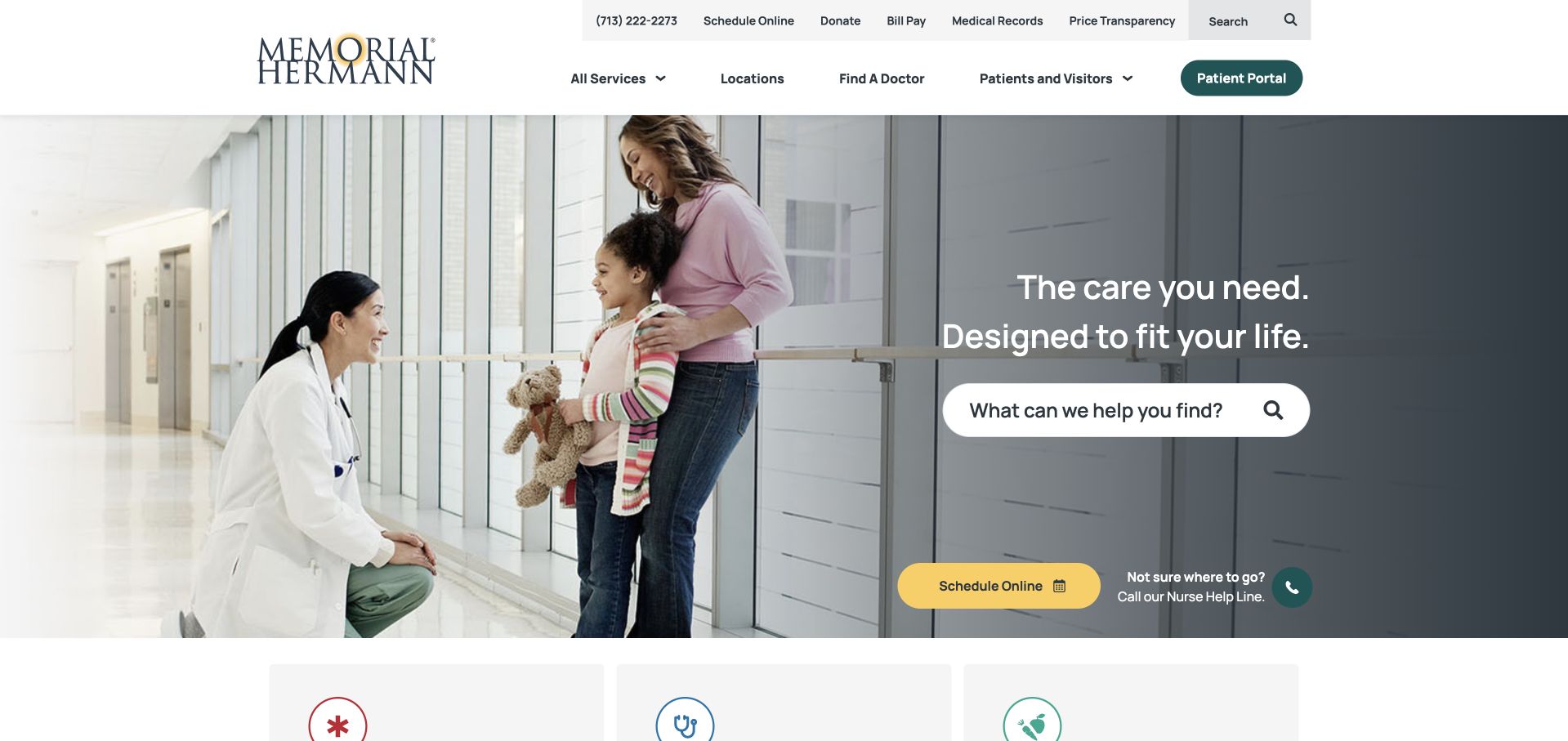
Memorial Hermann places a large search field alongside a family-care photograph and an introductory message. The header also offers services, locations and doctor search, with scheduling, billing and records in a utility row. The composition accommodates both visitors who can name what they need and people who prefer a clear category. A .NET-associated project can borrow this dual approach while treating linked sensitive workflows as separate systems with their own requirements.
What you can learn
Give search a defined role instead of using it to compensate for unclear navigation. Decide which content types it should return, how ambiguous requests are handled and when a person should use a specific service route. Test those distinctions with realistic content, especially where public information and private account actions meet.
Pros
Search and category navigation offer complementary entry points for different levels of visitor knowledge.
A visible scheduling action gives a practical next step without requiring the visitor to interpret the entire menu.
Cons & considerations
The many utility and primary links need strong grouping to remain understandable at narrow widths.
The ASP.NET-family signal belongs to the public page and does not establish patient-portal or appointment software.
Platform source: Dated public ASP.NET evidence; qualified .NET-family relationship. Recognized cookie name (values discarded) on the exact public source response, observed 2026-11-09. This is a dated ASP.NET-family association within the .NET ecosystem, not proof of C#, ASP.NET Core, a runtime version, a specific CMS, private applications or other properties. Public response identifiers can be indirect; no complete backend inventory is claimed. Platform evidence is separate from the direct website screenshot and is not a complete current infrastructure audit.
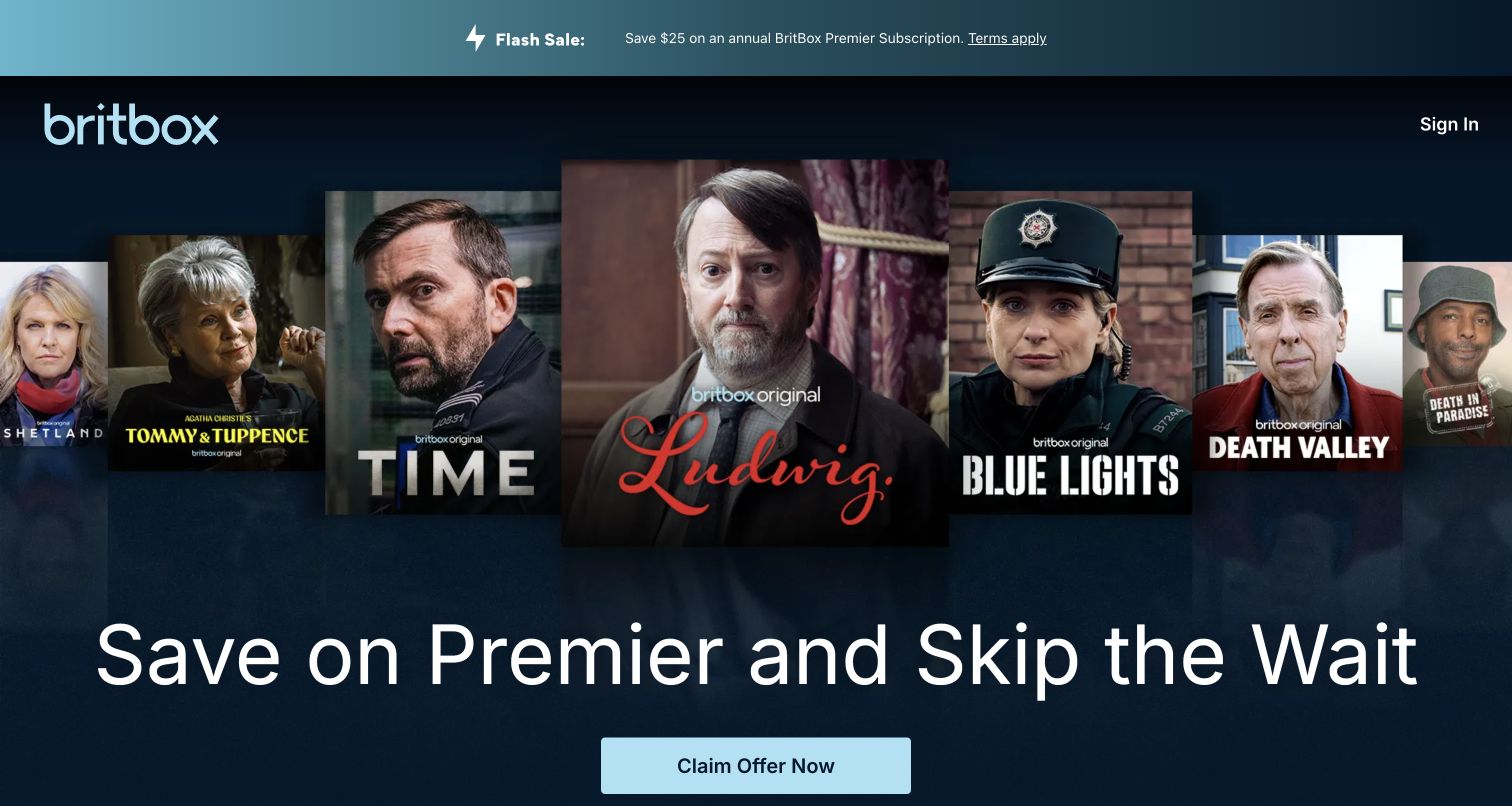
BritBox’s captured landing page uses a row of recognizable programme artwork to give a subscription offer concrete meaning. A dark background connects the different covers, while a large headline and a pale primary button establish one main action. Sign-in remains small but visible in the header. For a .NET-associated subscription site, the useful reference is the balance between demonstrating the product and stating the offer. The dated promotion is not current pricing or availability evidence.
What you can learn
Separate the durable subscription explanation from temporary offer content. Give promotions an owner, terms and an expiry process, and preserve a direct route for existing subscribers. The catalog preview should support the proposition without implying that every title, region or device has identical availability or that the screenshot verifies the streaming application.
Pros
Programme artwork makes the product understandable before the visitor reads detailed subscription information.
The restrained header and prominent primary button create a clear visual priority for the landing page.
Cons & considerations
Large promotional typography can crowd out plan distinctions and terms if supporting sections are not carefully structured.
The retained ASP.NET response header does not establish the video platform, billing system or current runtime version.
Platform source: Dated public ASP.NET evidence; qualified .NET-family relationship. x-powered-by response header identifies ASP.NET on the exact public source response, observed 2026-11-04. This is a dated ASP.NET-family association within the .NET ecosystem, not proof of C#, ASP.NET Core, a runtime version, a specific CMS, private applications or other properties. Public response identifiers can be indirect; no complete backend inventory is claimed. Platform evidence is separate from the direct website screenshot and is not a complete current infrastructure audit.
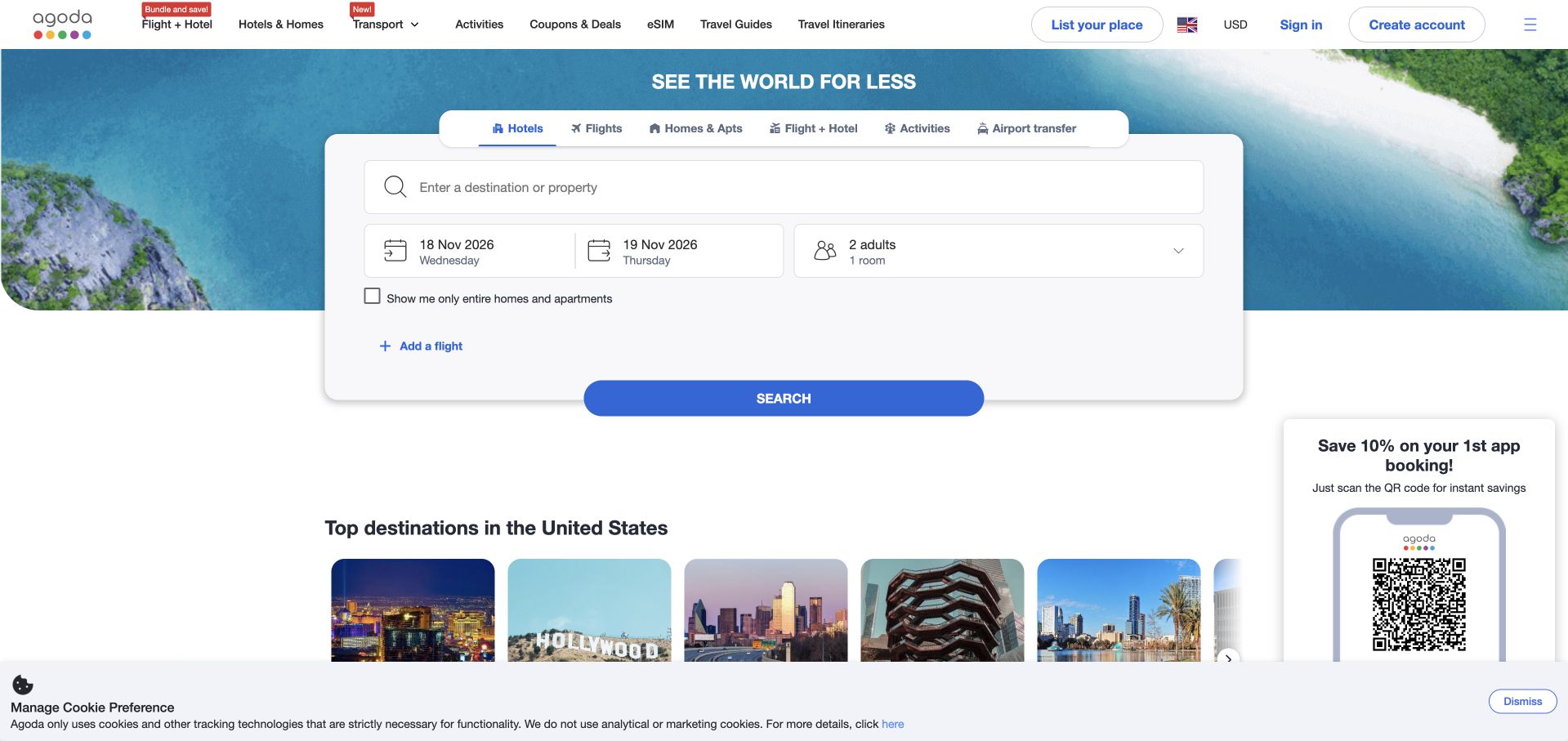
Agoda places destination, dates and guests inside a large central search panel, with travel categories presented as tabs above it. A wide search button gives the form a clear endpoint, while destination cards below support people who are still exploring. This .NET-associated example organizes its information hierarchy around a concrete task rather than a long brand introduction. The screenshot shows an earlier search state and does not verify current availability, pricing or the outcome of a booking.
What you can learn
Model the dependencies between inputs before decorating the form. A destination, date range and party size affect what results can be useful, so validation and recovery need to be understandable. Keep exploratory content nearby, but avoid letting app promotions or secondary offers interrupt the visitor before the main task is clear.
Pros
The search panel groups related inputs into a recognizable sequence with one visually dominant final action.
Travel-type tabs keep different search modes connected while preserving a common task-oriented presentation.
Cons & considerations
Promotional and consent panels compete with the search area and need careful prioritization on smaller screens.
The retained ASP.NET cookie-name observation does not identify the booking engine or every service behind the interface.
Platform source: Dated public ASP.NET evidence; qualified .NET-family relationship. Recognized cookie name (values discarded) on the exact public source response, observed 2026-11-09. This is a dated ASP.NET-family association within the .NET ecosystem, not proof of C#, ASP.NET Core, a runtime version, a specific CMS, private applications or other properties. Public response identifiers can be indirect; no complete backend inventory is claimed. Platform evidence is separate from the direct website screenshot and is not a complete current infrastructure audit.
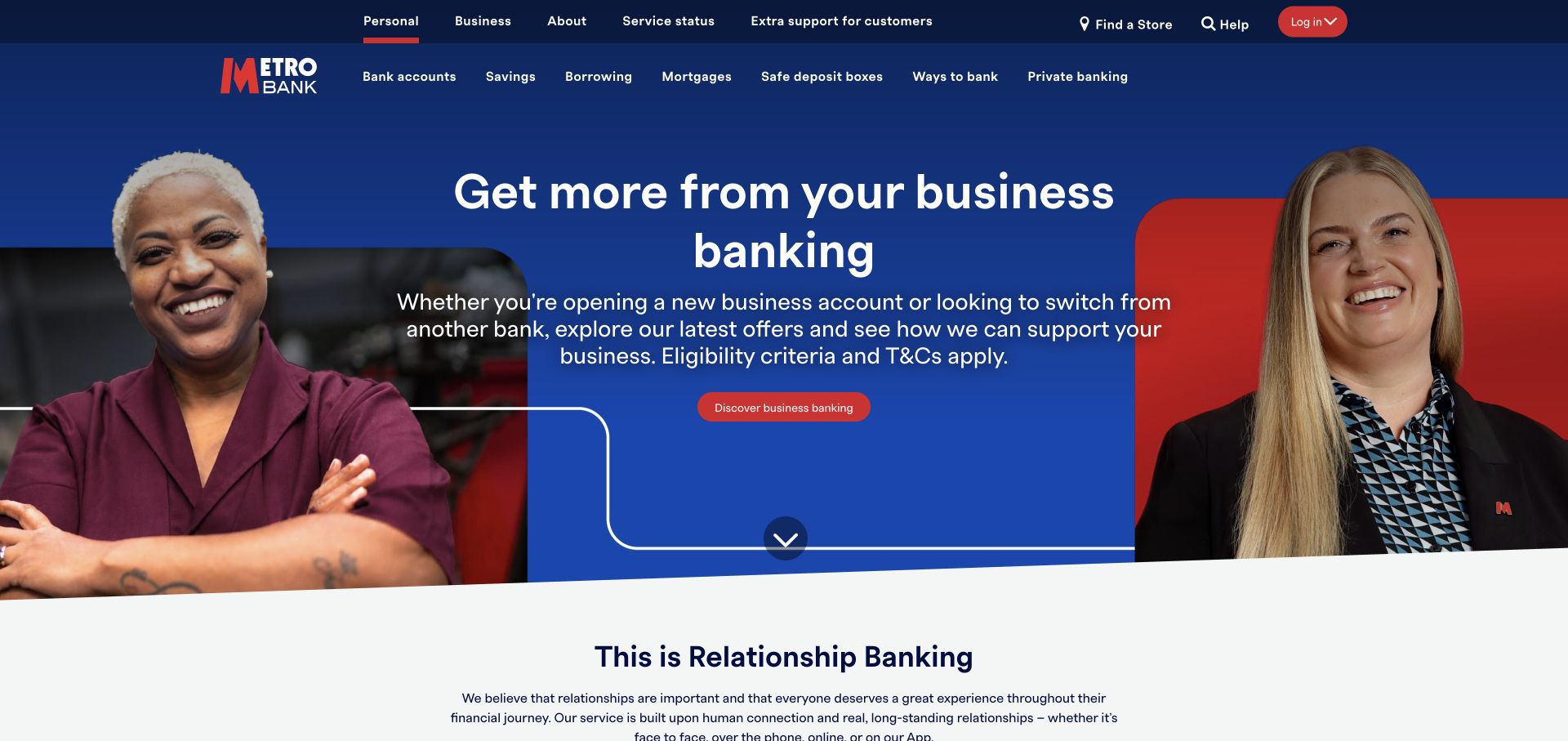
Metro Bank’s captured homepage uses a slim audience row above a more detailed product menu. Personal, business and service information remain distinguishable, while the hero introduces business banking with people-focused imagery and a specific next action. The blue and red palette connects the interface to the identity without turning every link into a competing button. This .NET-associated public site accommodates several customer types while keeping account access and support visible.
What you can learn
Decide which audience choices affect the whole browsing journey and which belong inside individual product pages. Consistent labels and a clear selected state help visitors recover when they arrive at the wrong section. Product terms and eligibility information need structured maintenance beyond the introductory message, especially when campaigns change.
Pros
The two navigation levels separate audience selection from product categories without hiding practical support links.
A single hero action creates a clearer next step than presenting every banking product in the opening panel.
Cons & considerations
The business campaign appears within a broader entry page, making audience context particularly important.
The public ASP.NET-family cookie signal does not verify secure banking systems or imply any assessment of their protections.
Platform source: Dated public ASP.NET evidence; qualified .NET-family relationship. Recognized cookie name (values discarded) on the exact public source response, observed 2026-11-03. This is a dated ASP.NET-family association within the .NET ecosystem, not proof of C#, ASP.NET Core, a runtime version, a specific CMS, private applications or other properties. Public response identifiers can be indirect; no complete backend inventory is claimed. Platform evidence is separate from the direct website screenshot and is not a complete current infrastructure audit.
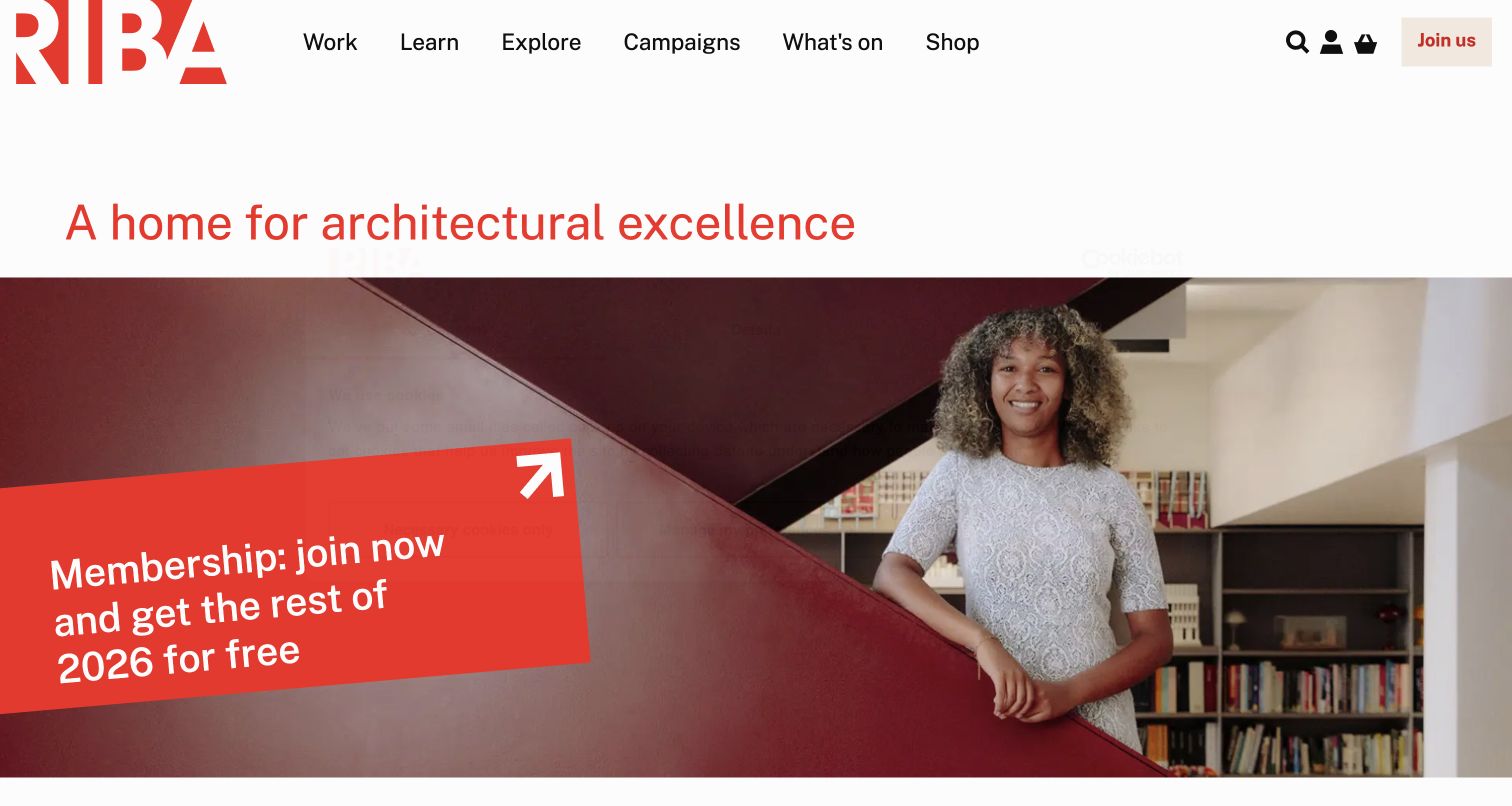
RIBA’s captured homepage uses large red branding and a short mission statement above a membership-focused feature. Its main navigation uses direct verbs such as Work, Learn and Explore, which frame the organization around activities instead of departmental names. The prominent membership card gives a clear campaign priority while search and account tools remain in the header. The useful .NET publishing pattern combines public institutional identity with practical routes for different stages of involvement.
What you can learn
Build the information architecture around what people come to do, then connect membership or commercial actions to the relevant content. A professional organization can have educational, cultural and service responsibilities at once. Clear categories help those responsibilities coexist without assuming that every visitor understands the institution’s internal structure.
Pros
Short activity-based menu labels provide an approachable entry into a broad professional content library.
The membership feature makes its immediate purpose legible without obscuring the wider organizational identity.
Cons & considerations
Campaign dates in a large visual card need a reliable replacement process when the promotion ends.
The retained ASP.NET response-header signal does not identify the membership, shop or account systems behind linked destinations.
Platform source: Dated public ASP.NET evidence; qualified .NET-family relationship. x-powered-by response header identifies ASP.NET on the exact public source response, observed 2026-11-03. This is a dated ASP.NET-family association within the .NET ecosystem, not proof of C#, ASP.NET Core, a runtime version, a specific CMS, private applications or other properties. Public response identifiers can be indirect; no complete backend inventory is claimed. Platform evidence is separate from the direct website screenshot and is not a complete current infrastructure audit.
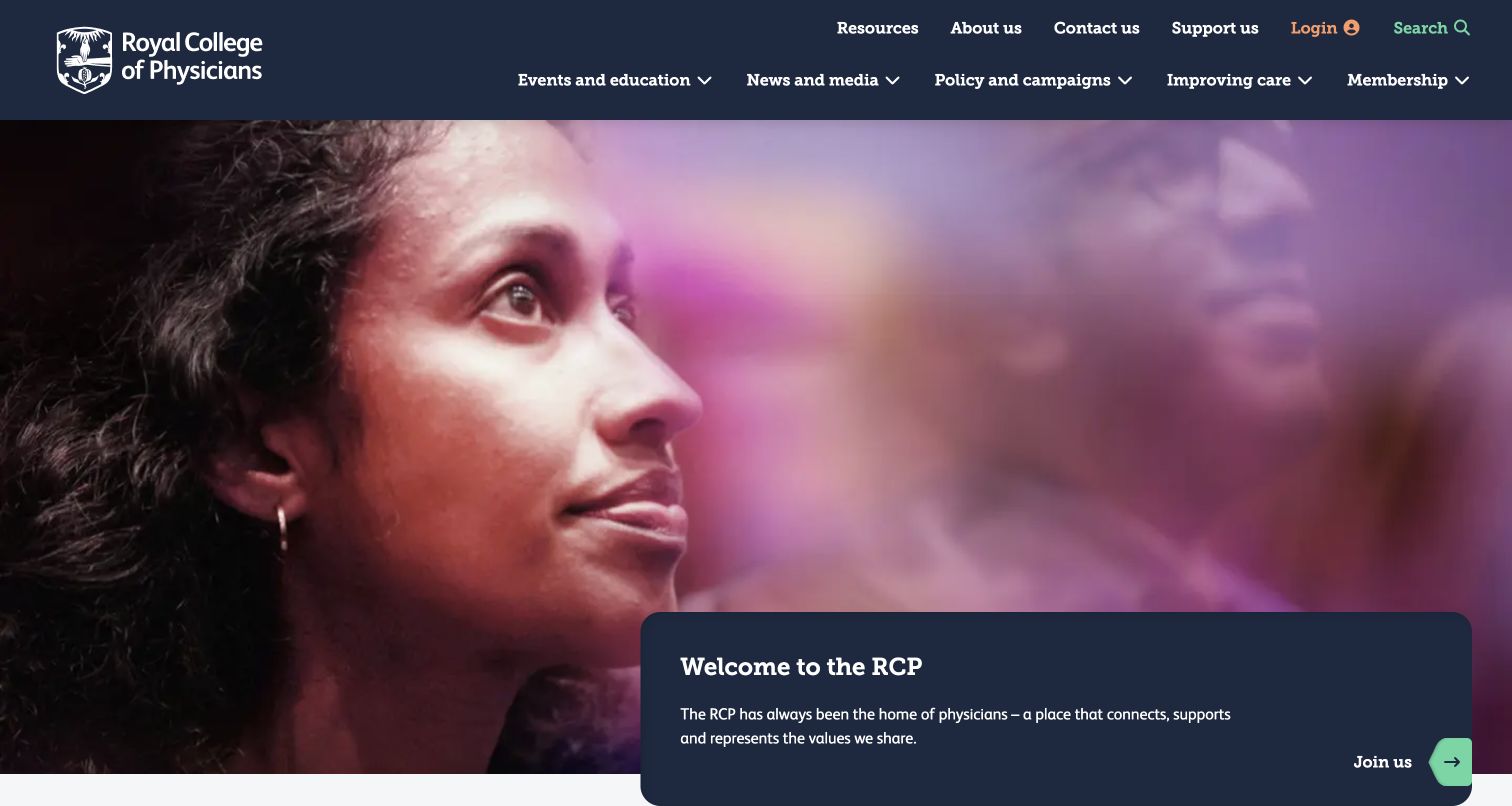
The Royal College of Physicians presents a large portrait beneath a dark header with clearly separated resource and subject navigation. Events, education, news, policy and membership are visible before the welcome card introduces the organization. The card’s join action is prominent without replacing the broader content routes. For a .NET-associated institutional website, this is a useful example of letting a professional community’s identity emerge through people while maintaining a stable framework for the material that members and public visitors need.
What you can learn
Give recurring content types clear homes and owners before building a large menu. Events require dates and registration states; policy material needs publication context; membership information needs a different maintenance rhythm. A shared publishing platform should support those distinctions while keeping the experience coherent for someone arriving through an unfamiliar page.
Pros
The navigation distinguishes resources, education and policy instead of compressing everything into one generic section.
The welcome card creates a readable text area separate from the large portrait behind it.
Cons & considerations
Several levels of navigation require deliberate mobile ordering and accessible disclosure behavior.
The dated ASP.NET header supports a platform-family association only and does not prove the member-service implementation.
Platform source: Dated public ASP.NET evidence; qualified .NET-family relationship. x-powered-by response header identifies ASP.NET on the exact public source response, observed 2026-11-03. This is a dated ASP.NET-family association within the .NET ecosystem, not proof of C#, ASP.NET Core, a runtime version, a specific CMS, private applications or other properties. Public response identifiers can be indirect; no complete backend inventory is claimed. Platform evidence is separate from the direct website screenshot and is not a complete current infrastructure audit.
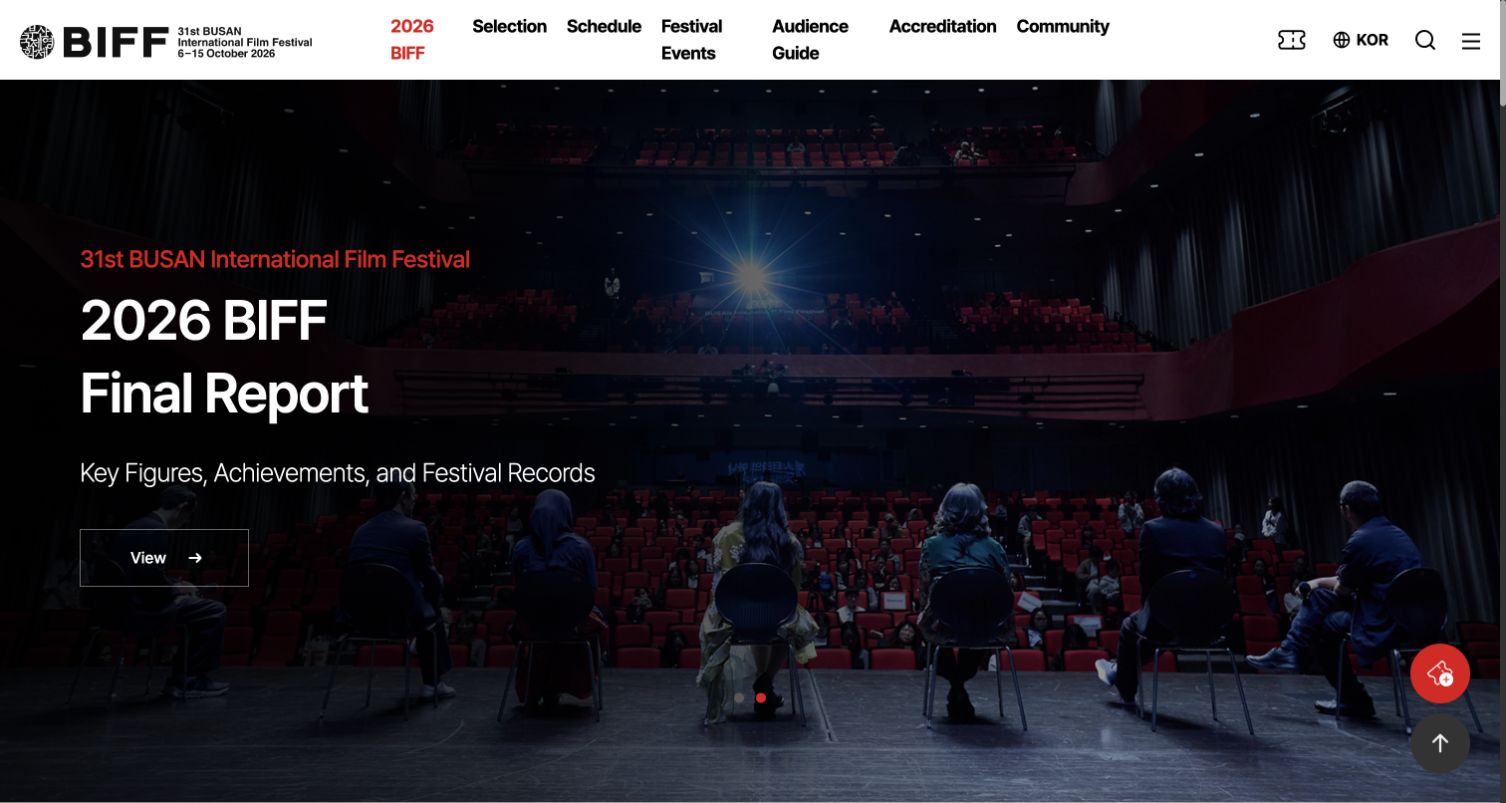
The Busan International Film Festival’s captured English homepage leads with a final-report feature while keeping selection, schedule, audience guidance and accreditation in the header. The auditorium image maintains the event’s atmosphere after the programme itself has finished. The dated festival identity remains explicit. For a .NET-associated event site, this is a useful reference for a phase that is often overlooked: visitors still need results, records and context after the ticketing and attendance period has passed.
What you can learn
Plan the whole event lifecycle in the content model. Opening announcements, schedules, ticket availability, live updates and final reports need different priorities and expiry rules. Keep stable archive routes so useful information survives the next edition, and make the year visible wherever readers might confuse historical material with current opportunities.
Pros
The final-report feature gives the homepage a purposeful post-event role instead of leaving expired calls to action.
The festival year and edition remain visible alongside the main navigation for important context.
Cons & considerations
A dark photograph and subtle secondary action demand careful contrast decisions when imagery changes.
The retained ASP.NET response header does not establish the ticketing, accreditation or other linked application backends.
Platform source: Dated public ASP.NET evidence; qualified .NET-family relationship. x-powered-by response header identifies ASP.NET on the exact public source response, observed 2026-11-04. This is a dated ASP.NET-family association within the .NET ecosystem, not proof of C#, ASP.NET Core, a runtime version, a specific CMS, private applications or other properties. Public response identifiers can be indirect; no complete backend inventory is claimed. Platform evidence is separate from the direct website screenshot and is not a complete current infrastructure audit.
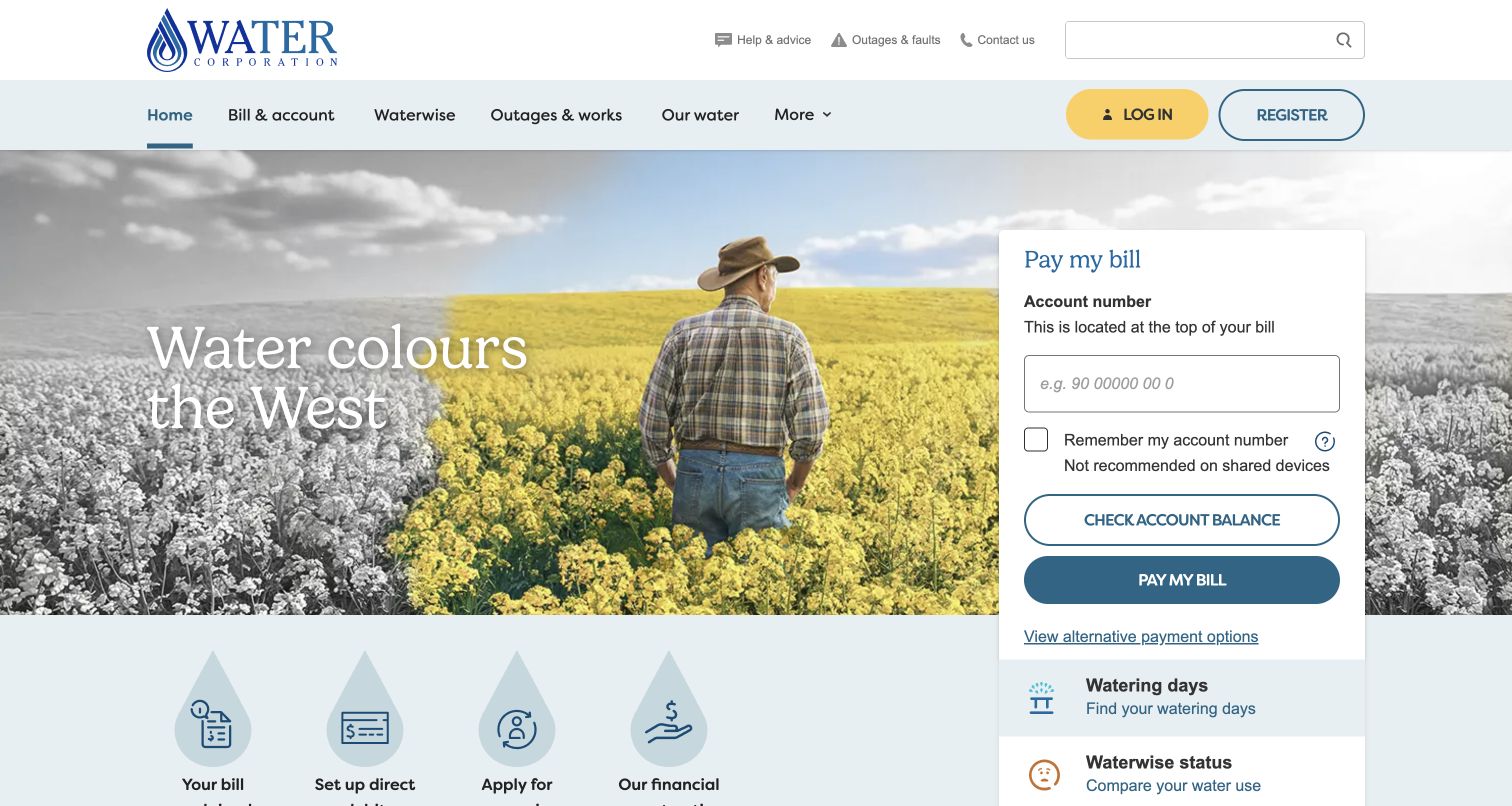
Water Corporation’s captured homepage places an account-number panel beside a broad landscape image and public-service message. Billing, outages and water information are separate navigation choices, while login and registration remain visible above the hero. The payment panel makes the page useful to someone arriving with a specific task, without removing the wider explanatory content. This .NET-associated utility website gives frequent service needs a prominent place within broader public information.
What you can learn
Define the boundaries between public information, account lookup and payment before designing a combined entry screen. Explain what information an input expects and how visitors can find it. Keep alternative routes available for people who cannot use the preferred process, and give outage information independent priority when service conditions change.
Pros
The account panel states the required input and provides a short explanation of where to find it.
Billing, outages and water guidance remain separate navigation choices rather than competing promotional slogans.
Cons & considerations
A task panel over a large hero needs careful stacking and labeling when space becomes limited.
The public ASP.NET cookie-name signal does not verify payment processing, account authorization or private service implementations.
Platform source: Dated public ASP.NET evidence; qualified .NET-family relationship. Recognized cookie name (values discarded) on the exact public source response, observed 2026-11-05. This is a dated ASP.NET-family association within the .NET ecosystem, not proof of C#, ASP.NET Core, a runtime version, a specific CMS, private applications or other properties. Public response identifiers can be indirect; no complete backend inventory is claimed. Platform evidence is separate from the direct website screenshot and is not a complete current infrastructure audit.
Kegan has 15+ years of experience working with small businesses, Fortune 500 companies, and everything in between. No development job is too big or too small: he brings the same hands-on attention to a focused improvement, a complete website, or a custom application.
For .NET projects, he can help with responsive interfaces, reusable components, custom functionality, API connections, and performance-minded implementation. He works directly with clients on scope, design, implementation, testing, and handover, with an emphasis on clear communication and a system that remains practical to maintain after launch.
Show 3 other .NET developersHide other .NET developers
When the main need is publishing information, establish the page types and editorial workflow first. News, service descriptions, location records and institutional resources need different fields and review rules. Choose templates that give those differences a clear shape while keeping navigation consistent. Decide which features genuinely need application logic and which can remain straightforward content. Keep the public publishing experience separate from private business systems unless a documented integration is necessary.
For searches, account tools and structured requests, map the input, validation, successful result and recoverable failure before polishing the interface. A compact screen can still require several services behind it. Define data ownership, authentication boundaries and the conditions under which an action is allowed. Use clear labels and preserve progress where appropriate. The goal is a dependable task, not merely a visually impressive form placed over a marketing photograph.
Begin with an inventory of the current application, supported dependencies, content and integration contracts. Preserve useful public routes and separate presentation improvements from changes to sensitive workflows. A staged change can modernize a confusing entry point while leaving a well-understood service boundary intact. Establish what must remain compatible, which owner verifies each integration and how a failed release can be identified and rolled back. Do not infer that a public technology signal reveals the complete system.
List the important audiences, the routes they use and the information each route requires. For recurring content, define fields, required context, ownership and expiry behavior. For actions, document the expected input and result without tying the language to an internal department name. Use realistic examples: a closed location, an expired campaign, a missing search result or a service interruption often reveals requirements that an ideal homepage does not. Agree on these cases before expanding the component library.
Define boundaries and failure behavior
Record the systems behind search, content, account access and other connected services. Explain which information can be public, which requires authorization and which system is authoritative. Decide what happens when a dependency is unavailable or returns an incomplete result. Keep those states understandable to the visitor and useful to the team operating the site. Microsoft’s security documentation provides implementation topics, but the project still needs deliberate decisions about its own data, permissions and service boundaries.
Plan checks that exercise realistic requests across the application and its supporting infrastructure. Microsoft’s integration-testing guidance distinguishes these broader checks from isolated unit tests. Also review content changes, redirects, essential assets and recoverable errors. Identify who owns dependencies, editorial updates, monitoring and release verification. A project is easier to maintain when someone can explain what changed, how the result was checked and which evidence belongs to the current release rather than an older screenshot.
Ask the actual team to carry out its routine job: publish a realistic update, correct a mistake, preview a narrow screen, and identify who owns an integration failure. For a library or frontend framework, also ask who maintains the content source and deployment. A polished screenshot does not answer those operational questions.
Beyond the screenshot
A practical .NET website planning checklist
Name the primary audiences and give each an understandable route to its most important task.
Confirm the actual application model and supported runtime from project evidence, not a competitor’s screenshot.
Document public and private system boundaries, including account and payment handoffs.
Keep authorization and sensitive data handling on the appropriate trusted service boundary.
Provide clear empty, invalid, unavailable and recoverable error states for important tasks.
Check integration behavior with realistic requests and supporting infrastructure.
Preserve useful public URLs, redirects and search metadata when reorganizing content.
Test essential navigation, forms and content with keyboard access and varied screen sizes.
Assign maintenance owners for dependencies, content updates, monitoring and release verification.
Test with real content, a keyboard, a small screen, slow or failed requests, and the people who will maintain the system. These are planning checks, not an accessibility, security, performance, or search-ranking certification.
Sources & editorial method
How this .NET collection was reviewed
The collection contains twenty distinct public source properties and twenty original reviews written on November 10, 2026 for the saved November 9 evening batch. All screenshots are genuine prior direct browser captures, inspected for this review and retained without altering their bytes or dates. Every source has an existing bounded broad audit; those records and their original observations are reused unchanged. The .NET association is derived from positive ASP.NET-family response evidence and Microsoft’s platform documentation. It is not a current implementation audit, a C# claim, a runtime-version determination or evidence about linked private applications. No accounts, forms, payments or other real user actions were tested.
Every image is an unmodified capture from the actual website, with its source and capture date. Some captures are reused from our shared catalog; their dates remain the original capture dates. None comes from a vendor gallery or a generated reconstruction. Moving imagery and live content can change.
Technology attribution uses public page assets or metadata, official platform documentation, or a cited first-party project case study. Documentary and framework-relationship evidence is identified where used; it is not a complete current backend inventory. A CMS image CDN alone does not establish a full CMS deployment. A library’s presence does not prove which individual controls use it, and a platform label does not establish AI authorship.
The composition notes, lessons, pros and tradeoffs are original editorial observations. We have not measured conversion, traffic, security, performance or accessibility conformance. Website owners retain their brands and imagery; these examples are not our client portfolio. Written, Edited and Curated are independent records, not dates advanced by a build. See our editorial standards or suggest a correction.
Questions worth asking
.NET website development FAQs
Does every example use the latest .NET release?
That is not established. The evidence identifies a dated ASP.NET-family response signal on each public property. It does not determine the runtime version, whether ASP.NET Core is used or whether an organization has changed its implementation since the observation.
Does an ASP.NET signal prove that the site is written in C#?
No. A public response header or recognized cookie name does not reveal the source language. This collection uses the official .NET name and describes its ASP.NET-family association without assigning C# to the pictured websites.
Are ASP.NET and ASP.NET Core interchangeable?
No. Microsoft documents ASP.NET Core separately from older ASP.NET application models. A general ASP.NET signal is insufficient to distinguish them. A real development or migration decision needs evidence from the application, its dependencies and its supported operating requirements.
Can a .NET website use a separate frontend or content system?
Yes. A project may combine web services, frontend components, a publishing system and other integrations. The important planning work is to define what each part owns and how they communicate. Public observations should be scoped to the specific component they identify.
Does a homepage signal identify its linked account or payment systems?
No. A link may lead to a different application with a different implementation and owner. This guide does not inspect or attribute private accounts, healthcare portals, booking engines, payment processing or other linked services from a public homepage marker.
Why are older screenshots and audit dates retained?
They record what was actually captured or observed at that time. A new design review can reuse a genuine image, but it cannot make the capture or technology observation new. The guide preserves those dates and distinguishes them from its editorial work date.
Borrow the clear tasks, useful content groupings and explicit service boundaries in these examples. Choose the .NET approach from your own project requirements, and keep technology claims tied to evidence that actually supports them.