TensorFlow can sit behind search, recommendations, classification, or a browser interaction. These references pair public product surfaces with precisely scoped documentary evidence, including TensorFlow.js, TensorFlow Lite, and named TensorFlow libraries where the sources identify them.
The collection opens with Etsy, LinkedIn Learning, Dropbox, Netflix, and Airbnb. Each has a sourced customer-facing feature association. Several captures deliberately show a public product or informational entrance because the functional experience is personalized or authenticated. The screenshot and the technology evidence answer different questions.
Dates matter. A documented implementation from 2015, 2020, or 2022 does not establish the current runtime of a 2026 page. Browser execution, backend inference, model training, and supporting infrastructure are distinct roles. Read the qualification attached to each example before borrowing an architectural idea.
Before the examples
What makes good TensorFlow website development in 2026?
Start with the decision the feature improves
Write the user task before choosing a model: finding a relevant item, understanding an image, translating a message, or controlling a visual effect. Define a useful baseline and the evidence that would justify replacing it. A polished interface is not a measurement of prediction quality.
Name the runtime and its boundaries
TensorFlow.js provides a JavaScript machine-learning library, while TensorFlow Serving provides a production model-serving system. These are different implementation choices. Record where inputs are processed, what reaches the server, and what happens when the selected environment cannot run the model.
Treat an empty result, weak prediction, unavailable model, denied device permission, and interrupted connection as ordinary interface states. Keep the original input recoverable and provide a useful route forward. The model should support a task whose basic structure remains understandable to the user.
The collection · 20 examples
20 TensorFlow website examples worth studying
Study the visible hierarchy, task entrances, and explanations alongside the documentary feature scope. These twenty distinct public properties include commercial products and practical creation tools. They are not twenty claims that the captured page frontend currently executes TensorFlow.
We start with five recognizable brands or organizations: Etsy, LinkedIn Learning, Dropbox, Netflix, Airbnb. Each attribution applies to the named website property, not every product or website belonging to its organization. This is a curated reading sequence, not a measured ranking.
Etsy gives its wide search field a prominent position beside the orange wordmark, then switches to a carefully arranged seasonal composition. A large red ornament photograph occupies the left while smaller product images, price labels, and a substantial serif headline fill the right. The black shopping action is easy to distinguish from the orange search control. Etsy’s October 2022 engineering account documents TensorFlow Ranking for search. This marketplace entrance illustrates that product context; the decorative campaign and every homepage recommendation are not attributed to that model.
What you can learn
Keep deliberate merchandising and algorithmic retrieval legible as different ways to explore. A developer should preserve the search route through campaign changes, then evaluate ranking separately with representative queries, useful empty states, and a clearly defined fallback when predictions are unavailable.
Pros
Search remains accessible without understanding the current campaign.
Price labels connect decorative photography to concrete shopping decisions.
Cons & considerations
The large seasonal image delays the visible category selection.
Small product labels compete with the more expressive headline.
Public source checked November 3, 2026. References may be embedded or legacy—not a complete backend inventory.
Platform source: Official dated feature evidence (undated where stated). Documentary feature association; see exact variant, date and limits in technology evidence. Public capture does not independently verify model runtime. Platform evidence is separate from the direct website screenshot and is not a complete current infrastructure audit.
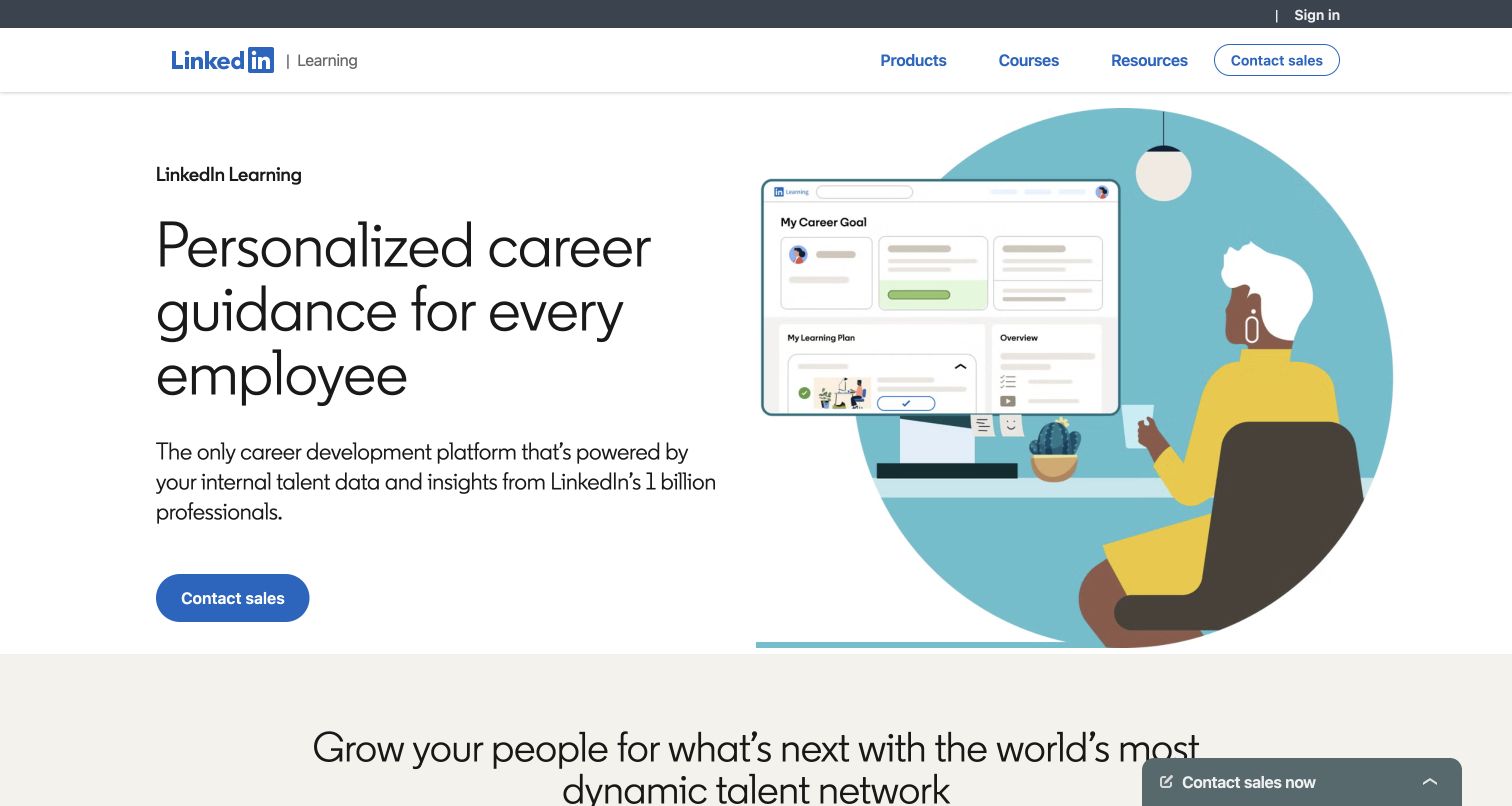
LinkedIn Learning’s public product entrance pairs an oversized left-aligned headline with a turquoise illustration of a learner and a planning interface. The blue sales button sits below a short explanation, while courses and resources remain in the header. Its July 2020 engineering article describes TensorFlow neural collaborative filtering for course recommendations. The screenshot is the current public introduction to the learning product, not a learner’s private recommendations or evidence that this marketing page runs that model. The illustration makes an abstract career proposition easier to picture.
What you can learn
Explain what a recommendation helps someone decide before explaining its machinery. Keep course discovery, organizational buying, and personal learning actions distinct. A personalized product also needs understandable reasons for suggestions and a route to browse independently when its initial profile is incomplete.
Pros
The learning-plan illustration supplies a concrete product reference.
Courses and resources provide routes beyond the sales action.
Cons & considerations
The opening prioritizes organizational buyers over individual learners.
The illustrated interface cannot demonstrate actual recommendation quality.
Public source checked November 3, 2026. References may be embedded or legacy—not a complete backend inventory.
Platform source: Official dated feature evidence (undated where stated). Documentary feature association; see exact variant, date and limits in technology evidence. Public capture does not independently verify model runtime. Platform evidence is separate from the direct website screenshot and is not a complete current infrastructure audit.
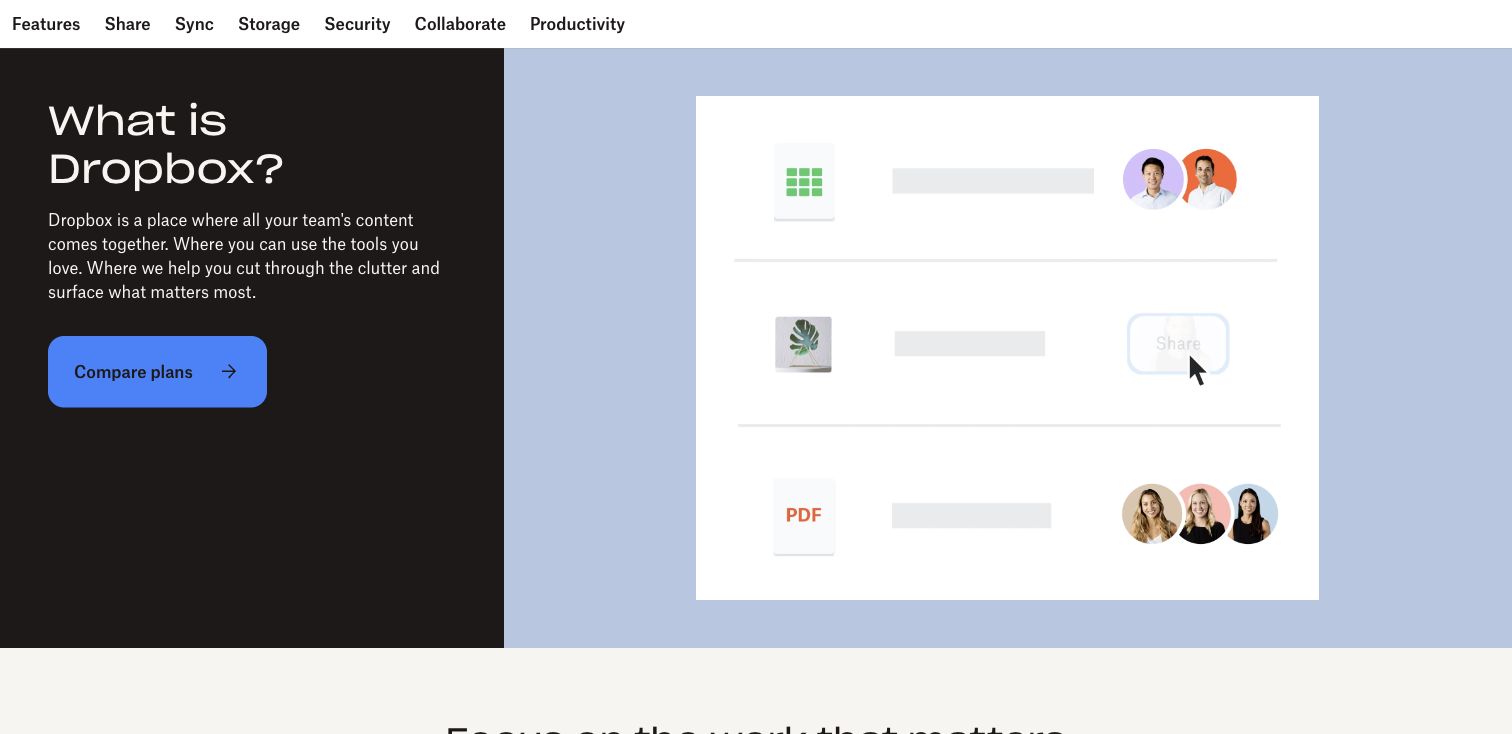
Dropbox’s public features page divides its opening into a dark explanatory panel and a pale blue illustration area. A large blue comparison button anchors the left, while simplified file rows and collaborator portraits show the product’s organization model. The capture excludes the account header and contains only public marketing content. Dropbox’s May 2021 engineering article identifies TensorFlow training and inference for image-content search; its help documentation connects that feature to dropbox.com. This public entrance illustrates the product, without exposing private files or claiming its marketing frontend performs image classification.
What you can learn
Use a familiar file metaphor to explain an invisible retrieval capability. Keep model-assisted search results connected to ordinary file controls and predictable permissions. Plan how people recover when an image is misclassified or the available index does not contain their intended content.
Pros
The split composition makes the explanation and visual example distinct.
A strong primary action remains readable against the dark panel.
Cons & considerations
The simplified illustration omits difficult search and permission states.
Plan comparison precedes a hands-on demonstration of image retrieval.
Visible tech stack
Earlier / documented evidence
TensorFlow
Public source checked November 3, 2026. References may be embedded or legacy—not a complete backend inventory.
Platform source: Official dated feature evidence (undated where stated). Documentary feature association; see exact variant, date and limits in technology evidence. Public capture does not independently verify model runtime. Platform evidence is separate from the direct website screenshot and is not a complete current infrastructure audit.
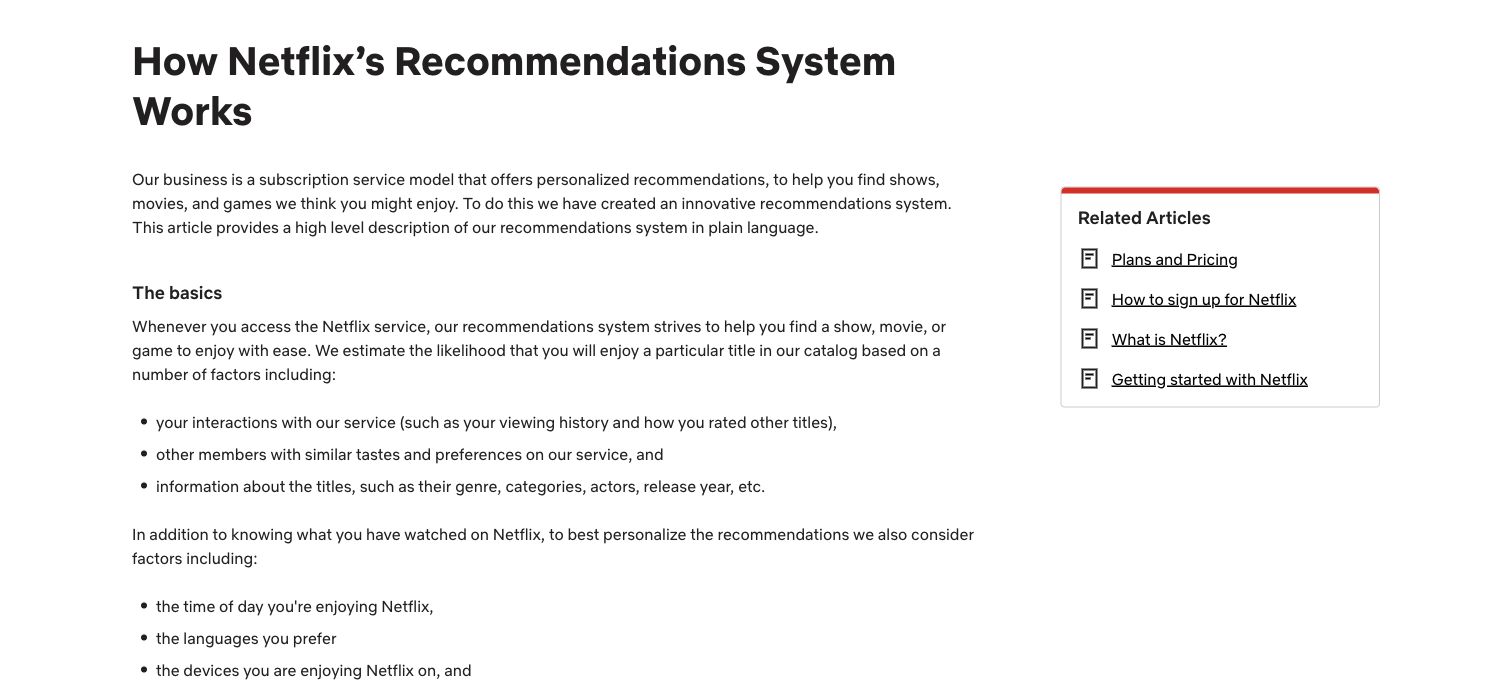
Netflix’s public help explanation uses a wide text column, a large two-line heading, and a compact related-articles box marked with a red top rule. Short subsections and bullet lists make a complex recommendation topic approachable. This capture is an informational entrance with the account header excluded, not a subscriber’s homepage. Netflix’s March 2026 engineering account places TensorFlow embedding work inside its production Ranker pipeline for homepage rows. The article’s Java Vector API optimization is a separate part of that system and is not relabeled as TensorFlow.
What you can learn
Give a recommendation system a plain-language explanation alongside its interface. Structure the explanation around inputs, ordering, and available user choices. Technical ownership should remain precise enough that a model update does not silently invalidate claims about the entire recommendation architecture.
Pros
Subheadings and lists support scanning without technical vocabulary.
Related support links stay separate from the main explanation.
Cons & considerations
The long text lacks a compact diagram of the ordering process.
This help view cannot show how recommendations behave in use.
Visible tech stack
Earlier / documented evidence
TensorFlow
Public source checked November 3, 2026. References may be embedded or legacy—not a complete backend inventory.
Platform source: Official dated feature evidence (undated where stated). Documentary feature association; see exact variant, date and limits in technology evidence. Public capture does not independently verify model runtime. Platform evidence is separate from the direct website screenshot and is not a complete current infrastructure audit.
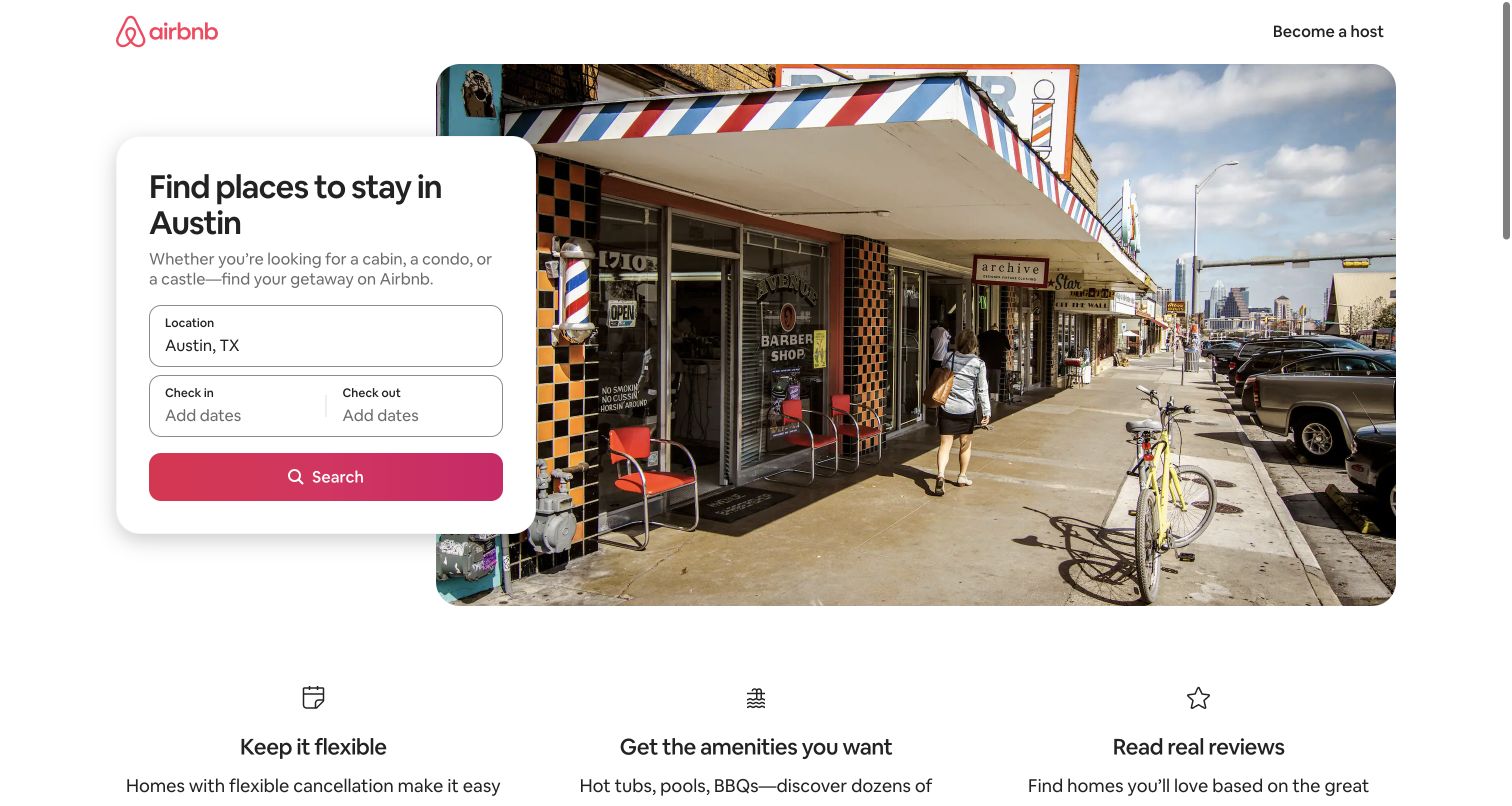
Airbnb’s Austin destination page places a rounded white search card over a broad street photograph. Location and date fields sit above a pink search button; the surrounding page leaves generous space for three practical benefits beneath the image. The capture uses a public destination page rather than an account’s personalized home screen. TensorFlow’s undated case catalog attributes listing-image classification and object detection to Airbnb, with a historical listing-photo article providing context. That documentary feature scope does not establish the current model behind this page or attribute its hero photograph to machine learning.
What you can learn
Connect visual exploration to explicit constraints such as place and dates. If image classification enriches listing discovery, keep the original photographs and human-readable categories available, and let customers correct their search without having to understand how a model organized the catalog.
Pros
The overlapping card keeps the search task visually prominent.
Three practical benefits balance the atmospheric destination image.
Cons & considerations
The opening postpones actual rental comparisons until further scrolling.
A large photograph needs careful cropping on narrower screens.
Public source checked November 3, 2026. References may be embedded or legacy—not a complete backend inventory.
Platform source: Official dated feature evidence (undated where stated). Documentary feature association; see exact variant, date and limits in technology evidence. Public capture does not independently verify model runtime. Platform evidence is separate from the direct website screenshot and is not a complete current infrastructure audit.
PayPal’s public homepage centers a bold seasonal headline above a single black action, followed by a blue gift-box composition. The personal and business switch is visually separated from the main navigation, and login and signup occupy familiar positions at the right. This is a public product entrance, not an account or transaction view. TensorFlow’s undated case catalog documents PayPal fraud-detection use. The evidence concerns backend payment protection; it does not show that this campaign page executes TensorFlow or reveal the present production model, decision thresholds, or customer outcomes.
What you can learn
Keep product education understandable without making automated protection the sole explanation of trust. A payment interface needs clear transaction status and accessible support routes alongside any model-assisted checks. Evaluate those states independently from the visual effectiveness of a seasonal marketing campaign.
Pros
Consumer and business paths are separated before detailed exploration.
The restrained action treatment avoids competing calls to action.
Cons & considerations
Seasonal merchandising delays an explanation of everyday payment tasks.
An app promotion competes with the lower portion of the image.
Public source checked November 3, 2026. References may be embedded or legacy—not a complete backend inventory.
Platform source: Official dated feature evidence (undated where stated). Documentary feature association; see exact variant, date and limits in technology evidence. Public capture does not independently verify model runtime. Platform evidence is separate from the direct website screenshot and is not a complete current infrastructure audit.
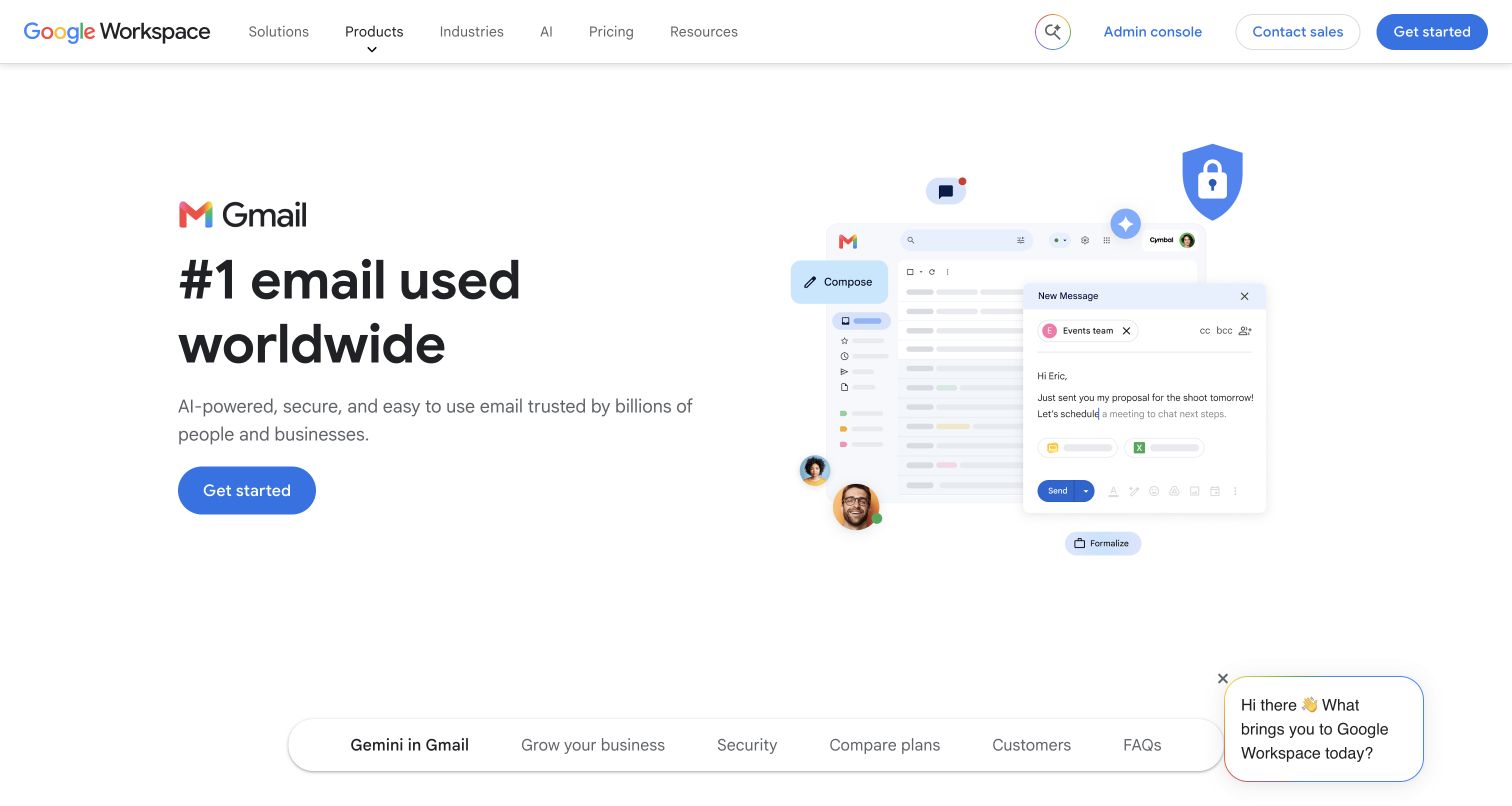
Gmail’s public Workspace page places a product lockup and bold heading beside an illustrated email compose window. Blue actions, security imagery, and generous white space hold the composition together. A rounded feature navigation bar introduces the sections below. Google’s May 2017 account explicitly documents TensorFlow for Gmail spam filtering. The current screenshot is a public product entrance, and its example message is vendor illustration rather than user mail. The historical spam-filter evidence is not extended to the separately promoted Gemini writing features or to the marketing page itself.
What you can learn
Separate background protection from optional assistance in the product explanation. Give each capability a clear purpose and its own evidence. When designing email workflows, preserve ordinary composing and reading tasks so a loading assistant or mistaken classification does not make the basic interface unusable.
Pros
The compose illustration grounds an otherwise broad product claim.
Feature navigation offers a visible route to security information.
Cons & considerations
Several assistant and signup elements compete near the opening.
The illustration cannot establish the accuracy of protective filtering.
Visible tech stack
Referenced on the public page
Google Fonts
Earlier / documented evidence
TensorFlow
Public source checked November 3, 2026. References may be embedded or legacy—not a complete backend inventory.
Platform source: Official dated feature evidence (undated where stated). Documentary feature association; see exact variant, date and limits in technology evidence. Public capture does not independently verify model runtime. Platform evidence is separate from the direct website screenshot and is not a complete current infrastructure audit.
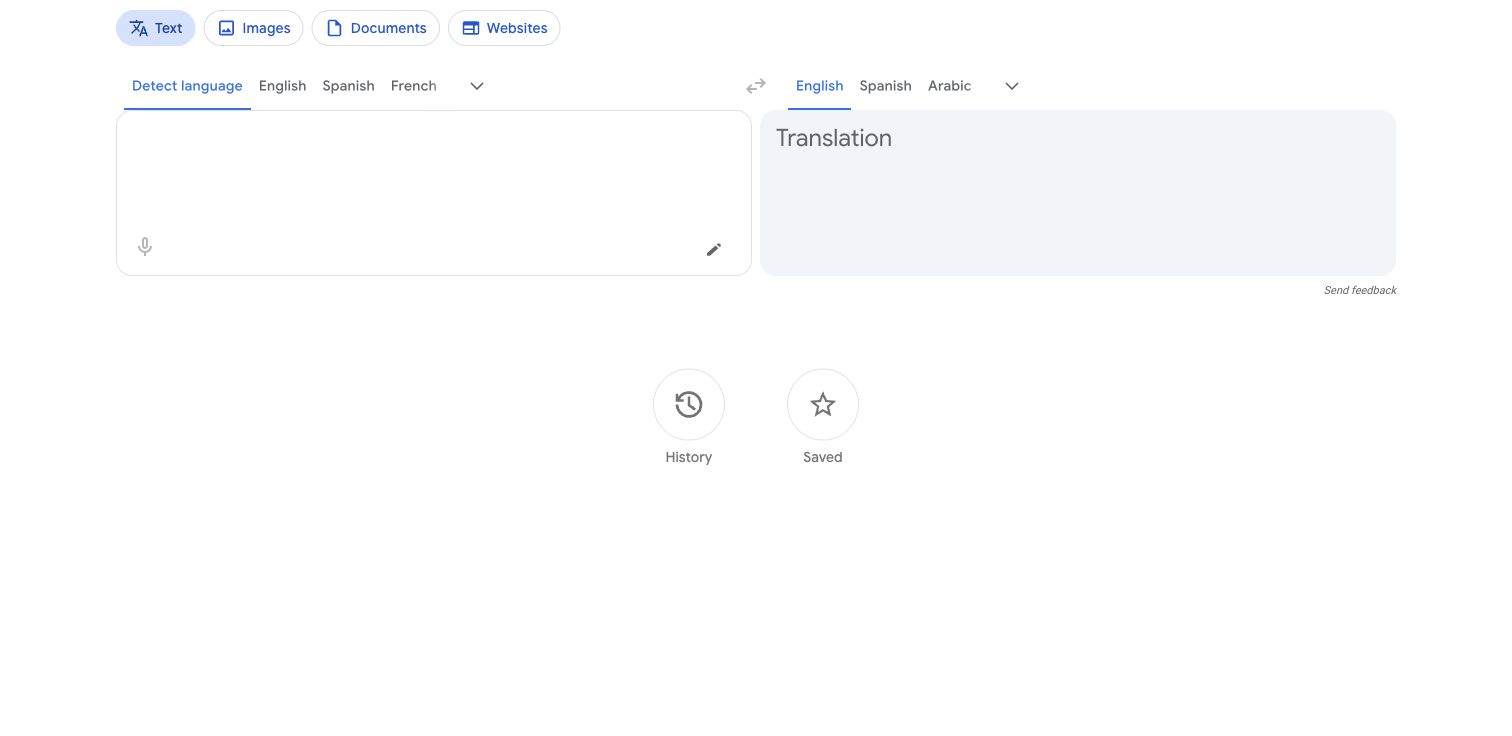
Google Translate’s empty public workspace uses two adjacent panels, source-language tabs, target-language tabs, and a central direction control. Text, image, document, and website modes appear above, while the output panel has a quiet tinted background. The account header was excluded and no history or saved translation was opened. Google’s June 2020 research account documents a production translation architecture implemented in Lingvo, a TensorFlow framework. This historical architecture evidence does not prove that every current translation mode shares that runtime. The capture shows the available starting interface, without submitting content.
What you can learn
Make source, destination, and processing state unambiguous before adding convenience features. Treat empty, loading, unsupported-language, and failed-result states as designed parts of the tool. Users should retain their input and be able to change direction without losing control of the task.
Pros
Parallel panels communicate the relationship between input and output.
Mode controls distinguish text from larger document workflows.
Cons & considerations
Compact language menus can hide the breadth of supported choices.
The empty view does not explain uncertain or ambiguous translations.
Visible tech stack
Earlier / documented evidence
TensorFlow
Earlier cited evidence retained; no current scan result. References may be embedded or legacy—not a complete backend inventory.
Platform source: Official dated feature evidence (undated where stated). Documentary feature association; see exact variant, date and limits in technology evidence. Public capture does not independently verify model runtime. Platform evidence is separate from the direct website screenshot and is not a complete current infrastructure audit.
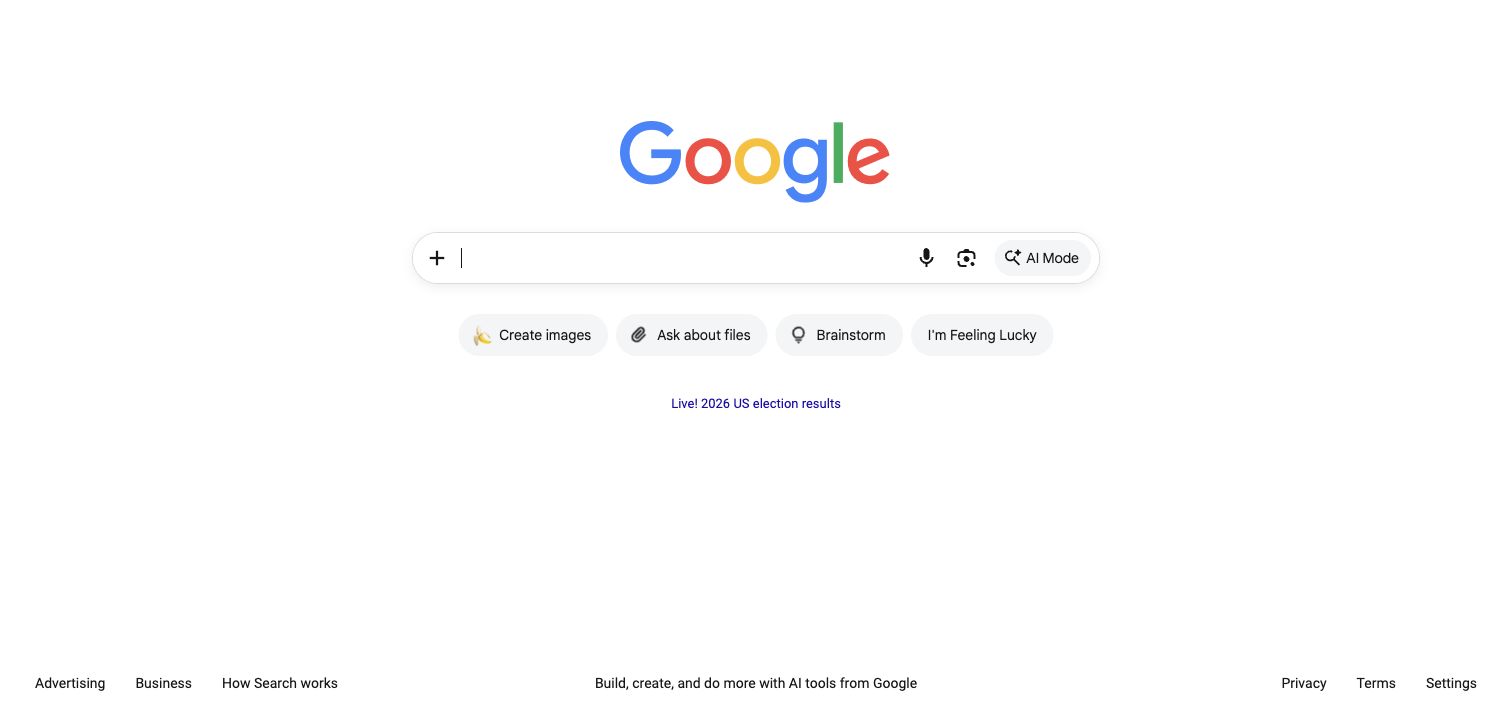
Google’s public search entrance concentrates attention on the multicolor wordmark and a single rounded input. Voice, image, and AI Mode controls sit within that field, with a row of related task shortcuts below. The screenshot excludes the account header and contains no query or results. Google’s November 2015 TensorFlow announcement explicitly identifies neural-network signals in Search. That dated statement supports a historical search feature association, not a claim about today’s AI Mode, generated images, or the complete ranking architecture. The large unoccupied area makes every additional shortcut noticeable.
What you can learn
Protect the clarity of the primary input when adding model-assisted modes. Each alternative should have a recognizable purpose and accessible label. Plan a straightforward results path and error recovery so the user can still complete a conventional search if an optional capability is unavailable.
Pros
The central field gives the page a clear starting point.
Input methods are placed close to the text-entry task.
Cons & considerations
New shortcuts can dilute the simplicity of the original entrance.
Small icon controls rely heavily on clear accessible naming.
Visible tech stack
Earlier / documented evidence
TensorFlow
Public source checked November 3, 2026. References may be embedded or legacy—not a complete backend inventory.
Platform source: Official dated feature evidence (undated where stated). Documentary feature association; see exact variant, date and limits in technology evidence. Public capture does not independently verify model runtime. Platform evidence is separate from the direct website screenshot and is not a complete current infrastructure audit.
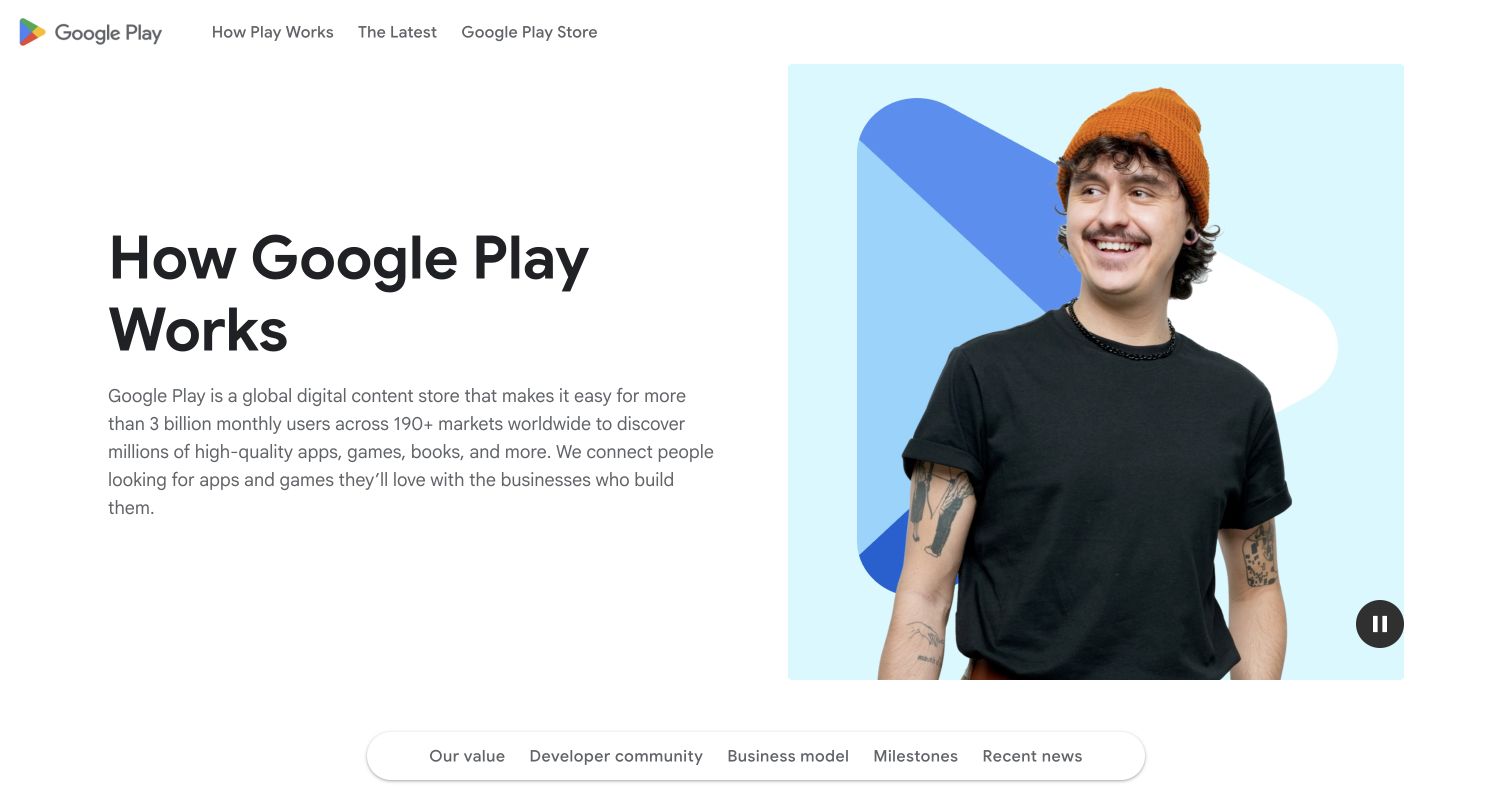
Google Play’s public explanation pairs a large left-aligned title and paragraph with a bright portrait panel. A simple header links back to the store, and a rounded section bar introduces value, community, and business-model topics. This is the informational product entrance on Google’s verified redirected domain, not a personalized store feed. TensorFlow’s December 2022 indexed official article explicitly associates TensorFlow Recommenders with major Google Play recommendation surfaces. Full article retrieval was rate-limited, so the evidence is limited to that indexed statement and does not establish a current model inventory.
What you can learn
Explain a marketplace’s purpose without forcing every visitor into a recommendation feed. Provide direct links to the functional store and concrete information about discovery. Keep technical attribution separate from broad platform messaging, especially when a feature is documented historically rather than inspected at runtime.
Pros
The portrait gives an abstract platform explanation a human focus.
The store link remains directly accessible in the header.
Cons & considerations
The opening offers little immediate detail about recommendation controls.
A large moving portrait needs a meaningful still presentation.
Visible tech stack
Referenced on the public page
Google Fonts
Earlier / documented evidence
TensorFlow
Public source checked November 3, 2026. References may be embedded or legacy—not a complete backend inventory.
Platform source: Official dated feature evidence (undated where stated). Documentary feature association; see exact variant, date and limits in technology evidence. Public capture does not independently verify model runtime. Platform evidence is separate from the direct website screenshot and is not a complete current infrastructure audit.
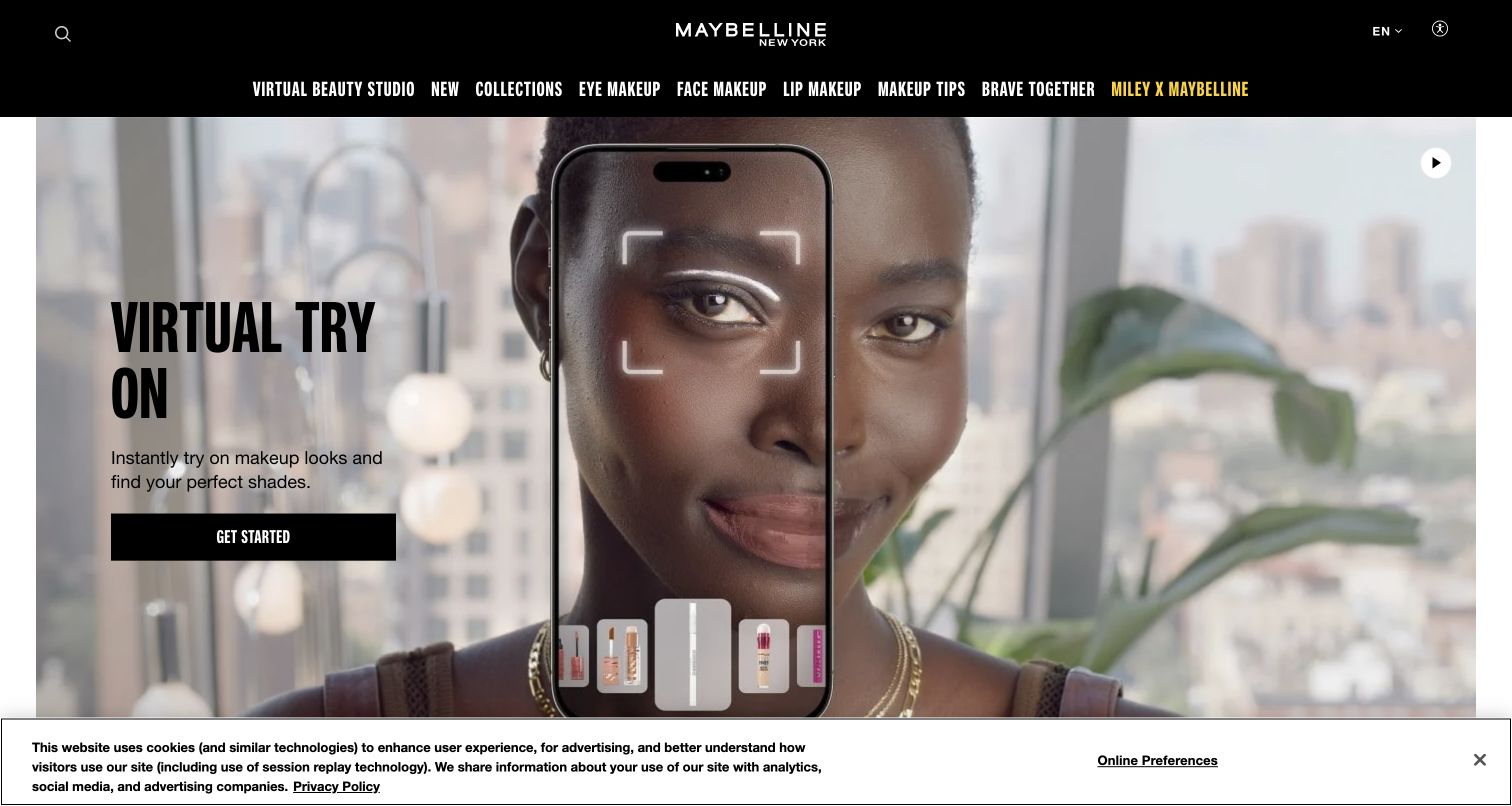
Maybelline’s try-on entrance places a large face and phone frame behind a short left-aligned introduction. The black header and condensed navigation type establish a strong brand frame, while a black starting button sits beneath the explanation. A small playback control acknowledges the moving demonstration. ModiFace’s February 2020 account links this brand’s browser makeup experience to TensorFlow.js. The screenshot records the current public entrance; it does not verify an unchanged engine or show a submitted face. The phone metaphor makes the intended interaction understandable before the visitor starts it.
What you can learn
Introduce a camera-based experience with a useful preview and an explicit next step. Keep ordinary product browsing available and explain permission choices before requesting access. The demonstration should help visitors understand the outcome without implying that every screen or lighting condition produces the same result.
Pros
The phone frame makes the try-on concept immediately recognizable.
A single starting action gives the large image a practical destination.
Cons & considerations
The dense header competes with the short introductory copy.
The demonstration needs an accessible explanation beyond moving imagery.
Visible tech stack
Earlier / documented evidence
TensorFlow
Earlier cited evidence retained; no current scan result. References may be embedded or legacy—not a complete backend inventory.
Platform source: Official dated feature evidence (undated where stated). Documentary feature association; see exact variant, date and limits in technology evidence. Public capture does not independently verify model runtime. Platform evidence is separate from the direct website screenshot and is not a complete current infrastructure audit.
Armani Beauty introduces its virtual try-on through oversized cosmetic packaging on a red textured background. A compact serif heading and short explanation occupy the opposite side, with a black action below. The white header preserves the store’s conventional categories and product search. A February 2020 ModiFace account documents this brand’s TensorFlow.js browser try-on. The current entrance is a later public page, so the evidence remains historical and does not establish its present engine. Packaging provides a tangible product reference even though no camera permission or trial was started.
What you can learn
Make an interactive aid feel like part of the shopping journey rather than a detached technical experiment. Keep its introduction short, relate it to specific products, and provide a route back to shade and product information. Test whether the next step explains what data the experience needs.
Pros
The composition ties the tool directly to recognizable products.
Conventional store navigation stays available above the feature.
Cons & considerations
Small explanatory text has limited prominence beside large packaging.
The opening does not show how the result can be compared or saved.
Visible tech stack
Earlier / documented evidence
TensorFlow
Earlier cited evidence retained; no current scan result. References may be embedded or legacy—not a complete backend inventory.
Platform source: Official dated feature evidence (undated where stated). Documentary feature association; see exact variant, date and limits in technology evidence. Public capture does not independently verify model runtime. Platform evidence is separate from the direct website screenshot and is not a complete current infrastructure audit.
Urban Decay’s public try-on page gives most of the opening viewport to a close-up beauty demonstration. The settled capture shows a lip-color example below a white navigation shell and black promotional strip. Below the media, the page separates eye, face, and lip exploration into named sections. ModiFace’s February 2020 TensorFlow.js evidence specifically links the brand’s Vice Lipstick experience. The broader current entrance is illustrative; it does not prove that every new category retains the same implementation. No trial was launched and no face or camera stream was supplied.
What you can learn
Use motion to explain a visible change, then provide ordinary labeled routes for each product category. Give the demonstration a useful poster and playback controls. Preserve the difference between a historically documented lipstick capability and later features that require their own technical verification.
Pros
The close-up makes the intended cosmetic change easy to understand.
Named category sections provide routes beyond the opening video.
Cons & considerations
The large demonstration pushes explanatory copy below the first view.
A delayed media poster can briefly communicate little about the tool.
Visible tech stack
Earlier / documented evidence
TensorFlow
Earlier cited evidence retained; no current scan result. References may be embedded or legacy—not a complete backend inventory.
Platform source: Official dated feature evidence (undated where stated). Documentary feature association; see exact variant, date and limits in technology evidence. Public capture does not independently verify model runtime. Platform evidence is separate from the direct website screenshot and is not a complete current infrastructure audit.
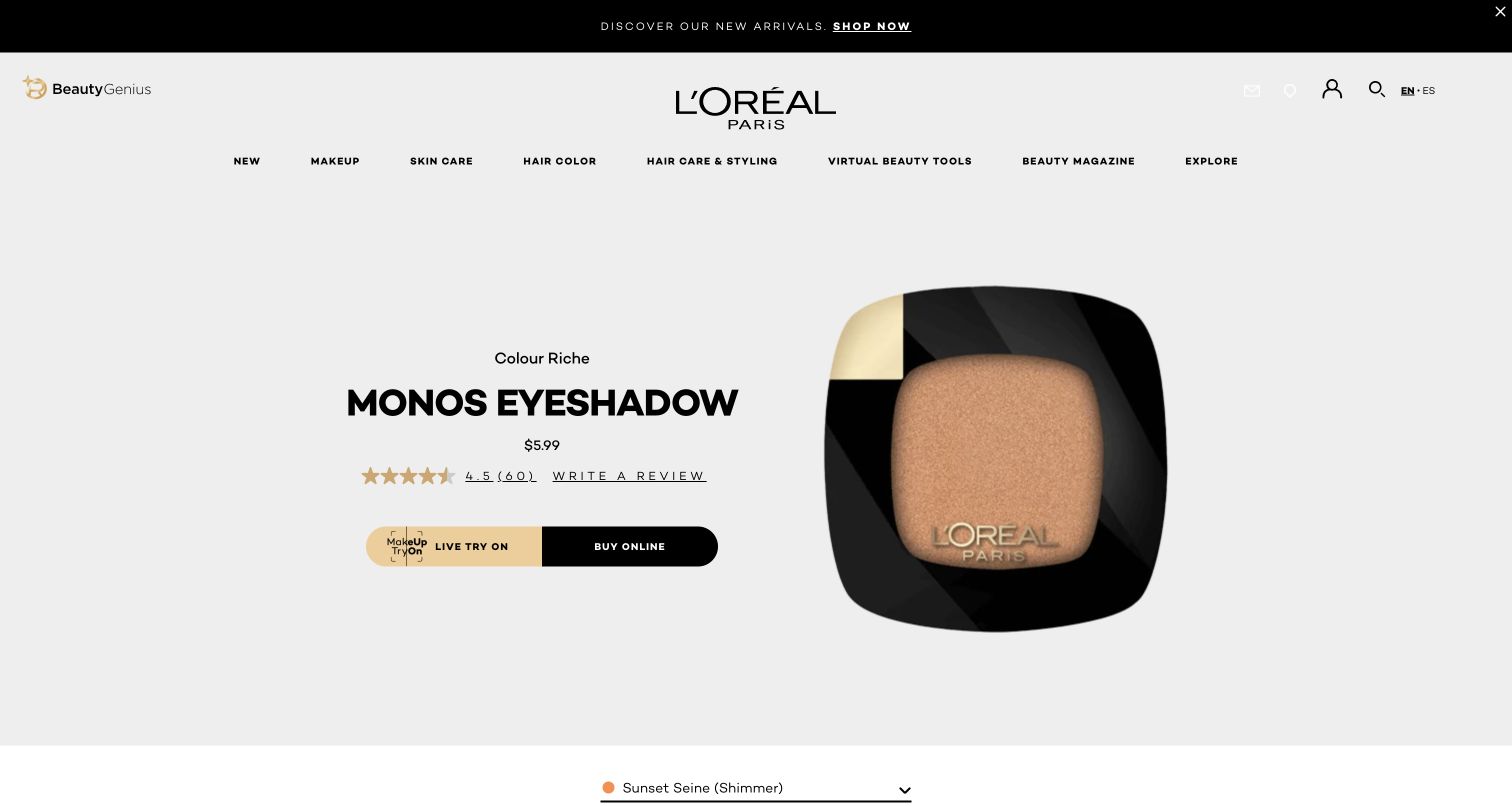
L’Oréal Paris’s eyeshadow page presents a large product pack against a pale background, with name, price, and review information grouped to the left. A two-part action bar puts the gold try-on option directly beside the black buying option. The February 2020 ModiFace account links this eyeshadow product’s browser try-on to TensorFlow.js. The source’s product route still reaches the current page, but current runtime continuity is unverified. The capture shows the public product surface after dismissing an incidental notice, without starting the trial or entering a purchase flow.
What you can learn
Place an optional visual aid where a shopper is already making a product decision. Preserve price, shade selection, and ordinary purchase information around it. Make the return path from the aid predictable, and avoid allowing an unrelated assistant panel to cover the product’s essential controls.
Pros
Try-on and buying actions are easy to compare side by side.
The large pack image keeps the precise product identifiable.
Cons & considerations
Widely spaced review text can be difficult to scan quickly.
Promotional assistants can obscure the otherwise simple product hierarchy.
Visible tech stack
Earlier / documented evidence
TensorFlow
Earlier cited evidence retained; no current scan result. References may be embedded or legacy—not a complete backend inventory.
Platform source: Official dated feature evidence (undated where stated). Documentary feature association; see exact variant, date and limits in technology evidence. Public capture does not independently verify model runtime. Platform evidence is separate from the direct website screenshot and is not a complete current infrastructure audit.
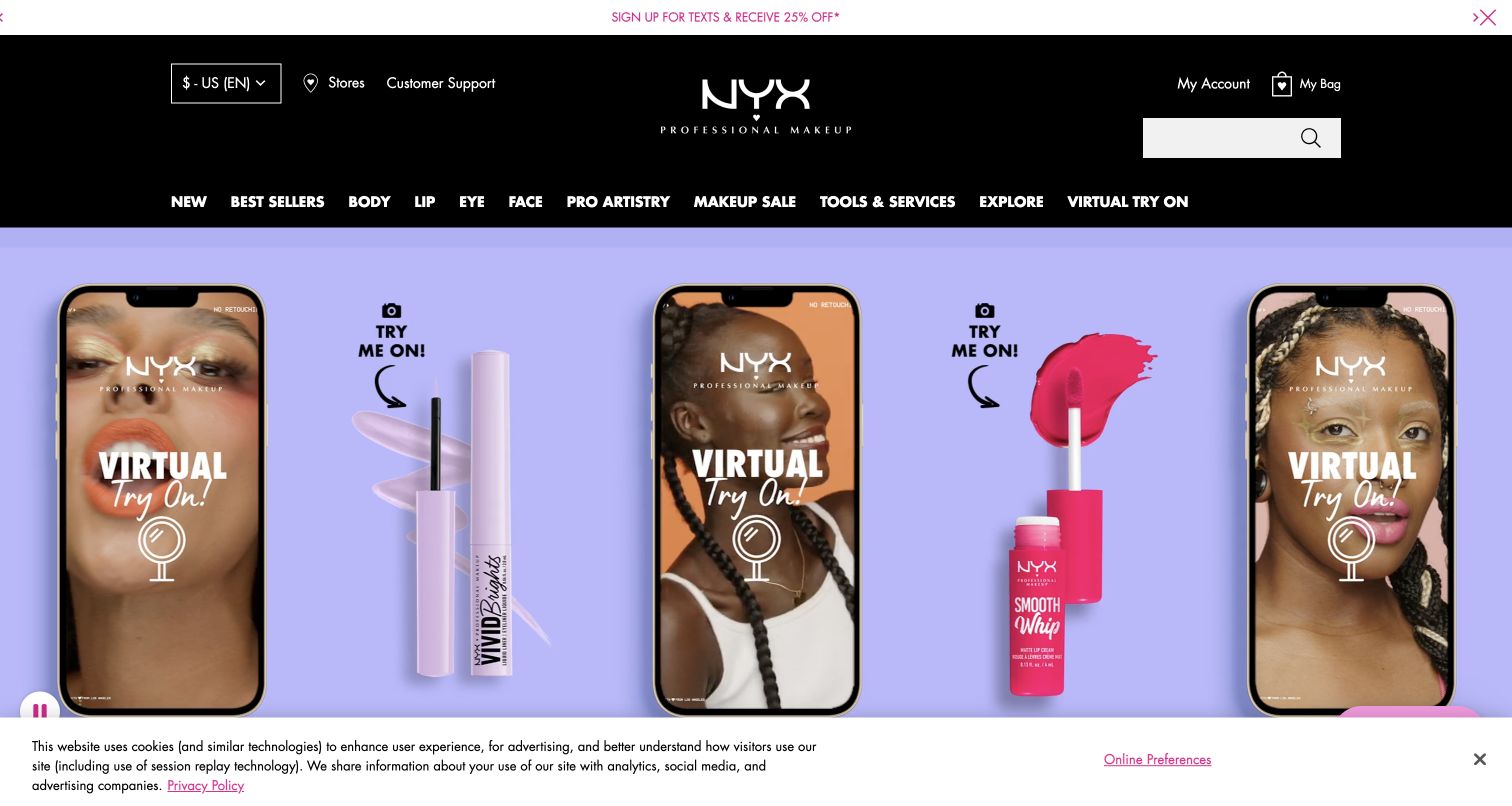
NYX’s public try-on entrance uses three phone-shaped portraits against a lavender field, interspersed with large product imagery and small try-on cues. The black store header, prominent search field, and bright cosmetic colors create a deliberately energetic composition. ModiFace’s February 2020 account links NYX Instant Looks to TensorFlow.js. That historical feature evidence is kept separate from the current page’s wider assortment and does not establish its present runtime. The observed page continues below the demonstration with an explicit starting action; no image was uploaded and no camera access was requested.
What you can learn
A repeated device frame can explain one interaction across different products, but it still needs a clear written start point. Keep the tool’s permission step and fallback browsing route understandable. Show variety without turning each portrait into a competing instruction or an implied guarantee of results.
Pros
Repeated frames make the interaction consistent across several looks.
Product imagery connects the demonstration to the store’s assortment.
Cons & considerations
The large header and demonstration delay the main starting control.
Dense promotional elements can compete with the instructional content.
Visible tech stack
Earlier / documented evidence
TensorFlow
Earlier cited evidence retained; no current scan result. References may be embedded or legacy—not a complete backend inventory.
Platform source: Official dated feature evidence (undated where stated). Documentary feature association; see exact variant, date and limits in technology evidence. Public capture does not independently verify model runtime. Platform evidence is separate from the direct website screenshot and is not a complete current infrastructure audit.
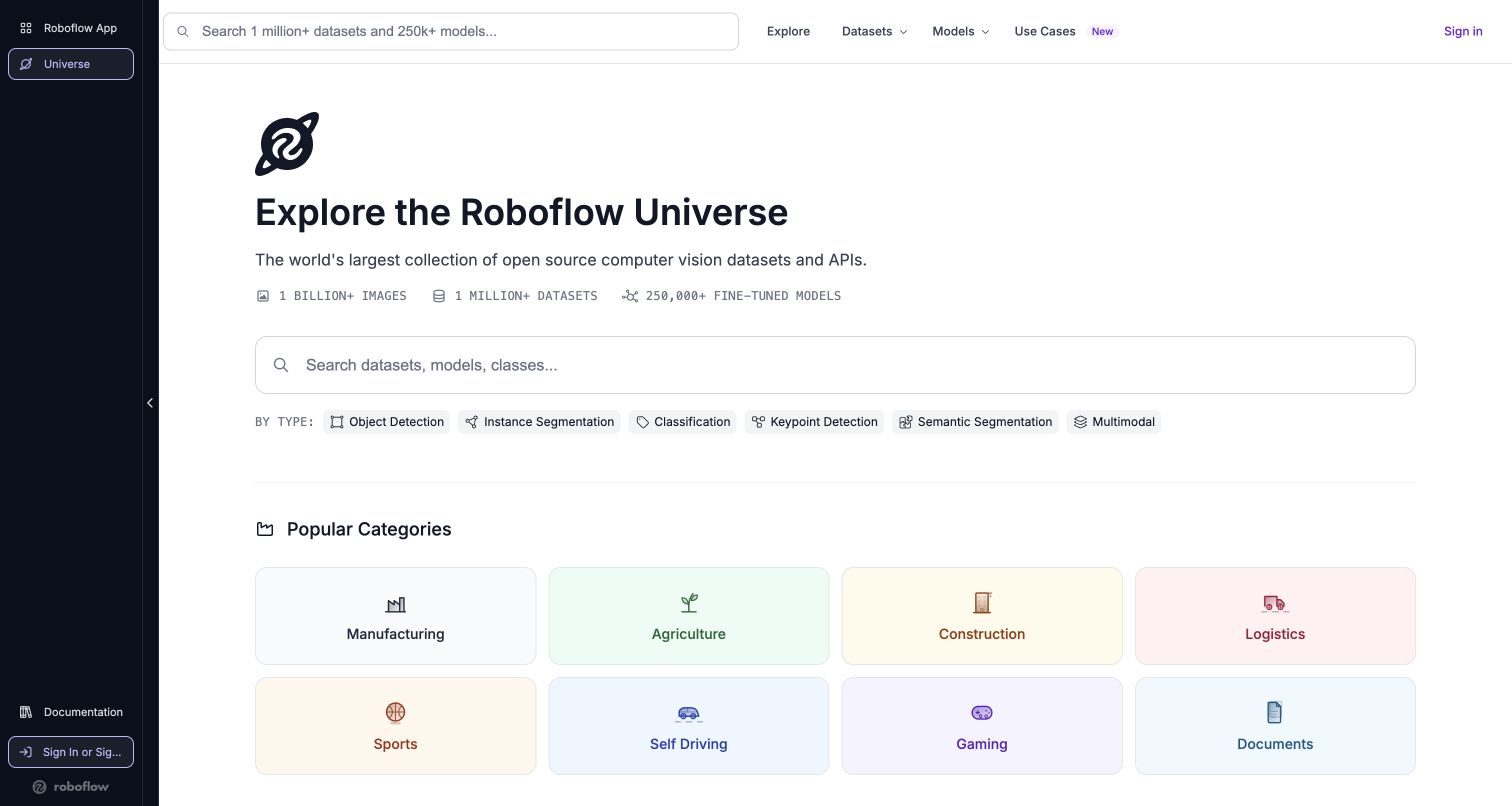
Roboflow Universe opens as a working discovery interface: a narrow dark sidebar, a wide top search field, and a spacious main area with another prominent search. Type filters distinguish detection, classification, and other tasks, while softly colored category tiles suggest application areas. A July 2022 TensorFlow article documents TensorFlow.js through roboflow.js in Universe’s browser Preview capability. The captured catalog entrance illustrates that product; it does not attribute every hosted model or deployment target to the same runtime. No dataset was uploaded and no preview inference was executed during capture.
What you can learn
Organize model discovery around the user’s problem and the kind of output required. Keep model cards connected to their documentation, licensing, and deployment choices. A preview should explain its inputs and limitations without letting the attractiveness of a sample result substitute for evaluation on representative data.
Pros
Task filters and application tiles offer complementary exploration paths.
The sidebar separates the catalog from account-oriented application work.
Cons & considerations
Two large search fields can create unnecessary visual repetition.
Catalog scale claims do not establish individual model suitability.
Visible tech stack
Earlier / documented evidence
TensorFlow
Earlier cited evidence retained; no current scan result. References may be embedded or legacy—not a complete backend inventory.
Platform source: Official dated feature evidence (undated where stated). Documentary feature association; see exact variant, date and limits in technology evidence. Public capture does not independently verify model runtime. Platform evidence is separate from the direct website screenshot and is not a complete current infrastructure audit.
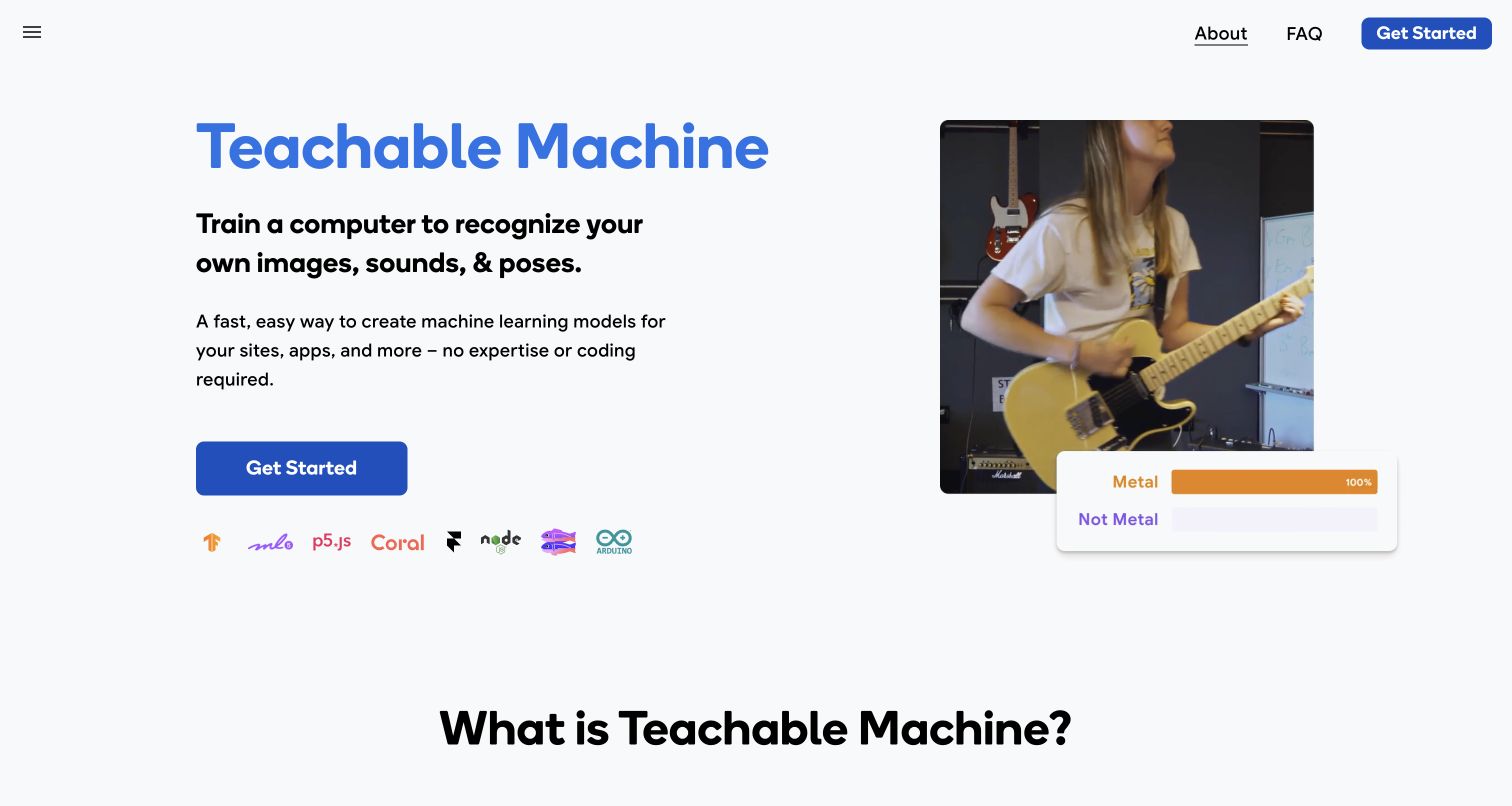
Teachable Machine places a large blue title and short explanation beside a playful classification demonstration. A strong starting button and a row of ecosystem marks sit beneath, while the next section begins with a direct explanation of the tool. Google’s November 2019 announcement documents browser training and TensorFlow.js model output. This is a functional public creation tool’s entrance, not evidence that a sample classifier is reliable for a real deployment. The demonstration illustrates the workflow without requiring the visitor’s own webcam, microphone, or files merely to understand the proposition.
What you can learn
Teach the sequence of gathering examples, training, and evaluating before encouraging export. Make uncertainty visible and include examples that fail, not only flattering predictions. A friendly starting interface should lead to clear data and testing responsibilities as the visitor moves toward a practical application.
Pros
The sample prediction makes the abstract training concept tangible.
The large starting action is easy to find without technical knowledge.
Cons & considerations
A playful demonstration can understate the work of reliable evaluation.
Several ecosystem marks need explanation for an unfamiliar audience.
Visible tech stack
Referenced on the public page
Google Fonts
Earlier / documented evidence
TensorFlow
Public source checked November 3, 2026. References may be embedded or legacy—not a complete backend inventory.
Platform source: Official dated feature evidence (undated where stated). Documentary feature association; see exact variant, date and limits in technology evidence. Public capture does not independently verify model runtime. Platform evidence is separate from the direct website screenshot and is not a complete current infrastructure audit.
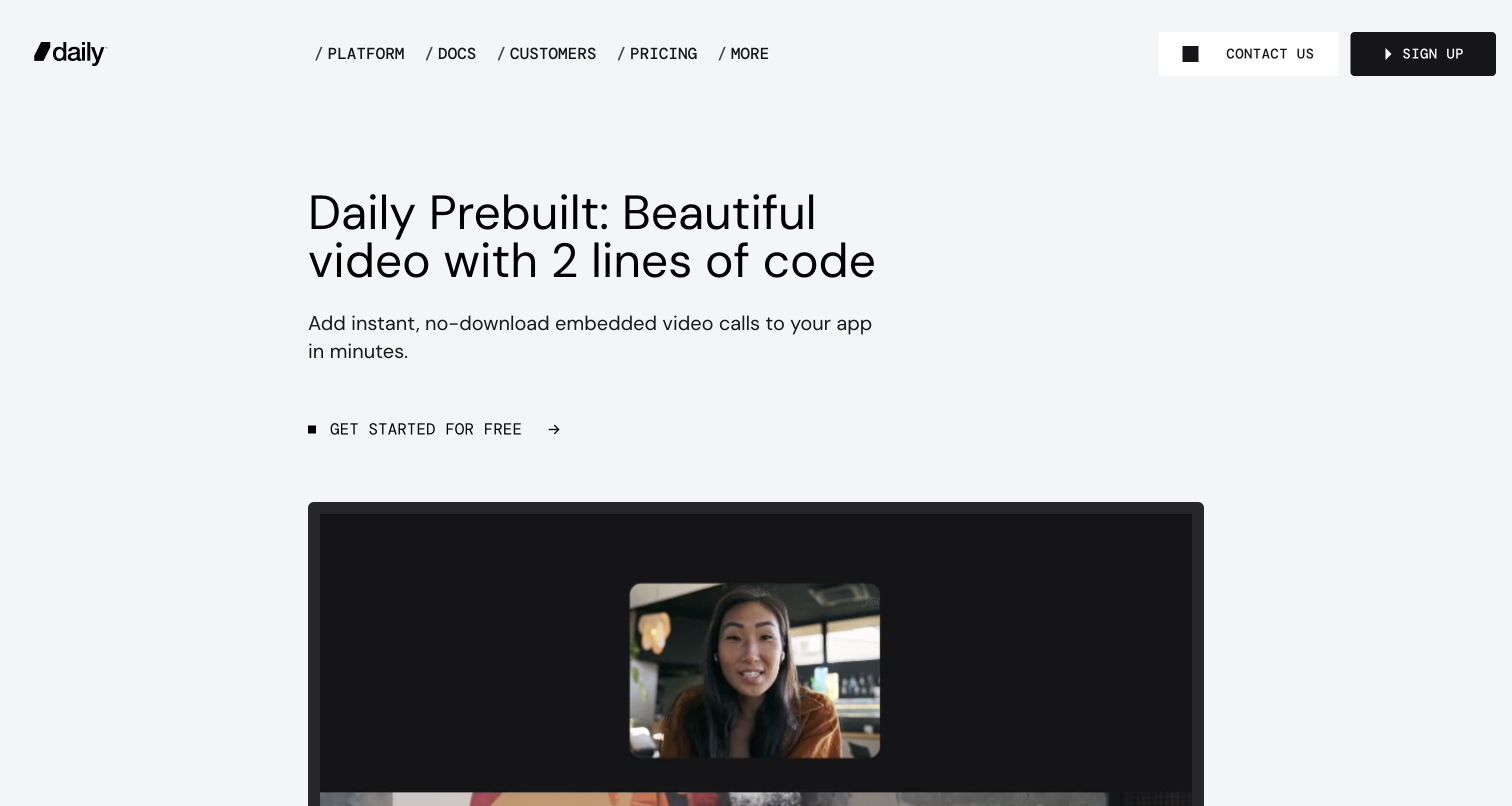
Daily Prebuilt’s public product page uses a pale background, a plain large heading, and compact developer-oriented navigation. The introductory action is followed by a dark video-call illustration, giving the broad embedding promise a concrete interface reference. Daily’s May 2022 article explicitly describes shipped Prebuilt background effects using a TensorFlow WASM backend with MediaPipe segmentation. This is historical feature evidence, not proof that the marketing page or every current call capability uses that implementation. The capture contains the public product entrance after its cookie notice was dismissed; no meeting or device permission was opened.
What you can learn
Introduce an embedded communication feature through its user experience as well as its integration story. Plan loading, denied-device, and low-capability states before polishing backgrounds. Keep a basic call usable when optional effects are unavailable, and document which system owns each part of the experience.
Pros
A compact introduction leads directly to a recognizable call illustration.
The navigation separates platform learning from signup and contact routes.
Cons & considerations
The short integration promise leaves operational detail for later reading.
The first viewport shows only part of the call demonstration.
Public source checked November 3, 2026. References may be embedded or legacy—not a complete backend inventory.
Platform source: Official dated feature evidence (undated where stated). Documentary feature association; see exact variant, date and limits in technology evidence. Public capture does not independently verify model runtime. Platform evidence is separate from the direct website screenshot and is not a complete current infrastructure audit.
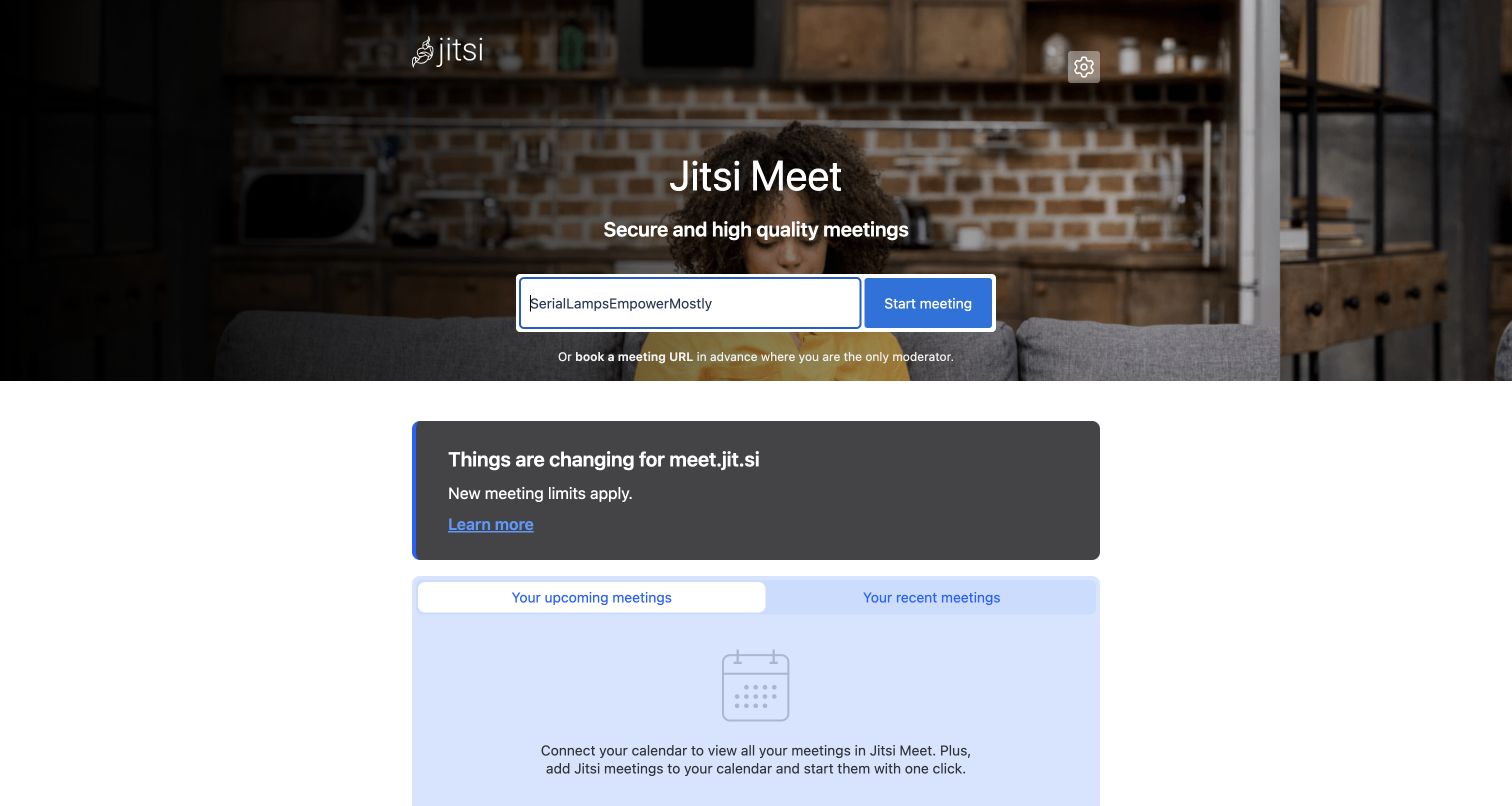
Jitsi Meet’s public entrance centers its name, a room field, and a blue meeting action over a dimmed interior photograph. A prominent service-change notice follows, then a calendar panel offering an optional connection. No calendar was connected and no meeting was started. Jitsi’s March 2021 release documents virtual backgrounds deployed to meet.jit.si using TensorFlow Lite and MediaPipe Meet Segmentation, replacing an older BodyPix approach. The capture is the current entrance; it does not verify today’s background implementation or turn that historical TensorFlow Lite scope into a TensorFlow.js claim.
What you can learn
Keep the essential meeting path short while giving service limitations a visible place. Treat background processing as an optional enhancement with its own capability checks. Design camera and microphone permission explanations carefully, and preserve a useful path when the user declines an integration or effect.
Pros
The room field and meeting action form one obvious starting unit.
Service changes are surfaced before a visitor enters a call.
Cons & considerations
Several secondary calendar and platform messages lengthen the entrance.
The background photograph needs sufficient contrast behind small text.
Public source checked November 3, 2026. References may be embedded or legacy—not a complete backend inventory.
Platform source: Official dated feature evidence (undated where stated). Documentary feature association; see exact variant, date and limits in technology evidence. Public capture does not independently verify model runtime. Platform evidence is separate from the direct website screenshot and is not a complete current infrastructure audit.
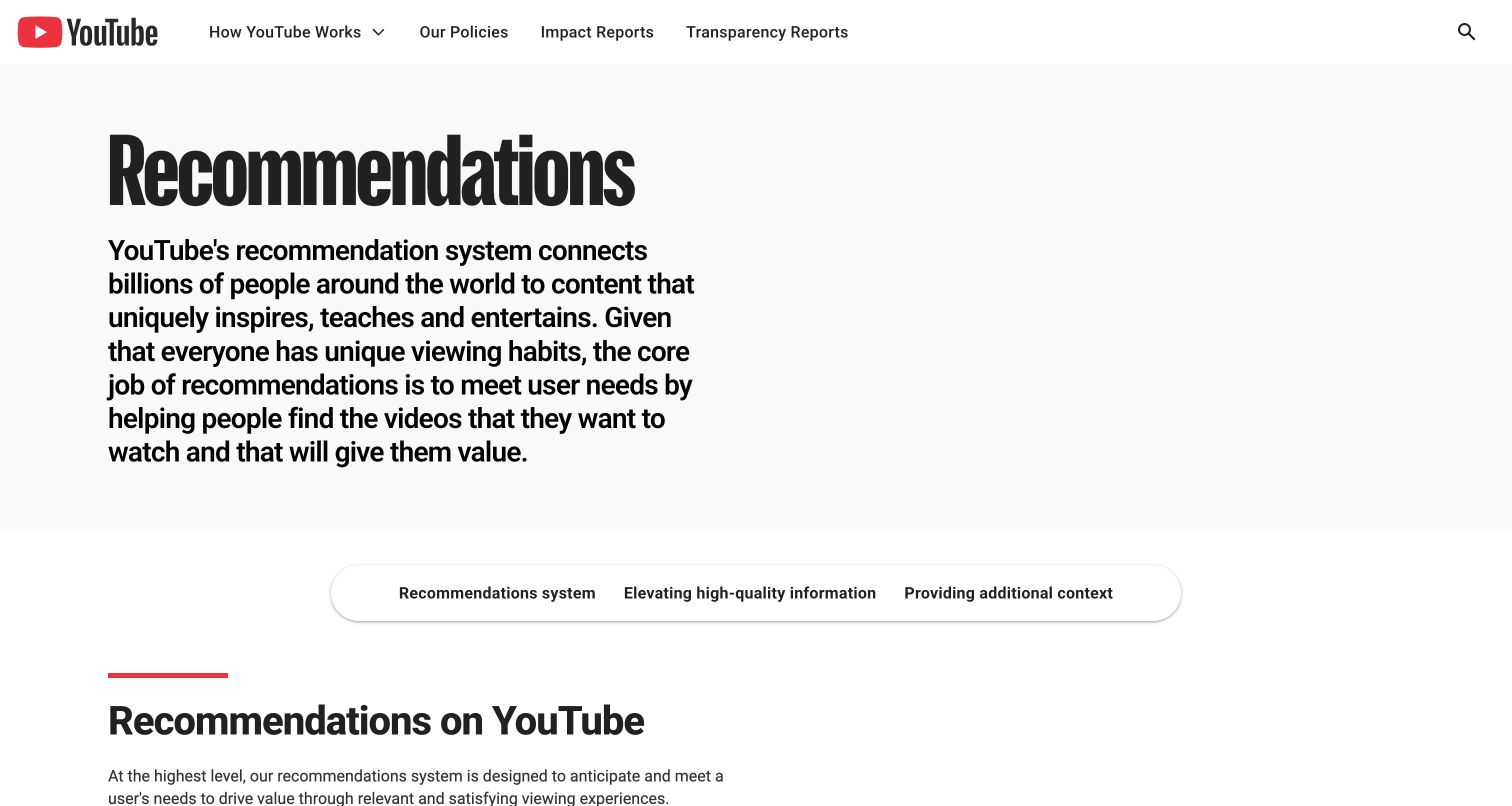
YouTube’s public recommendation explanation uses an oversized condensed heading and a substantial introductory paragraph on a pale field. A rounded three-part section bar separates recommendation mechanics, information quality, and additional context. The familiar wordmark anchors a restrained header. TensorFlow’s December 2022 indexed official article explicitly names TensorFlow Recommenders in major YouTube recommendation surfaces. The full source was rate-limited, so only that actual indexed statement supports the technology association. This screenshot is an informational product entrance, not a private feed, and it does not establish the current recommendation runtime.
What you can learn
Give algorithmic discovery a public explanation that can be read without exposing someone’s viewing history. Separate how suggestions are selected from how sensitive information is contextualized. Link that explanation to understandable user controls, and avoid presenting a polished information page as proof of recommendation effectiveness.
Pros
Strong headings make the explanation easy to identify and navigate.
The section bar separates related but different recommendation questions.
Cons & considerations
The large opening paragraph creates a dense first reading block.
An explanatory page cannot substitute for testing actual discovery controls.
Visible tech stack
Referenced on the public page
Google Fonts
Earlier / documented evidence
TensorFlow
Public source checked November 3, 2026. References may be embedded or legacy—not a complete backend inventory.
Platform source: Official dated feature evidence (undated where stated). Documentary feature association; see exact variant, date and limits in technology evidence. Public capture does not independently verify model runtime. Platform evidence is separate from the direct website screenshot and is not a complete current infrastructure audit.
Choose where the model belongs in the web experience
A browser interaction with an explicit start
For a visual preview or local experiment, define the initial loading state, the required device capability, and the fallback before building the demonstration. Ask permission only when the person reaches the relevant action. Test the slowest realistic device and preserve conventional navigation around the tool.
Search and recommendation systems can retain ordinary fields, lists, and controls while model work happens elsewhere. Specify request limits, degraded behavior, freshness expectations, and ownership of result explanations. Do not allow a failed prediction service to make the surrounding website unusable.
A model-building tool needs to teach collection, training, testing, and export as separate steps. Give users room to inspect failures and revise examples. Keep sample demonstrations clearly labeled, and make deployment responsibilities explicit before a successful preview is treated as a finished product.
From references to requirements
Brief the model feature and the surrounding product together
Define evidence and scope
Record the source, publication date, exact model family, production status, and named product for every architectural reference. Separate a current public screenshot from a historical engineering claim. A company logo, partnership, or internal productivity story cannot establish the architecture of its public web product.
Prepare representative inputs
Use a reviewed set of realistic and awkward examples to evaluate the feature, including inputs the product should reject or handle conservatively. Identify who owns corrections and how the team will notice meaningful regressions. Choose success criteria that reflect the actual user task rather than a flattering demonstration.
Assign ongoing operational ownership
Name the people responsible for model changes, interface copy, dependency updates, monitoring, and rollback. Document what an editor may change without retraining or redeploying the feature. Keep a versioned record linking the released interface, model behavior, and the evaluation used to approve it.
A useful handover demonstration
Ask the actual team to carry out its routine job: publish a realistic update, correct a mistake, preview a narrow screen, and identify who owns an integration failure. For a library or frontend framework, also ask who maintains the content source and deployment. A polished screenshot does not answer those operational questions.
Beyond the screenshot
Review a TensorFlow-backed feature before launch
Identify the exact TensorFlow-family variant and where it runs.
Document the user task, baseline, and measurable acceptance criteria.
Test realistic inputs, unsupported cases, and uncertain predictions.
Check loading, error, timeout, and fallback behavior in the interface.
Review device permissions and the actual path of user-provided data.
Test keyboard navigation, small screens, motion, and readable status messages.
Assign model, dependency, monitoring, and rollback ownership.
Keep technical claims tied to dated evidence and the named feature.
Test with real content, a keyboard, a small screen, slow or failed requests, and the people who will maintain the system. These are planning checks, not an accessibility, security, performance, or search-ranking certification.
Sources & editorial method
How this TensorFlow collection was reviewed
Twenty distinct public properties were captured directly in the browser on November 4, 2026 UTC for the November 3 Pacific editorial run. Account headers were excluded in four genuine body captures; no private files, messages, recommendations, or meeting content were captured. Public product and informational entrances are labeled. Documentary sources retain their dates and exact variants; undated catalog evidence is identified. YouTube and Google Play rely only on the actual indexed official TensorFlow recommendation statement after two full-source rate-limit failures. The reviews assess visible design, not prediction accuracy, accessibility conformance, conversion, or current runtime continuity. Broader stack findings are a separate evidence layer.
Every image is an unmodified capture from the actual website, with its source and capture date. Some captures are reused from our shared catalog; their dates remain the original capture dates. None comes from a vendor gallery or a generated reconstruction. Moving imagery and live content can change.
Technology attribution uses public page assets or metadata, official platform documentation, or a cited first-party project case study. Documentary and framework-relationship evidence is identified where used; it is not a complete current backend inventory. A CMS image CDN alone does not establish a full CMS deployment. A library’s presence does not prove which individual controls use it, and a platform label does not establish AI authorship.
The composition notes, lessons, pros and tradeoffs are original editorial observations. We have not measured conversion, traffic, security, performance or accessibility conformance. Website owners retain their brands and imagery; these examples are not our client portfolio. Written, Edited and Curated are independent records, not dates advanced by a build. See our editorial standards or suggest a correction.
Questions worth asking
TensorFlow website development FAQs
Does every screenshot show TensorFlow running in the browser?
No. Some sources document a backend feature or historical architecture. A public marketing or informational capture illustrates that product, and the accompanying evidence explains exactly what is supported. TensorFlow.js browser examples are labeled separately from other variants.
Why include public product entrances instead of signed-in screens?
Personalized interfaces can contain private files, messages, viewing history, or recommendations. Public entrances allow the product to be reviewed without exposing that data. They cannot demonstrate the private feature’s current behavior or model quality.
Does an old engineering article prove a current implementation?
No. Its date is part of the claim. Treat the documented feature as a historical reference unless a later primary source or direct inspection independently establishes the current implementation.
Should a new website copy a large brand’s model architecture?
Start with the task, available data, evaluation requirements, and operating capacity. Borrow an interface pattern only when it improves that task. A recognizable brand and an attractive screenshot do not establish that its architecture is suitable for another project.