Definitive guide · Elasticsearch website development
Best Elasticsearch Websites of 2026 (20 Real-World Examples)
Elasticsearch-associated websites: discovery patterns, sourced workloads, and search planning
These 20 public website examples have official evidence for a specific Elasticsearch search, retrieval, or analytics workload. The screenshots show public design. They do not prove that a marketing homepage runs on Elasticsearch, that every company search uses it, or that a generated answer is correct.
A search index and an authoritative business record have different responsibilities. Elasticsearch can support property discovery, agreement retrieval, institutional knowledge, or editorial analytics while other systems own the underlying facts. This guide treats that separation as a design advantage: people should understand what a result represents, where it came from, and what they can safely do next.
GitHub, Docusign, BMW, Tinder, and BBVA form the recognizable opening, with individual official customer accounts. Their documented roles range from semantic document discovery and agreement management to vehicle stock, geographically filtered candidates, and transaction-history search. The public captures introduce those organizations without exposing private repositories, agreements, profiles, or bank records.
Before the examples
What makes good Elasticsearch website development in 2026?
Define what a good result means
Create a small, realistic query set before choosing a ranking approach. Include a known identifier, an ambiguous phrase, a misspelling, and a query that should return nothing. Judge results by the user’s next decision rather than by a large index count or the presence of an AI label.
Official mapping guidance distinguishes full-text fields, exact values, numbers, dates, and geographic information. Text analysis affects how language is interpreted. Decide which distinctions the interface must preserve—for example, a model code versus descriptive text—before relying on automatic field inference or a generic query box.
Keep authority and permission outside the relevance score
A highly relevant result can still be stale, unauthorized, or unsuitable for a particular action. Carry source identity, update state, and the appropriate access boundary into the retrieval design. In a RAG workflow, inspect the evidence behind an answer rather than treating fluent output as proof.
The collection · 20 examples
20 Elasticsearch website examples worth studying
Each review pairs original public-page criticism with a separately scoped Elasticsearch association and a November 8, 2026 evidence check. The Guardian’s Ophan account and eBay’s 2017 internal-service session are explicitly historical. Elastic product names alone are not used as substitutes for exact Elasticsearch evidence.
We start with five recognizable brands or organizations: GitHub — Features, Docusign, BMW, Tinder, BBVA. Each attribution applies to the named website property, not every product or website belonging to its organization. This is a curated reading sequence, not a measured ranking.
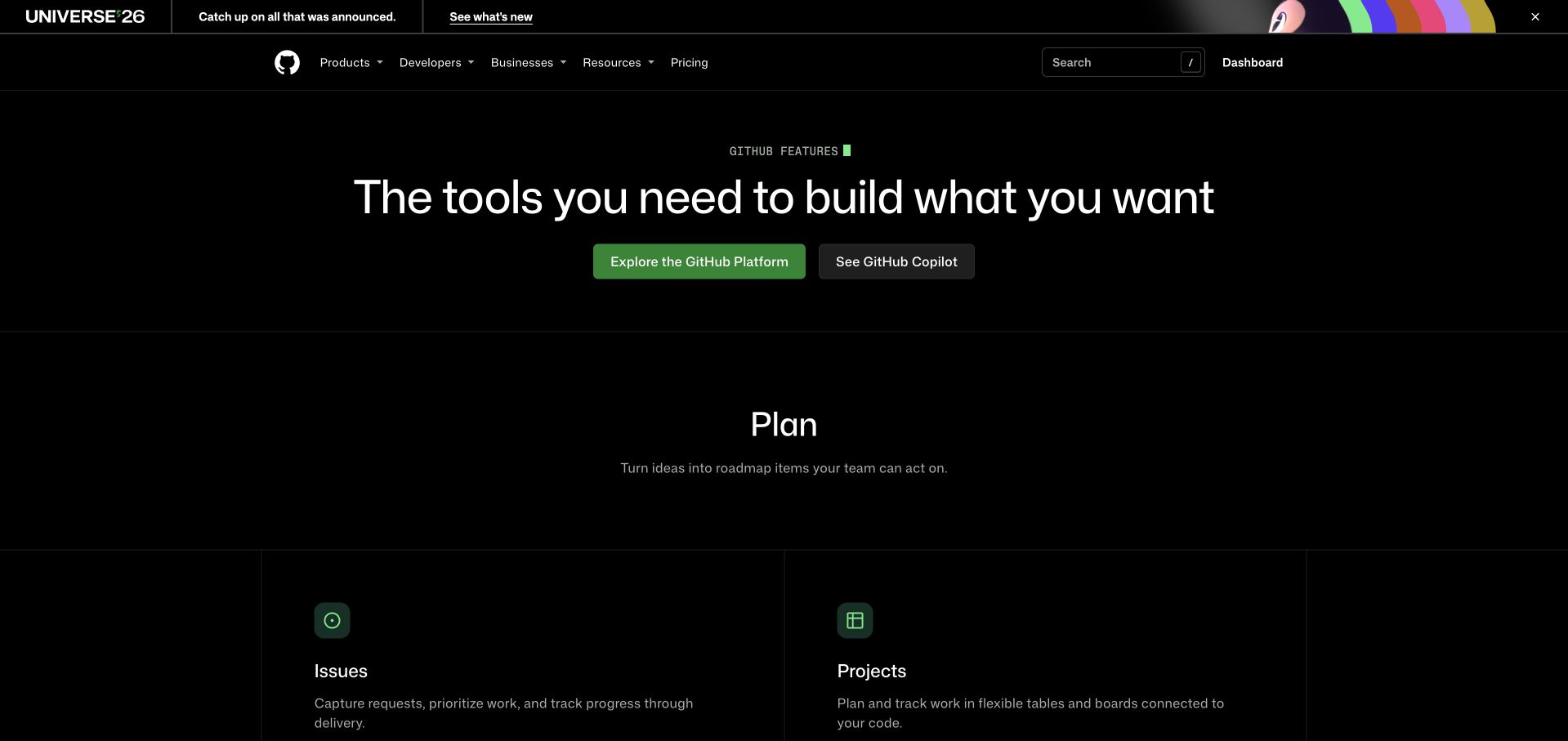
GitHub’s feature overview groups an expanding developer platform into recognizable areas of work rather than presenting infrastructure first. The public page gives visitors routes into collaboration, automation, and AI-related capabilities without exposing a private repository. Its main design challenge is hierarchy: a newcomer needs a meaningful starting point before a broad platform story becomes an actionable product choice. Documented association checked November 8, 2026: Elasticsearch on Elastic Cloud for semantic discovery across GitHub’s repository-related documents; feature-overview screenshot is separate from backend evidence.
What you can learn
Separate semantic discovery from the authoritative repository record. The documented Elasticsearch workload concerns discovery across repository-related documents; it does not establish that all code storage, permissions, or current search features share one implementation. A useful search design still needs clear result context and access boundaries.
Pros
Public feature grouping provides orientation without requiring the visitor to disclose or open a private project.
Developer-focused explanations connect the product portfolio with recognizable work rather than only corporate positioning.
Cons & considerations
A broad capability story can make the most relevant starting point difficult for less experienced visitors.
The marketing overview does not reveal the corpus, relevance rules, or authorization checks of individual search services.
Platform source: Official Elasticsearch customer or product evidence. Elasticsearch on Elastic Cloud for semantic discovery across GitHub’s repository-related documents; feature-overview screenshot is separate from backend evidence. Official source reviewed November 8, 2026 Pacific; no complete current-stack audit is implied. Official documentary association is scoped to the named product, workload, dependency, or database service. No marketing-homepage runtime, complete company stack, independent performance, or private customer workflow is inferred. Platform evidence is separate from the direct website screenshot and is not a complete current infrastructure audit.
Docusign’s public presentation expands a familiar signing category into a wider agreement-management proposition. Product routes and enterprise explanations must help visitors distinguish completing a signature from organizing and understanding a body of agreements. That is a useful design problem: an established brand can introduce adjacent capabilities, but it must preserve the simple task that made many customers recognize it in the first place. Documented association checked November 8, 2026: Elasticsearch in Docusign IAM’s Navigator agreement repository and natural-language contract discovery.
What you can learn
Make agreement retrieval a permission-aware information journey. The Navigator case documents Elasticsearch inside the IAM agreement repository, not the database for every signature or public page; a result should explain which agreement it comes from and what further action the viewer is allowed to take.
Pros
A recognizable signing identity gives the broader agreement-management proposition a familiar initial anchor.
Product organization can separate document completion from ongoing agreement discovery and management needs.
Cons & considerations
An expanded platform narrative may add interpretation work for visitors who only need a simple signing task.
The public page cannot demonstrate permissions or the correctness of natural-language answers about private agreements.
Platform source: Official Elasticsearch customer or product evidence. Elasticsearch in Docusign IAM’s Navigator agreement repository and natural-language contract discovery. Official source reviewed November 8, 2026 Pacific; no complete current-stack audit is implied. Official documentary association is scoped to the named product, workload, dependency, or database service. No marketing-homepage runtime, complete company stack, independent performance, or private customer workflow is inferred. Platform evidence is separate from the direct website screenshot and is not a complete current infrastructure audit.
BMW’s pictured US property uses large vehicle imagery and model-oriented navigation to connect brand aspiration with practical product exploration. The visual entrance makes the category immediate, while specific vehicle routes give buyers a way beyond the campaign. Its transferable lesson is that a sophisticated brand experience still needs an understandable route to a concrete item with relevant specifications and availability information. Documented association checked November 8, 2026: Elasticsearch backbone for BMW Group’s Vehicle Search Service and central stock-vehicle repository.
What you can learn
Keep the central Vehicle Search Service separate from the public campaign surface. Its Elasticsearch index supports stock discovery, but a polished model page does not prove current local availability. A similar project should define how geographic filters, inventory updates, and individual vehicle records reach the customer.
Pros
Vehicle imagery communicates the brand and product category before a visitor reads detailed specifications.
Model-oriented navigation provides a practical path from an aspirational campaign to more concrete research.
Cons & considerations
Large campaign content can postpone the details needed to compare closely related vehicles or configurations.
The public screenshot cannot independently validate inventory freshness or the search service behind every regional property.
Platform source: Official Elasticsearch customer or product evidence. Elasticsearch backbone for BMW Group’s Vehicle Search Service and central stock-vehicle repository. Official source reviewed November 8, 2026 Pacific; no complete current-stack audit is implied. Official documentary association is scoped to the named product, workload, dependency, or database service. No marketing-homepage runtime, complete company stack, independent performance, or private customer workflow is inferred. Platform evidence is separate from the direct website screenshot and is not a complete current infrastructure audit.
Tinder’s public homepage uses oversized typography and a small set of adoption actions to express a familiar interaction model. Product, subscription, safety, and support navigation remain separate from account creation. The captured page is a public introduction, not a view of personal profiles or matches, which makes its marketing clarity possible to study without inspecting a private dating experience. Documented association checked November 8, 2026: Elasticsearch-based candidate retrieval and geo-indexed filtering in Tinder’s recommendation architecture.
What you can learn
Treat candidate retrieval as one stage of a recommendation system. The Elasticsearch case describes geographically filtered candidates, not a guarantee about compatibility, safety, or every ranking decision; a new service still needs explicit consent, eligibility, and permission rules outside the search index.
Pros
A focused headline and limited primary actions make the public page’s purpose easy to understand.
Safety and support routes remain visible without requiring access to a personal profile or matching session.
Cons & considerations
A highly condensed proposition leaves many practical questions about the actual service for deeper pages.
The public introduction cannot reveal recommendation quality, individual eligibility, or private account behavior.
Platform source: Official Elasticsearch customer or product evidence. Elasticsearch-based candidate retrieval and geo-indexed filtering in Tinder’s recommendation architecture. Official source reviewed November 8, 2026 Pacific; no complete current-stack audit is implied. Official documentary association is scoped to the named product, workload, dependency, or database service. No marketing-homepage runtime, complete company stack, independent performance, or private customer workflow is inferred. Platform evidence is separate from the direct website screenshot and is not a complete current infrastructure audit.
BBVA’s Spanish public banking page combines a prominent account offer with a recognizable product-and-service frame. The promotional panel is visually clear, while navigation separates personal, business, and other audiences. The page is useful for studying how a large bank presents one concrete acquisition proposition without abandoning its broader service architecture, although the offer’s detail requires careful reading beyond the headline. Documented association checked November 8, 2026: Elasticsearch for unified transaction search and banking-data applications.
What you can learn
Distinguish transaction-history retrieval from transaction execution. BBVA’s documented Elasticsearch use concerns banking-data search and aggregation; it does not prove the datastore or authorization rules of this public account offer, and it cannot independently validate balances or financial records inside a customer session.
Pros
Audience navigation helps visitors distinguish personal banking from other parts of a large financial institution.
A concrete account proposition is easier to understand than a broad list of unrelated banking benefits.
Cons & considerations
Promotional emphasis can compete with the recurring service tasks that bring existing customers back.
The public page cannot demonstrate the freshness, completeness, or authorization of private transaction-history search.
Visible tech stack
Earlier / documented evidence
Elasticsearch
Platform source: Official Elasticsearch customer or product evidence. Elasticsearch for unified transaction search and banking-data applications. Official source reviewed November 8, 2026 Pacific; no complete current-stack audit is implied. Official documentary association is scoped to the named product, workload, dependency, or database service. No marketing-homepage runtime, complete company stack, independent performance, or private customer workflow is inferred. Platform evidence is separate from the direct website screenshot and is not a complete current infrastructure audit.
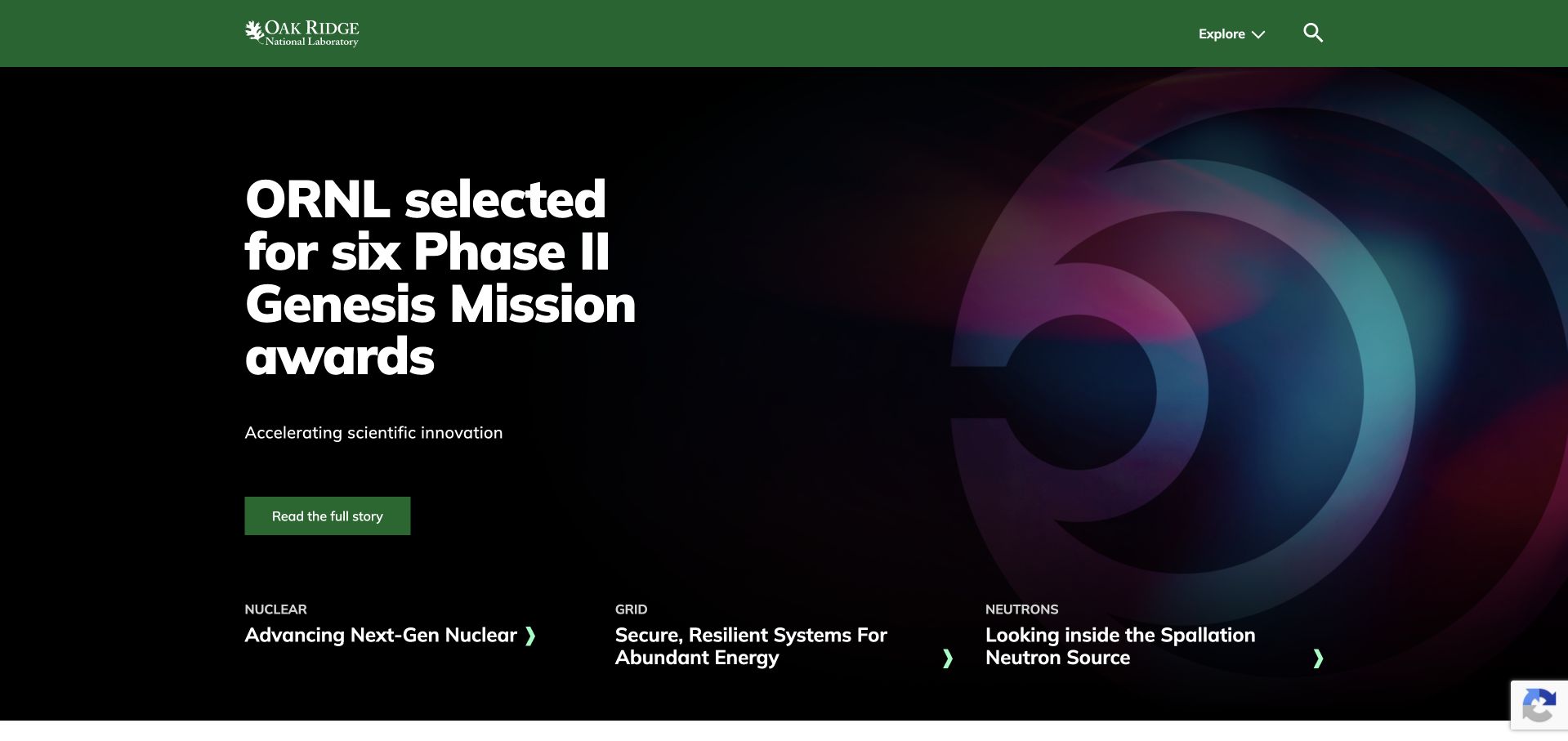
Oak Ridge National Laboratory leads with a current research announcement, then offers career and institutional-science routes. Large imagery gives the public page a strong sense of place and purpose, while thematic sections organize a very broad scientific organization. The design supports public understanding and recruitment, but it is distinct from the internal knowledge service described in the Elasticsearch evidence. Documented association checked November 8, 2026: Elasticsearch in an institutional-knowledge discovery service for laboratory staff.
What you can learn
Plan institutional search around the staff questions and permitted sources it must serve. A public laboratory site can introduce the organization without exposing internal documents; the case-study association does not imply that classified, private, and public information belong in one unrestricted searchable corpus.
Pros
A current research story gives a large scientific institution a concrete public entrance and editorial focus.
Thematic science and career routes accommodate audiences who do not share the same information needs.
Cons & considerations
Institution-wide themes may require further explanation before a specialist locates a particular program or resource.
The public homepage does not demonstrate access controls or relevance inside an internal staff knowledge service.
Platform source: Official Elasticsearch customer or product evidence. Elasticsearch in an institutional-knowledge discovery service for laboratory staff. Official source reviewed November 8, 2026 Pacific; no complete current-stack audit is implied. Official documentary association is scoped to the named product, workload, dependency, or database service. No marketing-homepage runtime, complete company stack, independent performance, or private customer workflow is inferred. Platform evidence is separate from the direct website screenshot and is not a complete current infrastructure audit.
Canals introduces its platform through three recognizable supply-chain audiences: distributors, manufacturers, and contractors. Real-world workplace imagery and separate audience panels make an AI proposition more concrete. The useful pattern is not the headline alone but the way the page connects a shared technology story with different operational roles, each of which arrives with its own vocabulary and purchasing process. Documented association checked November 8, 2026: Elasticsearch hybrid product search for a wholesale-distribution AI platform.
What you can learn
Use the product-search case to define relevance for a specialist catalog. Hybrid retrieval needs a test set that reflects real distributor queries, product identifiers, and vocabulary; the marketing page and vendor-reported results do not independently establish accuracy for a new customer’s inventory.
Pros
Explicit audience panels make the platform’s relevance clearer than a generic enterprise-AI proposition would.
Workplace imagery connects digital tools with the physical operations that buyers already understand.
Cons & considerations
Several adjacent audiences can make the exact product boundary unclear without a deeper operational example.
A public platform story cannot validate search relevance across every manufacturer or distributor catalog.
Platform source: Official Elasticsearch customer or product evidence. Elasticsearch hybrid product search for a wholesale-distribution AI platform. Official source reviewed November 8, 2026 Pacific; no complete current-stack audit is implied. Official documentary association is scoped to the named product, workload, dependency, or database service. No marketing-homepage runtime, complete company stack, independent performance, or private customer workflow is inferred. Platform evidence is separate from the direct website screenshot and is not a complete current infrastructure audit.
Anyone.com places location-based home discovery inside a friendly, illustrated presentation. The main search route is supported by city shortcuts and a distinct route for finding an agent, giving visitors several concrete starting points. The page is useful for studying how a complex transaction can begin with a simple question, though the fuller purchase or sale process remains far more demanding than the initial screen suggests. Documented association checked November 8, 2026: Elasticsearch index for real-estate data discovery; case study describes a migration away from a PostgreSQL search workload.
What you can learn
Separate searchable property projections from the authoritative transaction workflow. The documented Elasticsearch migration concerns a real-estate search workload, not every step of buying or selling a home. A similar design should explain geography, listing freshness, and the next responsible party after a result is selected.
Pros
Location search and city shortcuts give a large property catalog an understandable initial structure.
An agent-discovery route recognizes that some visitors need professional guidance rather than more listings.
Cons & considerations
An easy search entrance cannot communicate all conditions and responsibilities of a real-estate transaction.
The public page does not independently verify listing completeness, current availability, or transaction-state consistency.
Platform source: Official Elasticsearch customer or product evidence. Elasticsearch index for real-estate data discovery; case study describes a migration away from a PostgreSQL search workload. Official source reviewed November 8, 2026 Pacific; no complete current-stack audit is implied. Official documentary association is scoped to the named product, workload, dependency, or database service. No marketing-homepage runtime, complete company stack, independent performance, or private customer workflow is inferred. Platform evidence is separate from the direct website screenshot and is not a complete current infrastructure audit.
Nikkei’s homepage uses the dense hierarchy of a major financial publication: a distinctive masthead, topic navigation, current headlines, market information, and supporting stories. The page assumes a reader willing to scan several parallel information streams. Its useful lesson is the role of editorial priority in a high-volume catalog, where a search interface complements rather than replaces a strong publication structure. Documented association checked November 8, 2026: Elasticsearch on Elastic Cloud for large-scale article and record search, forming a base for generative-AI services.
What you can learn
Distinguish article retrieval from publishing authority. The Elastic Cloud case documents search across articles and records, with a role in newer AI services; it does not make generated summaries authoritative or identify every system responsible for subscriptions, advertisements, and the current homepage layout.
Pros
A strong masthead and topical hierarchy help readers orient within a large and continually changing publication.
Visible current stories provide an editorial route for visitors who do not arrive with a precise query.
Cons & considerations
High information density can make a narrow reading task harder when several news and commercial elements compete.
The public page cannot expose the complete corpus, subscription permissions, or accuracy of AI-assisted retrieval.
Platform source: Official Elasticsearch customer or product evidence. Elasticsearch on Elastic Cloud for large-scale article and record search, forming a base for generative-AI services. Official source reviewed November 8, 2026 Pacific; no complete current-stack audit is implied. Official documentary association is scoped to the named product, workload, dependency, or database service. No marketing-homepage runtime, complete company stack, independent performance, or private customer workflow is inferred. Platform evidence is separate from the direct website screenshot and is not a complete current infrastructure audit.
CADDi’s public site uses a large industrial visual entrance before explaining its manufacturing data platform in more structured sections. The thematic progression moves from an ambitious business idea toward ingestion, context, and useful actions. That structure is helpful for a technical product, although the first impression asks the visitor to accept a broad promise before seeing the practical details that distinguish an actual manufacturing workflow. Documented association checked November 8, 2026: Elasticsearch semantic search in a manufacturing AI data platform.
What you can learn
Make the retrieved object concrete: a drawing, related document, or manufacturing record with enough context to judge it. Elasticsearch semantic search is a documented product component, not proof that a returned item is technically interchangeable or appropriate for a production decision without expert review.
Pros
Manufacturing-specific context gives a broad AI proposition a recognizable industrial audience and purpose.
The progression into data and context sections helps unpack a complex platform beyond the visual hero.
Cons & considerations
An ambitious opening can delay the operational explanation needed by a technically focused evaluator.
The public presentation cannot validate the suitability of retrieved manufacturing documents for a particular engineering task.
Visible tech stack
Earlier / documented evidence
Elasticsearch
Platform source: Official Elasticsearch customer or product evidence. Elasticsearch semantic search in a manufacturing AI data platform. Official source reviewed November 8, 2026 Pacific; no complete current-stack audit is implied. Official documentary association is scoped to the named product, workload, dependency, or database service. No marketing-homepage runtime, complete company stack, independent performance, or private customer workflow is inferred. Platform evidence is separate from the direct website screenshot and is not a complete current infrastructure audit.
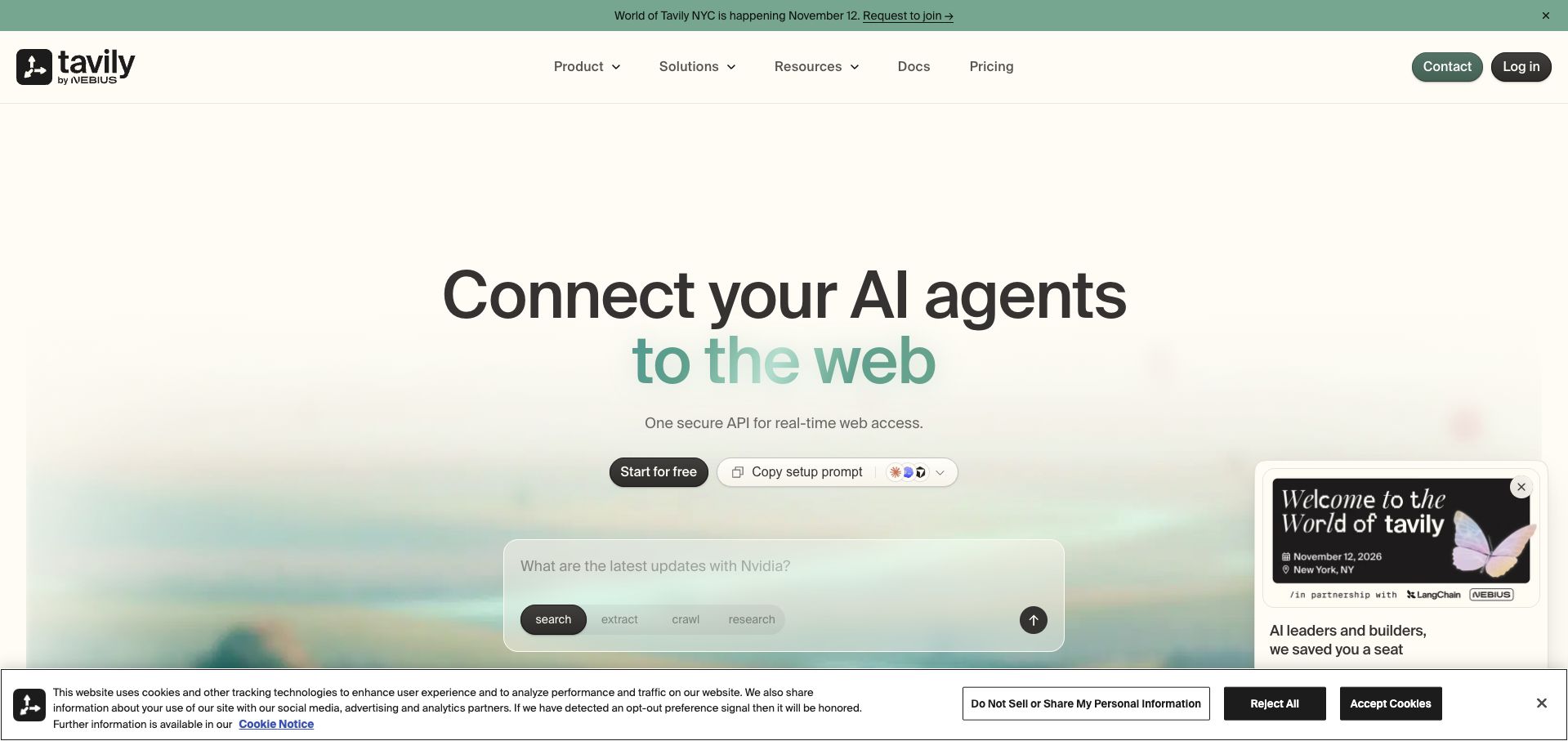
Tavily introduces web access for AI agents with a concise developer proposition, an adoption route, and a public search-style demonstration. The visible operation choices help distinguish searching, extracting, crawling, and research instead of treating web retrieval as one action. The page’s promotional layers also show a practical tradeoff: event messaging and cookie notices can compete with a deliberately simple technical entrance. Documented association checked November 8, 2026: Elasticsearch supporting the web-information retrieval layer used by Tavily’s AI-agent search services.
What you can learn
Treat web retrieval as a sourced intermediate result rather than guaranteed truth. The documented Elasticsearch infrastructure supports Tavily’s retrieval layer; a new implementation still needs source attribution, freshness rules, access restrictions, and a clear distinction between retrieved material and an agent’s later interpretation.
Pros
Visible operation choices help explain several related web-access capabilities without hiding them behind one vague label.
A developer-oriented proposition and documentation route make the technical audience easy to recognize.
Cons & considerations
Promotional and consent layers can crowd the small demonstration that explains the core retrieval idea.
A public demo cannot establish the correctness, permission status, or freshness of every returned web source.
Platform source: Official Elasticsearch customer or product evidence. Elasticsearch supporting the web-information retrieval layer used by Tavily’s AI-agent search services. Official source reviewed November 8, 2026 Pacific; no complete current-stack audit is implied. Official documentary association is scoped to the named product, workload, dependency, or database service. No marketing-homepage runtime, complete company stack, independent performance, or private customer workflow is inferred. Platform evidence is separate from the direct website screenshot and is not a complete current infrastructure audit.
Sacramento’s city homepage combines a civic identity with service shortcuts, topic categories, and a visible search route. The structure recognizes that residents often arrive to accomplish a practical task rather than browse municipal departments. This is a useful public-service pattern because common needs such as utilities, waste collection, and meetings can remain approachable even when the organization behind them is complex. Documented association checked November 8, 2026: Elasticsearch-based AI search for public access to city information.
What you can learn
Evaluate municipal search with real resident language and clear source ownership. The documented Elasticsearch-based service is relevant to public information access, but an AI answer should point back to maintained city material and distinguish general guidance from a formal application, payment, or official decision.
Pros
Service shortcuts connect the city’s organizational structure with the practical tasks residents commonly need to complete.
Search and topic browsing offer complementary routes for visitors who describe the same need differently.
Cons & considerations
A broad municipal catalog can still hide exceptions and eligibility details beneath otherwise concise shortcut labels.
The public homepage cannot independently demonstrate the completeness or current accuracy of every AI-assisted answer.
Visible tech stack
Earlier / documented evidence
Elasticsearch
Platform source: Official Elasticsearch customer or product evidence. Elasticsearch-based AI search for public access to city information. Official source reviewed November 8, 2026 Pacific; no complete current-stack audit is implied. Official documentary association is scoped to the named product, workload, dependency, or database service. No marketing-homepage runtime, complete company stack, independent performance, or private customer workflow is inferred. Platform evidence is separate from the direct website screenshot and is not a complete current infrastructure audit.
The Guardian’s US homepage uses strong editorial hierarchy to manage a large, changing news agenda. A distinctive masthead and clearly separated story positions help readers understand what the publication currently prioritizes. The design balances breadth with editorial judgment, but the pictured publication is different from the private analytics tool documented in the Elasticsearch case. Documented association checked November 8, 2026: Historical official case study documents Elasticsearch in Ophan editorial audience analytics; not the public homepage content store.
What you can learn
Keep audience analytics distinct from the reader-facing content store. The historical Ophan case documents Elasticsearch for editorial traffic analysis, not the current database behind every article; a similar dashboard should explain event freshness and interpretation limits rather than treating attention metrics as editorial truth.
Pros
A distinctive publication identity provides a stable frame while individual headlines and visual priorities change.
Separated editorial positions help accommodate a broad news agenda without requiring a single reading sequence.
Cons & considerations
A crowded news surface can make a visitor’s narrow information need compete with the publication’s wider priorities.
The public homepage does not expose the event collection or interpretation rules of internal newsroom analytics.
Platform source: Official Elasticsearch customer or product evidence. Historical official case study documents Elasticsearch in Ophan editorial audience analytics; not the public homepage content store. Historical Ophan editorial-analytics account; not current public article-store or homepage-runtime verification. Official documentary association is scoped to the named product, workload, dependency, or database service. No marketing-homepage runtime, complete company stack, independent performance, or private customer workflow is inferred. Platform evidence is separate from the direct website screenshot and is not a complete current infrastructure audit.
FRAIM’s corporate page uses a restrained typographic identity and a clear mission before introducing its document-related services and technical components. The structure makes a specialist company legible without pretending that every visitor is ready to inspect the application itself. Its strongest pattern is the progression from purpose to named capabilities, although the product vocabulary still requires context for an unfamiliar reader. Documented association checked November 8, 2026: Elasticsearch in FRAIM’s knowledge-search platform for document workflows.
What you can learn
Connect knowledge search to the document unit a person can actually assess. The Elasticsearch association concerns FRAIM’s search platform, not a promise that every suggested passage is appropriate; a similar workflow should preserve document context, permissions, and human responsibility for adopting retrieved language.
Pros
A restrained visual system gives specialist document capabilities room for explanation instead of competing decoration.
A purpose-to-service progression helps readers connect the company mission with more specific product components.
Cons & considerations
Specialist document terminology may need examples before an unfamiliar visitor understands each capability’s scope.
The public corporate page cannot independently verify the relevance or appropriateness of suggested document content.
Platform source: Official Elasticsearch customer or product evidence. Elasticsearch in FRAIM’s knowledge-search platform for document workflows. Official source reviewed November 8, 2026 Pacific; no complete current-stack audit is implied. Official documentary association is scoped to the named product, workload, dependency, or database service. No marketing-homepage runtime, complete company stack, independent performance, or private customer workflow is inferred. Platform evidence is separate from the direct website screenshot and is not a complete current infrastructure audit.
eBay’s public storefront combines a prominent all-category search with merchandise navigation and a large live-shopping campaign. The layout preserves a familiar utility even as the hero promotes a newer shopping format. Its useful design challenge is balancing known-item discovery, exploratory browsing, and current campaigns without making a very heterogeneous marketplace feel like an unstructured collection of unrelated offers. Documented association checked November 8, 2026: Historical 2017 eBay engineer session documents an internal Elasticsearch-as-a-service platform for text search and analytics; not a fresh audit of the shopping homepage.
What you can learn
Distinguish an internal search-service platform from the consumer search box. The official 2017 engineer session describes cluster provisioning for internal text-search and analytics workloads; it does not establish today’s marketplace-search implementation, current cluster configuration, or the runtime of the pictured storefront.
Pros
A prominent search and category structure give a highly varied marketplace a stable utility-oriented entrance.
A separate campaign area allows newer shopping formats to coexist with conventional product discovery.
Cons & considerations
A dominant campaign can compete with visitors whose only goal is to locate a specific item.
Historical internal infrastructure evidence cannot identify every current consumer-facing marketplace or analytics service.
Platform source: Official Elasticsearch customer or product evidence. Historical 2017 eBay engineer session documents an internal Elasticsearch-as-a-service platform for text search and analytics; not a fresh audit of the shopping homepage. Historical 2017 engineer session on internal Elasticsearch-as-a-service, not a claim about current public marketplace search. Official documentary association is scoped to the named product, workload, dependency, or database service. No marketing-homepage runtime, complete company stack, independent performance, or private customer workflow is inferred. Platform evidence is separate from the direct website screenshot and is not a complete current infrastructure audit.
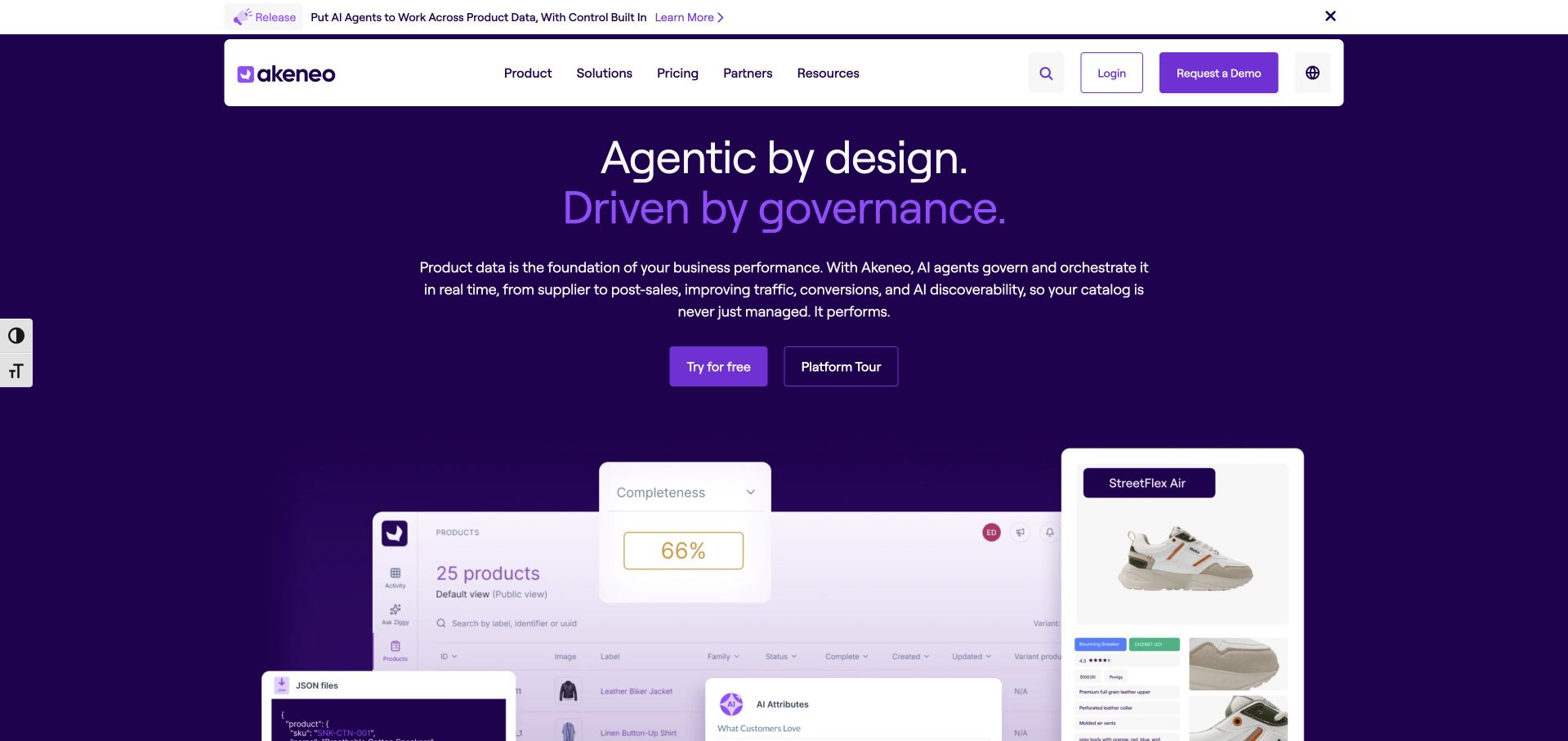
Akeneo’s public page puts product information at the center of its commerce proposition, pairing a bold campaign with a visible product-interface illustration. The page explains governance and orchestration before opening into a wider platform story. Its useful design problem is making a back-office information product feel relevant to commercial teams without hiding the detailed data responsibilities that determine whether a catalog remains trustworthy. Documented association checked November 8, 2026: Elasticsearch on Elastic Cloud in Akeneo’s product-information-management read and search paths.
What you can learn
Separate product-information authority from its search-oriented read path. The documented Elastic Cloud workload concerns PIM retrieval and reads; a similar architecture still needs explicit rules for publication status, localization, and updates before search results can safely represent a current sellable product.
Pros
A visible product-interface illustration makes a back-office data proposition more tangible for organizational buyers.
The commerce context connects information management with a recognizable business purpose rather than database terminology alone.
Cons & considerations
A broad agent-focused campaign can postpone detailed explanation of the underlying catalog-management workflow.
The public page cannot demonstrate that indexed product facts match every authoritative source and publication state.
Platform source: Official Elasticsearch customer or product evidence. Elasticsearch on Elastic Cloud in Akeneo’s product-information-management read and search paths. Official source reviewed November 8, 2026 Pacific; no complete current-stack audit is implied. Official documentary association is scoped to the named product, workload, dependency, or database service. No marketing-homepage runtime, complete company stack, independent performance, or private customer workflow is inferred. Platform evidence is separate from the direct website screenshot and is not a complete current infrastructure audit.
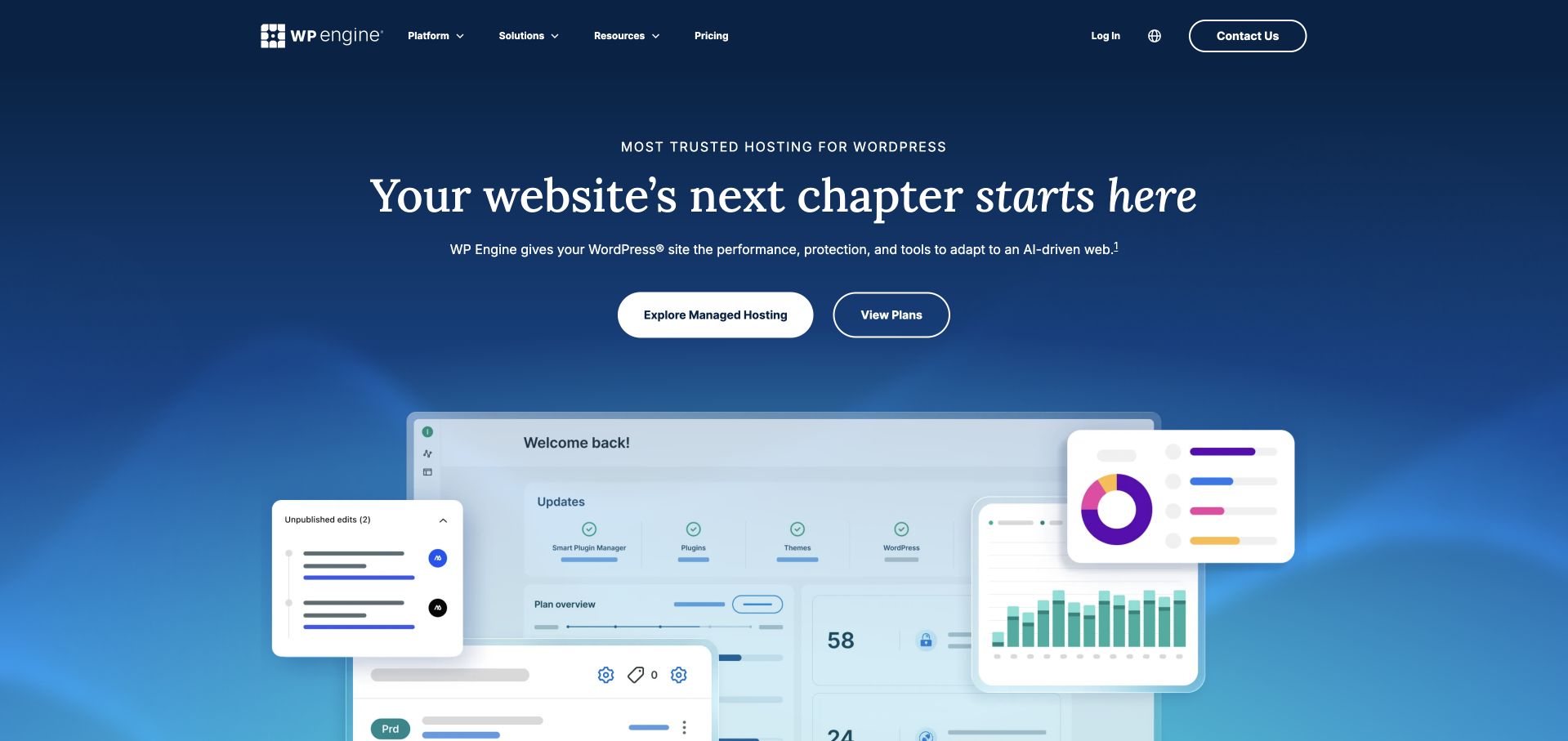
WP Engine’s public storefront organizes managed website hosting around practical audiences and a recognizable WordPress context. The hero gives a broad platform proposition, while plans and audience pathways offer more concrete routes into evaluation. The visible management-interface illustration helps explain that the service includes operational tooling rather than merely renting an abstract server, though individual capabilities still require careful product-level comparison. Documented association checked November 8, 2026: Elasticsearch and Google Cloud for WP Engine’s managed search and AI-enhanced WordPress offerings.
What you can learn
Treat managed search as an explicit offering, not an automatic attribute of every hosted WordPress site. The Elasticsearch and Google Cloud case documents particular search and AI capabilities; a customer must still select, configure, and govern an appropriate implementation for its own content and permissions.
Pros
WordPress-specific context gives the hosting proposition a clear audience and a familiar technical boundary.
Audience and plan routes offer practical alternatives to the broad message in the main hero.
Cons & considerations
A wide hosting-platform promise can obscure which capabilities belong to a particular plan or add-on.
The public vendor page does not establish that every hosted customer website uses Elasticsearch.
Platform source: Official Elasticsearch customer or product evidence. Elasticsearch and Google Cloud for WP Engine’s managed search and AI-enhanced WordPress offerings. Official source reviewed November 8, 2026 Pacific; no complete current-stack audit is implied. Official documentary association is scoped to the named product, workload, dependency, or database service. No marketing-homepage runtime, complete company stack, independent performance, or private customer workflow is inferred. Platform evidence is separate from the direct website screenshot and is not a complete current infrastructure audit.
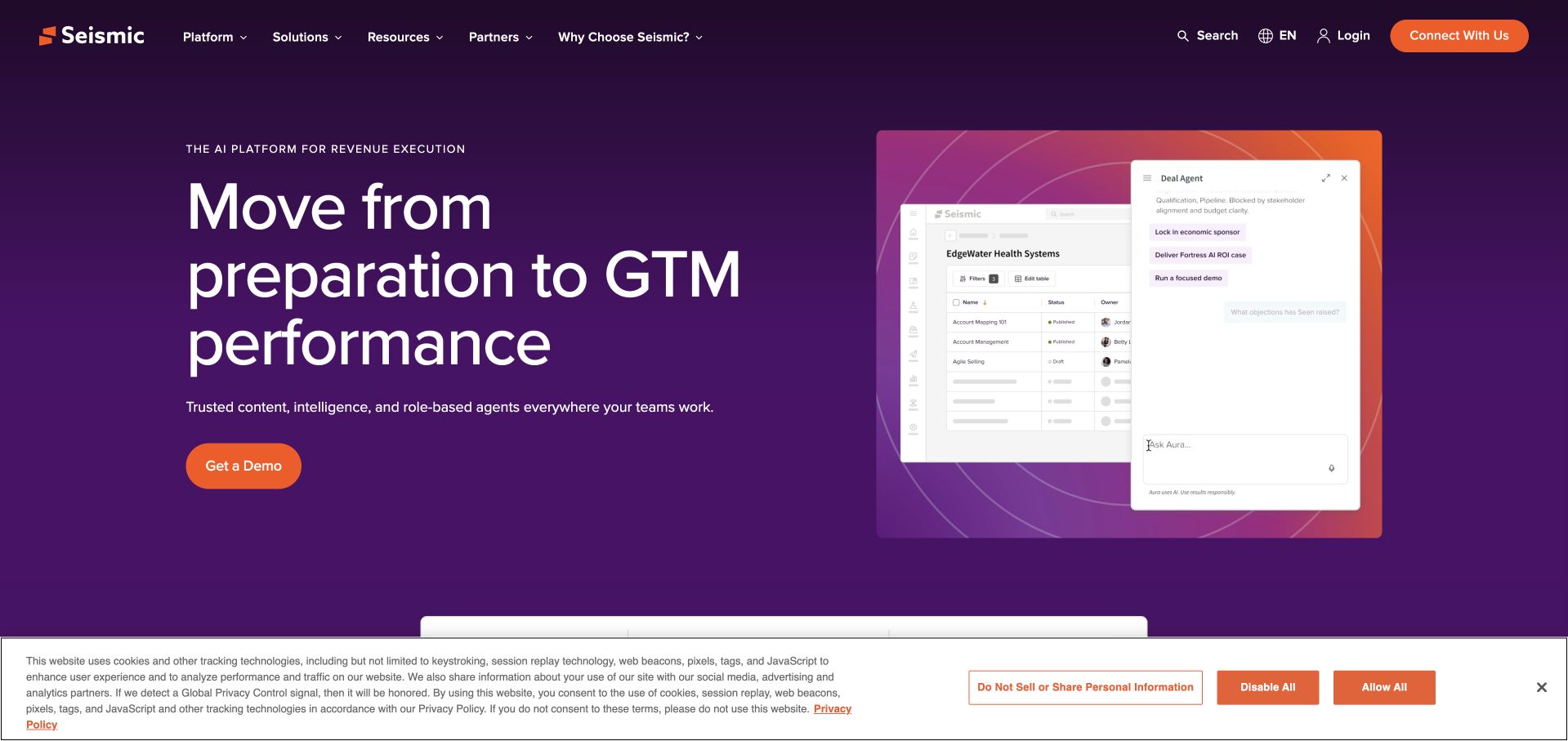
Seismic introduces a revenue-enablement platform with a prominent demonstration-style product image and a clear route to a demo. The visible combination of workspace content and an assistant panel makes an abstract platform idea more concrete. Its challenge is helping visitors distinguish content management, team preparation, and AI assistance rather than treating every part of a complex sales organization as one interchangeable workflow. Documented association checked November 8, 2026: Elasticsearch and ELSER semantic search for sales enablement content and Aura Copilot.
What you can learn
Ground semantic discovery in the content and permissions a seller actually needs. The Elasticsearch and ELSER case concerns sales-enablement retrieval and Aura Copilot, not proof that every answer is suitable for a customer conversation or that all private workspace data share one implementation.
Pros
A product-interface illustration gives a complex organizational platform a more concrete first impression.
A clear demonstration route provides a recognizable next step for visitors who need workflow detail.
Cons & considerations
Broad revenue terminology can leave the boundaries between several related organizational capabilities unclear initially.
A public illustration cannot validate retrieval permissions or the factual accuracy of AI-assisted sales material.
Platform source: Official Elasticsearch customer or product evidence. Elasticsearch and ELSER semantic search for sales enablement content and Aura Copilot. Official source reviewed November 8, 2026 Pacific; no complete current-stack audit is implied. Official documentary association is scoped to the named product, workload, dependency, or database service. No marketing-homepage runtime, complete company stack, independent performance, or private customer workflow is inferred. Platform evidence is separate from the direct website screenshot and is not a complete current infrastructure audit.
Rightmove makes property discovery the center of its public entrance, with clear distinctions among buying, renting, and other housing-related tasks. Location input provides a concrete starting point, while supporting routes address valuations, agents, and broader research. This is a useful example of a large service catalog preserving one familiar primary action without pretending that every visitor is at the same stage of moving. Documented association checked November 8, 2026: Elasticsearch on Elastic Cloud for property search, geographic queries and property-alert matching.
What you can learn
Design geographic search and property alerts as related but distinct experiences. The Elasticsearch case documents both retrieval and matching; a similar project should explain location boundaries, listing freshness, and notification timing without implying that an alert guarantees an available property or a successful transaction.
Pros
A prominent location-based search gives a large property service a clear and recognizable initial action.
Separate housing tasks accommodate visitors who are researching, comparing, selling, or preparing to move.
Cons & considerations
Supporting services can become visually competitive when a visitor only wants to begin a narrow property search.
The public entrance cannot independently verify listing freshness or the delivery behavior of saved-property alerts.
Platform source: Official Elasticsearch customer or product evidence. Elasticsearch on Elastic Cloud for property search, geographic queries and property-alert matching. Official source reviewed November 8, 2026 Pacific; no complete current-stack audit is implied. Official documentary association is scoped to the named product, workload, dependency, or database service. No marketing-homepage runtime, complete company stack, independent performance, or private customer workflow is inferred. Platform evidence is separate from the direct website screenshot and is not a complete current infrastructure audit.
Contextual AI’s public page combines a restrained enterprise layout with an explanation of context for technical and institutional information. Product and industry routes help turn an abstract AI proposition into more specific evaluation paths. The platform’s core value lives inside private customer workflows, but the public introduction must still earn the leap from a broad promise to a concrete retrieval task. Documented association checked November 8, 2026: Elasticsearch cluster as the indexed retrieval layer for Contextual AI’s enterprise RAG platform.
What you can learn
Keep the indexed retrieval layer distinct from the model’s generated answer. Elasticsearch stores searchable document chunks in the documented RAG architecture; useful implementation planning still needs document provenance, authorization, update handling, and a way for people to inspect the evidence behind an answer.
Pros
Product and industry navigation give visitors several concrete routes beyond an abstract enterprise-AI introduction.
A restrained layout leaves room for explanatory content rather than relying only on decorative technical imagery.
Cons & considerations
Context-engineering terminology can remain difficult to assess without a realistic document and question to inspect.
The public page cannot demonstrate answer correctness or the access controls of a private customer corpus.
Platform source: Official Elasticsearch customer or product evidence. Elasticsearch cluster as the indexed retrieval layer for Contextual AI’s enterprise RAG platform. Official source reviewed November 8, 2026 Pacific; no complete current-stack audit is implied. Official documentary association is scoped to the named product, workload, dependency, or database service. No marketing-homepage runtime, complete company stack, independent performance, or private customer workflow is inferred. Platform evidence is separate from the direct website screenshot and is not a complete current infrastructure audit.
Kegan has 15+ years of experience working with small businesses, Fortune 500 companies, and everything in between. No development job is too big or too small: he brings the same hands-on attention to a focused improvement, a complete website, or a custom application.
For Elasticsearch projects, he can help with data modeling, application data access, query design, search and cache integrations, migration planning, access boundaries, and maintainable handover. He works directly with clients on scope, design, implementation, testing, and handover, with an emphasis on clear communication and a system that remains practical to maintain after launch.
Show 3 other Elasticsearch developersHide other Elasticsearch developers
BMW, Anyone.com, and Rightmove provide different property and inventory contexts. Specify the indexed object, geographic boundaries, filters, and update path. Explain how a selected result reaches the authoritative detail or transaction workflow; discovering a record is not the same as reserving or purchasing it.
Knowledge and agreement discovery
Docusign, ORNL, FRAIM, and Contextual AI illustrate distinct document-oriented use cases. Define document units, access rules, provenance, and how changes or removals reach the index. A useful result includes enough context for a person to inspect its relevance instead of receiving only an unexplained answer.
Internal analysis rather than public search
The Guardian’s Ophan story documents editorial audience analytics, while eBay’s historical session concerns an internal service platform. These are real Elasticsearch associations without being claims about the public shopping or news search box. Label the analytical question and the people responsible for interpreting its output.
From references to requirements
Plan relevance, freshness, and operations together
Build a query-and-result brief
For each important query, specify the expected object, acceptable alternatives, visible explanation, and next action. Include empty and restricted-result states. Ask a domain specialist to evaluate representative results before approving an impressive-looking demonstration against only easy examples.
Document the indexing lifecycle
Identify the authoritative source, record identifier, transformation, and update or deletion path. Decide how the interface behaves while the index catches up or is rebuilt. Keep changes to mappings, analyzers, and derived representations in a controlled plan rather than assuming all existing documents update themselves.
Measure the actual mix of work
Search performance depends on queries, concurrency, index organization, shards, and available resources. Elastic’s production guidance does not offer one universally correct configuration. Test the project’s own workload and recovery procedures; copying a customer’s headline metric or adding replicas is not a substitute for measurement.
A useful handover demonstration
Ask the actual team to carry out its routine job: publish a realistic update, correct a mistake, preview a narrow screen, and identify who owns an integration failure. For a library or frontend framework, also ask who maintains the content source and deployment. A polished screenshot does not answer those operational questions.
Beyond the screenshot
Elasticsearch project checklist
Name the indexed object and authoritative source.
Create representative queries before tuning relevance.
Distinguish identifiers from descriptive language.
Specify mappings and language analysis deliberately.
Define geographic and exact-value filters.
Carry permissions into retrieval.
Show source context and useful empty states.
Plan update and deletion propagation.
Rehearse an index rebuild or migration.
Measure realistic concurrency and query mix.
Separate retrieved evidence from generated interpretation.
Keep historical architecture claims dated.
Test with real content, a keyboard, a small screen, slow or failed requests, and the people who will maintain the system. These are planning checks, not an accessibility, security, performance, or search-ranking certification.
Sources & editorial method
How this Elasticsearch collection was reviewed
Twenty distinct public properties were selected and individually reviewed for this Elasticsearch collection. Public browser captures were visually inspected; each image preserves its actual captureUrl, captureDate, dimensions, and provenance. New captures occurred November 9 UTC during November 8, 2026 Pacific research. Reused captures retain their original dates and timestamps; capturedAt:null means only the original day is known and no time was invented. Official primary customer, engineering, operations, or product documentation establishes only the named application workload, dependency, or database-service association. A company’s use of Elasticsearch is not evidence of the pictured homepage’s runtime or its entire technology estate. Historical accounts remain dated, and customer-reported results were not independently benchmarked. Reviews are original design criticism, not endorsements of financial, clinical, security, service-quality, or AI outcomes. No logins, account forms, transactions, or private workflows were used. Images and trademarks belong to their owners. A separate bounded public stack audit is performed by the sole publisher before publication; it is not replaced by these documentary associations.
Every image is an unmodified capture from the actual website, with its source and capture date. Some captures are reused from our shared catalog; their dates remain the original capture dates. None comes from a vendor gallery or a generated reconstruction. Moving imagery and live content can change.
Technology attribution uses public page assets or metadata, official platform documentation, or a cited first-party project case study. Documentary and framework-relationship evidence is identified where used; it is not a complete current backend inventory. A CMS image CDN alone does not establish a full CMS deployment. A library’s presence does not prove which individual controls use it, and a platform label does not establish AI authorship.
The composition notes, lessons, pros and tradeoffs are original editorial observations. We have not measured conversion, traffic, security, performance or accessibility conformance. Website owners retain their brands and imagery; these examples are not our client portfolio. Written, Edited and Curated are independent records, not dates advanced by a build. See our editorial standards or suggest a correction.
Questions worth asking
Elasticsearch website development FAQs
Are all these examples public Elasticsearch search interfaces?
No. Some public pages introduce an organization whose documented Elasticsearch workload is internal or part of a separate product. Every review distinguishes the visible property from the application association; the collection does not infer a homepage database from a customer logo.
Is semantic search always preferable to keyword search?
No. A known identifier, exact product code, broad concept, and geographic query can require different treatment. Compare approaches against representative tasks and preserve the exact distinctions users need to make.
Can Elasticsearch replace the authoritative database?
That depends on the actual workload, but these examples do not establish a universal replacement rule. Identify who owns the facts and how the index is rebuilt, updated, and reconciled. Retrieval and transaction completion are separate responsibilities.
Does a RAG architecture guarantee accurate answers?
No. Retrieval can supply useful material without making an answer correct or authorized. Preserve provenance, permissions, update handling, and human inspection appropriate to the task. The official customer association is not an independent model evaluation.
Why retain historical analytics and internal-service examples?
They show clearly documented Elasticsearch roles that differ from a shopping search box. Their dates and scope are preserved, so readers can learn an architectural distinction without mistaking an older account for a complete current infrastructure audit.
Build search around a decision people need to make, with an understandable result, a known source, and honest freshness. The database association gives context; the project’s own evaluation must establish usefulness.