Best PostgreSQL Websites of 2026 (20 Real-World Examples)
PostgreSQL-associated websites, engineering accounts, and managed-service design references
These 20 examples combine public website design with official evidence for PostgreSQL product databases, application dependencies, or managed database services. A service offering and a company’s application database are not proof of the pictured marketing page’s runtime.
PostgreSQL often sits behind relationships that a user never sees directly: membership, document ownership, workflow states, and the links among records. Its presence does not prescribe a visual style. This guide therefore separates a public page’s communication and navigation from the engineering or product documentation that establishes the database association.
Figma, Notion, GitLab, OpenStreetMap, and Supabase form the recognizable opening. Their evidence is not uniform: Figma and Notion provide dated engineering accounts, GitLab documents an OLTP policy, OpenStreetMap’s operators describe a database incident, and Supabase documents a PostgreSQL service. Those differences are useful because they show why a named association must include both a workload and a date.
Before the examples
What makes good PostgreSQL website development in 2026?
Model relationships that the product can explain
Begin with the objects and relationships people actually manage. Decide which records may exist independently, what must be unique, and what happens when a related record is removed. PostgreSQL constraints can express important invariants, but the interface still has to explain a rejected action in terms the user understands.
A database can support many queries, but an index is not a free improvement. Official guidance describes the read benefit alongside maintenance overhead. Review the filters, sorts, joins, and result sizes that matter to the application, then test them with representative data before copying a large company’s partitioning strategy.
Treat recovery as part of the product promise
A managed plan does not eliminate the need to understand backups, restoration, and ownership. Define the state people expect after an interruption and which records can be reconstructed elsewhere. The public claim that a service is managed is not an independent demonstration of your application’s recovery readiness.
The collection · 20 examples
20 PostgreSQL website examples worth studying
The reviews distinguish application use, documented software dependencies, and PostgreSQL services sold by vendors. Dated engineering stories remain dated; current product pages are not used to silently update an older architecture account. Every pictured property has its own direct capture metadata.
We start with five recognizable brands or organizations: Figma, Notion, GitLab, OpenStreetMap, Supabase. Each attribution applies to the named website property, not every product or website belonging to its organization. This is a curated reading sequence, not a measured ranking.
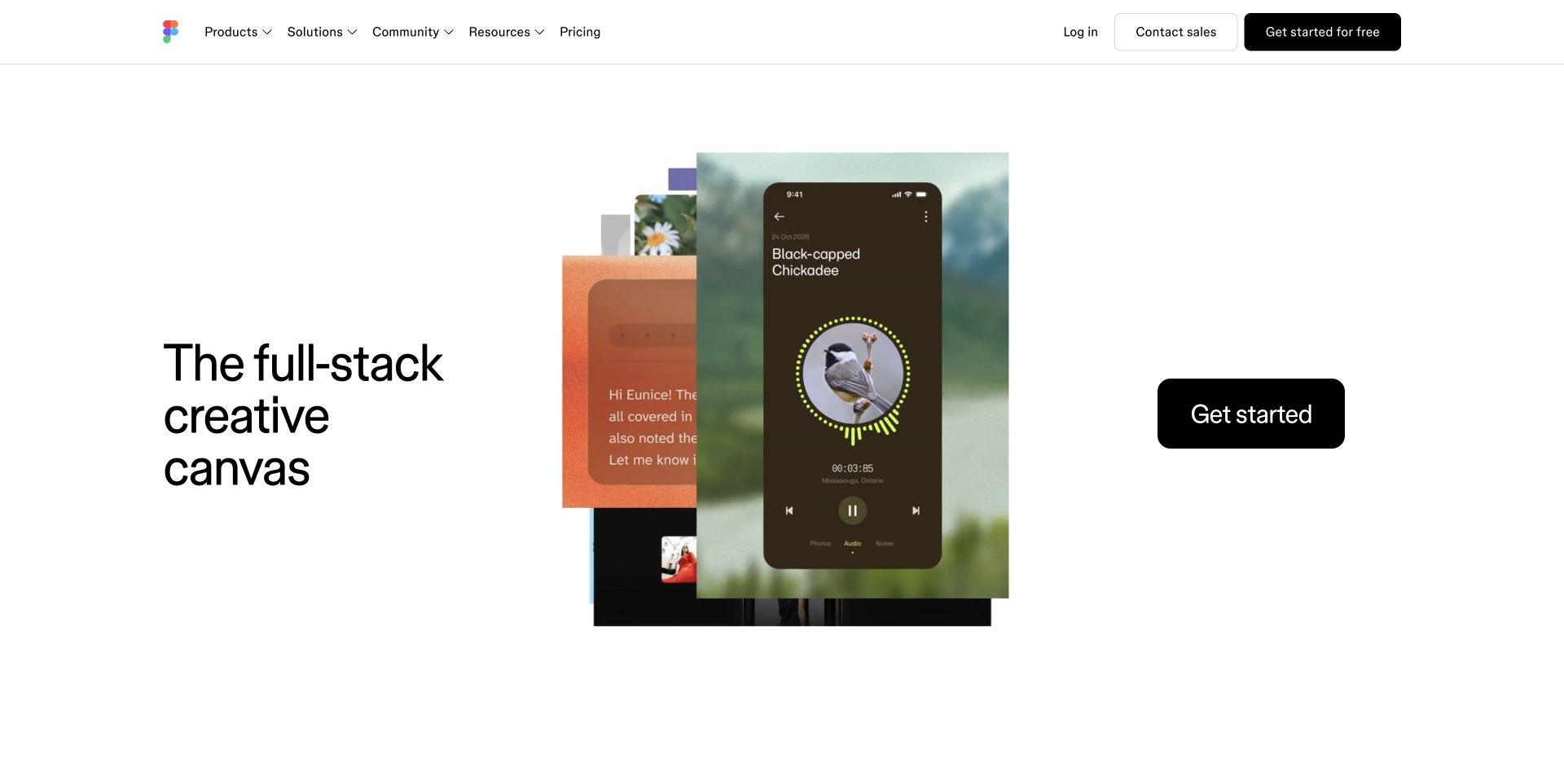
Figma’s captured homepage pairs a concise creative proposition with a layered example of designed interfaces and a strong adoption route. The product category is communicated through work rather than a long list of features. That restraint gives the page a clear first impression, although the expanding portfolio still requires navigation that distinguishes visual design, collaboration, and adjacent creative tasks for different visitors. Documented association checked November 8, 2026: March 2024 engineering account of horizontally sharding Figma’s product Postgres databases; not an audit of the marketing website.
What you can learn
Separate a polished creative canvas from the relational services that support the product. Figma’s March 2024 sharding account is a useful example of application-database evolution, not evidence that the marketing page uses PostgreSQL or that every collaboration subsystem follows the same persistence design.
Pros
Designed interface examples communicate the product’s purpose without requiring visitors to enter a private design file.
A restrained headline and prominent adoption route make the initial decision easy to recognize.
Cons & considerations
A compact first impression leaves important product distinctions and collaboration requirements to deeper pages.
A dated engineering account cannot identify every current storage service behind an expanding creative platform.
Platform source: Official PostgreSQL customer or product evidence. March 2024 engineering account of horizontally sharding Figma’s product Postgres databases; not an audit of the marketing website. Engineering account dated March 14, 2024; scoped to product database sharding. Official documentary association is scoped to the named product, workload, dependency, or database service. No marketing-homepage runtime, complete company stack, independent performance, or private customer workflow is inferred. Platform evidence is separate from the direct website screenshot and is not a complete current infrastructure audit.
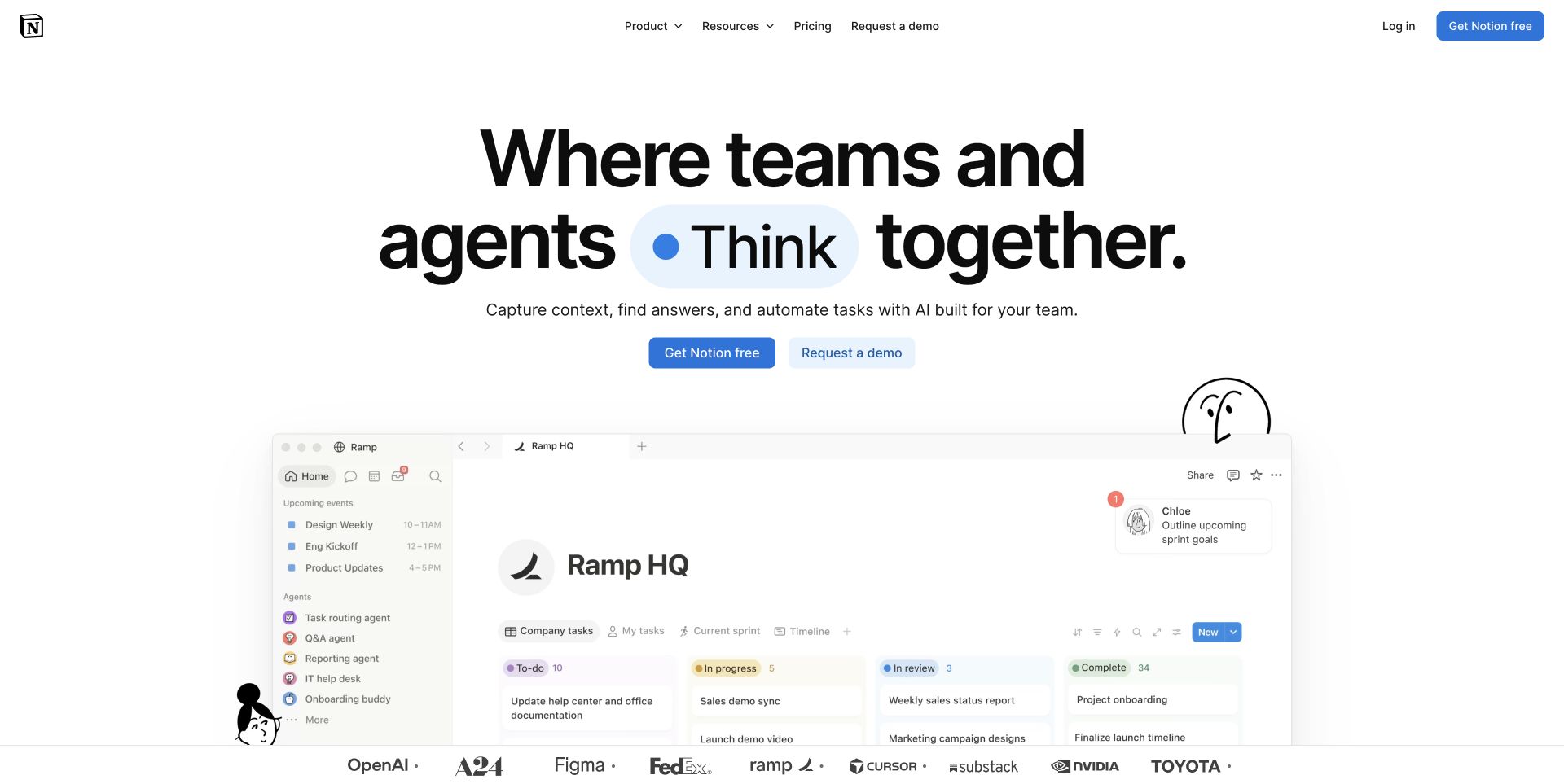
Notion’s captured page combines a broad teams-and-agents proposition with a large workspace illustration. The interface example supplies concrete context for an otherwise expansive collaboration promise, while a small set of primary actions keeps adoption visible. The tension is flexibility versus orientation: a product that can organize many kinds of work still needs to show a newcomer one understandable starting point. Documented association checked November 8, 2026: July 2024 engineering account identifies Postgres as the source store for Notion’s block-based application data.
What you can learn
Keep the documented block store separate from analytics and generated answers. Notion’s July 2024 data-lake account identifies Postgres as an application-data source, not the whole current platform. A similar product should define record ownership and downstream projections without assuming every read must hit the primary database.
Pros
A large workspace illustration makes an abstract organizational proposition more tangible for a prospective user.
A small set of prominent actions offers clear next steps despite the breadth of the product family.
Cons & considerations
A broad flexibility promise can leave a newcomer uncertain about which workflow to build first.
The public illustration does not demonstrate the synchronization or permission rules of a real team workspace.
Platform source: Official PostgreSQL customer or product evidence. July 2024 engineering account identifies Postgres as the source store for Notion’s block-based application data. Engineering account dated July 1, 2024; scoped to application block data feeding the data lake. Official documentary association is scoped to the named product, workload, dependency, or database service. No marketing-homepage runtime, complete company stack, independent performance, or private customer workflow is inferred. Platform evidence is separate from the direct website screenshot and is not a complete current infrastructure audit.
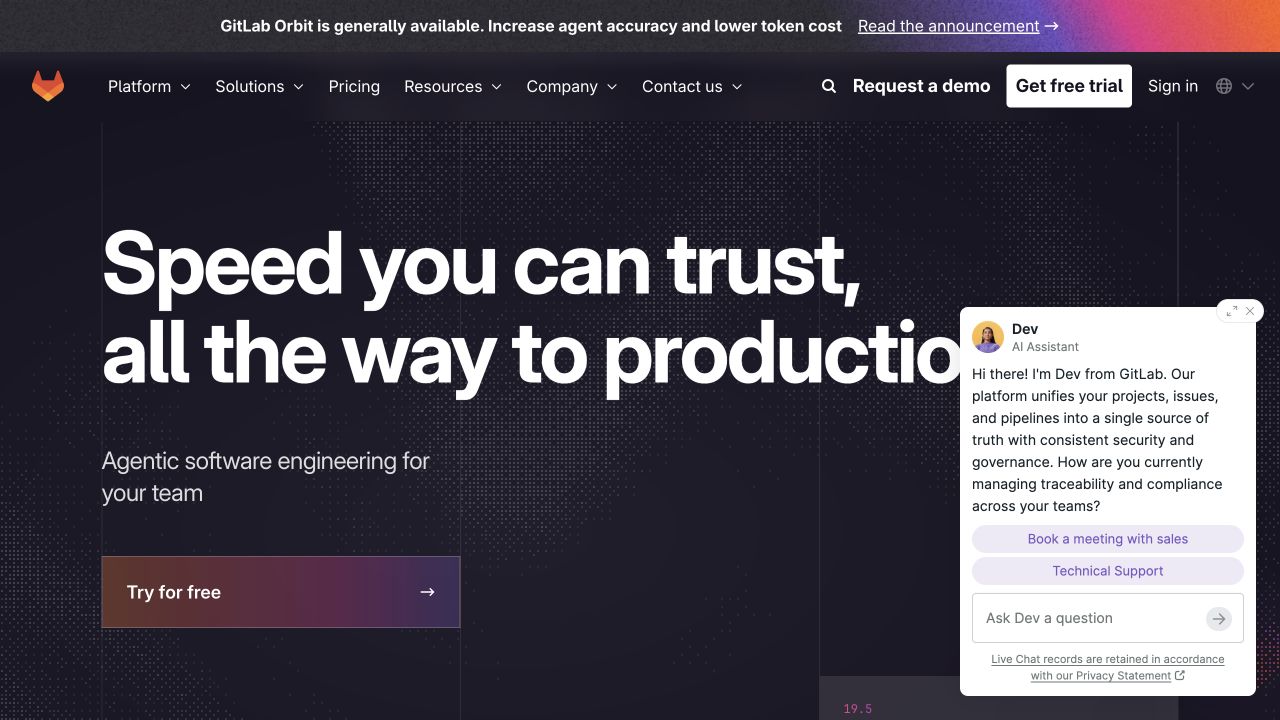
GitLab’s captured corporate page leads with a production-oriented proposition and a prominent trial route inside a dense developer-platform frame. The public presentation addresses organizational software delivery rather than displaying private source code. Its useful challenge is explaining breadth without collapsing distinct development, security, and operational responsibilities into a single slogan; the visible chat overlay also shows how assistance can compete with the main message. Documented association checked November 8, 2026: GitLab’s current developer documentation identifies PostgreSQL as GitLab.com’s approved OLTP database.
What you can learn
Use GitLab’s explicit OLTP guidance to discuss authoritative application records, not every development artifact. PostgreSQL is documented for GitLab.com’s transactional data; code repositories, analytics, search, and the marketing property are separate systems whose implementations cannot be inferred from that database policy alone.
Pros
A production-oriented framing connects an extensive developer platform with a recognizable organizational objective.
A visible trial route gives visitors a concrete continuation beyond the broad corporate proposition.
Cons & considerations
A large assistance overlay can obscure the primary message and reduce the clarity of the first impression.
The public page cannot reveal the separate data paths behind code, issues, pipelines, and search.
Platform source: Official PostgreSQL customer or product evidence. GitLab’s current developer documentation identifies PostgreSQL as GitLab.com’s approved OLTP database. Official source reviewed November 8, 2026 Pacific; no complete current-stack audit is implied. Official documentary association is scoped to the named product, workload, dependency, or database service. No marketing-homepage runtime, complete company stack, independent performance, or private customer workflow is inferred. Platform evidence is separate from the direct website screenshot and is not a complete current infrastructure audit.
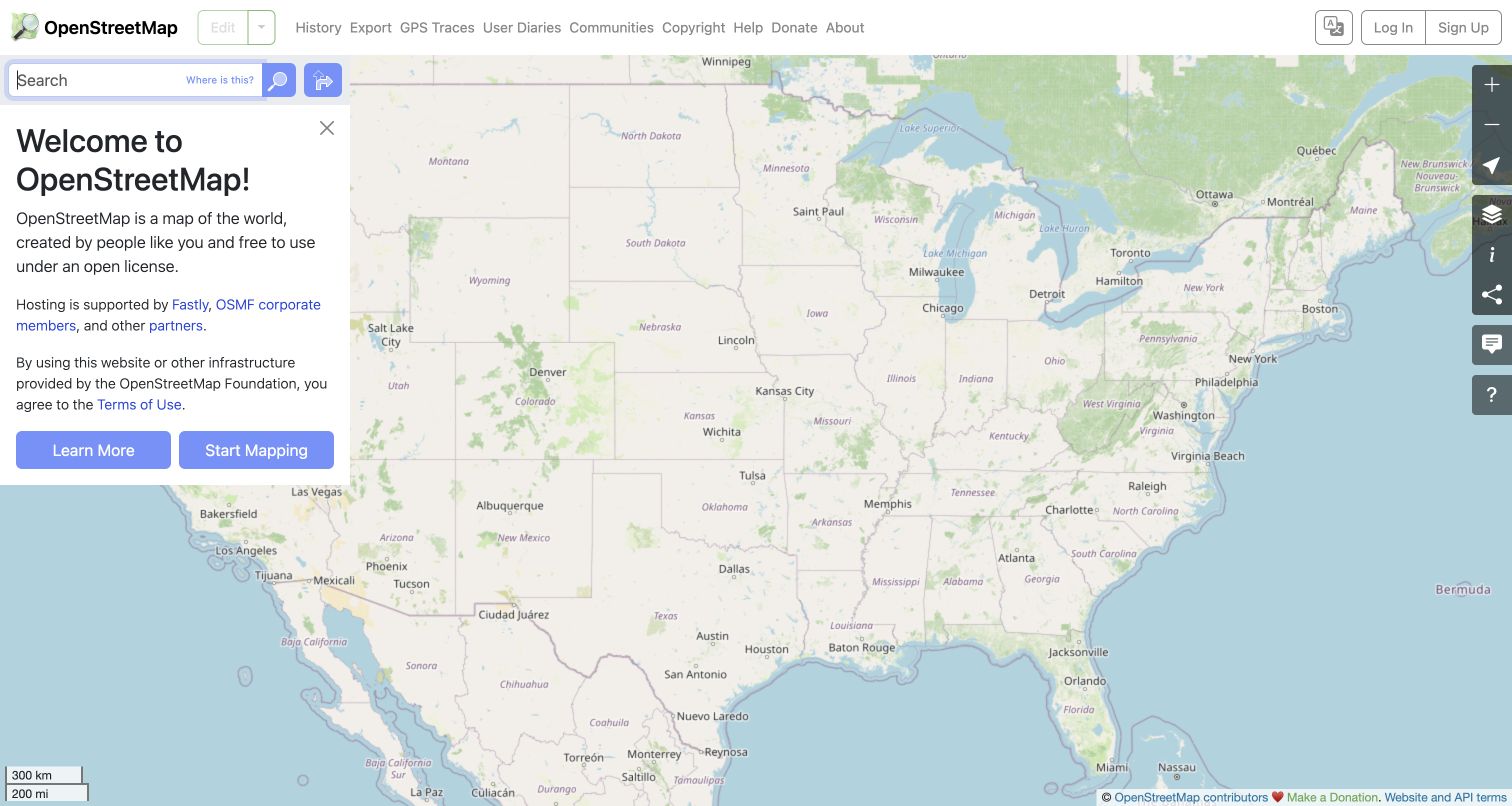
OpenStreetMap’s public entrance is the map itself, supported by search, map controls, and a concise explanation of the community project. The page makes utility visible before asking visitors to learn the organization’s structure. Its strongest pattern is the combination of immediate use and a contribution route, though the map-centered interface also requires accessible alternatives and careful explanations for people unfamiliar with editing geographic information. Documented association checked November 8, 2026: Official July 2025 operations post-mortem documents PostgreSQL in OpenStreetMap.org’s editing database and replication-diff pipeline.
What you can learn
Distinguish the editing database from rendered map tiles and downstream consumers. The official July 2025 post-mortem documents PostgreSQL in the editing and replication pipeline; it does not establish that every map view or external OpenStreetMap-based service directly queries the same database.
Pros
The actual map provides immediate utility instead of requiring visitors to pass through a promotional landing page.
A concise project explanation and contribution route connect everyday use with the community behind the information.
Cons & considerations
A map-dominated interface needs alternatives for visitors who cannot rely on visual geographic navigation alone.
The public map cannot demonstrate the freshness or infrastructure of every downstream tile and data service.
Platform source: Official PostgreSQL customer or product evidence. Official July 2025 operations post-mortem documents PostgreSQL in OpenStreetMap.org’s editing database and replication-diff pipeline. Official operations post-mortem dated July 11, 2025; scoped to editing database and replication pipeline. Official documentary association is scoped to the named product, workload, dependency, or database service. No marketing-homepage runtime, complete company stack, independent performance, or private customer workflow is inferred. Platform evidence is separate from the direct website screenshot and is not a complete current infrastructure audit.
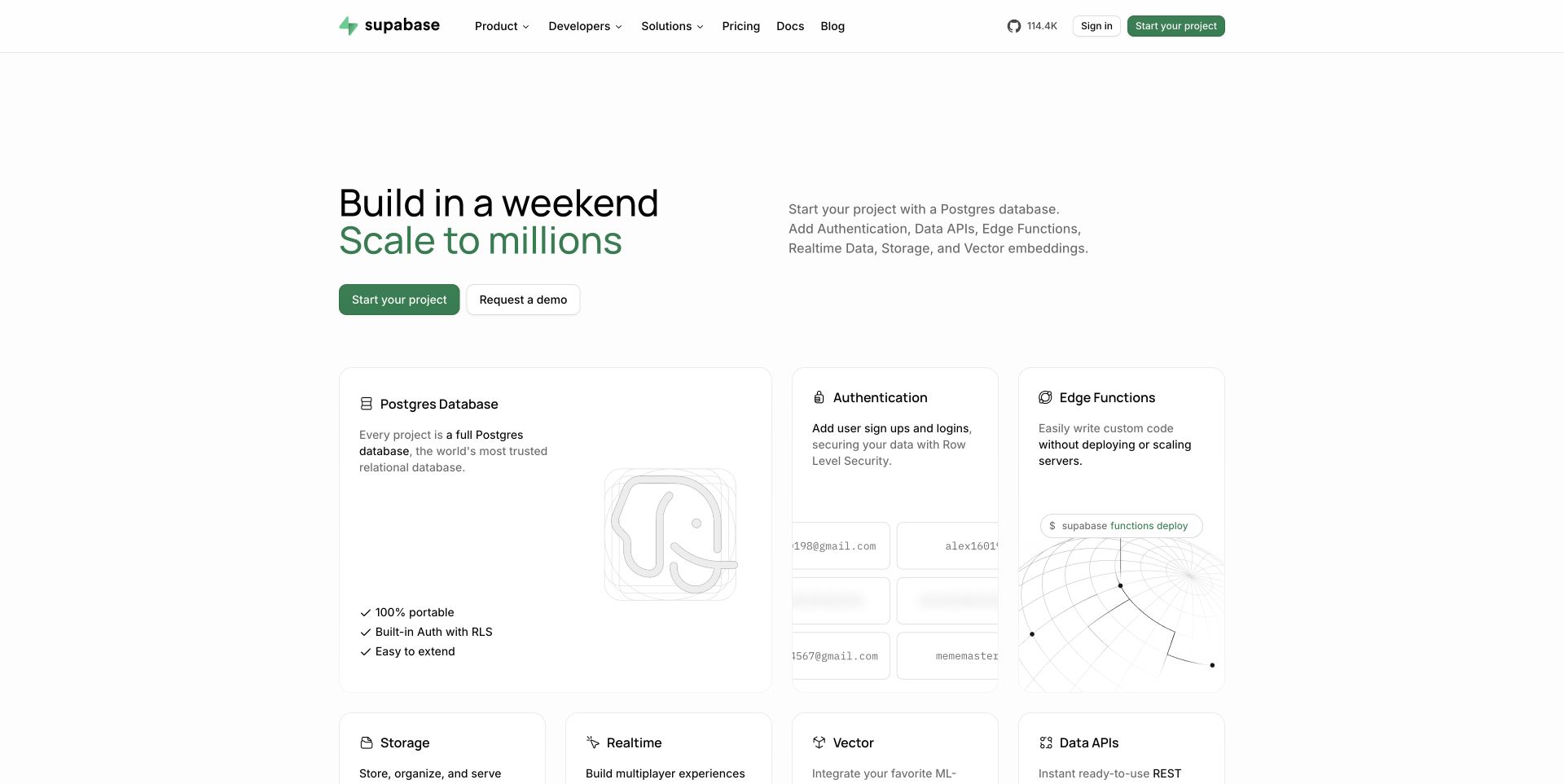
Supabase’s captured homepage names the Postgres database directly and presents adjacent backend capabilities as separate cards. This makes the technical foundation unusually visible for a public product page. The concise promise and adoption route are useful, but the simplicity of the introduction should not hide the configuration work needed to create an appropriate schema, access rules, and operating plan for a real application. Documented association checked November 8, 2026: Supabase’s product documentation identifies its database service as full PostgreSQL; service association, not marketing-page runtime.
What you can learn
Treat a managed database offering as a service association, not as evidence about the vendor homepage’s runtime. Supabase’s official documentation identifies a full PostgreSQL database per project; a customer still owns application modeling, authorization decisions, and the consequences of exposing data through additional APIs.
Pros
The database foundation is named plainly instead of being hidden behind a generic backend-platform metaphor.
Separate capability cards help visitors distinguish persistence, authentication, functions, and other surrounding services.
Cons & considerations
A short adoption promise can make the work of modeling and securing a production application look deceptively small.
The public page does not independently demonstrate the configuration or reliability of an individual customer project.
Platform source: Official PostgreSQL customer or product evidence. Supabase’s product documentation identifies its database service as full PostgreSQL; service association, not marketing-page runtime. Official source reviewed November 8, 2026 Pacific; no complete current-stack audit is implied. Official documentary association is scoped to the named product, workload, dependency, or database service. No marketing-homepage runtime, complete company stack, independent performance, or private customer workflow is inferred. Platform evidence is separate from the direct website screenshot and is not a complete current infrastructure audit.
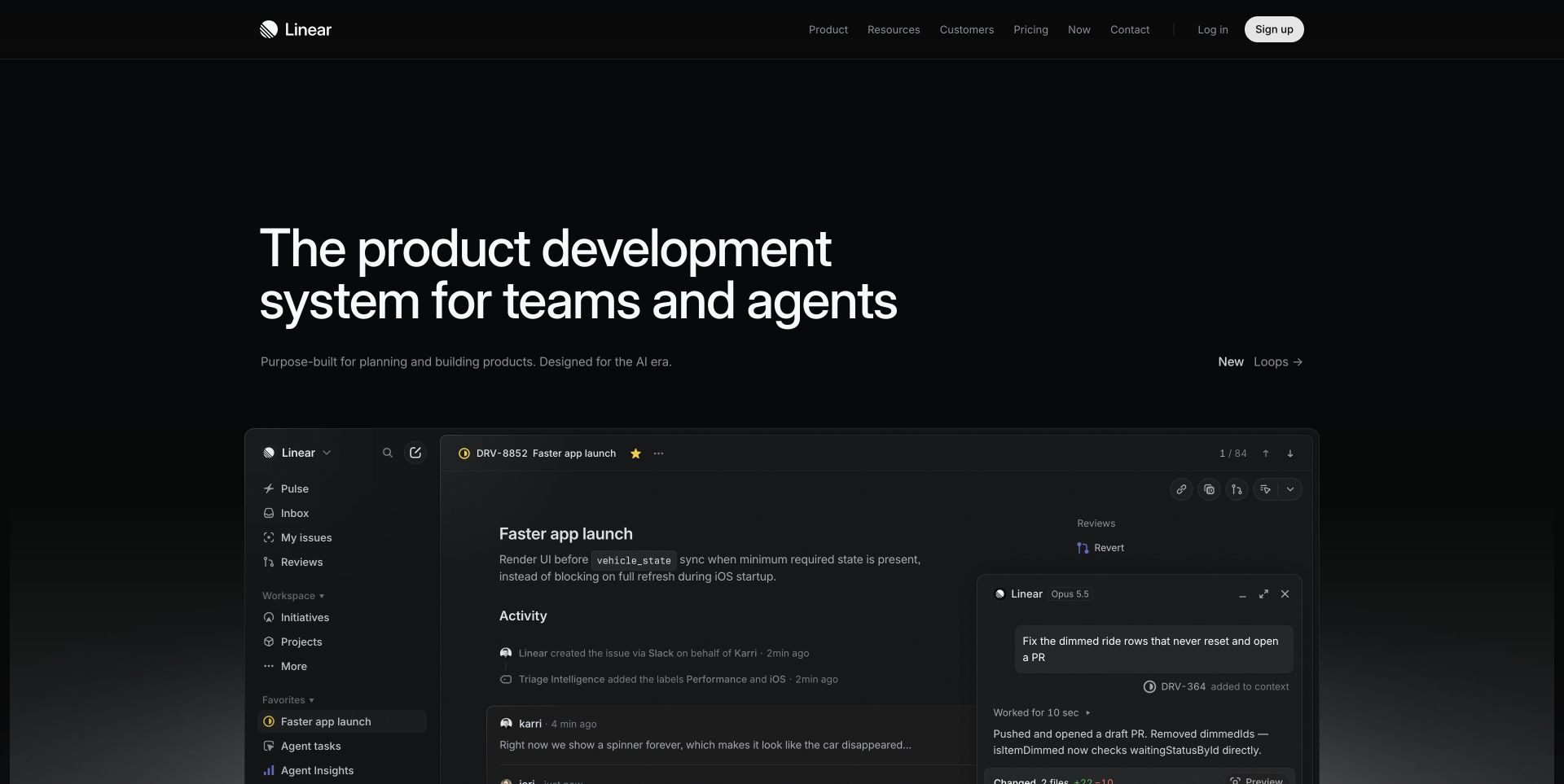
Linear’s captured page uses a restrained dark interface, a clear product-development proposition, and a large application illustration. The public design communicates focus before introducing a broader set of team and agent capabilities. Coherence matters for this workflow product, although the marketing view cannot demonstrate the real experience of a team with long histories, complex permissions, and many concurrent changes. Documented association checked November 8, 2026: May 2024 engineering account identifies Linear’s primary Postgres application database in its regional deployment architecture.
What you can learn
Keep the May 2024 regional-architecture account at its stated date and scope. A primary Postgres database can coexist with caches, specialized read paths, and later architectural changes; do not turn a historic regional explanation into a claim that every current Linear feature queries PostgreSQL directly.
Pros
A focused proposition and restrained visual system give a complex team workflow a coherent first impression.
A large application illustration provides more practical context than a purely abstract productivity promise.
Cons & considerations
A concise marketing view cannot expose the complexity of a real team’s accumulated work and permissions.
A dated architecture article does not identify every current read path or adjacent storage service.
Platform source: Official PostgreSQL customer or product evidence. May 2024 engineering account identifies Linear’s primary Postgres application database in its regional deployment architecture. Engineering account dated May 23, 2024; not a complete statement about every current serving path. Official documentary association is scoped to the named product, workload, dependency, or database service. No marketing-homepage runtime, complete company stack, independent performance, or private customer workflow is inferred. Platform evidence is separate from the direct website screenshot and is not a complete current infrastructure audit.
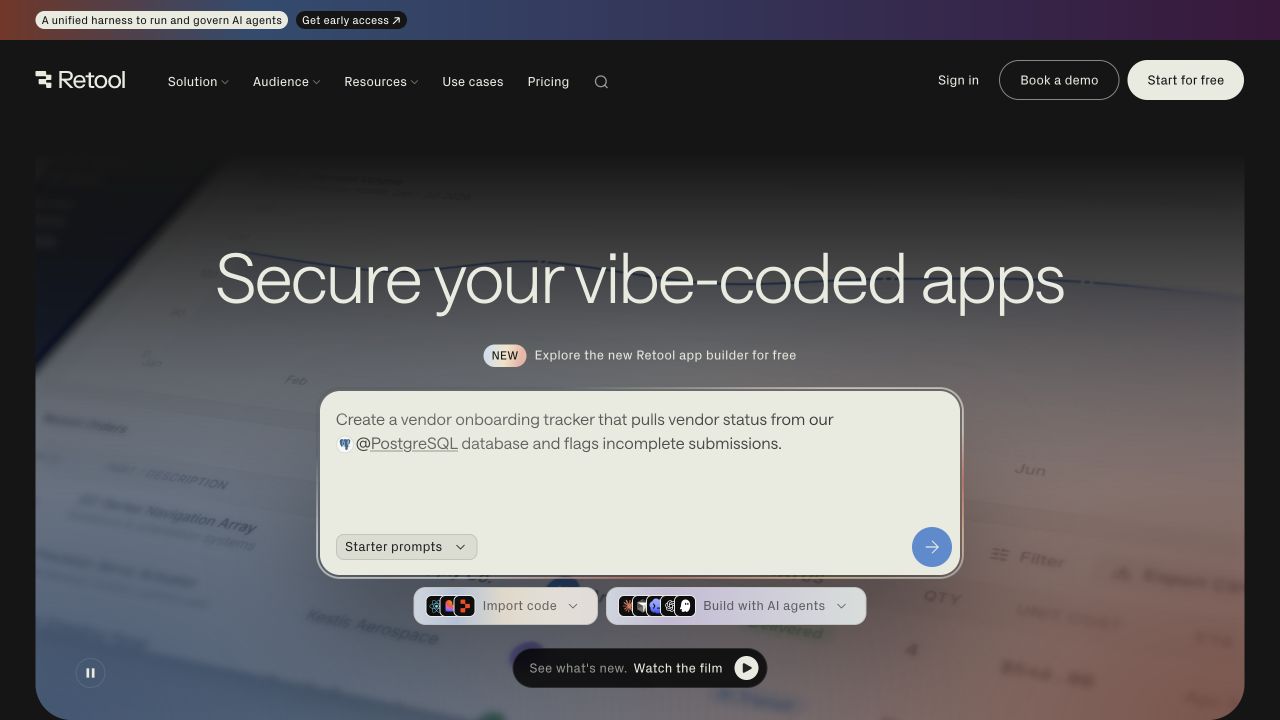
Retool’s captured homepage introduces application building through a concrete prompt and several building routes. The example connects a broad platform with a recognizable operational task, while the public interface avoids revealing an actual customer’s internal records. The technical tool begins with intent, but it still needs to explain the boundary between a generated demonstration and a maintainable production application. Documented association checked November 8, 2026: Retool’s product announcement identifies Retool Database as a hosted PostgreSQL database for internal applications.
What you can learn
Separate Retool Database, the hosted PostgreSQL offering, from every datasource a Retool application can connect to. The official product announcement establishes that service association; it does not mean all customer apps or the pictured marketing page store their authoritative data in one Retool-managed database.
Pros
A concrete prompt makes an otherwise broad application-building platform easier to understand at first glance.
Distinct building routes acknowledge that teams may start with existing code, agents, or other workflows.
Cons & considerations
A prompt-led demonstration can understate the maintenance and permission decisions required after an application is created.
The public page cannot reveal the data ownership or controls of an individual internal business application.
Platform source: Official PostgreSQL customer or product evidence. Retool’s product announcement identifies Retool Database as a hosted PostgreSQL database for internal applications. Official source reviewed November 8, 2026 Pacific; no complete current-stack audit is implied. Official documentary association is scoped to the named product, workload, dependency, or database service. No marketing-homepage runtime, complete company stack, independent performance, or private customer workflow is inferred. Platform evidence is separate from the direct website screenshot and is not a complete current infrastructure audit.
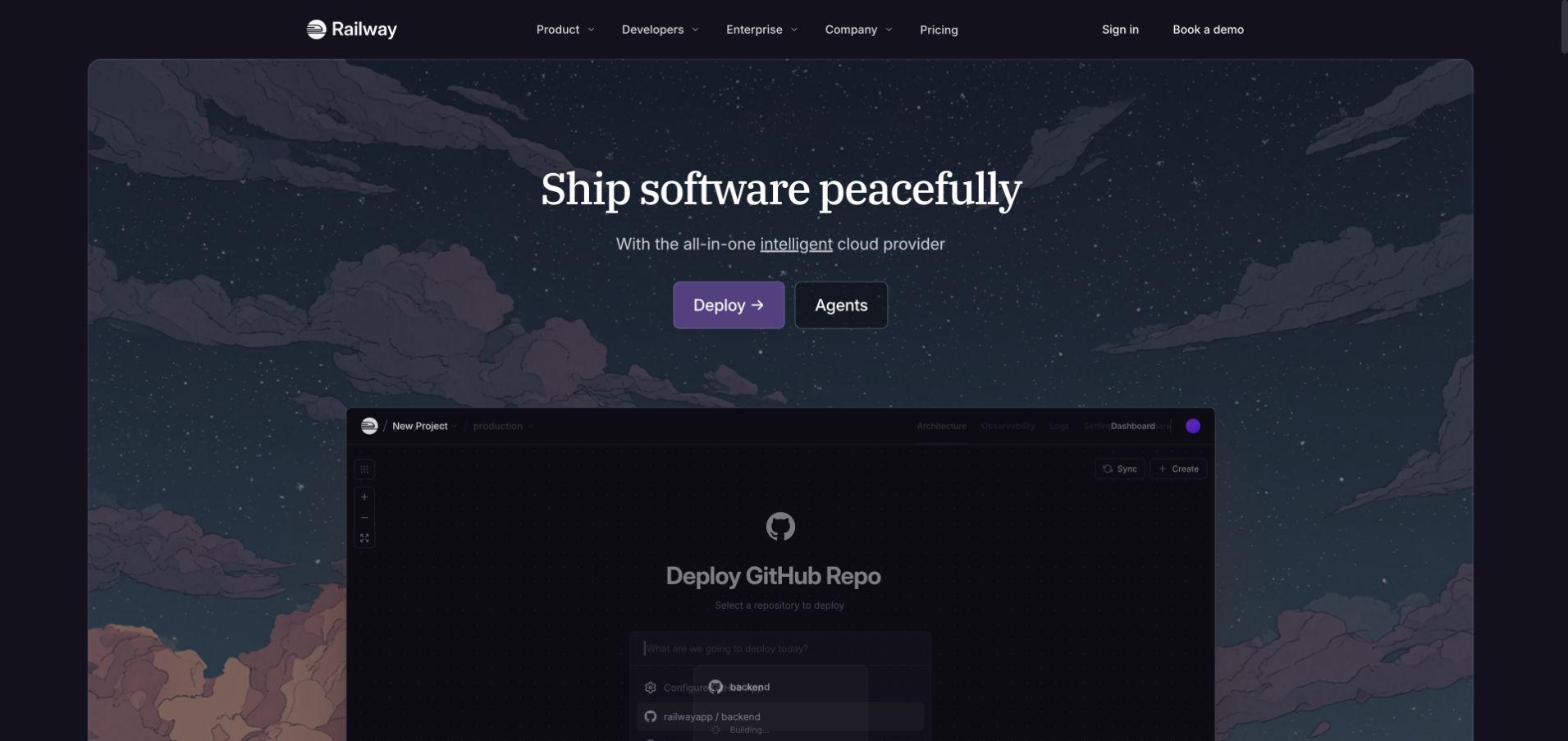
Railway’s public page connects a broad cloud proposition with a visible deployment-interface demonstration. It moves from an approachable headline into deployment, networking, scaling, and monitoring themes, giving technical visitors a practical outline of the platform. The visual friendliness is useful, but a database decision still requires a more precise account of availability, storage, and recovery than the main marketing story provides. Documented association checked November 8, 2026: Official documentation describes Railway’s PostgreSQL database deployment service and connection workflow.
What you can learn
Distinguish a convenient PostgreSQL deployment template from a fully specified database operating model. Railway’s documentation establishes the database service and connection workflow; a project must still examine the selected topology, backups, upgrades, and recovery responsibilities rather than assuming every deployment has identical managed guarantees.
Pros
A deployment-interface illustration makes an abstract cloud-platform proposition more tangible for prospective developers.
Operational themes show that the platform’s scope extends beyond the first successful application deployment.
Cons & considerations
A smooth deployment story can leave database-specific recovery and availability questions insufficiently prominent.
The public page does not establish the topology or operating guarantees of an individual PostgreSQL deployment.
Platform source: Official PostgreSQL customer or product evidence. Official documentation describes Railway’s PostgreSQL database deployment service and connection workflow. Official source reviewed November 8, 2026 Pacific; no complete current-stack audit is implied. Official documentary association is scoped to the named product, workload, dependency, or database service. No marketing-homepage runtime, complete company stack, independent performance, or private customer workflow is inferred. Platform evidence is separate from the direct website screenshot and is not a complete current infrastructure audit.
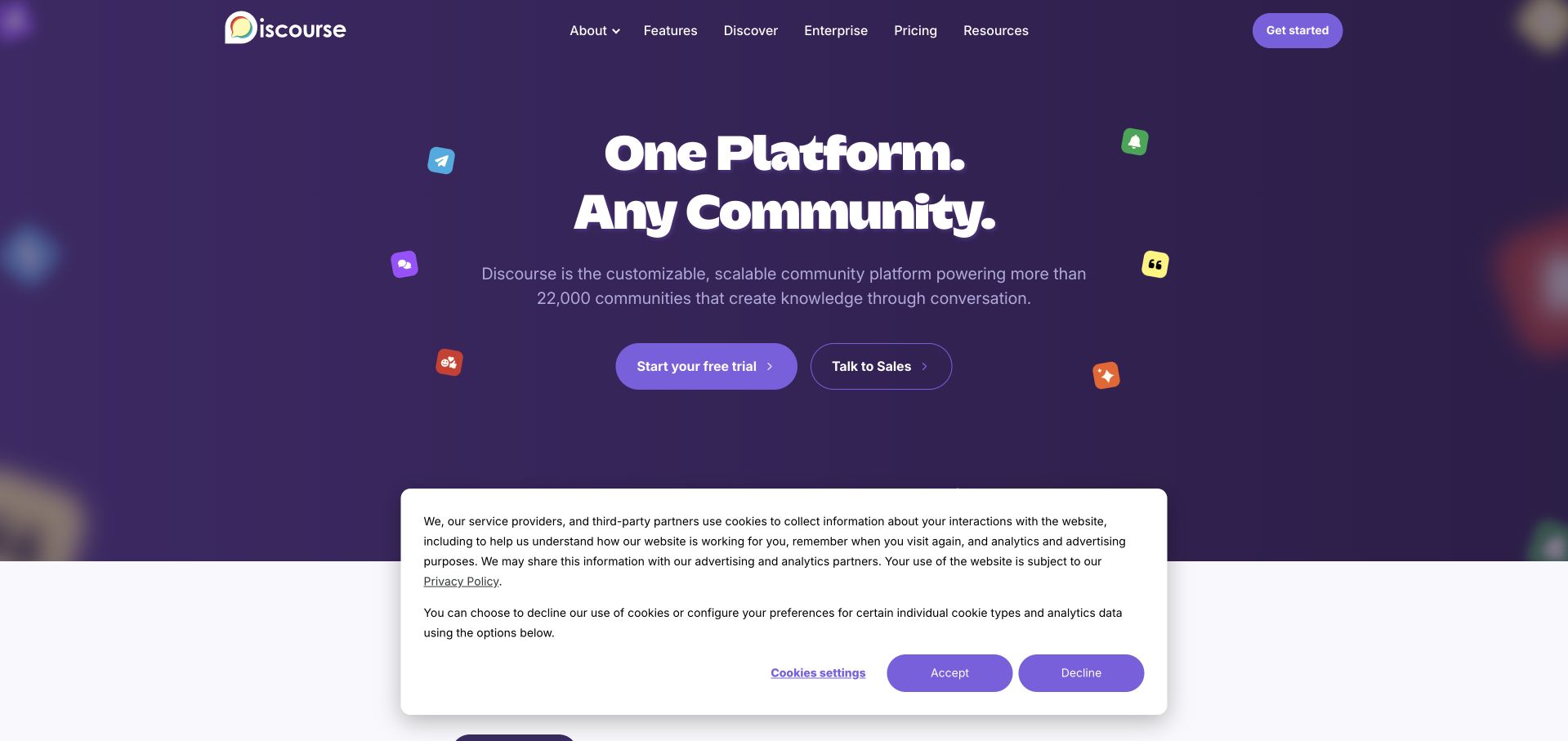
Discourse presents a community platform through a focused headline and separate adoption routes for self-directed and sales-led evaluation. The broader page explains possible community goals rather than treating every organization as the same forum. This is a useful public-product pattern, but the visitor must still connect the general platform with actual category structure, moderation responsibility, and the people who will maintain an ongoing conversation space. Documented association checked November 8, 2026: August 2026 official Discourse announcement documents the PostgreSQL database in its supported Docker installation.
What you can learn
Use the official August 2026 PostgreSQL upgrade notice as a product-dependency reference. It concerns supported Discourse deployments, not the database of the vendor’s marketing homepage; a real community migration must preserve conversations, permissions, and attachments while testing the database upgrade in its own environment.
Pros
A clear platform proposition gives organizational buyers a recognizable category before they inspect detailed capabilities.
Separate trial and sales routes accommodate different levels of implementation confidence and purchasing complexity.
Cons & considerations
A broad community promise does not resolve the category and moderation decisions needed for a particular audience.
The public vendor site cannot demonstrate the migration readiness of an individual community installation.
Platform source: Official PostgreSQL customer or product evidence. August 2026 official Discourse announcement documents the PostgreSQL database in its supported Docker installation. Official supported-installation PostgreSQL update announcement dated August 3, 2026. Official documentary association is scoped to the named product, workload, dependency, or database service. No marketing-homepage runtime, complete company stack, independent performance, or private customer workflow is inferred. Platform evidence is separate from the direct website screenshot and is not a complete current infrastructure audit.
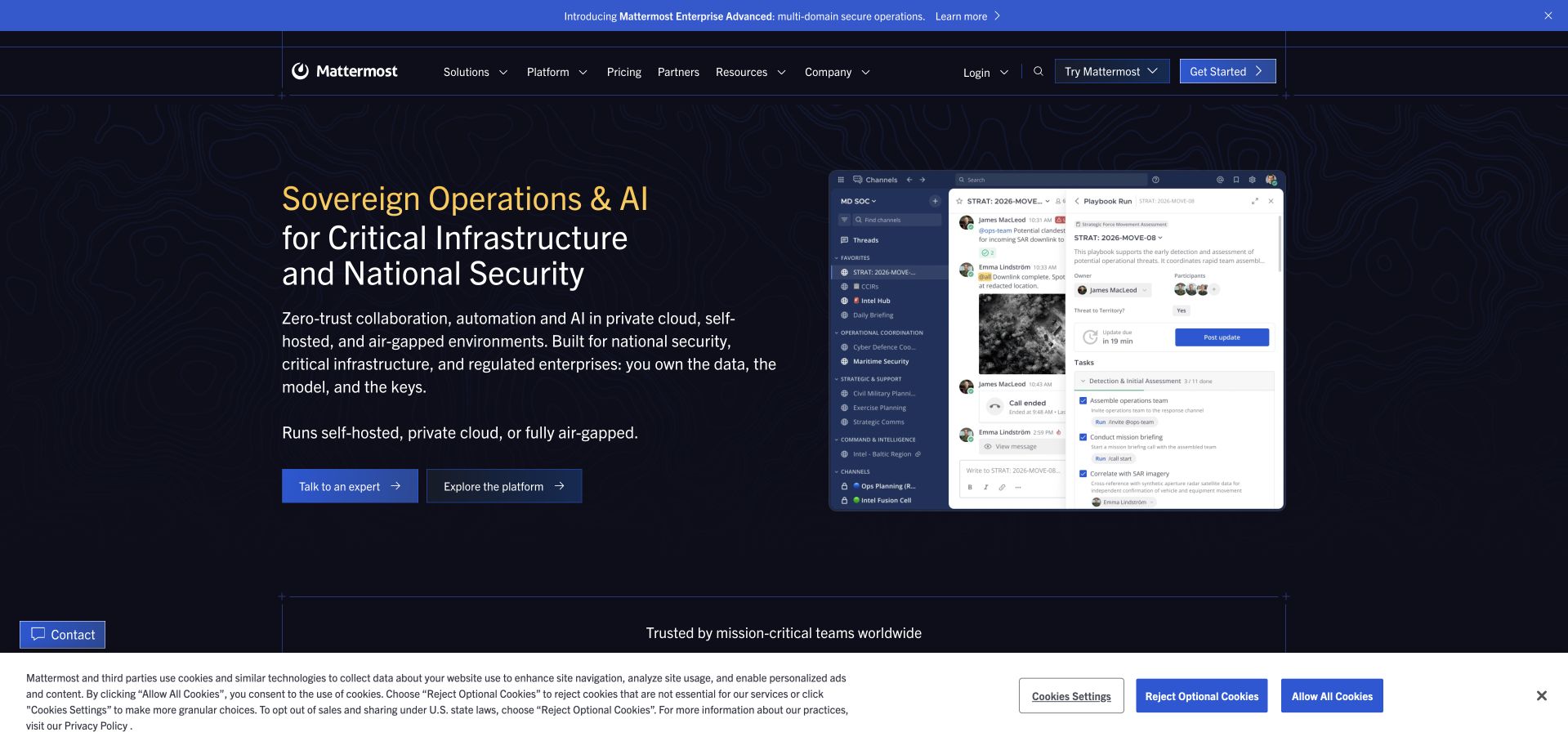
Mattermost’s public page focuses on operational control and specialist organizational environments, pairing that proposition with a workspace illustration. Deployment choices receive visible attention, which helps a technical buyer connect the product with infrastructure requirements. The public presentation is intentionally different from a general consumer chat service, although its specialist vocabulary can make the entry less approachable to visitors without a defined deployment context. Documented association checked November 8, 2026: Mattermost’s deployment documentation identifies PostgreSQL as its supported application database.
What you can learn
Treat PostgreSQL as a documented application requirement within the supported deployment. Mattermost’s current preparation guidance names the database; it does not establish the public marketing site’s runtime or independently certify security. A project still needs tested permissions, storage, retention, and restore procedures appropriate to its environment.
Pros
Deployment-oriented messaging makes infrastructure control a visible part of the product evaluation rather than an afterthought.
A workspace illustration connects a specialist organizational proposition with recognizable collaboration tasks and states.
Cons & considerations
Specialist operational vocabulary raises the interpretation burden for readers without a defined technical deployment need.
The public page cannot independently verify the security or recovery behavior of a particular customer installation.
Platform source: Official PostgreSQL customer or product evidence. Mattermost’s deployment documentation identifies PostgreSQL as its supported application database. Official source reviewed November 8, 2026 Pacific; no complete current-stack audit is implied. Official documentary association is scoped to the named product, workload, dependency, or database service. No marketing-homepage runtime, complete company stack, independent performance, or private customer workflow is inferred. Platform evidence is separate from the direct website screenshot and is not a complete current infrastructure audit.
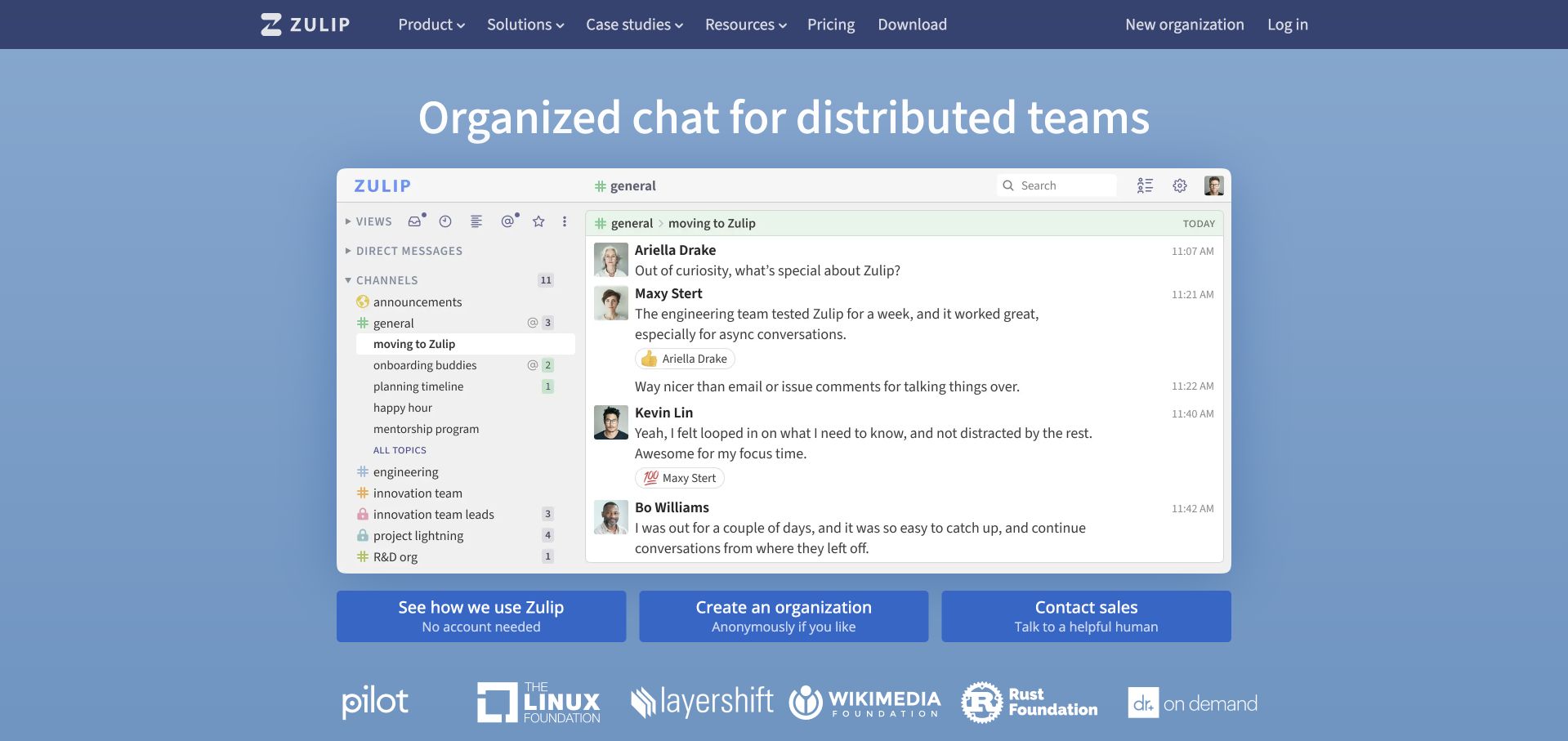
Zulip leads with organized conversation and shows the channel-and-topic structure inside a large product illustration. Public evaluation, organization creation, and sales contact are separated clearly, including a route that does not require an account. The design is useful because it demonstrates the organizing idea before asking a visitor to trust a broad communication promise or imagine the product from feature names alone. Documented association checked November 8, 2026: Zulip’s architectural overview states PostgreSQL stores persistent application data.
What you can learn
Connect persistent chat records with the conversation structure users see. Zulip’s architecture documentation explicitly assigns persistent application data to PostgreSQL; that product dependency does not identify the marketing page’s runtime or mean that message delivery, search, and every other service are implemented inside the database.
Pros
The visible channel-and-topic structure explains the product’s organizing idea before a visitor enters a workspace.
A no-account evaluation route lowers the effort required to understand a private-workspace product.
Cons & considerations
A static illustration cannot demonstrate how a large organization’s actual conversation habits fit the structure.
The public page does not expose message retention, delivery behavior, or every surrounding infrastructure service.
Platform source: Official PostgreSQL customer or product evidence. Zulip’s architectural overview states PostgreSQL stores persistent application data. Official source reviewed November 8, 2026 Pacific; no complete current-stack audit is implied. Official documentary association is scoped to the named product, workload, dependency, or database service. No marketing-homepage runtime, complete company stack, independent performance, or private customer workflow is inferred. Platform evidence is separate from the direct website screenshot and is not a complete current infrastructure audit.
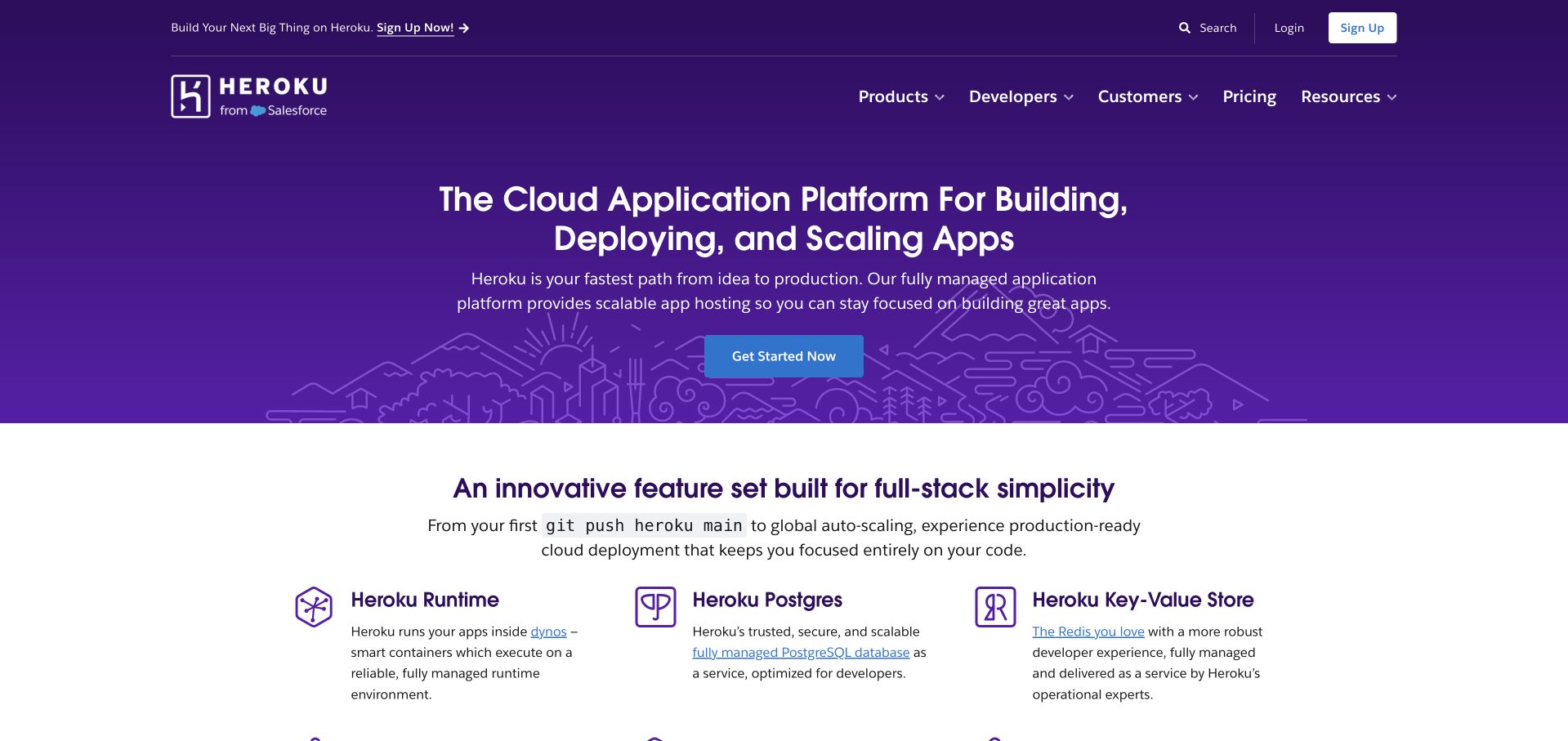
Heroku’s public page introduces managed application hosting and then names major platform components, including Postgres, as distinct offerings. That separation is useful for explaining a cloud service without reducing it to a generic server metaphor. The developer-oriented language creates a practical frame, while the breadth of the platform means visitors still need product documentation to understand the operating characteristics of a selected database plan. Documented association checked November 8, 2026: Official documentation describes Heroku Postgres as a managed PostgreSQL database service.
What you can learn
Keep a managed PostgreSQL service distinct from the runtime of the vendor website. Heroku Postgres documentation establishes the offering, but a customer’s design still needs explicit decisions about connections, migrations, backups, and failure recovery rather than assuming that managed operation removes all application responsibilities.
Pros
Named platform components make the database service easier to distinguish from application runtime and other infrastructure.
Developer-oriented language connects the public offer with recognizable deployment and scaling tasks.
Cons & considerations
A broad managed-platform proposition can conceal meaningful differences among individual service plans and operating limits.
The public page cannot independently demonstrate application-level correctness or recovery readiness for a customer database.
Platform source: Official PostgreSQL customer or product evidence. Official documentation describes Heroku Postgres as a managed PostgreSQL database service. Official source reviewed November 8, 2026 Pacific; no complete current-stack audit is implied. Official documentary association is scoped to the named product, workload, dependency, or database service. No marketing-homepage runtime, complete company stack, independent performance, or private customer workflow is inferred. Platform evidence is separate from the direct website screenshot and is not a complete current infrastructure audit.
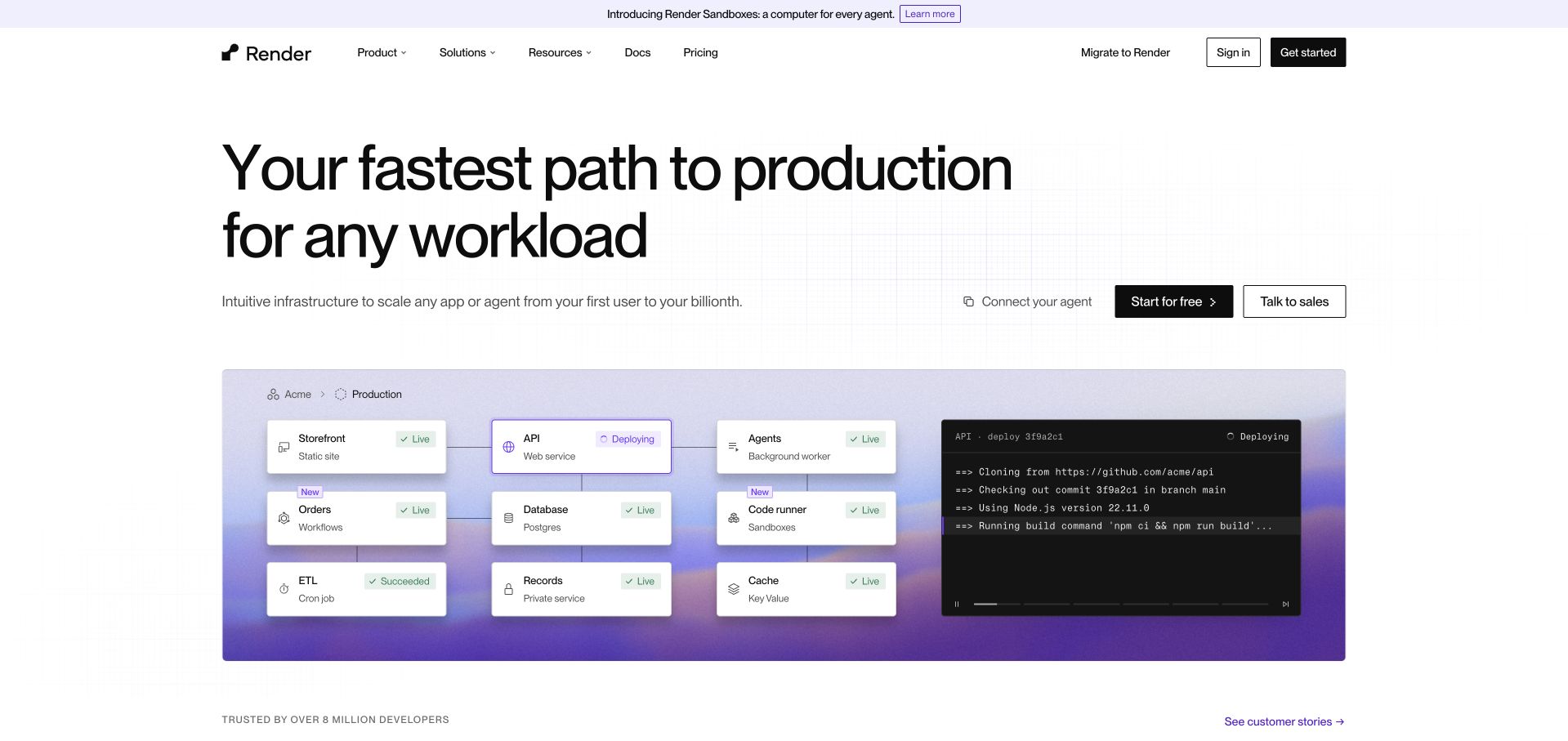
Render pairs an approachable production proposition with a diagram-like illustration of a complete application environment. Visible service types help visitors understand that a working product involves more than one web process. The page then explains a short deployment sequence, making a complex infrastructure category more legible, although the simplicity of the narrative should not be confused with a complete operating specification for each component. Documented association checked November 8, 2026: Official documentation describes Render Postgres, the platform’s managed PostgreSQL service.
What you can learn
Plan a Postgres service as one part of the application’s stateful architecture. Render’s documentation establishes a managed PostgreSQL product; it does not identify the marketing page’s runtime or imply that background workers, caches, previews, and production databases share the same retention or availability behavior.
Pros
A visible multi-service environment helps explain the relationships among application code, databases, and supporting jobs.
A short deployment sequence gives newcomers a concrete entry into an otherwise broad infrastructure platform.
Cons & considerations
An easy production narrative can leave database-specific limits and recovery responsibilities for deeper documentation.
The public diagram cannot demonstrate the configuration or resilience of an actual customer’s service environment.
Platform source: Official PostgreSQL customer or product evidence. Official documentation describes Render Postgres, the platform’s managed PostgreSQL service. Official source reviewed November 8, 2026 Pacific; no complete current-stack audit is implied. Official documentary association is scoped to the named product, workload, dependency, or database service. No marketing-homepage runtime, complete company stack, independent performance, or private customer workflow is inferred. Platform evidence is separate from the direct website screenshot and is not a complete current infrastructure audit.
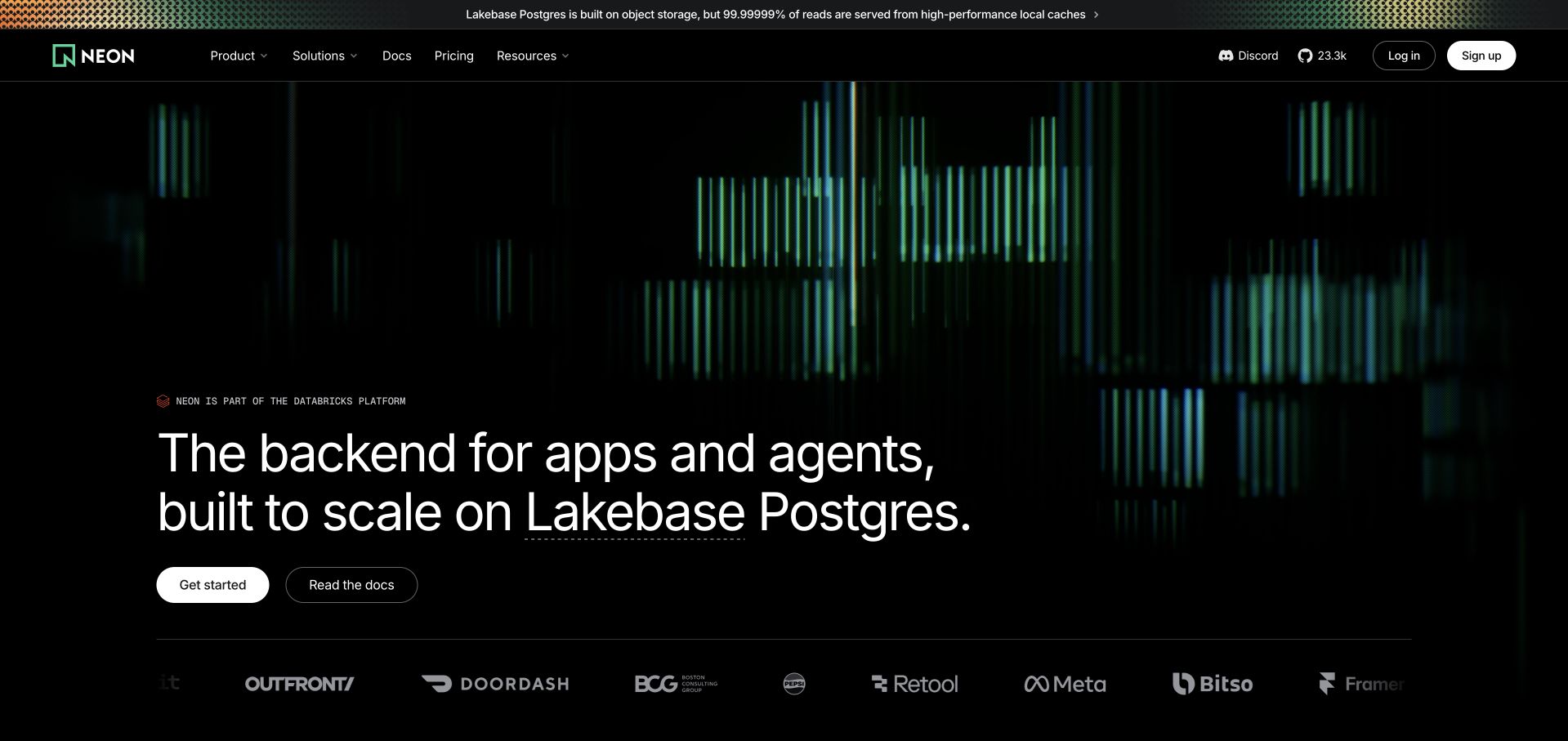
Neon’s current public page presents a broader backend platform while naming its Postgres foundation and providing a direct documentation route. The dark visual system and concise technical language address builders already familiar with application infrastructure. Its useful design challenge is preserving the database category as the product expands, so visitors can distinguish core persistence from authentication, storage, functions, and other surrounding capabilities. Documented association checked November 8, 2026: Official documentation identifies Neon’s Postgres foundation and managed backend offering; current marketing names Lakebase Postgres.
What you can learn
Keep the managed Postgres offering separate from the entire backend bundle. Current official documentation establishes Neon’s service association, while an application team must still understand connection behavior, environment isolation, and the ownership of production data before treating a branch or preview as a safe operational substitute.
Pros
The Postgres foundation remains explicit even as the public proposition expands into a wider backend platform.
A direct documentation route supports technical evaluation beyond the concise marketing introduction.
Cons & considerations
An expanded backend bundle can blur the boundary between the database and adjacent services for new visitors.
The public page cannot establish the configuration or data-isolation behavior of an individual application environment.
Platform source: Official PostgreSQL customer or product evidence. Official documentation identifies Neon’s Postgres foundation and managed backend offering; current marketing names Lakebase Postgres. Official source reviewed November 8, 2026 Pacific; no complete current-stack audit is implied. Official documentary association is scoped to the named product, workload, dependency, or database service. No marketing-homepage runtime, complete company stack, independent performance, or private customer workflow is inferred. Platform evidence is separate from the direct website screenshot and is not a complete current infrastructure audit.
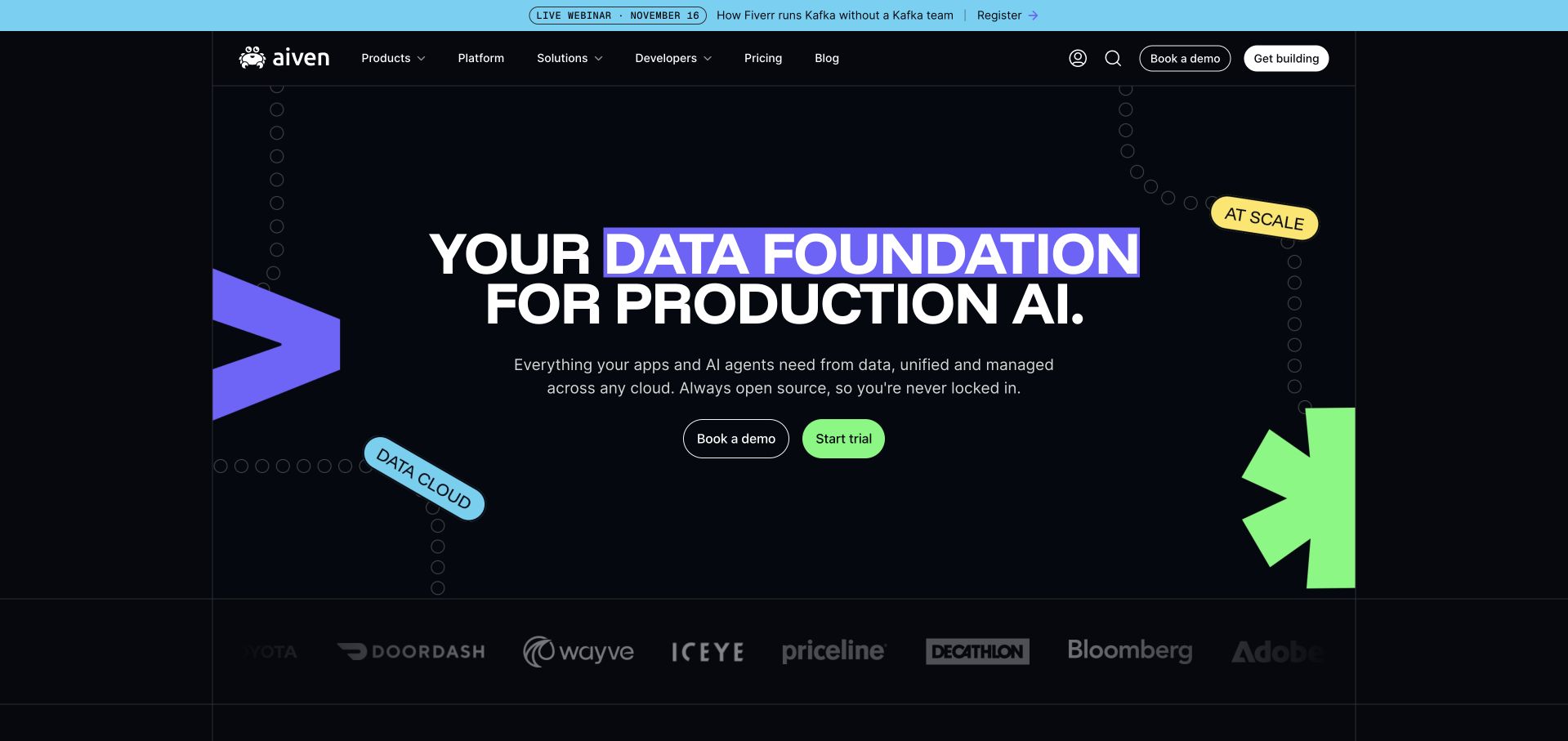
Aiven introduces a multi-service data platform through a production-oriented AI campaign and clear product navigation. The public proposition emphasizes the relationships among data services rather than a single database engine. That framing is useful for organizational evaluation, but it creates a responsibility to distinguish individual managed products and their operating characteristics instead of allowing the platform story to stand in for precise service requirements. Documented association checked November 8, 2026: Official product documentation describes Aiven for PostgreSQL, its managed PostgreSQL service.
What you can learn
Treat Aiven for PostgreSQL as a specific managed offering within the portfolio. Its official documentation establishes the service, not the runtime of this marketing page or identical guarantees across every product. A buyer still needs an explicit comparison of regions, plans, recovery options, and supported extensions.
Pros
Product navigation gives a multi-service data company a practical structure beyond its broad campaign message.
A production-oriented proposition encourages visitors to consider the data platform as an ongoing operational system.
Cons & considerations
A platform-wide AI theme can postpone the concrete database details needed for a narrow evaluation.
The public page does not establish that all managed products share the same features or operating guarantees.
Platform source: Official PostgreSQL customer or product evidence. Official product documentation describes Aiven for PostgreSQL, its managed PostgreSQL service. Official source reviewed November 8, 2026 Pacific; no complete current-stack audit is implied. Official documentary association is scoped to the named product, workload, dependency, or database service. No marketing-homepage runtime, complete company stack, independent performance, or private customer workflow is inferred. Platform evidence is separate from the direct website screenshot and is not a complete current infrastructure audit.
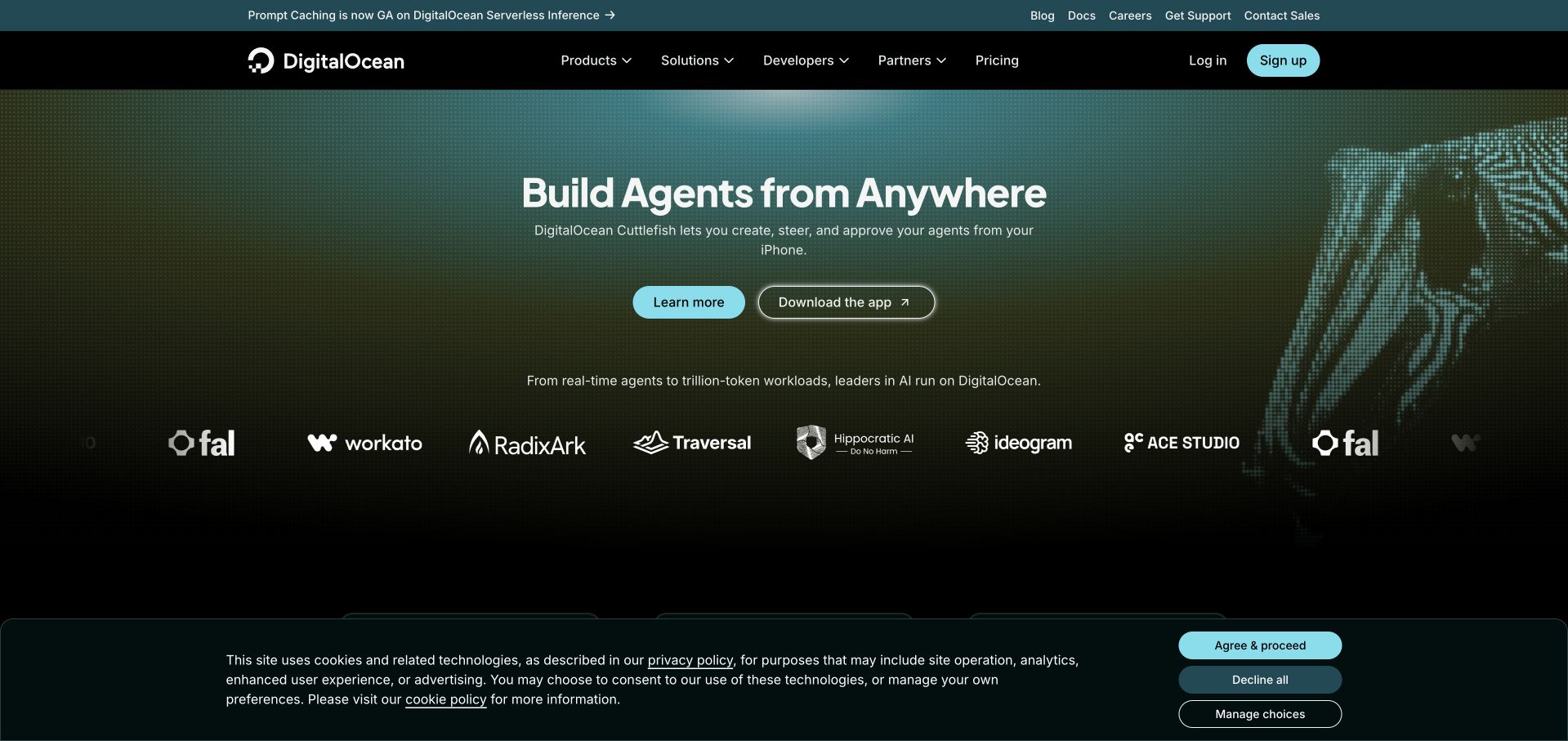
DigitalOcean’s public site places an AI-focused campaign within a larger cloud-product catalog. Product navigation exposes compute, managed databases, storage, networking, and other infrastructure families, giving established users a route beyond the current hero. The useful design problem is keeping that broad catalog understandable when the campaign emphasizes only one direction and visitors may arrive with a straightforward database-hosting requirement. Documented association checked November 8, 2026: Official documentation describes DigitalOcean Managed PostgreSQL database clusters.
What you can learn
Scope the PostgreSQL association to the documented managed database clusters. It does not establish the corporate homepage’s backend or the implementation of every AI product; a project should evaluate the selected database service’s networking, connection limits, backup policy, and recovery behavior independently of the broader cloud campaign.
Pros
A structured cloud-product catalog gives returning visitors alternatives to the current campaign’s main subject.
Recognizable infrastructure families help distinguish managed databases from compute, storage, and surrounding services.
Cons & considerations
A dominant campaign can make a simple database-hosting task less immediately visible to a newcomer.
The public homepage cannot demonstrate the operating limits or restoration behavior of a particular database cluster.
Platform source: Official PostgreSQL customer or product evidence. Official documentation describes DigitalOcean Managed PostgreSQL database clusters. Official source reviewed November 8, 2026 Pacific; no complete current-stack audit is implied. Official documentary association is scoped to the named product, workload, dependency, or database service. No marketing-homepage runtime, complete company stack, independent performance, or private customer workflow is inferred. Platform evidence is separate from the direct website screenshot and is not a complete current infrastructure audit.
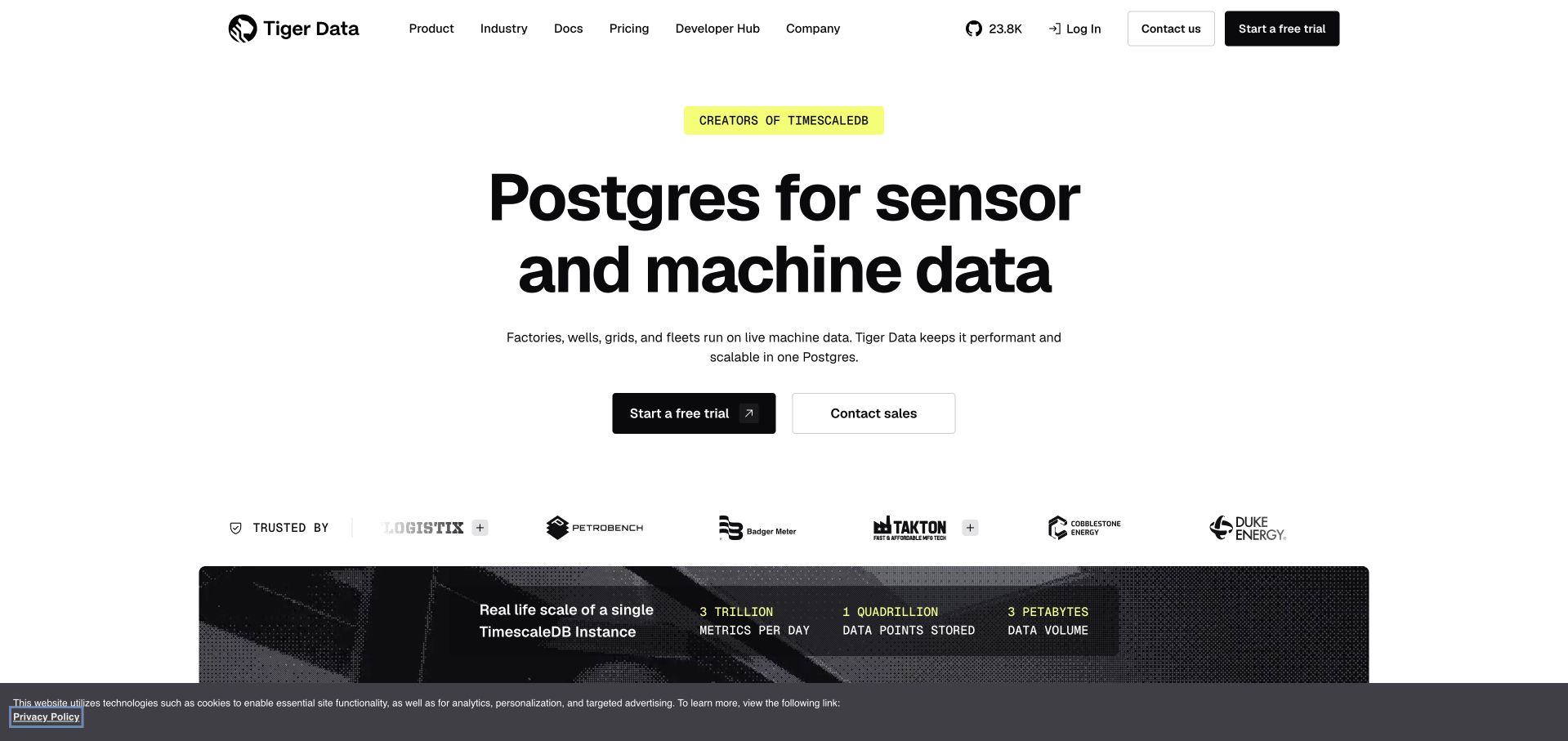
Tiger Data’s current page names a concrete workload—sensor and machine data—and connects it directly with Postgres. The restrained layout and separate technical-capability sections make a specialized database proposition easier to evaluate than a generic analytics promise. Its main design strength is workload specificity, while the prominent scale claims still need careful context and should not be treated as predictions for an unrelated application. Documented association checked November 8, 2026: Official product announcement describes Timescale’s PostgreSQL-based database offering under the Tiger Data brand.
What you can learn
Distinguish a PostgreSQL-based time-series offering from an unmodified general-purpose deployment. The official rebrand and product material establish the Timescale foundation; a new project should evaluate ingestion patterns, retention, query requirements, and extension dependencies against its own machine-data workload rather than copy a headline scale number.
Pros
A named sensor-and-machine workload makes the specialist database proposition concrete before technical details appear.
Separated capability sections provide a clearer evaluation structure than a single undifferentiated performance claim.
Cons & considerations
Large scale claims can distract from the workload conditions and configuration needed to interpret them responsibly.
The public page cannot predict the cost or performance of a different customer’s time-series application.
Platform source: Official PostgreSQL customer or product evidence. Official product announcement describes Timescale’s PostgreSQL-based database offering under the Tiger Data brand. Official source reviewed November 8, 2026 Pacific; no complete current-stack audit is implied. Official documentary association is scoped to the named product, workload, dependency, or database service. No marketing-homepage runtime, complete company stack, independent performance, or private customer workflow is inferred. Platform evidence is separate from the direct website screenshot and is not a complete current infrastructure audit.
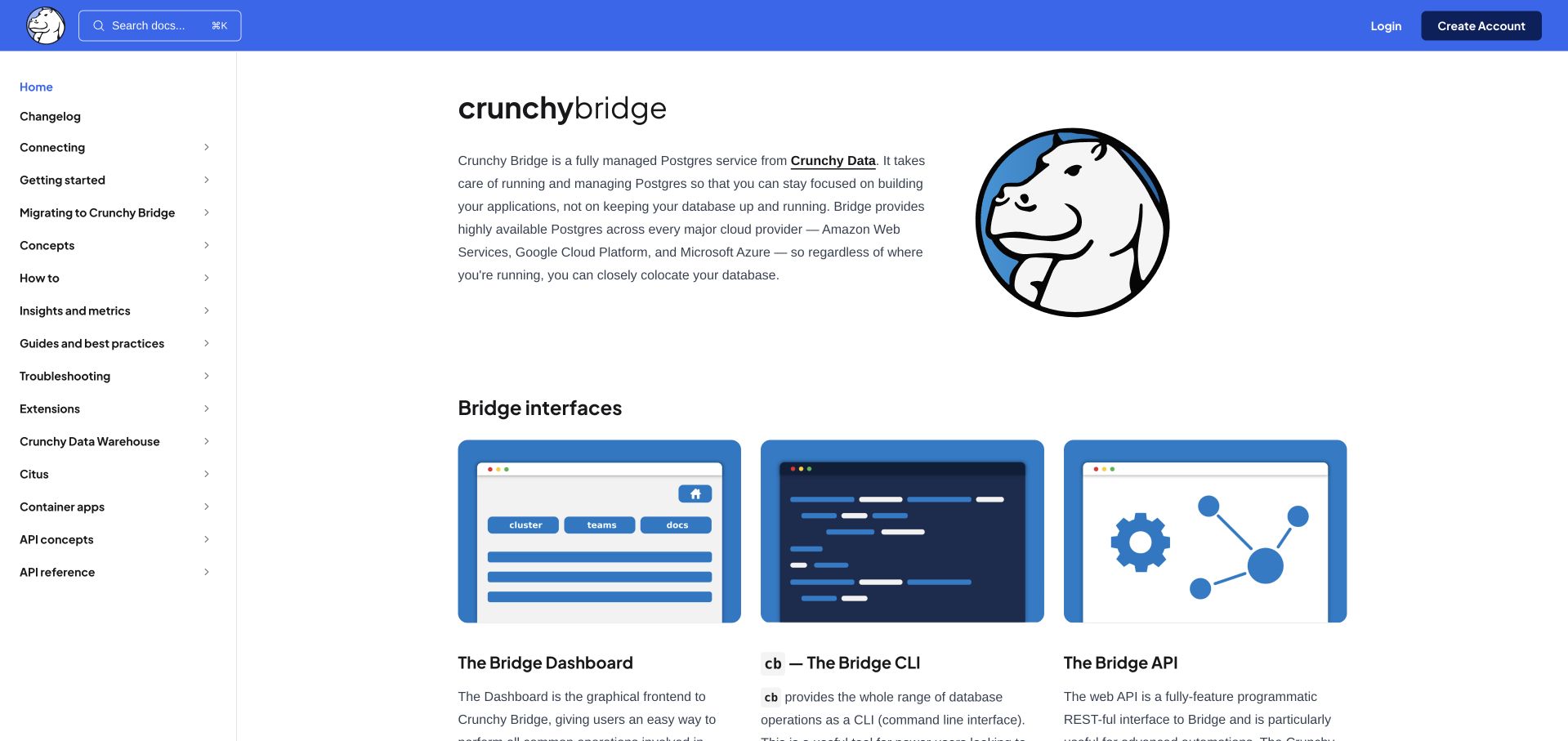
Crunchy Bridge’s public documentation opens with a plain service explanation, a persistent sidebar, and separate introductions to its dashboard, command line, and API. The design prioritizes orientation and ongoing reference over a large promotional hero. That is useful for an infrastructure product whose users must move between conceptual understanding and operational tasks, though the broad navigation still requires a newcomer to identify the correct starting sequence. Documented association checked November 8, 2026: Official documentation identifies Crunchy Bridge as a managed PostgreSQL database service.
What you can learn
Use the documentation as direct evidence of a managed PostgreSQL offering, not as a claim about the documentation renderer’s database. A practical evaluation should follow connection setup into permissions, backups, and restoration, keeping the operational service separate from the public site used to explain it.
Pros
A persistent topic sidebar makes reference material easier to revisit than a single long promotional page.
Separate interface introductions acknowledge that operators may use a dashboard, command line, or programmatic API.
Cons & considerations
A broad reference navigation can overwhelm a newcomer without a clearly followed first-use sequence.
Documentation explains supported behavior but does not independently demonstrate a particular customer cluster’s recovery readiness.
Platform source: Official PostgreSQL customer or product evidence. Official documentation identifies Crunchy Bridge as a managed PostgreSQL database service. Official source reviewed November 8, 2026 Pacific; no complete current-stack audit is implied. Official documentary association is scoped to the named product, workload, dependency, or database service. No marketing-homepage runtime, complete company stack, independent performance, or private customer workflow is inferred. Platform evidence is separate from the direct website screenshot and is not a complete current infrastructure audit.
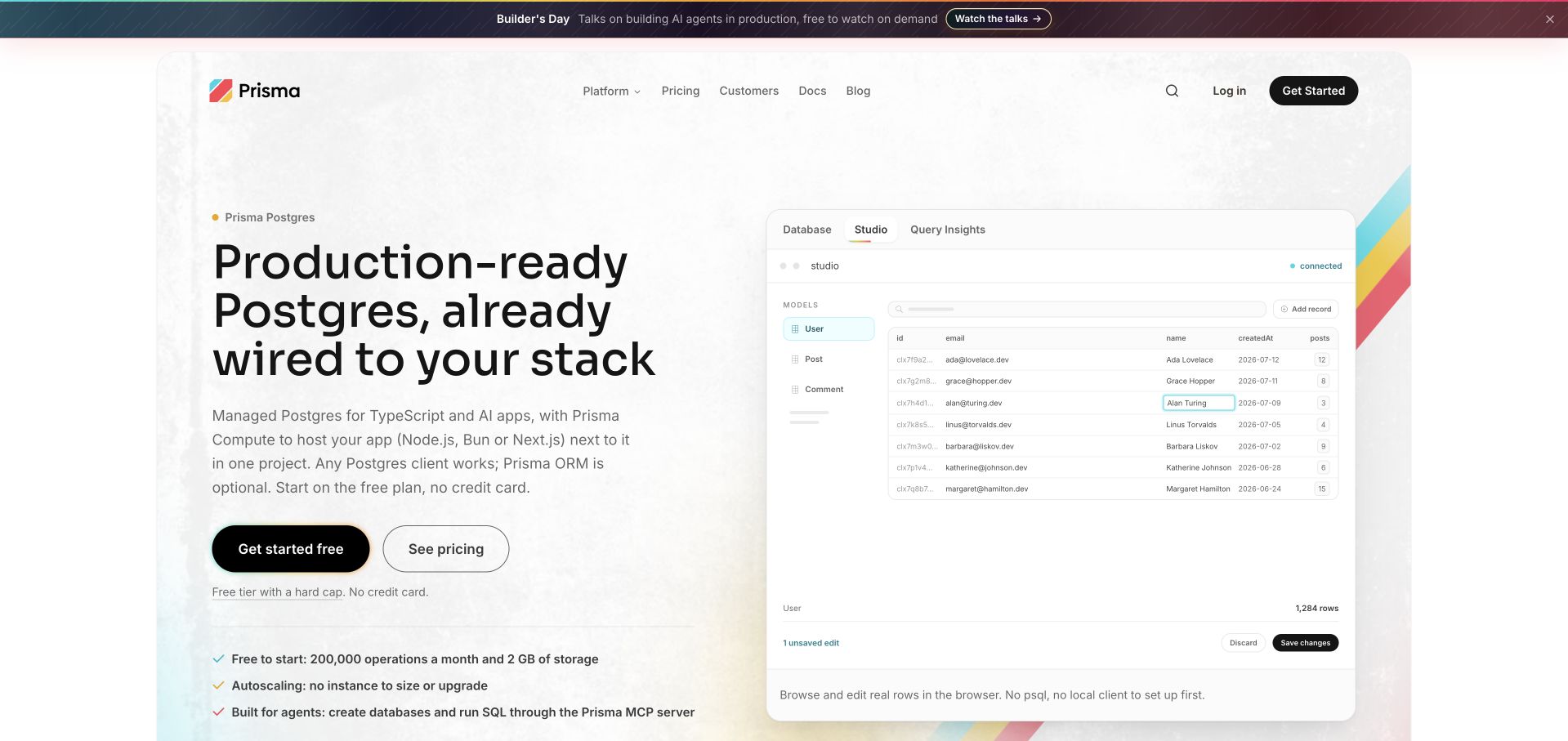
Prisma Postgres’s public product page names the managed database clearly and pairs the explanation with a table-oriented interface illustration. The page also states that ordinary Postgres clients can connect, making an important product boundary visible near the entrance. Its useful design lesson is to explain interoperability directly, while separating that claim from the broader application-hosting and tooling features promoted around the database. Documented association checked November 8, 2026: Official documentation identifies Prisma Postgres as managed PostgreSQL, accessible with standard PostgreSQL clients.
What you can learn
Keep the managed service association distinct from a mandatory ORM choice. Prisma’s documentation identifies PostgreSQL and standard client access; a project should still test its actual driver, migrations, connection lifecycle, and operating limits rather than infer compatibility from a familiar logo or an illustrative table of sample records.
Pros
The database category and standard-client proposition are visible early instead of hidden in implementation documentation.
A table-oriented product illustration gives a technical persistence service a concrete and recognizable interface.
Cons & considerations
Bundled application-platform messaging can complicate a visitor’s effort to evaluate only the database offering.
A public illustration cannot verify a particular driver, migration path, or production connection workload.
Platform source: Official PostgreSQL customer or product evidence. Official documentation identifies Prisma Postgres as managed PostgreSQL, accessible with standard PostgreSQL clients. Official source reviewed November 8, 2026 Pacific; no complete current-stack audit is implied. Official documentary association is scoped to the named product, workload, dependency, or database service. No marketing-homepage runtime, complete company stack, independent performance, or private customer workflow is inferred. Platform evidence is separate from the direct website screenshot and is not a complete current infrastructure audit.
Fly.io’s public page combines a distinctive illustrated identity with a concrete proposition around computers for applications and agents. Product and documentation routes provide practical alternatives to the broad campaign. The page maintains personality for a technical audience, although visitors evaluating a database still need to distinguish managed service operation from running their own software on virtual machines. Documented association checked November 8, 2026: Official documentation describes Fly.io Managed Postgres as a managed PostgreSQL offering; not the older unmanaged fly postgres deployment path.
What you can learn
Keep Managed Postgres separate from older self-managed deployment paths. The current documentation establishes a managed PostgreSQL offering, not the database behind the marketing page. A project should identify who owns backups, upgrades, availability, and incident response before choosing between managed operation and running a datastore on general-purpose machines.
Pros
A distinctive illustrated identity makes the infrastructure brand recognizable without hiding product and documentation routes.
Application-oriented language gives the compute proposition a practical purpose beyond an abstract server specification.
Cons & considerations
A broad computers-and-agents campaign can leave a database-focused visitor with extra navigation work.
The public homepage cannot establish the operating responsibilities of every managed and self-managed deployment option.
Visible tech stack
Earlier / documented evidence
PostgreSQL
Platform source: Official PostgreSQL customer or product evidence. Official documentation describes Fly.io Managed Postgres as a managed PostgreSQL offering; not the older unmanaged fly postgres deployment path. Official source reviewed November 8, 2026 Pacific; no complete current-stack audit is implied. Official documentary association is scoped to the named product, workload, dependency, or database service. No marketing-homepage runtime, complete company stack, independent performance, or private customer workflow is inferred. Platform evidence is separate from the direct website screenshot and is not a complete current infrastructure audit.
Kegan has 15+ years of experience working with small businesses, Fortune 500 companies, and everything in between. No development job is too big or too small: he brings the same hands-on attention to a focused improvement, a complete website, or a custom application.
For PostgreSQL projects, he can help with data modeling, application data access, query design, search and cache integrations, migration planning, access boundaries, and maintainable handover. He works directly with clients on scope, design, implementation, testing, and handover, with an emphasis on clear communication and a system that remains practical to maintain after launch.
Show 3 other PostgreSQL developersHide other PostgreSQL developers
Define the authoritative business records and the changes that must succeed together. Keep the transaction boundary understandable and avoid assuming that a relational primary database must also serve every analytical, search, or large-object requirement. Explain where derived views obtain their data and how they catch up.
A supported software dependency
Discourse, Mattermost, and Zulip document PostgreSQL within their application architectures or supported installations. Follow the product’s maintained deployment guidance rather than treating the database as an independent interchangeable component. Plan upgrades around the complete application, including permissions, file storage, and a realistic restoration test.
A managed PostgreSQL offering
The later examples include several database-service providers. Compare operating responsibility, regions, extension support, networking, and recovery options against a written requirement. A familiar PostgreSQL connection protocol does not mean that every surrounding management feature or plan limit is the same across vendors.
From references to requirements
Plan schema, change, and operations together
Draw the record relationships
Name identifiers, required relationships, ownership, and deletion behavior before polishing a form. Test an attempted duplicate, a removed related record, and an incomplete import. Document which rules belong in database constraints and which require application-level policy or a human decision.
Make migrations a normal workflow
Plan a realistic change to an existing field or relationship. Rehearse it with representative data and an application version transition, not only a freshly created database. Decide how deployment is paused or reversed if the data change cannot safely be undone in the same way as a code change.
Follow one request through failure
Trace a user action through application connections, the database, and any downstream readers. Test a delayed response and a restored environment. Assign the operator, escalation route, and evidence needed to say that the application—not just the database process—is healthy again.
A useful handover demonstration
Ask the actual team to carry out its routine job: publish a realistic update, correct a mistake, preview a narrow screen, and identify who owns an integration failure. For a library or frontend framework, also ask who maintains the content source and deployment. A polished screenshot does not answer those operational questions.
Beyond the screenshot
PostgreSQL project checklist
Name the authoritative records and their owners.
Define identifiers, uniqueness, and required relationships.
Decide deletion behavior deliberately.
Keep user-facing errors understandable.
List representative queries and result sizes.
Measure index tradeoffs with realistic data.
Document transaction and downstream-read boundaries.
Rehearse a migration on existing records.
Check the selected service’s operating limits.
Record extension and driver assumptions.
Restore an appropriate test environment.
Assign responsibility for application recovery.
Test with real content, a keyboard, a small screen, slow or failed requests, and the people who will maintain the system. These are planning checks, not an accessibility, security, performance, or search-ranking certification.
Sources & editorial method
How this PostgreSQL collection was reviewed
Twenty distinct public properties were selected and individually reviewed for this PostgreSQL collection. Public browser captures were visually inspected; each image preserves its actual captureUrl, captureDate, dimensions, and provenance. New captures occurred November 9 UTC during November 8, 2026 Pacific research. Reused captures retain their original dates and timestamps; capturedAt:null means only the original day is known and no time was invented. Official primary customer, engineering, operations, or product documentation establishes only the named application workload, dependency, or database-service association. A company’s use of PostgreSQL is not evidence of the pictured homepage’s runtime or its entire technology estate. Historical accounts remain dated, and customer-reported results were not independently benchmarked. Reviews are original design criticism, not endorsements of financial, clinical, security, service-quality, or AI outcomes. No logins, account forms, transactions, or private workflows were used. Images and trademarks belong to their owners. A separate bounded public stack audit is performed by the sole publisher before publication; it is not replaced by these documentary associations.
Every image is an unmodified capture from the actual website, with its source and capture date. Some captures are reused from our shared catalog; their dates remain the original capture dates. None comes from a vendor gallery or a generated reconstruction. Moving imagery and live content can change.
Technology attribution uses public page assets or metadata, official platform documentation, or a cited first-party project case study. Documentary and framework-relationship evidence is identified where used; it is not a complete current backend inventory. A CMS image CDN alone does not establish a full CMS deployment. A library’s presence does not prove which individual controls use it, and a platform label does not establish AI authorship.
The composition notes, lessons, pros and tradeoffs are original editorial observations. We have not measured conversion, traffic, security, performance or accessibility conformance. Website owners retain their brands and imagery; these examples are not our client portfolio. Written, Edited and Curated are independent records, not dates advanced by a build. See our editorial standards or suggest a correction.
Questions worth asking
PostgreSQL website development FAQs
Why include database-service vendors among website examples?
Their public sites are useful communication references and their documentation establishes a precise PostgreSQL offering. They are clearly labeled service associations, not customers whose marketing-page database has been observed.
Does PostgreSQL imply that all data belongs in tables?
The architecture question is ownership, not a mandate to put every asset and workload in one system. Identify the authoritative transactional records and keep object storage, search, analytics, and other specialized responsibilities explicit.
Should a project copy Figma’s sharding approach?
Not from a customer name alone. The March 2024 article describes a particular product, scale, and engineering situation. Begin with your real queries and operating constraints; architectural complexity needs a demonstrated reason.
Is a managed database enough to guarantee recovery?
No. Understand the selected plan and test how the application is restored, reconnected, and verified. A provider’s backup feature and your complete product recovery process are related but different responsibilities.
Why retain older engineering and incident sources?
A dated primary account can establish an honest association and teach a concrete operating lesson. Its date is preserved so readers do not mistake it for an independent audit of the organization’s complete current infrastructure.
A useful PostgreSQL brief explains relationships, authoritative state, change, and recovery. The public website can make those ideas understandable, but its appearance cannot prove the database architecture behind it.