Definitive guide · Amazon Redshift website development
Best Amazon Redshift Websites of 2026 (20 Real-World Examples)
Twenty public design references paired with specific Amazon Redshift evidence, including dated historical adoption, experimentation and migration accounts.
Redshift is an analytical warehouse, not a homepage design system. Use these references to study communication and tasks while keeping warehouse requirements grounded in your own data and decisions.
A restaurant group’s enterprise analytics, a manufacturer’s plant-data warehouse and a freight company’s reporting platform are different uses of analytical infrastructure. Their public websites can provide useful design references without revealing that infrastructure. The evidence below names the actual association and preserves limits: SoundCloud’s article describes historical Redshift use followed by a BigQuery migration, Woot discusses Spectrum experimentation, and FINRA, Hearst and Amgen are dated 2016 documentary references.
For a new project, begin with the decision a report or analytical application must support. Identify its data sources, the required update timing and who can access the result. Do not begin by copying a famous company’s service list. A successful dashboard depends on consistent definitions and trustworthy data as much as it does on query performance.
Before the examples
What makes good Amazon Redshift website development in 2026?
Separate analytics from operational transactions
A warehouse can support business insight without becoming the system that accepts an order, dispatches a vehicle or approves a booking. Identify the operational authority and the path that brings information into analysis. If an insight returns to a customer-facing workflow, give that movement its own validation and permission rules.
Define the measure before designing the chart
Write down what revenue, retention, an active account or a completed shipment means in the specific report. State the time period, source and treatment of corrections. Two attractive charts can disagree because of different definitions rather than faulty infrastructure. Resolve that disagreement before presenting either as an authoritative business answer.
Choose capacity against the real workload
AWS documents both provisioned clusters and Redshift Serverless. Evaluate them using representative query patterns, concurrency, freshness and operating needs instead of assuming one mode is universally simpler or cheaper. A vendor’s benchmark or another organization’s workload cannot establish your performance and cost result.
The first five examples are recognizable major organizations with specific AWS evidence. Each of the 20 public-page reviews separates visible design from its documentary database association, and historical or experimental contexts are not described as current universal deployments.
We start with five recognizable brands or organizations: McDonald’s, Moderna, Pfizer, Nasdaq, Warner Bros. Games. Each attribution applies to the named website property, not every product or website belonging to its organization. This is a curated reading sequence, not a measured ranking.
McDonald’s corporate homepage places a short purpose statement over a large photograph of a child beside the water with a familiar Happy Meal. A restrained white navigation separates company, impact, stories and investor routes. The opening is an institutional introduction, not an ordering interface. AWS’s customer case identifies Redshift within McDonald’s Global Data Platform in a historical digital-transformation account. It does not establish the corporate site’s database, the implementation of every restaurant system or a complete current architecture.
What you can learn
Keep corporate storytelling distinct from operational customer journeys. A recognizable product can establish continuity without making the page an ordering funnel. For analytics, define which decisions the warehouse supports and which source systems remain authoritative; collecting enterprise data does not mean replacing every transactional service with a warehouse.
Pros
The familiar consumer imagery gives the corporate purpose message an immediately recognizable context.
A short stakeholder navigation makes company and investor routes available without competing with the photograph.
Cons & considerations
The broad purpose statement provides little immediate help with a specific corporate research task.
A small terms-update notice above navigation adds another layer before the main content.
Visible tech stack
Earlier / documented evidence
Amazon Redshift
Platform source: Official technology-specific customer or workload source. AWS’s McDonald’s digital-transformation case identifies Redshift, Athena and EMR within its Global Data Platform in an account discussing 2016 and 2019 developments. It is not a corporate homepage database claim. This evidence establishes only the stated product, workload, organization or historical association. It does not prove that the pictured public page uses the technology, reveal its CMS/frontend, establish a complete current architecture or independently verify vendor-reported outcomes. Platform evidence is separate from the direct website screenshot and is not a complete current infrastructure audit.
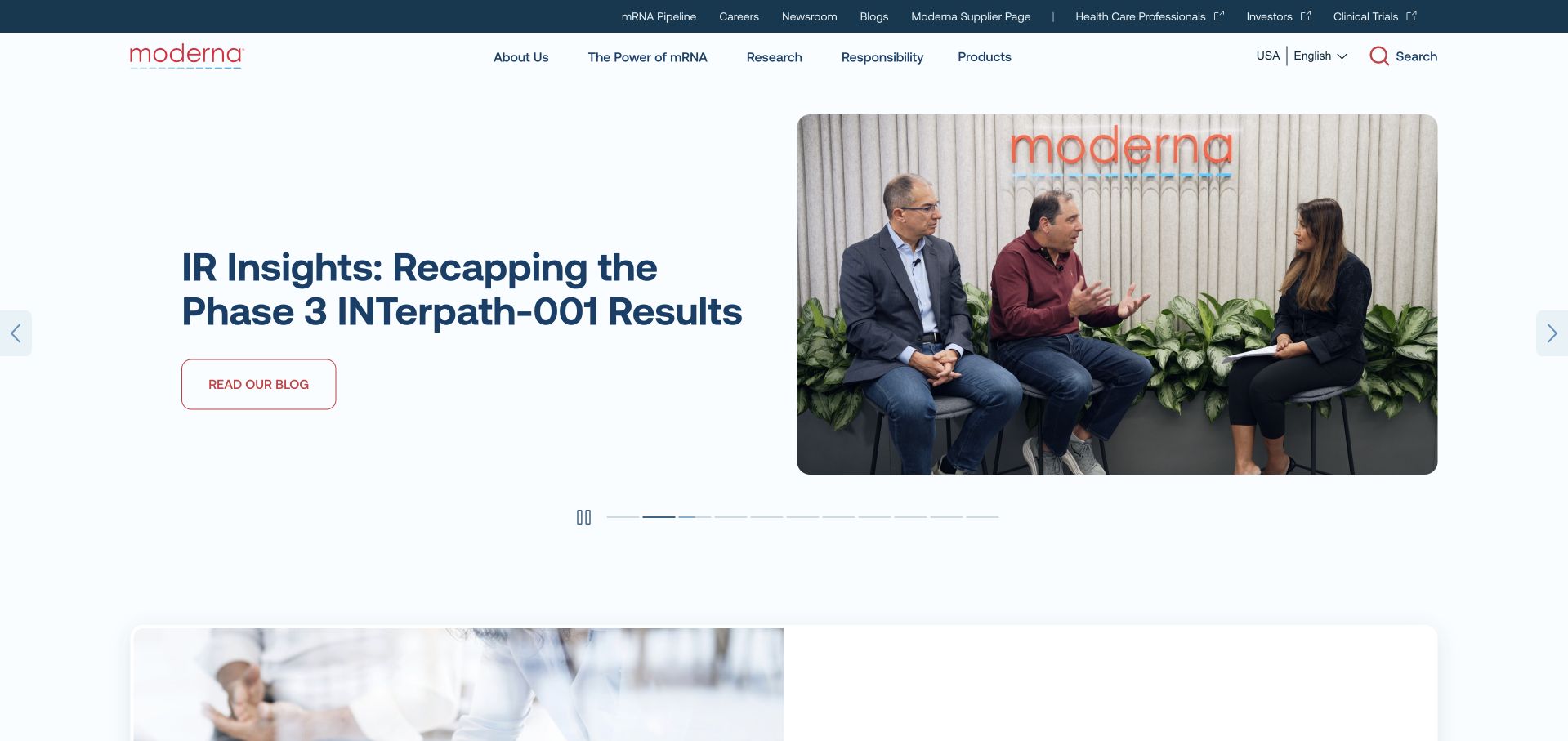
Moderna’s captured homepage pairs a contained research-interview image with a concise investor-relations feature headline. A pale background and small outlined action give the content an editorial tone, while separate utility and research navigation remain above. The next section starts without an abrupt visual change. AWS’s 2023 case describes Redshift supporting real-world data analysis and disease-surveillance dashboards through AWS Data Exchange. It does not establish the marketing site’s backend or independently validate the research results featured in the contemporary hero.
What you can learn
Give scientific updates a clear publication context and a route to the underlying explanation. In a data brief, distinguish licensed datasets, analytical access and public claims. A warehouse can support research reporting, but provenance, permitted use and review of any published interpretation remain separate responsibilities.
Pros
The split editorial composition connects a specific update to an identifiable discussion rather than generic laboratory imagery.
The restrained action and generous space make the feature easy to scan.
Cons & considerations
Multiple navigation tiers introduce substantial audience complexity before the feature begins.
A rotating research feature may delay evergreen explanations for visitors unfamiliar with the organization.
Platform source: Official technology-specific customer or workload source. AWS’s 2023 Moderna case identifies Redshift for real-world data analysis and disease-surveillance dashboards using AWS Data Exchange. This evidence establishes only the stated product, workload, organization or historical association. It does not prove that the pictured public page uses the technology, reveal its CMS/frontend, establish a complete current architecture or independently verify vendor-reported outcomes. Platform evidence is separate from the direct website screenshot and is not a complete current infrastructure audit.
Pfizer’s captured opening uses a large white headline beside a close view of a researcher at a microscope. A dark photographic treatment protects the text, while a small violet action connects the awareness story to further reading. The simple white header separates science, products and corporate routes. AWS’s analytics customer page explicitly quotes Pfizer’s use of Redshift for manufacturing and regulatory-submission data work. It does not establish the technology behind this public story or independently verify its clinical assertions.
What you can learn
Keep educational content, scientific evidence and product information distinguishable. A public awareness page needs accessible explanations and appropriate sources, while manufacturing analytics requires governed definitions and restricted data access. The fact that both belong to one company does not make them the same application or justify a shared unrestricted data flow.
Pros
The microscope photograph and focused headline give the public-awareness feature a clear scientific context.
A distinct reading action remains visible without turning the opening into a sales form.
Cons & considerations
The large campaign occupies most of the first view before broader organizational information appears.
A strong research image cannot substitute for the detailed sources needed to assess health-related claims.
Platform source: Official technology-specific customer or workload source. AWS’s analytics customer page explicitly quotes Pfizer’s Redshift use for manufacturing and regulatory-submission data work. This evidence establishes only the stated product, workload, organization or historical association. It does not prove that the pictured public page uses the technology, reveal its CMS/frontend, establish a complete current architecture or independently verify vendor-reported outcomes. Platform evidence is separate from the direct website screenshot and is not a complete current infrastructure audit.
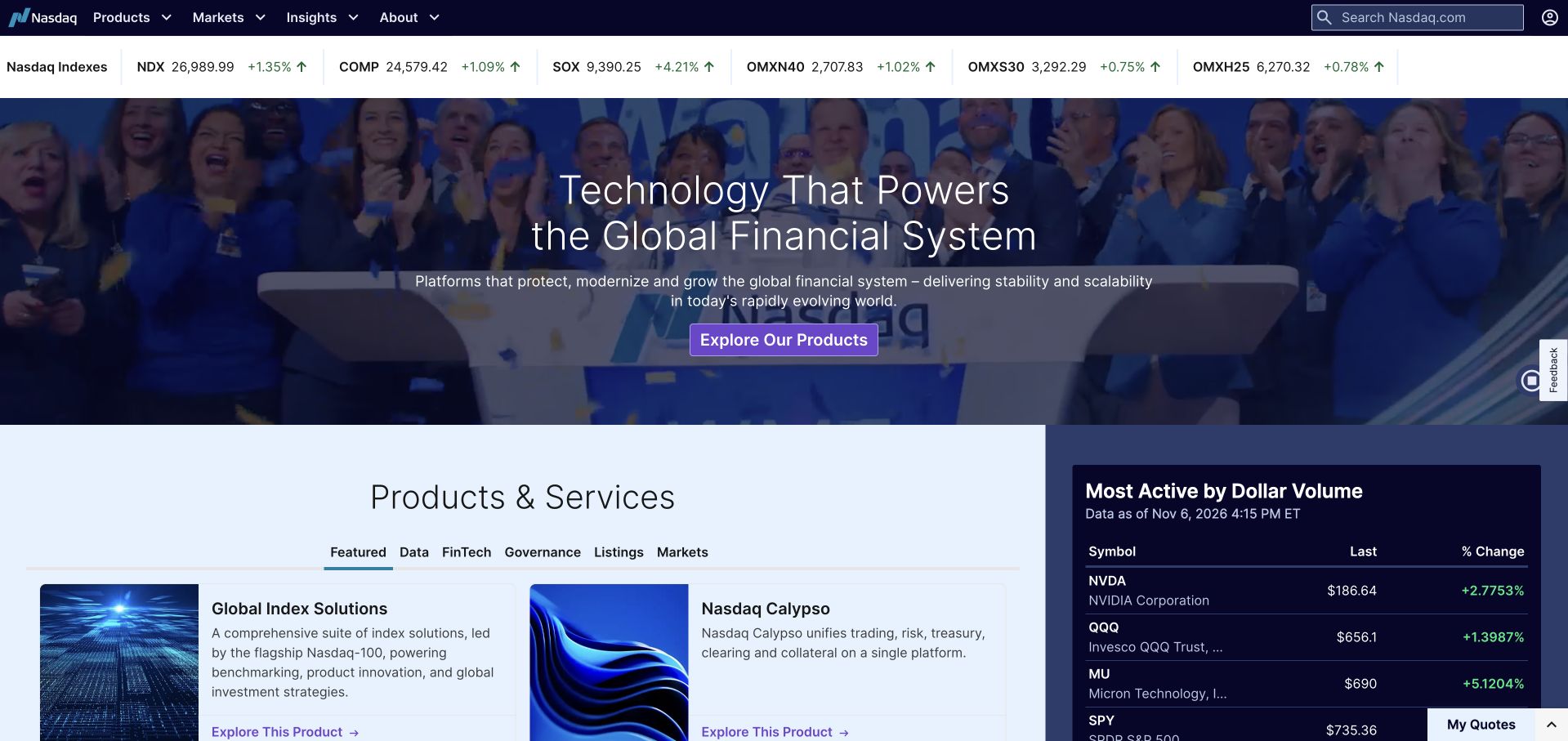
Nasdaq combines a narrow market-index strip with a large technology proposition, a purple product action and a lower products-and-services panel. A dark market table supplies another reading path beside the main catalog area. The design accommodates both current information and commercial discovery. AWS’s dated cloud-warehouse article describes Nasdaq using Redshift and Spectrum with an S3 data lake. It does not establish the public homepage’s renderer, the live market-feed implementation or the technology of every Nasdaq trading and analytics product.
What you can learn
Use visual separation to distinguish market information from product navigation. In architecture planning, distinguish an analytical warehouse from latency-sensitive operational systems. A published data-lake case can inform reporting design, but cannot establish the suitability of the same components for matching trades or serving every real-time market event.
Pros
The market strip provides recognizable context without replacing the main product-discovery hierarchy.
The lower catalog and market table offer distinct paths for visitors with different intentions.
Cons & considerations
Multiple information densities make the opening more demanding to scan than a single-purpose landing page.
A broad global-financial-system headline needs specific product explanations before technical buyers can evaluate fit.
Platform source: Official technology-specific customer or workload source. AWS’s cloud-warehouse article describes Nasdaq using Redshift and Spectrum alongside an S3 data lake for its analytical workload. This evidence establishes only the stated product, workload, organization or historical association. It does not prove that the pictured public page uses the technology, reveal its CMS/frontend, establish a complete current architecture or independently verify vendor-reported outcomes. Platform evidence is separate from the direct website screenshot and is not a complete current infrastructure audit.
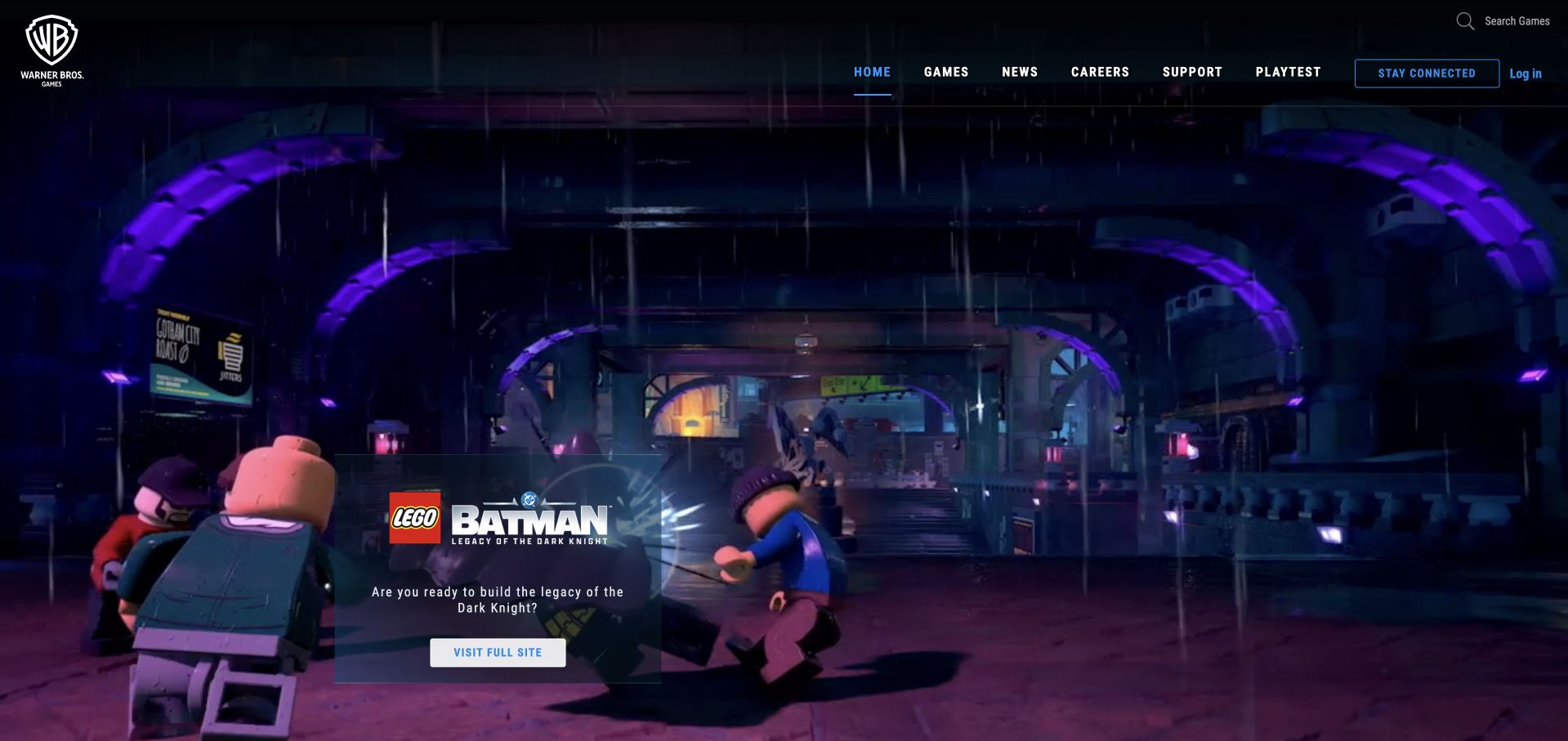
Warner Bros. Games uses a large animated LEGO Batman scene, placing a compact title treatment and a visit action in the quieter lower-left area. The dark navigation remains visible above, with games, news, support and careers separated clearly. The scene prioritizes the featured franchise rather than a corporate explanation. AWS documents Redshift in WB Games’ game-data analysis and creative insight workflows. It does not establish the marketing site’s runtime, prove that a pictured game uses Redshift for gameplay or identify every studio’s architecture.
What you can learn
Let the featured product retain its identity while keeping the broader catalog accessible. A game-data warehouse supports analysis, not necessarily the live game session. Define telemetry collection, retention and player-privacy boundaries separately from public promotion and from the infrastructure needed for interactive play.
Pros
The restrained title panel allows the game artwork to remain the main visual experience.
Clear catalog and support navigation lets visitors bypass a featured franchise when necessary.
Cons & considerations
A moving cinematic opening can obscure details and requires alternatives for reduced-motion visitors.
The corporate scope and range of available games are not explained by one prominent franchise scene.
Platform source: Official technology-specific customer or workload source. AWS describes WB Games using Redshift to capture and analyze data informing game development and storytelling, not a live gameplay or public marketing runtime claim. This evidence establishes only the stated product, workload, organization or historical association. It does not prove that the pictured public page uses the technology, reveal its CMS/frontend, establish a complete current architecture or independently verify vendor-reported outcomes. Platform evidence is separate from the direct website screenshot and is not a complete current infrastructure audit.
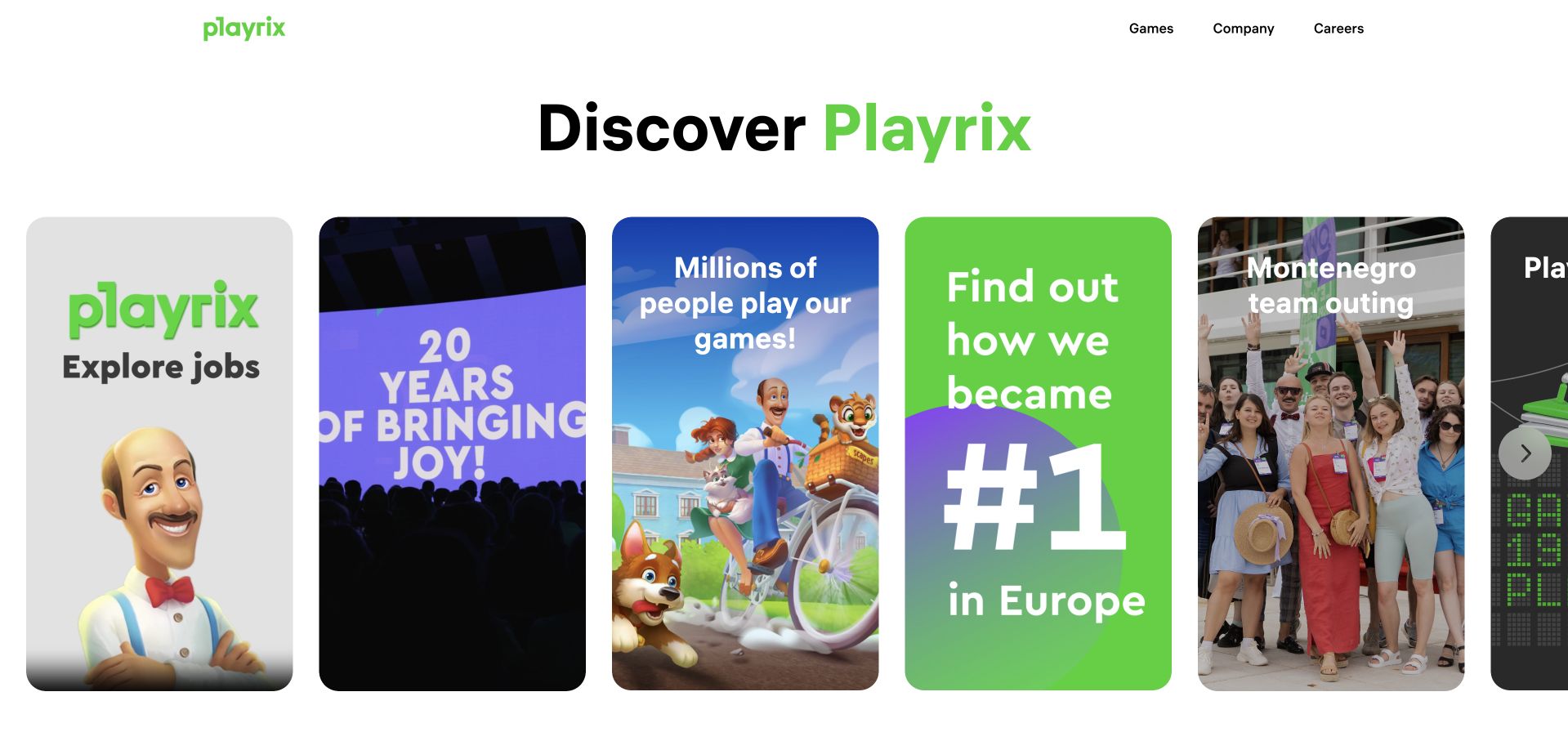
Playrix places a short centered introduction above tall rounded cards featuring games, company history, employees and recruitment. Bright green brand accents connect otherwise different photographs and illustrations. The navigation remains unusually short, allowing the card collection to define the experience. AWS’s cloud-warehouse article specifically describes Playrix using Redshift Serverless for financial dashboards and historical marketing analysis. It does not establish the public site’s frontend, the databases used during gameplay or the infrastructure behind every featured title.
What you can learn
A shared card format can connect varied corporate content without forcing every story into the same tone. Keep the purpose of each card explicit. In analytics, financial reporting and player-acquisition analysis may share a warehouse, but they still require distinct definitions, permissions and freshness expectations.
Pros
The repeated tall-card format gives games, people and company history a coherent presentation.
A limited navigation set keeps the opening visually focused on the available stories.
Cons & considerations
Horizontal browsing can hide important destinations beyond the initial set of visible cards.
The mixed content types need clear labels so visitors can distinguish recruitment, company information and games.
Platform source: Official technology-specific customer or workload source. AWS describes Playrix using Redshift Serverless for financial dashboards and historical marketing analysis. This evidence establishes only the stated product, workload, organization or historical association. It does not prove that the pictured public page uses the technology, reveal its CMS/frontend, establish a complete current architecture or independently verify vendor-reported outcomes. Platform evidence is separate from the direct website screenshot and is not a complete current infrastructure audit.
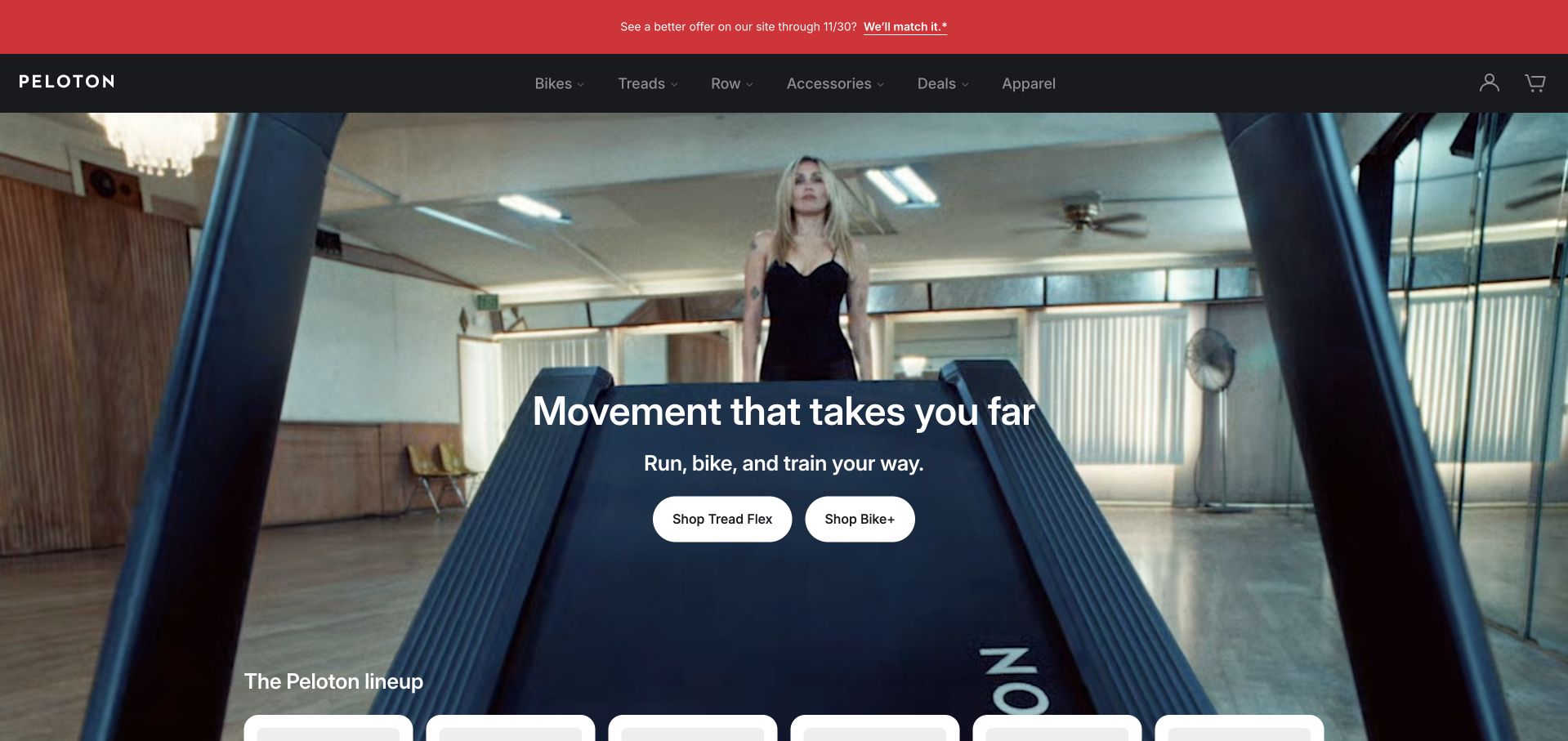
Peloton’s captured homepage puts the viewer close to a treadmill user, with a short white message and two equipment-shopping actions. A dark category header and a separate red promotional strip keep the image anchored in a practical store structure. The result emphasizes movement rather than a technical product diagram. AWS’s May 2023 account describes Redshift supporting Peloton’s growing data and subscription analytics. It does not establish the public storefront’s backend or the systems delivering every workout, equipment function and customer transaction.
What you can learn
Explain the experience first, then preserve clear routes into individual equipment categories. For a connected product, separate commerce, subscription administration, content delivery and analytical workloads. A warehouse case may inform reporting requirements without determining the architecture that keeps a live workout or purchase running.
Pros
The close exercise scene connects the equipment to a recognizable use rather than isolated hardware specifications.
Two labeled shopping actions make the first product choice clear within the campaign.
Cons & considerations
The promotional strip and category navigation add several layers before the main product explanation.
The opening provides limited immediate information about ongoing membership commitments and equipment differences.
Platform source: Official technology-specific customer or workload source. AWS’s May 2023 account identifies Redshift supporting Peloton data engineering and subscription analytics during its changing business volumes. This evidence establishes only the stated product, workload, organization or historical association. It does not prove that the pictured public page uses the technology, reveal its CMS/frontend, establish a complete current architecture or independently verify vendor-reported outcomes. Platform evidence is separate from the direct website screenshot and is not a complete current infrastructure audit.
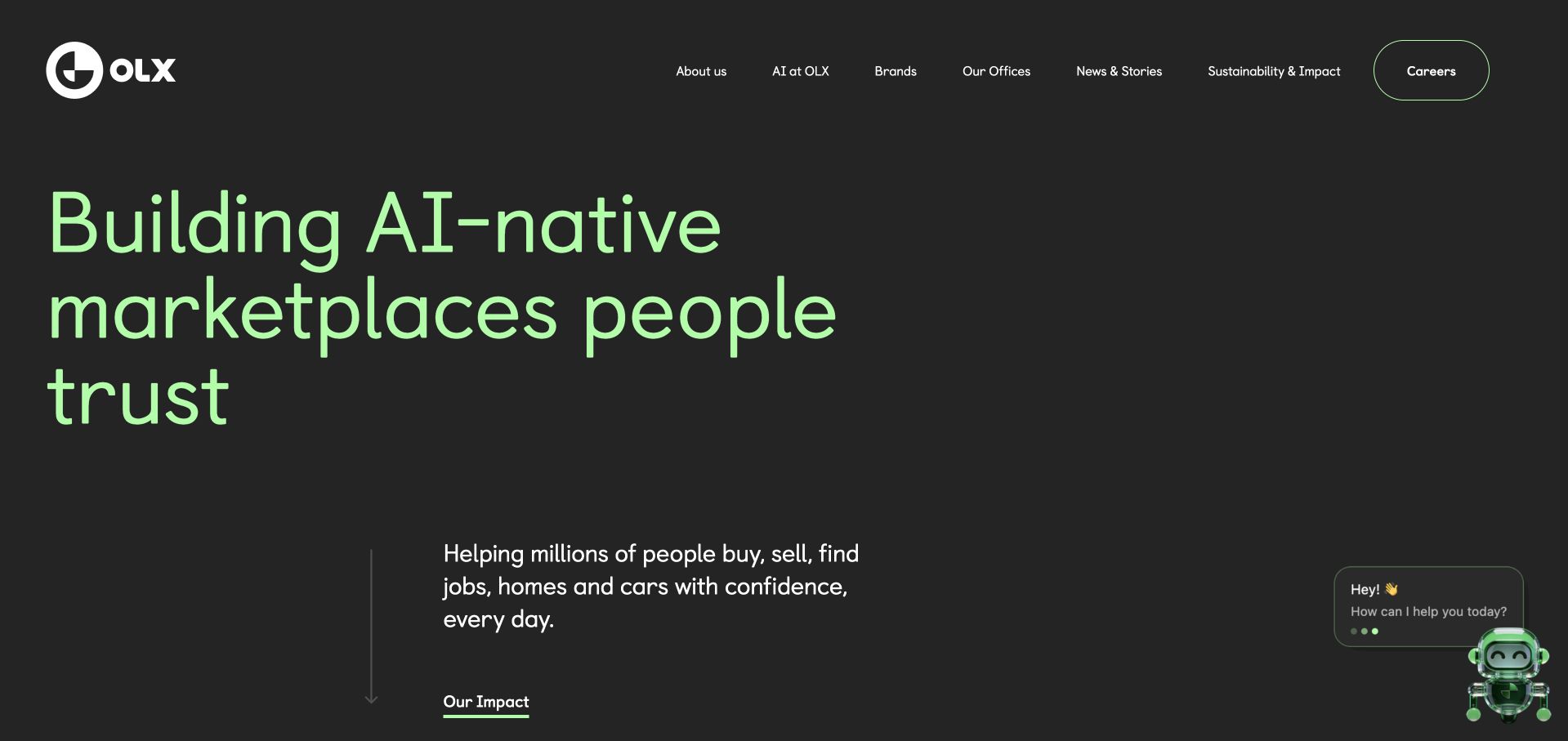
OLX Group opens with a very large pale-green statement on a charcoal background, supported by a short description and a quiet impact link. A simple header separates brands, offices, news and careers from the corporate introduction. The lack of a listing grid makes the parent-company context clear. AWS explicitly identifies OLX with Redshift in its analytics customer material, but does not specify this corporate page’s runtime or establish a uniform current architecture across every marketplace in the group.
What you can learn
Give a parent organization a clear purpose without pretending its homepage is the consumer product. In the data architecture, preserve marketplace, region and operational-system boundaries. Organization-level customer evidence can identify an association, but more precise workload verification is necessary before making a specific implementation recommendation.
Pros
The large typographic treatment makes the corporate proposition easy to identify without a busy portfolio collage.
The short header exposes brand and organizational routes in a predictable structure.
Cons & considerations
The broad AI-native positioning requires further explanation of actual marketplace capabilities and safeguards.
A sparse introduction gives limited practical information before the visitor explores individual brands or stories.
Platform source: Official technology-specific customer or workload source. AWS explicitly identifies OLX leveraging Redshift in its analytics customer material. This establishes a product association without identifying this corporate homepage or every marketplace workload. This evidence establishes only the stated product, workload, organization or historical association. It does not prove that the pictured public page uses the technology, reveal its CMS/frontend, establish a complete current architecture or independently verify vendor-reported outcomes. Platform evidence is separate from the direct website screenshot and is not a complete current infrastructure audit.
INVISTA pairs an everyday mobility scene with a short materials proposition and two clear organizational routes. The white header, gold accents and visible product action give the cinematic image a practical industrial frame. A customer-focused section begins directly below. AWS’s source specifically describes plant information centralized in an S3-based lake with Redshift as the warehouse environment. It does not establish the public homepage’s CMS or imply that manufacturing control systems and business analytics are the same workload.
What you can learn
Show the applications of an unfamiliar material without losing the route to technical product information. A data platform should likewise distinguish raw plant signals, contextual business data and approved analytical outputs. The ability to centralize information is not permission to expose operational controls or confidential plant records broadly.
Pros
The mobility photograph connects an industrial product portfolio to recognizable everyday applications.
Product and company-learning actions make the two main discovery paths easy to distinguish.
Cons & considerations
The broad materials statement needs detailed product information before an engineer can assess suitability.
A large lifestyle scene offers less immediate technical evidence than specifications or application examples.
Visible tech stack
Earlier / documented evidence
Amazon Redshift
Platform source: Official technology-specific customer or workload source. AWS describes INVISTA plant information centralized in an S3-based data lake with Redshift as the warehouse environment. This evidence establishes only the stated product, workload, organization or historical association. It does not prove that the pictured public page uses the technology, reveal its CMS/frontend, establish a complete current architecture or independently verify vendor-reported outcomes. Platform evidence is separate from the direct website screenshot and is not a complete current infrastructure audit.
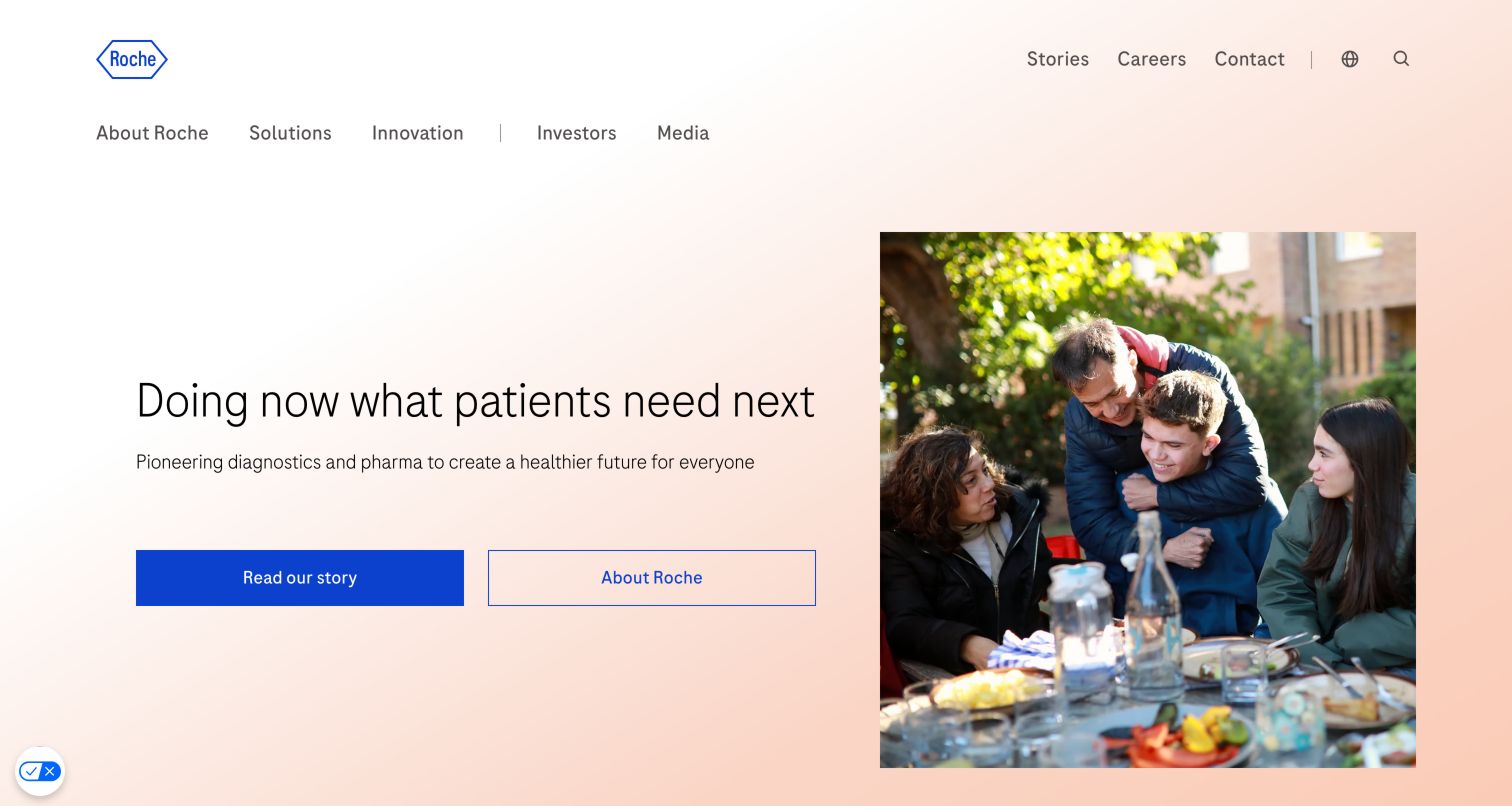
Roche uses a pale warm gradient, a large restrained headline and a contained family photograph. Two clear actions separate a story from general company information. The generous spacing and simple navigation create a calmer first impression than a crowded healthcare portal. AWS’s August 30, 2024 article describes a Roche data hub using Redshift, S3 and Lake Formation. This is a dated analytical-platform association, not proof of the corporate homepage’s backend or independent validation of any clinical outcome.
What you can learn
Use human context to explain why the organization exists, then provide clear access to the underlying science and services. For a research data hub, define ownership, permitted access and provenance before selecting analytical tools. A patient-centered photograph does not justify treating sensitive patient data as ordinary unrestricted business reporting material.
Pros
The contained photograph and generous space support a calm, approachable corporate introduction.
Two differently weighted actions offer understandable story-led and general-information paths.
Cons & considerations
The broad mission statement reveals little about specific products or research areas without further navigation.
Several corporate audience routes can require exploration before a visitor finds a practical healthcare task.
Platform source: Official technology-specific customer or workload source. AWS’s August 30, 2024 article identifies a Roche data hub using Redshift, S3 and Lake Formation in the documented analytical environment. This evidence establishes only the stated product, workload, organization or historical association. It does not prove that the pictured public page uses the technology, reveal its CMS/frontend, establish a complete current architecture or independently verify vendor-reported outcomes. Platform evidence is separate from the direct website screenshot and is not a complete current infrastructure audit.
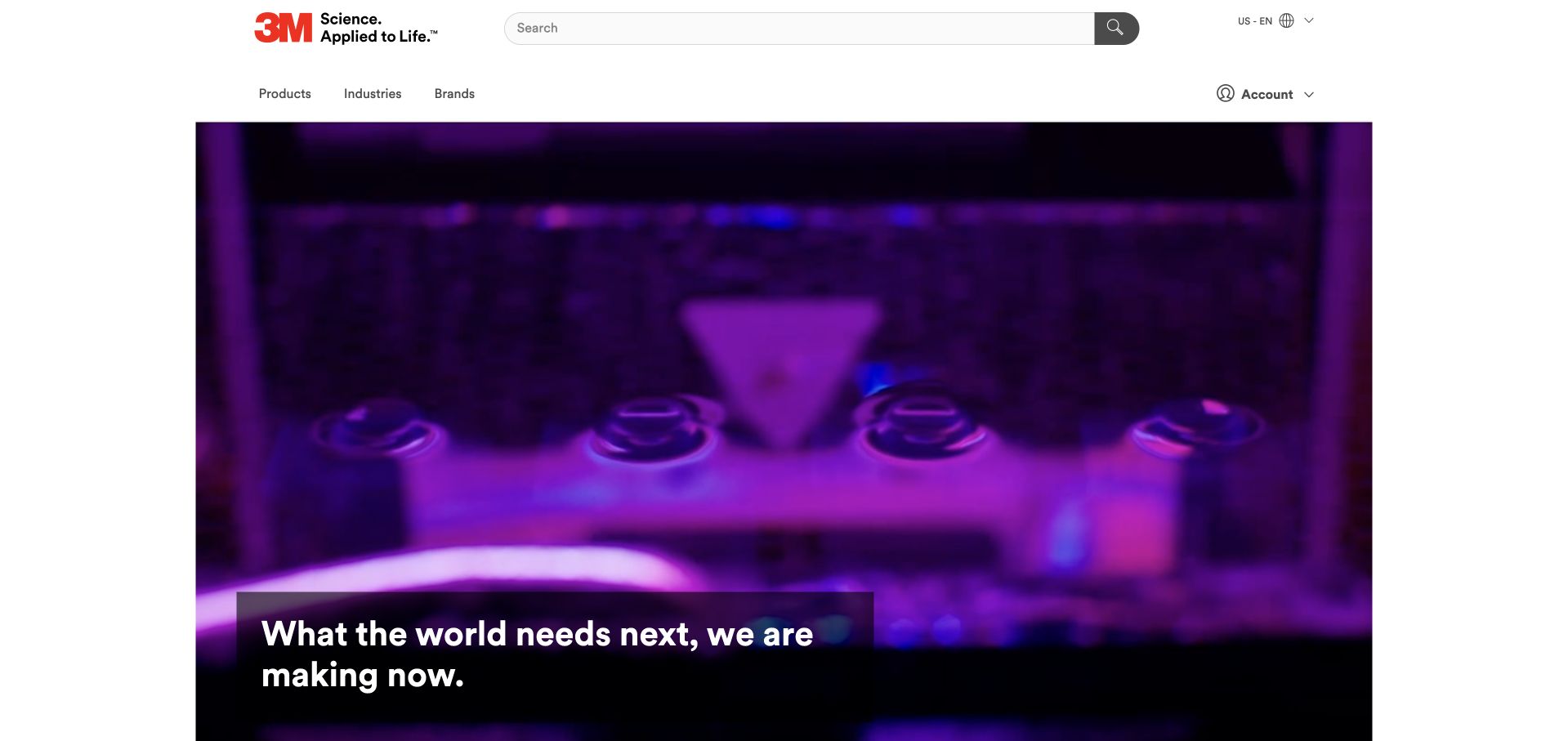
3M’s public homepage uses a prominent red wordmark, broad search field and a large industrial video panel with a contained white-on-dark statement. The composition gives a diversified manufacturer one clear visual anchor. This current corporate page is separate from the historical 3M Health Information Systems case documented by AWS. That case describes a Redshift healthcare reporting warehouse, including S3 bulk loading; it does not establish today’s corporate page runtime or the current ownership and architecture of the former business unit.
What you can learn
Keep a historical application case tied to the business and period it actually describes. The practical warehouse lesson is to test the ingestion path with realistic volumes before designing reports. A corporation’s continuing brand presence does not prove that a specific older division, product or data environment remains unchanged.
Pros
The strong wordmark and prominent search field provide a recognizable frame around a broad industrial portfolio.
The contained caption stays readable while allowing the manufacturing scene to remain visible.
Cons & considerations
A general innovation statement gives little immediate guidance about the organization’s many separate product categories.
A large video panel delays detailed product and application information for task-focused visitors.
Visible tech stack
Earlier / documented evidence
Amazon Redshift
Platform source: Official technology-specific customer or workload source. AWS’s historical 3M Health Information Systems case describes a Redshift healthcare reporting warehouse, including S3 bulk loading. The current 3M corporate homepage is a separate design reference, not proof of that former business unit’s current architecture. This evidence establishes only the stated product, workload, organization or historical association. It does not prove that the pictured public page uses the technology, reveal its CMS/frontend, establish a complete current architecture or independently verify vendor-reported outcomes. Platform evidence is separate from the direct website screenshot and is not a complete current infrastructure audit.
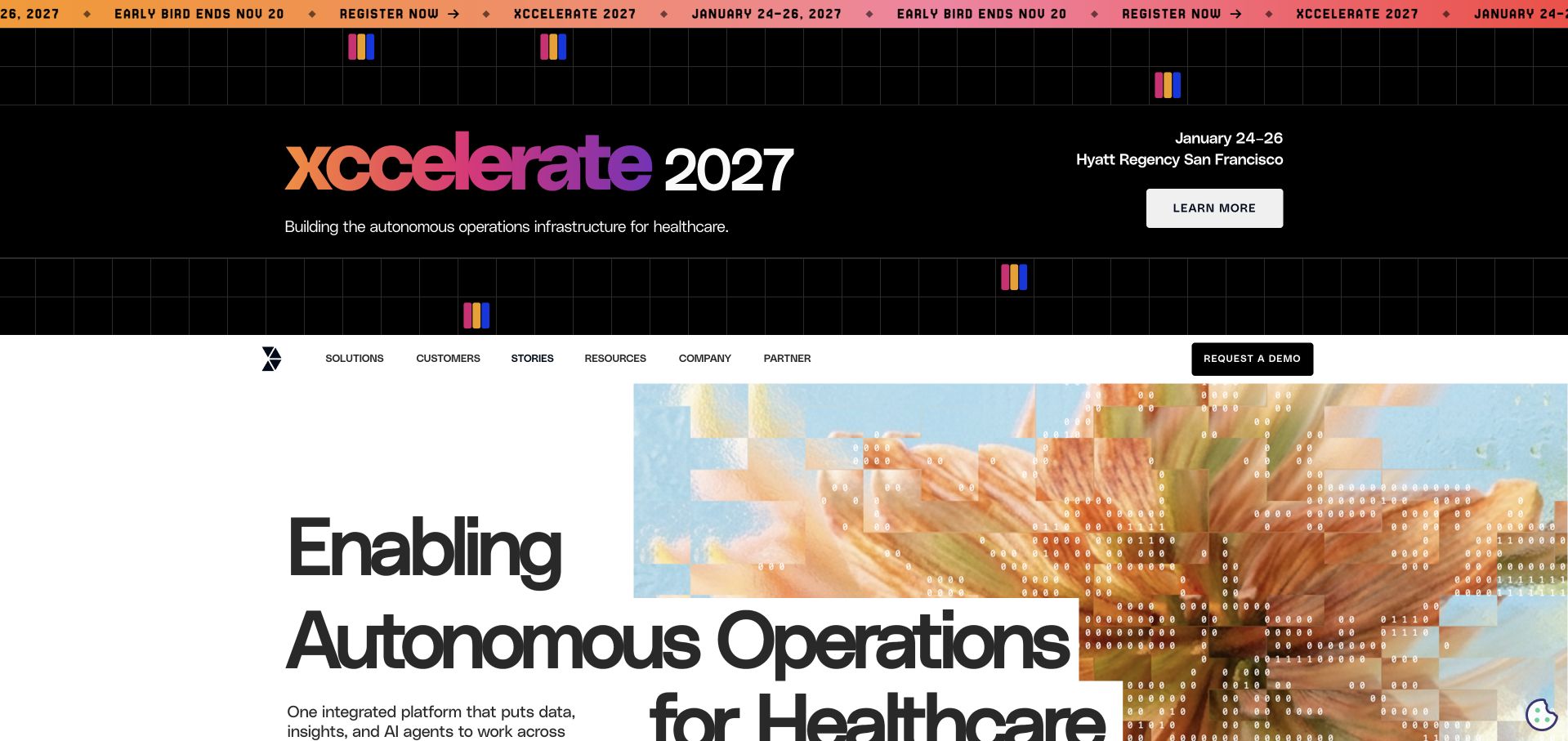
Innovaccer’s captured opening places a large event banner above a compact navigation and an oversized healthcare-platform headline. Colorful patterns and a split hero image create energy, but the event and product messages compete for the same first view. AWS’s analytics customer page explicitly describes Redshift in Innovaccer’s healthcare-data activation and analytics context. It does not establish this public marketing page’s runtime, independently validate healthcare outcomes or identify every component used by customer care teams.
What you can learn
Decide whether an event or the enduring product should lead the first visit, and avoid making both equally dominant. In healthcare analytics, define the permitted data purpose and the relationship between source records and derived insight. Warehouse performance alone does not validate clinical interpretation or authorize an automated change to care.
Pros
The colorful visual system gives a complex healthcare data platform a recognizable identity.
A compact navigation provides product and customer routes below the large event feature.
Cons & considerations
The substantial event announcement delays the main product explanation and consumes much of the opening.
Large text and overlapping visual blocks can crowd the boundary between the headline and supporting image.
Platform source: Official technology-specific customer or workload source. AWS’s analytics customer page identifies Redshift in Innovaccer healthcare-data activation and analytics. Outcome claims remain vendor-reported. This evidence establishes only the stated product, workload, organization or historical association. It does not prove that the pictured public page uses the technology, reveal its CMS/frontend, establish a complete current architecture or independently verify vendor-reported outcomes. Platform evidence is separate from the direct website screenshot and is not a complete current infrastructure audit.
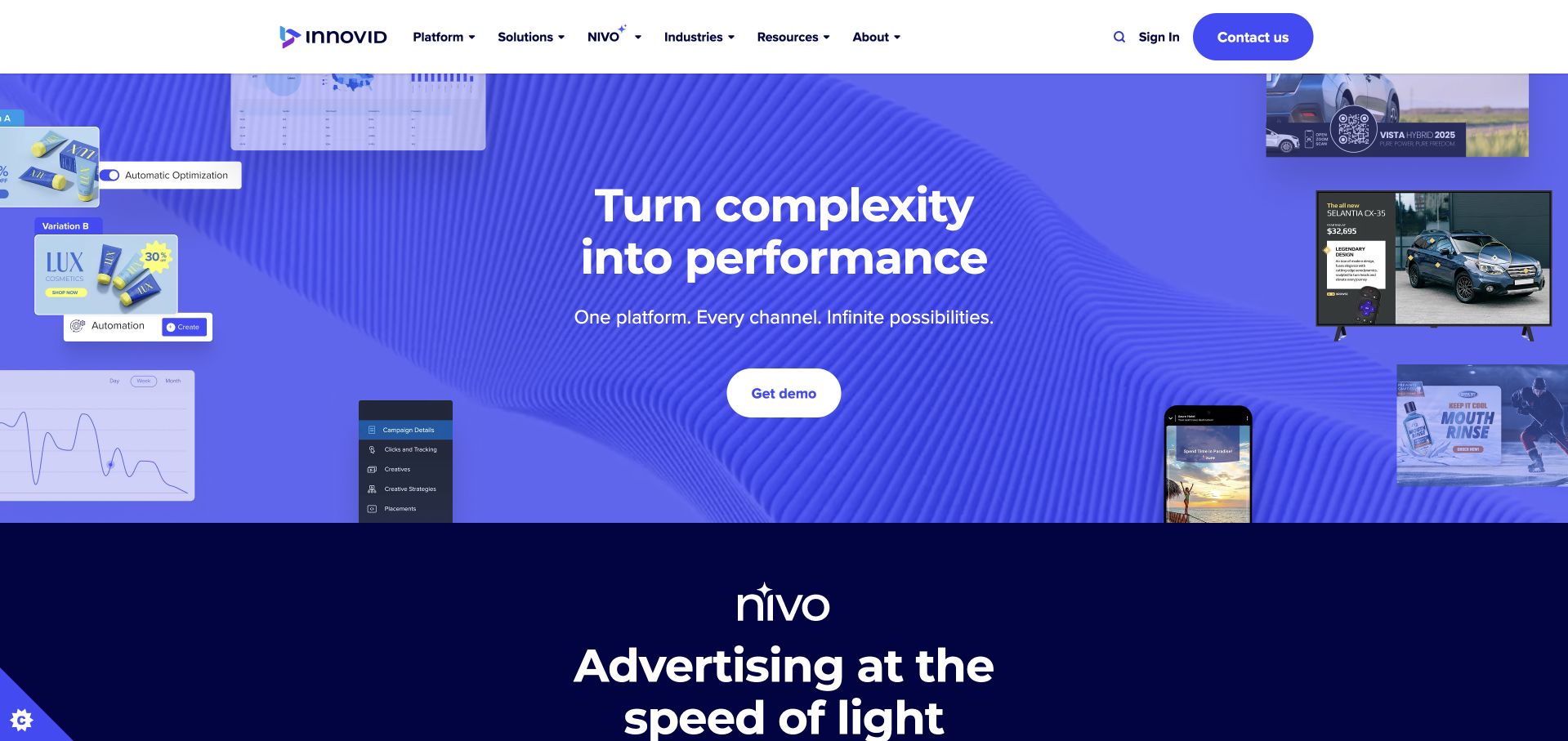
Innovid surrounds a concise white performance statement with examples of advertising output and small analytical interfaces. A violet field, curved line pattern and restrained white header give varied media a shared visual frame. The next product section begins in a darker band below. AWS’s source explicitly describes Innovid choosing Redshift for its data warehouse and S3 access. It does not establish this homepage’s hosting or independently verify the effectiveness of the advertising examples shown around the headline.
What you can learn
Connect a broad advertising proposition to recognizable output types, but explain what each interface actually measures. A warehouse brief should define attribution windows, source limitations and data freshness before producing persuasive performance dashboards. Infrastructure scalability cannot make incompatible campaign definitions or missing source data automatically comparable.
Pros
The surrounding examples make a cross-channel platform more tangible than an abstract performance claim alone.
A consistent violet treatment gives varied screens and advertising formats a coherent visual identity.
Cons & considerations
Several floating examples compete for attention with the central explanation.
The broad performance message needs methodological detail before buyers can evaluate measurement quality.
Platform source: Official technology-specific customer or workload source. AWS explicitly describes Innovid choosing Redshift for warehouse scaling, predictable analytics costs and access to its S3 data lake. This evidence establishes only the stated product, workload, organization or historical association. It does not prove that the pictured public page uses the technology, reveal its CMS/frontend, establish a complete current architecture or independently verify vendor-reported outcomes. Platform evidence is separate from the direct website screenshot and is not a complete current infrastructure audit.
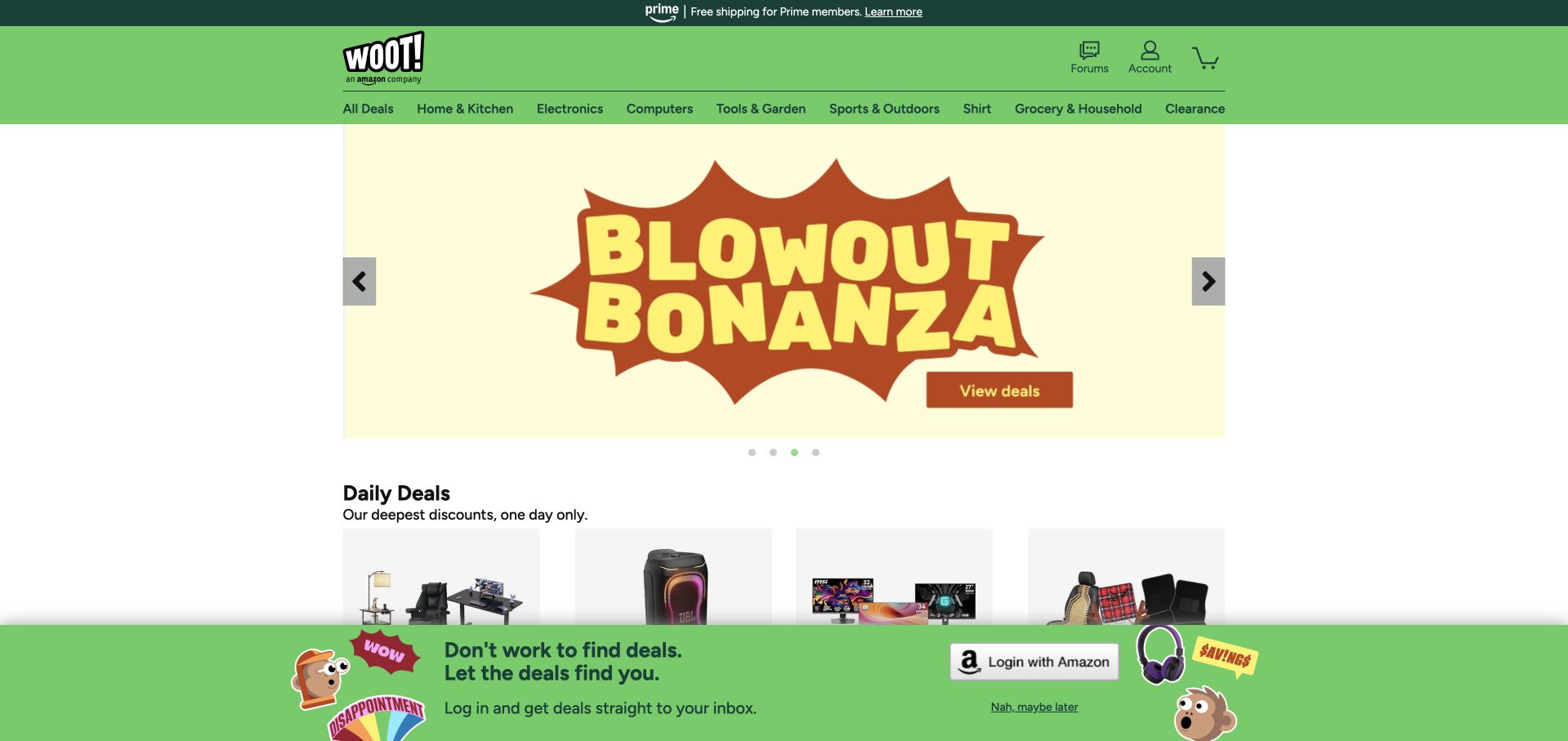
Woot uses a vivid green header, oversized illustrated promotion and compact category navigation above its daily-deal grid. The playful typography makes the offer feel distinctive, while the regular card structure below provides a practical shopping path. A lower email invitation is visibly separate from the catalog. AWS’s data-lake account mentions experimenting with Redshift Spectrum alongside other analytical services. This is a limited documented experimentation association, not proof that Redshift is the current primary warehouse or that it serves the live storefront.
What you can learn
Keep the promotional voice distinct from the structure shoppers need to compare products. Apply the same precision to technical case studies: an experiment is not a production deployment, and a service listed as a possible integration does not identify a complete current stack. Validate actual operational requirements before copying a reference architecture.
Pros
The playful promotion creates a memorable identity without removing familiar shopping categories.
The daily-deal grid establishes a clear next step beneath the large campaign banner.
Cons & considerations
A large promotional area delays comparison of individual deals and conditions.
The email invitation and multiple offer elements add competing actions around an already dense retail interface.
Platform source: Official technology-specific customer or workload source. AWS’s Woot data-lake account specifically mentions experimenting with Redshift Spectrum alongside other services. This is limited documented experimentation, not a claim of current primary production warehouse use. This evidence establishes only the stated product, workload, organization or historical association. It does not prove that the pictured public page uses the technology, reveal its CMS/frontend, establish a complete current architecture or independently verify vendor-reported outcomes. Platform evidence is separate from the direct website screenshot and is not a complete current infrastructure audit.
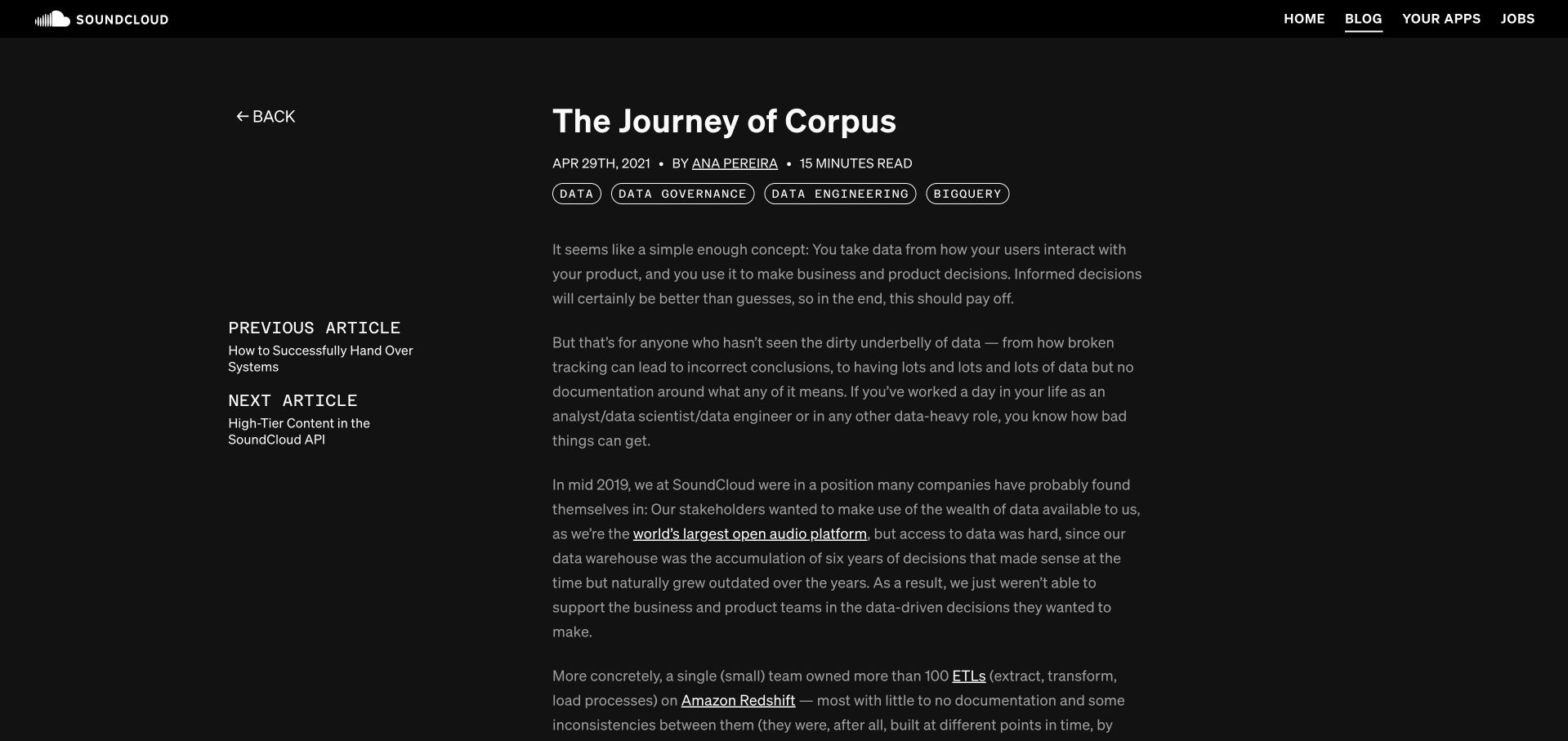
SoundCloud’s own Corpus article uses a narrow readable text column, a clear title, author, date and subject tags on a dark background. A small adjacent rail points to neighboring stories without interrupting the main explanation. The visible April 29, 2021 article explicitly describes more than 100 Redshift ETL processes in the mid-2019 environment, then a migration to BigQuery. It is evidence of historical Redshift use and a later change, not proof that Redshift remains the current analytical platform.
What you can learn
Document why a system changed, not just which services appeared in it. A migration account is especially useful when it describes ownership, inconsistent definitions and failed earlier attempts. For a new project, test those underlying organizational issues instead of assuming that replacing a warehouse will automatically create trustworthy data.
Pros
The visible author, date and subject tags give readers important context for a technical architecture account.
A restrained reading column keeps the engineering explanation primary rather than burying it among promotional elements.
Cons & considerations
Small light text on a dark background can be demanding during a long technical read.
A historical migration article requires careful interpretation before applying its product choices to a current system.
Platform source: First-party engineering migration account, April2021. SoundCloud’s own April 29, 2021 Corpus article explicitly describes more than100 Redshift ETL processes in mid2019, followed by migration to BigQuery. It proves historical use and a later change, not current Redshift adoption. This evidence establishes only the stated product, workload, organization or historical association. It does not prove that the pictured public page uses the technology, reveal its CMS/frontend, establish a complete current architecture or independently verify vendor-reported outcomes. Platform evidence is separate from the direct website screenshot and is not a complete current infrastructure audit.
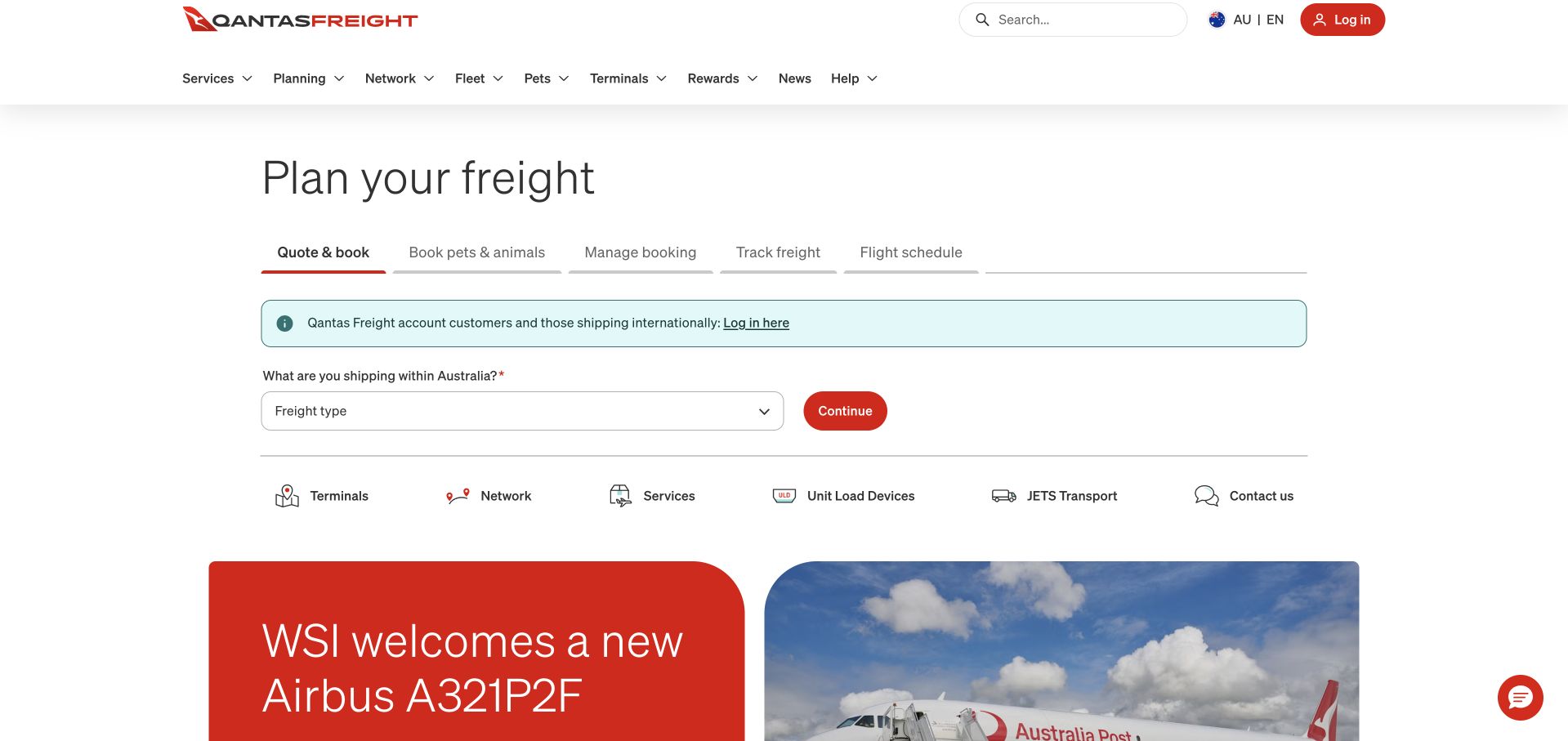
Qantas Freight’s public page opens with a large freight-planning area rather than a lifestyle hero. Tabs separate quoting, pets, booking management, tracking and schedules. A short account notice appears above a clearly labeled freight-type field, while practical location and contact links sit below. Altis Consulting’s September 9, 2025 implementation case identifies a Redshift-based Qantas Freight data platform and ERP exchange. It does not establish the public booking page’s runtime or the technology of the passenger-airline systems.
What you can learn
Keep operational tasks close to the opening and make audience prerequisites explicit. For an ERP-connected analytical platform, define the direction of each data exchange and which system owns each field. A reporting warehouse must not silently become the authority for a booking or revenue-management change without a designed control path.
Pros
The tabbed planning area makes several common freight tasks available immediately.
The account notice clarifies an important distinction before the visitor begins the public workflow.
Cons & considerations
Several adjacent tasks require careful preservation of context when visitors switch tabs.
A sparse opening provides little help comparing freight services before selecting a workflow.
Visible tech stack
Earlier / documented evidence
Amazon Redshift
Platform source: Implementation-partner customer case, September2025. Implementation partner Altis Consulting’s September 9, 2025 case identifies a Redshift-based Qantas Freight data platform and ERP data exchange, not passenger-airline systems. This evidence establishes only the stated product, workload, organization or historical association. It does not prove that the pictured public page uses the technology, reveal its CMS/frontend, establish a complete current architecture or independently verify vendor-reported outcomes. Platform evidence is separate from the direct website screenshot and is not a complete current infrastructure audit.
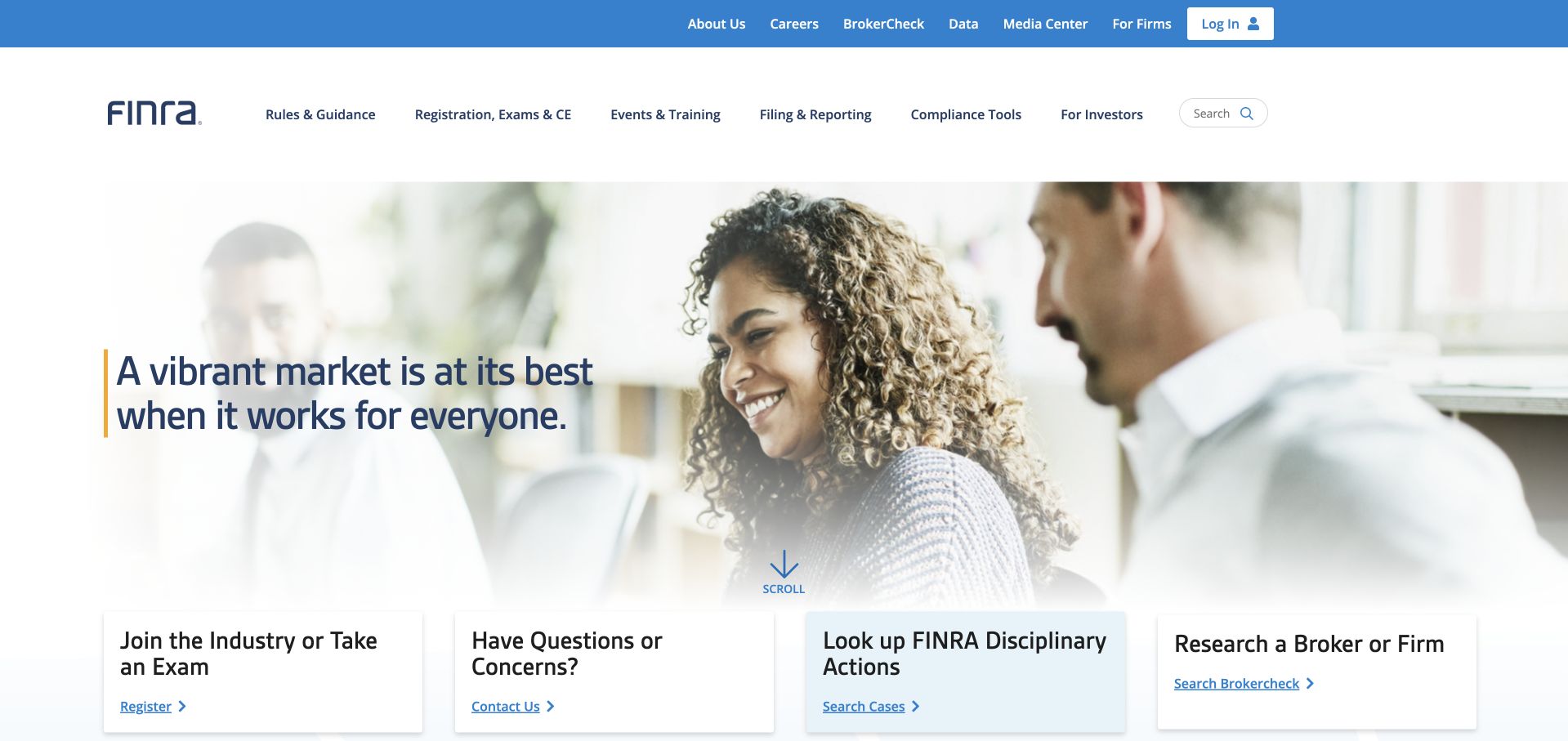
FINRA pairs a restrained market-confidence message with a photograph of people working together. Four practical cards below separate industry entry, questions, disciplinary actions and broker research. White space and blue navigation give the page an institutional rather than commercial tone. AWS’s March 2016 Data Warehousing on AWS whitepaper names FINRA among enterprises that had migrated to Redshift. That is historical organization-level evidence only; it does not identify a present workload, the public homepage’s database or the architecture of BrokerCheck.
What you can learn
Let a broad mission support, rather than replace, clear audience tasks. For a regulatory data service, separate public disclosures from restricted operational and analytical records. A dated customer listing can establish a historical association, but a current project still needs direct verification of its data sources, permissions and reporting obligations.
Pros
Four task cards make the institution’s different audiences and common needs visible in one place.
The restrained visual hierarchy avoids presenting regulatory information as a promotional product pitch.
Cons & considerations
Multiple navigation and utility tiers create a dense header for an unfamiliar public visitor.
The broad mission statement offers less immediate guidance than the practical cards beneath it.
Visible tech stack
Earlier / documented evidence
Amazon Redshift
Platform source: Historical official AWS whitepaper, March2016, page5. Page5 of AWS’s March2016 Data Warehousing on AWS whitepaper explicitly names FINRA among enterprises that had migrated to Redshift. This is historical organization-level evidence with no current workload identified. This evidence establishes only the stated product, workload, organization or historical association. It does not prove that the pictured public page uses the technology, reveal its CMS/frontend, establish a complete current architecture or independently verify vendor-reported outcomes. Platform evidence is separate from the direct website screenshot and is not a complete current infrastructure audit.
Hearst’s captured homepage uses a nearly full-screen video scene beneath a minimal white header. The small central exploration cue gives the moving image a deliberate introductory role, while navigation offers more direct routes into businesses, news and careers. The frame shown features an aircraft rather than a particular publication. AWS’s March 2016 whitepaper names Hearst among enterprises that had migrated to Redshift. It does not identify a current workload or establish that the corporate site or every Hearst publication uses Redshift.
What you can learn
A portfolio introduction can be atmospheric, but it still needs explicit routes to individual businesses and current information. In technical research, preserve the distinction between a parent-company customer association and a specific publication’s architecture. Historical enterprise adoption is not a license to label every property with the same present-day stack.
Pros
Minimal navigation lets a strong cinematic image establish a distinct corporate introduction.
Direct business, news and career links remain available for visitors who do not want to explore sequentially.
Cons & considerations
The large video reveals little practical information about the portfolio within the first view.
A subtle exploration cue may be overlooked by visitors expecting a conventional content grid.
Visible tech stack
Earlier / documented evidence
Amazon Redshift
Platform source: Historical official AWS whitepaper, March2016, page5. Page5 of AWS’s March2016 Data Warehousing on AWS whitepaper explicitly names Hearst among enterprises that had migrated to Redshift. This is historical organization-level evidence with no current workload identified. This evidence establishes only the stated product, workload, organization or historical association. It does not prove that the pictured public page uses the technology, reveal its CMS/frontend, establish a complete current architecture or independently verify vendor-reported outcomes. Platform evidence is separate from the direct website screenshot and is not a complete current infrastructure audit.
Lyft pairs a compact lifestyle photograph with a short destination-oriented message and a purple rider action. The white header clearly distinguishes riders, drivers and business services, while a pale-green promotion remains separate above the main content. The design is approachable without requiring a large animated map. AWS’s customer case identifies Redshift customer insights supporting the historical Lyft Line shared-ride product. It does not establish the public homepage’s backend or imply that the warehouse handles live ride dispatch and location updates.
What you can learn
Keep the main user journey obvious while preserving routes for other relationships to the service. In architecture planning, distinguish operational dispatch, account transactions and analytical insight. A warehouse may help understand shared-ride behavior without being the system responsible for assigning a vehicle or delivering a current arrival estimate.
Pros
A compact human scene and clear rider action create an understandable starting point.
Rider, driver and business navigation separates different service relationships early.
Cons & considerations
The promotional strip competes with the enduring proposition and adds conditions to the opening.
A broad destination promise needs further explanation of coverage and service availability.
Platform source: Official technology-specific customer or workload source. AWS’s Lyft case identifies Redshift customer insights supporting the historical Lyft Line shared-ride product, not live dispatch or a complete current data architecture. This evidence establishes only the stated product, workload, organization or historical association. It does not prove that the pictured public page uses the technology, reveal its CMS/frontend, establish a complete current architecture or independently verify vendor-reported outcomes. Platform evidence is separate from the direct website screenshot and is not a complete current infrastructure audit.
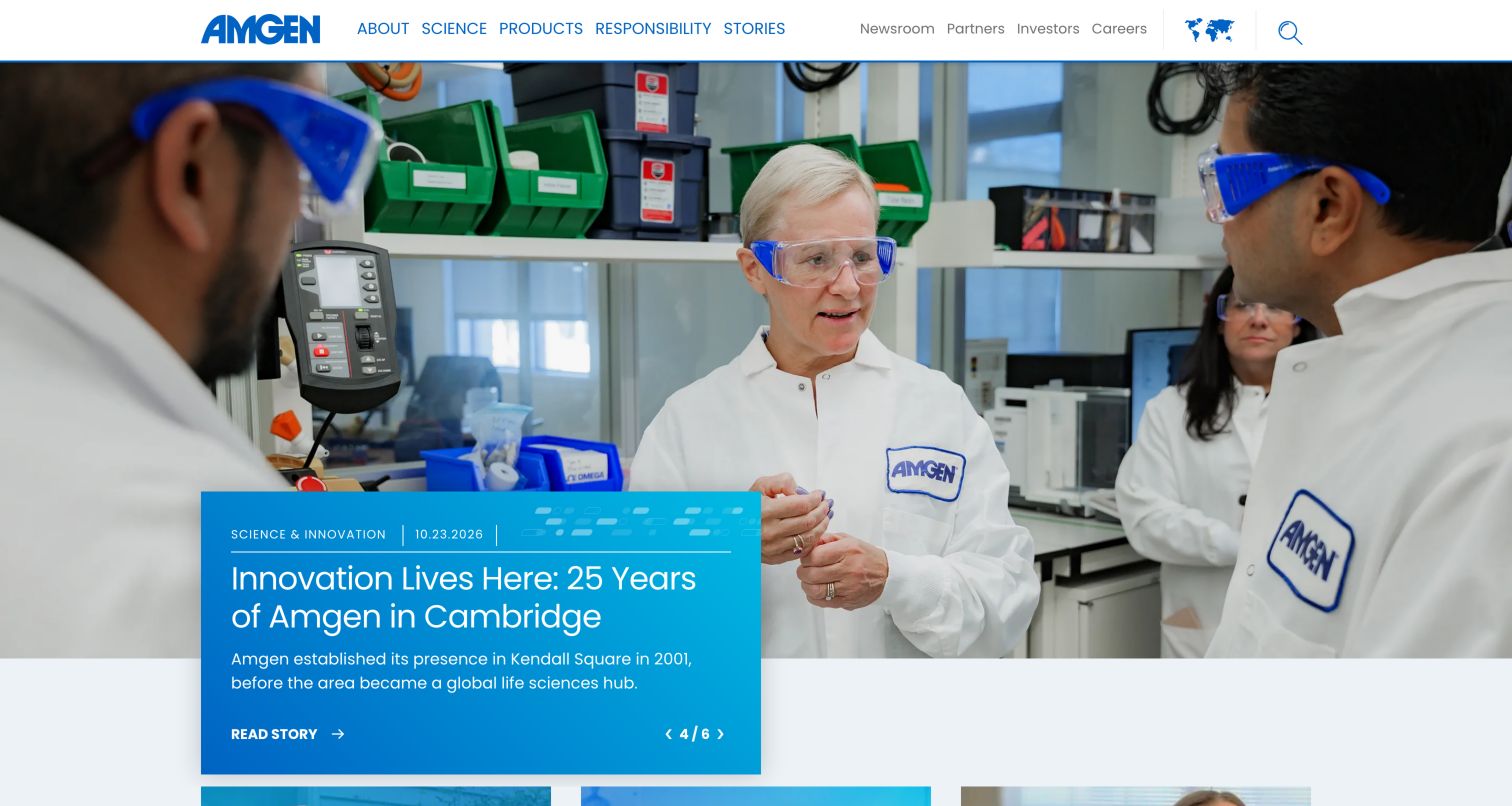
Amgen’s captured opening uses a laboratory photograph with a contained blue story panel. A visible date, category and short headline give the feature an editorial context rather than presenting the image as a generic scientific claim. The white navigation separates science, products, responsibility and corporate information. AWS’s March 2016 whitepaper lists Amgen among enterprises that had migrated to Redshift. It is historical organization-level evidence, not a finding about the current homepage, laboratory systems or any specific clinical-data workflow.
What you can learn
Give scientific stories a clear date and context, then make the underlying explanation accessible. Keep data-platform claims equally specific. A historical customer association cannot determine the current permissions, provenance or validation requirements of a research environment, and it should never be used as evidence of a medical outcome.
Pros
The dated story panel helps readers understand the editorial context of a large laboratory image.
Clear top-level categories expose several corporate audiences without covering the main photograph.
Cons & considerations
A rotating feature can delay information about the organization’s broader research and product scope.
The small story-panel text is less prominent than the photographic scene and large corporate branding.
Platform source: Historical official AWS whitepaper, March2016, page5. Page5 of AWS’s March2016 Data Warehousing on AWS whitepaper explicitly names Amgen among enterprises that had migrated to Redshift. This is historical organization-level evidence with no current workload identified. This evidence establishes only the stated product, workload, organization or historical association. It does not prove that the pictured public page uses the technology, reveal its CMS/frontend, establish a complete current architecture or independently verify vendor-reported outcomes. Platform evidence is separate from the direct website screenshot and is not a complete current infrastructure audit.
Kegan has 15+ years of experience working with small businesses, Fortune 500 companies, and everything in between. No development job is too big or too small: he brings the same hands-on attention to a focused improvement, a complete website, or a custom application.
For Amazon Redshift projects, he can help with data modeling, application data access, query design, search and cache integrations, migration planning, access boundaries, and maintainable handover. He works directly with clients on scope, design, implementation, testing, and handover, with an emphasis on clear communication and a system that remains practical to maintain after launch.
Show 3 other Amazon Redshift developersHide other Amazon Redshift developers
Three Redshift project scopes worth distinguishing
A business reporting warehouse
Start with a limited set of reliable sources and a small number of agreed reports. Define ingestion timing, access roles and reconciliation before building a large dashboard library. Keep a visible freshness indicator and an owner for each measure. The first successful query is a technical check, not the final acceptance of a business report.
A lake and warehouse analytical environment
When data spans object storage and warehouse tables, document which datasets are queried in place and which are loaded or transformed. Preserve source lineage, access boundaries and retention decisions. A shared analytical interface should not hide differences in freshness or quality. Test realistic partitions, record formats and concurrent use rather than a tiny demonstration dataset.
A warehouse migration or modernization
Inventory existing queries, transformations, schedules, consumers and unofficial exports. Test representative workloads and compare outputs before deciding that a new engine is compatible enough. SoundCloud’s own account is a reminder that ownership and inconsistent data definitions can matter as much as the product being replaced. Plan the organizational changes alongside technical cutover.
From references to requirements
Plan correctness, access and change before scaling the catalog
Create a decision-to-data map
For every proposed report or analytical feature, identify the decision, responsible audience, source records and acceptable delay. Include the action someone will take when a result changes. This helps distinguish an operational alert from a weekly trend and prevents a single warehouse freshness target from being applied indiscriminately to every business question.
Reconcile a representative workload
Load realistic data and compare known totals, edge cases and corrections against the source. Test long-running queries and simultaneous readers, not just a fast isolated example. Include time zones, late-arriving records and changed dimensions. Set clear acceptance criteria for the business output and record who can approve or reject a migration rehearsal.
Design the operating and recovery process
Assign ownership for access changes, failed ingestion, workload cost and recovery testing. Document how stale or incomplete data is communicated to report users. Review current supported features before copying older examples; AWS’s documentation now notes phased enforcement of Python UDF support ending after June 30, 2026. Inventory affected dependencies rather than assuming a historical SQL environment remains unchanged.
Ask the actual team to carry out its routine job: publish a realistic update, correct a mistake, preview a narrow screen, and identify who owns an integration failure. For a library or frontend framework, also ask who maintains the content source and deployment. A polished screenshot does not answer those operational questions.
Beyond the screenshot
An Amazon Redshift planning checklist
Name the business decisions and report owners.
Identify authoritative operational sources.
Define each measure and reporting period.
Specify data freshness and late-arrival rules.
Choose representative query and concurrency tests.
Compare provisioned and serverless operating needs.
Restrict access to the required datasets.
Document lake versus loaded-table responsibilities.
Reconcile known totals and exception records.
Inventory unsupported or changed dependencies.
Rehearse recovery and migration rollback decisions.
Assign cost, ingestion and stale-data communication owners.
Test with real content, a keyboard, a small screen, slow or failed requests, and the people who will maintain the system. These are planning checks, not an accessibility, security, performance, or search-ranking certification.
Sources & editorial method
How this Amazon Redshift collection was reviewed
Actual public images were inspected and paired with scoped AWS, first-party engineering and implementation-partner evidence. Historical adoption, experimentation and migration accounts remain labeled. The March 2016 AWS whitepaper’s page 5 was downloaded, rendered and visually verified for FINRA, Hearst and Amgen. Screenshots do not establish backend runtime or independently validate vendor performance claims.
Every image is an unmodified capture from the actual website, with its source and capture date. Some captures are reused from our shared catalog; their dates remain the original capture dates. None comes from a vendor gallery or a generated reconstruction. Moving imagery and live content can change.
Technology attribution uses public page assets or metadata, official platform documentation, or a cited first-party project case study. Documentary and framework-relationship evidence is identified where used; it is not a complete current backend inventory. A CMS image CDN alone does not establish a full CMS deployment. A library’s presence does not prove which individual controls use it, and a platform label does not establish AI authorship.
The composition notes, lessons, pros and tradeoffs are original editorial observations. We have not measured conversion, traffic, security, performance or accessibility conformance. Website owners retain their brands and imagery; these examples are not our client portfolio. Written, Edited and Curated are independent records, not dates advanced by a build. See our editorial standards or suggest a correction.
Questions worth asking
Amazon Redshift website development FAQs
Are these confirmed Redshift-powered homepages?
No. They are inspected public pages from organizations with separately stated Redshift evidence. Most evidence concerns analytical workloads rather than public-page delivery.
Why include SoundCloud if it migrated away?
Its first-party article offers explicit historical Redshift evidence and explains a later migration. It is presented as that history, not a claim of current Redshift use.
Does the Woot example prove a current production warehouse?
No. The linked AWS account describes Redshift Spectrum experimentation within a data-lake context. That limited scope is retained explicitly.
Is Redshift Serverless always cheaper?
No universal result is established here. Evaluate actual workload patterns, concurrency and operating requirements using current product information and realistic tests.
What makes the first warehouse milestone useful?
A reconciled, appropriately permissioned report that answers a real decision with known definitions and freshness. A large volume of copied tables is not an equivalent outcome.
Study the clearest public experiences, then build the analytical foundation around verified sources, explicit measures and a recoverable operating model.