Best Python Websites of 2026 (20 Real-World Examples)
Python-associated websites, original design observations, and a practical implementation brief
These 20 website references pair public design with separately documented Python applications, libraries, research tools or services. The screenshots show the pages; the sources identify the precise Python association. Neither one alone reveals a company’s complete current backend.
Python appears in very different kinds of work: a scientific pipeline, a desktop application, a data-analysis library and a web service are not interchangeable architectures. This collection names those responsibilities rather than pretending a shared language gives the websites one visual style. A public company page can use a completely different publishing stack from the software discussed in its engineering article.
Industrial Light & Magic, Netflix, Spotify, Dropbox and Instagram open with recognizable organizations and explicitly scoped sources. Several sources describe older systems and remain labeled historical. The later examples introduce open-source frameworks and scientific tools whose official repositories establish more direct project-level associations. Their documentation sites are still separate from the applications and libraries they explain.
Before the examples
What makes good Python website development in 2026?
Identify the work that needs Python
Decide whether the task is publishing content, serving an API, transforming data or running an analysis. A small marketing website may not need a custom Python application. Write the input, output and owner of one representative workflow before selecting a framework or treating a notebook demonstration as a production design.
Make the environment reproducible
Python’s venv documentation describes environments with their own package sets. Use that separation as one part of a documented setup, alongside explicit dependencies and a supported interpreter choice. A virtual environment helps organize packages; it is not a security sandbox or an assurance that an analysis will reproduce without its data and configuration.
The asyncio documentation describes asynchronous I/O and its network-oriented use. Distinguish time spent waiting from expensive processing before choosing an execution strategy. A data transformation or model call needs limits, error handling and an operating plan even when a convenient library makes the first successful demonstration short.
Study the information design, learning paths and product explanations independently from the language association. A library’s repository, a research pipeline and a dated corporate engineering account provide different kinds of evidence; the guide does not silently turn them into current homepage-runtime observations.
We start with five recognizable brands or organizations: Industrial Light & Magic, Netflix, Spotify, Dropbox, Instagram. Each attribution applies to the named website property, not every product or website belonging to its organization. This is a curated reading sequence, not a measured ranking.
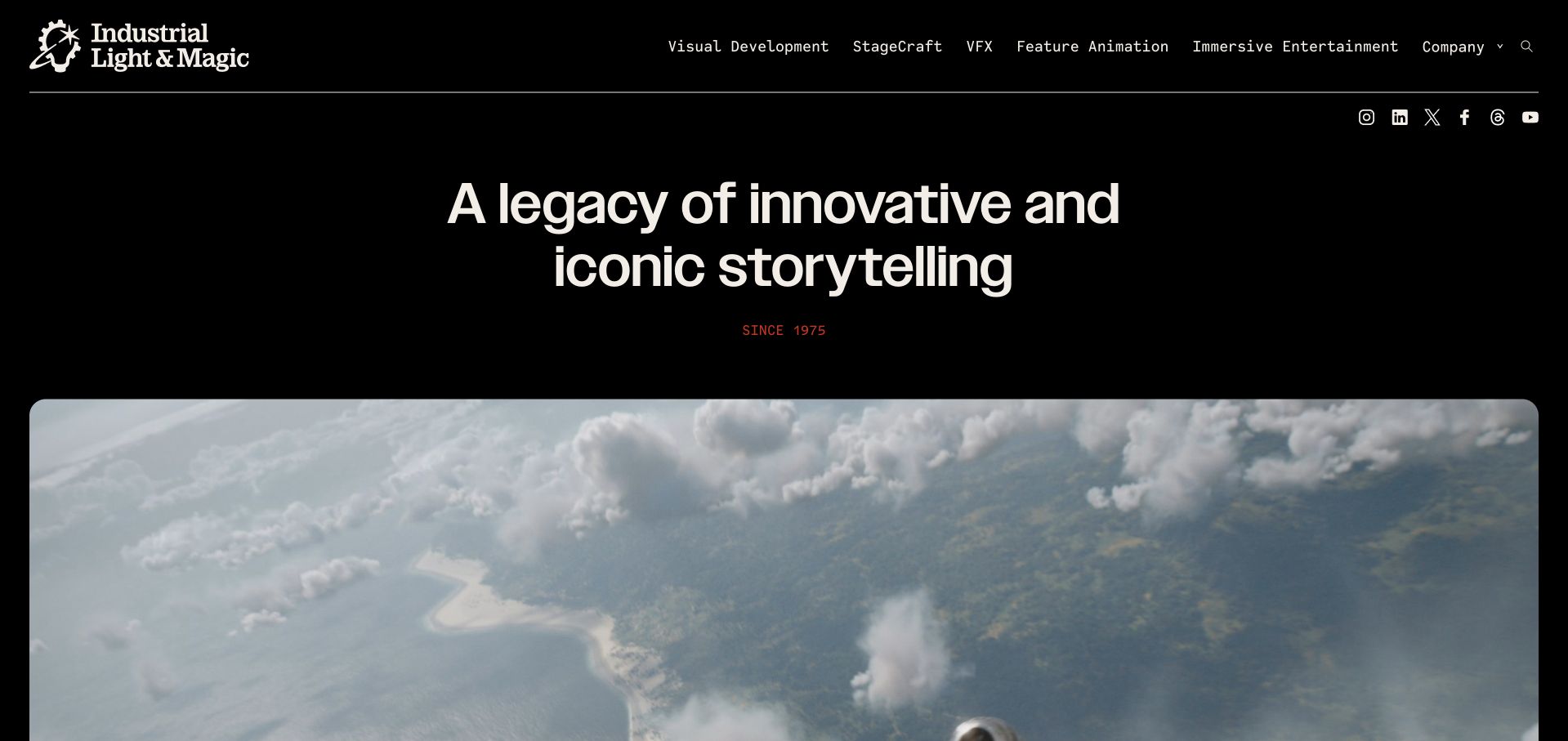
Industrial Light & Magic opens on a dark canvas with a short statement about its creative history and a large cinematic image. The navigation names different kinds of production work rather than making the visitor infer the studio’s capabilities from a showreel alone. This is a useful distinction for an organization whose output is famous but whose process is less familiar. The Python success story is a historical production-pipeline account, not evidence that the pictured public website is implemented in Python.
What you can learn
Let strong work carry the visual introduction, but label the capabilities surrounding it. A prospective collaborator needs a route from an impressive image to a relevant production discipline, a project story and a practical contact. Do not make motion the only way to understand what the company does.
Pros
The dark presentation gives the studio’s imagery room to work without unrelated promotional graphics.
Capability-based navigation connects a broad creative reputation to more specific areas of work.
Cons & considerations
A cinematic opening needs an informative still frame and a useful reduced-motion alternative.
The short historical proposition leaves practical questions about process, scope and collaboration to deeper pages.
Platform source: Official Python engineering or project evidence. Historical film-production pipeline use, not a homepage implementation claim. The cited engineering, project or customer source establishes only the named language association. It does not establish the marketing page runtime, every company system, current deployment continuity or independent performance results. Platform evidence is separate from the direct website screenshot and is not a complete current infrastructure audit.
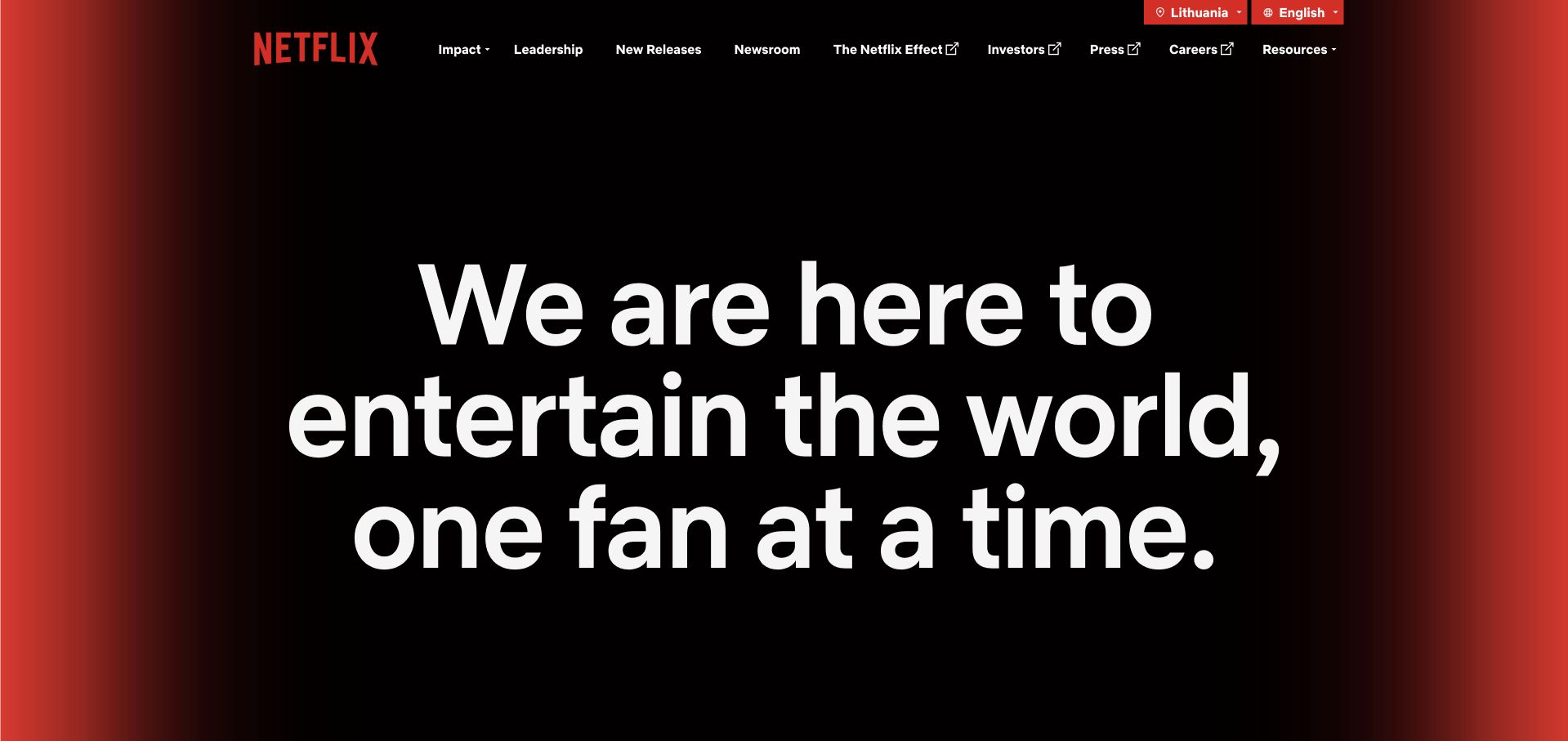
Netflix’s company page uses a short statement at a dramatic scale, framed by a simple corporate header. The design prioritizes recognition and purpose rather than reproducing a streaming catalog. Careers, newsroom and organizational subjects sit near the opening so professional visitors can choose a route immediately. Netflix’s Python engineering article describes work across its content lifecycle and tooling in 2019; that documentary context is separate from the public page’s visible typography, media treatment and unknown current server implementation.
What you can learn
Separate the public company story from the technical account that supports it. Most visitors need a clear purpose and destination first. Engineers can then find workload-specific material that names the relevant system, date and constraints rather than a sweeping claim that one language powers everything.
Pros
The corporate navigation supports several professional intentions without requiring a consumer account or subscription decision.
A limited palette makes the introductory statement readable and recognizably connected to the entertainment brand.
Cons & considerations
The opening provides little immediate detail about a particular product capability or organizational policy.
Very large text needs responsive testing to avoid turning a brief introduction into excessive vertical space.
Platform source: Official Python engineering or project evidence. Content-lifecycle, data and delivery tooling described in 2019. The cited engineering, project or customer source establishes only the named language association. It does not establish the marketing page runtime, every company system, current deployment continuity or independent performance results. Platform evidence is separate from the direct website screenshot and is not a complete current infrastructure audit.
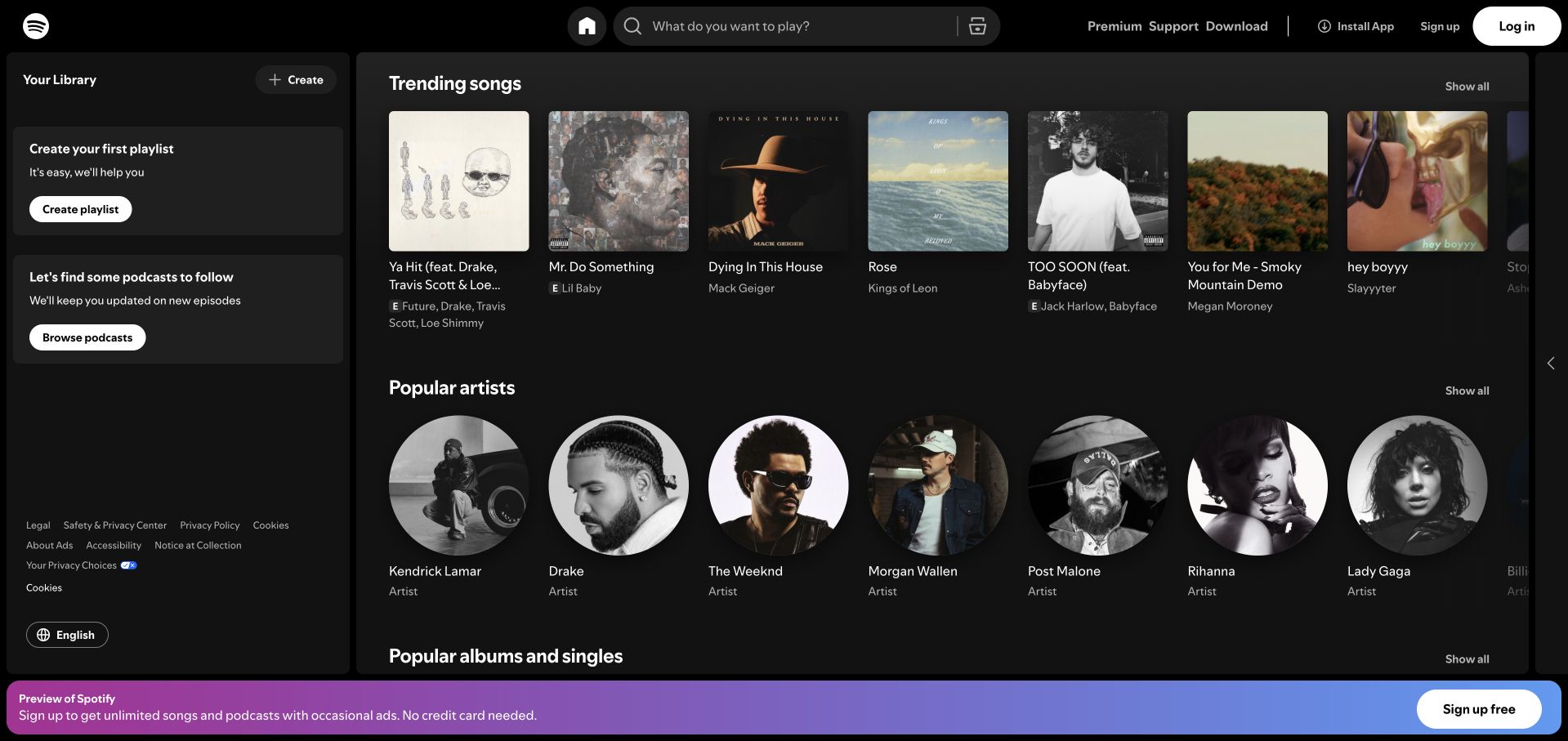
Spotify’s public player presents search, trending music and artist cards before asking the visitor to commit to an account. A library rail and signup strip distinguish public discovery from account features. The interface explains the service through actual content categories rather than an abstract illustration of listening. Spotify’s Python engineering account is from 2013 and concerns backend work and analytics; it is not a current inventory of the player’s frontend or every recommendation system.
What you can learn
Use the browse experience to establish value when the catalog is the product. Make the public and account-dependent tasks understandable, and preserve useful discovery without silently implying that personalization has already happened. An attractive cover grid still needs clear focus states, labels and an accessible playback route.
Pros
Search and visible content categories let an unfamiliar visitor understand the service without a long explanation.
Account-related actions are separated from the main discovery grid rather than replacing it with an immediate login wall.
Cons & considerations
Several horizontal content rows create a dense first screen and can make the available choices feel repetitive.
The screenshot cannot establish playback availability, regional rights, recommendation quality or the accessibility of the actual controls.
Platform source: Official Python engineering or project evidence. Backend services and analytics described in 2013; not a current stack census. The cited engineering, project or customer source establishes only the named language association. It does not establish the marketing page runtime, every company system, current deployment continuity or independent performance results. Platform evidence is separate from the direct website screenshot and is not a complete current infrastructure audit.
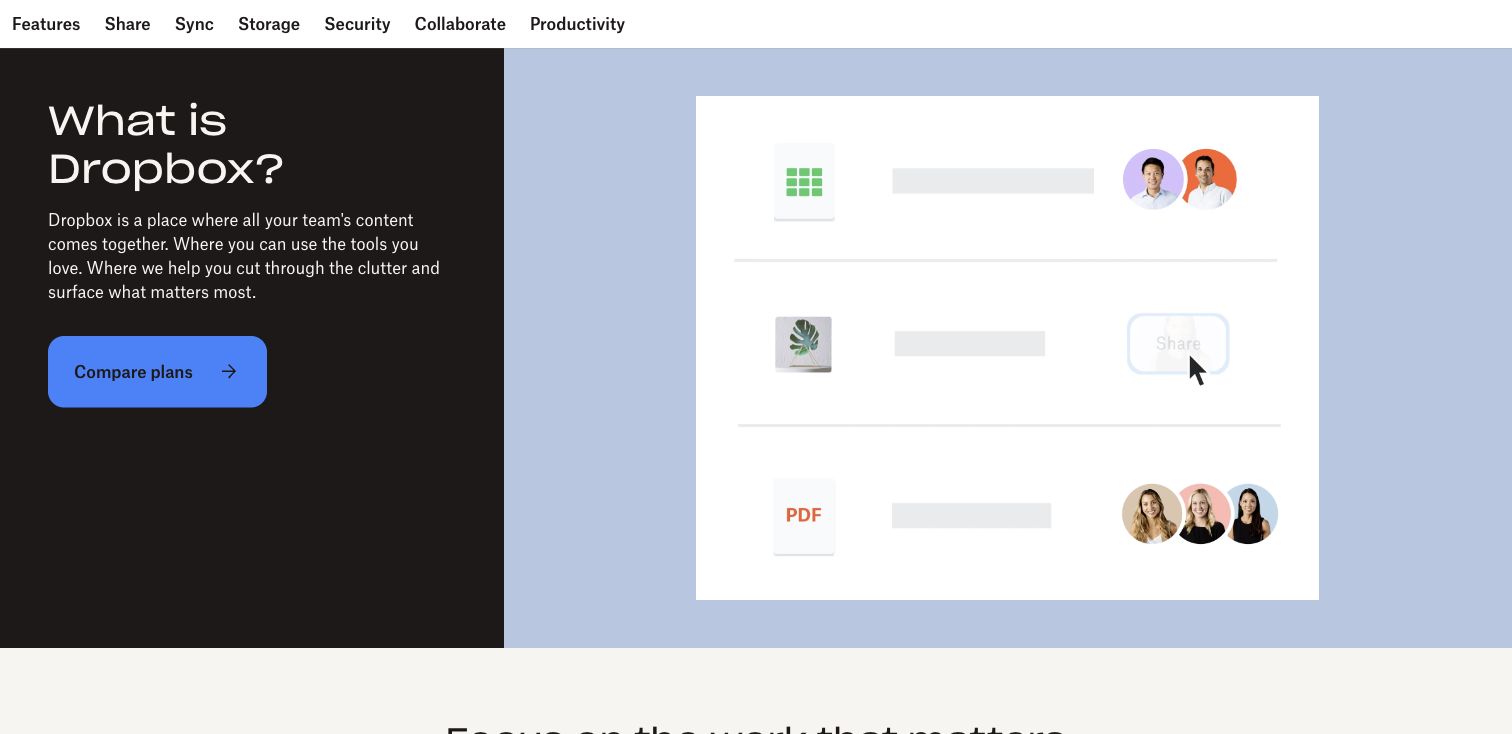
Dropbox’s feature overview uses a direct introductory question and a short answer beside a file-sharing illustration. The contrast between a dark explanation panel and a lighter product area gives the two jobs distinct visual roles. Feature tabs above the opening support visitors who already know the capability they want to investigate. The Python source documents a historical desktop-client migration, not the implementation of this public website; the reviewed page remains useful for its product explanation rather than an inferred Python frontend.
What you can learn
When a familiar brand’s offer has expanded, answer the category question again instead of assuming everyone understands the current product. Use the illustration to show the basic relationship between people and content. Keep feature detail and plan comparison close enough to turn that understanding into a practical evaluation.
Pros
The opening acknowledges that visitors may know the name but still need a clear current product definition.
A simple collaboration image supports the explanation without demanding a video or an account.
Cons & considerations
The conceptual illustration does not establish the actual editing, permissions or file-recovery experience.
Feature navigation can separate related tasks that a buyer needs to understand as one workflow.
Platform source: Official Python engineering or project evidence. Historical desktop-client migration to Python 3, described in 2018. The cited engineering, project or customer source establishes only the named language association. It does not establish the marketing page runtime, every company system, current deployment continuity or independent performance results. Platform evidence is separate from the direct website screenshot and is not a complete current infrastructure audit.
Instagram’s About page gives its opening statement unusually generous white space, with the familiar multicolor mark and a compact menu providing orientation. A small action sits below the introduction, while photographic content begins lower down. This public presentation is distinct from the logged-in feed and useful for people seeking general product or company information. Meta’s engineering source documents an Instagram Python web-server workload and Cinder-related work; it does not identify the runtime of this separate About page.
What you can learn
Provide a public explanation that does not depend on an existing account or familiarity with a personalized feed. A spacious introduction can make a complex social product approachable, provided the menu and following sections answer concrete questions about features, safety, policies and the people expected to use it.
Pros
The clean public page explains the product without exposing a private account or requiring a personalized feed.
The familiar logo and restrained menu make the otherwise minimal composition easy to orient within the wider brand.
Cons & considerations
The large amount of empty space delays more concrete examples of what the product enables.
A broad social promise needs direct supporting routes to safety, privacy and practical feature information.
Platform source: Official Python engineering or project evidence. Instagram web-server Python workload and Cinder described in 2023; public introduction is a separate layer. The cited engineering, project or customer source establishes only the named language association. It does not establish the marketing page runtime, every company system, current deployment continuity or independent performance results. Platform evidence is separate from the direct website screenshot and is not a complete current infrastructure audit.
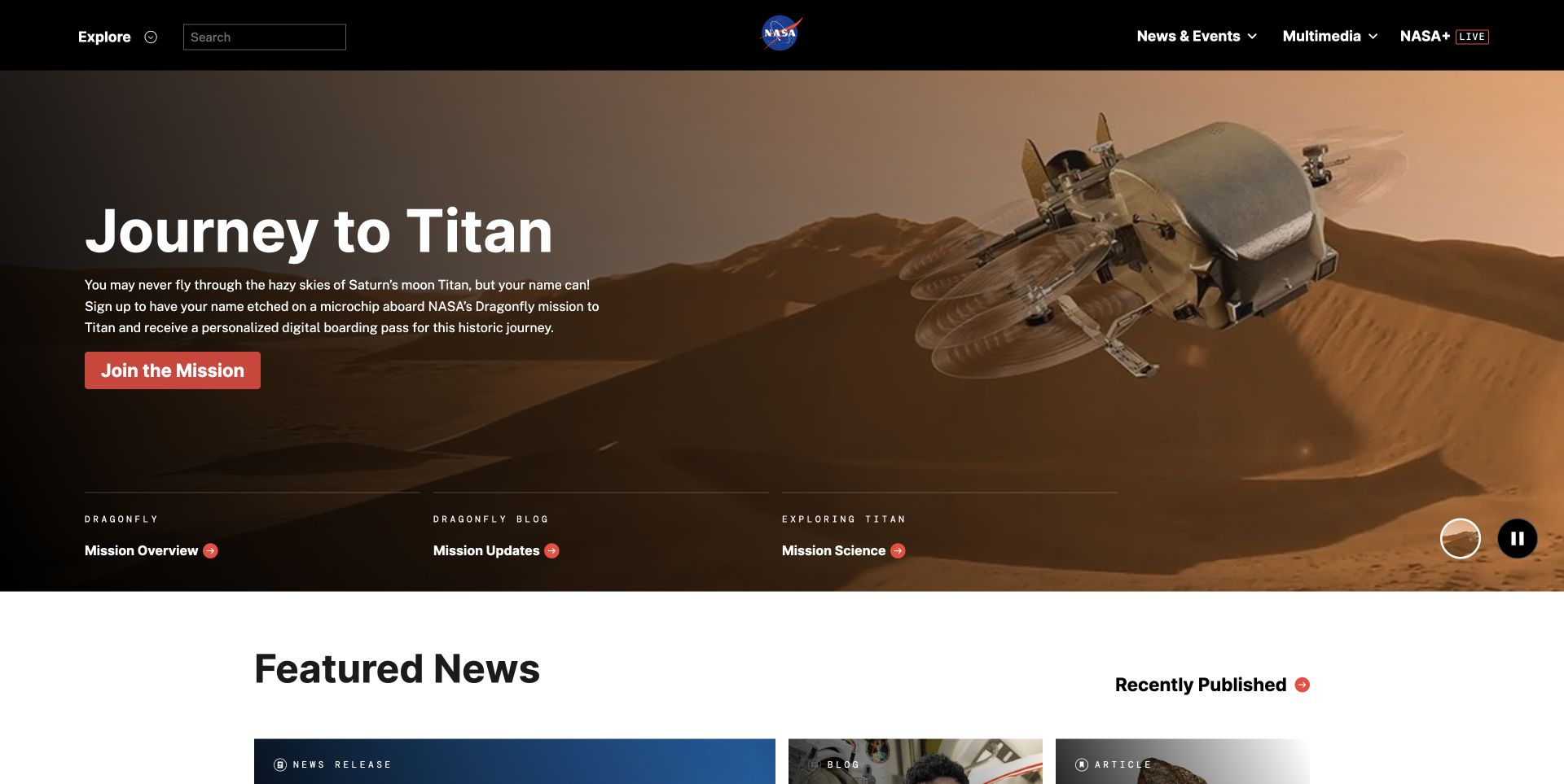
NASA’s captured homepage gives a mission a prominent visual opening, supported by short routes into its overview, updates and science. The image and introductory text create an accessible invitation before the page expands into featured news. That layered structure is useful for an institution serving readers with very different technical knowledge. The Python association here is the JWST science-calibration pipeline documented by the mission’s science institute; it concerns research processing, not the implementation of the pictured institutional homepage.
What you can learn
Let a general reader enter through a concrete mission, then label the path toward more specialized material. Avoid mixing the public explanation, scientific data processing and website implementation into one undifferentiated technology claim. Each audience needs its own context, source and appropriate level of detail.
Pros
The current mission provides a recognizable subject before a visitor encounters the wider institutional news archive.
Separate overview, science and update routes support different depths of interest without one overloaded introductory paragraph.
Cons & considerations
A mission-led hero necessarily gives less first-screen attention to other programs and institutional tasks.
Large illustrative media requires meaningful alternatives and tested controls beyond what a still capture demonstrates.
Platform source: Official Python engineering or project evidence. NASA mission context: the JWST science calibration pipeline is Python with some C bindings, not proof of the institutional homepage runtime. The cited engineering, project or customer source establishes only the named language association. It does not establish the marketing page runtime, every company system, current deployment continuity or independent performance results. Platform evidence is separate from the direct website screenshot and is not a complete current infrastructure audit.
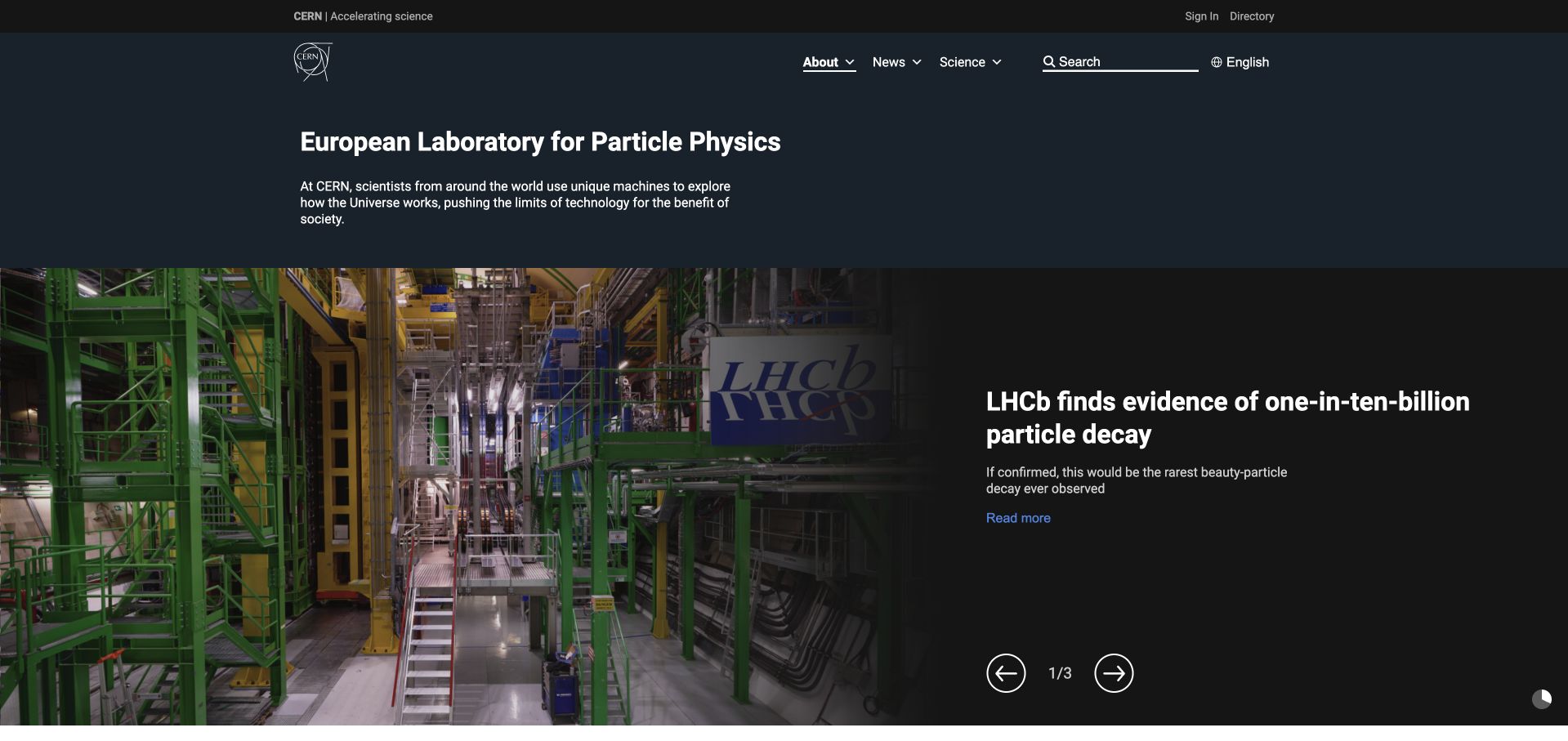
CERN states its institutional purpose above a large scientific-news feature, with restrained white text against a dark background. The layout gives a newcomer a basic explanation before introducing a more specialist result. News, science, search and language controls remain in the header, supporting deeper exploration without an immediate account task. The documented Python association is the CERN Open Data portal’s infrastructure project; that is a separate source and workload from the institutional homepage pictured here.
What you can learn
Introduce the institution’s purpose before asking a reader to interpret a specialized finding. A strong research story benefits from a plain-language summary and an obvious route into the original material. Keep the public communications website distinct from research repositories and data-processing systems when explaining the technology involved.
Pros
The short purpose statement gives essential context before the more technical featured-news headline.
Search and language controls remain visible alongside institutional subjects rather than being hidden inside the article collection.
Cons & considerations
A specialist headline may still need more explanation for readers unfamiliar with the underlying scientific vocabulary.
The large feature image and carousel hierarchy give only limited space to other institutional priorities.
Platform source: Official Python engineering or project evidence. Python infrastructure application for the CERN Open Data portal, separate from the institutional homepage. The cited engineering, project or customer source establishes only the named language association. It does not establish the marketing page runtime, every company system, current deployment continuity or independent performance results. Platform evidence is separate from the direct website screenshot and is not a complete current infrastructure audit.
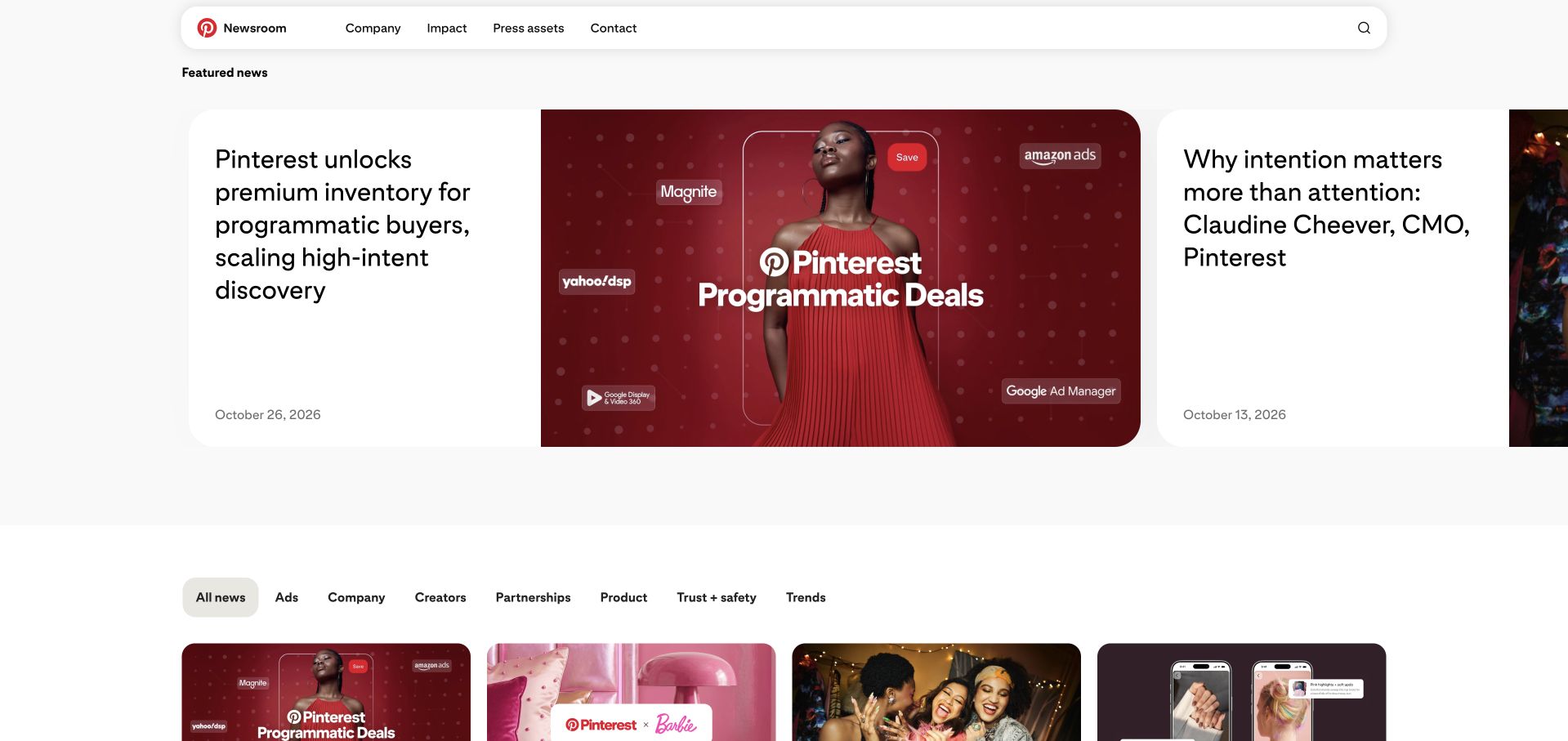
Pinterest’s newsroom presents large editorial cards beneath a compact navigation, with dates and category filters helping readers distinguish current announcements from background material. Product imagery and recognizable brand colors carry the visual identity without turning the whole page into the consumer discovery feed. This is a practical public-information surface. The Python association is Pinterest’s historical Pinball workflow-management project, archived in 2019; it does not establish the runtime of this newsroom, current deployment continuity or a recommendation algorithm behind the consumer application.
What you can learn
Give press and business readers a chronological, filterable publication rather than making them navigate a personalized consumer product. Dates, source ownership and clear categories are more valuable here than a large promotional introduction. Keep older engineering material clearly dated when using it as supporting context.
Pros
The card layout makes individual announcements easy to distinguish by subject and publication date.
Visible categories support readers looking for company, product or partnership news without relying only on search.
Cons & considerations
Large card images reduce the number of readable stories available in the first screen.
A newsroom cannot by itself demonstrate the consumer product’s discovery quality or the architecture behind it.
Platform source: Official Python engineering or project evidence. Historical Pinterest Python workflow-management project, archived in 2019; not newsroom runtime proof. The cited engineering, project or customer source establishes only the named language association. It does not establish the marketing page runtime, every company system, current deployment continuity or independent performance results. Platform evidence is separate from the direct website screenshot and is not a complete current infrastructure audit.
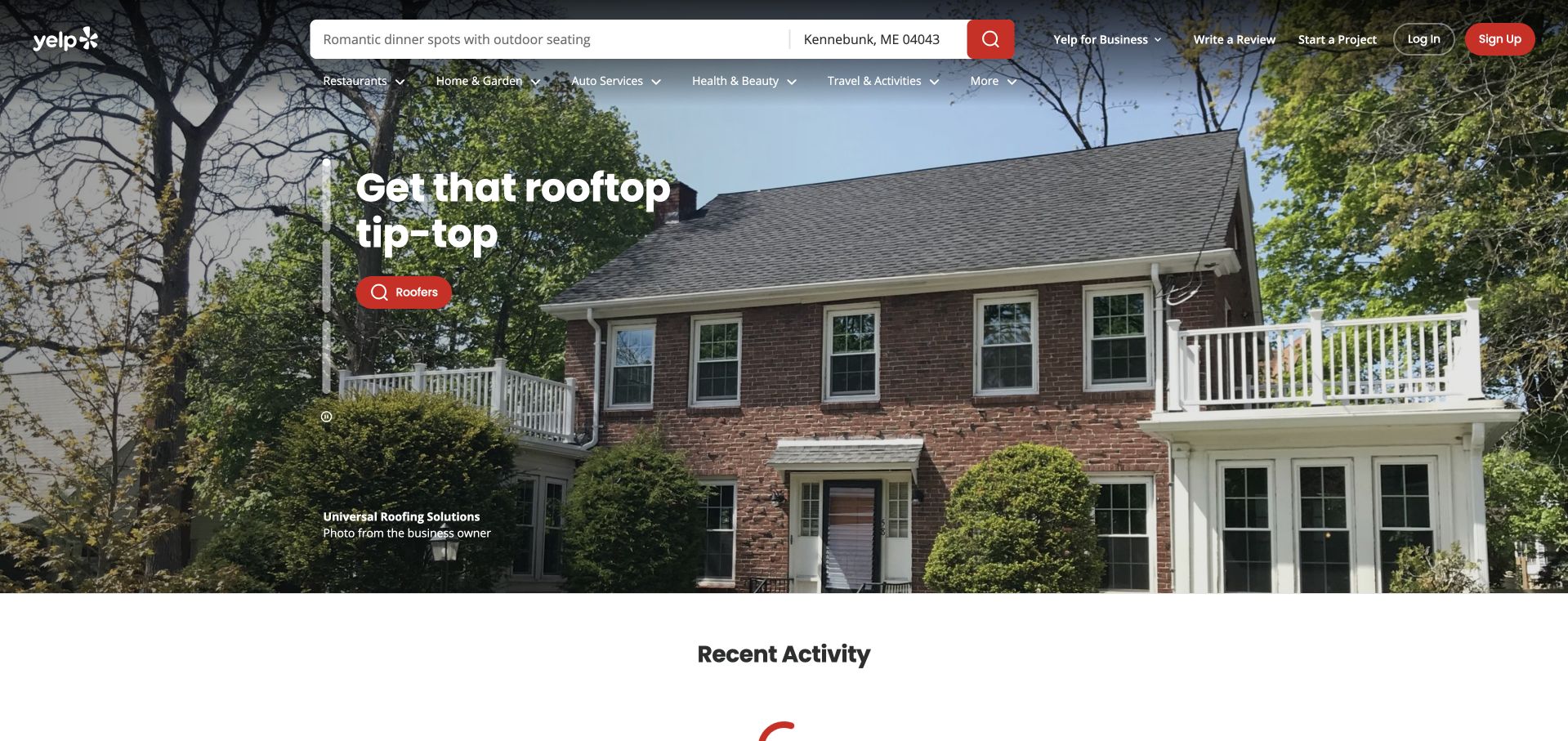
Yelp places a service-oriented scene behind a clear search bar, with a short prompt leading toward roofing work in the captured opening. A location input makes geography part of the task instead of an invisible assumption. The next section begins recent activity, transitioning from an editorial entrance into the broader community product. Yelp’s Python association is the public PaaSTA service-orchestration project, not proof that this particular homepage, every listing or every search result is implemented in Python.
What you can learn
Make both the task and the location explicit when relevance depends on local availability. A strong service photograph can help a visitor recognize the category, but the search interface must allow them to revise it. Distinguish platform presentation from any claim about the quality of an individual provider.
Pros
The service prompt connects the broad discovery platform to a recognizable immediate need.
A visible location field acknowledges that useful results depend on geography as well as the service query.
Cons & considerations
The large photographic treatment requires reliable text contrast across different campaign images and crops.
A regional homepage view cannot establish provider availability, review authenticity or the quality of a completed job.
Platform source: Official Python engineering or project evidence. Yelp-maintained Python service-orchestration software. The cited engineering, project or customer source establishes only the named language association. It does not establish the marketing page runtime, every company system, current deployment continuity or independent performance results. Platform evidence is separate from the direct website screenshot and is not a complete current infrastructure audit.
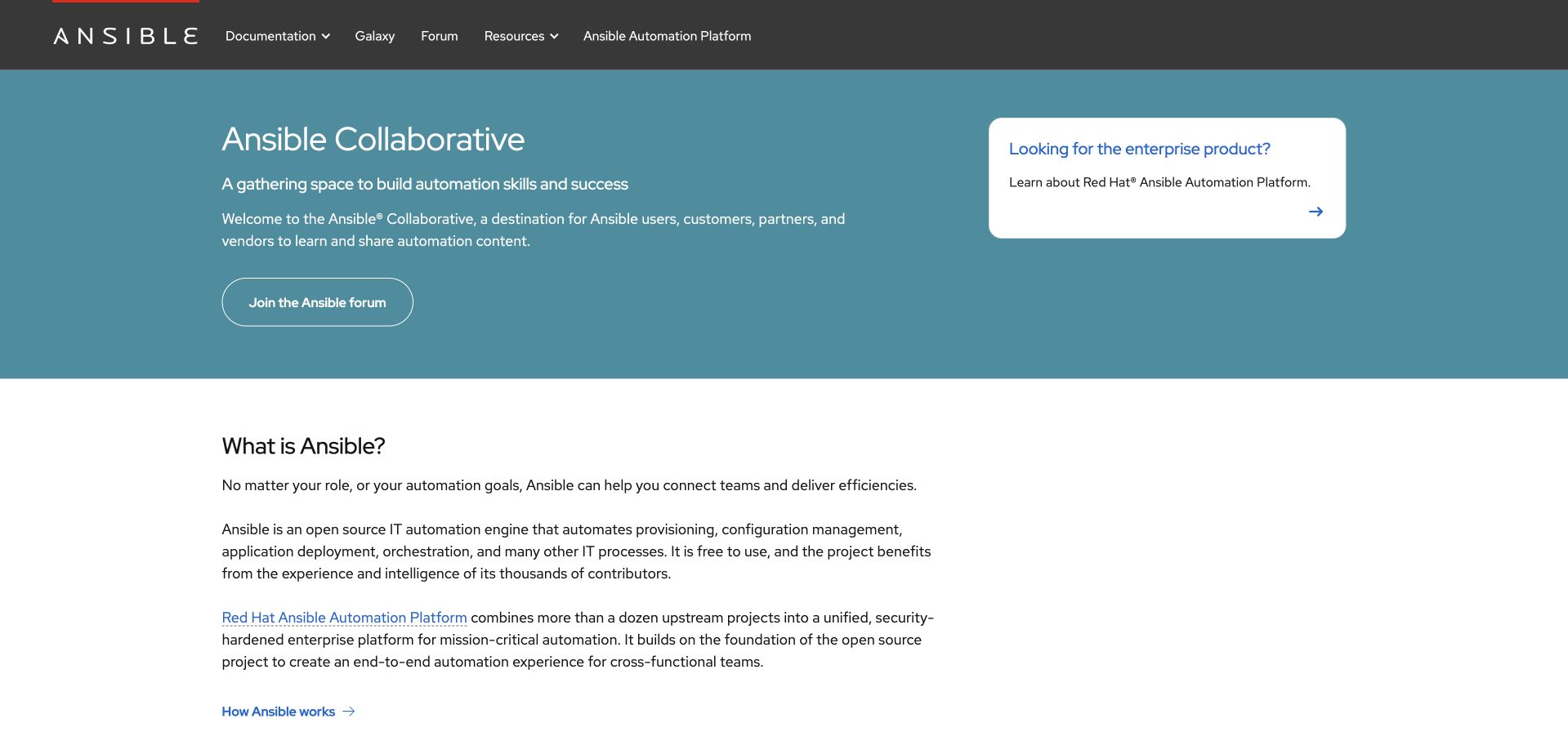
Ansible’s public entrance redirects to a labeled collaborative space, with a community invitation on the left and a distinct enterprise-product card on the right. A plain explanation of automation follows below. The result helps distinguish the open-source learning ecosystem from a commercial platform without concealing their relationship. The official source repository establishes Python in the Ansible project; the pictured Red Hat community page is not evidence that its public content-management layer uses the same implementation.
What you can learn
Make the relationship between a project, its community and its commercial distribution explicit. Visitors should know whether they are joining a forum, learning a tool or evaluating a supported product. A small explanatory split can prevent a complicated ecosystem from becoming a confusing collection of similarly named destinations.
Pros
The enterprise route is visibly separate from the community invitation rather than being disguised as the same next step.
A direct product explanation begins immediately below the introductory panel and gives new visitors useful context.
Cons & considerations
The redirected brand context can surprise someone expecting the former standalone project homepage.
Several related learning and product destinations require consistent naming so visitors can understand which organization maintains each one.
Platform source: Official Python engineering or project evidence. Python automation project maintained in the official source repository. The cited engineering, project or customer source establishes only the named language association. It does not establish the marketing page runtime, every company system, current deployment continuity or independent performance results. Platform evidence is separate from the direct website screenshot and is not a complete current infrastructure audit.
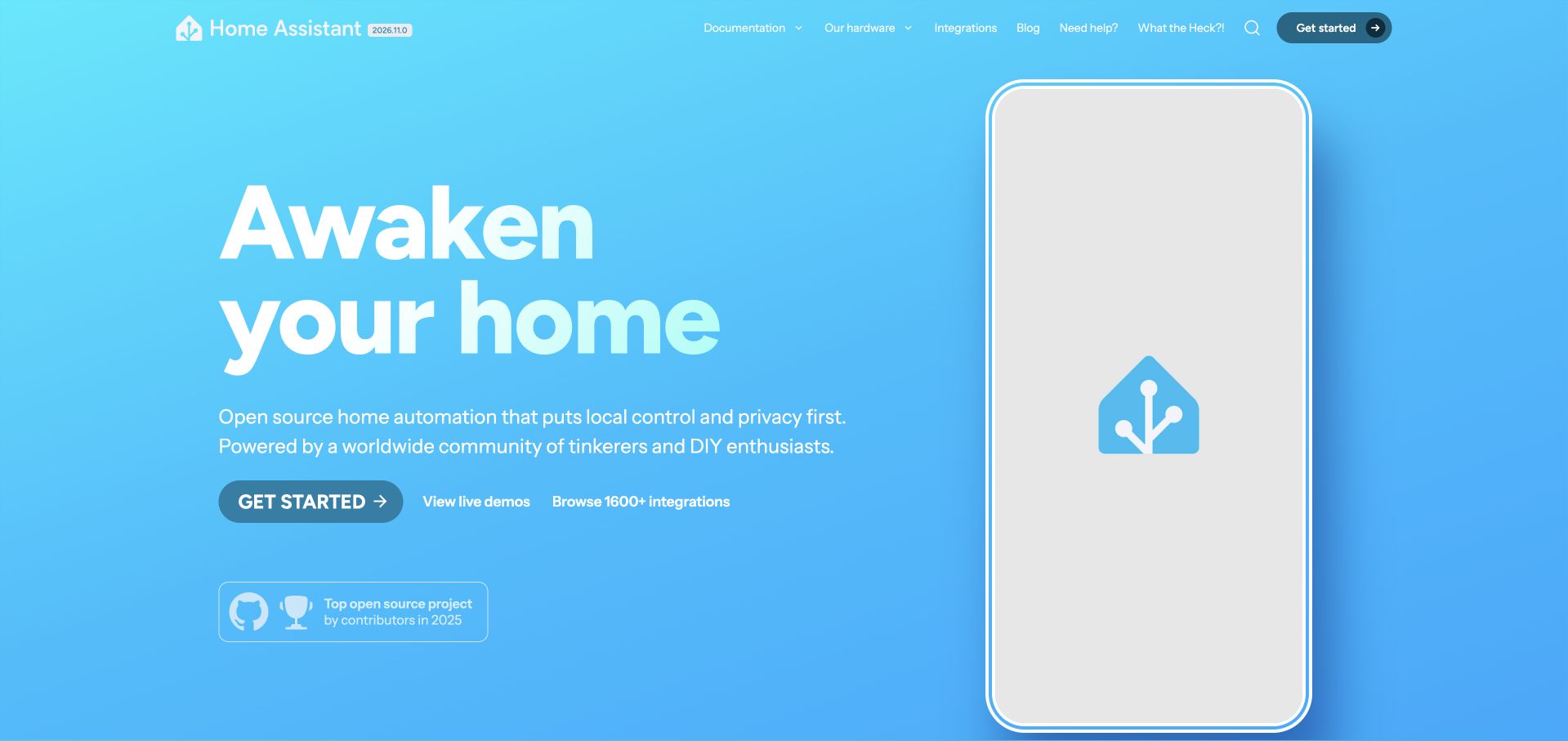
Home Assistant’s bright blue opening uses a large device image and a short home-oriented message, with practical starting and demonstration routes nearby. A compact explanation identifies the project as an open-source automation platform and highlights its local-control emphasis. The visible release link connects the broad presentation to ongoing project activity. The official core repository establishes a Python application association; it does not mean every integration, device firmware or public marketing component is written in Python.
What you can learn
Give an abstract automation platform a recognizable object or task, then explain the relationship between hardware, software and integrations. Keep the community and documentation routes visible for people who need to assess compatibility. A simple hero should not imply that every device or household setup works without additional configuration.
Pros
The physical product image gives a newcomer a tangible starting point for understanding the platform.
The release and documentation links make ongoing maintenance and practical learning discoverable beside the introductory story.
Cons & considerations
A hardware-centered opening may understate alternative installation routes unless the next sections explain them clearly.
The screenshot cannot establish integration compatibility, local-network behavior or the effort required for a real household setup.
Visible tech stack
Earlier / documented evidence
Python
Platform source: Official Python engineering or project evidence. Python home-automation application core. The cited engineering, project or customer source establishes only the named language association. It does not establish the marketing page runtime, every company system, current deployment continuity or independent performance results. Platform evidence is separate from the direct website screenshot and is not a complete current infrastructure audit.
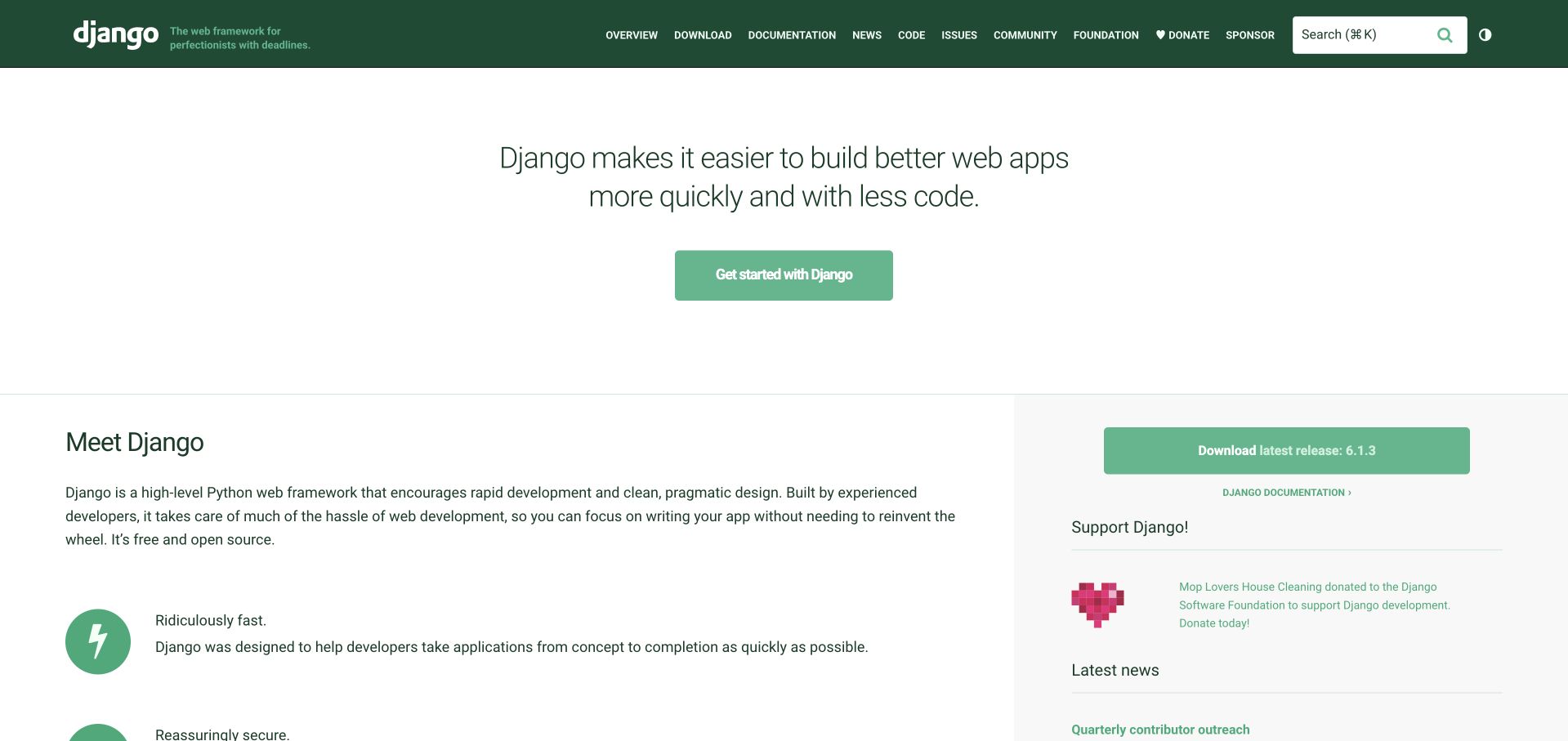
Django’s green-and-white homepage keeps its opening modest: a concise explanation, a getting-started action and a visible route to the current release. The next section introduces the framework’s benefits with short headings, while documentation and community destinations remain predictable in the header. It feels closer to a maintained technical reference than a startup sales page. The official project establishes a Python web-framework association; this does not identify every deployment choice or guarantee the quality of a website using it.
What you can learn
Make a mature tool easy to evaluate and begin using. State the category, expose the supported starting route and keep version information near documentation. Avoid allowing a long list of benefits to conceal the operational work needed to configure, deploy, update and maintain an actual application.
Pros
The getting-started action and release information are easy to find without a sales or account workflow.
The restrained layout gives technical explanation and documentation more priority than decorative visual effects.
Cons & considerations
Broad claims about development speed need practical examples and should not be treated as universal delivery estimates.
The compact benefits list cannot replace guidance about project structure, hosting, authentication or maintenance responsibilities.
Platform source: Official Python engineering or project evidence. Python web framework; project identity is not a claim about all showcased sites. The cited engineering, project or customer source establishes only the named language association. It does not establish the marketing page runtime, every company system, current deployment continuity or independent performance results. Platform evidence is separate from the direct website screenshot and is not a complete current infrastructure audit.
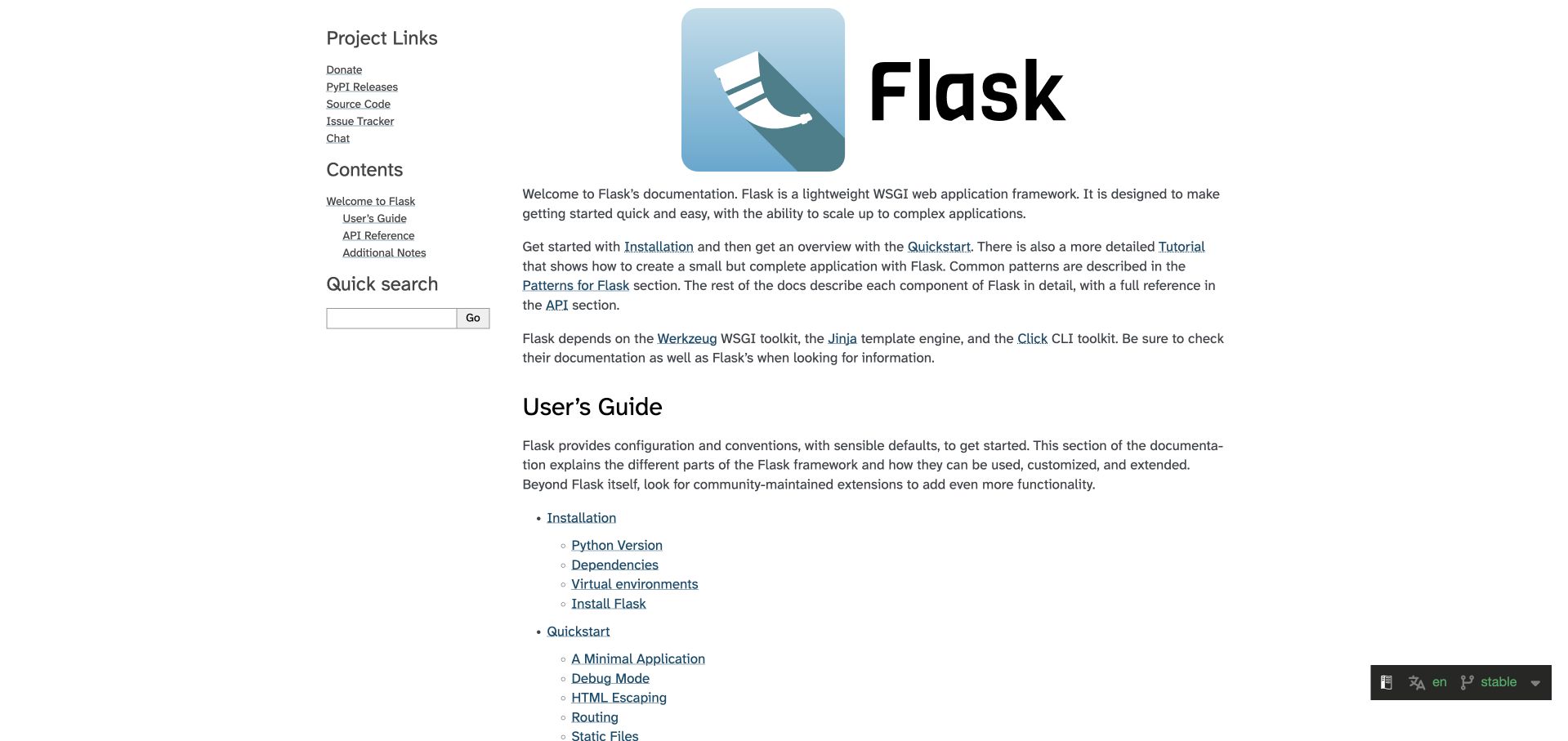
Flask’s public site opens directly into its documentation. The logo, short introduction and user-guide links sit in a narrow reading column beside a compact contents rail. Installation, quickstart and tutorial destinations are immediately available, while project and release links remain separate. This is useful for a small, focused framework whose visitors often arrive with a technical task already in mind. The official source establishes the Python framework; the documentation’s own publishing system is a different implementation question.
What you can learn
Do not add a promotional obstacle when the reader primarily needs an introduction and a reference. Organize the first screen around the next sensible learning steps, distinguish tutorials from API documentation and keep release context visible. A documentation homepage still needs readable type and a workable small-screen navigation.
Pros
The introductory paragraph quickly identifies the framework before offering practical learning routes.
A visible contents rail supports readers who already know the topic they need to find.
Cons & considerations
The small, dense link list can feel less approachable to readers without an existing technical vocabulary.
A reference-first presentation provides limited immediate evidence of complete application workflows or real project examples.
Platform source: Official Python engineering or project evidence. Python web-application framework. The cited engineering, project or customer source establishes only the named language association. It does not establish the marketing page runtime, every company system, current deployment continuity or independent performance results. Platform evidence is separate from the direct website screenshot and is not a complete current infrastructure audit.
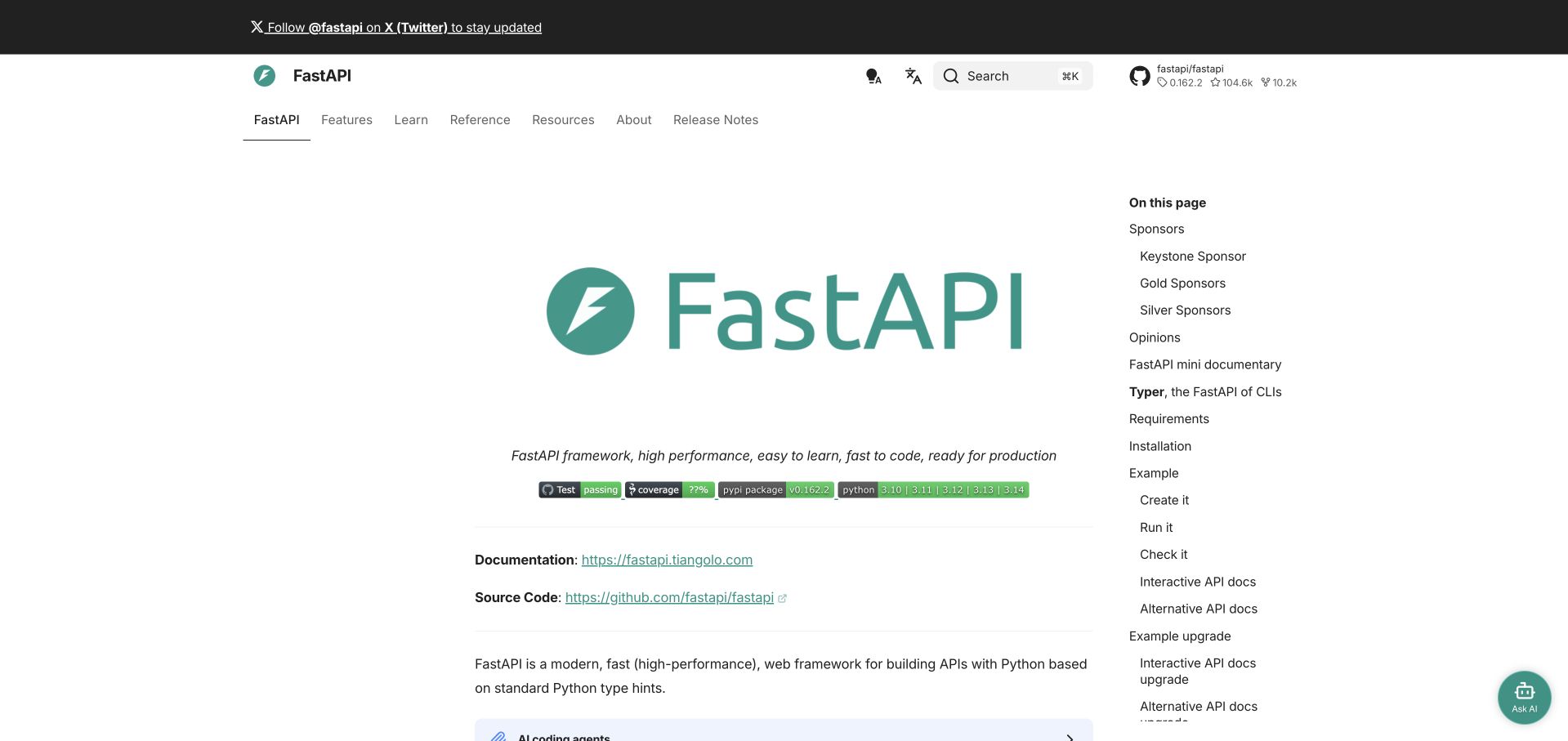
FastAPI’s documentation-led page combines a large project identity with direct documentation and source links. A top navigation and an on-page contents list expose several routes into the material, while short introductory text names the framework’s Python API role. The layout suits readers who are ready to inspect implementation guidance rather than watch a product film. The official project source establishes the framework association; its public documentation page does not prove the architecture or performance of applications built with it.
What you can learn
Put the learning path and source material close to the first definition of a technical product. Help a reader distinguish conceptual introduction, installation, tutorial and reference. Performance claims should retain their benchmark scope rather than becoming a blanket promise about any API written with the framework.
Pros
Documentation and source destinations are visible before a visitor has to navigate an unrelated marketing funnel.
The contents navigation makes a long introductory page more manageable for task-focused readers.
Cons & considerations
Badges, sponsor material and multiple navigation regions can crowd the first impression.
A dense reference-oriented layout may need a more explicit beginner route for readers new to API development.
Platform source: Official Python engineering or project evidence. Python API framework in its official repository. The cited engineering, project or customer source establishes only the named language association. It does not establish the marketing page runtime, every company system, current deployment continuity or independent performance results. Platform evidence is separate from the direct website screenshot and is not a complete current infrastructure audit.
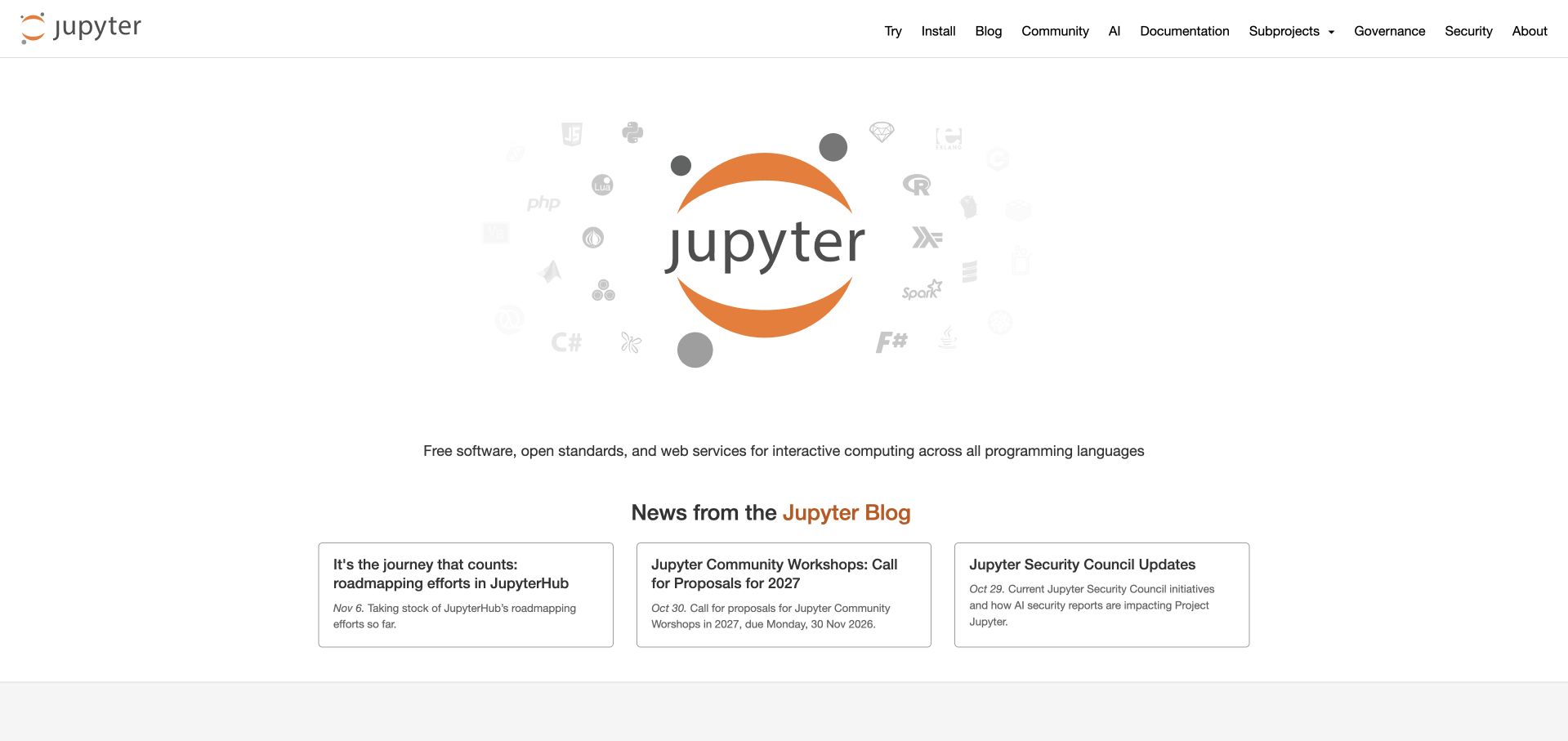
Project Jupyter gives its recognizable mark a generous introductory area, followed by a short explanation of its open standards and interactive-computing purpose. A news-card row shows current community activity, while navigation separates trying, installing, documenting and exploring subprojects. The page acknowledges that the ecosystem is broader than one application. This collection’s Python evidence concerns Jupyter Server; it does not imply that every notebook kernel, interface, public website component or Jupyter-branded project has the same implementation.
What you can learn
Explain the umbrella before listing its parts. People evaluating a scientific ecosystem need to distinguish the interface they use, the server that runs it and the language kernel executing their work. Offer a low-commitment trial separately from installation and reference material so those decisions do not become confused.
Pros
Separate trying and installing routes support exploration without implying that every reader is ready to configure a server.
Community news makes the project’s wider activity visible beneath a clear and restrained introduction.
Cons & considerations
The large logo area provides little immediate demonstration of an actual notebook workflow.
A broad ecosystem needs careful naming to prevent newcomers from treating related tools as interchangeable versions of one product.
Platform source: Official Python engineering or project evidence. Python Jupyter Server backend for computational notebooks. The cited engineering, project or customer source establishes only the named language association. It does not establish the marketing page runtime, every company system, current deployment continuity or independent performance results. Platform evidence is separate from the direct website screenshot and is not a complete current infrastructure audit.
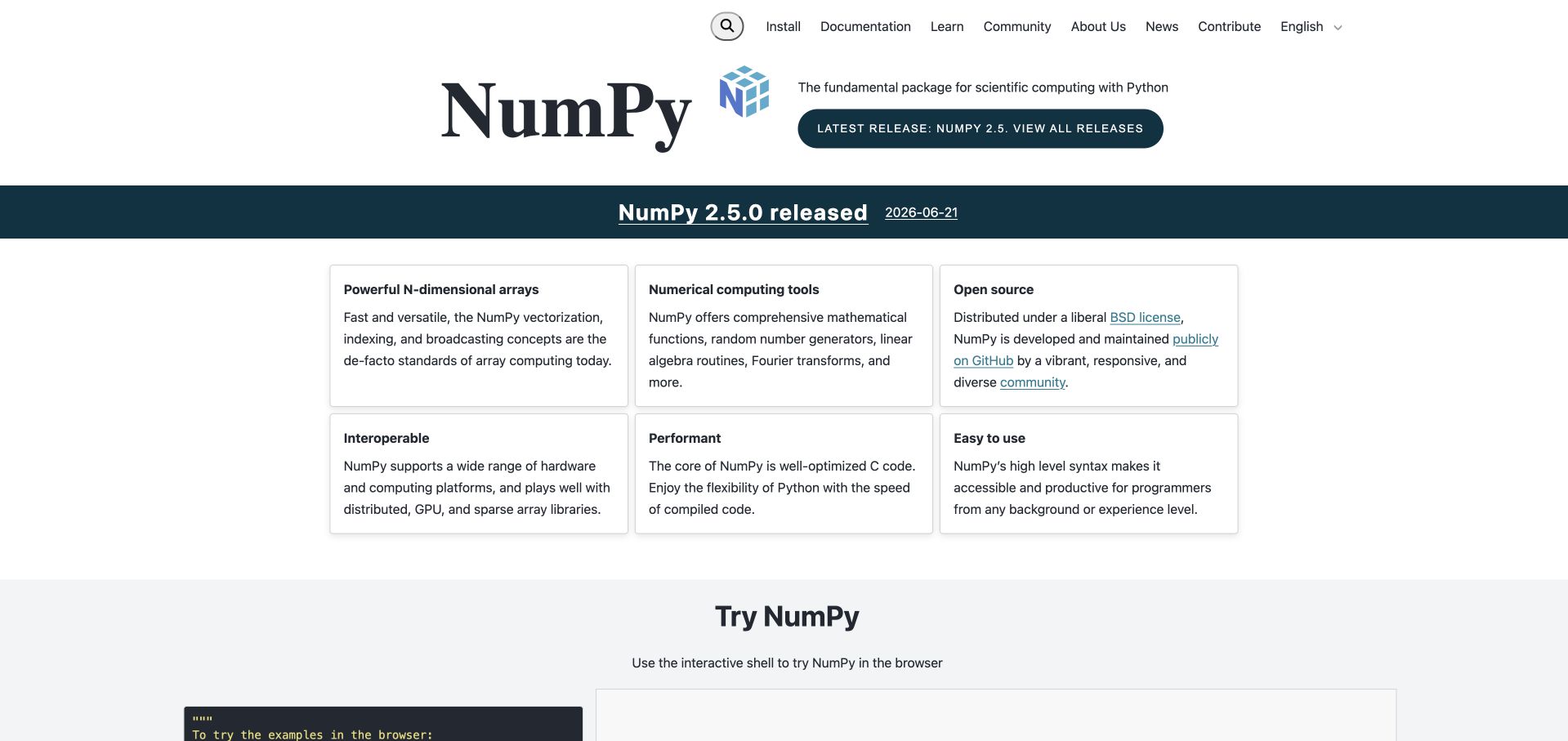
NumPy’s homepage pairs its wordmark with a short scientific-computing definition, a release route and a compact grid of capabilities. The page gives a newcomer enough context to distinguish an array library from a complete application or data platform. A browser-based trial begins further down, adding a practical route beyond reading. The official project establishes a Python library with native components; it is not a pure-Python implementation claim or evidence of the public documentation site’s backend.
What you can learn
Explain the library’s unit of value before presenting its ecosystem. Short capability cards can help readers orient themselves, but each should lead toward a real example and appropriate reference. Distinguish installing a foundational dependency from choosing a complete analysis workflow, application architecture or deployment environment.
Pros
The short definition and capability grid make an essential but abstract library easier to categorize.
A visible release route and browser trial support both informed evaluation and low-commitment experimentation.
Cons & considerations
Several small capability cards can become dense at narrow widths and need a deliberate reading order.
A concise overview cannot communicate numerical correctness, compatibility or performance characteristics for a specific workload.
Platform source: Official Python engineering or project evidence. Python numerical-computing library with native components; not a pure-Python backend claim. The cited engineering, project or customer source establishes only the named language association. It does not establish the marketing page runtime, every company system, current deployment continuity or independent performance results. Platform evidence is separate from the direct website screenshot and is not a complete current infrastructure audit.
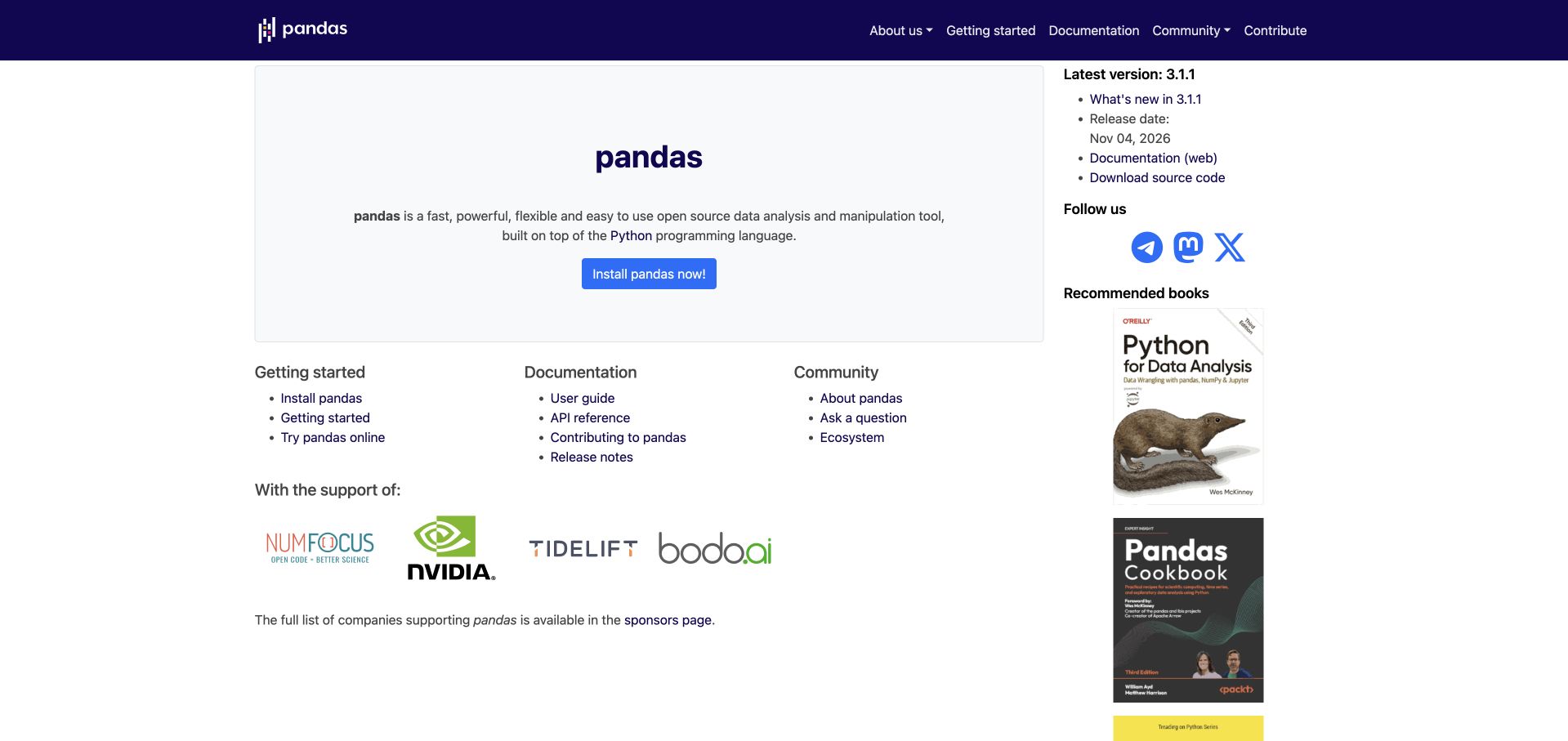
pandas uses a simple introduction beside a visible release panel, with getting-started, documentation and community links grouped below. The layout gives newcomers a definition while helping established users locate current reference material. Supporting organizations and recommended resources occupy separate areas instead of interrupting the main description. The official project establishes a Python data-analysis library with native components; neither that evidence nor the page design establishes a complete data pipeline, notebook environment or production deployment.
What you can learn
Serve the first-time reader and the returning practitioner in the same restrained structure. Keep the definition, installation route and version context close enough to compare. Recommended resources and sponsorship can support the project without becoming visually indistinguishable from the official documentation or the principal learning path.
Pros
The release panel makes version context discoverable without forcing readers to search a separate announcement archive.
Getting-started, reference and community routes are distinct enough to support different technical intentions.
Cons & considerations
The small text and several narrow columns require careful responsive treatment and zoom testing.
Book and sponsor areas can compete with the core learning route if they acquire too much visual weight.
Platform source: Official Python engineering or project evidence. Python data-analysis library with native components. The cited engineering, project or customer source establishes only the named language association. It does not establish the marketing page runtime, every company system, current deployment continuity or independent performance results. Platform evidence is separate from the direct website screenshot and is not a complete current infrastructure audit.
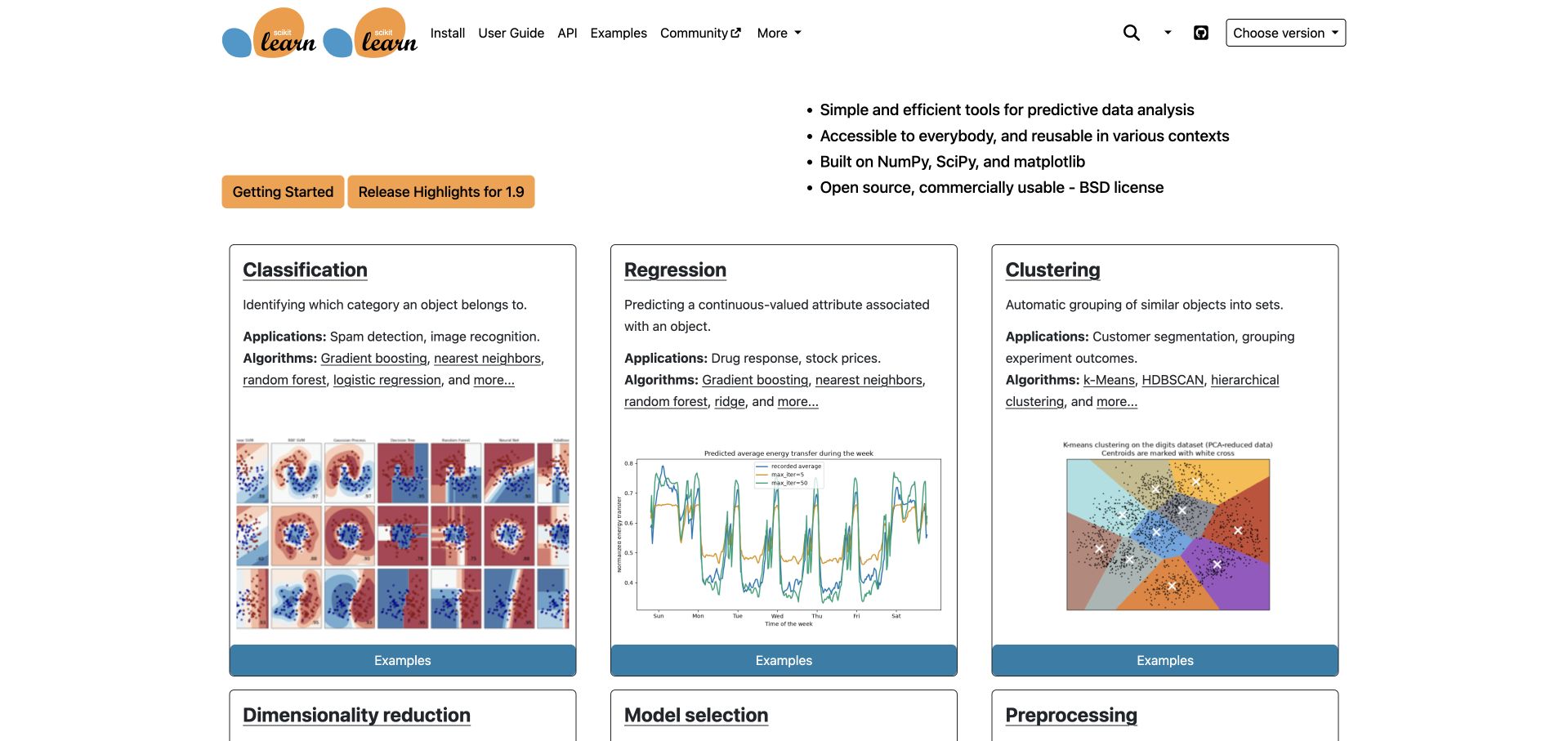
scikit-learn organizes its opening around classification, regression, clustering and other recognizable machine-learning tasks. Each category includes a short explanation, example image and routes toward relevant material. Installation and release information remain above the grid, providing a practical starting point before a reader chooses an algorithm family. The official source establishes a Python machine-learning library; a grid of example charts is not evidence that a particular model is suitable, validated or deployed in a production decision system.
What you can learn
Organize a technical library around the problems readers are trying to solve, not only its internal API names. Pair each category with a meaningful visual example and a route to limitations. A convincing chart should invite scrutiny of data, assumptions and evaluation rather than act as proof of model quality.
Pros
Task-based categories help readers approach a large library without already knowing a specific estimator name.
Small visual examples make abstract algorithm families easier to distinguish at the overview level.
Cons & considerations
The dense grid needs a clear reading order and readable labels when reduced for smaller screens.
Example charts cannot establish model validity, fairness or fitness for an individual dataset or consequential use.
Platform source: Official Python engineering or project evidence. Python machine-learning library; not proof of a training workflow on the homepage. The cited engineering, project or customer source establishes only the named language association. It does not establish the marketing page runtime, every company system, current deployment continuity or independent performance results. Platform evidence is separate from the direct website screenshot and is not a complete current infrastructure audit.
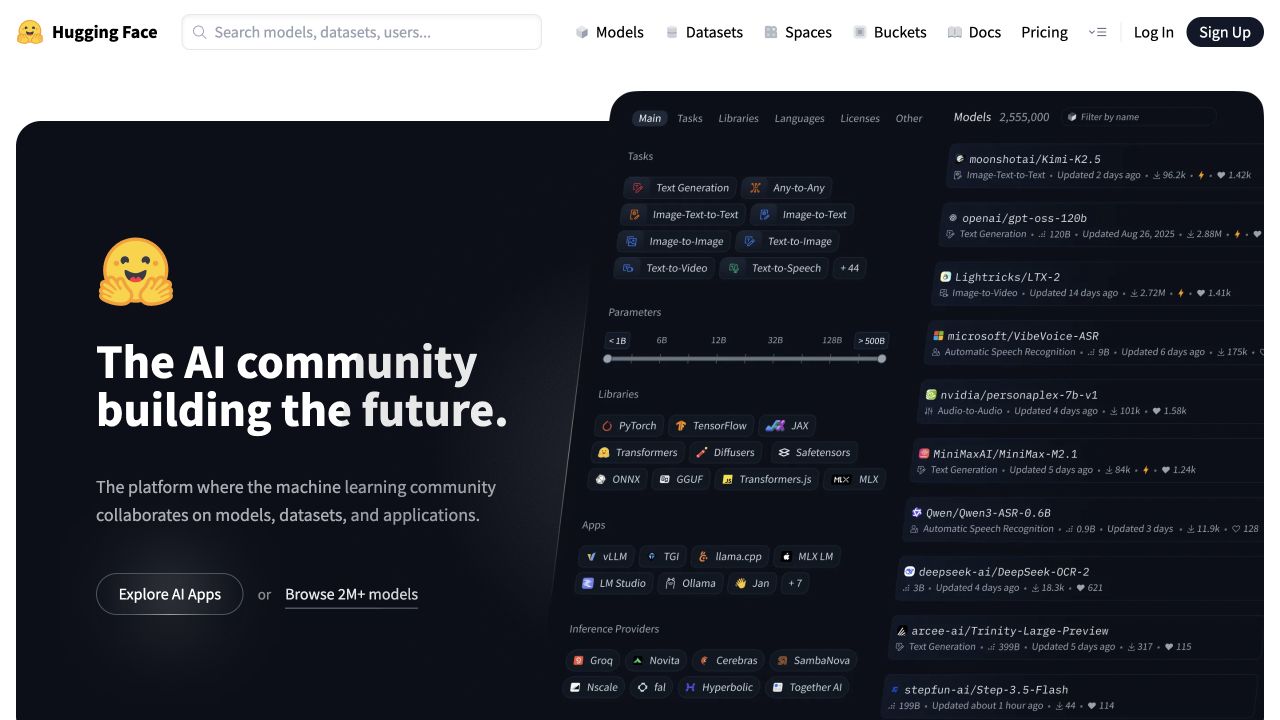
Hugging Face visualizes its community proposition through a dark catalog preview with models, datasets and application categories. Search and primary product families remain in the header, while exploratory buttons support visitors who have not chosen a specific artifact. The page communicates breadth without first asking for a complex setup. The Python association is the organization’s Transformers library; it does not establish the runtime, safety, license or implementation of every model, dataset or hosted application in the wider catalog.
What you can learn
Show the structure of a large ecosystem rather than merely claiming that it is large. Help visitors distinguish artifacts with different purposes and evaluation requirements. Discovery should lead toward model cards, licenses, provenance and appropriate testing, not imply that a popular catalog item is automatically ready for production.
Pros
The catalog preview makes the platform’s breadth tangible through recognizable artifact categories.
Prominent search provides a direct route for visitors arriving with a specific model or project in mind.
Cons & considerations
A busy preview can overwhelm newcomers who do not yet understand the differences between models, datasets and applications.
Community visibility and popularity do not establish an artifact’s quality, license compatibility or suitability for a deployment.
Platform source: Official Python engineering or project evidence. Python Transformers library maintained by the organization. The cited engineering, project or customer source establishes only the named language association. It does not establish the marketing page runtime, every company system, current deployment continuity or independent performance results. Platform evidence is separate from the direct website screenshot and is not a complete current infrastructure audit.
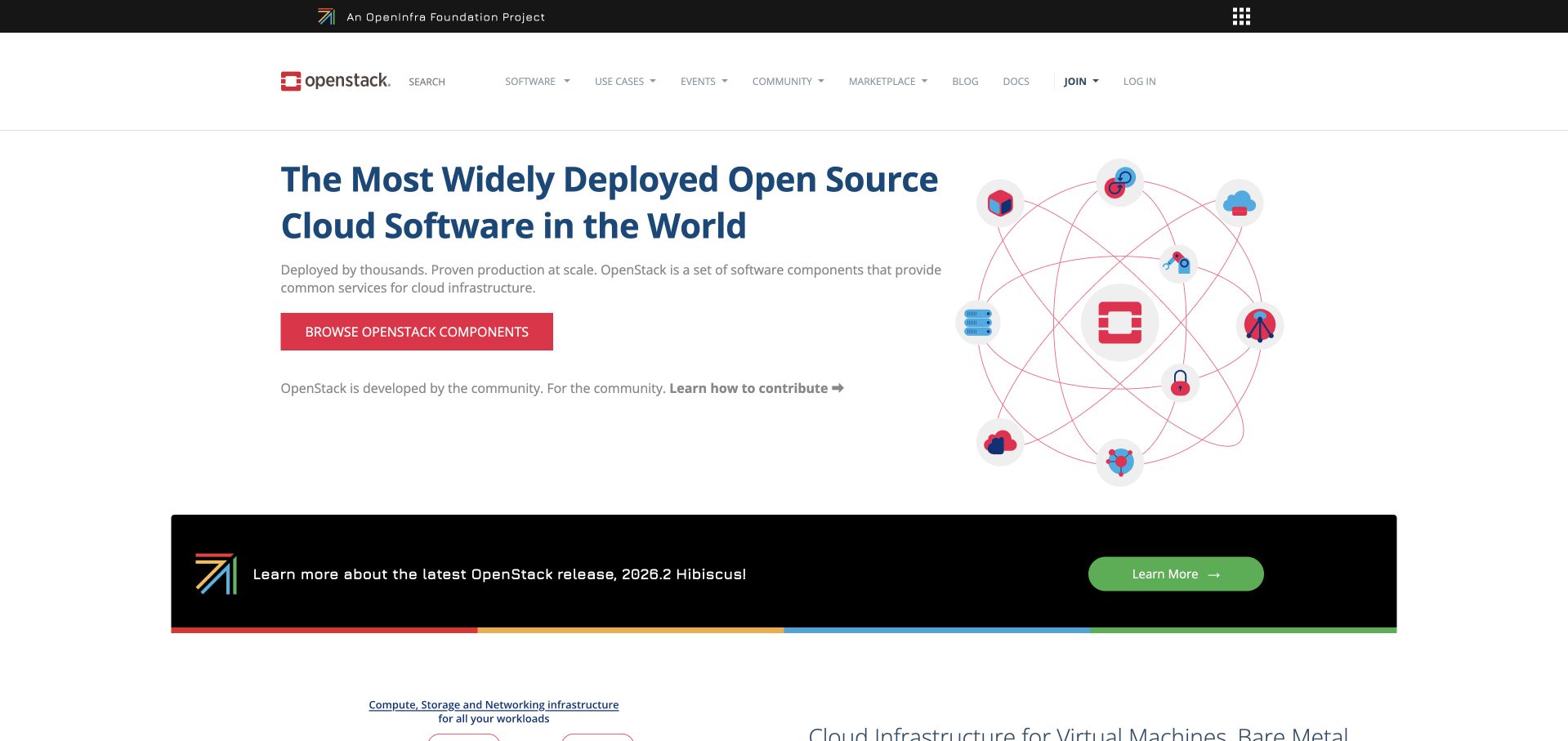
OpenStack’s public site explains the project beside a simple infrastructure illustration, with a prominent route to companies in its ecosystem. A visible release banner follows below, connecting the introduction to maintained software rather than leaving it as a timeless slogan. The foundation identity and documentation routes provide additional context. The Python evidence here concerns Nova’s compute-service implementation; it does not establish the language of every OpenStack component, the public homepage or any provider’s complete cloud environment.
What you can learn
Distinguish the software project from the businesses that help deploy or operate it. An infrastructure homepage should explain what the project manages, then offer separate routes into documentation, releases and the service ecosystem. A large adoption statement is more useful when readers can trace its source and intended scope.
Pros
The project definition and infrastructure illustration provide an accessible opening for a technically broad platform.
Release information gives the introduction a practical connection to current software and maintenance activity.
Cons & considerations
A prominent company-directory action can distract visitors whose immediate task is evaluating the software itself.
The overview cannot establish operational complexity, deployment cost or the suitability of a particular cloud configuration.
Platform source: Official Python engineering or project evidence. Python Nova compute-service implementation. The cited engineering, project or customer source establishes only the named language association. It does not establish the marketing page runtime, every company system, current deployment continuity or independent performance results. Platform evidence is separate from the direct website screenshot and is not a complete current infrastructure audit.
Kegan has 15+ years of experience working with small businesses, Fortune 500 companies, and everything in between. No development job is too big or too small: he brings the same hands-on attention to a focused improvement, a complete website, or a custom application.
For Python projects, he can help with content architecture, custom functionality, system integrations, testing, and maintainable handover. He works directly with clients on scope, design, implementation, testing, and handover, with an emphasis on clear communication and a system that remains practical to maintain after launch.
Show 3 other Python developersHide other Python developers
Start with the user journeys, data ownership and editing requirements, then compare an appropriate framework against them. Authentication, authorization, forms, administration and deployment each need explicit configuration and tests. Do not add a separate frontend merely because one reference uses a visually sophisticated interface.
A bounded data or integration worker
Define what arrives, how it is validated and where the result becomes authoritative. Rehearse a changed input file, a duplicate record and a failed external request. An operator should be able to distinguish completed work from work that needs review without rereading a developer’s terminal output.
A scientific or model-supported application
Separate exploratory analysis from a user-facing service. Record the dataset, model or algorithm version, limitations and review process. An attractive chart or a popular library is not validation for a consequential decision. Keep source material and uncertainty visible rather than presenting generated output as an unquestionable result.
From references to requirements
Turn the prototype into an understandable operating workflow
Write a representative input contract
Include missing values, unexpected types, large files and sensitive data. Decide what is rejected, what is normalized and what requires human review. Preserve enough context to correct a problem without exposing private values in a public error response or an unrestricted diagnostic log.
Define a reproducible run
Record interpreter and dependency requirements, configuration, input provenance and expected outputs. Test from a clean environment with a small representative dataset. A notebook that relies on unstated execution order or local files is an exploration artifact, not an adequate handover for a recurring business process.
Rehearse failure and maintenance
Test timeouts, interrupted jobs, partial output and restoration in a suitable nonproduction environment. Decide which tasks may retry and which need reconciliation. Assign ownership for dependency updates, scheduling, backups and permissions. Explain how a non-developer recognizes that a process failed and whom they should contact.
A useful handover demonstration
Ask the actual team to carry out its routine job: publish a realistic update, correct a mistake, preview a narrow screen, and identify who owns an integration failure. For a library or frontend framework, also ask who maintains the content source and deployment. A polished screenshot does not answer those operational questions.
Beyond the screenshot
Python project checklist beyond the first notebook
State the actual application, analysis or worker responsibility.
Identify inputs, outputs and their authoritative owners.
Choose an interpreter and dependency support policy.
Document a clean reproducible environment.
Keep environment isolation distinct from security isolation.
Test missing, malformed and oversized inputs.
Separate I/O waits from expensive processing.
Bound external calls and background jobs.
Plan duplicate, partial and interrupted runs.
Keep data provenance and important version context.
Rehearse recovery and a dependency update.
Assign a human owner for operation and review.
Test with real content, a keyboard, a small screen, slow or failed requests, and the people who will maintain the system. These are planning checks, not an accessibility, security, performance, or search-ranking certification.
Sources & editorial method
How this Python collection was reviewed
Twenty distinct public website source pages were independently reviewed for this collection. Screenshots are direct browser captures, with actual source URLs, dates, timestamps where known, dimensions and attribution retained. Existing source-page captures were inspected and reused without changing their original capture dates. New screenshots were captured November 9 UTC during the November 8, 2026 Pacific research session. Private account screens, transient blank shells and challenge pages were excluded. Official engineering, runtime, repository and project sources establish only the named language or workload association; historical and archived projects remain qualified. They do not establish current marketing-homepage runtime, a full corporate technology inventory, independent performance results or service-quality endorsement. Original reviews describe visible public design, not private account workflows. A separate bounded public source audit records additional supported technologies before publication. Images and trademarks belong to their owners.
Every image is an unmodified capture from the actual website, with its source and capture date. Some captures are reused from our shared catalog; their dates remain the original capture dates. None comes from a vendor gallery or a generated reconstruction. Moving imagery and live content can change.
Technology attribution uses public page assets or metadata, official platform documentation, or a cited first-party project case study. Documentary and framework-relationship evidence is identified where used; it is not a complete current backend inventory. A CMS image CDN alone does not establish a full CMS deployment. A library’s presence does not prove which individual controls use it, and a platform label does not establish AI authorship.
The composition notes, lessons, pros and tradeoffs are original editorial observations. We have not measured conversion, traffic, security, performance or accessibility conformance. Website owners retain their brands and imagery; these examples are not our client portfolio. Written, Edited and Curated are independent records, not dates advanced by a build. See our editorial standards or suggest a correction.
Questions worth asking
Python website development FAQs
Are all these websites written in Python?
No. The public pages are design references associated with specifically documented Python work. A production pipeline, desktop sync client or open-source library does not prove that the organization’s marketing page uses Python.
Does an attractive notebook make a production application?
No. A production workflow needs reproducible setup, input validation, permissions, failure handling, operating limits and a maintenance owner. A notebook can be useful exploration or documentation without being the final user-facing interface.
Does asyncio make CPU-heavy work automatically faster?
No such conclusion follows from adding async syntax. Identify the workload and execution environment, then measure representative behavior. Asynchronous I/O addresses a different problem from expensive computation and still needs bounded work and error handling.
Should a small business choose a custom Python CMS?
Only when a real editorial or application requirement justifies the operating work. Compare established publishing tools and a bounded integration before commissioning a custom content system merely to reproduce a visual reference.
Can these examples validate a machine-learning outcome?
No. A documented library or engineering association is not a model evaluation. Accuracy, suitability, bias, data rights and human oversight need task-specific evidence; a polished website or chart cannot establish them.
Use the public designs to clarify a user journey, then scope the Python work around reproducible inputs, understandable outputs and a process someone can maintain. A language association is context, not a complete implementation plan.