Best Aluminum Fabricator Websites of 2026 (18 Real-World Examples)
Aluminum fabrication and extrusion businesses with useful ways to explain capabilities, finished components and project enquiries.
An aluminum fabricator website should make the manufacturing scope clear before asking someone to send a drawing or request a quote.
Aluminum fabrication can describe very different businesses. One makes custom extrusions and machined components; another manufactures architectural assemblies or finished fencing products. The public website should explain which work is actually available, where the business fits in the supply chain and what information starts a useful discussion. A workshop photograph alone cannot establish those boundaries.
Use this collection to study capability navigation, project presentation, technical-resource organization and enquiry design. The examples are not engineering recommendations or independent assessments of product quality, tolerances, structural suitability or certification. A convincing website still needs accurate manufacturing information and an appropriate review of the customer’s actual requirements.
Before the examples
What makes good aluminum fabricator website design in 2026?
Name the work the business actually performs
Separate extrusion, cutting, machining, forming, welding, finishing and assembly where those processes are genuinely offered. Explain what is done in-house and what is coordinated elsewhere. Avoid a broad capability headline that leaves the reader unsure whether the company fabricates a part, distributes a system or installs the finished product.
Connect processes with recognizable outputs
Show the component or product context alongside the capability. A clear explanation of the company’s contribution is more useful than an unexplained photograph of machinery or a finished building that suggests responsibility for work performed by others.
Give technical documents a defined scope
Identify the product, process or facility to which a document applies. Keep revisions and relevant conditions visible. Do not turn a company-level quality statement into a blanket claim about every component, installation or customer application.
Treat a quotation as a controlled information handoff
Explain which initial details help route the enquiry and how drawings will be handled. A file-upload field should have a deliberate confidentiality and retention process, not simply collect sensitive designs because the form can accept attachments.
The collection · 18 examples
18 aluminum fabricator websites worth studying
Compare custom-component manufacturers with architectural and product-focused fabrication businesses. Look for clear capability boundaries, useful supporting information and an understandable route from a possible application to a qualified project discussion.
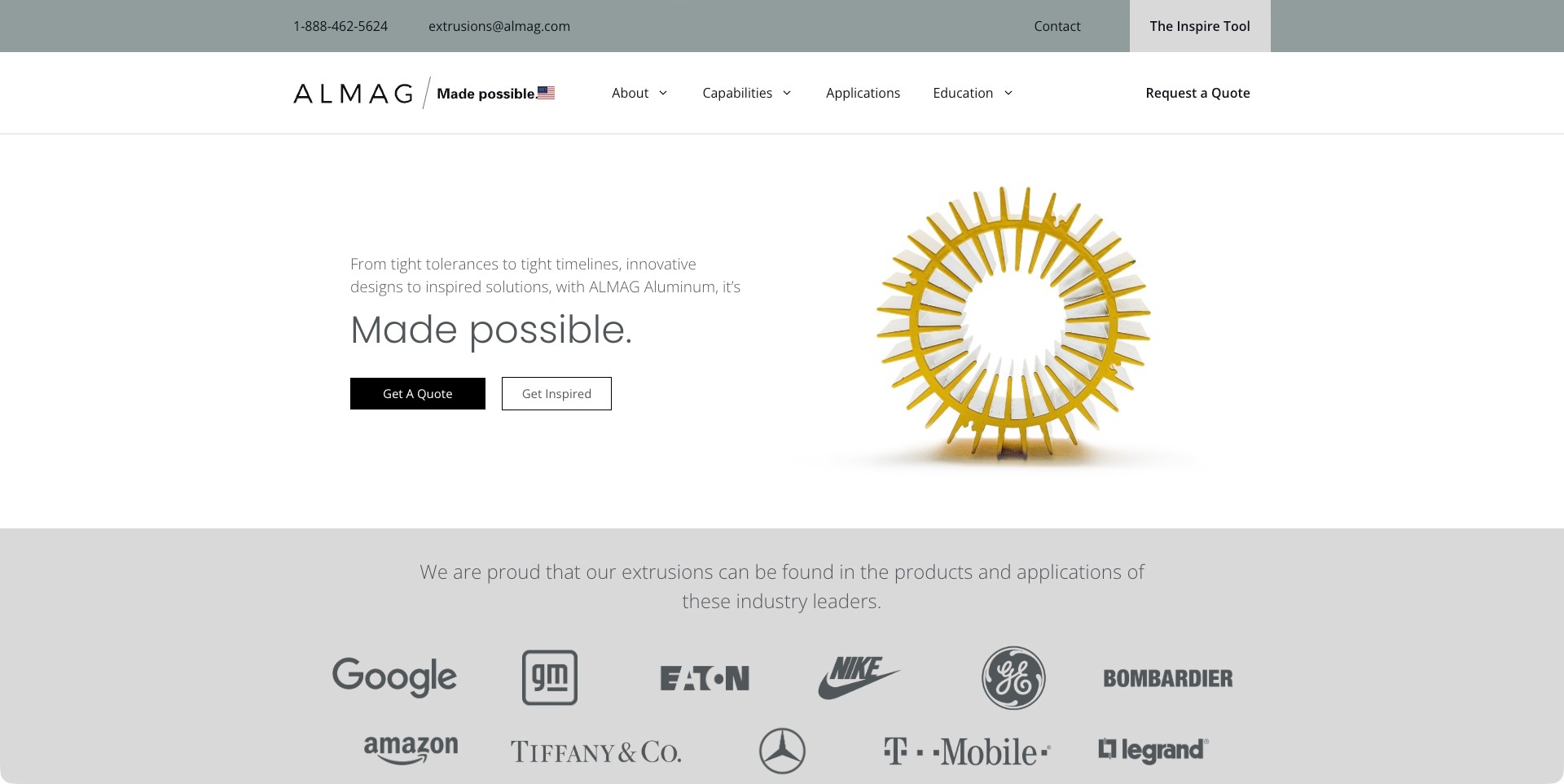
ALMAG gives a gold-colored extrusion profile a large area of white space, making the component itself the visual subject instead of beginning with a generic factory panorama. Restrained gray typography and black actions keep the page focused. Quote and inspiration routes sit together, recognizing that some buyers already have requirements while others are investigating possibilities. Capabilities, applications, education, and the Inspire tool provide more structured next steps. Current first-party content explicitly distinguishes design, extrusion, fabrication, and finishing. The example concerns how those capabilities are communicated, not independent verification of the pictured profile’s properties or the company’s production promises.
What you can learn
Give an exploratory visitor a useful next step without making a complete quotation request the only route forward. A focused component image can introduce unfamiliar work, but the website still needs plain capability boundaries and appropriately qualified technical information.
Pros
The isolated profile makes a complex cross-section visually inspectable without surrounding factory clutter.
Separate quote and inspiration actions acknowledge different stages of product development.
Cons & considerations
Pale introductory copy needs contrast testing on ordinary displays and smaller screens.
Customer logos and broad tolerance claims need precise attribution rather than blanket interpretations.
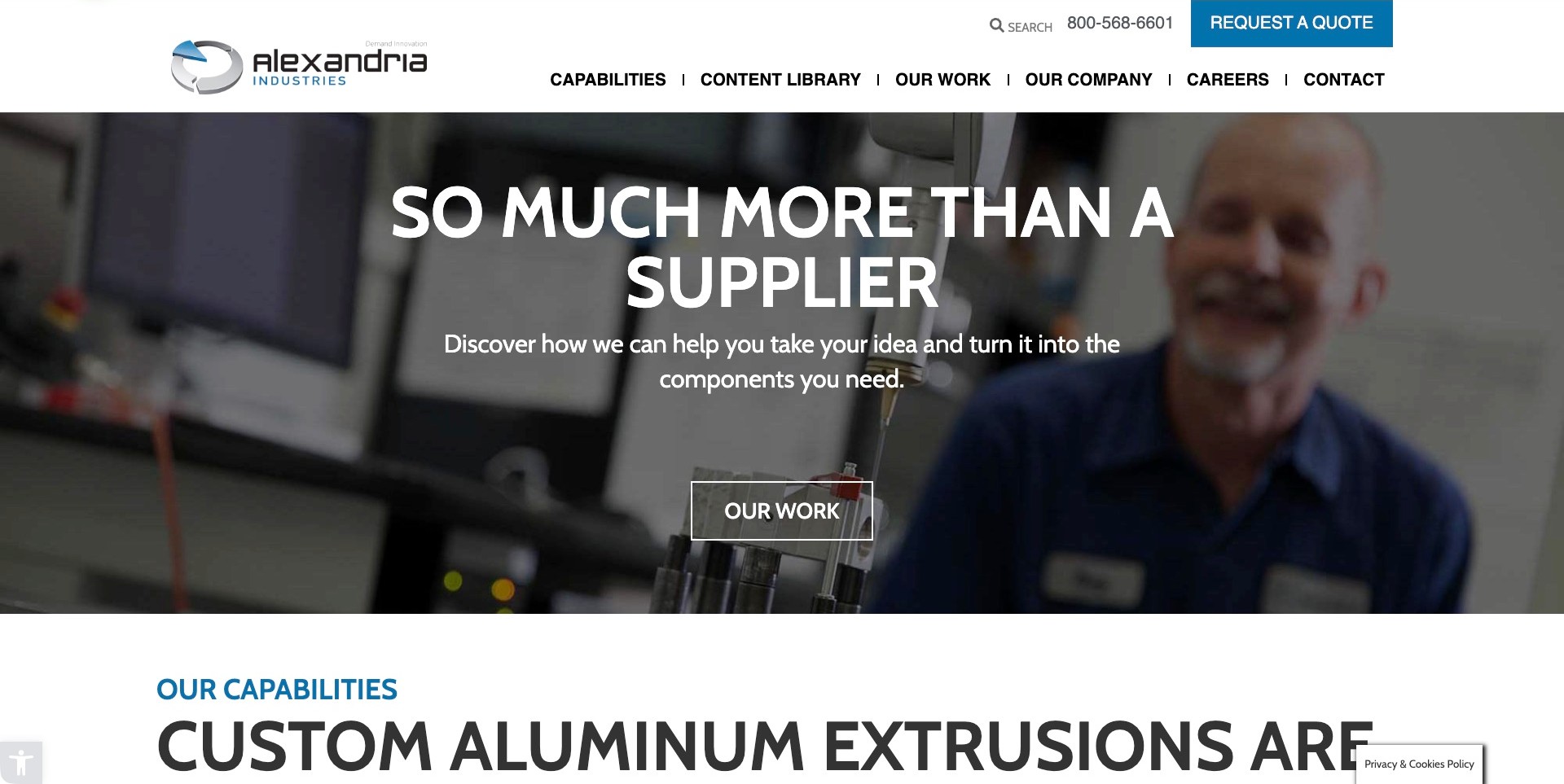
Alexandria Industries pairs a workshop photograph with an introduction about turning an idea into components. A darkened image keeps the headline readable, while a blue quotation action remains in the header. Capabilities, Content Library, and Our Work are separate destinations rather than one undifferentiated services menu. The next section explicitly introduces custom extrusion as one part of a broader manufacturing offering. Its current first-party navigation distinguishes processes from services and organizes buyer resources around stages such as research and quotation. The design reference is that separation of tasks, not our endorsement of quality, lead times, or engineering suitability.
What you can learn
Organize a broad manufacturing business around both what it does and what a buyer needs to learn. Project examples, capabilities, and purchasing resources can complement each other when their labels make the difference clear before the visitor opens a menu.
Pros
The quotation route stays visible independently of the large introductory image.
Content Library and Our Work give research and evidence distinct navigation roles.
Cons & considerations
The broad hero message postpones detailed process distinctions until further down the page.
A tall image-led introduction needs careful narrow-screen cropping and a stable readable alternative to motion.
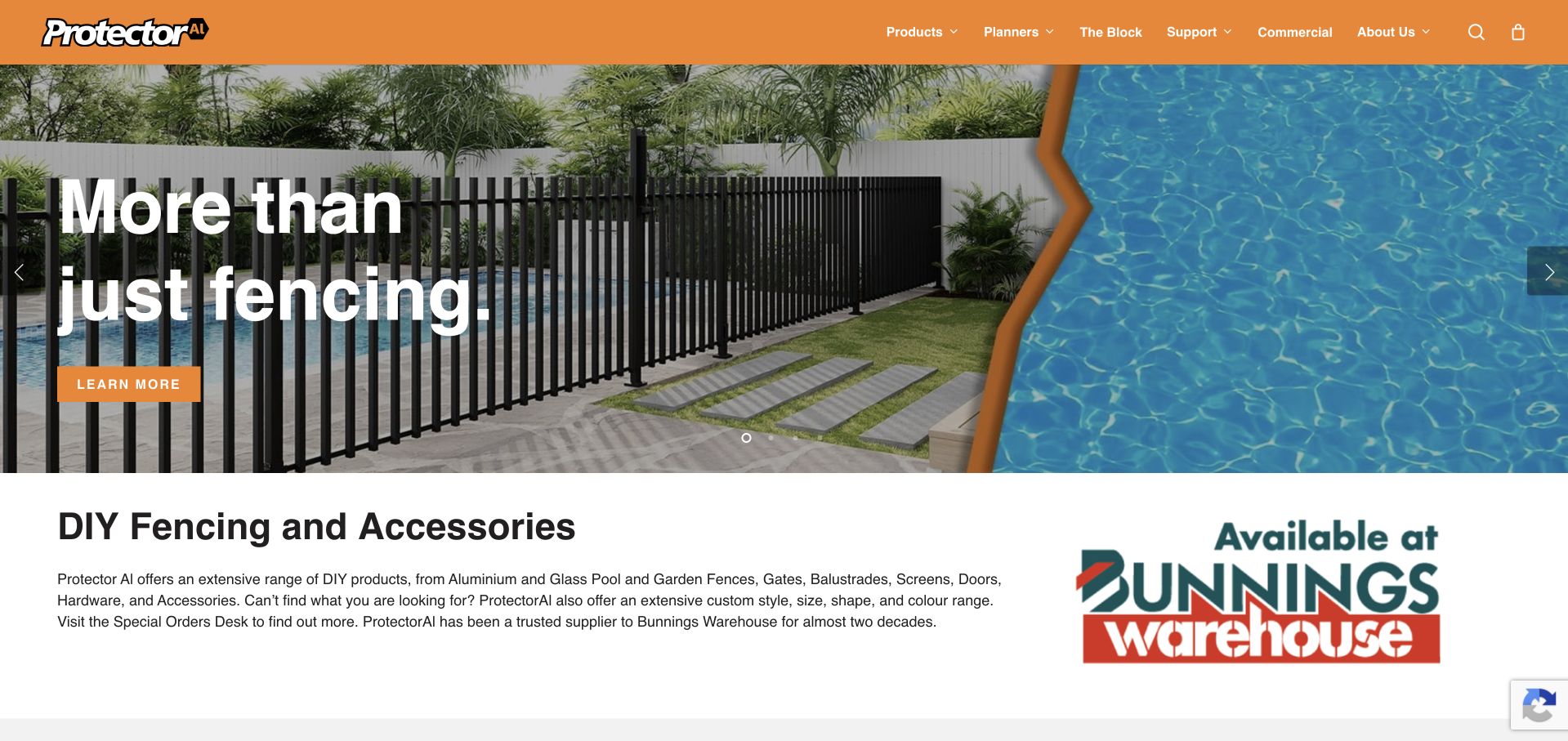
ProtectorAl’s retained Australian homepage uses an orange header and a large pool-fence scene before a plain explanation of its DIY product range. Products, Planners, Support, and Commercial are distinct navigation choices, while the body separately mentions custom sizes, shapes, and colors. Current first-party company information explicitly describes bespoke work at its Queensland factory, establishing a manufacturing scope beyond a product reseller. The large retailer mark explains an availability relationship but does not establish who performs an installation. This is a useful product-focused reference: it connects an installed result with planning and purchasing tasks without needing to present a machining-service catalog.
What you can learn
Show the finished context, then distinguish standard products, custom fabrication, and assistance with planning. Keep the manufacturer’s actual contribution explicit, and do not let a retail handoff or an attractive installed scene stand in for project-specific approval.
Pros
Product, planner, support, and commercial labels distinguish several practical research tasks.
Custom-order information is presented separately from the ordinary retail availability statement.
Cons & considerations
The retailer mark competes visually with the explanation of the manufacturer’s own scope.
Safety and standards claims require current assembly-specific evidence, not assumptions about every custom configuration.
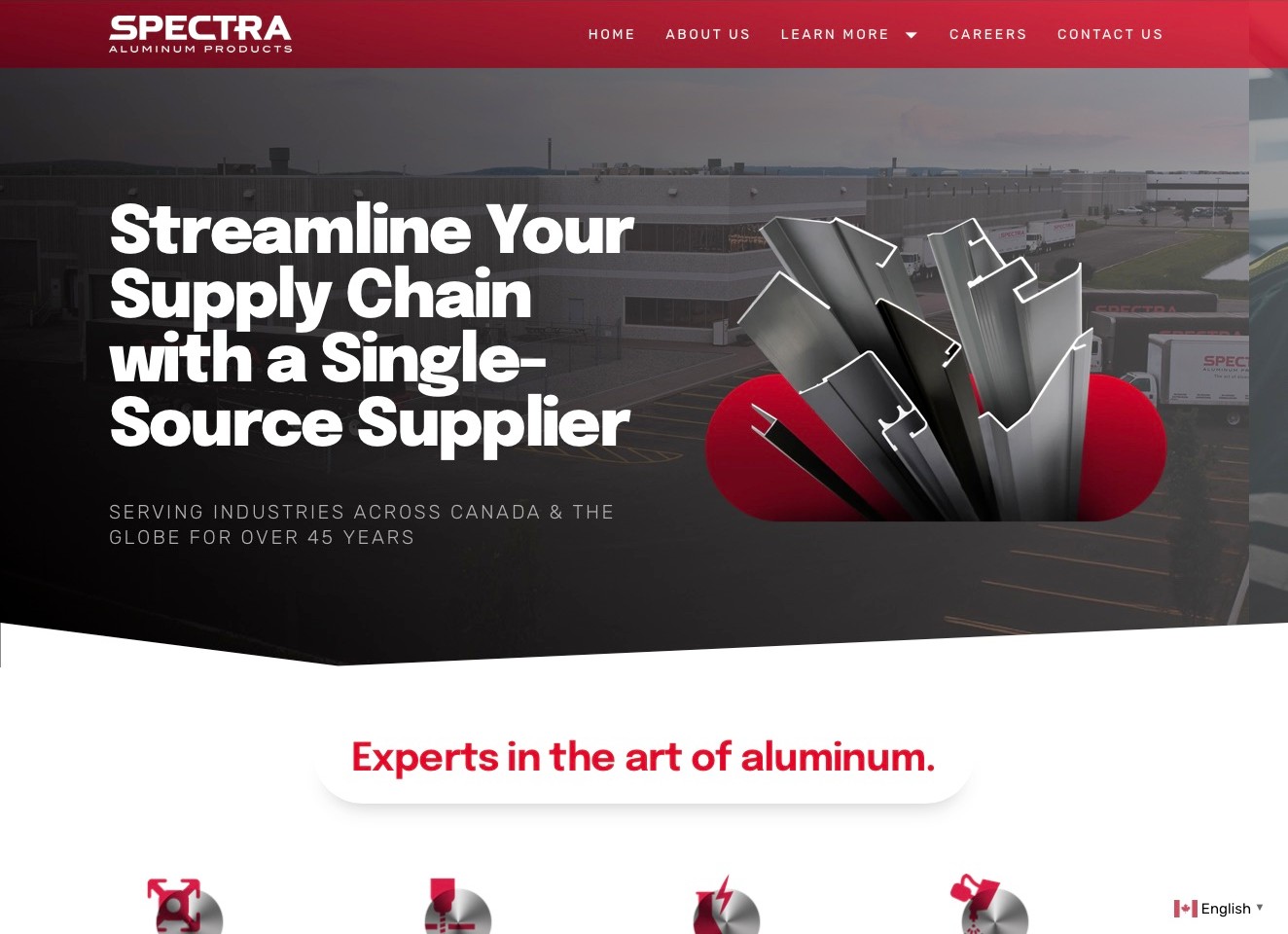
Spectra combines a red navigation bar with a factory-background hero and an illustration of aluminum profiles. The headline presents a single-source supplier, while a short regional statement makes Canada and international work explicit. A curved lower edge leads into a capability introduction and process icons. Current first-party content names extrusion, fabrication, anodizing, and finishing, establishing what sits behind the supply-chain message. The useful reference is the transition from a memorable brand introduction to concrete operations, not an independent guarantee about every process, delivery outcome, or manufactured component.
What you can learn
Let a short introduction explain the operating model, then provide named capabilities immediately afterward. Pair representative profiles with manufacturing context, but keep actual production scope and project-specific conditions in maintained content rather than asking the hero artwork to prove them.
Pros
A concise main navigation avoids exposing a long technical taxonomy before the visitor understands the business.
Profile illustrations and factory context connect the broad headline to a tangible material and output.
Cons & considerations
The high-contrast overlay and oversized type need testing across narrower image crops.
Single-source and quality language require clear process boundaries rather than an assumption that every project follows the same route.
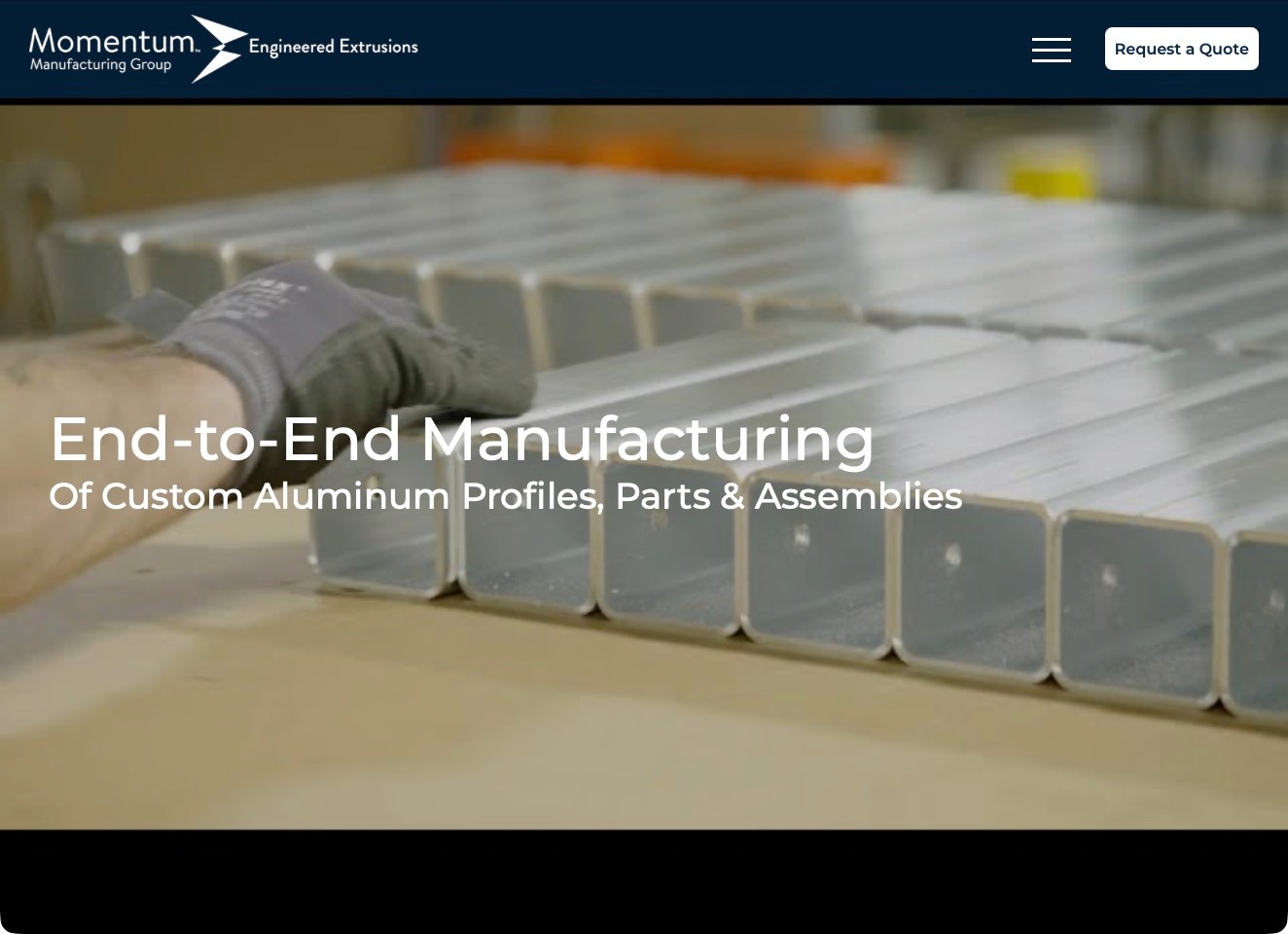
MMG Engineered Extrusions opens with a navy brand bar above footage of a gloved hand beside aluminum profiles. The large introduction explicitly identifies manufacturing of custom profiles, parts, and assemblies rather than relying on a vague innovation promise. At the reviewed viewport, navigation is condensed into a menu control, while Request a Quote remains independently visible. Current first-party content separates extrusion, machining, fabrication and welding, finishing, and assembly. The visual reference is the relationship between material, production context, and a literal scope statement. The footage is not independent evidence of capacity, tolerances, employee practices, or a particular customer’s production arrangement.
What you can learn
Use the opening screen to explain the tangible output and keep a commercial conversation accessible even when navigation is collapsed. Follow that introduction with clear process boundaries rather than expecting a factory video to establish the feasibility of every potential component.
Pros
The introduction names profiles, parts, and assemblies instead of leaving the manufacturing role implicit.
The quotation action remains distinct from the compact navigation control.
Cons & considerations
An expansive video-led hero delays detailed capabilities on shorter screens.
Moving imagery needs accessible controls and a stable equivalent introduction when video cannot play.
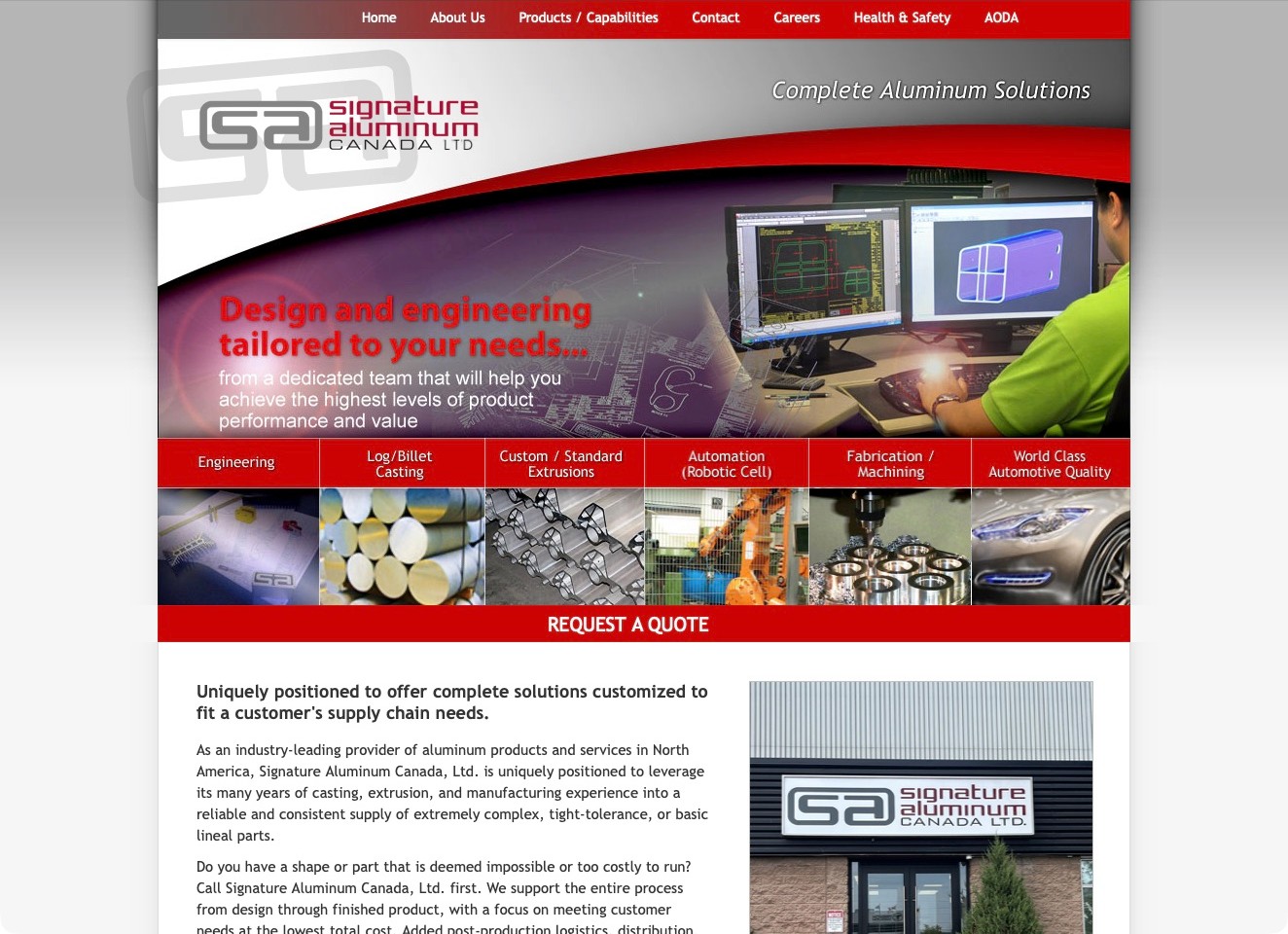
Signature Aluminum uses a fixed-looking central page with red accents, a curved branded header, and a large design-workstation image. Six photographic capability tiles sit immediately below, separating engineering, casting, extrusion, automation, fabrication and machining, and automotive-quality information. A full-width quotation strip then leads into a plain company introduction and a photograph of its building. Current first-party content explicitly identifies extrusion manufacturing and fabrication. The useful reference is the direct connection between a broad introduction, named operations, and an inquiry, not independent confirmation of production quality, customer outcomes, or the feasibility of a pictured component.
What you can learn
Use a concise visual index to make a multi-process offering understandable before presenting a long company description. Keep the technical scope and conditions behind each label current, and distinguish quality documentation from a promise that every proposed part is already approved.
Pros
Named capability tiles make manufacturing stages visible without opening a large menu.
The quotation strip has a clear position between introductory imagery and company detail.
Cons & considerations
Small embedded graphic text can be difficult to read or adapt on narrow screens.
A contained desktop composition needs a tested responsive equivalent instead of relying on horizontal shrinking.
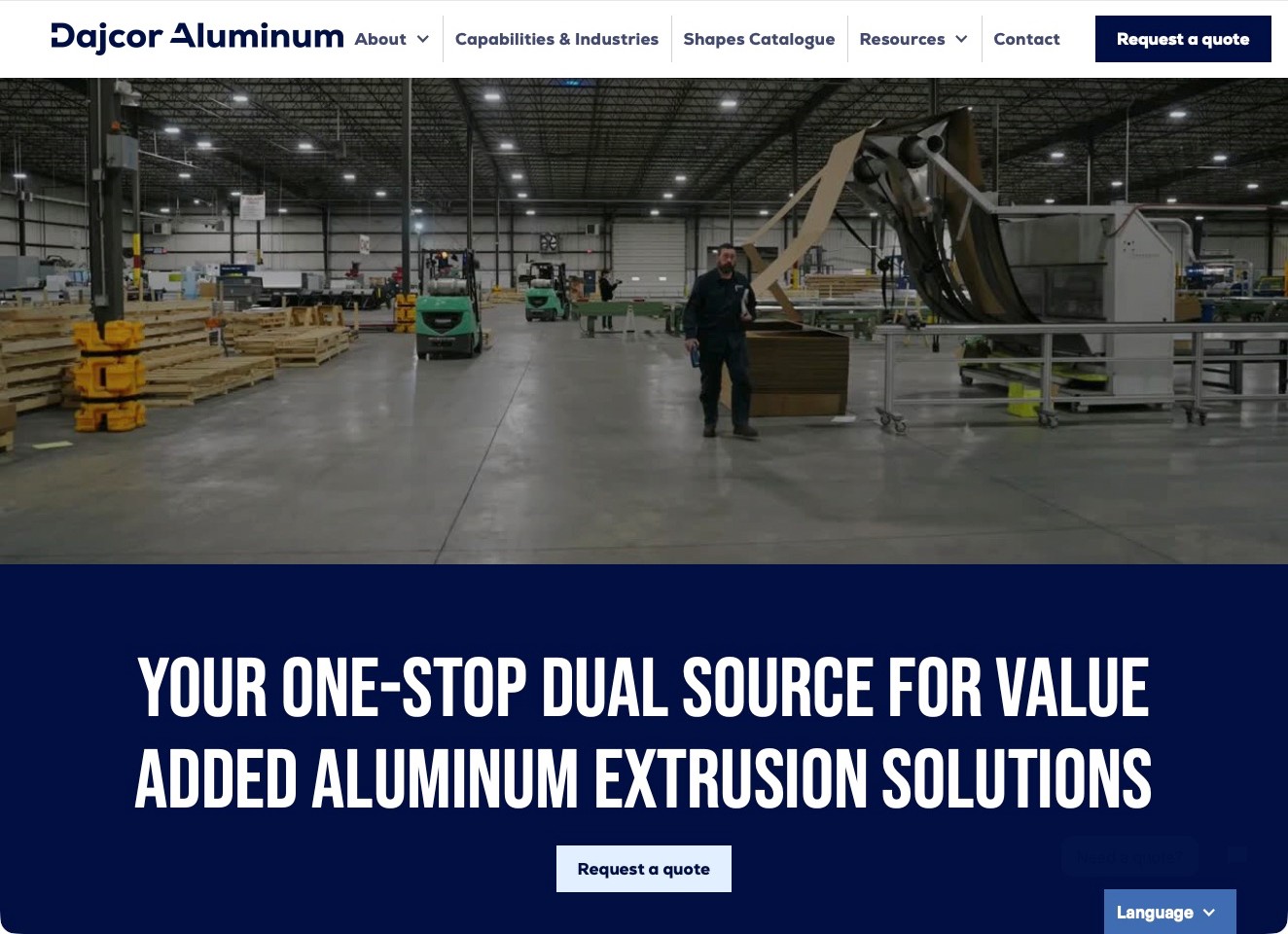
Dajcor puts a large factory scene below a compact white header, then moves its broad extrusion introduction into a solid navy panel rather than placing all the copy directly over the image. A separate quotation action appears in both the header and the main introduction. Capabilities and Industries, Shapes Catalogue, Resources, and Contact give research tasks named destinations. Current first-party content explicitly distinguishes design support, extrusion, fabrication, machining, and finishing. The reference is the separation of production context from readable introductory content, not evidence that a factory scene verifies capacity, certification, or the suitability of any particular component.
What you can learn
Give technical buyers a clear choice between exploring capabilities, finding a catalog, reading resources, and discussing requirements. An introduction can be visually bold while still leaving enough structure for a visitor who already knows the information they need.
Pros
The main introduction has a solid background independent of the factory image.
Catalog and resources remain visible beside the commercial quotation route.
Cons & considerations
The tall opening image delays the actual capability explanation on shorter screens.
Broad sourcing and performance language needs maintained process-specific detail and appropriate qualifications.
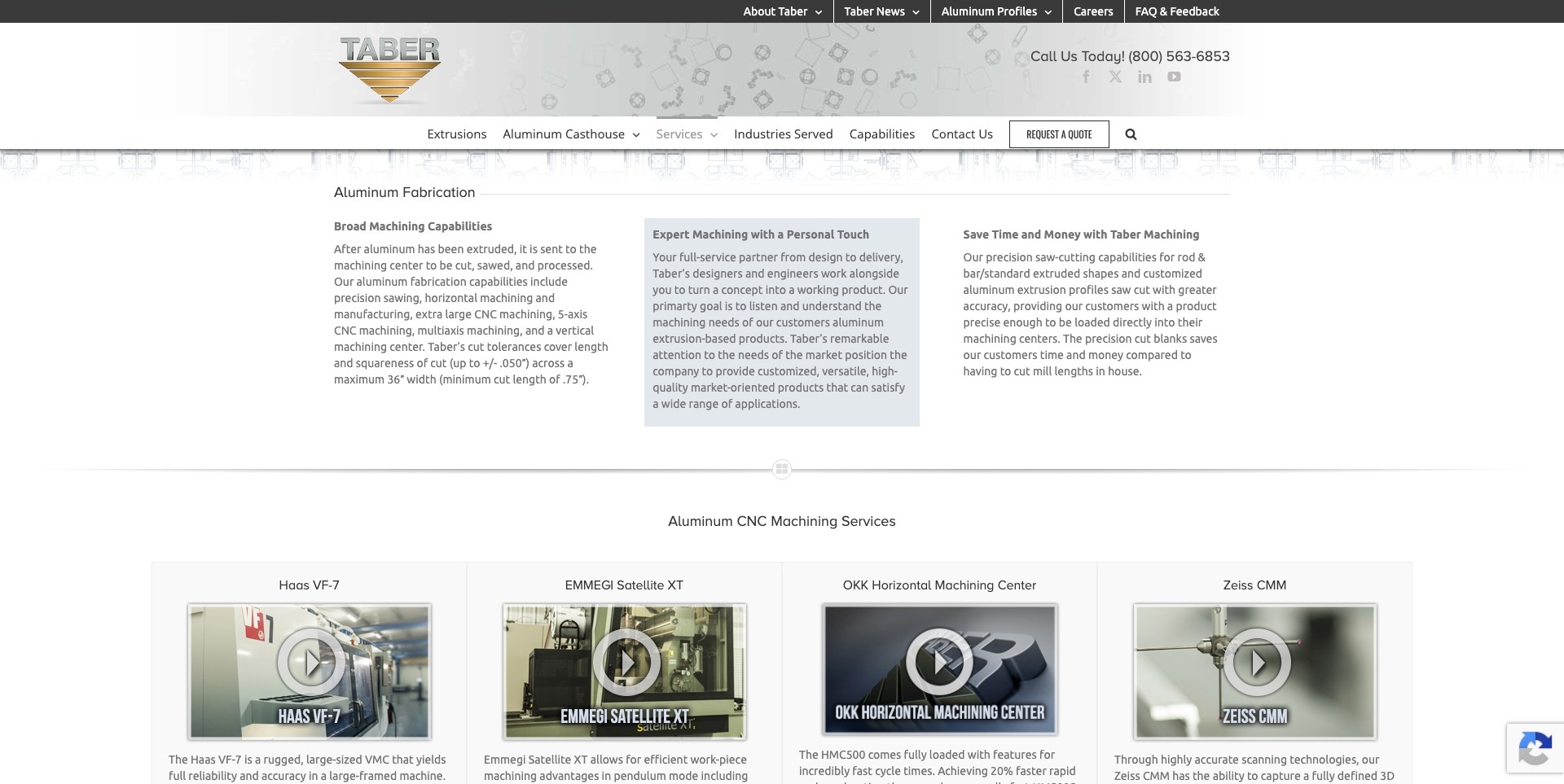
Taber’s fabrication page replaces a broad homepage campaign with three short introductory columns and a row of named machining-media cards. A gray panel distinguishes the middle explanation, while the metallic identity and two navigation rows retain the surrounding corporate context. The service title is literal, and a quotation action remains available above the reading area. Four thumbnails introduce different machines without requiring immediate playback. This is useful for a technical audience that needs to understand the offered work before starting a conversation. Equipment descriptions and stated tolerances remain the company’s information, not independent verification of a proposed part’s feasibility.
What you can learn
Give a specialist capability its own readable destination. Separate the process overview from equipment references, and connect both to a requirements discussion; a named machine or an attractive demonstration should not substitute for reviewing geometry, material and applicable production conditions.
Pros
The literal service title and three introductory blocks establish the subject before the equipment detail.
Named media cards give technically experienced readers distinct further-research choices.
Cons & considerations
Small gray body type needs careful contrast and narrow-screen reading checks.
Equipment specifications and headline tolerances need maintained scope rather than interpretation as universal commitments.
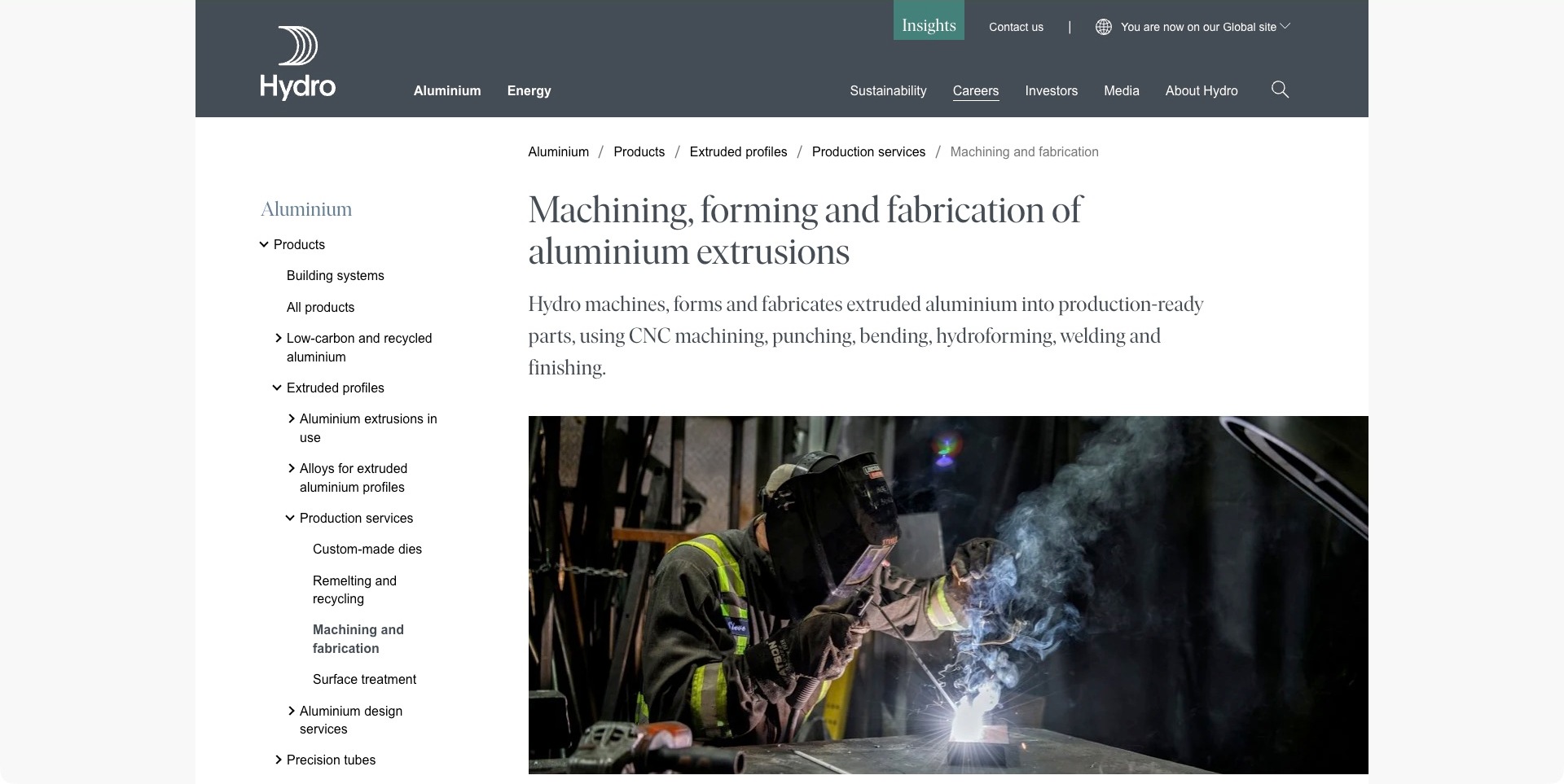
Hydro’s machining and fabrication page gives its service explanation a large serif heading and introductory paragraph above a welding photograph. A left sidebar expands the aluminum-product hierarchy and highlights the current production-service category, while breadcrumbs repeat the path across the top. The header identifies the global site and keeps contact distinct from corporate subjects such as investors and careers. This pictured destination is a specific fabrication page, not the previously unsuccessful corporate homepage. Its useful pattern is contextual navigation: visitors can understand where machining sits alongside extrusion, surface treatment and design without treating every group business as the same service.
What you can learn
Keep a specialist service understandable within the product system. Use an explicit scope statement and neighboring categories, then provide contact and supporting detail; process imagery should illustrate the subject without becoming proof of production results for an unreviewed component.
Pros
Expanded sidebar and breadcrumbs make the current service’s place in the product hierarchy explicit.
The introduction names the transformation from extruded material to processed parts.
Cons & considerations
A deep category tree needs a compact, usable equivalent on smaller screens.
A broad group identity requires clear regional and service availability context before an enquiry.
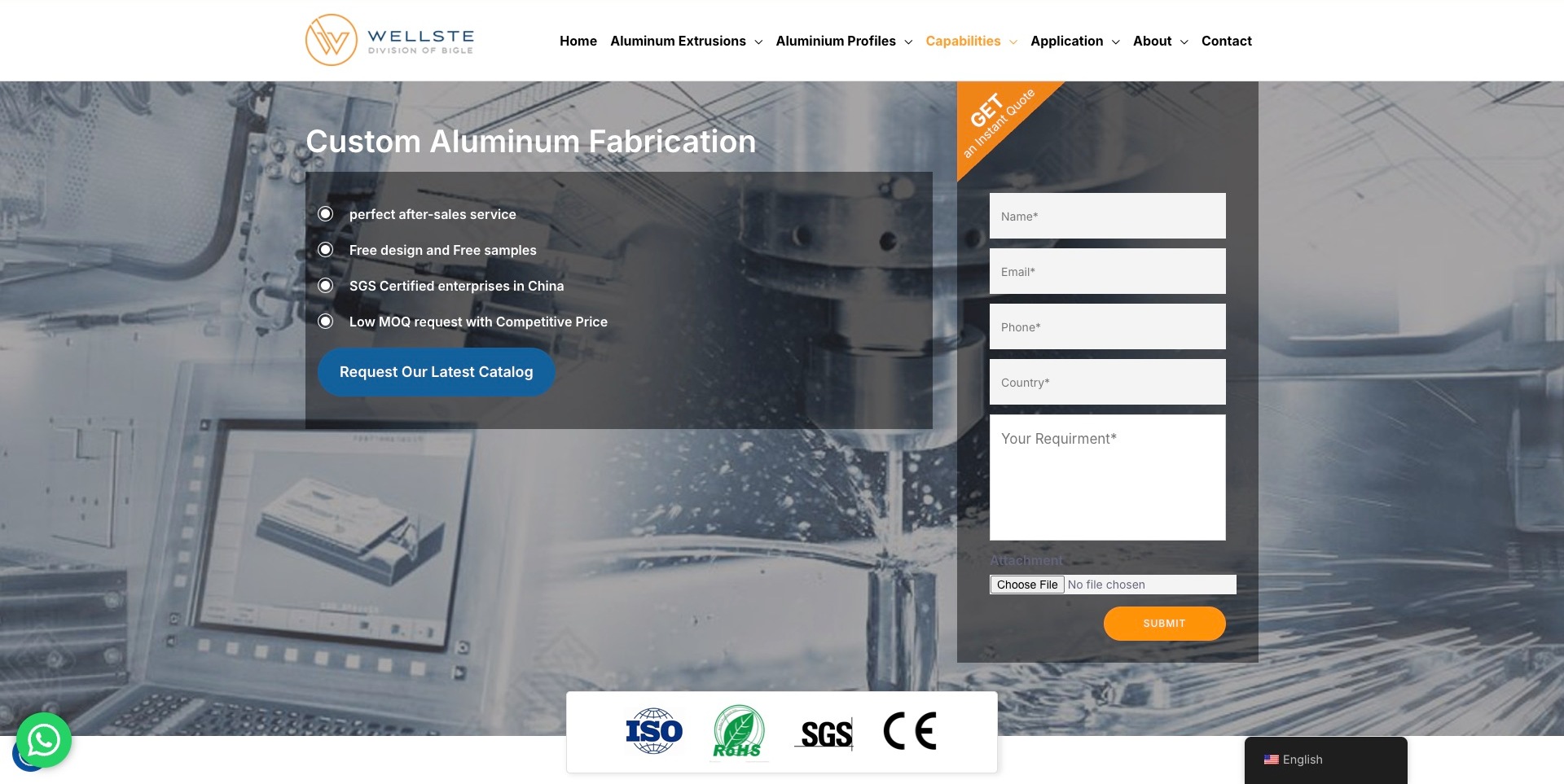
Wellste’s fabrication page places its literal service title over a machining photograph and divides the introduction between a short benefits panel and an inline quotation form. A blue catalogue action supports visitors who are still researching, while orange accents distinguish the form and active capability navigation. The photographed equipment supplies a physical context rather than an abstract promise about innovation. Several certification-style marks appear below the introduction; they are the website’s presentation, not certifications independently checked by this collection. The captured form remains empty, and no enquiry, attachment or other information was submitted during review.
What you can learn
Offer research and conversation routes, but explain information handling before collecting drawings. A quotation form should identify useful details and file handling, without implying that submitting a request establishes manufacturing feasibility or an agreed production commitment.
Pros
Catalogue discovery and quotation have separate actions for different stages of technical research.
The literal service heading keeps the scope identifiable beside the large production photograph.
Cons & considerations
Dense benefits and form panels need readable contrast and stacking on smaller screens.
Certification-style marks and free-service claims require current scope and conditions on their supporting destinations.
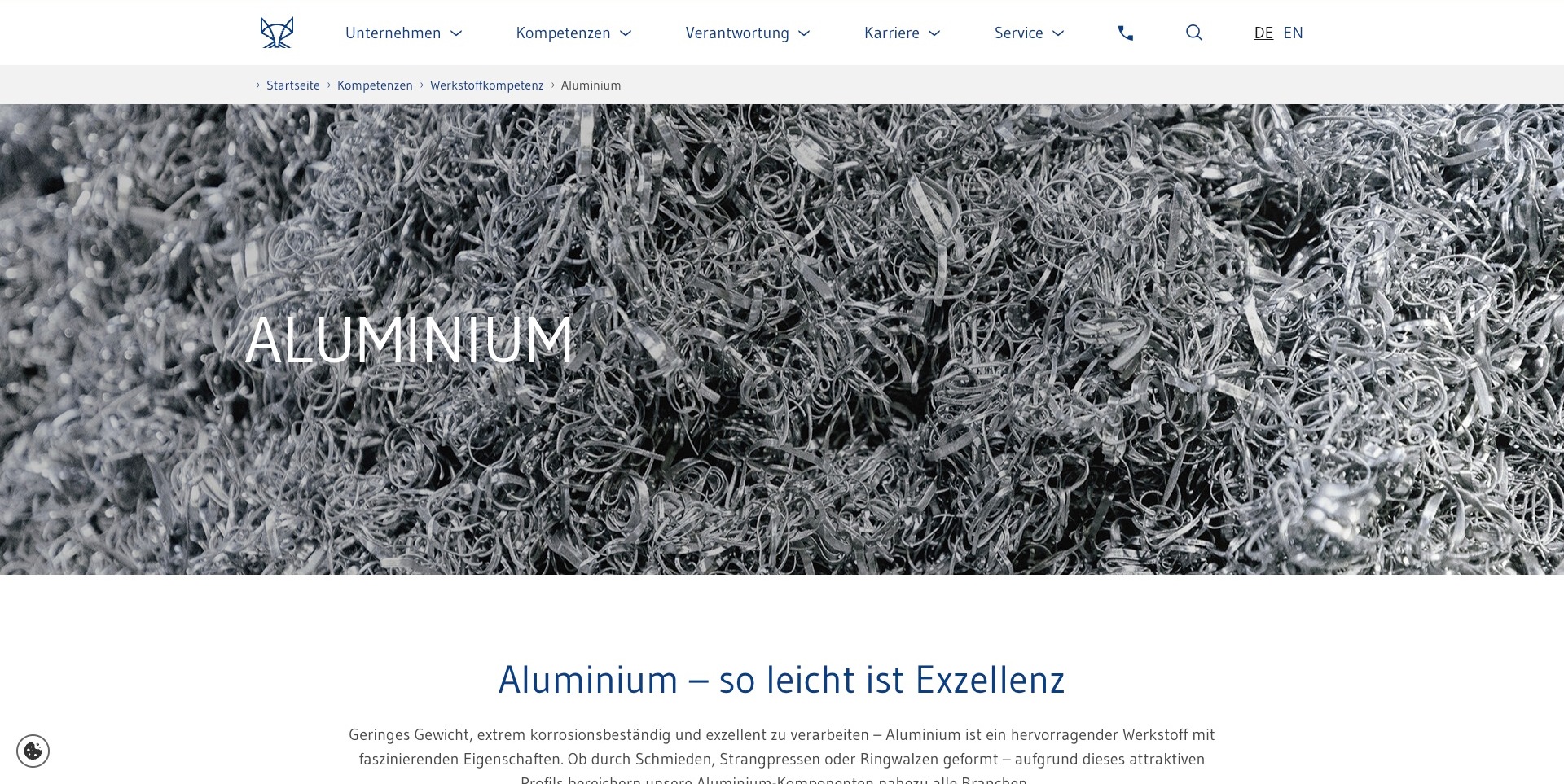
OTTO FUCHS gives aluminum a dedicated German-language material page, using an expansive photograph of metal turnings behind a single clear title. A light breadcrumb band places the subject within competencies and material expertise, while the header separates the company, competencies, responsibility, careers and service. DE and EN controls remain visible without changing the photographed page’s actual language. The next reading area begins with an aluminum-specific introduction rather than another general corporate campaign. Current first-party copy connects the material with manufacturing methods, but the image itself is not evidence of a component’s composition, processing history or performance.
What you can learn
Provide material-specific context when a business works across several metals or production methods. Make language and hierarchy visible, then connect a broad material introduction to actual processes and relevant project enquiries without treating a representative photograph as a technical specification.
Pros
Material breadcrumbs keep the subject identifiable within a broad competency structure.
Visible language controls provide an explicit route for international readers.
Cons & considerations
A tall single-image introduction postpones the practical manufacturing explanation on short screens.
Material-property and quality language needs specific supporting scope rather than universal application to every component.
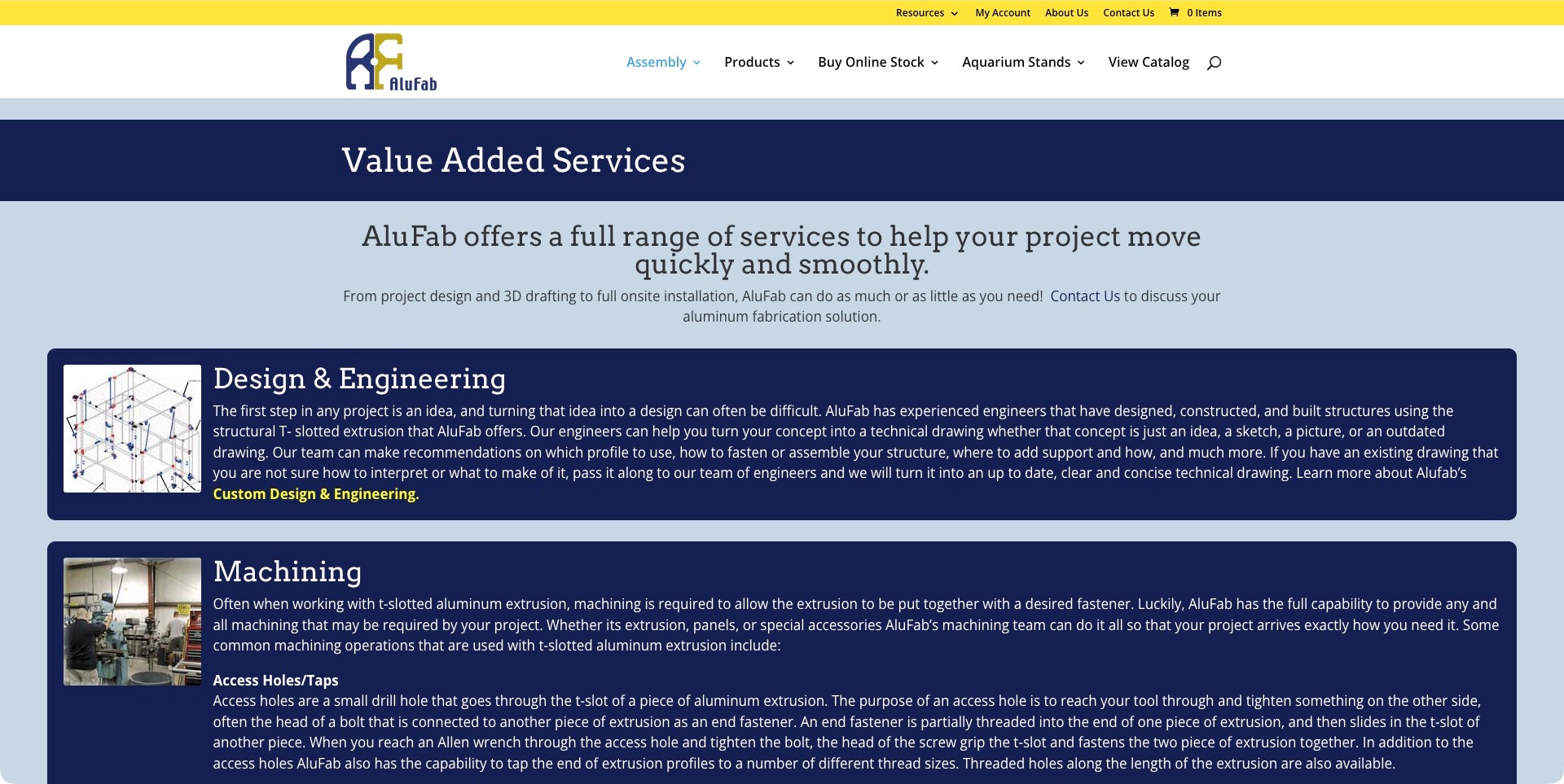
AluFab’s value-added-services page uses navy content panels on a pale blue background, with yellow accents connecting the page to its utility bar and identity. A literal title and short introduction precede separate design-and-engineering and machining sections. Each panel pairs a small relevant image with explanatory text, and a highlighted link offers a more specific design destination. Assembly, products, online stock, aquarium stands and the catalogue remain separate header tasks. This is useful for a framing business that combines component sales with assistance and finished assemblies. Its broad service language should not be interpreted as engineering approval of every proposed structure.
What you can learn
Explain assistance in distinct stages. Connect design, machining and assembly to appropriate information, keeping stock purchases and project-specific conversations separate so visitors can choose a route matching their requirements.
Pros
Named service panels distinguish design work from machining rather than combining every activity in one paragraph.
Product, assembly and catalogue navigation remain available around the focused service explanation.
Cons & considerations
Very long desktop text lines need comfortable width and responsive spacing.
Broad design and installation statements require clear engagement boundaries rather than assumptions about responsibility for a complete project.
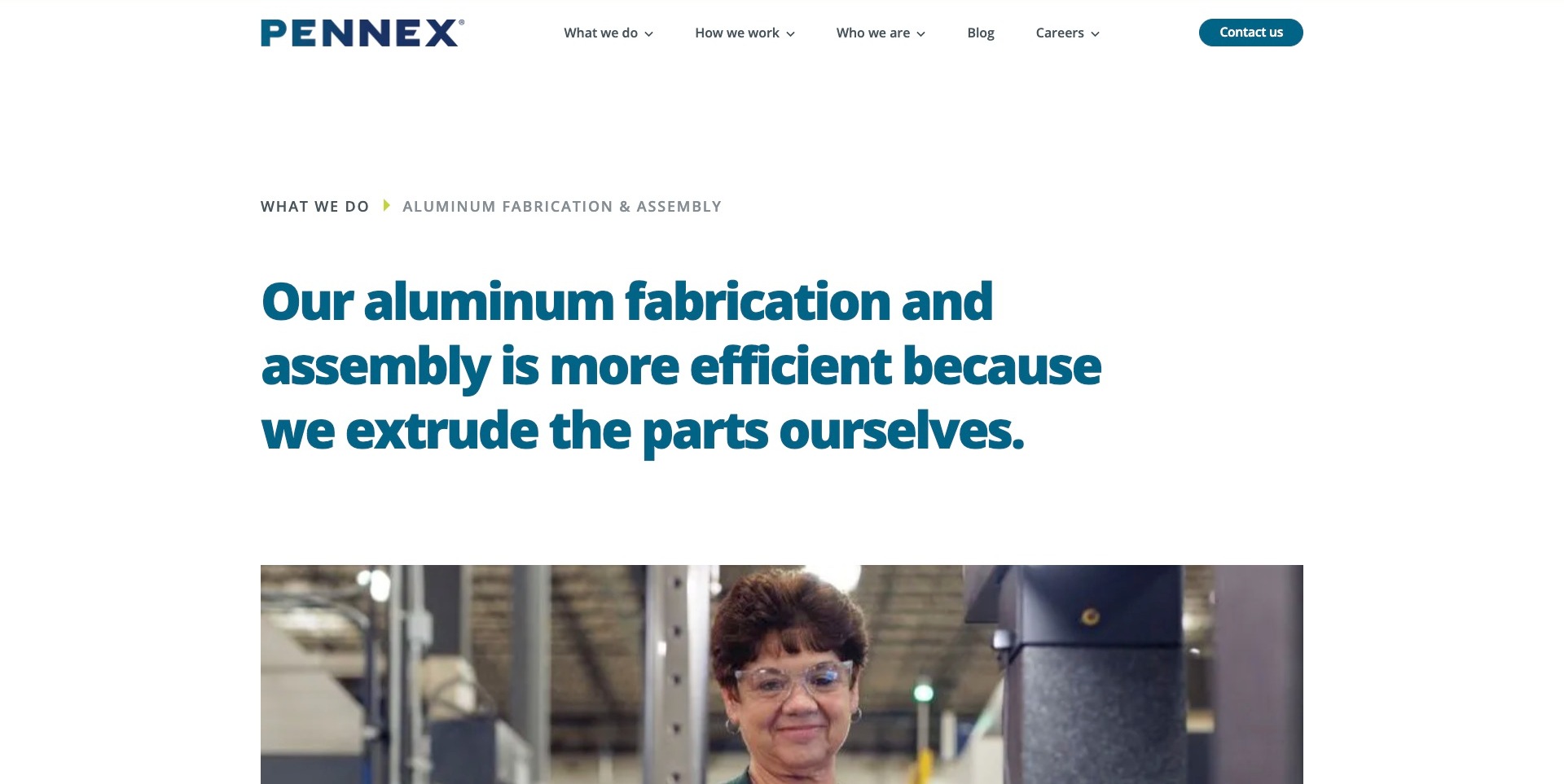
Pennex’s fabrication and assembly page uses a spacious white opening, a service breadcrumb and an oversized teal statement connecting its assembly work with its own extrusion. A photograph of a person in a manufacturing setting begins below the introduction rather than obscuring the text. The compact header separates what the business does, how it works and who it is, with contact retained as a contrasting rounded action. This is a focused service destination, not the earlier held homepage view. The integrated-process message supplies a useful question for buyers to investigate; its implied efficiency remains the company’s positioning rather than an independently measured result.
What you can learn
Explain connected production stages in terms a buyer can understand. Support the proposition with process boundaries, appropriate examples and a requirements discussion, rather than implying identical benefits for every component.
Pros
The service breadcrumb and literal subject keep fabrication and assembly identifiable.
Readable text and a distinct contact action remain independent of the supporting photograph.
Cons & considerations
A large opening statement delays detailed capability conditions on shorter screens.
Integrated-production and efficiency claims need relevant supporting context rather than a universal interpretation.
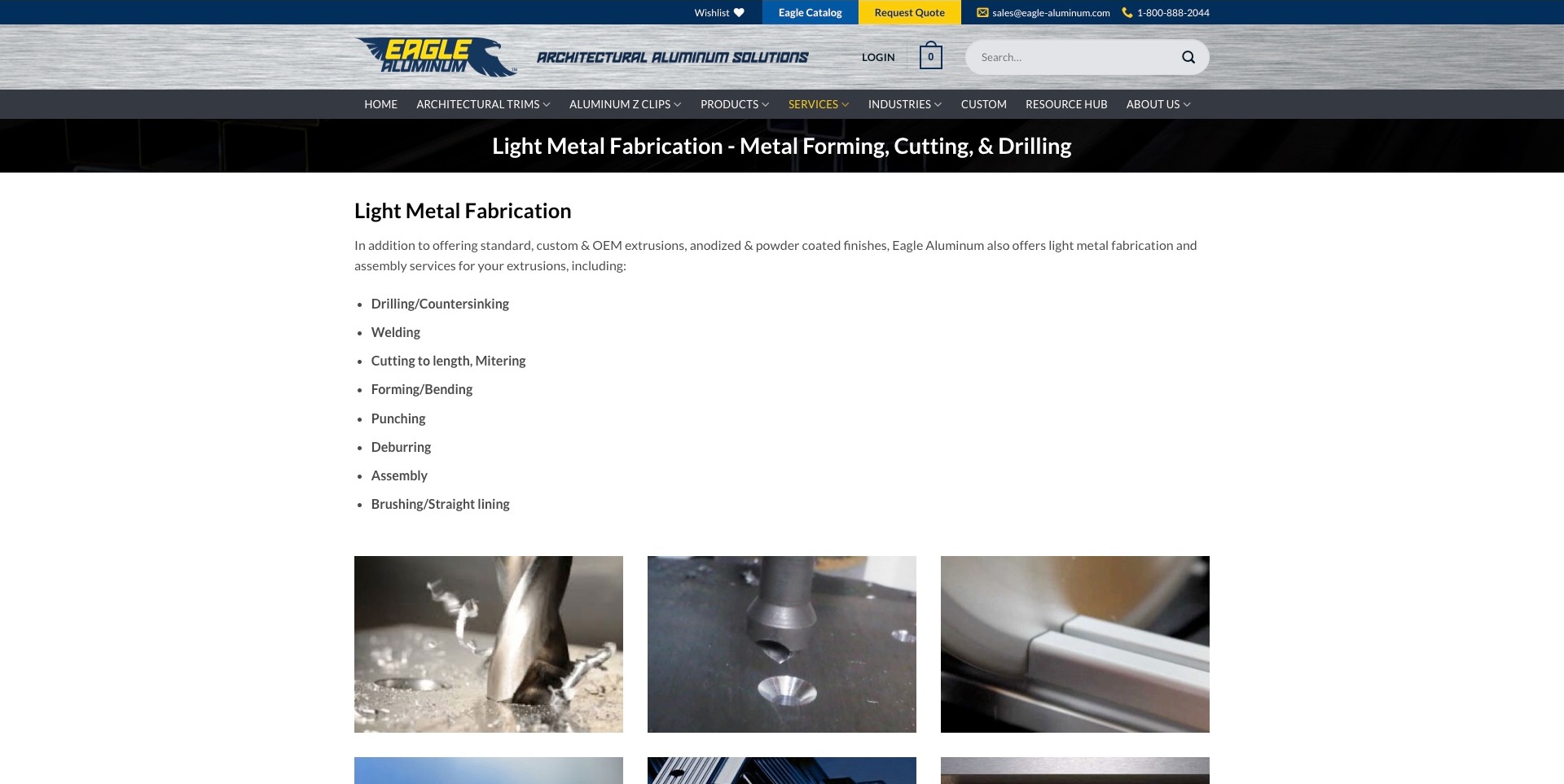
Eagle’s light-fabrication page follows its metallic blue-and-yellow header with a literal service title, a short introduction and a readable list of operations. Drilling, cutting, forming, deburring and assembly are presented as distinct subjects before a row of close-up process photographs. The surrounding header keeps catalogue access, search, quotation, product categories and services identifiable. This specific destination communicates more scope than the earlier incomplete homepage view. Current company material also discusses supply relationships, so the example should be read as a supplier offering fabrication services rather than proof that every stocked profile is extruded in-house.
What you can learn
Give custom processing a clear place beside product discovery. Name the available operations and connect them to appropriate requirements information, while distinguishing stock supply, fabrication and any partner contribution instead of implying responsibility for the complete manufacturing chain.
Pros
The simple operation list establishes service scope before the supporting photographs.
Catalogue, search and quotation provide separate routes for different buyer questions.
Cons & considerations
Dense multirow navigation needs a usable keyboard and mobile equivalent.
Representative process photos need specific conditions and context rather than interpretation as approval of every proposed operation.
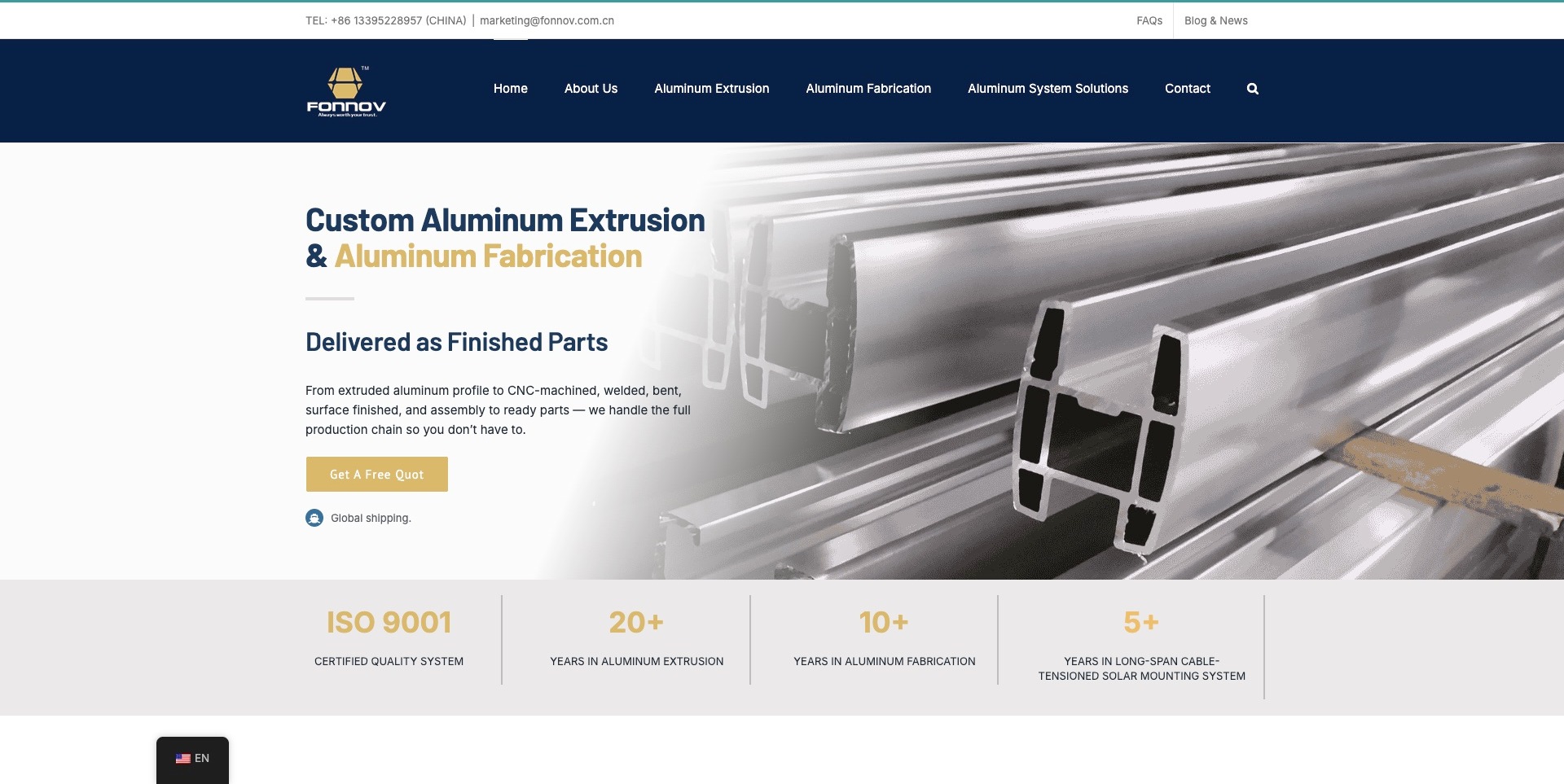
FONNOV places a plain white reading area beside a close-up profile photograph, using navy and muted gold to distinguish the material and fabrication introduction. The supporting explanation names the transition from an extruded profile to processed, finished parts, while the main menu separates extrusion, fabrication, and system solutions. A quotation action sits within the reading area rather than relying solely on a small contact link. Current first-party content explicitly describes machining, forming, welding, finishing, and assembly. The design reference is this concrete explanation of the output, not independent verification of every production claim, shipping arrangement, or project-specific manufacturing condition.
What you can learn
Explain what the customer receives after fabrication, not only the process names the company operates. Keep a readable introduction beside the material image and give detailed capabilities their own maintained pages, with appropriate conditions and a clear inquiry route.
Pros
The profile photograph provides tangible context for the otherwise abstract process terminology.
Extrusion and fabrication have distinct destinations in the main navigation.
Cons & considerations
The long header and multiple introductory messages need careful prioritization on narrow screens.
Broad integrated-production and global-shipping statements need clear scope rather than universal interpretations.
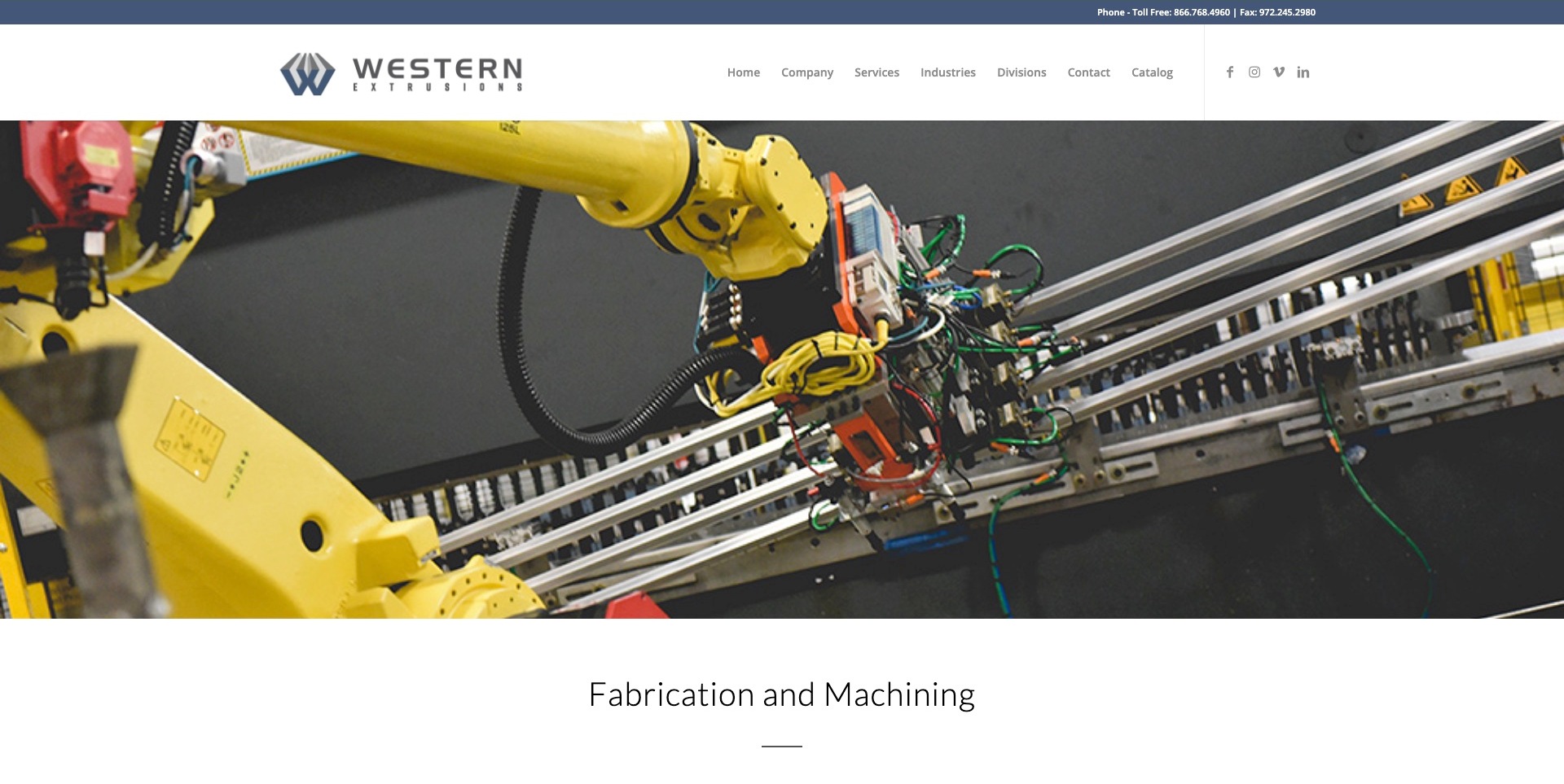
Western’s fabrication and machining page uses a wide photograph of a yellow industrial robot above a literal service title. Its white header keeps services, industries, divisions, contact and the catalogue distinct, with telephone information in a narrow utility strip. The photograph gives the technical subject a tangible production setting without placing small explanatory copy over the machinery. This specific service destination replaces the unusable animated homepage frame. The accompanying public service description distinguishes fabrication operations and equipment, but neither the robot photograph nor an equipment list independently demonstrates capacity, achievable tolerances or the feasibility of a customer’s component.
What you can learn
Connect manufacturing imagery to a clearly named capability and maintained supporting detail. Make catalogue and contact routes easy to locate, while explaining what the business actually processes instead of relying on a dramatic production scene to communicate every service boundary.
Pros
The unambiguous service title distinguishes this destination from a broad corporate introduction.
Catalogue and contact remain ordinary navigation choices rather than hidden campaign actions.
Cons & considerations
An expansive photograph delays the explanatory body on short screens.
Equipment and processing claims need appropriate conditions rather than interpretation as guarantees for every geometry or material.
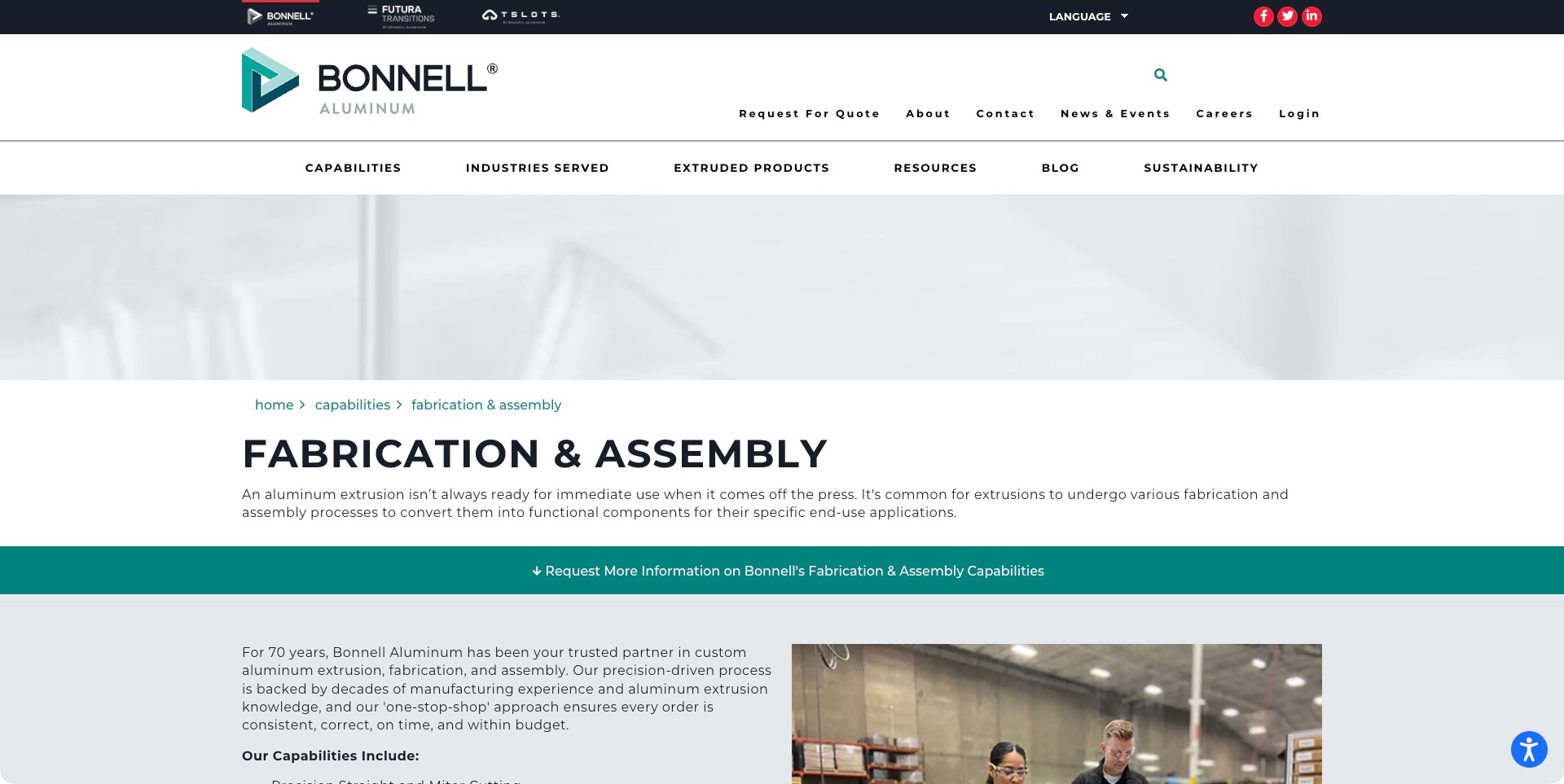
Bonnell’s fabrication and assembly page retains its dark product-family strip and multirow navigation, then gives the service a complete title, breadcrumb and plain introduction. A teal information-request band separates that opening from the explanatory body and factory-context photograph below. Capabilities, industries, extruded products and resources remain distinct routes, while quotation and account access occupy the utility layer. This static page is a clearer research destination than the held mid-animation homepage capture. Its useful design pattern is the separation of manufacturing scope from the wider brand portfolio, not independent confirmation of the company’s delivery or quality claims.
What you can learn
Give each capability a stable explanation within the larger commercial structure. Describe the relationship between extrusion and subsequent assembly, then let visitors investigate processes or request information without assuming that a broad brand-family promise applies equally to every project.
Pros
A literal service title and breadcrumb keep the current capability identifiable.
The information-request band has a distinct position between introductory and detailed content.
Cons & considerations
The tall multirow header consumes space before the service explanation appears.
One-stop and delivery statements need scoped supporting information rather than a blanket interpretation of production commitments.
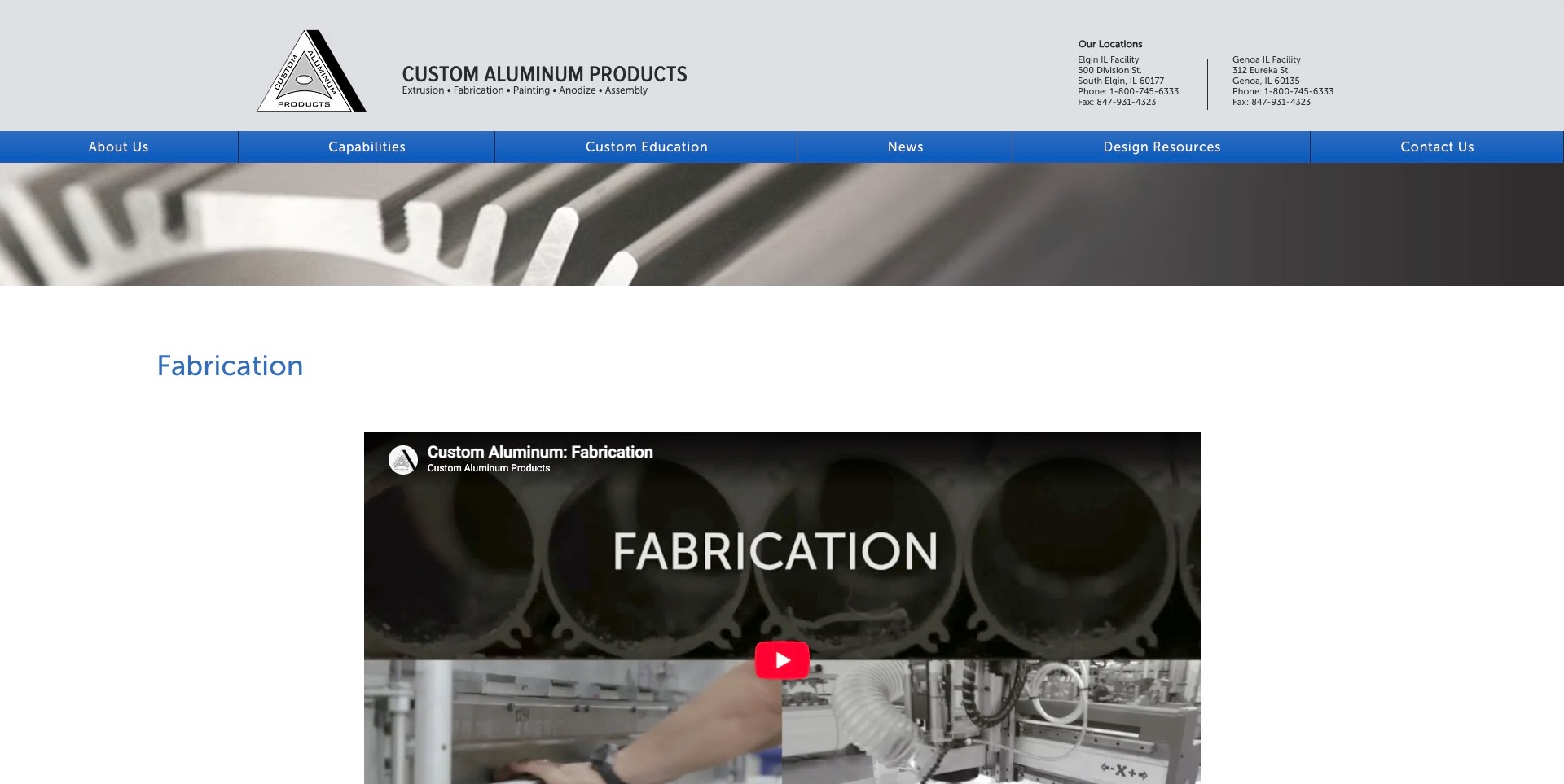
Custom Aluminum Products gives its fabrication page a blue heading and a large, stopped video thumbnail beneath a narrow material-image banner. The triangular identity and two Illinois locations remain visible above the blue navigation bar. Capabilities, education, news, design resources and contact receive separate labels rather than disappearing into one general company menu. This is the genuine hyphenated company domain and a stable capability destination, not the held transitional homepage or the unrelated domain-sale address. The public fabrication description supplies additional manufacturing context; the video thumbnail itself does not independently establish machining performance or a component’s suitability.
What you can learn
Use a video as one research format, not the only explanation of a capability. Keep meaningful written scope, usable contact information and relevant design resources available without playback, and distinguish general production examples from the review required for a particular drawing or prototype.
Pros
Locations and technical-resource navigation remain visible around the focused capability content.
The literal heading and labeled video make the subject clear before playback.
Cons & considerations
A large embedded player delays written capability detail on shorter screens.
Video-led pages need accessible captions and an equivalent text explanation when third-party media is unavailable.
Kegan is a freelance web designer and developer with 15+ years of experience helping businesses turn complicated website requirements into clear, maintainable digital experiences. He works directly with clients from planning and design through development, launch, and ongoing support.
For aluminum fabricator website design, his development approach focuses on material and process distinctions, current capability and equipment information, relevant project context, technical-document discovery, and proportionate quotation handoffs without unsupported manufacturing guarantees. The scope can be a targeted improvement or a complete custom build, with responsive layouts, thoughtful content structure, and integrations chosen around the people using and maintaining the site.
Show 3 other aluminum fabricator website designersHide other aluminum fabricator website designers
Plan an aluminum fabrication website around scope, evidence and the quotation process
Decide whether visitors are buying a process, a component or a product
Start by mapping the enquiries the business wants to receive. A product designer seeking a custom extrusion needs different information from a builder looking for a finished architectural system. Identify the actual customer groups, the work they can commission and the regions the business serves. Do not imply that a standard-product supplier offers any imaginable custom process, or that a component manufacturer takes responsibility for an entire finished installation.
Organize capabilities around real production stages. ALMAG makes design, extrusion, fabrication and finishing separate destinations. Alexandria Industries distinguishes manufacturing processes from services and customer-work examples. The useful pattern is a readable sequence with enough detail to understand the company’s role. A visitor should be able to move from a broad capability to the information needed for a discussion without decoding internal department names.
Where the company works across several materials, keep aluminum-specific information identifiable. A photograph of a metal part does not tell a reader which material or process it represents. Label representative examples accurately and distinguish stock supply from custom manufacture. The website can explain the questions the team considers without prescribing an alloy, tolerance or joining method for a visitor’s unreviewed design.
Explain manufacturing capabilities without losing their conditions
Give each capability page a clear purpose, example outputs and an appropriate next step. Describe what the process contributes to the customer’s project in ordinary language, then provide technical detail where the company can maintain it accurately. Equipment lists can help an experienced buyer, but they need context. Owning a named machine does not automatically establish the feasibility of every part a visitor might want to produce.
Keep stated dimensions, tolerances, finish options and production quantities tied to their actual conditions. The company’s technical team should approve how those details are presented and when they require case-by-case review. Avoid turning the largest machine capacity into a universal promise about every geometry or material. If a public capability sheet is only an overview, say how a reader can confirm the requirements for a particular job.
Show the boundary between production and related services. MMG Engineered Extrusions separates custom extrusion from machining, fabrication and welding, finishing, and assembly. ProtectorAl explains finished-product categories and custom-made work. These businesses illustrate different models rather than interchangeable service menus. A website brief should reflect the actual operating model instead of borrowing another manufacturer’s complete list because it looks comprehensive.
Build project records that show contribution rather than implied ownership
Use project or component examples to answer what was made, which work the company performed and why the example is relevant. A small close-up can communicate a fabricated feature better than a dramatic photograph of a whole building. Where the company supplied only one element, say so. Give customers, architects, installers and other partners appropriate attribution without implying a broader appointment or relationship than the source supports.
Record permissions for drawings, photographs, names and production information before publication. Some buyers may allow a general application description but not a detailed component image or a named end customer. A useful case study can still explain the type of challenge and the manufacturer’s role at an appropriate level. Do not use another company’s recognizable product as silent proof of a supplier relationship.
Separate demonstrable project facts from promotional outcomes. Claims about reduced cost, improved yield or faster delivery need a defined comparison and permission to publish. If that evidence is unavailable, focus on scope and process rather than inventing a precise result. The collection’s design observations should not be confused with independent verification of manufacturing performance, engineering compliance or the suitability of the finished product.
Make the quotation journey useful before a file is uploaded
Work with the estimating team to identify the minimum information that makes an initial enquiry actionable. It may include the type of component, general application, quantity range, intended schedule and whether a drawing is available. Distinguish an exploratory conversation from a complete request for quotation. Requiring every technical field at the first step can discourage a legitimate visitor who is still establishing whether the company is a fit.
Explain acceptable file formats and the handling process before collecting drawings. Decide whether confidential or controlled project information belongs in the public form at all. Use a suitable secure exchange when necessary, and avoid placing uploaded files in publicly browsable locations. A checkbox labelled confidential does not create a complete agreement, access policy or retention process by itself.
Make the confirmation honest about what has happened. Receipt of a drawing is not manufacturing approval, an accepted purchase order or a confirmed production slot. Explain who reviews the enquiry and offer an alternative contact route if the upload fails. Test the experience with realistic filenames, mobile devices and keyboard navigation, while using fictional test files rather than genuine customer designs in development.
Maintain documents, locations and claims as operational content
Create a content inventory for capability sheets, certifications, product instructions, finishes, locations and contact routes. Each item needs an owner and a review process appropriate to its use. Keep a document’s scope attached to it: a facility certificate, product guide and installation instruction are not interchangeable trust badges. Do not keep a superseded document prominent merely because other pages still link to its old file.
Distinguish public marketing content from customer portals, production systems and engineering tools. The visible website stack does not establish which software handles estimating, machining or quality control. A straightforward content-management system can be sufficient if it supports accurate updates, reliable document delivery and accessible product information. Add a configurator only when its assumptions and outputs can be maintained responsibly.
Review the website using real tasks. Can a new buyer tell what is fabricated, identify a relevant example, find the applicable document and understand the enquiry process? Can an existing customer find a location or contact without replaying a large introductory animation? Keep machine imagery, technical diagrams and downloadable tables readable on smaller screens, and ensure the important explanation remains available without optional video.
The editing job behind the design
Choose tools for capabilities, product records and controlled file exchange
Model capabilities, applications, projects, documents and locations as connected content. Avoid uploading separate copies of the same capability sheet under every service page. A controlled document reference makes it easier to replace a file without leaving different versions scattered through the site.
Keep quotation forms and drawing exchange appropriate to the sensitivity of the information. The public marketing site does not need direct access to production systems simply because both discuss the same component. Define ownership, access and retention before connecting systems or offering account features.
Prioritize clear navigation, useful search, accessible documents and simple editorial review over unnecessary visual complexity. Public technology notes should describe only what was genuinely observed on the example page, not infer an estimating system, machine-control platform or hidden customer database from the industry.
Our WordPress website examples offer a separate look at publishing approaches. A visible platform label is evidence for that named page, not a guarantee that the same system will suit your requirements.
Before the public launch
Aluminum fabrication website planning checklist
Identify custom-manufacturing, standard-product and installation audiences.
State the company’s actual place in the supply chain.
Separate extrusion, machining, fabrication, finishing and assembly where relevant.
Distinguish in-house work from coordinated or third-party services.
Label materials and representative component images accurately.
Attach conditions and scope to public capability statements.
Explain the company’s contribution to each project example.
Record publication permission for drawings, images and customer names.
Label document versions, facilities and applicable product scope.
Define the minimum useful information for an initial quotation enquiry.
Protect confidential designs and control uploaded-file access.
Keep form confirmation separate from approval or production commitments.
Test documents, navigation and contact routes on mobile and keyboard.
These checks are a project checklist, not a performance, legal, security, or accessibility certification. Test real journeys with the people responsible for the website before making claims about the result.
Sources & editorial method
How this collection was selected and reviewed
The collection considers public websites of businesses with an explicit aluminum fabrication, extrusion-and-fabrication or manufactured aluminum-product scope. Current first-party capability and company pages support the topic fit. Genuine screenshots retain their original source and capture metadata, including accepted earlier originals reviewed for this collection. Website observations do not independently establish capacity, tolerances, certification, structural performance, product quality or fitness for a customer’s project.
Each example links to its actual source page. Screenshots are direct browser captures with their own capture dates; moving imagery, announcements and live designs can change. The notes describe observable design choices and conditional tradeoffs, not measured traffic, conversion results, service quality, or accessibility conformance.
Technology labels use public page metadata, asset evidence, or explicitly cited platform documentation. Platform documentation is not a complete current deployment audit. A component reference may be legacy or unused; it is not a complete backend inventory. Unknown stacks are omitted. These sites are editorial examples, not our client portfolio.
Written, Edited and Curated are separate editorial records, not timestamps advanced by a rebuild. Website designs and imagery belong to their owners. See our editorial standards or suggest a correction.
Questions worth asking
Aluminum Fabricator website design questions
Should an extrusion manufacturer and a finished-product maker use the same structure?
Not necessarily. One may need to explain custom component capabilities, while another helps customers choose a defined product range. Start with the actual customer task and show which processes or products the company genuinely supplies.
How much technical information should be public?
Enough to help an appropriate visitor understand the scope and prepare an enquiry, with the company’s approved conditions and document references. Confidential designs, detailed customer requirements and project-specific engineering decisions need an appropriate separate handling process.
Can machinery photographs replace project examples?
They can explain a process, but they do not automatically show what the company made for a customer. A useful example identifies the output and the company’s contribution without implying responsibility for an entire product or building.
Should a quote form require a drawing?
Only when that requirement matches the intended stage of the conversation. An exploratory enquiry may need a simpler route. Before accepting drawings, define file handling, access, retention and the process for information that should not enter a public form.
Do these examples verify manufacturing quality?
No. The observations concern website design and communication. They are not independent inspections, engineering approvals, certification checks or recommendations about a particular component or application.
Borrow the precise capability explanations, well-scoped project records and usable quotation paths. Make the website a better introduction to the manufacturing conversation, not a substitute for reviewing the actual part and requirements.