Best Acoustic Contractor Websites of 2026 (29 Real-World Examples)
Specialist acoustic installers, soundproofing businesses and commercial contractors with useful ways to explain their work.
A good acoustic contractor website explains the noise problem, the installed scope and the responsibility for the finished work—not just the appearance of a panel.
An echoing meeting room, noise through a party wall, a loud transformer and traffic entering through a window are different problems. The strongest acoustic contractor websites help a visitor recognize that difference before presenting products. These 29 examples include commercial treatment installers, soundproofing specialists, industrial noise-control businesses and contractors delivering acoustic work within a broader construction package.
Resonics connects real installed interiors with room types, material systems and a survey route. Valley Acoustics clearly distinguishes absorptive installation from isolation design built by another contractor. Commercial Acoustics separates absorption, blocking and masking. Use these communication patterns to make a service understandable, not to infer engineering results from a polished photograph.
Before the examples
What makes good acoustic contractor website design in 2026?
Identify the problem before the product
Explain whether the task concerns echo inside a room, sound transmission between spaces, equipment noise or another defined issue. A panel, window, enclosure and masking system should not be presented as interchangeable answers.
State who designs, supplies and installs
Separate consultancy, fabrication, product supply, construction and testing. Name the handoff to another contractor when that is how the service works, and make optional measurements or surveys explicit.
Show a real scope in a real room
Use installed photographs, named cases and concise captions. Identify the business’s contribution rather than allowing the entire architectural project to be mistaken for its work.
Make enquiry qualification practical
State installation geography, target audiences, project types and the information needed next. A contractor bidding a ceiling package and a homeowner describing neighbour noise need different enquiry routes.
The collection · 29 examples
29 acoustic contractor websites worth studying
This collection brings together 29 distinct public company websites. Resonics is the specialist Editors Choice for its design-led installed-room presentation, clear contractor role and useful space, system and survey routes. The selection reviews website communication only; it is not an acoustic-performance ranking or a recommendation to appoint a contractor.
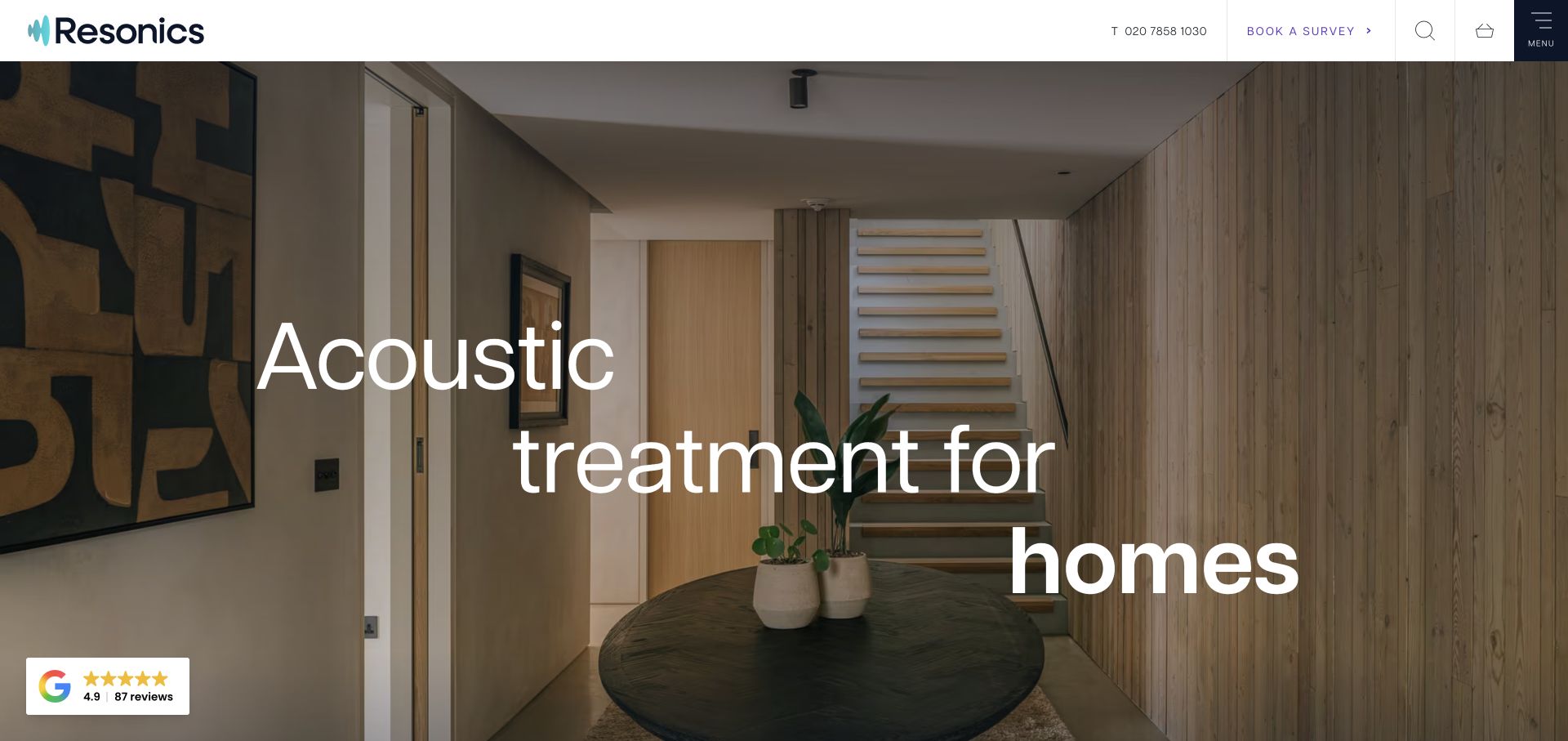
Resonics identifies itself as a specialist acoustic contractor and uses a photographed commercial interior to make the finished treatment visible. Offices, schools, halls, theatres and restaurants provide understandable entrances, while panels, baffles, rafts and stretched-fabric systems have their own product routes. A survey invitation connects the design-led presentation with a practical starting point for a real room.
What you can learn
Show the installed result, explain the contractor’s responsibility and let readers begin with a space they recognize. Product names become more useful once they are attached to a room and an assessment process.
Pros
A real treated interior connects acoustic work with architectural design.
Space, product and survey routes support different stages of project research.
Cons & considerations
A changing room word in the hero needs reduced-motion and stable-text alternatives.
Attractive finishes do not establish acoustic performance; project records need to explain the relevant conditions.
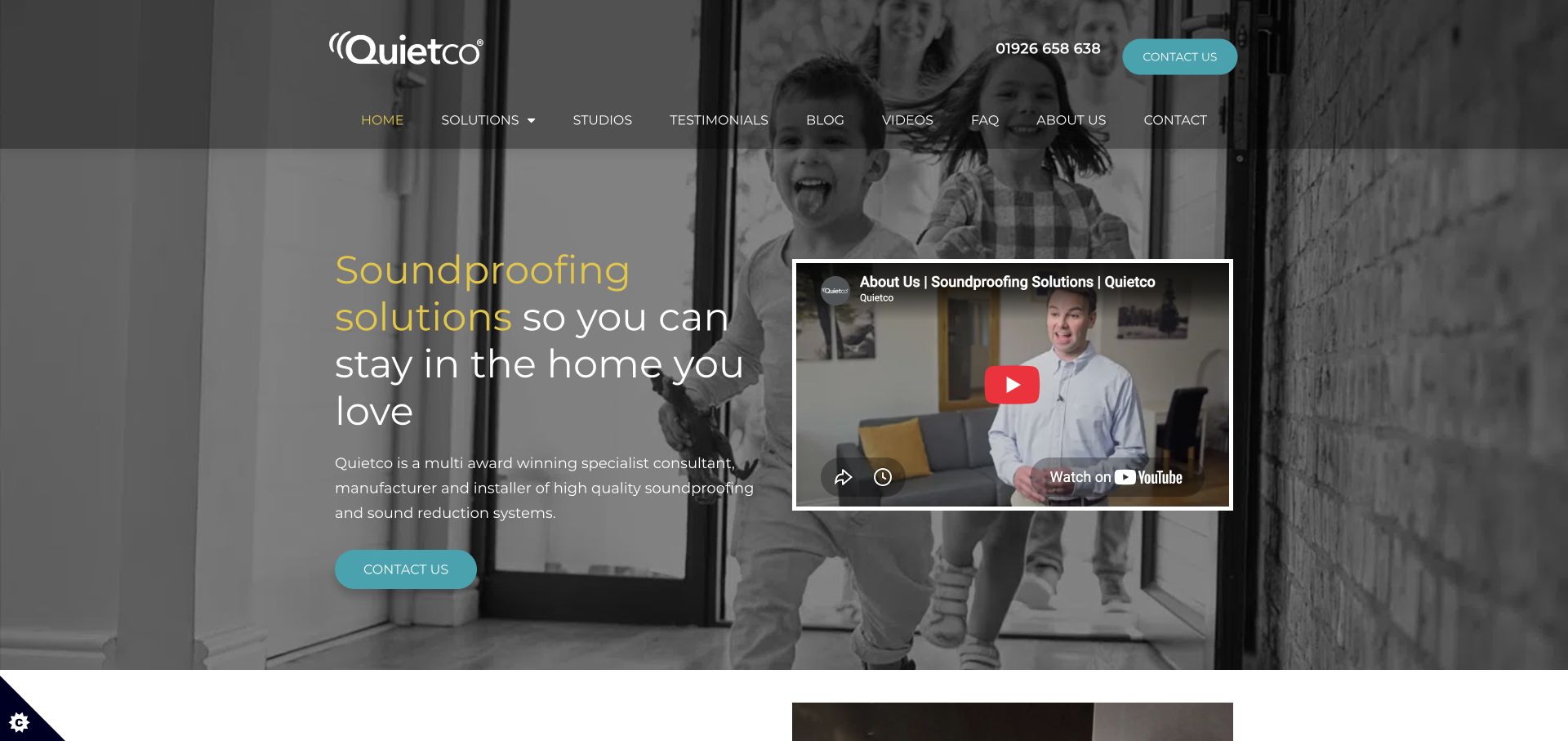
Quietco begins with the understandable benefit of staying in a home the owner loves. Family imagery, turquoise and yellow branding, and an introductory video make the service less abstract. The site explicitly describes consultancy, manufacture and installation, while neighbour noise, environmental noise and considerate noise-makers are separate contexts. A DIY course and scorecard sit alongside the installed-service offer rather than being its only explanation.
What you can learn
Translate the service into the household decision behind the enquiry, then clarify how the company helps. Keep a paid installation, a self-guided course and an initial assessment distinct so visitors understand which route they are choosing.
Pros
The opening benefit is understandable without acoustic terminology.
Consulting, manufacturing and installation responsibilities are made explicit.
Cons & considerations
A course and installed-service offer need consistently clear boundaries to avoid unsuitable enquiries.
The introductory video needs captions and an equivalent text explanation when playback is unavailable.
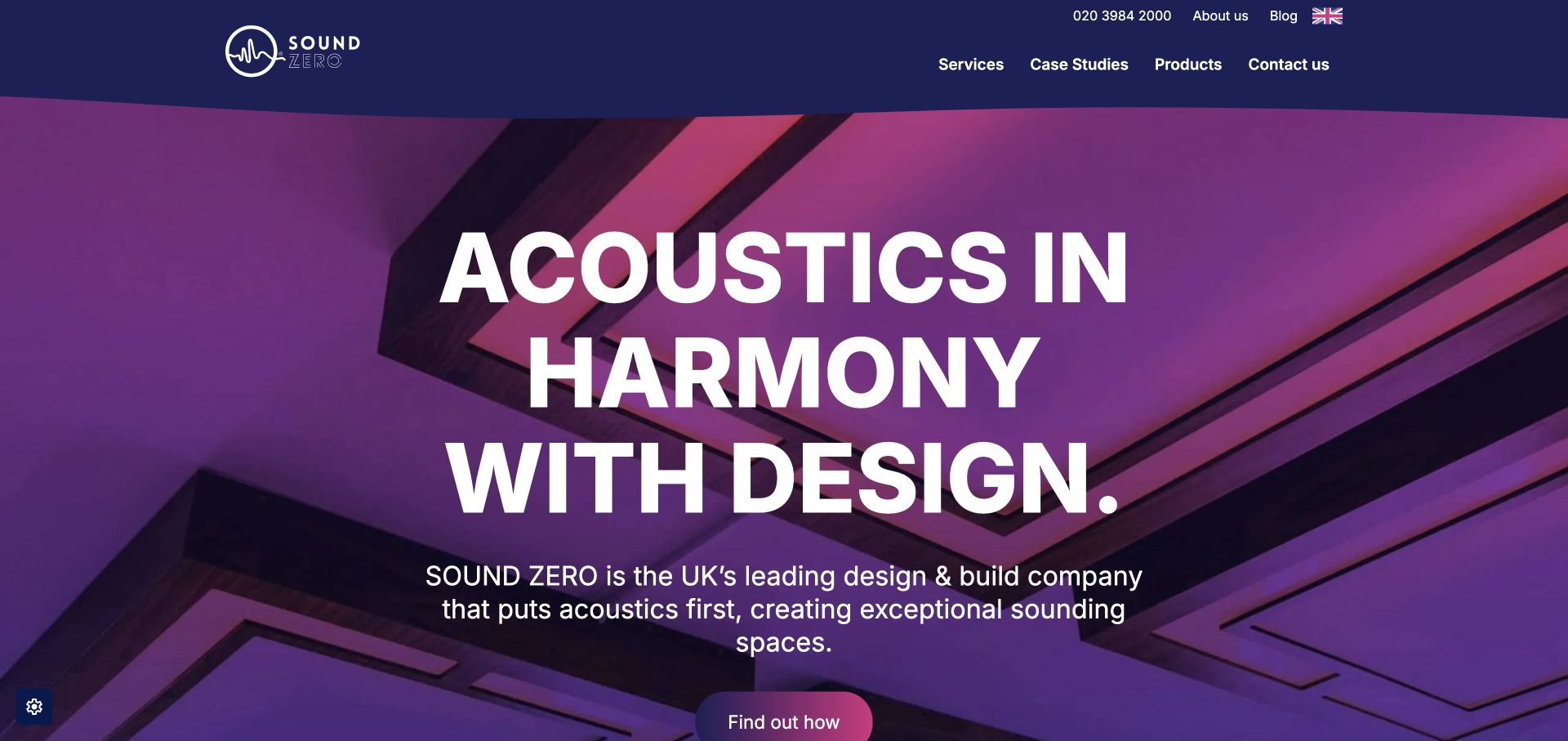
SoundZero uses a purple-lit installed ceiling to make acoustic treatment part of an interior rather than an invisible engineering promise. Office acoustics and music studios are recognizable service contexts, with services, case studies and products separated in the navigation. Named project references give the people-centred workplace introduction something concrete to investigate, rather than leaving the offer at a general statement about better sound.
What you can learn
Use a project photograph to explain the physical intervention, then connect the workplace benefit to relevant cases. Maintain distinct routes for design-and-build services and product-only research.
Pros
Installed treatment is shown as part of a recognizable interior.
Service, product and case-study navigation gives the visual introduction useful depth.
Cons & considerations
Logo references should consistently link to a relevant case or explanatory record.
Wellbeing and productivity language needs appropriate support rather than an implied guarantee from the design.
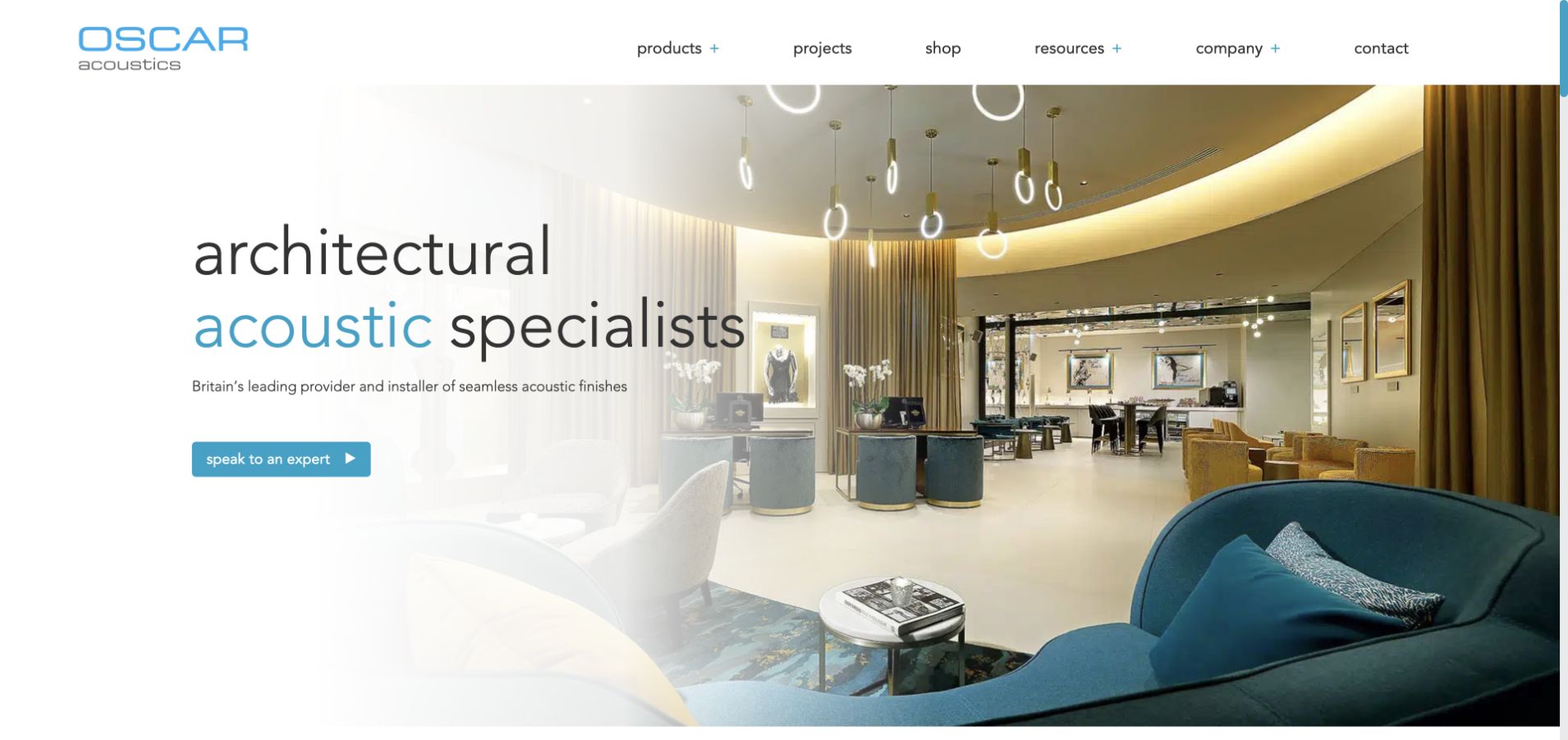
Oscar Acoustics pairs a real hotel interior with an explicit provider-and-installer description. Seamless finishes are easier to understand when the entire ceiling is visible, not only a small material swatch. Acoustic plaster, spray, hangers and thermal-insulation routes separate different systems, while downloads, CPD and a showroom acknowledge the research tasks of architects and specifiers.
What you can learn
Show how a specialist finish changes the whole room, then provide the documentation that a design professional needs. A beautiful application image and a technical specification serve different purposes and should work together.
Pros
The installed hotel ceiling gives a subtle finish a clear architectural context.
Downloads, education and showroom routes support professional specification research.
Cons & considerations
A broad system range needs comparison information so visitors do not treat every finish as interchangeable.
Fire, acoustic and environmental ratings need current system-specific documentation, not inference from a project image.
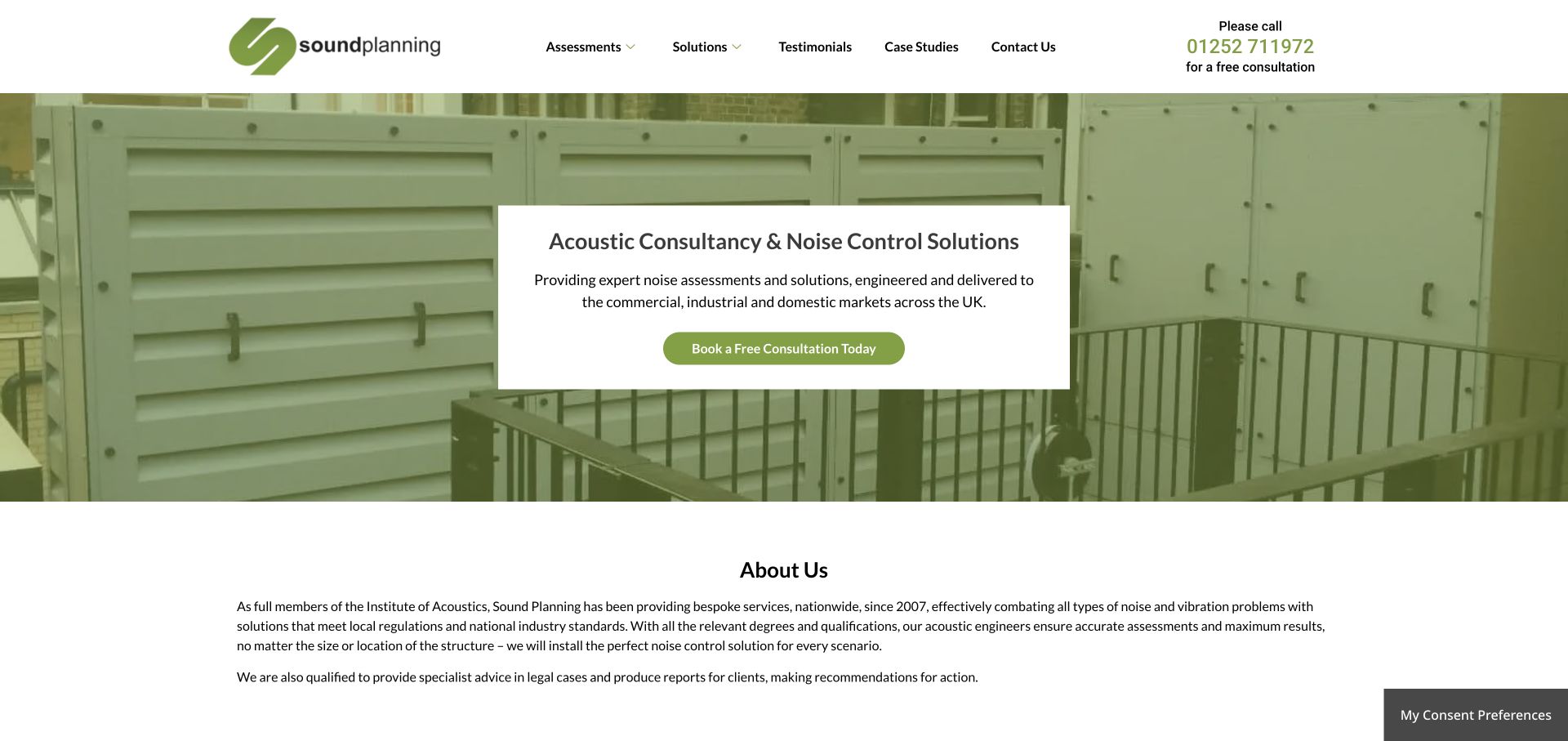
Sound Planning distinguishes assessments from solutions, then explains that it can design, build and install noise-control enclosures following a report. An industrial louvre image reflects that practical delivery work. The site names assessment standards and offers a consultation, giving a reader both a technical research route and a way to discuss the problem before selecting an enclosure or barrier.
What you can learn
Explain the handoff from diagnosing noise to implementing a solution. If the same business provides both, say what is included at each stage and translate standard numbers into the reader’s real decision.
Pros
Assessment and installed-solution routes distinguish diagnosis from construction.
The industrial image reflects a specific noise-control application.
Cons & considerations
A list of standard numbers needs plain-language explanations for non-specialist clients.
A consultation invitation should clarify the location, information required and whether later assessment work is separately priced.
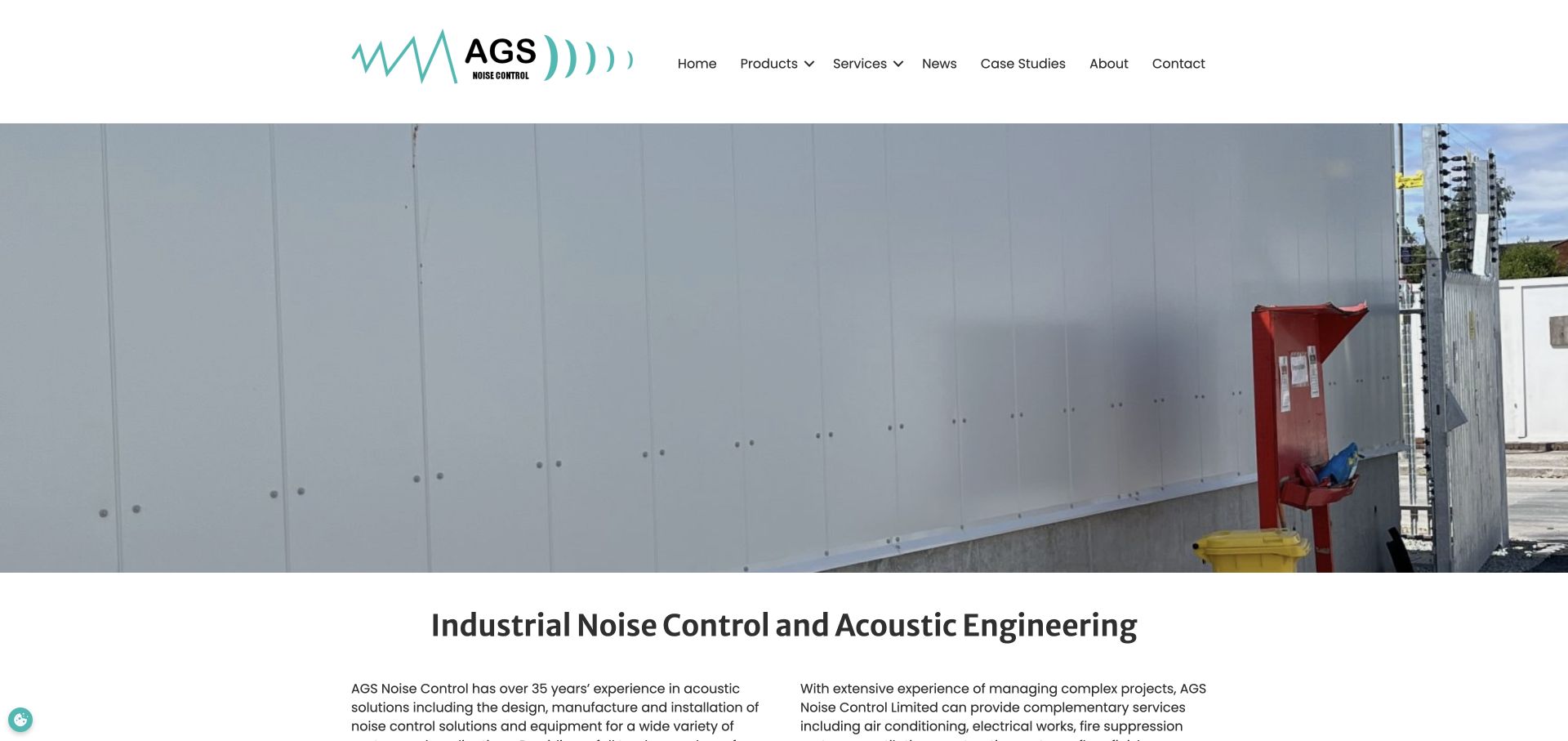
AGS Noise Control explicitly describes design, manufacture and installation of industrial noise-control systems. A transformer enclosure gives the opening photograph an identifiable subject. Enclosures, screens and audiology suites have separate routes, and the wider service explanation acknowledges coordination with ventilation, electrical and fire-related work. This is a useful example of presenting an acoustic package as a construction scope rather than only a product.
What you can learn
Describe the interfaces around an acoustic installation, not just its panel material. Industrial clients need to understand how access, ventilation and related trades will be considered alongside the noise-control objective.
Pros
The turnkey responsibility is explicit rather than implied by a product photograph.
A specific enclosure image and system categories make an industrial service tangible.
Cons & considerations
A broad turnkey claim needs clear project exclusions and responsibility boundaries.
Performance statements require operating conditions and measured evidence, not a photograph of a completed enclosure.
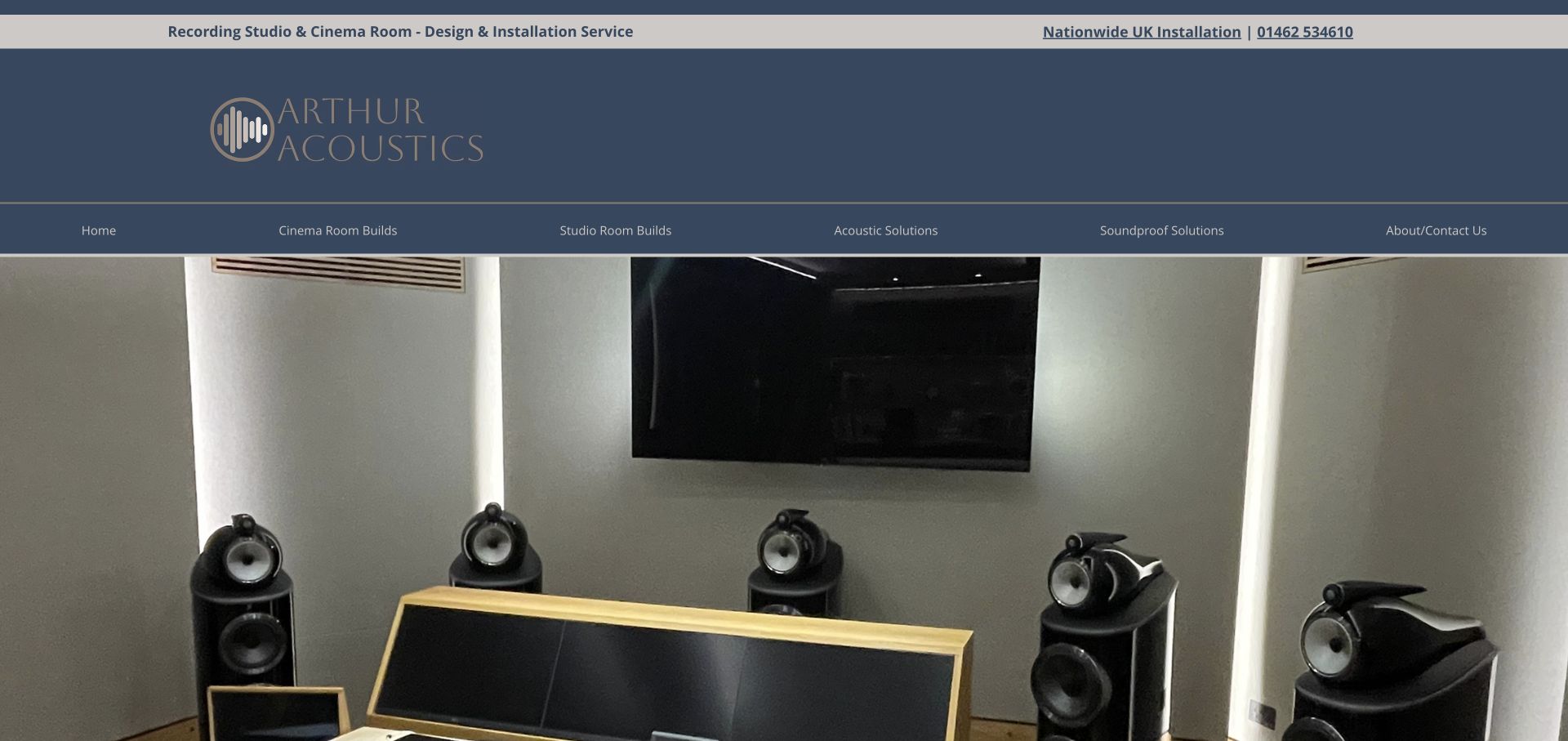
Arthur Acoustics introduces recording-studio and cinema-room design and installation with a real piano-room image. The navigation distinguishes complete room builds from acoustic and soundproofing solutions, with plaster, stretched ceilings and fabric walls as recognizable subcategories. Navy and gold branding gives the site a premium character, although a very tall header consumes much of the initial view before the service explanation.
What you can learn
Separate the complete room project from the individual finish or isolation system. Use the navigation to show how those scopes relate, while keeping the first explanation visible without excessive header space.
Pros
Complete room builds and individual acoustic systems have distinct entrances.
A real music-room photograph gives the specialist audience immediate context.
Cons & considerations
The tall desktop header postpones useful service information.
Empty and irregular heading elements need attention so assistive navigation has a coherent outline.
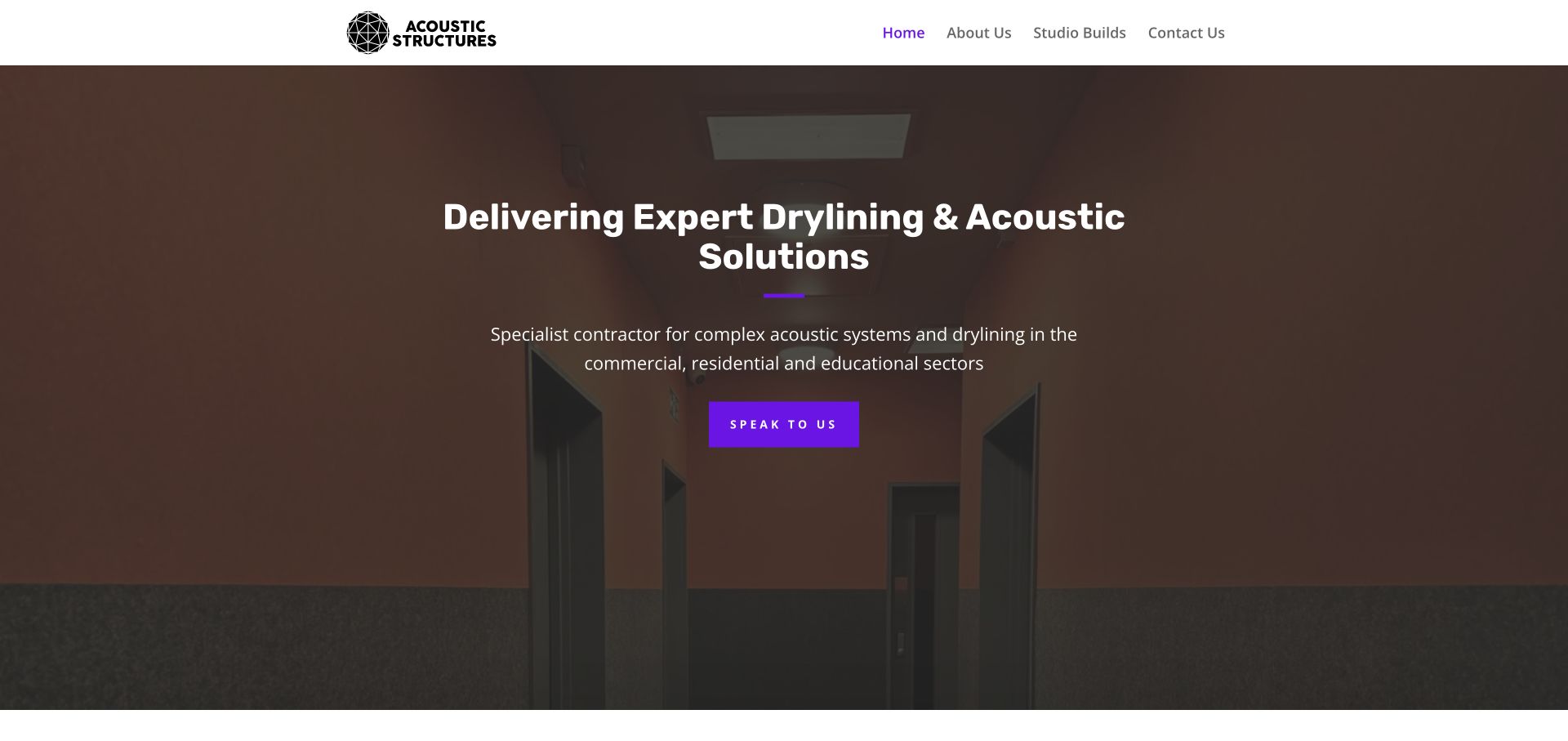
Acoustic Structures uses a compact white header, purple accents and a large installed-room image. Its description names acoustic and drylining work across commercial, residential and education projects. Walls and partitions, ceilings, isolated rooms and floors, and absorptive finishes form a building-element structure, with a separate studio-build route. The categories give a construction audience more useful context than an undifferentiated list of acoustic products.
What you can learn
Organize a contractor’s services around the parts of the building and the work package being procured. Keep room-within-room construction distinct from decorative absorption and general drylining.
Pros
Building-element categories map naturally to construction scopes.
A dedicated studio route acknowledges a more specialized project type.
Cons & considerations
The relationship between sound isolation and room absorption needs explicit explanation for less technical readers.
A broad sector list benefits from cases that identify the exact installed scope rather than only the client type.
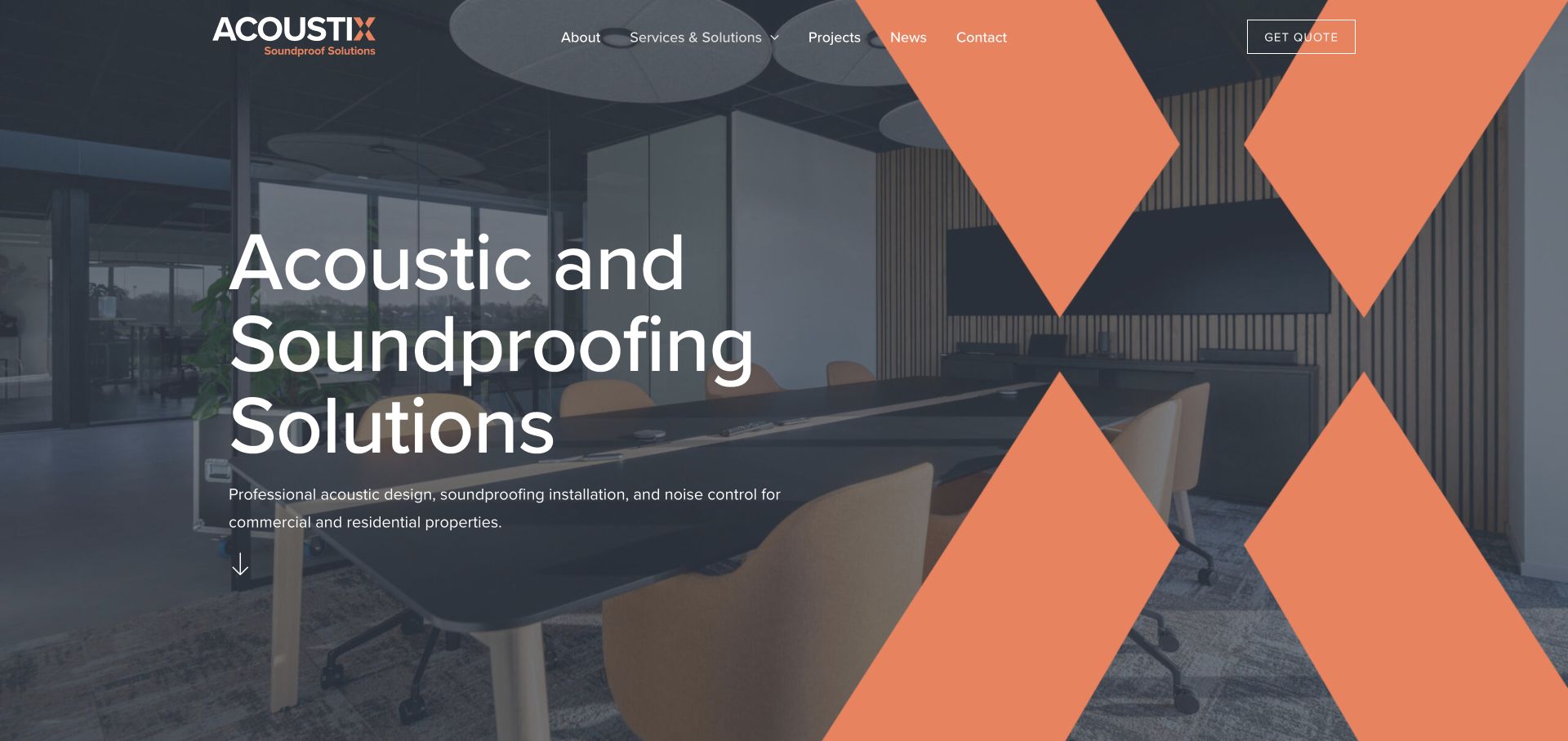
Acoustix combines a conspicuous orange identity with a photographed meeting-room ceiling. Design, installation and testing are explicitly described, with soundproofing, testing and design as separate service routes. The site states a nationwide commercial scope but a residential radius around Leeds, a useful distinction before someone requests a quotation. School, professional-office and entertainment cases connect the categories to actual project contexts.
What you can learn
Explain where each service is available before inviting an enquiry. A national commercial offer and a local residential service can coexist, but their boundaries should be as visible as the product categories.
Pros
Commercial and residential service coverage are differentiated.
Specific sector cases support the design, installation and testing structure.
Cons & considerations
A large brand graphic over an image can compete with the service explanation.
Testing and installation pages need to distinguish measured results, design targets and company claims.
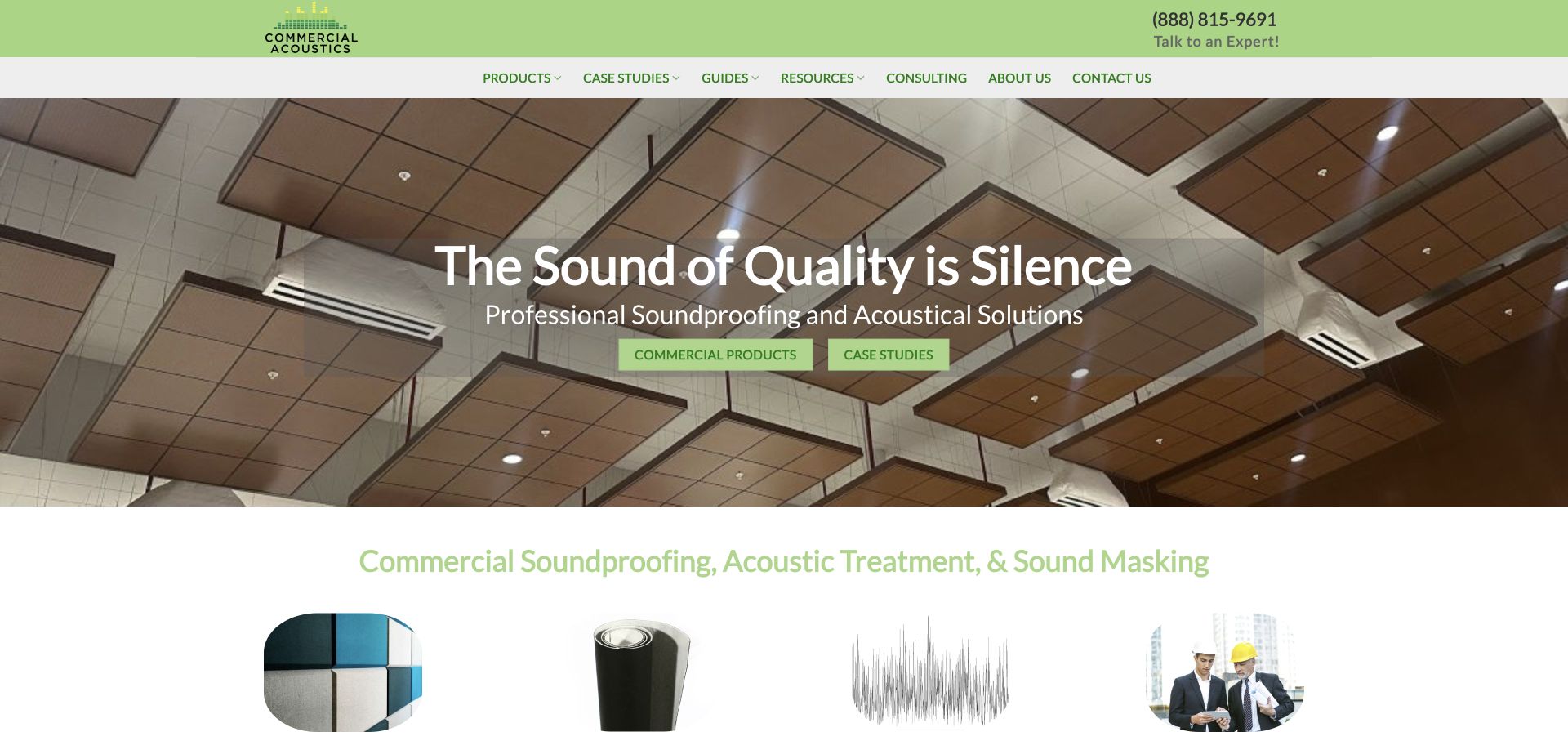
Commercial Acoustics separates absorption, sound blocking, masking and consulting instead of presenting every noise problem as a need for the same panel. A photographed treated ceiling illustrates the installation side of the business. The case-study structure can be explored by industry, use and product, while the service description includes installation and sound-masking tuning. This gives a broad catalog several useful routes into project research.
What you can learn
Differentiate the acoustic objective before naming a product. A reader investigating echo, transmission or speech privacy needs a different explanation, even when one contractor can deliver all three scopes.
Pros
The main categories distinguish fundamentally different sound-control tasks.
Case-study filters connect products with industries and use cases.
Cons & considerations
Deep menus need consistent labels and keyboard treatment to remain manageable.
Light green interface elements should retain sufficient contrast rather than depending on the brand colour alone.
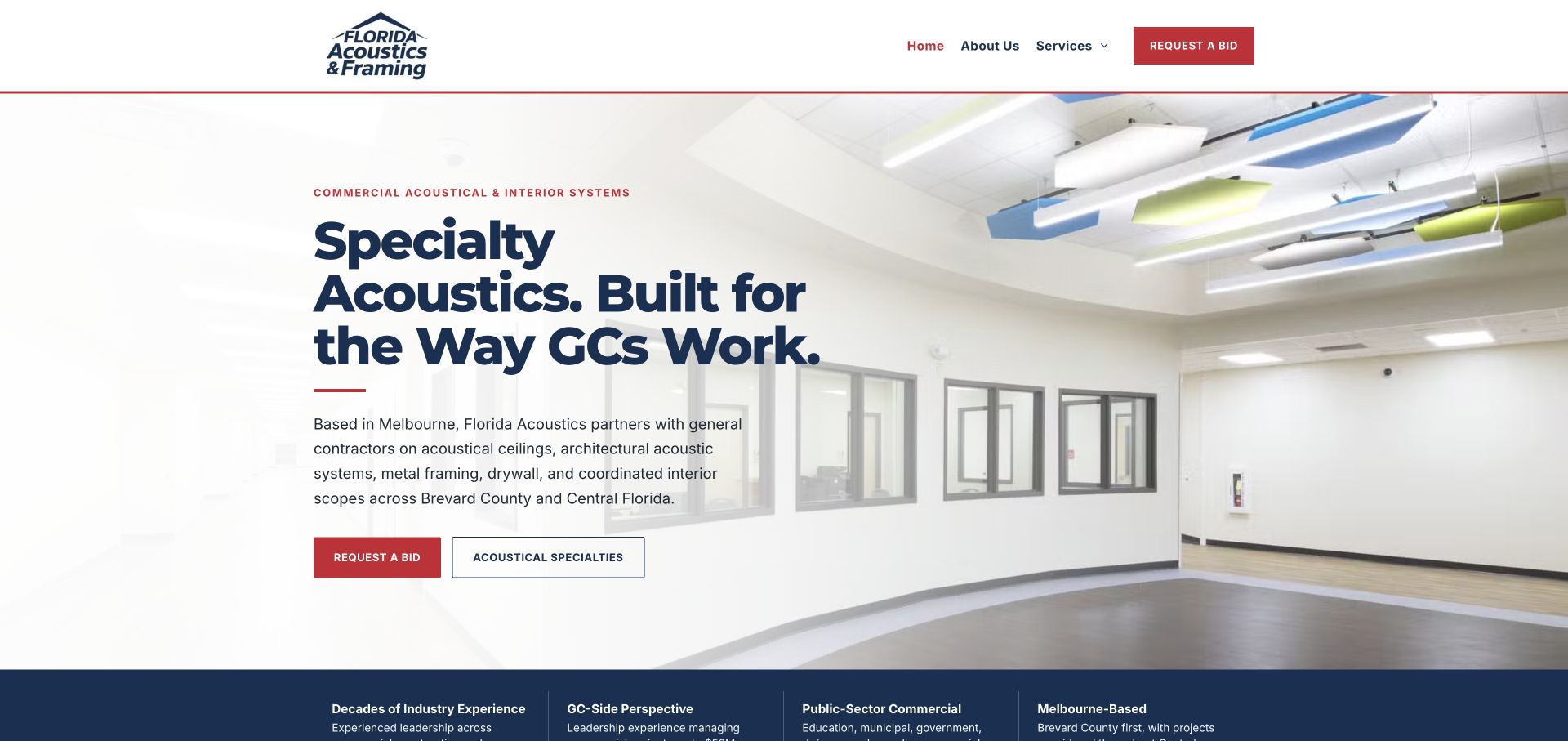
Florida Acoustics & Framing addresses general contractors rather than treating every visitor as a homeowner. The opening installed-ceiling photograph, request-a-bid route and acoustical-specialties destination reinforce that procurement context. Melbourne, Brevard County and Central Florida provide a geographic boundary. Acoustic ceilings are prominent, while framing, drywall, painting and flooring show the related scopes the business can coordinate.
What you can learn
Name the purchaser and the geographic market before presenting related trades. A bid invitation should feel different from a domestic noise consultation because the information and procurement process differ.
Pros
The general-contractor audience and regional scope are explicit.
The bid route is supported by a clear acoustic-ceiling specialty.
Cons & considerations
Related trades should not bury the acoustic scope that initially brought the reader to the site.
A bid form needs clear drawing, schedule and scope requirements rather than only a generic message box.
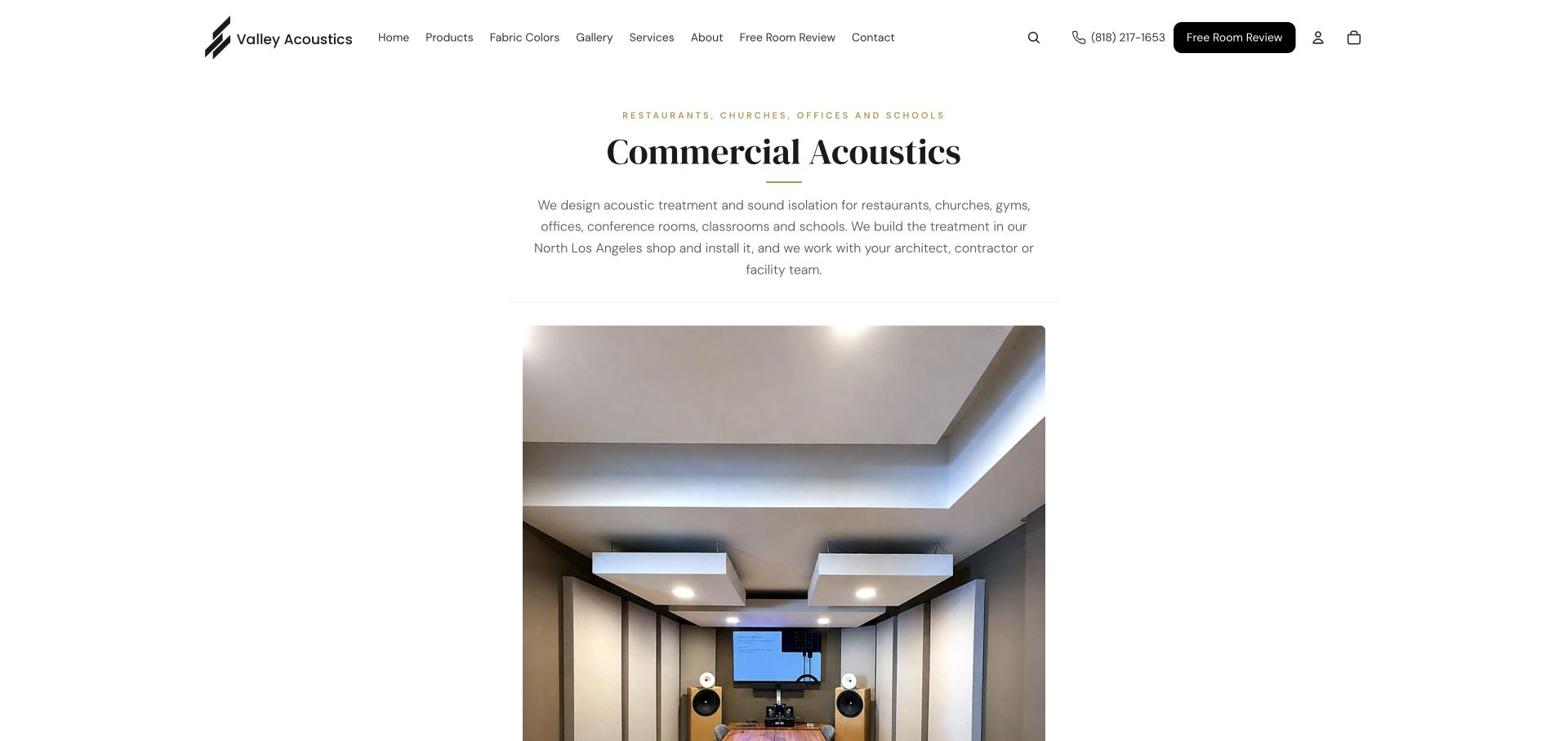
Valley Acoustics explains noise build-up, speech intelligibility and reverberation on a focused commercial-acoustics page, supported by a real treated conference-room image. Panels, clouds and fabric-track systems are installed by its crew, while sound-isolation designs are built by the customer’s licensed contractor. A free room-review invitation sits apart from the product store. The responsibility boundary is a particularly useful piece of service copy.
What you can learn
Say who actually performs each type of work. Absorptive installation, isolation design and product supply are different responsibilities; explaining the handoff can be more helpful than a broad full-service slogan.
Pros
The installation-versus-design boundary is unusually clear.
Room problems are explained in language a commercial client can recognize.
Cons & considerations
Long service explanations benefit from short summaries and stronger scanning landmarks.
A free review needs stated scope and limitations so it is not mistaken for a full technical assessment.
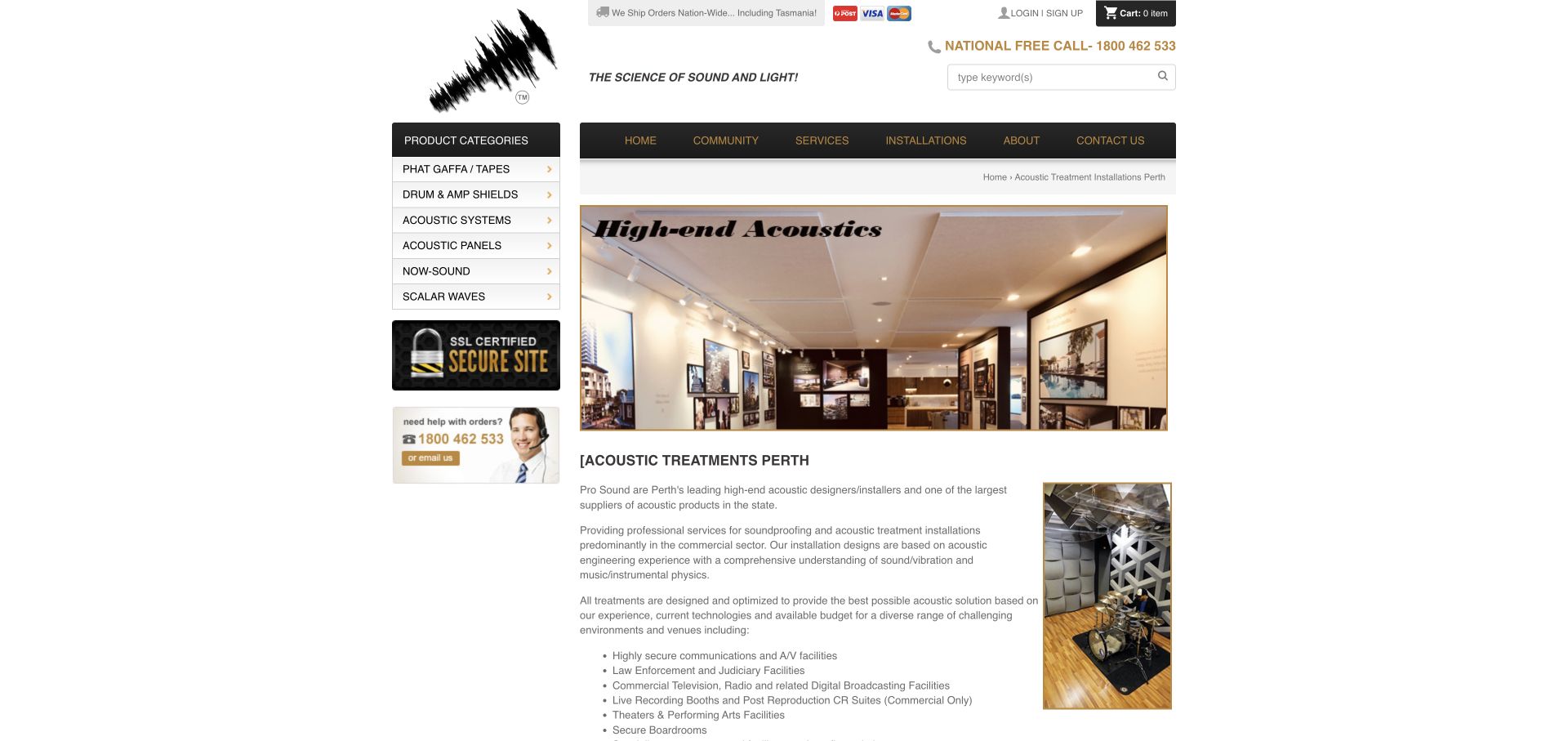
ProSound’s Perth installation page names commercial acoustic treatment and shows installed ceiling photographs. Broadcasting, courtrooms, boardrooms and performance spaces provide concrete use contexts. A visible telephone number and breadcrumb help the reader orient within a larger retail site. The dense product sidebar also makes the tension clear: shopping for equipment is a different task from commissioning a room-treatment service.
What you can learn
Give an installed service its own clear entrance when it sits inside an online store. Relevant room types, real installation photographs and an enquiry route should not be visually outweighed by unrelated retail categories.
Pros
The Perth location and commercial installation scope are easy to identify.
Real ceiling photographs support the listed venue contexts.
Cons & considerations
A dense retail sidebar competes with the service page’s primary task.
Bracket-like text in a visible heading needs editing to keep the page polished and understandable.
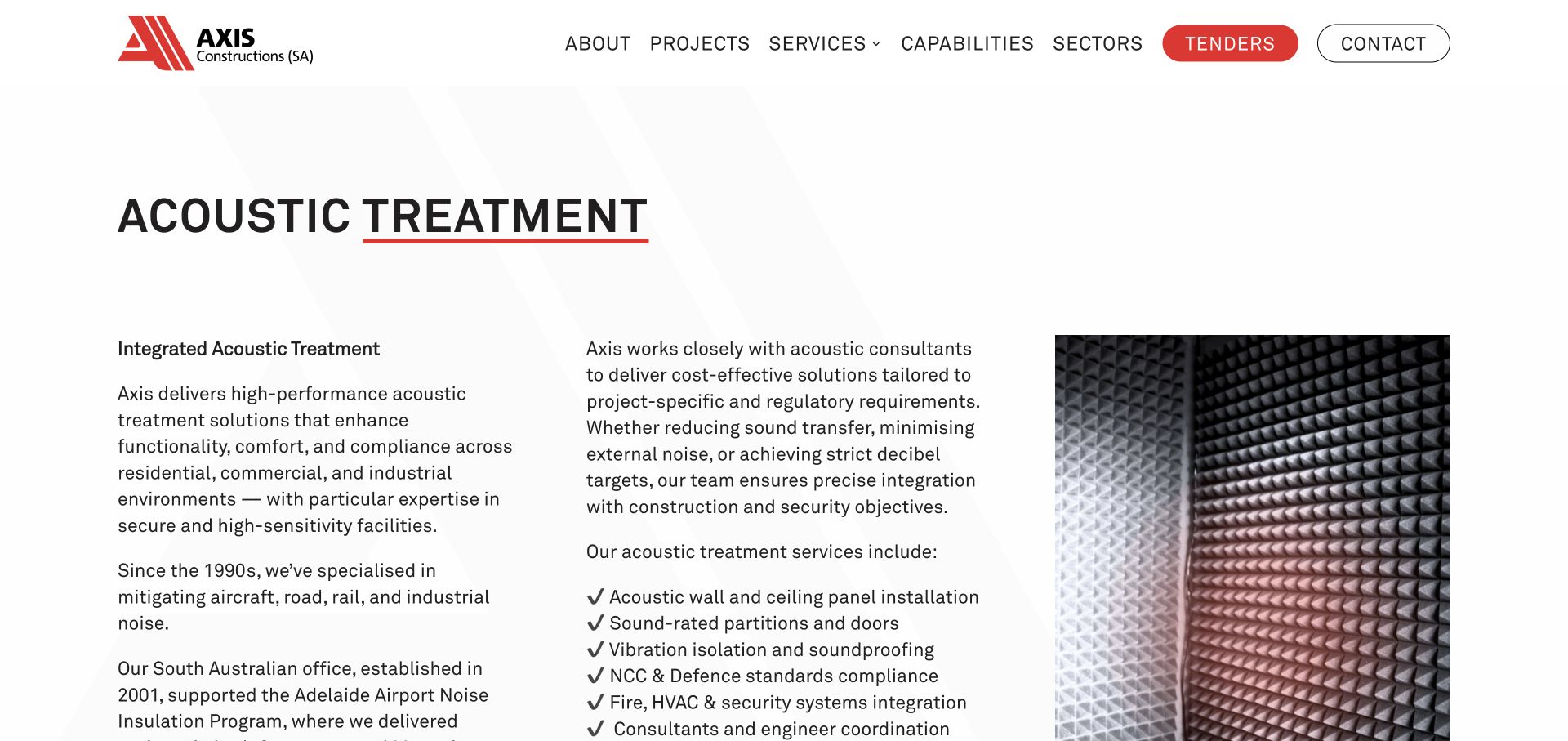
Axis Construction Group places acoustic treatment within a wider South Australian construction offer. The service page names wall and ceiling panels, sound-rated doors and partitions, vibration isolation and HVAC coordination, and says it works with consultants and engineers. Airport-noise context gives the work a regional setting. Its large text columns explain the package, although a close-up foam image is less informative than a documented installed room.
What you can learn
Explain how specialist acoustic work fits into the broader building project. Identify coordination with consultants and related systems without suggesting that a product photograph alone proves the finished room’s performance.
Pros
Related building systems and consultant coordination are explicitly acknowledged.
The regional airport-noise context makes the service less generic.
Cons & considerations
Wide text columns can be difficult to scan on desktop.
A foam close-up needs installed-project context so it does not oversimplify a multi-system service.
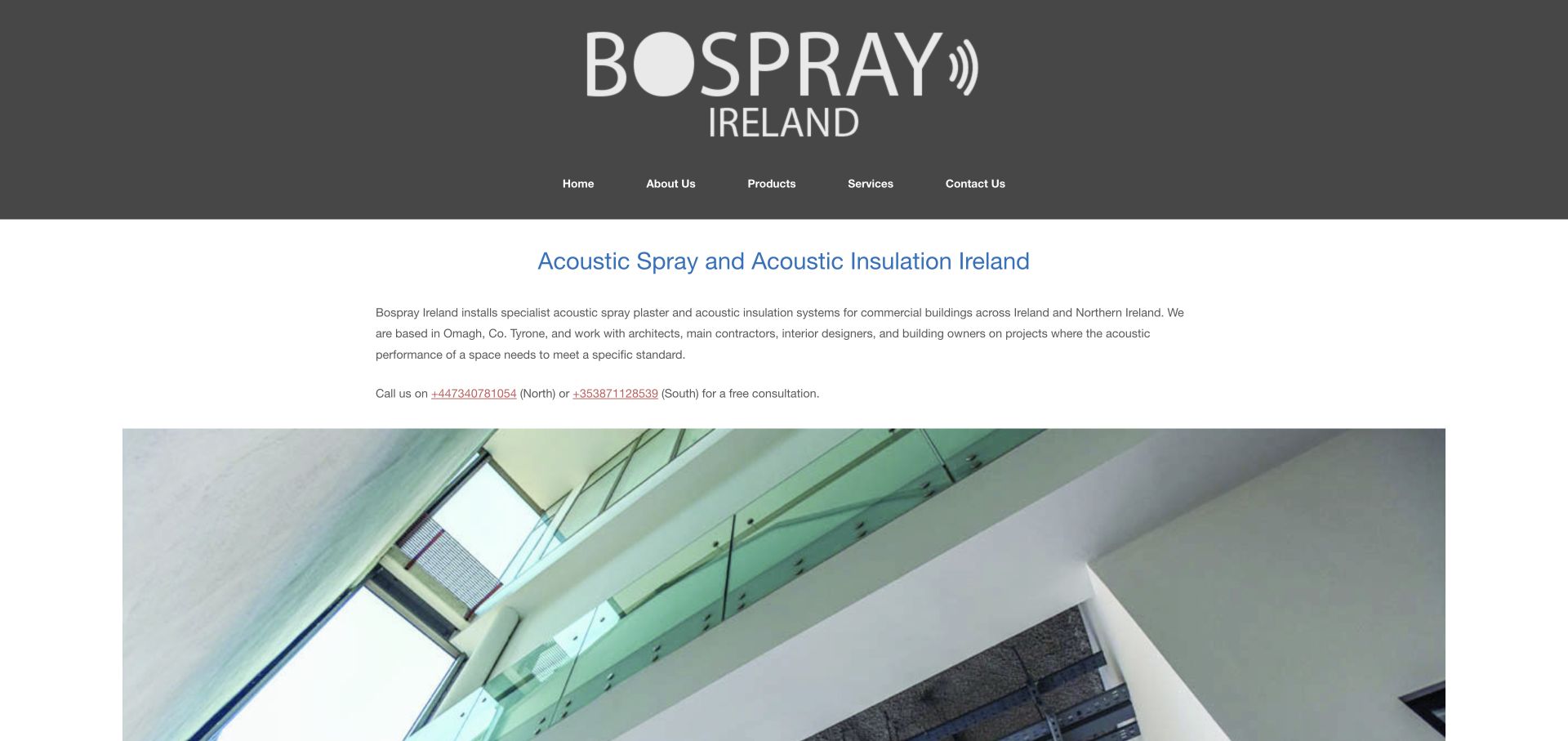
Bospray Ireland names acoustic spray and insulation installation across Ireland and Northern Ireland. BoSpray cellulose spray and BoCoustic plaster panels have separate explanations, with colour and design information extending the technical description. A real ceiling photograph appears below the initial scope, and the header exposes north and south contact numbers. The specialist technique is clear, although the oversized logo area delays the practical material information.
What you can learn
Name the application method and service geography early, then show the finished surface in a real room. Where regional phone routes differ, make them consistently usable rather than merely printing two numbers.
Pros
The installation method and geographic scope are explicit.
Material and colour information connect technical work with design decisions.
Cons & considerations
A large logo header postpones the substantive service explanation.
The northern number used an HTTP-style destination rather than a working telephone link in the reviewed source.
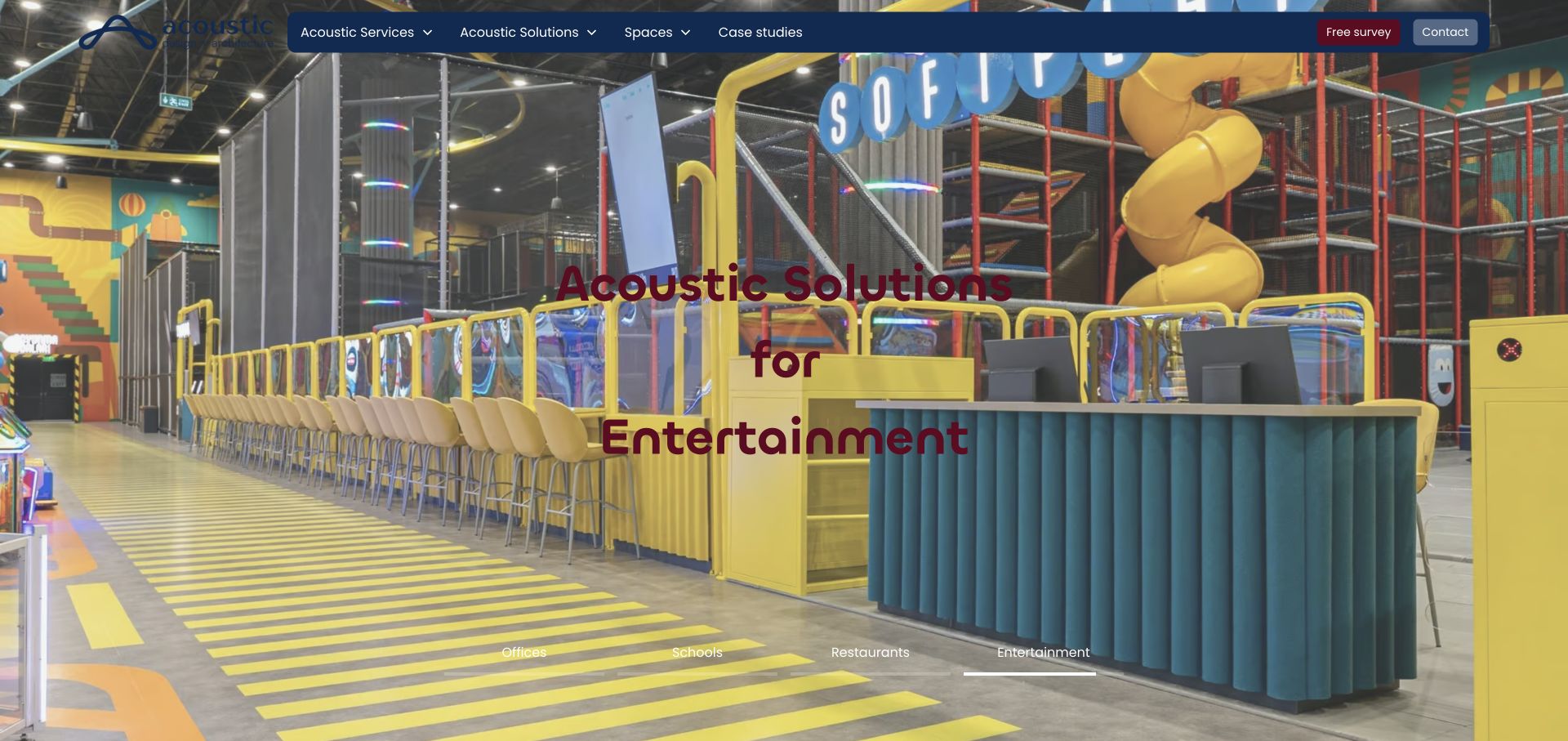
Acoustic Design & Architecture describes a survey, specification and own-team installation service, with a Milton Keynes showroom as a physical research destination. Installed office and school images connect the service to familiar spaces. Services, solutions and room contexts have different navigation roles, and before-and-after measurement is described as a paid addition rather than silently implied as part of every installation.
What you can learn
Make both the service process and its optional additions explicit. A showroom can support finish selection, while measurement needs its own scope and price expectations rather than being treated as decorative evidence.
Pros
Survey, specification and installation responsibilities are stated.
The showroom and optional measurement routes clarify different research needs.
Cons & considerations
Large text over changing room photography needs reliable contrast across every frame.
Overlapping services, solutions and space menus need consistent descriptions to avoid repetition.
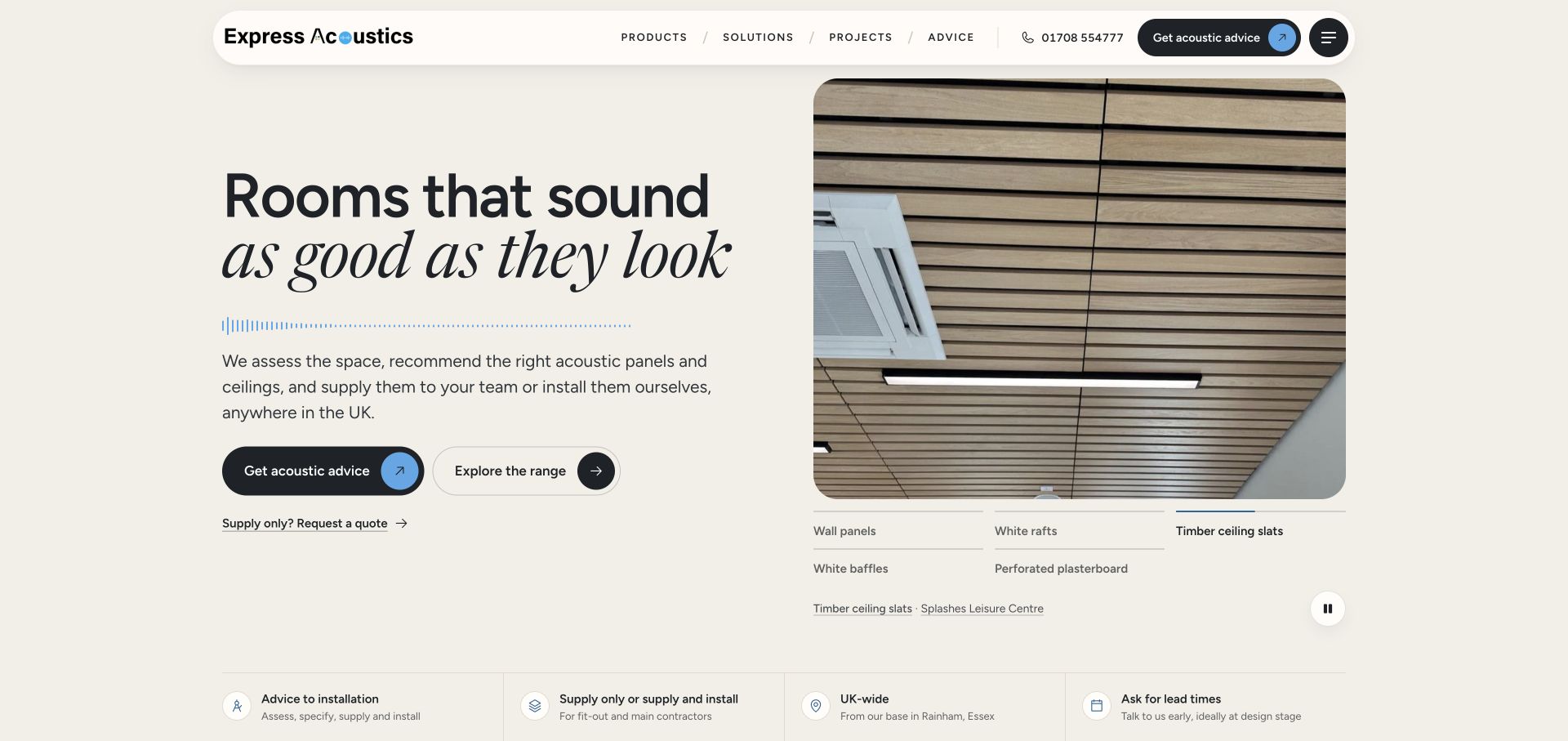
Express Acoustics presents real project imagery in a restrained beige, black and blue visual system. Advice, material ranges and supply-only quotations are separate routes, while the service copy says it can assess, recommend, supply or install with its own team. Named project captions and product-family documentation make the site useful for specifying material as well as commissioning work. The distinction between buying and installing is not left for an enquiry to resolve.
What you can learn
Separate the level of service before asking for a quote. Someone buying material for an appointed contractor needs a different destination from a client who wants assessment and installation handled together.
Pros
Supply-only and installed-service paths are clearly distinguished.
Project captions and product documentation support deeper material research.
Cons & considerations
A broad product range needs useful comparisons, not only more category links.
Installation coverage and survey expectations should stay close to each relevant quote route.
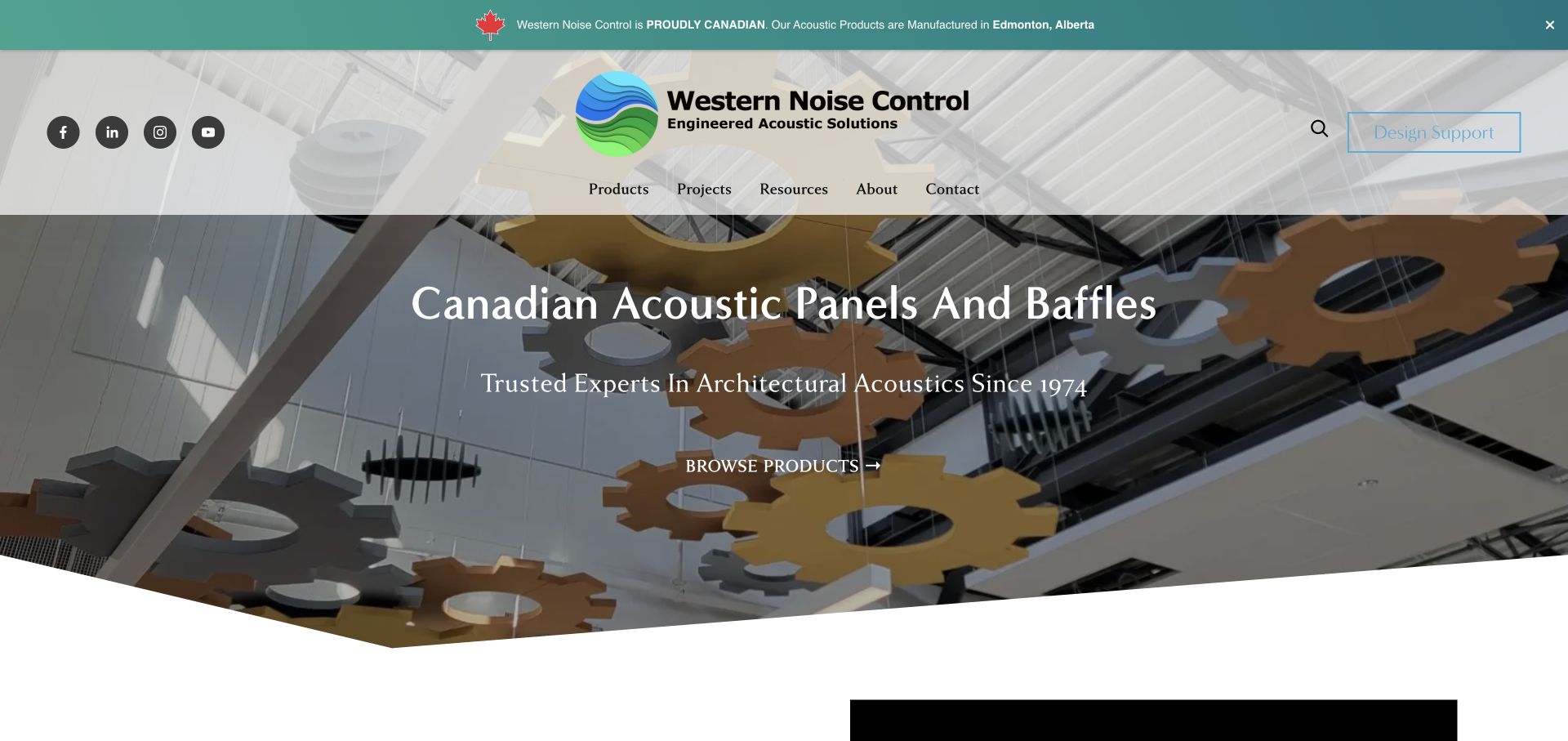
Western Noise Control places a distinctive installed ceiling across the opening screen and offers design support alongside products, projects and resources. The page explicitly connects engineering, manufacture and installation. Wall, ceiling and specialty systems are illustrated in real spaces, while an Edmonton manufacturing banner gives a concrete geographic reference. The product story works best where the architectural image leads to the relevant application and documentation.
What you can learn
Use a memorable installation to show what the material can become, then clarify the engineering and delivery relationship. Keep design support separate from simple catalog browsing.
Pros
The installed ceiling photograph makes architectural possibilities immediately visible.
Engineering, manufacturing and installation are all named in the service explanation.
Cons & considerations
A tall translucent header can compete with the photograph and postpone page content.
Canadian-manufacturing and material-performance statements need their specific current scope rather than blanket assumptions.
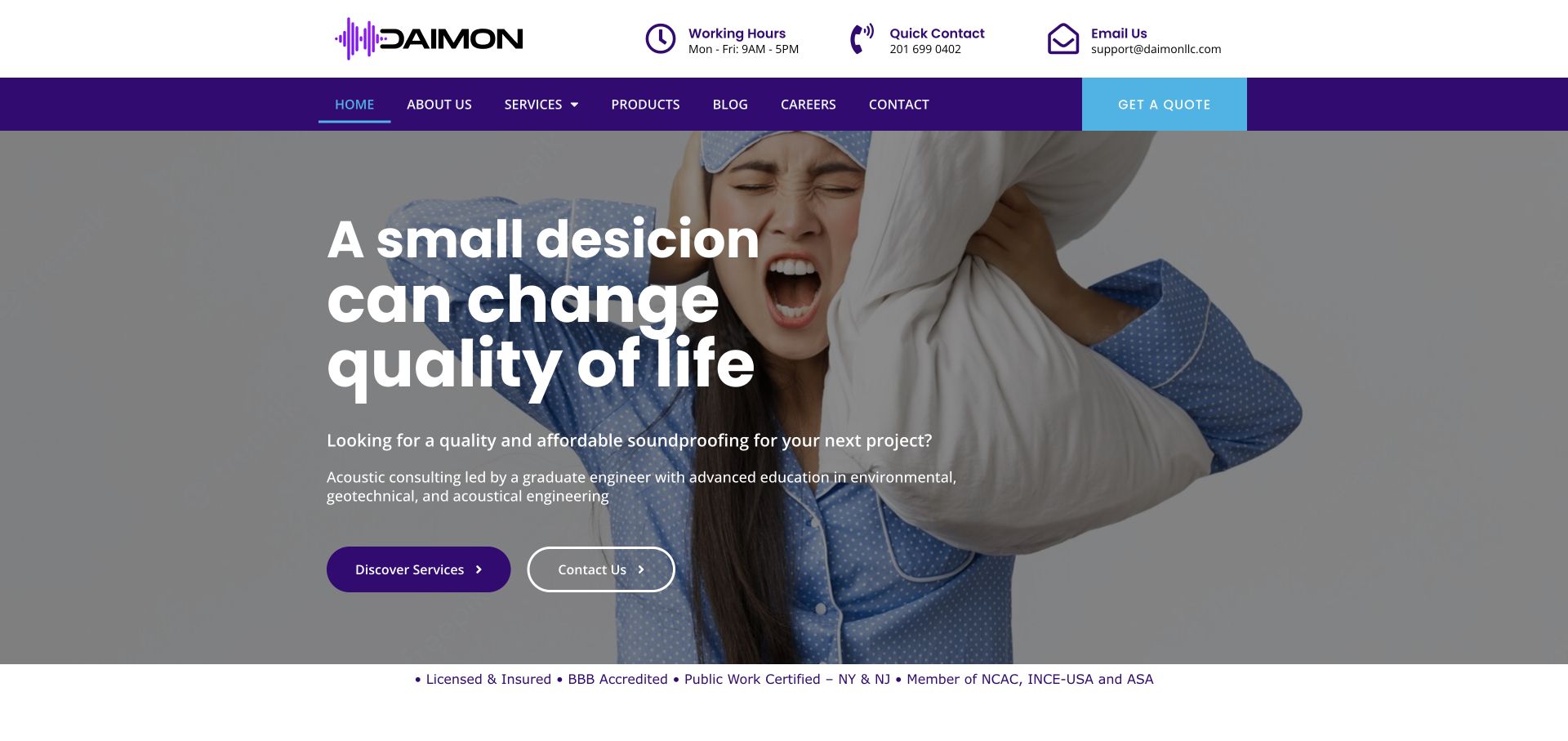
Daimon uses a domestic noise illustration and prominent contact strip to introduce the practical problem before presenting technical systems. Discover Services and Contact Us are separate actions. Its supporting acoustic-treatment page explicitly distinguishes room treatment from soundproofing, then describes evaluation, design, in-house manufacture and professional own-team installation. The homepage’s quality-of-life framing becomes more useful when connected to this specific process.
What you can learn
Start with the problem the client can describe, then explain the difference between echo control and noise transmission. A visible evaluation-to-install sequence gives the introductory benefit practical substance.
Pros
The service page clearly separates acoustic treatment from soundproofing.
Evaluation, design, manufacturing and own-team installation form an understandable process.
Cons & considerations
Misspellings in prominent homepage copy weaken an otherwise straightforward introduction.
Accreditation and qualification statements need relevant current records rather than a decorative assurance strip.
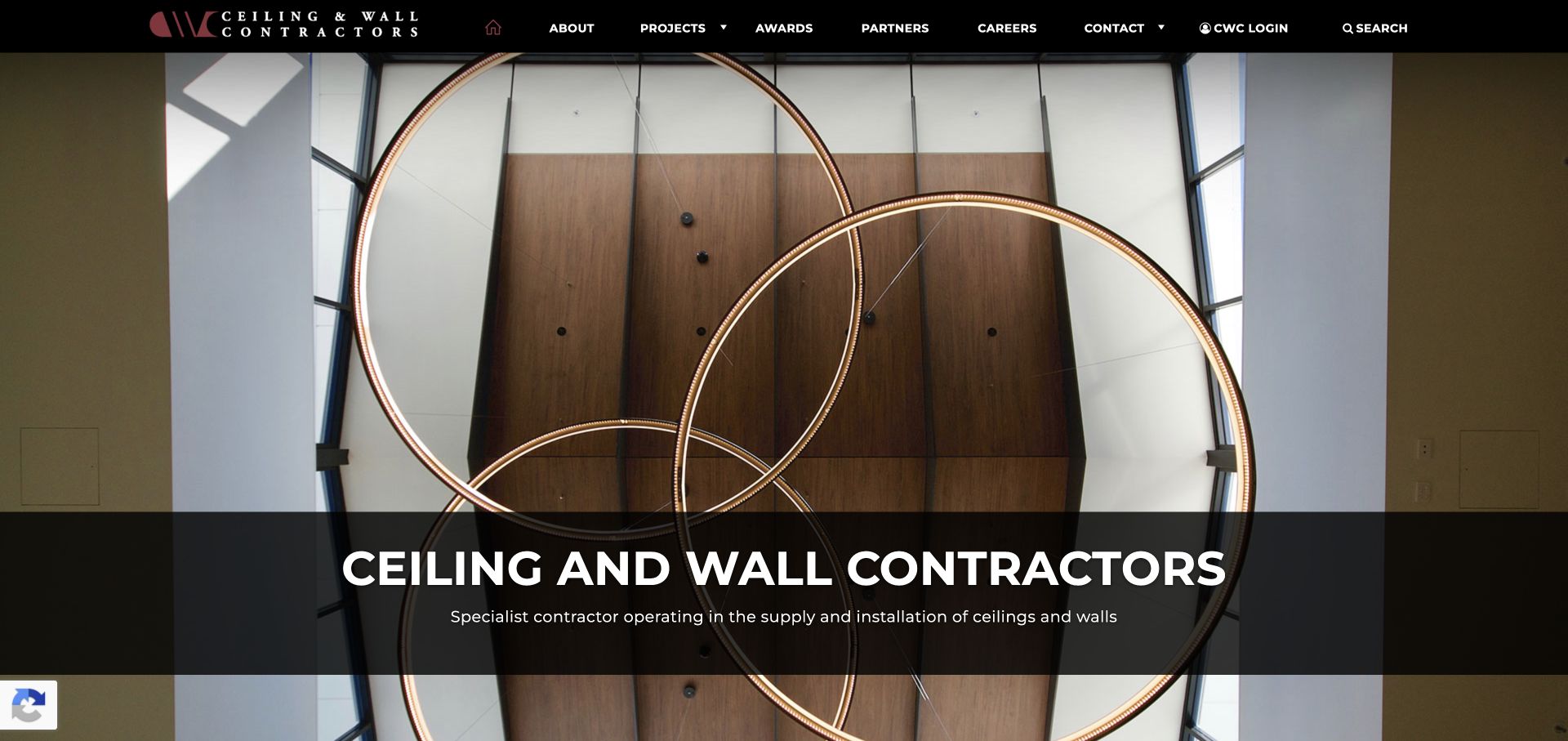
Ceiling and Wall Contractors uses a full-width architectural slideshow with named hotel, convention-centre and education projects linked to further detail. Its introduction explicitly includes acoustic-system supply and installation alongside ceilings, partitions, fire-rated systems and fit-outs. South Australian and Western Australian offices establish a service footprint. A pause control acknowledges that a large project-image opening still needs to be manageable for the person reading it.
What you can learn
Label the project and connect it to an actual case rather than using a ceiling photograph as an anonymous backdrop. Explain the acoustic package within the wider fit-out scope and maintain clear regional contacts.
Pros
Named project captions link the visual portfolio to further investigation.
The installation scope and regional office structure are explicit.
Cons & considerations
A full-screen slideshow delays the first detailed service explanation.
Cases should distinguish the contractor’s acoustic scope from the architect’s wider design contribution.
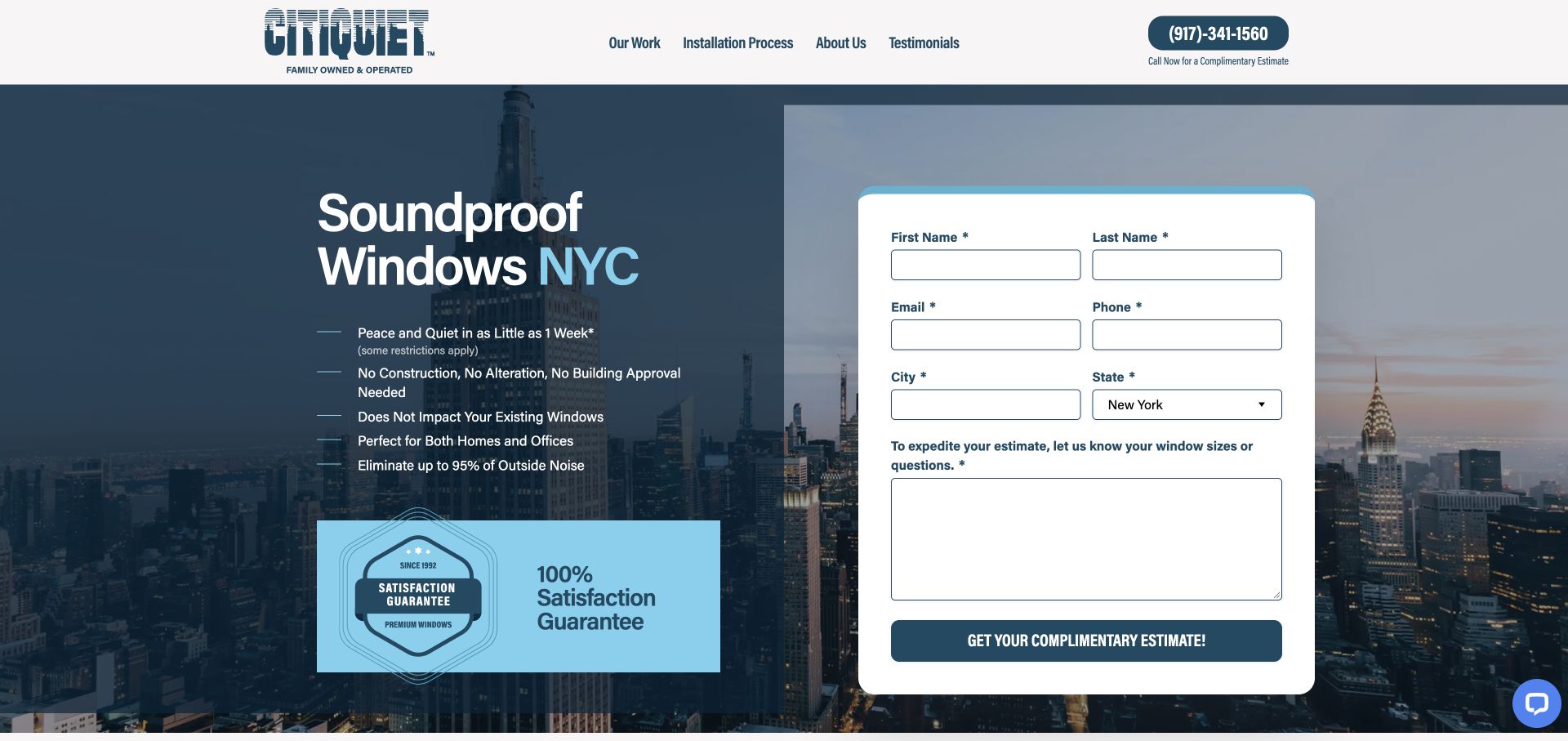
CitiQuiet’s soundproof-window landing page combines NYC positioning, a city photograph and a substantial complimentary-estimate form. Work, installation process, about and testimonial anchors keep the navigation narrowly focused. The explanation addresses how an interior window relates to an existing one, helping a reader understand the intervention. The page also uses strong performance and approval language that requires careful project-specific qualification.
What you can learn
Keep a specialized service landing page focused on the actual intervention, location and next step. Explain the installation process, but avoid treating a marketing claim about noise reduction or approvals as universal for every building.
Pros
The specialized window service and local market are unmistakable.
Process and work anchors keep the enquiry page connected to practical information.
Cons & considerations
A long first-screen form may ask for more detail than an early-stage reader is ready to provide.
Noise-reduction, timing and approval statements need explicit conditions rather than broad application to every property.
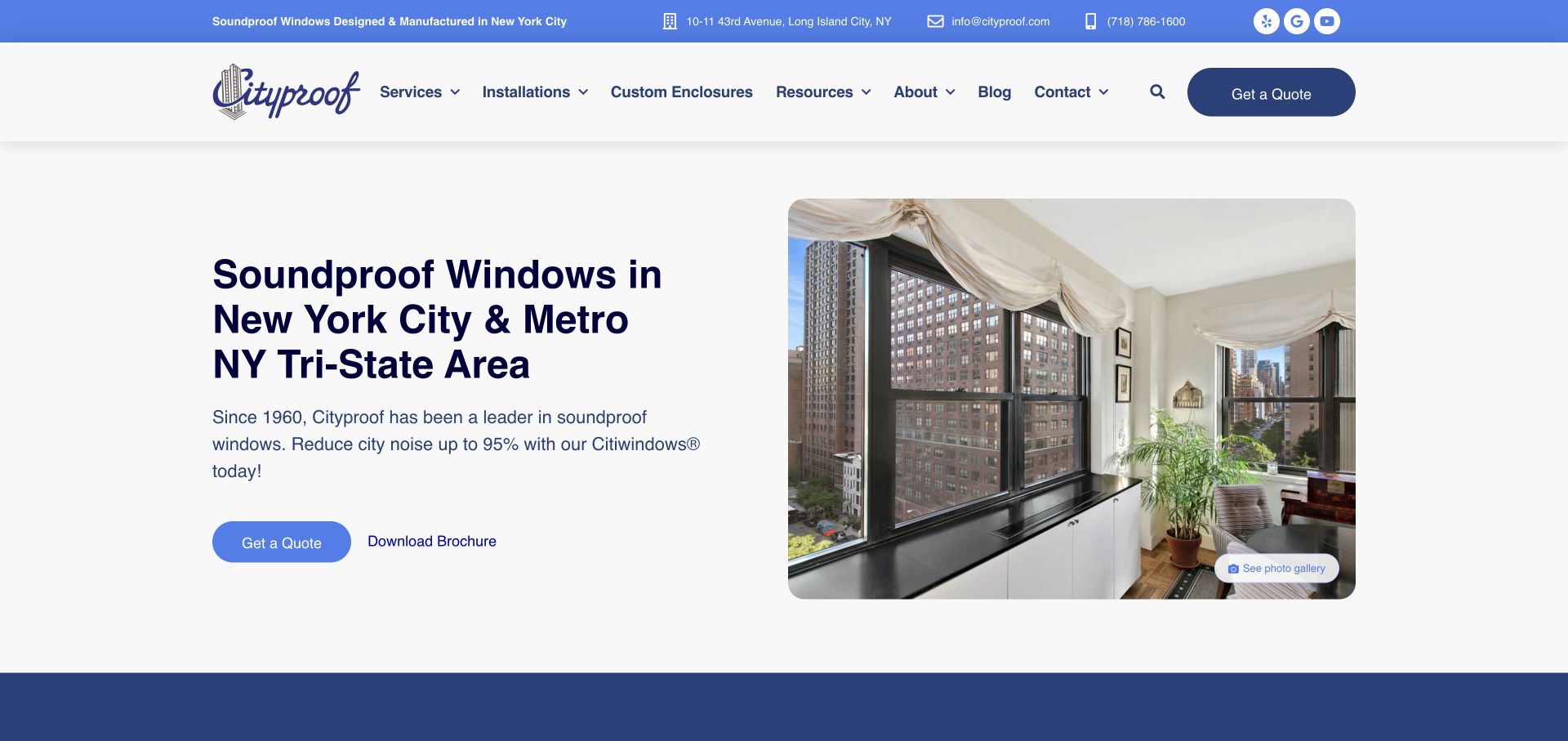
Cityproof uses a real apartment-window photograph beside a clear New York City and tri-state service introduction. A photo gallery, brochure and quote route offer different depths of research, while the body explains the relationship between its interior window and the existing exterior one. The installation showcase makes the intervention easier to picture than a skyline alone. A promotional savings panel was dismissed through its normal close control for the captured view.
What you can learn
Show the installed product from the room occupant’s perspective and explain what remains in place. Give gallery browsing, technical reading and requesting a quote their own clear routes.
Pros
A real interior-window photograph makes the retrofit concept understandable.
Gallery, brochure and quotation destinations serve distinct research tasks.
Cons & considerations
A promotional panel can interrupt a reader before the service has been understood.
Percentage savings and noise-reduction claims need defined conditions and supporting evidence.
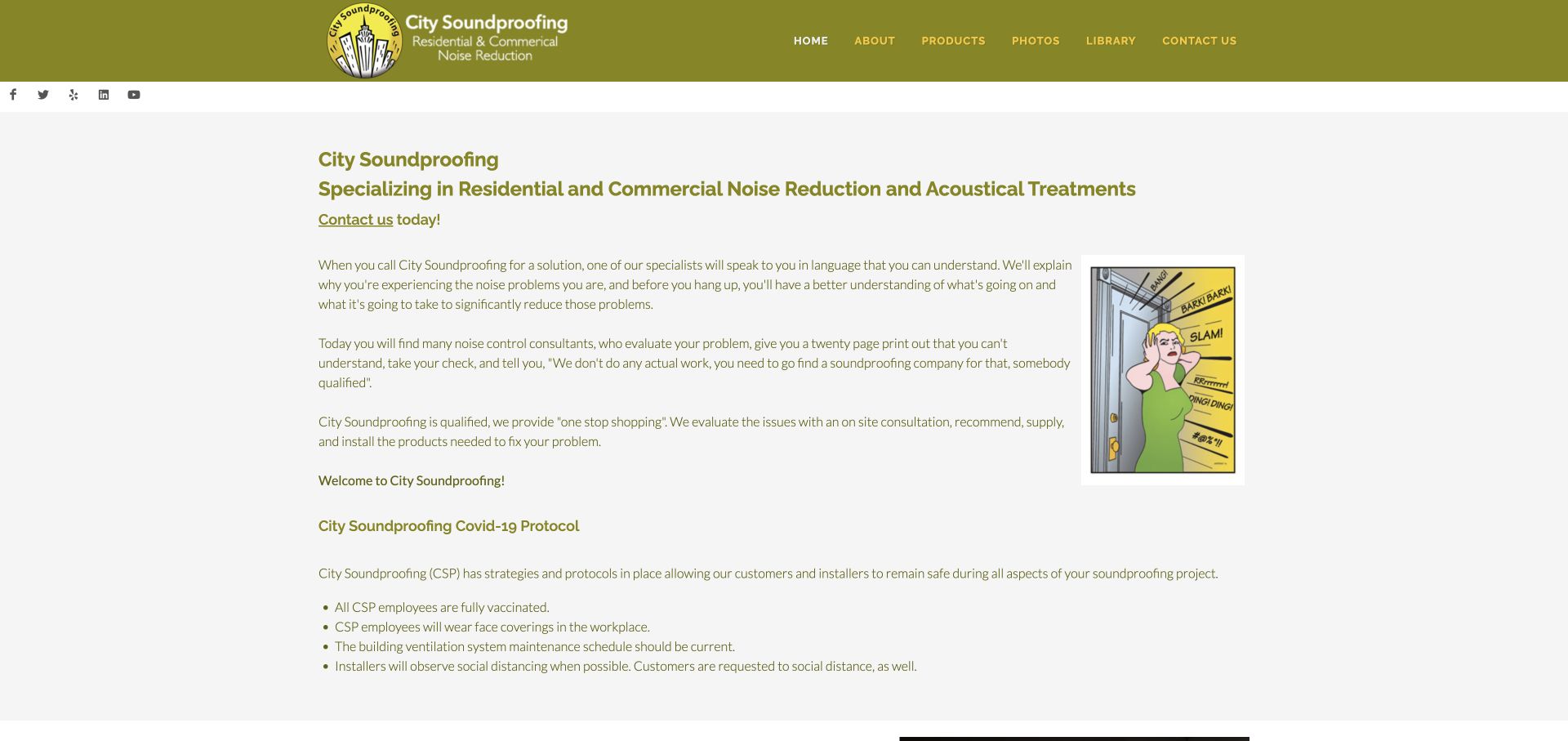
City Soundproofing uses a restrained olive layout and a simple neighbour-noise illustration. The opening text explicitly says it evaluates the issue on site, recommends, supplies and installs, distinguishing that relationship from a report-only service. Doors, studios and other applications are linked below. Its direct explanation is useful, although dense text and an older COVID-protocol block occupy much of the initial view.
What you can learn
Explain what happens after the first conversation and who completes the work. A modest site can answer an important commissioning question well, but the most relevant service information should remain ahead of dated operational notices.
Pros
The assessment-to-install responsibility is clear.
Ordinary neighbour-noise language makes the service approachable.
Cons & considerations
Long paragraphs and low-contrast olive text need stronger reading hierarchy.
An old operational notice should not displace current service and project information.
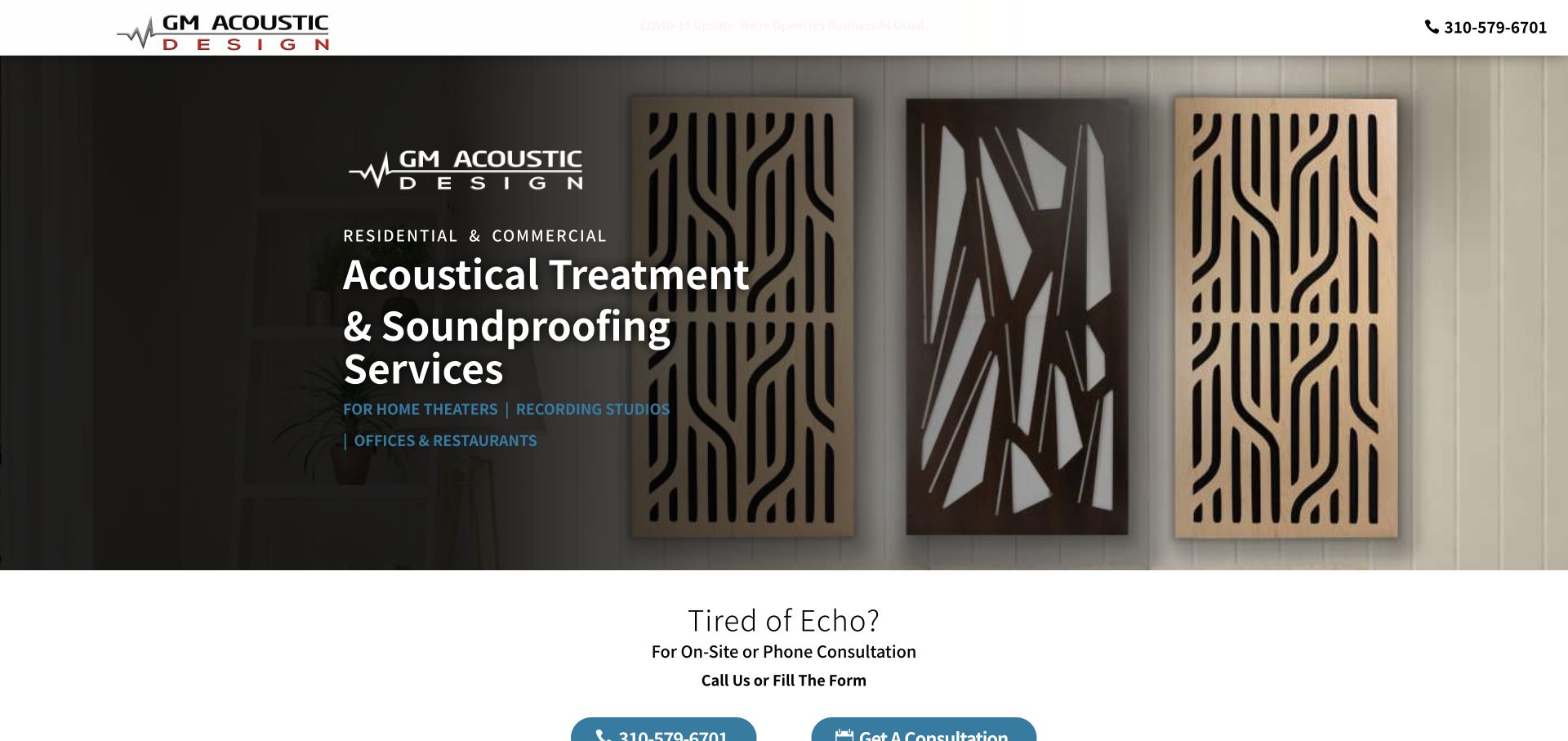
GM Acoustic Design uses a large photograph of sculptural wall panels and a simple telephone-led header. The page names home theatres, studios, offices and restaurants, then explains consultation, custom design and delivery or installation. A work gallery and room-type images reinforce the custom-manufactured offer. The product is presented as a visible part of a room, not merely an unseen performance claim.
What you can learn
Show the finished panel as part of the interior and explain how a custom order becomes an installation. Keep consultation, fabrication and fitting distinct enough that the client knows what information is needed next.
Pros
A strong installed-panel photograph demonstrates the visual role of treatment.
Consultation, design and delivery/installation give the service an understandable sequence.
Cons & considerations
Different phone numbers in rendered and underlying content need reconciliation.
Rapid-turnaround and acoustic-performance language need conditions rather than an assumption that every room follows the same schedule.
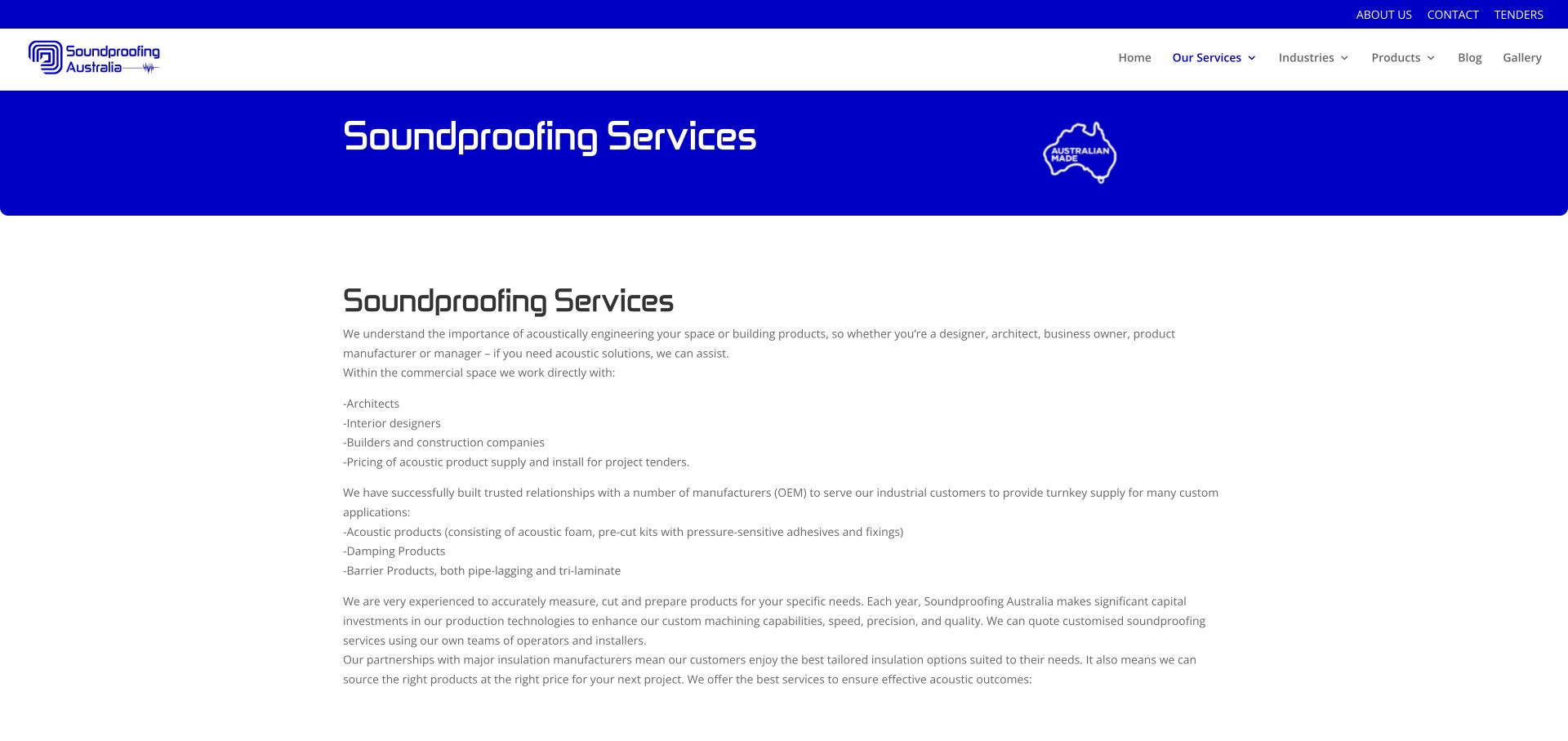
Soundproofing Australia’s service page separates installation, wrapping, cutting and laminating rather than grouping all work under a generic solutions label. The introduction names architects, designers, builders and product manufacturers, and explicitly describes its own operators and installers. A blue title strip and straightforward service links establish orientation, although much of the supporting detail appears as long unbulleted text blocks.
What you can learn
Describe the work being bought, not only the material being supplied. Installation, machining and wrapping involve different inputs and responsibilities, so give them distinct pages and concise scope explanations.
Pros
Fabrication services and site installation are individually named.
The business identifies several professional audiences and its own installation capability.
Cons & considerations
Long text blocks would be easier to compare with concise summaries and structured lists.
Repeated broad best-service language adds less value than specific process, scope and evidence.
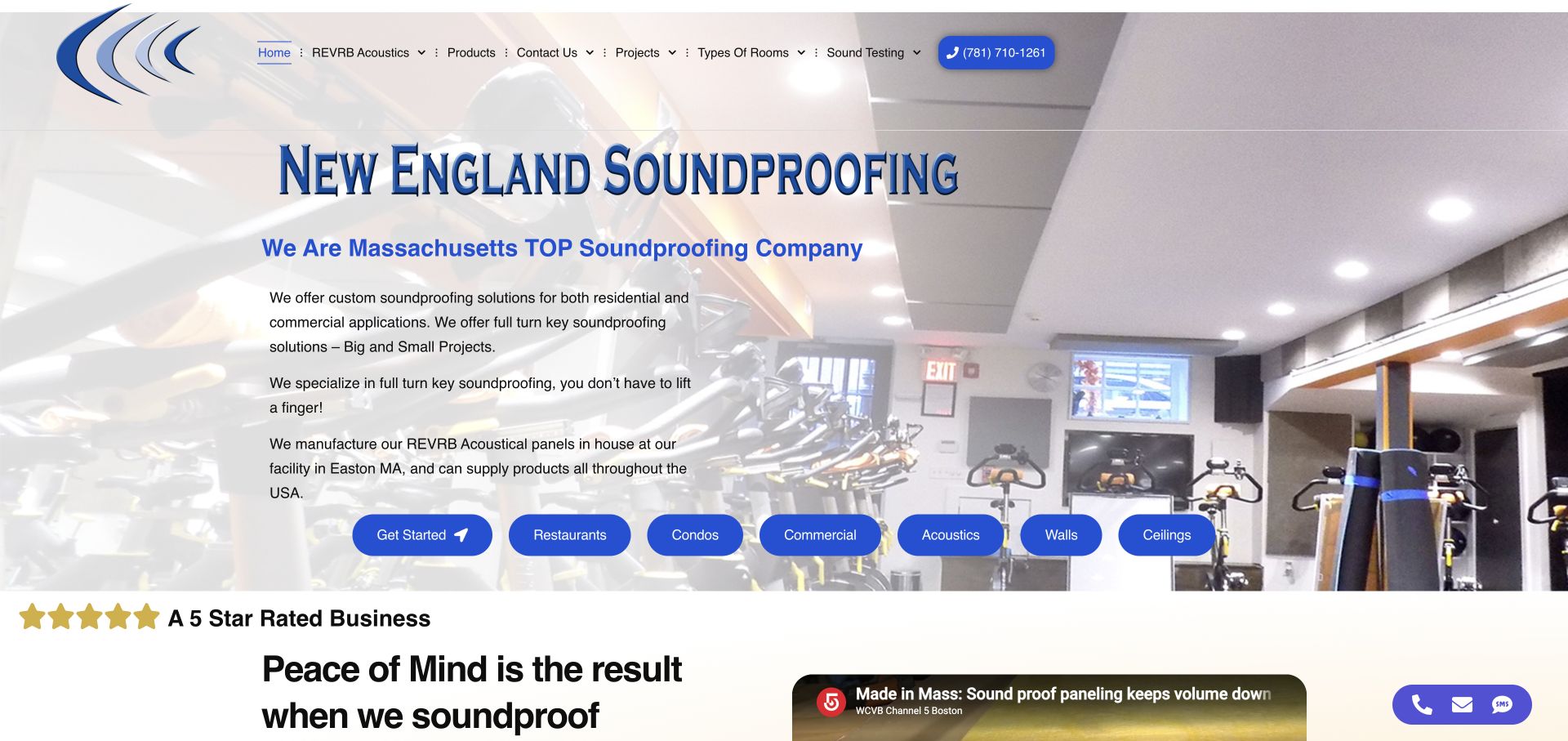
New England Soundproofing pairs a photographed restaurant ceiling with Massachusetts positioning and short routes for restaurants, condos, commercial spaces, acoustics, walls and ceilings. It explicitly describes turnkey work and its own REVRB panel manufacture, while product-store and sound-testing routes acknowledge different tasks. The site shows that regional installation and nationwide product supply can share a homepage when the reader can distinguish them.
What you can learn
Offer recognizable room or problem routes, then distinguish installed service coverage from product shipping. A locally installed offer and a national store need separate expectations and contact details.
Pros
Room-type shortcuts help readers recognize a relevant starting point.
Installation, testing and manufactured-product routes are all visible.
Cons & considerations
The reviewed header telephone used a page-hash destination rather than a telephone link.
Superlatives and star-rating statements need current supporting records and should not substitute for project evidence.
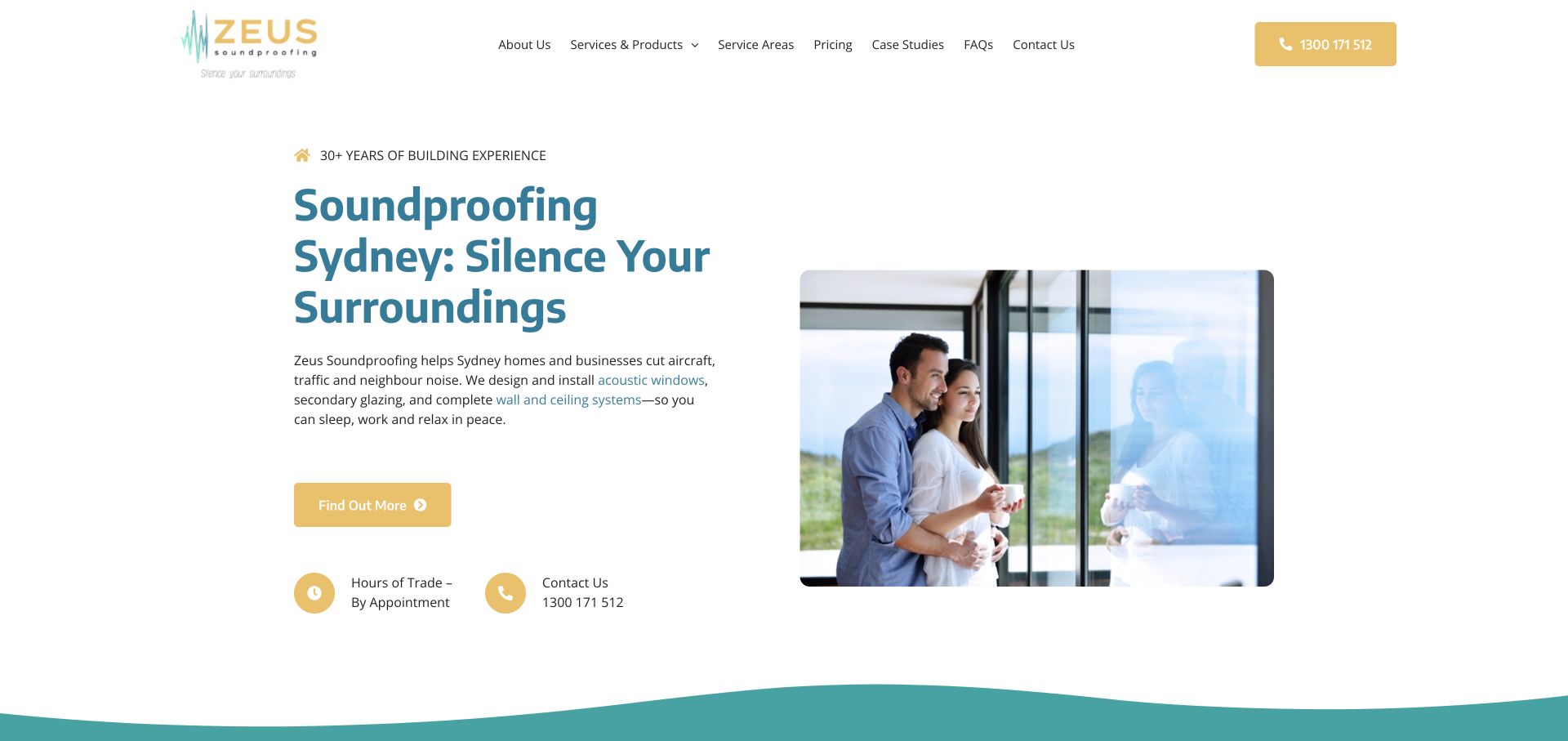
Zeus Soundproofing uses a readable split layout with a domestic lifestyle photograph, then immediately names Sydney, aircraft noise, traffic and neighbours. The opening copy explicitly describes design and installation of acoustic windows, secondary glazing and wall and ceiling systems. Pricing, service areas and case-study routes support practical research, while the founder explains his role in sales and installations further down the page.
What you can learn
State the location, problem and installed scope in the opening paragraph. A named person’s responsibility and practical pricing and coverage routes can make a local service easier to investigate than another general promise of quiet.
Pros
The local problems and installation systems are identified immediately.
Pricing, coverage and named responsibility provide useful follow-on research routes.
Cons & considerations
A lifestyle image needs genuine project photography to show the actual installed work.
Testimonials, qualifications and permanent-solution language need appropriate evidence and conditions rather than being accepted as universal guarantees.
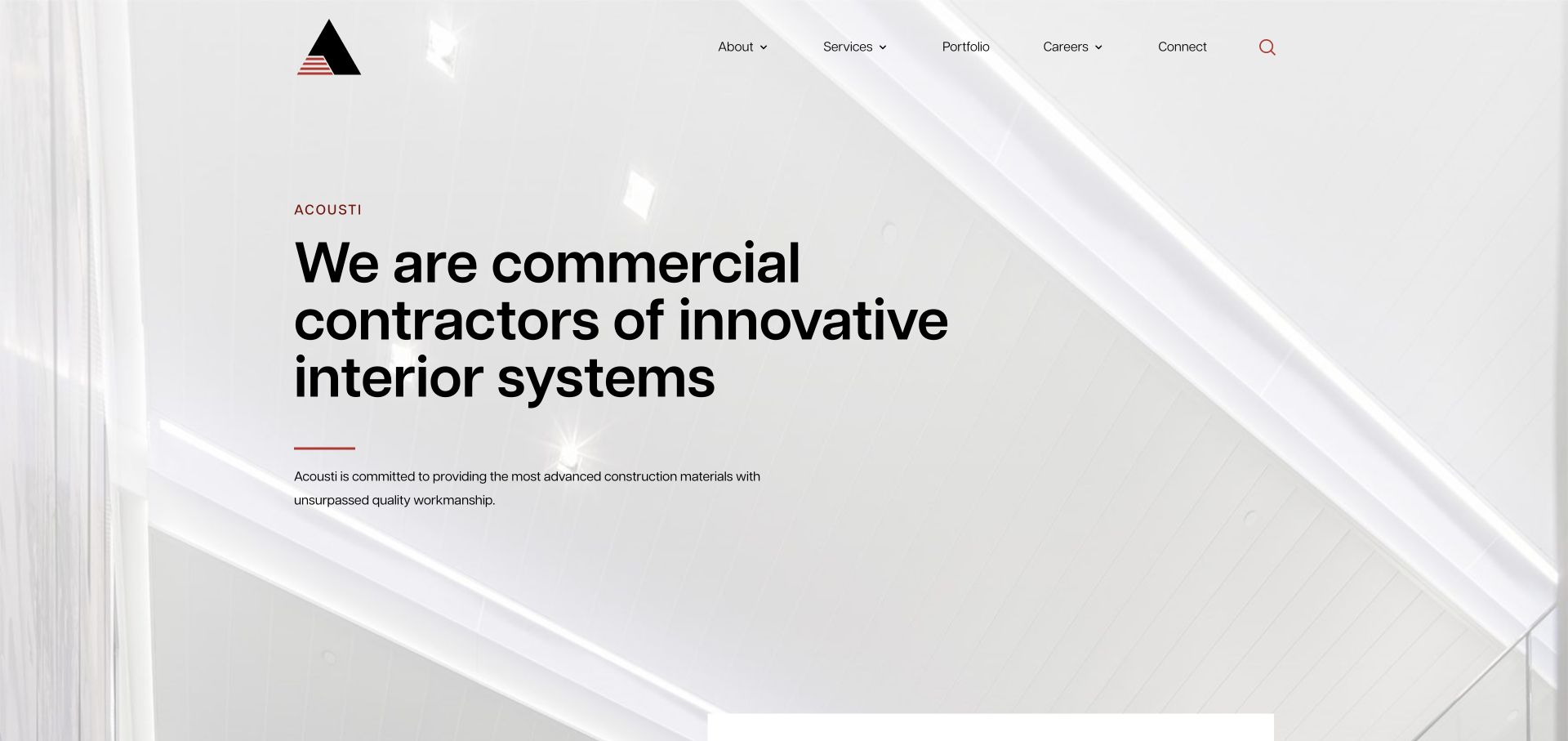
Acousti uses a pale ceiling photograph and oversized black commercial-contractor statement rather than a busy product grid. Acoustical ceilings and sound-control systems sit beside drywall, access floors and other interior packages. A named aeronautical-training-centre project gives the portfolio a concrete entrance, while the connection route acknowledges a branch-based business. The acoustic scope is part of a broader interior-construction offer, not a claim to independent consultancy.
What you can learn
Give a broad contractor a simple positioning statement, then expose the specialist work packages and a named case. Clarify the difference between installed construction services and independent acoustic advice.
Pros
Specific acoustic-system links prevent the broad interior offer becoming vague.
A named featured project supports further portfolio research.
Cons & considerations
The opening statement needs the service categories below it to establish acoustic relevance.
Branch-based contact routes should make regional availability and the correct estimating team easy to identify.
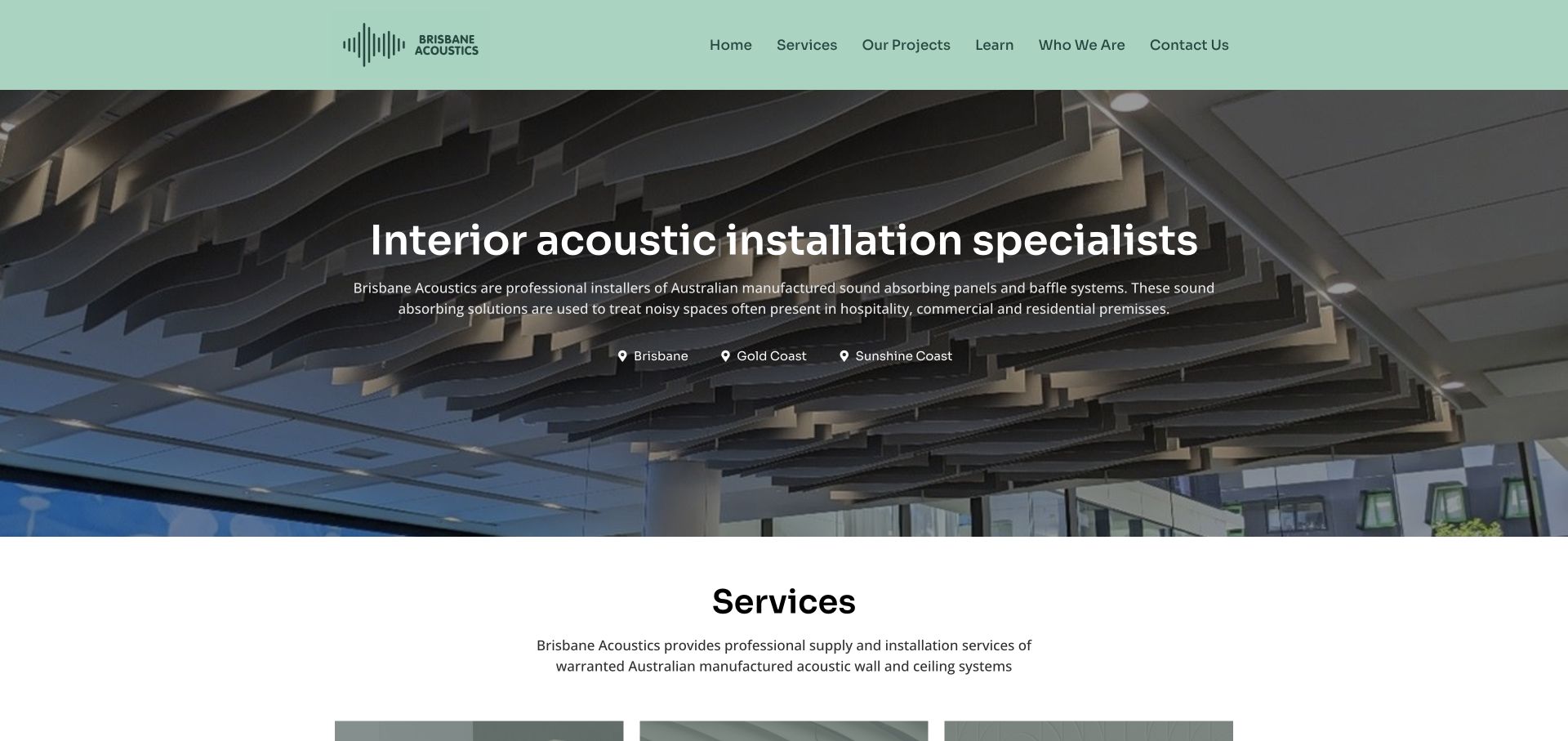
Brisbane Acoustics makes interior acoustic installation explicit over a real installed-baffle image. Brisbane, Gold Coast and Sunshine Coast coverage appears in the opening section, followed by design, ceiling and wall choices. The page links named office, hotel and dealership cases and provides a reverberation-assessment route. Its focused scope and local geography give an otherwise visual material category a practical project context.
What you can learn
State the installation region and separate material-selection support from ceiling and wall work. Named cases and an assessment route help a prospective client move beyond liking the photograph toward defining a real project.
Pros
The installation specialty and local coverage are visible immediately.
Named case studies connect material systems with recognizable project contexts.
Cons & considerations
A quote action sits below substantial introductory content and may deserve a clearer first-screen route.
Building-standard and product-testing statements need current system-specific documentation rather than a blanket assumption.
Kegan is a freelance web designer and developer with 15+ years of experience helping businesses turn complicated website requirements into clear, maintainable digital experiences. He works directly with clients from planning and design through development, launch, and ongoing support.
For acoustic contractor website design, his development approach focuses on noise and acoustic treatment scope, project context, product and installation information, and clear site-assessment and specification enquiry journeys. The scope can be a targeted improvement or a complete custom build, with responsive layouts, thoughtful content structure, and integrations chosen around the people using and maintaining the site.
Show 3 other acoustic contractor website designersHide other acoustic contractor website designers
Plan an acoustic contractor website around the problem and the work package
Separate room acoustics from sound isolation before choosing the layout
Start with the questions people actually ask: Is the room too echoey? Can speech be understood? Is noise entering through windows? Is sound passing through a wall or floor? Does machinery disturb an adjacent space? These questions should not all lead immediately to the same generic panel page. Commercial Acoustics separates absorption, blocking and masking; Daimon’s treatment page explicitly distinguishes sound inside a room from transmission into or out of it.
Choose a primary audience for each service page. Quietco discusses the household benefit of staying in a loved home. Florida Acoustics & Framing addresses general contractors and bids. AGS Noise Control shows an industrial enclosure. Those introductions work because the project context differs. The main navigation can support several audiences without requiring every page to speak to all of them at once.
Use ordinary problem descriptions alongside the technical term. Sound Planning’s standards list needs explanatory context; Valley Acoustics discusses reverberation and speech intelligibility in relation to recognizable rooms. Do not simplify the service so far that absorption is promised as sound isolation. The website should help the reader ask a better question, not diagnose a specific building without investigation.
Make the delivery boundary visible before the quote form
Write down which activities the business actually carries out: initial discussion, on-site survey, technical design, manufacture, supply, installation and verification. Resonics presents a contractor-and-survey relationship. Oscar Acoustics connects specialist finishes with installation. Express Acoustics separates supply-only work from assessment and own-team installation. The words full service should not conceal important exclusions.
Explain responsibilities that involve another party. Valley Acoustics says its crew installs absorptive systems while isolation designs are built by the customer’s licensed contractor. Axis describes coordination with consultants and engineers. Zeus names the founder’s role in sales and installations. These are useful examples of setting expectations without pretending that every project follows one procurement model.
Keep optional work clearly labelled. Acoustic Design & Architecture describes before-and-after measurement as an additional paid service. A free room review is not automatically a full assessment or a compliance test. A prospective client should be able to understand what the initial enquiry starts, what information is required and which later stages need a separate scope or fee.
Build case studies around contribution and evidence, not only beautiful ceilings
Photograph the installed result at a scale that explains the intervention. Resonics and Brisbane Acoustics show baffles in rooms; Cityproof shows an interior window from the occupant’s perspective; AGS shows an enclosure. Include room use, project context, the installed package and the company’s contribution. Distinguish the contractor’s work from the wider architecture, interior design or other trades.
Add close-ups and documentation where they answer a real question. A seamless finish needs a whole-room view as well as material information. Acoustic products may have relevant fire, durability, cleaning, acoustic or environmental records, but the website must state the actual system and scope. A product test is not automatically a field result for every installed assembly, and a project photograph does not establish either.
If publishing measured results, explain the method, conditions, date, measurement responsibility and limits. Avoid transferring percentages from one window, room or enclosure to every property. Keep testimonials recognizably separate from technical evidence. The collection evaluates public website design; it does not independently validate project outcomes, contractor qualifications or company performance claims.
Design the enquiry and maintenance structure for the actual business
Qualify the enquiry with geography and project type. Acoustix distinguishes national commercial work from a residential radius around Leeds. Brisbane Acoustics names three local regions. Bospray exposes north and south contact routes. Product shipping coverage should not silently become installation coverage; New England Soundproofing illustrates why those tasks need separate expectations.
Let a homeowner describe the noise and location without demanding a technical diagnosis. A bid enquiry can instead ask for drawings, scope, programme and procurement details. Explain file limits, privacy and the next step before requesting photographs, plans or recordings. Do not publish client addresses, room security details or confidential project information merely because it would make a more impressive portfolio.
Plan ongoing checks for telephone links, regional contacts, product documents, project permissions and old notices. The reviewed Bospray and New England telephone destinations show how a printed number can look useful while its link is not. Review carousel actions and accessible button names too. A source can communicate its service well and still contain details worth improving rather than copying.
The editing job behind the design
Choose a content system that maintains scope, projects and documentation
Model service type, installation region, room context, material system, project contribution and enquiry destination as explicit content fields. A specialist installer needs a different structure from an online material store even when both use the same product photographs.
Keep current specification documents and test references associated with the correct system and revision. Make case-study permissions, client confidentiality and image attribution part of the editorial workflow rather than an afterthought.
Visible website technology is separate from an acoustic design method, test equipment or a building assembly. Unknown technologies remain unlisted until a bounded public source audit supports a specific observation; a screenshot cannot establish the business’s internal tools.
Our WordPress website examples offer a separate look at publishing approaches. A visible platform label is evidence for that named page, not a guarantee that the same system will suit your requirements.
Before the public launch
Acoustic contractor website planning checklist
Identify whether the service concerns absorption, isolation, masking or industrial noise control.
Name the main client and project type on each service page.
State installation regions separately from product shipping.
Explain who surveys, designs, manufactures, supplies and installs.
Label work performed by another contractor.
Distinguish optional measurements from included services.
Show real installed projects with precise contribution captions.
Keep technical claims tied to the relevant system and conditions.
Separate testimonials from measured project evidence.
Provide an enquiry route suited to homeowners or construction bids.
Test telephone, brochure, case-study and carousel destinations.
Maintain accessible headings, contrast, motion controls and readable alternatives.
These checks are a project checklist, not a performance, legal, security, or accessibility certification. Test real journeys with the people responsible for the website before making claims about the result.
Sources & editorial method
How this collection was selected and reviewed
These 29 company websites were directly inspected and captured in a real browser. The collection includes homepages and clearly labelled service or landing pages where they explain the installed scope more precisely. Public service descriptions established an installation or construction role; report-only consultants were not included as contractors. The Editors Choice recognizes specialist website communication rather than independently verified company size, workmanship or acoustic performance. Company ratings, qualifications, performance percentages and compliance claims were not independently tested. Screenshots record the reviewed page appearance, not a guarantee that its content or services will remain unchanged.
Each example links to its actual source page. Screenshots are direct browser captures with their own capture dates; moving imagery, announcements and live designs can change. The notes describe observable design choices and conditional tradeoffs, not measured traffic, conversion results, service quality, or accessibility conformance.
Technology labels use public page metadata, asset evidence, or explicitly cited platform documentation. Platform documentation is not a complete current deployment audit. A component reference may be legacy or unused; it is not a complete backend inventory. Unknown stacks are omitted. These sites are editorial examples, not our client portfolio.
Written, Edited and Curated are separate editorial records, not timestamps advanced by a rebuild. Website designs and imagery belong to their owners. See our editorial standards or suggest a correction.
Questions worth asking
Acoustic Contractor website design questions
What should an acoustic contractor website explain first?
Identify the problem, project context and actual work being offered. Room absorption, sound isolation, masking, soundproof windows and industrial noise control need different explanations rather than one generic product promise.
Should the site distinguish soundproofing from acoustic treatment?
Yes. Explain in ordinary language whether the work aims to change sound within a space or reduce transmission between spaces. A website should not present decorative absorption as a universal solution to neighbour or equipment noise.
What belongs in an acoustic installation case study?
Show the actual installed work, room or site context, the contractor’s contribution and relevant documentation. If results are measured, state the method, conditions, date and limitations instead of applying one figure to every project.
How should a supply-and-install business handle product-only enquiries?
Give supply-only and full installation clear routes, geography and expectations. Explain whether a survey, design, fabrication, fitting or testing is included or needs a separate appointment and scope.
Why is Resonics the Editors Choice?
The reviewed specialist site connects design-led installed rooms with clear space and system navigation and a practical survey route. The choice recognizes website communication and does not certify acoustic results or recommend appointing the company.
Make the problem understandable, show the installed scope and explain who is responsible for each stage. The useful lesson is a clearer project conversation—not a promise that attractive acoustic photography proves performance.