Definitive guide · Microsoft IIS website development
Microsoft IIS website examples with public deployment lessons (20 Real-World Examples)
Twenty public properties with precisely scoped IIS response evidence, original design reviews, and practical release-planning guidance.
A web-server signal says little about the visitor’s experience. These examples show why permanent routes, usable error pages, fresh notices, and clear service handoffs deserve as much attention as a successful homepage response.
Microsoft Internet Information Services is represented here by dated server-response evidence from the reviewed public page or its linked same-origin assets. A server header is self-reported information. It does not establish a complete deployment topology, CMS, programming language, runtime version, or the infrastructure of private services.
The visual references span education, utilities, childcare, subscriptions, transport, retail, and professional organizations. Their common planning problem is preserving useful public content while campaigns and connected applications change. The reviews keep those design lessons separate from the narrower technical observation.
Before the examples
What makes good Microsoft IIS website development in 2026?
Make URL behavior part of the release brief
Write down which destinations are permanent, which are temporary campaigns, and which older paths need a meaningful redirect. IIS URL Rewrite supports URL mapping and redirects, but the rules still require explicit intent and verification. Test the exact public path and its query behavior rather than assuming every request reaches the desired page.
An unavailable page should explain the problem and provide useful next steps. IIS supports configurable HTTP error responses; choose behavior appropriate to the application and confirm status codes as well as appearance. A branded error page should not falsely report a successful content response.
A public site may lead to account, booking, learning, or customer-service applications. Document each handoff and its owner. A server observation on the marketing page cannot identify the technology or availability of every connected system.
Imperial College London, Dominion Energy, KinderCare, BritBox, and Avanti West Coast open the collection. Each has a recognizable public property and exact recorded IIS evidence; asset-only observations remain explicitly qualified.
We start with five recognizable brands or organizations: Imperial College London, Dominion Energy, KinderCare, BritBox, Avanti West Coast. Each attribution applies to the named website property, not every product or website belonging to its organization. This is a curated reading sequence, not a measured ranking.
Imperial College London's opening pairs a large institutional wordmark with laboratory imagery and a prominent research-positioning message. Search and menu controls occupy a restrained upper band, while the broader reviewed page provides course discovery by study level and subject. The contrast illustrates two different public tasks: understanding the institution and finding a specific educational route. The sampled homepage response identified IIS. That server-reported association does not establish a CMS, application language, private student system, or the configuration serving every Imperial property.
What you can learn
For an IIS deployment with comparable content, define permanent routes for courses, departments, and applicant guidance before changing the homepage feature. Check redirects and error pages against those routes, and verify the search entrance after release. Include long course names and a direct visit to an older program URL in the acceptance checks.
Pros
The research photograph gives the institution a concrete human setting.
Course discovery in the reviewed page distinguishes different levels of study.
Cons & considerations
The large reputation message can precede the practical information an applicant needs.
The captured consent strip reduces the visible space available beneath the hero.
Platform source: Dated public page and linked-resource audit. server response header identifies IIS. The sampled public page response reported Microsoft IIS. Server-reported software is not a verified runtime inventory and does not identify private services, CMS, language, version, or configuration. Platform evidence is separate from the direct website screenshot and is not a complete current infrastructure audit.
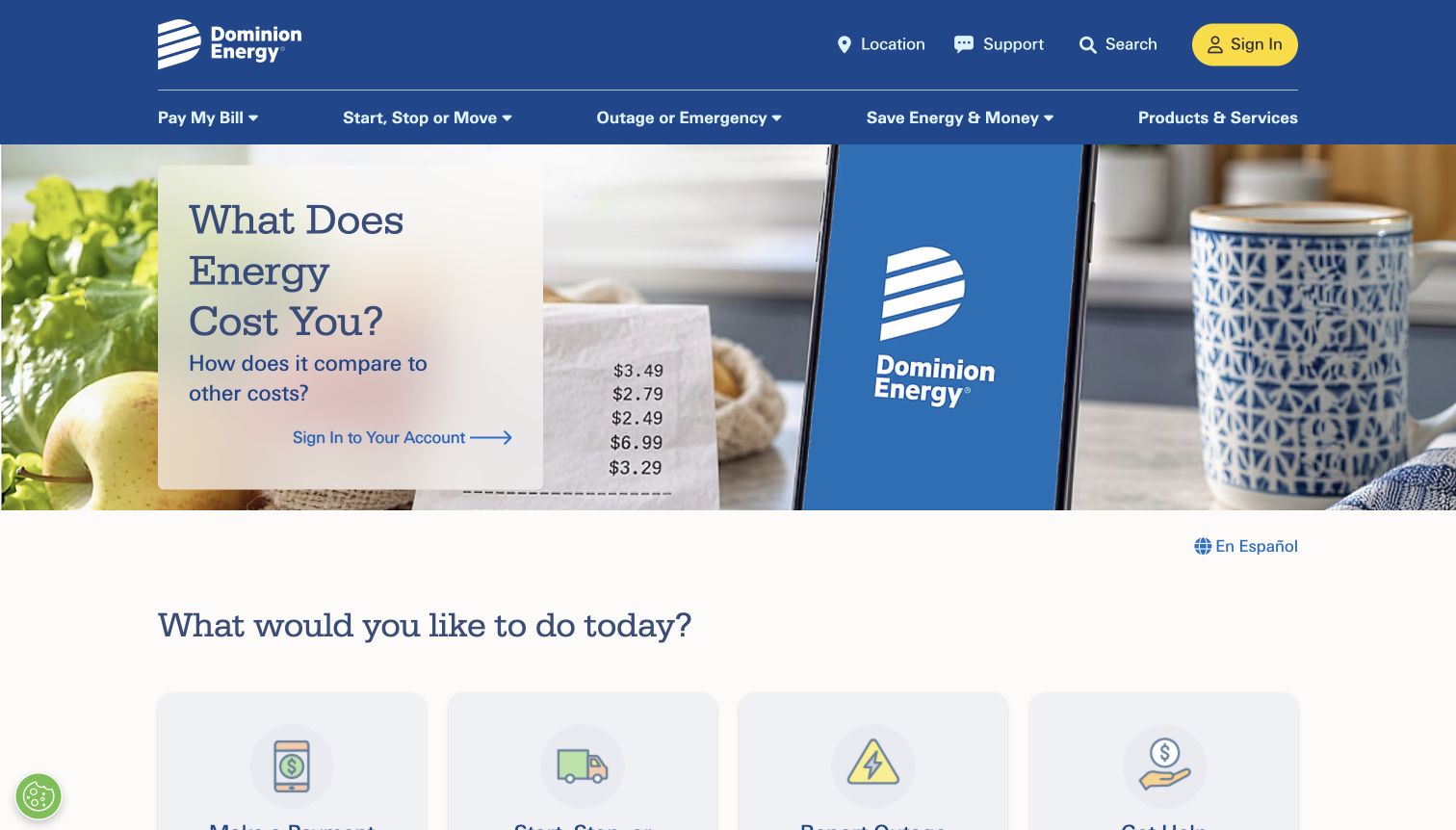
Dominion Energy's public homepage places location, support, search, and sign-in controls above a campaign about household energy costs. Below the photograph, a plain-language question introduces common customer tasks. The layout makes the service territory an important piece of context rather than merely a footer detail. An IIS identifier appeared in the sampled homepage response header. This supports a public-response association only; it does not identify the implementation of billing, outage reporting, or other services reached from the page.
What you can learn
Plan deployment checks around the selected territory and the destination of each task. A payment or assistance link should retain an understandable label even when it leaves the public content site. Verify canonical routes, regional redirects, and the handling of an unavailable destination. Keep urgent support accessible while a campaign changes, and make the current location easy to review rather than silently carrying an unexplained assumption.
Pros
Utility controls keep location and support visible before the main campaign.
The task introduction uses familiar customer language instead of internal departments.
Cons & considerations
A large campaign delays some of the practical choices below.
Regional service differences add complexity that a polished shared homepage cannot resolve alone.
Platform source: Dated public page and linked-resource audit. server response header identifies IIS. The sampled public page response reported Microsoft IIS. Server-reported software is not a verified runtime inventory and does not identify private services, CMS, language, version, or configuration. Platform evidence is separate from the direct website screenshot and is not a complete current infrastructure audit.
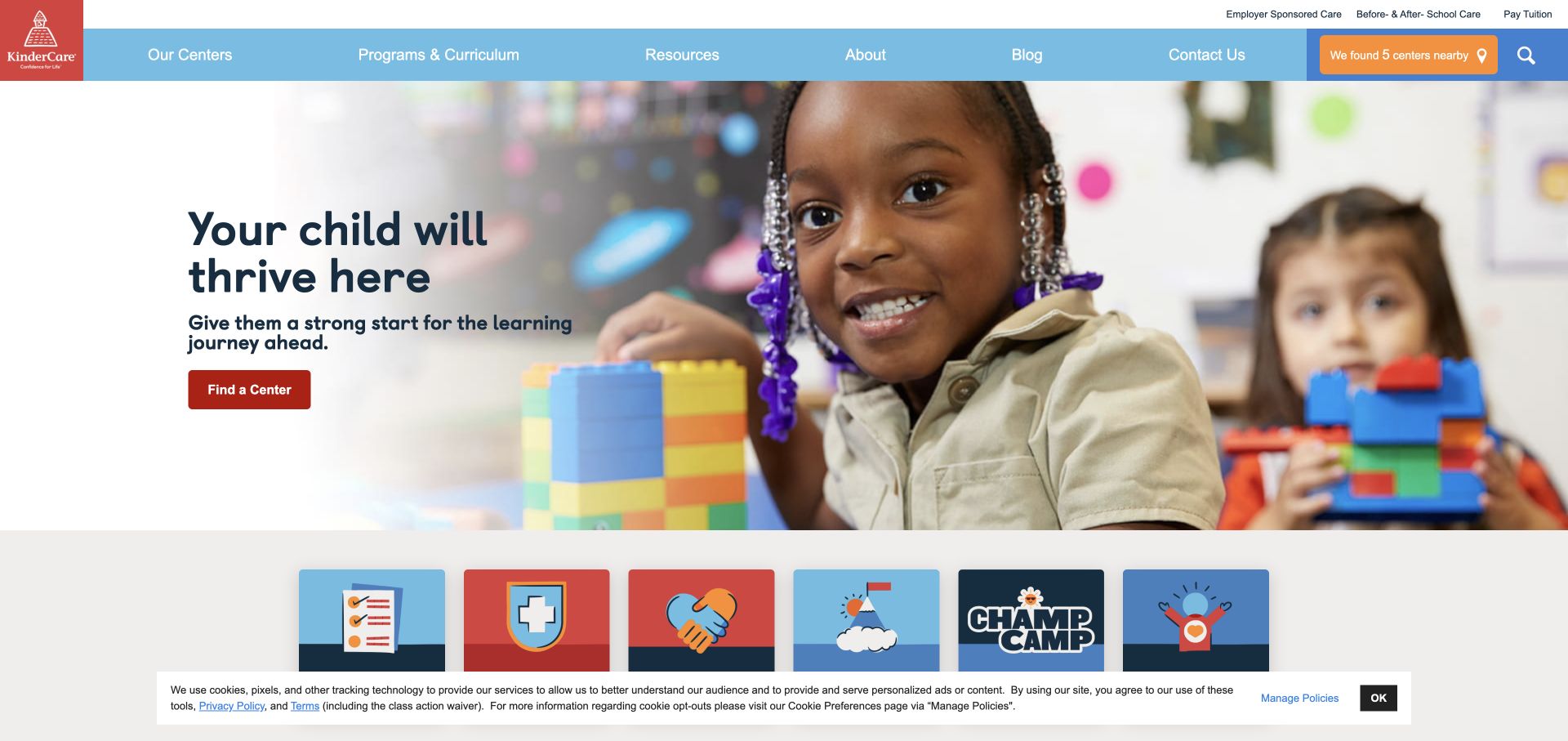
KinderCare combines bright branding with a classroom photograph, fading the image toward a pale text area. A Find a Center action sits beneath the headline, while programs, resources, and company information remain in the main navigation. The useful structure is a broad brand introduction with an obvious transition to local details. The reviewed public response reported IIS; that observation does not describe enrollment systems, family accounts, or the infrastructure of every individual center.
What you can learn
Treat center URLs as durable records when planning a similar deployment. Preserve location names and relationships to programs, and test a direct entrance from an older search result. Verify that missing or changed centers produce useful guidance instead of a generic failure. The national campaign should be replaceable without changing how a family reaches hours, age groups, and contact information at the relevant location.
Pros
The softened image edge gives the hero copy a readable background.
Location finding is available before a visitor reads the broader institutional story.
Cons & considerations
The national campaign cannot answer all questions about a particular center.
The retained consent strip competes for space near the bottom of the first screen.
Platform source: Dated public page and linked-resource audit. server response header identifies IIS. The sampled public page response reported Microsoft IIS. Server-reported software is not a verified runtime inventory and does not identify private services, CMS, language, version, or configuration. Platform evidence is separate from the direct website screenshot and is not a complete current infrastructure audit.
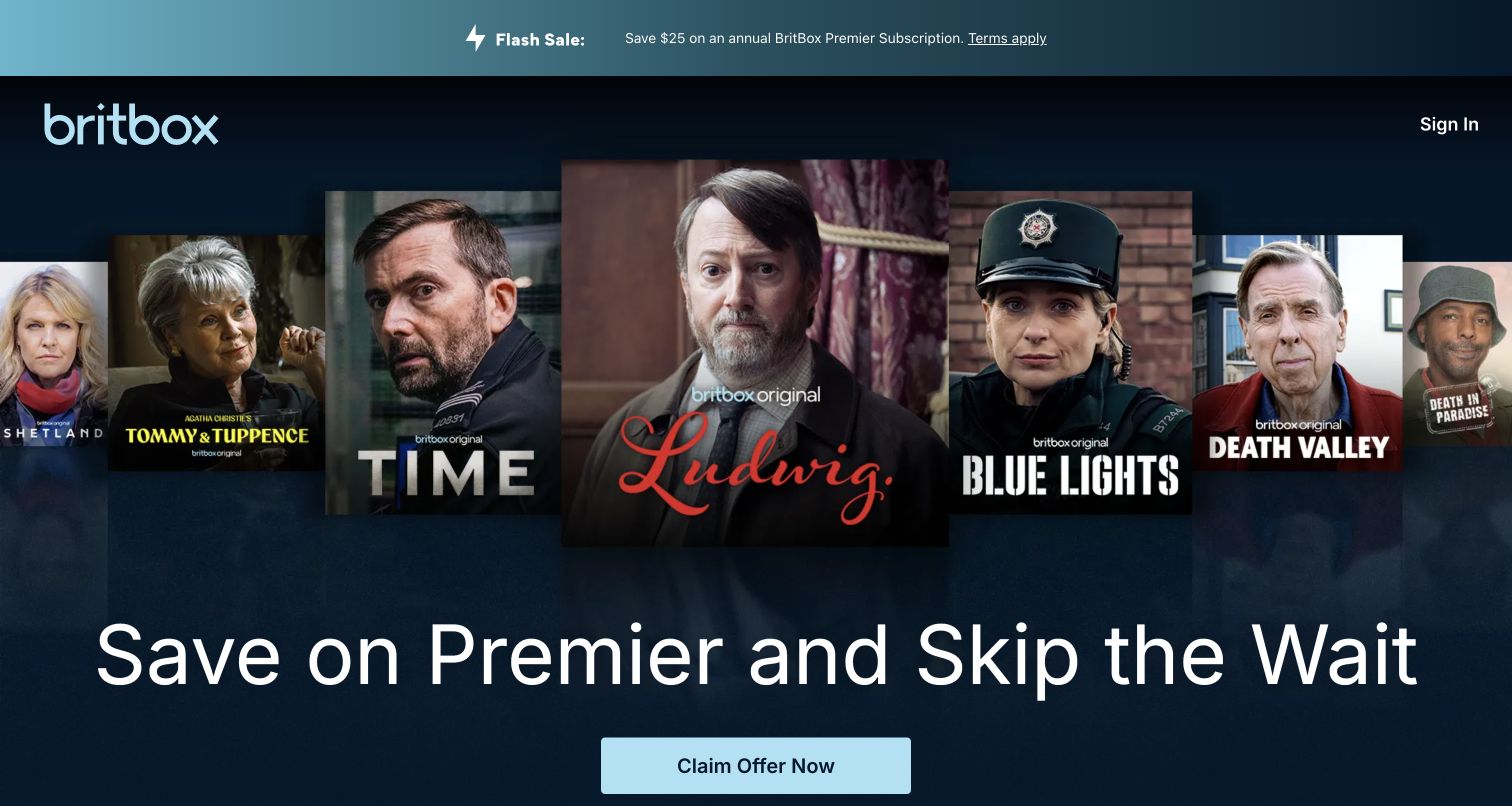
BritBox arranges recognizable program portraits above a large Premier-tier promotion on a dark blue background. Sign In remains in the upper-right corner, and a separate top strip repeats the incentive with a terms link. The page is focused on a timely offer while retaining a route for existing viewers. Its sampled public response identified IIS. This does not establish the streaming platform, account system, payment handling, or media-delivery architecture, which require separate evidence and testing.
What you can learn
For a similar marketing property, separate the campaign's public URL from the subscription service it introduces. Verify offer expiry, terms destinations, and redirects after a release, including a visitor returning through an old advertisement. Keep the plan comparison understandable before any commitment. A deployment is incomplete if the page renders correctly but a stale campaign still leads people to conditions that no longer match its headline.
Pros
Program artwork makes the service's editorial territory visible immediately.
The promotion includes a nearby route to its terms.
Cons & considerations
The Premier name assumes some understanding of the available membership tiers.
Repeated incentive messaging leaves less first-screen space for broader catalog explanation.
Platform source: Dated public page and linked-resource audit. server response header identifies IIS. The sampled public page response reported Microsoft IIS. Server-reported software is not a verified runtime inventory and does not identify private services, CMS, language, version, or configuration. Platform evidence is separate from the direct website screenshot and is not a complete current infrastructure audit.
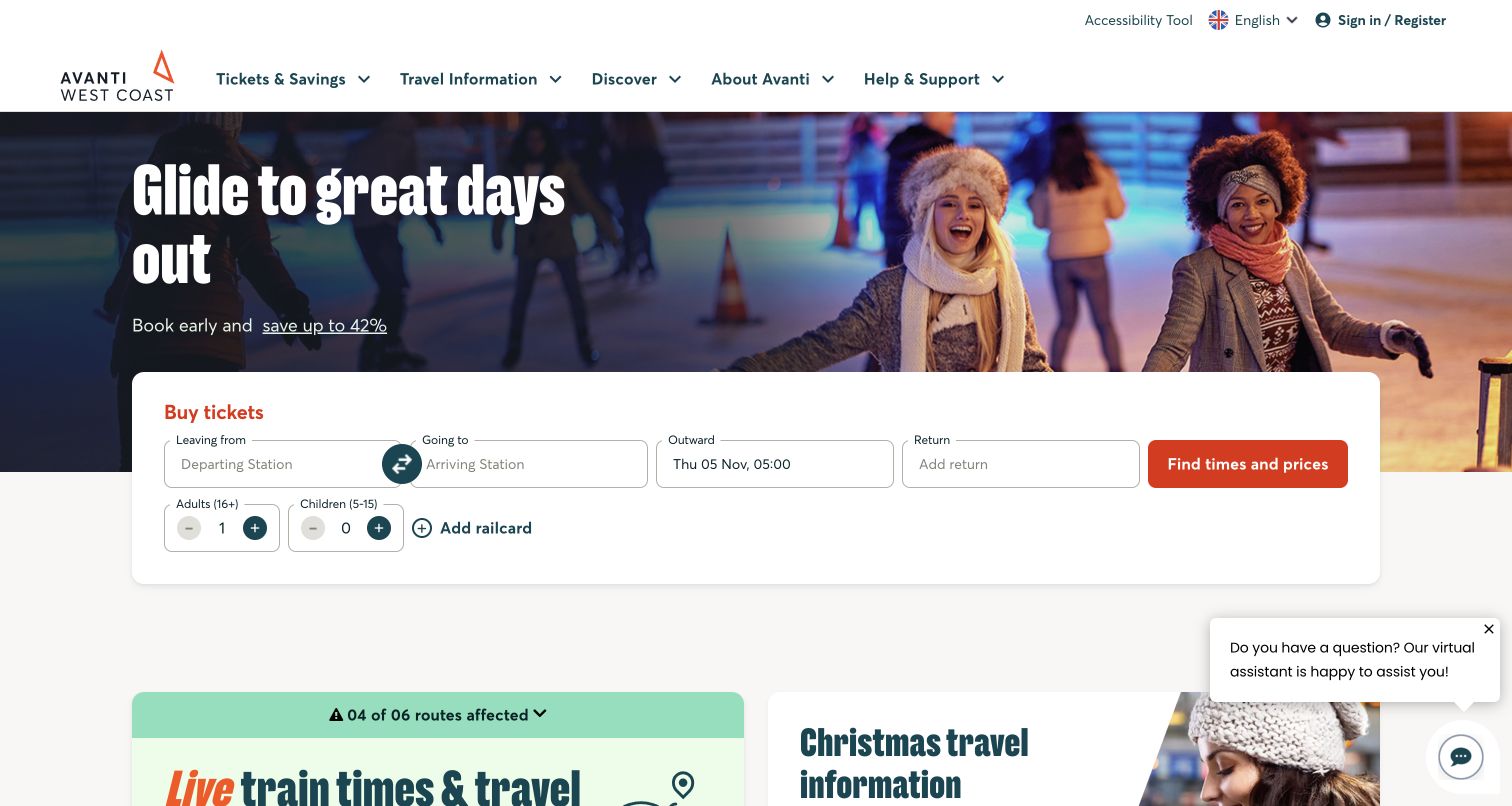
Avanti West Coast places a ticket-search panel over a seasonal travel image, with stations, dates, passengers, and railcard choices named directly. The action promises times and prices, while a separate panel below introduces live train information. Those tasks have different freshness requirements even though they share a brand. IIS was identified on a linked same-origin JavaScript response in the source-page audit, not established as the architecture of the booking or railway operations systems.
What you can learn
Use that distinction when designing a deployment checklist. Preserve stable information routes and verify that public assets and forms load from their expected destinations. Treat timetable and disruption information according to their own update rules rather than caching everything like campaign imagery. Test an old travel-information link, an unavailable search response, and the route back to the public homepage without completing a real booking.
Pros
The booking action explains the result it is intended to produce.
Live information is visibly distinguished from the sales-oriented journey panel.
Cons & considerations
The larger purchase module pushes operational information lower in the first view.
Chat prompts can compete with the service content near the page edge.
Platform source: Dated public page and linked-resource audit. server response header identifies IIS. Only linked same-origin asset responses reported Microsoft IIS; this is an asset-delivery association, not attribution of the whole application. Server-reported software is not a verified runtime inventory and does not identify private services, CMS, language, version, or configuration. Platform evidence is separate from the direct website screenshot and is not a complete current infrastructure audit.
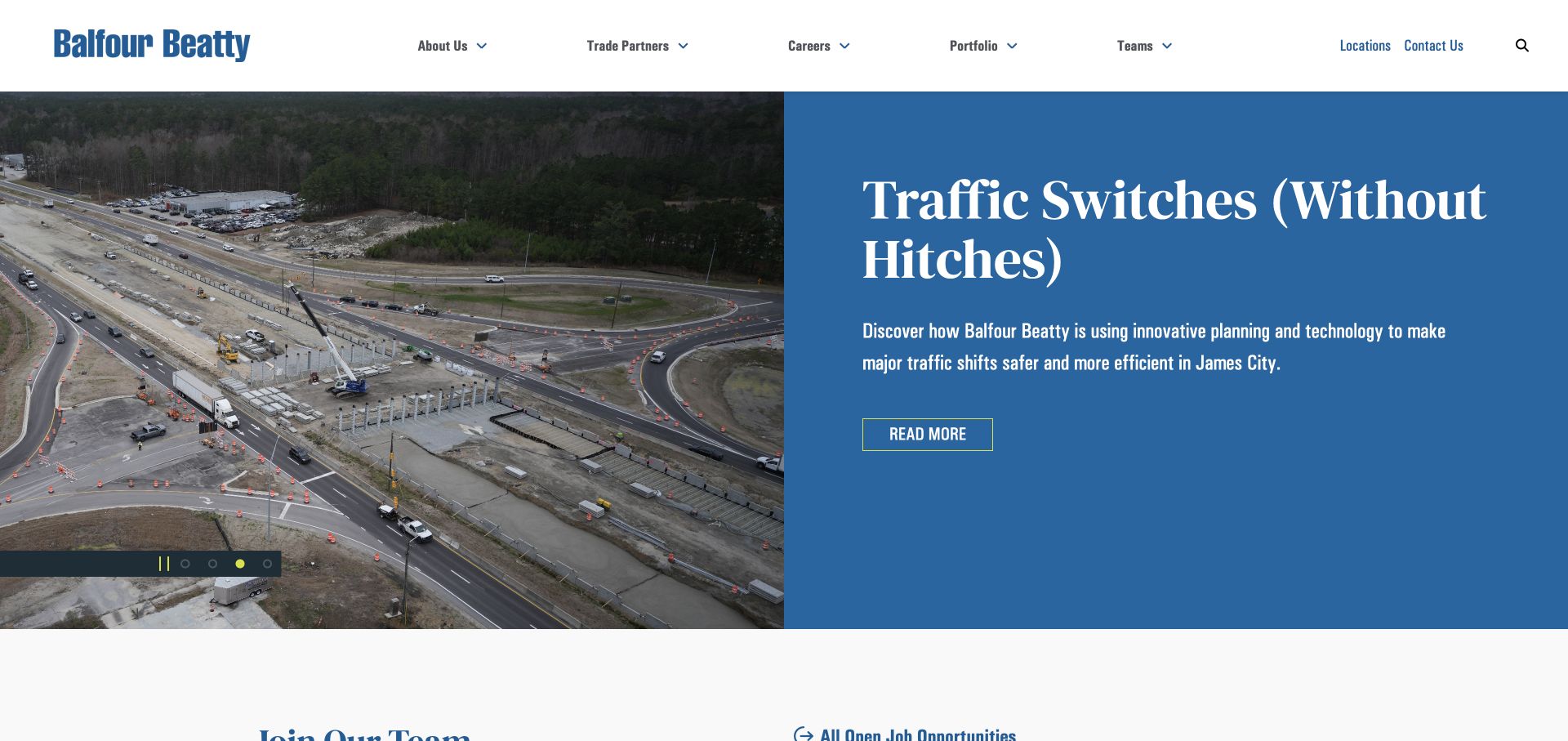
Balfour Beatty US uses a split hero pairing a road-project photograph with a blue editorial panel. The featured story can change while Portfolio, Teams, Trade Partners, Careers, Locations, and Contact keep their places in the navigation. This makes the homepage function as a current organizational front page without relying on the latest story to explain every capability. The sampled homepage response reported IIS; that server association does not identify project-management software or private partner services.
What you can learn
For a comparable release, maintain permanent project and capability routes separately from featured news. Check that removing an old homepage promotion leaves the article and its project relationships intact. Verify redirects for renamed offices and preserve the distinction between public trade-partner information and any private portal. A useful deployment review follows several audience paths, not just the newly edited opening screen.
Pros
Permanent portfolio and partner links remain available around the changing editorial feature.
The split composition provides a clear reading area beside the project photograph.
Cons & considerations
A timely story may not match a first-time visitor's immediate construction requirement.
News-led positioning needs ownership so an old feature does not become the default introduction indefinitely.
Platform source: Dated public page and linked-resource audit. server response header identifies IIS. The sampled public page response reported Microsoft IIS. Server-reported software is not a verified runtime inventory and does not identify private services, CMS, language, version, or configuration. Platform evidence is separate from the direct website screenshot and is not a complete current infrastructure audit.
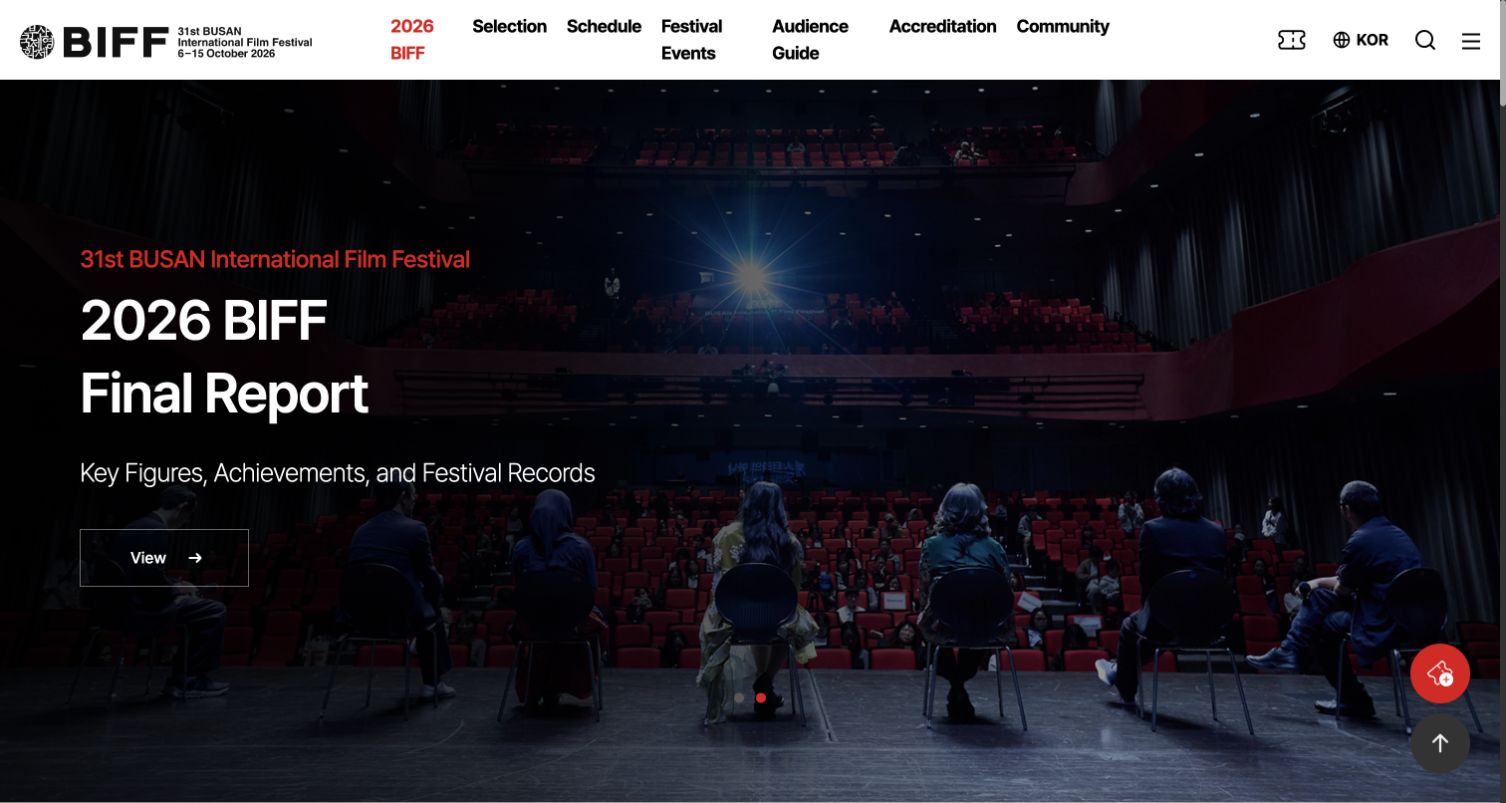
Busan International Film Festival promotes a final report over a theater photograph, with a clear edition year and a short explanation of the report's purpose. Selection, Schedule, Festival Events, Audience Guide, and Accreditation remain visible above it. The page therefore treats the completed festival as a new editorial phase rather than abandoning its useful records. The sampled English-language response identified IIS, without establishing the implementation of ticketing, accreditation, or other language properties.
What you can learn
Plan annual publication around stable, edition-aware URLs. Keep a past selection and schedule accessible while giving the next edition its own explicit context. Test redirects carefully so a previous film page does not become an unrelated current homepage. Confirm that report downloads, archive links, and language controls retain their intended destination after deployment, even when the main campaign changes from attendance to results.
Pros
The final-report feature gives the completed event a specific next story.
Audience guidance remains distinct from film selection and professional accreditation.
Cons & considerations
Archived schedules need unmistakable dates to avoid confusion with current availability.
Compact ticket and language icons require clear labels beyond their visual symbols.
Platform source: Dated public page and linked-resource audit. server response header identifies IIS. The sampled public page response reported Microsoft IIS. Server-reported software is not a verified runtime inventory and does not identify private services, CMS, language, version, or configuration. Platform evidence is separate from the direct website screenshot and is not a complete current infrastructure audit.
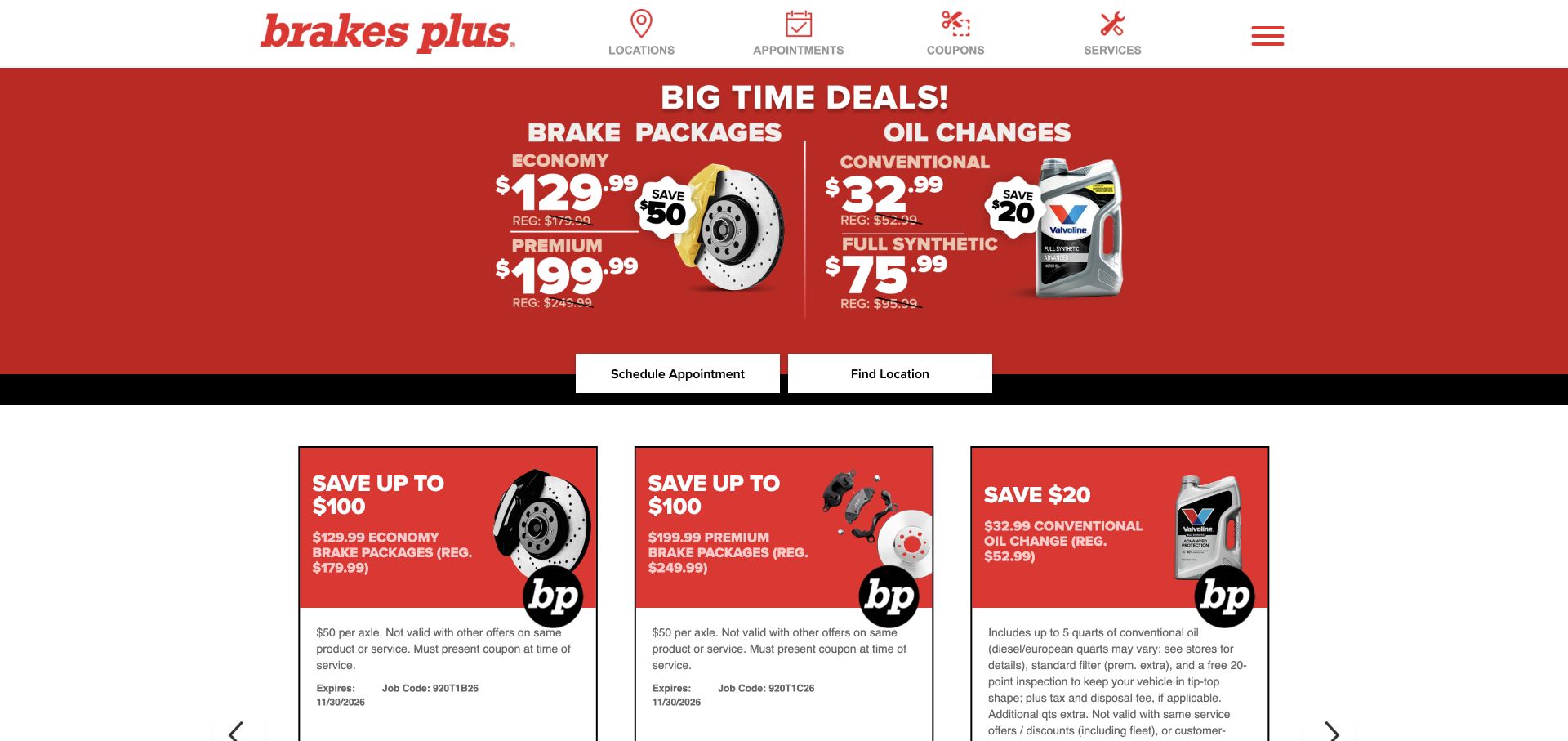
Brakes Plus uses a strong red offer panel for brake packages and oil changes, with Schedule Appointment and Find Location actions directly beneath. Compact header labels repeat the main tasks, while additional coupons occupy the next row. The structure makes commercial offers easy to see but leaves detailed eligibility and vehicle assessment to supporting content. The source audit identified IIS on a linked same-origin script response. It does not identify the scheduling backend or prove a single architecture for every connected service.
What you can learn
For a similar deployment, verify the relationship between each promotion, its conditions, and local availability. Keep package information at a stable destination that survives a homepage redesign. Check redirects, downloadable coupons, and error states without sending a real appointment request. A server update should preserve both the offer's wording and the context explaining what an appointment can actually confirm.
Pros
The primary offer connects directly to scheduling and location discovery.
The header limits itself to a small set of recognizable service tasks.
Cons & considerations
Repeated coupon blocks can crowd out explanations of repair categories.
Promotional prices need nearby conditions so they are not mistaken for a diagnosis or final quote.
Platform source: Dated public page and linked-resource audit. server response header identifies IIS. Only linked same-origin asset responses reported Microsoft IIS; this is an asset-delivery association, not attribution of the whole application. Server-reported software is not a verified runtime inventory and does not identify private services, CMS, language, version, or configuration. Platform evidence is separate from the direct website screenshot and is not a complete current infrastructure audit.
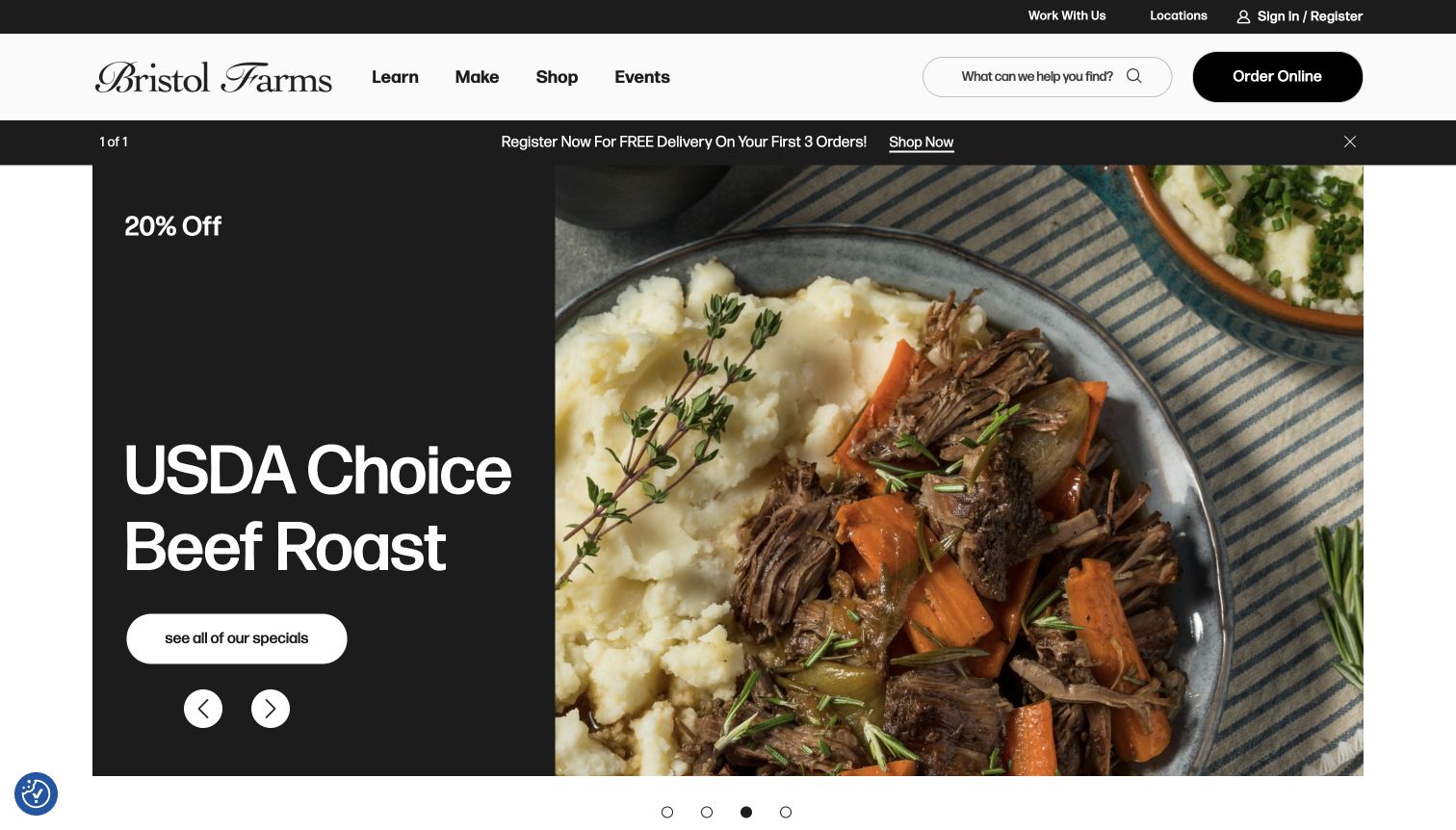
Bristol Farms pairs a dark text panel with a large plated-food photograph, using Learn, Make, Shop, and Events as its principal navigation. Locations and account access occupy the utility row, while a delivery strip introduces another shopping route. The visual economy keeps the food prominent, although some labels require interpretation. IIS was identified in the sampled public response, which does not determine the technology of delivery, loyalty, or external ordering services.
What you can learn
For this kind of public storefront, document where each concise navigation label actually leads. Verify that a seasonal special, a recipe, and a location page retain separate canonical destinations after release. Check document downloads and external ordering links as well as HTML pages. Keep offer dates and conditions in maintained content so a cached promotional image cannot become the only explanation of a shopping opportunity.
Pros
A solid panel gives the product name clear contrast beside the photograph.
The restrained navigation avoids presenting every department at once.
Cons & considerations
Learn and Make are less explicit than ordinary shopping-task labels.
The hero relies on its destination to explain the complete promotional conditions.
Platform source: Dated public page and linked-resource audit. server response header identifies IIS. The sampled public page response reported Microsoft IIS. Server-reported software is not a verified runtime inventory and does not identify private services, CMS, language, version, or configuration. Platform evidence is separate from the direct website screenshot and is not a complete current infrastructure audit.
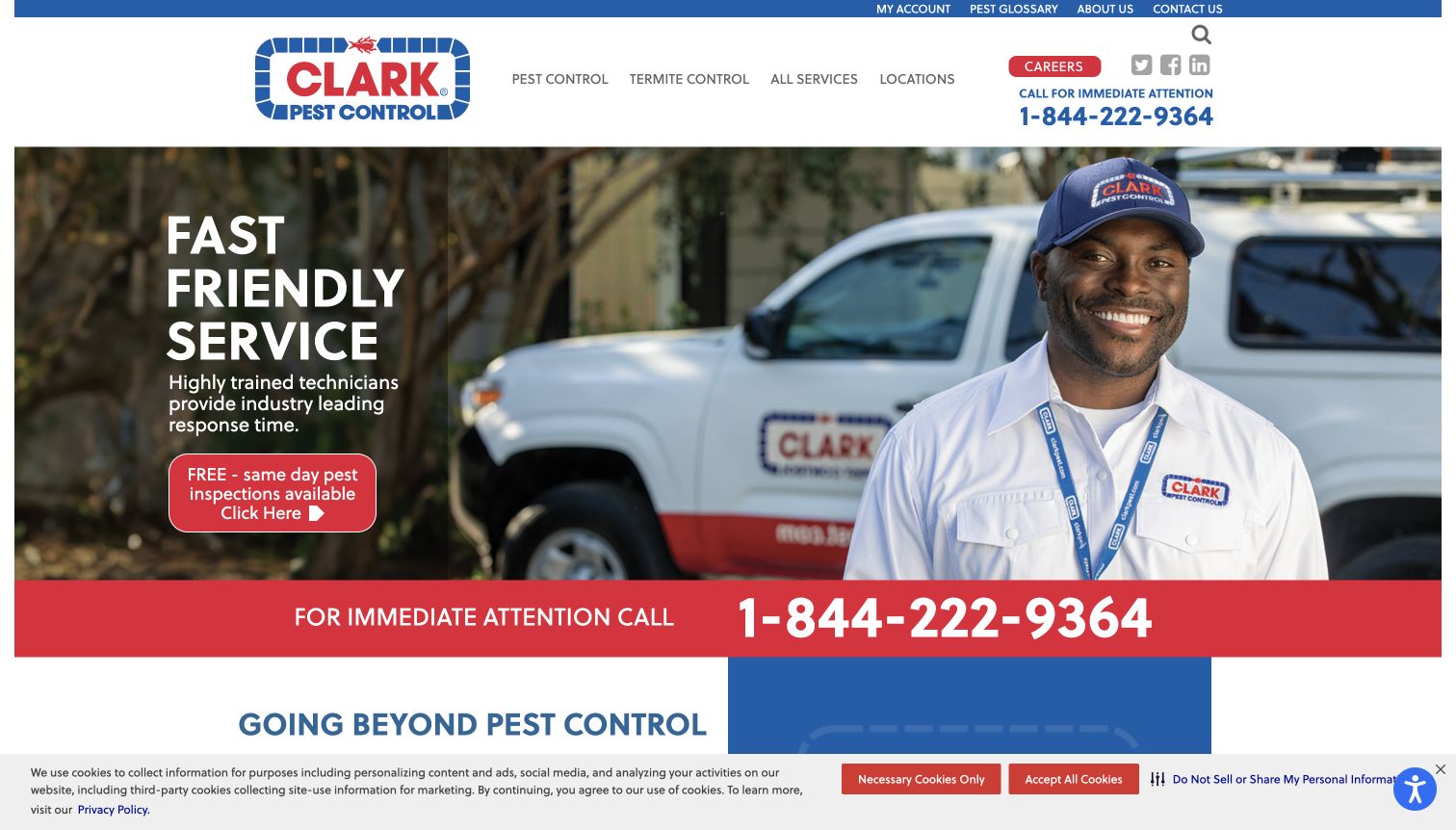
Clark Pest Control gives its telephone number substantial visual priority, including a red immediate-attention band beneath the technician photograph. The header also names pest control, termite control, services, and locations, while the image includes recognizable staff and vehicle branding. The page balances a rapid contact route with categories for visitors still identifying their problem. The sampled homepage response reported IIS; this evidence does not describe dispatch, customer accounts, or appointment handling.
What you can learn
When deploying a comparable service website, test phone links and geographic information as carefully as the main HTML. Preserve local service routes, keep the contact number consistent across templates, and check the fallback when an inquiry destination is unavailable. Separate public service descriptions from promises about a response that depends on an operational team. Verify narrow-screen ordering so the urgency message does not bury essential conditions or coverage details.
Pros
Telephone contact remains unmistakable in both header and hero-adjacent content.
Service categories give researching visitors another way to begin.
Cons & considerations
Repeated contact emphasis consumes space that could explain eligibility or service area.
The retained cookie panel adds another competing band beneath an already dense opening.
Platform source: Dated public page and linked-resource audit. server response header identifies IIS. The sampled public page response reported Microsoft IIS. Server-reported software is not a verified runtime inventory and does not identify private services, CMS, language, version, or configuration. Platform evidence is separate from the direct website screenshot and is not a complete current infrastructure audit.
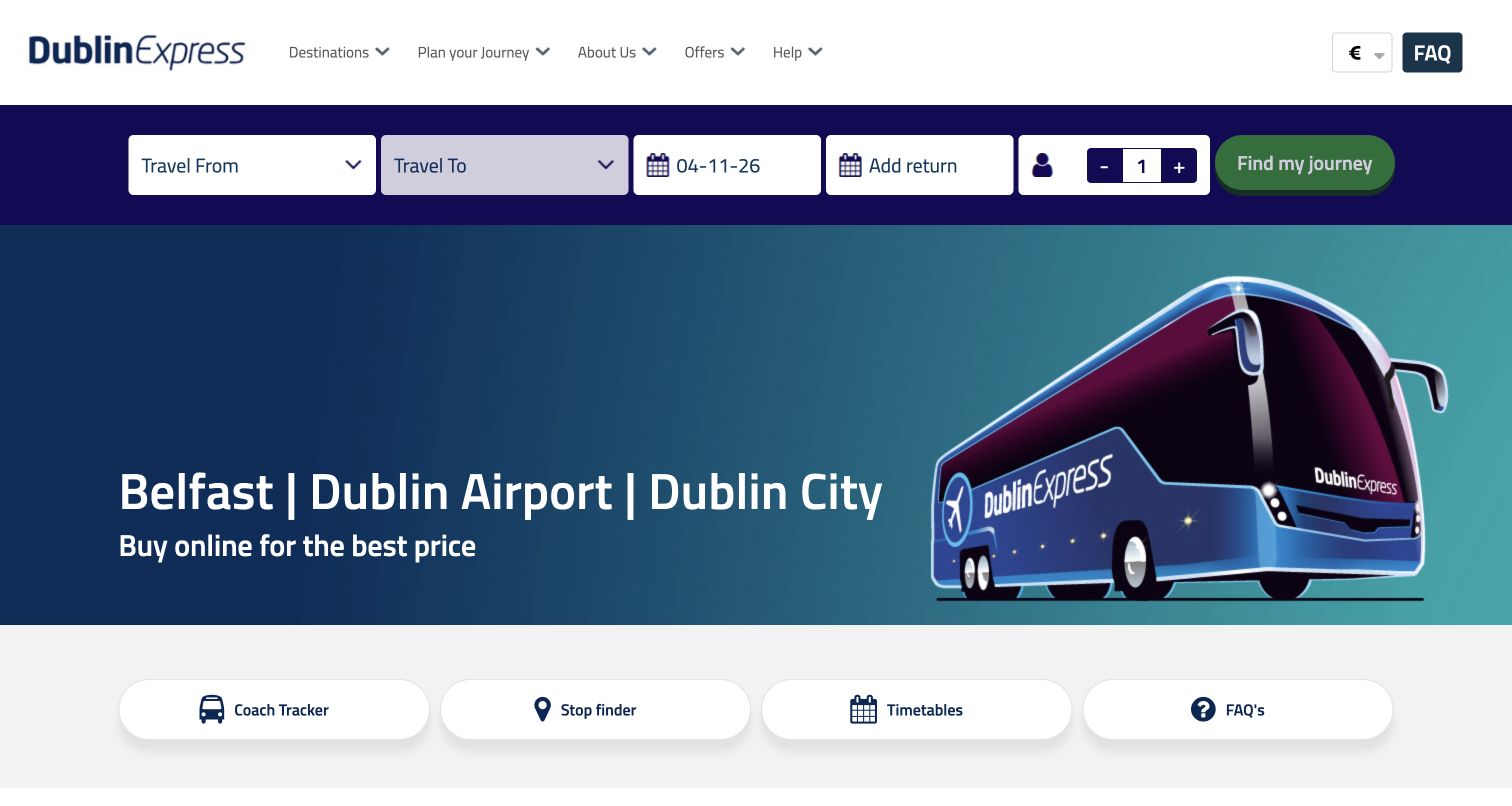
Dublin Express places its journey fields in a prominent blue strip above a branded coach image. Origins, destinations, travel dates, return travel, and passenger quantity form a compact sequence, with a clearly named search action. Coach tracking, stop finding, timetables, and FAQs appear as separate shortcuts below. The public response identified IIS, but that does not establish how fares, live tracking, payments, or booking accounts are implemented.
What you can learn
A useful deployment plan should distinguish the public information layer from connected operational services. Keep stop and timetable URLs stable, and test that the journey entrance remains usable when an asset is delayed. Verify route-specific notices and the destinations behind the four shortcuts without completing a purchase. Review how long airport and city names fit in the form, and ensure that a failed search retains enough context for a visitor to try again.
Pros
Journey inputs are available before the visitor reaches the large promotional image.
Operational shortcuts distinguish tracking and stop finding from a new purchase.
Cons & considerations
The compact form can become crowded with long station or airport names.
A strong price message still needs a destination explaining ticket scope and conditions.
Platform source: Dated public page and linked-resource audit. server response header identifies IIS. The sampled public page response reported Microsoft IIS. Server-reported software is not a verified runtime inventory and does not identify private services, CMS, language, version, or configuration. Platform evidence is separate from the direct website screenshot and is not a complete current infrastructure audit.
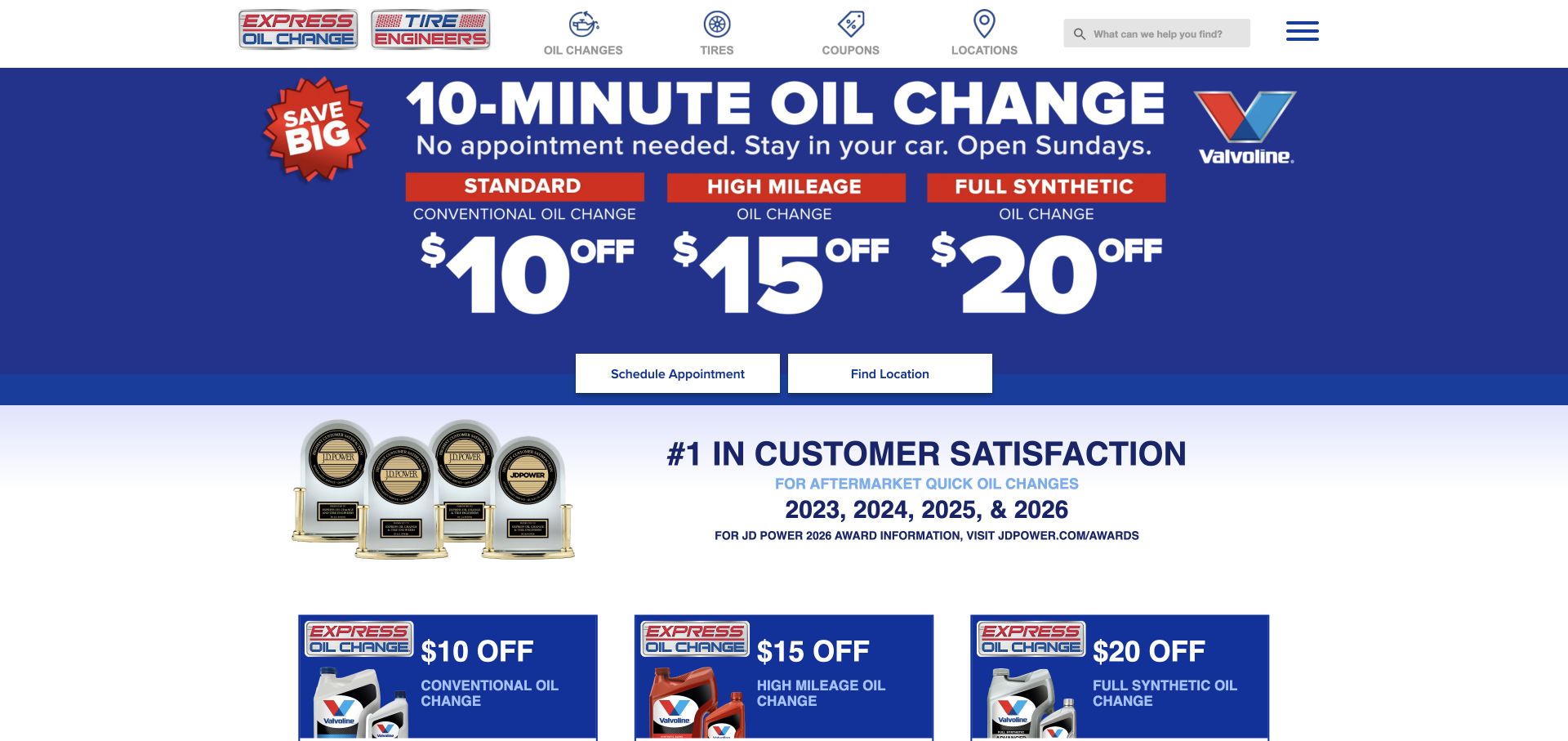
Express Oil Change & Tire Engineers leads with an oil-change promotion, placing scheduling and location actions underneath. The compact header offers icons for oil changes, tires, coupons, and locations, while a broader menu accommodates other services. The presentation favors a frequent task that many visitors already recognize. IIS was reported by a linked same-origin script response in the audit; the evidence does not identify the booking system or establish how every store manages appointments.
What you can learn
For a similar website, define public service pages independently from promotional panels and keep local availability explicit. Verify coupon destinations, permanent tire information, and phone or scheduling links after a release. Include an outdated offer URL in redirect checks. Distinguish a quick-maintenance proposition from work requiring a separate assessment so a campaign's speed claim does not silently become a promise about all repairs.
Pros
The repeated location route supports visitors who already know the service they want.
Primary actions sit directly below the highlighted maintenance offer.
Cons & considerations
The dominant oil-change campaign can obscure the broader repair catalog.
Time-oriented promotion needs precise scope and current supporting conditions at its destination.
Platform source: Dated public page and linked-resource audit. server response header identifies IIS. Only linked same-origin asset responses reported Microsoft IIS; this is an asset-delivery association, not attribution of the whole application. Server-reported software is not a verified runtime inventory and does not identify private services, CMS, language, version, or configuration. Platform evidence is separate from the direct website screenshot and is not a complete current infrastructure audit.
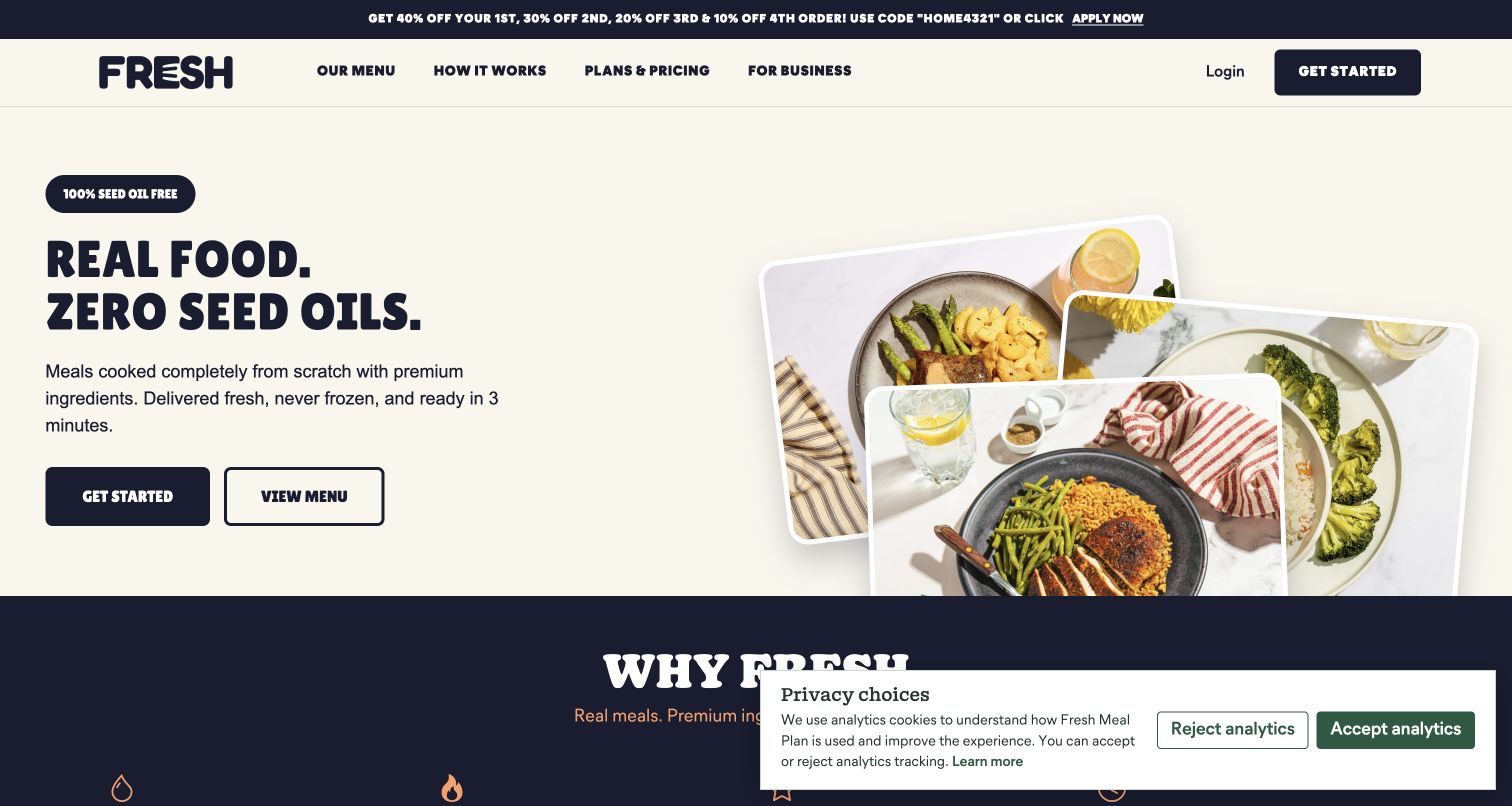
Fresh Meal Plan uses a cream background and a collage of prepared dishes beside a short product-standard message. Get Started and View Menu give visitors different commitment levels, while Plans & Pricing is explicitly named in the header. The page links a distinctive food proposition with practical ordering information. Its sampled public response identified IIS, which does not establish the infrastructure behind subscriptions, payment, delivery scheduling, or customer accounts.
What you can learn
Treat the menu, pricing explanation, and order entrance as separate release checks. Preserve stable meal URLs and verify that changing a plan does not leave old promotional links pointing to incompatible conditions. Keep ingredient and availability information maintained at item level rather than relying on a homepage claim. Test the public experience through a slow or unavailable ordering handoff, but do not infer the private transaction behavior from a successful marketing-page load.
Pros
Menu browsing remains available beside the more direct getting-started action.
Plans and pricing have a plain, discoverable navigation label.
Cons & considerations
A sweeping ingredient statement requires support across changing recipes and extras.
Layered discount messaging can complicate the understanding of recurring costs.
Platform source: Dated public page and linked-resource audit. server response header identifies IIS. The sampled public page response reported Microsoft IIS. Server-reported software is not a verified runtime inventory and does not identify private services, CMS, language, version, or configuration. Platform evidence is separate from the direct website screenshot and is not a complete current infrastructure audit.
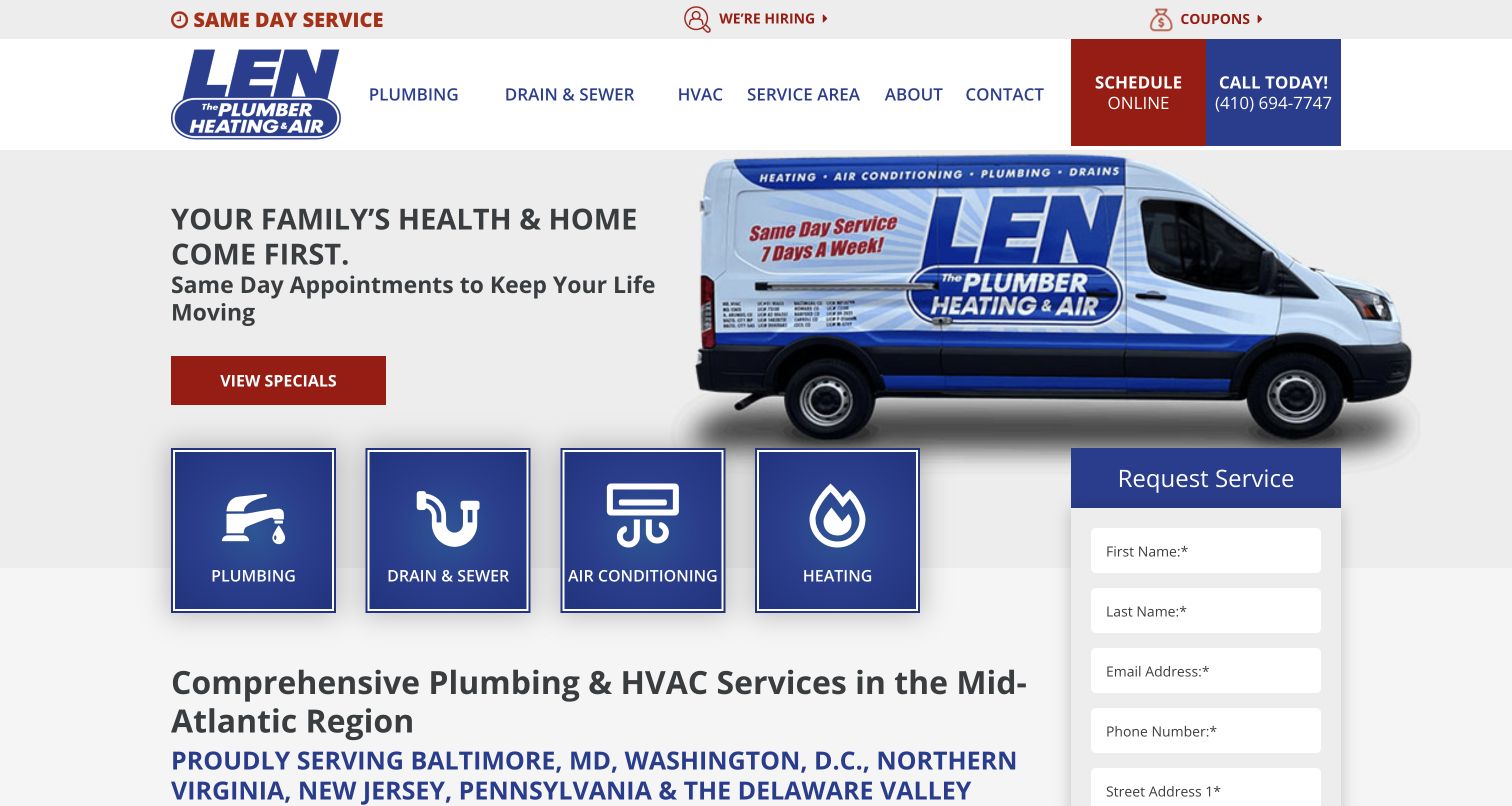
Len The Plumber pairs a branded service vehicle with household-oriented copy, four large service tiles, and a visible request form. Plumbing and drain work are separated from cooling and heating, which lets a visitor start with the problem they recognize. Regional wording below anchors the offer geographically. The public response reported IIS; this does not describe the private intake, dispatch, or customer-management systems behind the visible form.
What you can learn
For a similar deployment, keep service-category URLs and geographic coverage synchronized across templates. Test required-field labels and error presentation in a safe environment, and verify the public form destination without submitting a real inquiry. Preserve a telephone alternative and distinguish requested service from a confirmed appointment. Redirect checks should cover renamed categories so an old drain-service link remains useful rather than landing on an unrelated general campaign.
Pros
Drain and sewer work receives a concrete shortcut instead of disappearing inside plumbing.
Regional wording gives the broad service offer a more specific setting.
Cons & considerations
Offers and form fields compete for attention within the opening area.
Several trades share the page, reducing the space available to explain any one service.
Platform source: Dated public page and linked-resource audit. server response header identifies IIS. The sampled public page response reported Microsoft IIS. Server-reported software is not a verified runtime inventory and does not identify private services, CMS, language, version, or configuration. Platform evidence is separate from the direct website screenshot and is not a complete current infrastructure audit.
MVRDV overlays a bold condensed statement on a broad project photograph. The sparse interface gives the architecture room while thematic routes connect the introduction to a larger body of work. The opening is distinctive, but the usefulness of the site ultimately depends on projects, facts, and research remaining findable beyond the slogan. The sampled public response identified IIS. This does not determine a CMS, programming language, project database, or private design workflow.
What you can learn
When publishing an image-led archive on IIS, map project destinations and media paths before changing the presentation. Verify that older project links, image variants, and translated routes remain available. Test a missing media file and a long title as well as the ideal hero. Keep concise display copy separate from the reading style required for technical project information, and ensure that direct visitors receive the same meaningful context as homepage visitors.
Pros
The large project scene establishes the practice's visual position immediately.
A restrained interface avoids competing with the architectural image.
Cons & considerations
Condensed overlaid lettering needs careful wrapping on narrow crops.
An emphatic statement cannot replace clear project facts and ordinary contact routes.
Platform source: Dated public page and linked-resource audit. server response header identifies IIS. The sampled public page response reported Microsoft IIS. Server-reported software is not a verified runtime inventory and does not identify private services, CMS, language, version, or configuration. Platform evidence is separate from the direct website screenshot and is not a complete current infrastructure audit.
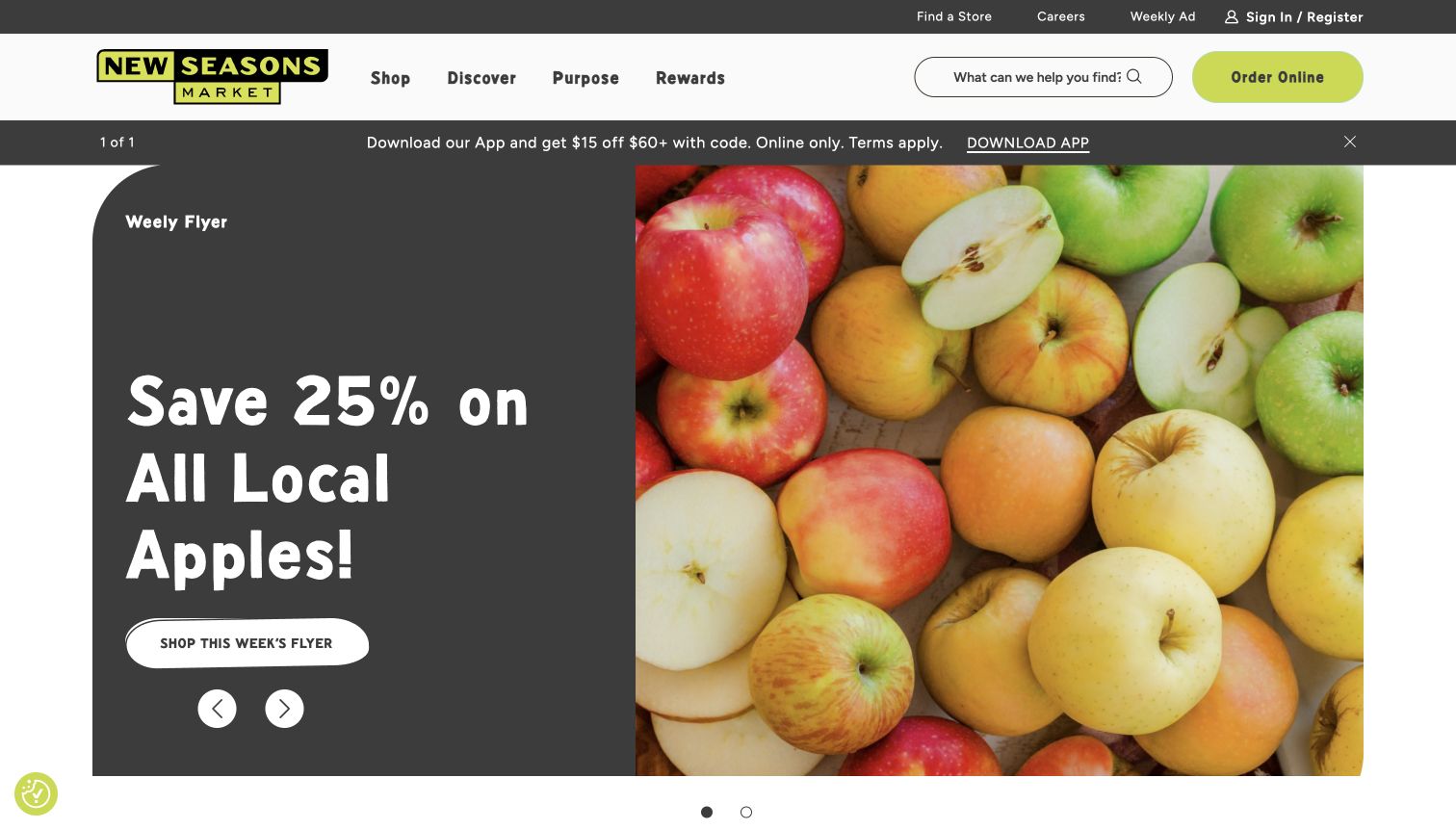
New Seasons Market pairs a close apple photograph with a dark promotional panel and a conspicuous flyer action. Store finding and the weekly ad remain in the upper utility row, while broader navigation covers shopping, discovery, purpose, and rewards. The page links local food storytelling to a practical offer, but its small flyer label contains a visible copy error in the retained capture. The sampled response identified IIS without establishing the technology of rewards or external ordering.
What you can learn
Use public deployment checks to verify more than availability. Confirm the flyer destination, offer dates, store context, and small link labels against the campaign brief. Keep the ordinary weekly-ad route working after the featured promotion changes, and test older advertised URLs. Separate image caching from time-sensitive offer text so a visually correct page cannot silently preserve an expired condition or discount.
Pros
The dark text panel makes the campaign action easy to distinguish from the food image.
Store and weekly-ad utilities remain outside the changing promotional panel.
Cons & considerations
An additional app strip competes with the principal shopping message.
A small copy error undermines clarity despite the strong visual hierarchy.
Platform source: Dated public page and linked-resource audit. server response header identifies IIS. The sampled public page response reported Microsoft IIS. Server-reported software is not a verified runtime inventory and does not identify private services, CMS, language, version, or configuration. Platform evidence is separate from the direct website screenshot and is not a complete current infrastructure audit.
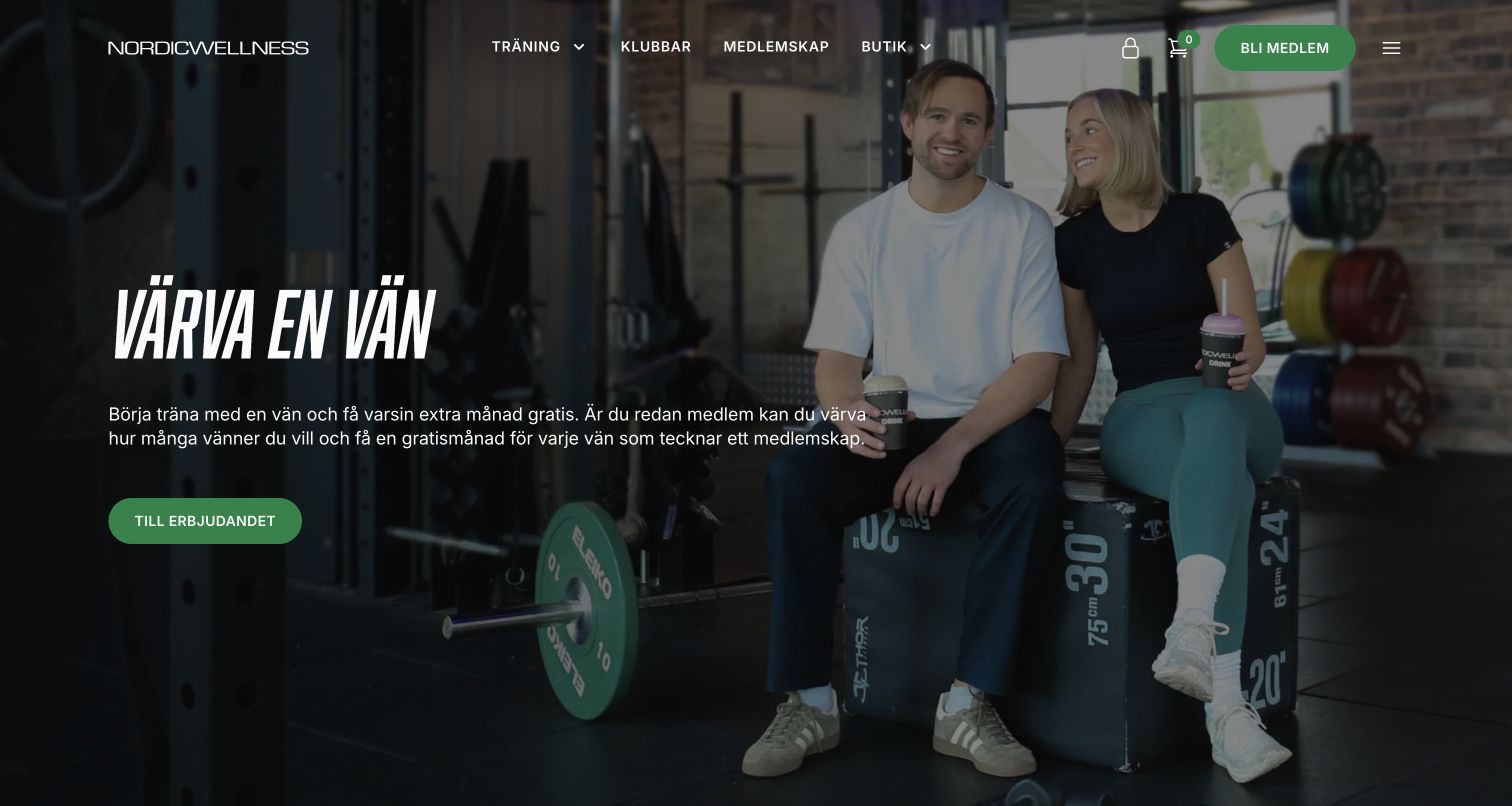
Nordic Wellness places a referral campaign over a gym photograph, using green actions against a darkened image. Training, clubs, memberships, and shopping remain recognizable navigation categories. The page illustrates how an immediate membership promotion can coexist with location-based information that must remain useful throughout the year. The sampled response reported IIS. Separate documentary CMS evidence exists, but this server observation alone does not establish booking, payment, or private member-service architecture.
What you can learn
Build release checks around both the campaign and the enduring club records. Verify facility details, local destinations, membership explanations, and the boundaries between public pages and connected services. Keep referral conditions dated and separate from general membership copy. Test image crops and long club names on a small screen, and make sure older location links remain useful when the promotional message is replaced.
Pros
The club route is explicit rather than hidden beneath the membership campaign.
A limited accent color makes the main action recognizable over lifestyle photography.
Cons & considerations
The referral message assumes some familiarity with the membership proposition.
The full-image treatment requires renewed contrast checks whenever the photograph changes.
Platform source: Dated public page and linked-resource audit. server response header identifies IIS. The sampled public page response reported Microsoft IIS. Server-reported software is not a verified runtime inventory and does not identify private services, CMS, language, version, or configuration. Platform evidence is separate from the direct website screenshot and is not a complete current infrastructure audit.
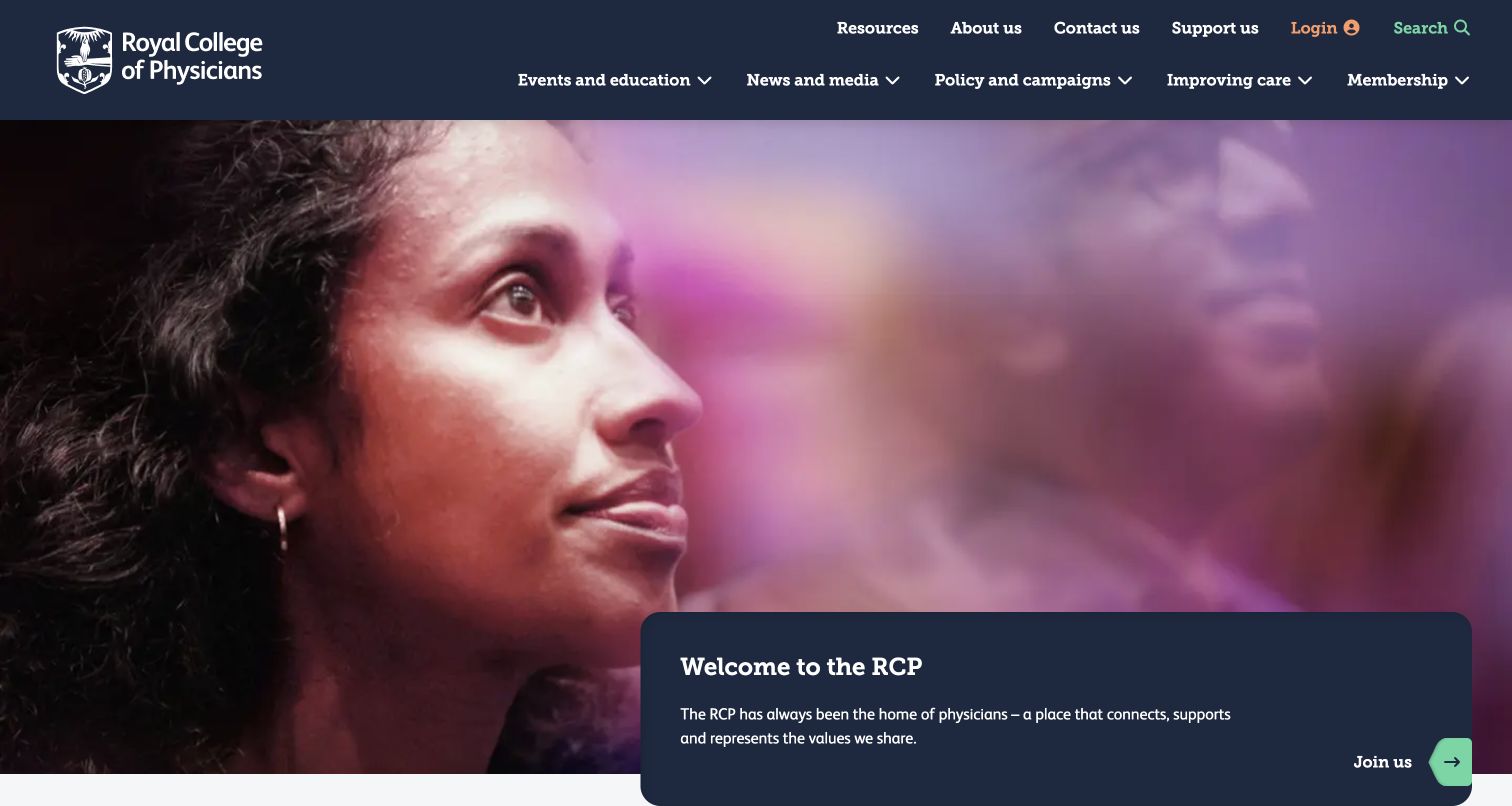
The Royal College of Physicians combines a dark-blue institutional header with a large portrait and an introductory membership panel. Educational, improvement, and advocacy routes remain visible above the image, while a joining action sits within the welcome text. The design gives the organization a human face without discarding its formal identity. The sampled homepage response identified IIS; the observation does not determine how private membership, educational registration, or connected systems operate.
What you can learn
For a comparable public deployment, preserve stable resource and event URLs alongside the introductory content. Check a direct visit to an older educational page and a handoff to membership services, with clear labels at the boundary. Verify that replacing the portrait cannot cover the action or change reading order. Keep historical implementation documentation separate from present server observations so a prior version claim is not presented as a current inventory.
Pros
The portrait and welcome panel connect institutional purpose with individual participation.
The formal navigation retains routes to resources beyond membership acquisition.
Cons & considerations
A large introductory image delays some of the deeper educational material.
The overlaid panel needs crop and contrast review when editors replace the photograph.
Platform source: Dated public page and linked-resource audit. server response header identifies IIS. The sampled public page response reported Microsoft IIS. Server-reported software is not a verified runtime inventory and does not identify private services, CMS, language, version, or configuration. Platform evidence is separate from the direct website screenshot and is not a complete current infrastructure audit.
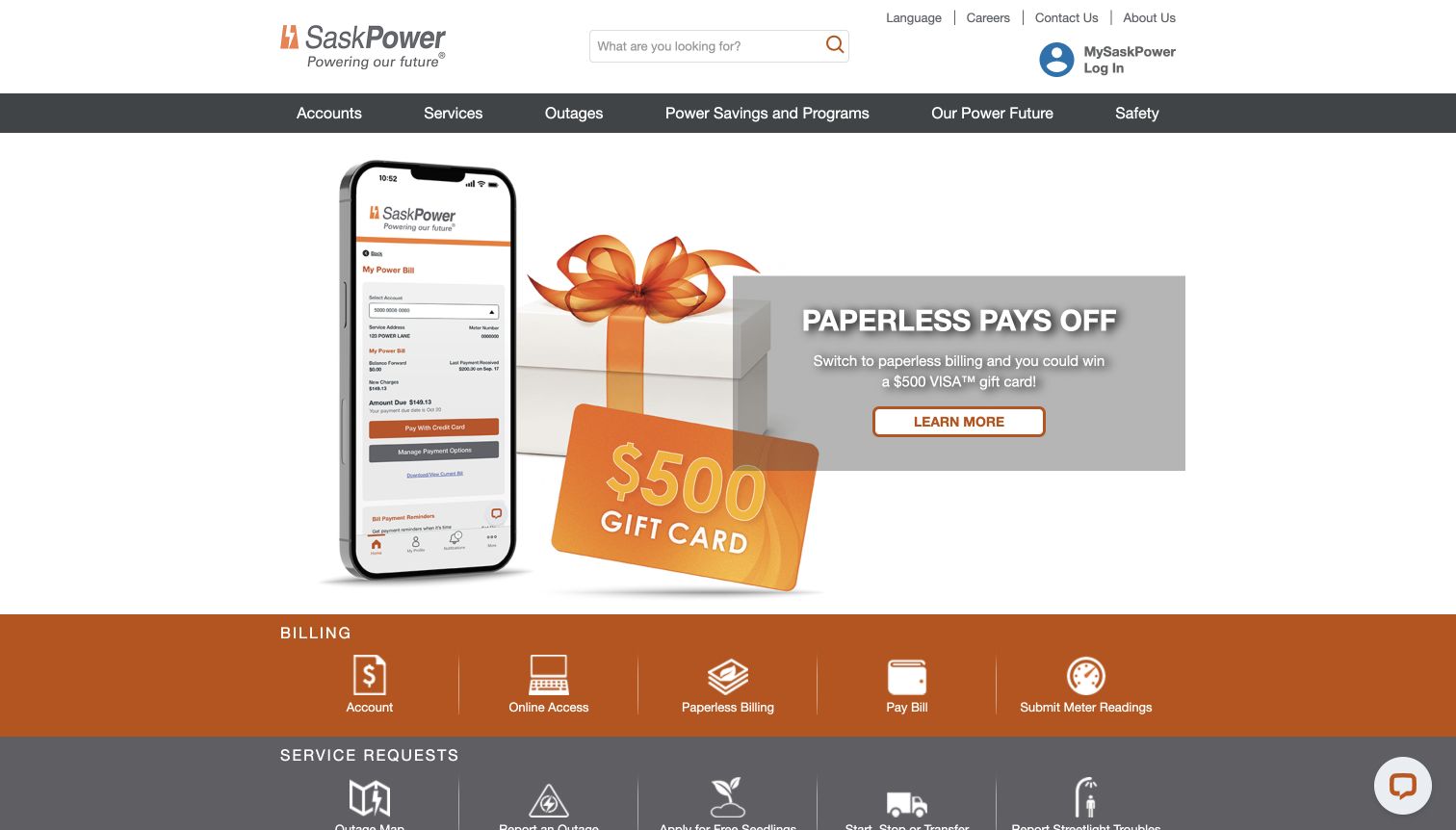
SaskPower puts a paperless-billing campaign above two visually different task bands. Billing actions include account access, online payment, and meter readings; service requests occupy the next row. The separation gives operational meaning to a set of icons that could otherwise look interchangeable. IIS was identified in the sampled public response, without proving the architecture of payment, account, or outage applications reached through these links.
What you can learn
During an IIS release, verify each handoff according to its own purpose and freshness requirements. Keep emergency information available independently from the billing campaign, and check that a direct service URL retains context after redirects. Test the ordering of both bands on mobile, where a horizontal arrangement becomes a long sequence. A useful public page should explain where a customer is going even when a connected application is temporarily unavailable.
Pros
Billing and operational tasks are grouped with visibly different treatments.
Meter-reading submission has a direct, named shortcut.
Cons & considerations
The promotional hero occupies much of the initial viewport before practical actions.
Many equally weighted shortcuts can produce a lengthy and difficult mobile sequence.
Platform source: Dated public page and linked-resource audit. server response header identifies IIS. The sampled public page response reported Microsoft IIS. Server-reported software is not a verified runtime inventory and does not identify private services, CMS, language, version, or configuration. Platform evidence is separate from the direct website screenshot and is not a complete current infrastructure audit.
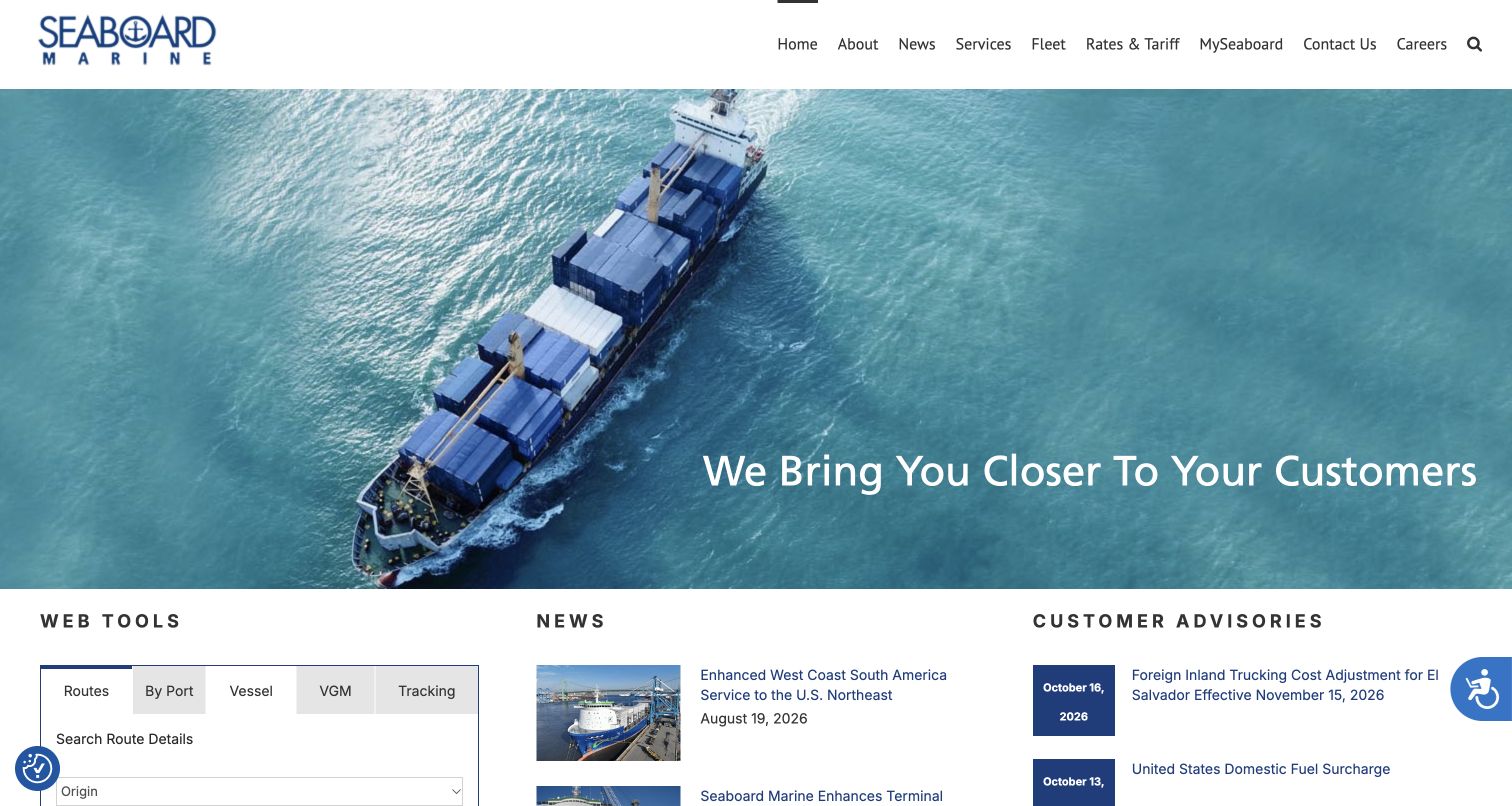
Seaboard Marine opens with an aerial vessel photograph and a concise customer-oriented statement. Directly below, Web Tools, News, and Customer Advisories form three distinct sections. The tool group exposes route, port, vessel, verified-gross-mass, and tracking choices, while rates and tariffs receive explicit navigation labels. The sampled public response identified IIS; that does not establish the implementation of customer portals, tracking feeds, or operational shipping systems.
What you can learn
For a similar deployment, treat advisories as dated operational records rather than ordinary promotional posts. Verify their permanent links and affected-service context alongside tool destinations and tariff documents. Check that a changed vessel image cannot obscure urgent information, and keep public error pages useful when a connected service is unavailable. Explain specialized abbreviations near the action so customers can choose the correct tool without already knowing the internal terminology.
Pros
The three-column structure distinguishes practical tools from news and operational advisories.
Rates and tariffs are named directly in the primary navigation.
Cons & considerations
The large vessel image delays much of the useful operational content.
Specialized tool labels can be opaque to less experienced shipping customers.
Platform source: Dated public page and linked-resource audit. server response header identifies IIS. The sampled public page response reported Microsoft IIS. Server-reported software is not a verified runtime inventory and does not identify private services, CMS, language, version, or configuration. Platform evidence is separate from the direct website screenshot and is not a complete current infrastructure audit.
Kegan has 15+ years of experience working with small businesses, Fortune 500 companies, and everything in between. No development job is too big or too small: he brings the same hands-on attention to a focused improvement, a complete website, or a custom application.
For Microsoft IIS projects, he can help with custom application features, API integrations, existing-system improvements, testing, and dependable deployment. He works directly with clients on scope, design, implementation, testing, and handover, with an emphasis on clear communication and a system that remains practical to maintain after launch.
Show 3 other Microsoft IIS developersHide other Microsoft IIS developers
Choose release checks for the content being served
Institutional archives
Preserve course, project, publication, and event identities. Test older direct links and renamed sections so an updated homepage does not conceal a damaged archive.
Time-sensitive service information
Separate alerts, opening status, offers, and schedules from slower-changing imagery. Assign owners and review dates, and check how an update becomes visible through the public route.
Entrances to connected services
Keep account, inquiry, payment, and booking destinations plainly named. Explain the transition and verify the public link without treating it as evidence about the private workflow.
From references to requirements
Prepare an IIS release that can be reviewed
Inventory routes and assets
List canonical paths, redirects, downloadable documents, media, and external destinations. Include the pages people reach directly from search results or saved links.
Define acceptance beyond a successful response
Check status codes, destination identity, readable content, working asset paths, and useful error behavior. Include a long title, a missing image, and an expired campaign in the fixtures.
Retain a verified recovery point
Record the exact package and previous healthy release. Keep deployment evidence separate from customer data, and verify representative public journeys after rollout before declaring the change complete.
A useful handover demonstration
Ask the actual team to carry out its routine job: publish a realistic update, correct a mistake, preview a narrow screen, and identify who owns an integration failure. For a library or frontend framework, also ask who maintains the content source and deployment. A polished screenshot does not answer those operational questions.
Beyond the screenshot
Microsoft IIS website planning checklist
Confirm the actual server and application configuration from authorized source records.
Keep a canonical inventory of public pages and asset paths.
Document meaningful permanent redirects and preserve intended query behavior.
Test error status codes and useful public error content.
Separate time-sensitive information from long-lived campaign imagery.
Verify account and booking handoffs without inferring their private architecture.
Review mobile order, long labels, media failures, and document links.
Record the exact deployed package and a previously verified recovery point.
Test with real content, a keyboard, a small screen, slow or failed requests, and the people who will maintain the system. These are planning checks, not an accessibility, security, performance, or search-ranking certification.
Sources & editorial method
How this Microsoft IIS collection was reviewed
This collection contains twenty distinct public website properties with genuine retained screenshots and original collection-specific reviews. Stable authoring inputs supply capture provenance and dates. Dated broad source audits provide IIS associations from page responses or linked same-origin resources; each record identifies the exact evidence URL and original observation time. A header is server-reported evidence, not a complete or independently verified backend inventory. No private services, real forms, payments, or account actions were tested.
Every image is an unmodified capture from the actual website, with its source and capture date. Some captures are reused from our shared catalog; their dates remain the original capture dates. None comes from a vendor gallery or a generated reconstruction. Moving imagery and live content can change.
Technology attribution uses public page assets or metadata, official platform documentation, or a cited first-party project case study. Documentary and framework-relationship evidence is identified where used; it is not a complete current backend inventory. A CMS image CDN alone does not establish a full CMS deployment. A library’s presence does not prove which individual controls use it, and a platform label does not establish AI authorship.
The composition notes, lessons, pros and tradeoffs are original editorial observations. We have not measured conversion, traffic, security, performance or accessibility conformance. Website owners retain their brands and imagery; these examples are not our client portfolio. Written, Edited and Curated are independent records, not dates advanced by a build. See our editorial standards or suggest a correction.
Questions worth asking
Microsoft IIS website development FAQs
Does IIS prove that a site uses ASP.NET?
No. The evidence in this collection identifies an IIS response association. A programming language, framework, CMS, or database needs its own evidence.
Why are some examples qualified as asset delivery?
For those properties, the identifying header came from a linked same-origin script response rather than the main page response. That scope is retained instead of attributing the whole application to the observed server.
Do these examples reveal server versions?
The collection does not infer versions or recommend copying another property’s configuration. Consult authorized configuration and current vendor documentation for your own deployment.
What should be verified after a release?
Check public routes, redirects, status codes, assets, readable error states, and the relevant visitor journeys. A homepage that returns successfully is useful evidence but does not cover every connected service.