Best Acoustical Engineering Websites of 2026 (17 Real-World Examples)
Acoustic consultancies, specialist design practices and multidisciplinary engineering firms with useful ways to explain their work.
An acoustical engineering website should help a visitor understand the question being investigated, the consultant’s role and the evidence needed—not just admire a beautiful concert hall.
The sound of a performance space, noise from nearby transport and vibration affecting sensitive equipment are related subjects, but they are not the same brief. A good consultancy website makes those differences understandable before asking a prospective client to describe a project. Architects, developers, facility teams and public bodies also arrive with different levels of technical familiarity. The site has to connect their ordinary questions with the appropriate discipline without pretending to diagnose a building from a short message.
This collection focuses on acoustic design, engineering and advisory services rather than companies primarily selling and fitting treatment products. Some examples are focused practices; others place acoustics inside a much larger engineering business. Study how each explains services, project contribution, people and research. These are website communication references, not independent evaluations of engineering competence, project compliance, predicted sound levels or the quality of a finished building.
Before the examples
What makes good acoustical engineering website design in 2026?
Translate the project question before listing a standard
Explain what is being investigated: speech intelligibility, room character, sound transmission, external noise, building-services noise or vibration. A relevant standard can support the explanation, but its number should not be the only way a non-specialist identifies the service.
Distinguish advice from products and construction
Say whether the practice surveys, models, designs, specifies, monitors or tests. Explain what another designer or contractor does. A consultant’s role can be valuable without suggesting that the practice manufactures, sells or installs the final treatment.
Show the contribution behind the project photograph
Name the project context and the consultancy’s actual scope. An auditorium image becomes useful when the reader understands whether the work concerned room design, sound isolation, building systems or a defined assessment rather than the entire architectural commission.
Connect expertise with a practical first conversation
Make a relevant person, office or service contact discoverable. Explain what information starts a discussion and keep technical project files out of an ordinary public enquiry until the team has defined an appropriate handling process.
The collection · 17 examples
17 acoustical engineering websites worth studying
Compare focused acoustic practices with larger engineering sites, looking at the path from an understandable project question to service detail, relevant work and the people responsible. The collection is an editorial design reference rather than a ranking of consultancy outcomes.
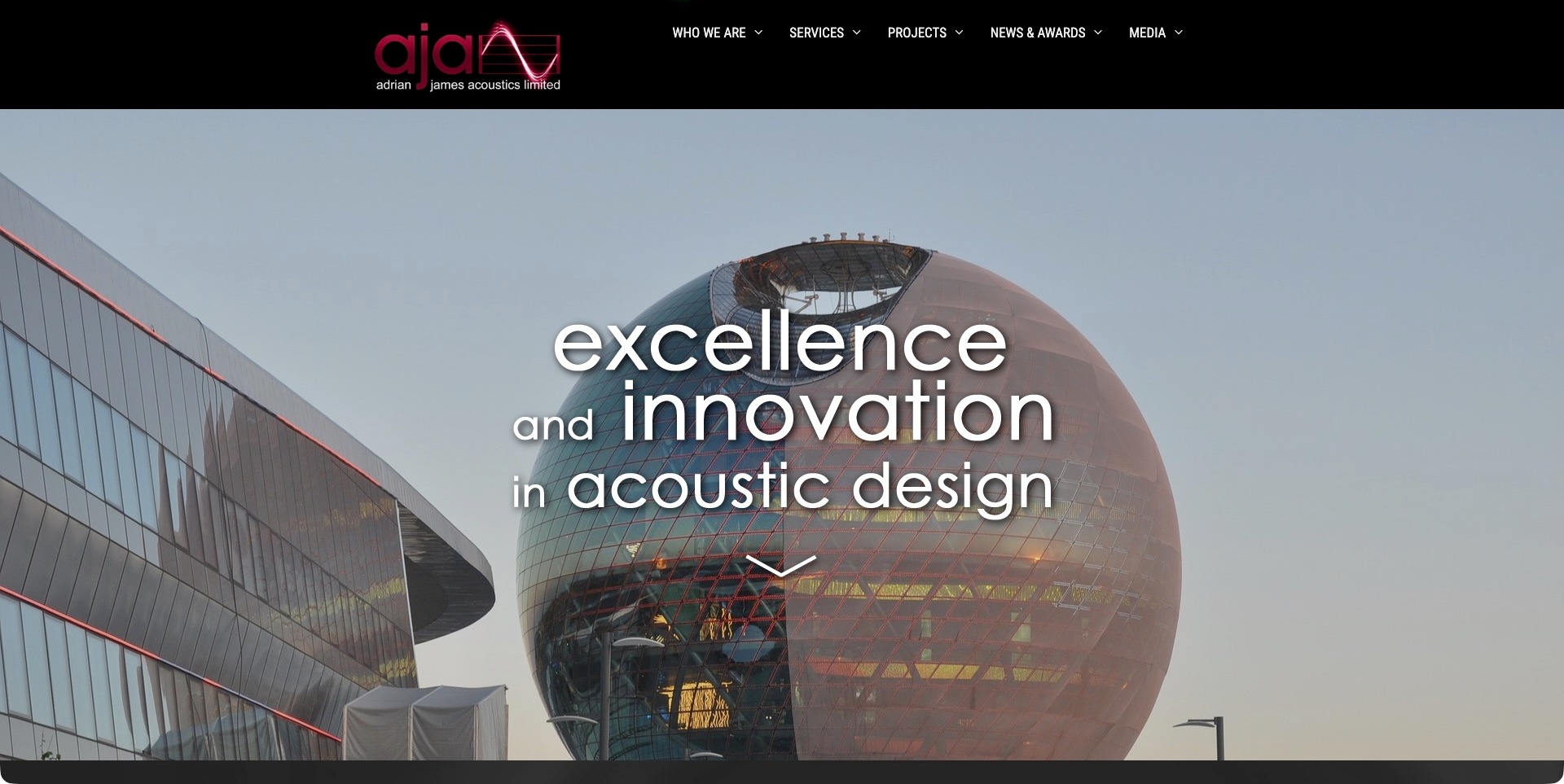
Adrian James Acoustics opens with a black header, red wordmark and an architectural exterior beneath large white type. The top navigation gives services, projects and company information separate entrances rather than crowding the image with technical claims. Supporting first-party material then distinguishes building acoustics, environmental noise, monitoring and testing, with sector-based projects and named team profiles. The combination gives a focused practice a memorable introduction while leaving the detail to explain what is being commissioned; the building photograph itself is not evidence of an acoustic result.
What you can learn
Connect the client’s question with a defined professional role, an appropriate project and a relevant person. A focused practice can make its expertise understandable without presenting every enquiry as the same survey or promising a solution before the conditions are known.
Pros
Separate service families make investigation, design and testing easier to distinguish.
Named team profiles add a practical next step after someone identifies a relevant discipline.
Cons & considerations
A project-category route still needs a clear account of the consultant’s actual contribution.
An environmental enquiry may need location and project-stage context before the visitor can choose the right service.
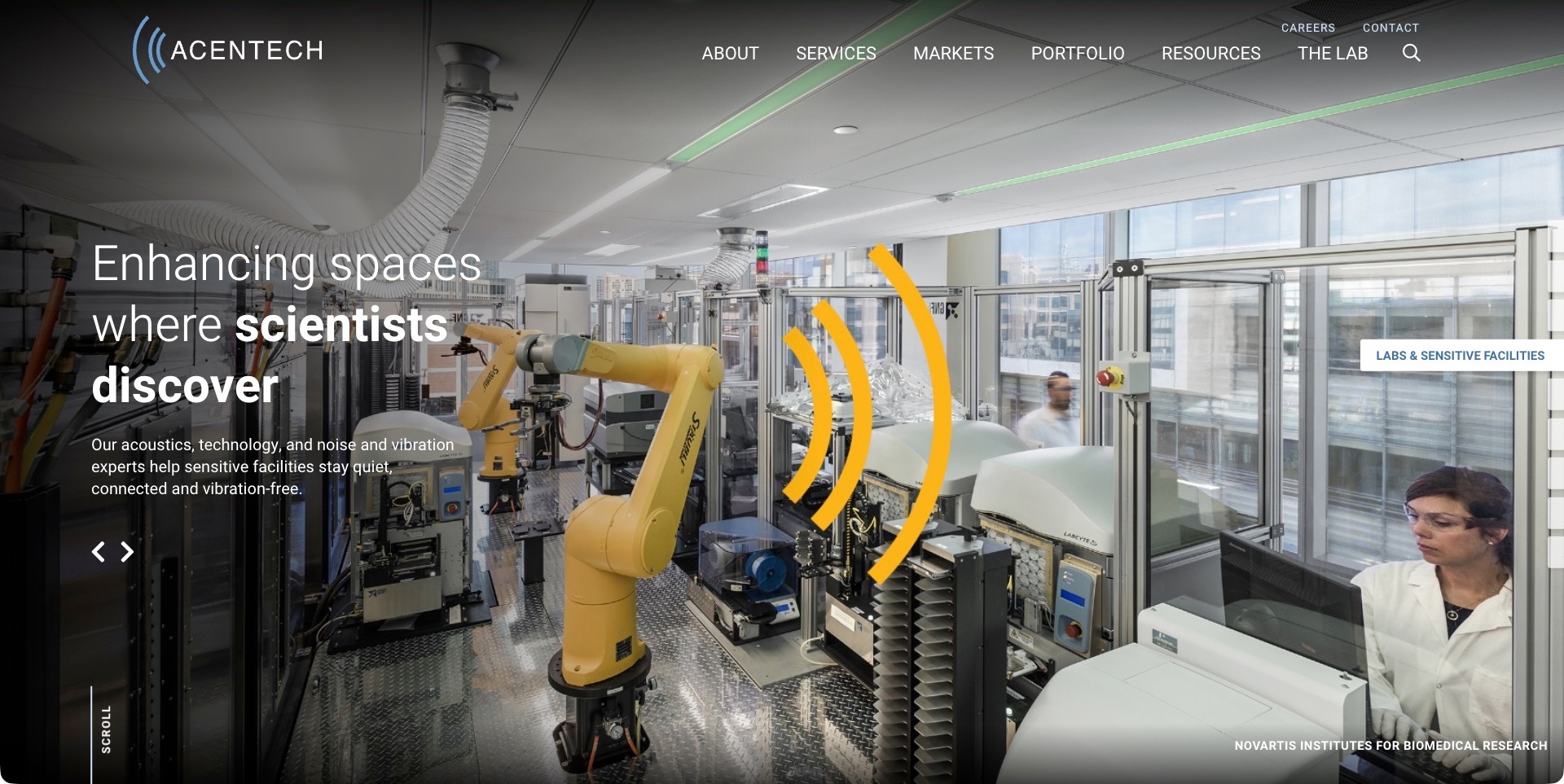
Acentech places a laboratory photograph behind a left-aligned introduction, with a yellow wave motif linking the image to its identity. A visible market label gives the opening a specific context, while services, markets, portfolio and resources remain distinct header choices. Its public content spans building acoustics, noise and vibration, and methods such as 3D listening. The useful pattern is the relationship between a recognizable place and the technical discipline behind it: the image introduces a sensitive facility, while the service structure explains the consultancy rather than relying on the photograph alone.
What you can learn
Offer a sector entrance and a service entrance, then connect them with specific projects. Someone planning a laboratory and someone investigating vibration may reach the same team through different questions; the navigation should support both without duplicating an identical sales paragraph.
Pros
Distinct service and market routes accommodate different levels of technical familiarity.
Projects and resources give specialist explanations a place beyond the homepage introduction.
Cons & considerations
A broad service menu needs prioritization so a first-time visitor can identify a starting point.
Listening demonstrations need their own assumptions and scope rather than implying that a simulation guarantees a finished result.
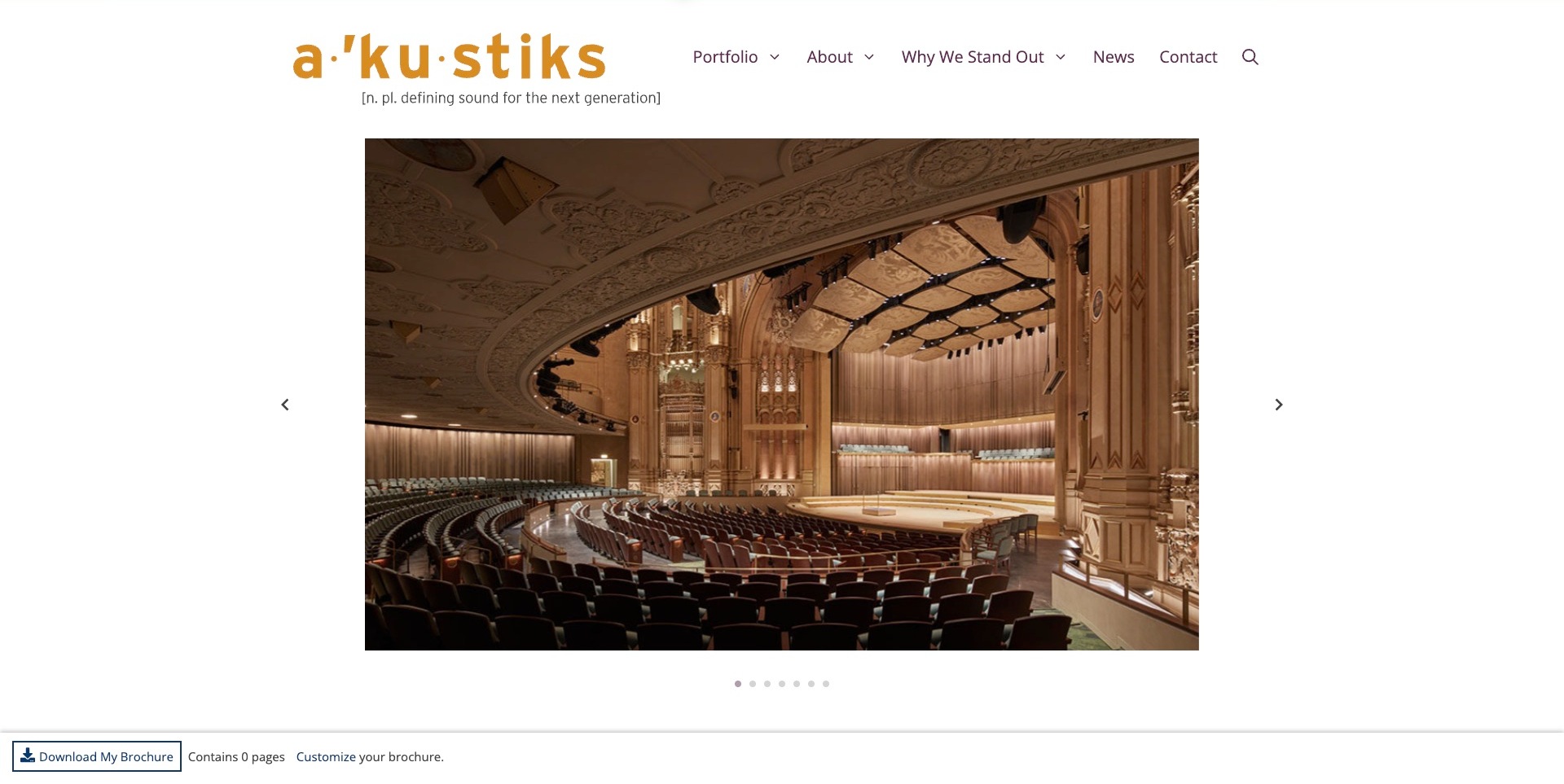
Akustiks presents a concert-hall photograph within white margins beneath a gold wordmark. Carousel controls sit outside the image, leaving the room itself clear, and a brochure-collection control provides a separate research task at the bottom. The first-party portfolio distinguishes concert and recital halls, opera, academic settings, multipurpose spaces and restoration. This is a focused presentation: the visitor encounters a kind of place before exploring the professional contribution. The useful lesson comes from the specific project categories, not an assumption that an attractive hall proves acoustic performance.
What you can learn
Let a carefully chosen taxonomy communicate specialization. A recital hall and a restored theater may require different explanations even when both involve performance; connect each project category with the relevant constraints, scope and design-team relationship instead of repeating a universal promise about sound.
Pros
Specific venue categories give the portfolio more meaning than a single projects grid.
Acoustic and audiovisual context acknowledges the relationship between a room and its use.
Cons & considerations
A strong cultural-building focus may require explicit guidance for visitors with other project types.
Restoration stories need to distinguish retained architecture, acoustic advice and technology work rather than attribute the whole result to one practice.
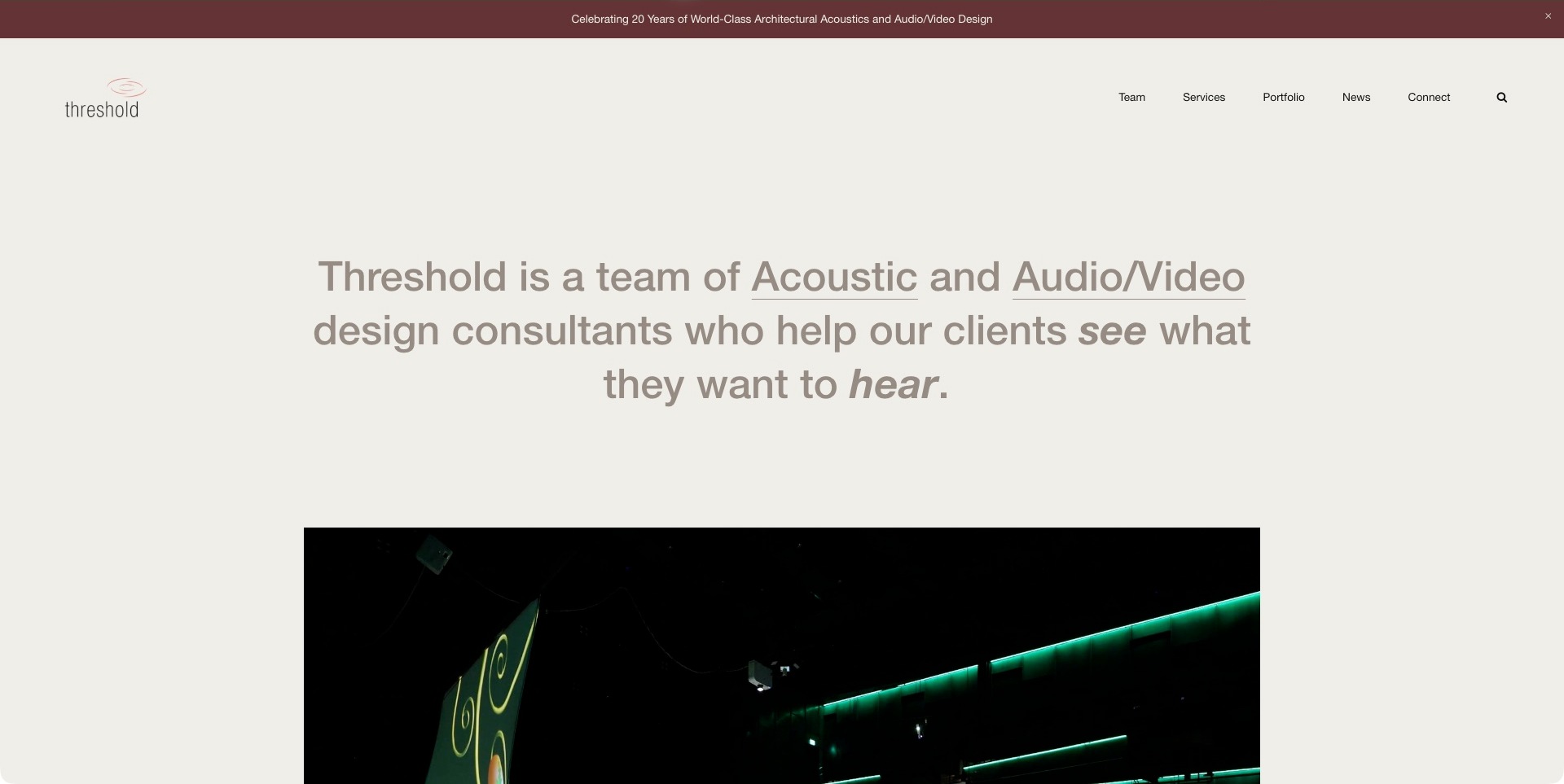
Threshold uses an off-white field, small wordmark and a centered introduction with Acoustic and Audio/Video as linked specialties. A dark venue image begins below the text instead of taking over the entire opening screen; a narrow anniversary announcement remains separate at the top. Supporting service material distinguishes room acoustics, isolation, environmental questions and auralization. The page therefore introduces the kind of adviser before asking a visitor to interpret a project image. The current threshold.llc identity is the pictured source, rather than the older domain that now hands visitors onward.
What you can learn
Introduce a specialist method through the decision it helps explore. Auralization, isolation and system design are easier to understand when each has a clear relationship to the room, project stage and consultant’s responsibility rather than appearing as interchangeable technical credentials.
Pros
Separate service descriptions distinguish room behavior, isolation and environmental questions.
Studio and project routes give methods a professional and practical context.
Cons & considerations
A long set of related specialties needs plain-language entry points for non-specialists.
An auralization demonstration should disclose what is proposed or simulated rather than imply a verified future outcome.
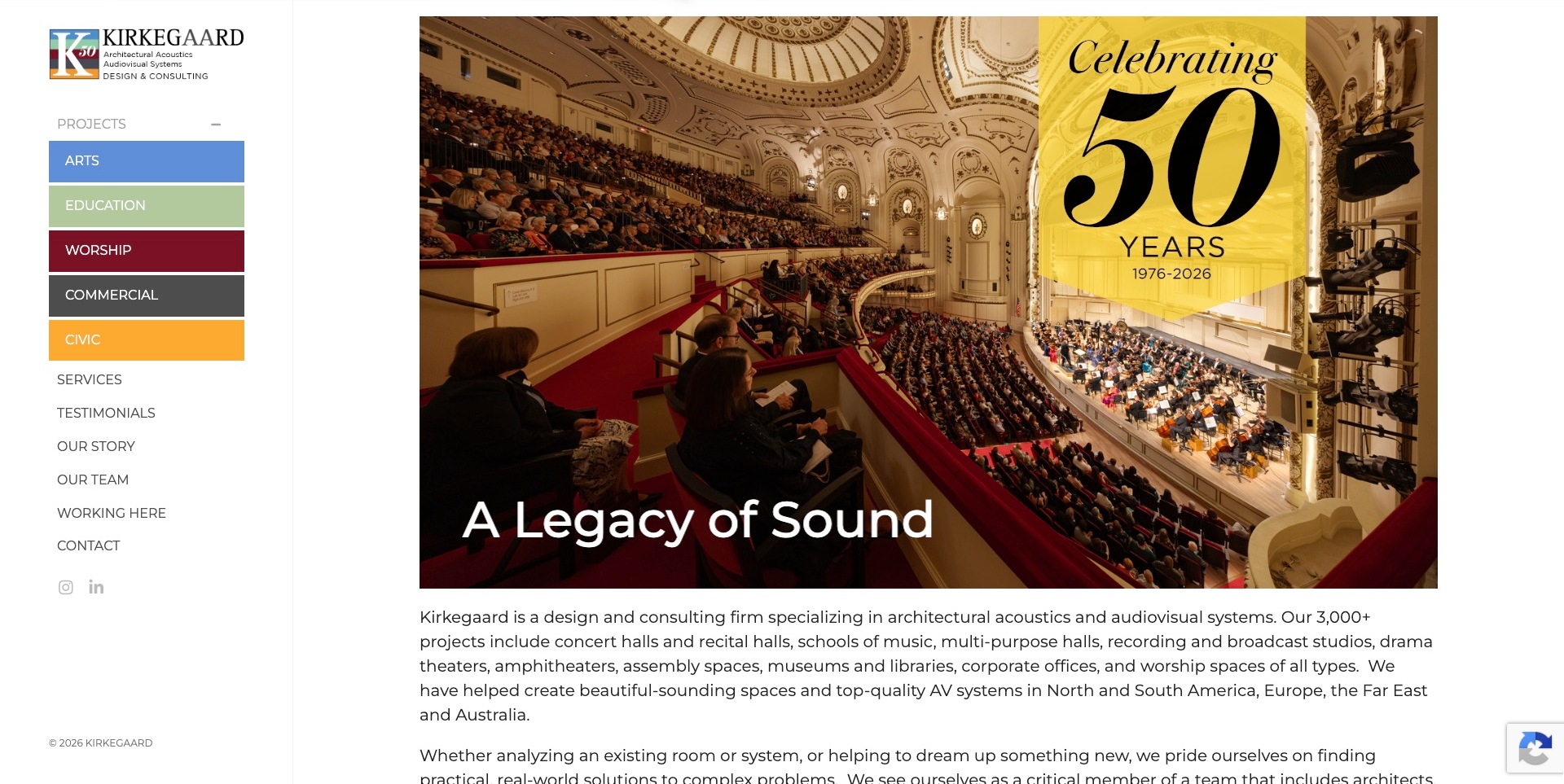
Kirkegaard keeps a project-category rail on the left and a large concert-hall image on the right. Colored sector blocks distinguish arts, education, worship, commercial and civic work, with services, people and contact routes below. The anniversary image leads directly into an explanation of architectural acoustics and audiovisual consulting rather than leaving the room uncaptioned. This makes the portfolio taxonomy part of the interface itself: a reader can select a familiar building context while retaining access to the consultancy’s role and team, without treating the photograph as ownership of the whole architecture.
What you can learn
Use the architectural setting to introduce a project, then identify the consultant’s contribution and collaborators. That sequence lets a reader appreciate a venue without mistaking a portfolio photograph for ownership of the architecture or independent verification of the acoustic performance.
Pros
Named places make project browsing more concrete than anonymous visual case studies.
Acoustic and audiovisual service context helps explain the practice’s role within architecture.
Cons & considerations
Project recognition alone does not answer which services were included in the appointment.
A portfolio led by notable venues needs task-based routes for readers researching more ordinary building requirements.
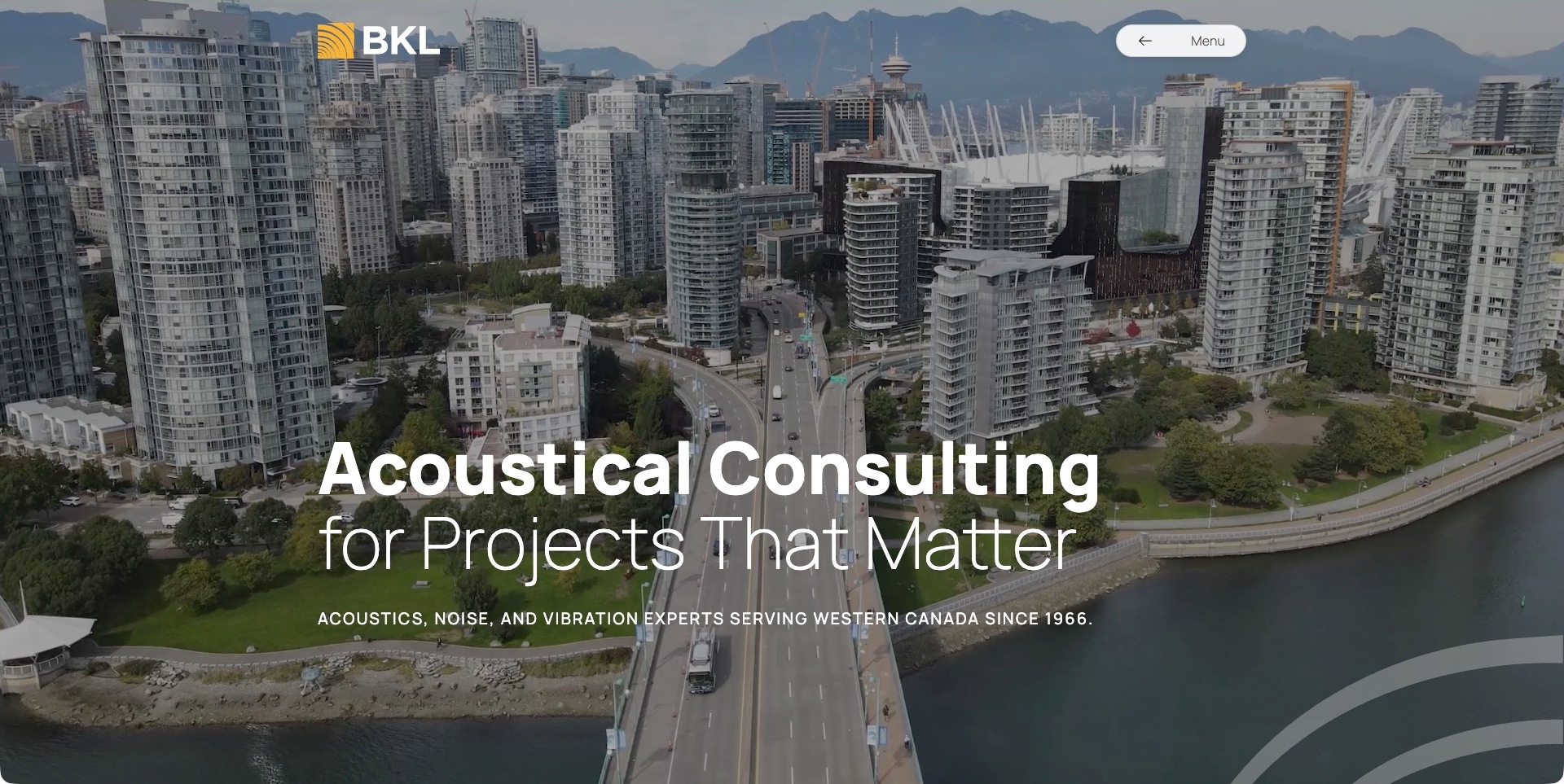
BKL opens with an aerial Vancouver scene, a large acoustic-consulting introduction and a compact menu control. The regional setting reinforces the Western Canada scope stated in the text rather than relying on an anonymous architectural image. Further down, the public content offers starting points for design, permits, testing, noise problems and independent review, alongside selected projects and market categories. That task-based layer is particularly useful for a technical practice: a property owner can begin with a question while an experienced project team can go directly to the relevant professional service.
What you can learn
Organize the next step around what the visitor is trying to resolve. Planning a building, investigating a complaint and commissioning testing should not require identical navigation, even when the same acoustic team participates in all three.
Pros
The regional introduction makes the service setting explicit before detailed research.
Task-led starting points translate a technical subject into recognizable client questions.
Cons & considerations
A single menu control asks visitors to open navigation before comparing all available routes.
Permit and testing descriptions need locally applicable scope rather than an implied promise of approval.
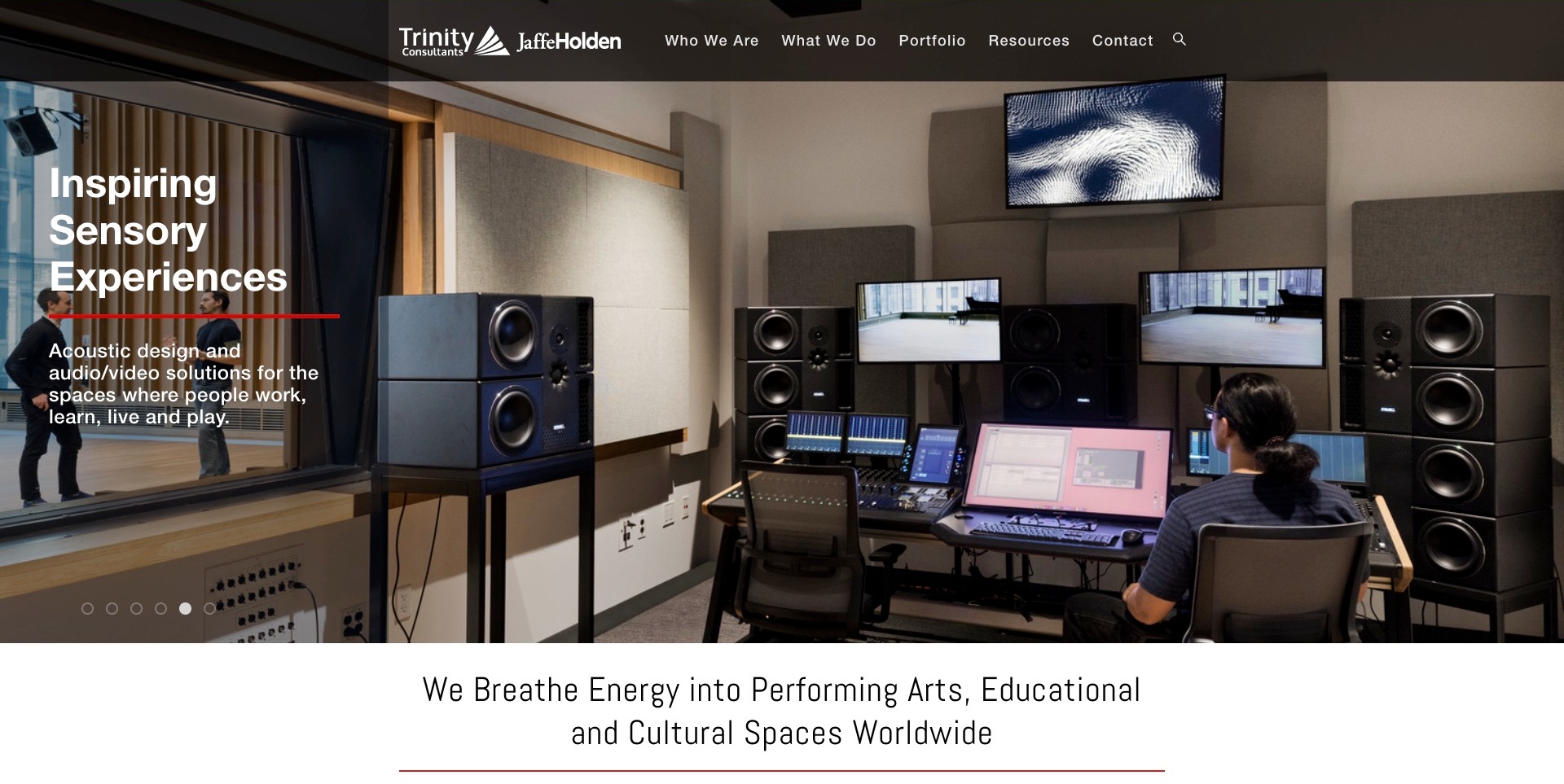
Jaffe Holden’s current homepage puts a compact white introduction over a studio-control-room scene, with a red rule separating the headline from the acoustic and audiovisual explanation. A dark translucent header keeps company, services, portfolio, resources and contact routes visible, and the Trinity Consultants relationship appears in the brand itself. Below the image, the site names performing-arts, educational and cultural settings. Supporting material describes work from early design through post-opening tuning. The useful combination is a concrete environment and a defined consulting role, rather than asking a room photograph to explain the whole appointment.
What you can learn
State what the team contributes next to the project environment, then identify the kinds of space it serves. Keep company affiliation and the service relationship clear when a familiar specialist brand becomes part of a wider organization.
Pros
The introduction explicitly connects acoustic design with audiovisual work.
Portfolio and resources remain separate routes around the immersive project image.
Cons & considerations
Text over detailed room imagery needs contrast protection throughout the carousel.
A corporate transition needs maintained expert and contact links beyond a temporary announcement.
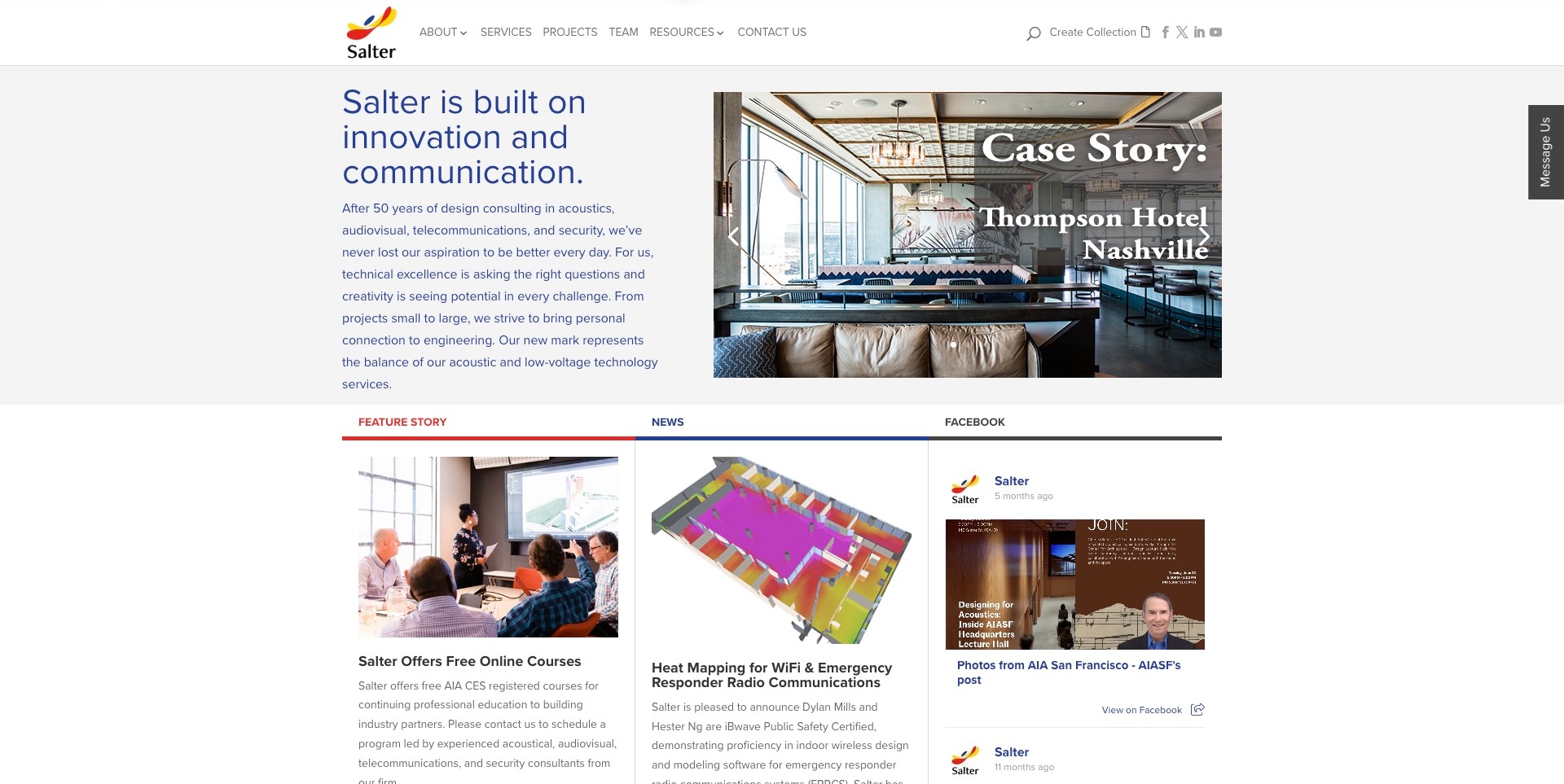
Salter pairs a blue company introduction with a clearly named hotel case-story image instead of using the entire opening for a photograph. Below it, feature stories, news and a social feed form distinct columns, while services, projects, team and resources remain visible in the header. The supporting service page separates acoustic and noise consulting from audiovisual, telecommunications and security work, and states that the consultancy does not sell or install equipment. This combination is useful because it connects a recognizable project with a defined professional relationship rather than presenting the practice as an equipment supplier.
What you can learn
State what the business does not do when that distinction affects the client’s expectations. An independent consulting role becomes more understandable when service families, educational resources and the later supplier or installer handoff have different labels rather than sharing one vague solutions heading.
Pros
Separate disciplines help a client avoid conflating acoustic advice with technology-system design.
The explicit equipment-sales and installation boundary clarifies the consultancy relationship.
Cons & considerations
A multidisciplinary menu benefits from examples showing when the services intersect.
Professional independence is a scope statement, not a substitute for reviewing the proposed appointment and relevant project experience.
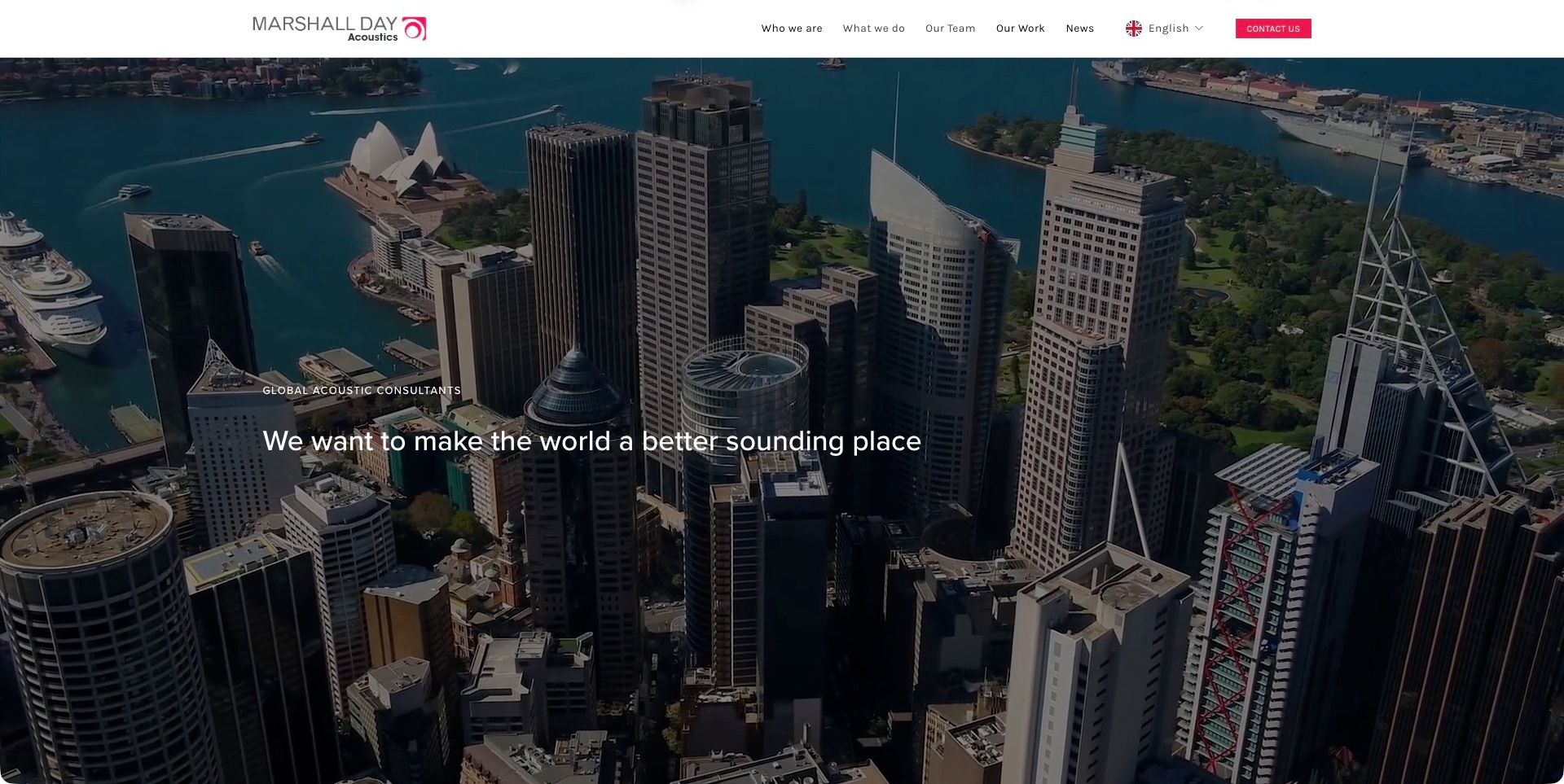
Marshall Day Acoustics combines a compact white header with a darkened aerial view of Sydney’s harbor and city. Its pink contact action contrasts with restrained navigation for the company, services, team, work and news. A global-consultancy introduction occupies only a small part of the image. Supporting service material provides the specificity missing from that broad opening: architectural acoustics, environmental noise and vibration need distinct explanations. The design is useful for studying how a strong geographic scene can introduce a practice, provided the onward service and regional contact routes remain clear.
What you can learn
Keep the discipline consistent, but make project and regional scope explicit. Architectural room design, environmental assessment and vibration investigation require different explanations; use service detail and attributed projects to show how they relate instead of relying on a global consultancy introduction.
Pros
Architectural and environmental service routes recognize different client questions.
Project context can connect specialist terminology with recognizable building or site situations.
Cons & considerations
Multiple regions require clear office routing and locally applicable service descriptions.
An assessment or modelling claim needs its conditions and professional scope rather than a universal performance promise.
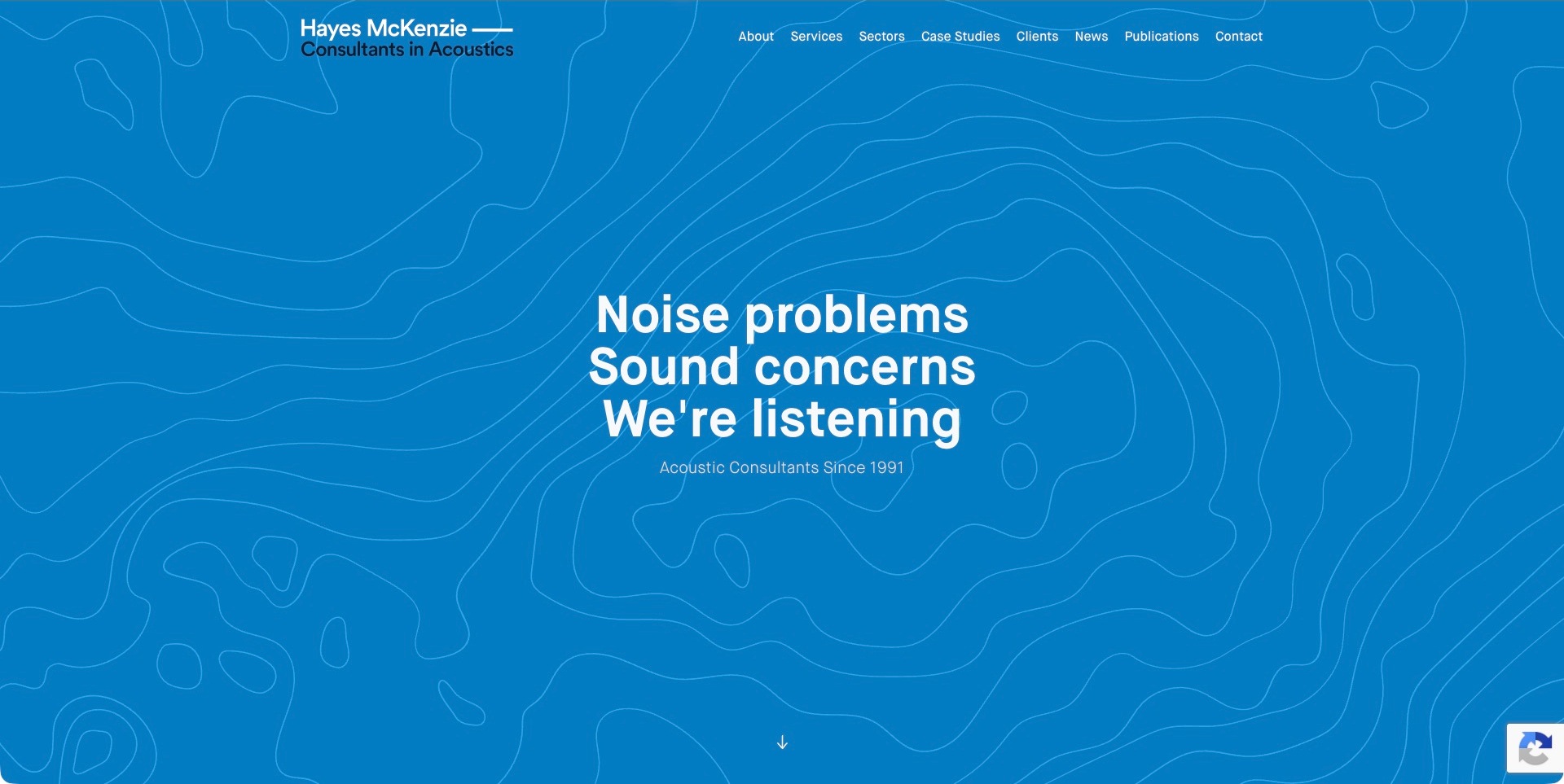
Hayes McKenzie uses a blue contour-pattern background and a centered, plain-language introduction about noise and sound concerns. The wordmark immediately identifies acoustic consultants, while services, sectors, case studies, clients and publications remain separate header routes. Unlike a concert-hall-led portfolio, the opening does not require a visitor to recognize a prestigious building before understanding the subject. Supporting first-party material distinguishes planning, impact assessment, sound-insulation testing and complaint investigation, with project cases providing the more specific settings. This creates an approachable entrance to a technical conversation without presenting the homepage as a diagnosis.
What you can learn
Name the concern before introducing specialist service terminology. A clear opening can serve someone investigating an everyday noise issue as well as a professional client, provided the next pages explain the relevant process and scope.
Pros
The acoustic-consultancy identity is explicit without depending on a project photograph.
Separate sector, case-study and publication routes support different kinds of research.
Cons & considerations
An abstract opening benefits from concrete project context immediately below it.
Accreditation references must retain their precise testing scope rather than imply approval of every service.
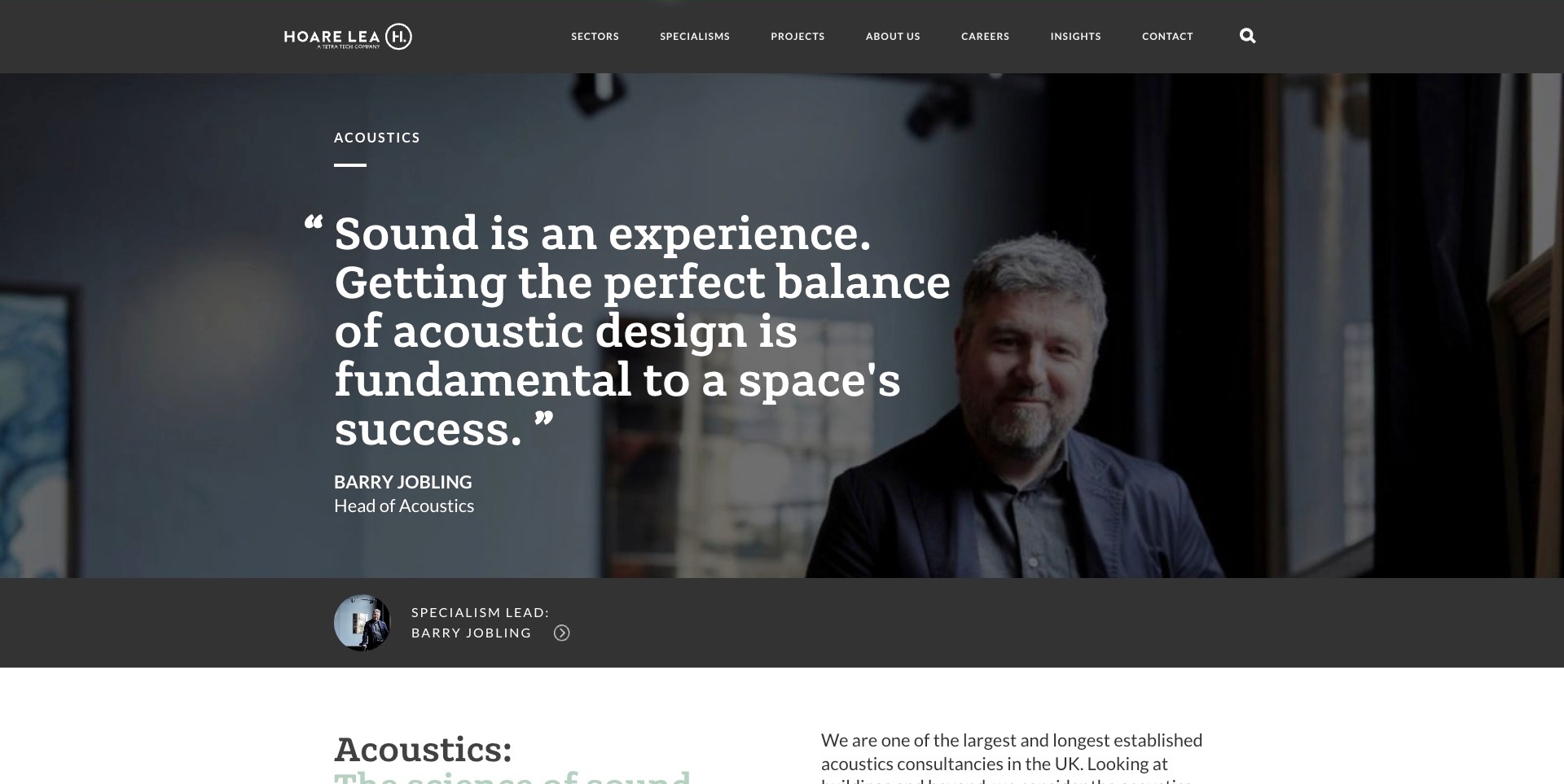
Hoare Lea’s acoustic page gives a named specialist the opening screen: a large portrait and attributed statement sit under a charcoal header, followed by a separate specialism-lead strip. This is more specific than listing acoustics among many corporate services. Supporting text describes concept and planning, development and delivery, and work with buildings in use. The portrait establishes who is speaking, while the stage-based explanation clarifies when the team may contribute. The page is still part of a multidisciplinary consultancy, not a claim that one acoustic team owns every aspect of the building.
What you can learn
Explain the appointment through project stages as well as technical terms. Early advice, design development and in-use investigation require different information; a named specialist and relevant project context can help the visitor ask a better first question.
Pros
Project-stage descriptions make the service relevant before detailed technical knowledge is assumed.
A named specialism lead provides a human route from explanation to enquiry.
Cons & considerations
Related technical content needs clear labels so it does not obscure the acoustic service itself.
An in-use optimization description should not imply a result before the actual building conditions have been assessed.
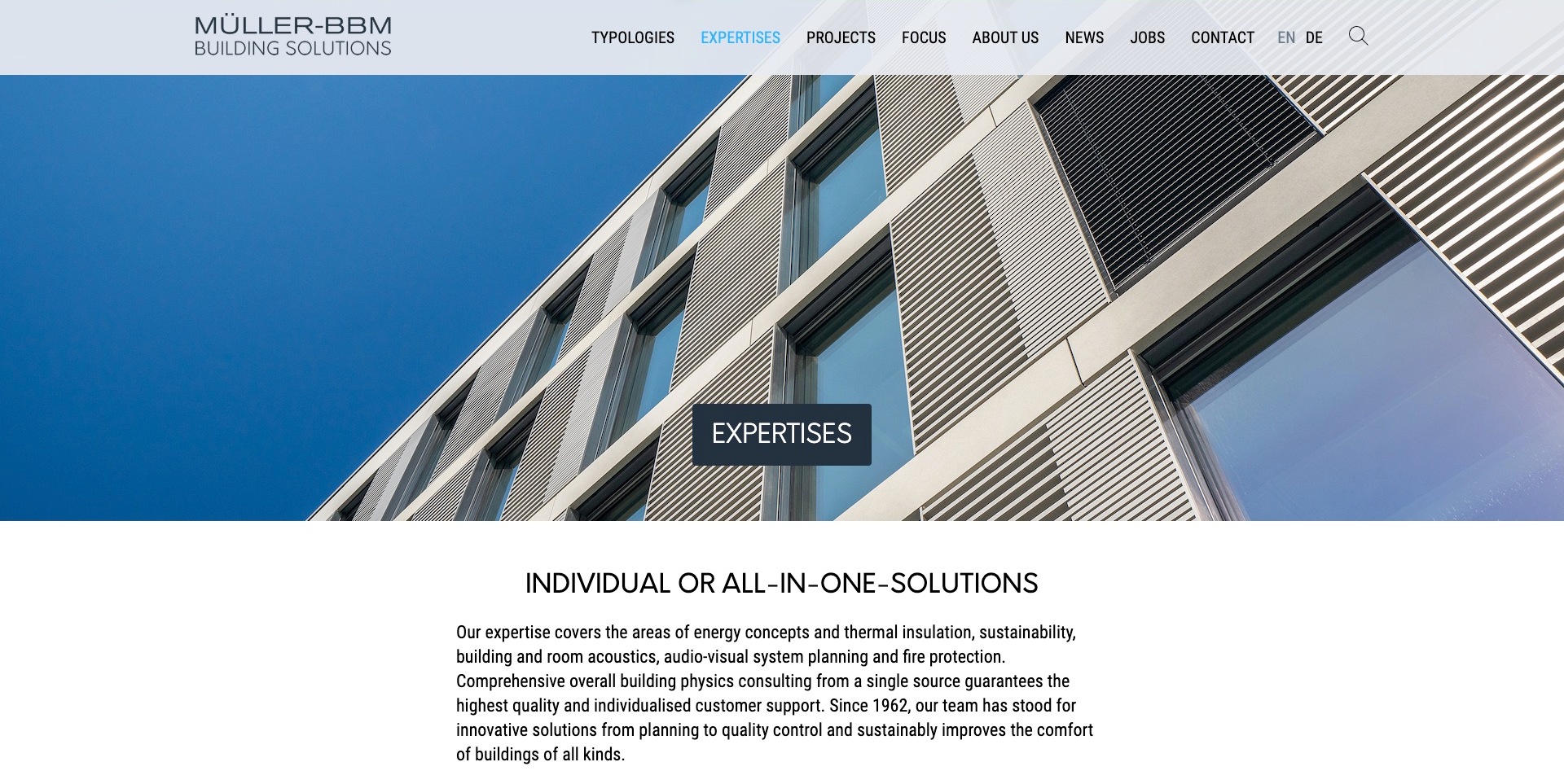
Müller-BBM Building Solutions introduces its expertise index with an architectural facade photograph and a compact central label. The navigation separately names building typologies, expertise and projects, while the first paragraph below the image explicitly includes building and room acoustics within a wider building-physics offer. The photographed page is therefore an overview, not a single acoustic case study. Supporting company information distinguishes this building-focused business from Industry Solutions. For a visitor, the useful sequence is to identify the discipline and responsible organization before moving into more detailed methods or project records.
What you can learn
Use the expertise taxonomy to explain both technical and organizational boundaries. Room behavior, transmission through a building and wider physical-design questions can be connected without becoming interchangeable labels; show the responsible business and contact route wherever that affects the appointment.
Pros
Separate expertise categories give related building disciplines their own explanatory destinations.
The building-business identity helps readers distinguish it from another organization sharing the group name.
Cons & considerations
A group relationship needs current contact and service links rather than assumptions based on branding.
An expertise index still needs project context and deliverables before a non-specialist can judge which conversation to begin.
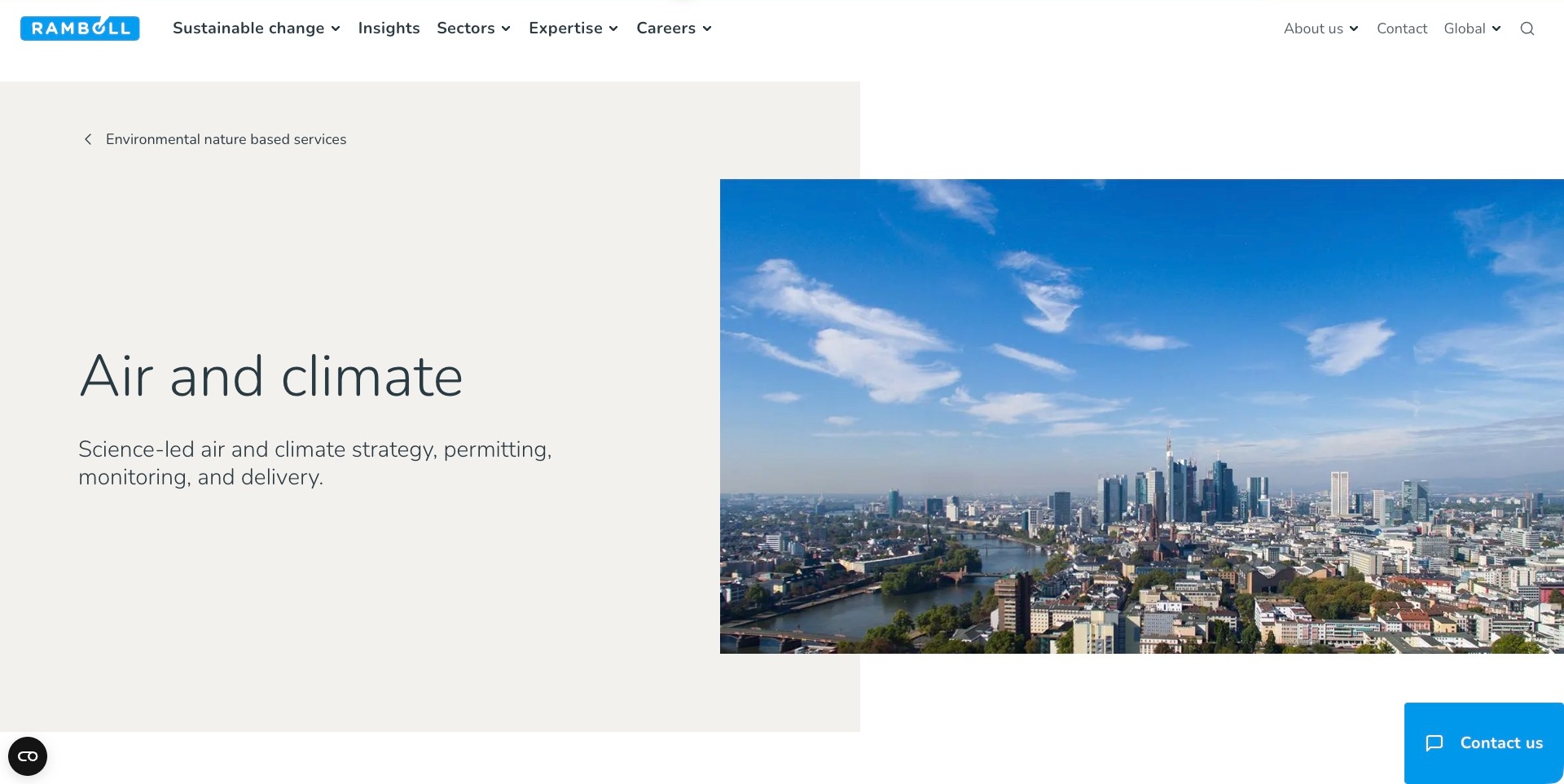
Ramboll’s pictured page is the broader Air and climate service, with a spacious beige split layout, plain heading and city panorama. It is not a dedicated acoustic hero. Further first-party content explicitly includes acoustics, noise and vibration assessment, modelling and monitoring within the environmental offer. That relationship is the design lesson: the firm’s organizational category is broader than the language a client may use to search for a noise problem. A clear specialist subsection and onward route are therefore needed before the general environmental introduction becomes useful acoustic-service research.
What you can learn
Make a specialty discoverable even when it sits inside a broader organizational category. Link the acoustic question to an explicit subsection and an appropriate next step; a visitor should not need to understand the company’s internal service hierarchy before finding noise and vibration advice.
Pros
Explicit acoustic terminology gives the wider environmental page a meaningful specialist entry.
Assessment, modelling and monitoring describe different kinds of professional contribution.
Cons & considerations
A parent category centered on air and climate may not match a visitor’s initial acoustic search language.
General mitigation descriptions need project-specific conditions and scope before informing an appointment or proposed intervention.
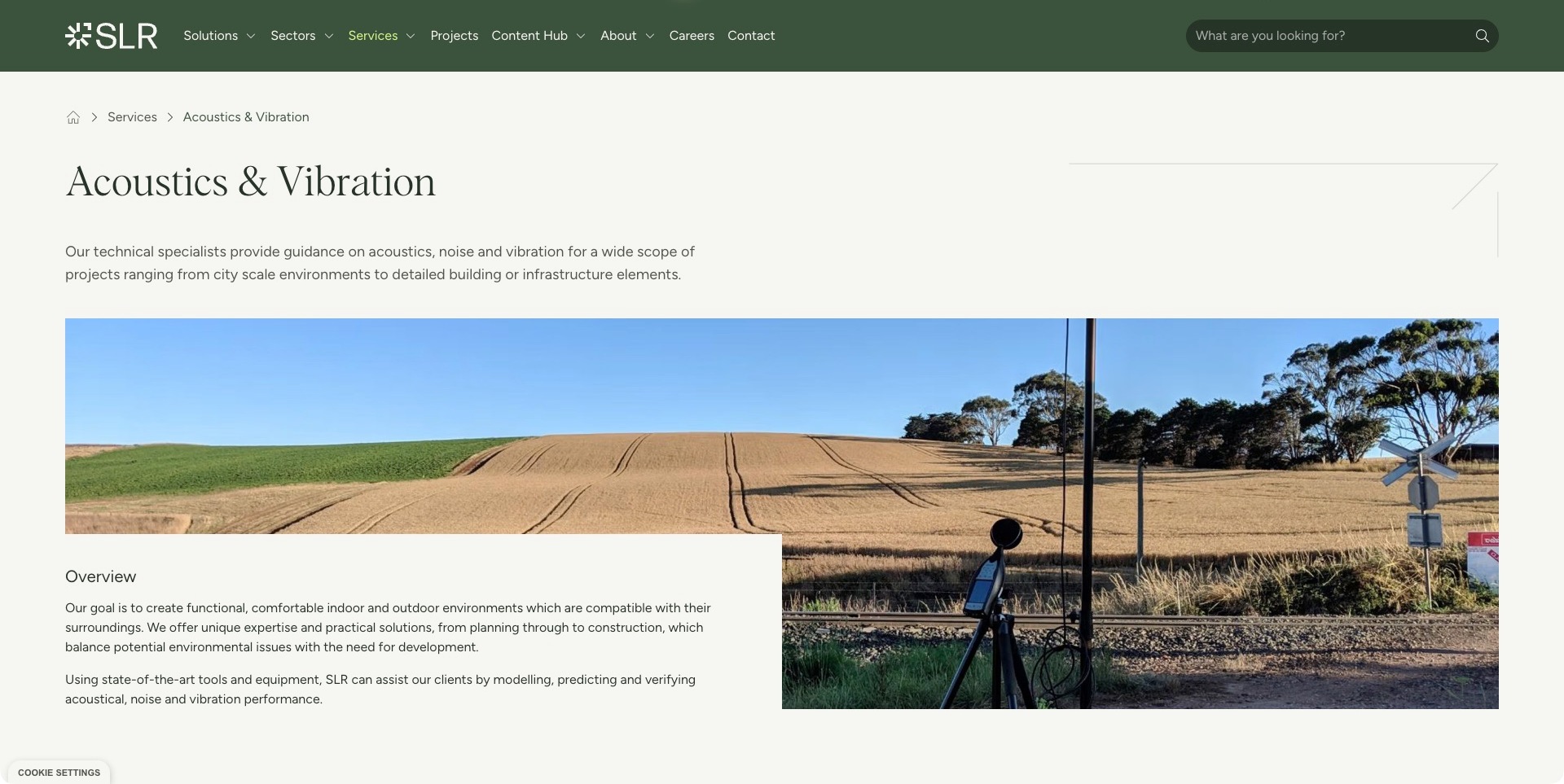
SLR’s Canadian Acoustics & Vibration page uses a forest-green header, a serif discipline heading and a plain-language introduction before a field-measurement photograph. The overview begins beside the lower part of that image rather than delaying every explanation behind a full-screen visual. Supporting material names architectural design, isolation, mechanical-services noise, audits and specialized environmental contexts. This is a direct service-page approach: the picture shows investigation rather than a glamorous finished room, while the regional path and subtopics establish the scope of the page without claiming identical capabilities in every global office.
What you can learn
Combine a clear regional destination with specific service subtopics. A reader investigating noise in an existing building needs a different explanation from one researching underwater assessment; use the page to establish those boundaries before presenting projects or asking for detailed information.
Pros
Named subtopics make a broad acoustics-and-vibration heading more actionable.
A regional service destination provides context that a global corporate introduction cannot supply alone.
Cons & considerations
A wide range of specialties needs clear contact routing to avoid an undifferentiated enquiry path.
Project and audit descriptions require explicit scope rather than implying that a general service page verifies a particular acoustic outcome.
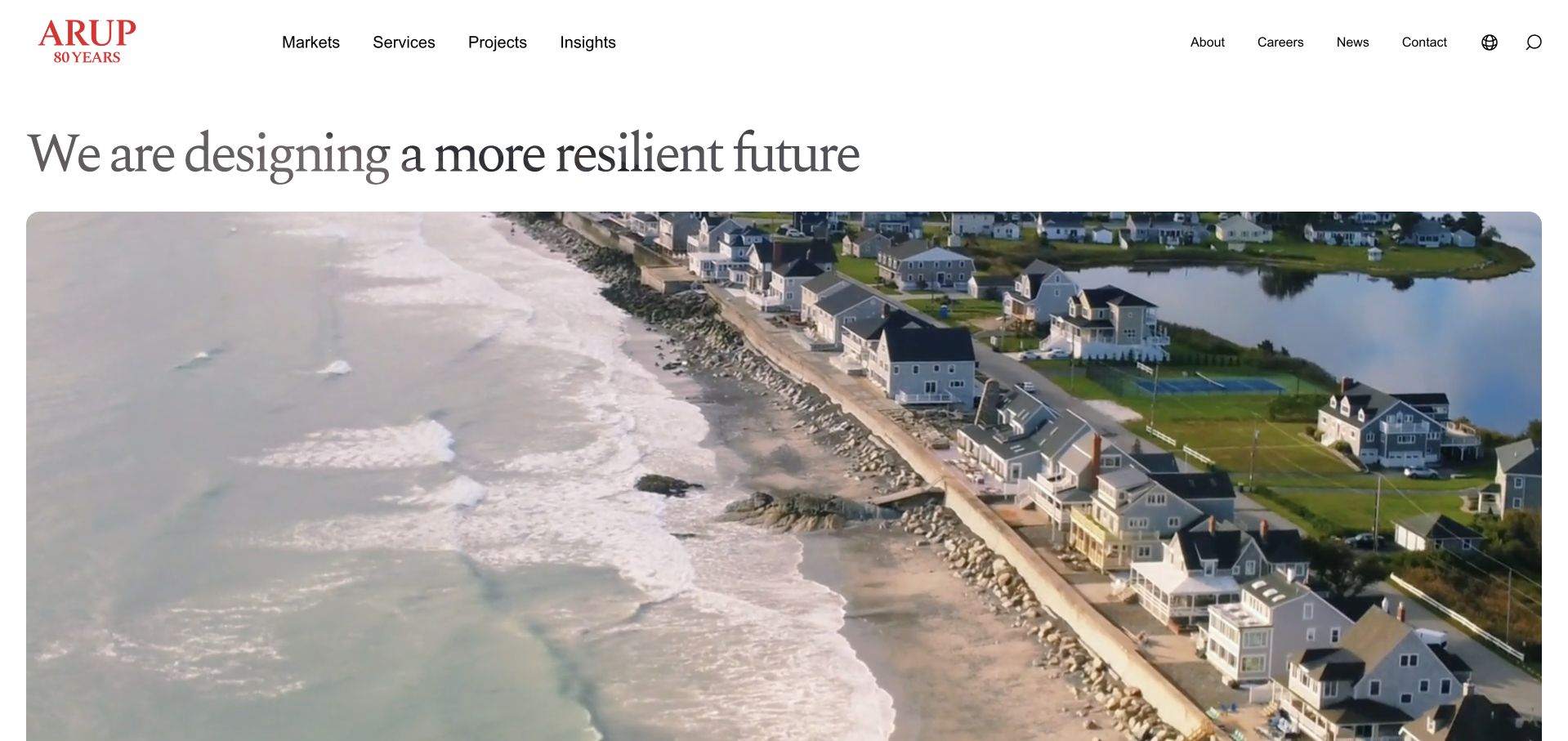
Arup’s retained homepage capture uses a restrained white header, large serif statement and coastal image. Markets, services, projects and insights are separate top-level routes, so the corporate story does not have to contain every discipline. Its current acoustic-consulting page gives the specialist subject a more useful structure: room acoustics, building acoustics, environmental sound and transport noise have distinct explanations, alongside tools and named experts. The coastal homepage photograph is a corporate introduction, not evidence of an acoustic result.
What you can learn
Give a broad consultancy a compact navigation system, then make the specialist page answer the commissioning questions. Room function, project context and a relevant expert provide better orientation than expecting a general resilience headline to explain acoustic engineering.
Pros
A small set of stable navigation labels separates service research from editorial and project browsing.
The acoustic page connects specific advice contexts with tools and named people.
Cons & considerations
A broad corporate photograph needs an explicit onward route before an acoustics visitor sees its relevance.
Tool descriptions and project claims need their own scope and evidence; the homepage appearance does not validate them.
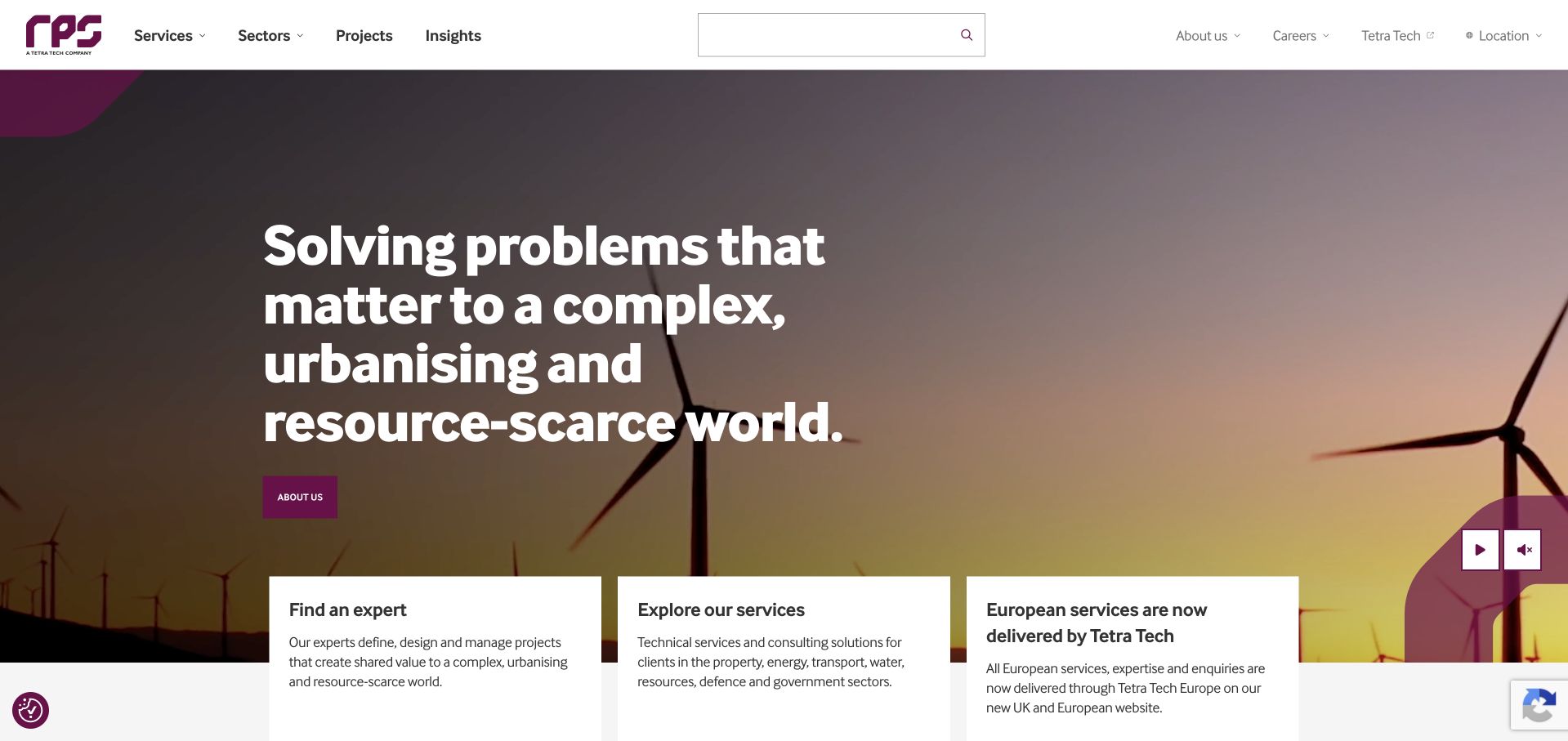
RPS combines a purple corporate identity and wind-farm imagery with three practical cards: finding an expert, exploring services and understanding the European handoff to Tetra Tech. The retained capture makes that transition visible rather than leaving it inside a footer. A supporting first-party acoustic article explains planning-stage advice, testing and monitoring, with named staff and professional contexts. The homepage is a broad consulting entrance, while the acoustic material supplies the subject-specific role; neither should be mistaken for an installer’s product catalog.
What you can learn
Explain regional and corporate handoffs at the point where someone chooses a service or person. During a brand transition, preserving a familiar logo is less useful than showing which team now receives the relevant acoustic enquiry.
Pros
The European-service transition is explicit beside normal research routes.
Expert discovery is a distinct task rather than only a general contact invitation.
Cons & considerations
A changing group structure requires regular checking of old service and staff destinations.
An immersive corporate opening does not itself explain the acoustic scope and needs supporting service detail.
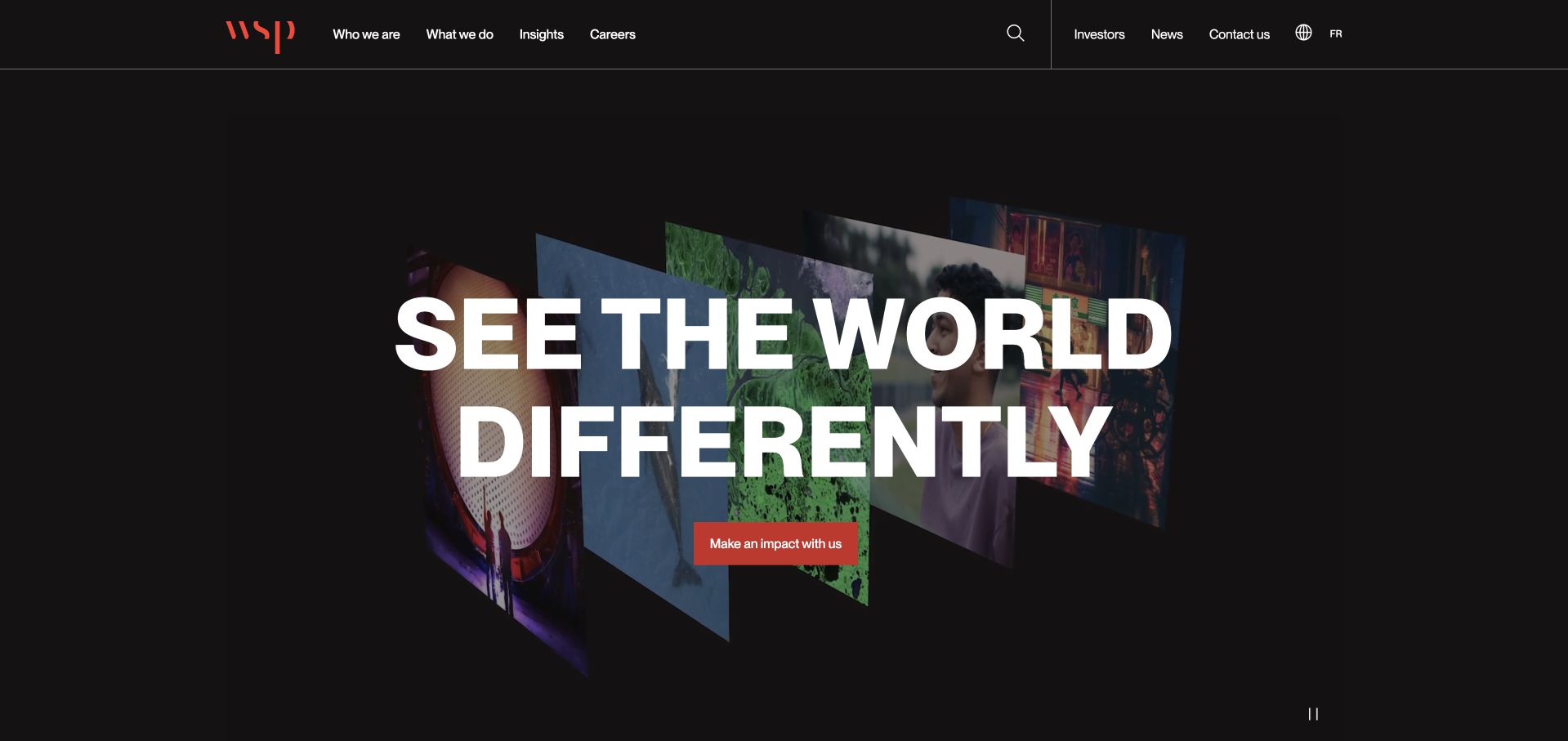
WSP’s retained Canadian homepage capture uses a dark background, red accents and layered imagery behind a very large identity statement. Who We Are, What We Do, Insights and Careers make the main purposes visible, with a separate language route. The current Canadian acoustic-service page then describes sound insulation, room modelling, building-services noise and vibration, and commissioning tests. This is a contrast worth studying: the broad homepage earns attention, while the specialist destination must do the explanatory work for an architect, owner or project team.
What you can learn
Let a strong brand opening lead to a service page with meaningful subtopics. A person investigating a vibration study needs clearer context than a global identity slogan, even when the same firm offers many related disciplines.
Pros
Major visitor purposes remain visible around the immersive introduction.
The acoustic destination distinguishes design, modelling, environmental work and testing.
Cons & considerations
Very large introductory type postpones specialist relevance below the opening screen.
Regional claims and testing descriptions need clear applicability rather than assumptions that every office offers an identical scope.
Kegan is a freelance web designer and developer with 15+ years of experience helping businesses turn complicated website requirements into clear, maintainable digital experiences. He works directly with clients from planning and design through development, launch, and ongoing support.
For acoustical engineering website design, his development approach focuses on clearly scoped acoustic design, testing and consulting services, sector-specific project records, technical team information, and useful project enquiries without unsupported performance guarantees. The scope can be a targeted improvement or a complete custom build, with responsive layouts, thoughtful content structure, and integrations chosen around the people using and maintaining the site.
Show 3 other acoustical engineering website designersHide other acoustical engineering website designers
Plan an acoustical engineering website around the brief and the advisory relationship
Map the questions that precede a technical appointment
Begin with the language the client brings to a meeting. A school may report that speech is difficult to understand, a laboratory may be concerned about sensitive instruments, and a developer may need to investigate nearby transport noise. The initial service structure should make those situations recognizable. Technical terminology can then refine the question rather than becoming a barrier to finding the right page. Do not promise a design solution before the project conditions have been assessed.
Organize services and sectors as related but different content. Adrian James Acoustics separates building acoustics, environmental noise, monitoring and testing, with distinct project categories. Acentech gives both services and markets a prominent place. A sector page can introduce a familiar setting, while a service page explains the work being commissioned. Link between them instead of duplicating the same paragraph under every school, office and residential heading.
Clarify the stage of the work as well as the setting. Early feasibility, planning support, detailed design, construction monitoring and completion testing have different inputs and deliverables. The website should help a visitor explain where the project stands without suggesting that every appointment includes every stage. A concise process diagram or plain sequence can be useful, but only if it reflects the practice’s actual responsibilities.
Build a portfolio that explains the consultant’s part
Collect project records while the team can still describe the scope accurately. Useful fields include the building or site type, location at an appropriate level, design partners where permission allows, project stage and the consultancy’s contribution. Do not assume that permission to name a public building automatically grants permission to publish drawings, detailed measurements or photographs taken by someone else. Image rights and confidentiality should be recorded alongside the content.
Use a short project summary to explain a real design constraint or investigation. BKL’s task-based routes distinguish design, permitting, testing and independent advice. Salter explicitly separates consultancy from equipment sales and installation. The useful pattern is attribution: readers should be able to tell what the consultant did without confusing it with the architect’s, contractor’s or equipment supplier’s work. A dramatic finished room does not establish the whole project scope.
Separate design intent, predicted results and measured verification. If the practice can publish a result, identify the context and relevant conditions. If it cannot, a clearly explained scope can still make a valuable case study. Avoid decorating the page with precise-looking numbers that have lost their original assumptions. The website is not an independent commissioning report, and a testimonial should not be positioned as if it were a technical test.
Let people, methods and resources answer different research needs
Give professional profiles consistent fields for role, relevant disciplines, office or region and an appropriate contact route. The aim is not to create an inflated directory of credentials. It is to help someone find the person or team who can discuss the question. Have the practice verify qualification wording and current professional affiliations before publication, then make staff departures and role changes part of routine site maintenance.
Explain specialist methods in terms of the decision they support. Arup’s acoustic-consulting material distinguishes room, building, environmental and transport contexts and connects them with explanatory tools. Auralisation can be introduced as a way to explore a proposed sound environment, but the site should also explain its scope and limits. Do not imply that a demonstration alone settles a performance requirement or proves what an unbuilt space will achieve.
Keep technical articles, project stories and company news distinguishable. A dated regulatory commentary needs a different review process from an evergreen service explanation. Educational resources can demonstrate how the practice thinks, provided the publication date, authorship and limitations remain clear. Do not silently refresh old guidance whenever the website is rebuilt or treat a broad article as advice for a reader’s specific project.
Design navigation for both specialist and multidisciplinary practices
A focused consultancy can often introduce its discipline directly. A large engineering group needs a clear route from the corporate homepage into the relevant practice. The retained Arup and WSP homepage examples illustrate that difference: a strong corporate identity does not need to recite every service, but the next destination must give an acoustic visitor enough specificity to continue. Keep the specialist page easy to find through both navigation and site search.
Manage regional and organizational boundaries explicitly. The RPS homepage identifies a European-service handoff to Tetra Tech. That kind of transition belongs close to service and expert discovery, not only in a legal footer. Review old project links, office pages and contact destinations when teams move between brands. A reader should not have to infer whether a familiar practice name still receives the enquiry in the same way.
Test the navigation with realistic tasks rather than only browsing the homepage. Ask someone to find a relevant service, identify a project contribution, locate an office and understand the first-contact process. Use a keyboard and a phone as well as a large screen. Keep descriptive link text, readable headings and essential explanations available when moving imagery or optional embedded media cannot be used.
Define the information handoff before adding an upload field
Start enquiries with enough information to route the conversation: project type, general location, stage and a short description of the question. Explain who handles the request and offer a useful alternative if the form fails. Do not promise an immediate technical answer or a response time that the team cannot staff. A confirmation should say what was received and what happens next without suggesting that an appointment or advice relationship has already been agreed.
Treat drawings, monitoring records, recordings and building-security information as deliberate information-management decisions. Decide which files can safely be requested through the public website and which should move to a controlled exchange after the team has responded. Avoid public file directories or real client data in demonstration forms. A document-upload feature is not a complete confidentiality or retention policy just because it appears inside a polished interface.
Assign content owners for service descriptions, people, offices, project permissions and dated resources. Test contact routing and document destinations periodically. Keep a record of substantive editorial changes rather than automatically making every service appear newly reviewed. A manageable publishing process is particularly important for a small specialist practice, where the people with the knowledge may not have time to maintain a complicated custom system.
The editing job behind the design
Choose publishing tools for connected services, people and project records
Model services, sectors, projects, team members, offices and resources as connected content rather than isolated pages. A project should be able to surface its relevant service and team without repeating the same biography or scope in several places. Decide which relationships editors can change safely and which statements need technical approval.
Keep the public marketing site distinct from acoustic modelling software, monitoring systems and confidential client workspaces. A visible website platform does not identify the tools used to design or measure a building. Public technology observations should remain scoped to the named page and supported by their actual evidence.
Choose a system the practice can maintain, with draft review, dependable image handling, descriptive document links and a simple correction process. An elaborate front end is not useful if staff cannot update an office contact or withdraw a superseded article without specialist development help.
Our WordPress website examples offer a separate look at publishing approaches. A visible platform label is evidence for that named page, not a guarantee that the same system will suit your requirements.
Before the public launch
Acoustical engineering website planning checklist
Name the project questions and professional audiences the site supports.
Separate room acoustics, noise transmission, environmental noise and vibration where relevant.
State the actual survey, design, advisory, monitoring and testing scope.
Distinguish consultancy from product sales and installation.
Explain project stages and the information needed to begin.
Record the consultant’s contribution to each featured project.
Verify image, client-name and document publication permissions.
Separate predicted, measured and testimonial evidence.
Review qualifications, roles, offices and professional affiliations.
Label regional and corporate contact handoffs clearly.
Protect drawings, recordings and sensitive project information.
Test navigation, keyboard access, mobile reading and enquiry routing.
Assign owners for dated resources and substantive review dates.
These checks are a project checklist, not a performance, legal, security, or accessibility certification. Test real journeys with the people responsible for the website before making claims about the result.
Sources & editorial method
How this collection was selected and reviewed
The collection compares public website communication by acoustic consultancies and engineering practices with an explicit acoustic advisory or design scope. It distinguishes focused practices from larger multidisciplinary businesses. Source screenshots retain their own genuine capture dates, including any earlier accepted originals reviewed for this collection. Public service descriptions help establish topic fit, not independently verified qualifications, compliance, performance or appointment suitability.
Each example links to its actual source page. Screenshots are direct browser captures with their own capture dates; moving imagery, announcements and live designs can change. The notes describe observable design choices and conditional tradeoffs, not measured traffic, conversion results, service quality, or accessibility conformance.
Technology labels use public page metadata, asset evidence, or explicitly cited platform documentation. Platform documentation is not a complete current deployment audit. A component reference may be legacy or unused; it is not a complete backend inventory. Unknown stacks are omitted. These sites are editorial examples, not our client portfolio.
Written, Edited and Curated are separate editorial records, not timestamps advanced by a rebuild. Website designs and imagery belong to their owners. See our editorial standards or suggest a correction.
Questions worth asking
Acoustical Engineering website design questions
How is this different from an acoustic contractor website?
This collection focuses on investigation, design, advice, modelling, monitoring and testing. A contractor may primarily supply and install products. A business can perform more than one role, but its website should explain the responsibility rather than leave the reader to infer it.
Does every acoustic project need a published performance number?
No. A useful case can explain the context, consultant’s contribution and design process without disclosing confidential results. When a result is published, retain its method, conditions and limits instead of presenting an isolated number as a universal outcome.
Should a consultancy organize the site by sector or by service?
Both can be useful when they answer different questions. A sector helps readers recognize a setting such as a school or laboratory; a service explains the work being commissioned. Connect the two without filling every page with duplicated text.
What should an initial acoustic enquiry ask for?
Request enough context to route the discussion, such as project type, general location, stage and a short description. Define a suitable process for drawings and sensitive files before collecting them. The enquiry should not imply that project-specific advice has already been provided.
Do the examples certify engineering quality or compliance?
No. The observations concern website structure, presentation and communication. They do not test acoustic designs, confirm professional competence, validate regulatory claims or recommend a particular firm for a specific appointment.
Borrow the clear service boundaries, useful project records and understandable research routes. Let the website support a better project conversation without presenting visual polish as proof of acoustic engineering performance.