Best Rust Websites of 2026 (20 Real-World Examples)
Rust-associated websites, precisely scoped project evidence, and practical development tradeoffs
Explore 20 public website references connected to documented Rust components, services and open-source projects. The screenshots illustrate design; the linked sources identify the particular Rust work. They do not establish that every pictured homepage is served by Rust.
Rust is a systems programming language, not a website aesthetic or a universal replacement for an existing web stack. A company may use it in a sync engine, network proxy, browser component or developer tool while publishing its marketing pages elsewhere. This guide keeps those responsibilities separate so a strong design example does not become an invented implementation claim.
Cloudflare, Dropbox, Figma, Discord and Mozilla open with recognizable brands and explicitly bounded sources. Some accounts are historical, and a service named by the Rust core team in 2020 is not a current inventory of an organization. Later examples introduce public implementation projects such as build tools, editors and databases, whose source can be evaluated without assuming that every surrounding product uses Rust.
Before the examples
What makes good Rust website development in 2026?
Start with a measured requirement
Name the component, its inputs and the problem a language change is meant to solve. A slow page may be dominated by media or an external service rather than its backend language. Compare a bounded improvement with a rewrite, including migration, review, testing and operating responsibilities. A brand’s success story is not a benchmark for your workload.
Treat ownership as a design constraint
The Rust Book describes compiler-checked ownership rules for memory management. Plan the team’s learning and review around the actual data and resource lifetimes in the component. Those rules are valuable engineering tools, but they do not decide whether an application’s business permissions, user experience or recovery behavior are correct.
The official book explains that unsafe Rust permits operations requiring additional guarantees from the programmer. Record where unsafe code, foreign interfaces and native dependencies enter the project and how they are reviewed. Do not turn a language’s safety model into a blanket promise that every dependency or deployed service is secure.
Compare the public explanation and interface design, then inspect the actual Rust association named by the source. A desktop client, an Android component, a runtime implementation and a database are different workloads. Their presence here does not imply the public pages share an architecture.
We start with five recognizable brands or organizations: Cloudflare, Dropbox, Figma, Discord, Mozilla Firefox. Each attribution applies to the named website property, not every product or website belonging to its organization. This is a curated reading sequence, not a measured ranking.
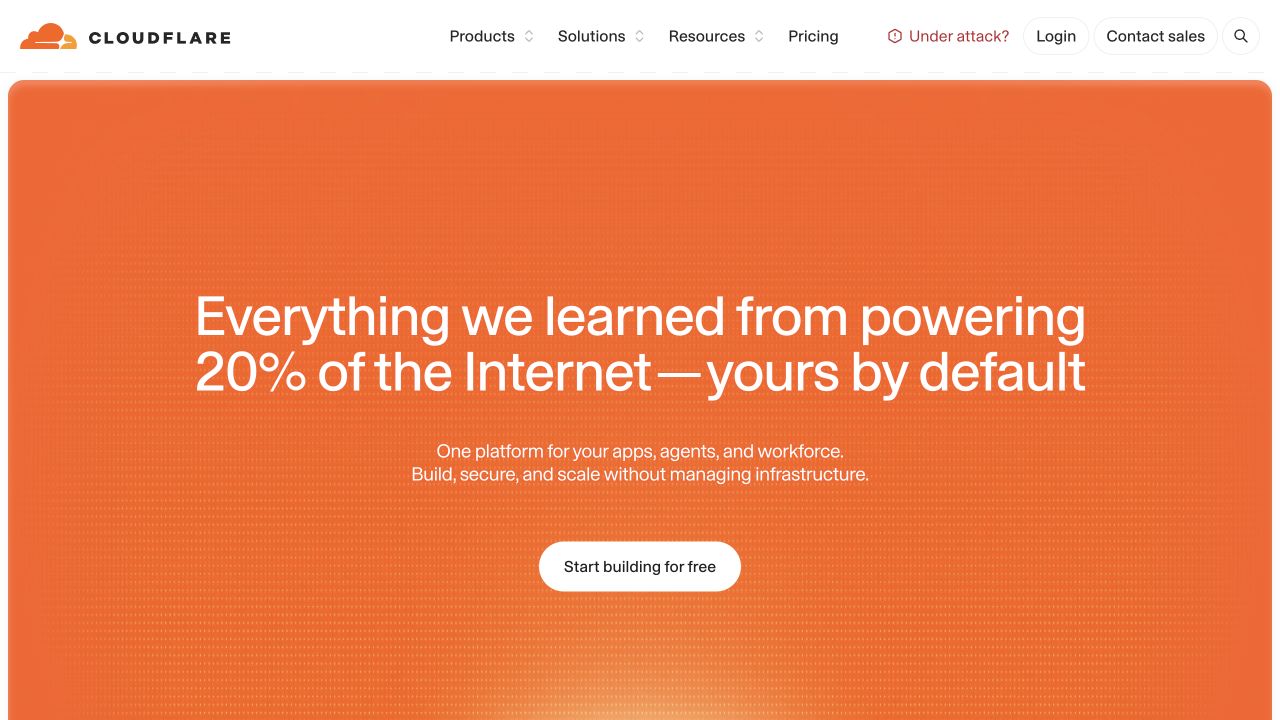
Cloudflare’s orange opening panel makes the public platform story immediately recognizable. A short description and one light action sit beneath a large introductory statement, with specialist product routes retained in the navigation. The hierarchy avoids making a newcomer understand every infrastructure term before finding a way in. Cloudflare’s Pingora source documents a Rust network-services framework; that engineering evidence does not establish the language of this marketing page, the full network stack or every product linked from the header.
What you can learn
Introduce an infrastructure portfolio through one understandable proposition, then let the specialist routes carry technical depth. Connect important claims to the relevant engineering or product source. A memorable first screen should make exploration easier without replacing the precise explanation an implementation decision ultimately requires.
Pros
A tightly controlled orange field gives the broad infrastructure story a clear visual center.
Specialist navigation remains available outside the introductory panel for visitors who know their technical destination.
Cons & considerations
The opening is intentionally broad and needs supporting pages to explain product boundaries and configuration effort.
Platform-scale claims should not be copied without their original source, date and intended measurement scope.
Platform source: Official Rust engineering or project evidence. Pingora network-services framework, not a full marketing-stack claim. The cited engineering, project or customer source establishes only the named language association. It does not establish the marketing page runtime, every company system, current deployment continuity or independent performance results. Platform evidence is separate from the direct website screenshot and is not a complete current infrastructure audit.
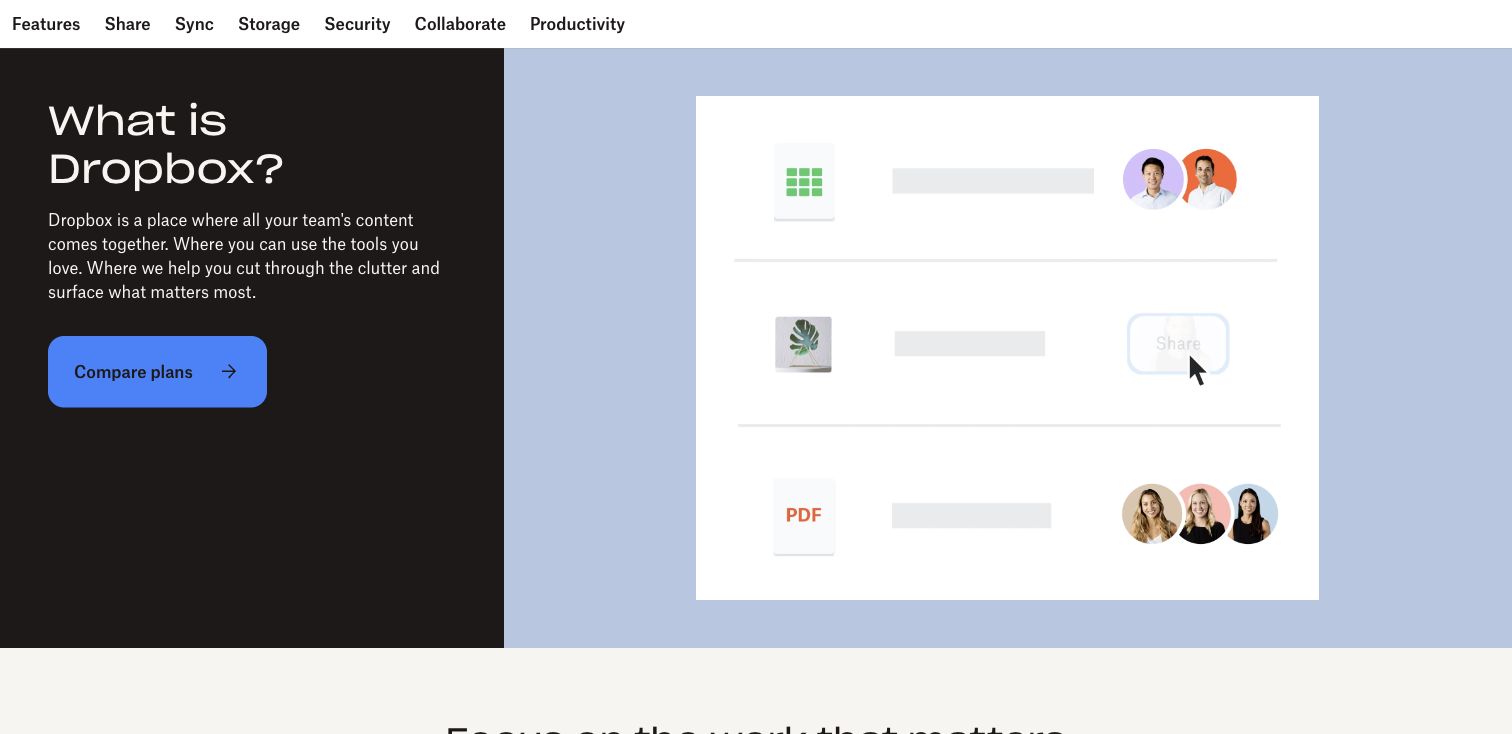
Dropbox’s feature overview explains a shared place for content through a short question-and-answer introduction and a file illustration. The design emphasizes what people can do together, not the mechanics of syncing or storing the files. That restraint is relevant to a service whose internal systems are technically complex but should not become the customer’s burden. Dropbox’s Rust source is a historical desktop sync-engine rewrite; it does not identify this public page’s backend or establish every current Dropbox component.
What you can learn
Explain the customer-facing task in its own language, and reserve implementation detail for an appropriate engineering route. A rewrite story may be valuable evidence for technical readers, but the public product introduction still needs to make collaboration, permissions and the next practical action understandable.
Pros
The split composition gives the product definition and illustrative workspace clear, separate roles.
A plain-language opening can reach readers who do not need to understand the implementation of a sync engine.
Cons & considerations
A conceptual illustration cannot demonstrate actual conflict handling, access controls or file-recovery behavior.
The broad overview needs more specific workflow and plan information before a team can assess its requirements.
Platform source: Official Rust engineering or project evidence. Nucleus desktop sync-engine rewrite; separate from the pictured public page. The cited engineering, project or customer source establishes only the named language association. It does not establish the marketing page runtime, every company system, current deployment continuity or independent performance results. Platform evidence is separate from the direct website screenshot and is not a complete current infrastructure audit.
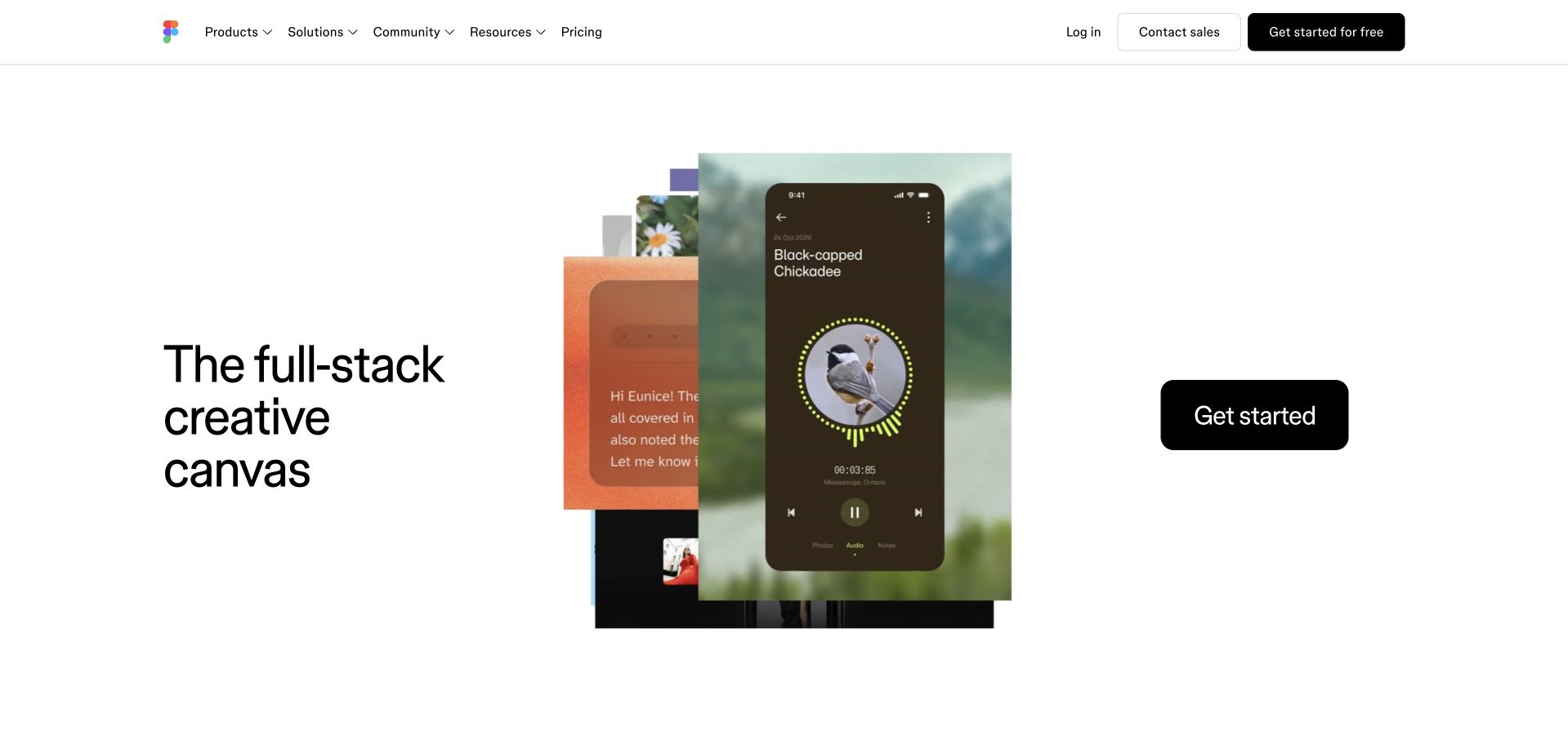
Figma places colorful creative examples between a large introductory statement and a prominent action. The white background lets the output carry the visual variety, while the navigation keeps product, community and pricing routes predictable. It is a confident way to present a broad creative platform without opening on a dense application toolbar. The Rust core team named a Figma service association in 2020; that historical attestation is not proof of the current runtime of this public homepage or every Figma feature.
What you can learn
Show a believable range of output while keeping the first decision simple. A creative platform can demonstrate breadth through a carefully selected composition rather than dozens of tiny feature cards. Follow the spectacle with clear distinctions between product capabilities, collaboration and the practical work of getting started.
Pros
The sample work gives the creative proposition a concrete visual companion instead of unrelated decorative imagery.
The restrained background keeps a visually varied central composition from making the navigation hard to find.
Cons & considerations
A large animated composition needs a meaningful settled frame and reduced-motion treatment.
The expansive promise still requires supporting detail to explain which products and workflows are included.
Platform source: Official Rust engineering or project evidence. Figma service association named by the Rust core team in 2020; complete current stack not inferred. The cited engineering, project or customer source establishes only the named language association. It does not establish the marketing page runtime, every company system, current deployment continuity or independent performance results. Platform evidence is separate from the direct website screenshot and is not a complete current infrastructure audit.
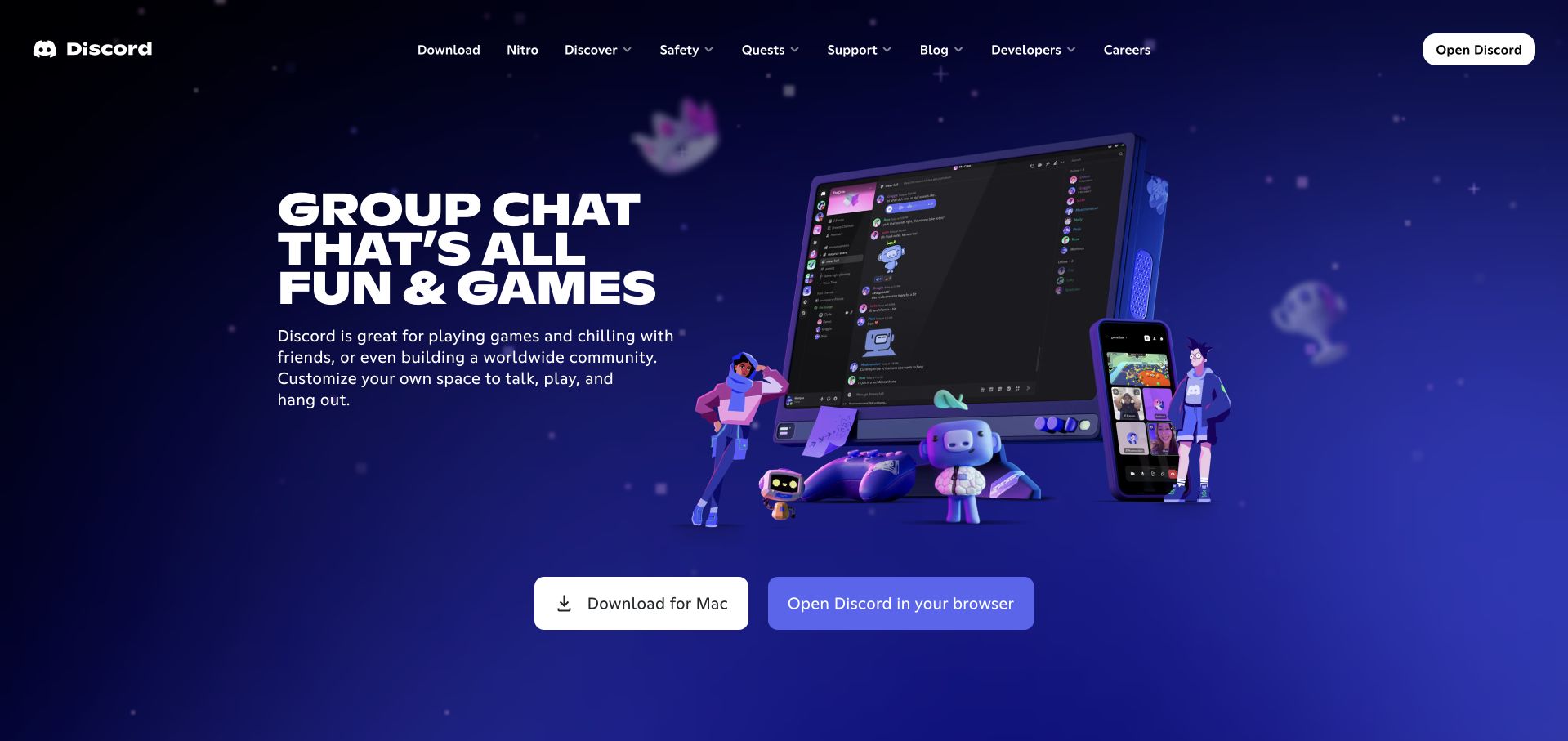
Discord’s public homepage uses a vivid blue environment and an oversized product-oriented composition to introduce group conversation. The branded illustration and interface fragments give the service a recognizable world rather than a generic enterprise-software appearance. Download and browser-oriented routes provide practical next steps alongside the expressive presentation. The Rust engineering source discusses a read-state service and other components in a historical account; it does not establish that the entire application, website or communication pipeline was rewritten in Rust.
What you can learn
Use a distinctive visual world to make a social product recognizable, but connect it to a clear way of starting. Separate the emotional promise of belonging from the practical requirements of account creation, device support and moderation. Engineering improvements should be described at the component level they actually concern.
Pros
A coherent blue visual environment makes the service more recognizable than a generic messaging-dashboard collage.
Practical starting routes remain visible alongside the more expressive brand treatment.
Cons & considerations
Large imagery and display text can delay the concrete explanation for someone unfamiliar with the product.
A promotional interface cannot establish moderation quality, privacy behavior or accessibility of actual conversations.
Platform source: Official Rust engineering or project evidence. Read-state service and other components described in a 2020 engineering account. The cited engineering, project or customer source establishes only the named language association. It does not establish the marketing page runtime, every company system, current deployment continuity or independent performance results. Platform evidence is separate from the direct website screenshot and is not a complete current infrastructure audit.
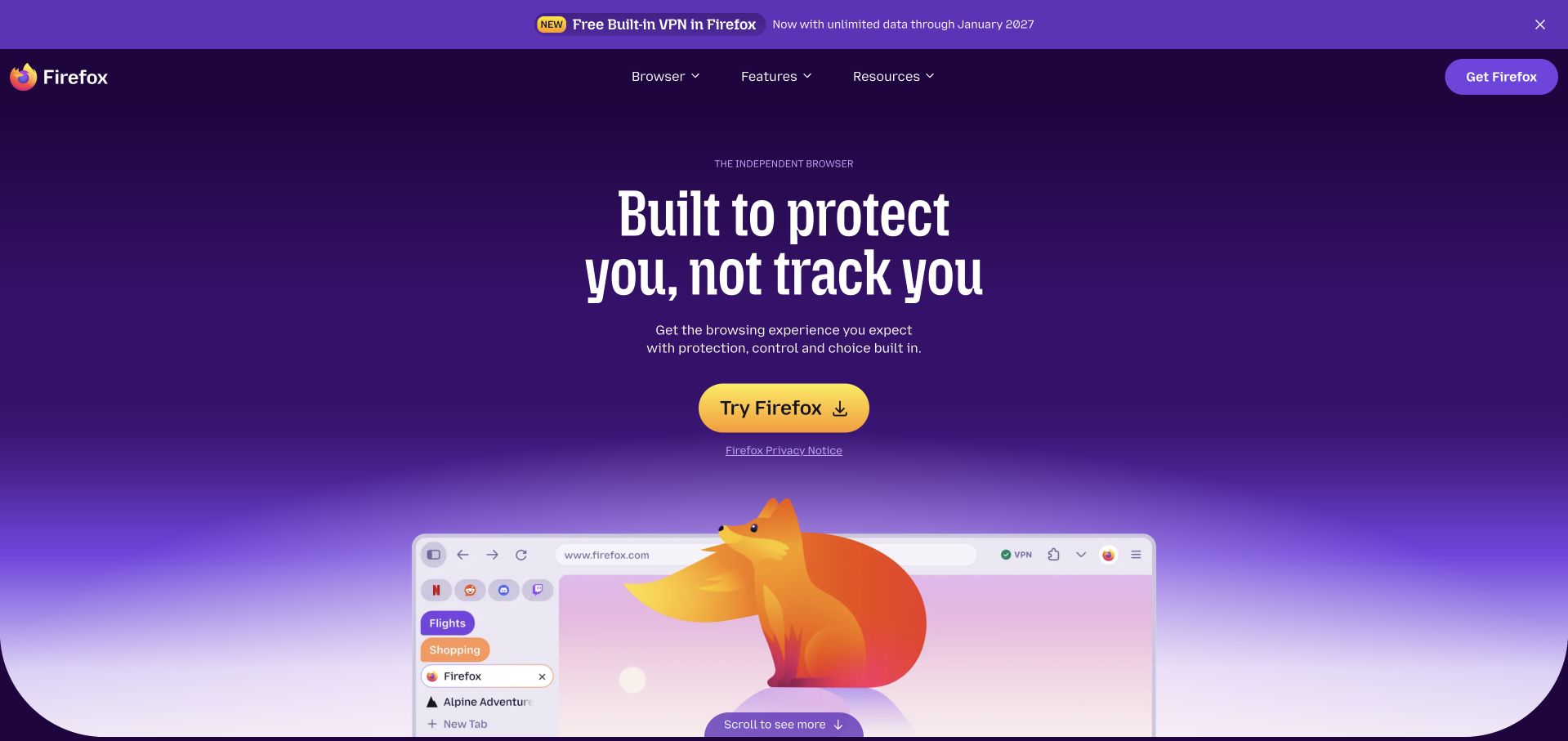
Firefox’s opening uses a purple gradient, a playful browser illustration and a prominent download button. The main proposition centers the user’s relationship with the product rather than a long technical feature list. Navigation and a restrained announcement strip support deeper research without competing equally with the download task. Mozilla’s Rust evidence concerns the Stylo CSS-engine component documented in 2017; it does not identify the implementation of this public marketing page or imply that the entire browser is written in Rust.
What you can learn
Give an alternative consumer product one clear reason to be considered, then make the immediate action unmistakable. Keep the supporting technical explanation reachable for visitors who want evidence. A privacy-oriented message should be accompanied by precise policy and product documentation rather than treated as self-proving branding.
Pros
The contrasting download action is easy to locate within a strongly branded introductory composition.
The browser illustration connects an abstract protection message to a recognizable everyday product.
Cons & considerations
A broad privacy proposition needs details about settings, services and data handling beyond the first screen.
Download suitability and platform requirements cannot be established from the visual presentation alone.
Platform source: Official Rust engineering or project evidence. Stylo CSS-engine component, documented in 2017; not a public-page backend claim. The cited engineering, project or customer source establishes only the named language association. It does not establish the marketing page runtime, every company system, current deployment continuity or independent performance results. Platform evidence is separate from the direct website screenshot and is not a complete current infrastructure audit.
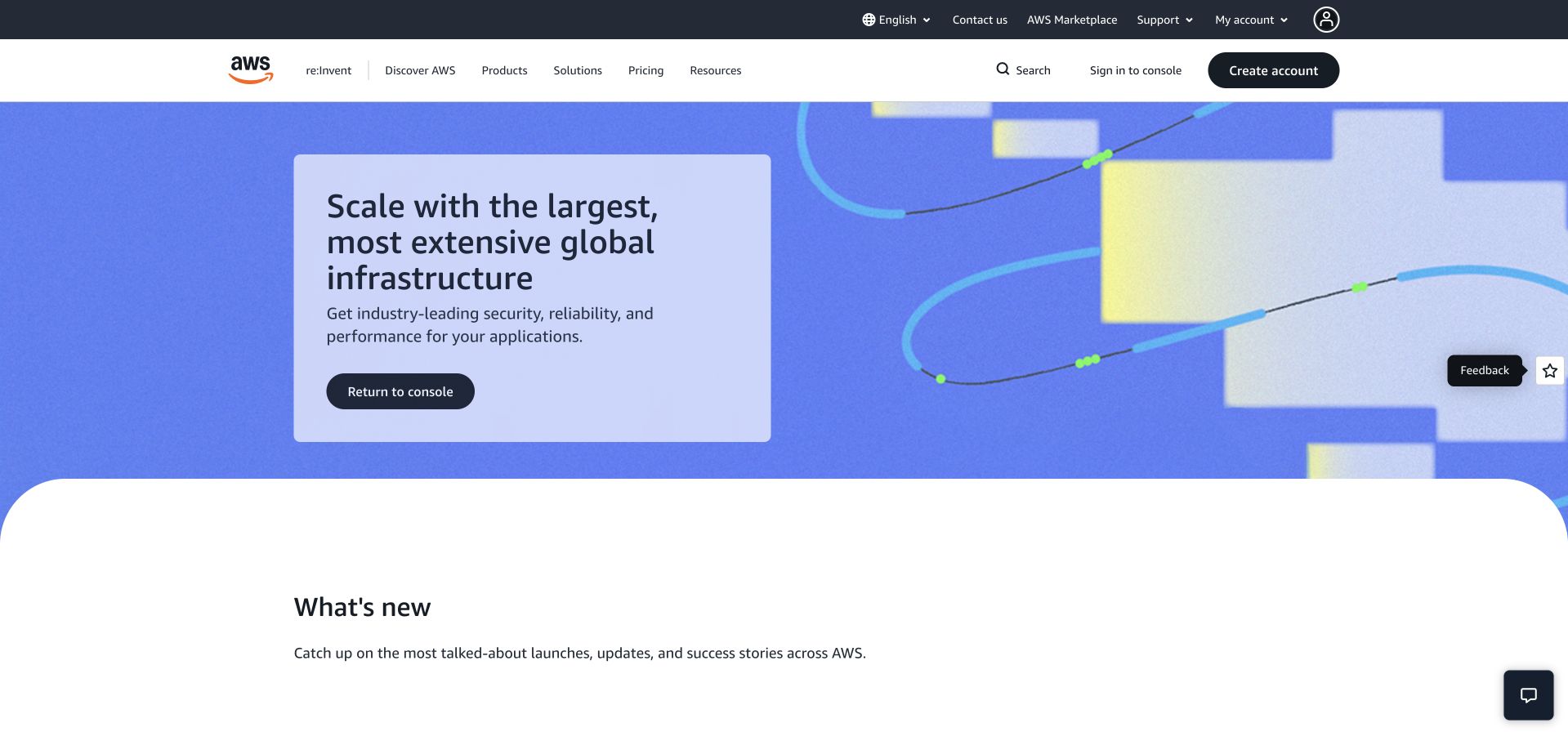
AWS places a short infrastructure-oriented statement inside a light panel over a blue abstract illustration. The large rounded transition into the next section gives the page a recognizable break between campaign and current updates. A dense but familiar top navigation preserves product and resource discovery. The Rust association is the Firecracker microVM project associated with AWS; it does not identify the server language of this public homepage, every AWS service or any particular customer’s architecture.
What you can learn
Give a large infrastructure catalog a manageable introductory story while preserving direct utility navigation. Separate the public marketing route from the operational console, and do not let an individual implementation example stand in for the entire platform. Technical evaluators need product-specific documentation, limits and responsibility boundaries.
Pros
The bounded text panel makes the broad infrastructure message readable against the abstract visual environment.
The next-section transition clearly signals a move from the main campaign into current platform information.
Cons & considerations
The extensive navigation can be intimidating to visitors who do not already know the platform’s product names.
A broad scale-oriented proposition cannot establish price, regional availability or operational suitability for a particular workload.
Platform source: Official Rust engineering or project evidence. Firecracker microVM implementation associated with AWS. The cited engineering, project or customer source establishes only the named language association. It does not establish the marketing page runtime, every company system, current deployment continuity or independent performance results. Platform evidence is separate from the direct website screenshot and is not a complete current infrastructure audit.
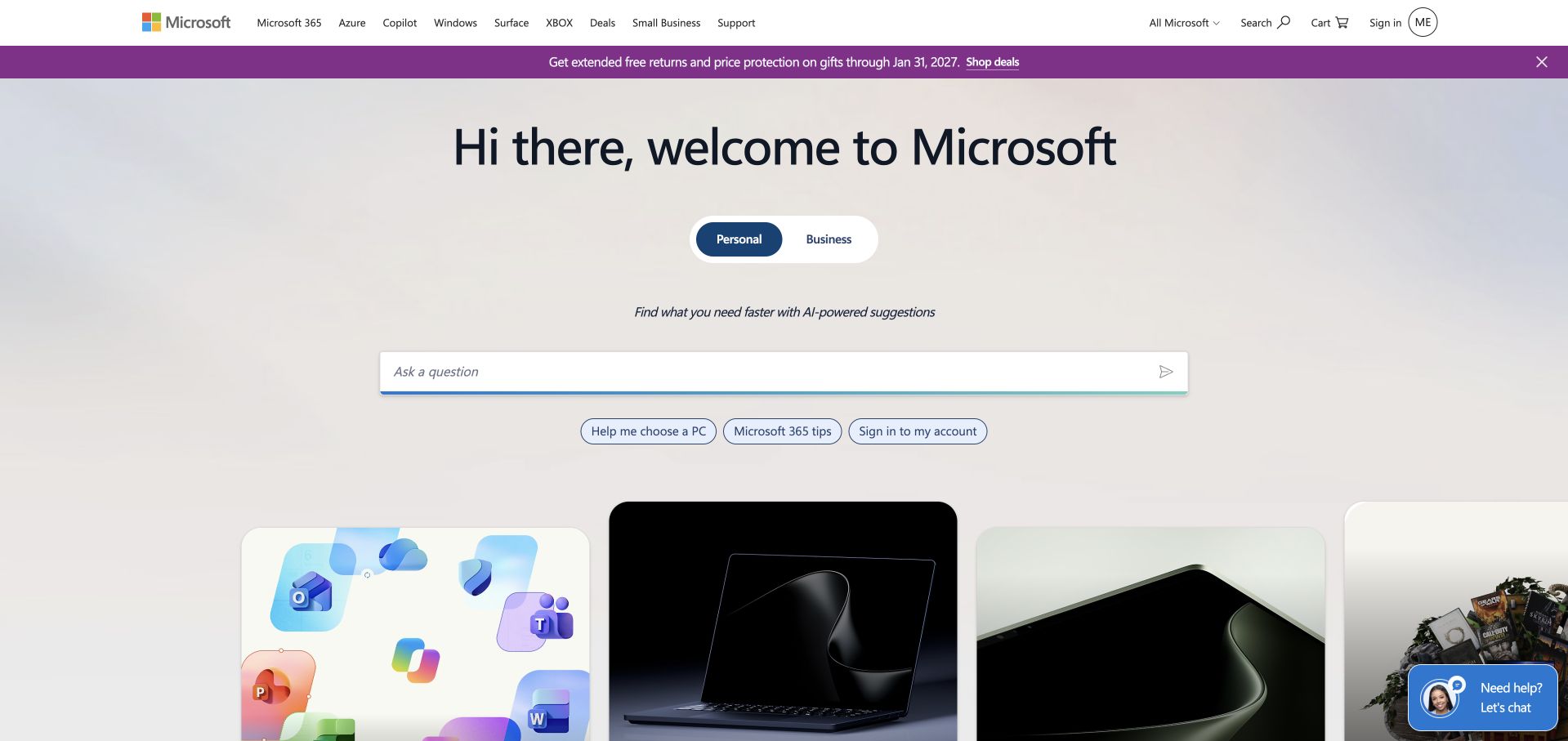
Microsoft’s public opening combines a Personal and Business choice with a broad question field and familiar product cards. The gentle gradient and large greeting make the catalog feel approachable, while the conventional header remains available for direct navigation. The design is useful as a study of guided discovery, not as evidence of a systems-language frontend. This collection’s Rust association is Microsoft’s Windows API bindings project, a precisely identified developer component rather than a claim about the pictured website or all Windows code.
What you can learn
Keep the visible customer journey separate from the implementation story used to support a technology association. A corporate brand can maintain a Rust project while its public website uses unrelated delivery technology. For design, compare whether the question-led entrance helps people find a product faster than recognizable categories would.
Pros
The audience switch adds context to an otherwise very open-ended discovery prompt.
Product cards provide a recognition-based fallback for visitors who do not want to formulate a question.
Cons & considerations
An open question can make a simple known-product task feel more complicated than direct navigation.
The spacious greeting leaves limited first-screen room for explaining differences between the available products.
Platform source: Official Rust engineering or project evidence. Rust bindings for Windows APIs maintained by Microsoft. The cited engineering, project or customer source establishes only the named language association. It does not establish the marketing page runtime, every company system, current deployment continuity or independent performance results. Platform evidence is separate from the direct website screenshot and is not a complete current infrastructure audit.
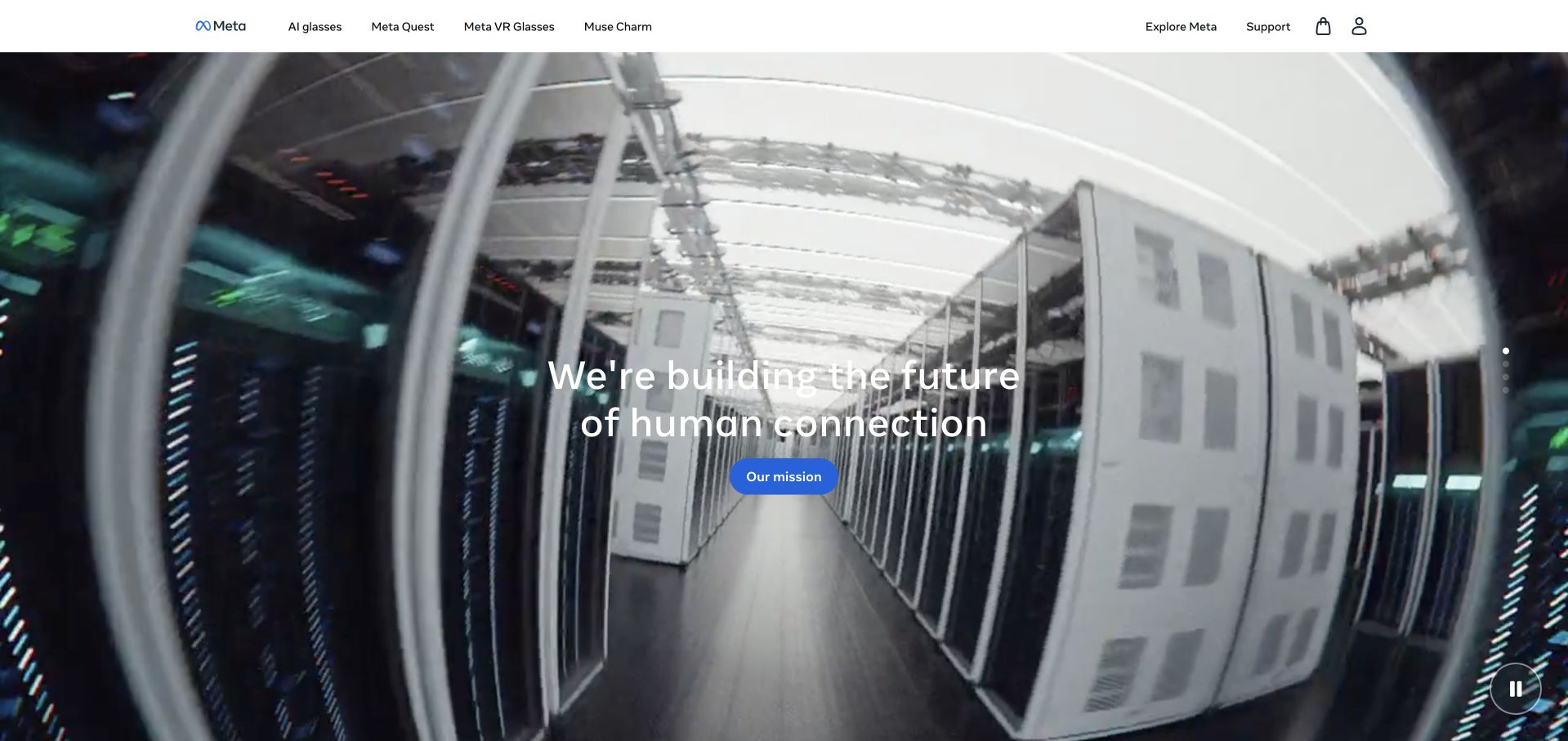
Meta’s public company page places a short human-connection statement over large infrastructure footage, with a distinct company-oriented header above it. The visual setting hints at the systems behind the products without pretending to explain them in a single diagram. A compact mission action gives the introduction somewhere concrete to lead. The Rust association is Buck2, Meta’s public build-tool project; the server-room imagery is not independent evidence of Rust or proof of the runtime serving this marketing page.
What you can learn
Use infrastructure imagery as context, not as a technology fingerprint. A corporate page should identify its actual subject and give visitors routes to products, policies and company information. When linking an open-source project as technical evidence, name that project explicitly instead of implying that one language describes the organization.
Pros
The restrained statement remains readable against a deliberately subdued moving background.
The company-oriented navigation distinguishes the public introduction from a consumer application or account interface.
Cons & considerations
A broad connection message provides little detail about the practical differences between the company’s products.
Large moving infrastructure footage needs accessible alternatives and cannot by itself substantiate implementation or environmental claims.
Platform source: Official Rust engineering or project evidence. Buck2 build-tool implementation; not an attribution of the public homepage. The cited engineering, project or customer source establishes only the named language association. It does not establish the marketing page runtime, every company system, current deployment continuity or independent performance results. Platform evidence is separate from the direct website screenshot and is not a complete current infrastructure audit.
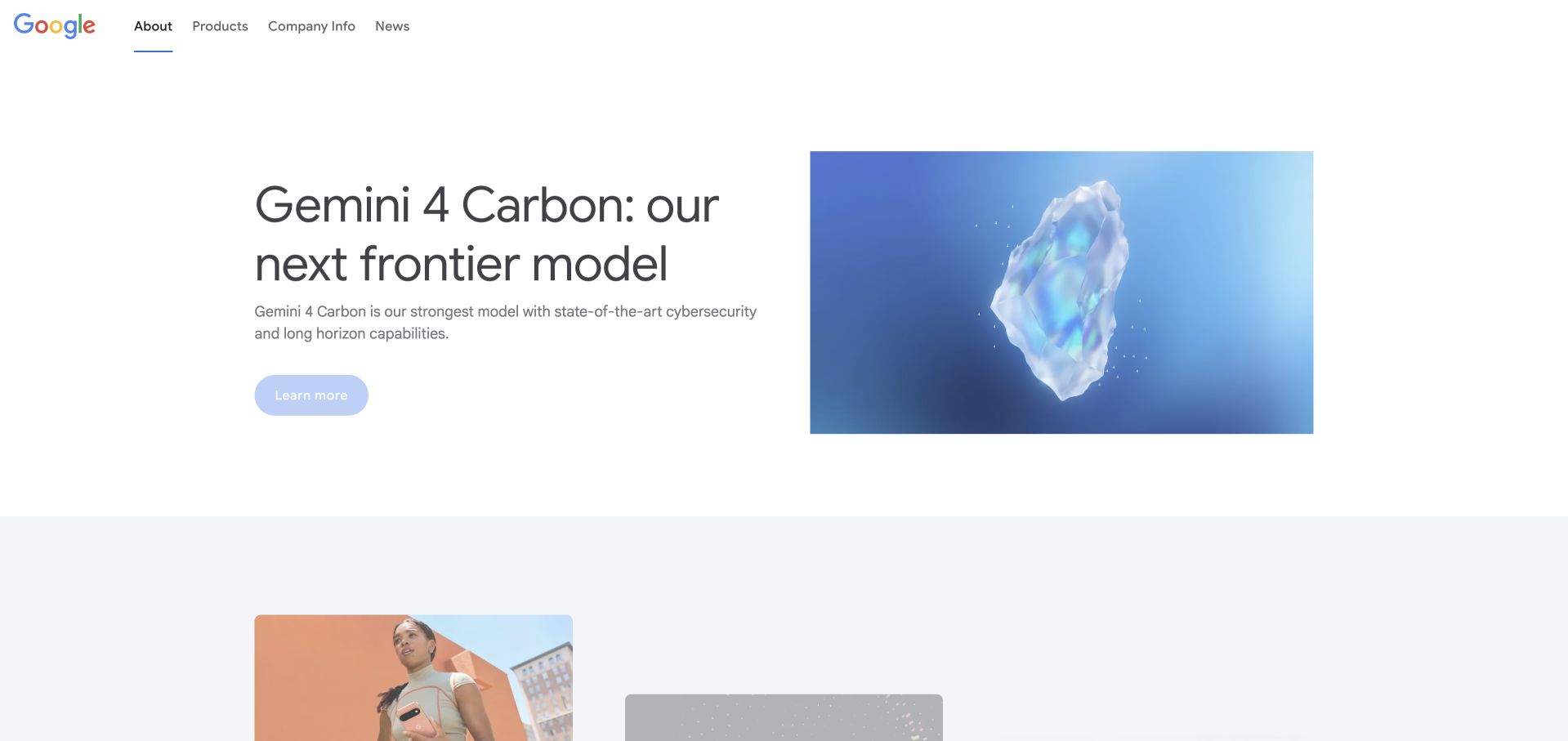
Google’s About page presents one product story through a restrained headline-and-image pairing. The pale background and compact company navigation keep the opening light, while the next editorial row introduces the wider organization. The design does not try to explain the entire technology estate at once. The Rust evidence concerns Android platform components documented by Google’s security team in 2022; it is not a claim about the language serving this company page.
What you can learn
Choose a clear public story and keep the implementation evidence attached to the actual system it describes. A company can use a systems language in an operating platform while presenting that work through a completely separate web publishing stack. Readers should not have to infer that distinction from the brand name alone.
Pros
The restrained opening lets one product subject remain understandable without a dense feature or organization chart.
Predictable company navigation supports visitors whose questions differ from the currently featured announcement.
Cons & considerations
An announcement-led opening may delay an evergreen explanation for someone unfamiliar with the company’s wider work.
The minimal composition depends on editorial selection and loses focus if too many stories receive equal visual priority.
Platform source: Official Rust engineering or project evidence. Android-platform Rust components, documented in 2022. The cited engineering, project or customer source establishes only the named language association. It does not establish the marketing page runtime, every company system, current deployment continuity or independent performance results. Platform evidence is separate from the direct website screenshot and is not a complete current infrastructure audit.
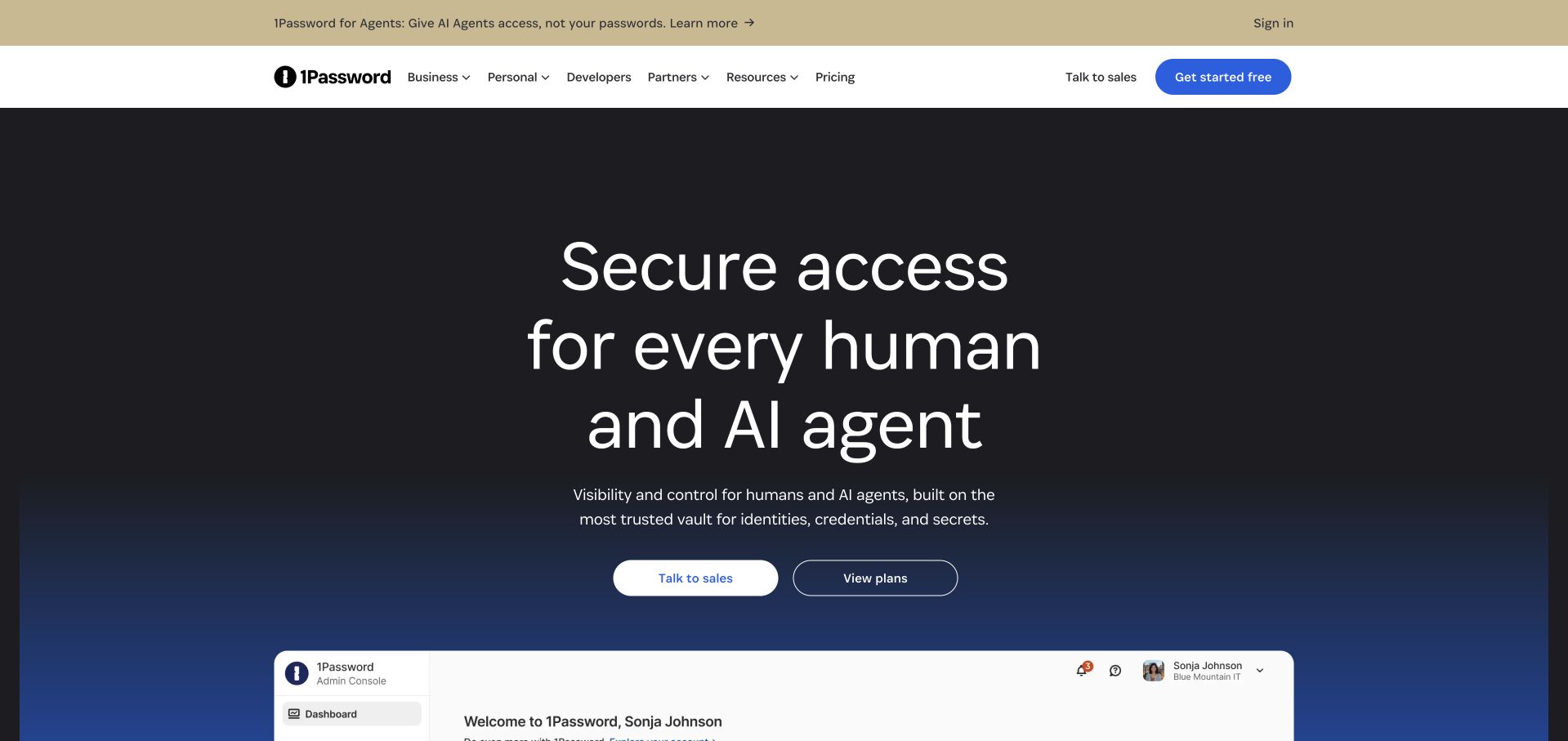
1Password’s dark opening combines a concise access-management proposition with separate sales and plan actions. A recognizable product interface begins below the headline, helping connect a broad security topic to an everyday working surface. The header distinguishes business, personal and developer audiences rather than presenting them as one identical buying journey. The Rust core team’s historical source names a 1Password service association; it is not a current inventory of the company’s systems or independent proof of security properties.
What you can learn
Explain an expanding security product through the people and tasks it serves, then distinguish the routes for each audience. Interface imagery can make access management less abstract, but policy, architecture and evaluation material still need to substantiate the claims. A visual impression of safety is not a security assessment.
Pros
The audience navigation recognizes that individuals, organizations and developers evaluate access tools differently.
Distinct sales and plan actions support visitors who need assistance and those ready to compare options.
Cons & considerations
A broad access proposition needs more detailed boundaries around the particular products and integrations involved.
A marketing interface cannot establish credential handling, threat resistance or the suitability of a deployment.
Platform source: Official Rust engineering or project evidence. 1Password service association named by the Rust core team in 2020. The cited engineering, project or customer source establishes only the named language association. It does not establish the marketing page runtime, every company system, current deployment continuity or independent performance results. Platform evidence is separate from the direct website screenshot and is not a complete current infrastructure audit.
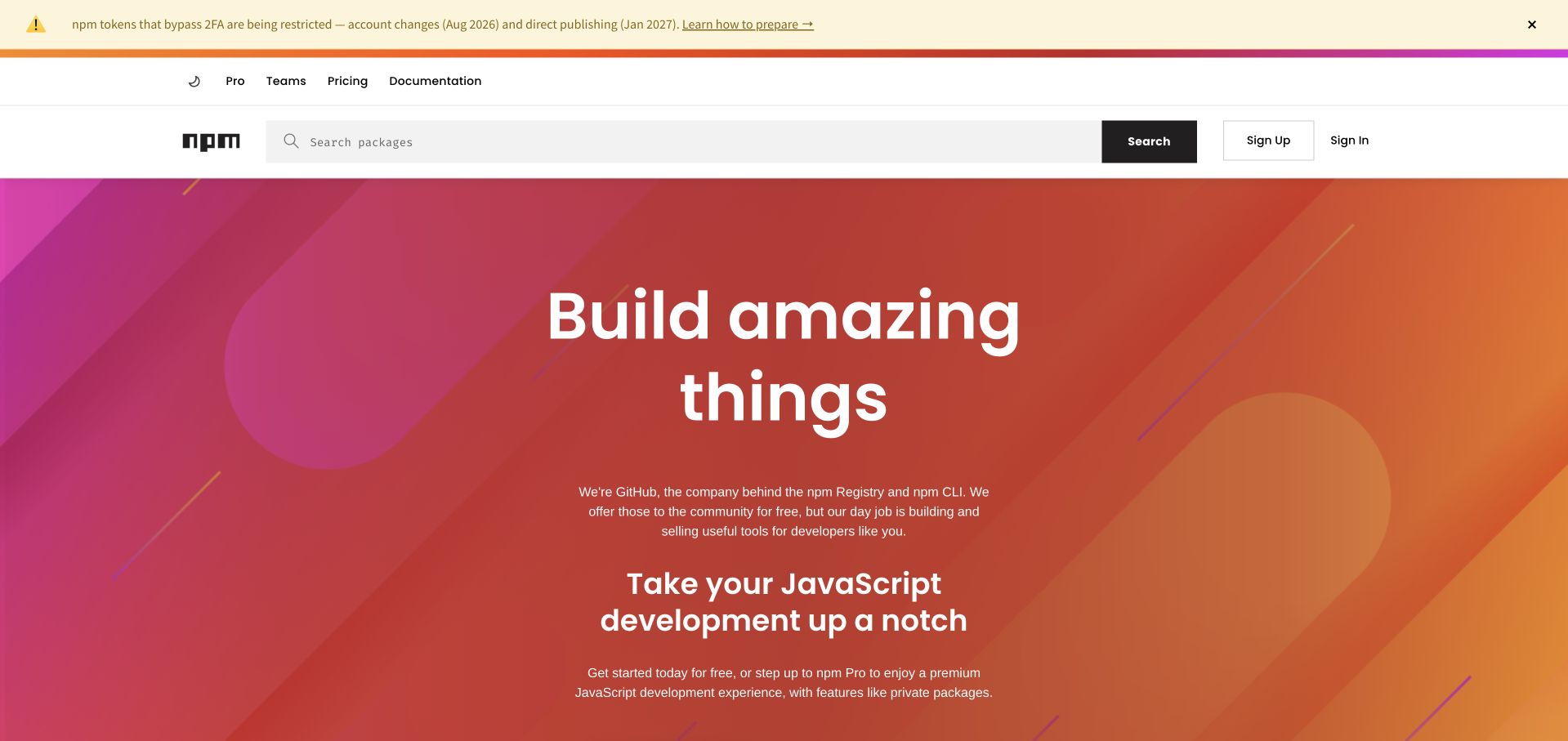
npm keeps package search near the top of the page, above a warm orange promotional field. Product and documentation links are compact, allowing a returning developer to reach the familiar utility without interpreting the main campaign. A visible account-security notice adds operational context but also another layer to the opening. npm’s Rust case is a historical authorization-service account; it does not establish the implementation of the registry search, every package or the public marketing page.
What you can learn
Protect the primary repeat task when a developer utility also carries commercial messaging. Search should remain direct and predictable, with important account notices distinguishable from promotion. Package discovery must still lead to version, maintainer, license and provenance information rather than implying that registry availability is an endorsement.
Pros
A prominent package search supports the registry’s most familiar use without requiring a trip through the promotional content.
The warm campaign field is visually separate from the compact utility and documentation navigation.
Cons & considerations
The security notice, navigation and campaign create several horizontal layers before deeper product explanation.
A searchable package registry does not establish the safety or maintenance quality of an individual dependency.
Visible tech stack
Earlier / documented evidence
Rust
Platform source: Official Rust engineering or project evidence. Historical authorization-service case study, not a full registry-stack audit. The cited engineering, project or customer source establishes only the named language association. It does not establish the marketing page runtime, every company system, current deployment continuity or independent performance results. Platform evidence is separate from the direct website screenshot and is not a complete current infrastructure audit.
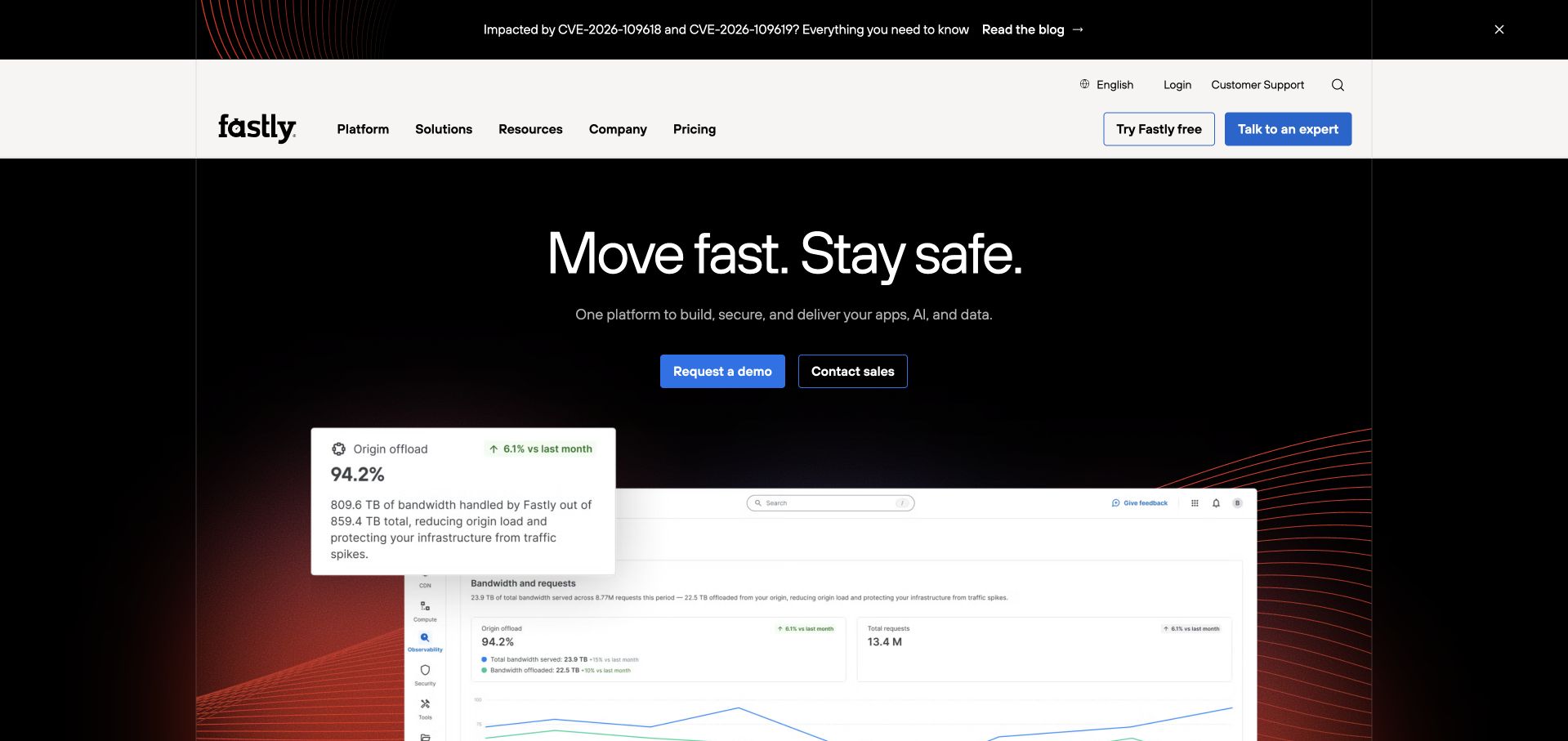
Fastly’s homepage places a short speed-and-safety proposition above an observability-style interface image. The dark background and controlled red lighting make the white demonstration panel the main visual anchor. Trial, expert and sales routes remain available for different levels of readiness. Fastly’s cited 2019 Lucet announcement documents a Rust WebAssembly runtime project; it is a historical component association, not a claim that the current public homepage, every edge product or every customer workload uses that implementation.
What you can learn
Make an infrastructure service tangible through the work an operator sees, while keeping technical claims precisely sourced. Explain the difference between an edge platform, an application runtime and the code a customer deploys. A dashboard image is useful context but should not replace documentation of limits, responsibility and failure behavior.
Pros
The bright interface image gives the otherwise abstract delivery proposition a concrete operational reference.
Separate commercial and trial routes recognize that visitors arrive with different technical and purchasing intentions.
Cons & considerations
The short headline needs supporting product detail to explain what the platform actually delivers and secures.
Dashboard metrics in a promotional image are not independent measurements or promises about a customer’s workload.
Platform source: Official Rust engineering or project evidence. Historical Lucet Rust WebAssembly runtime project, documented by Fastly in 2019. The cited engineering, project or customer source establishes only the named language association. It does not establish the marketing page runtime, every company system, current deployment continuity or independent performance results. Platform evidence is separate from the direct website screenshot and is not a complete current infrastructure audit.
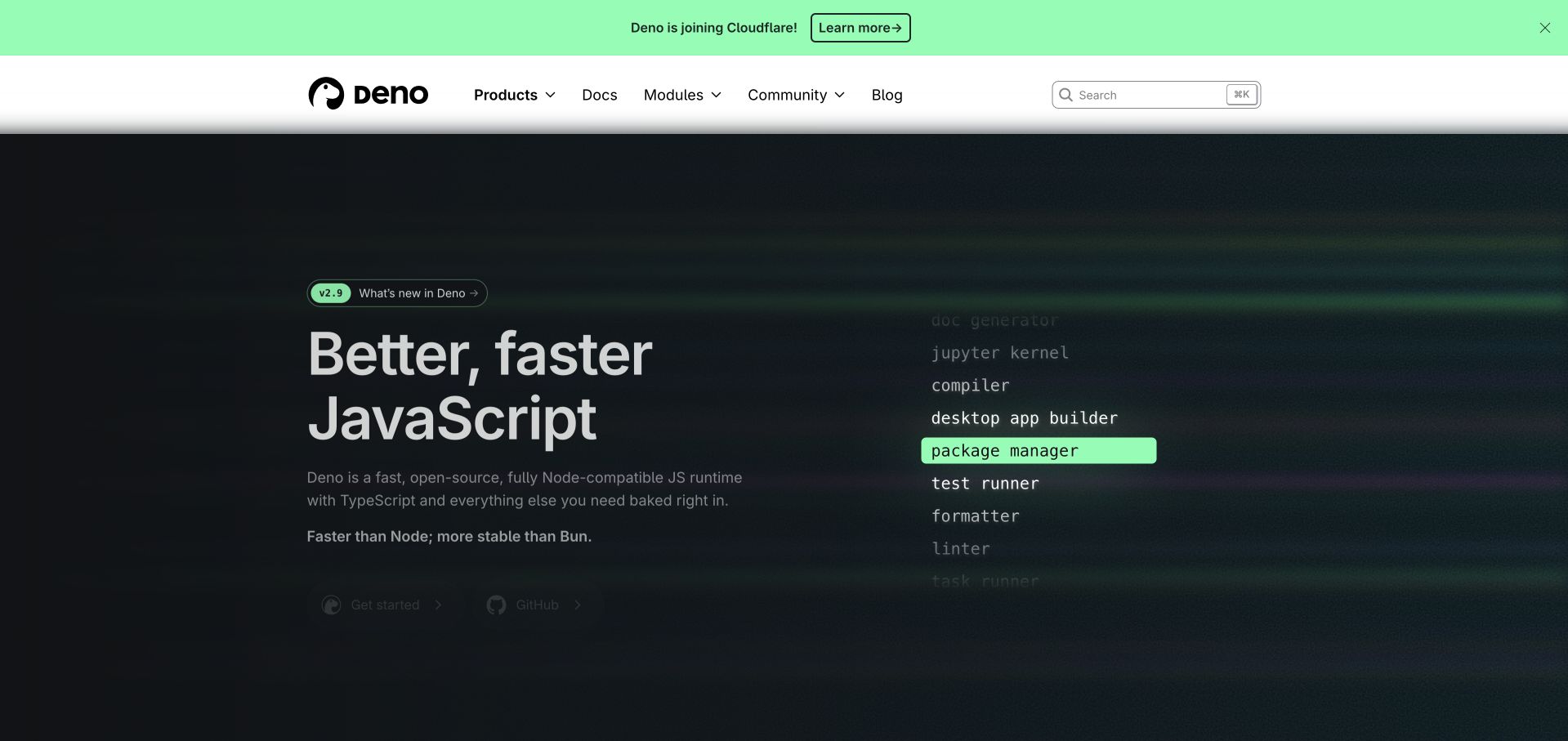
Deno combines a dark, restrained introduction with a vertical list of recognizable development tasks. The highlighted list item adds movement and helps connect the broad JavaScript proposition to specific work. Search, documentation and product navigation remain visible above the hero. The official repository establishes Rust components in Deno’s JavaScript and TypeScript runtime; it does not make every Deno application a Rust application or establish the runtime of this separate public marketing page.
What you can learn
Explain an alternative runtime through the tasks a developer already recognizes, then make the migration and reference material easy to reach. Distinguish the language used to implement the runtime from the languages users write. Compatibility and operational behavior need their own evidence rather than being inferred from an attractive task list.
Pros
The task list supplies concrete context for a broad runtime proposition without an overwhelming feature matrix.
Search and documentation remain accessible in the same restrained header as the introductory product story.
Cons & considerations
An animated task list needs a stable reading order and a useful reduced-motion alternative.
A short alternative-runtime message cannot establish compatibility with every existing dependency or deployment environment.
Platform source: Official Rust engineering or project evidence. Rust components of the JavaScript/TypeScript runtime. The cited engineering, project or customer source establishes only the named language association. It does not establish the marketing page runtime, every company system, current deployment continuity or independent performance results. Platform evidence is separate from the direct website screenshot and is not a complete current infrastructure audit.
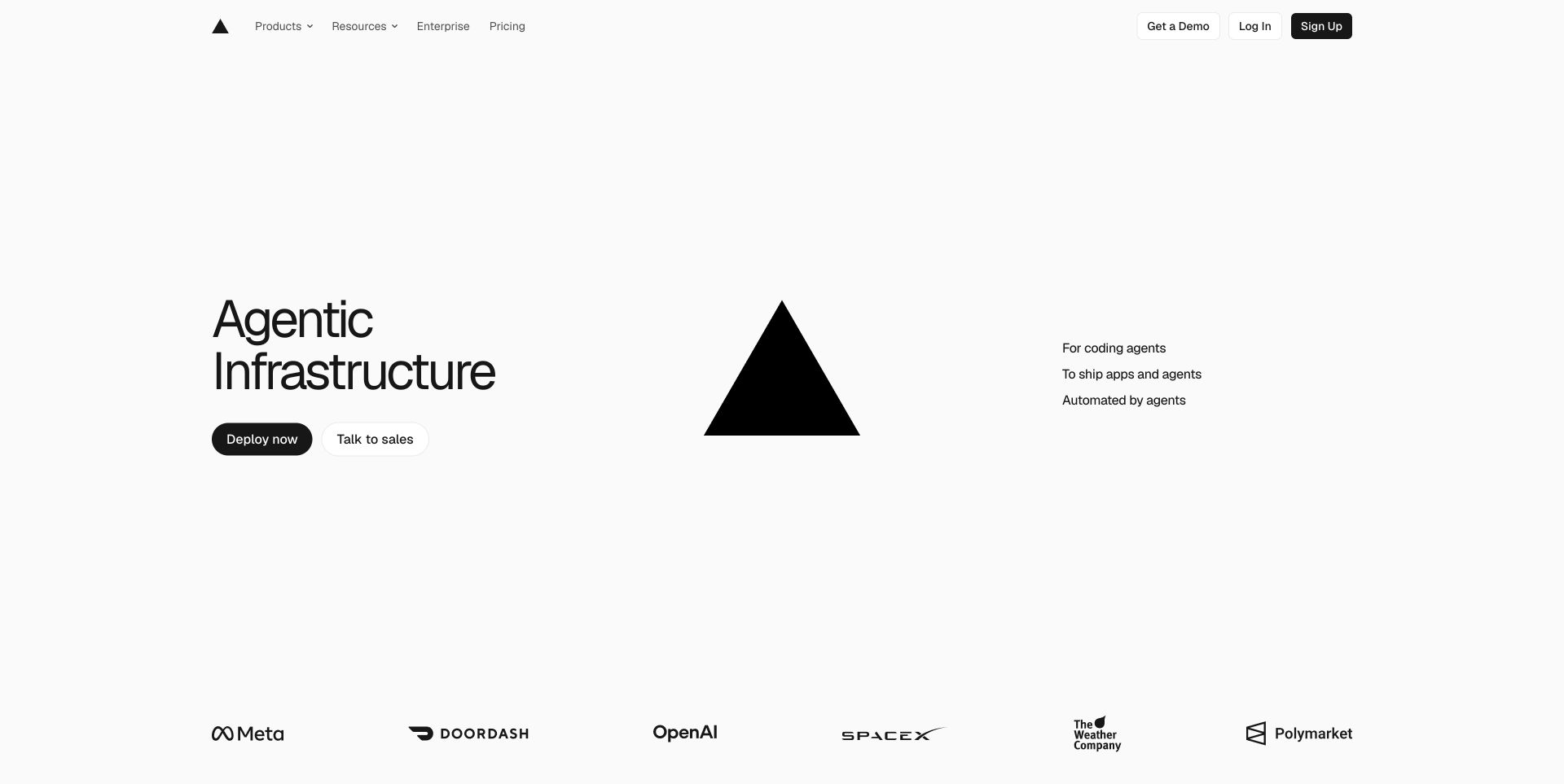
Vercel’s captured page uses an unusually sparse white opening, a central geometric mark and a short infrastructure-oriented statement. Deploy and demo actions sit beneath it, while a customer-logo row introduces broader context below. The composition relies on confidence and recognition rather than a detailed application screenshot. The Rust association is Turborepo’s public build-orchestration project; it is not a claim about the public page’s server, every Vercel service or the language of applications deployed on the platform.
What you can learn
A sparse introduction works best when the product category and immediate actions remain understandable. Give technical visitors a route to the specific tool or service they need, and distinguish a build-system implementation from the platform hosting the result. Minimal presentation should reduce friction rather than conceal important product boundaries.
Pros
The limited number of opening elements makes the two practical evaluation actions easy to find.
A strong central mark provides recognition without adding several decorative product illustrations.
Cons & considerations
The broad infrastructure language may leave unfamiliar visitors unsure which concrete service to investigate first.
Customer logos do not establish a particular deployment architecture, product combination or independent reliability result.
Platform source: Official Rust engineering or project evidence. Rust build-orchestration project; not a public-page server assertion. The cited engineering, project or customer source establishes only the named language association. It does not establish the marketing page runtime, every company system, current deployment continuity or independent performance results. Platform evidence is separate from the direct website screenshot and is not a complete current infrastructure audit.
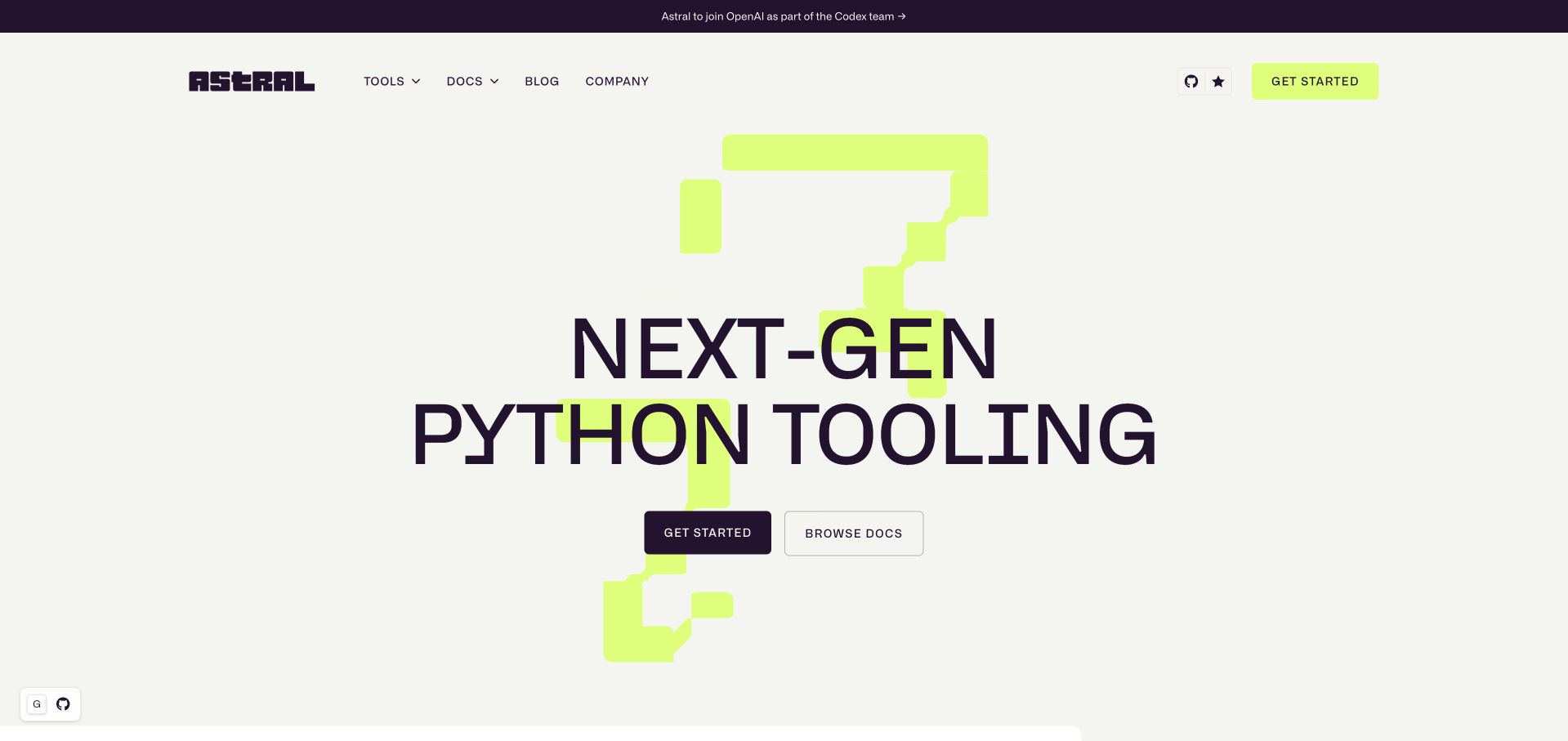
Astral’s homepage uses a pale background, high-contrast typography and bright acid-green geometry to establish an identifiable technical brand. Its opening names Python tooling directly, with distinct starting and documentation actions beneath the headline. The result communicates a product family without requiring a dense list of package names in the first sentence. The Rust source here is Ruff’s implementation repository; it does not establish that every Astral tool, every Python workload or the marketing site itself shares the same codebase.
What you can learn
Give related developer tools a coherent family identity while keeping their individual purposes clear. A strong visual system can help recognition, but users still need to distinguish installing a linter from choosing a package manager or runtime. Link each practical task to the appropriate project documentation.
Pros
The bright geometric accent creates a memorable identity without competing with the short product-category explanation.
Separate starting and documentation actions give technically motivated visitors an immediate practical route.
Cons & considerations
A family-level headline needs more specific product distinctions before someone can choose the right tool.
A short high-performance proposition cannot establish results for an individual repository, dependency set or machine.
Platform source: Official Rust engineering or project evidence. Rust Python-linting implementation in Ruff. The cited engineering, project or customer source establishes only the named language association. It does not establish the marketing page runtime, every company system, current deployment continuity or independent performance results. Platform evidence is separate from the direct website screenshot and is not a complete current infrastructure audit.
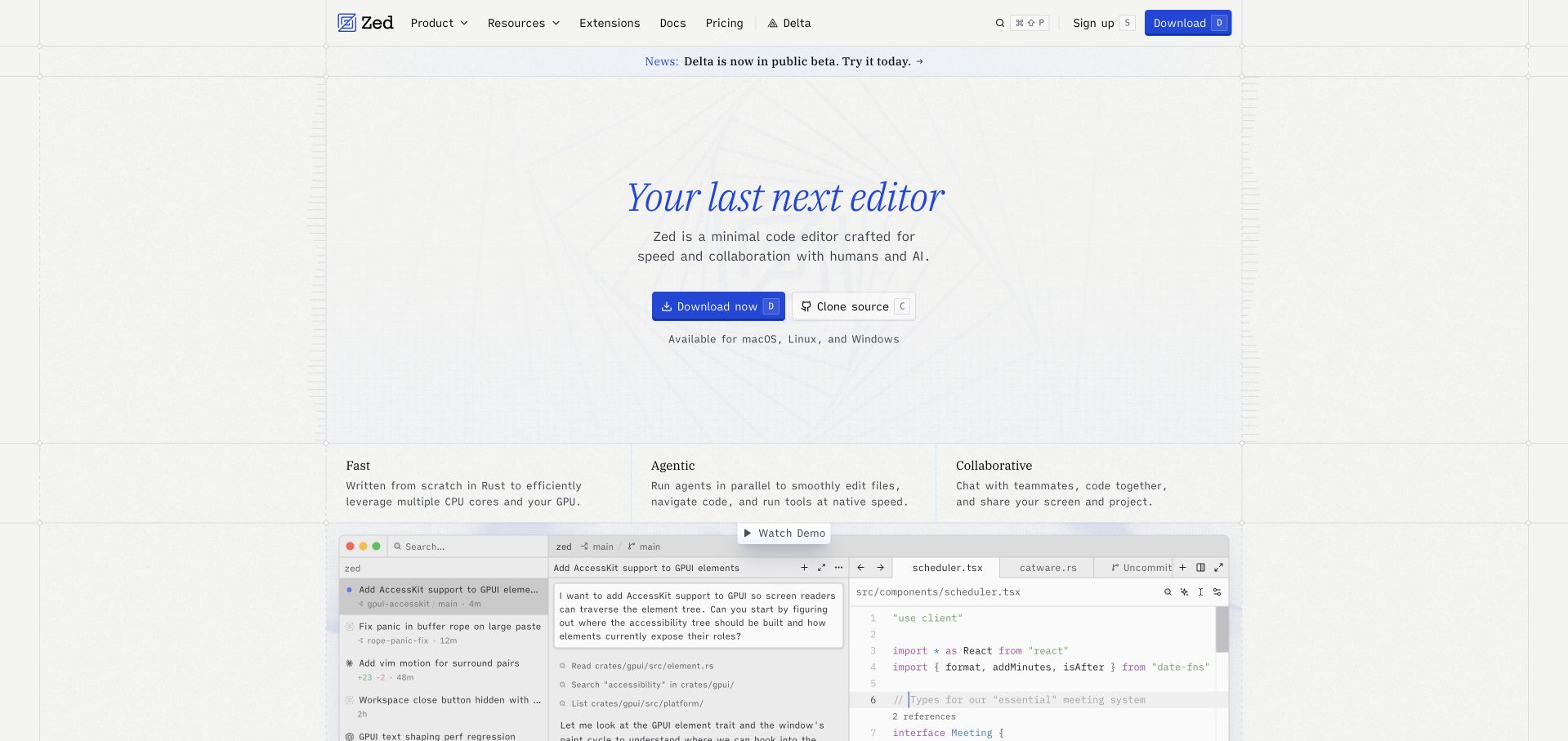
Zed’s light homepage combines a short editor introduction, a prominent download route and a wide view of the application. Small capability summaries sit directly above the interface, connecting the product’s claims to the surface a developer will actually use. The restrained border grid adds structure without a heavy decorative background. Zed’s official source establishes its Rust-based editor implementation; that does not identify the language serving this public site or validate the performance and collaboration behavior of every editor session.
What you can learn
Show the everyday working surface early and make the installation route explicit. A developer choosing an editor needs to understand the relationship between core editing, collaboration and optional assistance. Keep supported platforms, privacy behavior and configuration requirements reachable beyond the compact first-screen promise.
Pros
The large editor view gives practical context to claims that would otherwise remain abstract.
A restrained visual system lets the actual application carry more explanatory weight than decorative marketing imagery.
Cons & considerations
Small interface details become difficult to read when the wide screenshot is reduced for a narrow viewport.
The captured product view cannot establish responsiveness, extension compatibility or collaboration behavior during real work.
Visible tech stack
Earlier / documented evidence
Rust
Platform source: Official Rust engineering or project evidence. Rust-based code-editor application. The cited engineering, project or customer source establishes only the named language association. It does not establish the marketing page runtime, every company system, current deployment continuity or independent performance results. Platform evidence is separate from the direct website screenshot and is not a complete current infrastructure audit.
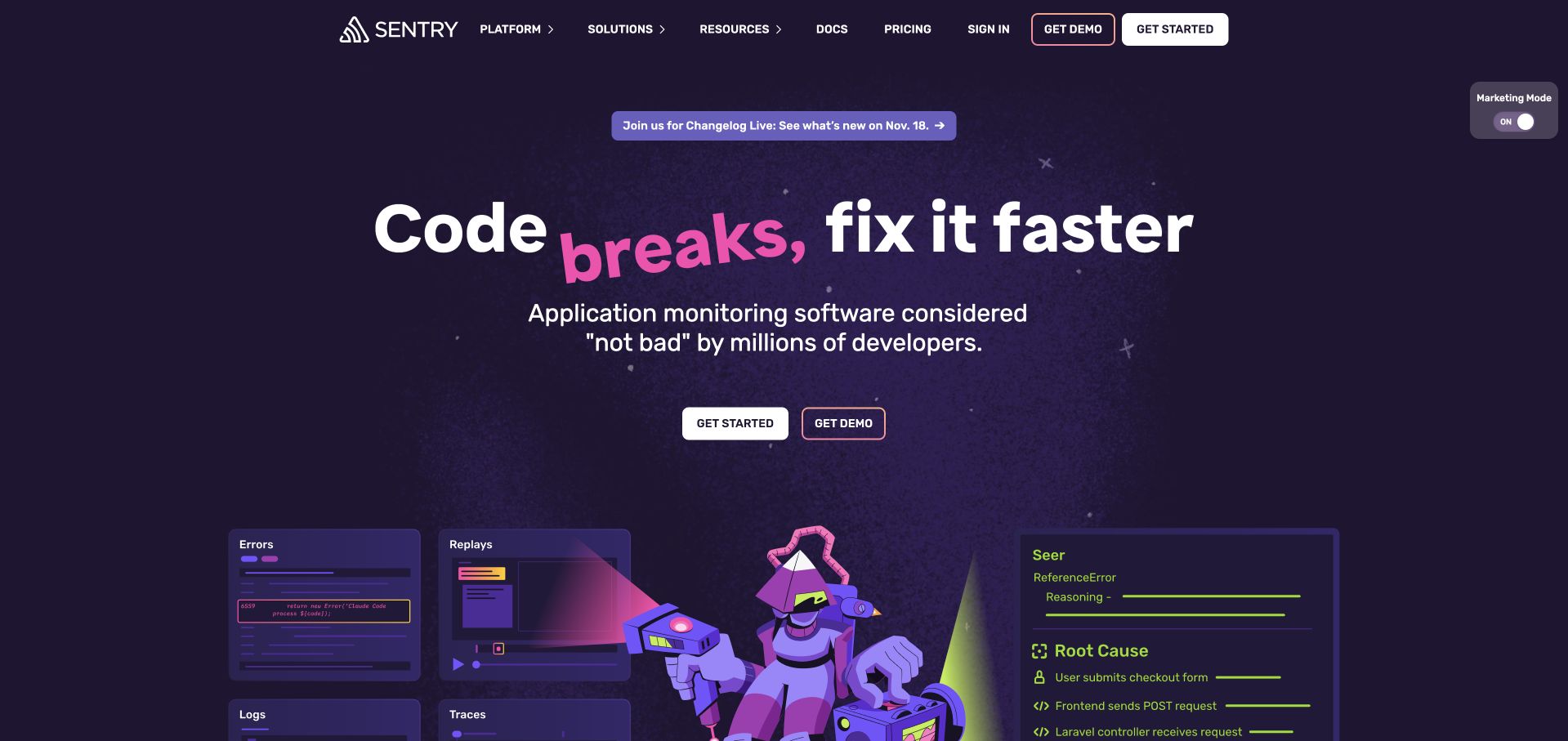
Sentry opens with a direct code-failure proposition and a purple-toned illustration combining interface panels and a distinctive character. Trial and demonstration actions remain visible beneath the short explanation. The page turns an operational problem into an approachable product story without beginning with an exhaustive list of telemetry types. The Rust association here is Relay, a specific public event-processing service project; it does not establish that the entire monitoring platform, every SDK or the pictured marketing page is implemented in Rust.
What you can learn
Start with the operational problem the reader recognizes, then connect it to a concrete workflow. Distinguish detecting an issue, understanding its cause and fixing the application. A monitoring interface should invite evaluation of data collection and triage rather than imply that a diagnostic tool automatically resolves every failure.
Pros
The problem-oriented introduction connects monitoring to a familiar developer task before introducing specialist terminology.
Distinct trial and demonstration actions support visitors ready to experiment and those still evaluating the workflow.
Cons & considerations
The expressive illustration can occupy space that a more detailed example of investigation would use.
The opening cannot establish event coverage, privacy behavior or the effort required to instrument a real application.
Platform source: Official Rust engineering or project evidence. Rust Relay event-processing service in the public project. The cited engineering, project or customer source establishes only the named language association. It does not establish the marketing page runtime, every company system, current deployment continuity or independent performance results. Platform evidence is separate from the direct website screenshot and is not a complete current infrastructure audit.
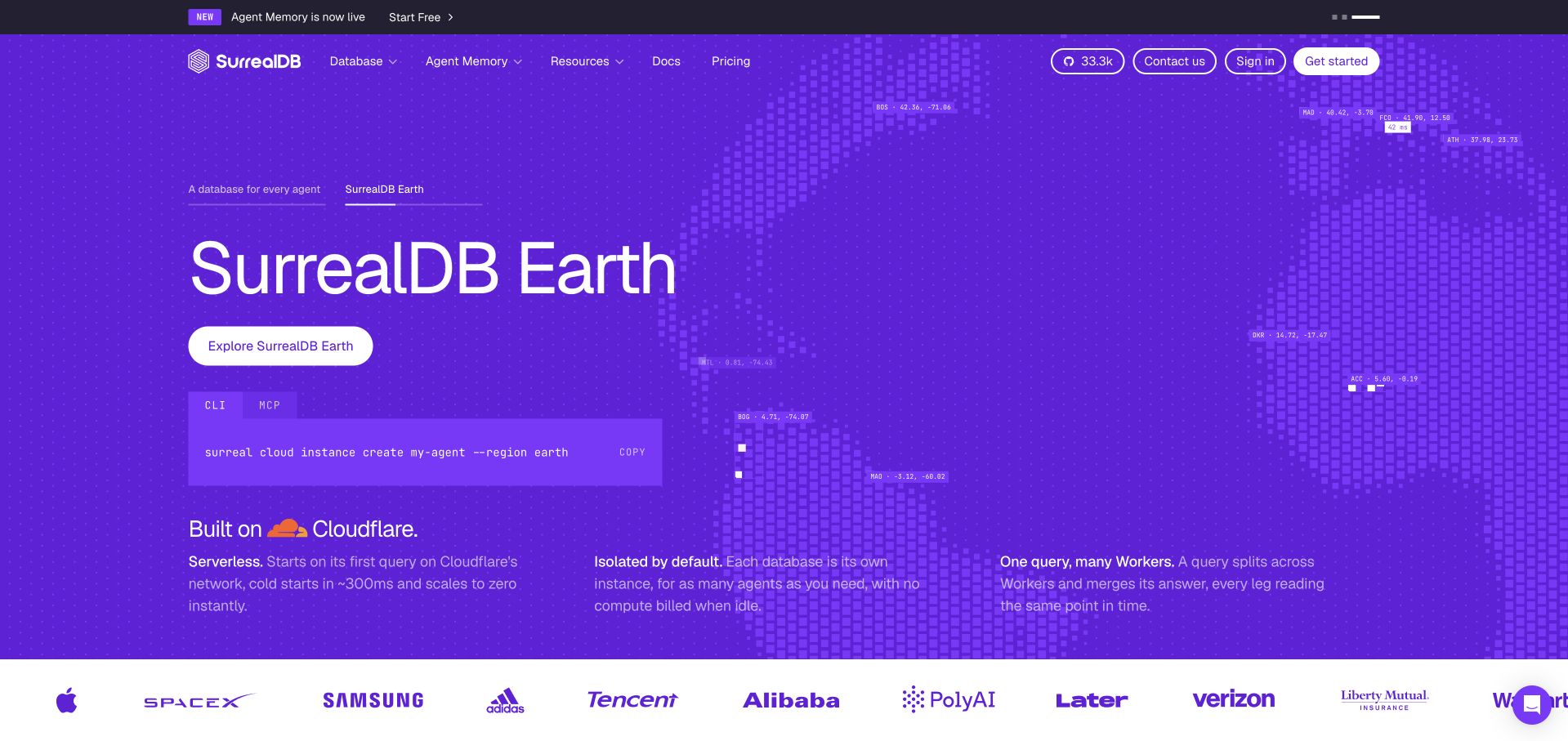
SurrealDB’s purple opening pairs a large database proposition with a command sample and an explicit deployment-context statement. A pixel-like world map gives the service a memorable visual setting, while product and documentation navigation remain distinct above it. The map and deployment context give the broad product message a more concrete location. The official repository establishes a Rust database implementation; the visual association with another infrastructure provider does not make this a complete inventory of the marketing page or every deployment.
What you can learn
Pair an abstract data-service promise with a small concrete starting point, then explain where and how it runs. A command can orient a developer, but it needs supporting prerequisites, data ownership and recovery guidance. Ensure animated introductions resolve to readable content rather than remaining a dependency for understanding.
Pros
The command sample gives a developer a practical anchor beneath a broad database message.
The strong color and map treatment create recognition while leaving conventional product and documentation routes visible.
Cons & considerations
Several announcements and product tabs add complexity to an already active opening.
Deployment and performance claims need their original documentation and conditions rather than being inferred from the visual presentation.
Platform source: Official Rust engineering or project evidence. Rust database implementation; marketing frontend remains separate. The cited engineering, project or customer source establishes only the named language association. It does not establish the marketing page runtime, every company system, current deployment continuity or independent performance results. Platform evidence is separate from the direct website screenshot and is not a complete current infrastructure audit.
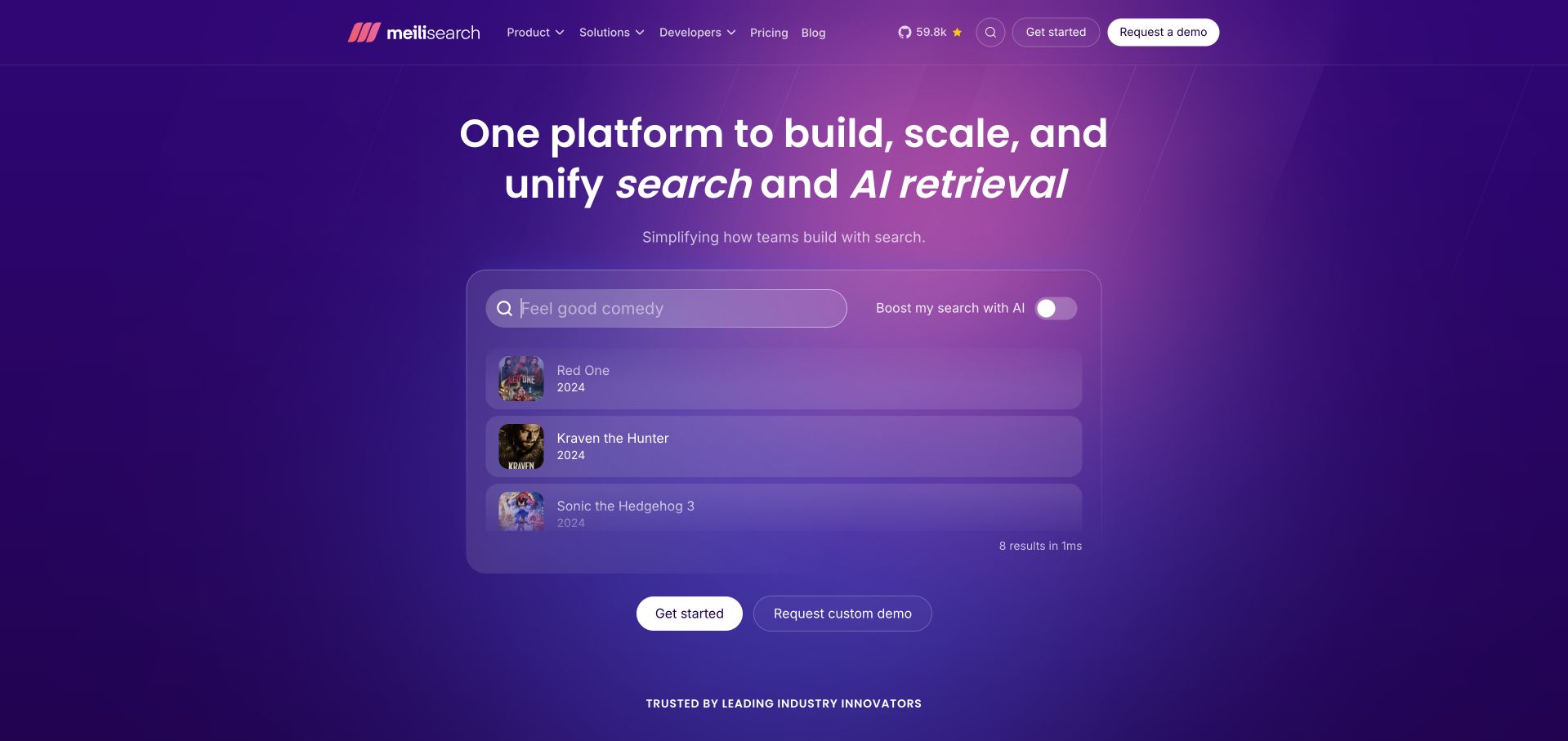
Meilisearch places a visible search example inside its purple hero, directly below a short search-and-retrieval proposition. A list of recognizable results gives an otherwise abstract infrastructure capability a concrete output. The main action and a more consultative demo route sit beneath it, while documentation remains in the header. The official project establishes the Rust search-engine implementation; the promotional search example does not identify the complete hosting stack or independently validate relevance, latency or AI behavior.
What you can learn
Use a representative query and result set to explain a search product, then show how a team configures the underlying data and ranking. A small demonstration is especially useful when it leads toward a realistic evaluation dataset. Keep retrieval, generative features and frontend integration as distinct implementation questions.
Pros
A visible query and result list make the search proposition easier to understand than an abstract database illustration.
Self-service and demonstration routes support different evaluation styles without hiding the developer path.
Cons & considerations
A short curated example cannot establish relevance quality across a real catalog or multilingual dataset.
Several combined search and AI claims need clear product boundaries and configuration detail further down the page.
Platform source: Official Rust engineering or project evidence. Rust search-engine implementation. The cited engineering, project or customer source establishes only the named language association. It does not establish the marketing page runtime, every company system, current deployment continuity or independent performance results. Platform evidence is separate from the direct website screenshot and is not a complete current infrastructure audit.
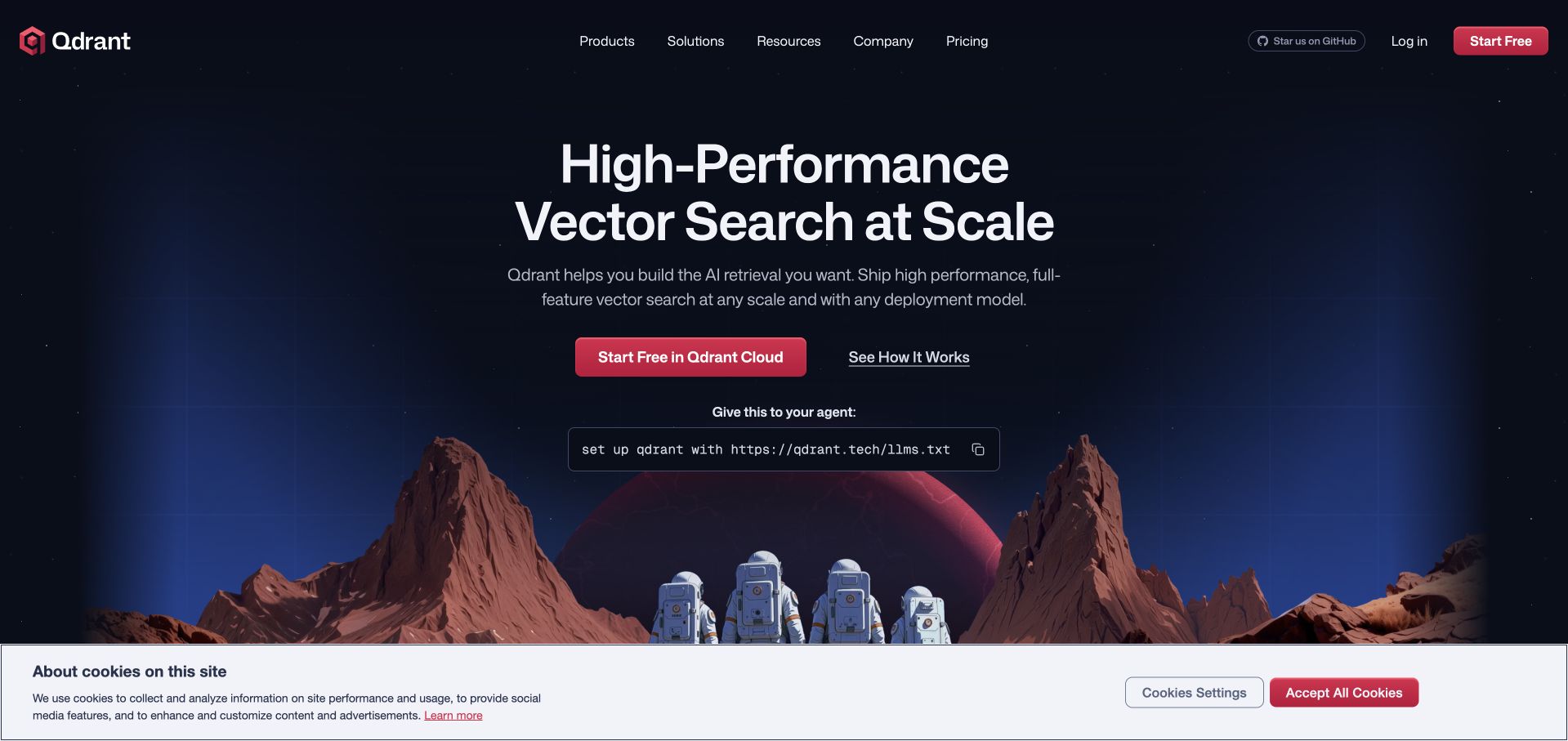
Qdrant names vector search prominently above a concise explanation and a visible command sample. A dark landscape illustration adds character without replacing the technical category, while cloud and explanatory actions offer two ways to continue. Product, resource and pricing destinations remain visible in a restrained header. The official repository establishes its Rust vector-search database implementation; the pictured homepage does not establish the performance, retrieval quality or operational suitability of any particular vector workload.
What you can learn
State the database category before discussing its potential applications. A command sample can help developers recognize the integration route, but a serious evaluation still needs representative data, filtering requirements and operational limits. Distinguish the database from the model producing embeddings and the application presenting results to a user.
Pros
The explicit product category prevents the visual treatment from becoming the only explanation of the service.
The command and cloud route give technical visitors concrete next steps with different operating responsibilities.
Cons & considerations
A broad performance proposition needs workload-specific evidence before it can guide capacity or architecture decisions.
The captured cookie strip competes with the lower edge of the otherwise focused hero composition.
Platform source: Official Rust engineering or project evidence. Rust vector-search database implementation. The cited engineering, project or customer source establishes only the named language association. It does not establish the marketing page runtime, every company system, current deployment continuity or independent performance results. Platform evidence is separate from the direct website screenshot and is not a complete current infrastructure audit.
Kegan has 15+ years of experience working with small businesses, Fortune 500 companies, and everything in between. No development job is too big or too small: he brings the same hands-on attention to a focused improvement, a complete website, or a custom application.
For Rust projects, he can help with content architecture, custom functionality, system integrations, testing, and maintainable handover. He works directly with clients on scope, design, implementation, testing, and handover, with an emphasis on clear communication and a system that remains practical to maintain after launch.
Show 3 other Rust developersHide other Rust developers
Choose a Rust component the team can explain and maintain
A bounded service replacement
Keep the external contract stable while testing one justified implementation boundary. Define compatibility, observability and rollback before moving traffic. Include representative failures and resource limits in the comparison. Replacing a component should not silently change authorization, data ownership or the meaning of a user-visible result.
A library or developer tool
Specify the users, supported platforms, distribution and integration surface. A command-line utility, browser component and reusable library have different packaging and support needs. Show a realistic installation and first task, then document error messages and upgrade behavior rather than treating a successful local build as the finished product.
A database, search or runtime project
These examples show different kinds of Rust implementation, not interchangeable website foundations. Evaluate the actual product’s data model, query behavior, limits and operating model. A project being implemented in Rust does not remove the work of configuring it, backing it up or integrating it into an accessible application.
From references to requirements
Plan the interfaces and the maintenance work around the code
Write the compatibility contract
Record inputs, outputs, error states and the behavior other systems already depend on. Include malformed data, cancellation and version mismatch. A faster implementation that changes a subtle business rule may be an unsuccessful migration even if its local measurements improve.
Make review and dependencies concrete
Inventory direct dependencies, native interfaces and any unsafe boundary. Decide who reviews changes and how updates are tested. Keep useful rationale near the code or architecture record so a future maintainer understands why a lower-level implementation was chosen and which assumptions still need to hold.
Measure and rehearse recovery
Use a representative workload and record latency, memory and failure behavior under stated conditions. Include the build and deployment process, not only steady-state execution. Practice rollback and data reconciliation in a suitable test environment before replacing the original component or widening its responsibilities.
A useful handover demonstration
Ask the actual team to carry out its routine job: publish a realistic update, correct a mistake, preview a narrow screen, and identify who owns an integration failure. For a library or frontend framework, also ask who maintains the content source and deployment. A polished screenshot does not answer those operational questions.
Beyond the screenshot
Rust project checklist beyond a successful compile
Name the bounded component and measured problem.
Compare a smaller fix with a replacement.
Write the compatibility and error contract.
Plan ownership and resource lifetimes.
Inventory unsafe and foreign-interface boundaries.
Review native and third-party dependencies.
Test invalid input and cancellation.
Document supported platforms and distribution.
Measure a representative workload under stated conditions.
Rehearse deployment and rollback.
Keep historical evidence separate from current observations.
Assign code review, upgrades and operating ownership.
Test with real content, a keyboard, a small screen, slow or failed requests, and the people who will maintain the system. These are planning checks, not an accessibility, security, performance, or search-ranking certification.
Sources & editorial method
How this Rust collection was reviewed
Twenty distinct public website source pages were independently reviewed for this collection. Screenshots are direct browser captures, with actual source URLs, dates, timestamps where known, dimensions and attribution retained. Existing source-page captures were inspected and reused without changing their original capture dates. New screenshots were captured November 9 UTC during the November 8, 2026 Pacific research session. Private account screens, transient blank shells and challenge pages were excluded. Official engineering, runtime, repository and project sources establish only the named language or workload association; historical and archived projects remain qualified. They do not establish current marketing-homepage runtime, a full corporate technology inventory, independent performance results or service-quality endorsement. Original reviews describe visible public design, not private account workflows. A separate bounded public source audit records additional supported technologies before publication. Images and trademarks belong to their owners.
Every image is an unmodified capture from the actual website, with its source and capture date. Some captures are reused from our shared catalog; their dates remain the original capture dates. None comes from a vendor gallery or a generated reconstruction. Moving imagery and live content can change.
Technology attribution uses public page assets or metadata, official platform documentation, or a cited first-party project case study. Documentary and framework-relationship evidence is identified where used; it is not a complete current backend inventory. A CMS image CDN alone does not establish a full CMS deployment. A library’s presence does not prove which individual controls use it, and a platform label does not establish AI authorship.
The composition notes, lessons, pros and tradeoffs are original editorial observations. We have not measured conversion, traffic, security, performance or accessibility conformance. Website owners retain their brands and imagery; these examples are not our client portfolio. Written, Edited and Curated are independent records, not dates advanced by a build. See our editorial standards or suggest a correction.
Questions worth asking
Rust website development FAQs
Are all the pictured websites built with Rust?
No. The sources establish specifically named Rust projects or workloads. The public screenshots are separate design references. A company using Rust in a browser component or sync engine does not identify its marketing-page runtime.
Does Rust make an application automatically secure?
No. Its ownership and type systems address important classes of implementation problems, but application permissions, secrets, unsafe code, dependencies and operating configuration still need review. A language association is not a security assessment.
Should a small marketing website use Rust?
Only when a real requirement and a maintainable operating model justify the custom component. A conventional CMS or static publishing system may satisfy the actual task more directly. Visual similarity to one of these examples is not a reason by itself.
Does a Rust database make my frontend a Rust application?
No. The database implementation, service API, browser interface and publishing layer are separate choices. Name the component accurately rather than assigning one language to an entire product or organization.
When is a rewrite comparison useful?
When the team has a defined problem, representative measurements, a compatibility contract and a migration path. Compare the complete operating and maintenance implications, not only a small benchmark or a first successful prototype.
Borrow the clear explanation or useful interface pattern, then scope the Rust work around an actual component and a measurable requirement. A systems-language choice should clarify responsibilities rather than become a substitute for them.