Best MongoDB Websites of 2026 (20 Real-World Examples)
MongoDB-associated websites: public design, documented application workloads, and practical data planning
These 20 public website examples belong to organizations with documented MongoDB applications. The screenshots illustrate website design; official customer accounts establish the separate, specifically named backend workloads. They are not observations that each marketing homepage runs on MongoDB.
MongoDB is a document database, not a visual website builder. A company can use it for an operational application, an internal compliance tool, or an AI retrieval workflow while publishing its corporate homepage with an unrelated system. This collection keeps those layers separate so the examples are useful without turning a brand logo into an invented stack claim.
Adobe, Cisco, L’Oréal, Wells Fargo, and Toyota Connected open the collection because they are recognizable organizations with individual official customer accounts. Their documented uses are deliberately varied: embedded creative AI, developer and support workflows, specialist processing, a card-modernization data store, and connected-vehicle services. The common lesson is to define the application’s responsibility before deciding how its data should be represented.
Before the examples
What makes good MongoDB website development in 2026?
Start with a read and a write, not a database slogan
Choose one important screen or service event and describe the information it reads, creates, and changes. MongoDB’s modeling guidance emphasizes access patterns and the choice between embedded and referenced relationships. A product family or attractive public homepage does not reveal those patterns; the application’s actual responsibilities do.
Flexible documents still need agreed field meanings, identifiers, and validation. Decide how older and newer records coexist and which changes require migration. Schema validation can constrain types and values; it is not a substitute for deciding who owns a fact or what the interface should do when required information is missing.
Give search an explicit boundary
Several documented applications combine MongoDB with search or vector retrieval. Define the corpus, permitted viewers, update path, and result context before adding a natural-language entrance. A relevant document does not automatically make an answer correct, authorized, or appropriate for a consequential decision.
The collection · 20 examples
20 MongoDB website examples worth studying
Compare the public information architecture and the separately documented application role. Each review names the workload, records the November 8, 2026 evidence check, and distinguishes a current source from an explicitly historical account. Atlas and Enterprise Advanced are not treated as interchangeable deployments.
We start with five recognizable brands or organizations: Adobe, Cisco, L’Oréal Groupe, Wells Fargo, Toyota Connected. Each attribution applies to the named website property, not every product or website belonging to its organization. This is a curated reading sequence, not a measured ranking.
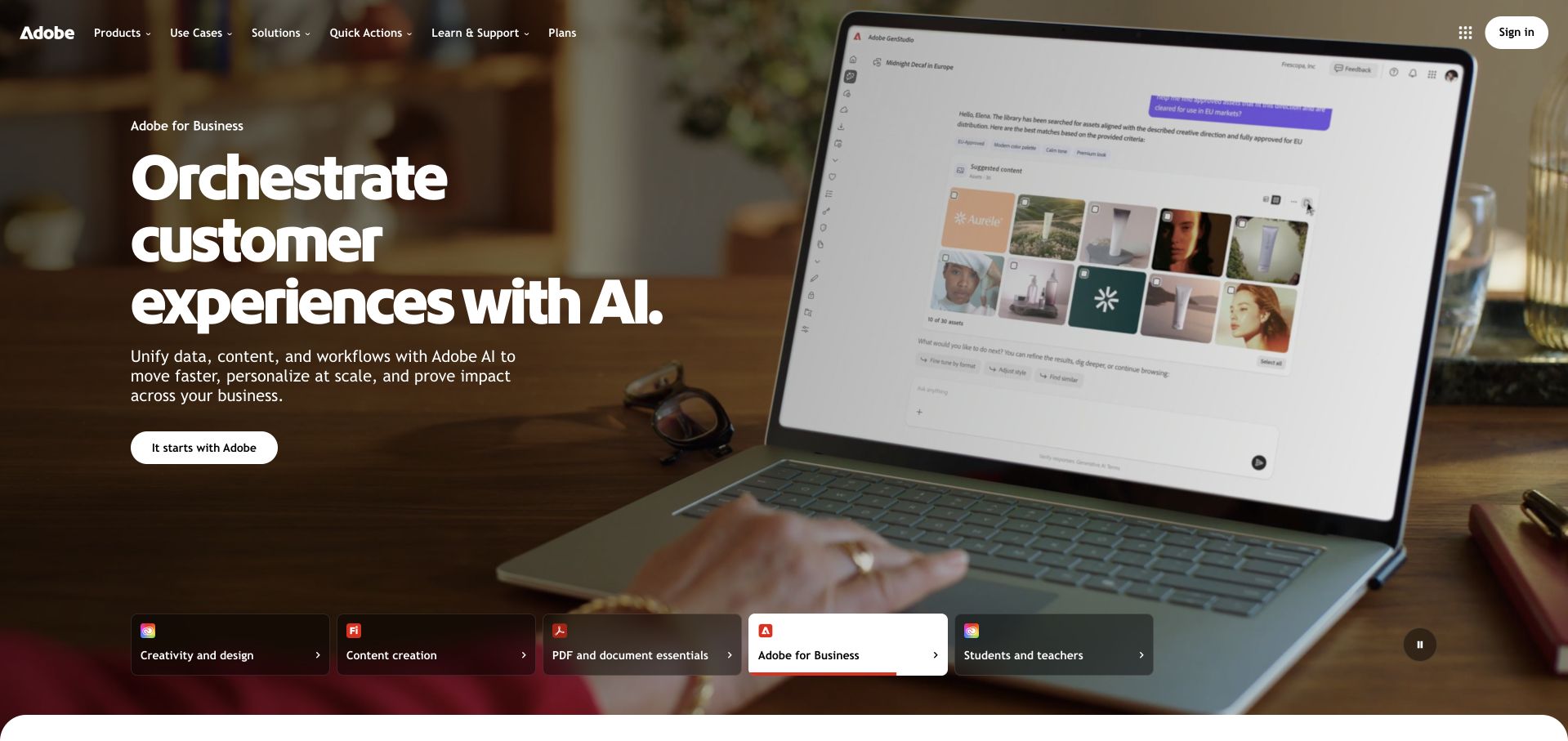
Adobe organizes an unusually broad creative portfolio around recognizable product names and strong promotional artwork. Purchase and trial routes compete with educational navigation, so the page works best for visitors who already know the task or application they need. Its visual confidence comes from showing creative output rather than diagramming infrastructure. Documented association checked November 8, 2026: MongoDB Atlas data layer for embedded creative AI tools, including Adobe Acrobat PDF interactions.
What you can learn
Borrow the separation between a recognizable product and its underlying capability. An Acrobat document interaction needs useful context and permissions; a flexible document database alone does not design that experience or explain an AI answer to its reader.
Pros
Recognizable application names give returning visitors useful anchors across a very broad creative portfolio.
Large creative examples demonstrate the type of work customers might make with the tools.
Cons & considerations
Promotions and product families can overwhelm visitors who arrive without an application in mind.
The corporate storefront cannot reveal the accuracy or data handling of individual AI workflows.
Platform source: Official MongoDB customer or product evidence. MongoDB Atlas data layer for embedded creative AI tools, including Adobe Acrobat PDF interactions. Official source reviewed November 8, 2026 Pacific; no complete current-stack audit is implied. Official documentary association is scoped to the named product, workload, dependency, or database service. No marketing-homepage runtime, complete company stack, independent performance, or private customer workflow is inferred. Platform evidence is separate from the direct website screenshot and is not a complete current infrastructure audit.
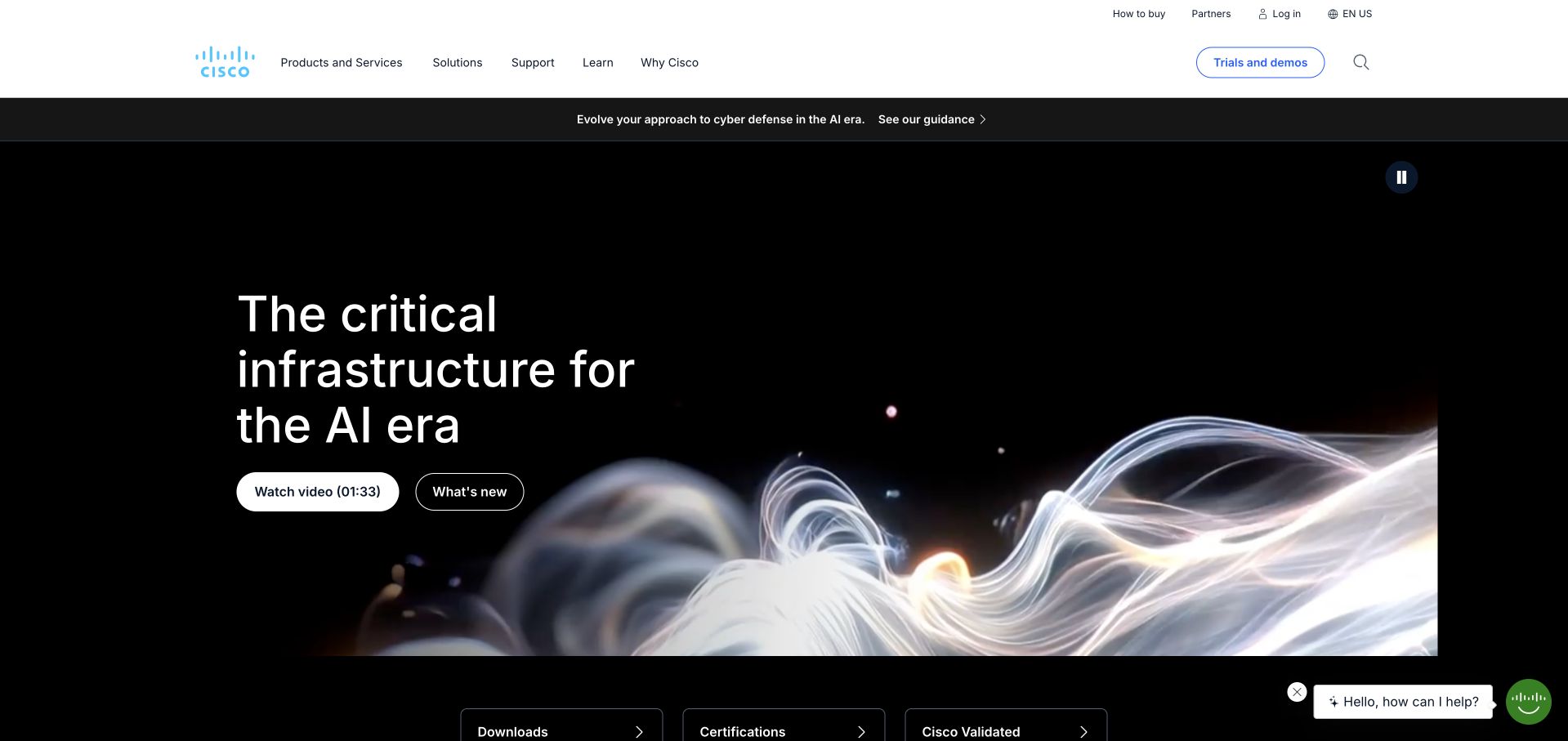
Cisco’s public site presents enterprise technology through product families, business needs, and prominent campaign messaging. The restrained corporate navigation gives familiar customers several routes into a large catalog, but the breadth creates a meaningful interpretation burden for newcomers. Product naming and solution grouping carry more explanatory weight than the decorative hero treatment. Documented association checked November 8, 2026: MongoDB Atlas sandbox clusters and Vector Search for Cisco generative-AI development and the Webex support assistant.
What you can learn
Treat a support assistant as a retrieval product with a clearly defined corpus. Cisco’s documented Webex example is useful for thinking about support knowledge and developer environments, not for assuming every network product or public page shares one database.
Pros
Product and solution navigation accommodate both technical buyers and broader business decision makers.
A consistent enterprise identity helps unify networking, security, collaboration, and other separate offerings.
Cons & considerations
Portfolio breadth makes the first decision harder for visitors unfamiliar with Cisco’s internal product vocabulary.
A polished corporate overview provides little direct visibility into assistant answer quality or retrieval permissions.
Platform source: Official MongoDB customer or product evidence. MongoDB Atlas sandbox clusters and Vector Search for Cisco generative-AI development and the Webex support assistant. Official source reviewed November 8, 2026 Pacific; no complete current-stack audit is implied. Official documentary association is scoped to the named product, workload, dependency, or database service. No marketing-homepage runtime, complete company stack, independent performance, or private customer workflow is inferred. Platform evidence is separate from the direct website screenshot and is not a complete current infrastructure audit.
L’Oréal Groupe treats its corporate presence as an editorial brand environment, mixing business updates with beauty, teams, and careers. Large imagery and multiple campaign headlines express a global organization rather than a single retail checkout. The result is useful for reputation building, though practical visitors must distinguish corporate storytelling from consumer product discovery. Documented association checked November 8, 2026: MongoDB Atlas on Google Cloud for L’Oréal Tech Accelerator applications and complex data processing.
What you can learn
Separate the public brand experience from the specialist applications that support it. The Tech Accelerator case illustrates complex application data work; reproducing the homepage’s visual direction would neither require that architecture nor establish the same processing needs.
Pros
Business, cultural, and career stories give different audiences reasons to explore the organization.
Generous photography expresses a beauty company’s identity without relying on a dense technical explanation.
Cons & considerations
Several competing campaign narratives can make a concrete corporate task less immediately obvious.
The consumer-facing visual language does not explain the specific boundaries of internal technology services.
Platform source: Official MongoDB customer or product evidence. MongoDB Atlas on Google Cloud for L’Oréal Tech Accelerator applications and complex data processing. Official source reviewed November 8, 2026 Pacific; no complete current-stack audit is implied. Official documentary association is scoped to the named product, workload, dependency, or database service. No marketing-homepage runtime, complete company stack, independent performance, or private customer workflow is inferred. Platform evidence is separate from the direct website screenshot and is not a complete current infrastructure audit.
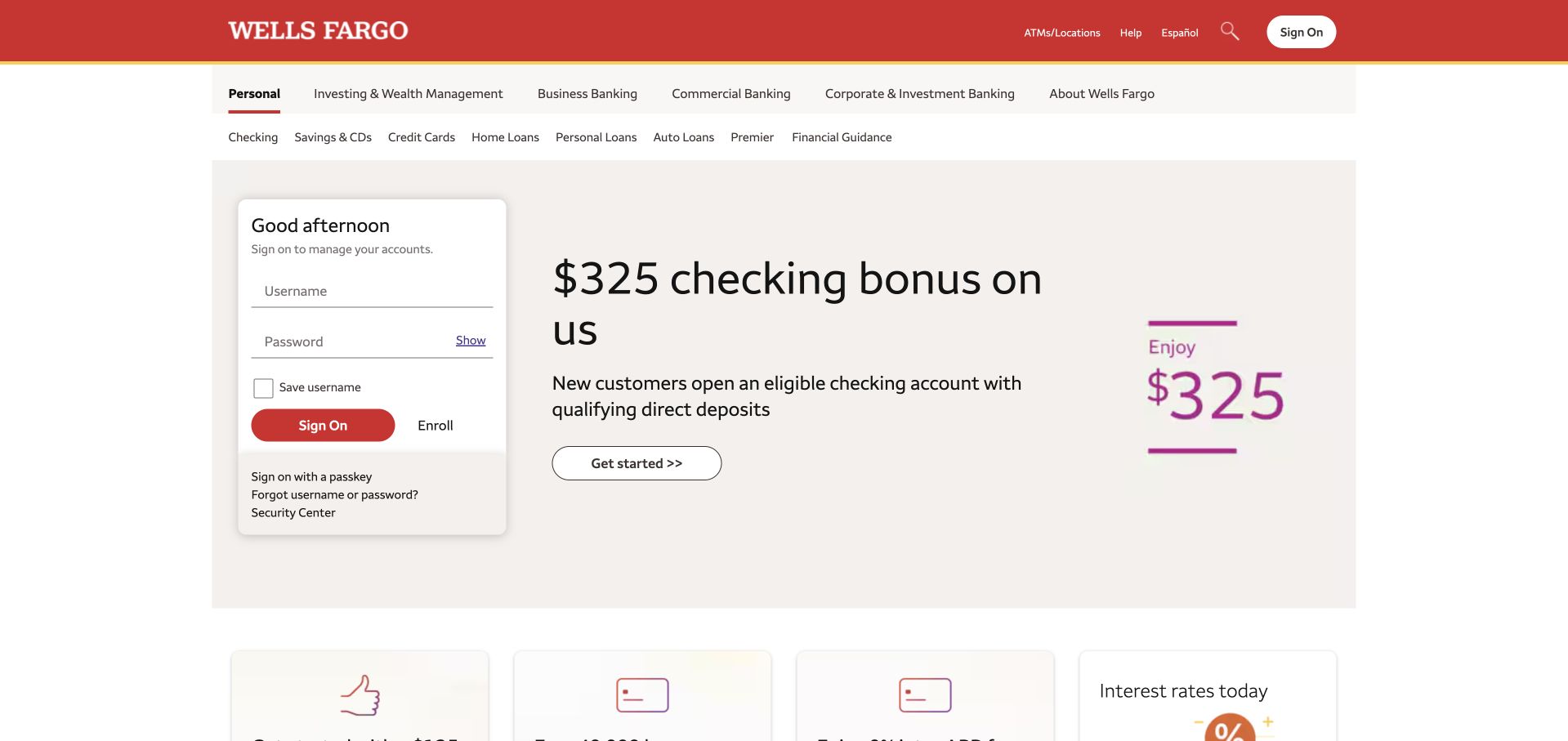
Wells Fargo keeps familiar account access close to the top while arranging product information and financial guidance around everyday banking needs. The greeting and utility-oriented layout prioritize returning customers without completely hiding discovery. That pragmatic structure is more instructive than any individual promotion, especially where an established institution must serve several audiences simultaneously. Documented association checked November 8, 2026: MongoDB Enterprise Advanced operational data store for the Cards 2.0 payments modernization initiative.
What you can learn
Use the operational-data-store association to ask how a modernization project preserves clear account relationships and trustworthy states. Do not treat a documented Cards 2.0 data layer as evidence for the homepage, all banking products, or an independently tested security outcome.
Pros
Account access remains easy to distinguish from general product research and educational guidance.
Conventional labels reduce the interpretation effort for visitors completing familiar recurring banking tasks.
Cons & considerations
Marketing offers can still compete with the utility tasks that make customers return.
The public view cannot demonstrate the accuracy, availability, or controls of private account information.
Visible tech stack
Earlier / documented evidence
MongoDB
Platform source: Official MongoDB customer or product evidence. MongoDB Enterprise Advanced operational data store for the Cards 2.0 payments modernization initiative. Official source reviewed November 8, 2026 Pacific; no complete current-stack audit is implied. Official documentary association is scoped to the named product, workload, dependency, or database service. No marketing-homepage runtime, complete company stack, independent performance, or private customer workflow is inferred. Platform evidence is separate from the direct website screenshot and is not a complete current infrastructure audit.
Toyota Connected leads with mobility as a mission, then introduces global products and safety-related services. The emphasis is organizational and explanatory rather than a vehicle-shopping funnel. Clear thematic sections help connect an abstract connected-car proposition to recognizable uses, although visitors looking for detailed technical behavior must continue beyond the corporate introduction. Documented association checked November 8, 2026: MongoDB Atlas databases behind the telematics service platform and Toyota Safety Connect services.
What you can learn
Explain the service around the event it handles. The telematics example suggests designing explicit notification states and operational ownership; the public safety narrative does not independently verify collision detection, emergency response, or any particular database configuration.
Pros
A focused mobility theme gives a specialist company a more understandable public purpose.
Safety and product sections connect corporate positioning with concrete categories of connected services.
Cons & considerations
High-level mission language leaves implementation and service eligibility questions for deeper pages.
A corporate safety presentation is not evidence that every depicted vehicle feature uses this database.
Platform source: Official MongoDB customer or product evidence. MongoDB Atlas databases behind the telematics service platform and Toyota Safety Connect services. Official source reviewed November 8, 2026 Pacific; no complete current-stack audit is implied. Official documentary association is scoped to the named product, workload, dependency, or database service. No marketing-homepage runtime, complete company stack, independent performance, or private customer workflow is inferred. Platform evidence is separate from the direct website screenshot and is not a complete current infrastructure audit.
Novo Nordisk’s corporate homepage balances a recognizable healthcare identity with research, organizational news, and audience-specific routes. The layout supports learning about the company rather than choosing treatment or operating a clinical tool. Its restrained presentation gives important subjects room, but the distinction between corporate communication and specialist scientific workflows remains essential when studying the technology association. Documented association checked November 8, 2026: MongoDB Atlas and Vector Search within NovoScribe’s clinical-study-report authoring platform.
What you can learn
Keep scientific authoring assistance separate from public health claims. NovoScribe is a documented reporting workload; a useful implementation discussion would cover document provenance, access boundaries, and human review without suggesting that a database choice establishes clinical effectiveness.
Pros
Clear corporate identity helps visitors distinguish the organization from unrelated consumer health information.
Research and company information can coexist without presenting a transactional shopping interface.
Cons & considerations
Corporate storytelling cannot answer the detailed workflow questions faced by clinical-document authors.
The homepage offers no independent evidence about the correctness of AI-generated scientific material.
Platform source: Official MongoDB customer or product evidence. MongoDB Atlas and Vector Search within NovoScribe’s clinical-study-report authoring platform. Official source reviewed November 8, 2026 Pacific; no complete current-stack audit is implied. Official documentary association is scoped to the named product, workload, dependency, or database service. No marketing-homepage runtime, complete company stack, independent performance, or private customer workflow is inferred. Platform evidence is separate from the direct website screenshot and is not a complete current infrastructure audit.
Bosch Digital states its digital-business role directly and follows it with sections explaining the team and its work. The corporate framing is useful for a specialist unit whose audience may otherwise confuse it with the wider manufacturing group. Straightforward labels do the orientation work, while the page leaves deeper service evaluation to subsequent content. Documented association checked November 8, 2026: MongoDB Atlas and time-series collections for Bosch IoT Insights device-data management and analysis.
What you can learn
Connect an IoT data model to the questions operators actually ask about devices and time. The documented Insights workload is narrower than Bosch’s entire technology estate, and its storage choices should not be inferred from the pictured corporate presentation.
Pros
The specialist unit’s name and role are presented early instead of relying solely on group recognition.
Simple organizational sections help explain capabilities before asking visitors to navigate a large service catalog.
Cons & considerations
Broad digital-business language can remain abstract without a concrete implementation example nearby.
The public introduction does not expose device-data freshness, retention rules, or operational dashboards.
Visible tech stack
Earlier / documented evidence
MongoDB
Platform source: Official MongoDB customer or product evidence. MongoDB Atlas and time-series collections for Bosch IoT Insights device-data management and analysis. Official source reviewed November 8, 2026 Pacific; no complete current-stack audit is implied. Official documentary association is scoped to the named product, workload, dependency, or database service. No marketing-homepage runtime, complete company stack, independent performance, or private customer workflow is inferred. Platform evidence is separate from the direct website screenshot and is not a complete current infrastructure audit.
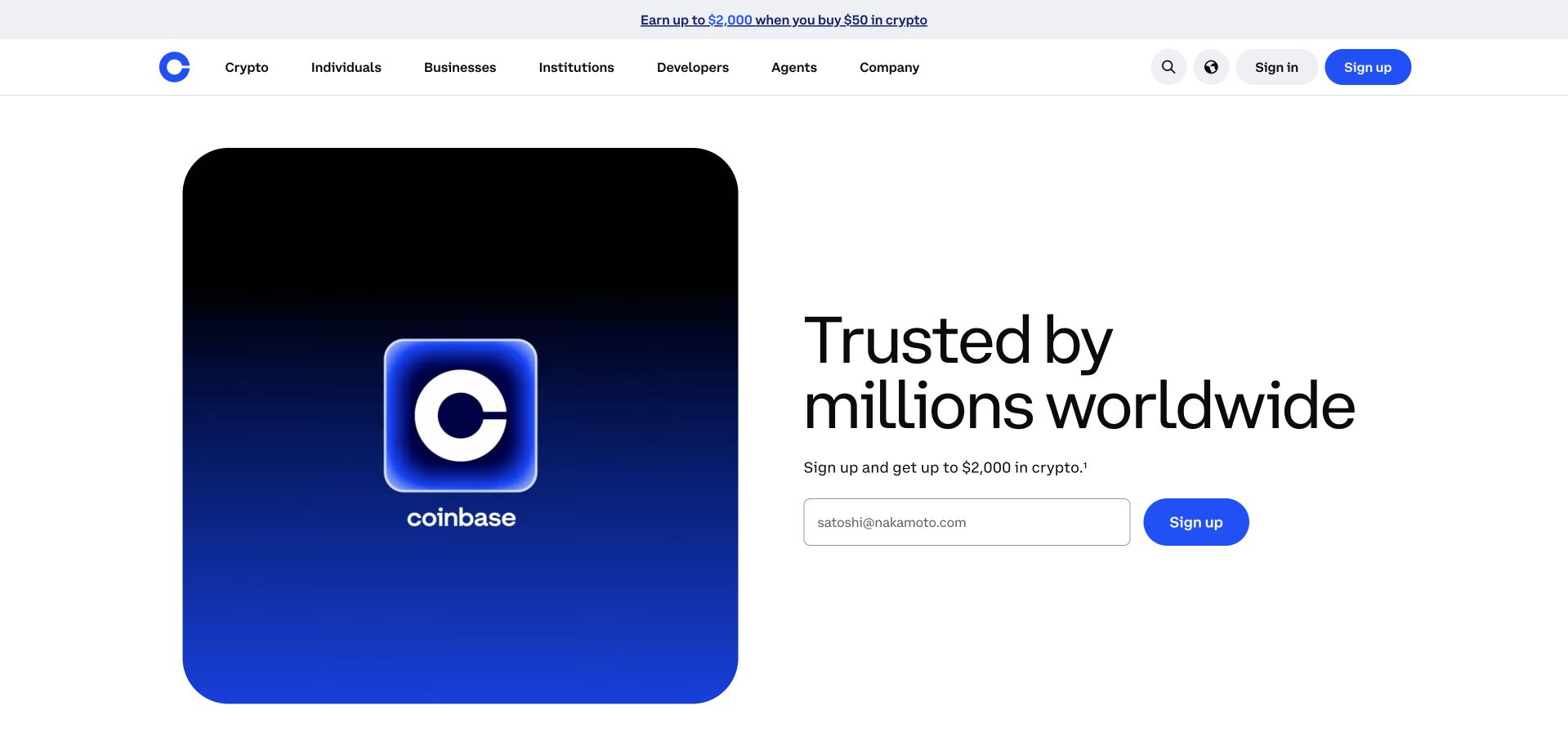
Coinbase’s storefront emphasizes the breadth of its trading offer and uses familiar product navigation to organize a rapidly expanding category. Large promotional messages make the commercial proposition immediate, while supporting routes accommodate visitors who need more context. This is a strong example of managing multiple product promises, not a basis for evaluating investment suitability or infrastructure security. Documented association checked November 8, 2026: MongoDB Atlas fleet storing critical financial application data; case study describes ephemeral-certificate database access.
What you can learn
Read the database case as an access-management example. Ephemeral database certificates concern operator access to a MongoDB fleet; they do not demonstrate that the pictured trading interface is risk-free, that every asset uses MongoDB, or that financial outcomes are assured.
Pros
Product-oriented navigation makes an expanding platform easier to scan than an undifferentiated feature list.
Prominent propositions help visitors understand the current commercial emphasis before exploring detailed product pages.
Cons & considerations
Several trading messages can crowd out the explanation needed by a visitor unfamiliar with the category.
Public promotional pages do not expose the full controls or failure behavior of financial application data.
Platform source: Official MongoDB customer or product evidence. MongoDB Atlas fleet storing critical financial application data; case study describes ephemeral-certificate database access. Official source reviewed November 8, 2026 Pacific; no complete current-stack audit is implied. Official documentary association is scoped to the named product, workload, dependency, or database service. No marketing-homepage runtime, complete company stack, independent performance, or private customer workflow is inferred. Platform evidence is separate from the direct website screenshot and is not a complete current infrastructure audit.
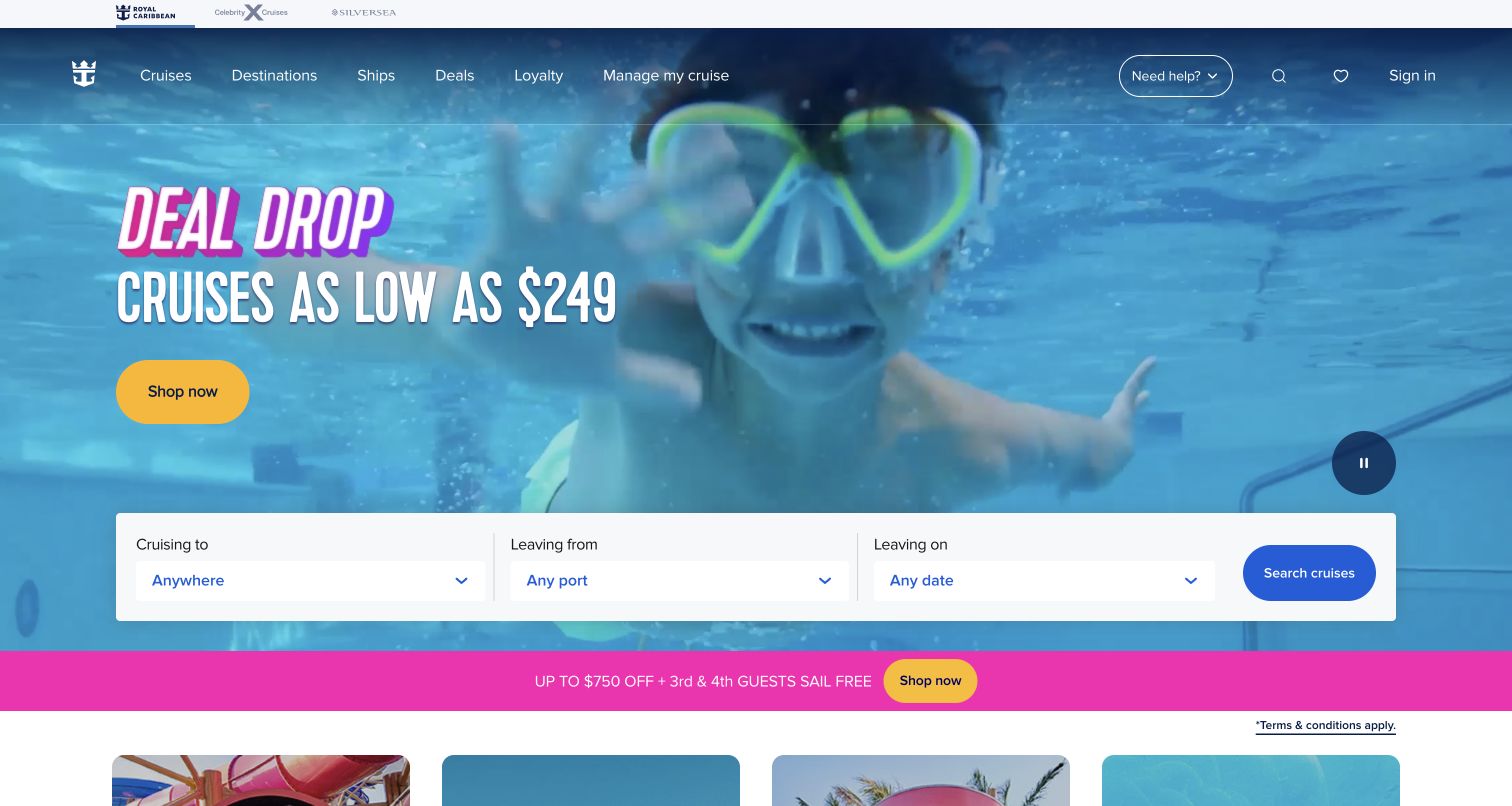
Royal Caribbean makes travel aspiration the entrance to a large cruise-shopping environment. Destination and sailing imagery create an immediate sense of the offer, while itinerary-related navigation gives practical planning a parallel route. The tension worth studying is between an emotional vacation proposition and the many factual decisions required before a traveler can select an appropriate sailing. Documented association checked November 8, 2026: Historical 2019 MongoDB Innovation Award documents Royal Caribbean’s guest-experience digital transformation; not a fresh confirmation of every booking-system component.
What you can learn
Use the historical guest-experience association as context, not as a current architecture diagram. A cruise project still needs explicit ownership of availability, guest information, and itinerary updates; the 2019 recognition does not verify today’s booking-page database or end-to-end availability.
Pros
Travel imagery communicates the experience quickly before visitors examine individual itineraries or ships.
Planning navigation gives a practical counterweight to the emotional appeal of vacation campaigns.
Cons & considerations
Promotional emphasis can make fare conditions and itinerary differences harder to compare at first glance.
An older innovation award cannot establish the present database behind each public booking component.
Platform source: Official MongoDB customer or product evidence. Historical 2019 MongoDB Innovation Award documents Royal Caribbean’s guest-experience digital transformation; not a fresh confirmation of every booking-system component. Historical 2019 award account; not a fresh architecture audit. Official documentary association is scoped to the named product, workload, dependency, or database service. No marketing-homepage runtime, complete company stack, independent performance, or private customer workflow is inferred. Platform evidence is separate from the direct website screenshot and is not a complete current infrastructure audit.
Michelin’s group website communicates a wider industrial and materials business than the familiar tire brand alone might suggest. Corporate stories and thematic navigation broaden that picture, making the site useful for audiences interested in the organization rather than a single product purchase. The challenge is to preserve practical pathways while expanding the visitor’s understanding of the group. Documented association checked November 8, 2026: MongoDB Atlas and Atlas Search for Michelin’s end-to-end monitoring application.
What you can learn
Keep monitoring tools distinct from the systems they describe. Michelin’s documented end-to-end monitoring application is an operational information use case; it does not prove that the corporate homepage, tire commerce, or every connected industrial service is built on Atlas.
Pros
The group presentation expands a well-known brand into a more complete organizational story.
Thematic navigation can serve investors, prospective employees, and other non-shopping audiences in one environment.
Cons & considerations
A broader corporate narrative may surprise visitors who arrive expecting direct tire-selection help.
The public group site cannot demonstrate the coverage or freshness of internal monitoring information.
Platform source: Official MongoDB customer or product evidence. MongoDB Atlas and Atlas Search for Michelin’s end-to-end monitoring application. Official source reviewed November 8, 2026 Pacific; no complete current-stack audit is implied. Official documentary association is scoped to the named product, workload, dependency, or database service. No marketing-homepage runtime, complete company stack, independent performance, or private customer workflow is inferred. Platform evidence is separate from the direct website screenshot and is not a complete current infrastructure audit.
Decathlon presents a familiar retail environment in which product categories and best sellers matter more than corporate explanation. The visible merchandise gives visitors a concrete starting point and makes comparison central to the journey. That simplicity depends on maintaining accurate product information beneath the presentation, especially when a global organization must coordinate pricing across markets and channels. Documented association checked November 8, 2026: MongoDB Atlas modernization of a central global pricing platform.
What you can learn
Separate the pricing service from the storefront that consumes its results. The documented central pricing platform makes consistency an important design question, but its MongoDB association is not a direct measurement of this regional page’s stack, inventory, or current prices.
Pros
Visible product choices give shoppers an actionable starting point instead of only a brand manifesto.
Conventional retail navigation supports visitors who already know the sport or equipment category they need.
Cons & considerations
Product-led promotions can leave technical differences and suitability questions to individual item pages.
A public catalog snapshot cannot establish synchronized pricing or stock across every market and channel.
Platform source: Official MongoDB customer or product evidence. MongoDB Atlas modernization of a central global pricing platform. Official source reviewed November 8, 2026 Pacific; no complete current-stack audit is implied. Official documentary association is scoped to the named product, workload, dependency, or database service. No marketing-homepage runtime, complete company stack, independent performance, or private customer workflow is inferred. Platform evidence is separate from the direct website screenshot and is not a complete current infrastructure audit.
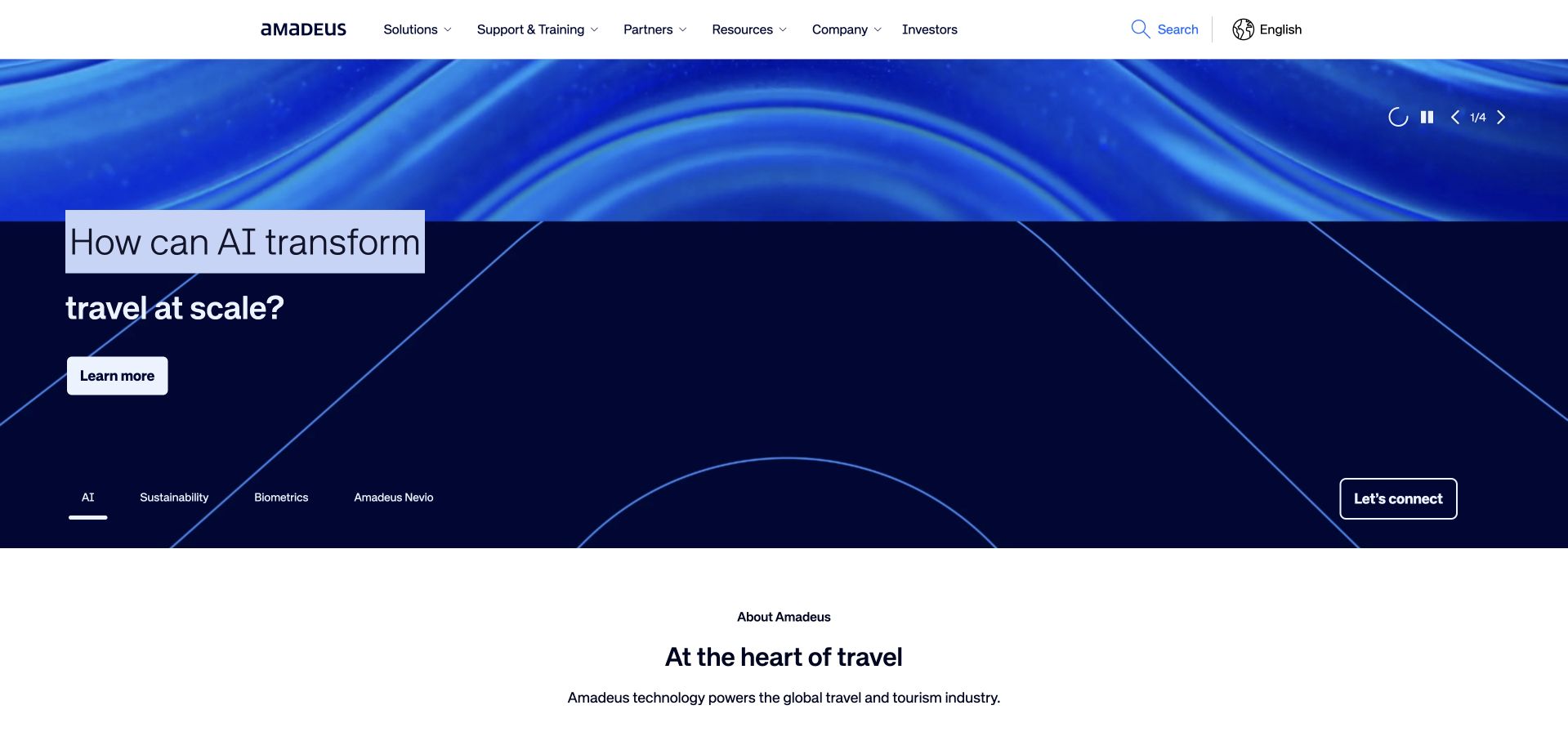
Amadeus presents travel technology at an industry scale, combining large strategic messages with routes into a diverse solutions business. The language addresses organizations designing travel services rather than travelers making a single reservation. Its strength is the connection between a sector-wide proposition and named operational themes; its weakness is the interpretation effort required before a newcomer finds the relevant product. Documented association checked November 8, 2026: MongoDB Enterprise Advanced document store for the intelligent flight-offer cache supporting New Distribution Capability travel search.
What you can learn
Distinguish an offer cache from a transaction record. The documented Enterprise Advanced flight-offer cache is a search-support workload, so an implementation team should define freshness and fallback behavior without assuming that cached offers guarantee bookable inventory or completed reservations.
Pros
Travel-specific positioning makes a complex business more coherent than a generic enterprise-software introduction.
Operational themes provide routes beyond the main campaign for visitors with an existing business need.
Cons & considerations
Large strategic headlines do not immediately explain which individual service solves a newcomer’s problem.
The corporate page cannot validate flight-offer freshness or the behavior of a downstream booking flow.
Platform source: Official MongoDB customer or product evidence. MongoDB Enterprise Advanced document store for the intelligent flight-offer cache supporting New Distribution Capability travel search. Official source reviewed November 8, 2026 Pacific; no complete current-stack audit is implied. Official documentary association is scoped to the named product, workload, dependency, or database service. No marketing-homepage runtime, complete company stack, independent performance, or private customer workflow is inferred. Platform evidence is separate from the direct website screenshot and is not a complete current infrastructure audit.
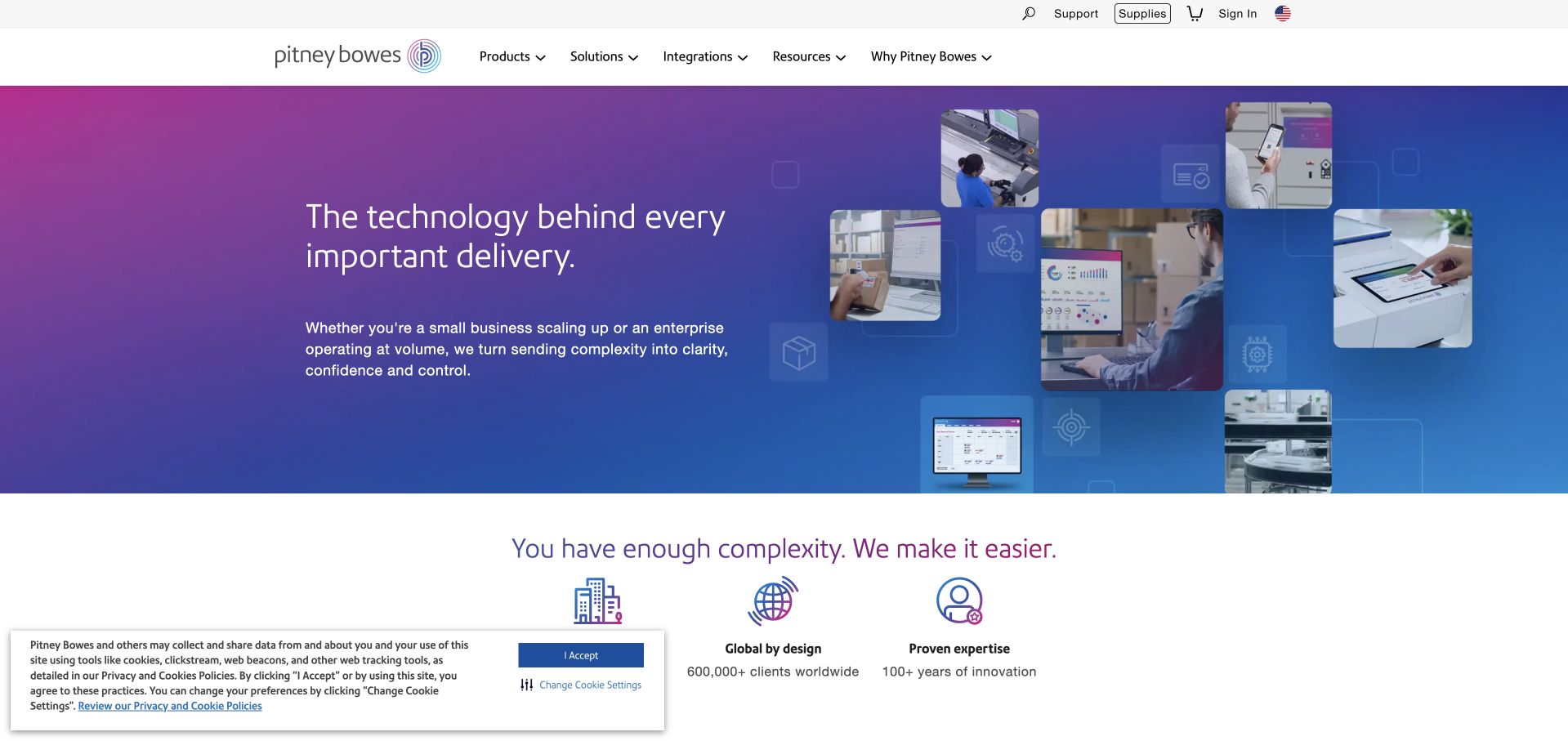
Pitney Bowes frames a wide delivery-technology business around the practical act of sending. Service grouping and plain business language make the offer more approachable than a catalog organized only by internal product names. The page is useful for understanding how an established logistics brand can serve different company sizes without making every visitor decode the full organization first. Documented association checked November 8, 2026: MongoDB for centralized real-time freight tracking and cross-border commerce logistics data.
What you can learn
Describe tracking as a sequence of sourced events rather than an undifferentiated real-time promise. The documented freight-data association is relevant to logistics information design, but it does not establish the database for this homepage or certify every delivery estimate displayed elsewhere.
Pros
A sending-focused proposition gives varied technology and service offerings a shared customer-facing purpose.
Business-size and service pathways can reduce the search burden for organizations with different shipping needs.
Cons & considerations
A broad sending umbrella still requires detailed explanation before a visitor can compare particular services.
The marketing introduction does not expose missing events, tracking delays, or cross-border data reconciliation.
Visible tech stack
Earlier / documented evidence
MongoDB
Platform source: Official MongoDB customer or product evidence. MongoDB for centralized real-time freight tracking and cross-border commerce logistics data. Official source reviewed November 8, 2026 Pacific; no complete current-stack audit is implied. Official documentary association is scoped to the named product, workload, dependency, or database service. No marketing-homepage runtime, complete company stack, independent performance, or private customer workflow is inferred. Platform evidence is separate from the direct website screenshot and is not a complete current infrastructure audit.
Intellect Design Arena positions itself within enterprise financial technology, using product and solution language to introduce a specialist portfolio. The presentation is aimed at organizational evaluation rather than consumer banking tasks. That audience focus is useful, but unfamiliar visitors still need a concrete explanation of each product’s users, inputs, and outputs before broad AI positioning becomes meaningful. Documented association checked November 8, 2026: MongoDB Atlas in Purple Fabric’s governed enterprise-AI architecture for unstructured ESG insights.
What you can learn
Scope governed AI to the actual application and information it processes. Purple Fabric’s ESG example is a specific documentary association; useful project planning would identify document provenance and review responsibilities rather than treating the database name as proof of trustworthy analysis.
Pros
Specialist positioning helps organizational buyers understand the category before exploring detailed product information.
A portfolio structure can support several financial-technology needs without pretending they are one consumer application.
Cons & considerations
Enterprise terminology raises the learning burden for visitors without knowledge of the product family.
A corporate AI proposition cannot independently validate the quality or governance of individual ESG insights.
Platform source: Official MongoDB customer or product evidence. MongoDB Atlas in Purple Fabric’s governed enterprise-AI architecture for unstructured ESG insights. Official source reviewed November 8, 2026 Pacific; no complete current-stack audit is implied. Official documentary association is scoped to the named product, workload, dependency, or database service. No marketing-homepage runtime, complete company stack, independent performance, or private customer workflow is inferred. Platform evidence is separate from the direct website screenshot and is not a complete current infrastructure audit.
Physics Wallah makes its learning proposition immediate and follows it with exam categories, student-oriented pathways, and evidence of its educational reach. The page gives an audience with a known goal several recognizable entry points. Its breadth is also the principal design challenge: promotional claims, results, and course families must not obscure what a learner should choose next. Documented association checked November 8, 2026: MongoDB Atlas, Search and Vector Search supporting the learning platform’s growth, course data, analytics and personalization.
What you can learn
Model course discovery around the learner’s actual goal and eligibility. The documented platform use of Atlas and search services supplies technical context, not independent proof of educational results, recommendation quality, or the exact database serving every public course page.
Pros
Exam-based categories align the navigation with the goals that bring learners to the platform.
A direct learning proposition avoids making visitors interpret an abstract education-technology brand first.
Cons & considerations
Many exam and course pathways can make similar-looking options difficult to distinguish quickly.
Prominent result claims need context and do not independently demonstrate the effectiveness of a course.
Platform source: Official MongoDB customer or product evidence. MongoDB Atlas, Search and Vector Search supporting the learning platform’s growth, course data, analytics and personalization. Official source reviewed November 8, 2026 Pacific; no complete current-stack audit is implied. Official documentary association is scoped to the named product, workload, dependency, or database service. No marketing-homepage runtime, complete company stack, independent performance, or private customer workflow is inferred. Platform evidence is separate from the direct website screenshot and is not a complete current infrastructure audit.
StoreHippo introduces an enterprise ecommerce ecosystem through marketplace, AI-assistant, and business-model propositions. The product breadth is visible immediately, giving larger organizations several ways to recognize their situation. It is less useful for a visitor seeking a simple small-shop checklist, because the page assumes some understanding of enterprise commerce and the operational complexity behind multiple channels. Documented association checked November 8, 2026: Hippo Innovations built StoreHippo on MongoDB and migrated to Atlas for its ecommerce platform and AI ecosystem.
What you can learn
Make the commerce model explicit before choosing the data model. StoreHippo’s documented MongoDB and Atlas history is relevant to a configurable platform, but it does not mean every merchant storefront shares one schema, deployment, or level of operational maturity.
Pros
Named enterprise scenarios help organizations connect the platform with specific marketplace or multi-channel ambitions.
The ecosystem framing acknowledges that commerce involves more than a single product-listing page.
Cons & considerations
Multiple enterprise and AI propositions can make the starting point unclear for smaller or less technical buyers.
The public vendor overview cannot establish how an individual merchant’s catalog and order data are implemented.
Visible tech stack
Earlier / documented evidence
MongoDB
Platform source: Official MongoDB customer or product evidence. Hippo Innovations built StoreHippo on MongoDB and migrated to Atlas for its ecommerce platform and AI ecosystem. Official source reviewed November 8, 2026 Pacific; no complete current-stack audit is implied. Official documentary association is scoped to the named product, workload, dependency, or database service. No marketing-homepage runtime, complete company stack, independent performance, or private customer workflow is inferred. Platform evidence is separate from the direct website screenshot and is not a complete current infrastructure audit.
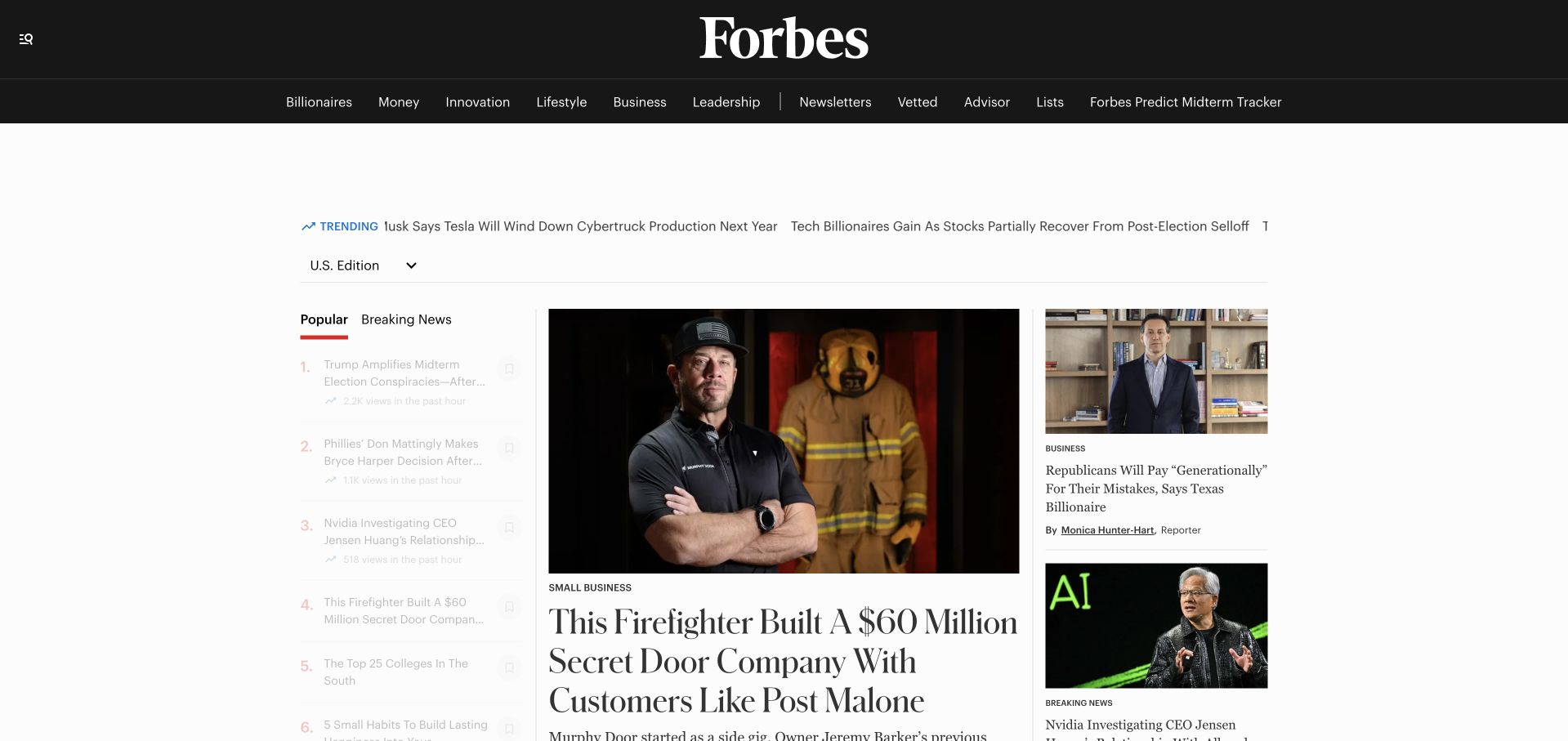
Forbes uses the conventions of a large news publication: a recognizable masthead, prominent current stories, and several competing editorial routes. Headlines provide the immediate browsing mechanism, while the grid accommodates a wide subject range. The design lesson is the importance of hierarchy when content changes continually, especially where commercial and editorial material share a busy public surface. Documented association checked November 8, 2026: MongoDB Atlas modernization of Forbes’ content-management and developer environment; source describes the 2019 migration.
What you can learn
Keep a CMS modernization story separate from every downstream page component. Forbes’ Atlas case describes a 2019 migration and developer environment; it supports discussion of publishing workflows without proving the current runtime of advertisements, subscriptions, recommendation modules, or this entire homepage.
Pros
A recognizable masthead and strong headline hierarchy make a frequently changing editorial surface legible.
Multiple story positions support a broad publication without requiring a single linear reading journey.
Cons & considerations
Competing news and commercial elements can dilute attention to the main editorial selection.
A historical CMS case does not identify every technology used by today’s public publication.
Platform source: Official MongoDB customer or product evidence. MongoDB Atlas modernization of Forbes’ content-management and developer environment; source describes the 2019 migration. Source describes a 2019 migration; not a statement that every current publication component uses Atlas. Official documentary association is scoped to the named product, workload, dependency, or database service. No marketing-homepage runtime, complete company stack, independent performance, or private customer workflow is inferred. Platform evidence is separate from the direct website screenshot and is not a complete current infrastructure audit.
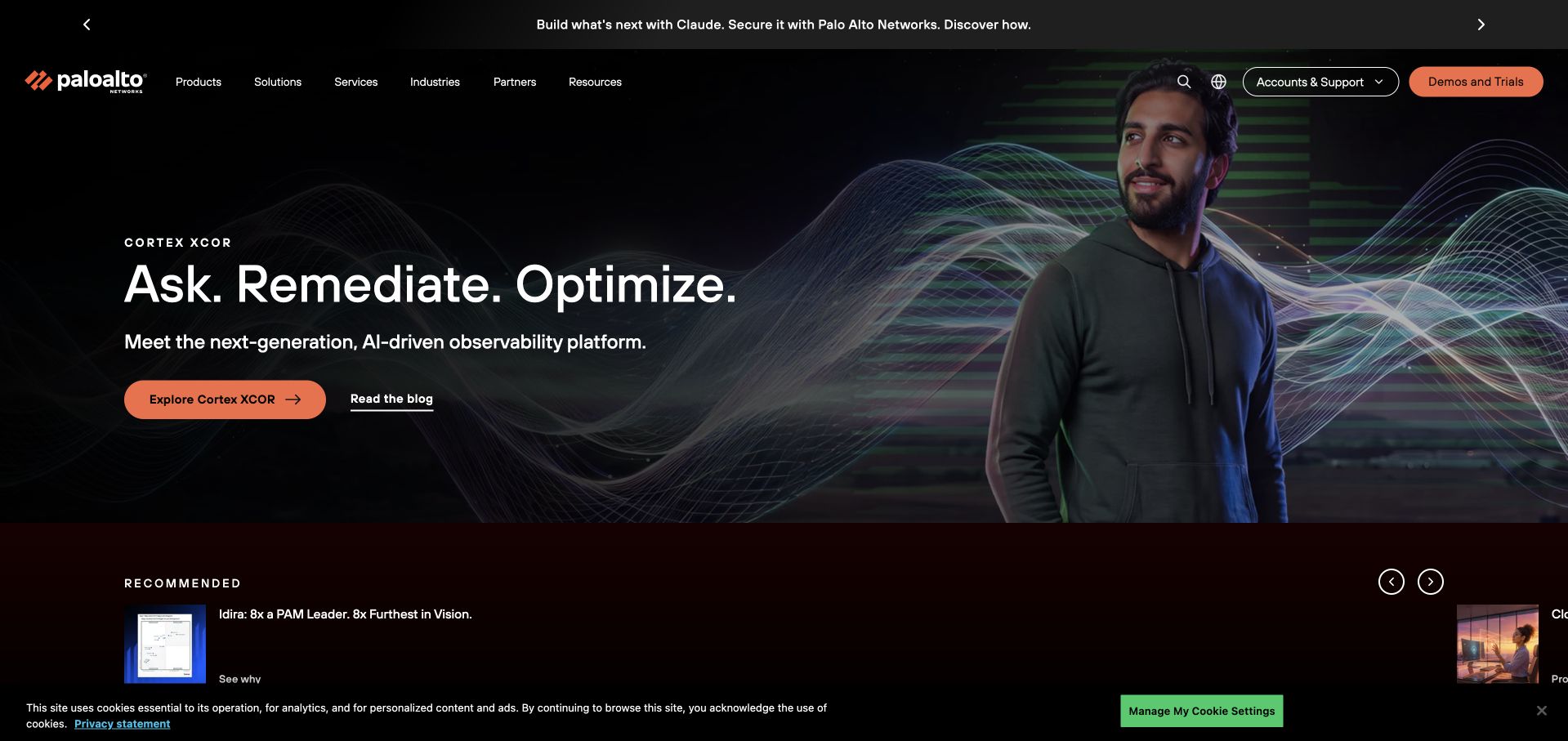
Palo Alto Networks’ corporate page places a large product campaign beside a broad cybersecurity portfolio. The presentation communicates scale and specialist ambition, with navigation and recommended material offering alternatives to the hero message. Its most transferable design challenge is distinguishing related security propositions clearly enough that an organizational visitor can locate the appropriate product without understanding the entire corporate portfolio. Documented association checked November 8, 2026: MongoDB Atlas for a multi-region SASE customer portal intended to stay available through cloud outages.
What you can learn
Translate availability architecture into explicit service states and ownership. The documented multi-region SASE portal is a bounded Atlas workload, not evidence that this marketing page or every security product uses MongoDB, and not an independent demonstration of zero downtime.
Pros
A consistent enterprise presentation unifies a wide collection of specialist security offerings and resources.
Recommended material provides another route for visitors who are not ready to follow the main campaign.
Cons & considerations
Portfolio breadth can obscure the difference between adjacent products for a less specialized visitor.
Public availability language cannot independently demonstrate outage behavior or the complete architecture of customer services.
Platform source: Official MongoDB customer or product evidence. MongoDB Atlas for a multi-region SASE customer portal intended to stay available through cloud outages. Official source reviewed November 8, 2026 Pacific; no complete current-stack audit is implied. Official documentary association is scoped to the named product, workload, dependency, or database service. No marketing-homepage runtime, complete company stack, independent performance, or private customer workflow is inferred. Platform evidence is separate from the direct website screenshot and is not a complete current infrastructure audit.
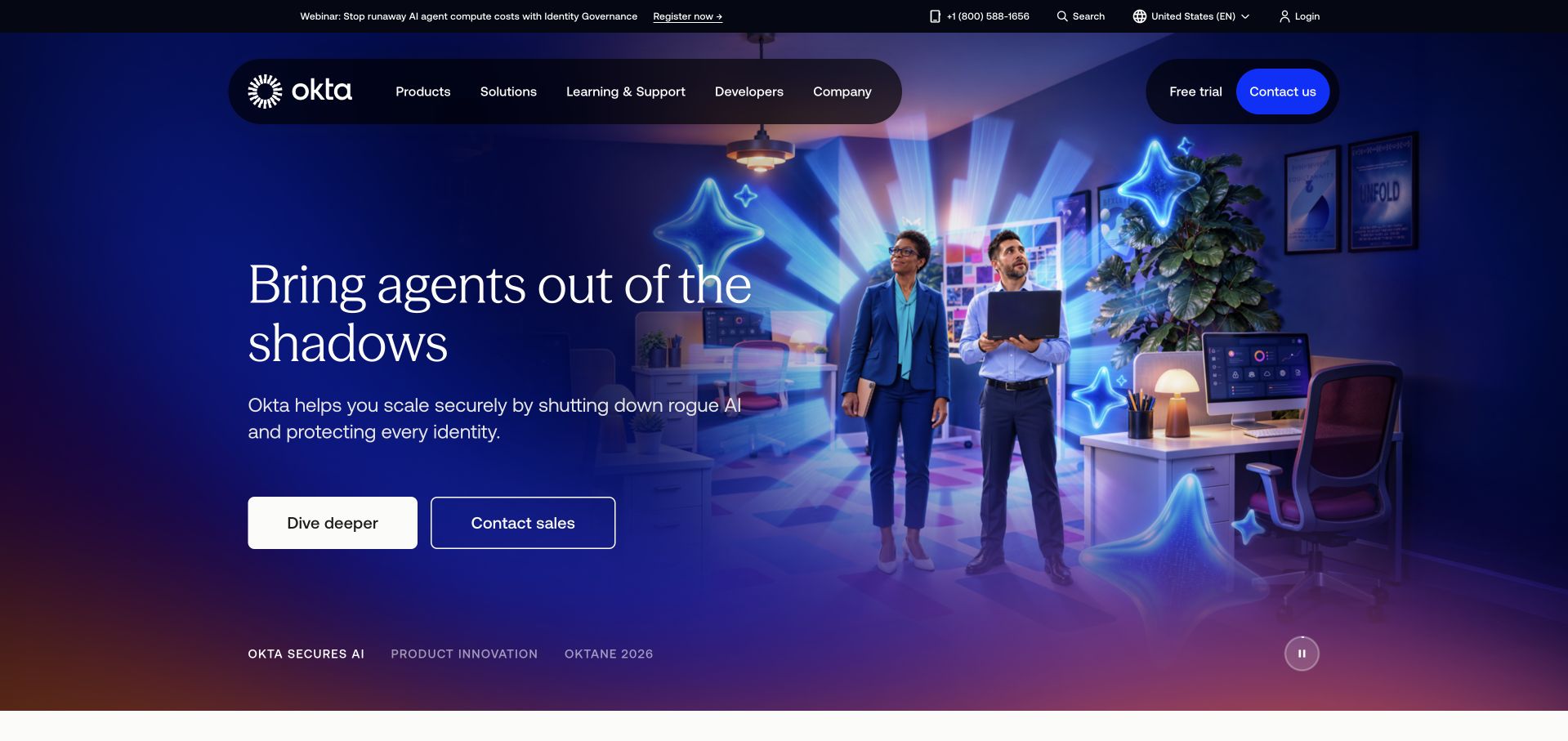
Okta’s public presentation connects its established identity category with an agent-focused campaign, then opens into broader business and product navigation. The campaign gives a current theme to an extensive portfolio, but the practical design work lies in explaining which identity problem each route addresses. A strong visual direction cannot substitute for distinguishing employee, customer, and agent-related requirements. Documented association checked November 8, 2026: MongoDB Atlas and Vector Search in Okta Inbox’s natural-language application-access request workflow.
What you can learn
Keep a natural-language access request grounded in the permissions it can actually change. Okta Inbox’s documented retrieval workflow is narrower than Okta’s whole authentication estate; it is not evidence that an AI answer is authorized merely because relevant content was retrieved.
Pros
An identity-centered vocabulary keeps the main category visible even as the campaign introduces newer concepts.
Broader product routes give existing customers alternatives to the agent-focused first impression.
Cons & considerations
Campaign terminology can add an extra translation step for visitors with a conventional access-management task.
The public presentation does not expose request approval rules or the permissions of retrieved information.
Platform source: Official MongoDB customer or product evidence. MongoDB Atlas and Vector Search in Okta Inbox’s natural-language application-access request workflow. Official source reviewed November 8, 2026 Pacific; no complete current-stack audit is implied. Official documentary association is scoped to the named product, workload, dependency, or database service. No marketing-homepage runtime, complete company stack, independent performance, or private customer workflow is inferred. Platform evidence is separate from the direct website screenshot and is not a complete current infrastructure audit.
Intuit introduces a family of financial products through an assistance-oriented entrance and audience-specific propositions. QuickBooks and other recognizable destinations help turn a broad corporate platform into more concrete choices. The page is useful for examining how a company can promote a shared direction while preserving separate product identities, although that breadth requires careful labels and clear expectations at each handoff. Documented association checked November 8, 2026: MongoDB Atlas, Charts, BI Connector and Triggers for Intuit’s internal Automated Compliance Platform.
What you can learn
Do not attach an internal compliance architecture to unrelated customer products. Intuit’s Automated Compliance Platform provides a specific Atlas example; useful technical planning would map evidence collection, review, and reporting responsibilities without claiming that the same database powers all bookkeeping or tax experiences.
Pros
Recognizable product names help visitors navigate a platform that serves several distinct financial audiences.
Audience-specific propositions provide more useful orientation than a single undifferentiated corporate feature list.
Cons & considerations
A broad assistance-oriented opening may require additional explanation before a visitor identifies the right product.
The public product family does not reveal the systems used for internal compliance or individual customer workflows.
Platform source: Official MongoDB customer or product evidence. MongoDB Atlas, Charts, BI Connector and Triggers for Intuit’s internal Automated Compliance Platform. Official source reviewed November 8, 2026 Pacific; no complete current-stack audit is implied. Official documentary association is scoped to the named product, workload, dependency, or database service. No marketing-homepage runtime, complete company stack, independent performance, or private customer workflow is inferred. Platform evidence is separate from the direct website screenshot and is not a complete current infrastructure audit.
Kegan has 15+ years of experience working with small businesses, Fortune 500 companies, and everything in between. No development job is too big or too small: he brings the same hands-on attention to a focused improvement, a complete website, or a custom application.
For MongoDB projects, he can help with data modeling, application data access, query design, search and cache integrations, migration planning, access boundaries, and maintainable handover. He works directly with clients on scope, design, implementation, testing, and handover, with an emphasis on clear communication and a system that remains practical to maintain after launch.
Show 3 other MongoDB developersHide other MongoDB developers
Use a representative business object to test how related information is read and updated. Consider embedding when information is normally consumed together and referencing when relationships or ownership demand it. Test realistic growth and change rather than approving a schema from an empty demo collection.
A modernization data layer
Wells Fargo’s documented operational data store and Amadeus’s offer cache have different responsibilities from a new product’s primary record system. Specify what remains authoritative elsewhere, how changes arrive, and which stale states are acceptable. Modernization is not permission to leave ownership ambiguous.
A retrieval-supported workflow
Adobe, Okta Inbox, and NovoScribe provide different documentary examples of AI-related work. Begin with a narrow task and inspect sources, permissions, and human review. The data service should support an understandable workflow; its presence cannot establish clinical validity, compliance, or the accuracy of a generated answer.
From references to requirements
Plan data changes alongside the interface
Describe the object lifecycle
Write down creation, edits, archival, and deletion for one important object. Include a duplicate identifier, a missing optional field, and an older document shape. Decide what users see when a write is rejected, and preserve useful context so that correcting an error does not require restarting the entire task.
Define ownership across systems
A pricing platform, telemetry service, and compliance application each depend on outside information in different ways. Record the owner of every business-critical field, the update mechanism, and a reconciliation procedure. Do not let the public page imply immediate consistency when the actual workflow includes delayed ingestion or a cached projection.
Rehearse an operating day
Test growth, a changed field, a delayed integration, and a restoration exercise in an appropriate nonproduction environment. Assign responsibility for monitoring and upgrades. The useful question is not whether a famous company chose MongoDB, but whether your team can explain and recover the particular service it proposes to operate.
A useful handover demonstration
Ask the actual team to carry out its routine job: publish a realistic update, correct a mistake, preview a narrow screen, and identify who owns an integration failure. For a library or frontend framework, also ask who maintains the content source and deployment. A polished screenshot does not answer those operational questions.
Beyond the screenshot
MongoDB project checklist
Name the application workload, not just the company.
Define the authoritative owner of each important fact.
Write representative read and write journeys.
Choose embedding and references intentionally.
Specify validation and old-document behavior.
Plan identifiers and duplicate handling.
Document integration freshness and reconciliation.
Separate retrieval relevance from authorization.
Show users meaningful incomplete and rejected states.
Test realistic growth and a schema change.
Rehearse restoration outside production.
Assign an owner for ongoing operations.
Test with real content, a keyboard, a small screen, slow or failed requests, and the people who will maintain the system. These are planning checks, not an accessibility, security, performance, or search-ranking certification.
Sources & editorial method
How this MongoDB collection was reviewed
Twenty distinct public properties were selected and individually reviewed for this MongoDB collection. Public browser captures were visually inspected; each image preserves its actual captureUrl, captureDate, dimensions, and provenance. New captures occurred November 9 UTC during November 8, 2026 Pacific research. Reused captures retain their original dates and timestamps; capturedAt:null means only the original day is known and no time was invented. Official primary customer, engineering, operations, or product documentation establishes only the named application workload, dependency, or database-service association. A company’s use of MongoDB is not evidence of the pictured homepage’s runtime or its entire technology estate. Historical accounts remain dated, and customer-reported results were not independently benchmarked. Reviews are original design criticism, not endorsements of financial, clinical, security, service-quality, or AI outcomes. No logins, account forms, transactions, or private workflows were used. Images and trademarks belong to their owners. A separate bounded public stack audit is performed by the sole publisher before publication; it is not replaced by these documentary associations.
Every image is an unmodified capture from the actual website, with its source and capture date. Some captures are reused from our shared catalog; their dates remain the original capture dates. None comes from a vendor gallery or a generated reconstruction. Moving imagery and live content can change.
Technology attribution uses public page assets or metadata, official platform documentation, or a cited first-party project case study. Documentary and framework-relationship evidence is identified where used; it is not a complete current backend inventory. A CMS image CDN alone does not establish a full CMS deployment. A library’s presence does not prove which individual controls use it, and a platform label does not establish AI authorship.
The composition notes, lessons, pros and tradeoffs are original editorial observations. We have not measured conversion, traffic, security, performance or accessibility conformance. Website owners retain their brands and imagery; these examples are not our client portfolio. Written, Edited and Curated are independent records, not dates advanced by a build. See our editorial standards or suggest a correction.
Questions worth asking
MongoDB website development FAQs
Are these homepages proven to run on MongoDB?
No. The direct captures establish what the named public pages looked like. The linked official customer material establishes a separate, scoped application association. A company’s use of MongoDB elsewhere does not identify its marketing-page runtime.
Does a flexible document model remove schema planning?
No. Decide field meaning, identifiers, relationships, validation, and how old records behave. Flexibility can support change, but leaving those decisions undocumented makes application behavior harder to understand and maintain.
Why do some examples say Enterprise Advanced rather than Atlas?
The sources describe different offerings and deployments. Wells Fargo and Amadeus are labeled according to their official cases instead of being silently rewritten as Atlas customers. The distinction matters when reasoning about operating responsibility.
Can these AI examples prove that a generated answer is trustworthy?
No. A database and retrieval association is not an evaluation of model accuracy, clinical effectiveness, financial suitability, or governance. Those questions need task-specific evidence, permissions, and appropriate human review.
Should a small marketing site copy this architecture?
Only if it has a justified application-data requirement. Reproducing a layout, publishing articles, or showing a simple service catalog does not by itself require the operational architecture of a global product company.
Use the examples to sharpen a bounded application brief: what information the service owns, how it changes, and how people understand the resulting experience. A recognizable customer is context, not an architecture specification.