Express website examples and public application planning (20 Real-World Examples)
Twenty public properties with dated Express response associations, genuine screenshots, and original lessons for routes, content state, and service boundaries.
Express provides application building blocks; it does not prescribe a visual style or prove how an entire brand operates. These references connect specific public-response evidence with practical interface and content decisions.
Express is a Node.js web framework with routing and middleware capabilities. The examples here were selected because a sampled public page or linked same-origin resource reported Express in its response. The signal is self-reported and limited to that response; it is not an audit of the complete application or its private systems.
The collection includes catalogs, museums, insurers, retailers, developer tools, scientific records, publications, and transport services. Their visible interfaces raise concrete questions about stable identities, retained selections, understandable failures, and the boundary between a public page and a connected service. Each review addresses those questions without inventing an unseen implementation.
Before the examples
What makes good Express website development in 2026?
Give routes a clear public purpose
Express routes respond to requests by path and HTTP method. For your own application, decide which paths represent durable content, which represent searches, and which start an action. Preserve meaningful identities and verify direct entry and browser return rather than designing only the ideal homepage path.
Define what visitors see when a request cannot complete, with enough context to recover and without exposing internal details. Express has error-handling conventions; apply the guidance for your actual version and test failures deliberately. A polished success screen does not demonstrate that the failure path is usable.
Keep asset delivery distinct from application claims
Express can serve static files through middleware. A header on a script or stylesheet response therefore supports a narrower association than an inventory of the application behind a page. In your own project, verify asset paths, caching intent, and missing-file behavior separately from content and action routes.
Coursera, the Louvre, Nationwide, Rogers, and Jared open the collection. Their exact public properties have recorded Express associations. Some observations concern asset responses only; the accompanying source records and reviews retain that distinction.
We start with five recognizable brands or organizations: Coursera, Musée du Louvre, Nationwide, Rogers, Jared. Each attribution applies to the named website property, not every product or website belonging to its organization. This is a curated reading sequence, not a measured ranking.
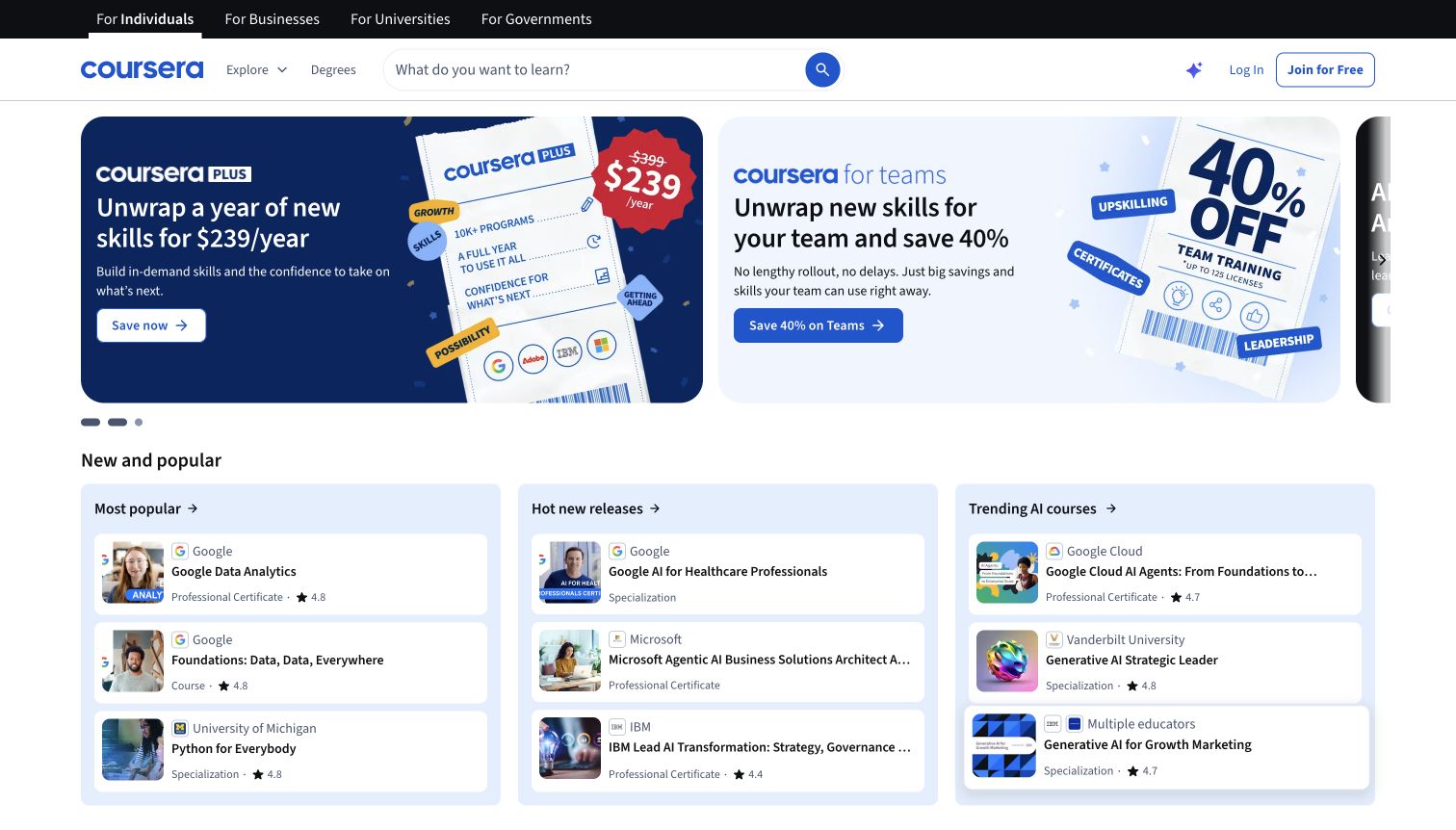
Coursera places a wide catalog search beside Explore and Degrees, with separate audience routes above. Large promotional cards lead into three columns of course suggestions, where provider, title, format, and occasional ratings repeat in a consistent order. That structure helps a learner compare options even when discounts dominate the opening. The sampled homepage reported Express in its response header. This is a server-reported association for the public property, not proof of the architecture behind course delivery, enrollment, or authenticated learning.
What you can learn
For an Express-based catalog of your own, define the result fields and route identities before building promotional modules. Keep the search destination independent from the current campaign, preserve query context when opening a detail page, and give empty or failed searches a useful response. Test long titles and multiple learning formats so the interface explains what a result actually represents.
Pros
The persistent input gives learners an alternative to current offers.
Repeated provider and format labels make compact course rows easier to compare.
Cons & considerations
Large discounts compete before a learner has chosen a subject.
Truncated titles can hide the words needed to distinguish similar courses.
Platform source: Dated public page and linked-resource audit. x-powered-by response header identifies Express. The sampled public page response reported Express. Server-reported software is not a verified runtime inventory and does not identify private services, CMS, language, version, or configuration. Platform evidence is separate from the direct website screenshot and is not a complete current infrastructure audit.
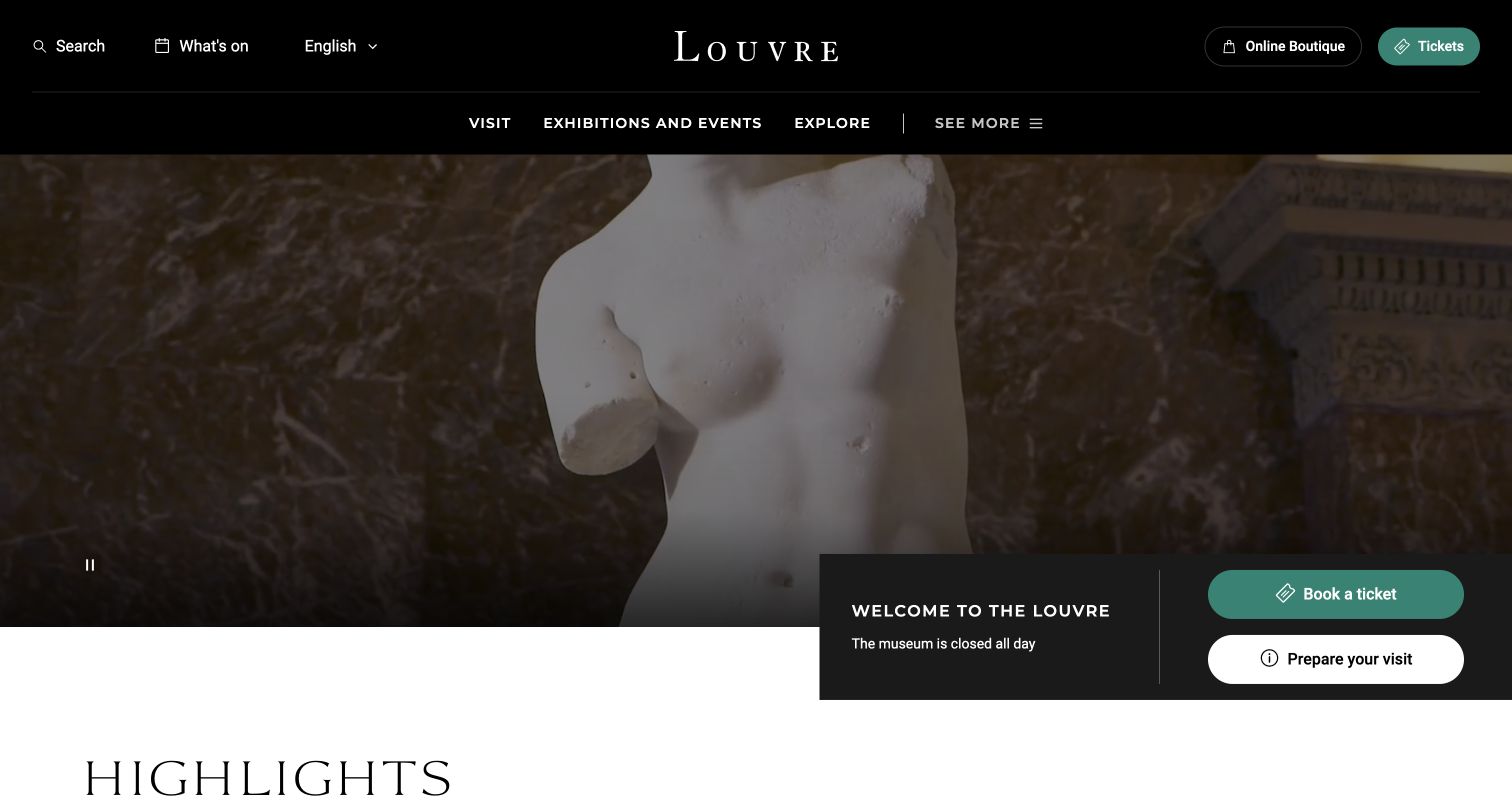
The Louvre pairs an expansive art-focused opening with a compact practical panel containing opening status, ticketing, and visit preparation. Language selection remains in the header alongside the museum's main categories. The page balances a powerful cultural image with the ordinary questions someone must answer before arriving. Express was reported by linked same-origin asset responses in the audit, not established as the implementation of admission, the collections database, or other museum systems.
What you can learn
Use this distinction when designing your own public application. Give visiting information a freshness policy separate from decorative assets, and make status text available without requiring a moving image. Preserve translated route identity and verify ticket-service handoffs without completing a transaction. Test closed days and exceptional notices as normal content states, with a still image or readable fallback supporting the same practical hierarchy.
Pros
Opening status appears beside the principal visitor actions.
Ticketing and preparation remain explicitly named despite the dominant visual treatment.
Cons & considerations
Moving imagery needs controls and a fallback that preserve the reading hierarchy.
A highlights sequence can hide alternatives unless ordinary program routes remain available.
Platform source: Dated public page and linked-resource audit. x-powered-by response header identifies Express. Only linked same-origin asset responses reported Express; this is an asset-delivery association, not attribution of the whole application. Server-reported software is not a verified runtime inventory and does not identify private services, CMS, language, version, or configuration. Platform evidence is separate from the direct website screenshot and is not a complete current infrastructure audit.
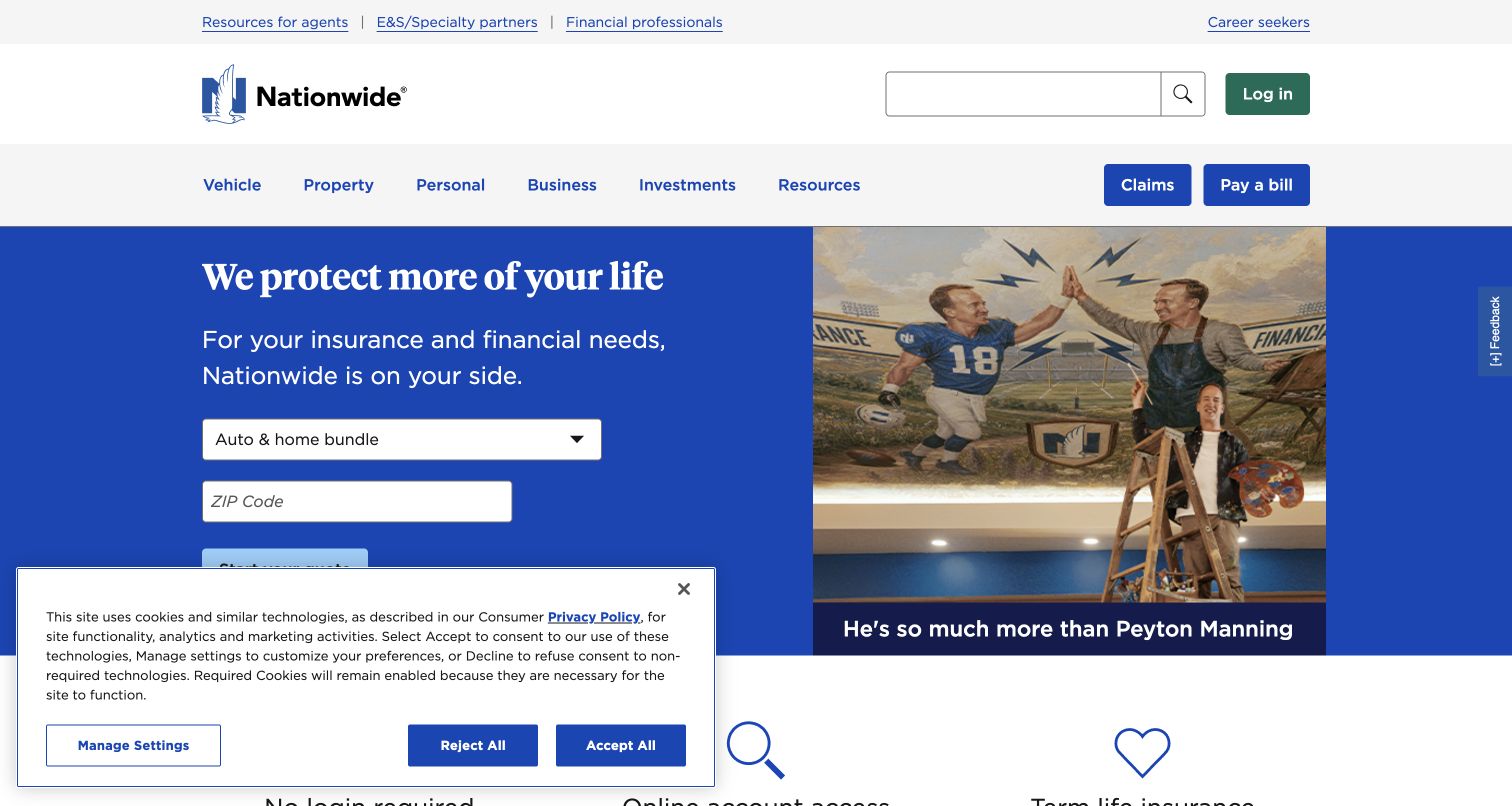
Nationwide gives product selection and a quote entrance a clear place beneath its brand message, while navigation separates insurance, business, investments, and resources. A smaller utility supports recurring service tasks, including claims and bill payment. The visible structure acknowledges both prospective customers and people maintaining an existing relationship. The sampled public homepage reported Express in a response header; this does not establish the architecture of private accounts, underwriting, payment, or claims processing.
What you can learn
In an application with similar audience boundaries, give public content routes and authenticated actions explicit ownership and labels. Preserve the chosen task when handing someone to another service, and make an unavailable destination understandable without exposing internal details. Test direct links, browser return, and changed product selection in a safe environment. A visually compact task menu still needs clear outcomes and a reliable ordinary navigation alternative.
Pros
Recurring service actions have a place outside the main acquisition message.
Separate navigation labels help distinguish different product and audience categories.
Cons & considerations
A dropdown conceals its alternatives until opened.
The retained consent panel covers part of the initial product-entry area.
Platform source: Dated public page and linked-resource audit. x-powered-by response header identifies Express. The sampled public page response reported Express. Server-reported software is not a verified runtime inventory and does not identify private services, CMS, language, version, or configuration. Platform evidence is separate from the direct website screenshot and is not a complete current infrastructure audit.
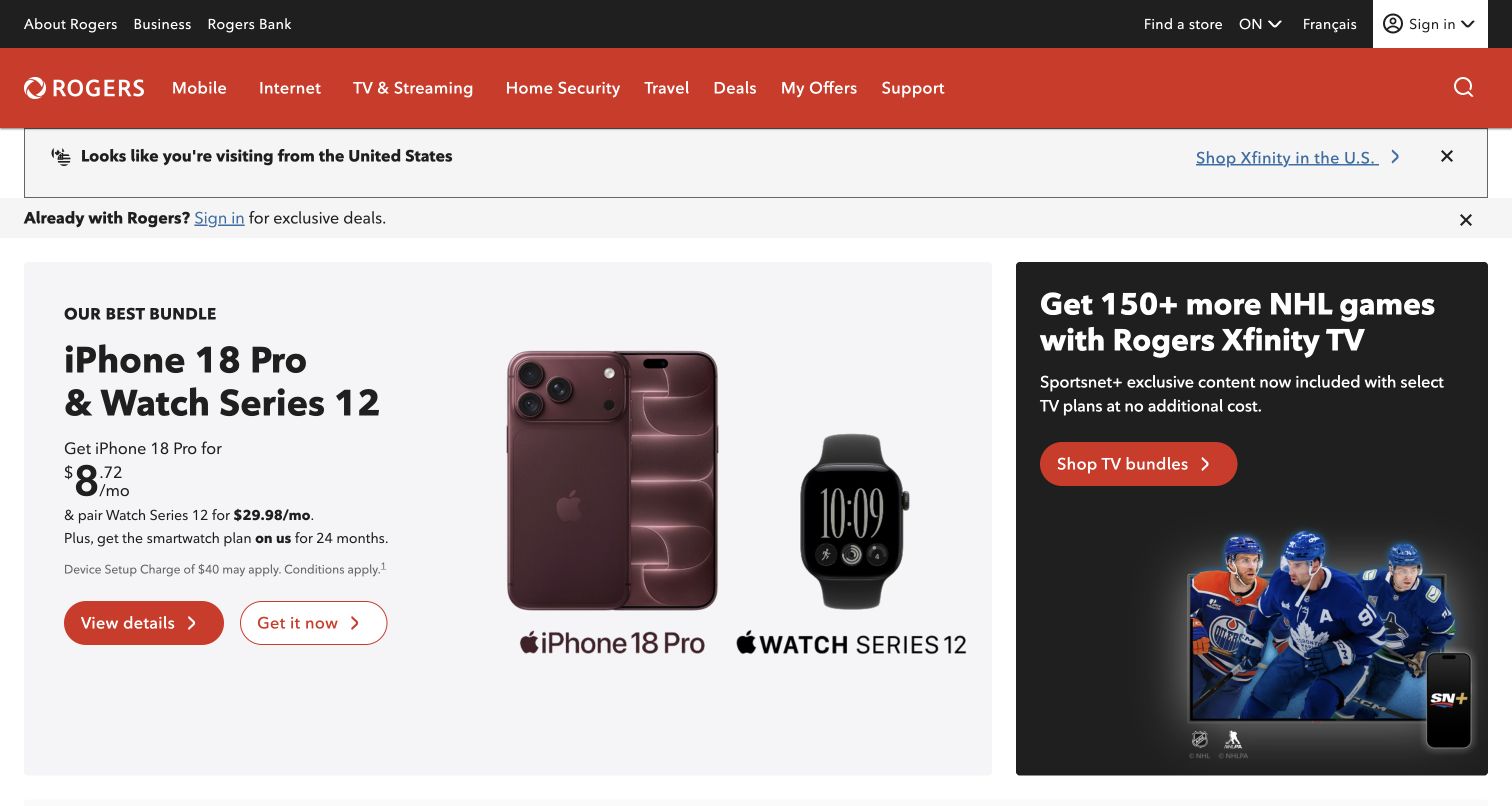
Rogers uses adjacent panels for a mobile-device bundle and television programming, keeping each offer visually distinct. A region control and location-related notice establish geographic context, while an existing-customer strip leads toward account-specific offers. The broad header also includes internet, home security, travel, and support. Express was reported by a linked same-origin JavaScript response. The observation supports that delivery-response association only, not a claim about the complete customer platform or billing systems.
What you can learn
For a comparable Express application, represent region and offer identity explicitly in the public route and content model. Verify that campaign links preserve the intended geographic context and that expired offers reach useful explanations. Keep existing-customer actions distinguishable from acquisition promotions. Test narrow screens and long qualification text without assuming that a successful homepage response proves the availability or price of a connected product.
Pros
Two panels give mobile and television propositions separate destinations.
Region and returning-customer context appear before the main offers.
Cons & considerations
Several monthly figures and bundle components complicate comparison.
Broad navigation can make a narrow support need harder to locate quickly.
Platform source: Dated public page and linked-resource audit. x-powered-by response header identifies Express. Only linked same-origin asset responses reported Express; this is an asset-delivery association, not attribution of the whole application. Server-reported software is not a verified runtime inventory and does not identify private services, CMS, language, version, or configuration. Platform evidence is separate from the direct website screenshot and is not a complete current infrastructure audit.
Jared places a portrait of worn jewelry beside three visible spending thresholds for a bridal promotion. A clear shopping action and exclusions link sit within the dark campaign area, while store finding and appointment booking remain in a separate utility strip. The design explains more of the offer structure than a single percentage headline would. The sampled public response reported Express, without establishing the implementation of checkout, financing, appointments, or store inventory.
What you can learn
For a similar storefront, keep promotional tiers and their conditions in one maintained record rather than duplicating them across unrelated templates. Give the campaign a stable destination and define what happens after expiry. Verify that a category link, an assistance route, and a returning visitor from an old advertisement receive coherent context. Treat price and availability as separate operational facts requiring their own checks.
Pros
The three thresholds can be compared without opening another page.
The portrait demonstrates the scale of several pieces when worn together.
Cons & considerations
Financing and savings messages compete in the upper promotional bands.
A broad shopping action does not immediately explain which bridal categories qualify.
Platform source: Dated public page and linked-resource audit. x-powered-by response header identifies Express. The sampled public page response reported Express. Server-reported software is not a verified runtime inventory and does not identify private services, CMS, language, version, or configuration. Platform evidence is separate from the direct website screenshot and is not a complete current infrastructure audit.
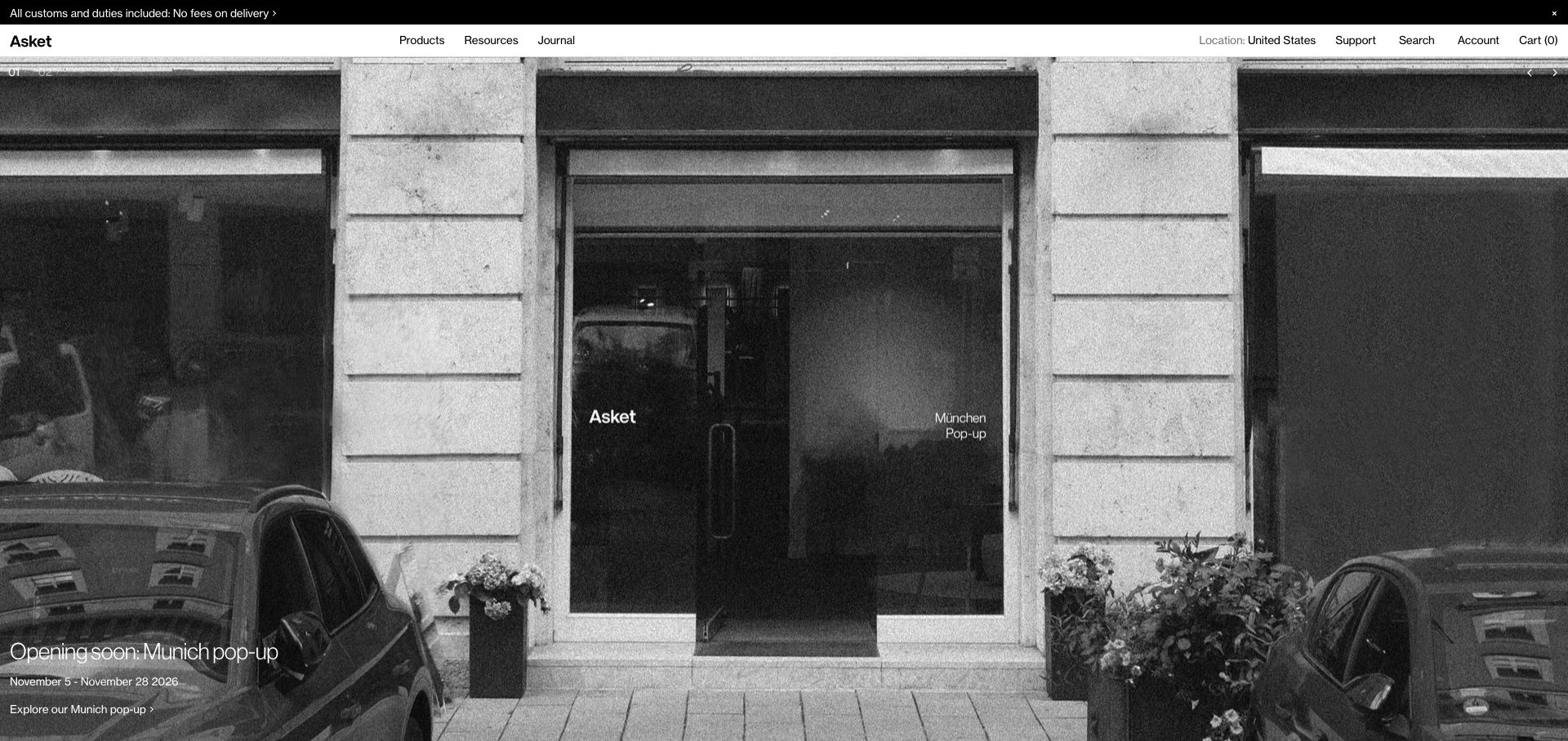
Asket uses a monochrome storefront photograph to announce a physical pop-up, with small event text near the lower edge. Products, Resources, and Journal retain similar prominence in the white header, and a delivery notice addresses another practical concern. The restrained design lets a temporary event coexist with a broader clothing proposition. The sampled public response reported Express; that observation does not identify shopping, fulfillment, or customer-account architecture.
What you can learn
For an Express-backed publication or storefront, make campaign dates and destinations structured fields with an expiry review. Keep the event's public record useful after its lead position ends, and preserve product and information routes independently. Verify that regional paths retain their intended market context during redirects. Test the event copy against different image crops, and provide readable dates and location details in text rather than relying on the photograph.
Pros
The quiet palette gives the event a coherent visual relationship to the brand.
Resources and journal remain available beside transactional browsing.
Cons & considerations
The campaign occupies most of the opening before garments appear.
Small light text on a photograph requires careful contrast and crop review.
Platform source: Dated public page and linked-resource audit. x-powered-by response header identifies Express. The sampled public page response reported Express. Server-reported software is not a verified runtime inventory and does not identify private services, CMS, language, version, or configuration. Platform evidence is separate from the direct website screenshot and is not a complete current infrastructure audit.
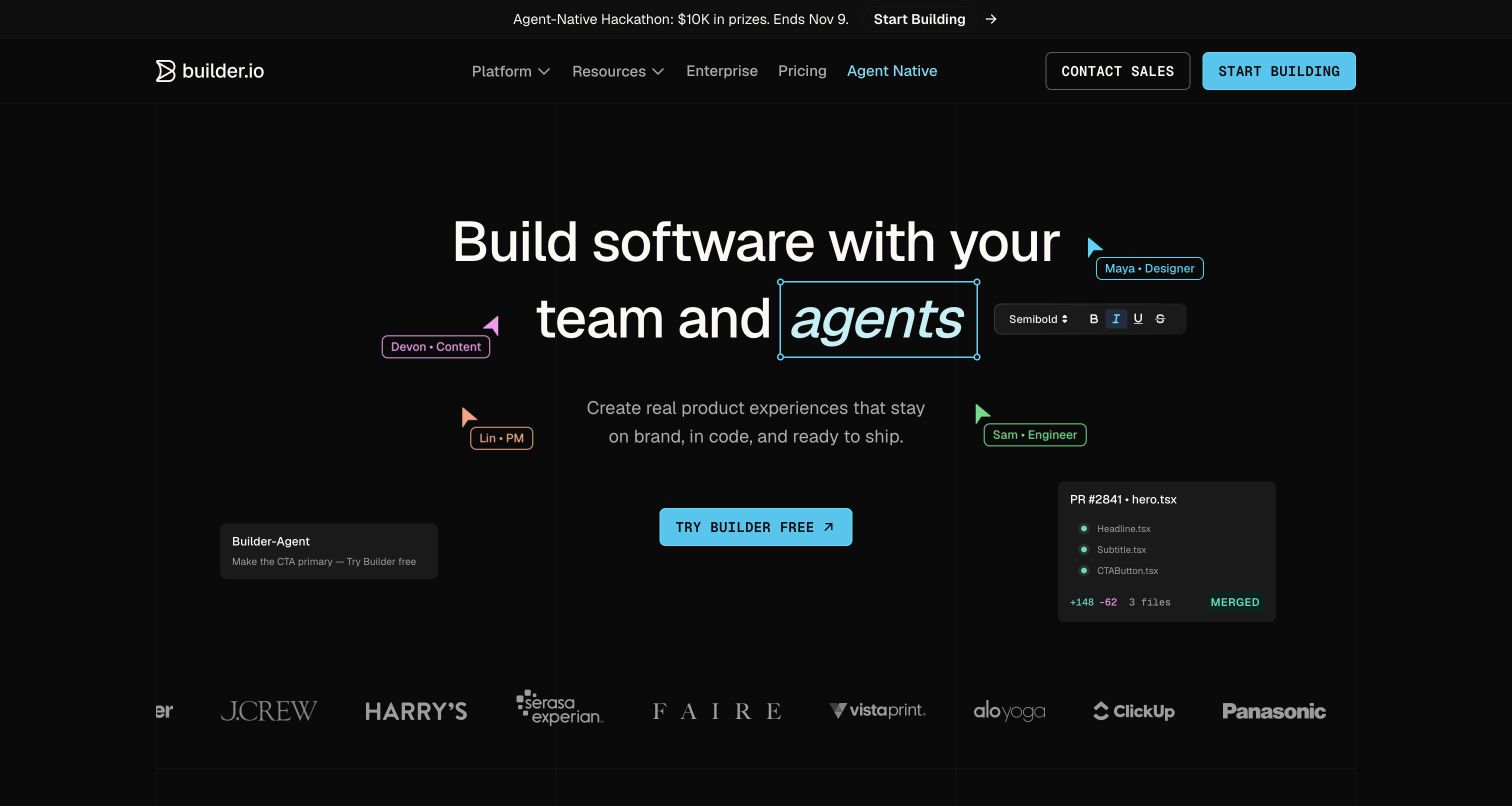
Builder.io presents its headline as a collaborative editing scene, surrounding it with cursor labels, a formatting toolbar, an agent instruction, and a pull-request preview. Cyan actions stand out against a dark grid, while customer marks sit below. The illustration explains a relationship between design decisions and code changes. The public page reported Express in its response header, but the marketing demonstration does not establish how actual projects, model calls, approvals, or merged changes are processed.
What you can learn
When building a comparable application, distinguish illustrative examples from live artifacts and name each transition clearly. Preserve a user's project context when moving from documentation to product entry, and define useful error and empty states before adding automation effects. Keep documentation and pricing reachable without forcing a signup. Evaluate the public story separately from any authenticated workflow that would require its own evidence and tests.
Pros
Recognizable design and engineering artifacts clarify the intended collaboration.
Bright primary actions remain visible within the dark composition.
Cons & considerations
Several floating elements compete with the central reading sequence.
An illustrated success state cannot demonstrate the behavior of a customer's review process.
Platform source: Dated public page and linked-resource audit. x-powered-by response header identifies Express. The sampled public page response reported Express. Server-reported software is not a verified runtime inventory and does not identify private services, CMS, language, version, or configuration. Platform evidence is separate from the direct website screenshot and is not a complete current infrastructure audit.
Cupertino Electric pairs a short delivery statement over field imagery with a spacious explanation of its infrastructure work. The retained capture begins around the homepage introduction rather than showing the entire top navigation. The broader reviewed page provides core markets, project summaries, locations, and inquiry routes, with project details explaining the kind of infrastructure involved. Express was reported by a linked same-origin script response, not established as the technology of private project or inquiry systems.
What you can learn
For a comparable public application, make project records independently addressable and preserve their market and location relationships. Keep statistics dated and traceable to maintained content, and verify older project URLs after a release. Test missing images and long scope descriptions so the evidence remains understandable beyond the lead photograph. A good content route should explain the contractor's actual role without relying on a broad delivery slogan alone.
Pros
Project summaries connect positioning to concrete infrastructure context.
The spacious introduction gives explanatory text room beside the visual message.
Cons & considerations
Large company claims require current supporting context.
The long homepage separates some detailed project evidence from the initial introduction.
Platform source: Dated public page and linked-resource audit. x-powered-by response header identifies Express. Only linked same-origin asset responses reported Express; this is an asset-delivery association, not attribution of the whole application. Server-reported software is not a verified runtime inventory and does not identify private services, CMS, language, version, or configuration. Platform evidence is separate from the direct website screenshot and is not a complete current infrastructure audit.
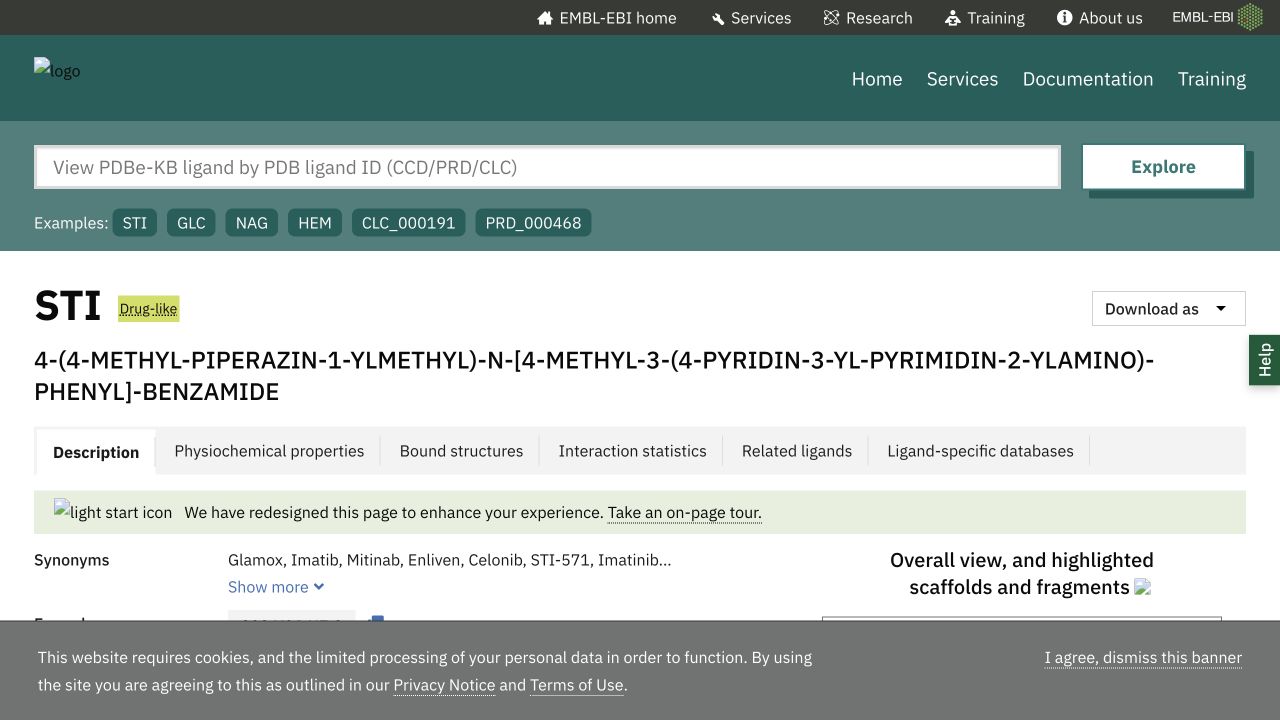
The EMBL-EBI PDBe chemical-component page places a prominent ligand identifier and a long systematic name beneath a direct lookup field. Tabs separate description, properties, structures, statistics, and related resources, with download and help controls nearby. Some image assets are unavailable in the retained capture, but the textual record remains readable. The sampled response reported Express. This is evidence about that public response, not a scientific validation or a complete account of the research infrastructure.
What you can learn
For a data-oriented Express application, preserve canonical identifiers in stable URLs and make each detail view understandable after direct entry. Handle missing diagrams without hiding the record's text, and keep download formats clearly named. Test long names, unknown identifiers, and unavailable supporting assets. Separate rendering errors from the meaning of the underlying data, so a broken image cannot be mistaken for an absent or invalid scientific record.
Pros
The identifier remains visually prominent above dense technical information.
Distinct tabs organize different kinds of record detail.
Cons & considerations
Long technical names need deliberate wrapping on small screens.
Unavailable diagrams limit the visual interpretation possible from this captured page.
Platform source: Dated public page and linked-resource audit. x-powered-by response header identifies Express. The sampled public page response reported Express. Server-reported software is not a verified runtime inventory and does not identify private services, CMS, language, version, or configuration. Platform evidence is separate from the direct website screenshot and is not a complete current infrastructure audit.
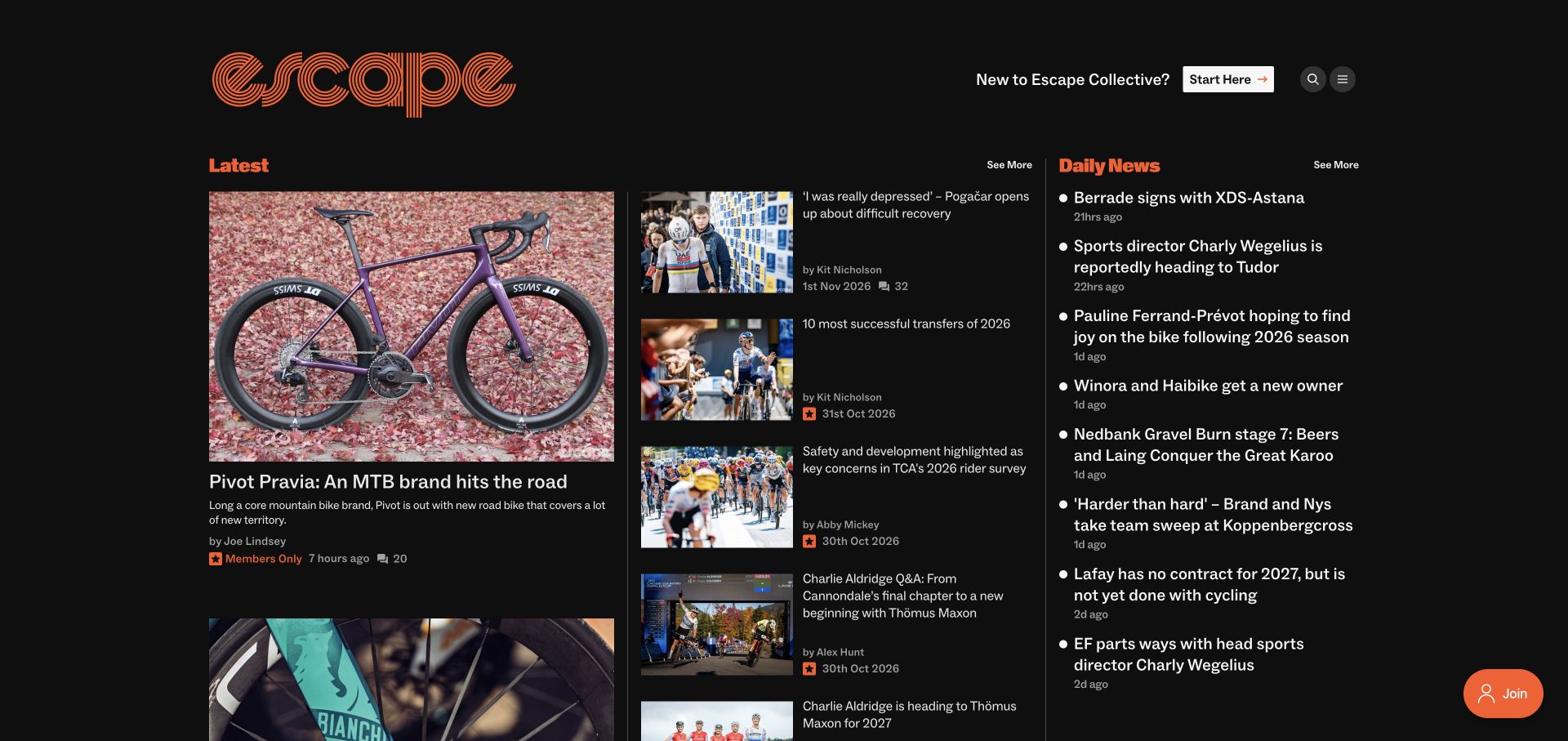
Escape Collective uses orange identity on a dark background, arranging a large cycling feature beside shorter stories and a daily-news list. A Start Here route welcomes readers unfamiliar with the publication, while membership labels distinguish access conditions. The homepage makes several editorial rhythms visible without requiring a sign-in. The sampled public response reported Express, which does not establish the implementation of member authentication, billing, comments, or any connected community service.
What you can learn
For a comparable publishing application, model brief updates and long features separately while keeping their permanent URLs predictable. Preserve access labels across cards, search, and article previews. Test an unauthenticated direct visit and an expired or unavailable destination without exposing private content. Give new readers a stable introduction that survives changes to the lead story, and verify mobile ordering so the daily-news column does not interrupt the main reading sequence.
Pros
Start Here acknowledges that new readers need more context than the latest headline.
Brief news and longer features have visibly different roles.
Cons & considerations
Parallel narrow columns need careful mobile reordering.
Small dates and metadata can become difficult to read against the dark surface.
Platform source: Dated public page and linked-resource audit. x-powered-by response header identifies Express. The sampled public page response reported Express. Server-reported software is not a verified runtime inventory and does not identify private services, CMS, language, version, or configuration. Platform evidence is separate from the direct website screenshot and is not a complete current infrastructure audit.
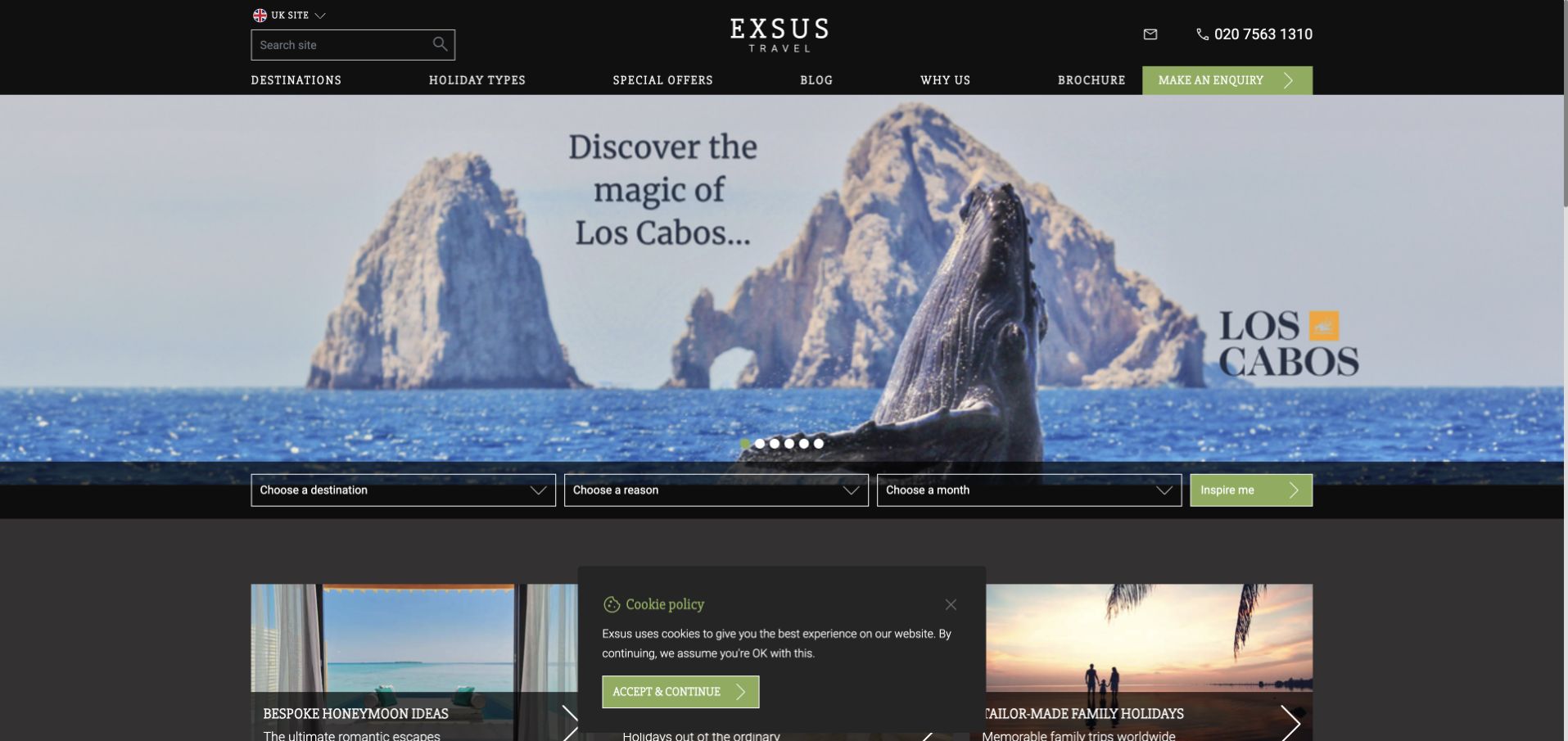
Exsus Travel places a destination campaign beneath conventional navigation, with phone, brochure, and inquiry routes nearby. A dark filter bar asks for destination, reason for travel, and month before offering inspiration. This is more specific than a generic search because it recognizes that a traveler may know only part of the desired trip. Express was reported on linked same-origin script responses, not established as the implementation of inquiries, availability, or any booking service.
What you can learn
When developing a similar exploration route, preserve the visitor's selected dimensions in a shareable, understandable result state. Explain why suggestions match those choices and provide a useful response when no combination is available. Keep brochure and inquiry links independent from the filter enhancement. Test a changed month, an incomplete selection, and browser return without submitting a real travel request or inventing availability from promotional content.
Pros
The filter dimensions accommodate several different starting points for planning.
Human assistance and brochure routes remain available beside self-directed exploration.
Cons & considerations
Three simultaneous choices can burden someone who has not narrowed the trip.
Anonymous sequence dots reveal little about alternative featured destinations.
Platform source: Dated public page and linked-resource audit. x-powered-by response header identifies Express. Only linked same-origin asset responses reported Express; this is an asset-delivery association, not attribution of the whole application. Server-reported software is not a verified runtime inventory and does not identify private services, CMS, language, version, or configuration. Platform evidence is separate from the direct website screenshot and is not a complete current infrastructure audit.
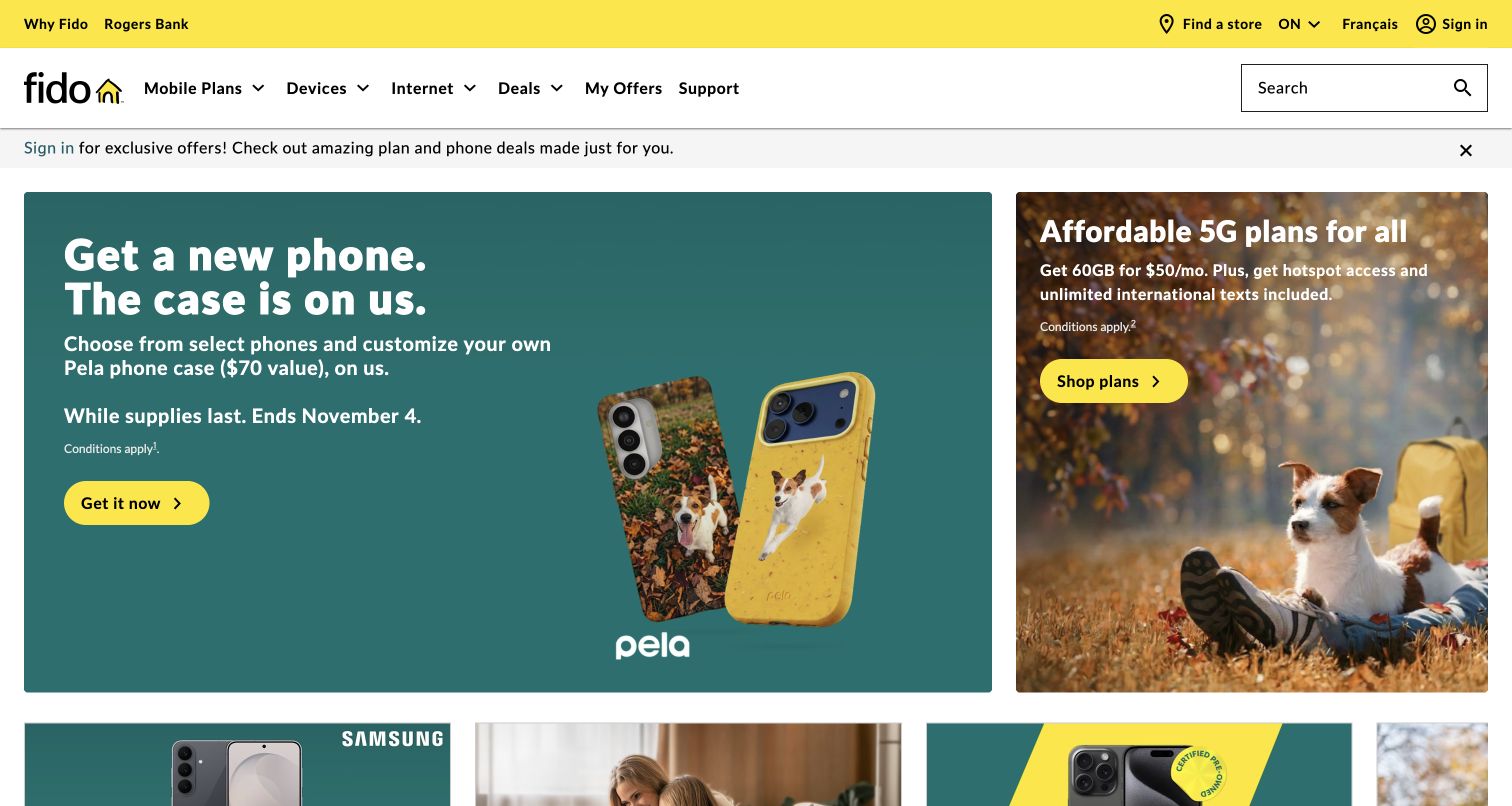
Fido gives a large phone promotion and a smaller plan-only offer distinct cards, using yellow accents and different imagery. An existing-customer sign-in strip spans the page above, while search and support remain in the header. The layout serves two shopping intentions without combining them into one ambiguous product. Express was reported by a linked same-origin JavaScript response. This does not identify the private customer platform, payment services, or the infrastructure behind plan eligibility.
What you can learn
For a comparable public application, keep each offer's identity, expiry, qualifications, and destination together in the content model. Verify a device-led path and a plan-only path separately after deployment. Make the transition to customer-specific offers explicit, and retain readable conditions when a card becomes narrow. Test old campaign links and unavailable destinations rather than assuming that a successful marketing page proves a product is still purchasable.
Pros
Different cards give device and plan-only offers separate visual territory.
The returning-customer strip explains where account-specific offers belong.
Cons & considerations
The larger phone campaign can overshadow the simpler plan choice.
Concurrent promotions increase the work needed to keep conditions and dates synchronized.
Platform source: Dated public page and linked-resource audit. x-powered-by response header identifies Express. Only linked same-origin asset responses reported Express; this is an asset-delivery association, not attribution of the whole application. Server-reported software is not a verified runtime inventory and does not identify private services, CMS, language, version, or configuration. Platform evidence is separate from the direct website screenshot and is not a complete current infrastructure audit.
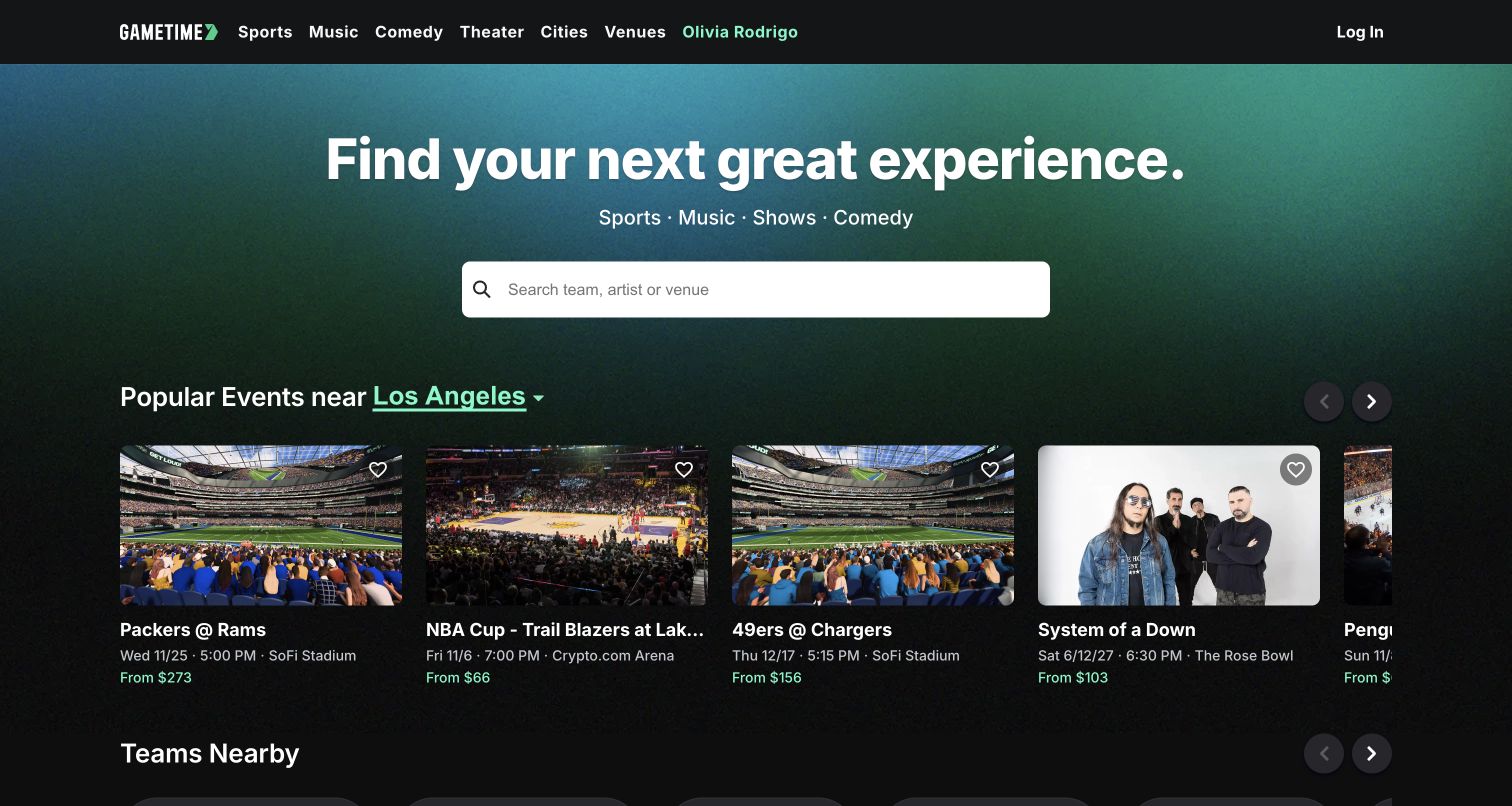
Gametime centers a large search field that names teams, artists, and venues as useful queries. Categories above and event cards below provide alternatives to typing, while a visible city context shapes the initial recommendations. The page helps someone express an intent without knowing an exact event title. Express was reported by a linked same-origin stylesheet response in the audit, not established as the architecture of inventory, ticket fulfillment, or payment.
What you can learn
In an Express-based discovery application, keep event, venue, performer, and city identities distinct even when they share search results. Preserve the chosen location and query when opening a detail route, and explain empty or failed searches. Test recurring events with similar names and different dates. Keep price and availability freshness separate from the public page's visual rendering, and never infer a completed ticket transaction from a successful browsing view.
Pros
The input explains several types of query in plain language.
Visible event cards connect the search invitation with concrete examples.
Cons & considerations
A default city can mislead unless its context remains easy to change.
Prices and availability require operational verification beyond a static homepage capture.
Platform source: Dated public page and linked-resource audit. x-powered-by response header identifies Express. Only linked same-origin asset responses reported Express; this is an asset-delivery association, not attribution of the whole application. Server-reported software is not a verified runtime inventory and does not identify private services, CMS, language, version, or configuration. Platform evidence is separate from the direct website screenshot and is not a complete current infrastructure audit.
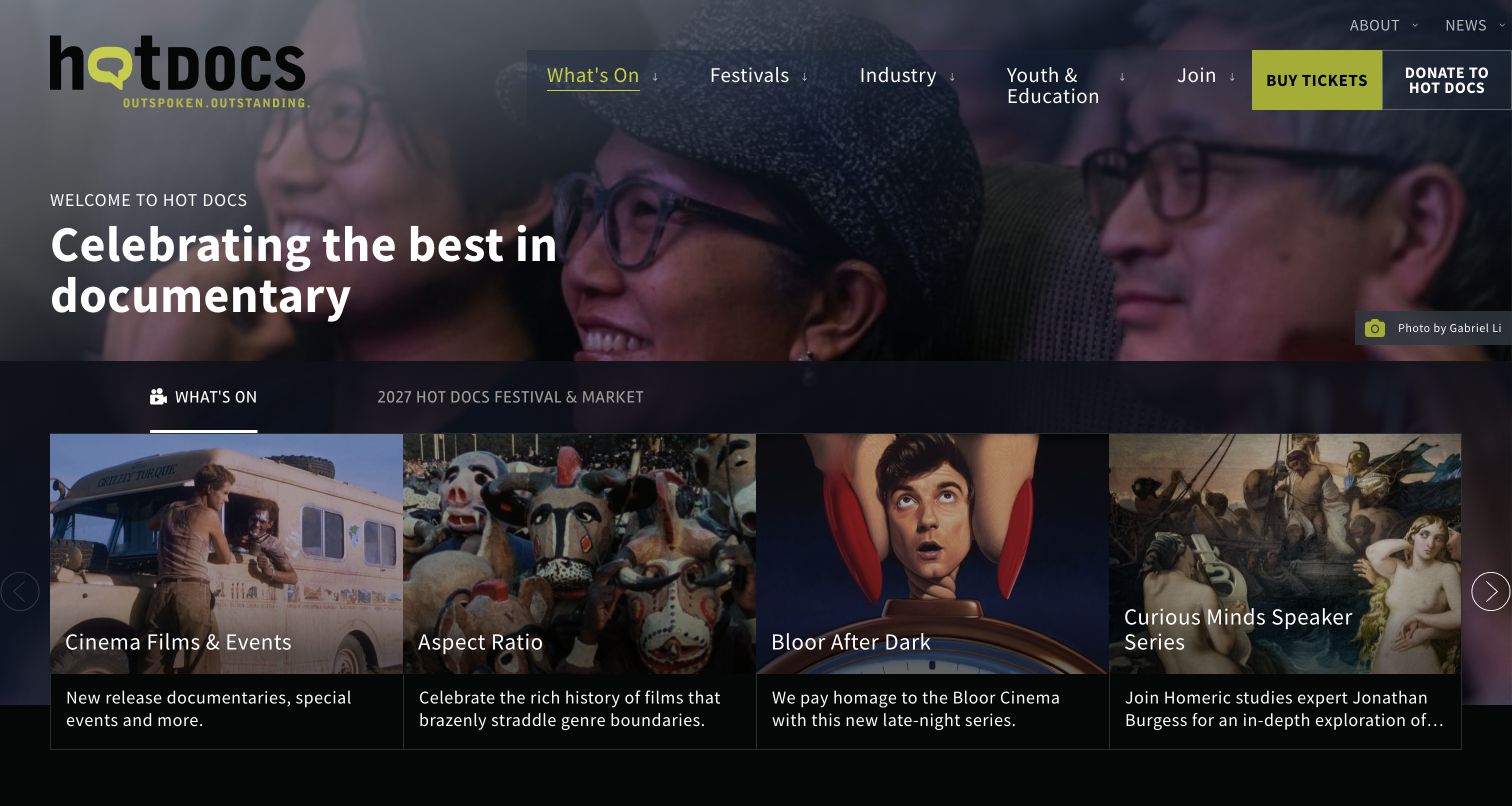
Hot Docs uses an audience photograph and a concise documentary-focused statement to introduce its public program. A bright ticket action sits in the header, while tabs below distinguish What's On from the next festival and market. Cards explain series, cinema events, and talks rather than presenting an undifferentiated feed. The sampled homepage reported Express, without establishing how ticketing, accreditation, membership, or private festival submissions are implemented.
What you can learn
For a similar cultural application, separate program records from annual festival editions and make their dates explicit in stable routes. Verify that a past screening remains understandable as an archive item while the current program changes. Keep tab destinations accessible through ordinary links and test an empty program section. Review ticket-service handoffs separately so an attractive public listing does not imply current seat availability or completed purchase behavior.
Pros
The audience photograph communicates participation rather than only promoting individual titles.
Tabs distinguish current public programming from the future festival.
Cons & considerations
A hidden tab can be overlooked if its label loses prominence on small screens.
Unfamiliar series names need concise explanations to help first-time visitors choose.
Platform source: Dated public page and linked-resource audit. x-powered-by response header identifies Express. The sampled public page response reported Express. Server-reported software is not a verified runtime inventory and does not identify private services, CMS, language, version, or configuration. Platform evidence is separate from the direct website screenshot and is not a complete current infrastructure audit.
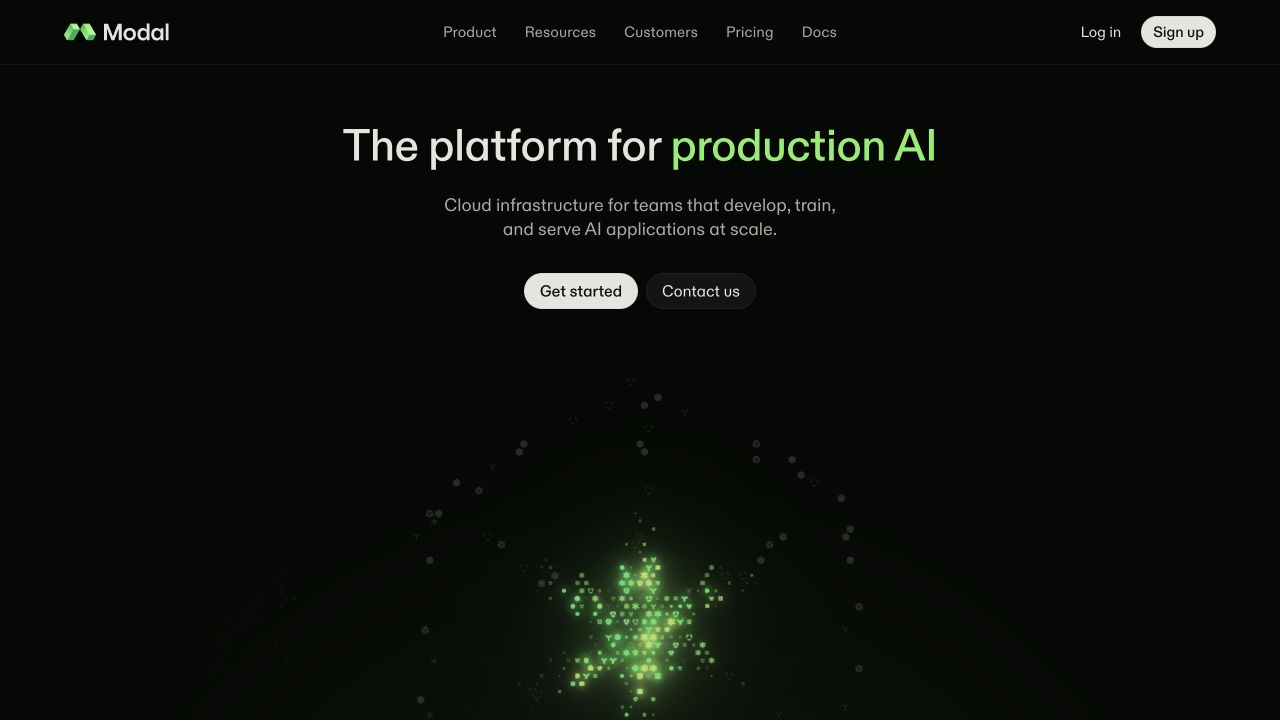
Modal uses a dark background, a short centered platform statement, and green emphasis around its AI focus. Get Started and Contact Us provide different evaluation routes, while pricing and documentation remain in the compact header. An abstract particle-like field supplies atmosphere below the message. The sampled public page reported Express; that does not establish GPU availability, runtime performance, authenticated infrastructure, or the implementation of customer workloads.
What you can learn
For a developer-product website built with Express, preserve documentation and pricing routes independently from marketing effects. Make product entry and sales contact distinct, and provide meaningful content before decorative assets initialize. Test failed asset delivery and direct visits to older documentation links. Keep claims about operational capability separate from visual demonstrations, and verify authenticated workflows only within their own authorized environment rather than treating a successful public response as platform validation.
Pros
The two main actions support self-service and sales-led evaluation separately.
Documentation remains an obvious destination without requiring signup first.
Cons & considerations
The abstract effect explains little about actual operational workflows.
Subdued text and decoration on a dark background require careful contrast choices.
Platform source: Dated public page and linked-resource audit. x-powered-by response header identifies Express. The sampled public page response reported Express. Server-reported software is not a verified runtime inventory and does not identify private services, CMS, language, version, or configuration. Platform evidence is separate from the direct website screenshot and is not a complete current infrastructure audit.
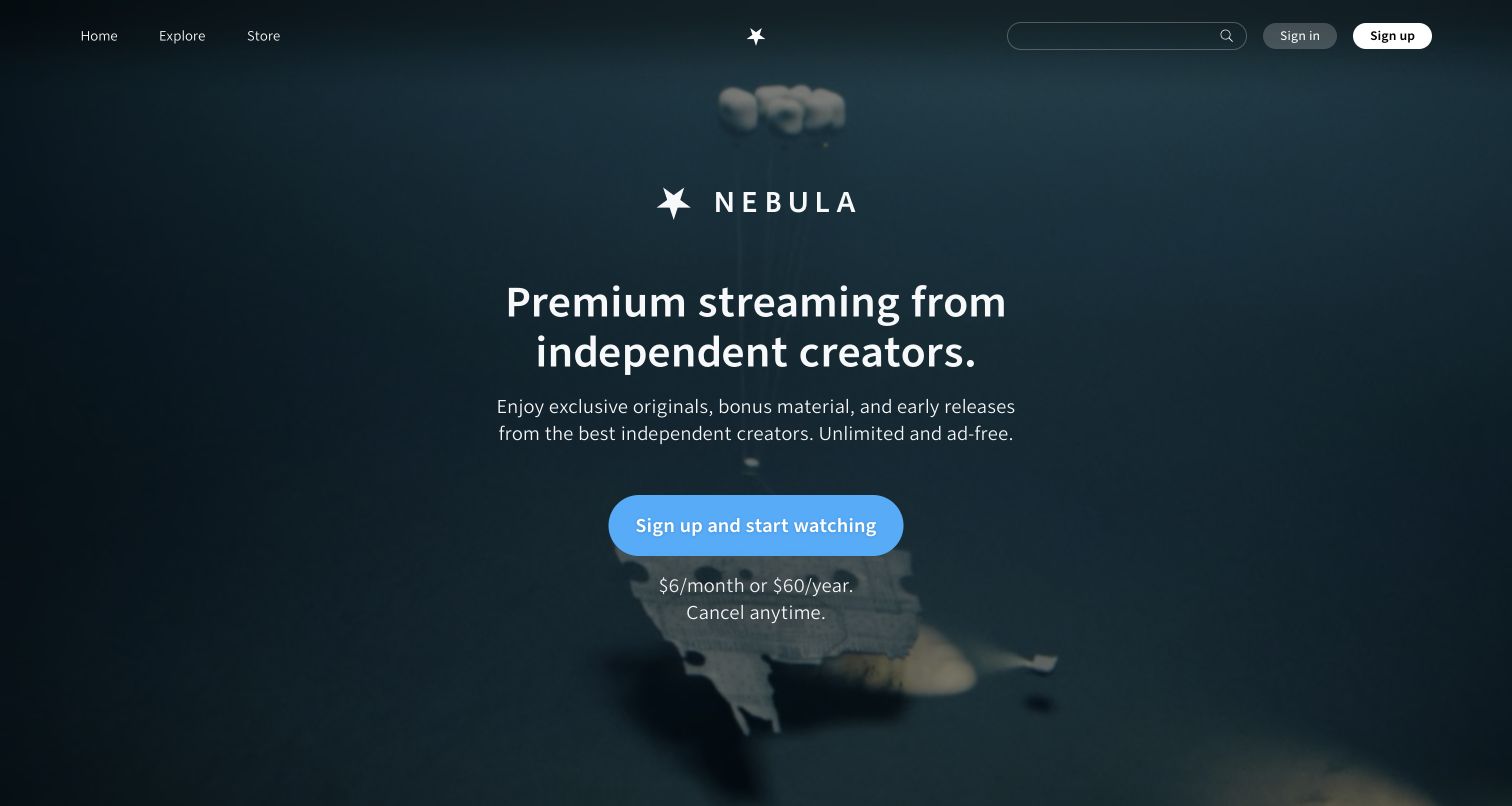
Nebula centers its star mark and creator-focused proposition over a subdued film background. Supporting text names originals, bonus material, and early releases, while a blue signup action is followed by monthly and annual options. Search and Explore remain visible despite the acquisition emphasis. The sampled public response reported Express, which does not establish the architecture of video delivery, subscriptions, creator payments, or authenticated viewing.
What you can learn
For a comparable service, keep public catalog routes useful before registration and distinguish them from private playback. Model creators, programs, and releases with stable identities so marketing can promote an item without changing its destination. Test a direct catalog link and an unavailable preview, and keep subscription conditions synchronized with the offer displayed. A dramatic background should support readable context rather than act as the only evidence of what the service contains.
Pros
Search and Explore provide alternatives to immediate registration.
Subscription options appear close to the primary action.
Cons & considerations
The dark background offers little specific catalog detail in the opening.
Visitors unfamiliar with the creators need concrete names and examples beyond the broad proposition.
Platform source: Dated public page and linked-resource audit. x-powered-by response header identifies Express. The sampled public page response reported Express. Server-reported software is not a verified runtime inventory and does not identify private services, CMS, language, version, or configuration. Platform evidence is separate from the direct website screenshot and is not a complete current infrastructure audit.
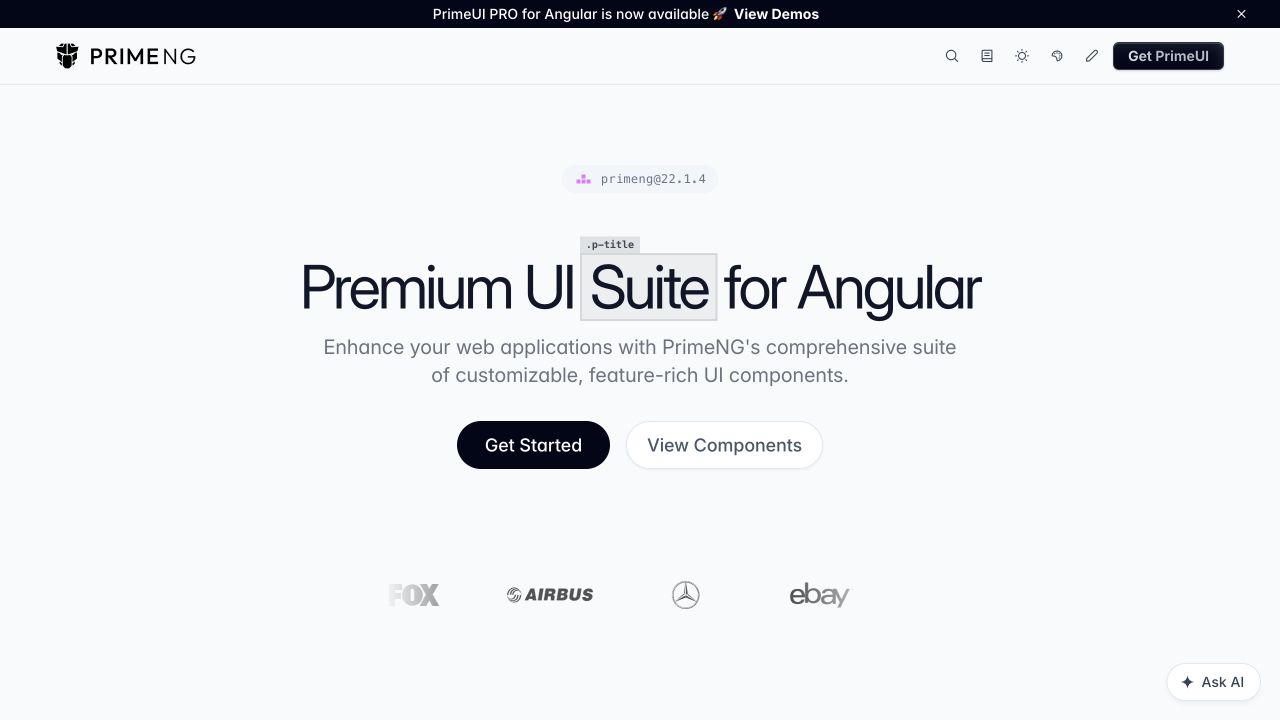
PrimeNG places a component-suite introduction on a light canvas, with a small version indicator and separate Get Started and View Components actions. A compact utility header and announcement strip surround the main message. The structure recognizes that installation and component exploration are different tasks. The sampled public response reported Express; its visible customer marks do not establish that those companies' websites use Express, Angular, or the same component implementation.
What you can learn
For a documentation application of your own, preserve version context in routes and keep installation guidance distinct from commercial announcements. Test deep links to individual components and maintain meaningful redirects when documentation moves. Give examples readable descriptions and explicit states rather than relying on a polished illustration. Verify search results and missing-page responses against the selected version so a newcomer is not silently sent to incompatible guidance.
Pros
Setup and component browsing are presented as distinct starting points.
A visible version cue gives technical readers useful release context.
Cons & considerations
The initial view demonstrates little actual component behavior.
Several product announcements can blur the boundary between core documentation and additional offerings.
Platform source: Dated public page and linked-resource audit. x-powered-by response header identifies Express. The sampled public page response reported Express. Server-reported software is not a verified runtime inventory and does not identify private services, CMS, language, version, or configuration. Platform evidence is separate from the direct website screenshot and is not a complete current infrastructure audit.
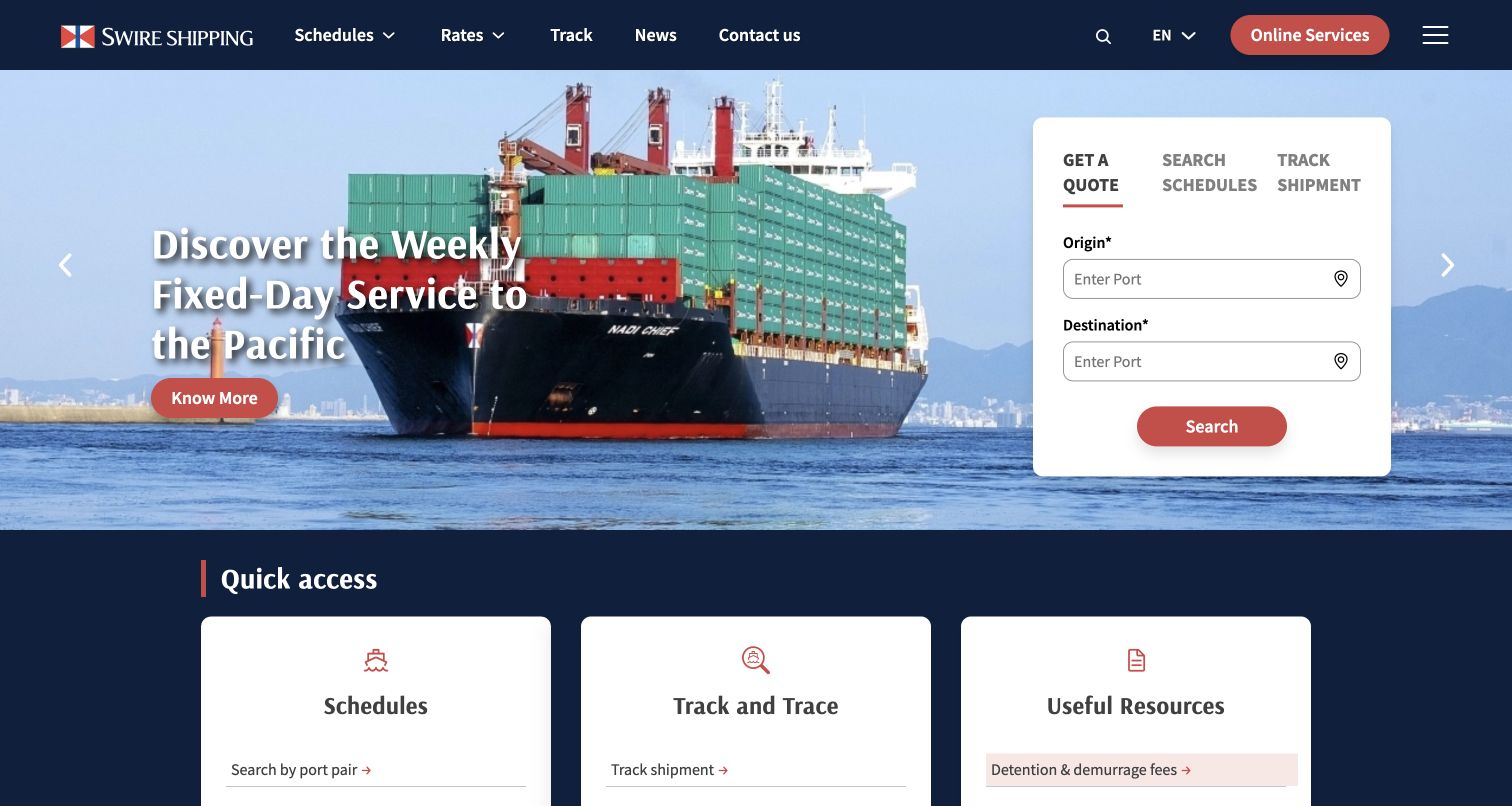
Swire Shipping places a white task card beside a weekly-service campaign. Get a Quote, Search Schedules, and Track Shipment are separate tabs, with origin and destination ports visible in the captured quote state. Quick Access below exposes schedules, tracking, and practical resources. The sampled public response reported Express, without identifying the architecture of freight rates, live tracking, customer accounts, or operational scheduling systems.
What you can learn
For an Express application serving this audience, give each task its own input contract and useful result or error state. Preserve port identity when users move between quote and schedule exploration, and keep supporting documents reachable without completing an inquiry. Test invalid or ambiguous port names, unavailable services, and direct links to reference information. Label the expected next result clearly rather than treating every operation as a generic search.
Pros
The task card separates three operational intentions from the campaign image.
Platform source: Dated public page and linked-resource audit. x-powered-by response header identifies Express. The sampled public page response reported Express. Server-reported software is not a verified runtime inventory and does not identify private services, CMS, language, version, or configuration. Platform evidence is separate from the direct website screenshot and is not a complete current infrastructure audit.
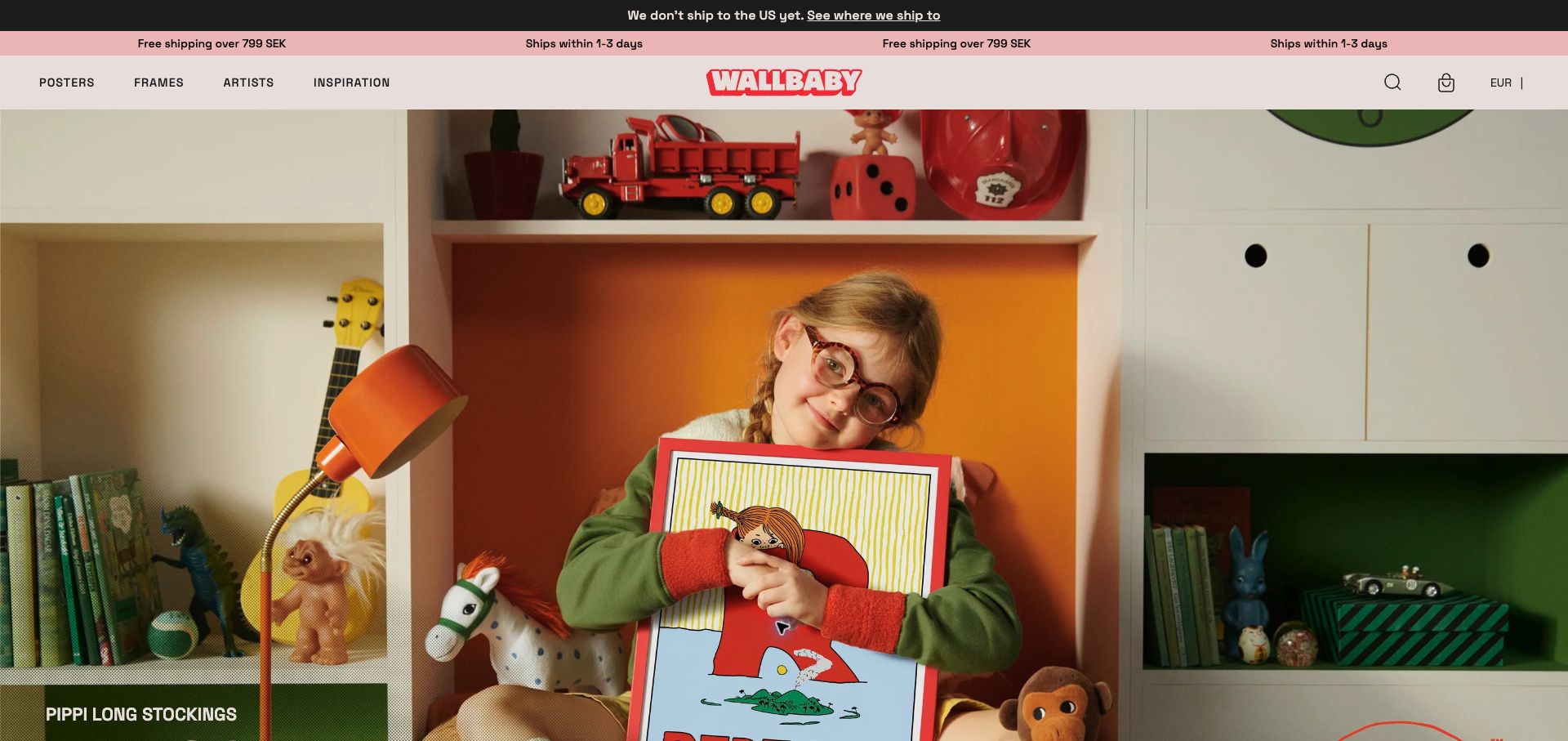
Wallbaby introduces a print through a colorful domestic scene with a child holding the artwork, providing a sense of scale and use. Posters, Frames, Artists, and Inspiration form distinct navigation routes, while shipping strips occupy the area above. The retained browser view includes translated text; it is not proof of a native language implementation. The sampled Swedish-property response reported Express, without establishing checkout, fulfillment, or account architecture.
What you can learn
For a similar storefront, make artwork, artist, size, and framing relationships explicit in stable public routes. Keep campaign copy separate from photography so translation and image replacement do not obscure essential meaning. Test a direct artist link, a missing product image, and a return from a detail page with the prior category intact. Preserve market context and explain product dimensions before the visitor reaches any transactional boundary.
Pros
The room scene gives the artwork a recognizable scale and setting.
Artist and inspiration routes support exploration beyond a product grid.
Cons & considerations
Multiple shipping strips consume space before the main visual story.
The opening delays practical size and price information needed for comparison.
Platform source: Dated public page and linked-resource audit. x-powered-by response header identifies Express. The sampled public page response reported Express. Server-reported software is not a verified runtime inventory and does not identify private services, CMS, language, version, or configuration. Platform evidence is separate from the direct website screenshot and is not a complete current infrastructure audit.
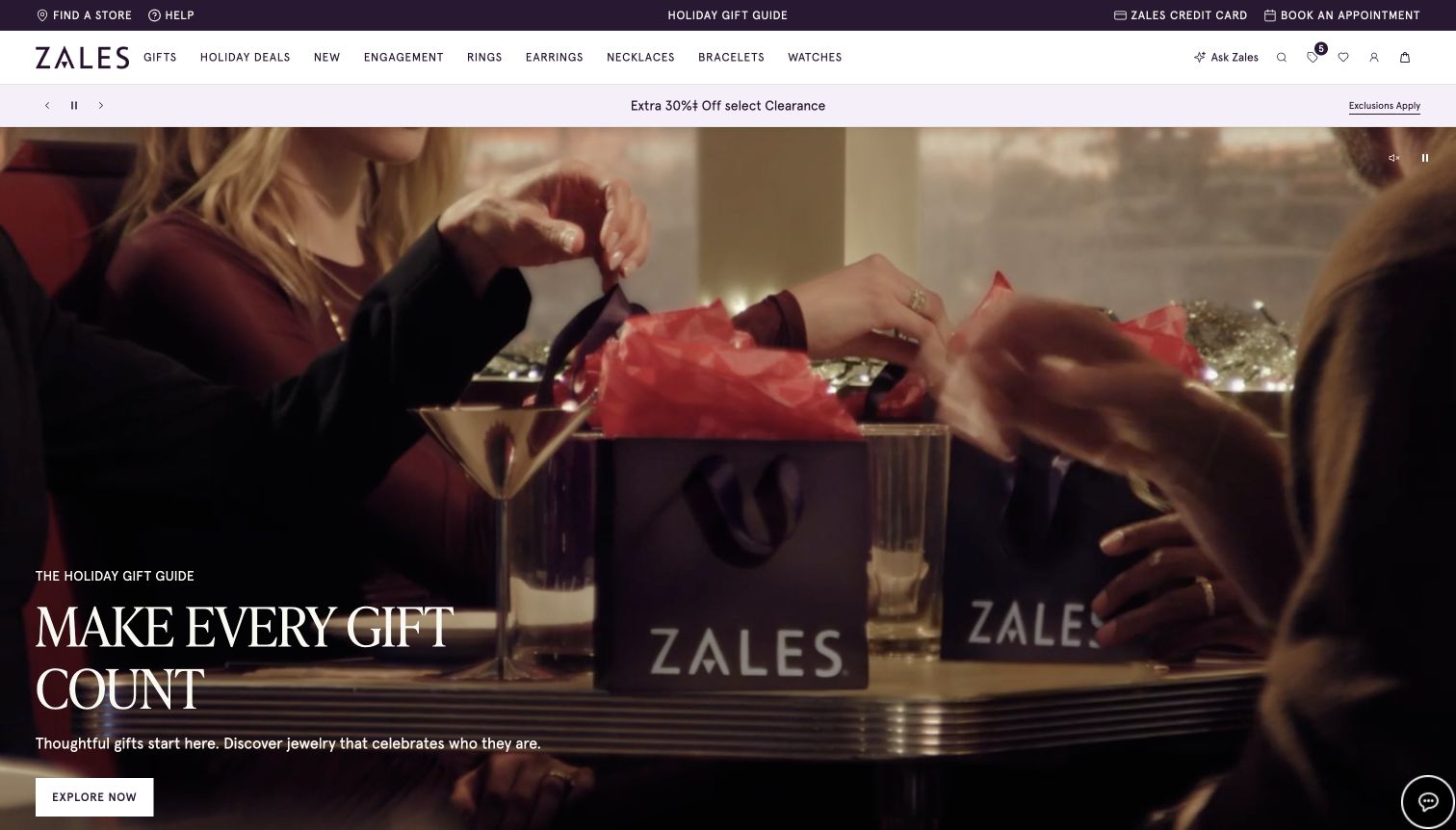
Zales uses a film of people exchanging branded gift bags to introduce its seasonal message. A dark area supports the headline and action, while engagement, rings, earrings, necklaces, bracelets, and watches remain direct category choices above. Store finding and appointments occupy another utility strip. The sampled public response reported Express; this does not identify payment, financing, store inventory, or appointment systems, and the campaign film does not demonstrate a shopping interaction.
What you can learn
For a comparable commerce application, keep gift campaigns separate from permanent categories and service routes. Verify that someone who already knows a product type can bypass the seasonal story. Test campaign expiry, older advertisement links, and a still fallback that preserves the action's readability. Maintain the relationship between category pages and product records without relying on the visual sequence to communicate what the retailer actually sells.
Pros
The dark campaign area supports readable text over the film.
Online categories and personal-assistance routes are both visible before scrolling.
Cons & considerations
The opening emphasizes bags and people more than detailed jewelry inspection.
An additional promotional strip competes with the main seasonal message.
Platform source: Dated public page and linked-resource audit. x-powered-by response header identifies Express. The sampled public page response reported Express. Server-reported software is not a verified runtime inventory and does not identify private services, CMS, language, version, or configuration. Platform evidence is separate from the direct website screenshot and is not a complete current infrastructure audit.
Kegan has 15+ years of experience working with small businesses, Fortune 500 companies, and everything in between. No development job is too big or too small: he brings the same hands-on attention to a focused improvement, a complete website, or a custom application.
For Express projects, he can help with responsive interfaces, reusable components, custom functionality, API connections, and performance-minded implementation. He works directly with clients on scope, design, implementation, testing, and handover, with an emphasis on clear communication and a system that remains practical to maintain after launch.
Show 3 other Express developersHide other Express developers
Model the visitor’s context before choosing the interface
Catalog and search applications
Define the entities and fields that make results comparable. Preserve query, location, selected category, and route identity when people open details or return to a list.
Editorial and documentation properties
Keep article, creator, project, or version identity separate from the homepage feature. Make archives and older direct links useful after campaigns or releases change.
Public entrances to operational services
Explain when a user moves from browsing to an account, booking, payment, or inquiry service. Keep task labels and relevant context consistent while verifying each system within its own scope.
From references to requirements
Prepare an Express brief with useful acceptance states
Describe route contracts in ordinary language
For each important destination, state what a visitor supplies, what the page explains, and what a successful next step means. Separate a search from a purchase and a request from a confirmed outcome.
Prototype awkward but normal content
Use long names, recurring events, unknown identifiers, unavailable images, and empty results. These cases expose gaps in the content model sooner than a short headline with perfect media.
Verify the whole public handoff
Check links, status codes, assets, retained selections, and error explanations after deployment. Do not equate the availability of a public marketing page with the health of a private transaction or customer workflow.
A useful handover demonstration
Ask the actual team to carry out its routine job: publish a realistic update, correct a mistake, preview a narrow screen, and identify who owns an integration failure. For a library or frontend framework, also ask who maintains the content source and deployment. A polished screenshot does not answer those operational questions.
Beyond the screenshot
Express website planning checklist
Identify the actual Express version and middleware from your own authorized source.
Define stable routes for content and explicit boundaries for actions.
Preserve query, location, category, or record context where relevant.
Provide useful empty, missing, and failed-request states.
Test static assets and content routes independently.
Keep public evidence separate from assumptions about private systems.
Review long content, keyboard journeys, and narrow-screen layouts.
Verify the exact deployed output and representative visitor paths.
Test with real content, a keyboard, a small screen, slow or failed requests, and the people who will maintain the system. These are planning checks, not an accessibility, security, performance, or search-ranking certification.
Sources & editorial method
How this Express collection was reviewed
Twenty distinct public properties were selected from stable capture records and dated broad source audits. Screenshots retain their original URLs, dimensions, attribution, and capture dates, while each review is new collection-specific analysis. Express associations are based on recorded x-powered-by response headers from the exact page or linked same-origin resources. Asset-only associations remain qualified and do not establish a complete application architecture, framework version, CMS, database, private workflow, or performance result. No real forms or transactions were submitted.
Every image is an unmodified capture from the actual website, with its source and capture date. Some captures are reused from our shared catalog; their dates remain the original capture dates. None comes from a vendor gallery or a generated reconstruction. Moving imagery and live content can change.
Technology attribution uses public page assets or metadata, official platform documentation, or a cited first-party project case study. Documentary and framework-relationship evidence is identified where used; it is not a complete current backend inventory. A CMS image CDN alone does not establish a full CMS deployment. A library’s presence does not prove which individual controls use it, and a platform label does not establish AI authorship.
The composition notes, lessons, pros and tradeoffs are original editorial observations. We have not measured conversion, traffic, security, performance or accessibility conformance. Website owners retain their brands and imagery; these examples are not our client portfolio. Written, Edited and Curated are independent records, not dates advanced by a build. See our editorial standards or suggest a correction.
Questions worth asking
Express website development FAQs
Are all these complete applications built with Express?
That conclusion is not supported. The collection records exact public-response associations. Some signals occur only on linked assets, and even a page header does not reveal the full system.
Does an Express header prove the current runtime?
A response header is self-reported evidence. It is useful to record with its URL and observation date, but it is not an independent configuration audit or a guarantee about future responses.
Can the design reviews prove how search or checkout works?
No. They examine visible structure and identify planning questions. Private behavior, inventory, payment, and authenticated systems require separate authorized evidence and testing.
Why keep old screenshot dates?
A genuine capture is a dated visual record. Reusing it for a new editorial angle does not make it a new capture; its date remains separate from the technology observation and review dates.