Best Fivetran Websites of 2026 (20 Real-World Examples)
Twenty inspected public pages from organizations with documented Fivetran data movement, with analytical workflows kept separate from public-page runtime claims.
A better data pipeline should make information more dependable, not merely move it faster. Begin with ownership, meaning and the decisions the destination needs to support.
Fivetran appears in very different organizational data programs: LVMH’s maison reporting, HubSpot’s workforce planning, Inova’s modernization and PostNL’s replication workflows. Those associations do not establish the technology behind each public homepage. The design reviews below consider the visible page, while the evidence notes identify the actual business-data context described by the primary case.
For a website or application project, the central question is often what happens after information leaves the operational system. A connector can provide a consistent route into a warehouse or lake, but a dashboard still needs agreed definitions, appropriate access and a known refresh time. Clean visual presentation can otherwise make unreliable numbers look more authoritative than they deserve.
Before the examples
What makes good Fivetran website development in 2026?
Keep the source of truth explicit
Document which system owns a customer, order, invoice or support record. A replicated table is not automatically the authority for changing that record. Make the direction of movement and the allowed use clear. If an analytical result later returns to an operational tool, specify a separate approved path rather than quietly creating a feedback loop.
Understand the shared responsibility model
Fivetran’s core documentation distinguishes maintaining data extraction and loading from the customer’s responsibility for business-specific transformation and modeling. Plan the people and tests needed after data arrives. A connector can reduce integration maintenance without deciding how your organization defines revenue, an active customer or a successful inquiry.
Tell report readers when information was last updated and what a missing value means. Define a response when a source changes, credentials expire or a sync needs attention. A connector’s successful status is not the same as a reconciled business report. Include source-to-destination checks that reflect the decisions people actually make.
The collection · 20 examples
20 Fivetran website examples worth studying
The first five are recognizable organizations with direct Fivetran customer cases. Each of the 20 examples has an independently inspected public design and a separately scoped data-workflow association; neither is treated as a complete current stack audit.
We start with five recognizable brands or organizations: LVMH, Canva, HubSpot, Dropbox.Tech, Okta. Each attribution applies to the named website property, not every product or website belonging to its organization. This is a curated reading sequence, not a measured ranking.
LVMH’s opening feature fills the page with a grid of named people from its houses. Portrait cards, varied uniforms and a small centered announcement turn an abstract group identity into a collection of individual practices. The compact header keeps investor and press utilities available without competing with the mosaic. Fivetran’s case describes data integration across maisons into BigQuery for business insight and customer visibility. It does not establish the content platform behind this public feature or imply one shared frontend across all LVMH brands.
What you can learn
Use the structure of a collection to explain an organization’s breadth without reducing every member to a logo. In a data project, preserve equivalent distinctions: brand ownership, shared definitions and permissions need to remain explicit even when information reaches a common destination. Centralized data does not require identical public identities.
Pros
Named portrait cards communicate the human breadth of the group more effectively than an abstract organization chart.
The contained announcement gives the large image mosaic one identifiable editorial purpose.
Cons & considerations
Small names and house labels require close attention within the visually rich grid.
The opening campaign provides limited immediate explanation of the group’s overall business structure.
Visible tech stack
Earlier / documented evidence
Fivetran
Platform source: Official technology-specific customer or workload source. Fivetran describes data integration across LVMH maisons into BigQuery for business insight and customer visibility. This evidence establishes only the stated product, workload, organization or historical association. It does not prove that the pictured public page uses the technology, reveal its CMS/frontend, establish a complete current architecture or independently verify vendor-reported outcomes. Platform evidence is separate from the direct website screenshot and is not a complete current infrastructure audit.
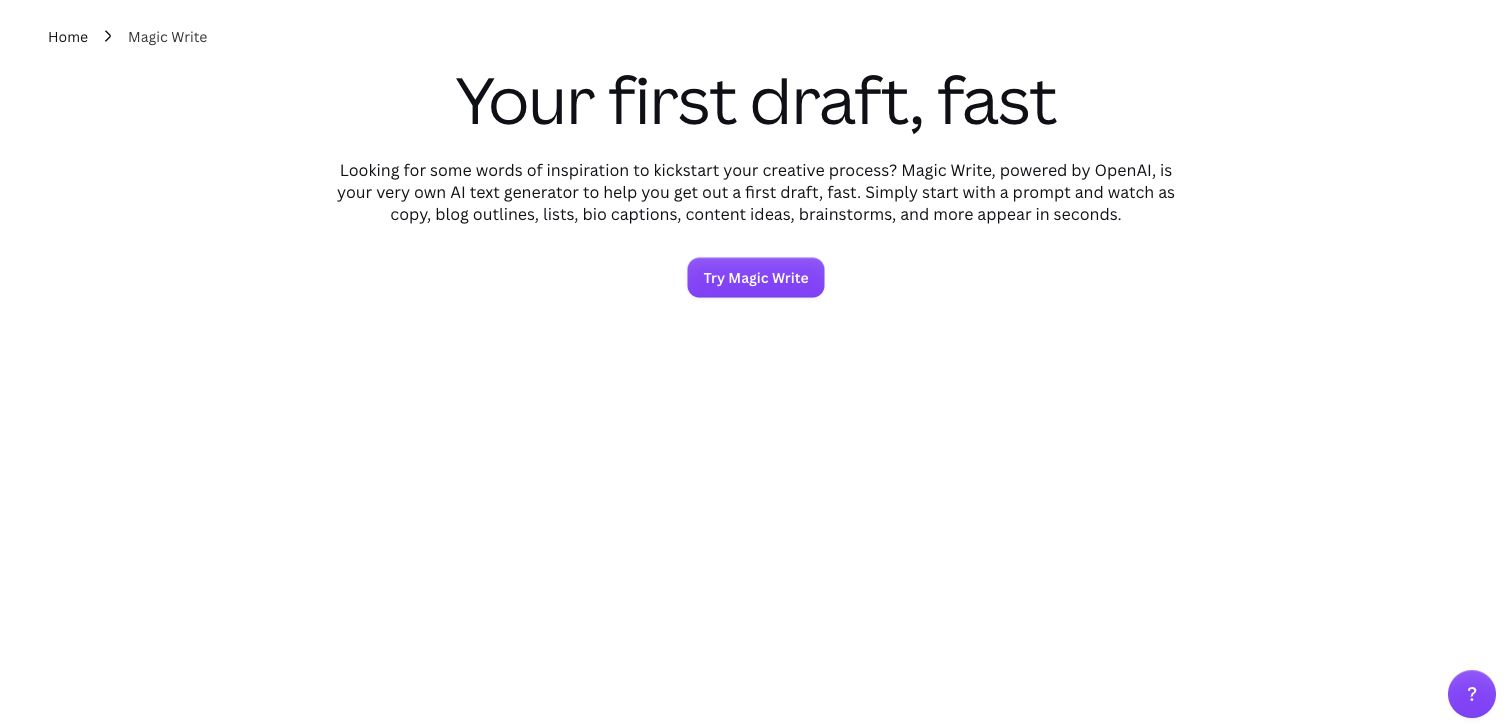
Canva’s Magic Write page uses a large centered heading, a short explanation and one violet action. A simple breadcrumb supplies context while substantial white space keeps the feature’s purpose unmistakable. The captured section prioritizes an introduction over a complex editor preview. Fivetran documents Canva centralizing business-platform information into Snowflake and activating customer data. That is an internal data and personalization association; it does not establish Magic Write’s model-serving infrastructure, the public landing page’s runtime or the implementation of every Canva feature.
What you can learn
A feature page can be intentionally narrower than its parent platform. Make the intended outcome and next step understandable before listing integrations. In the supporting data layer, separate product-use events from generated content and avoid collecting unnecessary prompt text just because a connector makes transmission convenient.
Pros
A single clear action and short explanation make the individual capability easy to identify.
The breadcrumb provides useful parent-platform context without requiring a large navigation structure in the content area.
Cons & considerations
The sparse section offers little immediate evidence of output quality or editing control.
Readers need further information to understand usage limits and how generated text should be reviewed.
Platform source: Official technology-specific customer or workload source. Fivetran describes Canva centralizing business-platform information into Snowflake and activating customer data. This is not evidence about Magic Write model serving. This evidence establishes only the stated product, workload, organization or historical association. It does not prove that the pictured public page uses the technology, reveal its CMS/frontend, establish a complete current architecture or independently verify vendor-reported outcomes. Platform evidence is separate from the direct website screenshot and is not a complete current infrastructure audit.
HubSpot’s homepage centers a readable serif proposition above a concise explanation and two orange-accented actions. Small audience photographs begin below, adding human context without interrupting the main reading path. Two header levels separate account and support utilities from product discovery. Fivetran’s case specifically concerns HubSpot’s internal HR, workforce-planning and finance information flowing into Snowflake. It is not evidence that HubSpot’s customer CRM product or the pictured marketing homepage uses Fivetran as its transactional backend.
What you can learn
Explain a suite through the relationship among customer-facing jobs, then offer a clear next step. Keep internal analytics separate from the product’s system of record. A tool that moves hiring and planning data can be valuable without being the platform that serves a customer’s CRM records or renders a landing page.
Pros
The centered proposition and paired actions create a calm introduction to a broad product portfolio.
Human photographs add warmth while remaining subordinate to the main explanation.
Cons & considerations
A large umbrella promise requires further product detail before a buyer can compare specific capabilities.
Several utility links and product menus create more header complexity than the simple central composition suggests.
Platform source: Official technology-specific customer or workload source. Fivetran’s HubSpot case specifically concerns internal HR, workforce-planning and financial data flowing into Snowflake, not the customer CRM transaction runtime. This evidence establishes only the stated product, workload, organization or historical association. It does not prove that the pictured public page uses the technology, reveal its CMS/frontend, establish a complete current architecture or independently verify vendor-reported outcomes. Platform evidence is separate from the direct website screenshot and is not a complete current infrastructure audit.
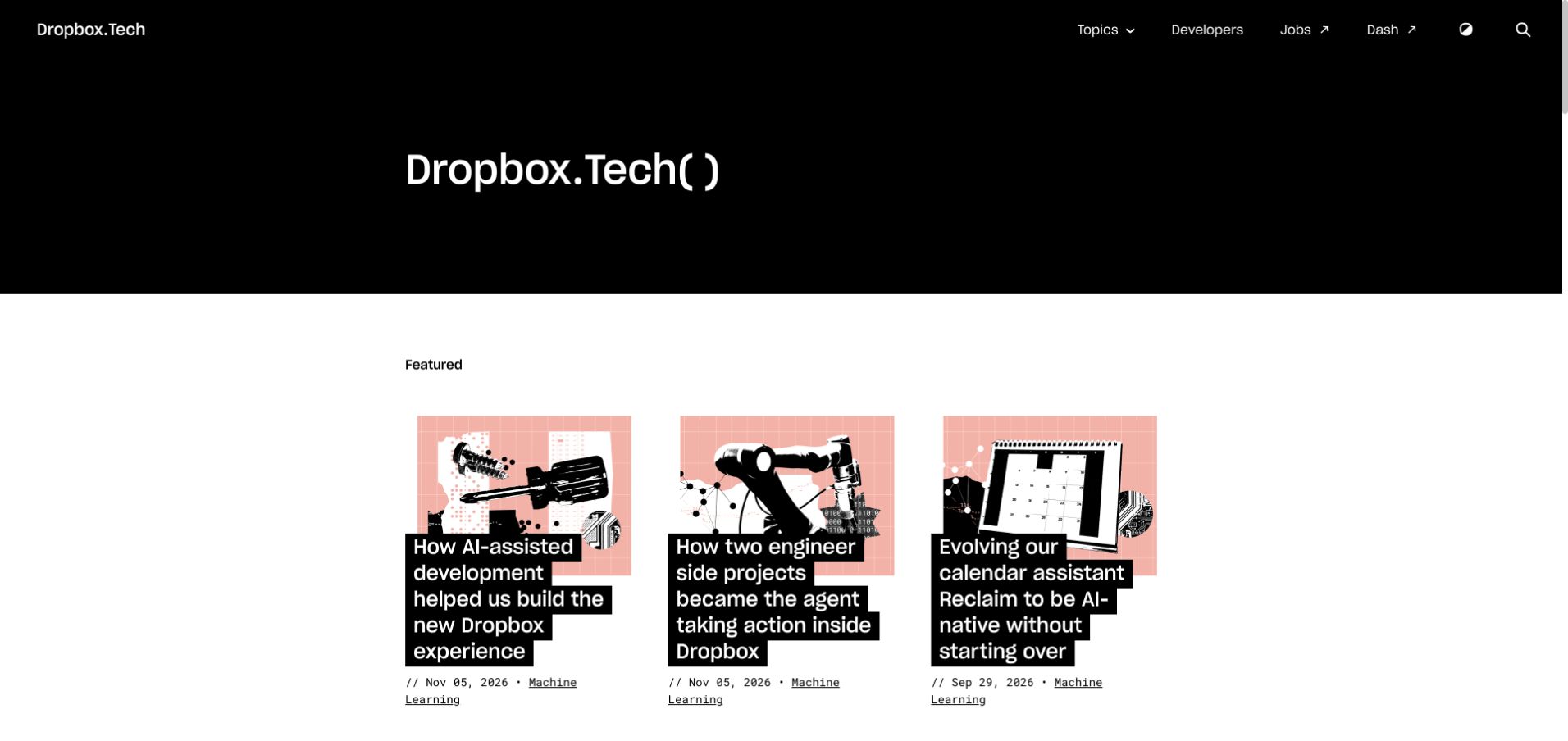
Dropbox.Tech opens with a large black masthead followed by three illustrated feature cards. Short category labels and publication dates provide context for each article without adding a long introduction. The restrained navigation keeps topics, developers and jobs distinct from the editorial grid. Fivetran’s Dropbox case concerns customer-experience, marketing and other business-data ingestion workflows. It does not identify the technology of the engineering publication, the core file-storage service or every analytical destination used by the organization.
What you can learn
A technical publication should make the content and its context easy to evaluate. Dates, categories and concrete titles matter more than a generic innovation statement. When documenting infrastructure, name the actual team and workload: customer-support analytics and the storage system discussed by engineers are not interchangeable implementations.
Pros
The small featured selection makes editorial priority clear instead of presenting an undifferentiated article archive.
Dates and category labels help readers assess relevance before opening a technical story.
Cons & considerations
The large masthead consumes substantial space before the first article summaries appear.
Small overlaid titles can be difficult to scan against detailed illustrations.
Platform source: Official technology-specific customer or workload source. Fivetran describes Dropbox customer-experience, marketing and other business-data ingestion workflows, not the Dropbox core file-storage system or its engineering publication. This evidence establishes only the stated product, workload, organization or historical association. It does not prove that the pictured public page uses the technology, reveal its CMS/frontend, establish a complete current architecture or independently verify vendor-reported outcomes. Platform evidence is separate from the direct website screenshot and is not a complete current infrastructure audit.
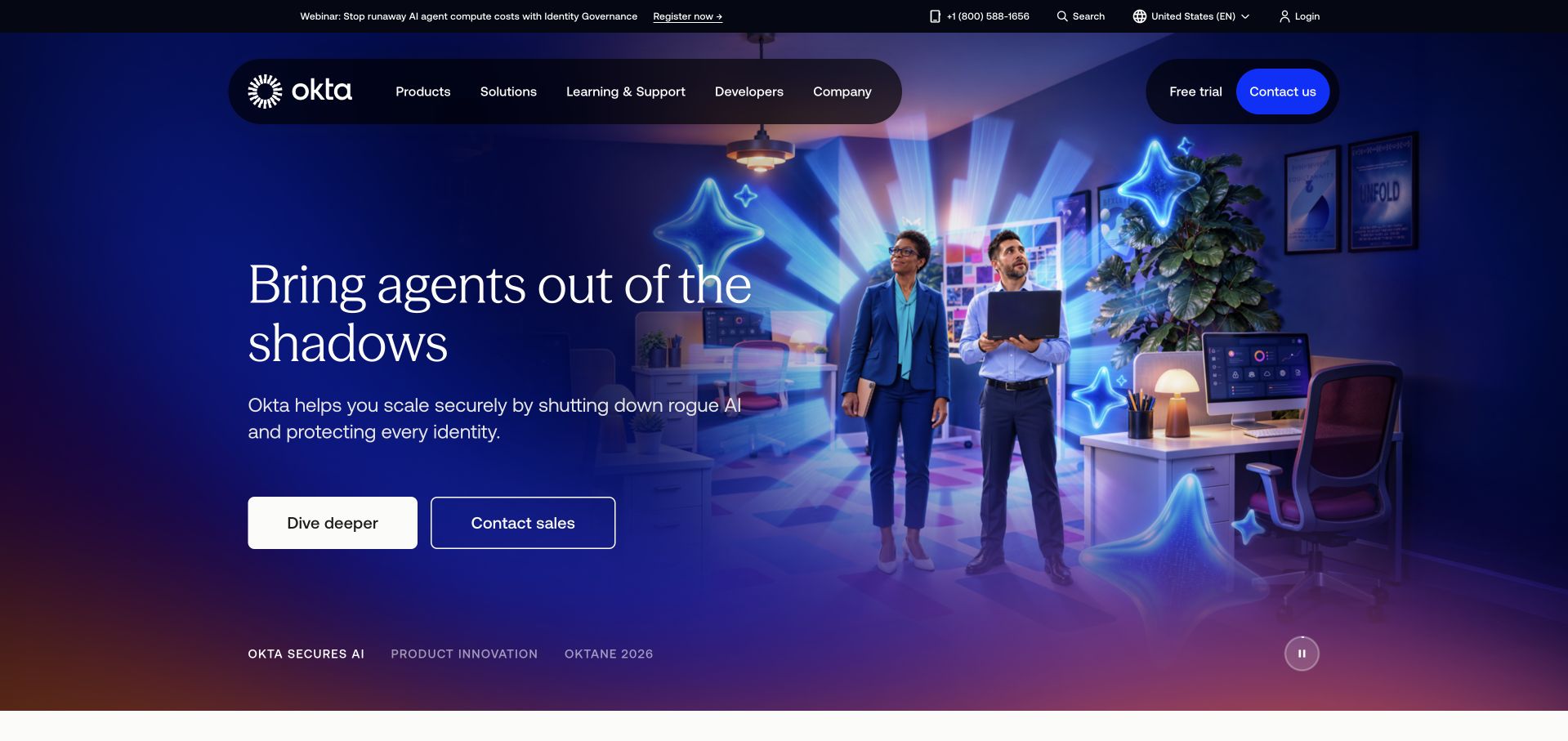
Okta combines a luminous blue-and-violet scene with a large serif headline about bringing agents into view. A compact white explanation and two clear actions connect the visual metaphor to identity security. The capsule navigation keeps product and developer routes available above the illustration. Fivetran’s case concerns internal financial planning, business metrics and governed data ingestion at Okta. It does not establish that Fivetran powers authentication transactions, the public homepage or the agent-security features advertised in the captured campaign.
What you can learn
A strong metaphor can introduce a technical problem, but the next layer must define the actual protected identities and permitted actions. For internal analytics, apply equally clear boundaries to financial, workforce and customer data. An organization’s use of a data connector is not evidence about the implementation of its security product.
Pros
The illustration gives an otherwise invisible identity-security problem a memorable visual form.
Developer and product navigation remain available without cluttering the central campaign.
Cons & considerations
The metaphor requires further explanation before a newcomer can understand specific security controls.
Small supporting text must compete with a large and brightly illuminated visual scene.
Platform source: Official technology-specific customer or workload source. Fivetran identifies Okta internal financial planning, business metrics and governed data ingestion, not authentication transaction processing. This evidence establishes only the stated product, workload, organization or historical association. It does not prove that the pictured public page uses the technology, reveal its CMS/frontend, establish a complete current architecture or independently verify vendor-reported outcomes. Platform evidence is separate from the direct website screenshot and is not a complete current infrastructure audit.
Shutterstock places a broad search bar directly beneath a concise introduction, with a dark background and a distinctive blue image treatment. Media-type navigation and trending searches provide additional ways into the catalog. A separate section begins introducing editing capabilities below. Fivetran’s case describes managed data ingestion into an S3-based open data environment, with analytical tools including Snowflake. It does not identify the public search engine’s runtime, establish the origin of individual images or imply that every AI editing workflow uses the same infrastructure.
What you can learn
Protect the primary discovery task while adding related creation tools. Keep search, licensing and editing decisions understandable as different stages. In the data architecture, distinguish analytical copies and business reporting from the live catalog and customer delivery systems; a shared brand does not make them one workload.
Pros
The large search control keeps the core marketplace task immediately available.
Media categories and example searches help visitors enter a very broad collection without a long tutorial.
Cons & considerations
Several product categories and newer AI services create a dense header for first-time visitors.
The opening mixes discovery and creation promises that need clearer licensing and usage explanations further on.
Visible tech stack
Earlier / documented evidence
Fivetran
Platform source: Official technology-specific customer or workload source. Fivetran describes managed ingestion into Shutterstock’s S3-based open data environment, with analytical tools including Snowflake. This evidence establishes only the stated product, workload, organization or historical association. It does not prove that the pictured public page uses the technology, reveal its CMS/frontend, establish a complete current architecture or independently verify vendor-reported outcomes. Platform evidence is separate from the direct website screenshot and is not a complete current infrastructure audit.
Zendesk places a large close-up portrait beside a short automation claim on a warm dark hero. A lime trial action and a separate demo route sit within a restrained white navigation frame. The captured campaign emphasizes the person receiving or delivering service more than a dashboard. Fivetran’s case identifies Zendesk’s internal ingestion into Snowflake, including billing, sales and go-to-market analytics. It does not establish how the Zendesk customer-service product executes automation or prove the promotional percentage shown in this public design.
What you can learn
Connect an automation story to the people and decisions it affects. Explain which interactions are suitable for automation, what escalation looks like and how outcomes are reviewed. A business analytics foundation may support product decisions, but it is not itself proof that an advertised automated service achieves the stated result.
Pros
The portrait gives the automation message a human context instead of relying entirely on interface diagrams.
Trial and demo routes accommodate different levels of buyer readiness within one clear header.
Cons & considerations
A large performance claim needs supporting methodology that is not visible in the opening composition.
The strong promotional focus delays practical information about configuration, limitations and handoff to people.
Platform source: Official technology-specific customer or workload source. Fivetran describes Zendesk business-data ingestion into Snowflake and transformation with dbt, including billing, sales and go-to-market analytics. This evidence establishes only the stated product, workload, organization or historical association. It does not prove that the pictured public page uses the technology, reveal its CMS/frontend, establish a complete current architecture or independently verify vendor-reported outcomes. Platform evidence is separate from the direct website screenshot and is not a complete current infrastructure audit.
Inova pairs a large institutional recognition statement with a photograph of a patient and clinician. Four dark-blue task cards directly below lead toward finding care, appointments, locations and the patient portal. The white-and-blue header keeps urgent and account utilities separate from the principal navigation. Fivetran’s case describes an organizational data-modernization program using sources such as Epic Clarity and destinations including Databricks. It does not establish this public homepage’s backend or independently validate the clinical recognition displayed in the hero.
What you can learn
Place practical patient tasks near any institutional message, and keep clinical claims tied to their actual source. In data planning, distinguish public content, patient access and internal analytics. Replicating a clinical source for governed analysis does not justify exposing patient information through a public page or broad employee reporting access.
Pros
Large task cards make common care-navigation needs visible immediately below the institutional feature.
The patient-and-clinician photograph provides context without making the page resemble a clinical record system.
Cons & considerations
The recognition-led hero may be less useful than direct care guidance to a visitor with an urgent question.
Multiple account, payment and employment utilities add complexity to the header.
Platform source: Official technology-specific customer or workload source. Fivetran describes Inova organizational data modernization using sources such as Epic Clarity and destinations including Databricks, not the public homepage backend. This evidence establishes only the stated product, workload, organization or historical association. It does not prove that the pictured public page uses the technology, reveal its CMS/frontend, establish a complete current architecture or independently verify vendor-reported outcomes. Platform evidence is separate from the direct website screenshot and is not a complete current infrastructure audit.
First Hawaiian Bank uses a family photograph and a short welcoming message above a floating panel of common product choices. A restrained red utility strip and warm yellow accents connect the brand to familiar banking tasks without a dense rate table in the opening. Fivetran’s case describes customer, financial and operational information integrated into Snowflake for analytics. It does not identify the core banking system, the public website’s renderer or the security and processing arrangements behind an individual account transaction.
What you can learn
A friendly opening should lead quickly to clearly labeled financial products and service routes. Keep promotional content separate from authenticated banking, and define analytics access by business purpose. Combining information for reporting is not the same as consolidating operational authority to change balances, approve applications or manage customer accounts.
Pros
The floating product panel gives the lifestyle campaign a practical next step.
Familiar banking categories reduce the amount of introductory explanation needed for a returning customer.
Cons & considerations
The broad welcoming message provides little immediate detail about account eligibility, pricing or conditions.
Small utility and language controls can be easy to overlook above the large photograph.
Platform source: Official technology-specific customer or workload source. Fivetran describes First Hawaiian Bank customer, financial and operational data integration into Snowflake for analytics, not core banking transactions. This evidence establishes only the stated product, workload, organization or historical association. It does not prove that the pictured public page uses the technology, reveal its CMS/frontend, establish a complete current architecture or independently verify vendor-reported outcomes. Platform evidence is separate from the direct website screenshot and is not a complete current infrastructure audit.
Tinuiti uses a deep violet background, a short bold statement and a distinctive collage beside one contact action. A row of client logos follows the opening, while the white header organizes services, technology and work. The visual treatment is energetic without turning the page into a portfolio grid immediately. Fivetran’s case describes marketing-data ingestion into an S3-based lake and a transition away from earlier warehouse constraints. It does not establish the agency homepage’s runtime or prove that every client uses the same data architecture.
What you can learn
Give an agency a recognizable visual voice while keeping the business offer and next step readable. For client-data platforms, preserve separate permissions, definitions and retention rules for each engagement. A common ingestion service should not become an excuse to blend unrelated client records or assume identical reporting requirements.
Pros
The short headline and single contact action preserve a clear hierarchy within an expressive visual identity.
Client logos add useful context without overwhelming the main introduction.
Cons & considerations
The stylized collage can distract from the smaller explanation of what the agency actually delivers.
Broad growth language needs specific service and case-study detail before a buyer can evaluate fit.
Platform source: Official technology-specific customer or workload source. Fivetran describes Tinuiti marketing-data ingestion into an S3-based lake, with a transition away from the earlier warehouse constraints described in the case. This evidence establishes only the stated product, workload, organization or historical association. It does not prove that the pictured public page uses the technology, reveal its CMS/frontend, establish a complete current architecture or independently verify vendor-reported outcomes. Platform evidence is separate from the direct website screenshot and is not a complete current infrastructure audit.
Dance fills its opening with a rider in a city setting, a large white statement and a violet starting action. The short explanation identifies an e-bike and moped subscription, while the compact navigation exposes service and vehicle choices. The composition emphasizes using the service rather than technical specifications. Fivetran’s case describes operational and acquisition data moving into Redshift for analytics. It does not establish the public page’s frontend, the bike telemetry system or the customer-facing booking and subscription runtime.
What you can learn
Show the experience customers are buying, then explain the recurring obligations and included services. A subscription brief should distinguish browsing, eligibility, signup and ongoing servicing. Analytical data movement can help evaluate those journeys, but it should not be confused with the operational system that schedules repairs or maintains an active subscription.
Pros
The riding photograph gives a service subscription a concrete everyday context.
A small navigation set makes the main product and service distinctions easy to understand.
Cons & considerations
Text over moving or detailed photography needs careful contrast and responsive cropping.
The emotional opening leaves pricing, geographic coverage and service conditions for later exploration.
Platform source: Official technology-specific customer or workload source. Fivetran identifies Dance operational and acquisition data integration into Redshift for analytics. This evidence establishes only the stated product, workload, organization or historical association. It does not prove that the pictured public page uses the technology, reveal its CMS/frontend, establish a complete current architecture or independently verify vendor-reported outcomes. Platform evidence is separate from the direct website screenshot and is not a complete current infrastructure audit.
Swapfiets’ UK site combines a large lifestyle video, a concise worry-free biking statement and one mint-colored action. The white header keeps bikes, stores and service information easy to identify. Small review and certification references sit near the lower edge rather than replacing the core explanation. Fivetran’s case documents data integration into Redshift for subscriber and operational insight. It does not establish the public UK website’s implementation or independently validate review scores, sustainability claims or the performance of an individual subscription.
What you can learn
Explain what the subscription removes from the customer’s workload, then make the practical boundaries easy to find. Geographic availability, maintenance and replacement conditions belong in the decision path. Keep analytical views of subscriber behavior separate from the operational record that determines billing and service eligibility.
Pros
The short promise and single action give a broad lifestyle scene a clear purpose.
The compact navigation exposes service, local stores and bikes without requiring a large introductory menu.
Cons & considerations
Video imagery can communicate mood more readily than specific product or service differences.
Small peripheral ratings and certification marks need supporting context that the opening view does not provide.
Platform source: Official technology-specific customer or workload source. Fivetran describes Swapfiets subscriber and operational information integrated into Redshift, not the public UK website runtime. This evidence establishes only the stated product, workload, organization or historical association. It does not prove that the pictured public page uses the technology, reveal its CMS/frontend, establish a complete current architecture or independently verify vendor-reported outcomes. Platform evidence is separate from the direct website screenshot and is not a complete current infrastructure audit.
YipitData places a bold white-and-orange statement over a dark teal field of small data-like points. A short supporting paragraph and one orange demo action keep the reading path compact. Audience navigation distinguishes corporations and investor groups before visitors encounter a detailed product catalog. Fivetran’s case describes SaaS business-data ingestion into Databricks and a move away from many Redshift clusters. It does not establish the public site’s runtime or imply that Fivetran itself produces every alternative-data insight sold by YipitData.
What you can learn
Use audience distinctions to organize a complex information product without promising identical answers to every customer. In the architecture, distinguish licensed source data, internal operating data and customer-facing analytical outputs. A connector that moves business records is not evidence about the provenance or methodology of a separate research product.
Pros
The limited color palette makes the headline and demo action easy to locate.
Audience-oriented navigation provides meaningful entry points before presenting detailed products.
Cons & considerations
The abstract background conveys data volume but reveals little about the product’s actual analytical workflow.
A broad speed-oriented promise needs examples and methodology before buyers can evaluate information quality.
Platform source: Official technology-specific customer or workload source. Fivetran describes SaaS business-data ingestion into Databricks at YipitData, following a move away from many Redshift clusters. This evidence establishes only the stated product, workload, organization or historical association. It does not prove that the pictured public page uses the technology, reveal its CMS/frontend, establish a complete current architecture or independently verify vendor-reported outcomes. Platform evidence is separate from the direct website screenshot and is not a complete current infrastructure audit.
Red Ventures uses a large monochrome moving image behind a centered white statement. A thin red underline supplies the main brand accent, while a minimal header separates company information, portfolio, careers and contact. The next section begins below rather than competing with the opening. Fivetran’s case documents marketing-data ingestion, Databricks processing and dbt transformations in designated client environments. It does not establish the corporate homepage’s technology or show that every company in the portfolio shares that data stack.
What you can learn
A portfolio organization can keep its introduction simple if the paths into individual businesses remain clear. Apply the same discipline to shared analytics: separate client environments, access and definitions before standardizing tools. Central operational efficiency should not erase the commercial and privacy boundaries among the businesses being supported.
Pros
The short statement and restrained header create a strong corporate identity without a dense organizational explanation.
The subtle red accent gives the monochrome scene a recognizable brand cue.
Cons & considerations
The broad business-growth statement provides little immediate detail about specific capabilities or portfolio companies.
A large moving background delays practical information for task-focused visitors.
Platform source: Official technology-specific customer or workload source. Fivetran describes Red Ventures marketing-data ingestion with Databricks and dbt in designated client environments, not every portfolio company’s stack. This evidence establishes only the stated product, workload, organization or historical association. It does not prove that the pictured public page uses the technology, reveal its CMS/frontend, establish a complete current architecture or independently verify vendor-reported outcomes. Platform evidence is separate from the direct website screenshot and is not a complete current infrastructure audit.
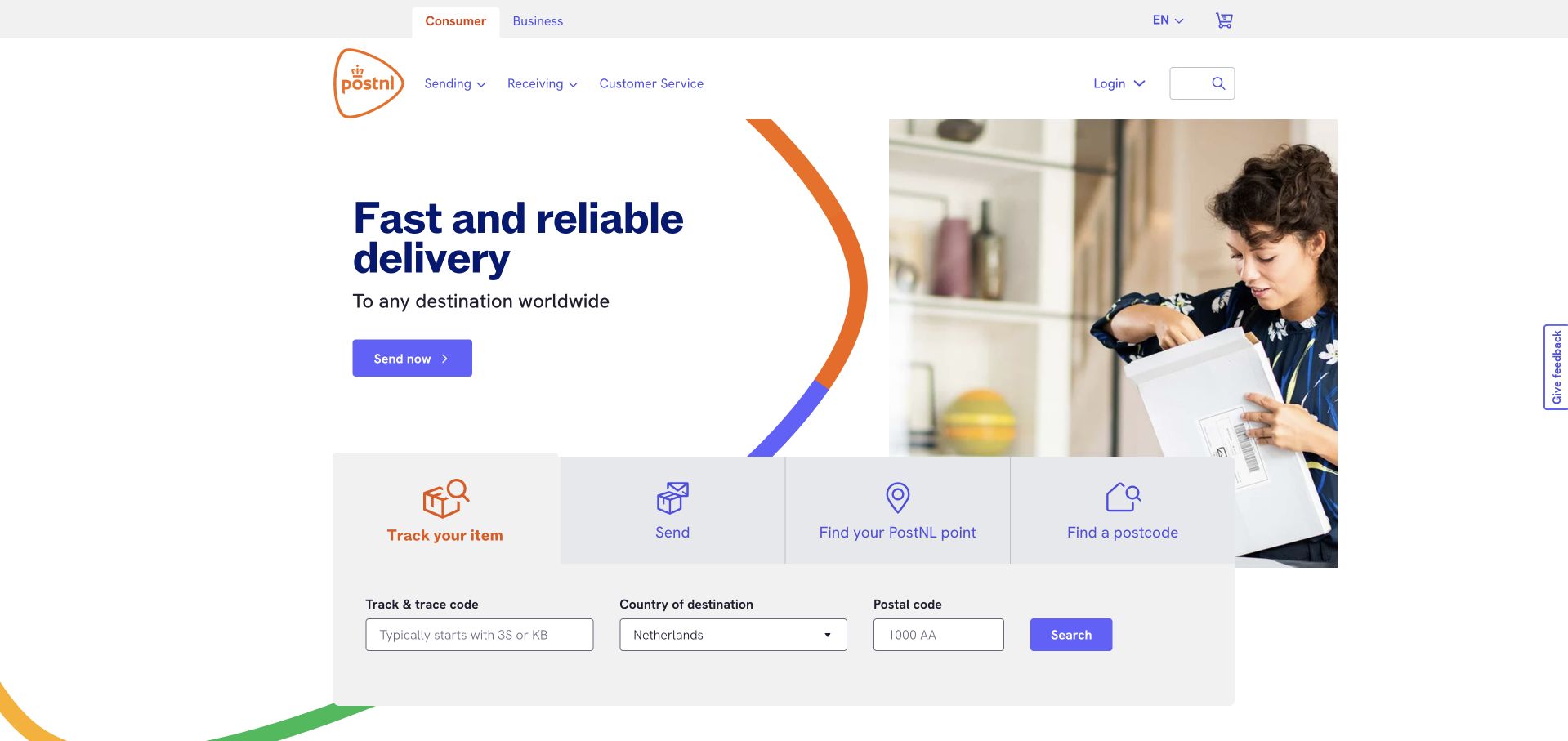
PostNL pairs a concise delivery message and a household photograph with a large task panel. Tabs separate tracking, sending, finding a location and locating a postcode; the default tracking view has clearly labeled fields. Orange and violet brand accents distinguish the utility from the white page. Fivetran’s case describes database replication and cloud integration for track-and-trace and other operational systems. It does not establish the exact current implementation of this public tracking form or the runtime behind every PostNL application.
What you can learn
Put common logistics tasks within reach, but ask only for the information required by the selected workflow. Treat invalid identifiers, delayed updates and unavailable backend services as designed states. Replication architecture and a polished form are separate concerns; the user needs clear freshness and recovery guidance when their parcel information is incomplete.
Pros
The tabbed task panel lets visitors start a practical action without navigating through a corporate story.
Distinct field labels make the default tracking workflow understandable.
Cons & considerations
Several tasks in one panel require careful preservation of context when visitors switch tabs.
The broad delivery promise does not explain tracking delays or service exceptions within the opening view.
Visible tech stack
Earlier / documented evidence
Fivetran
Platform source: Official technology-specific customer or workload source. Fivetran’s PostNL account describes database replication, a cloud integration hub adopted in summer 2014 and track-and-trace-related workflows. Its long historical narrative is not a fresh public-form runtime audit. This evidence establishes only the stated product, workload, organization or historical association. It does not prove that the pictured public page uses the technology, reveal its CMS/frontend, establish a complete current architecture or independently verify vendor-reported outcomes. Platform evidence is separate from the direct website screenshot and is not a complete current infrastructure audit.
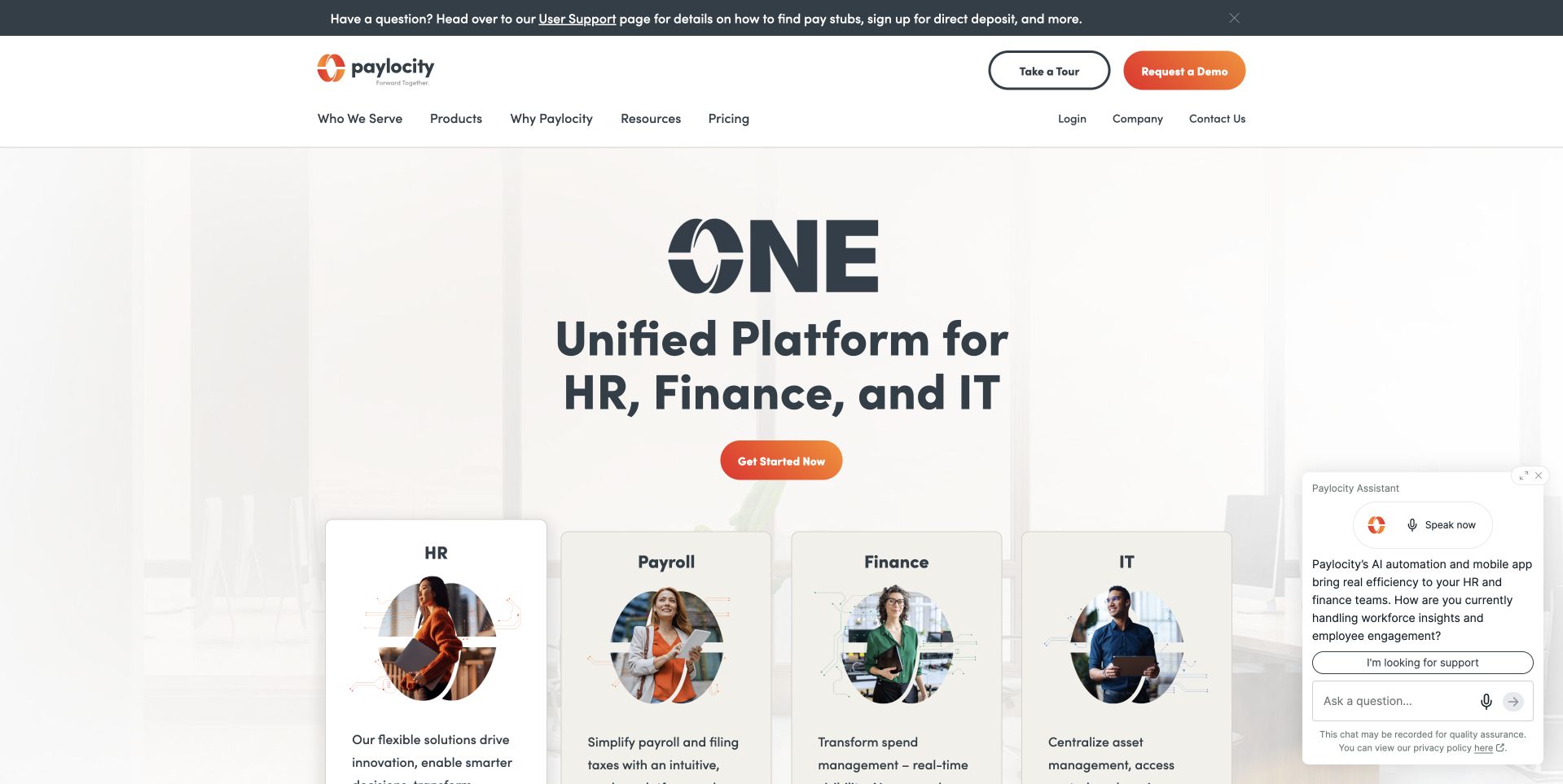
Paylocity centers a large unified-platform statement above four visual category cards for HR, payroll, finance and IT. A restrained white composition and orange action keep the page recognizable as a business platform rather than a dashboard. A narrow support notice helps existing users find a separate route. Fivetran’s case concerns internal marketing, sales, finance and related analytics using BigQuery and dbt. It does not establish the transactional payroll product’s architecture, the public homepage’s frontend or how every customer’s employment data is processed.
What you can learn
Use categories people recognize in their daily responsibilities, then explain how the shared platform connects them. Keep internal business analytics and customer production data explicitly separate. A shared data foundation should have defined permissions and ownership; it does not imply that every department or application should receive every record.
Pros
Four category cards make a broad suite’s coverage easier to scan than a long feature paragraph.
A separate support notice acknowledges that existing users need a different path from prospective buyers.
Cons & considerations
The large unity message postpones explanation of the actual relationships among the individual products.
An automatically opened assistant panel competes with the main category grid for attention.
Visible tech stack
Earlier / documented evidence
Fivetran
Platform source: Official technology-specific customer or workload source. Fivetran’s Paylocity case concerns internal marketing, sales, finance and related analytics using BigQuery and dbt, not the transactional payroll product. This evidence establishes only the stated product, workload, organization or historical association. It does not prove that the pictured public page uses the technology, reveal its CMS/frontend, establish a complete current architecture or independently verify vendor-reported outcomes. Platform evidence is separate from the direct website screenshot and is not a complete current infrastructure audit.
Trinny London combines a festive dining scene, a restrained white campaign heading and a bright yellow shopping action. The same yellow appears in utility and personalization strips, tying the seasonal image to the wider brand. A compact category row keeps skincare, makeup and other shopping routes available. Fivetran’s case describes business and marketing data integrated into BigQuery for reporting. It does not establish the current commerce frontend, prove a product recommendation’s suitability or identify the implementation of the store’s matching experience.
What you can learn
Keep a seasonal campaign visually coherent while preserving reliable category and product-finding routes. Personalization requires more than moving data: explain the information requested, its purpose and how a customer can browse without providing it. Separate analytics of a matching flow from any unsupported assumption about a person’s health or appearance.
Pros
The warm scene and consistent yellow accents create a recognizable campaign without changing the navigation’s basic structure.
A single bright shopping action remains visible against a detailed photographic background.
Cons & considerations
Several promotional and matching strips reduce the space available for the main content.
The atmospheric opening provides limited immediate information about product ingredients, suitability or ongoing conditions.
Platform source: Official technology-specific customer or workload source. Fivetran describes Trinny London business and marketing data integrated into BigQuery for reporting, not the commerce frontend or product-matching implementation. This evidence establishes only the stated product, workload, organization or historical association. It does not prove that the pictured public page uses the technology, reveal its CMS/frontend, establish a complete current architecture or independently verify vendor-reported outcomes. Platform evidence is separate from the direct website screenshot and is not a complete current infrastructure audit.
Raiffeisen Bank International uses a bridge photograph beside a dark text panel to explain its regional role. Yellow chevron motifs connect the photo to the brand, and the platform-login action remains visible in the header. The captured German locale appeared translated into English in the browser. Fivetran’s case concerns multi-country marketing analytics and reporting-data integration. It does not identify the core banking system, establish this page’s runtime or independently verify the compliance and performance claims reported by the vendor.
What you can learn
Make regional and audience boundaries understandable before presenting complex financial services. A multilingual layout should accommodate longer translated labels without relying on one exact line break. In the data brief, specify country permissions, source ownership and reporting definitions instead of assuming a common tool removes jurisdictional differences.
Pros
The bridge image gives the regional-connectivity message a concrete and memorable visual structure.
A distinct login action separates platform access from general corporate exploration.
Cons & considerations
Several utility and organizational navigation tiers make the header dense for unfamiliar visitors.
The broad regional message requires deeper product information before a business can evaluate service fit.
Visible tech stack
Earlier / documented evidence
Fivetran
Platform source: Official technology-specific customer or workload source. Fivetran describes Raiffeisen Bank International multi-country marketing analytics and reporting-data integration, not core banking transaction processing. This evidence establishes only the stated product, workload, organization or historical association. It does not prove that the pictured public page uses the technology, reveal its CMS/frontend, establish a complete current architecture or independently verify vendor-reported outcomes. Platform evidence is separate from the direct website screenshot and is not a complete current infrastructure audit.
PropertyGuru’s corporate site uses a wide rounded video frame below a very restrained header. The captured scene emphasizes an individual’s expression, with a short subtitle rather than a large product interface. A practical corporate positioning statement begins just below the video. Fivetran’s case describes connecting operational data sources into BigQuery for dashboards and organizational insight. It does not establish the corporate site’s content platform, the infrastructure of every property marketplace or the accuracy of individual property data presented by those services.
What you can learn
Keep a parent company’s mission and its product destinations distinguishable. A human introduction can support recruiting and corporate storytelling, but users still need clear routes into actual services. When unifying data from several products, preserve source identity and access boundaries so a combined dashboard does not silently imply a single operational system.
Pros
The restrained header and rounded video create a calm introduction to a broad technology group.
The human scene gives the corporate mission a more approachable tone than a portfolio logo wall.
Cons & considerations
A large video consumes most of the opening before the practical business explanation appears.
Short cinematic subtitles reveal little about specific products, markets or service boundaries.
Visible tech stack
Earlier / documented evidence
Fivetran
Platform source: Official technology-specific customer or workload source. Fivetran describes PropertyGuru operational-source integration into BigQuery for organizational dashboards and insight, not every property marketplace runtime. This evidence establishes only the stated product, workload, organization or historical association. It does not prove that the pictured public page uses the technology, reveal its CMS/frontend, establish a complete current architecture or independently verify vendor-reported outcomes. Platform evidence is separate from the direct website screenshot and is not a complete current infrastructure audit.
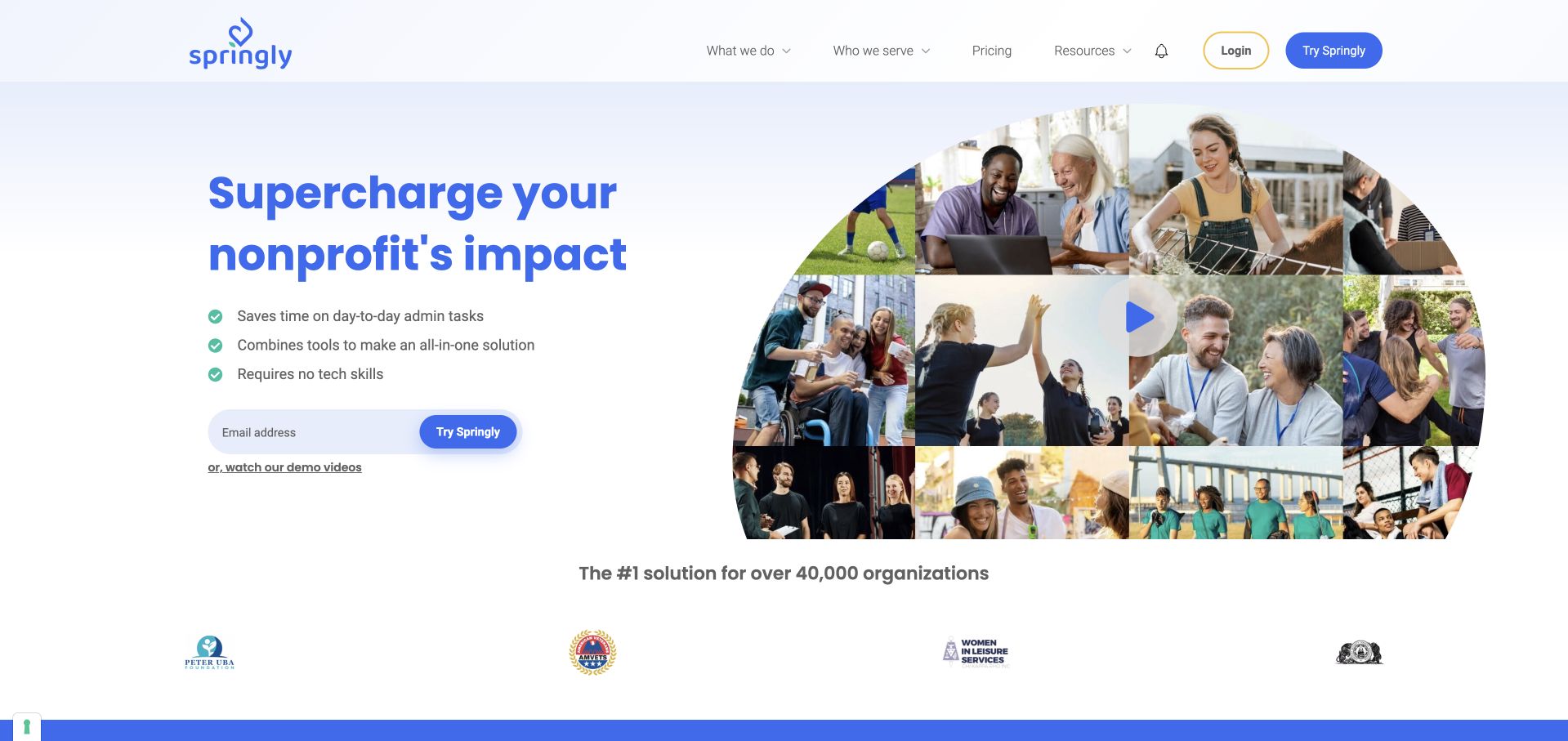
Springly places a large blue headline and three short benefit statements beside a circular collage of nonprofit activities. A small email entry and demo link supply two starting routes. The light background, green checkmarks and compact header give the page a friendly administrative-product tone. Fivetran’s case documents centralizing business information from tools such as MySQL, HubSpot and support systems into BigQuery. It does not establish how a nonprofit customer’s operational records are stored or the runtime of this public landing page.
What you can learn
Tie administrative efficiency to the mission it supports, then show the actual tasks behind the promise. In data planning, separate the software vendor’s own reporting from customer organizations’ member and donor records. Shared tooling should not blur tenant boundaries, permissions or the purpose for which personal information was collected.
Pros
The collage reflects several nonprofit contexts without making the page depend on a single organizational type.
Three concise benefits make the opening easier to scan than a long feature list.
Cons & considerations
Broad time-saving and simplicity claims need concrete workflow demonstrations before evaluation.
The email-first action may feel premature to readers who still need pricing and data-handling detail.
Platform source: Official technology-specific customer or workload source. Fivetran describes Springly’s own business reporting using sources such as MySQL, HubSpot and support tools with BigQuery as destination, not a complete inventory of nonprofit customer records. This evidence establishes only the stated product, workload, organization or historical association. It does not prove that the pictured public page uses the technology, reveal its CMS/frontend, establish a complete current architecture or independently verify vendor-reported outcomes. Platform evidence is separate from the direct website screenshot and is not a complete current infrastructure audit.
Kegan has 15+ years of experience working with small businesses, Fortune 500 companies, and everything in between. No development job is too big or too small: he brings the same hands-on attention to a focused improvement, a complete website, or a custom application.
For Fivetran projects, he can help with data modeling, application data access, query design, search and cache integrations, migration planning, access boundaries, and maintainable handover. He works directly with clients on scope, design, implementation, testing, and handover, with an emphasis on clear communication and a system that remains practical to maintain after launch.
Show 3 other Fivetran developersHide other Fivetran developers
Start with a limited set of sources and one report with a clear owner. Document the fields required and the business checks that establish correctness. Keep raw access restricted and expose a deliberate reporting model. A small, trusted result is a better launch milestone than a broad warehouse full of tables nobody can explain.
A multi-source warehouse program
Agree on identifiers and definitions across finance, marketing, sales and support before joining their data. Preserve source lineage and tenant boundaries. Separate ingestion from transformation and presentation so a change in one layer has a clear owner. Build reconciliation and permission reviews into the release process rather than adding them after dashboards are adopted.
A replication or modernization project
Inventory the current databases, dependencies and acceptable delay. Test schema changes, deletes, re-sync behavior and cutover reconciliation with realistic data. Do not assume a report-ready model arrives merely because replication succeeds. PostNL’s case and other migration stories are scoped examples, not proof that every source or target has identical behavior.
Make the destination trustworthy before expanding the pipeline
Write a source and field inventory
Record connection owners, required privileges, business purpose, sensitive fields and destination access. Include informal spreadsheets and exports if they influence reporting. Decide which sources can be retired and which remain authoritative. Avoid copying every available field by default; unnecessary replication creates storage, governance and interpretation work even when the connector is easy to configure.
Test the transformations and reconciliation
Choose representative records and known totals, then compare source and modeled output. Test time zones, duplicate identifiers, changed types and delayed updates. Fivetran documents automatic type handling and limited transformations during ingestion, but business meaning still needs explicit modeling. Keep exceptions visible and assign someone who can decide whether a report is safe to use.
Document what happens when a source adds a field, changes permissions or becomes unavailable. Review connector release phases and the impact of a re-sync before depending on a feature for production reporting. Set a process for resolving failed jobs and communicating stale data. A data platform needs an operating agreement after launch, not merely a successful initial load.
A useful handover demonstration
Ask the actual team to carry out its routine job: publish a realistic update, correct a mistake, preview a narrow screen, and identify who owns an integration failure. For a library or frontend framework, also ask who maintains the content source and deployment. A polished screenshot does not answer those operational questions.
Beyond the screenshot
A Fivetran data project checklist
Name the decision each destination supports.
Identify authoritative source systems and owners.
Limit privileges to the required connection scope.
Inventory sensitive and unnecessary fields.
Define stable identifiers across sources.
Separate ingestion from business transformations.
Reconcile representative records and known totals.
Specify timestamps, time zones and freshness labels.
Test deletes, schema changes and failed syncs.
Review connector release phase and actual limitations.
Plan re-sync, recovery and stale-data communication.
Assign access, cost and ongoing model-review owners.
Test with real content, a keyboard, a small screen, slow or failed requests, and the people who will maintain the system. These are planning checks, not an accessibility, security, performance, or search-ranking certification.
Sources & editorial method
How this Fivetran collection was reviewed
Original design observations were written from actual public captures. Official Fivetran cases establish specified business-data workflows, not complete homepage stacks or independently verified outcomes. Public properties, products and internal analytics remain separated, and source-specific limitations are retained.
Every image is an unmodified capture from the actual website, with its source and capture date. Some captures are reused from our shared catalog; their dates remain the original capture dates. None comes from a vendor gallery or a generated reconstruction. Moving imagery and live content can change.
Technology attribution uses public page assets or metadata, official platform documentation, or a cited first-party project case study. Documentary and framework-relationship evidence is identified where used; it is not a complete current backend inventory. A CMS image CDN alone does not establish a full CMS deployment. A library’s presence does not prove which individual controls use it, and a platform label does not establish AI authorship.
The composition notes, lessons, pros and tradeoffs are original editorial observations. We have not measured conversion, traffic, security, performance or accessibility conformance. Website owners retain their brands and imagery; these examples are not our client portfolio. Written, Edited and Curated are independent records, not dates advanced by a build. See our editorial standards or suggest a correction.
Questions worth asking
Fivetran website development FAQs
Is Fivetran the database behind these websites?
The evidence does not establish that. Fivetran cases generally describe moving data between systems for analytics, replication or related organizational purposes, not rendering a public homepage.
Does automated ingestion produce a finished business report?
No. The destination still needs suitable modeling, definitions, tests and presentation. The documented shared responsibility model makes those distinctions important.
Should we copy every available table?
Not automatically. Identify the purpose, access requirements and maintenance cost of the data first. A broad copy can create more governance and interpretation work than useful insight.
Can a historical migration case determine our cutover plan?
No. Use it for questions to investigate, then test your actual sources, destination, delays and reconciliation requirements.
What is the strongest first milestone?
One useful, permissioned and reconciled report with a known refresh behavior and an owner who can explain its figures. Expand after that foundation is trustworthy.