Best Redis Websites of 2026 (20 Real-World Examples)
Redis-associated websites and the real-time workloads documented behind the brands
These 20 public properties belong to organizations with official Redis customer or product evidence. Their documented roles include caching, session context, event coordination, and retrieval. A Redis association is not proof of a marketing homepage’s runtime or a guarantee that all application data lives in memory.
Redis is often discussed as a cache, but the selected primary accounts describe several different responsibilities. That variety is useful only if each role stays explicit. Temporary shopping state, a telecom decision path, and short-term agent memory have different failure and retention requirements; combining them under a vague real-time label would hide the very decisions a project needs to make.
Ulta Beauty, SonyLIV, Axis Bank, Raymond James, and Yext form the recognizable opening, with individual official evidence for their associations. The captures are public pages, not private customer sessions. SonyLIV is explicitly a finished public account-entry gateway, and the collection does not inspect playback, banking, investment advice, or other private workflows.
Before the examples
What makes good Redis website development in 2026?
Decide whether a value can be lost or rebuilt
Name the authoritative owner of each value before putting it in a fast layer. A cached product detail and a payment-related workflow state cannot be assigned the same retention policy by habit. Redis persistence documentation describes different durability tradeoffs; choose and test the behavior required by the actual application.
A time limit, invalidation rule, and memory-pressure policy are separate decisions. Redis documentation distinguishes eviction policies and memory limits. Make sure the user experience remains meaningful when a value is missing, stale, or cannot be written; a disappearing cache entry should not become an unexplained loss of a business record.
Do not equate low latency with correctness
Fast retrieval does not establish current inventory, an authorized answer, or a valid financial decision. Explain how the fast path obtains its data, how updates arrive, and when the application must consult another source. The case-study association is not an independent benchmark of a current deployment.
The collection · 20 examples
20 Redis website examples worth studying
Compare the public communication and the separately documented Redis role. The reviews distinguish short-term memory from a complete knowledge graph, cached process state from MySQL persistence, and event checks from a PostgreSQL system of record. Older Yext and Freshworks material is not presented as a fresh architecture audit.
We start with five recognizable brands or organizations: Ulta Beauty, SonyLIV, Axis Bank, Raymond James, Yext. Each attribution applies to the named website property, not every product or website belonging to its organization. This is a curated reading sequence, not a measured ranking.
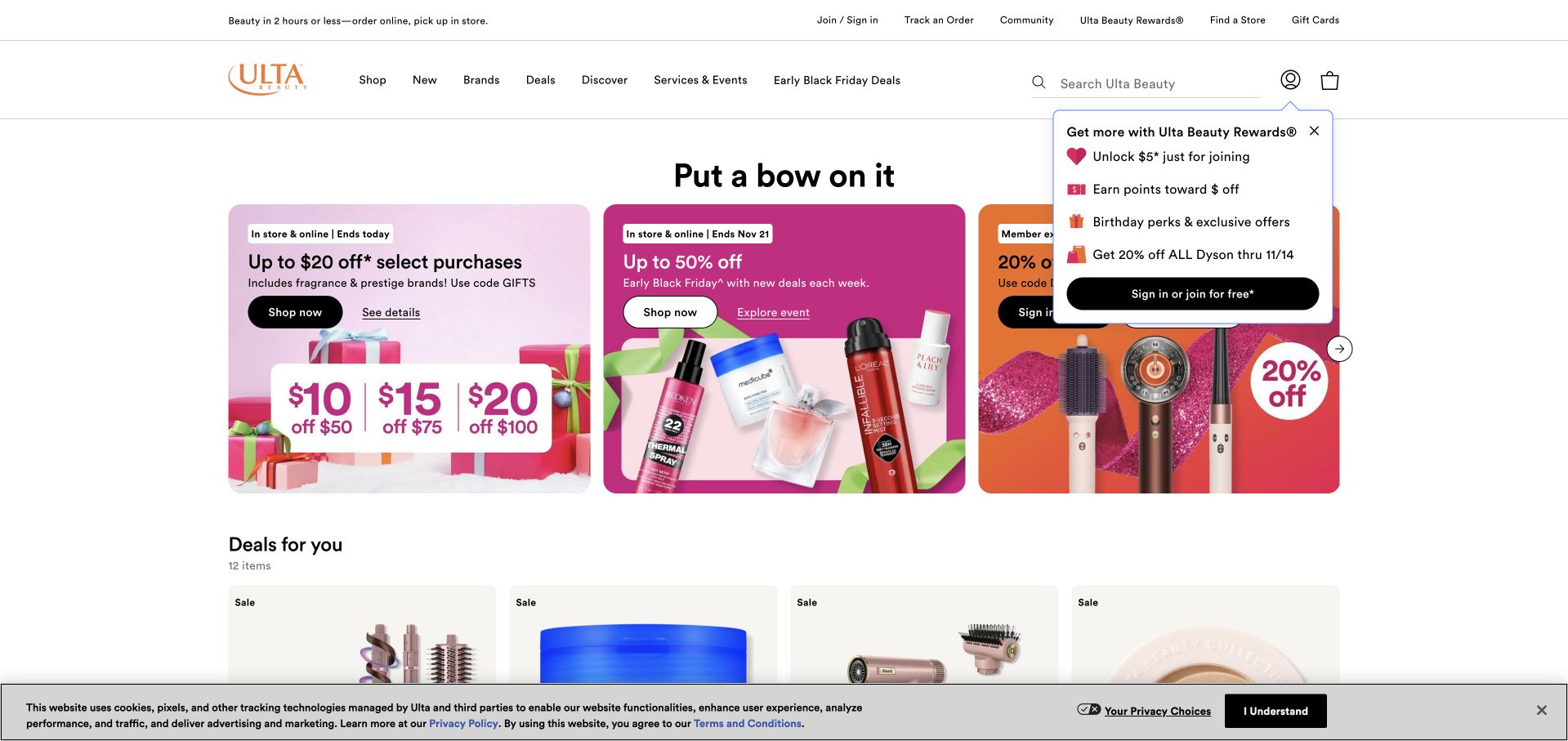
Ulta Beauty’s storefront gives seasonal merchandising a prominent role while keeping search, brand discovery, and shopping navigation in a familiar retail frame. Product imagery and offers provide many possible starting points. The useful design challenge is balancing that abundance with a shopper’s need to identify the right item, understand availability, and move between digital browsing and store-related tasks without losing context. Documented association checked November 8, 2026: Redis Cloud on Google Cloud for inventory services and omnichannel shopping applications.
What you can learn
Think about inventory as a shared service with explicit freshness expectations. Ulta’s documented Redis workload concerns inventory and omnichannel applications; it does not independently establish this page’s runtime or prove that every visible offer and store quantity is synchronized at every moment.
Pros
Familiar shopping navigation gives structure to a large assortment of brands and beauty categories.
Seasonal merchandising supplies timely entry points for visitors who arrive without a specific product in mind.
Cons & considerations
Competing offers and loyalty messages can distract from the practical task of finding an appropriate item.
The public storefront cannot independently demonstrate consistency between warehouse inventory, store stock, and shopping-cart state.
Visible tech stack
Earlier / documented evidence
Redis
Platform source: Official Redis customer or product evidence. Redis Cloud on Google Cloud for inventory services and omnichannel shopping applications. Official source reviewed November 8, 2026 Pacific; no complete current-stack audit is implied. Official documentary association is scoped to the named product, workload, dependency, or database service. No marketing-homepage runtime, complete company stack, independent performance, or private customer workflow is inferred. Platform evidence is separate from the direct website screenshot and is not a complete current infrastructure audit.
SonyLIV’s captured public entry page uses a backdrop of recognizable entertainment artwork and a single account-entry action. It is a finished sign-in gateway, not a catalog-loading placeholder; no account was created or opened. The visual treatment communicates the service category quickly, but it offers little public browsing context before asking the visitor to continue into the service. Documented association checked November 8, 2026: Redis Cloud on AWS for viewer interactions, leaderboards, caching and subscription-tier rate limiting.
What you can learn
Preserve the distinction between an entry screen and the viewer systems behind it. SonyLIV’s documented Redis interaction, caching, and rate-limiting workloads are relevant to streaming operations, but this public gateway cannot reveal their configuration or validate the behavior of a signed-in viewing session.
Pros
Entertainment artwork communicates the category immediately without requiring a long written description of the service.
A single prominent continuation route makes the public page’s immediate purpose unambiguous.
Cons & considerations
The account-first gateway gives visitors limited opportunity to inspect the catalog before continuing.
The captured public state does not expose subscription eligibility, playback behavior, or private viewer interactions.
Visible tech stack
Earlier / documented evidence
Redis
Platform source: Official Redis customer or product evidence. Redis Cloud on AWS for viewer interactions, leaderboards, caching and subscription-tier rate limiting. Official source reviewed November 8, 2026 Pacific; no complete current-stack audit is implied. Official documentary association is scoped to the named product, workload, dependency, or database service. No marketing-homepage runtime, complete company stack, independent performance, or private customer workflow is inferred. Platform evidence is separate from the direct website screenshot and is not a complete current infrastructure audit.
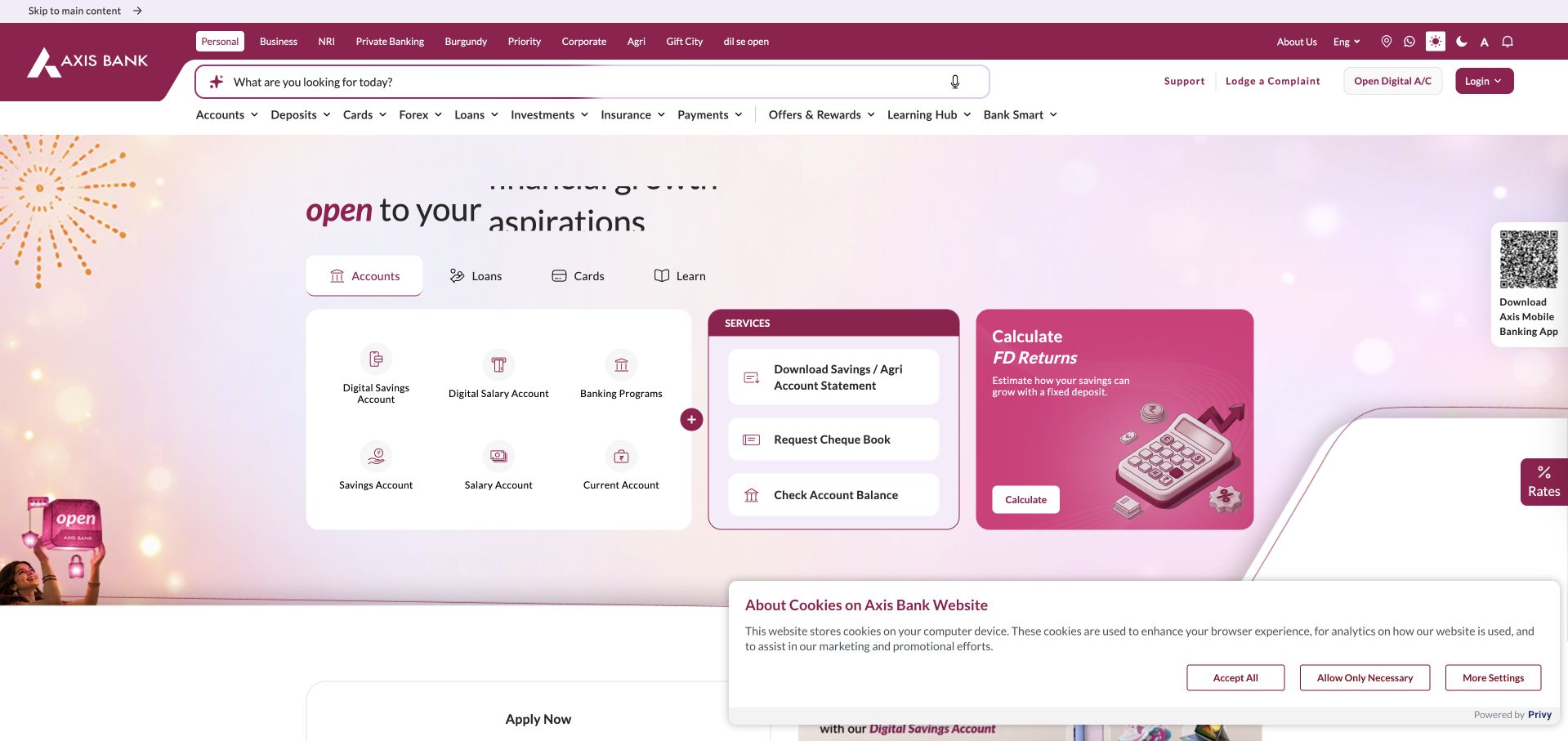
Axis Bank’s public site combines a broad financial-growth proposition with service shortcuts and product-oriented navigation. The visible calculator and service routes recognize that many visitors have a practical task rather than an interest in corporate storytelling. Its main challenge is keeping that utility clear while several account, investment, and promotional messages compete within a large banking portfolio. Documented association checked November 8, 2026: Redis and Redis Data Integration for Runtime Account Authorization and current relationship/account data in Axis Bank’s mobile app.
What you can learn
Scope fast account reads to the authorization and relationship-data workload described in the official case. Redis and Data Integration can support that mobile-app path without proving that every bank product, payment network, or public calculator uses the same architecture.
Pros
Service shortcuts give returning visitors practical alternatives to the main promotional message and product catalog.
Recognizable banking categories help organize a wide financial-service portfolio around familiar customer needs.
Cons & considerations
Numerous related offers can make the correct product or service path harder to identify quickly.
The public page cannot reveal mobile account authorization rules or validate the freshness of private relationship data.
Platform source: Official Redis customer or product evidence. Redis and Redis Data Integration for Runtime Account Authorization and current relationship/account data in Axis Bank’s mobile app. Official source reviewed November 8, 2026 Pacific; no complete current-stack audit is implied. Official documentary association is scoped to the named product, workload, dependency, or database service. No marketing-homepage runtime, complete company stack, independent performance, or private customer workflow is inferred. Platform evidence is separate from the direct website screenshot and is not a complete current infrastructure audit.
Raymond James places advisor discovery and wealth-management information within a recognizable institutional presentation. The emphasis is on connecting visitors with a service relationship rather than exposing a trading dashboard. This makes audience orientation and clear explanations especially important: a person researching the organization needs different information from a financial professional looking for technical or practice-management resources. Documented association checked November 8, 2026: Redis hybrid search supporting retrieval-augmented-generation pipelines for a financial-services firm.
What you can learn
Treat an advisor-facing retrieval pipeline as an internal information product with permission boundaries. The Redis hybrid-search case does not demonstrate investment performance, the suitability of advice, or the technology of this public advisor-discovery page; those are separate questions with different evidence requirements.
Pros
Advisor discovery gives visitors a practical service-oriented next step beyond learning about the corporate brand.
Institutional presentation supports several audiences without implying that every visitor should enter a transaction immediately.
Cons & considerations
Broad wealth-management language can require deeper reading before a visitor understands the relevant service relationship.
The public site does not expose the internal knowledge sources or permission checks used by an AI assistant.
Visible tech stack
Earlier / documented evidence
Redis
Platform source: Official Redis customer or product evidence. Redis hybrid search supporting retrieval-augmented-generation pipelines for a financial-services firm. Official source reviewed November 8, 2026 Pacific; no complete current-stack audit is implied. Official documentary association is scoped to the named product, workload, dependency, or database service. No marketing-homepage runtime, complete company stack, independent performance, or private customer workflow is inferred. Platform evidence is separate from the direct website screenshot and is not a complete current infrastructure audit.
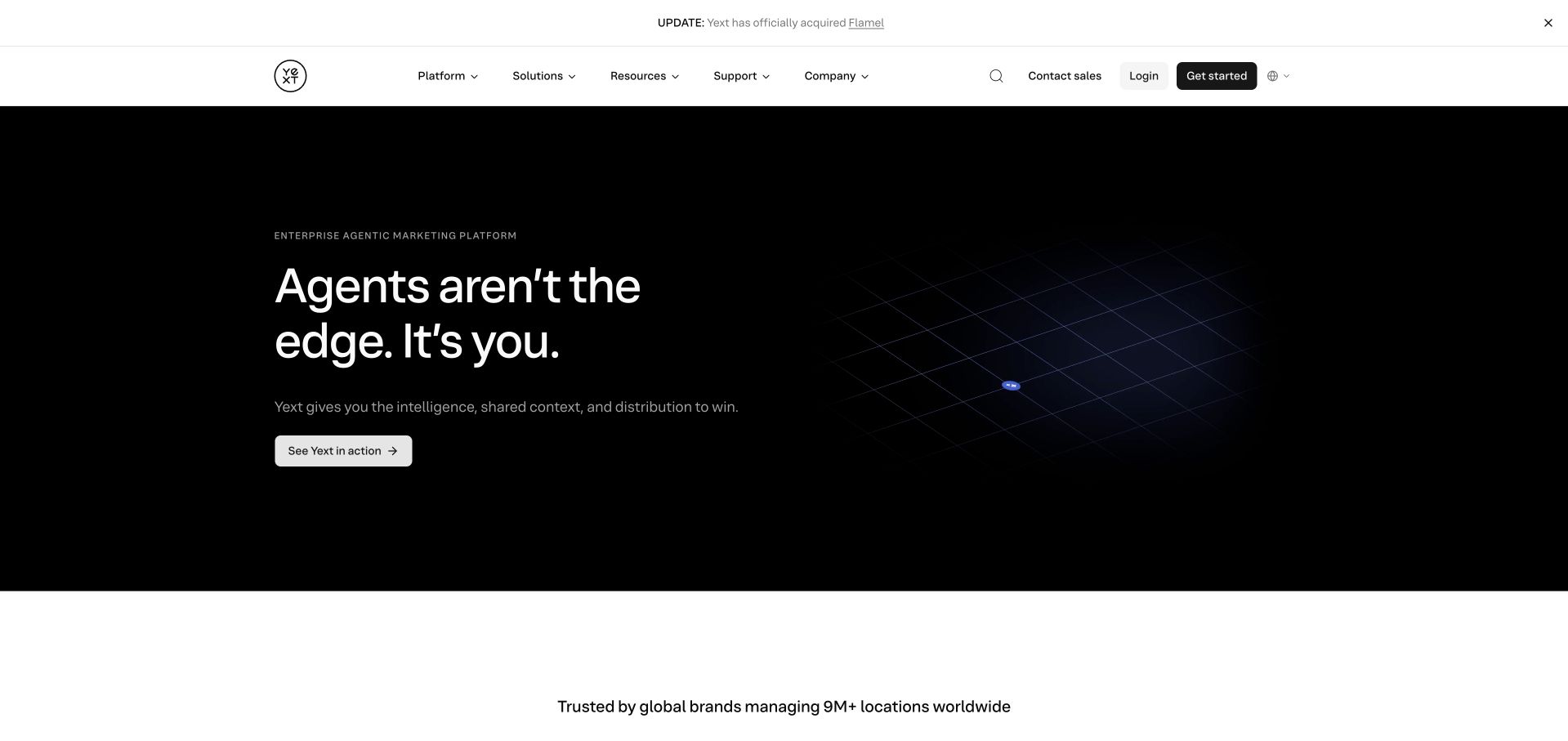
Yext’s public site introduces a location-oriented marketing platform through a contemporary AI campaign and routes into its broader capabilities. The company’s audience must connect an abstract platform proposition with the practical problem of keeping business information discoverable and consistent. Its strongest design lesson is the need to turn platform language into recognizable operational responsibilities rather than relying on a striking headline alone. Documented association checked November 8, 2026: Redis for real-time data indexing across Yext’s clouds and platforms.
What you can learn
Keep the historical Redis indexing interview separate from the current marketing campaign. The documented multi-cloud index is a backend association, not proof that every current agent feature, location page, or public marketing component uses Redis in the same way.
Pros
A location-oriented business context gives the platform a more specific role than generic AI positioning alone.
Product and resource navigation offer alternatives for visitors who need detail beyond the current campaign.
Cons & considerations
An abstract campaign headline can add interpretation work before a newcomer understands the platform’s concrete purpose.
A historical technical interview cannot establish the architecture of every capability introduced by today’s marketing.
Platform source: Official Redis customer or product evidence. Redis for real-time data indexing across Yext’s clouds and platforms. Historical primary customer interview published June 8, 2022 and updated January 27, 2023, linked from the official Redis customer route; current campaign is not fresh infrastructure confirmation. Official documentary association is scoped to the named product, workload, dependency, or database service. No marketing-homepage runtime, complete company stack, independent performance, or private customer workflow is inferred. Platform evidence is separate from the direct website screenshot and is not a complete current infrastructure audit.
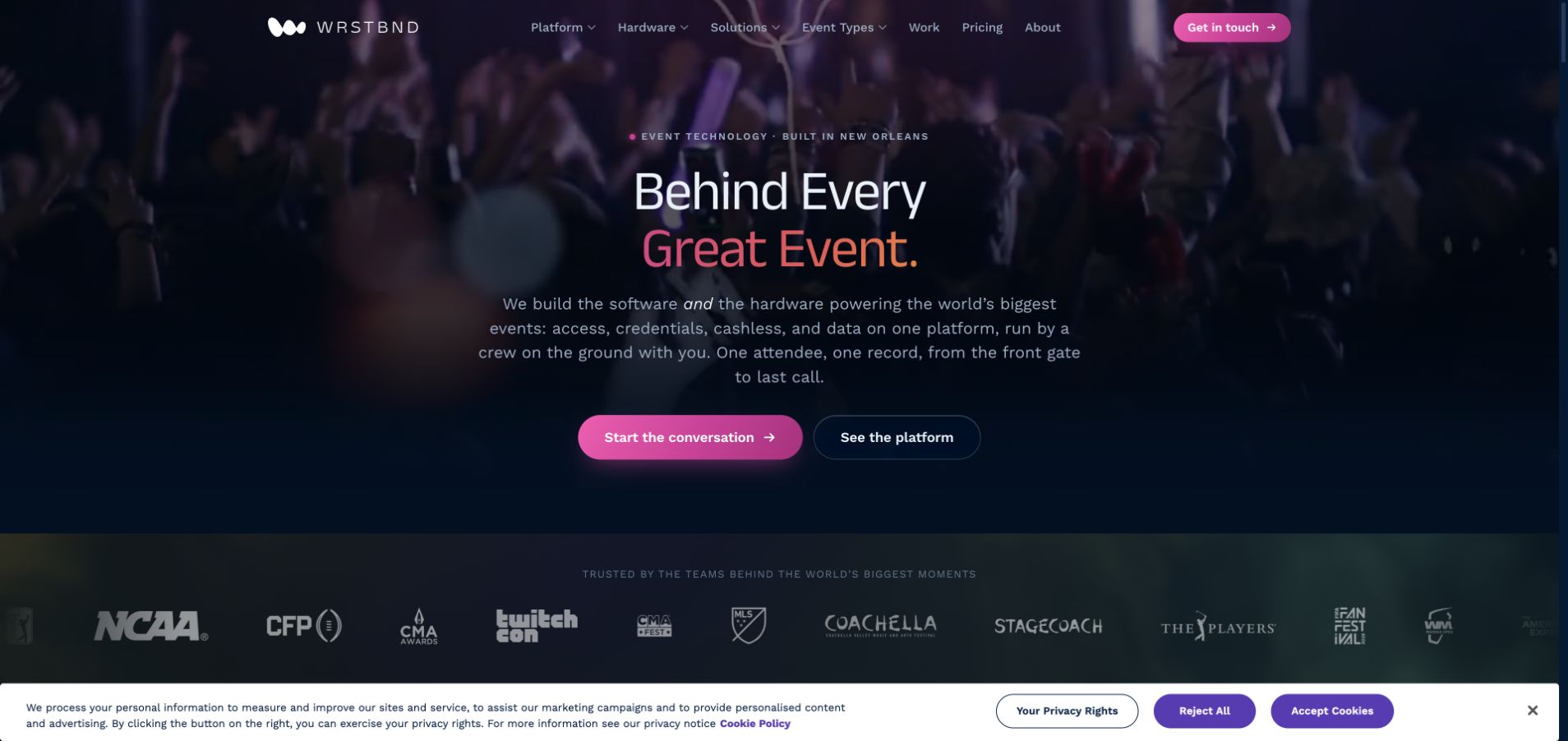
WRSTBND grounds event technology in the recognizable experience of an attendee moving through a live event. Event imagery and the idea of a unified attendee record make an otherwise technical operations platform easier to understand. The page is useful for connecting a backend proposition with a physical experience, while practical evaluation still requires detail about devices, access rules, and the operator’s workflow. Documented association checked November 8, 2026: Redis supporting real-time live-event access and guest operations.
What you can learn
Define which state must be fast and which system remains authoritative. The Redis case distinguishes frequent access checks and event activity from a PostgreSQL system of record; a similar project should preserve that boundary rather than assume every attendee fact belongs in one datastore.
Pros
The attendee-centered narrative connects event infrastructure with a concrete experience that buyers can recognize.
Real event context gives the platform more practical meaning than an isolated list of software capabilities.
Cons & considerations
A public event story cannot expose the behavior of every reader device or access-control exception.
The visual promise of a unified record still requires clear ownership and reconciliation between underlying systems.
Platform source: Official Redis customer or product evidence. Redis supporting real-time live-event access and guest operations. Official source reviewed November 8, 2026 Pacific; no complete current-stack audit is implied. Official documentary association is scoped to the named product, workload, dependency, or database service. No marketing-homepage runtime, complete company stack, independent performance, or private customer workflow is inferred. Platform evidence is separate from the direct website screenshot and is not a complete current infrastructure audit.
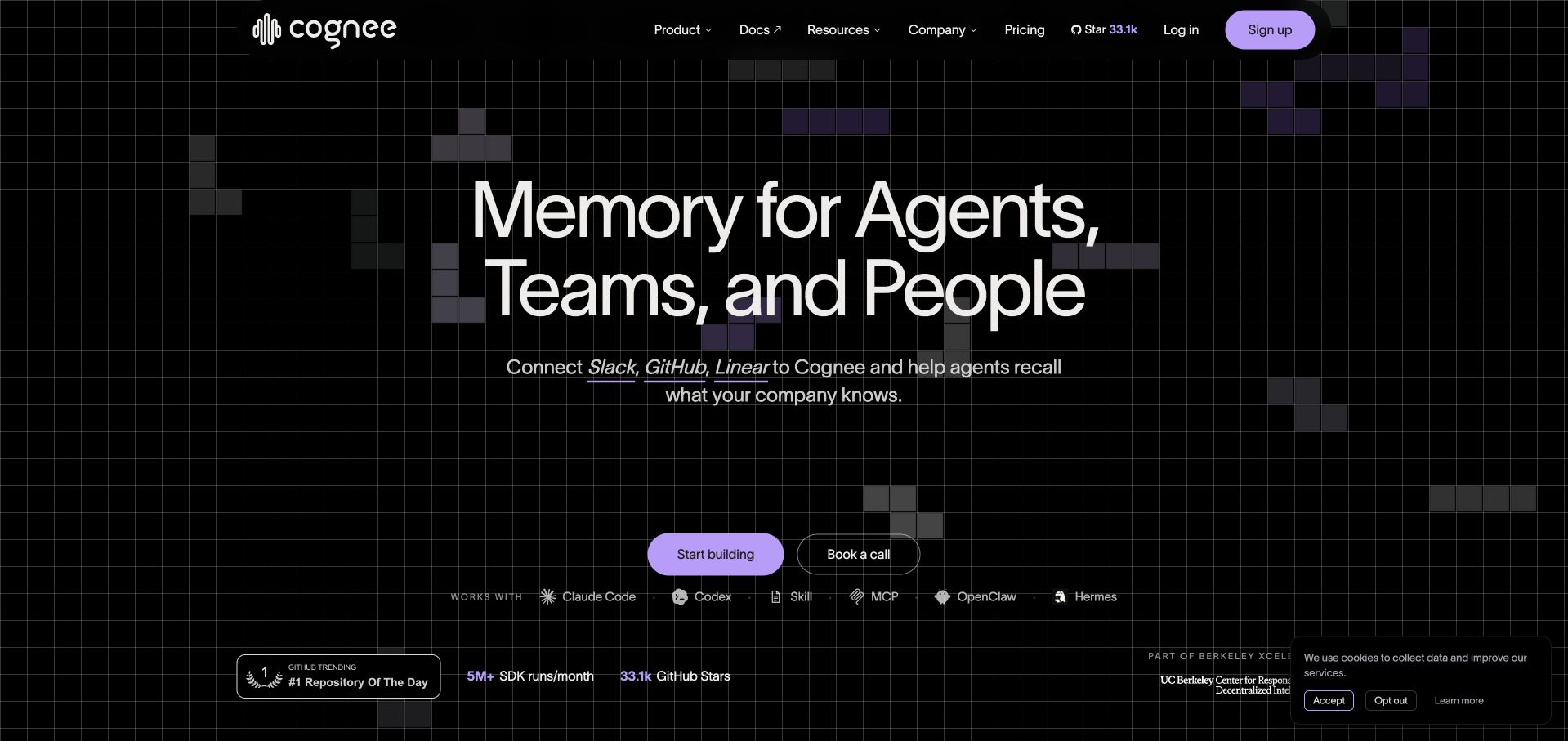
Cognee leads with memory for agents, teams, and people, then explains the problem of knowledge scattered across systems. That problem-first framing helps a visitor understand why the category exists before comparing technical components. The broad audience language is inviting, but the page must still distinguish persistent knowledge, temporary context, and the operational behavior of an agent that consumes both. Documented association checked November 8, 2026: Redis for short-term working memory and session state in Cognee’s agent-memory architecture, not the complete long-term knowledge graph.
What you can learn
Avoid calling all agent memory one storage layer. The Redis case describes short-term working memory and session state within Cognee’s architecture, not the whole knowledge graph; useful planning should specify what expires, what persists elsewhere, and what an agent is permitted to retrieve.
Pros
A scattered-knowledge problem gives a technical memory proposition a recognizable organizational context.
The page introduces the purpose before asking visitors to understand the implementation vocabulary of agent infrastructure.
Cons & considerations
A broad memory metaphor can blur important differences between durable knowledge and temporary session context.
The public vendor introduction cannot demonstrate retrieval correctness or permission boundaries across a customer’s connected systems.
Platform source: Official Redis customer or product evidence. Redis for short-term working memory and session state in Cognee’s agent-memory architecture, not the complete long-term knowledge graph. Official source reviewed November 8, 2026 Pacific; no complete current-stack audit is implied. Official documentary association is scoped to the named product, workload, dependency, or database service. No marketing-homepage runtime, complete company stack, independent performance, or private customer workflow is inferred. Platform evidence is separate from the direct website screenshot and is not a complete current infrastructure audit.
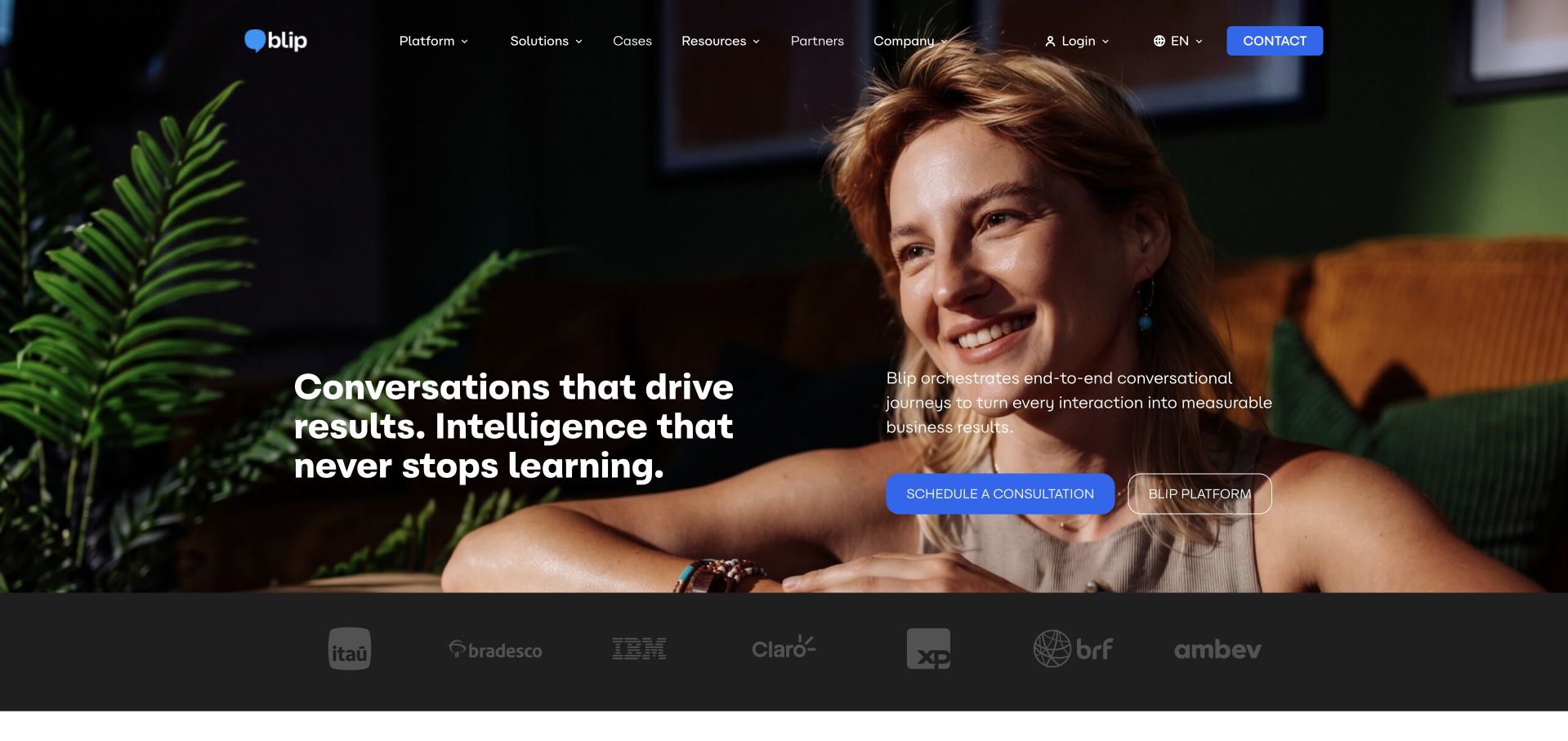
Blip presents conversational technology through customer interactions spanning an ongoing commercial relationship. The public story emphasizes communication outcomes rather than making the visitor first understand messaging infrastructure. This is useful for a platform whose technical complexity sits behind familiar conversations, but careful explanation is needed to distinguish channels, automation, human assistance, and the data retained at each stage. Documented association checked November 8, 2026: Azure Managed Redis in Blip’s global messaging platform.
What you can learn
Model conversation context separately from a durable customer record. Azure Managed Redis is documented in Blip’s messaging architecture, but that association does not establish where every message is archived or prove the quality of an automated response shown in marketing material.
Pros
A conversation-centered proposition makes infrastructure relevant to the customer-facing work an organization recognizes.
Lifecycle framing can connect initial inquiries and ongoing service without treating each as an unrelated feature.
Cons & considerations
Broad outcome language may leave the division between automated and human support unclear at first glance.
The public presentation cannot verify message retention, authorization, or the accuracy of automated answers.
Platform source: Official Redis customer or product evidence. Azure Managed Redis in Blip’s global messaging platform. Official source reviewed November 8, 2026 Pacific; no complete current-stack audit is implied. Official documentary association is scoped to the named product, workload, dependency, or database service. No marketing-homepage runtime, complete company stack, independent performance, or private customer workflow is inferred. Platform evidence is separate from the direct website screenshot and is not a complete current infrastructure audit.
CP AXTRA’s corporate site places its retail brands, organizational information, and business audiences inside a highly visible group identity. The large visual entrance communicates scale, while investor, sustainability, and business routes make the institutional purpose clear. This is a corporate property, not the MakroPRO or Lotus shopping application discussed in the Redis evidence, and the distinction matters when interpreting the example. Documented association checked November 8, 2026: Redis vector search for grocery discovery in MakroPRO and Lotus Smart App, separate from the pictured corporate property.
What you can learn
Separate the group website from a subsidiary product’s search workload. The official case concerns vector-powered grocery discovery in MakroPRO and Lotus Smart App; a corporate screenshot can introduce the organization without claiming that its investor or group pages run on the same service.
Pros
The group identity and business navigation clarify that the page serves organizational audiences as well as shoppers.
Retail-brand imagery connects an institutional portfolio with recognizable real-world businesses and locations.
Cons & considerations
A dominant visual entrance can postpone detailed explanations of the group’s individual digital services.
The corporate property does not demonstrate the query handling or recommendation behavior of the separate shopping applications.
Platform source: Official Redis customer or product evidence. Redis vector search for grocery discovery in MakroPRO and Lotus Smart App, separate from the pictured corporate property. Official source reviewed November 8, 2026 Pacific; no complete current-stack audit is implied. Official documentary association is scoped to the named product, workload, dependency, or database service. No marketing-homepage runtime, complete company stack, independent performance, or private customer workflow is inferred. Platform evidence is separate from the direct website screenshot and is not a complete current infrastructure audit.
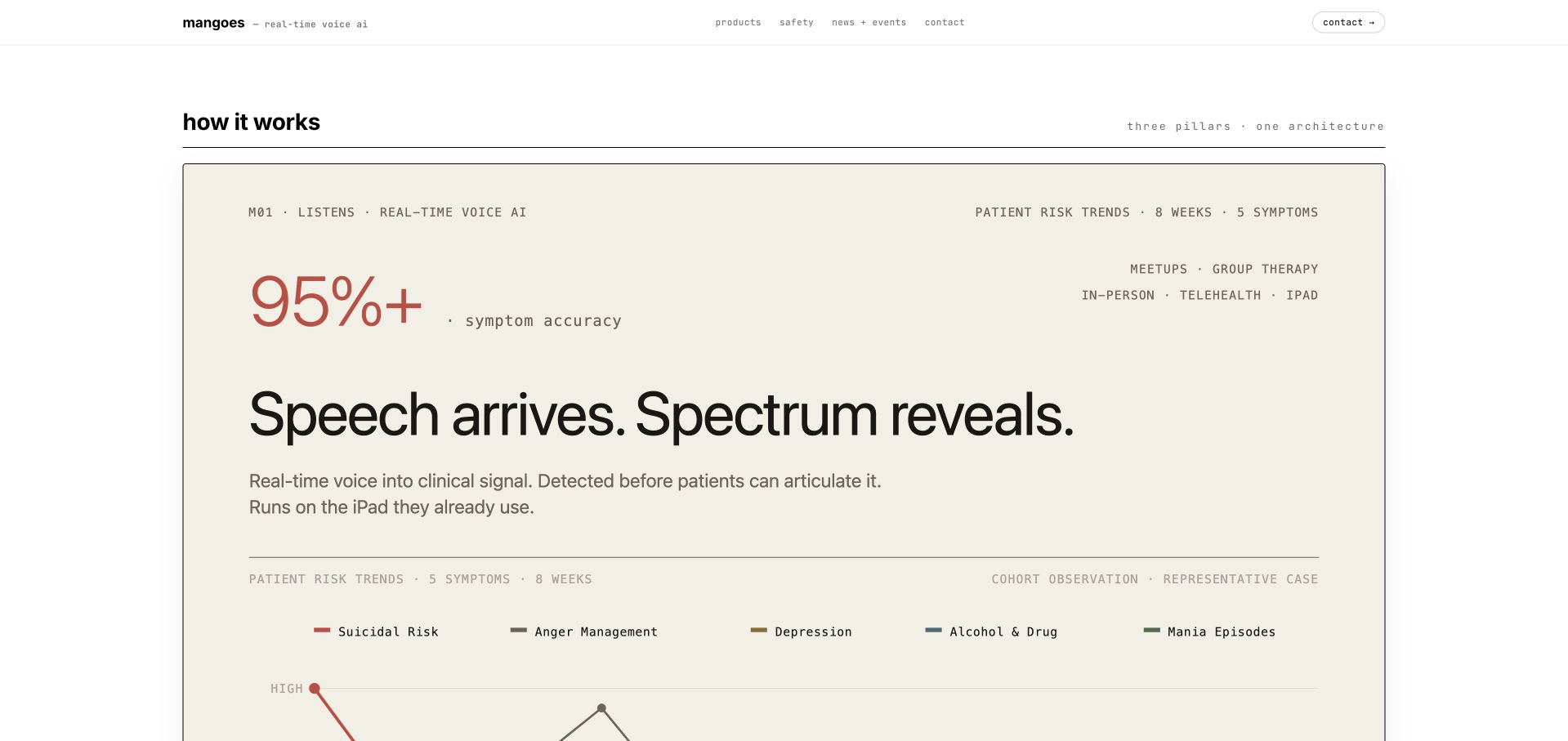
Mangoes.ai’s explanatory section uses a restrained editorial layout and a prominent demonstration-style panel to introduce its voice-AI proposition. The captured section is below the hero and shows how the company describes its system, including its own health-related claims. Those claims are not independently evaluated here; the useful design question is whether the interface distinguishes demonstration, evidence, and a real clinical workflow. Documented association checked November 8, 2026: Redis Agent Playbooks for a healthcare voice assistant’s contextual responses.
What you can learn
Keep the vendor’s Redis Agent Playbooks story scoped to contextual voice-assistant behavior. A technology association cannot establish medical accuracy, treatment effectiveness, regulatory status, or suitability for patient decisions; those require separate evidence and appropriate expert review beyond a website design collection.
Pros
A structured explanatory section offers more concrete context than a purely abstract AI-brand headline.
Restrained typography and separated panels make the company’s proposed workflow straightforward to scan.
Cons & considerations
Prominent clinical-performance language needs independent substantiation and should not be accepted from presentation alone.
The public demonstration does not establish clinical validation or reveal how sensitive information is handled in practice.
Platform source: Official Redis customer or product evidence. Redis Agent Playbooks for a healthcare voice assistant’s contextual responses. Official source reviewed November 8, 2026 Pacific; no complete current-stack audit is implied. Official documentary association is scoped to the named product, workload, dependency, or database service. No marketing-homepage runtime, complete company stack, independent performance, or private customer workflow is inferred. Platform evidence is separate from the direct website screenshot and is not a complete current infrastructure audit.
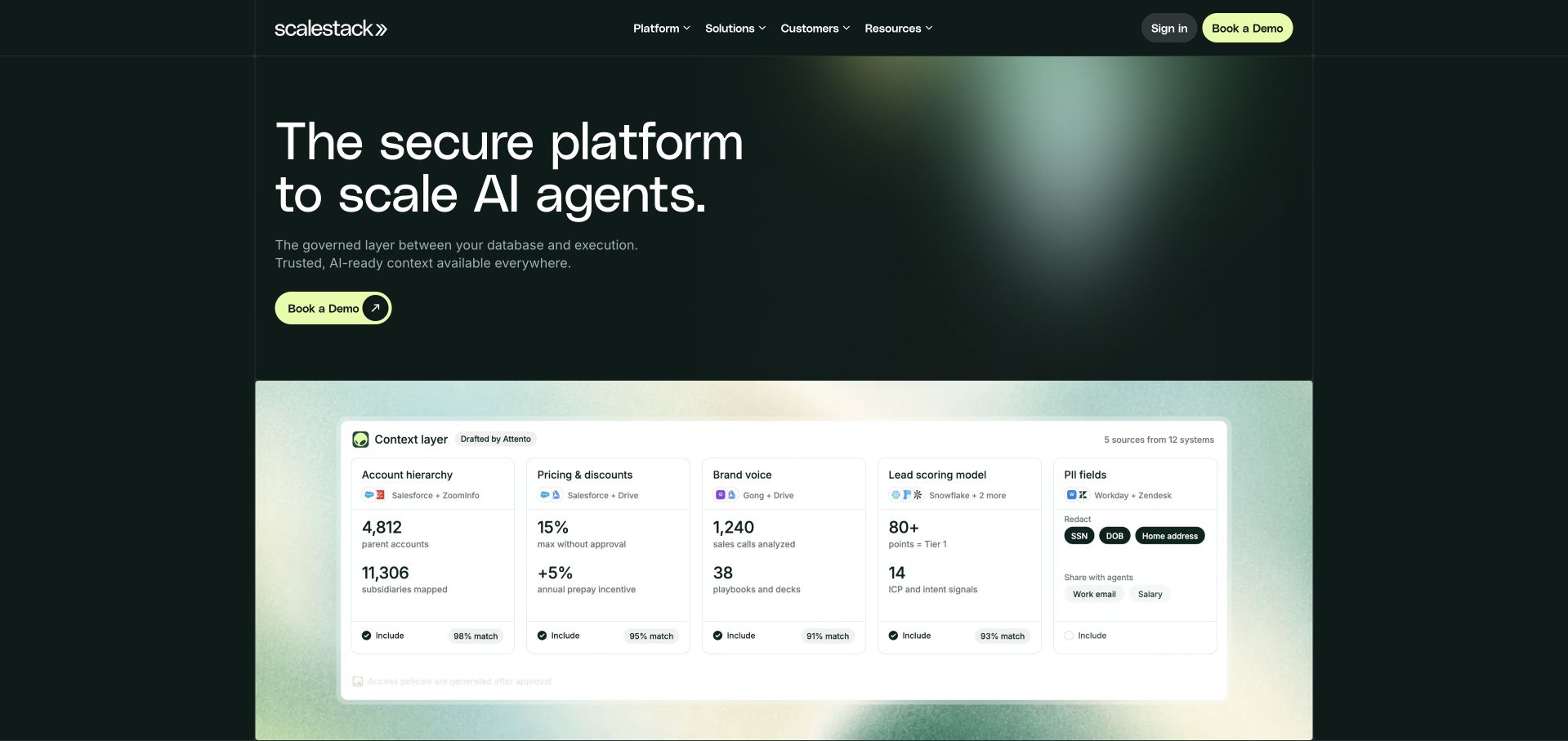
Scalestack frames its offer around scaling AI agents and the shared context those agents need. The public presentation is directed at organizations coordinating multiple systems rather than individuals completing a single task. That focus gives the proposition a recognizable operating problem, though terms such as context layer still require concrete examples before a buyer can understand the actual data movement and responsibilities. Documented association checked November 8, 2026: Redis Streams in Scalestack’s data and AI workflow infrastructure.
What you can learn
Treat Streams as part of workflow coordination, not proof that an agent’s work is correct. The documented dispatcher example suggests planning acknowledgments and recovery between steps; the public page cannot establish the implementation of every current integration or certify a customer’s use of data.
Pros
An organizational coordination problem gives the infrastructure proposition a more concrete reason to exist.
Platform-level framing can help buyers see common requirements across several otherwise separate agent workflows.
Cons & considerations
Context-layer terminology can remain abstract without a specific input, action, and output to inspect.
A marketing page cannot demonstrate reliable execution or appropriate data use across all connected customer systems.
Platform source: Official Redis customer or product evidence. Redis Streams in Scalestack’s data and AI workflow infrastructure. Official source reviewed November 8, 2026 Pacific; no complete current-stack audit is implied. Official documentary association is scoped to the named product, workload, dependency, or database service. No marketing-homepage runtime, complete company stack, independent performance, or private customer workflow is inferred. Platform evidence is separate from the direct website screenshot and is not a complete current infrastructure audit.
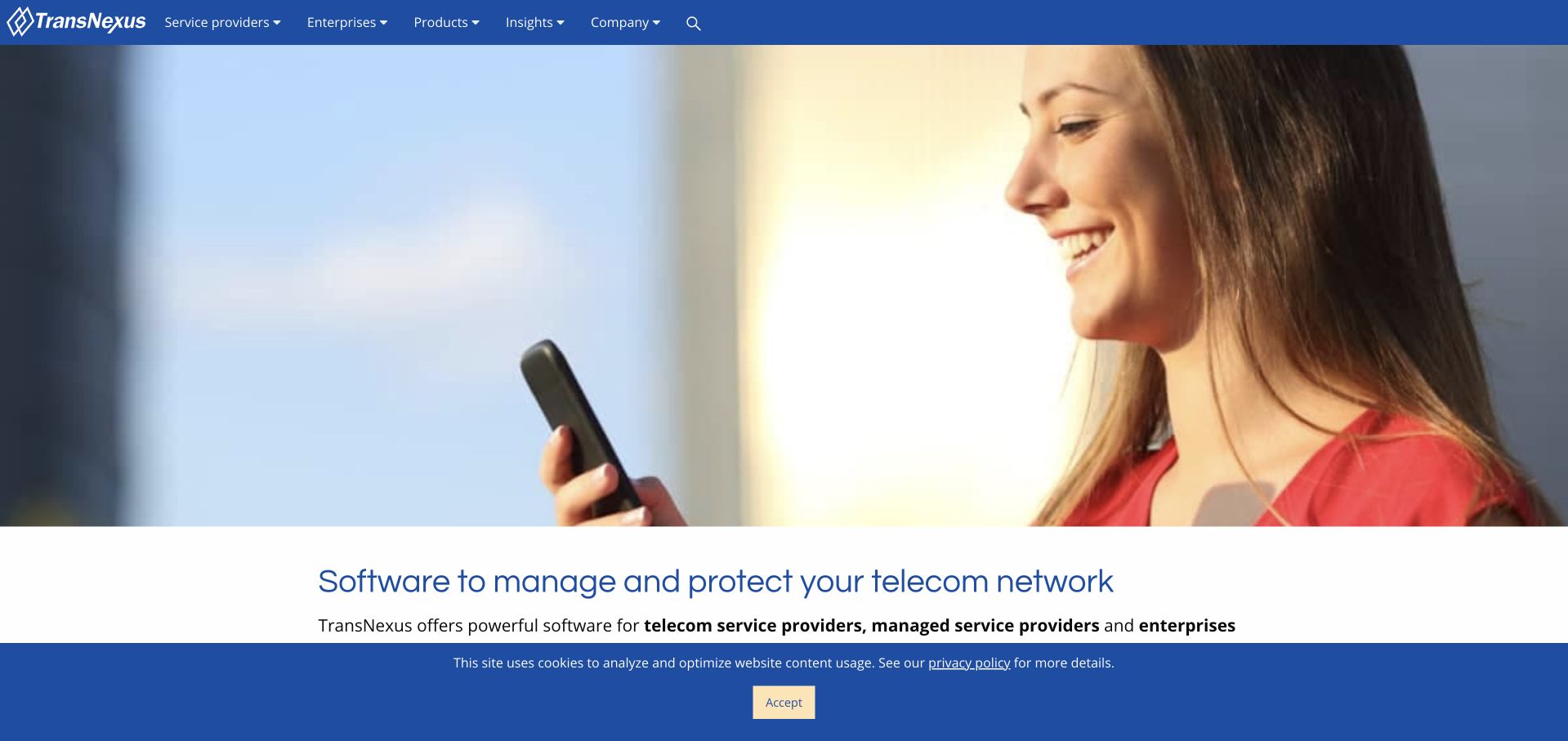
TransNexus introduces telecom software with a direct operational proposition: managing and protecting a network. Product and solution sections give a specialist audience routes into a focused catalog. The page’s restraint is useful because it lets the service category do the orientation work, although a less specialized visitor still needs explanation of call authentication, fraud detection, and the particular problems each product addresses. Documented association checked November 8, 2026: Redis microservices supporting real-time telecom fraud detection.
What you can learn
Connect low-latency state to the exact call-processing decision it supports. The ClearIP Redis association is a bounded telecom workload; it does not independently prove detection accuracy, prevent all fraud, or establish the datastore used for this public product-marketing site.
Pros
A direct telecom-network purpose makes the specialist category visible before visitors navigate the product range.
Separate product and solution routes support both known-product research and problem-oriented exploration.
Cons & considerations
Specialist telecom terminology can create a learning barrier for evaluators outside the operating team.
The public overview cannot demonstrate detection quality or the real behavior of call-processing failure paths.
Platform source: Official Redis customer or product evidence. Redis microservices supporting real-time telecom fraud detection. Official source reviewed November 8, 2026 Pacific; no complete current-stack audit is implied. Official documentary association is scoped to the named product, workload, dependency, or database service. No marketing-homepage runtime, complete company stack, independent performance, or private customer workflow is inferred. Platform evidence is separate from the direct website screenshot and is not a complete current infrastructure audit.
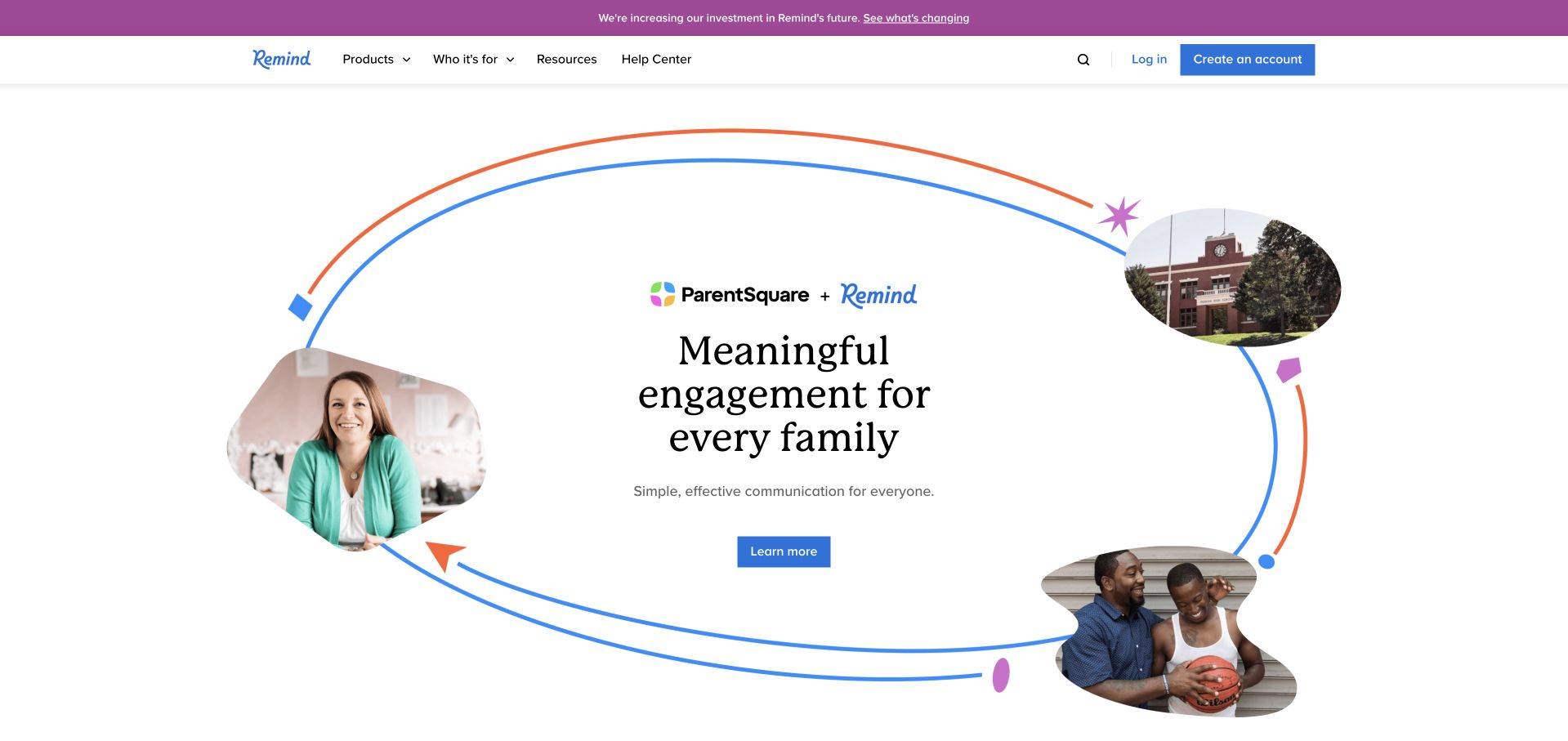
Remind presents communication through the relationship between schools and families, with separate product routes beneath a clear engagement theme. The public page makes the audience and purpose understandable before introducing software details. That clarity is useful, but the marketing experience cannot show the full differences among classroom messaging, broader school communication, recipient preferences, and the delivery states of individual messages. Documented association checked November 8, 2026: Redis for real-time scalable cloud services and low-latency data management in Remind’s messaging platform.
What you can learn
Keep the Redis reference at the scope the customer story supports: scalable low-latency cloud services. Do not infer that every message payload or long-term communication record lives in Redis; a new project should specify delivery status, retention, and permission ownership explicitly.
Pros
School-and-family framing gives the communication platform a concrete audience rather than a generic messaging proposition.
Separate product routes can distinguish different organizational communication needs beneath one consistent public identity.
Cons & considerations
Engagement language does not reveal the detailed experience of recipients with different access and notification preferences.
A brief vendor case does not identify the persistence and delivery systems behind every message workflow.
Platform source: Official Redis customer or product evidence. Redis for real-time scalable cloud services and low-latency data management in Remind’s messaging platform. Official source reviewed November 8, 2026 Pacific; no complete current-stack audit is implied. Official documentary association is scoped to the named product, workload, dependency, or database service. No marketing-homepage runtime, complete company stack, independent performance, or private customer workflow is inferred. Platform evidence is separate from the direct website screenshot and is not a complete current infrastructure audit.
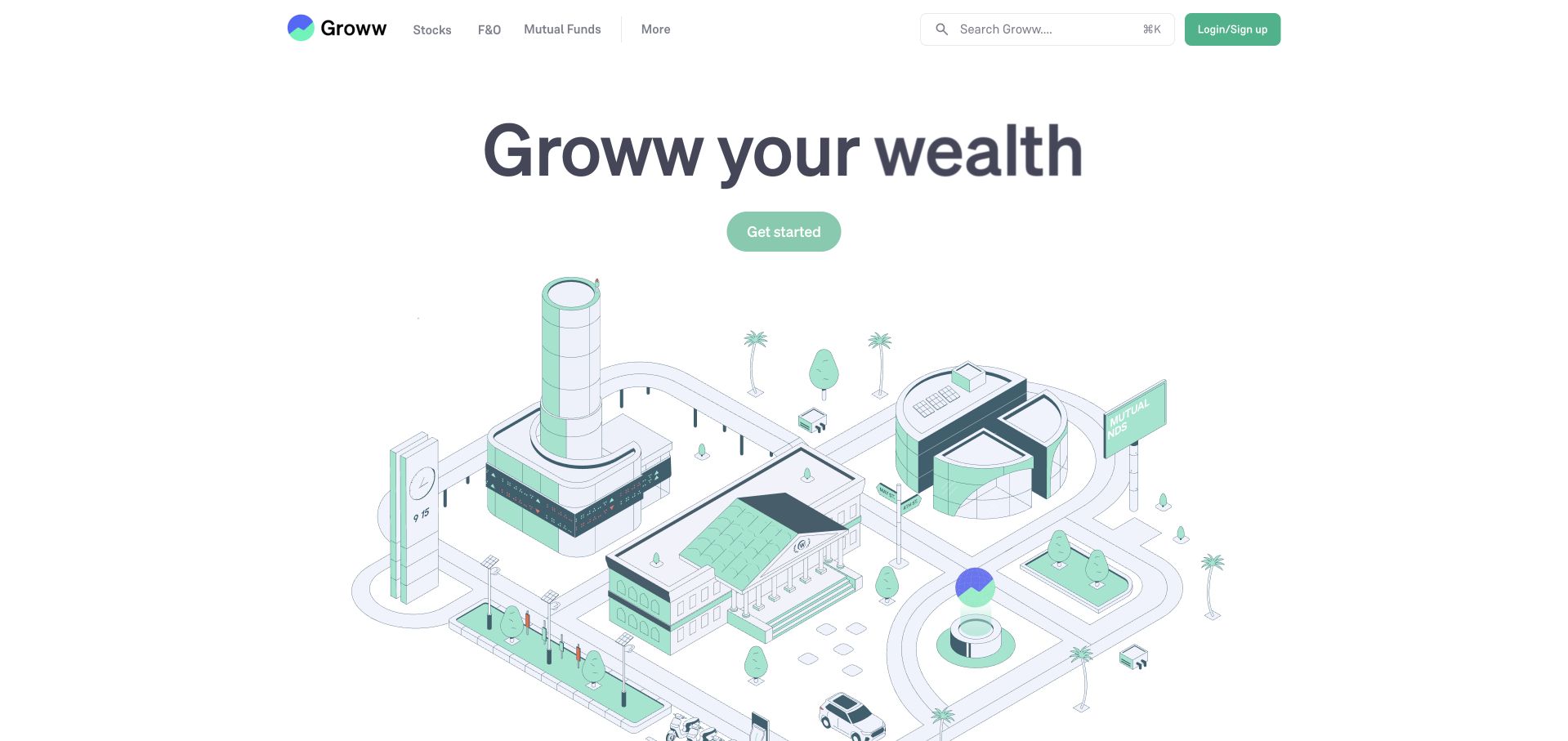
Groww’s public page introduces investing through recognizable product categories and prominent routes into its service. The language is designed to make a complex financial category approachable, while distinct sections help visitors separate different types of activity. As a design example it is useful for studying orientation, not for validating the merits of any investment or the performance of the private trading environment. Documented association checked November 8, 2026: Redis for real-time financial transactions and data access at the investment platform.
What you can learn
Define the data-access workload without promising financial or technical outcomes. The Redis case documents real-time transaction and data-access services, but it does not independently establish current latency, authorize an investment decision, or disclose the complete architecture behind each account action.
Pros
Distinct product sections give visitors a structure for researching a broad financial-service offering.
Plain category language helps orient people who may not already know the platform’s internal product terminology.
Cons & considerations
An approachable marketing tone cannot replace the detailed conditions and risks attached to financial products.
The public entry page cannot validate transaction processing or the reliability of private account data.
Platform source: Official Redis customer or product evidence. Redis for real-time financial transactions and data access at the investment platform. Official source reviewed November 8, 2026 Pacific; no complete current-stack audit is implied. Official documentary association is scoped to the named product, workload, dependency, or database service. No marketing-homepage runtime, complete company stack, independent performance, or private customer workflow is inferred. Platform evidence is separate from the direct website screenshot and is not a complete current infrastructure audit.
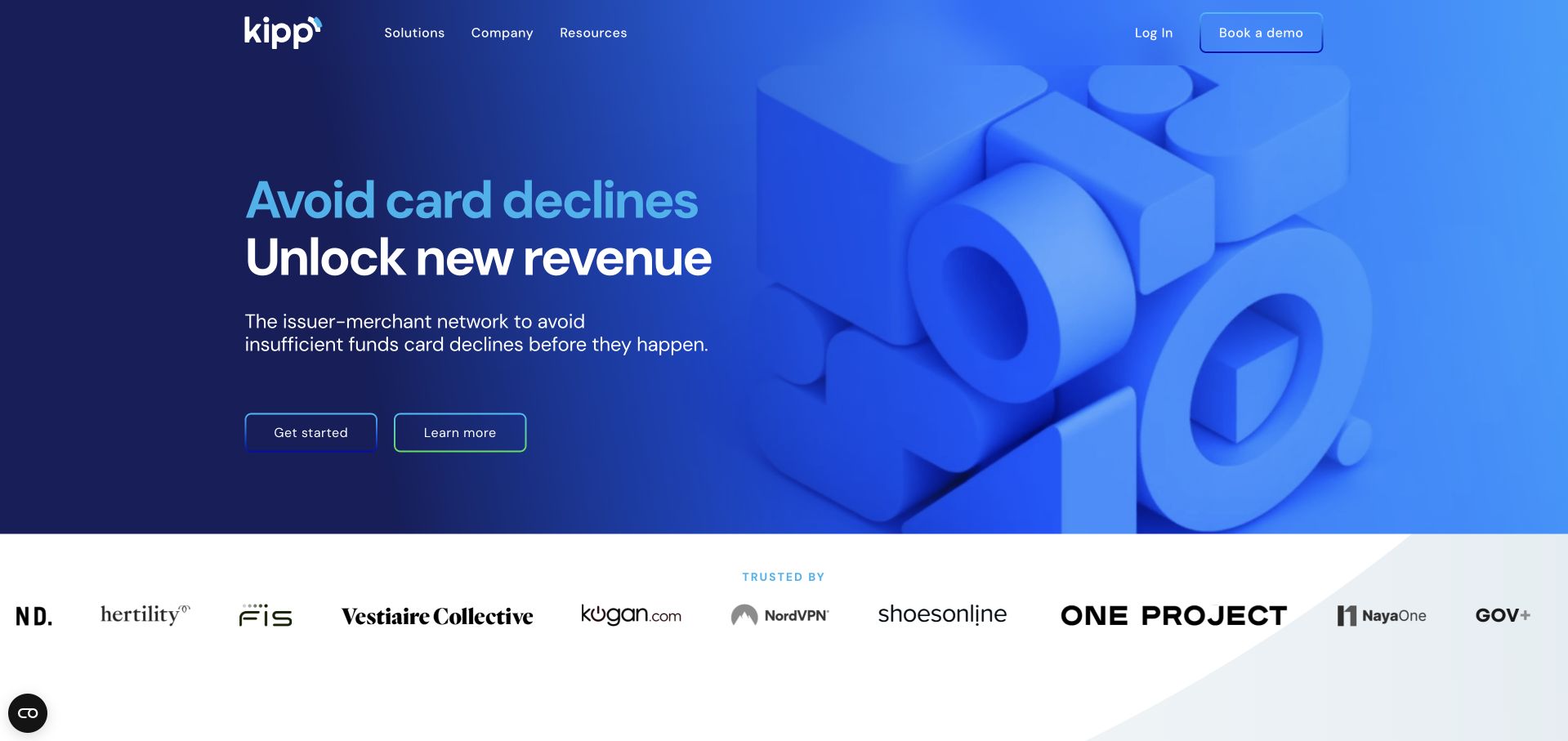
Kipp introduces a narrow commercial problem around card declines and connects it with a focused service proposition. That specificity makes the page easier to understand than a general payment-infrastructure manifesto. The design is useful for studying a problem-led enterprise pitch, but its commercial framing should be separated from the technical, contractual, and customer-experience details that determine an actual payment decision. Documented association checked November 8, 2026: Redis supporting real-time payment approval decisions for ecommerce transactions.
What you can learn
Describe the Redis workload as a real-time decision-support path, not as a guarantee that transactions will be approved. The official material establishes an ecommerce payment association; implementation planning still needs explicit ownership of inputs, decision rules, response deadlines, and failure behavior.
Pros
A clearly named card-decline problem gives business visitors an immediate reason to evaluate the service.
A focused proposition reduces the navigation burden compared with a broad multi-product financial platform.
Cons & considerations
Commercial benefit language can leave the detailed mechanics and limits of a payment decision unexplained.
The public page cannot establish approval outcomes, current decision latency, or the complete processing architecture.
Platform source: Official Redis customer or product evidence. Redis supporting real-time payment approval decisions for ecommerce transactions. Official source reviewed November 8, 2026 Pacific; no complete current-stack audit is implied. Official documentary association is scoped to the named product, workload, dependency, or database service. No marketing-homepage runtime, complete company stack, independent performance, or private customer workflow is inferred. Platform evidence is separate from the direct website screenshot and is not a complete current infrastructure audit.
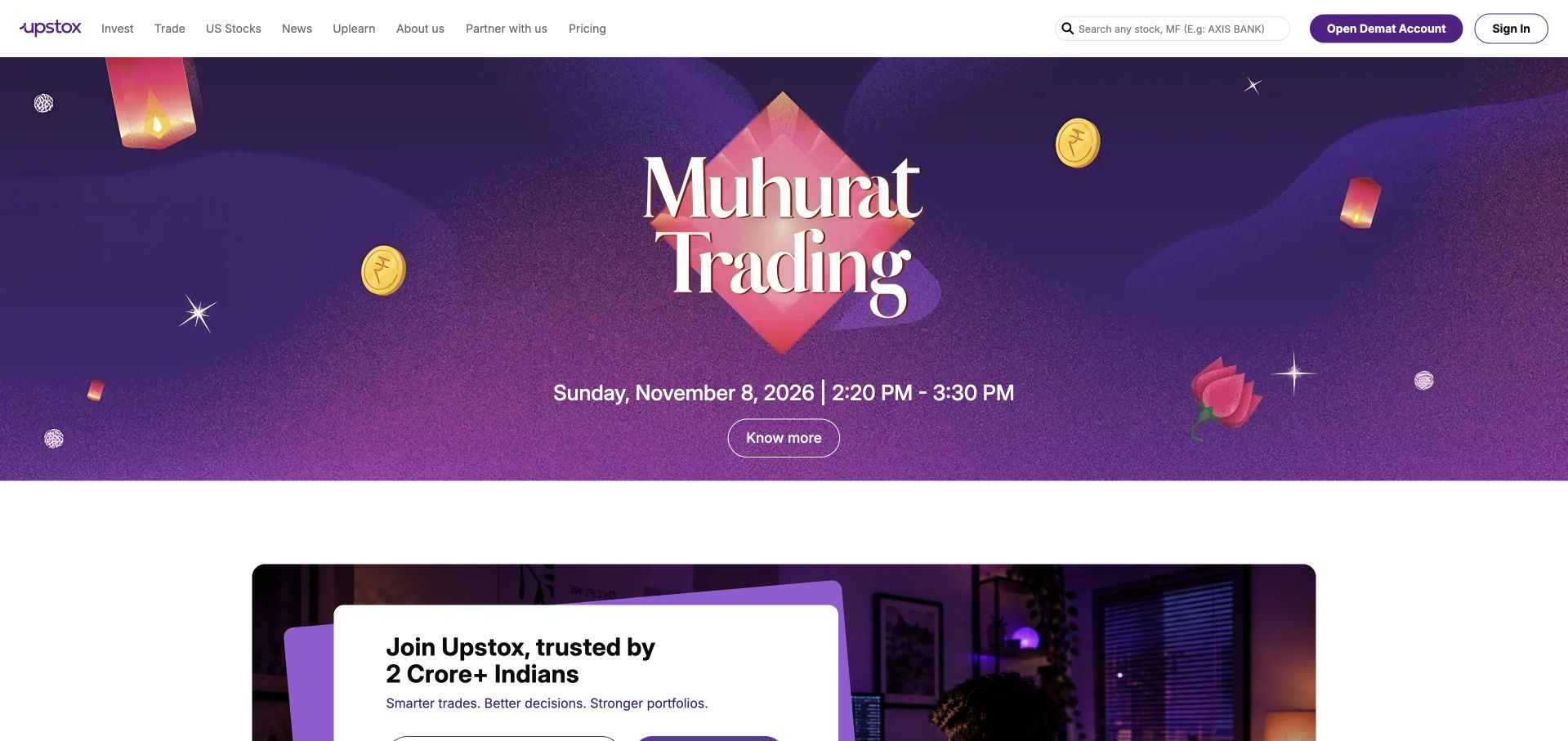
Upstox organizes its public investment offering around recognizable audience and product pathways. The page promotes scale and accessibility while giving investors several routes into more detailed information. Its useful design lesson is the need to separate product discovery from the operational interface: a clear public proposition can help orientation without revealing the account states, market-data timing, or execution details that matter inside a trading service. Documented association checked November 8, 2026: Redis serving low-latency data for the trading platform.
What you can learn
Scope Redis to the documented caching, market-data, and related low-latency paths. A chart or portfolio feature needs a visible freshness model; the vendor case does not independently prove current market latency or establish that every financial record is stored in Redis.
Pros
Investor-oriented sections make a broad service offering more approachable than an undifferentiated feature list.
Recognizable product routes give visitors a way to continue research beyond the main adoption campaign.
Cons & considerations
Prominent scale claims are marketing context rather than independent evidence that a product fits an individual investor.
A public page cannot demonstrate the timing or correctness of private account and market-data workflows.
Platform source: Official Redis customer or product evidence. Redis serving low-latency data for the trading platform. Official source reviewed November 8, 2026 Pacific; no complete current-stack audit is implied. Official documentary association is scoped to the named product, workload, dependency, or database service. No marketing-homepage runtime, complete company stack, independent performance, or private customer workflow is inferred. Platform evidence is separate from the direct website screenshot and is not a complete current infrastructure audit.
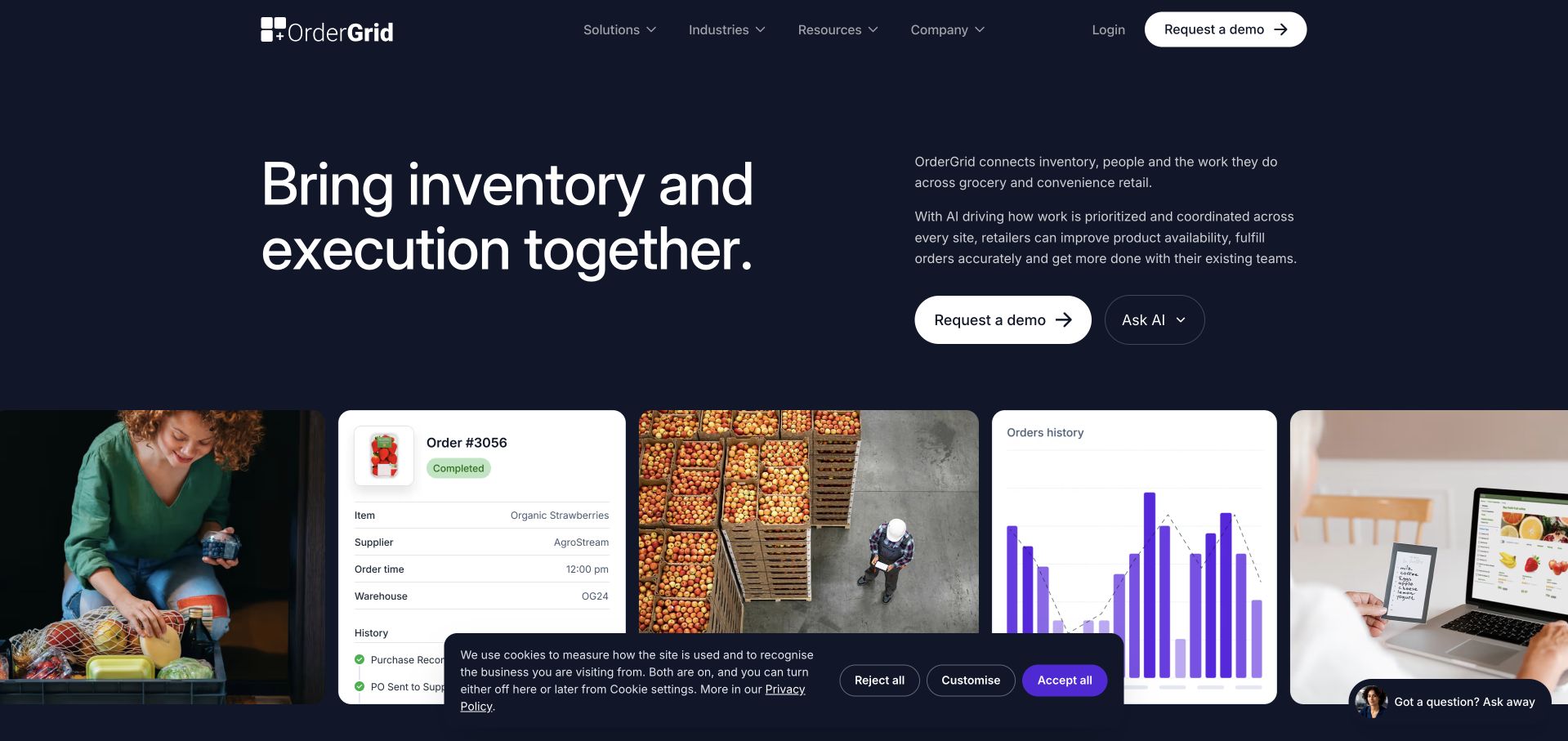
OrderGrid leads with the relationship between inventory and execution, then explains the operational cost of keeping them separate. The public story gives a logistics-oriented audience a concrete problem to recognize before introducing platform details. Its design is strongest when it connects a state of stock with an action in fulfillment, rather than treating inventory visibility as an isolated dashboard feature. Documented association checked November 8, 2026: Redis in a real-time fulfillment orchestration engine.
What you can learn
Define the sequence of inventory writes and fulfillment decisions before choosing a real-time layer. The documented Redis orchestration engine is not necessarily the durable owner of every product or order fact; plan concurrency, retries, and reconciliation according to the actual workflow.
Pros
Inventory-and-execution framing makes the platform’s operating problem concrete before presenting a broader technology explanation.
A before-and-after narrative can help stakeholders recognize the cost of disconnected logistics processes.
Cons & considerations
High-level operational claims need a detailed example before a buyer can assess a particular fulfillment scenario.
The public site cannot demonstrate concurrency handling or the authoritative source for every inventory and order state.
Platform source: Official Redis customer or product evidence. Redis in a real-time fulfillment orchestration engine. Official source reviewed November 8, 2026 Pacific; no complete current-stack audit is implied. Official documentary association is scoped to the named product, workload, dependency, or database service. No marketing-homepage runtime, complete company stack, independent performance, or private customer workflow is inferred. Platform evidence is separate from the direct website screenshot and is not a complete current infrastructure audit.
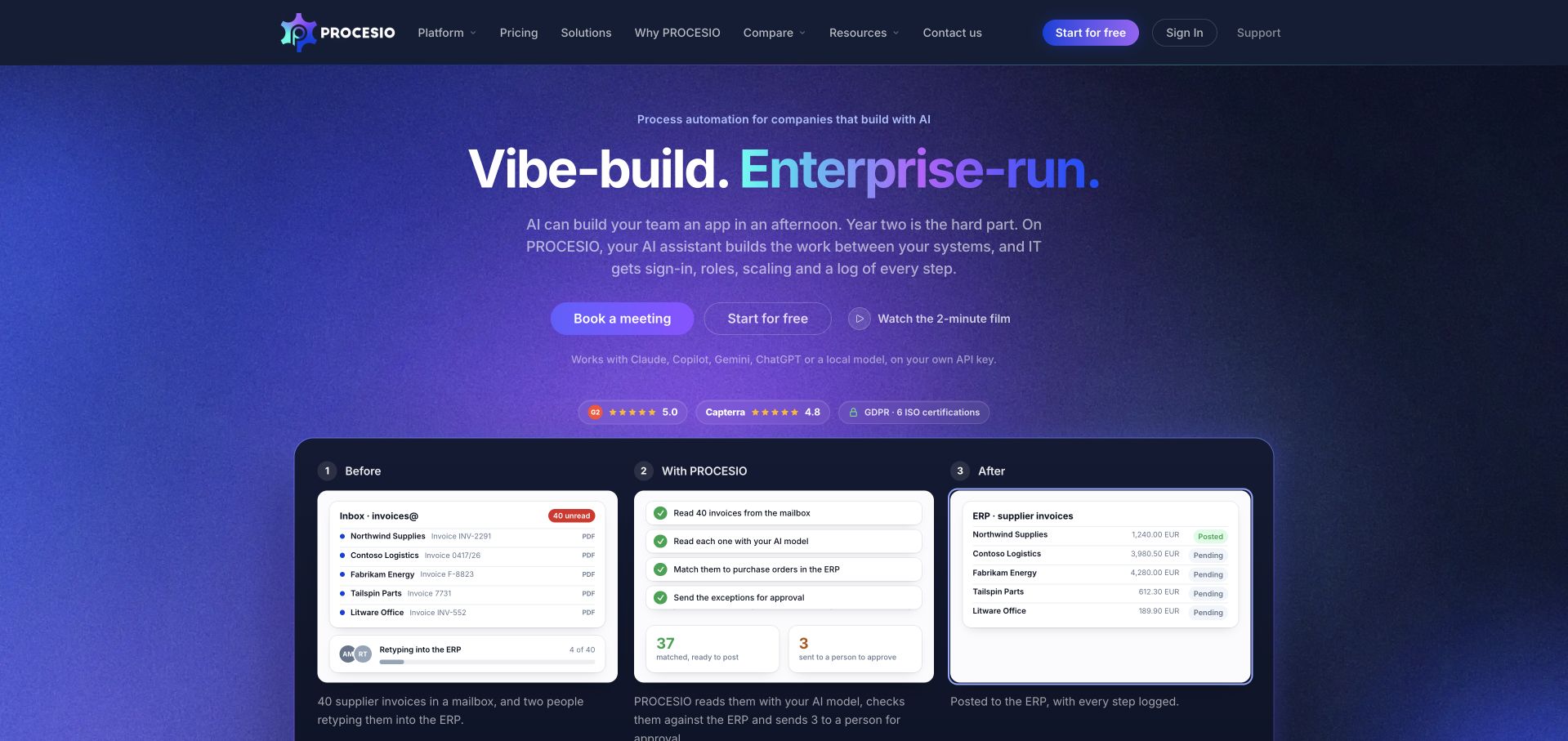
PROCESIO’s public page uses a three-stage invoice example to connect process automation with a recognizable business task. Before, automated work, and after states make the proposition more concrete than a general AI claim. The page also distinguishes building a workflow from operating it over time, a useful framing for teams that must maintain permissions, approvals, and execution history after a demonstration succeeds. Documented association checked November 8, 2026: Redis Cloud supporting low-latency process automation.
What you can learn
Separate cached execution context from durable process records. The Redis Cloud case sits beside MySQL persistence in the documented architecture; a similar project should define what can be recreated, what must survive failure, and how an interrupted approval returns to a known state.
Pros
A concrete invoice sequence makes the automation proposition easier to understand than a generic platform diagram.
The distinction between building and long-term operation highlights maintenance responsibilities that demonstrations often overlook.
Cons & considerations
A simplified public example cannot expose all integration errors or approval exceptions in a real organization.
The marketing view does not verify the persistence and recovery behavior of an actual customer workflow.
Visible tech stack
Earlier / documented evidence
Redis
Platform source: Official Redis customer or product evidence. Redis Cloud supporting low-latency process automation. Official source reviewed November 8, 2026 Pacific; no complete current-stack audit is implied. Official documentary association is scoped to the named product, workload, dependency, or database service. No marketing-homepage runtime, complete company stack, independent performance, or private customer workflow is inferred. Platform evidence is separate from the direct website screenshot and is not a complete current infrastructure audit.
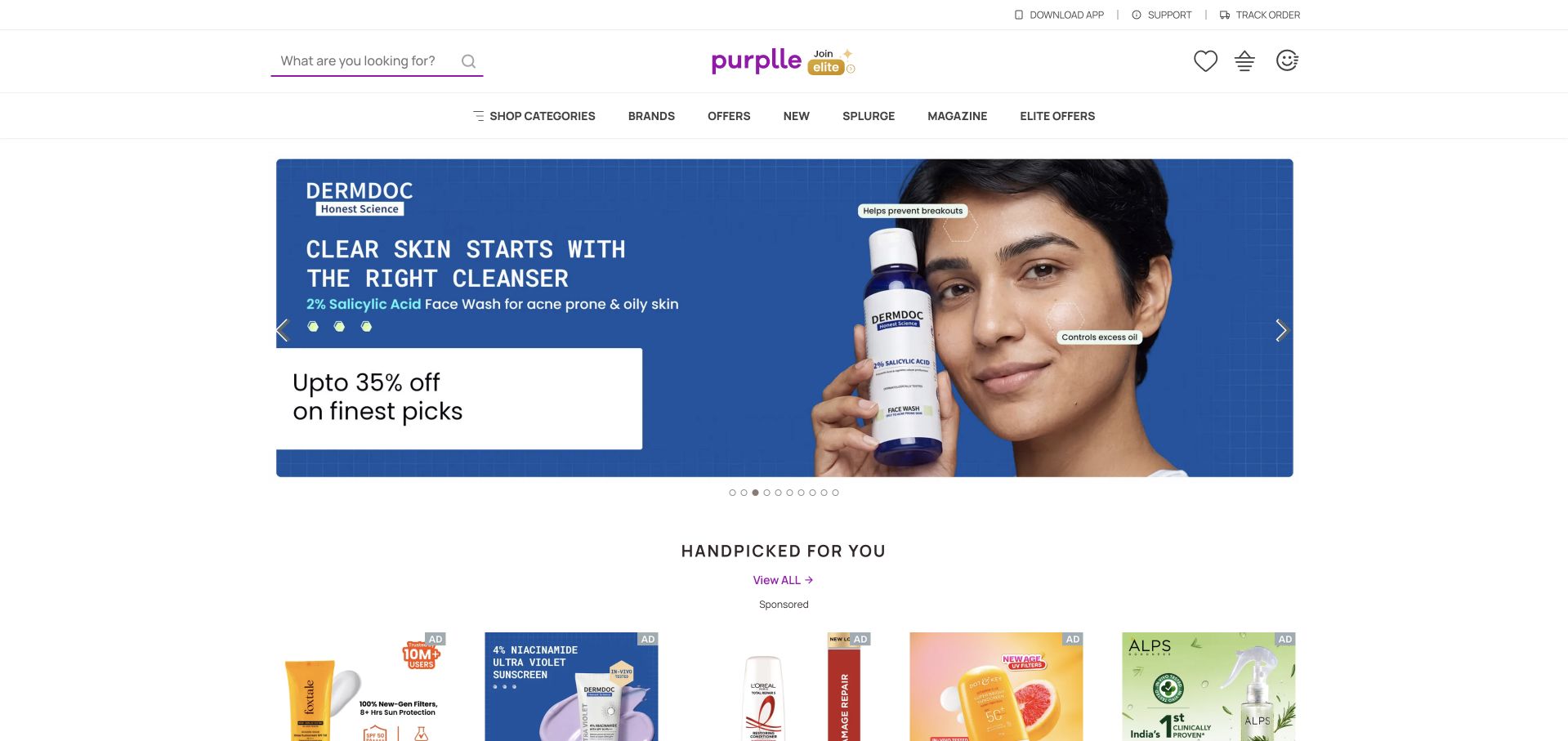
Purplle uses a familiar beauty-retail structure with prominent search, category navigation, offers, and a large product campaign. The photographed merchandise gives visitors an immediate browsing context, while the distinction between brands and categories supports several shopping habits. The crowded promotional environment is useful to study because commercial relevance, product suitability, and stock-related facts must remain understandable amid many simultaneous offers. Documented association checked November 8, 2026: Redis supporting personalized beauty-shopping experiences.
What you can learn
Keep personalization and inventory synchronization as specific service boundaries. The official Redis case covers several shopping workloads, but the screenshot does not independently validate a recommendation, confirm inventory in every channel, or establish the runtime of every retail page and promotional module.
Pros
Search, brands, and categories provide complementary routes into a large and varied beauty assortment.
Prominent product imagery communicates the commercial focus before a visitor opens an individual item page.
Cons & considerations
Many offers and campaign elements can make meaningful product differences harder to compare quickly.
A public retail snapshot cannot establish recommendation quality or synchronized stock and pricing across all channels.
Visible tech stack
Earlier / documented evidence
Redis
Platform source: Official Redis customer or product evidence. Redis supporting personalized beauty-shopping experiences. Official source reviewed November 8, 2026 Pacific; no complete current-stack audit is implied. Official documentary association is scoped to the named product, workload, dependency, or database service. No marketing-homepage runtime, complete company stack, independent performance, or private customer workflow is inferred. Platform evidence is separate from the direct website screenshot and is not a complete current infrastructure audit.
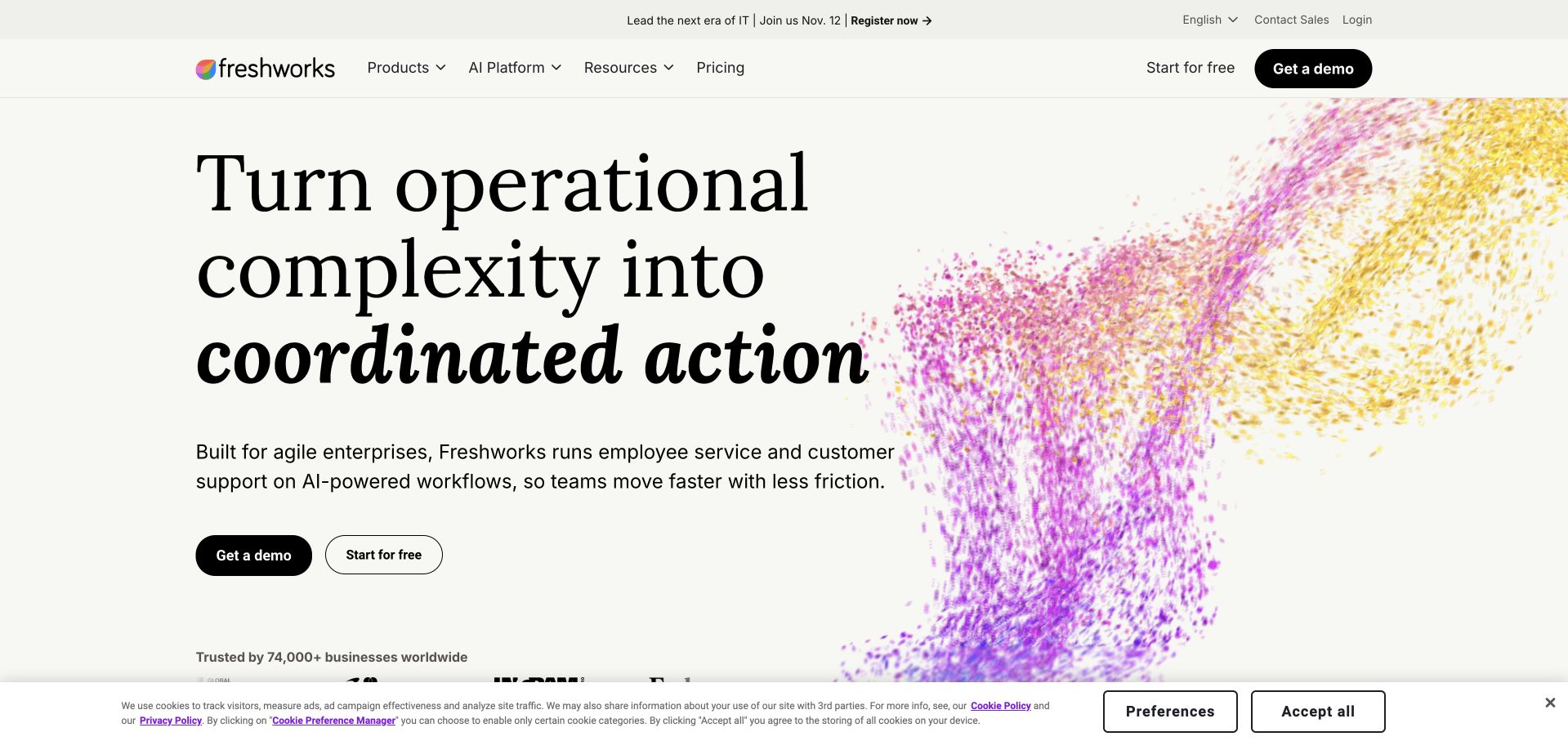
Freshworks introduces a broad software portfolio through the problem of coordinating organizational work. The public page connects several product experiences beneath a shared business proposition, which helps an established vendor expand beyond a single familiar tool. Its challenge is to preserve product distinctions so that visitors can identify whether they need customer service, employee support, or another workflow rather than choosing only a platform slogan. Documented association checked November 8, 2026: Historical September 2020 vendor announcement names Freshworks as a Redis Enterprise Cloud on AWS customer; not a fresh full-stack confirmation.
What you can learn
Keep the September 2020 Redis Enterprise Cloud announcement explicitly historical. It establishes a named customer association on AWS, not today’s complete Freshworks architecture; a current marketing campaign cannot update the technical scope of that older evidence by implication.
Pros
A shared operational problem gives several software products a coherent public introduction and brand relationship.
Product pathways can help existing and new customers move beyond a broad corporate proposition.
Cons & considerations
A platform-wide campaign can blur the differences between tools intended for different organizational teams.
An older vendor announcement cannot establish the present datastore or infrastructure of every current product.
Visible tech stack
Earlier / documented evidence
Redis
Platform source: Official Redis customer or product evidence. Historical September 2020 vendor announcement names Freshworks as a Redis Enterprise Cloud on AWS customer; not a fresh full-stack confirmation. Historical official Redis announcement published September 3, 2020; not current full-stack verification. Official documentary association is scoped to the named product, workload, dependency, or database service. No marketing-homepage runtime, complete company stack, independent performance, or private customer workflow is inferred. Platform evidence is separate from the direct website screenshot and is not a complete current infrastructure audit.
Kegan has 15+ years of experience working with small businesses, Fortune 500 companies, and everything in between. No development job is too big or too small: he brings the same hands-on attention to a focused improvement, a complete website, or a custom application.
For Redis projects, he can help with data modeling, application data access, query design, search and cache integrations, migration planning, access boundaries, and maintainable handover. He works directly with clients on scope, design, implementation, testing, and handover, with an emphasis on clear communication and a system that remains practical to maintain after launch.
Show 3 other Redis developersHide other Redis developers
Specify how a value is populated, invalidated, and rebuilt. Decide whether an absent or stale value can be shown, recomputed, or must trigger a slower authoritative read. Use the interface to communicate an appropriate pending state instead of silently converting a cache miss into a wrong business conclusion.
A coordinated event or workflow path
WRSTBND and Scalestack provide documentary examples involving event activity and Streams. Redis Streams supports consumer groups and acknowledgment, but application code must still define what processed means, handle repeated work, and recover interrupted tasks. A fast queue is not proof that a downstream action completed.
Context and retrieval for agents
Cognee and Raymond James illustrate different information roles. Define the memory lifespan, permitted corpus, and human inspection route before adding an assistant. Keep short-term context, durable knowledge, and generated interpretation separate so the word memory does not disguise several incompatible data responsibilities.
From references to requirements
Plan what happens when the fast path is unavailable
Create a state inventory
List the keys or objects the application needs and label each as authoritative, cached, temporary, or derived. Assign an owner, retention rule, and recovery source. Include the value that must never be evicted by accident and the value that is harmless to reconstruct on demand.
Rehearse pressure and interruption
Test a missing value, delayed update, memory pressure, and a service interruption in an appropriate test environment. Redis replication is normally asynchronous, and persistence settings affect failure behavior. Do not infer strong consistency or zero data loss merely from the presence of a replica or a successful acknowledgment.
Make freshness visible where it matters
A stock figure, market chart, and account-relationship read have different tolerance for delay. Write the acceptable behavior for each. If the application cannot confirm a state, give users a meaningful explanation and an appropriate next step rather than presenting an older value as a verified current fact.
A useful handover demonstration
Ask the actual team to carry out its routine job: publish a realistic update, correct a mistake, preview a narrow screen, and identify who owns an integration failure. For a library or frontend framework, also ask who maintains the content source and deployment. A polished screenshot does not answer those operational questions.
Beyond the screenshot
Redis project checklist
Name the exact role of Redis.
Identify the authoritative source for each value.
Separate temporary context from durable records.
Define expiration and invalidation rules.
Choose a memory-pressure policy deliberately.
Specify cache-miss and unavailable-service behavior.
Define workflow acknowledgment and repeated-work handling.
Document replication and persistence tradeoffs.
Test recovery, not only the fast path.
Show meaningful freshness and pending states.
Keep retrieval permissions independent of relevance.
Preserve historical evidence dates.
Test with real content, a keyboard, a small screen, slow or failed requests, and the people who will maintain the system. These are planning checks, not an accessibility, security, performance, or search-ranking certification.
Sources & editorial method
How this Redis collection was reviewed
Twenty distinct public properties were selected and individually reviewed for this Redis collection. Public browser captures were visually inspected; each image preserves its actual captureUrl, captureDate, dimensions, and provenance. New captures occurred November 9 UTC during November 8, 2026 Pacific research. Reused captures retain their original dates and timestamps; capturedAt:null means only the original day is known and no time was invented. Official primary customer, engineering, operations, or product documentation establishes only the named application workload, dependency, or database-service association. A company’s use of Redis is not evidence of the pictured homepage’s runtime or its entire technology estate. Historical accounts remain dated, and customer-reported results were not independently benchmarked. Reviews are original design criticism, not endorsements of financial, clinical, security, service-quality, or AI outcomes. No logins, account forms, transactions, or private workflows were used. Images and trademarks belong to their owners. A separate bounded public stack audit is performed by the sole publisher before publication; it is not replaced by these documentary associations.
Every image is an unmodified capture from the actual website, with its source and capture date. Some captures are reused from our shared catalog; their dates remain the original capture dates. None comes from a vendor gallery or a generated reconstruction. Moving imagery and live content can change.
Technology attribution uses public page assets or metadata, official platform documentation, or a cited first-party project case study. Documentary and framework-relationship evidence is identified where used; it is not a complete current backend inventory. A CMS image CDN alone does not establish a full CMS deployment. A library’s presence does not prove which individual controls use it, and a platform label does not establish AI authorship.
The composition notes, lessons, pros and tradeoffs are original editorial observations. We have not measured conversion, traffic, security, performance or accessibility conformance. Website owners retain their brands and imagery; these examples are not our client portfolio. Written, Edited and Curated are independent records, not dates advanced by a build. See our editorial standards or suggest a correction.
Questions worth asking
Redis website development FAQs
Is every example using Redis only as a cache?
No. The official cases describe several roles, including session context, event and workflow coordination, and search. The review names the documented role instead of treating Redis as either only a cache or the complete database for the entire company.
Can a replica guarantee that acknowledged data is never lost?
Not by itself. Redis’s official replication guidance describes asynchronous behavior and limits even when additional acknowledgment is requested. The required failure semantics must be evaluated with the chosen persistence and deployment configuration.
What is the difference between expiration and eviction?
Expiration removes values according to their time-based lifetime. Eviction responds to configured memory pressure and policy. An application should decide both deliberately and understand what users experience when either makes a value unavailable.
Does an agent-memory case prove a trustworthy AI answer?
No. Memory and retrieval are information mechanisms, not proof of factual accuracy, permission, clinical validity, or financial suitability. The application still needs scoped sources, appropriate controls, and review for its particular task.
Were private customer workflows inspected?
No. Only public pages and official documentary evidence were used. The SonyLIV account gateway was captured without continuing into sign-in, and no banking, trading, patient, messaging, or shopping-account data was opened.
A useful real-time design explains what is current, what can disappear, and how the system recovers. Redis can support the fast path; the application must make its meaning and limits clear.