Best Elixir Websites of 2026 (20 Real-World Examples)
Twenty public websites and products with genuine screenshots, original design reviews and carefully scoped Elixir implementation evidence.
Elixir can sit behind a conversation, a collaborative document, a public data search or a service that keeps another application responsive. The visible website still has to explain its purpose and help people act. These examples connect that presentation to documented Elixir components without attributing every screen, service or company system to one language.
Begin with the work a visitor needs to do. A product homepage should make that work understandable before asking someone to register, while an established application needs clear navigation, feedback and recovery. Elixir is a programming language, and Phoenix is a web framework within its ecosystem; neither requires a particular visual style. The collection is useful for studying decisions about information, product explanation and entry points, rather than copying a fashionable surface.
Discord, the BBC, Change.org, Heroku and Adobe Frame.io open the guide. Each has primary evidence tying Elixir to a named part of its public product or service. Some sources describe older implementations; others document current architecture or published source code. Their precise limits remain attached to each example. A backend case study is not proof that the pictured marketing page uses Elixir, and a public source audit cannot reveal every private component.
Before the examples
What makes good Elixir website development in 2026?
Explain the task before the architecture
People arrive with a question, a job or an intention. Show what they can accomplish, what information they will need and where to begin. The examples range from finding a podcast to building a video application, so the useful vocabulary changes with the audience. Use technical detail where it helps someone evaluate an integration or operating constraint. Keep a plain explanation beside it so visitors can understand the product before they understand its implementation.
Make changing information understandable
Chat, collaboration, maps and dashboards depend on information changing while someone is using the interface. Plan how updates appear, which changes require attention and what happens after a connection is interrupted. Phoenix documents channels and other realtime components, but choosing a component does not answer these design questions. A useful screen distinguishes a saved result from a pending action and provides an understandable route back after a recoverable failure.
The same product may use Elixir for an API, a separate frontend for presentation and specialist software for media or data processing. Document the responsibility of each part. Supabase describes Elixir in Realtime, while Firezone distinguishes its Elixir control plane from Rust networking components. These examples show why a precise component statement is more useful than a single whole-company stack label. Use the same discipline when planning your own application.
The twenty examples below pair original interface analysis with direct public-page screenshots. Seven captures retain their earlier dates; thirteen were newly captured for this research. Every exact source page has a bounded broad-audit attempt, including retained partial or blocked outcomes. Documentary Elixir associations are presented separately from technologies observed in public responses.
We start with five recognizable brands or organizations: Discord, BBC, Change.org, Heroku, Adobe Frame.io. Each attribution applies to the named website property, not every product or website belonging to its organization. This is a curated reading sequence, not a measured ranking.
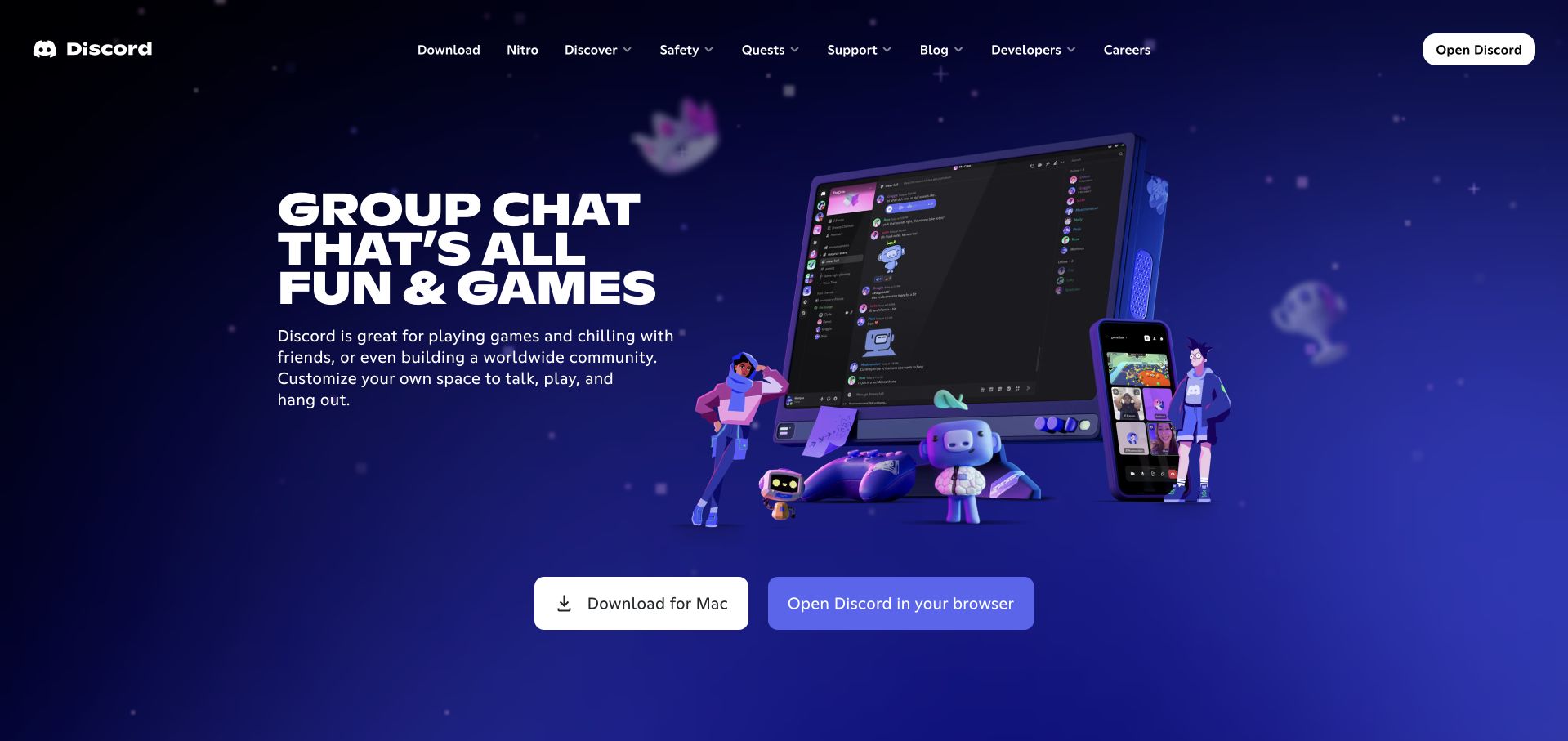
Discord makes the social setting tangible before asking visitors to choose a technical route. The large headline, playful environment and device illustrations present a place to spend time together, while the download and browser options acknowledge different starting preferences. The dense illustration is balanced by a short block of readable copy. This is a useful way to sell an experience without replacing the interface entirely with abstract branding. The official 2020 Elixir case concerns chat gateways, message replication and communication signaling; it does not attribute the pictured frontend or media codecs to Elixir.
What you can learn
Show enough of the product to explain the shared activity, then give each practical starting route a clear label. Keep technical implementation claims attached to the specific service described by their source.
Pros
The paired starting actions accommodate visitors who prefer installation or immediate browser access.
Device imagery connects the expressive brand world to an understandable communication interface.
Cons & considerations
The elaborate hero asks readers to separate decorative scenery from actual product behavior.
A broad social promise leaves specialized administration and moderation questions for deeper pages.
Platform source: Primary scoped Elixir implementation evidence. Chat gateway, realtime messaging replication and voice/video signaling; not the media codecs or all frontend code. Documentary association limited to the named public product or component. The cited implementation date is preserved; a fresh source reading does not establish current deployment continuity, the pictured marketing frontend, every company system or unrelated customer properties. Platform evidence is separate from the direct website screenshot and is not a complete current infrastructure audit.
The BBC homepage uses hierarchy to make a large editorial offering approachable. A dominant central story sits beside smaller articles, while category navigation provides another way into the publication. The restrained white background and familiar masthead leave images and headlines to establish contrast. Readers can skim a headline or choose a subject without first interpreting a product pitch. The named BBC engineer’s conference abstract documents Elixir in routing and resilience infrastructure serving public web and app traffic. That supports a specific delivery association, not a claim that every editorial system or visible component is written in Elixir.
What you can learn
Give the most important story a clear scale advantage while preserving alternative routes for readers with a known interest. Infrastructure can support this experience without becoming the subject of the public interface.
Pros
Different story sizes communicate priority without requiring an explanatory legend or onboarding.
Platform source: Primary scoped Elixir implementation evidence. BBC routing/resiliency infrastructure serving almost all public web and app traffic, documented in the named BBC tech lead conference abstract. Not a claim that all BBC content systems or page components use Elixir. Documentary association limited to the named public product or component. The cited implementation date is preserved; a fresh source reading does not establish current deployment continuity, the pictured marketing frontend, every company system or unrelated customer properties. Platform evidence is separate from the direct website screenshot and is not a complete current infrastructure audit.
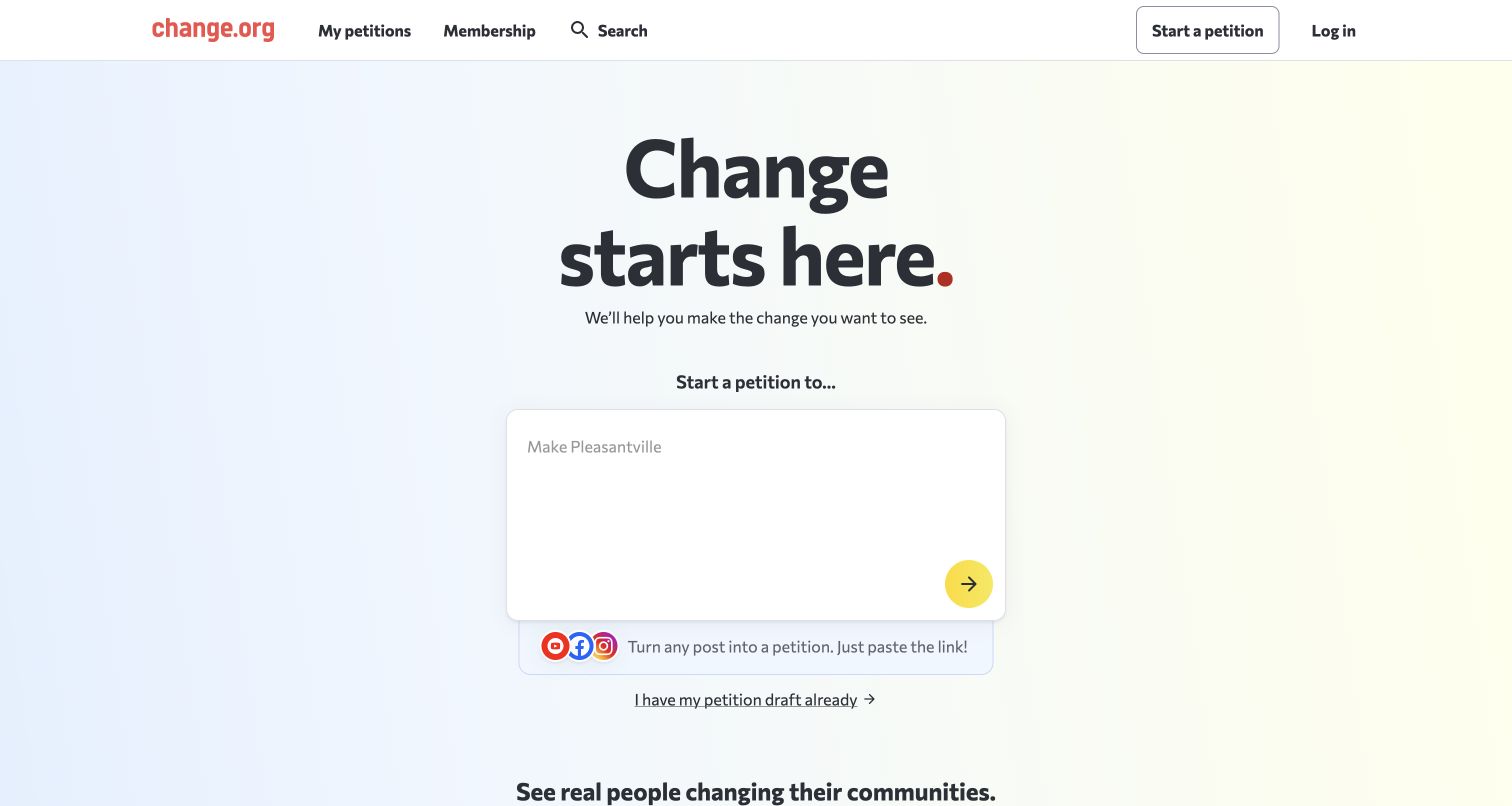
Change.org leads with the action that defines the platform: starting a petition. A large statement and generous input area sit on a soft gradient, giving the first action a clear visual center. That makes the proposed activity concrete, while the wider petition content provides context for people who are still exploring. The 2020 Elixir account describes messaging and a Phoenix API that selected user-facing copy. It establishes a bounded product association, not a current claim about the homepage renderer or every petition-processing service.
What you can learn
State the user’s intended action in familiar terms, then offer enough context to help them judge whether to proceed. Separate the clarity of an invitation from claims about the result it will achieve.
Pros
The central invitation gives an unfamiliar visitor a clear explanation of the platform’s purpose.
A short starting path makes participation feel understandable before detailed account requirements appear.
Cons & considerations
A strongly action-led opening gives cautious visitors less immediate space for process questions.
The simplified entry cannot itself explain how petitions are reviewed, promoted or resolved.
Platform source: Primary scoped Elixir implementation evidence. Public petition product messaging and the Phoenix Bandit API choosing user-facing copy; not proof of the current homepage renderer. Documentary association limited to the named public product or component. The cited implementation date is preserved; a fresh source reading does not establish current deployment continuity, the pictured marketing frontend, every company system or unrelated customer properties. Platform evidence is separate from the direct website screenshot and is not a complete current infrastructure audit.
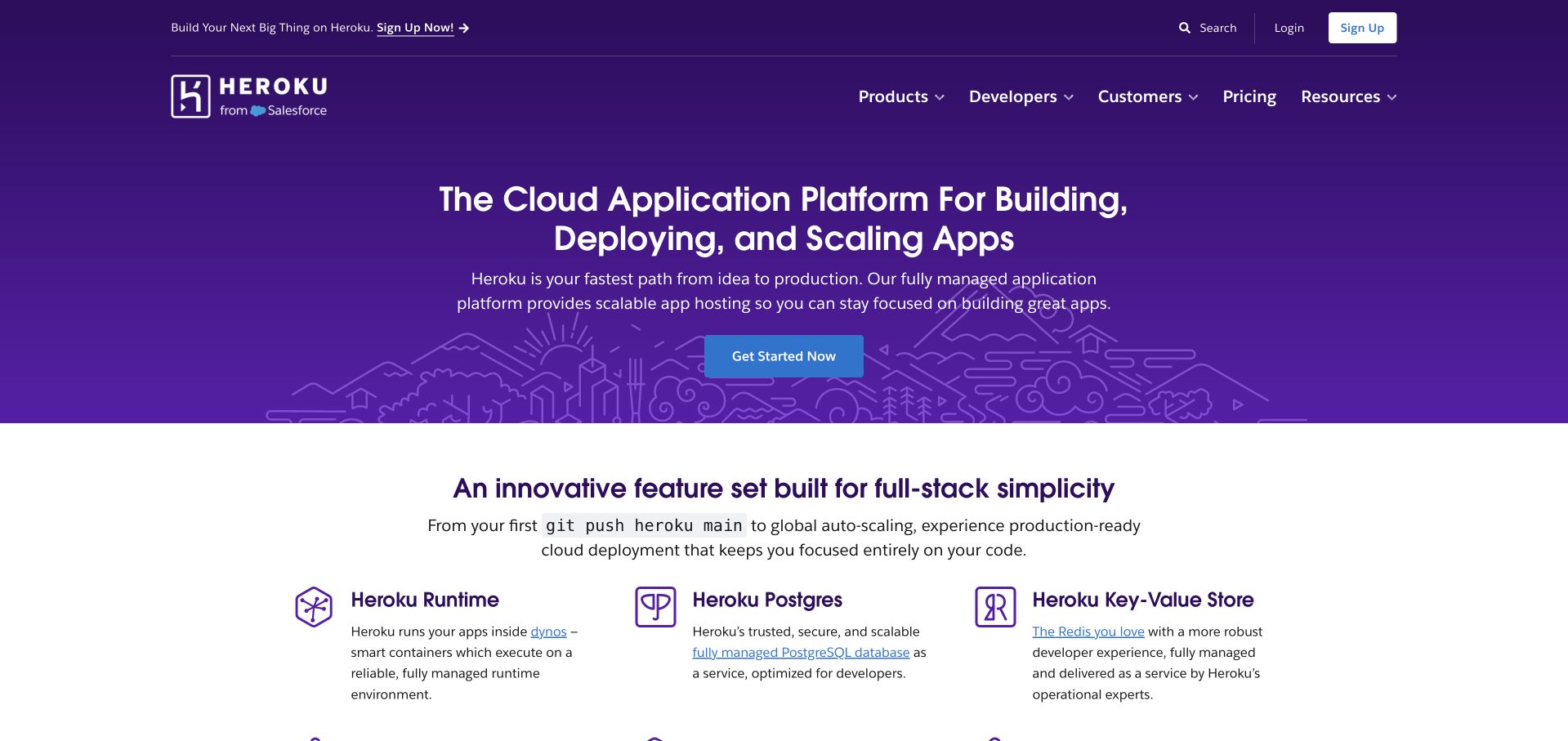
Heroku uses a centered platform proposition and a prominent starting action to orient visitors before exposing more specific capabilities. The purple identity is consistent across the opening area, while the next product blocks distinguish runtime, database and supporting services. Navigation offers documentation and pricing for people who already know what they need. This combination helps a broad platform avoid presenting every capability at the same weight. The official 2020 Elixir account concerns the customer Dashboard backend and realtime WebSocket features. It is not evidence that the marketing page or unrelated internal tools share that implementation.
What you can learn
Move from a concise platform description to named capabilities and practical evaluation routes. Make it easy for an experienced visitor to reach documentation without forcing them through the same introduction as a beginner.
Pros
The central starting action is easy to distinguish from the surrounding informational navigation.
Named service blocks turn a broad cloud-platform claim into more concrete product categories.
Cons & considerations
The general opening leaves workload-specific constraints and operating details to subsequent pages.
A wide platform menu may still require newcomers to learn unfamiliar service terminology.
Platform source: Primary scoped Elixir implementation evidence. Heroku Dashboard backend and realtime WebSocket functionality; exclude internal Vault billing tools and do not label the marketing HTML as Elixir. Documentary association limited to the named public product or component. The cited implementation date is preserved; a fresh source reading does not establish current deployment continuity, the pictured marketing frontend, every company system or unrelated customer properties. Platform evidence is separate from the direct website screenshot and is not a complete current infrastructure audit.
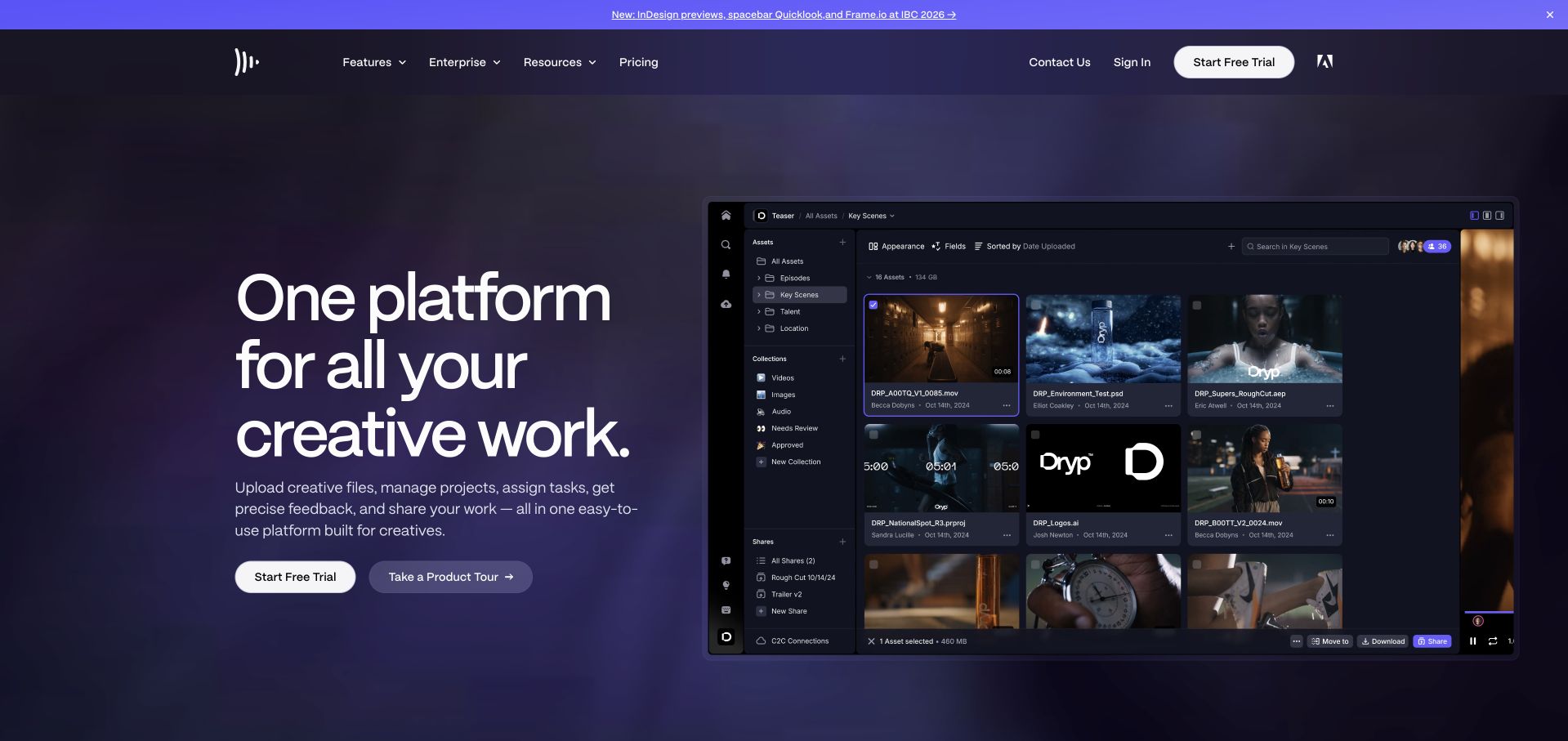
Adobe Frame.io connects an expressive creative promise with a substantial product-interface illustration. The violet and dark composition gives the page a recognizable mood, while the asset-management view shows what the service organizes. Trial and product-tour routes support visitors at different stages of evaluation. Adobe identification in the header adds organizational context without replacing the product name. A 2026 engineer’s conference abstract describes Elixir search pipelines, and Frame.io’s own 2018 account documents an Elixir backend and API rewrite. Neither source establishes the pictured marketing frontend or other Adobe products.
What you can learn
Place a real work surface beside the positioning statement so visitors can translate an abstract promise into an actual task. Offer both exploration and commitment paths without making them visually indistinguishable.
Pros
The interface image gives the creative language a specific organizational and collaborative context.
Separate trial and tour actions accommodate different levels of readiness to engage.
Cons & considerations
The richly styled opening can pull attention away from smaller supporting navigation labels.
A broad creative workflow still needs deeper explanation of roles, permissions and project handoffs.
Platform source: Primary scoped Elixir implementation evidence. Frame.io AI-search pipelines documented by its Adobe/Frame.io engineer in 2026; a separate 2018 company article documents the backend/API rewrite in Elixir. These do not establish the marketing frontend or other Adobe products. Documentary association limited to the named public product or component. The cited implementation date is preserved; a fresh source reading does not establish current deployment continuity, the pictured marketing frontend, every company system or unrelated customer properties. Platform evidence is separate from the direct website screenshot and is not a complete current infrastructure audit.
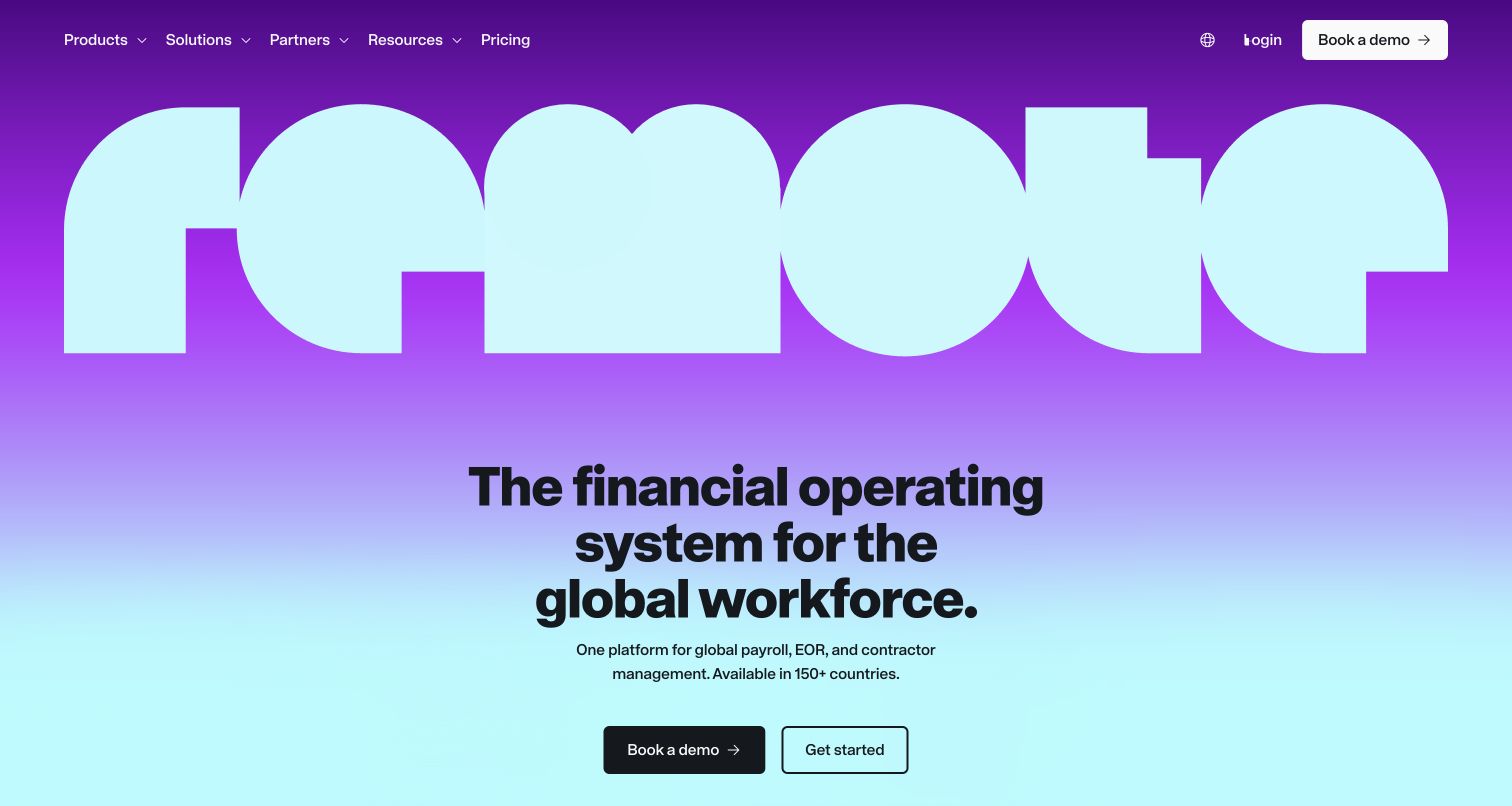
Remote’s public page brings a wide employment offering under a single workforce proposition. An oversized wordmark fills the purple gradient above a centered proposition, with the broader product navigation held in a compact row. Demo and self-service paths recognize that a buyer researching organizational requirements may need a different conversation from someone ready to begin. The 2025 Elixir case documents the employment product’s backend monolith and a separately deployed partner API. That relationship belongs to the service being presented; it does not identify the marketing page’s content system or prove every feature uses the same architecture.
What you can learn
Group a broad service around the problem customers recognize, then separate routes by their immediate needs. Preserve enough product vocabulary to make those routes meaningful without turning the opening screen into an internal organization chart.
Pros
Distinct evaluation routes acknowledge that business buyers do not all arrive ready for self-service.
A strong central proposition gives the extensive product navigation a useful common context.
Cons & considerations
The breadth of workforce services can make a narrowly focused visitor scan several categories.
A large brand treatment occupies space that could otherwise introduce practical operating detail.
Platform source: Primary scoped Elixir implementation evidence. Employment product backend monolith and separately deployed public partner API; not the marketing website CMS. Documentary association limited to the named public product or component. The cited implementation date is preserved; a fresh source reading does not establish current deployment continuity, the pictured marketing frontend, every company system or unrelated customer properties. Platform evidence is separate from the direct website screenshot and is not a complete current infrastructure audit.
VEEPS presents the product through its performances rather than an abstract description of streaming infrastructure. A large concert image sits against a black background, while schedule and genre navigation support visitors without a particular show in mind. Subscription and individual-ticket routes need to coexist because they answer different purchasing intentions. The official 2024 case documents Elixir in the streaming service backend and LiveView product development. That evidence does not mean Elixir encodes the video media, and the captured public catalog does not independently establish a complete playback or payment stack.
What you can learn
Let the content explain why the service matters, then make the available access models understandable. Keep discovery usable for visitors who are comparing options and have not yet decided to create an account.
Pros
Recognizable performance imagery gives a visitor concrete material to assess before committing.
Separate access routes acknowledge the difference between an ongoing subscription and one event.
Cons & considerations
Prominent featured programming can overshadow smaller catalog categories or less familiar performers.
Multiple access models require careful explanation of what each purchase actually includes.
Platform source: Primary scoped Elixir implementation evidence. Streaming service backend and LiveView product development documented in the VEEPS case; no claim that Elixir encodes video media. Documentary association limited to the named public product or component. The cited implementation date is preserved; a fresh source reading does not establish current deployment continuity, the pictured marketing frontend, every company system or unrelated customer properties. Platform evidence is separate from the direct website screenshot and is not a complete current infrastructure audit.
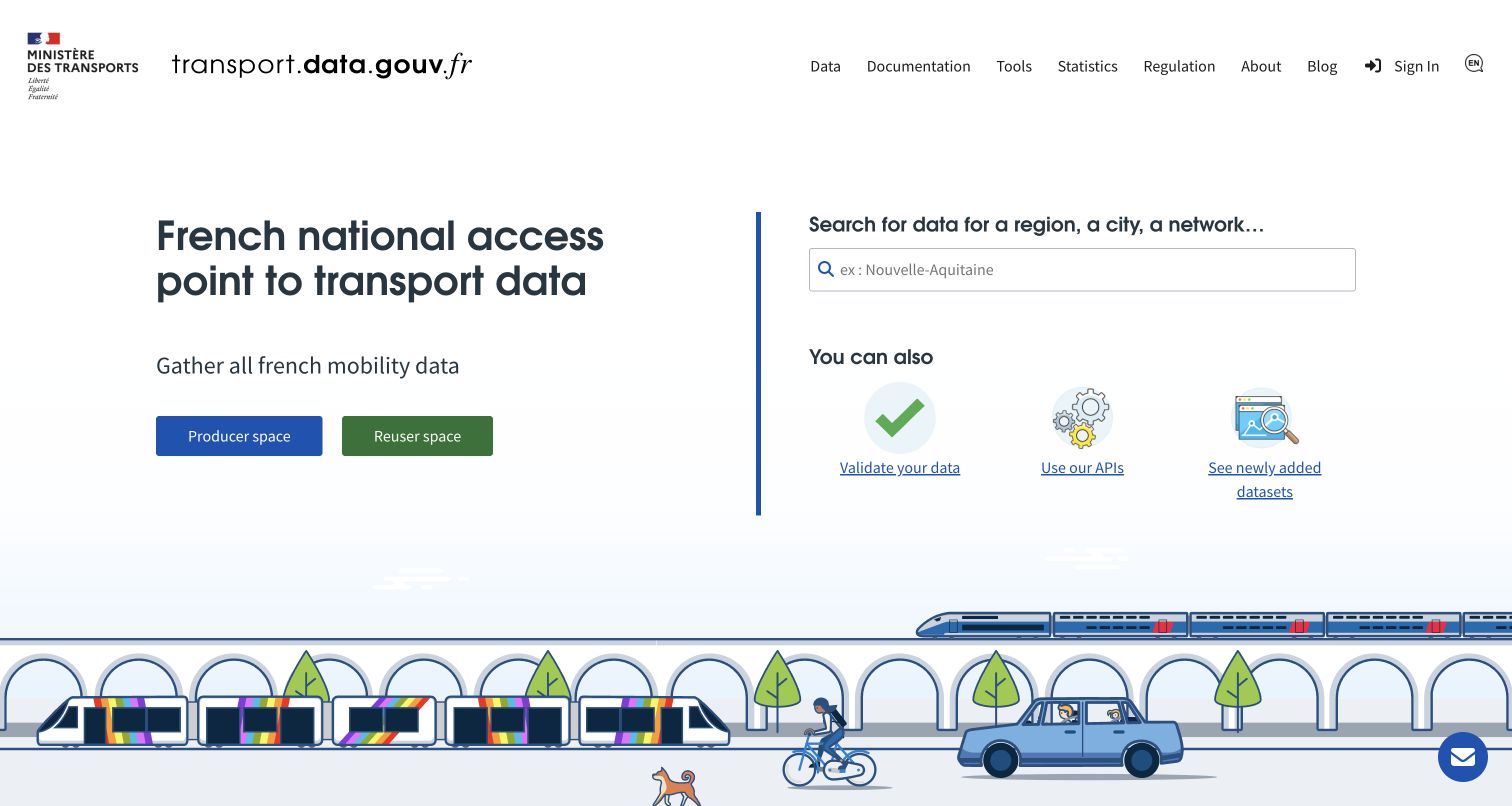
French Transport Open Data gives a technical public service a practical entry point. Search helps visitors locate datasets, while separate producer and reuser routes explain two distinct relationships with the same resource. Technical utilities and data-quality information make the portal more useful than a directory of downloads alone. A blue divider separates the two main areas, and the transport illustration reinforces the subject without displacing useful controls. The official 2021 Elixir case names this exact public application and its search, validation and visualization work, making the property connection more direct than a general customer-logo association.
What you can learn
Organize a shared resource around the jobs people perform with it. Explain how to contribute, find and evaluate information, and make quality context available alongside the route to the underlying material.
Pros
Role-specific routes help different professional audiences find the right starting point quickly.
Search and technical utilities connect the explanatory homepage to the portal’s actual work.
Cons & considerations
Specialist terminology still requires background knowledge from first-time or occasional data users.
A functional portal must balance many utilities without allowing secondary tools to obscure discovery.
Visible tech stack
Earlier / documented evidence
Elixir
Platform source: Primary scoped Elixir implementation evidence. Exact public transport data search, validation and visualization web application. Documentary association limited to the named public product or component. The cited implementation date is preserved; a fresh source reading does not establish current deployment continuity, the pictured marketing frontend, every company system or unrelated customer properties. Platform evidence is separate from the direct website screenshot and is not a complete current infrastructure audit.
V7 Darwin presents a focused annotation product rather than treating every V7 offering as interchangeable. The sparse opening pairs large type with a project-discussion button; annotated images below make the labeling task concrete. This distinction matters because V7’s main corporate site now promotes a different product, V7 Go. The official 2021 Elixir case describes the annotation and computer-vision platform’s API and orchestration. Current official links establish Darwin as the relevant product continuation, but they do not turn the older account into proof of today’s marketing renderer or V7 Go implementation.
What you can learn
Keep a specialist product’s name, task and evaluation route explicit when the wider company has several offerings. Match implementation evidence to that product rather than transferring a familiar technology claim across the entire brand.
Pros
A distinct product identity reduces confusion between annotation work and other company offerings.
The project-oriented contact route suits visitors whose requirements may need individual discussion.
Cons & considerations
A broad opening proposition leaves dataset-specific workflow questions for more detailed investigation.
The visible cookie notice occupies part of the first screen in the retained capture.
Platform source: Primary scoped Elixir implementation evidence. Historical V7 annotation/computer-vision platform API and orchestration, now represented by the separately linked Darwin product; do not transfer this evidence to V7 Go or current Darwin marketing renderer. Documentary association limited to the named public product or component. The cited implementation date is preserved; a fresh source reading does not establish current deployment continuity, the pictured marketing frontend, every company system or unrelated customer properties. Platform evidence is separate from the direct website screenshot and is not a complete current infrastructure audit.
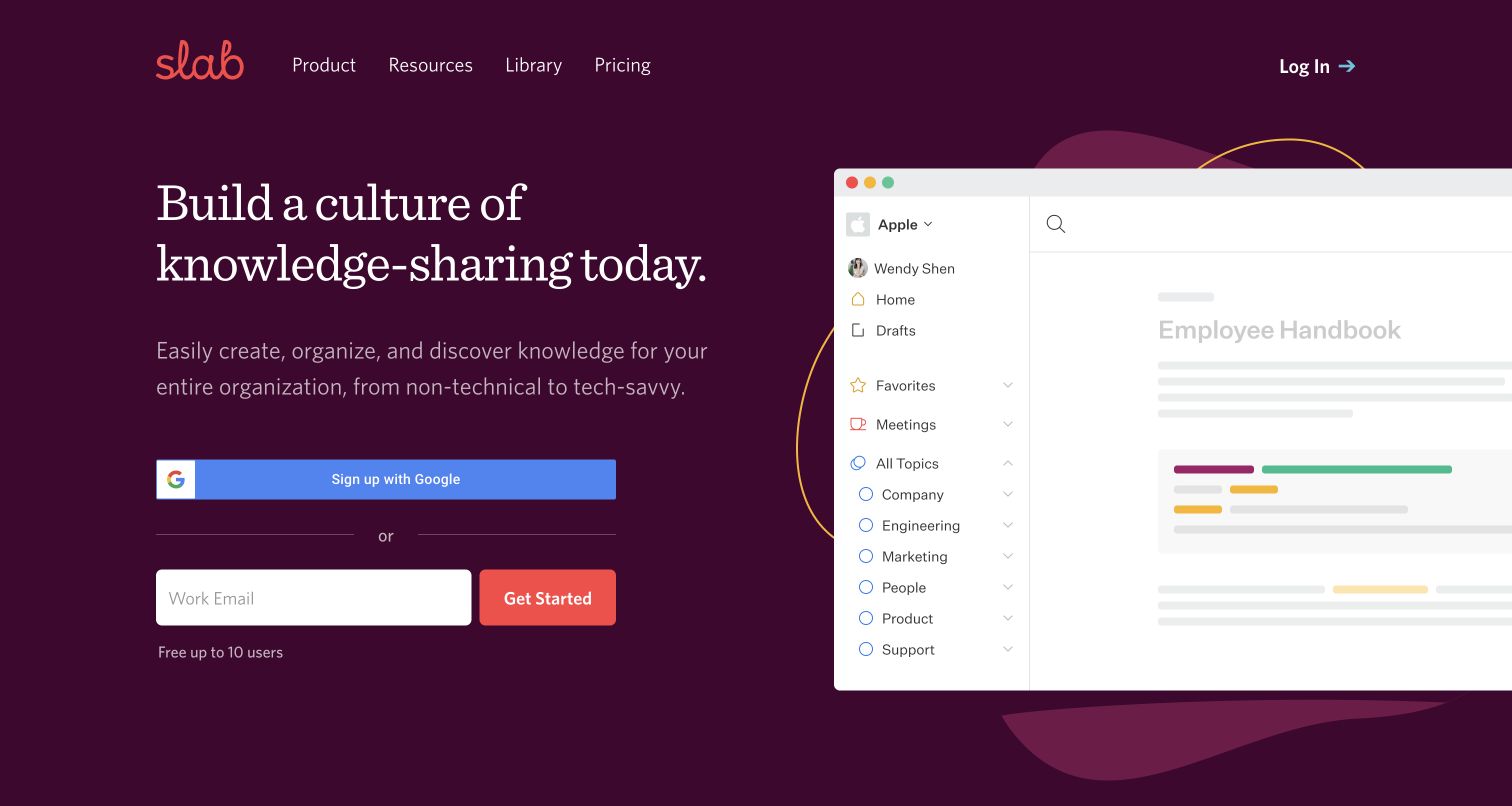
Slab keeps its opening explanation close to the everyday task of sharing and finding team knowledge. Serif type on a deep plum background sits beside a large knowledge-base preview, balancing positioning with a recognizable working surface. Google and work-email choices make the next step recognizable, while the wider product structure explains creation, organization and search. This is a useful example of making a collaborative product understandable before describing its implementation. The official 2020 Elixir case concerns the knowledge-base backend and realtime collaboration; it does not establish the current marketing page runtime or every connected integration.
What you can learn
Use the language of the recurring work people want to improve, then make the entry choices predictable. Introduce deeper organizational and collaboration capabilities after the visitor understands the basic information problem.
Pros
The concise knowledge-sharing proposition is easy to connect to an existing workplace task.
Familiar starting choices reduce ambiguity about how a new visitor can begin evaluation.
Cons & considerations
The simple opening cannot demonstrate how a large or disorganized knowledge collection behaves.
Immediate signup choices may arrive before a cautious buyer has resolved governance questions.
Platform source: Primary scoped Elixir implementation evidence. Knowledge-base product backend and realtime collaboration documented in the official case; not proof of marketing page runtime. Documentary association limited to the named public product or component. The cited implementation date is preserved; a fresh source reading does not establish current deployment continuity, the pictured marketing frontend, every company system or unrelated customer properties. Platform evidence is separate from the direct website screenshot and is not a complete current infrastructure audit.
Duffel makes a technical travel offering approachable by naming the capabilities developers and business teams can use. Flights, stays and supporting product routes give the platform concrete boundaries, while documentation and getting-started paths serve visitors ready for implementation detail. The centered headline and paired actions lead into travel-interface illustrations, giving the infrastructure a visible customer context. The official 2020 Elixir case concerns the flights API and airline-integration orchestration. That does not establish the implementation of airline websites, every later Duffel service or the current marketing frontend.
What you can learn
Translate integration complexity into clearly named customer capabilities, then provide a direct route to the technical contract. Keep the commercial explanation and developer documentation connected without trying to compress both into one introductory paragraph.
Pros
Named travel capabilities give a broad infrastructure offer recognizable and useful categories.
Developer-oriented entry points help technical evaluators move beyond the marketing explanation efficiently.
Cons & considerations
Several related travel products can complicate the starting choice for a narrowly scoped integration.
The public introduction cannot replace careful review of booking constraints and commercial responsibilities.
Platform source: Primary scoped Elixir implementation evidence. Flights API and airline integration orchestration; no inference about airline websites or the current marketing frontend. Documentary association limited to the named public product or component. The cited implementation date is preserved; a fresh source reading does not establish current deployment continuity, the pictured marketing frontend, every company system or unrelated customer properties. Platform evidence is separate from the direct website screenshot and is not a complete current infrastructure audit.
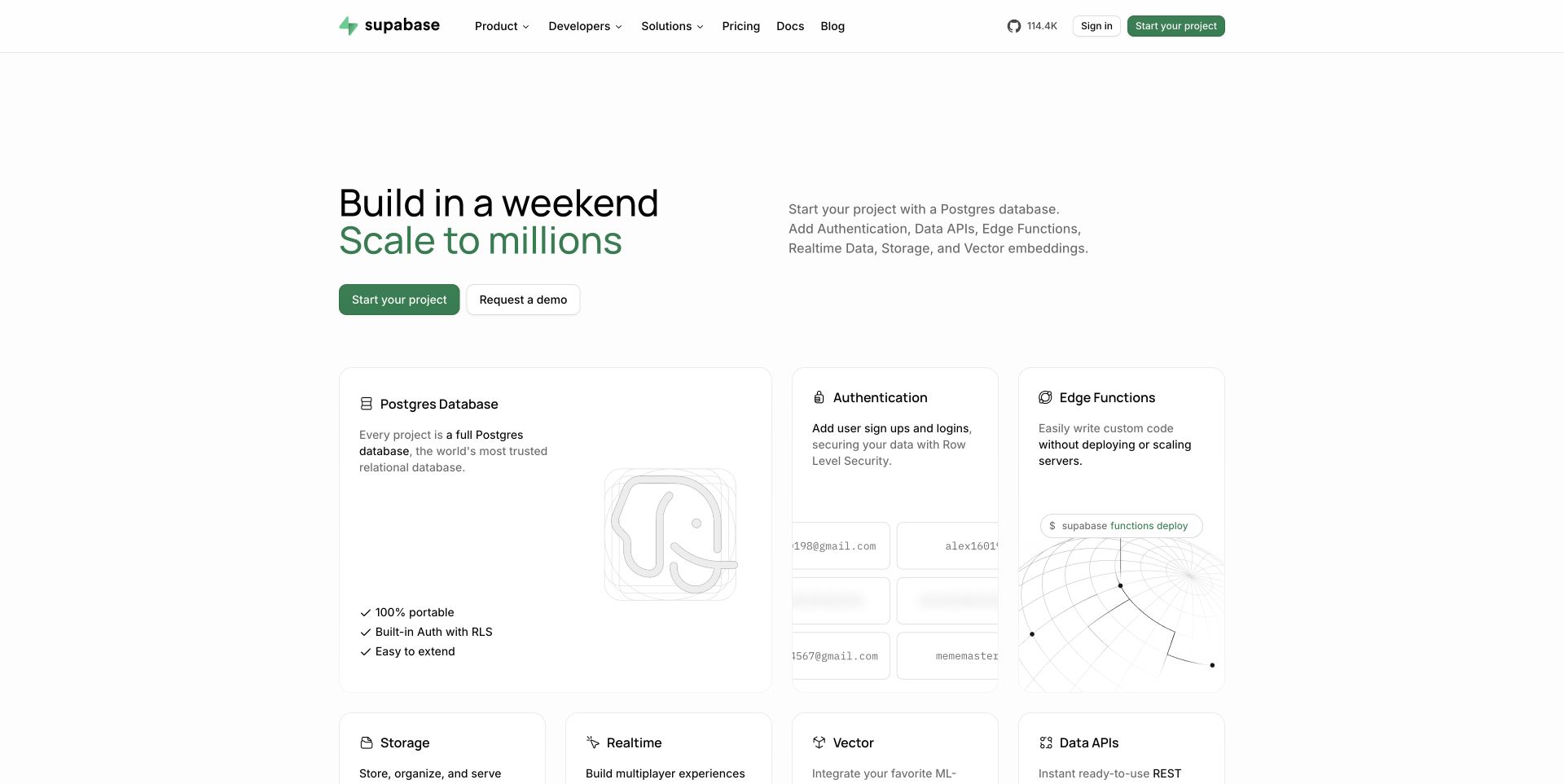
Supabase gives a broad developer platform a legible structure through a central proposition and a grid of named capabilities. Database, authentication, functions and realtime features appear as distinct parts rather than an undifferentiated feature paragraph. Green accents and clear starting actions help orient the eye across the otherwise restrained layout. The current architecture documentation specifically describes an Elixir cluster behind Supabase Realtime and its client-facing WebSocket connections. It does not identify PostgreSQL itself, the marketing frontend or every application built by a Supabase customer as an Elixir implementation.
What you can learn
Show how the platform’s parts relate while preserving their individual purposes. A clear capability grid can help visitors form a useful mental map, provided the documentation keeps each component’s responsibility and limits explicit.
Pros
The product grid turns a wide service offering into recognizable, separately explorable capabilities.
Project and demo actions support both direct experimentation and guided evaluation routes.
Cons & considerations
A dense collection of capabilities can make a beginner unsure which dependency comes first.
The short product cards necessarily leave operational limits and integration details elsewhere.
Platform source: Primary scoped Elixir implementation evidence. Supabase Realtime distributed Elixir cluster and client-facing WebSockets, not Postgres itself or the Supabase marketing frontend. Documentary association limited to the named public product or component. The cited implementation date is preserved; a fresh source reading does not establish current deployment continuity, the pictured marketing frontend, every company system or unrelated customer properties. Platform evidence is separate from the direct website screenshot and is not a complete current infrastructure audit.
Mux combines a direct video proposition with a distinctive but controlled visual language. A pale grid, strong black type and bright action buttons give the page a technical character without burying the message in code. Getting-started and documentation routes recognize the needs of developers evaluating an integration. The logo row adds context after the main explanation rather than replacing it. Mux’s 2018 engineering account documents Elixir and Phoenix in its realtime customer analytics dashboard. That historical scope does not establish every current Mux service, video-processing component or marketing-page dependency.
What you can learn
Use visual character to reinforce the product category, then keep practical evaluation routes obvious. Developer credibility comes from a clear capability and accessible documentation as well as the style of the opening screen.
Pros
The restrained grid and typography give the technical product a recognizable visual identity.
Documentation remains a visible alternative to immediately beginning a new integration.
Cons & considerations
The broad video statement leaves particular delivery and analytics requirements for deeper pages.
Decorative technical motifs can consume attention without explaining the integration contract themselves.
Platform source: Primary scoped Elixir implementation evidence. Realtime customer analytics dashboard architecture with Phoenix and Elixir; historical implementation evidence rather than current whole-site stack proof. Documentary association limited to the named public product or component. The cited implementation date is preserved; a fresh source reading does not establish current deployment continuity, the pictured marketing frontend, every company system or unrelated customer properties. Platform evidence is separate from the direct website screenshot and is not a complete current infrastructure audit.
Plausible presents its analytics offering through a short explanation, clear trial and demo choices, and a visible dashboard preview. The restrained white and purple composition lets the product’s reporting surface do much of the explanatory work. Visitors can connect the promise to recognizable measurements before deciding whether to investigate further. The company’s technology article and current engineering-role description identify Elixir and Phoenix in the analytics application. That does not make websites measured by Plausible Elixir implementations, and the public presentation is not independent verification of every privacy or compliance claim.
What you can learn
Give a focused product a concrete demonstration close to its explanation. A dashboard image can make the task understandable, while a live-demo route lets cautious visitors evaluate the interface before opening an account.
Pros
The dashboard preview turns a general analytics proposition into an identifiable working surface.
Trial and demo routes accommodate visitors with different levels of readiness to begin.
Cons & considerations
A simple presentation leaves more advanced reporting and integration requirements for further evaluation.
Privacy-oriented positioning still requires buyers to assess their own configuration and obligations.
Platform source: Primary scoped Elixir implementation evidence. Analytics application built with Elixir and Phoenix; does not make every tracked customer website an Elixir implementation. Documentary association limited to the named public product or component. The cited implementation date is preserved; a fresh source reading does not establish current deployment continuity, the pictured marketing frontend, every company system or unrelated customer properties. Platform evidence is separate from the direct website screenshot and is not a complete current infrastructure audit.
Felt organizes its public presentation around the map as a working surface. Product and use-case routes help visitors relate the platform to their own geographic information, while the collaborative proposition explains why the service extends beyond a static image. Paper-like colors, a detailed map and a sample question connect the spatial task to a recognizable working context. Felt’s own engineering account identifies Elixir in its collaborative backend and separately describes Python for upload and geospatial processing. The distinction prevents a useful component association from becoming an inaccurate claim about the entire mapping pipeline.
What you can learn
Show the medium people will work in and connect it to a clear collaborative task. Keep specialized processing details available for evaluators, while preserving an understandable explanation for visitors who approach the product through a business problem.
Pros
A map-centered presentation makes the product category immediately recognizable to spatial-data users.
Use-case routes help connect a flexible platform to more specific professional needs.
Cons & considerations
Broad platform positioning can leave newcomers uncertain about the simplest initial dataset workflow.
Visually rich maps may require additional explanation of editing, sharing and data ownership.
Platform source: Primary scoped Elixir implementation evidence. Collaborative mapping and multiplayer backend in Elixir; source distinguishes Python upload/geospatial processing. Documentary association limited to the named public product or component. The cited implementation date is preserved; a fresh source reading does not establish current deployment continuity, the pictured marketing frontend, every company system or unrelated customer properties. Platform evidence is separate from the direct website screenshot and is not a complete current infrastructure audit.
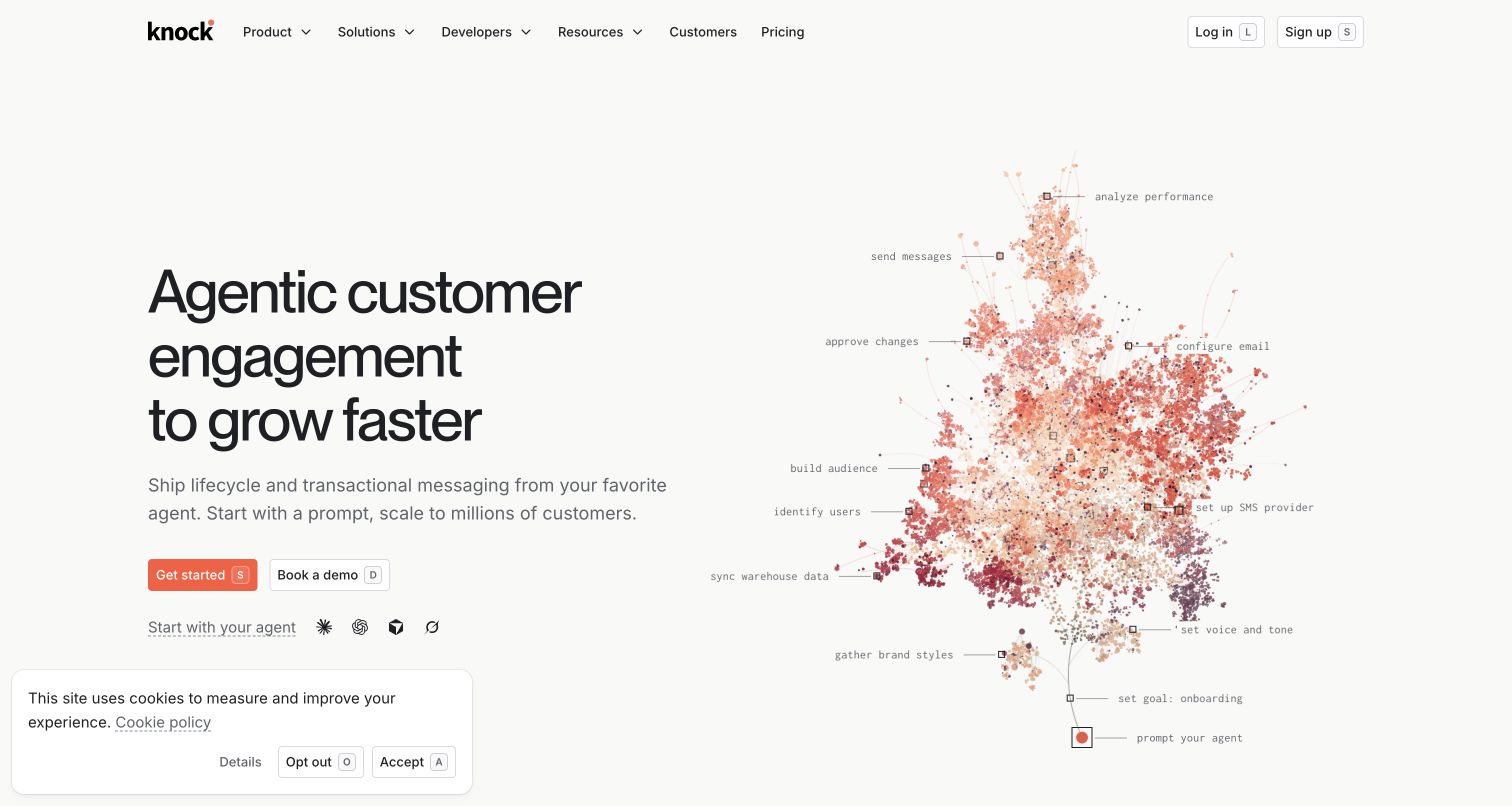
Knock frames its public offering around customer engagement and the orchestration of messages. A fine-grained network illustration labels different messaging tasks beside the headline, while compact starting and demo controls sit beneath the explanation. Its current positioning includes newer agent-oriented language, which makes precise evidence dates especially important. The co-founder and CTO’s 2022 account identifies Elixir as the notification-product backend choice. That does not independently establish every newly introduced feature, the marketing renderer or the implementation of customers integrating the service.
What you can learn
Explain what the service coordinates and who benefits from that coordination. When positioning evolves, keep older implementation accounts tied to the component and period they describe rather than silently extending them to new product claims.
Pros
The engagement framing connects technical messaging infrastructure to an understandable customer-facing purpose.
Product and developer routes can serve buyers and implementers without forcing identical journeys.
Cons & considerations
New category language may require extra explanation for visitors evaluating a straightforward notification need.
A broad orchestration promise needs deeper documentation to clarify responsibility across external channels.
Platform source: Primary scoped Elixir implementation evidence. Notification-product backend chosen in Elixir, as stated by its co-founder/CTO; no inference about customer sites using Knock or marketing renderer. Documentary association limited to the named public product or component. The cited implementation date is preserved; a fresh source reading does not establish current deployment continuity, the pictured marketing frontend, every company system or unrelated customer properties. Platform evidence is separate from the direct website screenshot and is not a complete current infrastructure audit.
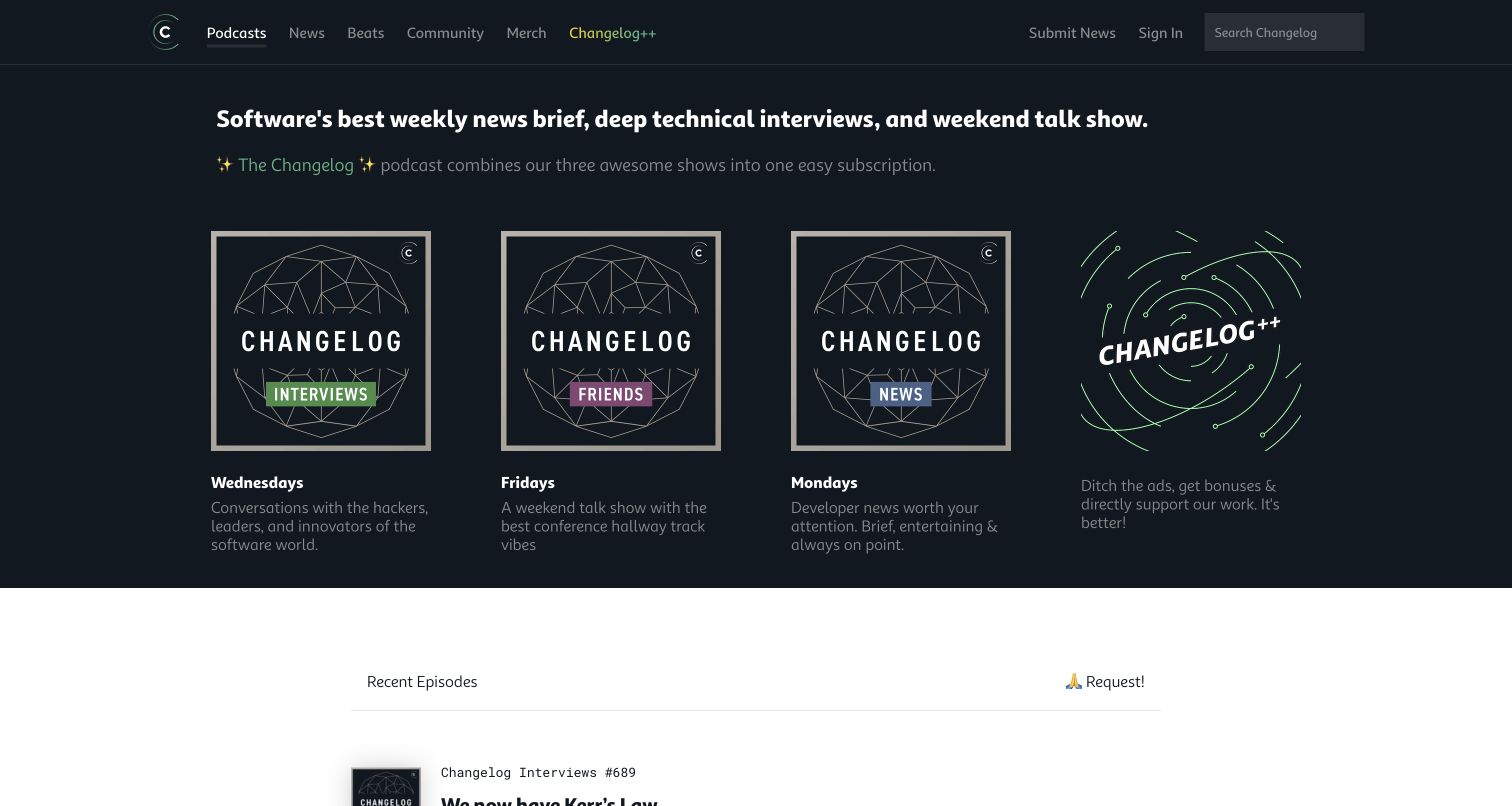
Changelog puts its editorial products and discovery routes at the center of the public experience. Three matching show cards explain different formats and weekly cadences; header search helps visitors who arrive with a particular topic in mind. This makes the website useful as a working publication rather than merely a brochure about one. The official project repository explicitly identifies itself as the Elixir and Phoenix CMS behind changelog.com. The separate public-source audit was robots-excluded, so the repository supports a documentary association without pretending that a new page scan confirmed the complete visible stack.
What you can learn
Let a publication demonstrate its value through accessible content and archive navigation. Keep the implementation evidence separate from the editorial review, especially when a bounded public audit cannot inspect the source page.
Pros
Content-led entry points give regular visitors a reason to return beyond a brand introduction.
Search supports focused discovery across a publication with many recurring episodes and articles.
Cons & considerations
Several editorial formats can make the best starting series less obvious to an unfamiliar reader.
A large archive benefits from clear context so older material is not mistaken for current guidance.
Visible tech stack
Earlier / documented evidence
Elixir
Platform source: Primary scoped Elixir implementation evidence. Official source repository explicitly identifies itself as the Elixir/Phoenix CMS behind changelog.com. Documentary association limited to the named public product or component. The cited implementation date is preserved; a fresh source reading does not establish current deployment continuity, the pictured marketing frontend, every company system or unrelated customer properties. Platform evidence is separate from the direct website screenshot and is not a complete current infrastructure audit.
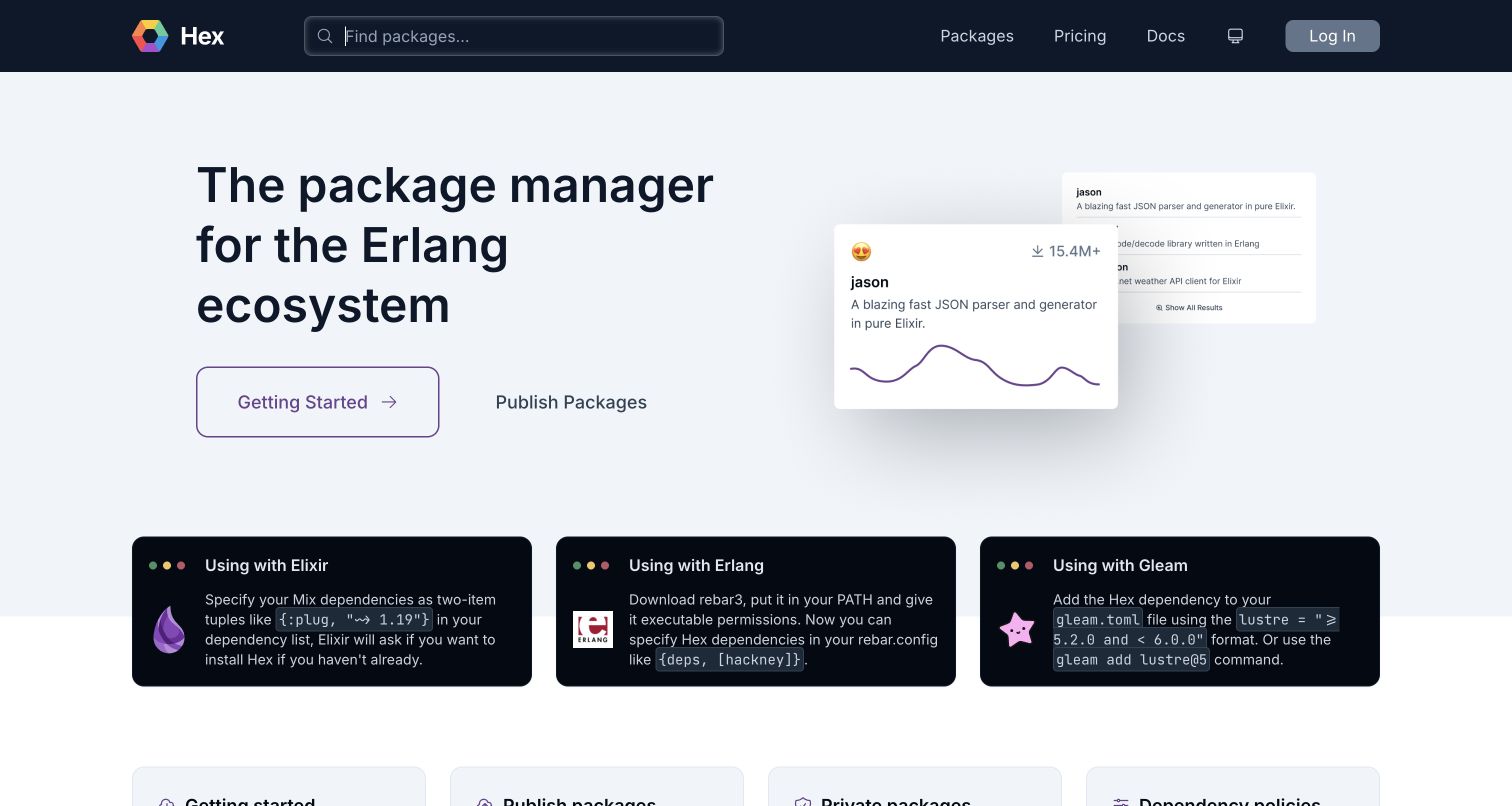
Hex centers the practical task of finding packages. Header search provides a direct entry point, while separate Elixir, Erlang and Gleam examples explain how different developers can start. The restrained presentation suits a resource that developers may revisit frequently with a specific name or dependency in mind. Its official website and API repository contains the Elixir and Phoenix application source for hex.pm. That is evidence about the public service itself, not merely an inference drawn because the directory distributes packages used by Elixir developers.
What you can learn
Put the repeated task first and use supporting information to make discovery more informed. For a technical directory, clear naming and useful package context matter more than a promotional opening that delays access to the resource.
Pros
A direct search path supports returning developers who already know the package they need.
Language-specific onboarding cards connect the directory to practical package-management steps for different developers.
Cons & considerations
Package-oriented terminology assumes familiarity that a first-time ecosystem visitor may not yet have.
Illustrated package popularity does not establish suitability or maintenance quality for a particular project.
Platform source: Primary scoped Elixir implementation evidence. Official website/API repository includes Elixir/Phoenix application source for hex.pm; not merely a package written in Elixir. Documentary association limited to the named public product or component. The cited implementation date is preserved; a fresh source reading does not establish current deployment continuity, the pictured marketing frontend, every company system or unrelated customer properties. Platform evidence is separate from the direct website screenshot and is not a complete current infrastructure audit.
Firezone pairs oversized white and orange type on black with documentation and an administrative entry point. That division helps distinguish learning about the product from operating an existing deployment. Technical material remains important because the service’s responsibilities span several components. Its architecture documentation is unusually useful for qualification: the managed administration portal, control-plane API and policy engine use Elixir and Phoenix, while clients, gateways and relays use Rust. The pictured marketing page is not evidence that all networking work happens in Elixir, and the design review is not a security certification.
What you can learn
Make the evaluation and operating routes distinct, then publish enough architecture context for readers to understand responsibility. Precise component descriptions support credibility better than a broad claim that one language powers the entire security product.
Pros
Documentation and administrative routes acknowledge different needs of prospective and existing users.
Explicit architecture boundaries help technical evaluators ask more accurate implementation questions.
Cons & considerations
A concise opening cannot explain the deployment and policy choices needed for a real organization.
Security-oriented claims still require independent assessment of configuration, operations and project requirements.
Platform source: Primary scoped Elixir implementation evidence. Managed admin portal, control-plane API and policy engine use Elixir/Phoenix; clients, gateways and relays are Rust and not claimed as Elixir. Documentary association limited to the named public product or component. The cited implementation date is preserved; a fresh source reading does not establish current deployment continuity, the pictured marketing frontend, every company system or unrelated customer properties. Platform evidence is separate from the direct website screenshot and is not a complete current infrastructure audit.
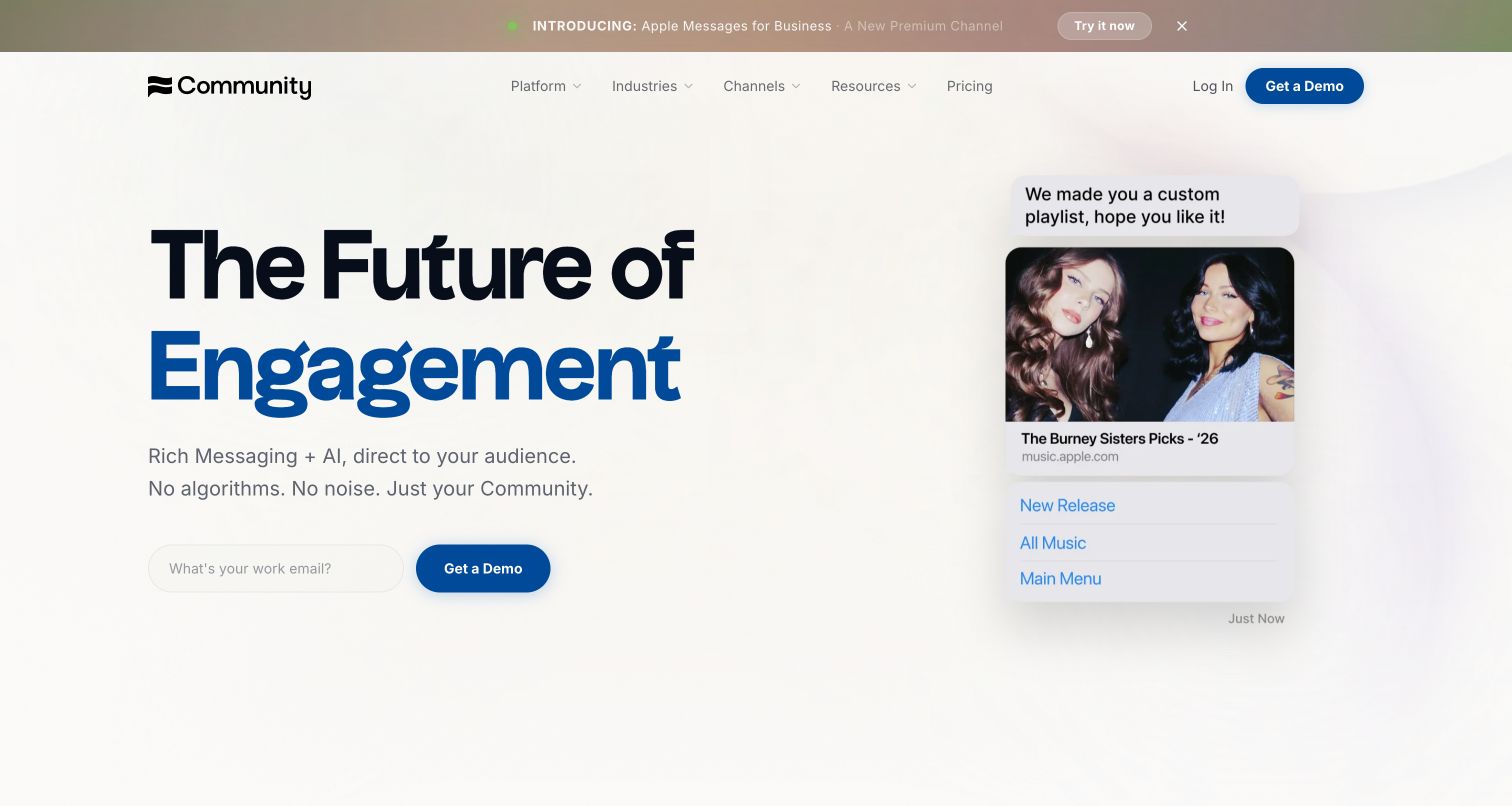
Community presents messaging as a way for organizations and public figures to build a more direct relationship with an audience. A rich-message preview sits beside the headline and an empty demo field, connecting the broad engagement promise to a recognizable customer interaction. Its current positioning includes newer rich-messaging and AI language, so the implementation evidence needs a careful boundary. The official 2021 Elixir case documents the earlier social-messaging product’s message hub and service architecture. It does not confirm every later feature, delivery channel or marketing-page component.
What you can learn
Make the intended relationship and buyer clear before expanding into channel features. When a product grows beyond an older implementation account, preserve the useful history without presenting it as verification of every current capability.
Pros
The audience-relationship framing gives the messaging service a recognizable commercial purpose.
The message preview makes the communication format easier to understand than positioning language alone.
Cons & considerations
Broad engagement language can leave a visitor needing more detail about individual workflows.
Newer channel and AI claims require their own evaluation rather than reliance on historical architecture.
Platform source: Primary scoped Elixir implementation evidence. Social messaging product message hub and service architecture; historical SMS product evidence, not a claim about all newly added AI/RCS features or marketing code. Documentary association limited to the named public product or component. The cited implementation date is preserved; a fresh source reading does not establish current deployment continuity, the pictured marketing frontend, every company system or unrelated customer properties. Platform evidence is separate from the direct website screenshot and is not a complete current infrastructure audit.
Kegan has 15+ years of experience working with small businesses, Fortune 500 companies, and everything in between. No development job is too big or too small: he brings the same hands-on attention to a focused improvement, a complete website, or a custom application.
For Elixir projects, he can help with responsive interfaces, reusable components, custom functionality, API connections, and performance-minded implementation. He works directly with clients on scope, design, implementation, testing, and handover, with an emphasis on clear communication and a system that remains practical to maintain after launch.
Show 3 other Elixir developersHide other Elixir developers
A searchable resource, publishing tool or collaboration product can use a coherent application to own its data and behavior. Establish the core records, permissions and user journeys before adding peripheral features. Phoenix provides a web-development foundation, but the product still needs deliberate decisions about navigation, content, errors and accessible interaction. Start with one useful task that can be explained, completed and maintained clearly.
When several interfaces share a capability, make the service contract explicit. Describe accepted inputs, authorization, response states and how consumers recover from interruptions. A documented Elixir component may support a web application without rendering its marketing pages. The Supabase, Duffel and Firezone examples are useful for thinking about how a public website can explain that narrower service and guide technical visitors toward the correct documentation.
A mature product may introduce Elixir for a specific need while preserving established systems around it. Begin with the problem, current contracts and operating responsibilities. Define what the component owns and what it must leave to another system. Historical accounts in this collection illustrate that kind of boundary; they do not establish that the same architecture remains deployed today. For a new decision, use current project evidence and a maintainable migration plan.
Start with one concrete journey and write the decisions a person must make along it. A developer evaluating an API may need a clear capability statement, documentation, limits and a working starting point. A visitor searching public data needs meaningful labels, useful results and an explanation of what can be reused. A potential customer evaluating collaboration software needs to understand the shared task before creating an account. These are different content problems even when their services use the same language.
List the information required at each step and identify who maintains it. Include an empty result, a missing permission, a changed record and an interrupted session. Decide how the person recognizes progress and how they return to unfinished work. Separate a demonstration from a committed action, especially where a button opens registration or a commercial conversation.
Then choose the content and interaction patterns that make those states legible. A short product illustration may explain more than a broad claim; a searchable list may be more useful than a large promotional hero. Review the journey with realistic examples and plain labels. Keep the first release small enough that every promised path has a clear owner and a complete outcome.
Define ownership, updates and recovery
Write down which component owns each important record and which interface may change it. If several people or clients can act on the same information, describe how they learn about changes and what happens when their view is out of date. Avoid leaving those decisions implicit in a screen design. A status indicator should represent an actual state the application can explain, not simply an animation that suggests progress.
Document the boundary between the browser, the Elixir service and any external dependency. For each request, consider authorization, validation, a successful result and a failure the user can recover from. Establish what can safely be repeated and how duplicate work is recognized. Decide what happens if an external service is slow or unavailable, and which information remains useful while the application waits.
Realtime infrastructure does not remove the need for understandable behavior. Plan reconnect states, delayed updates and conflicting edits in the product language. Keep operational diagnostics separate from personal information shown on public pages. Use the implementation documentation to choose mechanisms, then check the resulting experience against the actual task. Assign an owner to each integration and record the evidence needed to diagnose problems after launch.
Treat implementation claims as maintained content. Record the component, source, publication date and scope behind each statement. A company article about a past backend migration is useful history, but it does not prove the current marketing frontend or every newly launched feature. The same principle applies to project documentation: a diagram should identify the release or system it actually describes. Keep historical decisions available without presenting them as fresh observations.
Build the delivery plan around meaningful checks of the complete task. Include data validation, authorization, failed dependencies, important navigation and recovery from interruption. Use test data and controlled environments for actions that could contact people, alter records or incur charges. Preserve useful public routes when the information architecture changes, and make release verification specific enough to detect a broken asset, missing page or incorrect configuration.
Finally, assign ongoing responsibility. Content, application dependencies, support guidance and operating alerts all need owners. Decide how the team records a change, verifies its result and identifies the version currently serving users. A familiar customer logo can start a conversation about a technology; a documented operating plan is what makes that choice sustainable for your own product.
A useful handover demonstration
Ask the actual team to carry out its routine job: publish a realistic update, correct a mistake, preview a narrow screen, and identify who owns an integration failure. For a library or frontend framework, also ask who maintains the content source and deployment. A polished screenshot does not answer those operational questions.
Beyond the screenshot
An Elixir website planning checklist
Name the audience and its first useful task in ordinary language.
Identify the public website, application, API and external-service boundaries.
Define who owns each record and which actions require authorization.
Explain pending, completed, empty and recoverable failure states.
Plan for delayed updates, reconnection and conflicting information where relevant.
Keep documentation and starting points visible for technical visitors.
Separate product demonstrations from account creation and committed actions.
Tie technology claims to a named component, primary source and actual date.
Check essential navigation, inputs and feedback with keyboard access and varied screen sizes.
Use safe test data for actions that could change records or contact people.
Preserve useful URLs and verify the deployed pages, assets and configuration.
Assign maintenance owners for application dependencies, integrations and public content.
Test with real content, a keyboard, a small screen, slow or failed requests, and the people who will maintain the system. These are planning checks, not an accessibility, security, performance, or search-ranking certification.
Sources & editorial method
How this Elixir collection was reviewed
Twenty distinct public website or product properties were researched for the original November 9 evening batch, with editorial work completed November 10, 2026. The five opening identities are supported by official product pages and primary implementation accounts. Seven verified earlier direct captures retain their original bytes and dates; thirteen new direct captures record their actual UTC timestamps. Every exact source has a retained or newly completed bounded broad audit. Elixir claims come from official case studies, company engineering documentation, public project repositories or named engineers’ conference abstracts; they are documentary associations, not an inferred homepage fingerprint. Older accounts and component boundaries are explicit. No private accounts, purchases, messages or real form submissions were tested.
Every image is an unmodified capture from the actual website, with its source and capture date. Some captures are reused from our shared catalog; their dates remain the original capture dates. None comes from a vendor gallery or a generated reconstruction. Moving imagery and live content can change.
Technology attribution uses public page assets or metadata, official platform documentation, or a cited first-party project case study. Documentary and framework-relationship evidence is identified where used; it is not a complete current backend inventory. A CMS image CDN alone does not establish a full CMS deployment. A library’s presence does not prove which individual controls use it, and a platform label does not establish AI authorship.
The composition notes, lessons, pros and tradeoffs are original editorial observations. We have not measured conversion, traffic, security, performance or accessibility conformance. Website owners retain their brands and imagery; these examples are not our client portfolio. Written, Edited and Curated are independent records, not dates advanced by a build. See our editorial standards or suggest a correction.
Questions worth asking
Elixir website development FAQs
Does every pictured homepage run on Elixir?
That is not established. The guide connects each public property to a documented Elixir component, such as a product backend, realtime service, API or publishing application. Marketing pages may use a separate frontend or content system. Each example states the specific association rather than assigning the whole website to Elixir.
How are Elixir and Phoenix related?
Elixir is a programming language. Phoenix is a web framework written in Elixir, with web and realtime components. An Elixir implementation does not automatically establish Phoenix, LiveView or any particular frontend. Those names require their own supporting evidence.
Are the older implementation accounts current stack audits?
No. They document what the organization or project reported at the stated time. A fresh reading of an older article does not make its architecture current. The guide retains publication dates and does not claim continuous deployment or unchanged implementation without separate evidence.
Why include marketing pages for public products?
A product’s public entry page is useful for studying explanation, navigation and the path toward its documented service. Its screenshot is reviewed as presentation evidence. The associated engineering source establishes only the named product component, and the guide makes that distinction explicit.
Does using Supabase or Knock make a customer’s website an Elixir website?
That inference would be too broad. This collection reviews the service providers’ own public properties and their documented components. It does not transfer their implementation language to every customer, integration or linked website.
What happens when a source audit is partial or blocked?
The attempt and its limitation are retained. No controls are bypassed and no missing backend is guessed. A separately verified documentary association can still be described with its original scope, while the public-response stack remains limited to actual observations.
Borrow the clear product explanations, useful entry points and explicit boundaries in these examples. Choose Elixir from the requirements and maintainability of your own application, and keep every implementation claim tied to the component its source actually describes.