Best MariaDB Websites of 2026 (20 Real-World Examples)
Public design references connected to documented MariaDB applications and customer histories, not inferred homepage databases.
A relational database should support a clear service model. Start with the records, relationships and responsibilities behind the website, then choose the public interface that makes them understandable.
MariaDB can sit behind telecom services, booking systems, analytics and enterprise applications. Those uses do not create a recognizable homepage aesthetic. This collection therefore separates two kinds of evidence: the public page supplies the design reference, while a primary customer story or operational document establishes a specific MariaDB association. Several organizational relationships are historical and are labeled accordingly.
For a new project, the important question is not whether a familiar brand uses MariaDB. It is whether your team can explain the data model, maintain the application and recover its service when something goes wrong. A useful design brief connects the visible customer task to the records and decisions behind it, without exposing database complexity to the person using the website.
Before the examples
What makes good MariaDB website development in 2026?
Model business relationships explicitly
Identify the real entities before designing a dashboard: customers, organizations, orders, invoices, reservations or devices. Decide which relationships are required, which are optional and which may change over time. The interface should not hide these distinctions behind free-text fields that later make reporting or migration unreliable.
A page editor and a reservation record have different lifecycles. Separate draft publishing, customer transactions and analytics responsibilities even if they ultimately use related infrastructure. This makes permissions clearer and prevents a content update from accidentally becoming a risky production-data operation.
Design for recovery, not only successful queries
Test what a customer sees when a connection fails, a record has changed or an action cannot be completed. Preserve enough context to recover safely without displaying raw database errors. The service needs useful logs for operators and understandable messages for users; those are related but different outputs.
The collection · 20 examples
20 MariaDB website examples worth studying
The 20 examples combine current public-page design inspection with scoped official MariaDB evidence. The opening five are recognizable organizations, while dated historical customer references remain distinguished from current workload documentation.
We start with five recognizable brands or organizations: DBS, Nokia, Samsung SDS, Virgin Media O2, Wikipedia. Each attribution applies to the named website property, not every product or website belonging to its organization. This is a curated reading sequence, not a measured ranking.
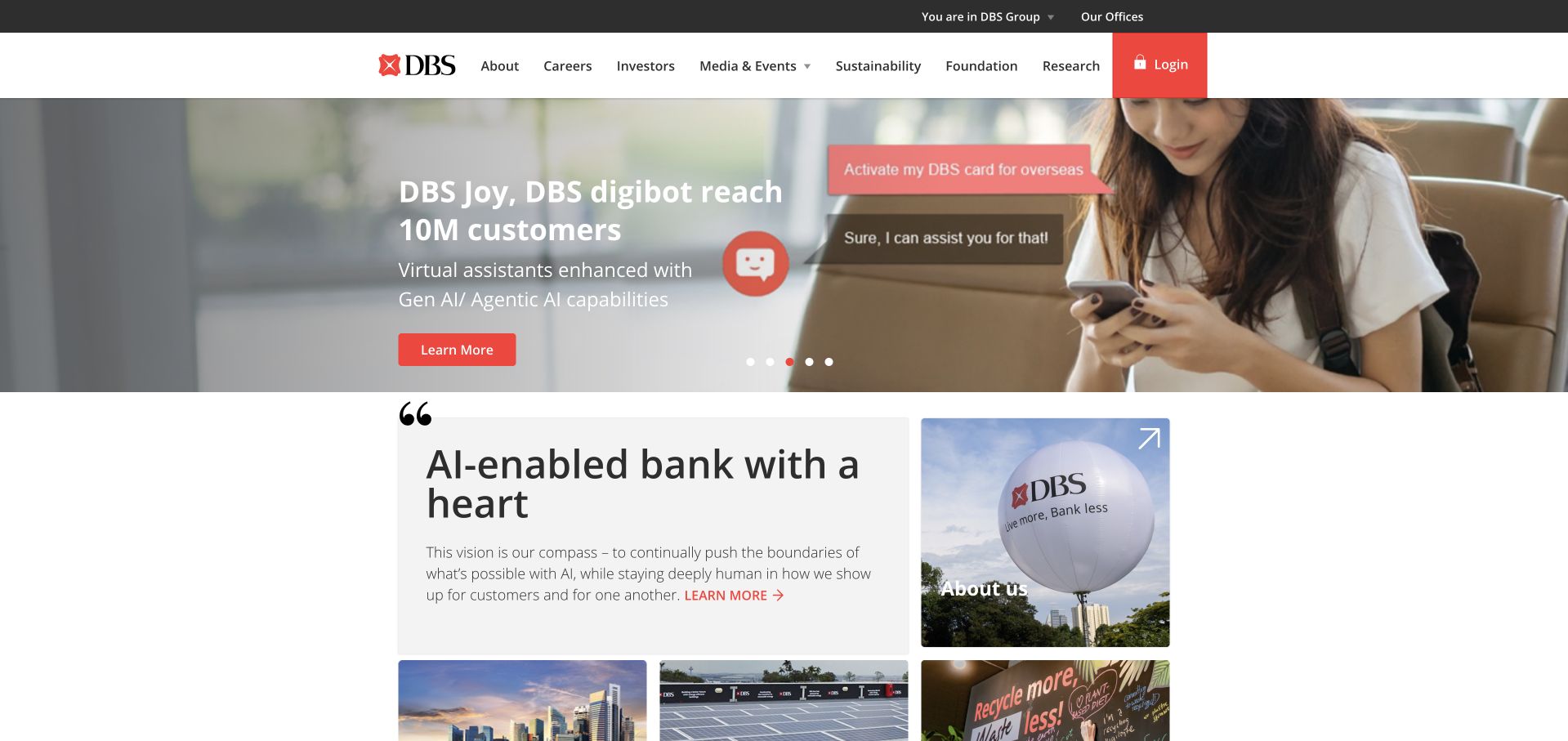
DBS’s group homepage places a digital-assistant campaign above a more restrained company introduction. Red accents connect the hero, login control and supporting links, while the header separates careers, investors, sustainability, foundation and research. The contrast is useful: an immediate product-related story provides energy, then a grid of company material adds depth. The page does not ask one headline to satisfy every stakeholder. It does, however, depend on keeping campaign language understandable for people who are not already customers. MariaDB’s source concerns the bank’s microservices database migration; it does not prove this corporate homepage runs on MariaDB.
What you can learn
Introduce technology through a recognizable customer task, then connect it to a stable institutional structure. A banking website needs to support existing customers, journalists and investors without letting an experimental product message obscure those essential routes.
Pros
A familiar red accent ties campaign content to ordinary company navigation.
Distinct stakeholder sections stop the digital-banking story from carrying every communication job.
Cons & considerations
Conversational-product imagery still needs a concise explanation of what is actually available.
A broad corporate menu can become crowded when compressed into a mobile header.
Platform source: Official product-specific customer case. MariaDB’s DBS case describes an Oracle-to-MariaDB migration in the bank’s microservices architecture. This source establishes only the stated organization, product or workload association. It does not prove the pictured public page uses this technology, identify its CMS or frontend, establish a complete current architecture, or independently verify vendor-reported outcomes. Platform evidence is separate from the direct website screenshot and is not a complete current infrastructure audit.
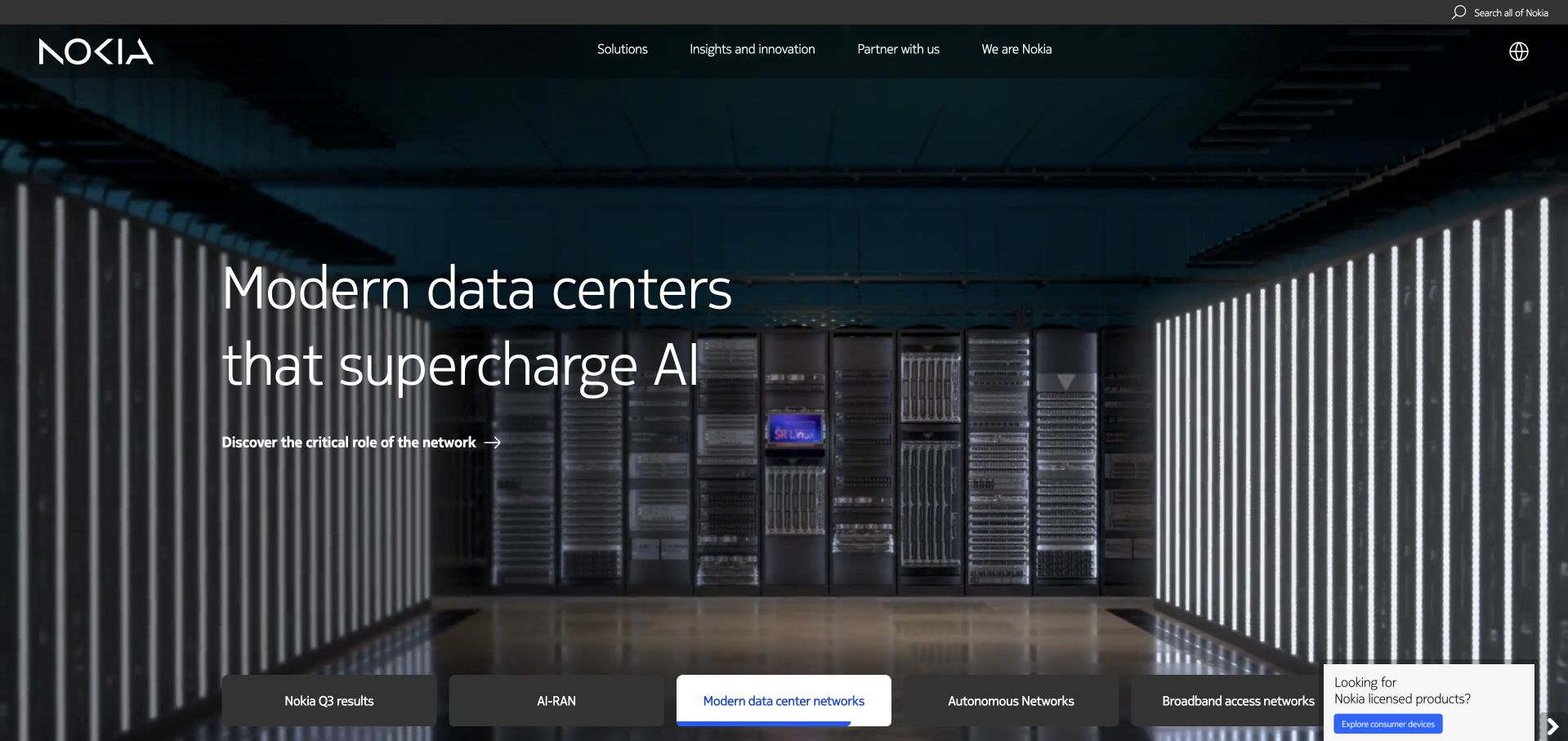
Nokia’s homepage combines a datacenter-scale photograph with a short technical proposition and a row of labeled campaign choices. Pale type across the image connects the infrastructure message to a recognizable physical environment. A dark translucent header holds a small set of company-level routes, while subsequent sections separate telecommunications providers from AI and cloud audiences. The strongest idea is the pairing of an evocative image with explicit audience categories below it. The hero’s specialized terminology still assumes substantial background knowledge. MariaDB’s Nokia case concerns containerized database deployment within Nokia Networks, not a technical audit of the public site shown here.
What you can learn
Explain an infrastructure business at two levels. Let the hero establish the larger ambition, then immediately offer clear routes for the people who buy, operate or integrate the technology. Those routes should use recognizable jobs and sectors.
Pros
The datacenter photograph gives the infrastructure proposition a recognizable physical setting.
Audience-specific sections provide a practical next step after the broad opening claim.
Cons & considerations
Specialist terminology can exclude visitors exploring the category for the first time.
Carousel text must retain contrast and legibility across every changing background.
Visible tech stack
Earlier / documented evidence
MariaDB
Platform source: Official product-specific customer case. MariaDB’s Nokia Networks case documents MariaDB databases deployed in containers for a telecom infrastructure application context. This source establishes only the stated organization, product or workload association. It does not prove the pictured public page uses this technology, identify its CMS or frontend, establish a complete current architecture, or independently verify vendor-reported outcomes. Platform evidence is separate from the direct website screenshot and is not a complete current infrastructure audit.
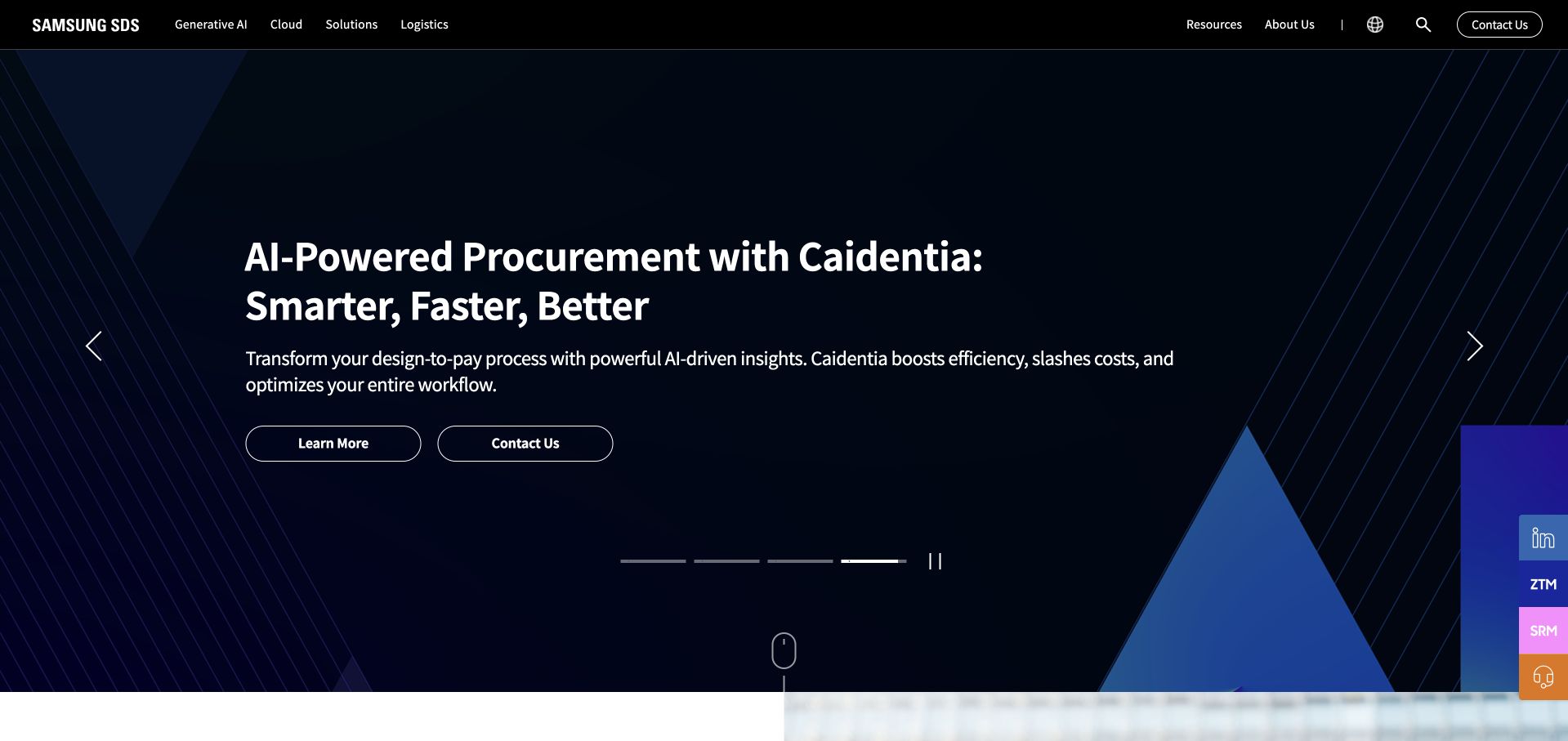
Samsung SDS’s US homepage uses dark blue geometry to frame a specific enterprise-software campaign. A prominent headline, a short explanation and paired actions keep the current slide focused, while the upper navigation divides generative AI, cloud, solutions and logistics. This is more useful than presenting every capability as an equal-sized feature tile in the first viewport. The page can spotlight one offer without losing the wider portfolio. Its limitation is the same one faced by many rotating enterprise heroes: the first message a visitor sees depends on timing. The MariaDB association is specifically documented for Samsung SDS’s Knox Portal groupware work, not every Samsung organization.
What you can learn
A portfolio homepage needs stable category navigation before it needs rotating promotions. Use the campaign area to introduce one coherent offer, and make the remaining capabilities discoverable without requiring someone to wait for a carousel.
Pros
A compact headline-and-action group makes the enterprise campaign easy to scan.
The primary navigation separates several genuinely different business technology categories.
Cons & considerations
Rotating offers can make the company’s central proposition feel inconsistent.
Product terminology requires supporting explanations for buyers outside the technical team.
Platform source: Official product-specific customer case. MariaDB’s case specifically identifies Samsung SDS’s Knox Portal, also called Samsung Groupware, migrating from Oracle to MariaDB. It is not a blanket claim about Samsung Electronics or every Samsung service. This source establishes only the stated organization, product or workload association. It does not prove the pictured public page uses this technology, identify its CMS or frontend, establish a complete current architecture, or independently verify vendor-reported outcomes. Platform evidence is separate from the direct website screenshot and is not a complete current infrastructure audit.
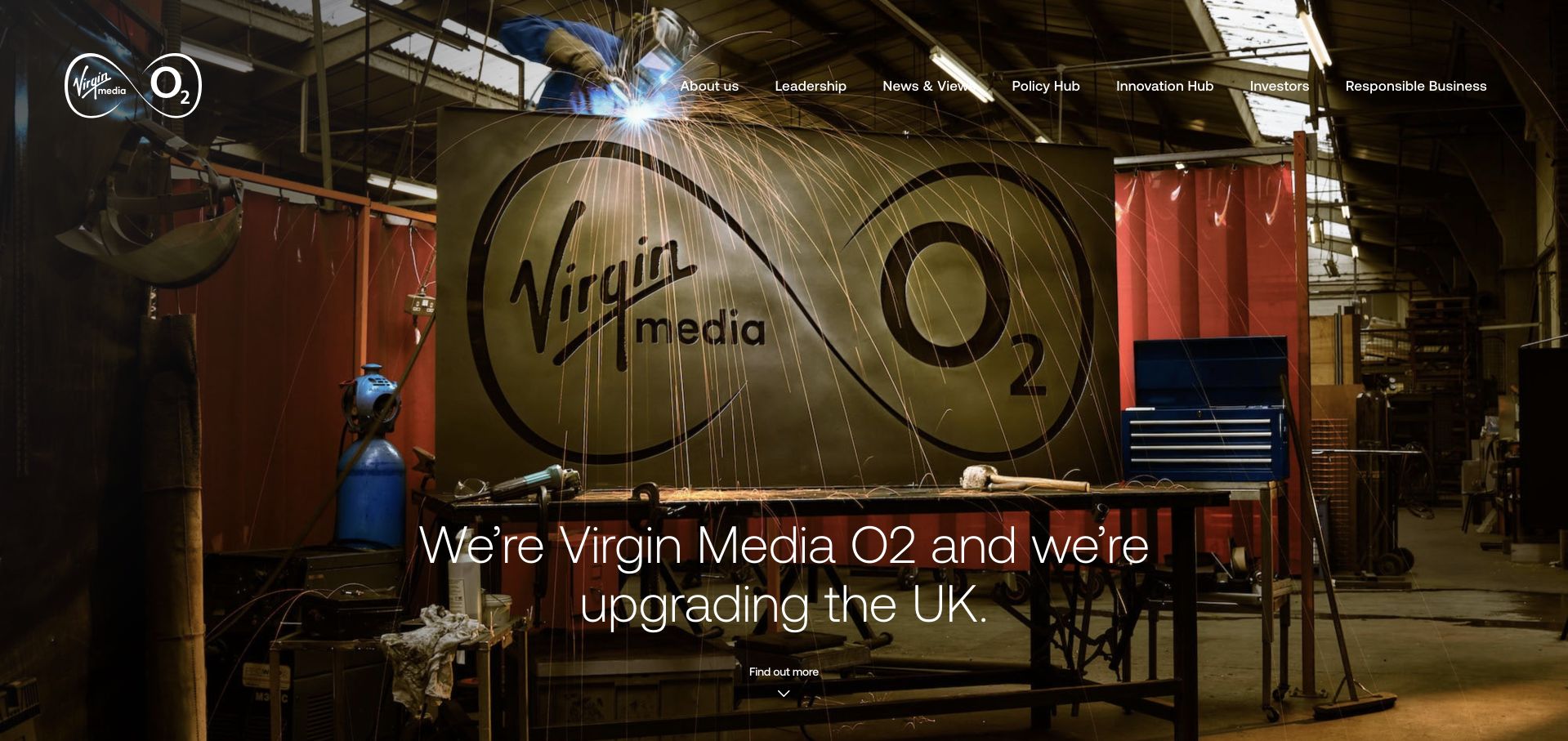
Virgin Media O2’s corporate homepage uses a large industrial photograph with unmistakable co-branded equipment. White navigation sits across the upper edge, and a short company introduction appears near the bottom of the image. The photograph does more than decorate the page: it connects a familiar consumer brand to the physical work of building and maintaining a network. Below, the content moves toward company context, news and business information. The opening remains broad, so the supporting sections must explain the organization’s actual services and responsibilities. MariaDB’s documented relationship concerns a cloud database service used in its operational environment, not the visible marketing page’s complete stack.
What you can learn
For an infrastructure business, show the work behind the brand. Real environments and equipment can make a corporate promise more credible, provided the image is followed by concrete information and clear routes for each stakeholder.
Pros
The branded working environment connects an abstract connectivity message to physical infrastructure.
A restrained overlay leaves the photograph as the primary introduction.
Cons & considerations
White navigation over a detailed photograph needs careful contrast management.
A broad corporate statement requires specific service and responsibility information nearby.
Platform source: Official product-specific customer case. MariaDB’s Virgin Media O2 case describes a cloud database service in its documented telecom application environment. This source establishes only the stated organization, product or workload association. It does not prove the pictured public page uses this technology, identify its CMS or frontend, establish a complete current architecture, or independently verify vendor-reported outcomes. Platform evidence is separate from the direct website screenshot and is not a complete current infrastructure audit.
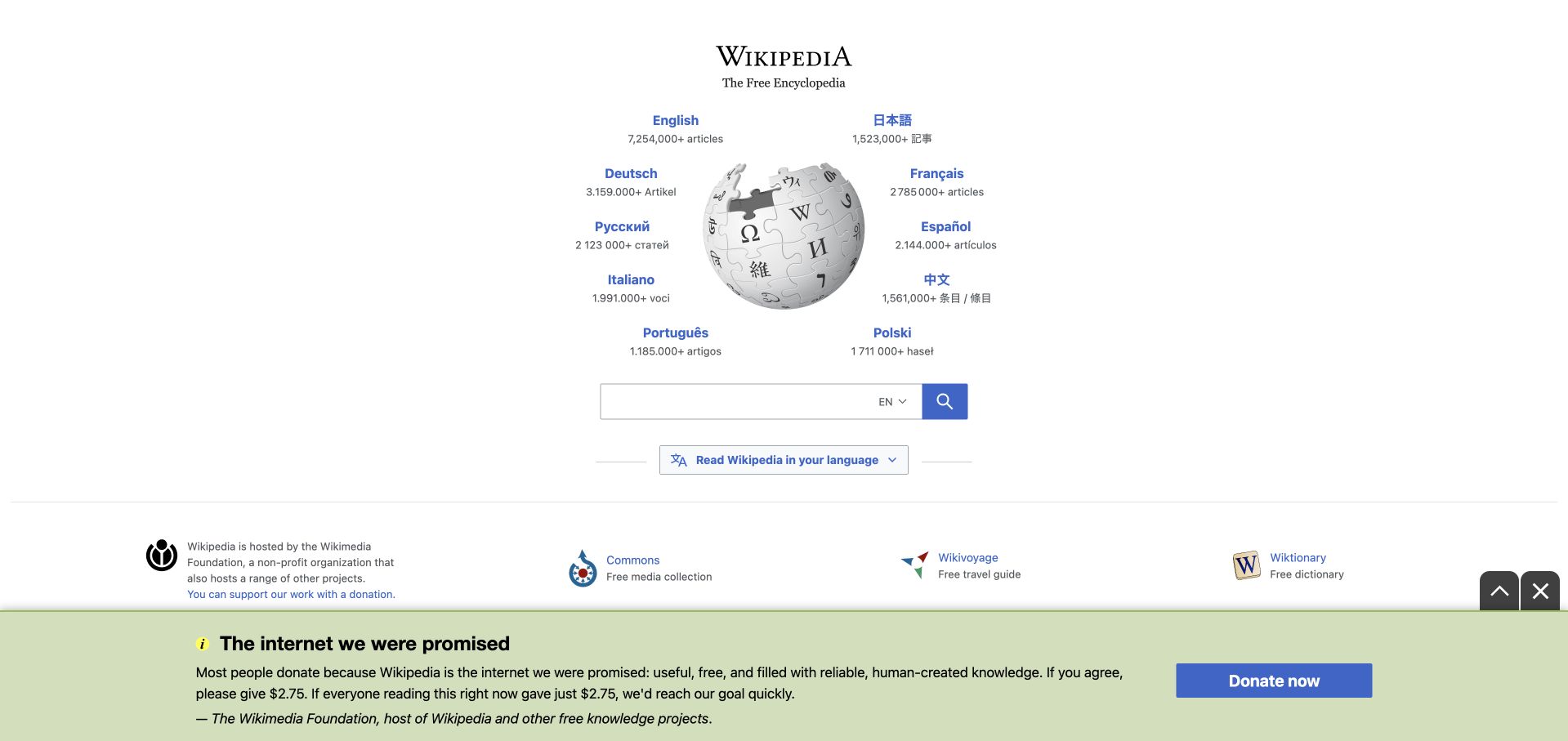
Wikipedia’s language portal organizes its opening around the globe mark, a ring of language choices and a central search field. The page does not lead with a long explanation of the organization because its main job is to move readers into the right language edition. Supporting links to Wikimedia projects sit below in a compact, consistent grid. The arrangement is unusual but purposeful: the visual center and the functional center are nearly the same. Its weakness is that language names, counts and institutional links can become visually small on a wide screen. Wikimedia’s operational documentation establishes a MariaDB production context; the portal image alone does not reveal its database.
What you can learn
A gateway should reduce the first decision rather than sell the organization. Put the search or language choice at the center, then move background information and related services into a secondary but predictable part of the page.
Pros
Language choice and search receive priority over promotional content.
Consistent related-project blocks make a large nonprofit ecosystem easier to recognize.
Cons & considerations
Small secondary labels need sufficient contrast and readable sizing.
A distinctive circular arrangement must still have a logical keyboard and screen-reader order.
Platform source: Wikimedia first-party database operations documentation. Wikimedia’s public operations documentation describes MariaDB production-host maintenance and replication procedures. This establishes an operational Wikimedia association, not the exact database serving the language portal pictured here. This source establishes only the stated organization, product or workload association. It does not prove the pictured public page uses this technology, identify its CMS or frontend, establish a complete current architecture, or independently verify vendor-reported outcomes. Platform evidence is separate from the direct website screenshot and is not a complete current infrastructure audit.
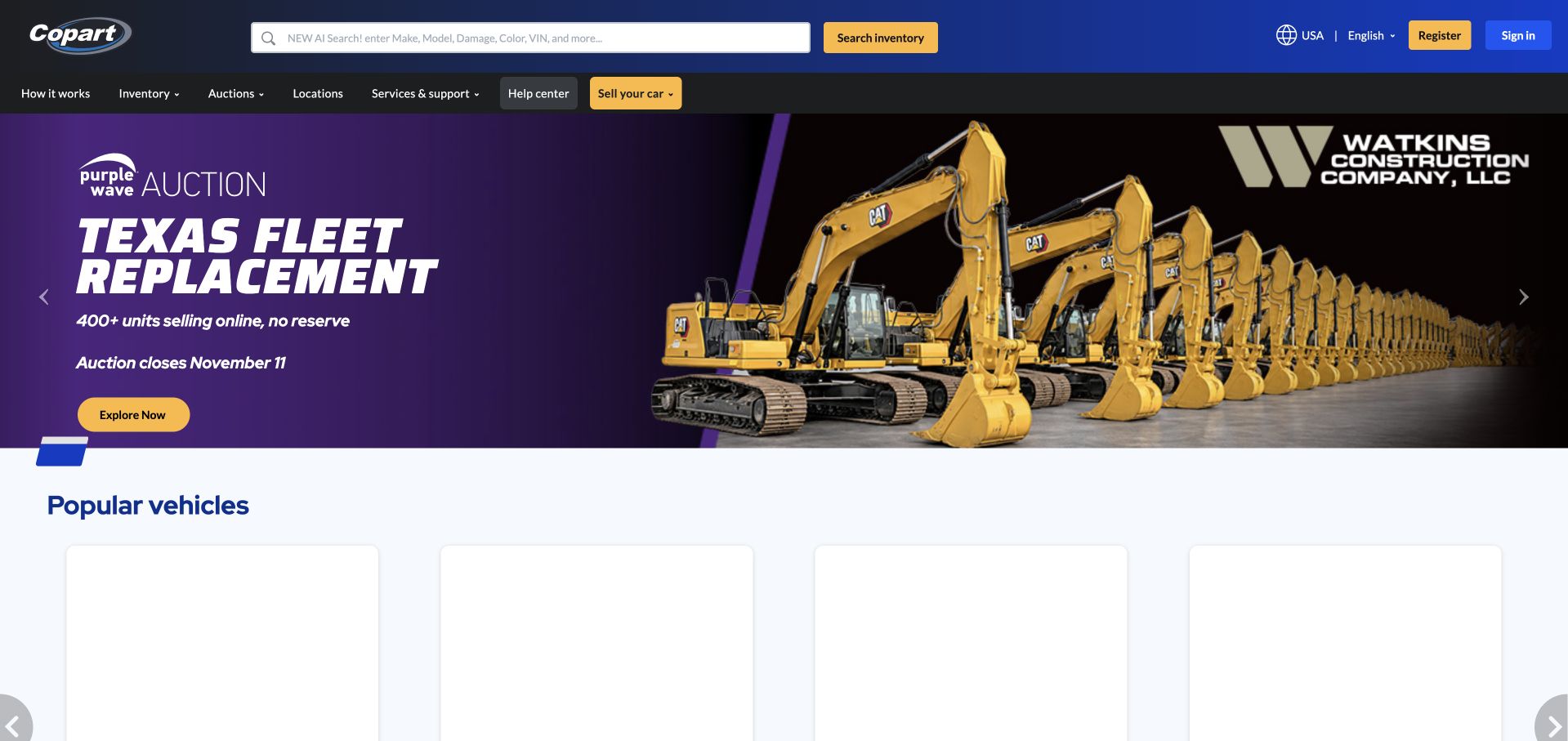
Copart’s public homepage uses a strong blue-and-yellow system to connect inventory search, account registration and its auction catalog. The captured hero promotes a Texas fleet auction with a specific vehicle photograph rather than a generic automotive illustration. Categories and support remain available in a separate navigation row, with search placed prominently above the campaign. This combination is practical for a marketplace with a large catalog and meaningful participation requirements. It also creates density: search, promotion and account controls all ask for attention. The MariaDB case concerns Copart’s database migration, not a verification of every current system behind the marketplace.
What you can learn
A marketplace campaign should supplement its ordinary browsing tools, not replace them. Preserve search and category routes for people with a specific vehicle in mind, while making auction eligibility, fees and purchase conditions accessible before any bidding action.
Pros
Inventory search is visible immediately rather than hidden behind a menu.
A specific fleet campaign gives the large catalog a timely and concrete entry point.
Cons & considerations
The combination of search, promotion and registration can make the opening feel crowded.
Auction-specific conditions need clear supporting pages beyond the promotional hero.
Visible tech stack
Earlier / documented evidence
MariaDB
Platform source: Official product-specific customer case. MariaDB’s official Copart story describes the company switching its application database to MariaDB. This source establishes only the stated organization, product or workload association. It does not prove the pictured public page uses this technology, identify its CMS or frontend, establish a complete current architecture, or independently verify vendor-reported outcomes. Platform evidence is separate from the direct website screenshot and is not a complete current infrastructure audit.
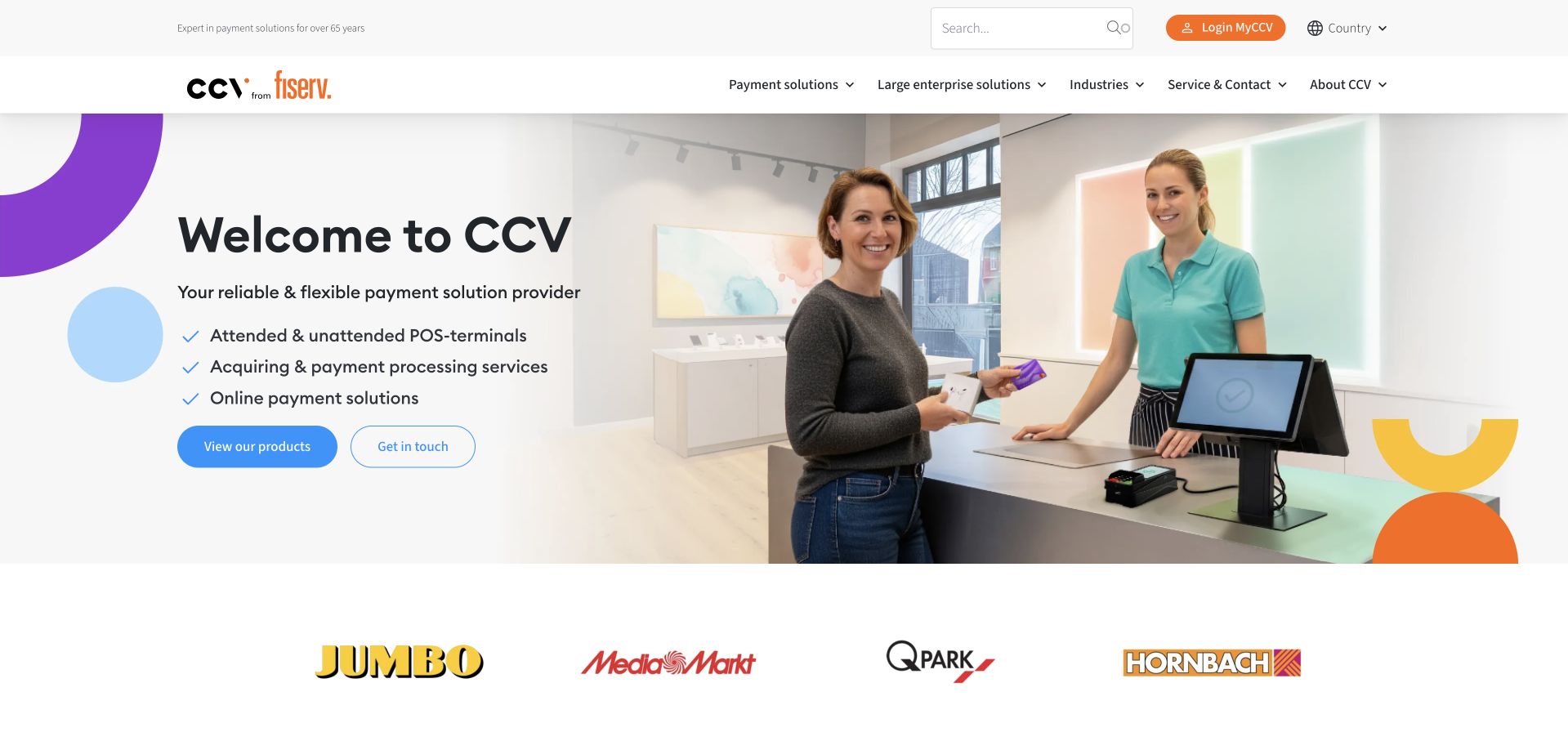
CCV’s homepage places a merchant-and-customer photograph beside a short introduction and three concrete payment capabilities. Soft geometric shapes add personality without competing with the payment terminal in the image. The header keeps payment solutions, large-enterprise needs, industries and service information separate, while customer logos provide a compact supporting layer. This is a good example of translating an infrastructure service into an ordinary commercial interaction. The opening still covers several product types, so detailed comparison and geographic availability need to follow. MariaDB’s CCV case documents payment-processing infrastructure work, not the software delivering this public homepage.
What you can learn
Show the moment in which the service becomes useful. A payment provider can explain more through a recognizable checkout interaction and a few specific capabilities than through an abstract wall of platform terminology.
Pros
The checkout photograph gives the technical service an immediate human context.
A short capability list makes the offer more concrete than the headline alone.
Cons & considerations
Different merchant sizes may need clearer routes to the appropriate product tier.
Payment availability and contractual conditions cannot be communicated by a general hero.
Platform source: Official product-specific customer case. MariaDB’s CCV case describes payment-processing infrastructure modernization with MariaDB. This source establishes only the stated organization, product or workload association. It does not prove the pictured public page uses this technology, identify its CMS or frontend, establish a complete current architecture, or independently verify vendor-reported outcomes. Platform evidence is separate from the direct website screenshot and is not a complete current infrastructure audit.
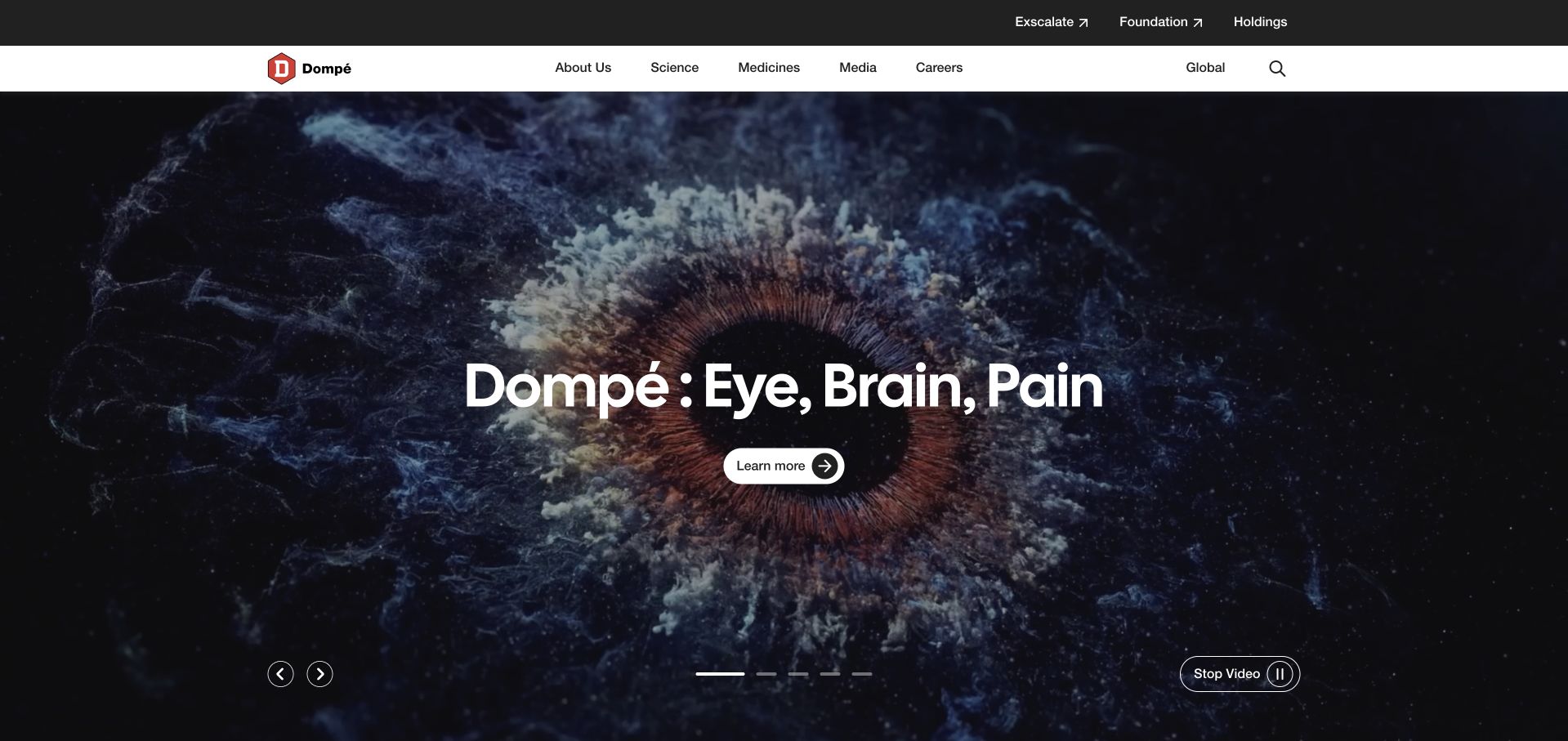
Dompé’s homepage uses close-up scientific imagery and a compact therapeutic-focus statement to introduce the company. The black utility strip, white main navigation and red brand mark create a restrained frame around the moving scientific background. About, Science, Medicines, Media and Careers give visitors predictable routes beyond the visual introduction. The page is effective at establishing a research context, but the first statement alone does not explain individual treatments, evidence or geographic availability. Those distinctions must remain in the appropriate detailed sections. MariaDB’s customer story concerns molecular-data analysis with ColumnStore; it is not evidence that the public pharmaceutical homepage is served from that system.
What you can learn
Use scientific imagery to establish context, not to substitute for explanation. Keep research, medicines and corporate information distinct, and let product-specific pages carry their own evidence, audience restrictions and regulatory detail.
Pros
Close-up scientific imagery gives the company’s research identity a distinctive visual context.
A small set of clearly named sections keeps the public information architecture understandable.
Cons & considerations
A brief therapeutic-focus phrase may be too compressed for unfamiliar visitors.
Moving background imagery needs a readable static alternative and an obvious pause control.
Visible tech stack
Earlier / documented evidence
MariaDB
Platform source: Official product-specific customer case. MariaDB’s Dompé case describes ColumnStore for analysis of molecular data, not the public pharmaceutical homepage’s backend. This source establishes only the stated organization, product or workload association. It does not prove the pictured public page uses this technology, identify its CMS or frontend, establish a complete current architecture, or independently verify vendor-reported outcomes. Platform evidence is separate from the direct website screenshot and is not a complete current infrastructure audit.
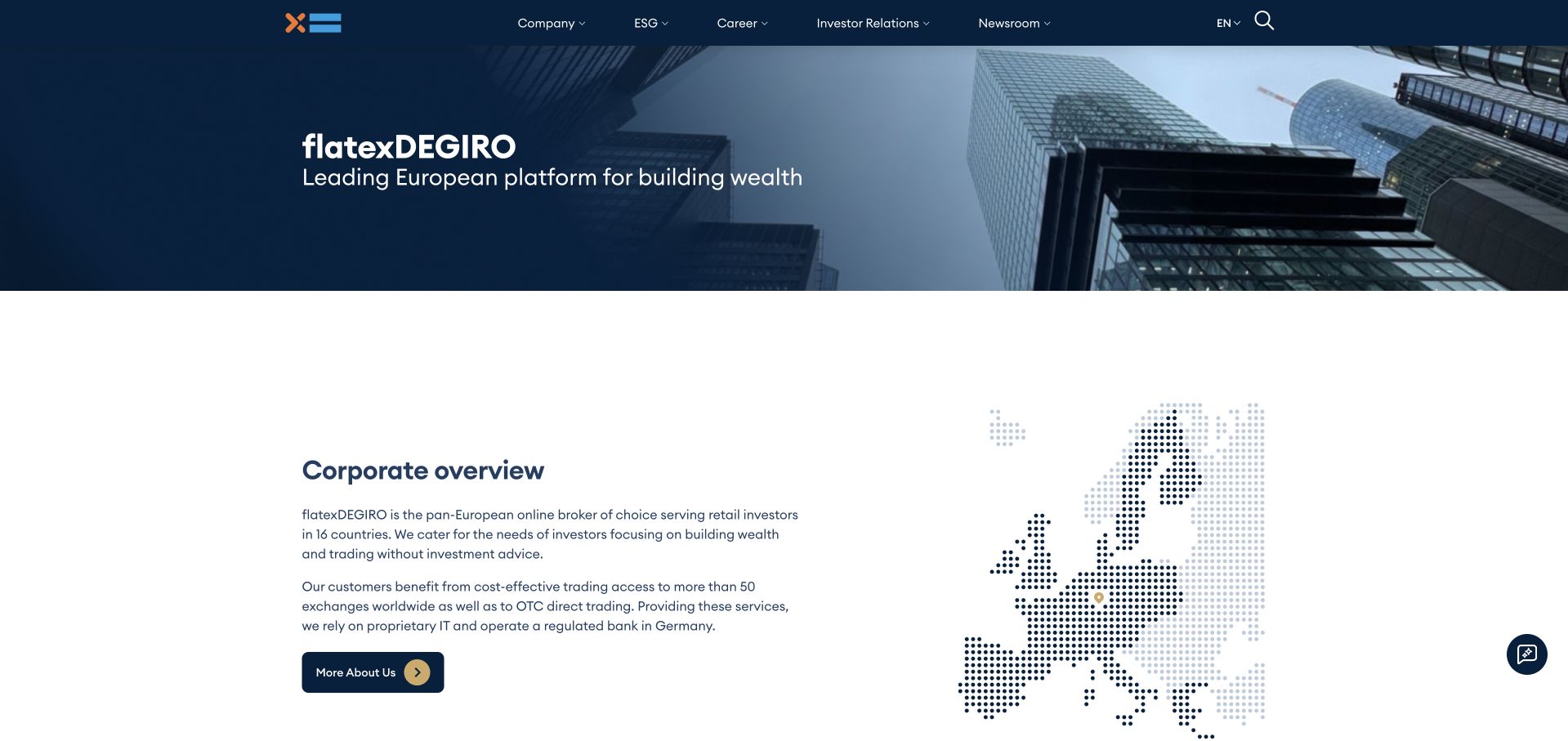
flatexDEGIRO’s corporate homepage combines a narrow architectural hero with a plain company overview and a dotted map of Europe. The page gives its central proposition room to sit apart from the main navigation, then uses a conventional grid for institutional information. The restrained dark blue palette is appropriate to a reference-oriented corporate site without depending on decorative financial charts. The map supplies geographic context, but the meaning still relies on adjacent text. Because the group operates several consumer-facing services, the company page should remain clear about whether a link leads to investor information or a retail trading product. MariaDB’s association is documented in a separate operational-resilience case.
What you can learn
A parent-company site should explain the organization before promoting individual products. Pair geographic or portfolio graphics with concise text, and make transitions from institutional information to consumer services explicit.
Pros
The compact hero leaves space for a substantive company overview.
A map gives the group’s geographic scope a quickly recognizable visual reference.
Cons & considerations
A decorative map cannot replace accessible information about specific markets.
Corporate and retail destinations need labels that prevent audience confusion.
Platform source: Official product-specific customer case. MariaDB’s flatexDEGIRO case describes database resilience and operational-efficiency work in its trading environment. This source establishes only the stated organization, product or workload association. It does not prove the pictured public page uses this technology, identify its CMS or frontend, establish a complete current architecture, or independently verify vendor-reported outcomes. Platform evidence is separate from the direct website screenshot and is not a complete current infrastructure audit.
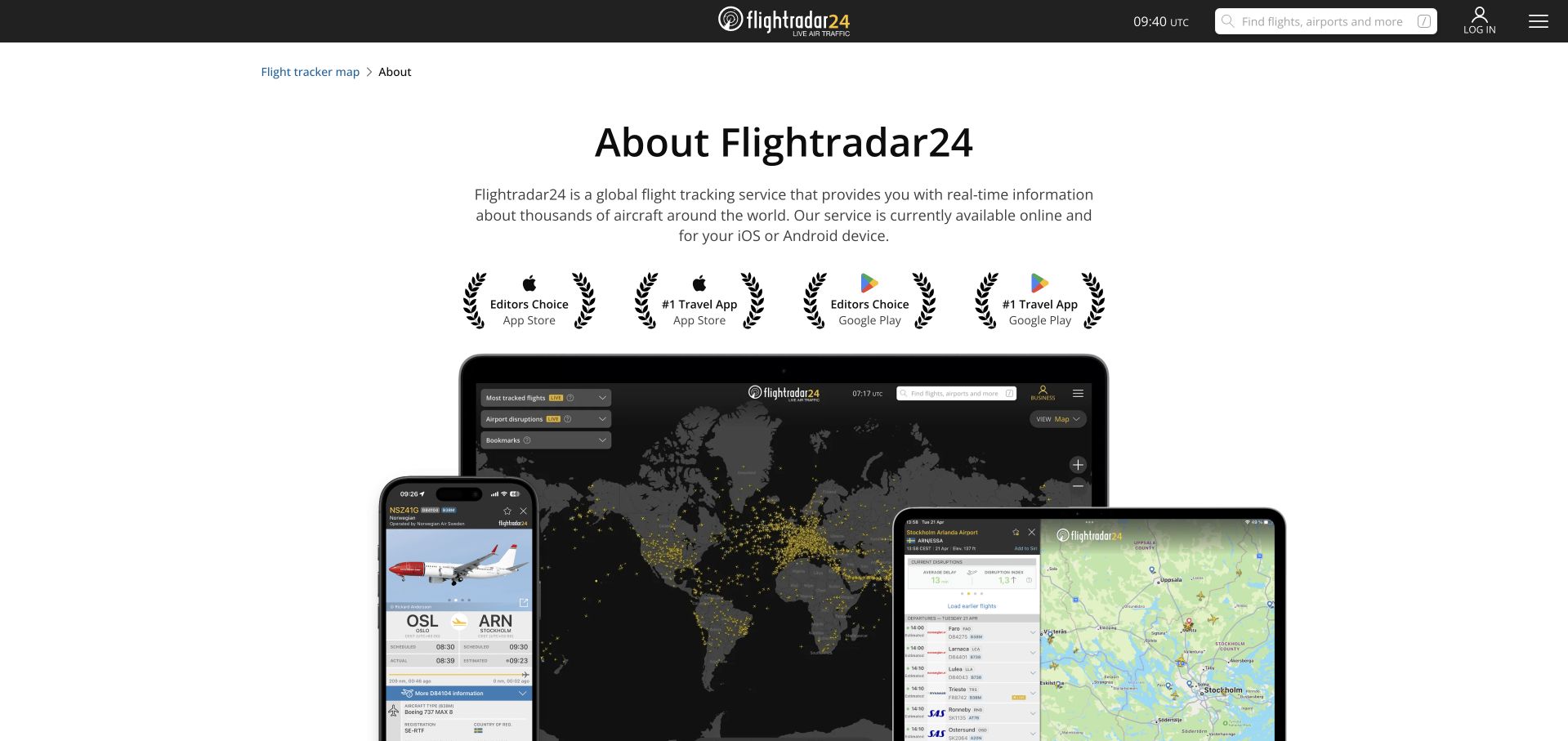
Flightradar24’s About page pairs a concise explanation of flight tracking with overlapping views of the product on a laptop, tablet and phone. The dark utility header preserves search and login without making either the whole purpose of the page. The multi-device arrangement is informative because the map is a core part of the service, not a generic dashboard image. Further content explains the receiver network and broader usage context. A static product montage cannot demonstrate live data quality or refresh speed, and those claims should not be inferred from the image. MariaDB’s source documents a data-platform association rather than a complete current frontend inventory.
What you can learn
An About page for a data product should explain both what people see and where the information comes from. Show a meaningful interface, then describe its coverage and limitations in readable text rather than relying on impressive visual density.
Pros
Consistent device views demonstrate how the same product works in different contexts.
A short introductory paragraph explains the service before detailed technical background.
Cons & considerations
Dense map screenshots can become unreadable when reduced to small cards.
A visual demonstration does not independently establish accuracy, latency or coverage.
Visible tech stack
Earlier / documented evidence
MariaDB
Platform source: Official product-specific customer case. MariaDB’s Flightradar24 case documents MariaDB in its flight-tracking data-platform environment. This source establishes only the stated organization, product or workload association. It does not prove the pictured public page uses this technology, identify its CMS or frontend, establish a complete current architecture, or independently verify vendor-reported outcomes. Platform evidence is separate from the direct website screenshot and is not a complete current infrastructure audit.
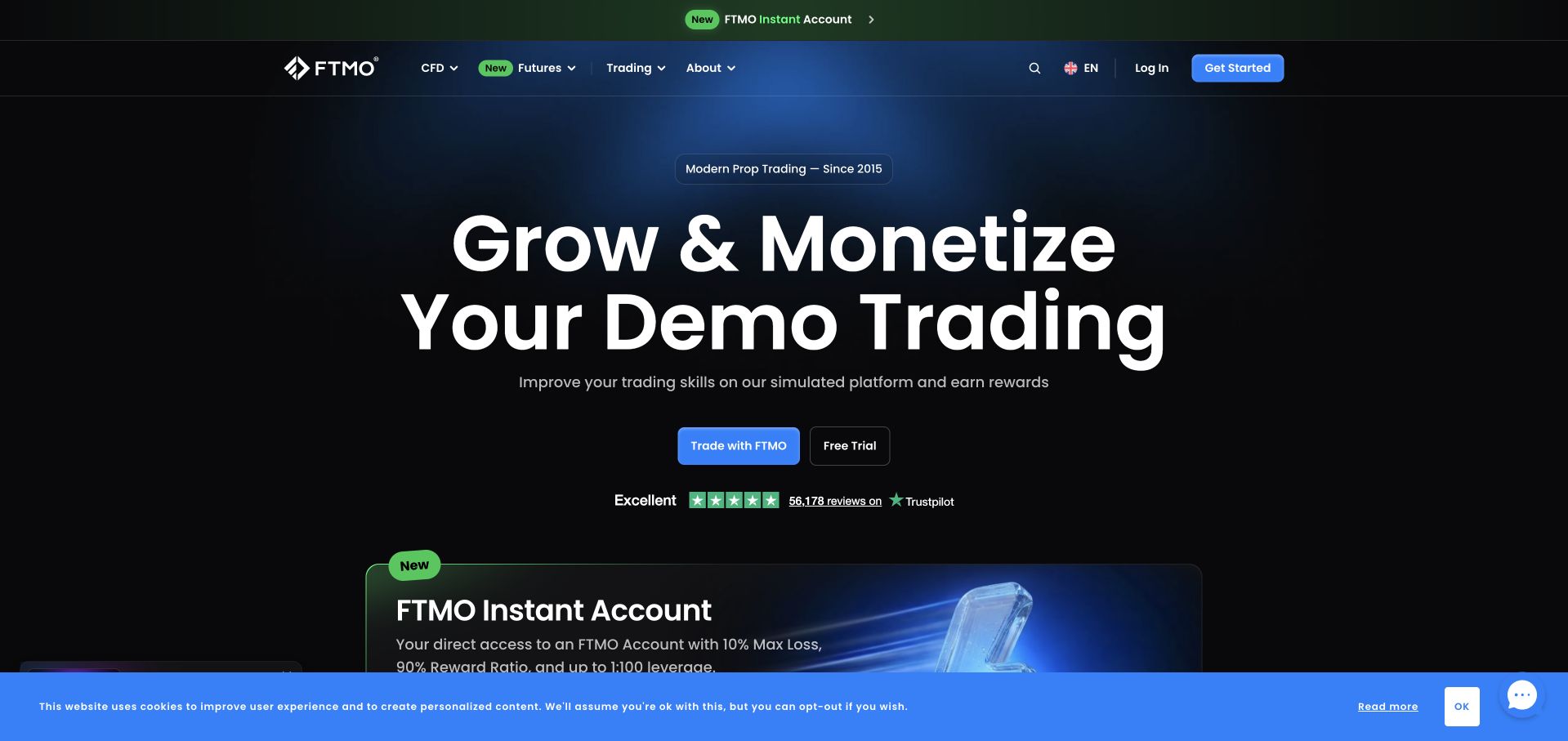
FTMO’s homepage uses a nearly black background, a large centered headline and bright blue actions to establish a specialist trading-platform identity. The wording explicitly describes demo trading, which is an important distinction to preserve rather than compressing the proposition into a vague earnings promise. Supporting product cards and a visible trial route give visitors alternatives to an immediate commitment. The design’s intensity suits the category, but promotional figures and participation requirements still need readable detail. MariaDB’s case concerns the company’s cloud database environment; no financial performance claim is validated by inclusion in this design collection.
What you can learn
In a consequential product category, the first screen must preserve important qualifiers. Make the type of account and participation model clear before emphasizing outcomes, and keep trial, educational and contractual information easy to distinguish.
Pros
Strong contrast gives the central proposition and primary actions clear hierarchy.
The demo-trading qualifier helps distinguish the product from an ordinary brokerage account.
Cons & considerations
Promotional emphasis can outpace the explanation of participation requirements.
Review counts and reward language should not replace clear risk and contract information.
Visible tech stack
Earlier / documented evidence
MariaDB
Platform source: Official product-specific customer case. MariaDB’s FTMO case identifies MariaDB Cloud on Google Cloud for the documented application workload. This source establishes only the stated organization, product or workload association. It does not prove the pictured public page uses this technology, identify its CMS or frontend, establish a complete current architecture, or independently verify vendor-reported outcomes. Platform evidence is separate from the direct website screenshot and is not a complete current infrastructure audit.
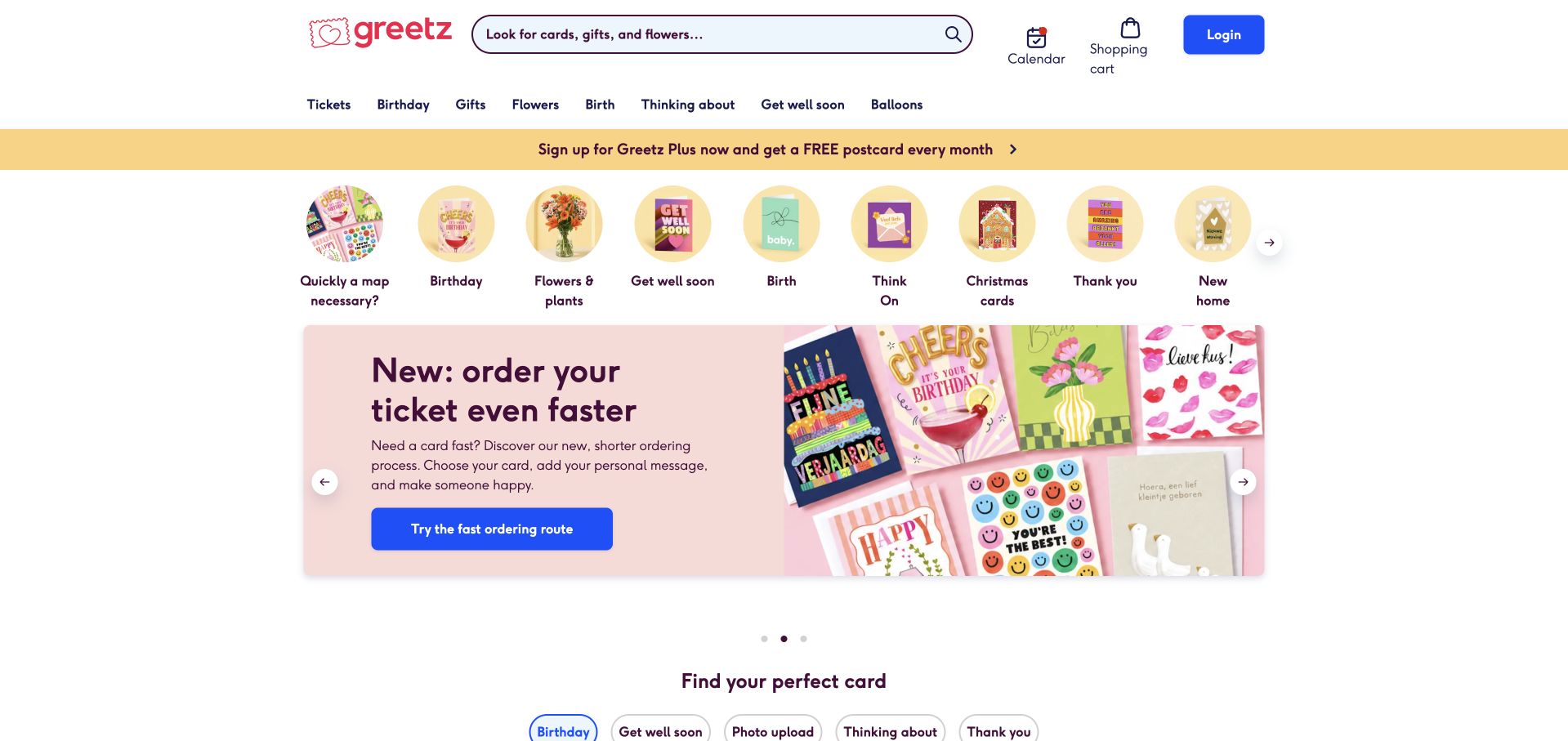
Greetz’s homepage combines a prominent search field with a row of illustrated occasion categories. The hero then promotes a specific ordering route using colorful cards and gifts, while the next section begins more detailed card discovery. The useful design choice is the ordering of decisions: a shopper can start with a birthday, new home or thank-you occasion rather than knowing a product name. Pink accents and small illustrations keep the interface friendly without abandoning familiar ecommerce controls. The Dutch site was rendered in the browser’s translated view during capture. MariaDB’s documented relationship concerns an Oracle-to-Galera migration, not every current storefront component.
What you can learn
Organize discovery around the customer’s reason for shopping. Occasion, recipient and timing can be more useful entry points than internal product categories, provided search and ordinary browsing remain available for people with a specific item in mind.
Pros
Occasion categories give uncertain shoppers an easy and emotionally relevant starting point.
A large search field supports visitors who already know what they want.
Cons & considerations
Many small illustrated categories can become difficult to distinguish on mobile.
Translated interface text may not preserve the original wording or line lengths.
Platform source: Official product-specific customer case. MariaDB’s Greetz case describes migration from Oracle RAC to MariaDB Galera Cluster. This source establishes only the stated organization, product or workload association. It does not prove the pictured public page uses this technology, identify its CMS or frontend, establish a complete current architecture, or independently verify vendor-reported outcomes. Platform evidence is separate from the direct website screenshot and is not a complete current infrastructure audit.
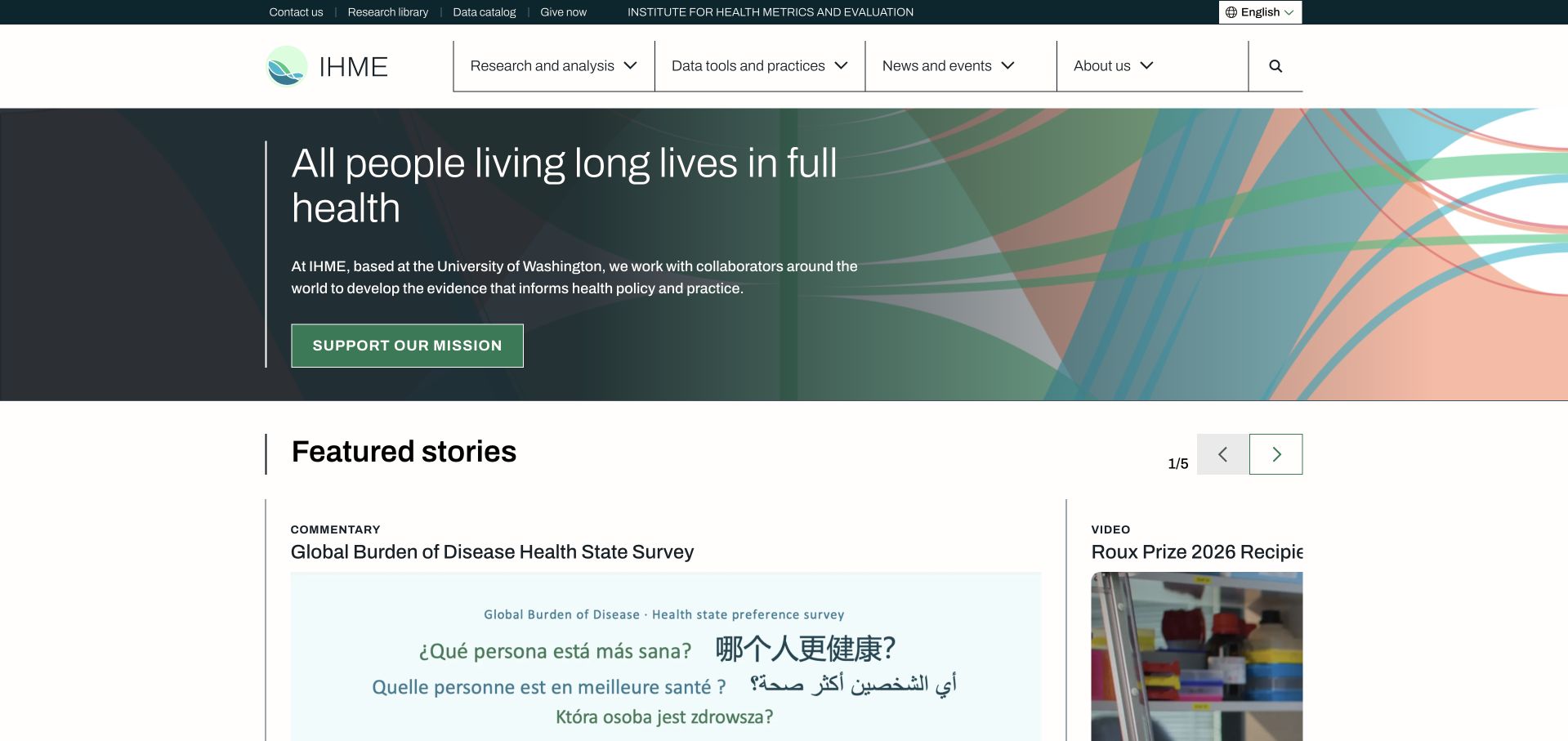
IHME’s homepage begins with a plain mission statement on an illustrated green background, then moves directly into featured research and news. The utility bar distinguishes the research library and data catalog from the main organization navigation, which is useful for repeat visitors seeking a specific output. Article types and updated dates give the editorial cards more meaning than a row of unexplained images. The mission remains broad, but the supporting structure points toward actual work rather than extending the introduction indefinitely. MariaDB’s case concerns large-scale health-data analytics; this public page should not be read as proof of a particular database behind every research tool.
What you can learn
Connect a research mission to visible outputs. Give articles a type and date, separate publications from tools, and make the underlying data or methodology reachable without requiring visitors to understand the institution’s internal structure first.
Pros
Research and data destinations are visible as distinct recurring tasks.
Dated editorial cards connect the organization’s mission to current work.
Cons & considerations
A broad mission statement needs specific research examples to become useful.
Carousel-based stories should retain accessible navigation and a non-rotating alternative.
Platform source: Official product-specific customer case. MariaDB’s IHME case describes health-data analytics using MariaDB at large record volumes. This source establishes only the stated organization, product or workload association. It does not prove the pictured public page uses this technology, identify its CMS or frontend, establish a complete current architecture, or independently verify vendor-reported outcomes. Platform evidence is separate from the direct website screenshot and is not a complete current infrastructure audit.
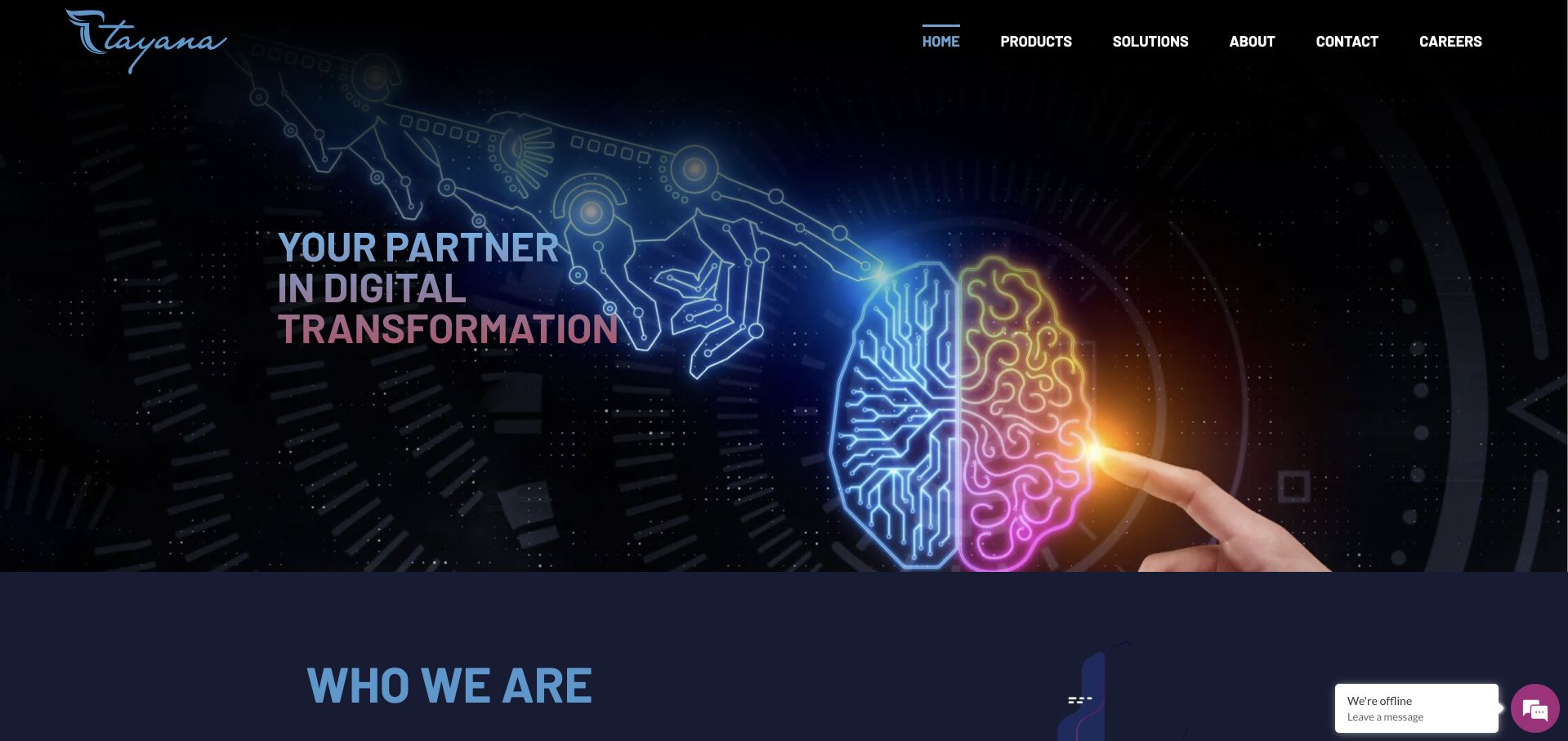
Tayana Mobility’s homepage uses a dark illustration of connected technology and a short digital-transformation statement as its opening. The next section supplies considerably more detail about the company, telecom products and communication-service-provider audience. This contrast is instructive: the hero creates a category impression, but the explanatory copy does the real qualification work. The navigation is compact enough to keep products, solutions, company information and contact routes recognizable. The weakness is that the initial language is generic and could describe many unrelated technology businesses. MariaDB’s customer story specifically concerns Tayana’s telecom policy-control and charging workload, not the public marketing composition.
What you can learn
Move the most distinguishing product information closer to the introduction. A specialist telecom vendor can retain expressive imagery while stating which operational problem it solves and who is responsible for buying or using that solution.
Pros
The company explanation provides concrete telecom context beyond the generic hero.
A short navigation structure makes product and solution routes easy to find.
Cons & considerations
Digital-transformation language alone does little to distinguish the business.
Dense introductory paragraphs would benefit from shorter, clearly labeled product explanations.
Platform source: Official product-specific customer case. MariaDB’s Tayana Mobility Technologies case describes telecom policy-control and charging workloads with MariaDB and an in-memory data layer. This source establishes only the stated organization, product or workload association. It does not prove the pictured public page uses this technology, identify its CMS or frontend, establish a complete current architecture, or independently verify vendor-reported outcomes. Platform evidence is separate from the direct website screenshot and is not a complete current infrastructure audit.
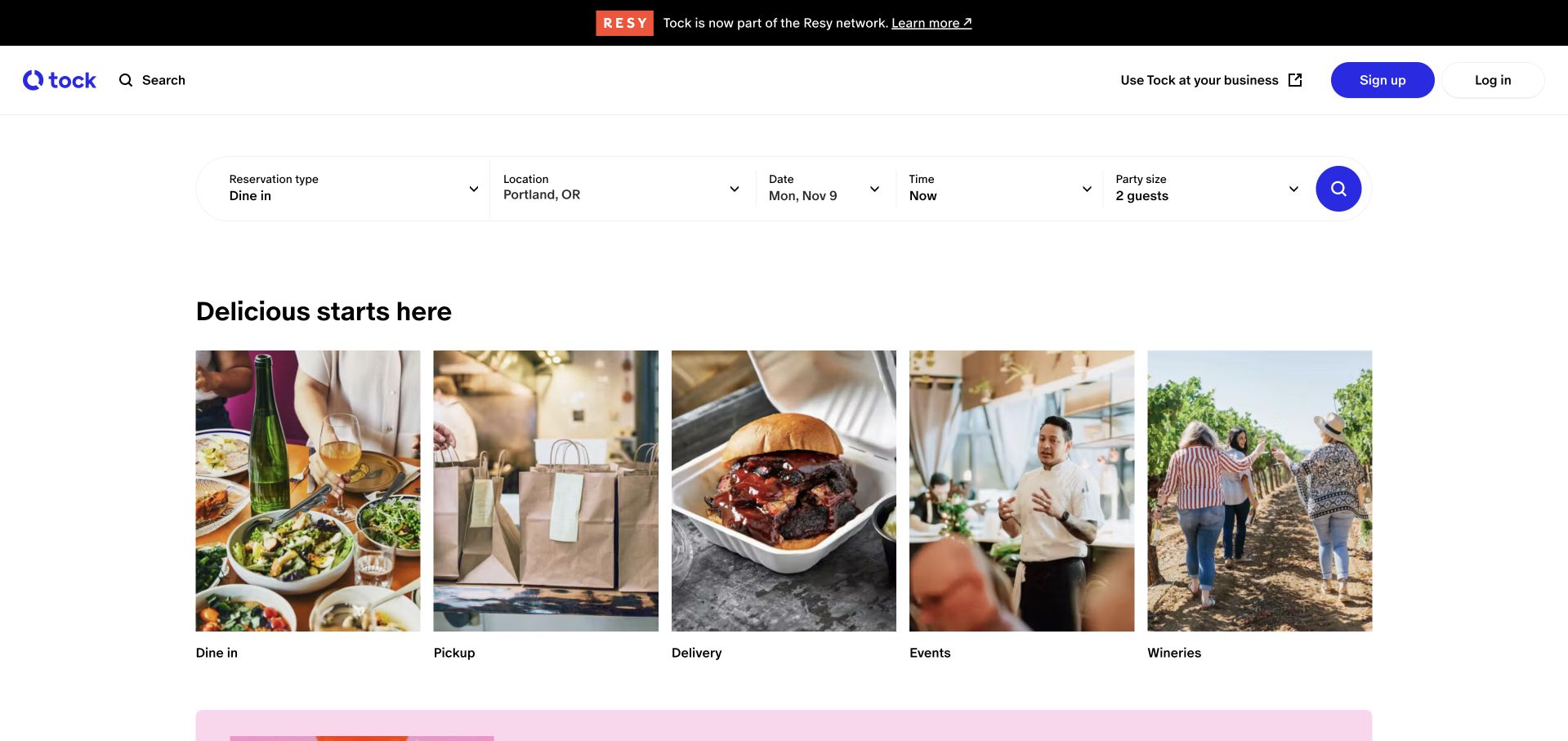
Tock’s public homepage places reservation type, location, date, time and party size in a horizontal search strip, then introduces dining, pickup, delivery, events and wineries through a row of photographic categories. The arrangement makes the transaction model understandable before a visitor chooses a venue. A small network announcement remains separate from the practical search task. The challenge is the number of inputs: a wide form can become cumbersome when stacked, and defaults should always remain obvious and editable. The displayed location is a public browsing default, not a private booking. MariaDB’s case concerns high-demand reservation handling rather than a full audit of the current marketplace.
What you can learn
A marketplace search should reveal the shape of the decision. Use explicit labels and sensible, editable defaults, then offer category browsing for people who are still exploring rather than ready to complete every field.
Pros
Labeled reservation inputs make the booking task visible before account creation.
Photographic experience categories offer an alternative to filling out the full search form.
Cons & considerations
A five-part horizontal form needs a carefully considered mobile sequence.
Default dates, locations and party sizes should never be mistaken for confirmed user choices.
Visible tech stack
Earlier / documented evidence
MariaDB
Platform source: Official product-specific customer case. MariaDB’s Tock case describes database support for high-demand restaurant reservation transactions. This source establishes only the stated organization, product or workload association. It does not prove the pictured public page uses this technology, identify its CMS or frontend, establish a complete current architecture, or independently verify vendor-reported outcomes. Platform evidence is separate from the direct website screenshot and is not a complete current infrastructure audit.
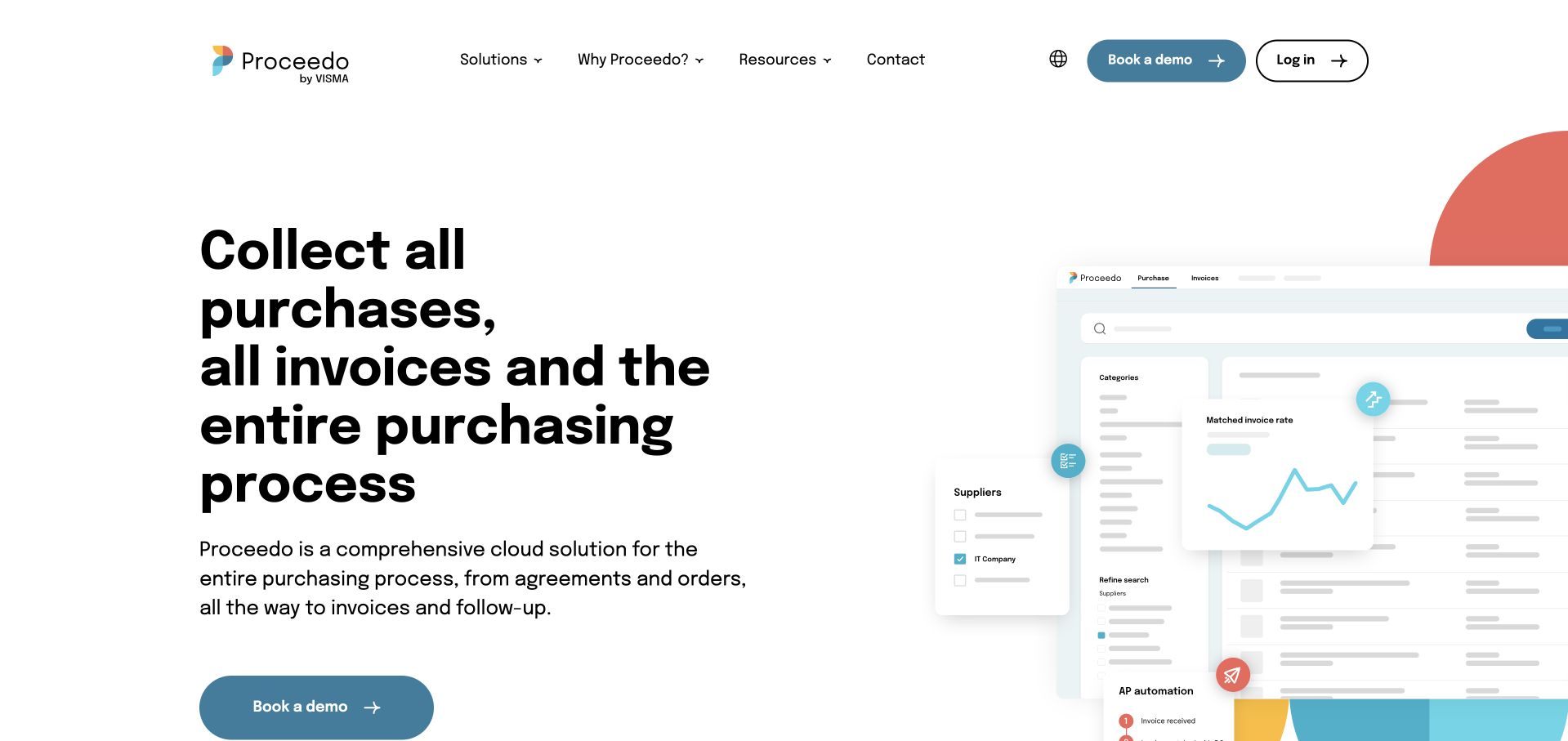
Proceedo’s homepage puts a large, tightly wrapped purchasing-process headline beside an interface montage. Small supplier, invoice and matching elements suggest the connections between tasks without requiring a long feature list in the first screen. The white background and muted blue action make the page feel less complicated than the workflow it describes. Navigation separates solutions, reasons to choose the product and resources, with login kept distinct from the demo action. The tradeoff is that the compressed headline still asks readers to absorb several concepts at once. MariaDB’s source identifies the Visma Proceedo application context, not the complete stack of this public marketing property.
What you can learn
For workflow software, explain the boundaries of the process before listing individual features. A concise diagram or meaningful product state can show how documents and decisions connect, while detailed pages explain exceptions, integrations and operational ownership.
Pros
The interface montage connects procurement terminology to visible working elements.
Login and demonstration routes support existing customers and evaluators separately.
Cons & considerations
A long headline can become hard to scan when wrapped into many short lines.
A simplified process image cannot explain exception handling or integration requirements.
Platform source: Official product-specific customer case. MariaDB’s case identifies Visma Proceedo’s purchasing and invoicing application database workload. This source establishes only the stated organization, product or workload association. It does not prove the pictured public page uses this technology, identify its CMS or frontend, establish a complete current architecture, or independently verify vendor-reported outcomes. Platform evidence is separate from the direct website screenshot and is not a complete current infrastructure audit.
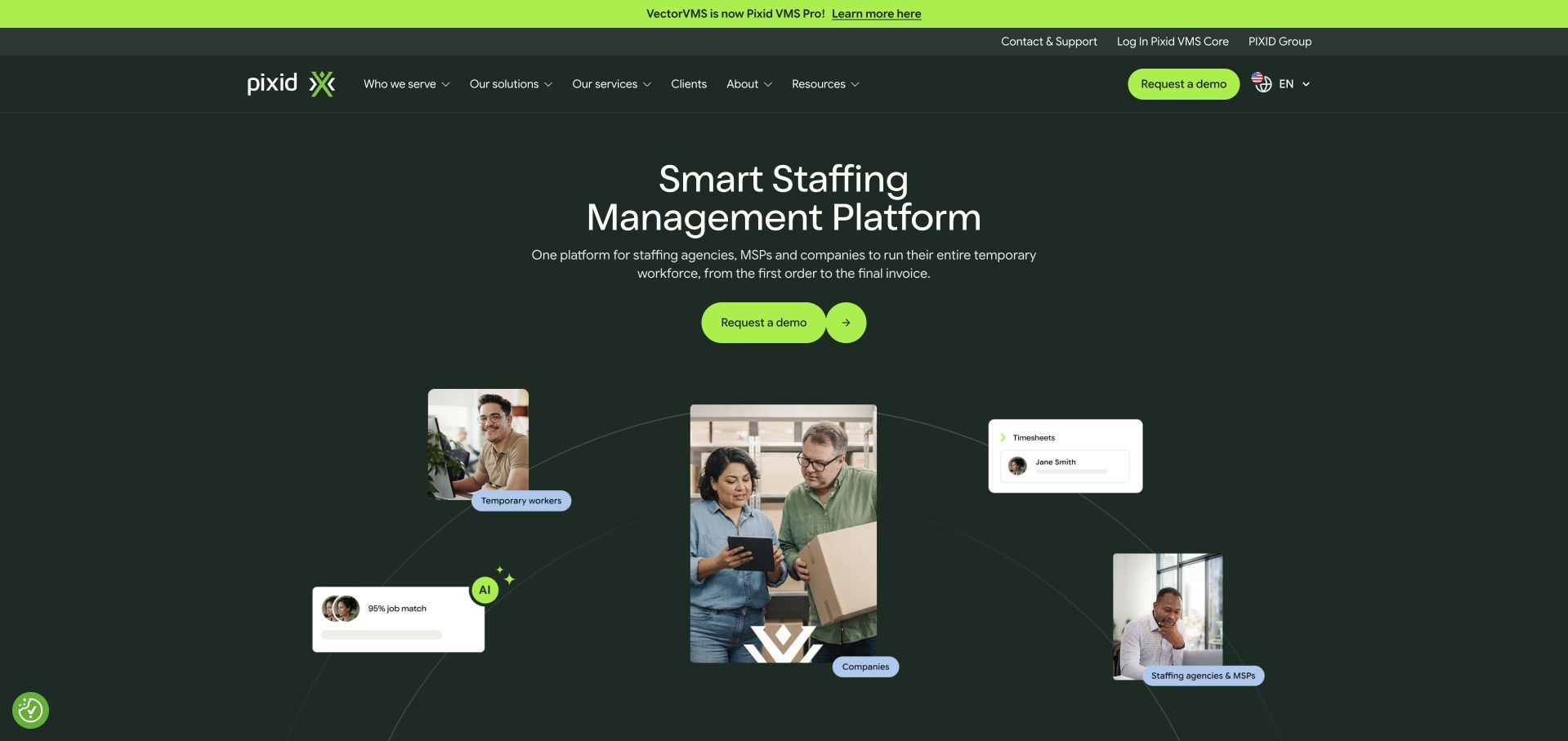
Pixid’s homepage uses a dark green background and bright lime actions around a centered staffing-platform statement. Photographs and small interface cards illustrate companies, workers and staffing organizations as parts of one connected process. The composition gives the platform a human dimension while preserving enough interface detail to suggest its operational purpose. A separate upper announcement handles a product-name change without replacing the main proposition. The page still relies on a broad platform label, so role-specific explanations are important further down. MariaDB’s official case concerns the documented Pixid database migration and hybrid architecture, not every application currently sold under the wider group.
What you can learn
Show the relationships a business application coordinates. Different user roles, records and handoffs can provide a more useful introduction than an isolated dashboard, provided each role has a clear route to its own detailed workflow.
Pros
People and interface cards make a multi-role staffing process easier to picture.
The product-change announcement is separated from the main platform introduction.
Cons & considerations
A broad platform label still needs concrete role-specific explanations.
Floating interface fragments should remain understandable when rearranged on small screens.
Platform source: Official product-specific customer case. MariaDB’s Pixid case describes migration from Oracle and a hybrid MariaDB architecture for the documented staffing application. This source establishes only the stated organization, product or workload association. It does not prove the pictured public page uses this technology, identify its CMS or frontend, establish a complete current architecture, or independently verify vendor-reported outcomes. Platform evidence is separate from the direct website screenshot and is not a complete current infrastructure audit.
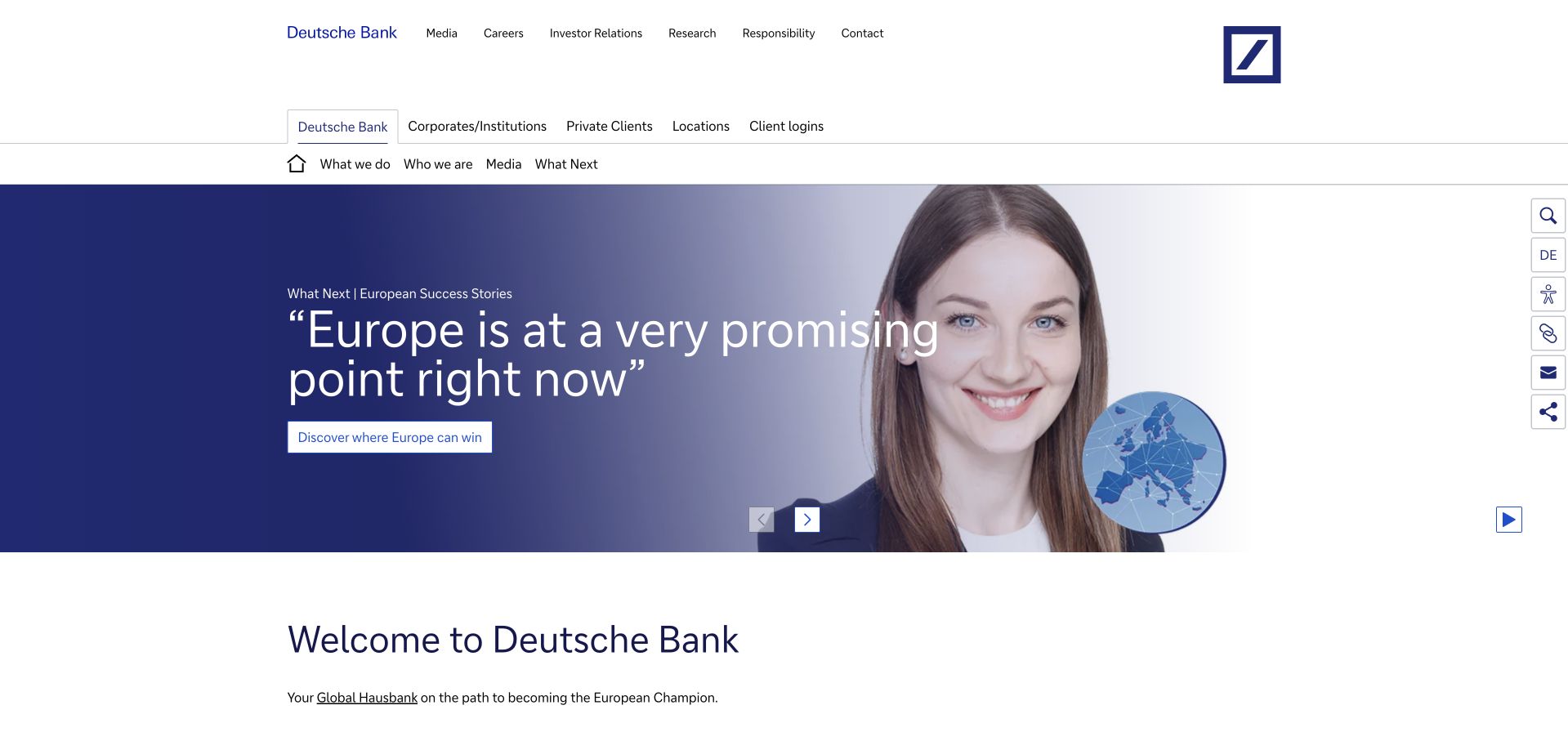
Deutsche Bank’s homepage combines a topical editorial hero with a persistent, multi-layered corporate navigation. Media, careers, investors and responsibility appear separately from business divisions and client-login routes. The brand’s blue mark and a blue content panel give the page a recognizable identity without relying on a consumer-product promotion. This structure is useful for an institution whose visitors arrive with very different responsibilities. It also carries a considerable navigation burden, so labels and mobile grouping matter more than decorative novelty. The MariaDB relationship is a historical organization-level association in a 2019 vendor release; it is not represented here as a verified current homepage deployment.
What you can learn
Give recurring institutional tasks stable positions, then use the editorial area for timely stories. Do not make investors, applicants or existing clients interpret a campaign headline before finding the route they came to use.
Pros
Stakeholder and business-division routes acknowledge several distinct audiences.
A restrained blue system maintains brand continuity across editorial and reference content.
Cons & considerations
Multiple navigation layers can become difficult to understand on a narrow screen.
Topical editorial content may not answer a new visitor’s basic service question.
Platform source: Historical official MariaDB customer release. MariaDB’s February 25, 2019 release names Deutsche Bank among organizations trusting MariaDB. This is a historical organization-level customer association without a specified current workload. This source establishes only the stated organization, product or workload association. It does not prove the pictured public page uses this technology, identify its CMS or frontend, establish a complete current architecture, or independently verify vendor-reported outcomes. Platform evidence is separate from the direct website screenshot and is not a complete current infrastructure audit.
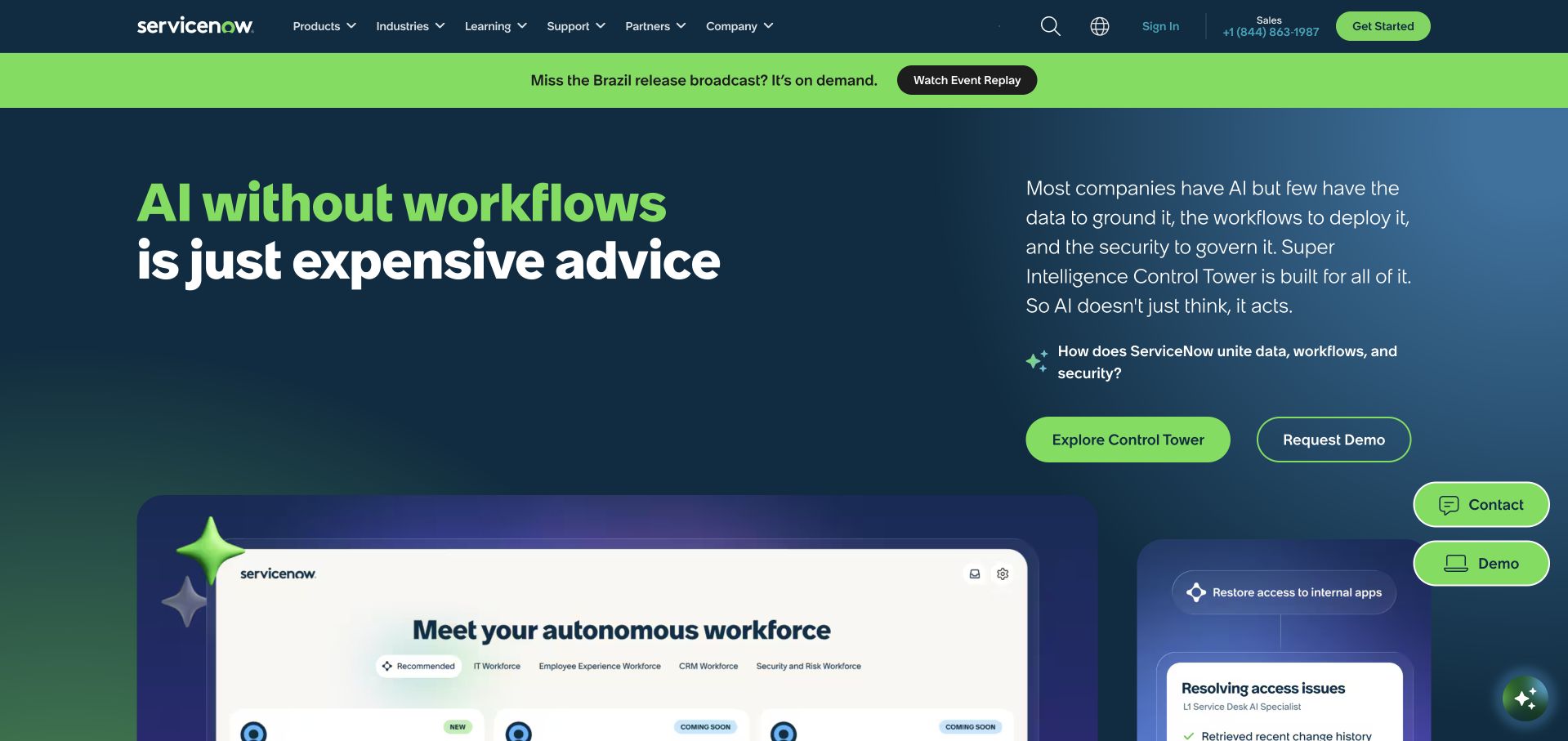
ServiceNow’s homepage uses a dark blue field, bright green emphasis and a two-part statement about AI and workflows. Supporting text sits beside the headline rather than underneath a large decorative illustration, and the product surface begins below the primary actions. The arrangement gives the company room to define its point of view before showing the interface. Green contact and demo controls remain prominent, although several floating actions can compete for attention. A broad platform claim still needs concrete use cases to become meaningful. MariaDB’s ServiceNow association comes from dated vendor documentation and is not evidence that this current marketing page runs on MariaDB.
What you can learn
A strong positioning statement needs a visible bridge to the product. Follow the claim with a recognizable workflow and a clear evaluation route, and avoid filling the same viewport with several equally urgent contact controls.
Pros
A limited blue-and-green palette makes the message and actions easy to distinguish.
Supporting copy explains the positioning before the interface illustration begins.
Cons & considerations
Broad enterprise terminology can remain abstract without specific workflow examples.
Several persistent contact controls may distract from the page’s main reading sequence.
Visible tech stack
Earlier / documented evidence
MariaDB
Platform source: Historical official MariaDB customer release. MariaDB’s February 25, 2019 release identifies ServiceNow among customers presenting MariaDB deployment experience at OpenWorks 2019. This is historical, not a current homepage-runtime claim. This source establishes only the stated organization, product or workload association. It does not prove the pictured public page uses this technology, identify its CMS or frontend, establish a complete current architecture, or independently verify vendor-reported outcomes. Platform evidence is separate from the direct website screenshot and is not a complete current infrastructure audit.
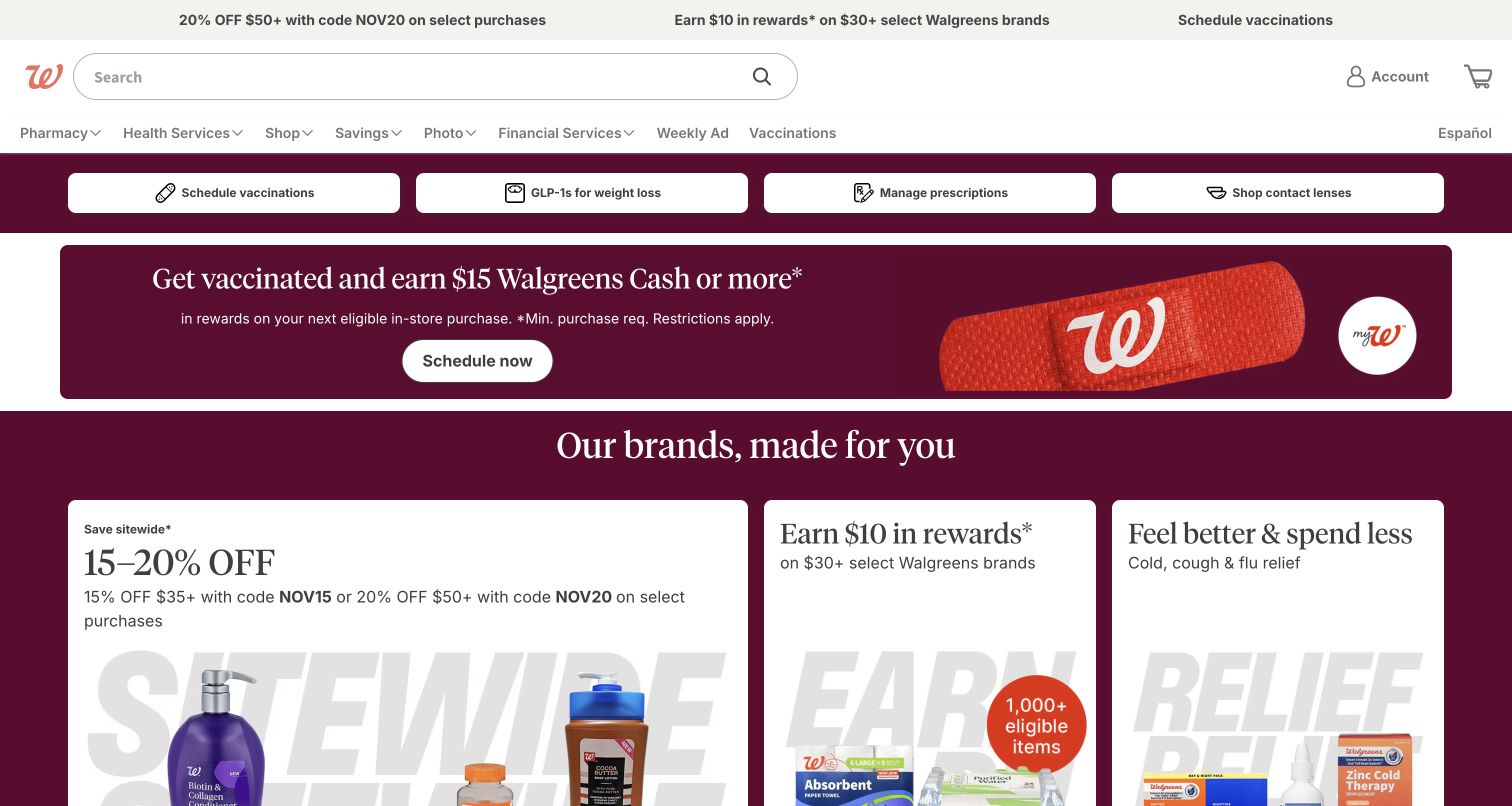
Walgreens’ captured public homepage separates quick service links from seasonal product promotions. Pharmacy-related tasks appear in a compact strip, while the larger maroon panels promote vaccinations and store-brand shopping. Search occupies a prominent place in the header, with account and basket controls kept recognizable. The page is useful to study because it does not assume every visitor is shopping the campaign: some need a specific ongoing service. That balance is demanding, particularly when promotional language appears beside health-related tasks. The historical MariaDB customer association does not verify the current public website’s database, clinical systems or prescription workflows.
What you can learn
Separate recurring service tasks from merchandising. Keep labels plain, make sensitive account routes unmistakable and ensure that a seasonal promotion cannot hide the action a returning customer needs to complete quickly.
Pros
Dedicated service shortcuts remain available above the main retail promotion.
A large search field supports specific product and information needs.
Cons & considerations
Promotional density can compete with more important recurring service tasks.
Health-related actions need clear conditions and secure destinations beyond the homepage.
Platform source: Historical official MariaDB customer release. MariaDB’s February 25, 2019 release identifies Walgreens among organizations presenting mission-critical MariaDB deployment experience at OpenWorks 2019. The evidence is historical and organization-level. This source establishes only the stated organization, product or workload association. It does not prove the pictured public page uses this technology, identify its CMS or frontend, establish a complete current architecture, or independently verify vendor-reported outcomes. Platform evidence is separate from the direct website screenshot and is not a complete current infrastructure audit.
Kegan has 15+ years of experience working with small businesses, Fortune 500 companies, and everything in between. No development job is too big or too small: he brings the same hands-on attention to a focused improvement, a complete website, or a custom application.
For MariaDB projects, he can help with data modeling, application data access, query design, search and cache integrations, migration planning, access boundaries, and maintainable handover. He works directly with clients on scope, design, implementation, testing, and handover, with an emphasis on clear communication and a system that remains practical to maintain after launch.
Show 3 other MariaDB developersHide other MariaDB developers
For a primarily editorial site, choose a maintained content system and verify its actual supported database requirements. Keep author permissions, publishing workflow, backups and updates understandable. The presence of MariaDB in the infrastructure does not remove the need to maintain the content platform and its extensions.
A custom operational application
Use a deliberate relational model for the service’s records and transactions. Put validation and authorization in a maintained application layer, and expose only the information a screen needs. Build a small complete workflow before expanding into a large dashboard with many disconnected tables.
A migration from another database
Begin with an inventory of schema features, queries, stored routines, integrations and reporting dependencies. Test realistic data and application behavior before deciding that compatibility is sufficient. Plan a rehearsal, a measurable reconciliation step and a rollback decision rather than treating the final import as the entire migration.
From references to requirements
Make the database lifecycle part of the website brief
Audit the existing data and application
Identify duplicate customer records, inconsistent identifiers, obsolete fields and unofficial exports before designing replacement screens. Ask the people who operate the service how they resolve exceptions. A clean visual table can disguise unreliable underlying information, and a migration is an opportunity to define responsibility rather than silently carrying every inconsistency forward.
Choose a supported operating model
Document whether the team or a provider manages updates, monitoring, backups and recovery. Record the exact edition and supported version rather than using MariaDB as an imprecise umbrella label. Review requirements for storage, availability, audit logs and geographic handling with the actual service owner.
Test a representative volume of data, long values, unusual characters and incomplete relationships. Include the reports and integrations used by staff, not only the public form. Rehearse a deployment and a restore before launch, and define who can authorize the final cutover or pause it when reconciliation does not match expectations.
A useful handover demonstration
Ask the actual team to carry out its routine job: publish a realistic update, correct a mistake, preview a narrow screen, and identify who owns an integration failure. For a library or frontend framework, also ask who maintains the content source and deployment. A polished screenshot does not answer those operational questions.
Beyond the screenshot
A MariaDB website and migration checklist
Identify entities and stable record identifiers.
Document required relationships and constraints.
Inventory application queries and stored routines.
Confirm supported versions and operating responsibilities.
Separate editor, customer and administrator permissions.
Keep credentials and raw errors out of public pages.
Test realistic data volumes and unusual values.
Define backup retention and restore ownership.
Rehearse migration and reconcile record totals.
Provide a rollback decision and cutover plan.
Test reports, exports and third-party integrations.
Review accessibility and failure states in the actual interface.
Test with real content, a keyboard, a small screen, slow or failed requests, and the people who will maintain the system. These are planning checks, not an accessibility, security, performance, or search-ranking certification.
Sources & editorial method
How this MariaDB collection was reviewed
Design observations were written from independently inspected public pages and actual browser images. Official MariaDB customer stories, a dated vendor release and Wikimedia operational documentation support narrowly stated associations. A customer relationship does not establish a public homepage database, a complete current stack or independently measured performance.
Every image is an unmodified capture from the actual website, with its source and capture date. Some captures are reused from our shared catalog; their dates remain the original capture dates. None comes from a vendor gallery or a generated reconstruction. Moving imagery and live content can change.
Technology attribution uses public page assets or metadata, official platform documentation, or a cited first-party project case study. Documentary and framework-relationship evidence is identified where used; it is not a complete current backend inventory. A CMS image CDN alone does not establish a full CMS deployment. A library’s presence does not prove which individual controls use it, and a platform label does not establish AI authorship.
The composition notes, lessons, pros and tradeoffs are original editorial observations. We have not measured conversion, traffic, security, performance or accessibility conformance. Website owners retain their brands and imagery; these examples are not our client portfolio. Written, Edited and Curated are independent records, not dates advanced by a build. See our editorial standards or suggest a correction.
Questions worth asking
MariaDB website development FAQs
Can a screenshot reveal MariaDB?
Usually not. The public interface may expose a content platform or frontend signal, but an underlying database needs separate reliable evidence.
Is MariaDB identical to MySQL?
Do not assume complete equivalence. Check the versions, connectors and application features involved, and test the actual workload before planning a replacement.
Does every customer story describe a current deployment?
No. This collection identifies historical references as historical and scopes individual stories to their documented application or organization.
What is the most useful first migration deliverable?
A verified inventory of the schema, application dependencies and reconciliation rules. It provides a basis for testing and scope decisions before any production cutover.
Should every content edit touch the operational database?
Not necessarily. Public editorial content and private transaction records often benefit from separate publishing and operational workflows, even when some infrastructure is shared.