Best GitLab Websites of 2026 (20 Real-World Examples)
Customer-associated websites, precisely scoped delivery evidence, and a practical DevSecOps brief
These 20 public websites are design references associated with official GitLab customer evidence. Siemens, NVIDIA, Goldman Sachs, Lockheed Martin and Airbus open the collection. Most sources describe engineering collaboration, source management or software delivery—not the runtime of the marketing homepage pictured. Airbus’s evidence is an explicitly dated official customer presentation.
A company can use GitLab for one engineering division, one product team or a much wider development programme. None of those relationships can be read reliably from the appearance of its corporate homepage. This collection pairs specific customer documentation with independently reviewed public websites so that visual inspiration and technical association remain useful without being confused.
The examples range from financial institutions and aerospace organizations to travel, agriculture, media and software businesses. Their public information problems differ just as their delivery contexts do. Use the reviews to study audience routes, product explanation and practical next steps. Use the cited customer source to understand the exact documented relationship, retaining organizational and historical limitations rather than treating a familiar logo as a complete current stack.
Before the examples
What makes good GitLab website development in 2026?
Define the unit of change
Name the application, library, document set or infrastructure configuration that the team is changing. Then identify its owners and the people affected by a release. This gives the pipeline a meaningful purpose. A company-wide platform discussion is much easier to evaluate when it starts with one representative change instead of an abstract promise to consolidate everything.
The people who review a change, the identity that runs a job and the identity allowed to deploy do not have to be the same. Write those boundaries down before configuring credentials. Treat runner access, secrets and repository permissions as part of the delivery design rather than administrative details that can be resolved casually at the end.
A pipeline should provide understandable evidence that a proposed result is ready for its intended destination. Decide which failures block that decision, who can approve an exception and how the accepted artifact is identified. More stages and more dashboards do not automatically mean a better process if maintainers cannot explain what the final approval actually represents.
The collection · 20 examples
20 GitLab website examples worth studying
These public pages solve communication problems, while their GitLab sources describe particular development contexts. Compare the relationship between a broad proposition and a concrete next step. Do not infer a CMS, runner configuration or production environment from a corporate screenshot.
We start with five recognizable brands or organizations: Siemens, NVIDIA, Goldman Sachs, Lockheed Martin, Airbus. Each attribution applies to the named website property, not every product or website belonging to its organization. This is a curated reading sequence, not a measured ranking.
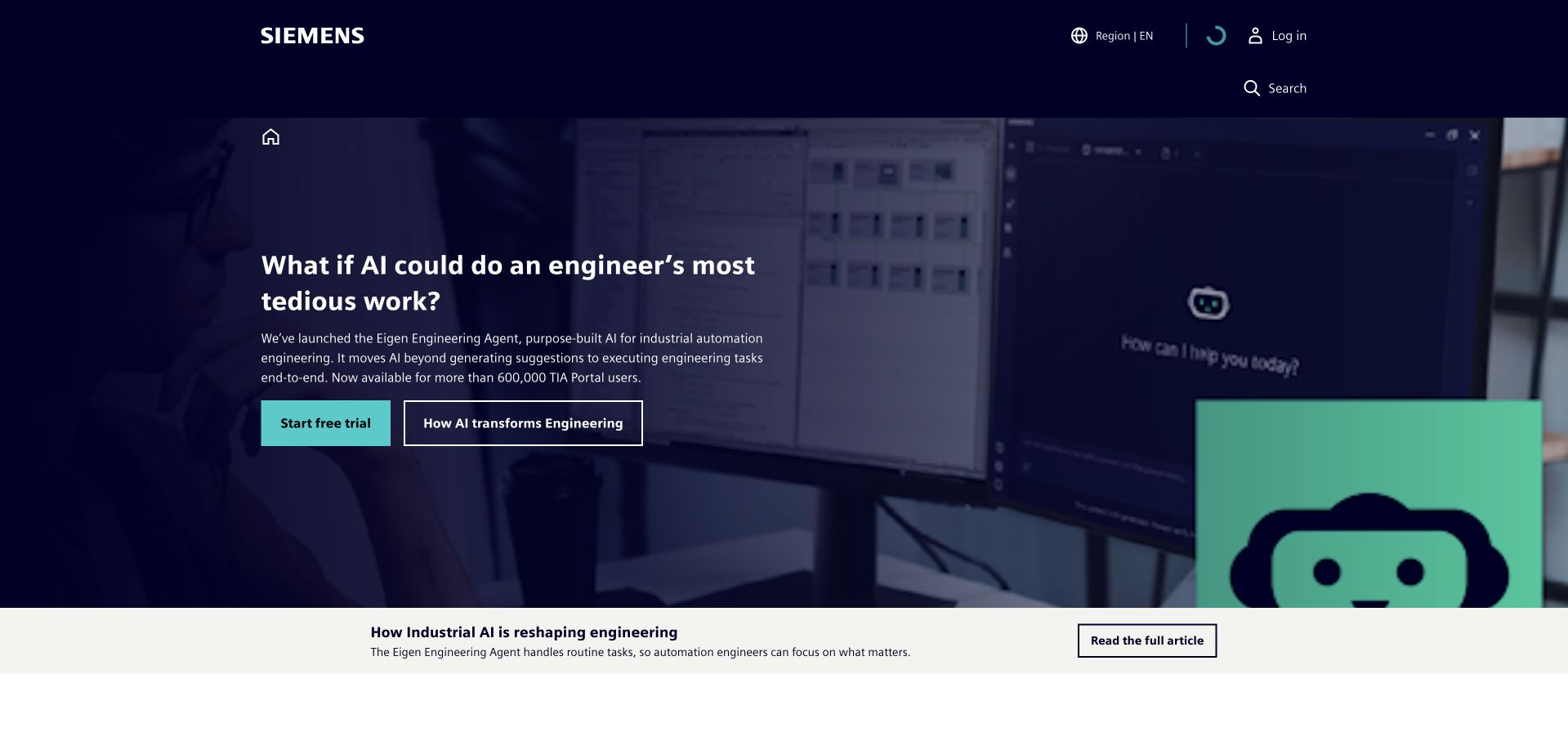
Siemens opens with an industrial engineering question over a dark technical scene, with a small number of actions distinguishing a trial from an explanatory route. A supporting strip adds a useful next article without turning the hero into a collection of competing cards. Further down, products, services and customer stories broaden the site’s scope. The page links an abstract AI proposition to the recognizable work of an engineer.
What you can learn
Start a complex product story with a task the intended audience recognizes, then explain the wider platform. GitLab’s Siemens case describes an internal open-source DevOps culture and collaboration. That association does not identify the CMS or hosting of the public homepage, and a visual reference should not silently turn internal development practices into frontend technology claims.
Pros
The opening question gives a wide industrial portfolio a specific, understandable point of entry.
Separate trial and explanation actions let visitors choose between immediate evaluation and more context.
Cons & considerations
A heavily shaded background needs enough contrast for smaller supporting text and secondary controls.
A single campaign can dominate the first impression for visitors looking for established non-AI product lines.
Platform source: Official GitLab customer documentation. GitLab’s Siemens case describes the code.siemens.com developer collaboration service, source management and CI/CD, including GitLab runners. The scope is that documented engineering platform. This official customer documentation establishes only the organization and engineering scope stated by the source. It does not identify the pictured marketing homepage’s CMS, frontend, hosting or complete current architecture. Vendor-reported outcomes were not independently tested. Platform evidence is separate from the direct website screenshot and is not a complete current infrastructure audit.
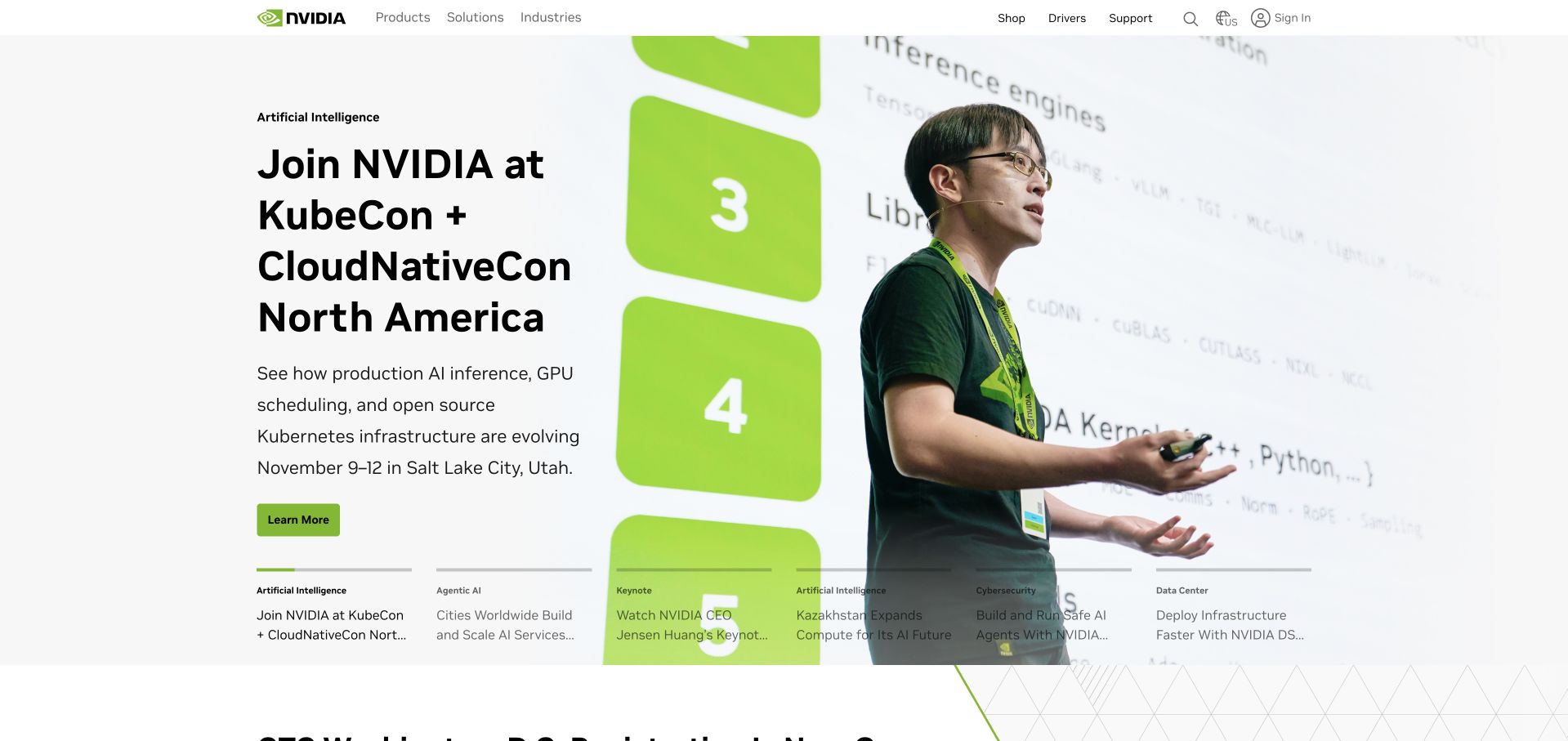
NVIDIA pairs a clear campaign headline with human-scale event photography and its distinctive green brand accent. A row of alternate stories below the main feature exposes the breadth of the company without giving every subject equal visual weight. The main navigation remains available above the campaign, while supporting sections lead into AI, data-centre and industry content. The result is editorial rather than a static catalogue of hardware specifications.
What you can learn
Use a current campaign as an invitation, while retaining stable routes for readers arriving with a concrete product question. GitLab’s NVIDIA case concerns GitLab Geo and engineering collaboration. It supports that named organizational workload, not an inference that the pictured website is built with GitLab or that all NVIDIA repositories share the same delivery architecture.
Pros
A recognizable accent color ties the campaign imagery to the wider brand without overwhelming the text.
Visible alternate stories provide a quick sense of breadth before the reader scrolls into product categories.
Cons & considerations
Rotating campaigns need pause controls and a stable reading experience for keyboard and reduced-motion users.
An event-led opening may be less immediately useful to readers seeking a particular developer download or compatibility answer.
Platform source: Official GitLab customer documentation. GitLab’s NVIDIA case describes GitLab Geo supporting geographically distributed engineering teams, repository availability and collaboration. It is not evidence of NVIDIA’s homepage deployment. This official customer documentation establishes only the organization and engineering scope stated by the source. It does not identify the pictured marketing homepage’s CMS, frontend, hosting or complete current architecture. Vendor-reported outcomes were not independently tested. Platform evidence is separate from the direct website screenshot and is not a complete current infrastructure audit.
Goldman Sachs uses full-width event photography and a large serif headline to introduce a small-business initiative. The corporate navigation is compact enough to remain legible above the image, while the explanatory copy and exploration link give the campaign a defined next step. Below, the firm-in-action structure separates leadership, media and transaction stories. The opening feels like a feature story rather than a banking-product comparison table.
What you can learn
A public corporate site can lead with a timely initiative when it still offers clear routes into the institution’s actual work. GitLab’s Goldman Sachs case describes development tooling and CI activity within engineering teams. Those internal practices are separate from the design and runtime of the public corporate homepage shown here.
Pros
Large editorial typography and event imagery make the featured initiative identifiable at a glance.
Corporate and client-login routes remain distinct from the public campaign rather than merging unrelated tasks.
Cons & considerations
Small white supporting copy over a detailed photograph requires careful contrast at every responsive crop.
A public initiative does not explain every business line, so the broader navigation must stay easy to understand.
Visible tech stack
Earlier / documented evidence
GitLab
Platform source: Official GitLab customer documentation. GitLab’s Goldman Sachs case describes Engineering Division automation, CI feature-branch builds and a consolidated development workflow. This official customer documentation establishes only the organization and engineering scope stated by the source. It does not identify the pictured marketing homepage’s CMS, frontend, hosting or complete current architecture. Vendor-reported outcomes were not independently tested. Platform evidence is separate from the direct website screenshot and is not a complete current infrastructure audit.
Lockheed Martin uses an expansive aerospace image with a restrained text overlay and a short highlights message. The page then divides capabilities into recognizable domains such as air, land, sea, space and cyber, while people and current news provide separate editorial layers. This sequence gives a large technical organization a simple initial story without attempting to explain every programme in the opening viewport.
What you can learn
Move from a strong visual statement into a small set of meaningful categories, then let detailed pages carry technical depth. GitLab’s official case describes software development and programme delivery across Lockheed Martin teams. It does not establish the public homepage’s CMS, the current configuration of any mission system or an independent assessment of the organization’s products.
Pros
A limited headline overlay allows the central image to communicate the broad aerospace context immediately.
Domain-based capability categories offer clearer orientation than exposing a very large product inventory first.
Cons & considerations
Background imagery should retain useful focal points and text contrast across narrower screen crops.
Mission-led language needs practical supporting routes for suppliers, job seekers and visitors with specific programme questions.
Platform source: Official GitLab customer documentation. GitLab’s Lockheed Martin case describes DevSecOps, software sharing, security and automated delivery across the programs discussed in that story. This official customer documentation establishes only the organization and engineering scope stated by the source. It does not identify the pictured marketing homepage’s CMS, frontend, hosting or complete current architecture. Vendor-reported outcomes were not independently tested. Platform evidence is separate from the direct website screenshot and is not a complete current infrastructure audit.
Airbus places a short purpose statement over a large aerospace scene, then continues into stories about the people and missions surrounding its products. The restrained navigation keeps careers, investors and suppliers available without filling the first screen with a dense catalogue. A lower mission structure organizes connectivity, security, crisis response and exploration. The page balances the scale of a global company with stories visitors can understand without technical background.
What you can learn
Use purpose as an opening theme, but provide concrete content that explains what it means in practice. Airbus appears in GitLab’s official Q4 FY2025 customer presentation. That is a dated organizational association only; it does not identify a current Airbus workload, demonstrate the public homepage’s build system or establish a complete present-day stack.
Pros
The large scene and short statement create an immediate, coherent sense of the organization’s field.
Audience-specific corporate routes remain accessible while the main page concentrates on broader stories and missions.
Cons & considerations
Video and rotating stories need reliable pause behavior and alternatives that do not depend on motion.
A broad sustainability statement should lead to specific evidence rather than asking visitors to treat imagery as proof of an outcome.
Platform source: Historical official GitLab investor presentation, page 27. Airbus is explicitly displayed in the Transportation / Automotive customer-logo group on page 27 of GitLab’s Q4 FY2025 official investor presentation. Historical organization-level customer-logo association from the Q4 FY2025 presentation (page 27), not a verified current workload, CI configuration or homepage implementation. No private Airbus system was inspected. Platform evidence is separate from the direct website screenshot and is not a complete current infrastructure audit.
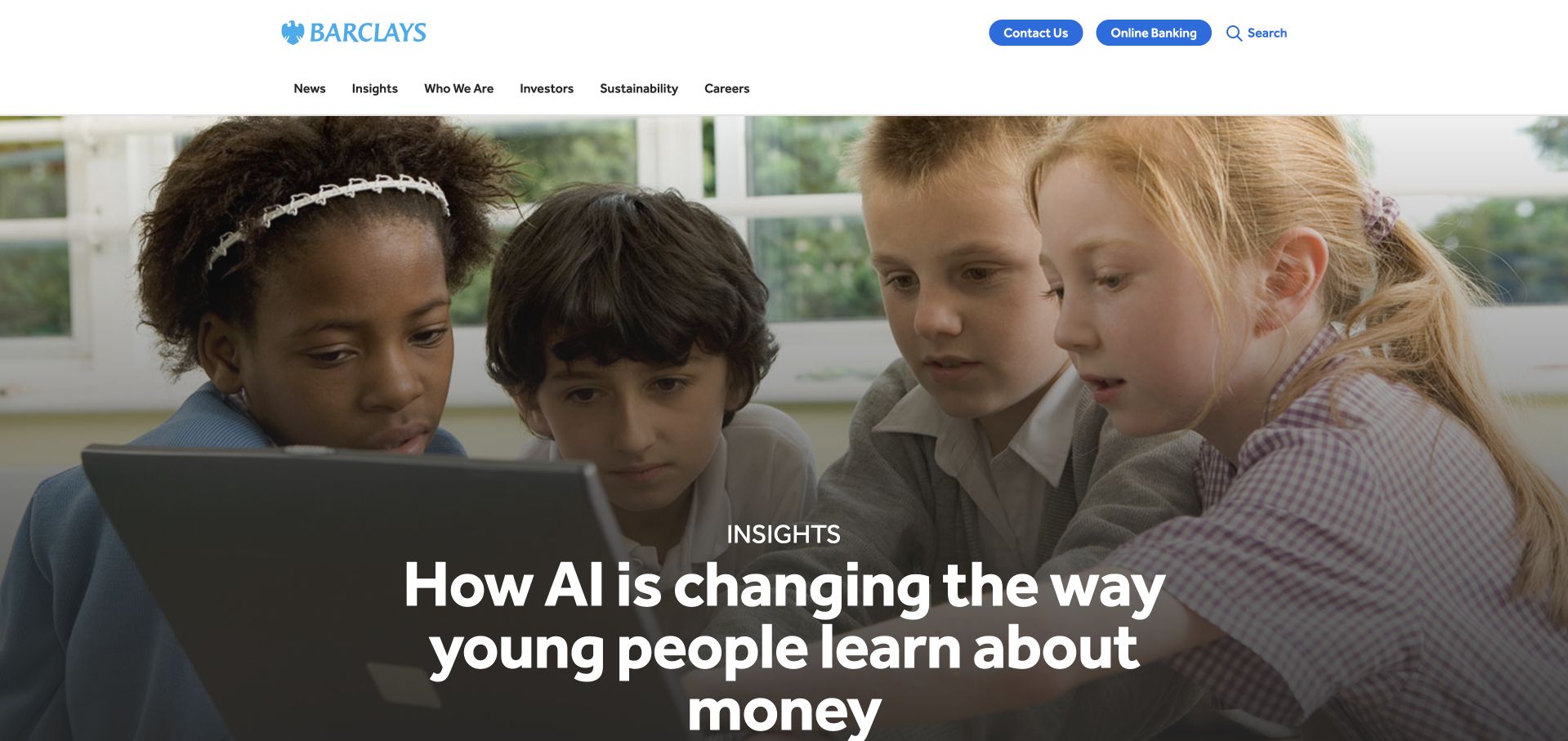
Barclays leads its corporate site with an editorial feature and a clean white header, keeping contact, online banking and search as recognizable utility actions. Below the opening, five divisions explain the group’s business in a structured sequence. Insights and other stories provide a more exploratory route. The design is useful to study because it avoids turning a corporate information site into an imitation of a personal banking application.
What you can learn
Separate the task of understanding a company from the task of using its financial products. GitLab’s Barclays case documents an enterprise toolchain and developer-assistance relationship. That is not evidence about the technology behind every Barclays web property, and neither the case nor this design review should be read as financial-product advice or an endorsement.
Pros
Corporate information and online banking are clearly differentiated instead of competing inside one undifferentiated navigation.
A division-based explanation gives a large financial group a manageable information structure below the feature story.
Cons & considerations
A current editorial theme can obscure the institution’s practical scope if visitors do not continue scrolling.
Supporting copy needs enough visual weight to remain legible when image-led campaign layouts adapt to small screens.
Platform source: Official GitLab customer documentation. GitLab’s Barclays PLC case describes adoption of GitLab Ultimate and GitLab Duo in its development toolchain, including automated security controls. This official customer documentation establishes only the organization and engineering scope stated by the source. It does not identify the pictured marketing homepage’s CMS, frontend, hosting or complete current architecture. Vendor-reported outcomes were not independently tested. Platform evidence is separate from the direct website screenshot and is not a complete current infrastructure audit.
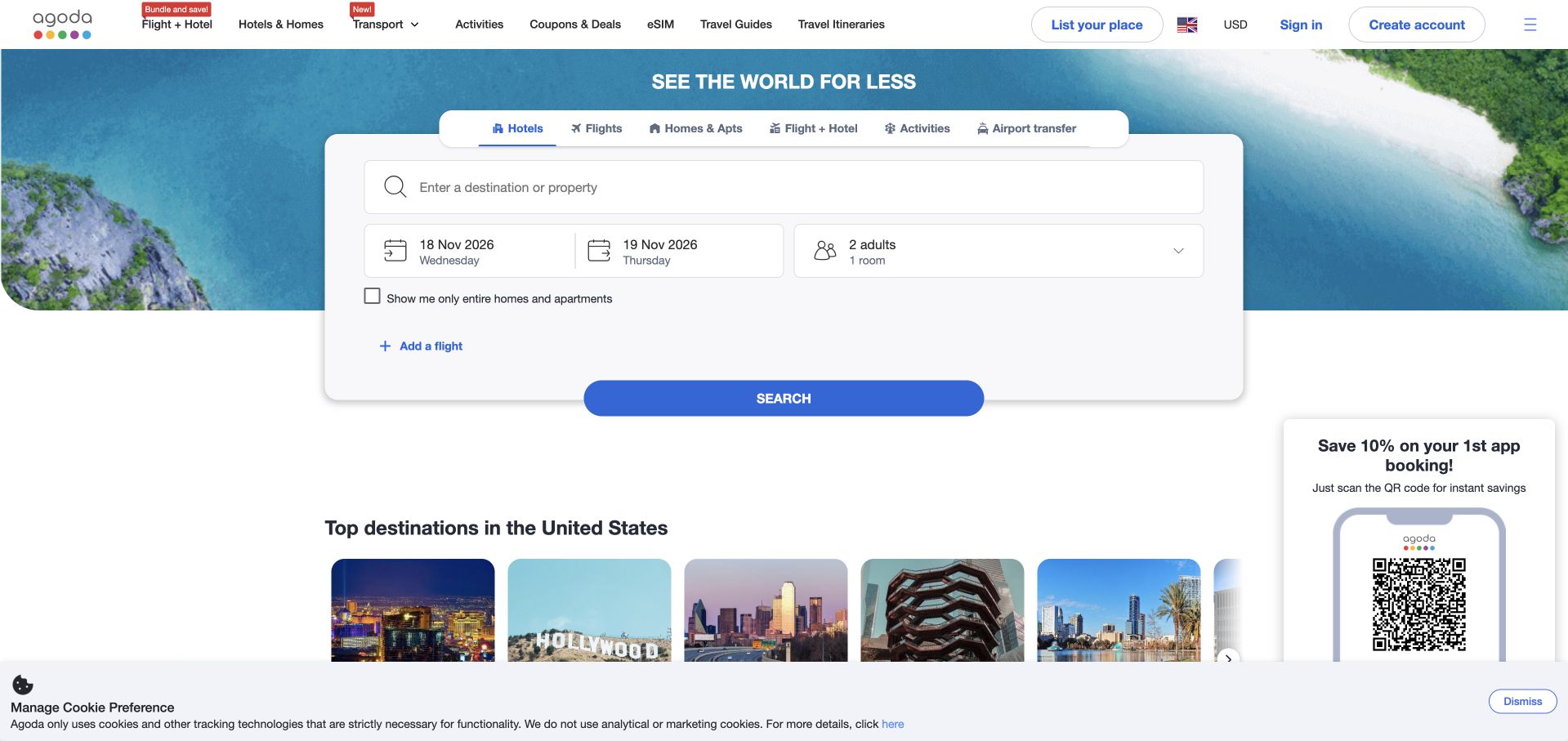
Agoda centers its opening around accommodation search, with destination, dates and guests grouped in one large panel. Travel categories sit directly above that form, while destination photography and promotional material follow below. The blue search action is visually unambiguous even within a busy commercial layout. The page demonstrates how a service can make its core transaction immediately available without removing all of the discovery content around it.
What you can learn
Put the information needed for the first useful action into one coherent interaction rather than scattering it through a campaign. GitLab’s Agoda case concerns developer productivity and software delivery practices. Those backend organizational facts do not identify the technologies rendering the search interface or independently verify any booking, price or availability shown in the public screenshot.
Pros
Destination, dates and party size are grouped around one clearly dominant search action.
Category tabs expose related travel tasks without forcing every visitor through the same accommodation workflow.
Cons & considerations
Promotions and app-download panels can crowd an already information-dense opening, especially on smaller screens.
Travel dates, prices and availability are transient interface content and should not be reused as evergreen factual claims.
Platform source: Official GitLab customer documentation. GitLab’s Agoda case describes DevSecOps consolidation, CI/CD and Kubernetes-based GitLab runners for its documented engineering environment. This official customer documentation establishes only the organization and engineering scope stated by the source. It does not identify the pictured marketing homepage’s CMS, frontend, hosting or complete current architecture. Vendor-reported outcomes were not independently tested. Platform evidence is separate from the direct website screenshot and is not a complete current infrastructure audit.
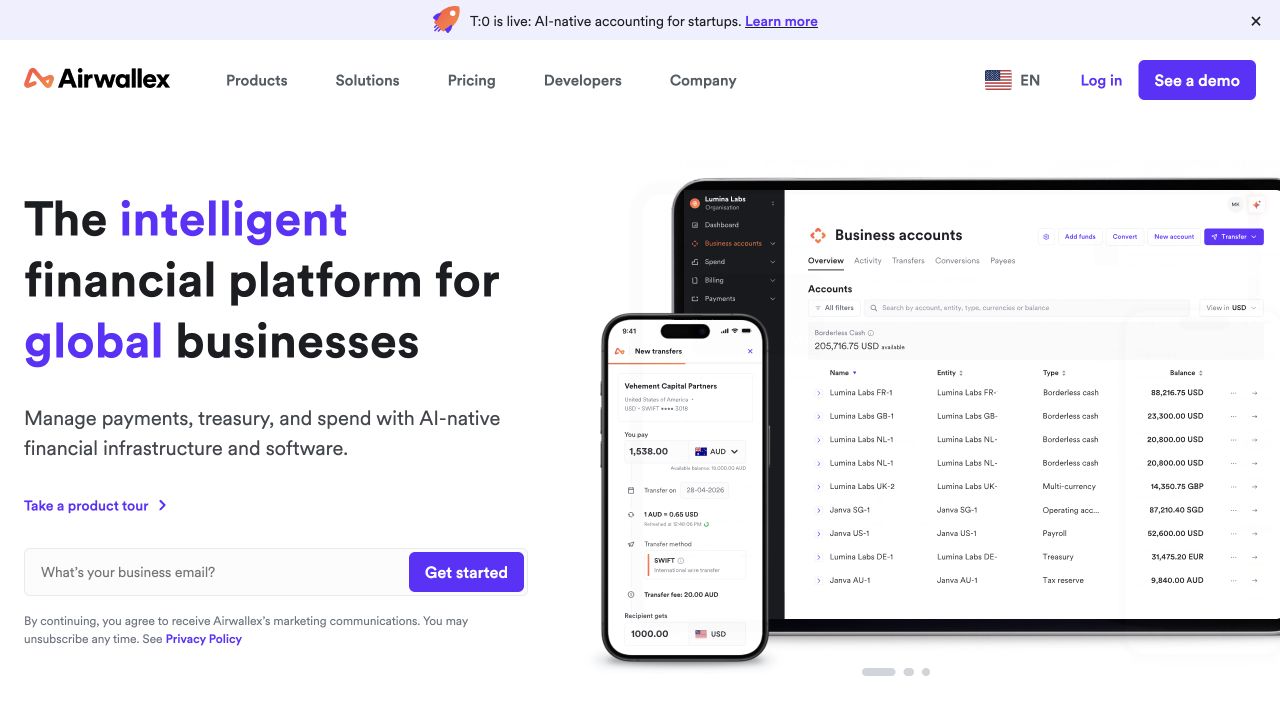
Airwallex pairs a large global-finance headline with desktop and mobile interface imagery. The restrained purple accent ties the main action, supporting labels and product visuals together. A short business-email field offers an immediate starting route, while a product-tour link supports readers who want to understand the interface first. The wider site then expands into infrastructure, local-market relevance and individual finance capabilities.
What you can learn
Demonstrate the operational surface behind a broad platform promise before asking the reader to compare every feature. GitLab’s official Airwallex case describes its engineering delivery process. That evidence does not prove the public marketing page’s framework, a particular customer’s financial infrastructure or the applicability of product claims to every country and business type.
Pros
Device imagery helps readers connect a broad infrastructure proposition to everyday finance tasks.
A product-tour route provides a lower-commitment alternative to the immediate business-email action.
Cons & considerations
An email-first start needs a clear explanation of what happens next and how submitted information will be used.
Global positioning still requires explicit local eligibility, product and regulatory details before a visitor makes a decision.
Visible tech stack
Earlier / documented evidence
GitLab
Platform source: Official GitLab customer documentation. GitLab’s Airwallex case describes source management and CI/CD on Google Cloud, including GitLab running on Google Kubernetes Engine. This official customer documentation establishes only the organization and engineering scope stated by the source. It does not identify the pictured marketing homepage’s CMS, frontend, hosting or complete current architecture. Vendor-reported outcomes were not independently tested. Platform evidence is separate from the direct website screenshot and is not a complete current infrastructure audit.
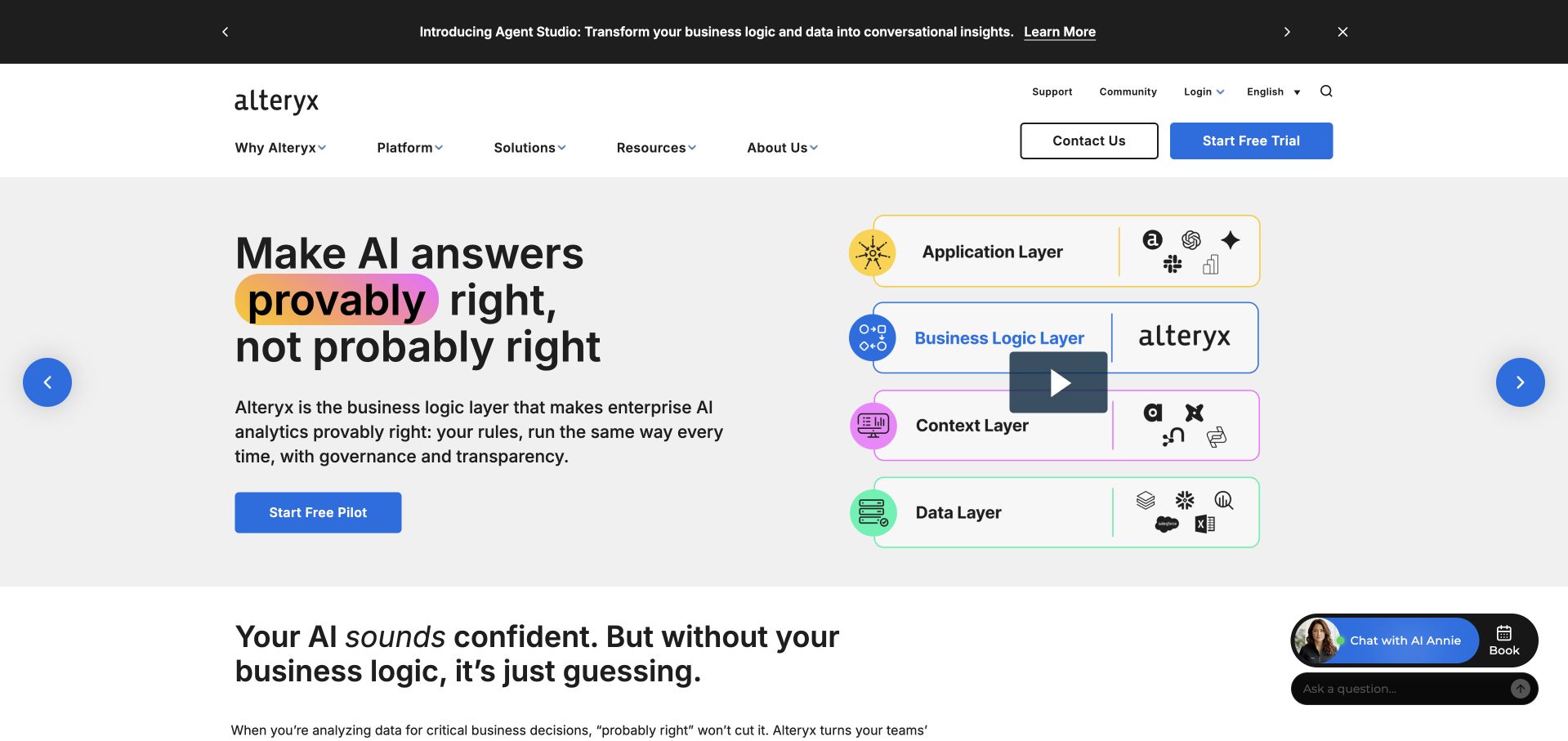
Alteryx combines a concise analytics headline with a product interface and two distinct commercial actions. A narrow announcement strip carries current material without replacing the main proposition. Lower sections connect data preparation, decisions and operational use, while customer stories add a different type of evidence. The design makes a complex analytical platform visible rather than relying only on abstract AI artwork.
What you can learn
Show the surface where users will do the work, then explain the limits of the promised outcome in supporting material. GitLab’s Alteryx case documents changes to its development toolchain and build process. It is an organizational software-delivery association, not proof of this marketing page’s runtime or an independent validation of the analytics claims displayed on it.
Pros
A visible application preview gives the platform narrative a practical focal point alongside the headline.
Trial and sales-contact routes serve visitors with different purchasing processes instead of implying one universal next step.
Cons & considerations
Several rotating propositions can make the precise product distinction harder to retain after a quick visit.
Strong claims about reliable AI answers need clear supporting definitions and should not be accepted merely because the layout looks authoritative.
Platform source: Official GitLab customer documentation. GitLab’s Alteryx case describes source control, code review, CI/CD and security scanning in a consolidated software-development environment. This official customer documentation establishes only the organization and engineering scope stated by the source. It does not identify the pictured marketing homepage’s CMS, frontend, hosting or complete current architecture. Vendor-reported outcomes were not independently tested. Platform evidence is separate from the direct website screenshot and is not a complete current infrastructure audit.
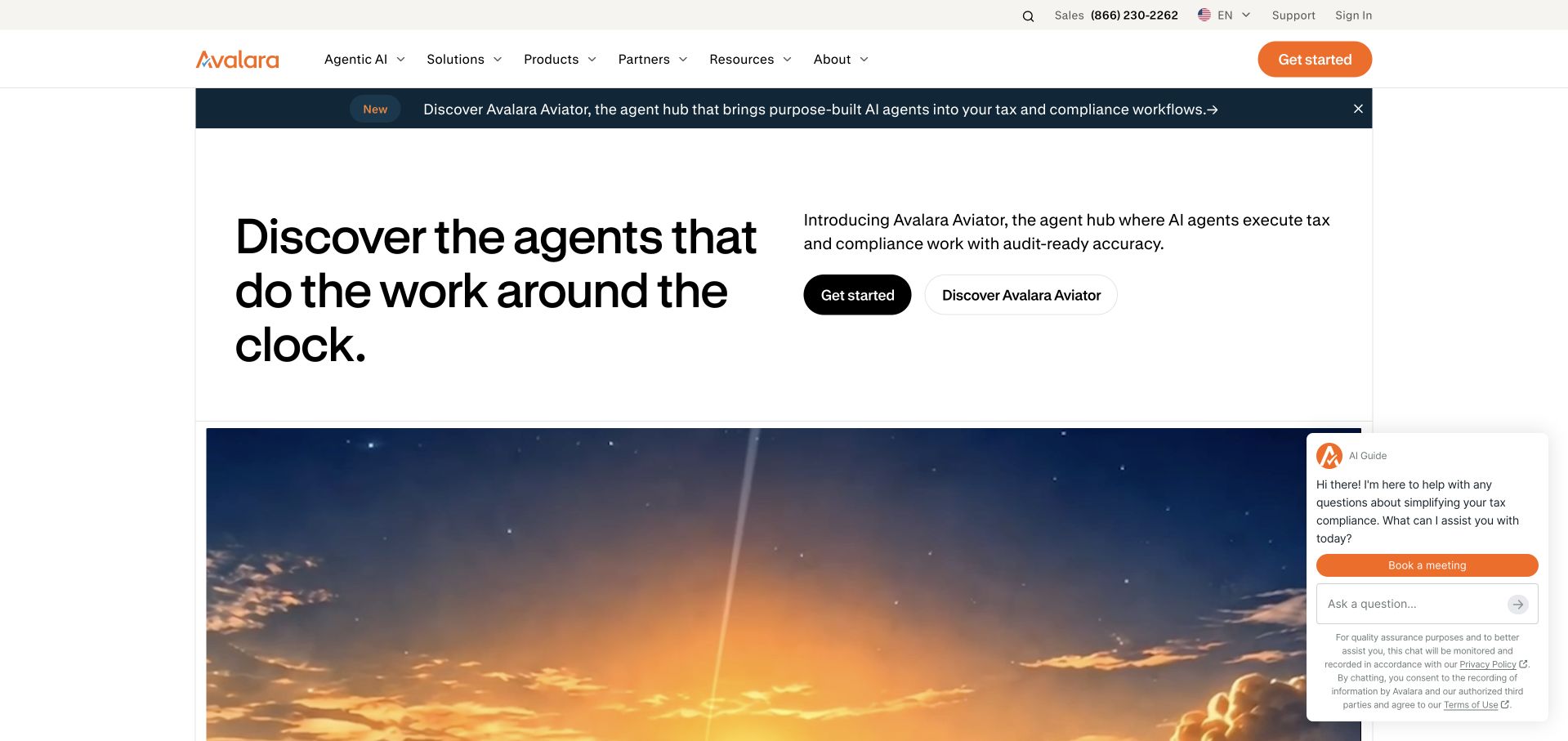
Avalara’s opening introduces around-the-clock tax and compliance assistance with a large headline and a small number of actions. Its orange brand accent appears in the logo, primary action and supporting interface elements, while a wider platform section explains the compliance lifecycle. A mixture of articles, integrations and product information broadens the experience. It is a useful reference for a specialized business service that still needs a clear public introduction.
What you can learn
Start with the task a business needs handled, then make the boundaries of automation and responsibility explicit. GitLab’s Avalara story concerns engineering and software-delivery operations. That association should not be expanded into a claim about the public site’s CMS, or interpreted as verification that any tax or AI statement on the page applies to a particular visitor.
Pros
A specialized business topic is introduced through a recognizable operational need rather than a feature inventory.
Consistent orange accents make the main actions easy to distinguish from the large amount of supporting content.
Cons & considerations
Chat panels, cookie notices and announcement bars can consume a disproportionate part of the viewport.
Compliance-oriented copy needs precise jurisdiction and responsibility details beyond a broad promise of continuous automation.
Platform source: Official GitLab customer documentation. GitLab’s Avalara case describes software delivery and security automation, including development and management of its AvaTax product. This official customer documentation establishes only the organization and engineering scope stated by the source. It does not identify the pictured marketing homepage’s CMS, frontend, hosting or complete current architecture. Vendor-reported outcomes were not independently tested. Platform evidence is separate from the direct website screenshot and is not a complete current infrastructure audit.
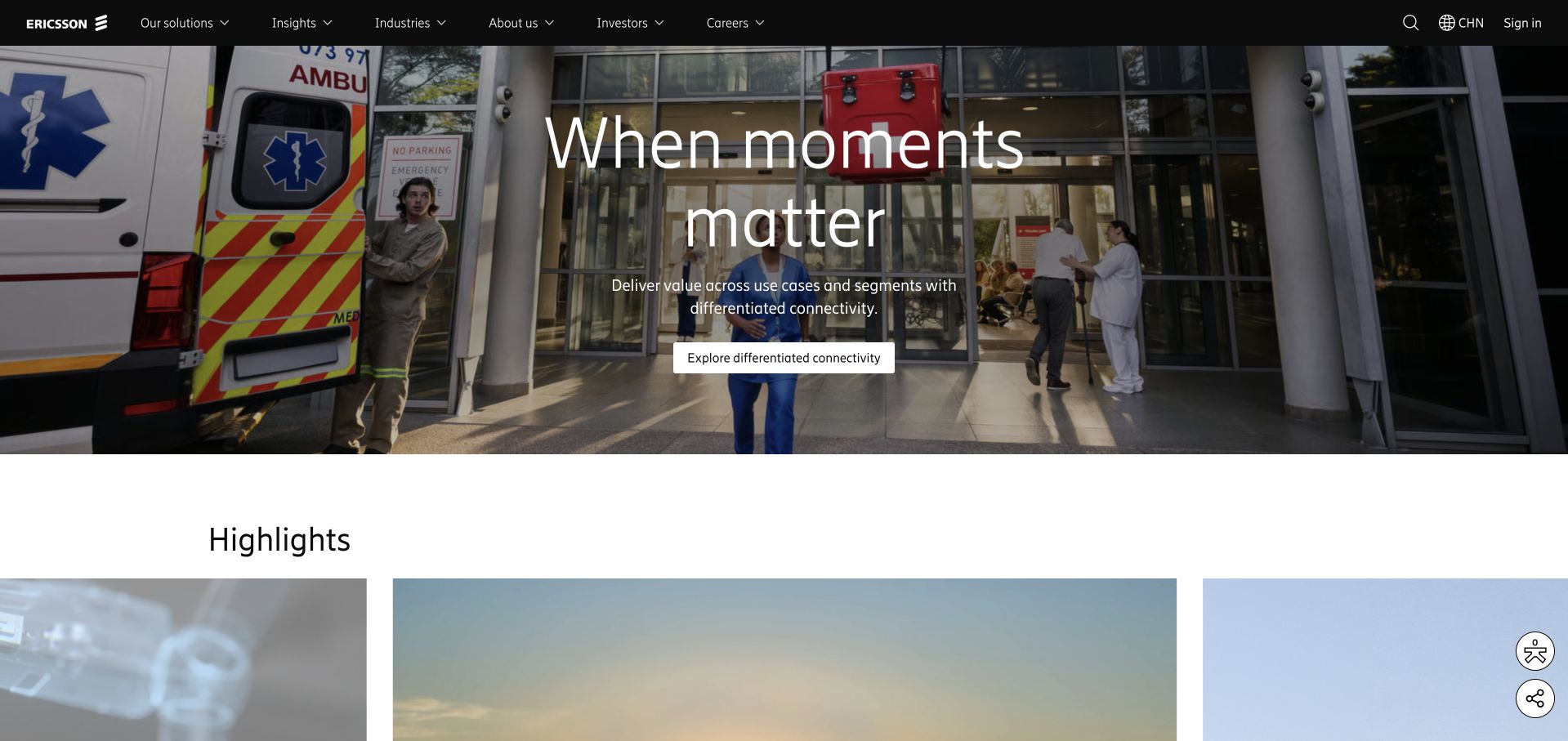
Ericsson introduces differentiated connectivity with a concise headline over real-world imagery, then moves into a structured highlights section. White papers, research topics and case studies offer several levels of depth without making the opening a dense telecom specification sheet. The main navigation groups solutions, industries and company information in familiar terms. The site demonstrates how a technically specialized company can begin with a broad human context and still retain substantial professional content.
What you can learn
A relatable opening can make an infrastructure proposition approachable, but the next steps must return to specific technical questions. GitLab’s Ericsson case concerns delivery for OSS/BSS customers. It does not identify this corporate homepage’s build pipeline, prove the configuration of any operator network or validate the performance of a particular connectivity service.
Pros
The hero connects a technical field to a situation that readers can recognize without specialist knowledge.
Highlights provide routes into research, products and practical cases instead of repeating one marketing claim throughout the page.
Cons & considerations
The distance between broad campaign language and concrete solution requirements needs careful supporting navigation.
Moving backgrounds and stacked announcement areas should not undermine text contrast or the ability to pause and read.
Visible tech stack
Earlier / documented evidence
GitLab
Platform source: Official GitLab customer documentation. GitLab’s Ericsson case concerns the OSS/BSS organization’s cloud-native software delivery and deployment automation, not every Ericsson workload. This official customer documentation establishes only the organization and engineering scope stated by the source. It does not identify the pictured marketing homepage’s CMS, frontend, hosting or complete current architecture. Vendor-reported outcomes were not independently tested. Platform evidence is separate from the direct website screenshot and is not a complete current infrastructure audit.
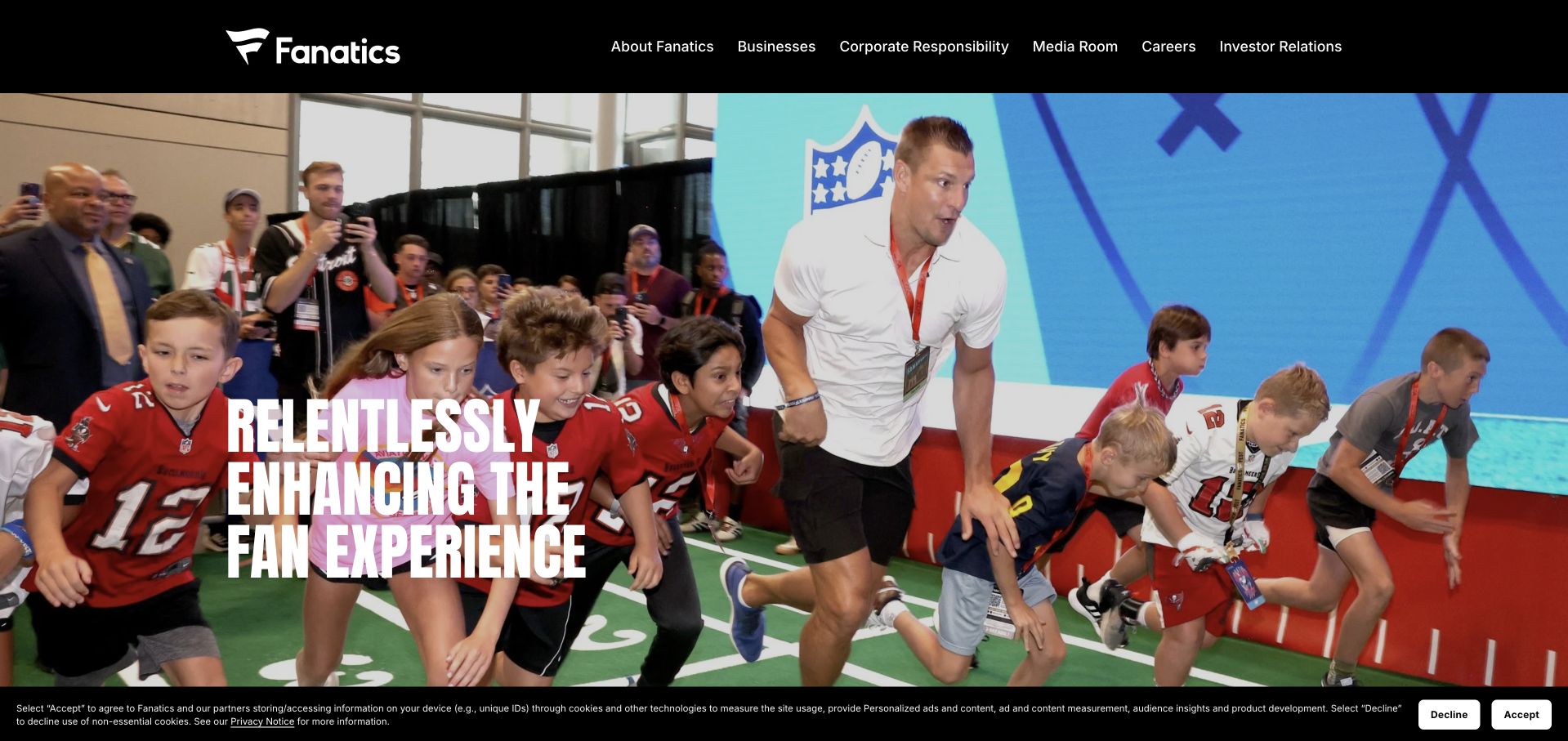
Fanatics leads with an energetic sports scene and an emphatic statement about the fan experience. The page then explains its business areas, partnerships and career opportunities, with the black header retaining a straightforward corporate structure. Large section titles and photography carry much of the identity. This is a corporate platform presentation, not a product-detail page, and the distinction is useful when a brand operates across several related consumer businesses.
What you can learn
Use a shared audience to connect related businesses, then let individual routes explain their different tasks and terms. GitLab’s Fanatics case describes CI stability in its engineering environment. That evidence does not establish the corporate homepage’s stack or imply that every Fanatics commerce, event or gaming product uses the same development system.
Pros
Human activity gives the broad sports-platform idea a recognizable emotional context before corporate detail appears.
Separate business sections make an extensive ecosystem easier to explore without placing every subsidiary in the hero.
Cons & considerations
Highly animated typography and large looping imagery require careful reduced-motion and keyboard behavior.
Commercial activities with very different eligibility and risk profiles need clearly differentiated destinations rather than relying on a shared brand impression.
Visible tech stack
Earlier / documented evidence
GitLab
Platform source: Official GitLab customer documentation. GitLab’s Fanatics case describes the cloud team’s migration to GitLab CI and its continuous integration and delivery processes. This official customer documentation establishes only the organization and engineering scope stated by the source. It does not identify the pictured marketing homepage’s CMS, frontend, hosting or complete current architecture. Vendor-reported outcomes were not independently tested. Platform evidence is separate from the direct website screenshot and is not a complete current infrastructure audit.
Fujitsu’s global homepage combines a vivid purple city image with an integrated-report feature, then shifts into insights and customer stories. The header keeps services, industries, technology and corporate information available in a compact structure. The first screen is deliberately corporate rather than a catalogue of individual devices. That choice helps establish an organizational point of view before the reader selects a more specific technology or market route.
What you can learn
A corporate report can provide a coherent opening when it remains connected to useful service and evidence pages. GitLab’s case concerns Fujitsu Cloud Technologies, a specifically named organizational context. Do not flatten that into a claim about all Fujitsu businesses, the public global homepage or every infrastructure service carrying the same brand.
Pros
A distinctive visual treatment makes the report feature recognizable without adding many competing hero controls.
Insights and customer stories provide a useful bridge from corporate positioning to concrete work and subject expertise.
Cons & considerations
A report-led opening may be less useful to visitors with an urgent product-support or service-selection task.
Group-level branding needs clear organizational scope when technical cases relate to a particular subsidiary or business unit.
Platform source: Official GitLab customer documentation. GitLab’s case specifically identifies Fujitsu Cloud Technologies and its NIFCLOUD engineering context, with source-code management and continuous integration. This official customer documentation establishes only the organization and engineering scope stated by the source. It does not identify the pictured marketing homepage’s CMS, frontend, hosting or complete current architecture. Vendor-reported outcomes were not independently tested. Platform evidence is separate from the direct website screenshot and is not a complete current infrastructure audit.
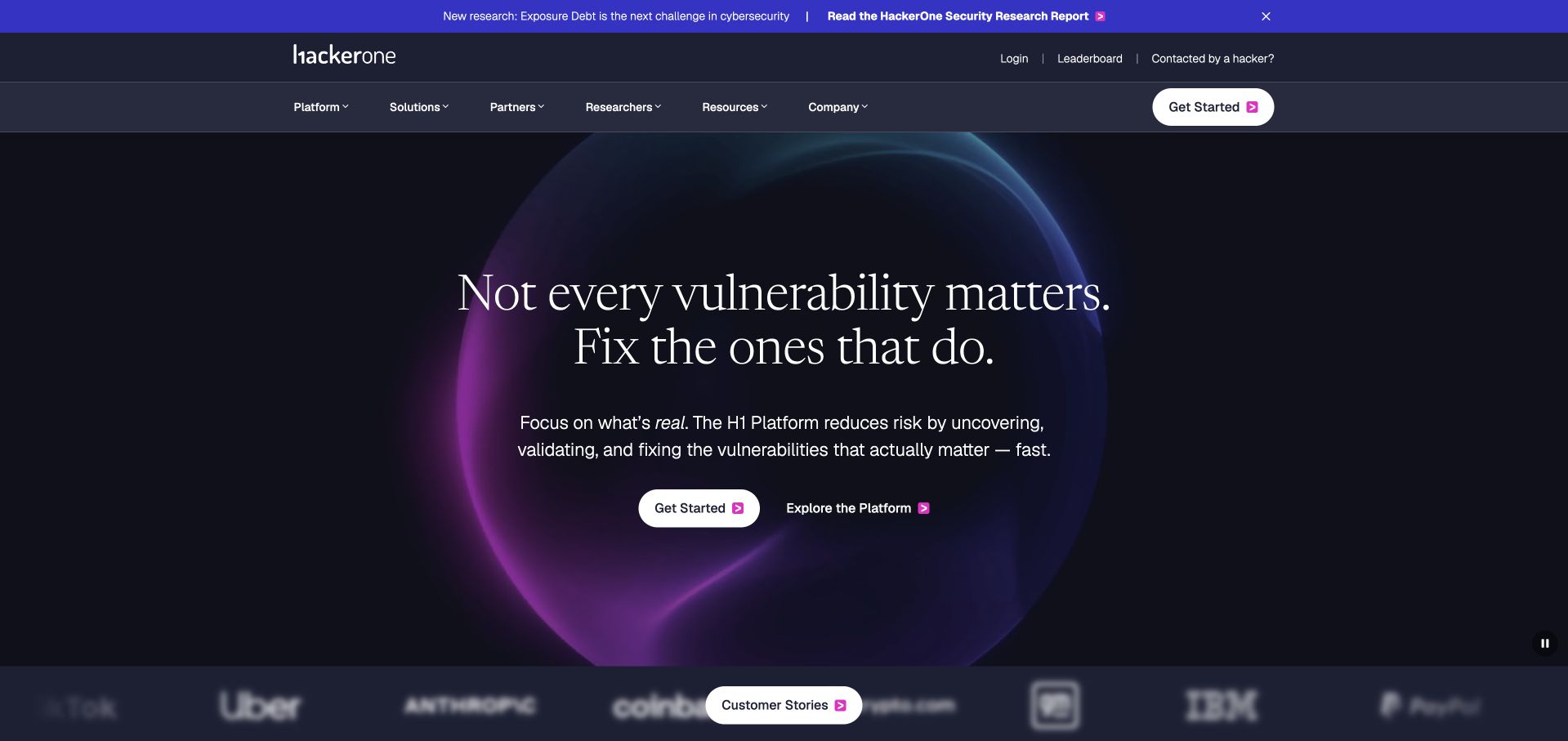
HackerOne uses a dark, restrained hero with a two-part headline about identifying vulnerabilities that matter. The primary actions distinguish getting started from exploring the platform, while later content explains discovery, validation and remediation. Customer references and product areas sit below rather than overwhelming the first statement. The visual tone is confident, but the useful structural idea is the decision to frame security as a sequence of connected jobs.
What you can learn
A security homepage should explain how information becomes a decision, not merely show a large volume of findings. GitLab’s HackerOne case documents development and integrated-security practices within that organization. It does not establish this page’s stack, every customer programme’s tooling or independently validate a security result pictured.
Pros
The headline identifies a practical prioritization problem instead of presenting all security findings as equally useful.
The platform explanation connects several stages of work in language that supports an evaluative visit.
Cons & considerations
An automatically opened assistant panel can obscure the proposition it is meant to support.
Broad security and AI claims need specific evidence, scope and limitations rather than relying on visual authority or customer logos alone.
Platform source: Official GitLab customer documentation. GitLab’s HackerOne case describes GitLab Ultimate, CI pipelines and integrated security checks in the software-development workflow. This official customer documentation establishes only the organization and engineering scope stated by the source. It does not identify the pictured marketing homepage’s CMS, frontend, hosting or complete current architecture. Vendor-reported outcomes were not independently tested. Platform evidence is separate from the direct website screenshot and is not a complete current infrastructure audit.
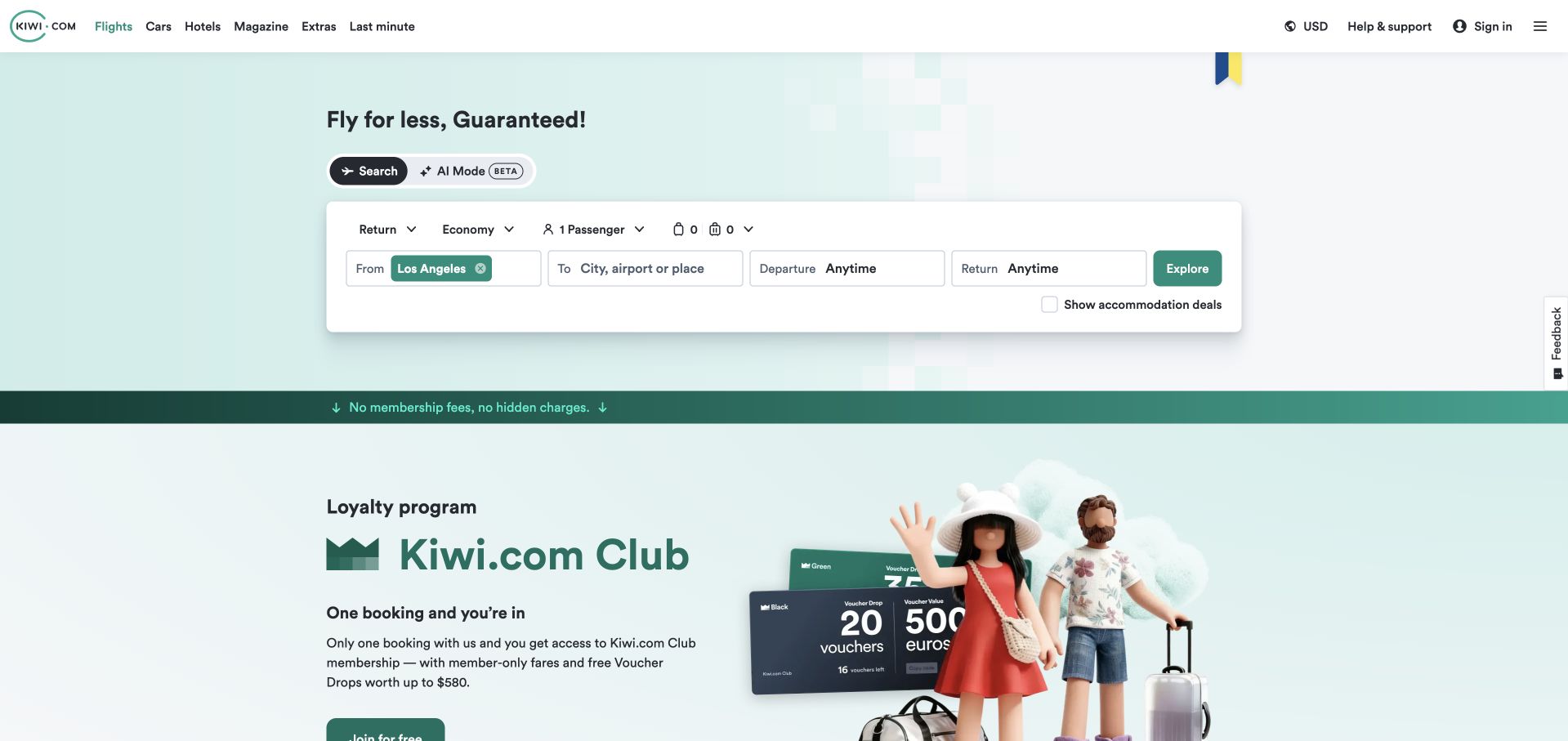
Kiwi.com places a route-search form near the top of a pale, uncluttered opening, with passenger and baggage details close to the main action. Loyalty and guarantee sections follow before a broader destination catalogue. The layout treats reassurance as part of the product explanation rather than a distant legal page. Its search-first structure remains clear even as promotions and related travel content add commercial complexity below.
What you can learn
Keep the immediate task simple, then explain the uncertainty that might prevent someone completing it. GitLab’s Kiwi case explicitly discusses workflow transformation with GitLab and Docker. That is a documented engineering association, not verification of the public search page’s complete runtime, the current terms of a guarantee or any fare visible during the visit.
Pros
Route, date and passenger controls are grouped into a recognizable travel-search interaction.
Guarantee and loyalty explanations acknowledge questions that can matter after the initial destination decision.
Cons & considerations
Automatically localized destinations and dates should not be mistaken for stable content or a personalized recommendation.
Promotional reassurance needs direct access to exclusions and booking responsibilities before a visitor relies on it.
Platform source: Official GitLab customer documentation. GitLab’s Kiwi.com case describes source control, container integration and CI automation for its documented engineering teams. This official customer documentation establishes only the organization and engineering scope stated by the source. It does not identify the pictured marketing homepage’s CMS, frontend, hosting or complete current architecture. Vendor-reported outcomes were not independently tested. Platform evidence is separate from the direct website screenshot and is not a complete current infrastructure audit.
KnowBe4 combines a dark-blue hero, an orange action and a human-focused photograph to introduce digital-workforce risk. Short supporting points sit immediately beneath the proposition, while customer stories and product categories provide more detailed paths below. The page retains a familiar business-software structure despite its expanding AI narrative. It is worth studying for the way it joins a specialized risk category to recognizable workplace situations.
What you can learn
When a product expands into a new theme, preserve clear routes to the established work users already understand. GitLab’s KnowBe4 story concerns keeping code in-house and improving software delivery. It does not establish the marketing homepage’s technical stack or independently validate claims about training effectiveness, security coverage or an individual organization’s risk.
Pros
The primary action stands out clearly against a restrained dark field and a limited accent palette.
Customer stories provide a more concrete route beyond broad workforce and AI language.
Cons & considerations
Several numerical proof points need context and dated sources rather than being treated as universal evidence.
An expanding category story can make established training, email-security and agent-specific capabilities harder to compare without careful product navigation.
Platform source: Official GitLab customer documentation. GitLab’s KnowBe4 case describes in-house source management and consolidation of its software delivery toolchain. This official customer documentation establishes only the organization and engineering scope stated by the source. It does not identify the pictured marketing homepage’s CMS, frontend, hosting or complete current architecture. Vendor-reported outcomes were not independently tested. Platform evidence is separate from the direct website screenshot and is not a complete current infrastructure audit.
Lely opens with a dairy-farming scene and a direct route to a local centre, then separates solutions, services, events and careers. The larger site explains a wide range of farm activities without beginning with a technical product matrix. A substantial location section acknowledges that buying and maintaining equipment depends on a real service network. The design feels grounded in the operating environment rather than generic industrial technology imagery.
What you can learn
For equipment businesses, a useful next step may be finding appropriate local support rather than requesting a global sales demo. GitLab’s Lely case describes consolidating development tools. That organizational association does not identify the homepage’s CMS, verify a specific machine configuration or establish the availability of service in a visitor’s region.
Pros
Real farming context makes the purpose of an extensive equipment portfolio immediately understandable.
A prominent centre-finding route recognizes the importance of regional advice and ongoing technical support.
Cons & considerations
Location and consent dialogs should not prevent visitors from understanding the basic offering first.
Very large product and country menus require strong search, mobile navigation and a consistent distinction between global information and local service.
Platform source: Official GitLab customer documentation. GitLab’s Lely case describes code review, collaboration and built-in continuous integration for its agricultural-robotics software teams. This official customer documentation establishes only the organization and engineering scope stated by the source. It does not identify the pictured marketing homepage’s CMS, frontend, hosting or complete current architecture. Vendor-reported outcomes were not independently tested. Platform evidence is separate from the direct website screenshot and is not a complete current infrastructure audit.
Radio France’s corporate homepage combines a large event-led feature with routes to frequencies, access information and current organizational stories. Its pale background, strong imagery and clear content categories make the page feel editorial without turning it into an audio-player application. Institutional and professional tasks remain separate from the wider listening ecosystem. This distinction is valuable for media organizations whose public purpose, physical venue and programme brands all need representation.
What you can learn
A media homepage should clarify whether someone is discovering content, finding a service or understanding the institution. GitLab’s official Radio France case describes CI/CD deployment work. That association does not establish the technical stack of every station, the public corporate page or the player surfaces linked from it.
Pros
Utility links acknowledge real visitor needs such as frequencies and access rather than only promoting current campaigns.
Event imagery gives a public institution a tangible setting while the surrounding categories preserve editorial orientation.
Cons & considerations
Carousels and multiple programme brands can make the relationship between institutional and listening sites harder to follow.
A consent layer should be dismissible without losing access to basic public information and practical service details.
Platform source: Official GitLab customer documentation. GitLab’s Radio France case describes GitLab source management and a migration from Jenkins to GitLab CI/CD for the broadcaster’s digital engineering work. This official customer documentation establishes only the organization and engineering scope stated by the source. It does not identify the pictured marketing homepage’s CMS, frontend, hosting or complete current architecture. Vendor-reported outcomes were not independently tested. Platform evidence is separate from the direct website screenshot and is not a complete current infrastructure audit.
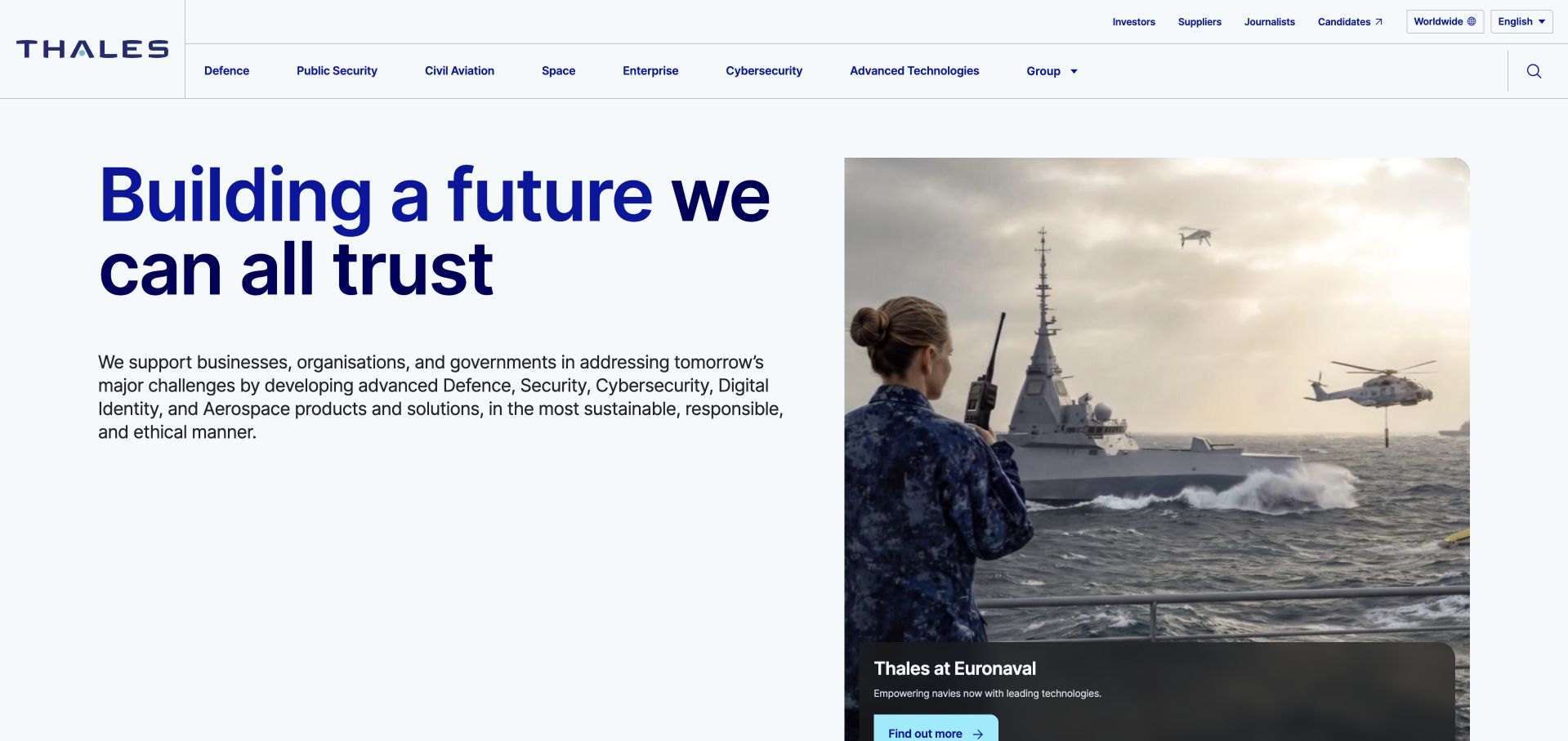
Thales introduces a broad trust-oriented proposition, then organizes its expertise into defence, aerospace, and cyber and digital fields. A featured event and research material give the corporate story current substance, while worldwide and career sections serve distinct audiences later in the page. The blue-and-white palette supports a serious technical tone. The structure is most useful as a reference for dividing a large portfolio into a small number of understandable domains.
What you can learn
A shared corporate promise needs clear domain routes if readers are to find a relevant solution. GitLab’s case concerns Thales in-flight entertainment development, a narrower context than the entire group. Keep that scope visible: it is not evidence about every Thales product or the runtime and publishing system of the corporate homepage.
Pros
A small number of expertise areas makes a wide technical organization easier to understand initially.
Research and current events supply deeper routes for readers who want more than a corporate introduction.
Cons & considerations
A very broad trust statement needs specific evidence and clear product boundaries further into the journey.
Different customers, regions and regulated uses require more precise routes than a single global corporate proposition can provide.
Visible tech stack
Earlier / documented evidence
GitLab
Platform source: Official GitLab customer documentation. GitLab’s Thales case describes DevSecOps automation and security across the teams discussed, including its in-flight-entertainment development context. It is not evidence for every Thales system. This official customer documentation establishes only the organization and engineering scope stated by the source. It does not identify the pictured marketing homepage’s CMS, frontend, hosting or complete current architecture. Vendor-reported outcomes were not independently tested. Platform evidence is separate from the direct website screenshot and is not a complete current infrastructure audit.
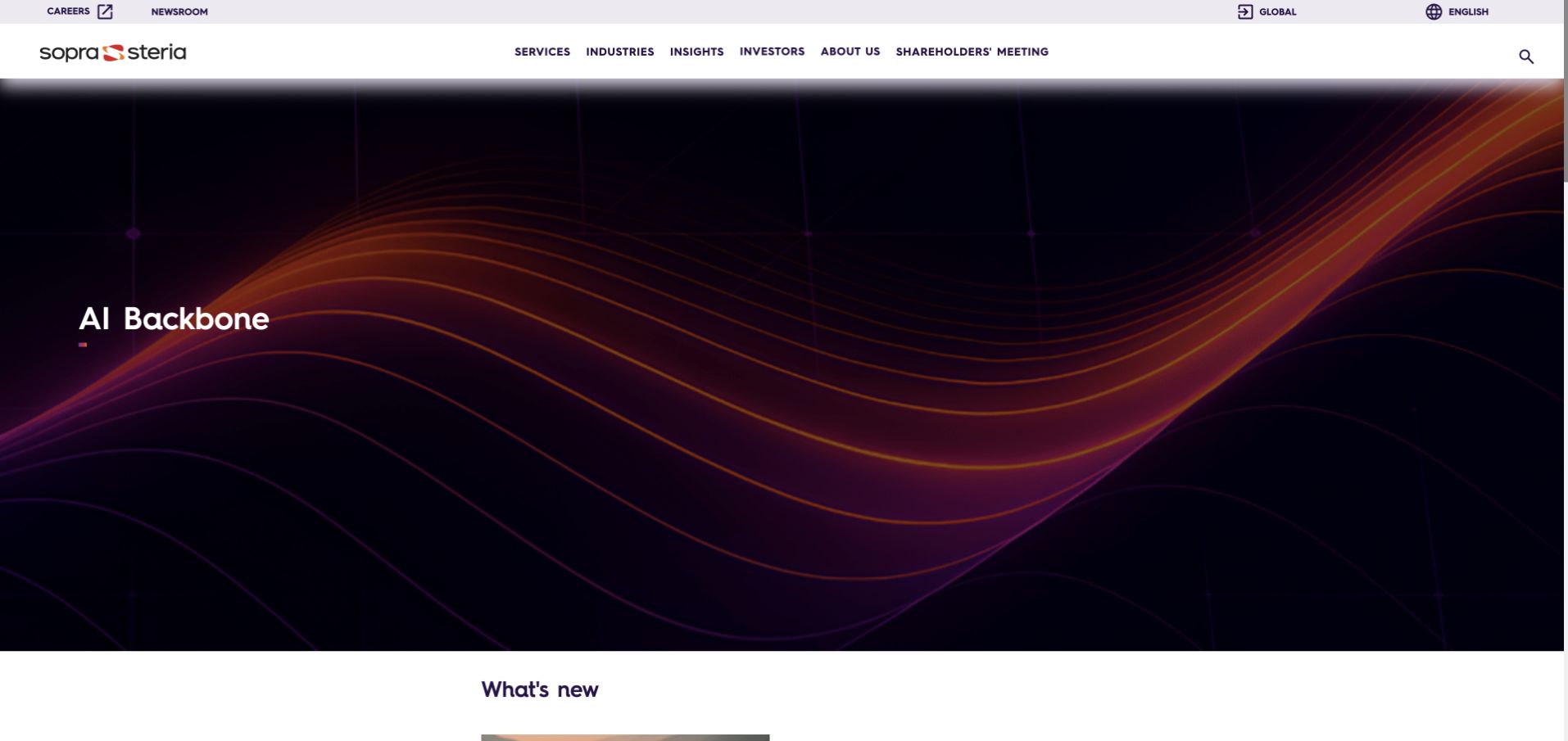
Sopra Steria presents an AI-focused opening above current stories, commitments and career material. The global header distinguishes services, industries and corporate audiences while a country selector makes local offerings available. The layout uses strong color and editorial sections rather than listing every engagement type in the hero. It is a useful example of a consultancy treating its website as both a service directory and an ongoing publication.
What you can learn
A professional-services site needs a point of view, but readers must still be able to find a relevant local service and a credible next step. GitLab’s official Sopra Steria case documents digital-enablement and software-delivery practices. That is not a claim about this homepage’s framework or independent verification of every consulting outcome described across the wider site.
Pros
Service and industry navigation provide different legitimate routes through a large consulting portfolio.
Editorial stories and commitments add depth beyond a static list of capabilities and commercial actions.
Cons & considerations
A country-selection overlay should not unnecessarily obscure the global introduction before visitors understand the organization.
An expansive AI theme needs concrete service definitions and evidence so it does not flatten distinct consulting disciplines into one fashionable category.
Platform source: Official GitLab customer documentation. GitLab’s Sopra Steria case describes a shared Git development platform, code reuse, CI templates and deployment workflows, with different adoption levels across teams. This official customer documentation establishes only the organization and engineering scope stated by the source. It does not identify the pictured marketing homepage’s CMS, frontend, hosting or complete current architecture. Vendor-reported outcomes were not independently tested. Platform evidence is separate from the direct website screenshot and is not a complete current infrastructure audit.
Kegan has 15+ years of experience working with small businesses, Fortune 500 companies, and everything in between. No development job is too big or too small: he brings the same hands-on attention to a focused improvement, a complete website, or a custom application.
For GitLab projects, he can help with content architecture, custom functionality, system integrations, testing, and maintainable handover. He works directly with clients on scope, design, implementation, testing, and handover, with an emphasis on clear communication and a system that remains practical to maintain after launch.
Show 3 other GitLab developersHide other GitLab developers
Start with the delivery problem, not the platform slogan
Improve one existing application pipeline
Choose a frequently changed application with a clear owner and a known failure pattern. Establish the current release path, then improve a specific bottleneck such as an unreliable test or an unclear artifact handoff. Keep a working comparison so the team can judge whether the new process is genuinely easier to operate.
Create a shared pattern with explicit escape hatches
A reusable pipeline can remove repeated work, but only if its assumptions are visible. Document supported languages, environments and approval rules. Give teams a reviewed way to handle a legitimate difference instead of encouraging hidden copies that drift. Shared configuration needs versioning, ownership and a deliberate update policy.
Migrate in bounded steps
Do not assume repository hosting, issue management, CI and production deployment must all move simultaneously. Identify dependencies and choose a reversible sequence. A staged migration gives maintainers a chance to verify permissions, imports and release behavior before the older path is retired. Preserve the source and release history needed to reconcile problems.
From references to requirements
Plan people, runners and recovery together
Inventory projects and their real owners
Record each project’s source of truth, maintainers, environments and business audience. Include a representative deployment and the person who can approve it. This inventory exposes ambiguous responsibility and duplicate-looking projects before those ambiguities are copied into a new group or runner configuration.
Classify inputs and secret access
Determine which jobs can process external contributions and which require protected resources. Review variables and secret-management choices using the official guidance, and identify the operational owner of every credential. A masked value is not permission design; the important question is which code can receive and use it.
Rehearse the failed release
Use nonproduction resources to test an interrupted pipeline, a rejected deployment and a rollback. Verify the state of the actual destination, not only the job log. Document safe retry behavior and a human escalation route. The team should know what happens when the normal maintainer is unavailable.
A useful handover demonstration
Ask the actual team to carry out its routine job: publish a realistic update, correct a mistake, preview a narrow screen, and identify who owns an integration failure. For a library or frontend framework, also ask who maintains the content source and deployment. A polished screenshot does not answer those operational questions.
Beyond the screenshot
A GitLab implementation brief
Name the exact application or repository scope.
Identify the owner of the release decision.
Inventory current tools and dependencies.
Map review, execution and deployment identities.
Classify external and trusted inputs.
Review runner access and isolation needs.
Choose an appropriate secret-management approach.
Define the artifact being promoted.
Make required checks and exceptions explicit.
Test cancellation and safe retries.
Rehearse recovery in a controlled environment.
Preserve source history and handover ownership.
Test with real content, a keyboard, a small screen, slow or failed requests, and the people who will maintain the system. These are planning checks, not an accessibility, security, performance, or search-ranking certification.
Sources & editorial method
How this GitLab collection was reviewed
Public properties were independently viewed and captured directly in Chrome, with exact existing capture facts retained where reused. Official customer stories establish the named engineering context; the Airbus entry uses the dated Q4 FY2025 GitLab investor presentation. We did not inspect private repositories, execute pipelines, infer public hosting from customer logos or validate vendor-reported business outcomes.
Every image is an unmodified capture from the actual website, with its source and capture date. Some captures are reused from our shared catalog; their dates remain the original capture dates. None comes from a vendor gallery or a generated reconstruction. Moving imagery and live content can change.
Technology attribution uses public page assets or metadata, official platform documentation, or a cited first-party project case study. Documentary and framework-relationship evidence is identified where used; it is not a complete current backend inventory. A CMS image CDN alone does not establish a full CMS deployment. A library’s presence does not prove which individual controls use it, and a platform label does not establish AI authorship.
The composition notes, lessons, pros and tradeoffs are original editorial observations. We have not measured conversion, traffic, security, performance or accessibility conformance. Website owners retain their brands and imagery; these examples are not our client portfolio. Written, Edited and Curated are independent records, not dates advanced by a build. See our editorial standards or suggest a correction.
Questions worth asking
GitLab website development FAQs
Are all these public websites built with GitLab?
No. The official sources establish particular customer and engineering relationships. A company may use GitLab internally while its corporate homepage is built and hosted elsewhere. The design review and the technical association are kept separate.
Why include a dated Airbus customer listing?
It is an official source that supports a historical organizational association. It does not identify a present-day workload or a homepage build system. The date and limitations remain explicit rather than being refreshed by a new screenshot.
Should a migration move all delivery tools at once?
Not automatically. A bounded sequence can make permissions, imported history and release behavior easier to verify. Choose the order around real dependencies and reversibility, not the assumption that every platform feature must be adopted together.
Are masked variables a complete secret-management strategy?
No. The team still needs to control which jobs and identities can access sensitive values and what code they run. Use the current official pipeline-security guidance and an appropriate secrets-management approach for the actual environment.
What is a useful first proof of value?
A representative change should move through a clear review, reliable checks and a traceable release, with a tested recovery path. That is more informative than a large dashboard or a tool-count reduction without operational evidence.
The useful lesson is a delivery process with clear ownership and recoverable steps. Borrow the public information design where it helps, then specify your own repositories, permissions and release responsibilities before choosing a platform pattern.