Best Odoo Websites of 2026 (20 Real-World Examples)
Twenty public design references with exact, dated Odoo module and business-workflow evidence.
See how organizations with documented Odoo use present their businesses, then plan an implementation around real operations. Website, CRM, accounting and manufacturing are different modules; adoption of one does not establish every other part of the stack.
Odoo can sit close to a public website or much further behind it. A company may use Website and ecommerce, another may use purchasing and accounting while retaining a different public CMS, and a large institution may have a narrowly defined regional or project deployment. Those are meaningfully different examples, even when the same vendor appears in the evidence.
This collection preserves that distinction. The opening recognizable organizations include historical material-handling, vending and forestry-project cases, a Bangladesh joint venture and a recent central-office humanitarian implementation. The smaller companies add more recent, module-specific operational examples. Study the actual public page for design lessons, then read the associated case at its stated date and scope rather than assuming a global, current, all-in-one architecture.
Before the examples
What makes good Odoo website development in 2026?
Choose modules around the work, not the catalog
A long list of available applications is not an implementation plan. Follow one real transaction from its first request through sales, stock, delivery and accounting, adding the relevant modules only where they solve an identified problem. Define the authoritative record at each stage. A service business and a configurable manufacturer should not receive an identical process merely because both can install the same apps.
Decide what employees, managers, portal users and external collaborators may see or change. Review the actual access rights and record rules rather than relying on a hidden menu item or a friendly interface. Test prohibited actions as carefully as successful ones. Administrative convenience must not silently broaden access to customer, personnel or financial information.
A small customization can become a long-lived dependency. Document why it exists, which standard behavior it changes and who will test it during upgrades. Prefer a clear business rule over a collection of unexplained exceptions. A project is easier to maintain when the operating team understands the process and the technical team can identify every supported extension.
Every example includes an actual public-page capture and primary Odoo evidence. Dates, companies, module lists and regional or project boundaries are retained. A parent-company photograph is sometimes a separate design reference for a narrower historical case, and that limitation is stated rather than concealed.
We start with five recognizable brands or organizations: Toyota Material Handling France, Sodexo Vending, WWF Eco-makala project, Grameen Danone Foods, Ukrainian Red Cross Society. Each attribution applies to the named website property, not every product or website belonging to its organization. This is a curated reading sequence, not a measured ranking.
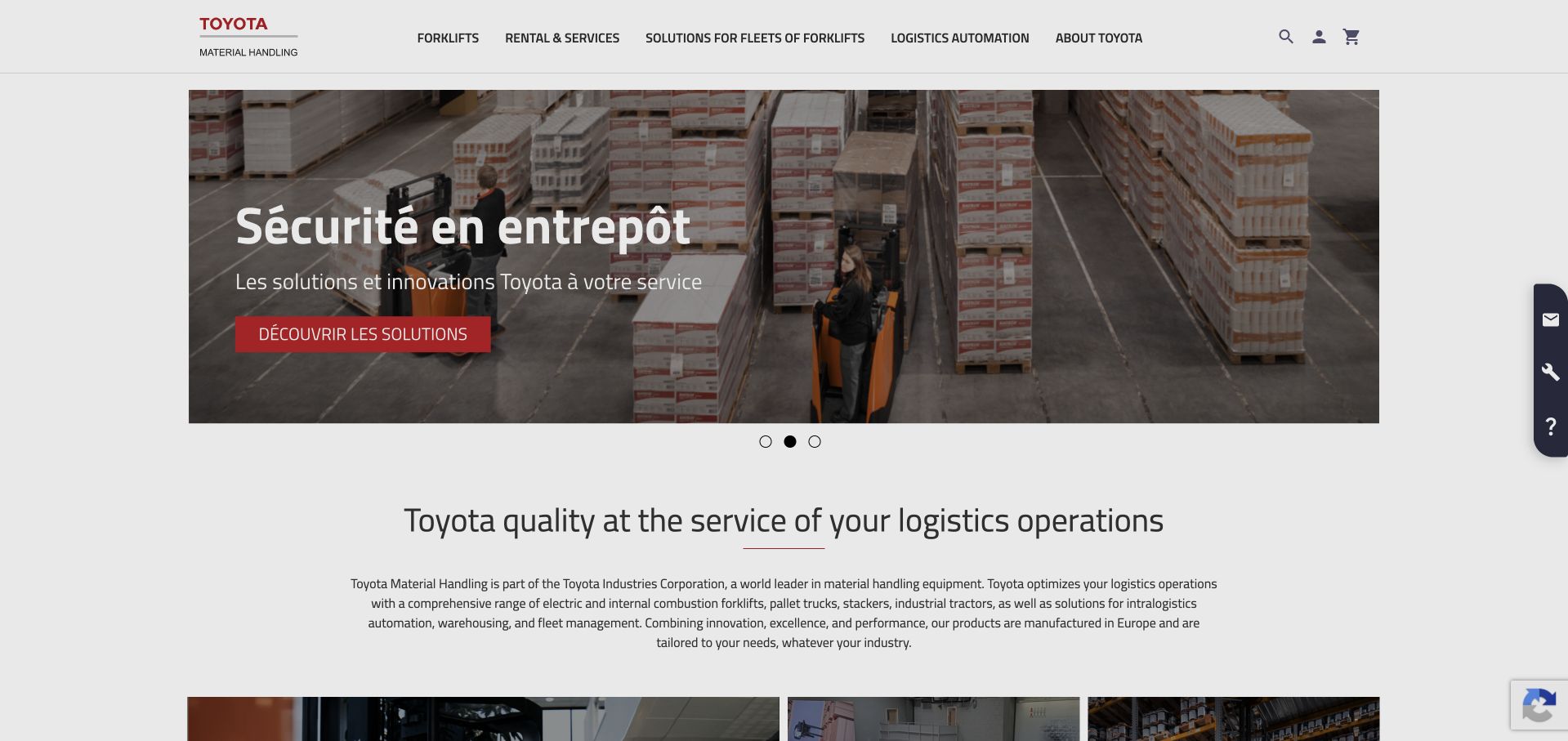
Toyota Material Handling France presents a warehouse-safety feature inside a conventional product-and-service site. The photograph shows equipment operating within a real storage environment, with a red action and a compact explanatory line. A company introduction and product imagery continue below, balancing the feature with a wider view of the business. Odoo’s July 11, 2017 case concerns Toyota Material Handling France CRM, sales, purchasing, manufacturing, inventory and accounting, within a material-handling project rather than Toyota’s global automotive systems.
What you can learn
Start with the operational situation a buyer understands, then lead into equipment, service and technical detail. When planning an ERP, map that same real-world sequence from quotation to stock and delivery. Keep the historical material-handling subsidiary case distinct from Toyota’s global automotive business.
Pros
The warehouse setting makes the equipment’s practical role understandable without a technical diagram.
A restrained header exposes product, rental, fleet and service routes before deeper exploration.
Cons & considerations
A rotating safety feature may not immediately reveal the full equipment catalog.
Regional service and historical implementation scope must remain explicit rather than relying on the Toyota name.
Platform source: Official product-specific customer case or dated announcement. Odoo’s July 11, 2017 case concerns Toyota Material Handling France CRM, sales, purchasing, manufacturing, inventory and accounting, within a material-handling project rather than Toyota’s global automotive systems. This establishes only the stated organization, workload, product family, regional or historical association. It does not prove the pictured public page runtime, reveal its CMS or frontend, establish a complete current stack, or independently verify vendor-reported results. Platform evidence is separate from the direct website screenshot and is not a complete current infrastructure audit.
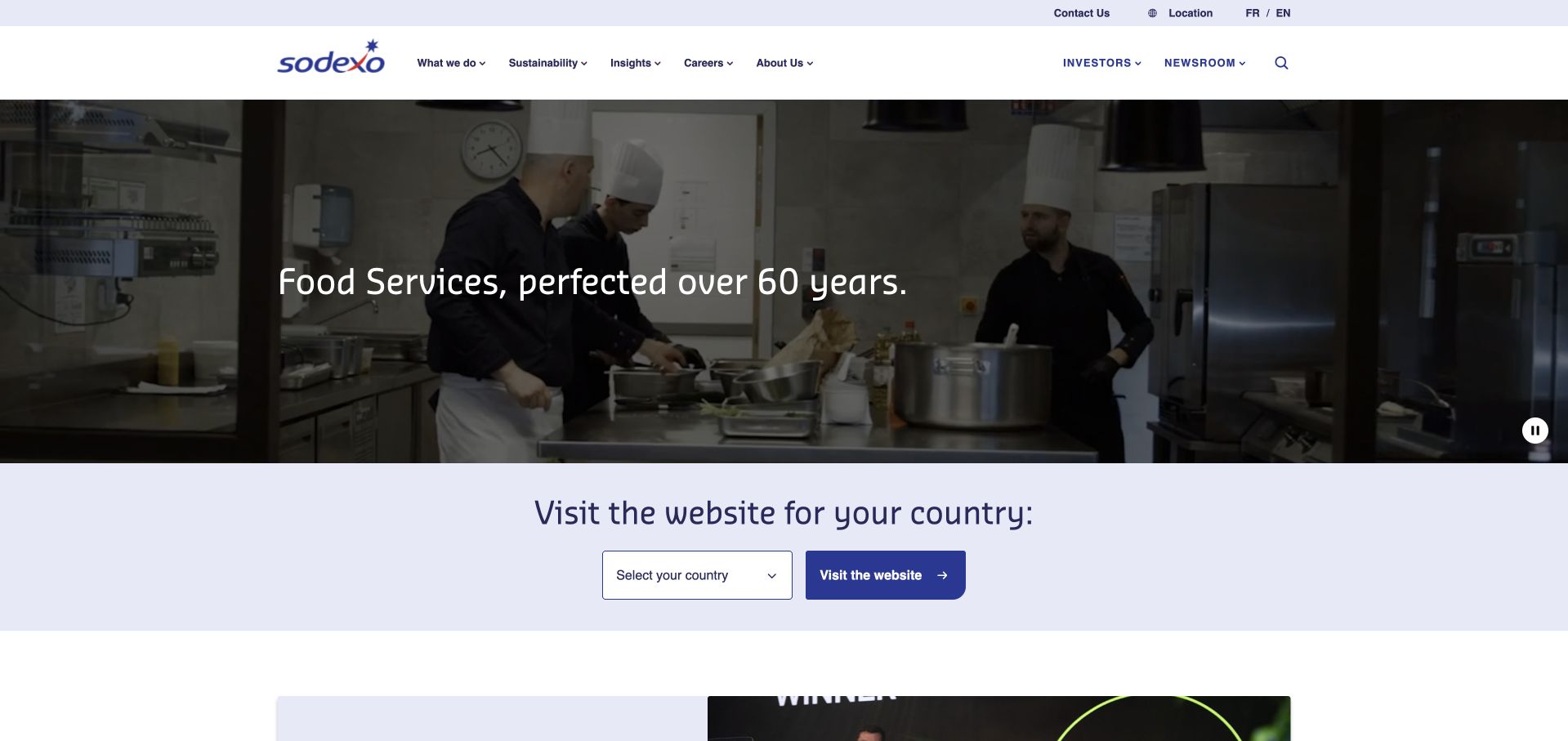
Sodexo’s current corporate page uses kitchen footage, a concise food-services line and a restrained white header. A country selector follows the main feature, acknowledging that visitors may need a local operation rather than the global company. The scene gives a broad service business an understandable activity before the organizational detail begins. The September 8, 2014 case concerns Sodexo Vending contracts, product, stock, meter-reading and financial workflows. Proposed expansion is not proof of current group-wide adoption; the screenshot is today’s parent-company site.
What you can learn
A parent-company page can provide visual context for a historical divisional case, but it must not imply a current group-wide deployment. For ERP planning, define the operating unit, contracts and stock processes precisely before deciding which modules belong in scope or what expansion would require.
Pros
The working-kitchen setting gives an abstract service portfolio a recognizable human activity.
Country selection creates a practical route from global information to a relevant local business.
Cons & considerations
A broad corporate feature can delay details about the specific service a visitor needs.
The historical vending case cannot establish the software used by every modern Sodexo operation.
Platform source: Official product-specific customer case or dated announcement. The September 8, 2014 case concerns Sodexo Vending contracts, product, stock, meter-reading and financial workflows. Proposed expansion is not proof of current group-wide adoption; the screenshot is today’s parent-company site. This establishes only the stated organization, workload, product family, regional or historical association. It does not prove the pictured public page runtime, reveal its CMS or frontend, establish a complete current stack, or independently verify vendor-reported results. Platform evidence is separate from the direct website screenshot and is not a complete current infrastructure audit.
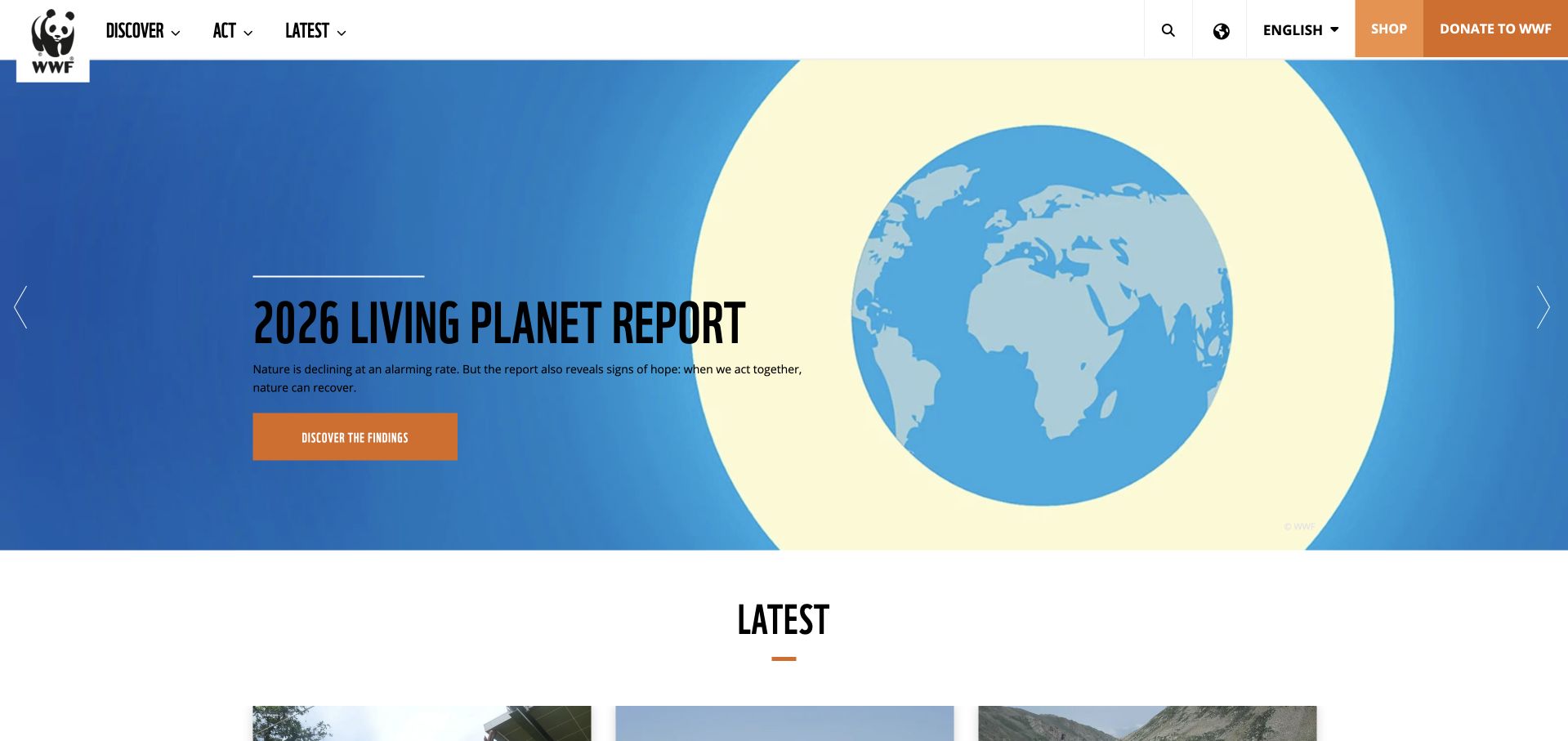
WWF’s global page combines a large illustrated globe, a current report headline and an orange discovery action. A strong logo and compact discover, act and latest navigation establish the publisher’s identity. The next-news section begins below the feature, making the page feel like an ongoing editorial resource rather than a single fundraising campaign. The September 19, 2014 case is specifically WWF’s Eco-makala forestry project in the Democratic Republic of Congo, with customized plantation reporting and budget management, not a global WWF website implementation.
What you can learn
A global organization needs clear editorial routes, while project-management systems need equally clear geographic and operational boundaries. Borrow the focused report presentation, not an assumption that one forestry project’s software represents every chapter. Keep the original project year and location visible in any technology association.
Pros
The globe illustration gives a substantial report an accessible and recognizable visual entrance.
A concise primary action and subsequent news section establish a straightforward reading sequence.
Cons & considerations
A global report feature may not orient visitors looking for a specific local program.
Conservation imagery and vendor outcomes require careful source context rather than implied independent endorsement.
Visible tech stack
Earlier / documented evidence
Odoo
Platform source: Official product-specific customer case or dated announcement. The September 19, 2014 case is specifically WWF’s Eco-makala forestry project in the Democratic Republic of Congo, with customized plantation reporting and budget management, not a global WWF website implementation. This establishes only the stated organization, workload, product family, regional or historical association. It does not prove the pictured public page runtime, reveal its CMS or frontend, establish a complete current stack, or independently verify vendor-reported results. Platform evidence is separate from the direct website screenshot and is not a complete current infrastructure audit.
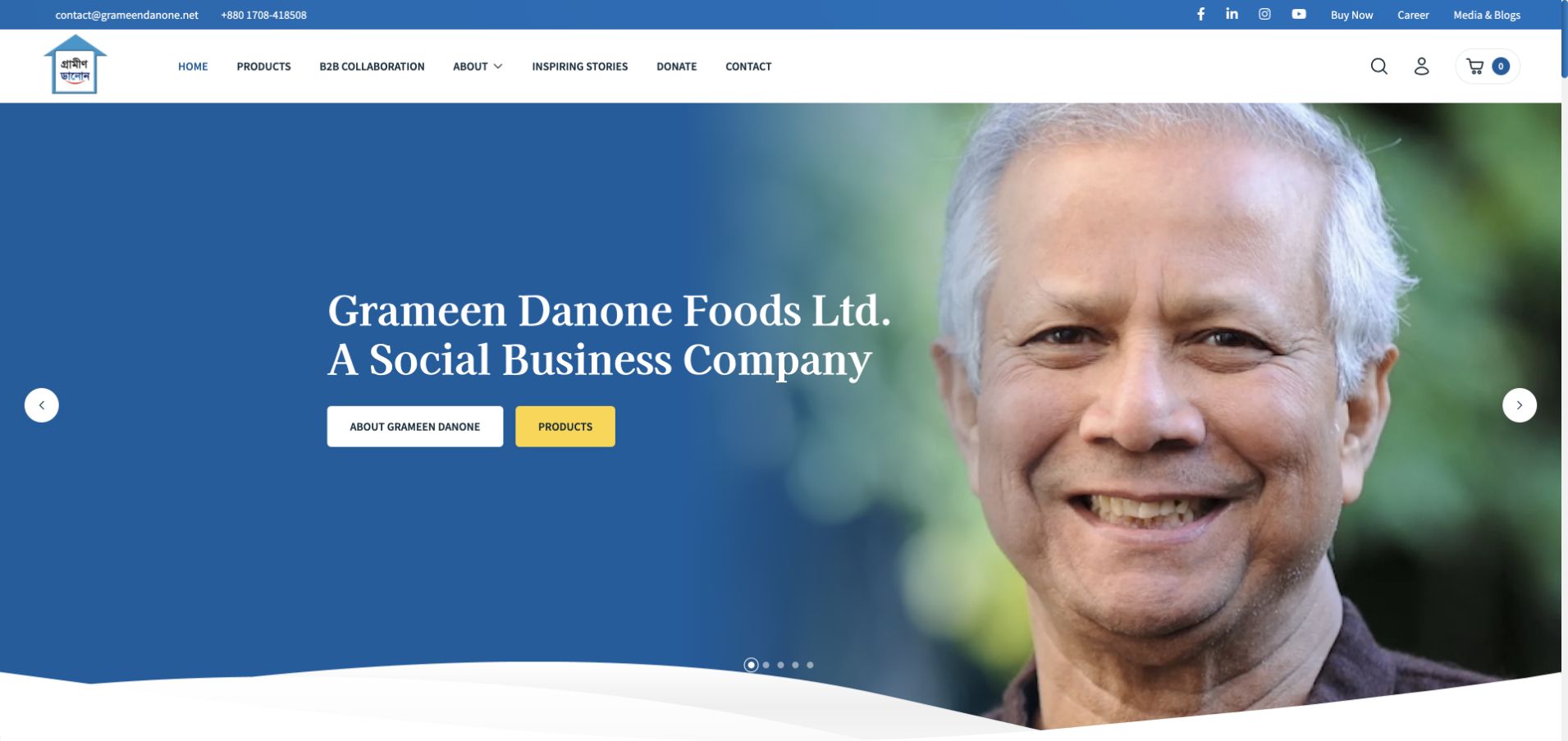
Grameen Danone Foods uses a blue portrait-led hero, a clear company name and separate about and product actions. A white header and blue utility strip provide routes into products, collaboration and company information. The composition establishes the Bangladesh social-business identity rather than presenting the page as Danone’s global corporate homepage. The June 29, 2023 case dates Grameen Danone Foods’ go-live to November 2021, covering Bangladesh purchasing, manufacturing, inventory, sales, accounting and quality workflows, not all Danone companies.
What you can learn
Name a joint venture precisely and explain its role before borrowing the recognition of either parent. In ERP work, preserve the actual company, go-live period and configured business processes. Product storytelling and workflow integration are useful design lessons, not evidence that nutrition or social outcomes have been independently verified.
Pros
The hero identifies the operating company explicitly rather than relying only on a parent-company logo.
Separate company and product actions support visitors with different levels of familiarity.
Cons & considerations
A portrait-led opening may postpone practical product and distribution information.
Claims about social or nutritional impact need their own evidence beyond an ERP customer story.
Platform source: Official product-specific customer case or dated announcement. The June 29, 2023 case dates Grameen Danone Foods’ go-live to November 2021, covering Bangladesh purchasing, manufacturing, inventory, sales, accounting and quality workflows, not all Danone companies. This establishes only the stated organization, workload, product family, regional or historical association. It does not prove the pictured public page runtime, reveal its CMS or frontend, establish a complete current stack, or independently verify vendor-reported results. Platform evidence is separate from the direct website screenshot and is not a complete current infrastructure audit.
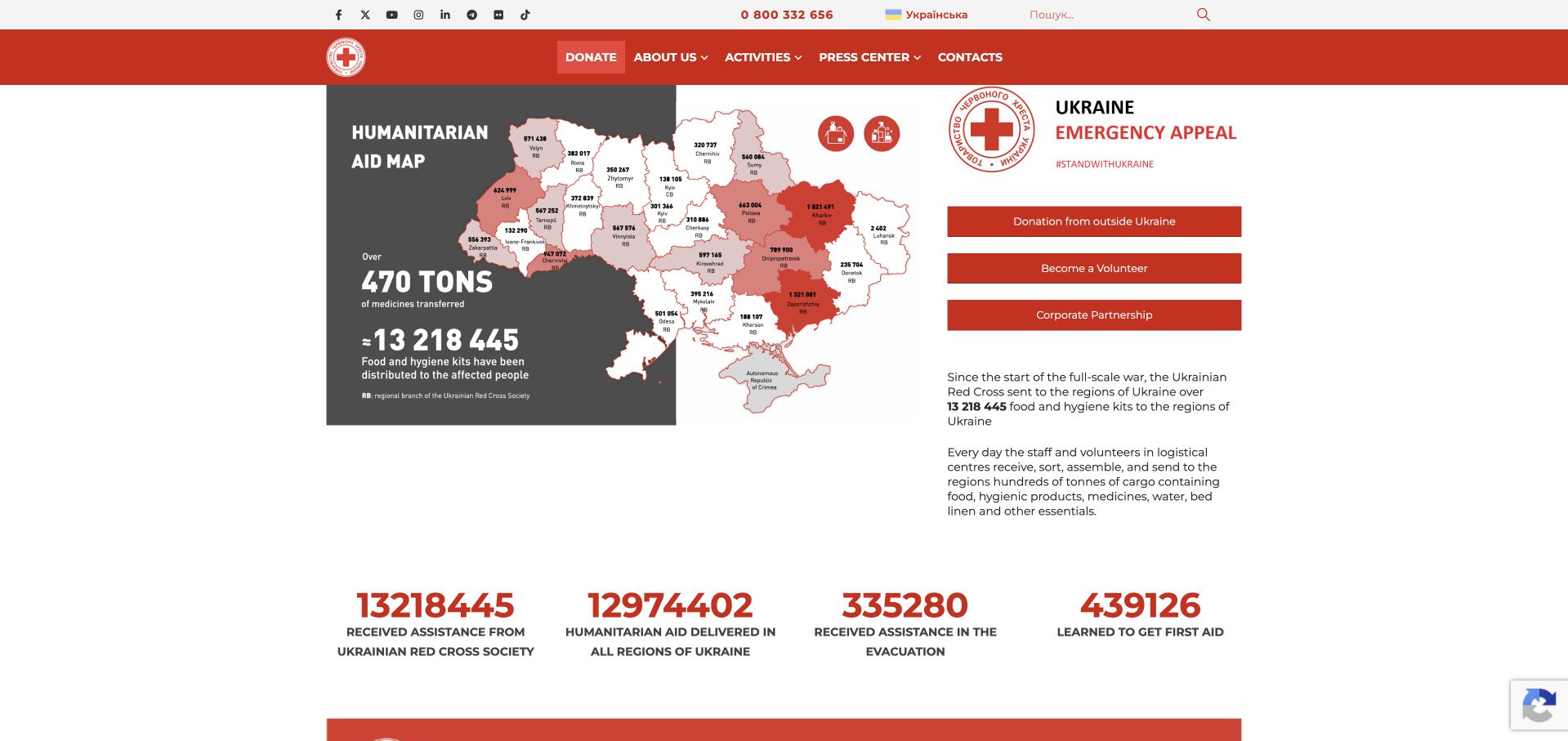
The Ukrainian Red Cross Society page pairs a humanitarian-aid map with an emergency-appeal panel and separate participation actions. Red navigation, practical information and visible activity figures create a utilitarian opening. The layout favors ways to help and understand the organization’s work over a purely atmospheric full-screen photograph. An official September 24, 2026 conference account describes Ukrainian Red Cross central-office finance, HR, volunteer, logistics and fleet implementation. Scaling to regional organizations remains a next step in that source.
What you can learn
A mission-driven site should distinguish the routes available to donors, volunteers and partners without burying them in a general story. For an operational platform, preserve regional rollout boundaries and separate volunteer access from finance and logistics. A conference implementation account is not an audit of every chapter.
Pros
Distinct donation, volunteering and partnership routes make different forms of participation easy to identify.
The map gives the organization’s work a concrete geographic frame.
Cons & considerations
Dense figures need clear periods and definitions to remain useful rather than merely impressive.
Emergency messaging and operational data require frequent editorial maintenance and careful source review.
Platform source: Official product-specific customer case or dated announcement. An official September 24, 2026 conference account describes Ukrainian Red Cross central-office finance, HR, volunteer, logistics and fleet implementation. Scaling to regional organizations remains a next step in that source. This establishes only the stated organization, workload, product family, regional or historical association. It does not prove the pictured public page runtime, reveal its CMS or frontend, establish a complete current stack, or independently verify vendor-reported results. Platform evidence is separate from the direct website screenshot and is not a complete current infrastructure audit.
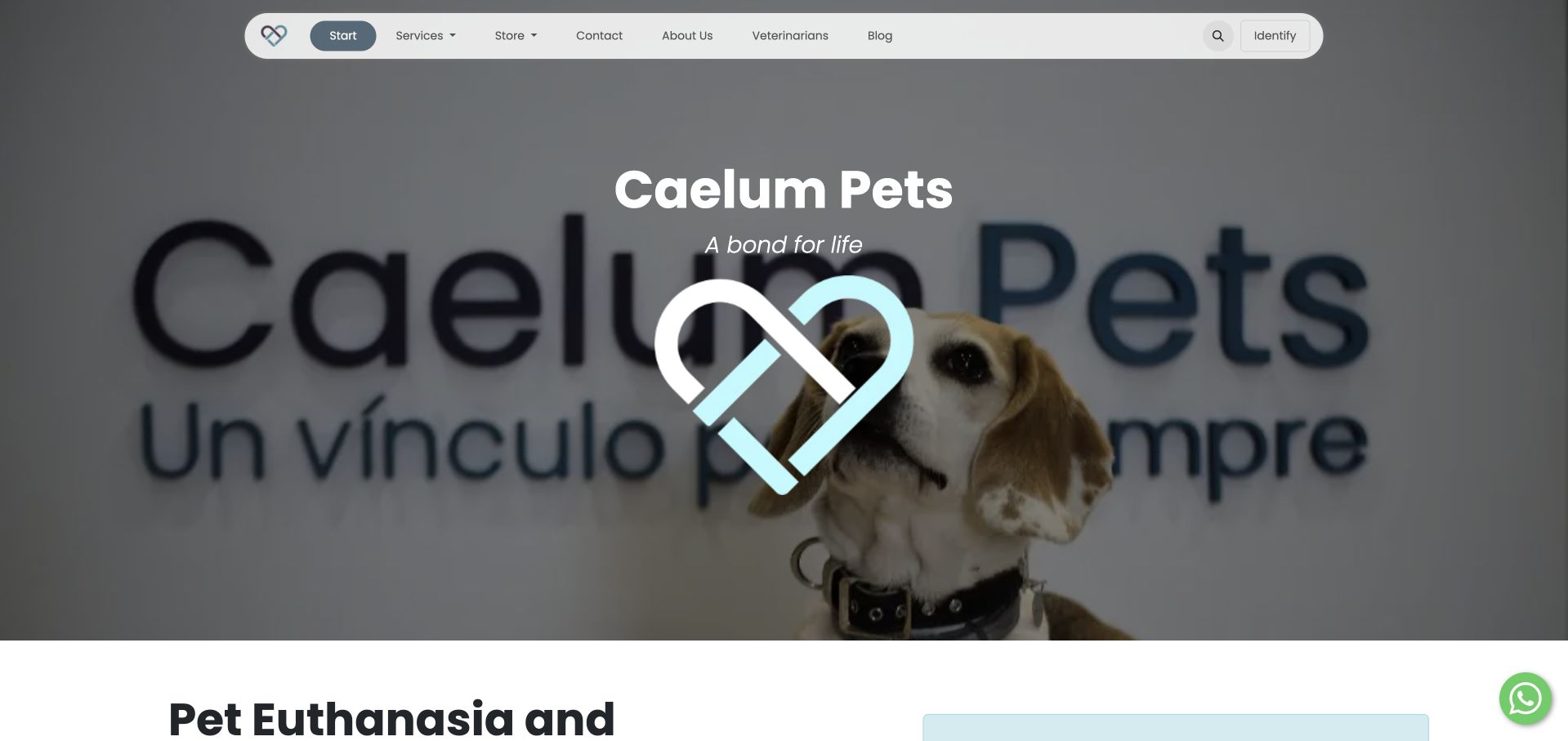
Caelum Pets combines a darkened dog photograph, a prominent heart-like mark and a short bond-oriented line. A floating pale navigation bar offers service, store and contact routes. The first service heading begins below the hero, connecting an emotional opening to the practical subject rather than relying entirely on imagery. Odoo’s November 9, 2026 case lists Caelum Pets Inventory, Sales, Project and Website applications on Odoo.sh. This is a specific company implementation, not an independently audited complete stack.
What you can learn
For a sensitive service, use empathetic visual language while making the actual offering and next steps clear. Keep operational records, scheduling and commerce permissions separate where needed. A documented Website application is useful evidence, but it does not establish every feature, plugin or private administrative workflow.
Pros
The photograph and restrained mark create a recognizable, emotionally appropriate identity.
Service and contact routes remain visible instead of being hidden behind the introductory image.
Cons & considerations
An emotive opening needs prompt, specific information about the service and its boundaries.
Floating navigation and text over photography need careful contrast and mobile behavior checks.
Platform source: Official product-specific customer case or dated announcement. Odoo’s November 9, 2026 case lists Caelum Pets Inventory, Sales, Project and Website applications on Odoo.sh. This is a specific company implementation, not an independently audited complete stack. This establishes only the stated organization, workload, product family, regional or historical association. It does not prove the pictured public page runtime, reveal its CMS or frontend, establish a complete current stack, or independently verify vendor-reported results. Platform evidence is separate from the direct website screenshot and is not a complete current infrastructure audit.
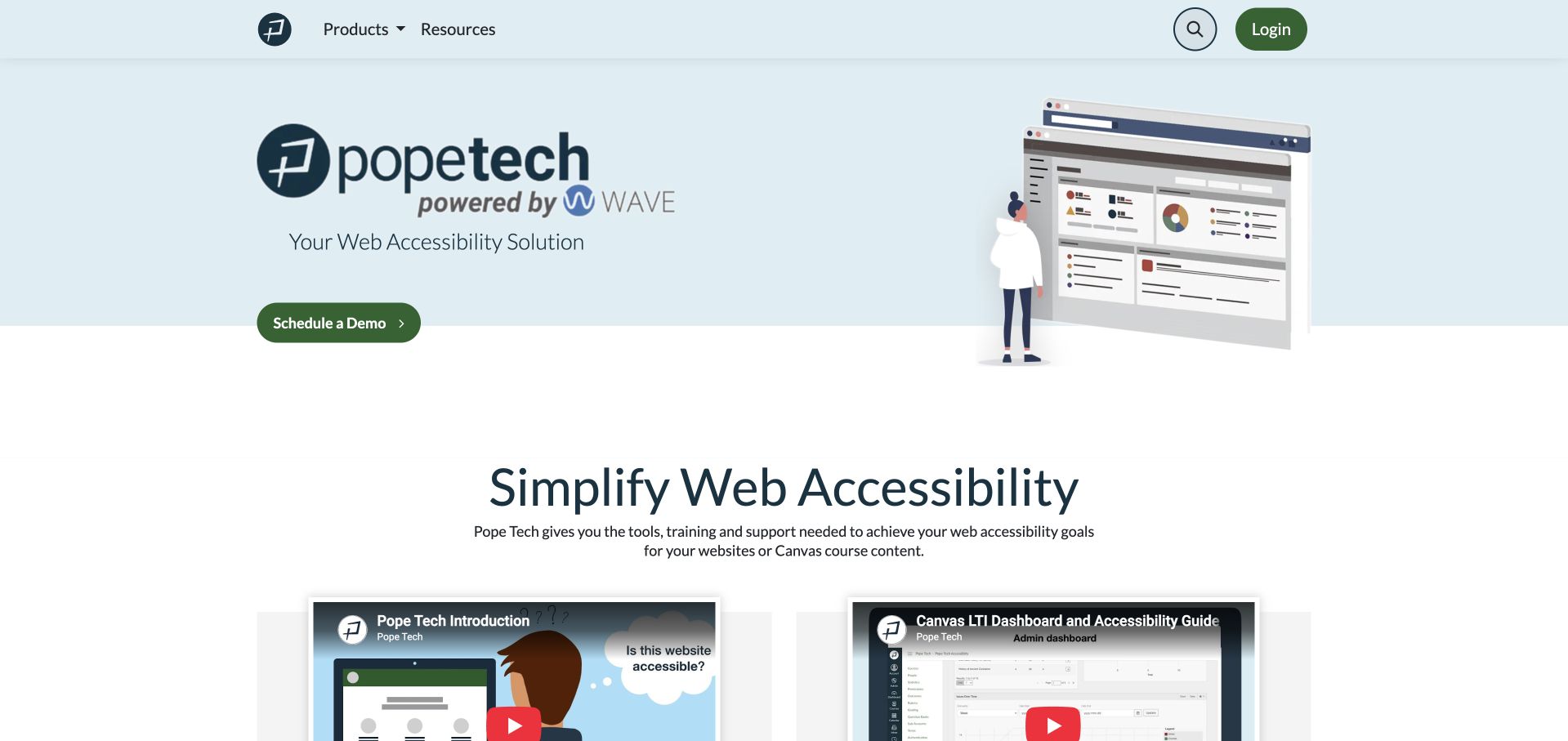
Pope Tech’s public page uses a pale blue feature area, a dashboard illustration and a simple demo action. A larger explanatory heading follows, with video resources visible beneath it. The design presents the product’s role before asking visitors to navigate a detailed feature catalog or interpret a large enterprise diagram. The October 31, 2026 Pope Tech case lists accounting, invoicing, CRM, helpdesk, subscriptions, Website, eLearning, recruitment and knowledge applications; this does not establish accessibility outcomes.
What you can learn
Explain the task a tool supports, then provide evidence and a clear evaluation route. Accessibility software itself still needs accessible navigation, labels and media alternatives. Keep internal subscriptions, support and accounting applications distinct from any claim that the tool guarantees accessibility or complete legal compliance.
Pros
The dashboard illustration provides a concrete reference for an otherwise abstract accessibility proposition.
A short introductory hierarchy leads naturally into explanatory videos and resources.
Cons & considerations
A product mockup cannot demonstrate real keyboard, screen-reader or reporting behavior on its own.
Accessibility and compliance outcomes require contextual assessment rather than a blanket software promise.
Platform source: Official product-specific customer case or dated announcement. The October 31, 2026 Pope Tech case lists accounting, invoicing, CRM, helpdesk, subscriptions, Website, eLearning, recruitment and knowledge applications; this does not establish accessibility outcomes. This establishes only the stated organization, workload, product family, regional or historical association. It does not prove the pictured public page runtime, reveal its CMS or frontend, establish a complete current stack, or independently verify vendor-reported results. Platform evidence is separate from the direct website screenshot and is not a complete current infrastructure audit.
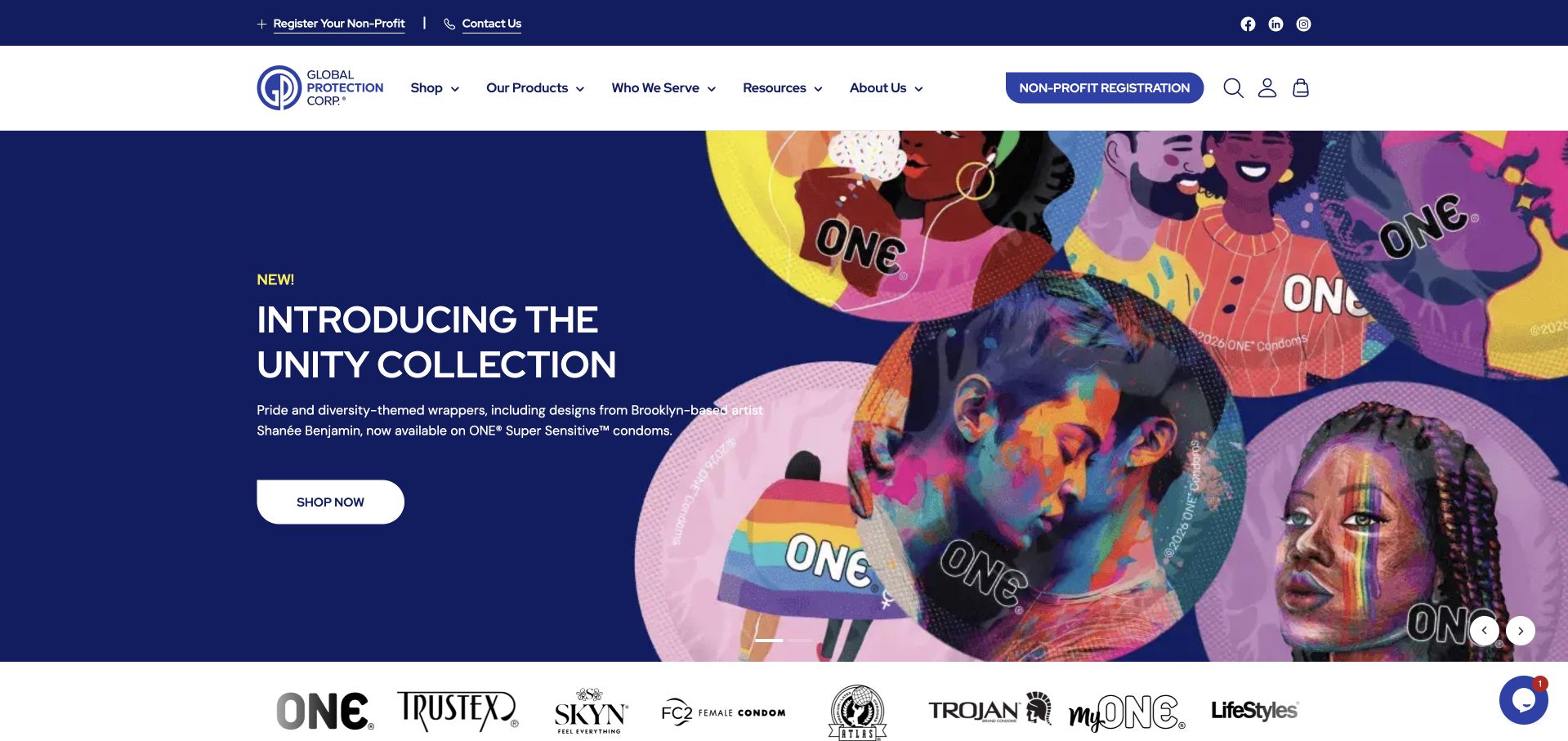
Global Protection’s public storefront introduces a colorful collection against a deep blue hero, followed by a recognizable product-brand strip. The white header separates shopping, product information, audience routes and nonprofit registration. The page combines a strong campaign identity with useful distributor-oriented navigation instead of behaving like a single-product landing page. The October 29, 2026 Global Protection case documents CRM, ecommerce, sales, project, inventory, manufacturing, knowledge and helpdesk applications for the matched company.
What you can learn
A specialized commerce site needs clear audience and account boundaries as well as memorable products. Model catalog, customer and fulfillment records carefully, and make registration purposes explicit. A documented operational application list should not be expanded into unsupported claims about payment handling, product effectiveness or every frontend component.
Pros
The campaign artwork creates a distinctive opening while the header retains practical catalog routes.
Nonprofit registration is visibly separated from general shopping and company exploration.
Cons & considerations
Collection artwork can dominate the first screen before visitors understand the broader product range.
Platform source: Official product-specific customer case or dated announcement. The October 29, 2026 Global Protection case documents CRM, ecommerce, sales, project, inventory, manufacturing, knowledge and helpdesk applications for the matched company. This establishes only the stated organization, workload, product family, regional or historical association. It does not prove the pictured public page runtime, reveal its CMS or frontend, establish a complete current stack, or independently verify vendor-reported results. Platform evidence is separate from the direct website screenshot and is not a complete current infrastructure audit.
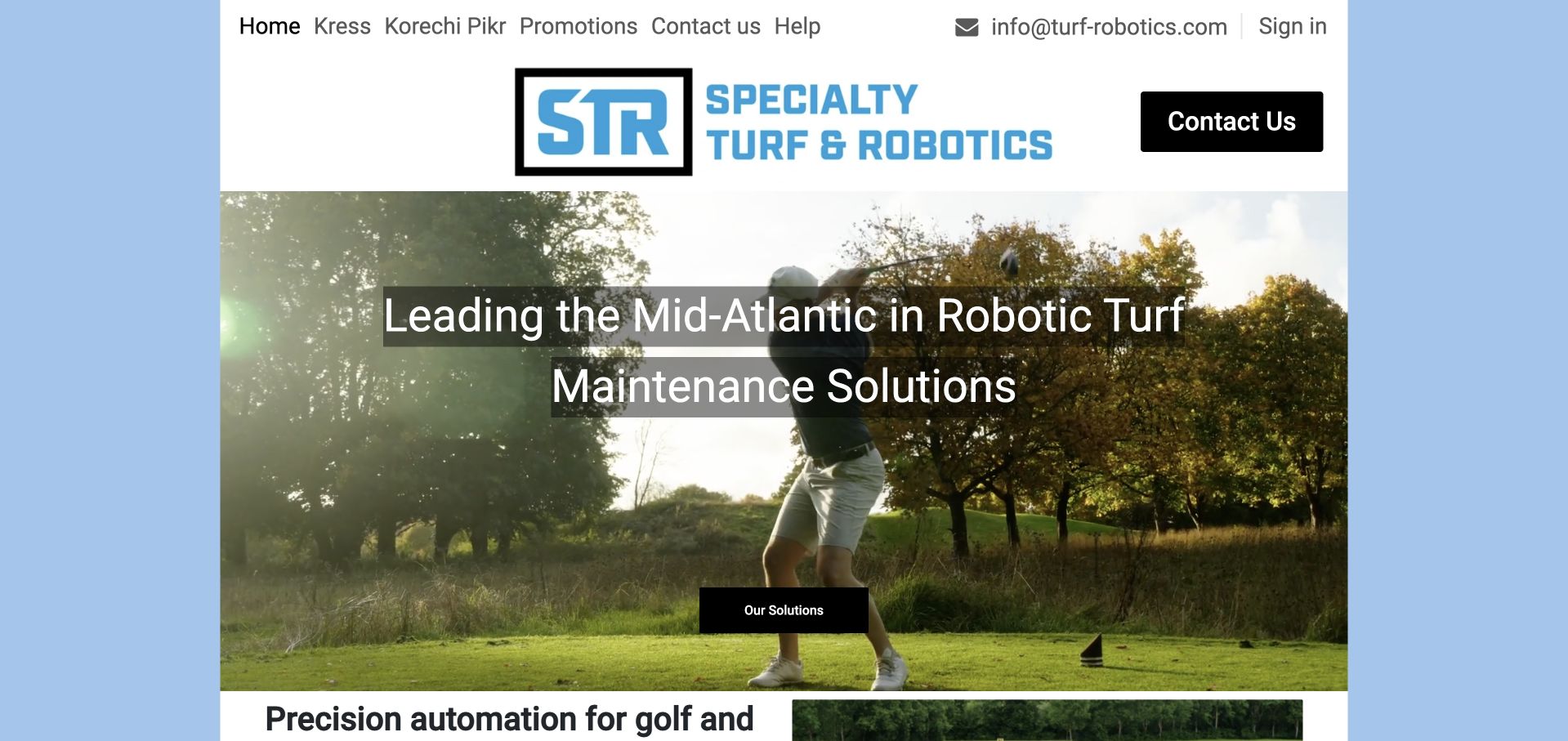
Specialty Turf and Robotics places a large logo above a golf-course scene and a concise regional service statement. A black solutions action and straightforward product-family navigation give the page a practical structure. The image explains the maintenance setting before visitors encounter the technical detail of robotic equipment. The October 27, 2026 Specialty Turf and Robotics case lists sales, CRM, inventory, accounting, expenses, Website, email marketing, dashboards and Studio.
What you can learn
A specialist business can begin with geography and a recognizable work environment rather than a broad technology slogan. Match its CRM, stock and service workflows to how equipment is actually sold and maintained. The documented Website app supports association, not an exhaustive inventory of third-party services.
Pros
The golf-course setting and regional headline make the service context immediately understandable.
A direct solutions action provides a simple next step without several competing offers.
Cons & considerations
The large logo and utility rows occupy significant space before the main proposition.
Equipment buyers still need specifications, support boundaries and installation requirements on deeper pages.
Platform source: Official product-specific customer case or dated announcement. The October 27, 2026 Specialty Turf and Robotics case lists sales, CRM, inventory, accounting, expenses, Website, email marketing, dashboards and Studio. This establishes only the stated organization, workload, product family, regional or historical association. It does not prove the pictured public page runtime, reveal its CMS or frontend, establish a complete current stack, or independently verify vendor-reported results. Platform evidence is separate from the direct website screenshot and is not a complete current infrastructure audit.
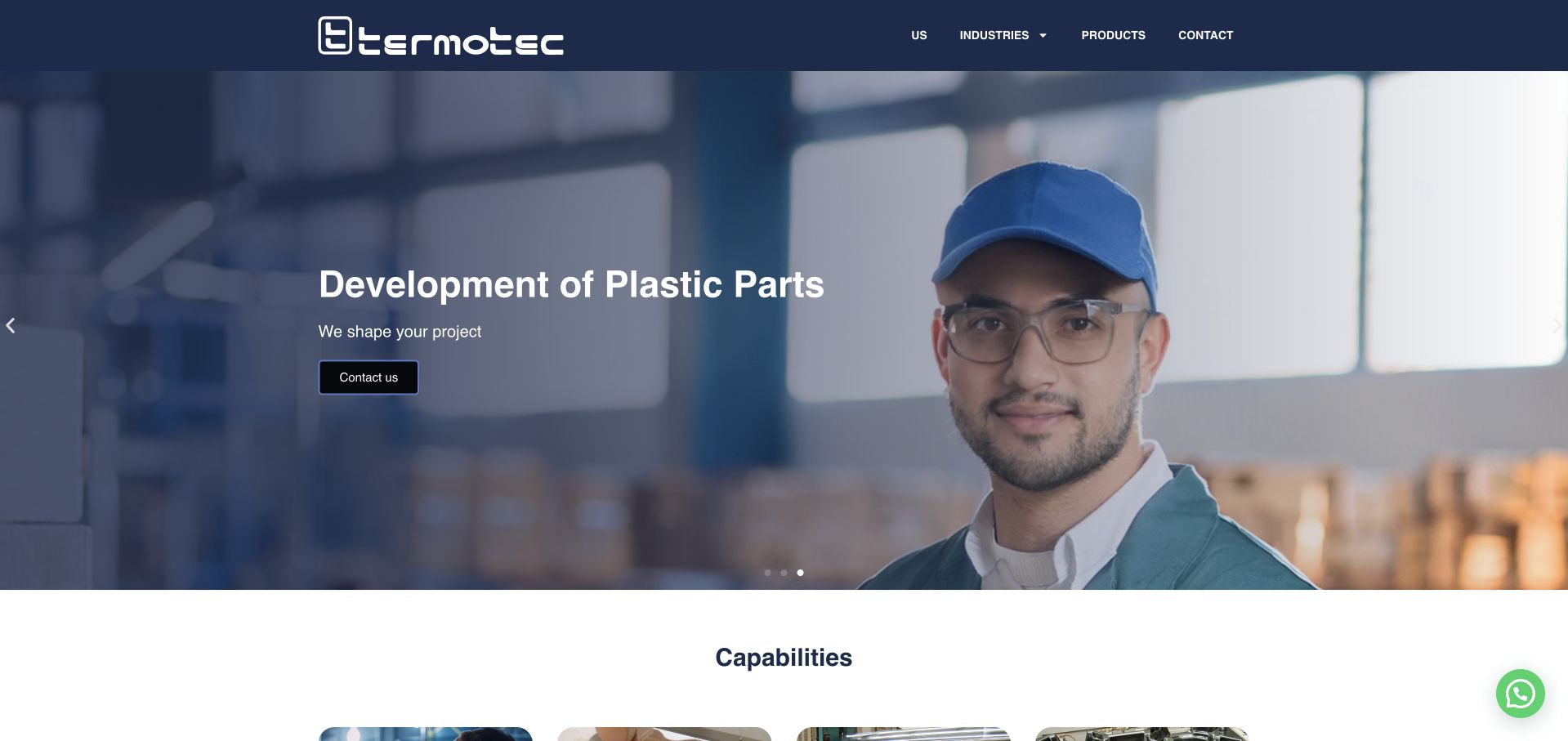
Termotec’s page uses a worker portrait and industrial setting beneath a dark navy header, with a short plastic-parts development message and a contact action. A capabilities section begins directly below. The restrained palette and real manufacturing context make the company’s specialty understandable without a complex animated production diagram. Odoo’s October 26, 2026 Termotec SRL case covers purchasing, accounting, sales, manufacturing, CRM and inventory. It does not identify Odoo as this public page’s website renderer.
What you can learn
Show the people and process behind a technical capability, then support that introduction with materials, tolerances and project detail. ERP integration should follow the production workflow rather than the homepage’s visual sections. A documented manufacturing module is not evidence that Odoo renders this public website.
Pros
The human subject gives an industrial service a specific and credible visual context.
A clear transition into capabilities supports practical evaluation after the introductory feature.
Cons & considerations
A short general headline needs detailed manufacturing information on its destination pages.
A carousel can conceal other capabilities unless controls and content alternatives remain easy to use.
Platform source: Official product-specific customer case or dated announcement. Odoo’s October 26, 2026 Termotec SRL case covers purchasing, accounting, sales, manufacturing, CRM and inventory. It does not identify Odoo as this public page’s website renderer. This establishes only the stated organization, workload, product family, regional or historical association. It does not prove the pictured public page runtime, reveal its CMS or frontend, establish a complete current stack, or independently verify vendor-reported results. Platform evidence is separate from the direct website screenshot and is not a complete current infrastructure audit.
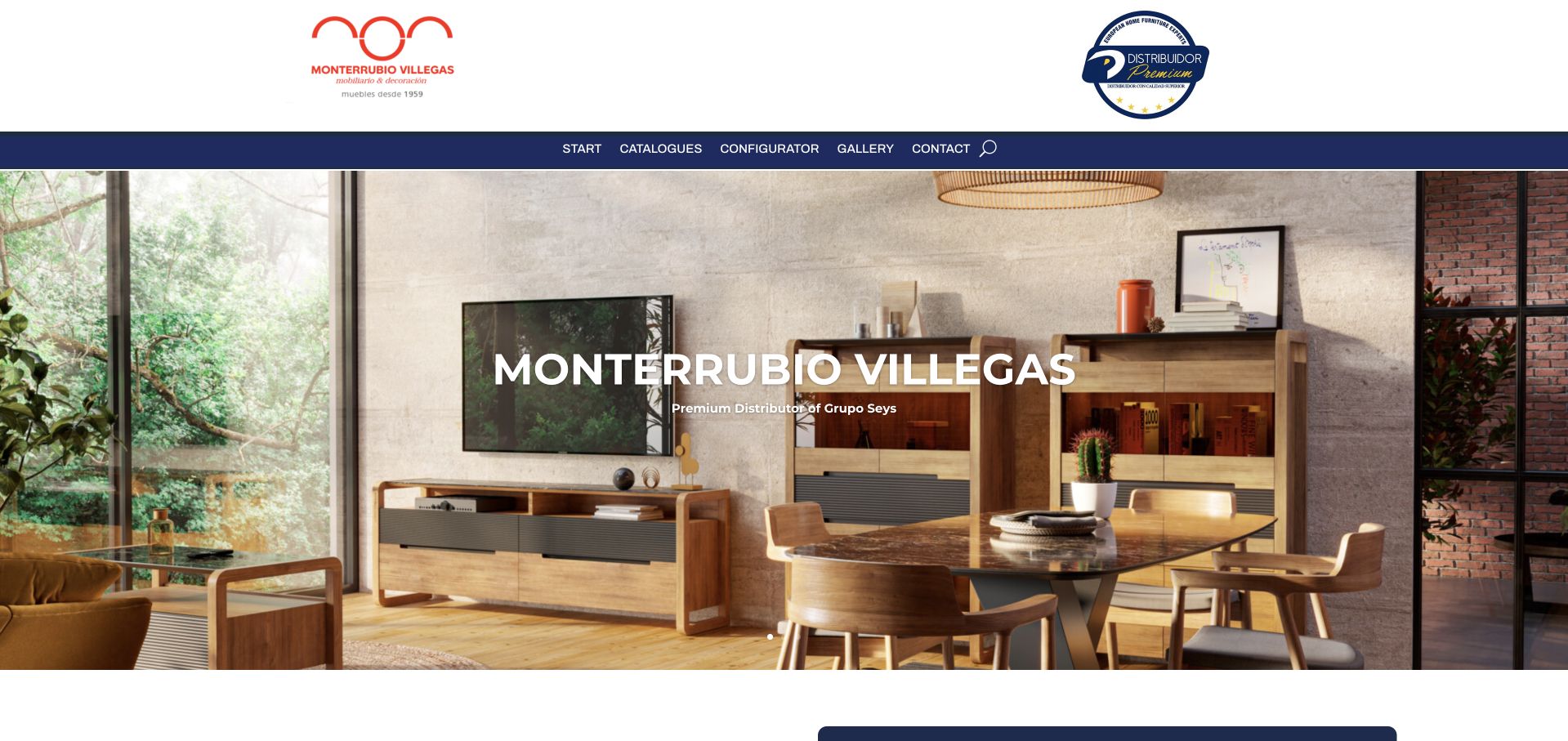
Monterrubio Villegas places a fully styled living-room image under a white identity band and narrow blue navigation. The business name is repeated within the scene, with a smaller reference to its distribution relationship. Catalog, configurator, gallery and contact routes make the image an entry into a practical furniture-selection process. The October 26, 2026 case lists Monterrubio Villegas CRM, purchasing, sales, projects, Website and inventory on premises; the captured distributor-network property is a separate public design reference.
What you can learn
A local retailer can borrow the visual richness of a room catalog while keeping its own identity clear. Map quotation, supplier ordering, installation and after-sales work before connecting them. A documented Website module does not establish that the photographed distributor-network property uses the same rendering system.
Pros
The furnished room helps visitors imagine materials and products within a coherent domestic setting.
Catalog and configurator navigation provide useful next steps beyond simply viewing inspiration.
Cons & considerations
The repeated identity bands and overlaid name take space away from product-specific information.
Distributor, manufacturer and local-store relationships need clear wording so ownership and service responsibility remain understandable.
Platform source: Official product-specific customer case or dated announcement. The October 26, 2026 case lists Monterrubio Villegas CRM, purchasing, sales, projects, Website and inventory on premises; the captured distributor-network property is a separate public design reference. This establishes only the stated organization, workload, product family, regional or historical association. It does not prove the pictured public page runtime, reveal its CMS or frontend, establish a complete current stack, or independently verify vendor-reported results. Platform evidence is separate from the direct website screenshot and is not a complete current infrastructure audit.
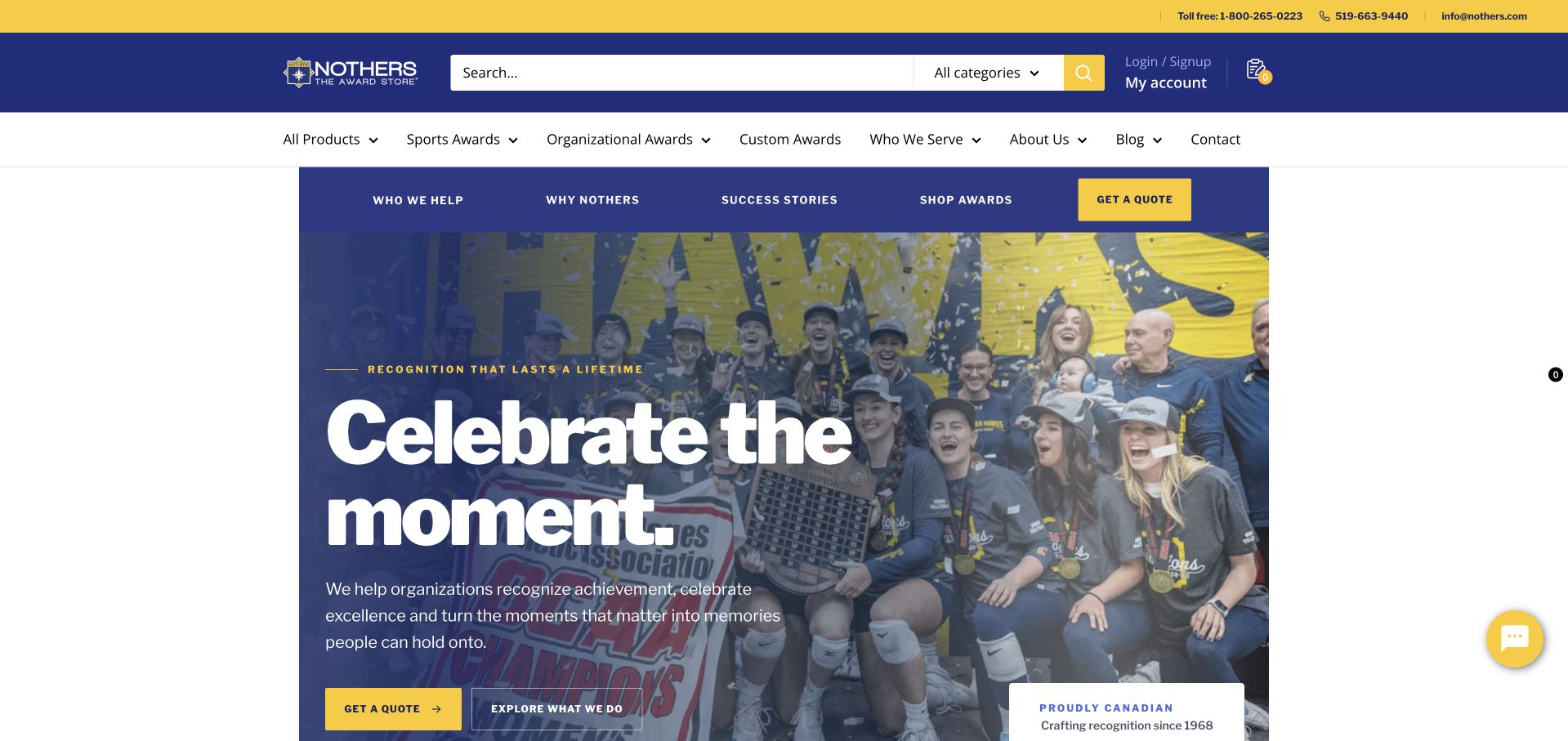
Nothers’ homepage combines blue-and-yellow branding, a team celebration photograph and a large recognition-oriented headline. Search and catalog categories appear above a second service-oriented navigation layer. The composition acknowledges both simple award shopping and more involved recognition programs, rather than treating every order as an identical ecommerce purchase. The October 22, 2026 Nothers case describes sales, inventory, manufacturing and employee applications on Odoo.sh, focused on customized award orders rather than proof of storefront rendering.
What you can learn
When a company sells both standard items and customized work, give those journeys clear but connected routes. Model artwork, components, approvals and production stages behind a quote instead of losing context between departments. The documented manufacturing implementation should not be mistaken for proof of the current public storefront platform.
Pros
The celebration photograph demonstrates the purpose of the products rather than showing only isolated trophies.
Search and a quote route support both catalog orders and more complex custom projects.
Cons & considerations
Two navigation layers and a large search area can make the header feel crowded.
A large campaign image should not postpone lead times, customization rules or order-support information.
Platform source: Official product-specific customer case or dated announcement. The October 22, 2026 Nothers case describes sales, inventory, manufacturing and employee applications on Odoo.sh, focused on customized award orders rather than proof of storefront rendering. This establishes only the stated organization, workload, product family, regional or historical association. It does not prove the pictured public page runtime, reveal its CMS or frontend, establish a complete current stack, or independently verify vendor-reported results. Platform evidence is separate from the direct website screenshot and is not a complete current infrastructure audit.
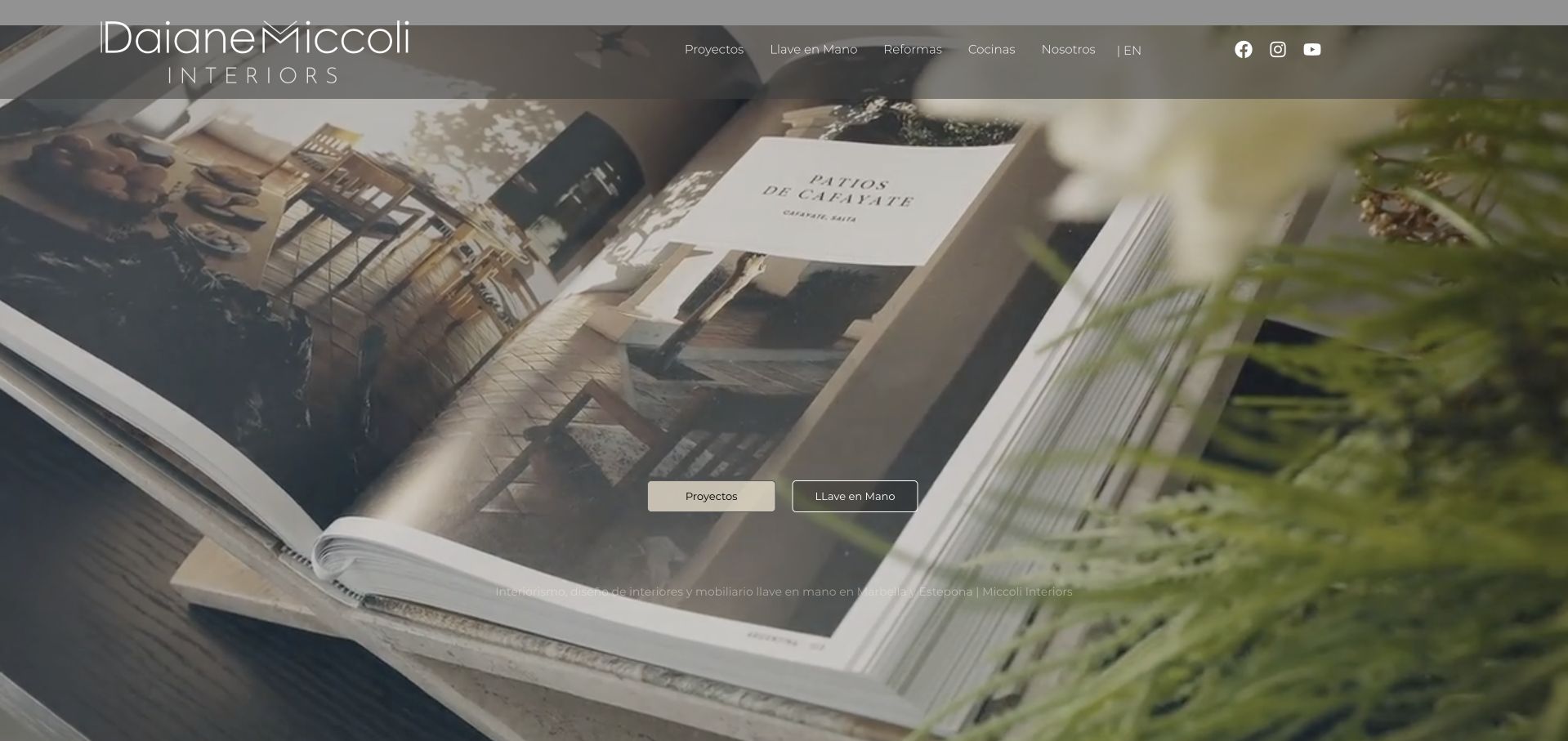
Daiane Miccoli Interiors uses a full-width photograph of an open design publication, with a light wordmark and compact service navigation over it. Two restrained project-related actions sit within the image. The muted palette and editorial subject give the studio a composed identity without immediately presenting a dense grid of finished rooms. Odoo’s October 15, 2026 case lists Daiane Miccoli Interiors accounting, purchasing, sales and inventory on Odoo Online, not a website-platform migration.
What you can learn
A boutique studio can establish a point of view through one strong image, but it still needs clear routes to projects and the scope of its service. Keep procurement, inventory and accounting traceability separate from claims about the portfolio’s frontend or the technology behind every client project.
Pros
The editorial photograph communicates a specific design sensibility without a large amount of introductory copy.
Project and turnkey-service actions distinguish two useful visitor intentions.
Cons & considerations
Small text over a detailed photograph can be hard to read at reduced sizes.
A mood-led opening needs concrete project evidence and geographic context further into the site.
Platform source: Official product-specific customer case or dated announcement. Odoo’s October 15, 2026 case lists Daiane Miccoli Interiors accounting, purchasing, sales and inventory on Odoo Online, not a website-platform migration. This establishes only the stated organization, workload, product family, regional or historical association. It does not prove the pictured public page runtime, reveal its CMS or frontend, establish a complete current stack, or independently verify vendor-reported results. Platform evidence is separate from the direct website screenshot and is not a complete current infrastructure audit.
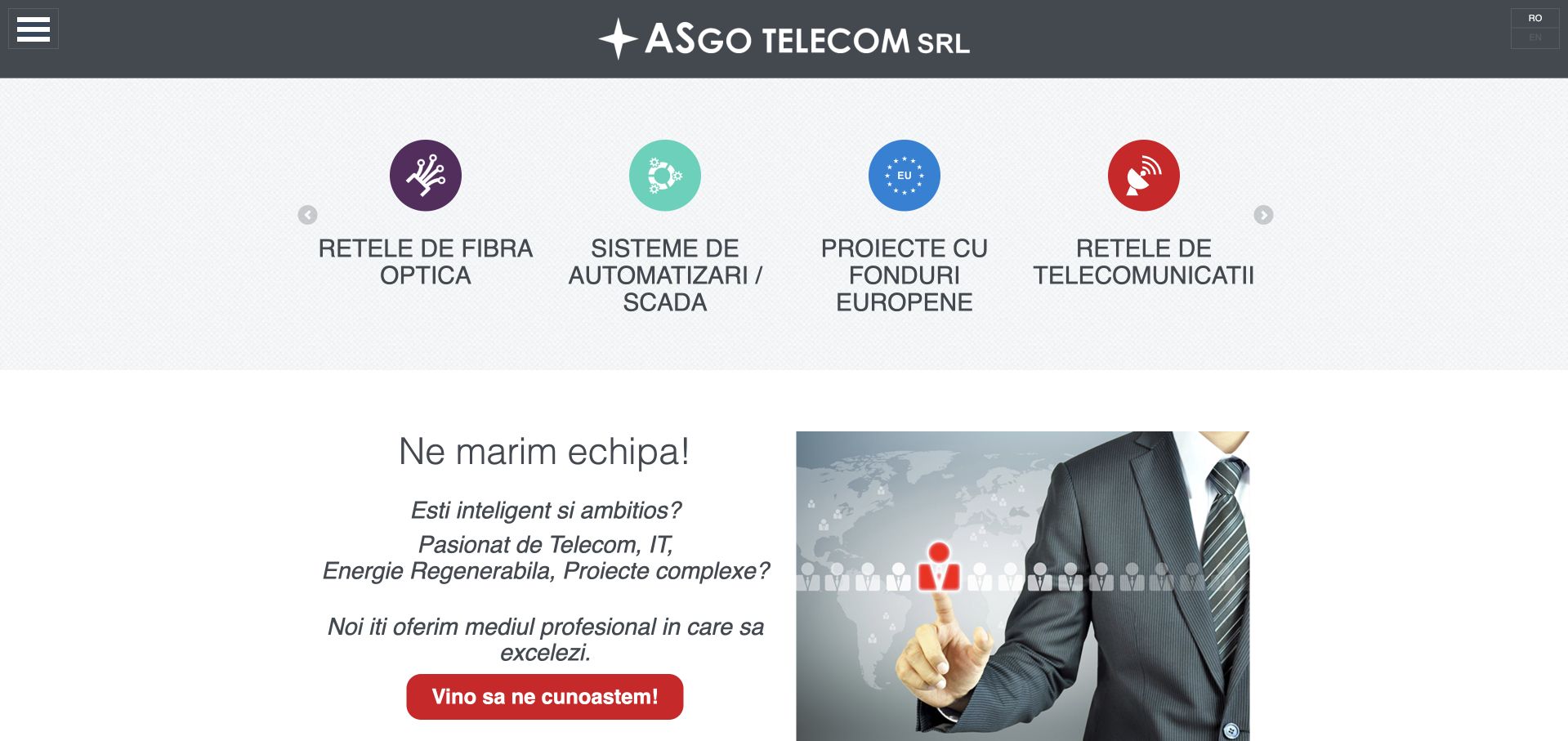
ASGO Telecom’s page presents a dark company header followed by colorful icons for infrastructure capabilities. A recruitment panel sits beneath the category row, pairing a short message with a people-oriented image. The public page is utilitarian and category-led rather than a cinematic introduction to the telecom industry. The October 9, 2026 ASGO Telecom case documents sales, purchasing, inventory, projects, timesheets and customized work-in-progress processes on Odoo.sh.
What you can learn
Technical service buyers need to recognize the applicable capability quickly. Use plain category labels, then show project evidence and contact routes. For an ERP, preserve the links between project budgets, materials, supplier approvals and timesheets instead of treating the website’s navigation categories as a sufficient operational model.
Pros
Distinct capability icons provide a quick visual route through several infrastructure service areas.
Recruitment is presented as a separate content purpose rather than mixed into a sales proposition.
Cons & considerations
Small category labels and narrow icon spacing need careful treatment on mobile devices.
A recruitment-led first screen may delay the project examples or service details a buyer needs.
Platform source: Official product-specific customer case or dated announcement. The October 9, 2026 ASGO Telecom case documents sales, purchasing, inventory, projects, timesheets and customized work-in-progress processes on Odoo.sh. This establishes only the stated organization, workload, product family, regional or historical association. It does not prove the pictured public page runtime, reveal its CMS or frontend, establish a complete current stack, or independently verify vendor-reported results. Platform evidence is separate from the direct website screenshot and is not a complete current infrastructure audit.
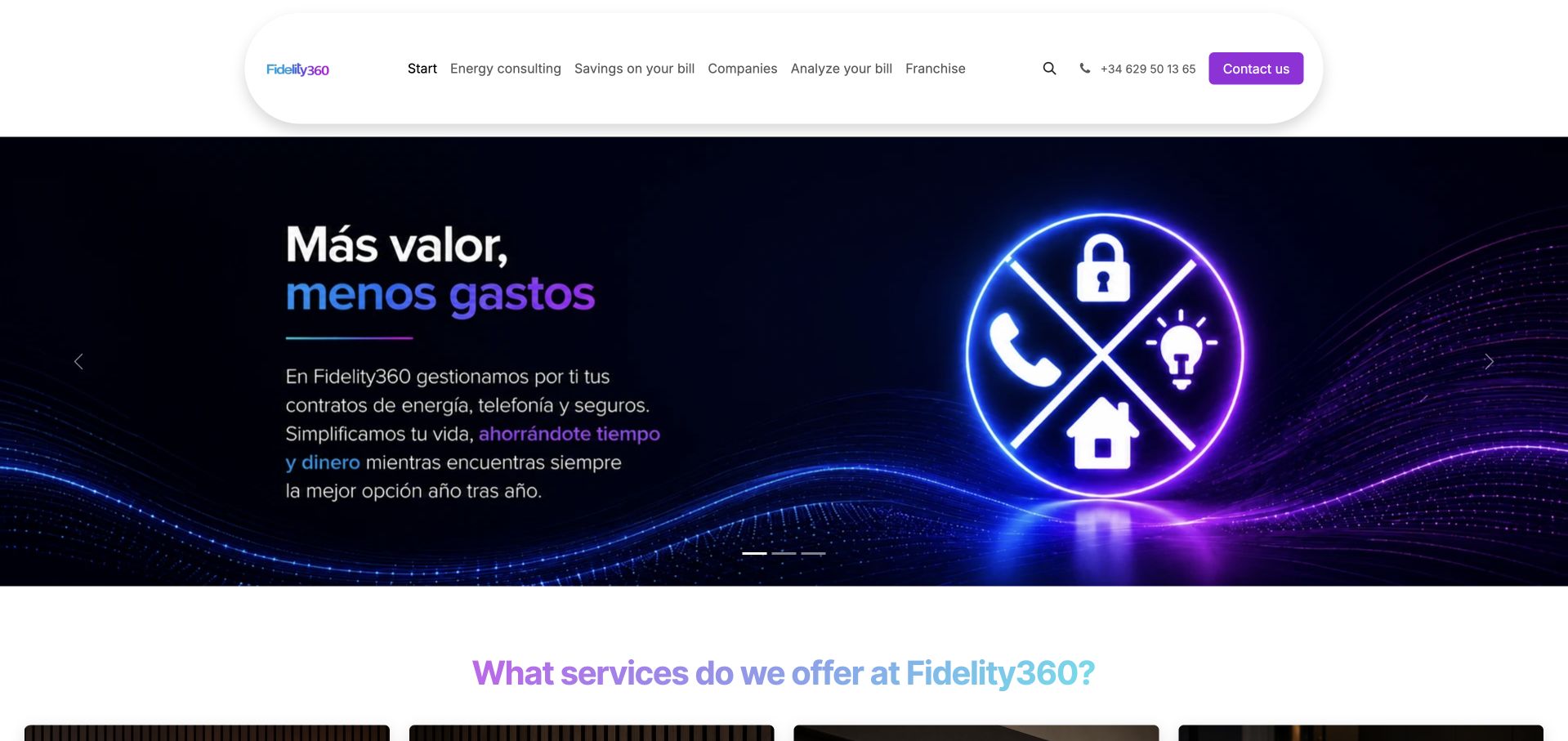
Fidelity360 pairs a dark blue-and-purple service graphic with a short value statement and a rounded white navigation bar. Energy, telephony, alarms and related services appear as the main browsing subjects below. A purple contact action stands out in the header, giving a broad bill-management proposition a clear next step. The October 7, 2026 Fidelity360 case documents accounting, documents, signatures and Website on Odoo Online. Vendor claims about local regulatory compliance are not independently endorsed here.
What you can learn
A consultancy with several related services needs a simple organizing idea and explicit destinations. Keep accounting, documents and signatures connected behind that interface, while preserving appropriate access and review. Vendor statements about local invoicing compliance should not become unqualified legal promises in a design collection.
Pros
The service symbols help connect several offerings within one recognizable visual theme.
A contrasting contact action remains easy to find in the otherwise restrained header.
Cons & considerations
A broad savings proposition needs specific service explanations and clear eligibility boundaries.
Dark gradients and small text require contrast checks rather than relying on visual atmosphere alone.
Platform source: Official product-specific customer case or dated announcement. The October 7, 2026 Fidelity360 case documents accounting, documents, signatures and Website on Odoo Online. Vendor claims about local regulatory compliance are not independently endorsed here. This establishes only the stated organization, workload, product family, regional or historical association. It does not prove the pictured public page runtime, reveal its CMS or frontend, establish a complete current stack, or independently verify vendor-reported results. Platform evidence is separate from the direct website screenshot and is not a complete current infrastructure audit.
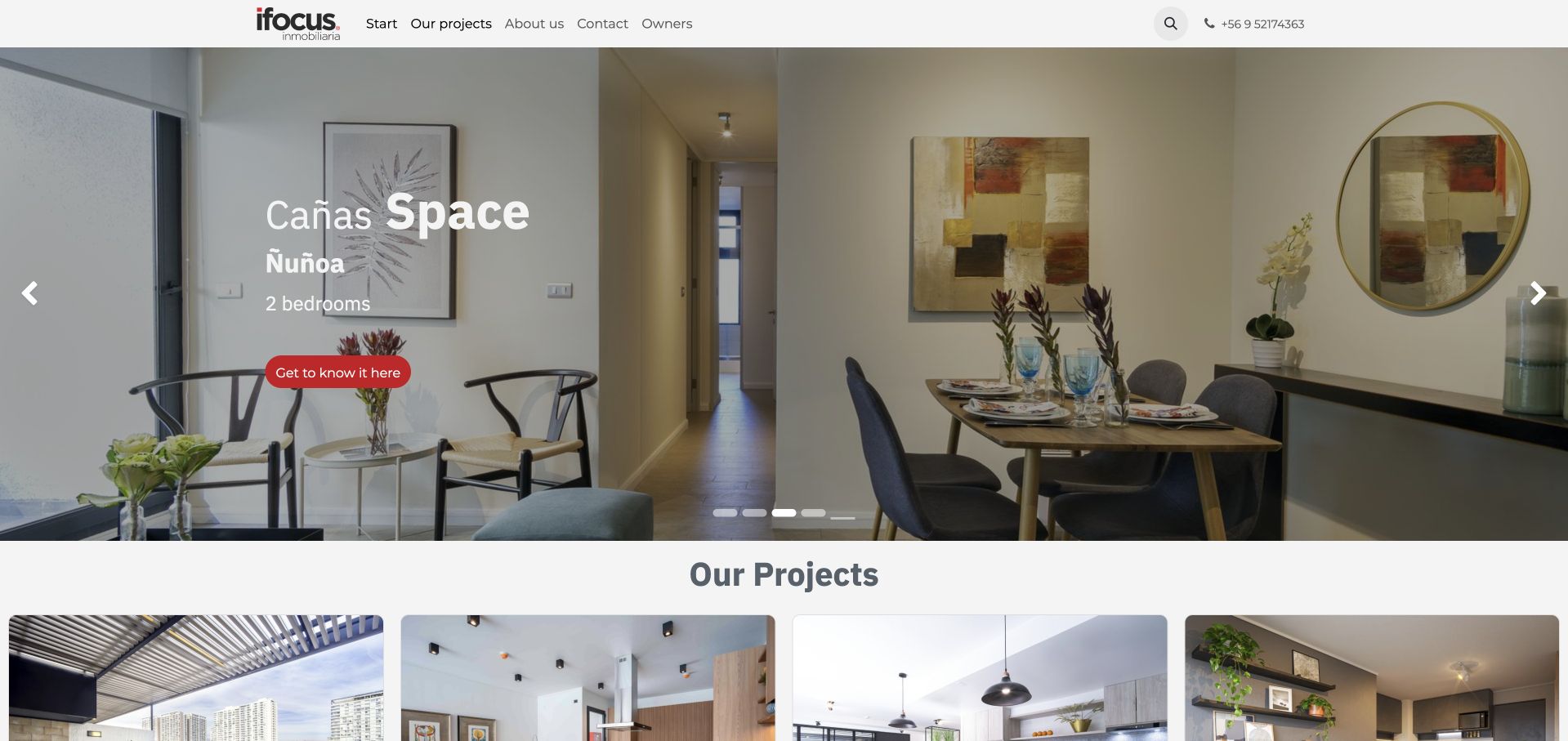
Inmobiliaria Focus opens with a bright apartment interior, a named development, location and a small project action. Current projects begin directly below as image cards, while a compact white header separates company, opportunity and contact routes. The design links aspiration to a concrete property instead of using a generic real-estate skyline. The October 1, 2026 case covers Focus’s Chilean and Peruvian operations, including accounting, purchasing, sales, CRM, Website, inventory and documents. The Peruvian business uses the Inmobiliaria Initalia name.
What you can learn
Use a real project to establish context, then make the route to plans, location and availability clear. For cross-country operations, retain each legal and accounting context in the underlying records. A unified business platform should not erase the distinction between the Chilean brand and the Peruvian operating name.
Pros
The development name and location make the featured room relevant to an actual project.
A nearby project-card section turns the hero into a gateway to the wider portfolio.
Cons & considerations
A single attractive interior cannot communicate availability, pricing or contractual conditions by itself.
Rotating project features need stable labels and clear alternatives for visitors who do not use the carousel.
Platform source: Official product-specific customer case or dated announcement. The October 1, 2026 case covers Focus’s Chilean and Peruvian operations, including accounting, purchasing, sales, CRM, Website, inventory and documents. The Peruvian business uses the Inmobiliaria Initalia name. This establishes only the stated organization, workload, product family, regional or historical association. It does not prove the pictured public page runtime, reveal its CMS or frontend, establish a complete current stack, or independently verify vendor-reported results. Platform evidence is separate from the direct website screenshot and is not a complete current infrastructure audit.
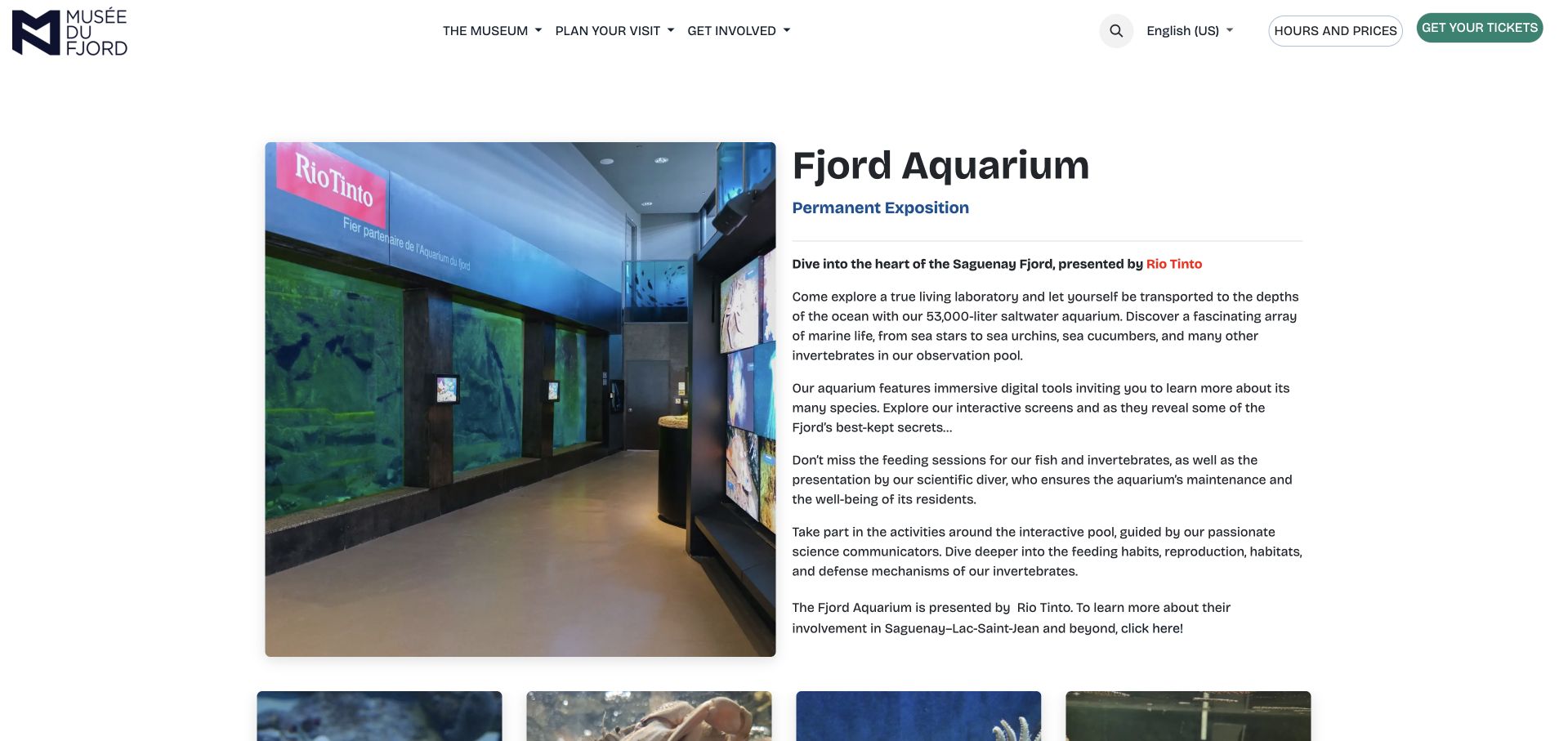
Musée du Fjord’s aquarium page pairs a large exhibit photograph with a clear title and several readable paragraphs about the visitor experience. Ticket and opening-hours routes remain in the header, with additional images beginning below. This accepted capture is the public exhibition page, not the homepage whose introductory media did not finish loading. The September 21, 2026 museum case documents POS, Website, ecommerce, surveys, calendar, Discuss, dashboards and Studio on Odoo Online. The pictured aquarium page is a public visitor resource.
What you can learn
A practical detail page can be a stronger reference than an unreliable multimedia hero. Give visitors a concrete description, supporting imagery and stable service routes. Connect ticketing and customer records carefully, while keeping the museum’s public presentation distinct from the complete operational system described by its vendor.
Pros
A real aquarium photograph gives visitors a useful sense of the space and experience.
Exhibition information remains adjacent to practical ticket and opening-hours destinations.
Cons & considerations
Several long paragraphs could benefit from more scannable subheadings and concise visitor essentials.
Important operational details should not depend on media that fails to load or requires optional cookies.
Platform source: Official product-specific customer case or dated announcement. The September 21, 2026 museum case documents POS, Website, ecommerce, surveys, calendar, Discuss, dashboards and Studio on Odoo Online. The pictured aquarium page is a public visitor resource. This establishes only the stated organization, workload, product family, regional or historical association. It does not prove the pictured public page runtime, reveal its CMS or frontend, establish a complete current stack, or independently verify vendor-reported results. Platform evidence is separate from the direct website screenshot and is not a complete current infrastructure audit.
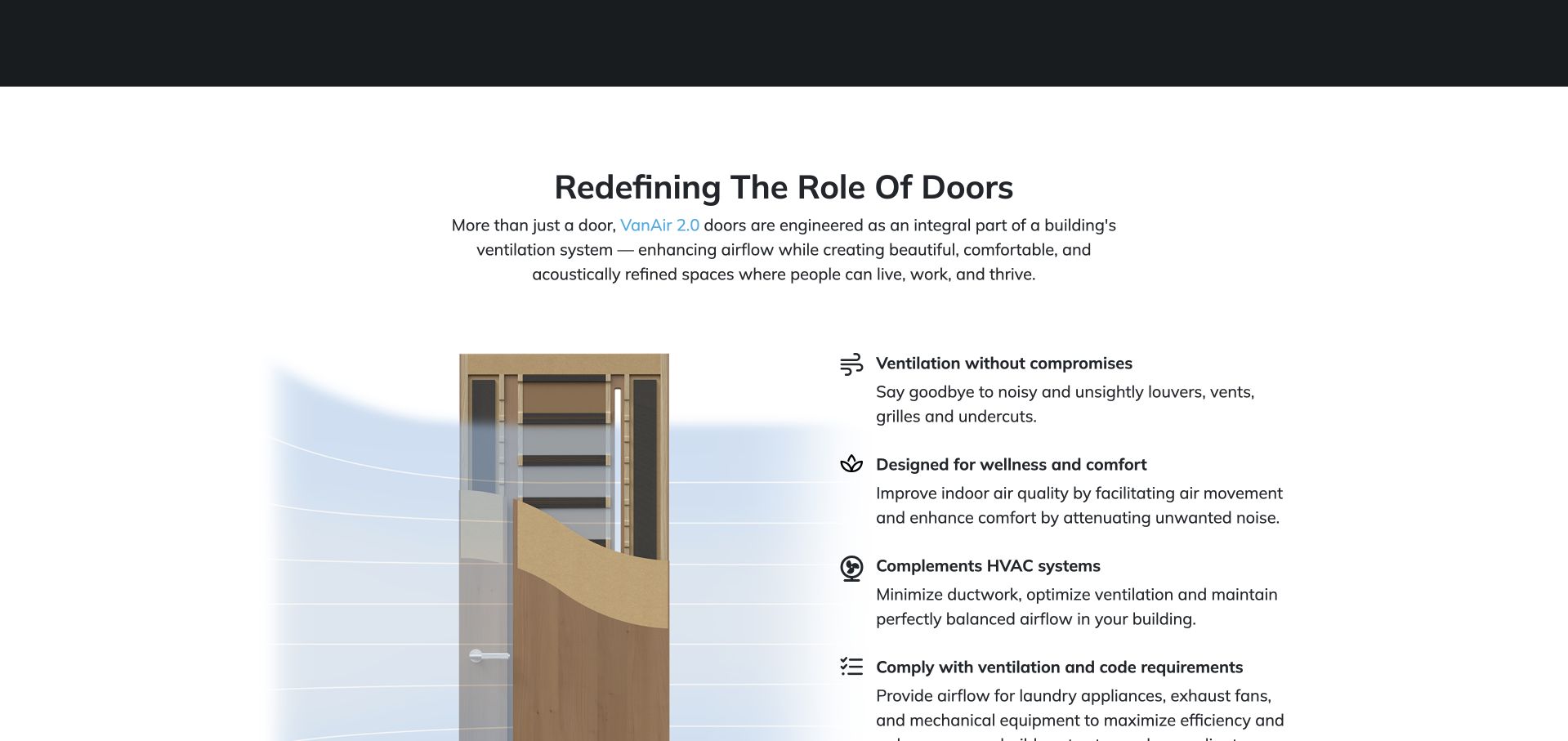
VanAir’s product page uses a door cutaway beside a vertical set of benefit explanations, with simple line icons marking each point. The accepted image shows the static explanatory section rather than the introductory video, which remained unready. A pale background and generous spacing let the physical airflow concept remain the main subject. The September 19, 2026 VanAir case covers configurable door manufacturing, inventory, purchasing, CRM, sales, accounting, Website and related operations on Odoo.sh, following a 2023 manufacturing expansion.
What you can learn
When a product’s value is hidden inside its construction, an explanatory illustration can be more useful than atmospheric video. Connect benefits to specific specifications and evidence. In manufacturing software, preserve configurable product details and production ownership instead of assuming every door variant follows the same record structure.
Pros
The cutaway illustration makes an otherwise invisible physical function easier to understand.
Aligned benefit blocks create a readable relationship between the product and its intended uses.
Cons & considerations
Engineering and code-related claims need supporting technical documentation rather than icons alone.
The failed introductory media shows why an informative static fallback is important for product pages.
Platform source: Official product-specific customer case or dated announcement. The September 19, 2026 VanAir case covers configurable door manufacturing, inventory, purchasing, CRM, sales, accounting, Website and related operations on Odoo.sh, following a 2023 manufacturing expansion. This establishes only the stated organization, workload, product family, regional or historical association. It does not prove the pictured public page runtime, reveal its CMS or frontend, establish a complete current stack, or independently verify vendor-reported results. Platform evidence is separate from the direct website screenshot and is not a complete current infrastructure audit.
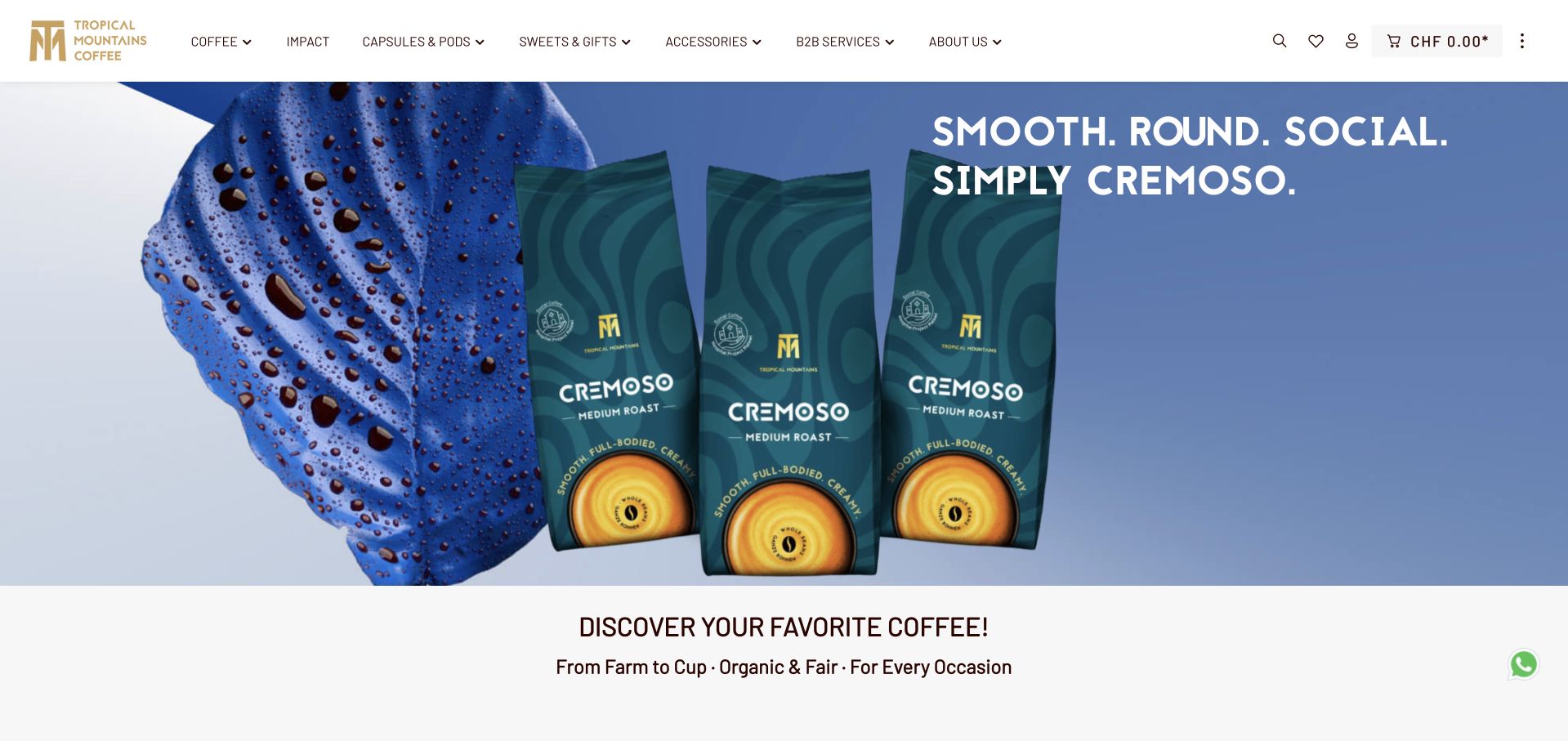
Tropical Mountains’ public store uses a large blue product composition featuring coffee packages, beans and a short flavor-oriented line. A compact white header organizes coffee, gifts, impact information and business services. The image is commercially focused, but the visible categories provide routes beyond the featured blend or promotion. Odoo’s September 28, 2026 case dates Tropical Mountains’ adoption to 2022 for purchasing, accounting, sales, manufacturing and inventory across Peru and Switzerland; it does not identify the current shop frontend.
What you can learn
A distinctive product image should lead into dependable catalog and fulfillment information. Model purchasing, lots, manufacturing and inventory around the real supply chain, not just the storefront categories. An ERP case about coffee logistics does not establish the rendering system behind the current public shop.
Pros
The packaging composition gives the featured coffee a clear visual identity without a busy lifestyle scene.
Consumer shopping and business-service routes are both visible within the main navigation.
Cons & considerations
A flavor-led campaign needs detailed product and sourcing information on the linked pages.
A large hero image can delay practical comparisons such as format, quantity and delivery options.
Platform source: Official product-specific customer case or dated announcement. Odoo’s September 28, 2026 case dates Tropical Mountains’ adoption to 2022 for purchasing, accounting, sales, manufacturing and inventory across Peru and Switzerland; it does not identify the current shop frontend. This establishes only the stated organization, workload, product family, regional or historical association. It does not prove the pictured public page runtime, reveal its CMS or frontend, establish a complete current stack, or independently verify vendor-reported results. Platform evidence is separate from the direct website screenshot and is not a complete current infrastructure audit.
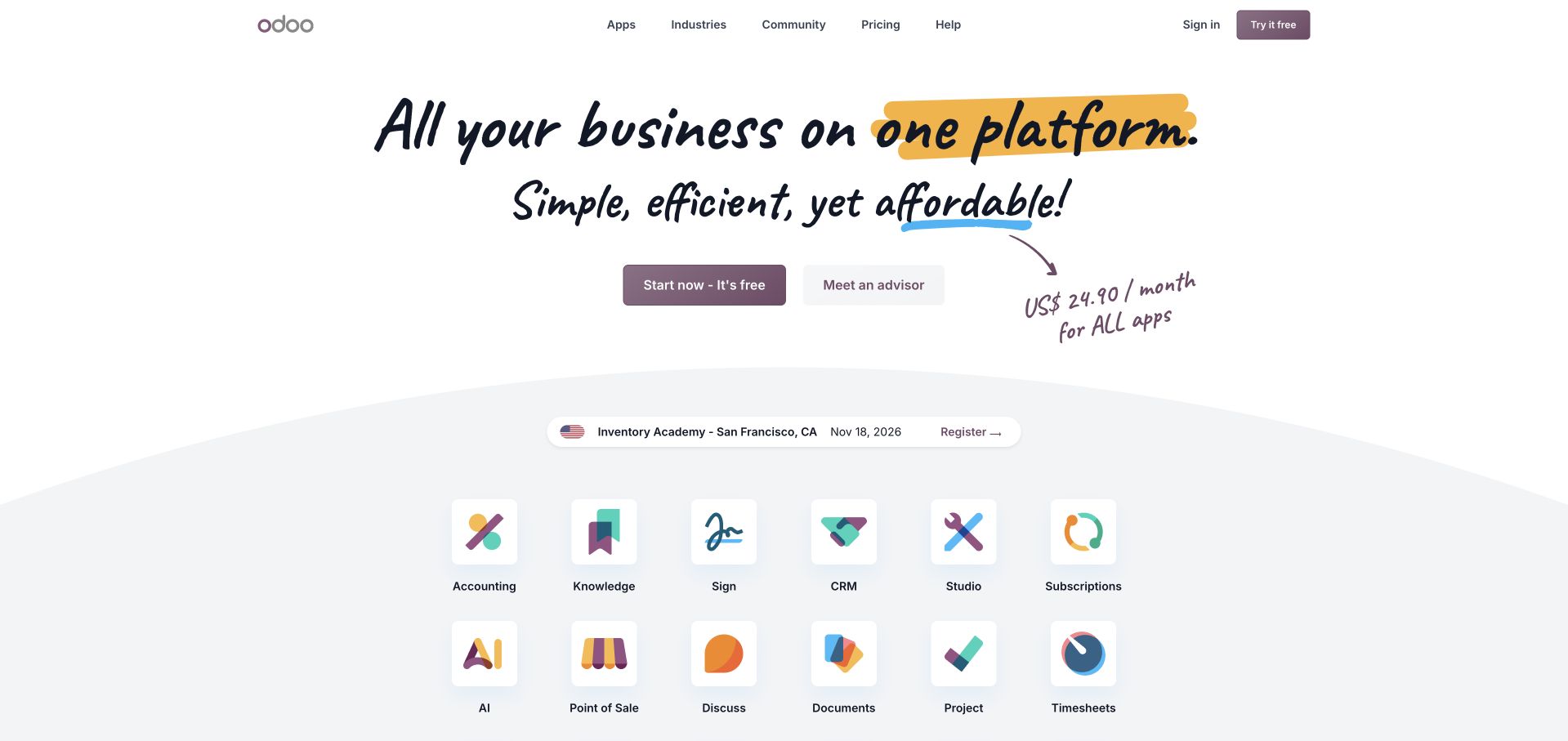
Odoo’s own homepage uses a handwritten-style headline, a highlighted phrase and a row of colorful application icons. Two simple actions separate immediate trial interest from a conversation with an advisor. The light background and informal annotations make a wide business-software suite feel less like a dense enterprise catalog. An October 4, 2024 official staff talk explicitly identifies an Internal Platform team responsible for Odoo SA’s own implementation and subsidiaries. That dated account does not reveal its private configuration.
What you can learn
Introduce an integrated suite through understandable jobs, then define the modules, data and permissions needed for a particular business. A shared visual system does not remove implementation complexity. Treat the vendor’s internal-use account as documentary evidence and evaluate its public marketing design separately from private operational configuration.
Pros
Application icons provide recognizable entry points into a broad set of business capabilities.
Trial and advisor actions accommodate both exploratory users and organizations needing implementation support.
Cons & considerations
Informal pricing annotations need clear plan, region and scope explanations on the relevant destination.
An all-in-one proposition can hide the real work of data migration, permissions and operational change.
Platform source: Official product-specific customer case or dated announcement. An October 4, 2024 official staff talk explicitly identifies an Internal Platform team responsible for Odoo SA’s own implementation and subsidiaries. That dated account does not reveal its private configuration. This establishes only the stated organization, workload, product family, regional or historical association. It does not prove the pictured public page runtime, reveal its CMS or frontend, establish a complete current stack, or independently verify vendor-reported results. Platform evidence is separate from the direct website screenshot and is not a complete current infrastructure audit.
Kegan has 15+ years of experience working with small businesses, Fortune 500 companies, and everything in between. No development job is too big or too small: he brings the same hands-on attention to a focused improvement, a complete website, or a custom application.
For Odoo projects, he can help with content architecture, custom functionality, system integrations, testing, and maintainable handover. He works directly with clients on scope, design, implementation, testing, and handover, with an emphasis on clear communication and a system that remains practical to maintain after launch.
Show 3 other Odoo developersHide other Odoo developers
Start with a coherent process such as quotations and sales, project time or inventory visibility. Choose a small group of users who can test the real work and its exceptions. Keep the first release complete rather than installing many disconnected modules. Include training and record cleanup, because inconsistent operational habits will not disappear simply by moving them into a new interface.
A connected Website and commerce experience
A public Odoo site can benefit from shared product and operational information when the modules and responsibilities are deliberately designed together. Specify public versus portal access, product ownership, order confirmation and fulfillment handoffs. Do not assume a documented Website module proves that every current brand property uses it, or that all payment and marketing services are part of the same system.
A tailored multi-module implementation
A manufacturer, distributor or multi-country organization may need connected purchasing, stock, projects and accounting with specific extensions. Define the deployment environment, support model and migration responsibilities before choosing custom development. Identify which local requirements need specialist review. A flexible platform can support a complex business, but flexibility does not eliminate the need for clear controls and a realistic rollout.
From references to requirements
Define a specific business implementation
Map the physical and financial flow
Trace an ordinary transaction and an exception with the people who actually perform the work. Include materials, variants, approvals, delivery and corrections where relevant. Record who owns each handoff and what confirms completion. This is especially important for custom awards, furniture installation or configurable doors, where a simple product label can conceal several different operational stages.
Select the environment and migration scope
Document the required modules, custom code, integrations and maintenance expectations before selecting an environment or plan. Check current product and API availability for that choice. Clean identifiers and relationships before importing records, then reconcile samples with the business owner. Preserve a clear account of excluded history, open orders and any manual work needed during the transition.
Plan review, testing and ongoing change
Name the implementation owner, process owners and long-term technical maintainer. Test roles, document changes and define a supported release procedure. Include a recovery exercise for failed imports or integrations rather than checking only a successful demo. Review local financial or regulatory requirements with appropriate specialists; a vendor testimonial is not a substitute for advice about a particular business’s obligations.
A useful handover demonstration
Ask the actual team to carry out its routine job: publish a realistic update, correct a mistake, preview a narrow screen, and identify who owns an integration failure. For a library or frontend framework, also ask who maintains the content source and deployment. A polished screenshot does not answer those operational questions.
Beyond the screenshot
Odoo implementation checklist
Name the specific company, operating unit and deployment scope.
Map the real workflow before selecting modules.
Identify product, customer, supplier and transaction record owners.
Define variants, units, warehouses and project stages where relevant.
Review public, portal, employee and administrator access separately.
Test record rules using realistic permitted and prohibited actions.
Check current version, environment and API availability.
Inventory integrations and keep credentials out of public code.
Document every custom module and its maintenance owner.
Reconcile imported records, balances and open transactions.
Test exceptions, recovery and upgrades before launch.
Train the operating team and plan a supported first release.
Test with real content, a keyboard, a small screen, slow or failed requests, and the people who will maintain the system. These are planning checks, not an accessibility, security, performance, or search-ranking certification.
Sources & editorial method
How this Odoo collection was reviewed
All twenty selected images were personally inspected after actual Chrome capture. Incomplete hero media was replaced with clear public content pages or sections, not fabricated imagery. Official cases and conference accounts establish the precise module or project association. Historical periods and planned expansions are preserved, and vendor outcomes are not independently verified performance claims.
Every image is an unmodified capture from the actual website, with its source and capture date. Some captures are reused from our shared catalog; their dates remain the original capture dates. None comes from a vendor gallery or a generated reconstruction. Moving imagery and live content can change.
Technology attribution uses public page assets or metadata, official platform documentation, or a cited first-party project case study. Documentary and framework-relationship evidence is identified where used; it is not a complete current backend inventory. A CMS image CDN alone does not establish a full CMS deployment. A library’s presence does not prove which individual controls use it, and a platform label does not establish AI authorship.
The composition notes, lessons, pros and tradeoffs are original editorial observations. We have not measured conversion, traffic, security, performance or accessibility conformance. Website owners retain their brands and imagery; these examples are not our client portfolio. Written, Edited and Curated are independent records, not dates advanced by a build. See our editorial standards or suggest a correction.
Questions worth asking
Odoo website development FAQs
Are all these public websites built with Odoo?
No. Some cases explicitly include Website or ecommerce; others document only internal operations. The pictured page is a design reference. Its current renderer and complete frontend stack require independent evidence.
Why include older or regional examples?
They can illustrate a real operational association and useful public design when their limits remain clear. A 2014 project or one-country implementation must not become a claim about the organization’s current worldwide architecture.
Should every available module be installed at launch?
Usually the better question is what complete workflow needs to function first. Start with an agreed process and its dependencies, then expand after the team trusts the records, permissions and operational handoffs.
Can Odoo connect to an existing website?
An appropriately designed integration may connect selected records or transactions. Confirm the current environment, plan and API options, define ownership and validate inputs. Keep privileged credentials away from anonymous browser code.
Does a customer case prove regulatory compliance?
No. It describes the vendor’s account of a particular implementation. Local invoicing, accounting, privacy or industry obligations need review for the actual organization and deployment; they should not be generalized from a testimonial.
Borrow a useful design pattern, then implement the actual business process with clear module boundaries, permissions and ownership. The most valuable integration is one the operating team can explain, trust and maintain after launch.