Best Astronomy Club Websites of 2026 (26 Real-World Examples)
Astronomy club websites that help newcomers find public events, understand membership and take a first step into a local observing community.
Explore 26 astronomy club websites, from regional observing societies to city clubs and volunteer observatories. These examples show how public events, beginner resources and membership information can work together without making a first-time visitor learn the club’s internal structure.
An astronomy club website serves people with very different levels of experience. A family may want to visit one public star party, a beginner may be deciding whether a telescope is necessary, and an experienced member may need an observing-site update. The homepage needs to distinguish those tasks while making the organisation feel welcoming.
The most useful patterns in this collection are practical ones: a visible next event, an honest beginner invitation, clear public-versus-member access and a reliable place to check changes. Some clubs use a modern image-led homepage; others use a compact calendar or a straightforward information page. Judge the design by whether the intended visitor can understand what to do next, rather than by the quantity of astronomical imagery.
Before the examples
What makes good astronomy club website design in 2026?
Welcome beginners in ordinary language
Say whether public events welcome people without experience or equipment, and only make that promise when the club’s actual policy supports it. Give first-time visitors a short explanation of what an event involves and where to find questions and contact details. Avoid making a newcomer interpret unexplained acronyms before finding an introductory activity.
Make the next event actionable
Display the date, start time, time zone, location and audience together. Explain whether booking, payment or membership is needed. Link to a maintained event page for directions and changes instead of scattering competing details through several homepage announcements. An attractive calendar is useful only when the information inside it is dependable.
Separate public participation from member access
Label public talks, outreach sessions, members-only observing and internal meetings clearly. Put restricted directions, member documents and private meeting credentials behind the appropriate access boundary. The public site should explain the opportunity without exposing information intended only for members.
Give changes one authoritative home
Outdoor events may change, so identify the page or channel visitors should check before travelling. Keep postponements and venue changes attached to the relevant event. Archive past announcements and avoid presenting an old date as the next activity simply because its article remains visually prominent.
Use images to explain the community as well as the sky
Combine appropriately credited astronomy images with approved photographs of meetings, equipment and public activities. A dramatic nebula sets a tone, but a newcomer may learn more about joining from a clearly captioned event photograph. Obtain suitable permission for identifiable participants and keep essential event details as readable text.
The collection · 26 examples
26 astronomy club websites worth studying
The original saved target remains 26 distinct website properties. Minnesota Astronomical Society is the explicit Editors Choice for connecting a welcoming beginner route to upcoming public events, first-visit information and learning resources. This is an editorial selection of website presentation, not a judgement about observing facilities, scientific work or membership quality.
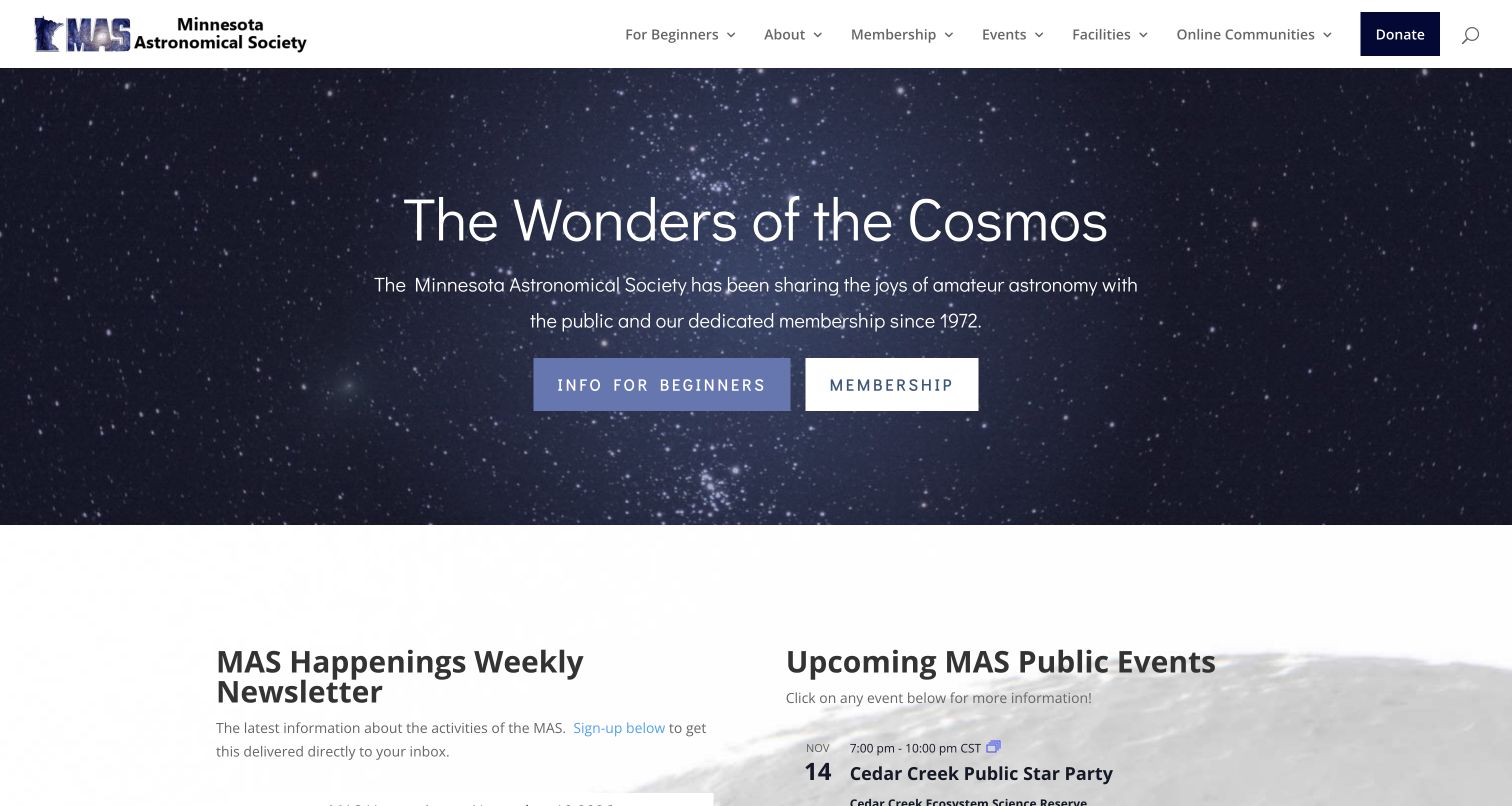
Minnesota Astronomical Society gives newcomers a distinct place in both its main navigation and its opening pair of buttons. The restrained star-field hero introduces the club, then the page puts a dated newsletter beside upcoming public events. Following the beginner route reveals a direct reassurance that a telescope is not required, a list of accessible starting activities and links to star-party FAQs. The useful design decision is the continuity: the promise of a welcoming club is followed by a concrete event, venue and learning path rather than just a membership payment screen.
What you can learn
Design the first-visit journey as a sequence. Pair a welcoming headline with a beginner page, a real next event and the practical information someone needs before arriving.
Pros
Beginner information is prominent before any membership commitment.
Dated public events connect the broad introduction to actual participation.
Cons & considerations
Several event types and facility names still require explanation for a first-time visitor.
Newsletter excerpts can grow long and compete with the next public event.
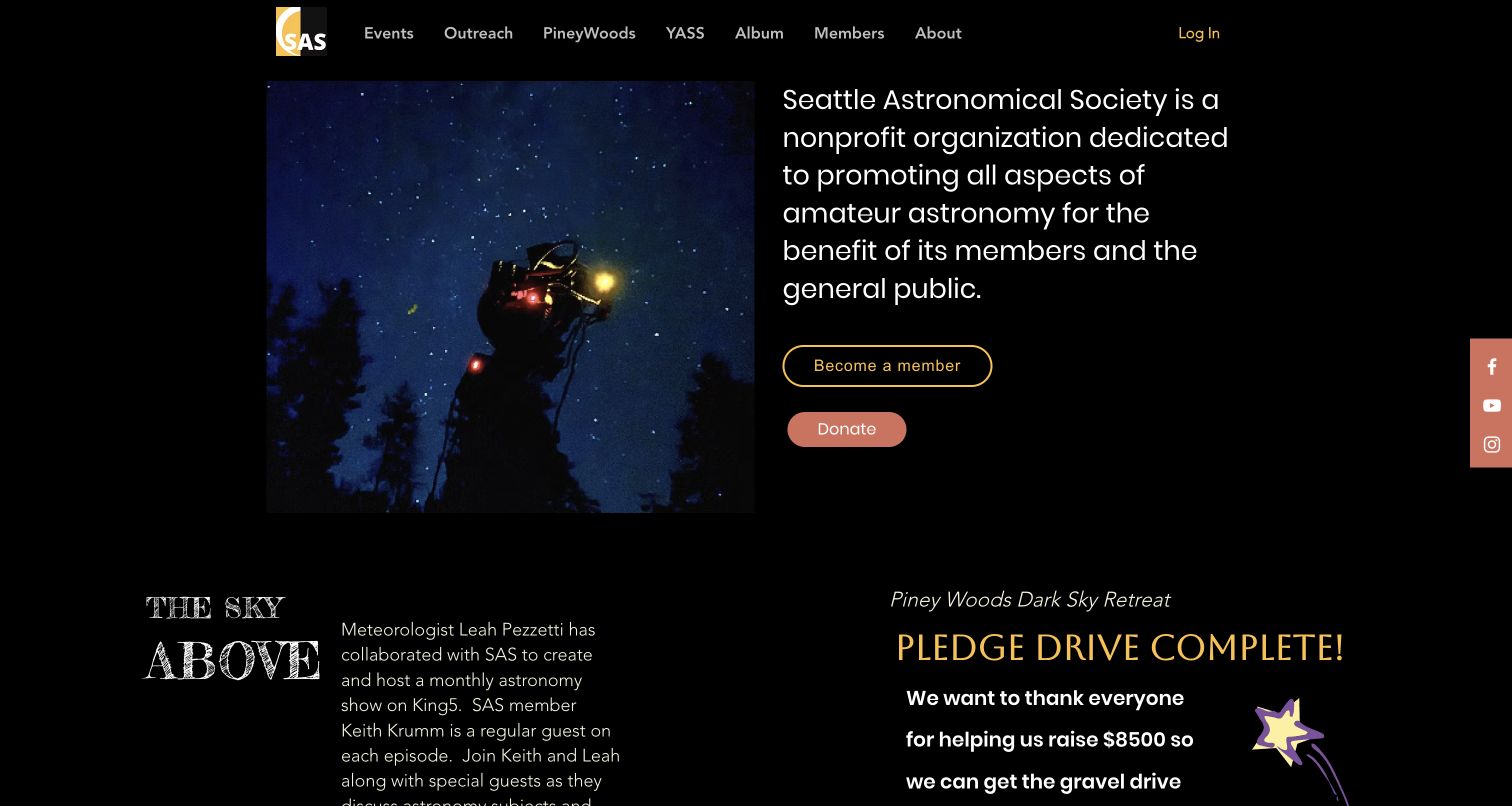
Seattle Astronomical Society places a telescope photograph beside a large mission statement, with membership and donation actions immediately below. The dark surface and restrained gold accents fit the subject while leaving the words readable. Further down, a local astronomy programme, a completed observing-site fundraiser and named upcoming events make the community visible. Separate Outreach, Piney Woods and Events destinations help visitors distinguish public involvement from the club's facilities and member activities. The homepage has several priorities, but they are grounded in recognisable projects rather than abstract promises.
What you can learn
Use photographs and current club projects to explain what membership supports. Keep public outreach, observing facilities and joining as distinct routes so visitors can choose their level of involvement.
Pros
The mission is stated beside a real observing image.
Named events and community projects show how the society operates.
Cons & considerations
Fundraising and programme promotions can push the next event farther down the page.
Specialised labels such as Piney Woods need context for newcomers.
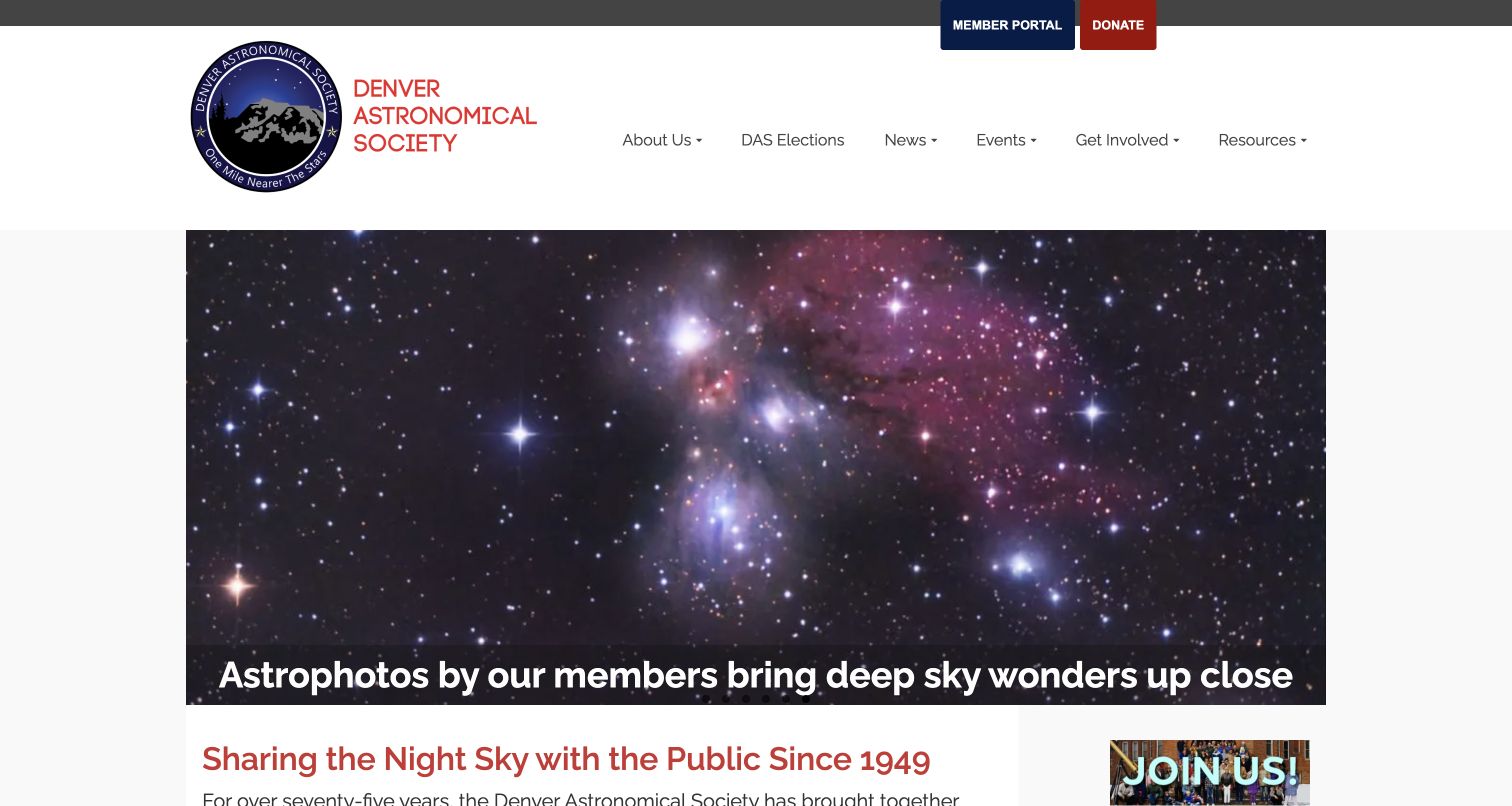
Denver's homepage pairs a generous white header with a wide carousel of member images and club activities. The public-service introduction follows immediately, while the event cards give a date, time and short explanation of the next open house. Member Portal and Donate occupy their own small utility area instead of taking over the main menu. The image captions also connect the attractive astronomy photography to people in the society. This is a useful reference for making a club feel established and active while keeping public events and volunteering within a conventional navigation structure.
What you can learn
Give impressive member images an explanatory role. A caption and a nearby public-event invitation can connect the visual appeal of astronomy to something a visitor can actually attend.
Pros
Utility actions are separated from public-facing navigation.
The open-house summary includes timing and a clear family-oriented invitation.
Cons & considerations
A large rotating hero can delay the next event on a short screen.
Carousel content changes the opening message, so essential details need a stable home too.
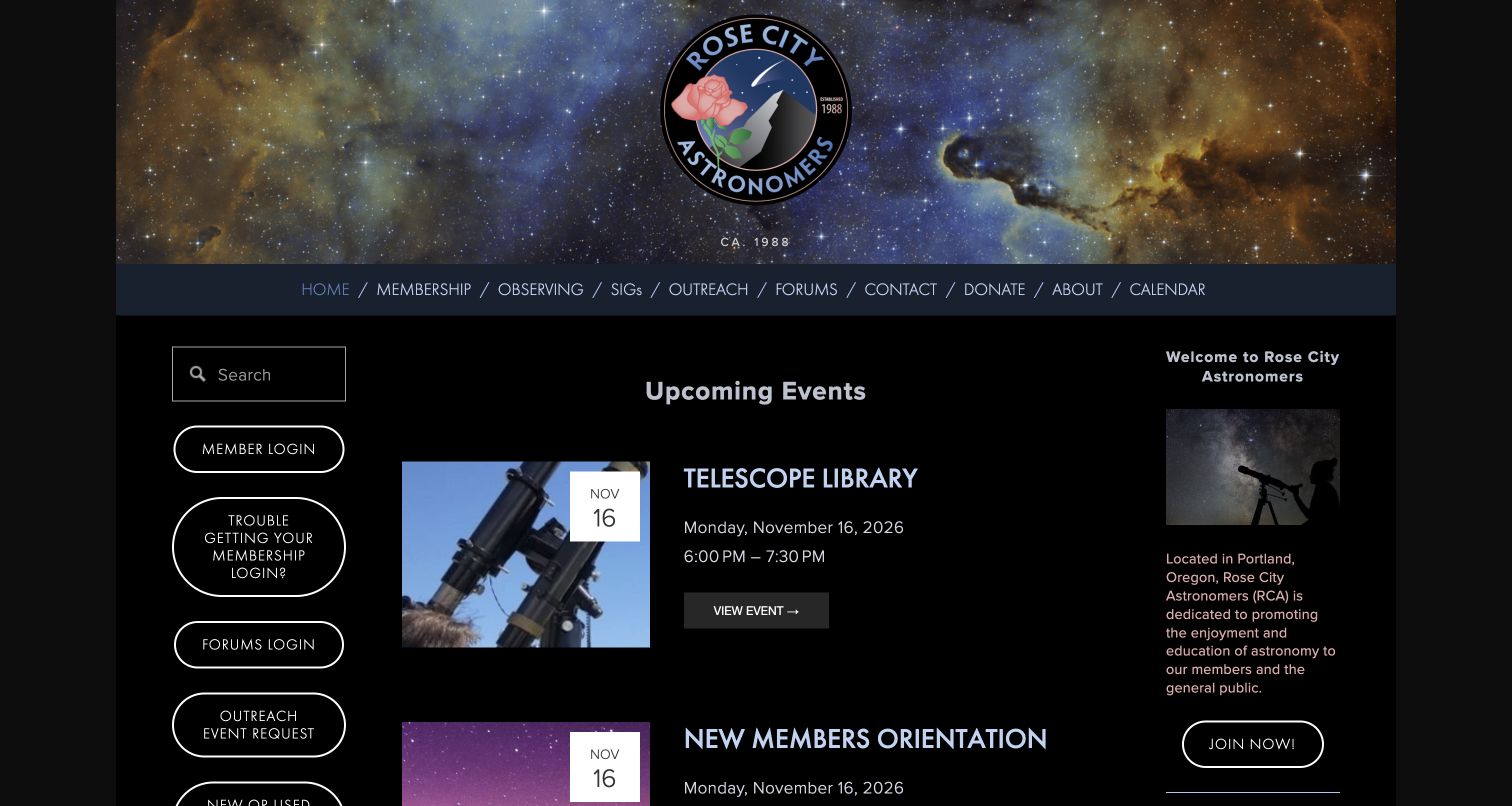
Rose City Astronomers uses its main home page as an upcoming-event list, with large event names, date badges, times and a consistent View Event action. Telescope Library and New Members Orientation appear alongside the general meeting, making the less intimidating entry points visible. A side column provides member login, forum and outreach routes, while another introduces the Portland club. The layout is busy, but its information hierarchy is practical: a visitor can see what happens next before navigating an organisational history or a membership form.
What you can learn
Put orientation and equipment-help sessions in the same event system as headline talks. Those small activities often answer a beginner's immediate question more directly than a general club description.
Pros
Event dates and time ranges are easy to scan.
New-member orientation and telescope lending are visible as specific activities.
Cons & considerations
Three columns create a dense first screen.
Abbreviations such as SIGs assume some familiarity with club terminology.
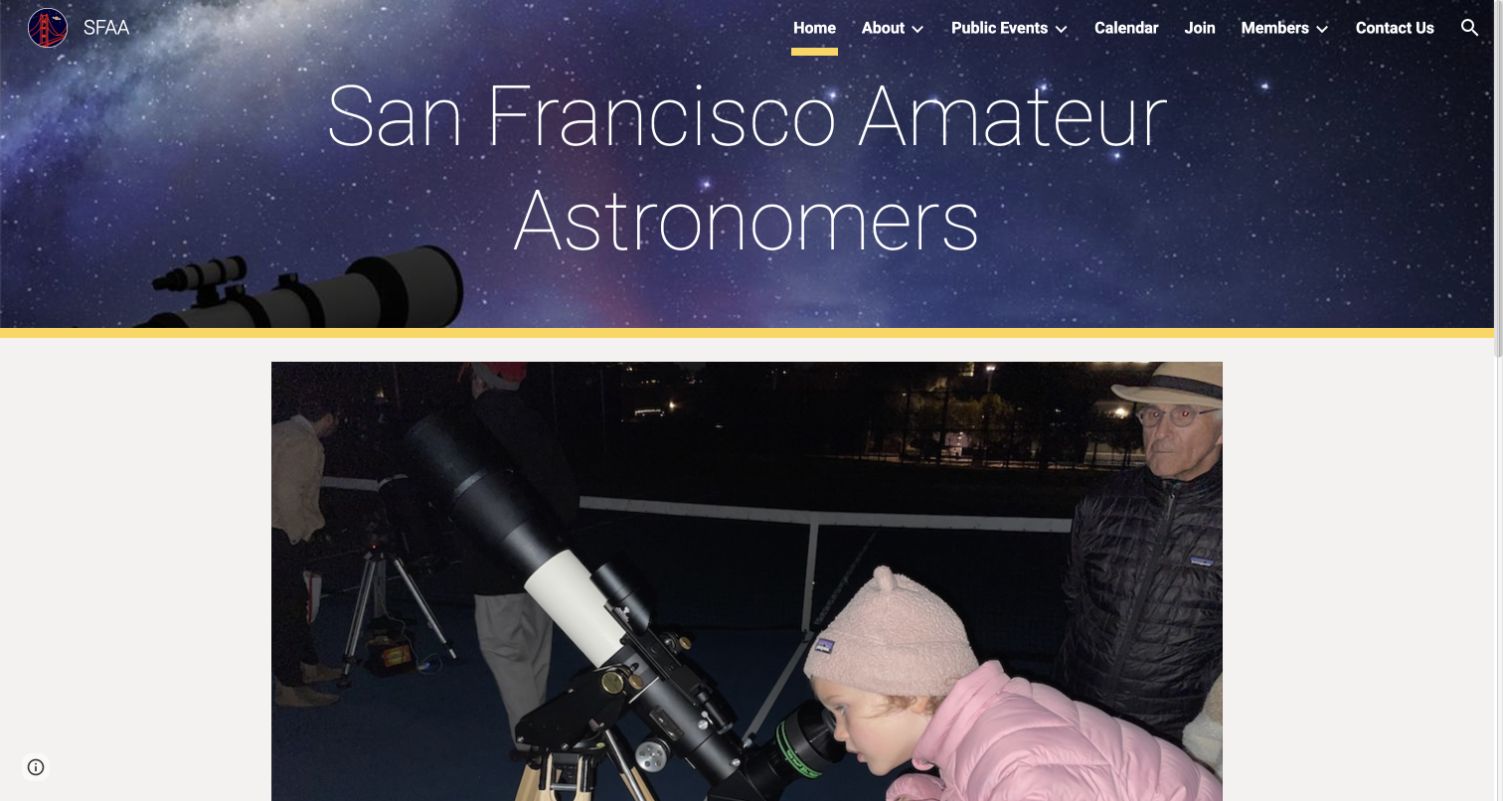
San Francisco Amateur Astronomers combines a large star-field title with a slideshow of people taking part in observing activities. The main navigation is short: public events, calendar, joining and member information are recognisable destinations. In the captured view, a child looking through a telescope makes the social side of the club more immediate than an equipment list would. The site is visually simple and puts much of its explanatory weight on the photographs. That works best when the calendar and event pages remain clear enough to turn interest into a visit.
What you can learn
Show people participating, not only objects in the sky. A welcoming outreach photograph can establish the intended audience, provided the nearby navigation clearly leads to dates and attendance information.
Pros
A concise menu separates public events from member material.
Community imagery demonstrates that observing is a shared activity.
Cons & considerations
The opening view offers little practical event detail without navigation.
A rotating photograph alone cannot explain attendance requirements or weather changes.
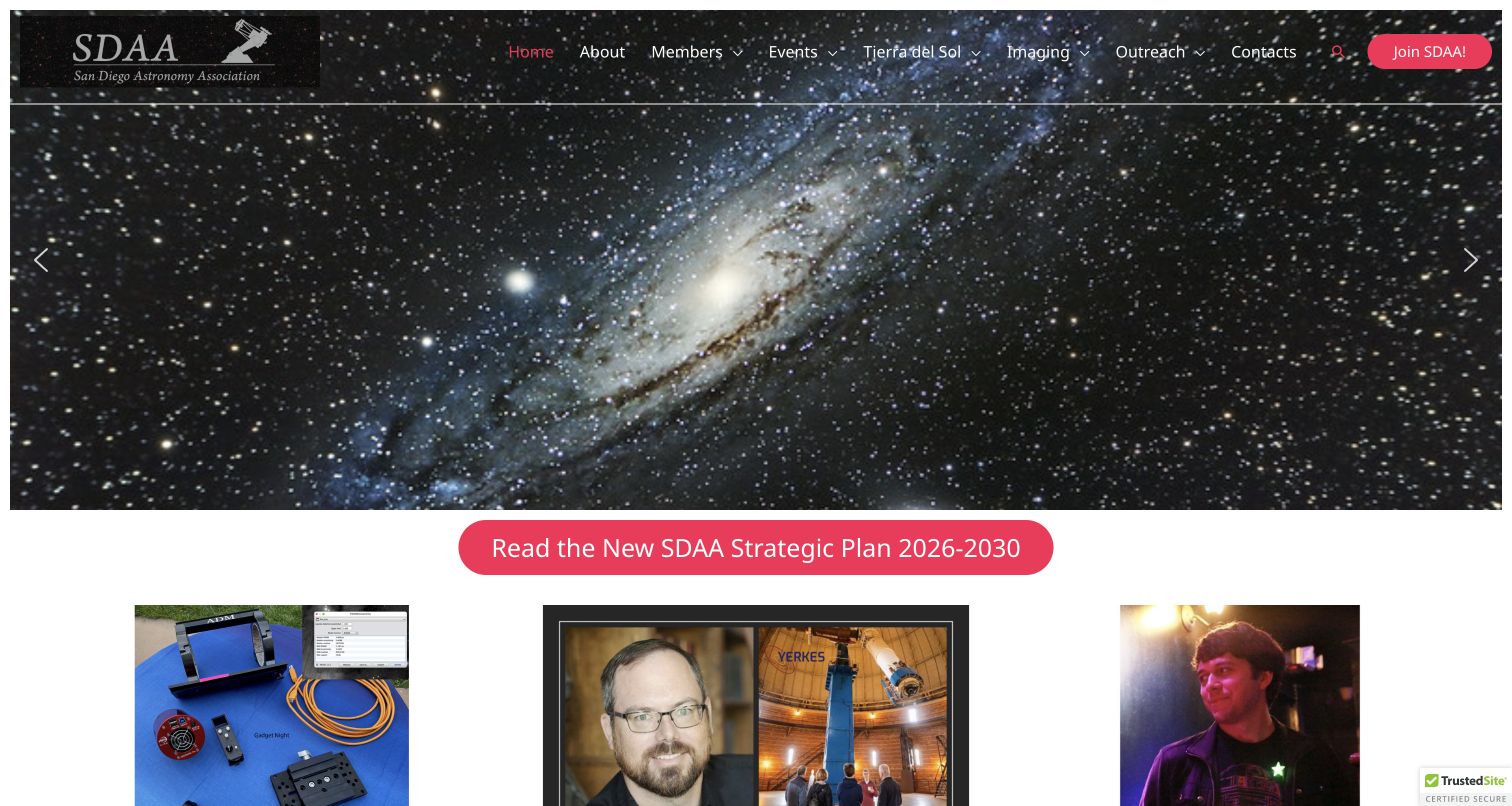
San Diego Astronomy Association gives a wide astronomical image the top of the page, with a compact navigation bar and a contrasting Join SDAA button. Beneath the image, a strategic-plan link and dated programme cards turn the site into a record of current activity. The menu distinguishes imaging, outreach and the Tierra del Sol observing site, rather than putting all services under one vague resources label. The presentation demonstrates how a club can use ambitious member imagery while still exposing the different ways people can learn, observe or volunteer.
What you can learn
Separate the club's main activities in navigation, then use dated programme cards to show that each is active. Keep a stable joining route outside the image carousel.
Pros
Imaging, outreach and the observing site have distinct destinations.
Programme cards include dates and enough context to identify the topic.
Cons & considerations
The very large image occupies much of the opening viewport.
A strategic-plan promotion may be less urgent than the next public event for a newcomer.
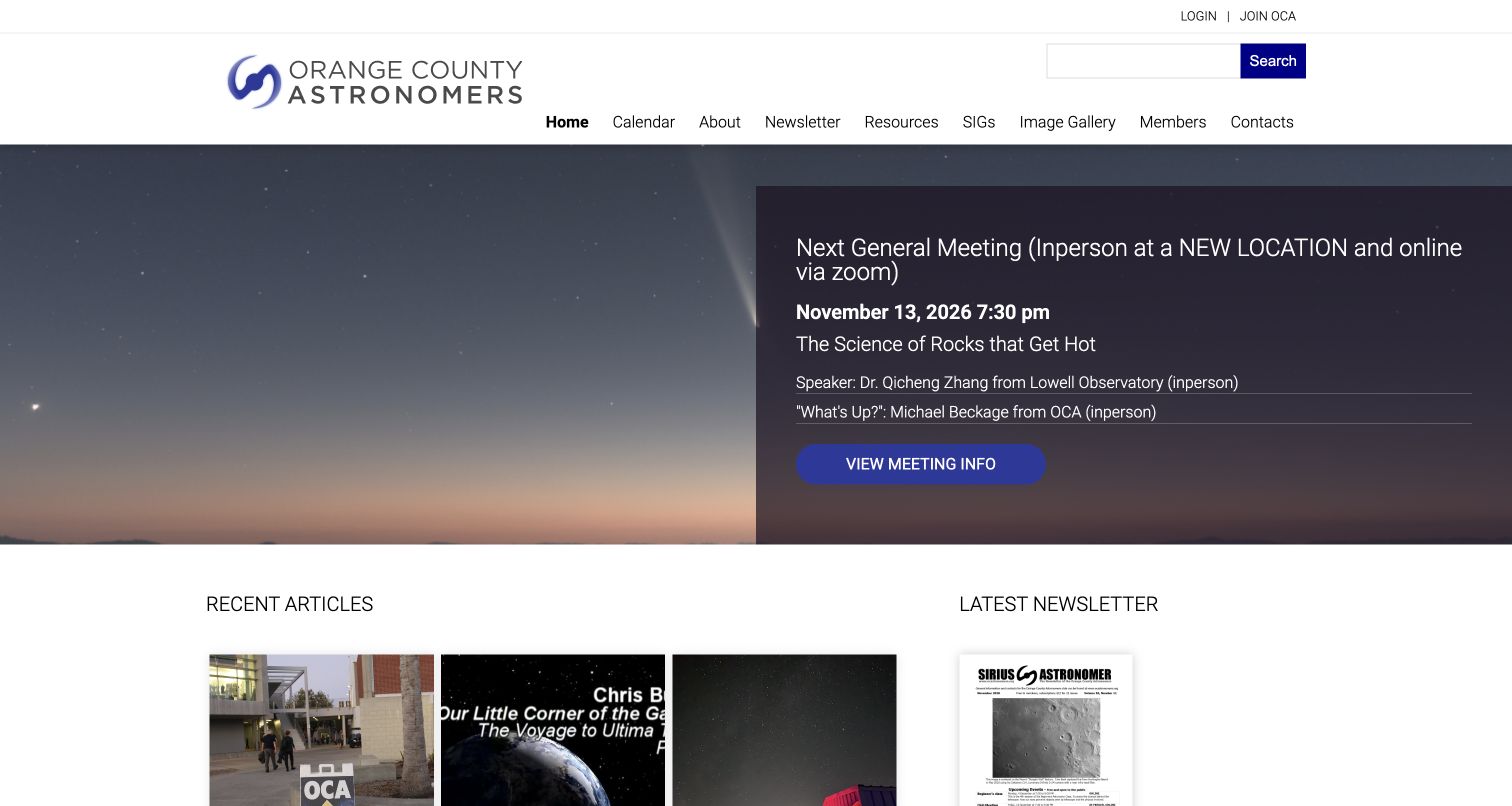
Orange County Astronomers puts the next general meeting directly over its opening image. The panel supplies the date, time, talk title, speaker and a View Meeting Info button, with a conspicuous note about the new location and online option. Recent articles and the latest newsletter appear below as supporting material. The header remains conventional, with calendar, resources, image gallery and contacts. The page is especially useful as a reference for giving a current operational update priority without replacing the rest of a club's information architecture.
What you can learn
Treat the next meeting as a compact structured record. Date, time, venue changes, participation format and one detail link should travel together whenever the event is promoted.
Pros
The next meeting is understandable in the first screen.
A location-change notice is attached to the relevant event rather than buried in news.
Cons & considerations
The top panel does not introduce the club's broader purpose in much detail.
Several resource destinations need a beginner-friendly explanation elsewhere.
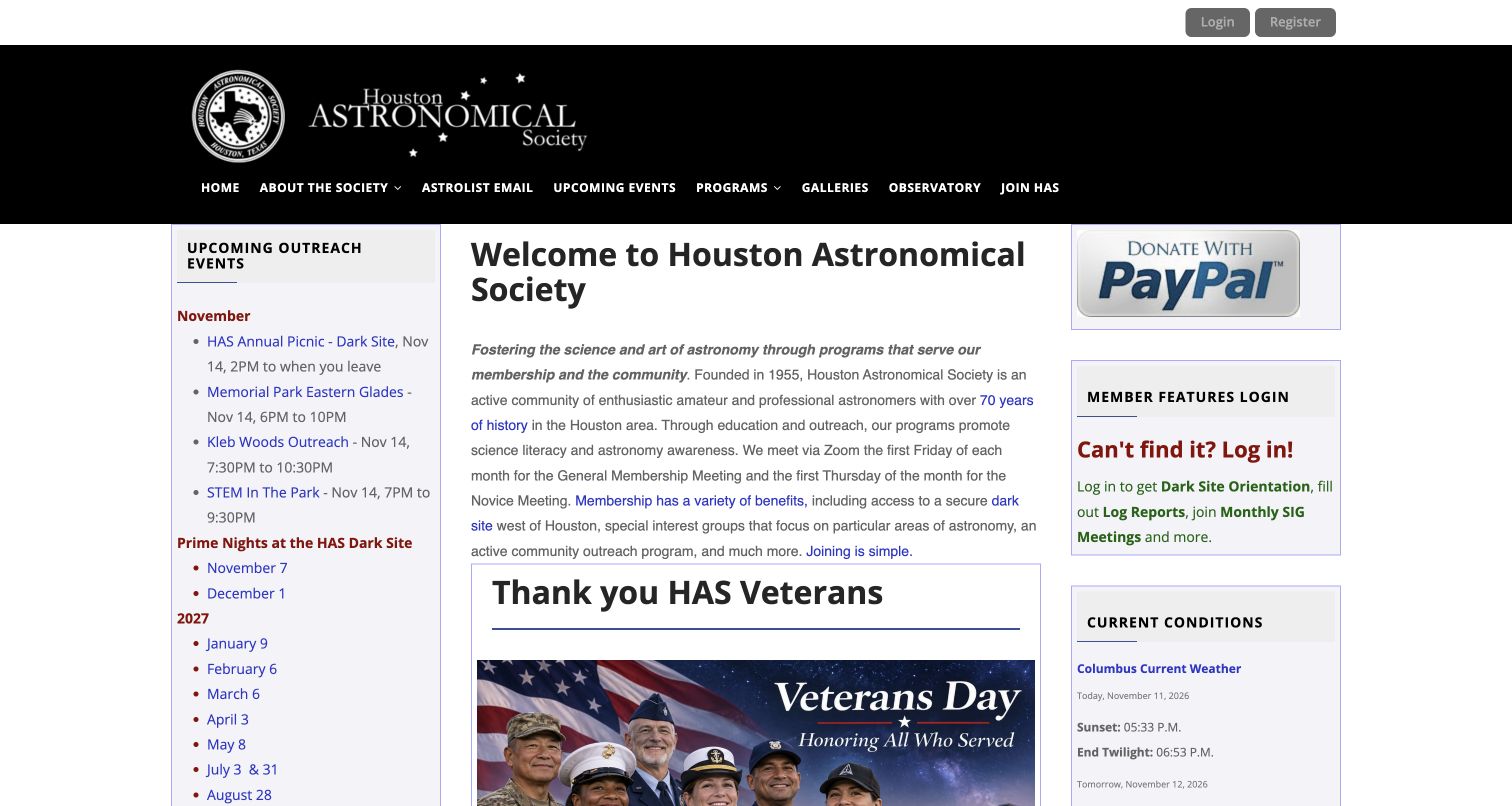
Houston Astronomical Society uses a three-column homepage with upcoming outreach on the left, a substantial welcome in the centre and member access or conditions on the right. The introductory text distinguishes novice and general meetings and links to membership benefits and the dark site. Dated articles then document current club activity. This is an information-rich approach rather than a minimal landing page. Its value lies in making operational details available, although the competing columns demand careful prioritisation for visitors who only want their first event.
What you can learn
Explain novice and general participation separately. A club can serve experienced observers without making newcomers decode every special-interest group or observatory requirement before joining in.
Pros
The introduction explains both novice and general meetings.
Outreach dates remain visible beside the main content.
Cons & considerations
Three competing columns make the opening view dense.
Long news articles can bury a concise first-visit pathway.
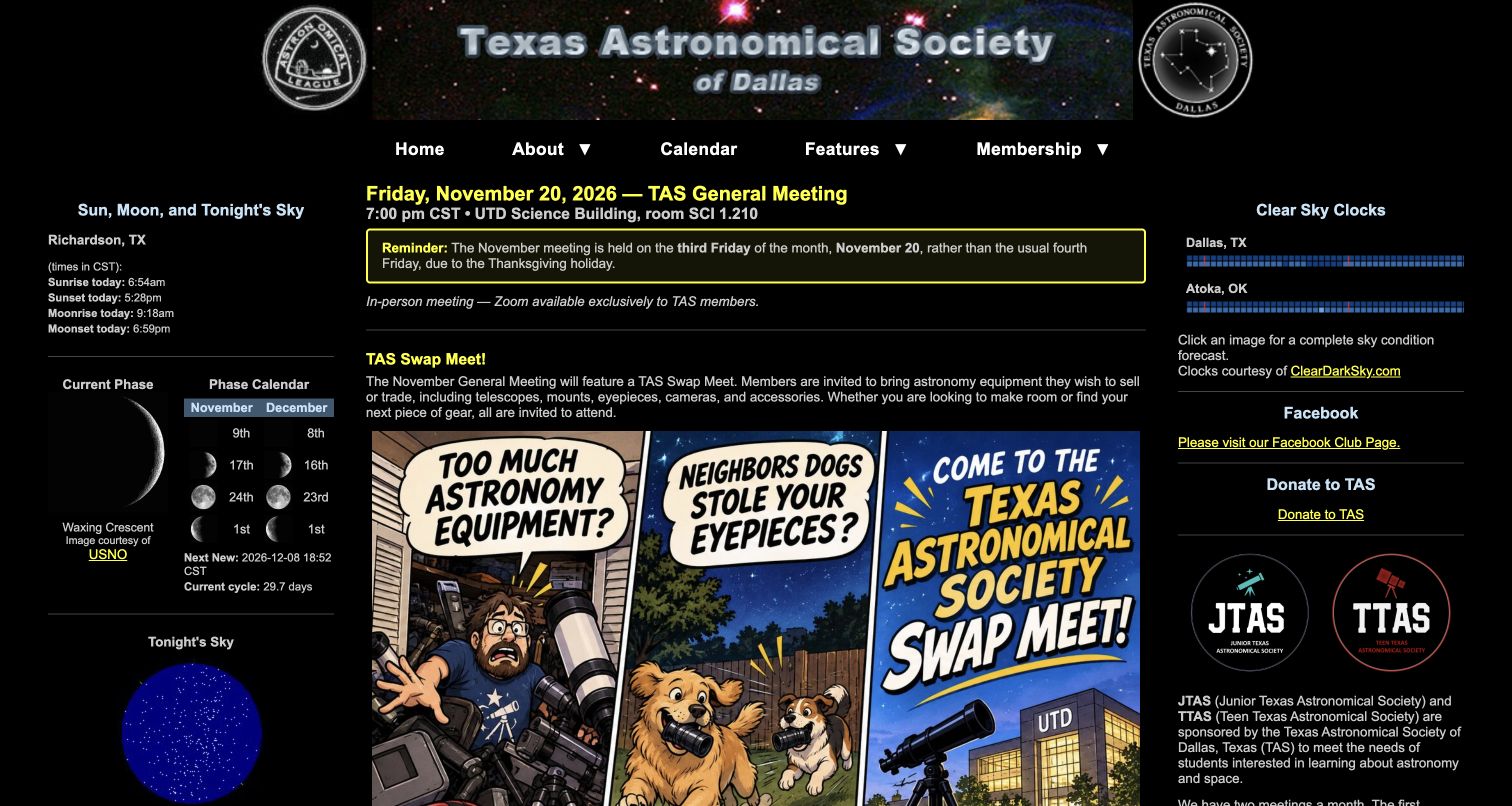
The Dallas society leads with the next meeting and a highlighted reminder that November's date differs from the usual monthly pattern. It also explains that guests may attend in person while Zoom access is reserved for members. Below, an agenda, parking guidance and membership information make the page a practical reference. The dark layout and yellow highlights are visually forceful, but some location details differ within the longer page. That makes it a useful example of both the value of explicit exceptions and the need to maintain one authoritative event record.
What you can learn
Publish schedule exceptions beside the next event, and reuse one source for its room, time and access rules. Repeating details across a long page creates opportunities for contradictions.
Pros
The holiday-related meeting change is clearly highlighted.
Guest attendance and member-only online access are distinguished.
Cons & considerations
Room numbers differ between the highlighted event and general meeting guidance.
The long page and sidebars give several secondary items equal visual weight.
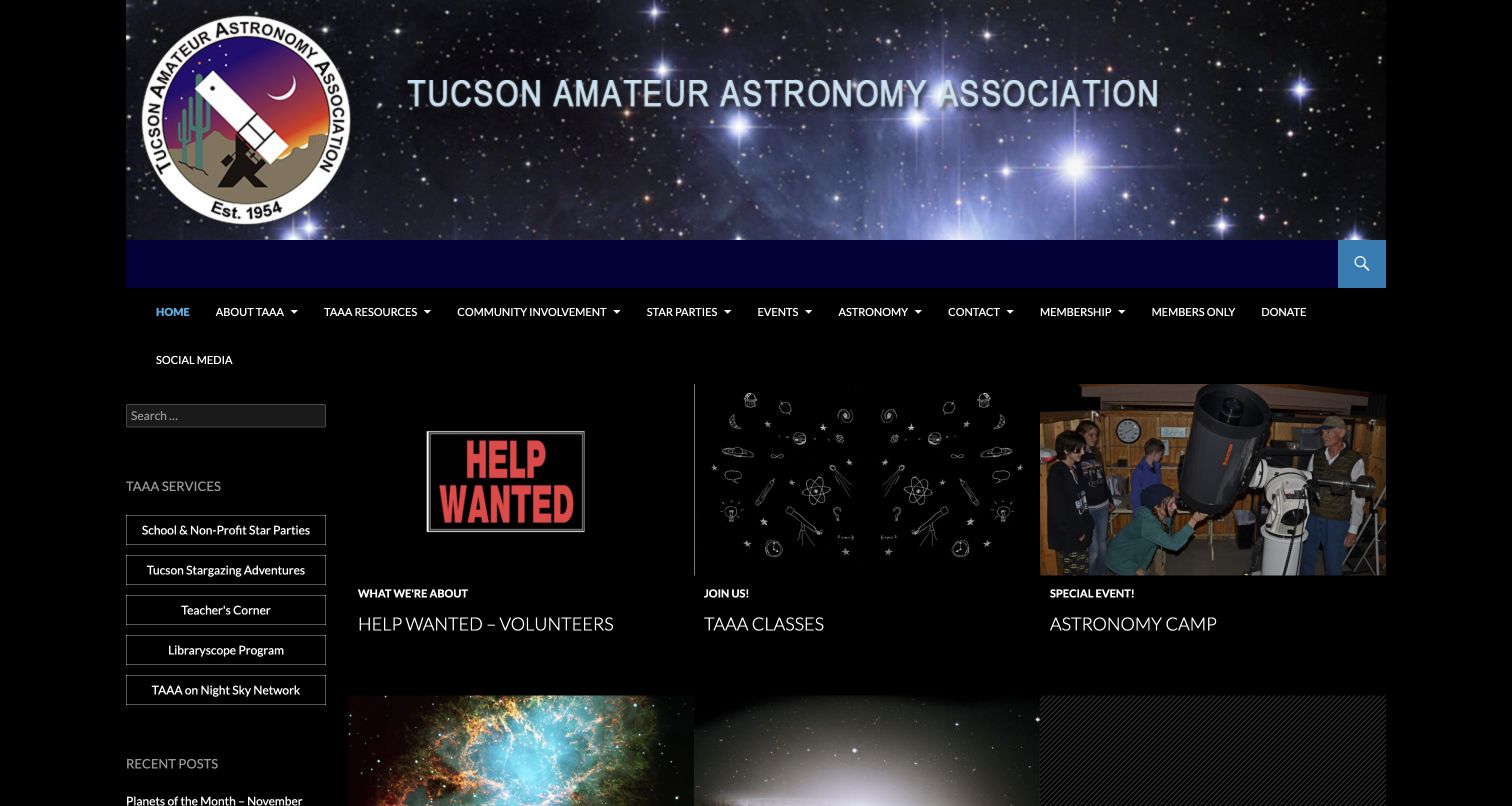
Tucson Amateur Astronomy Association presents a large programme through a dense navigation system and a grid of current opportunities. Volunteer help, classes and astronomy camp sit near the top, while later event descriptions explain public access, weather dependence and venue changes. The resource menu also exposes equipment loans, observing sites and a jargon guide. The amount of material reflects an active organisation, but it asks visitors to make many choices. The strongest lesson is the specificity of the attendance guidance, especially where an event has moved or requires a separate registration route.
What you can learn
Write observing-event information around real arrival decisions: public or member-only access, location changes, weather updates and any registration requirement. Keep those details close to the date.
Pros
Event descriptions explain weather and public-access conditions.
Equipment loans and terminology help are visible resources.
Cons & considerations
The extensive nested navigation can overwhelm a first-time visitor.
Long event feeds need careful maintenance to avoid stale venue details.
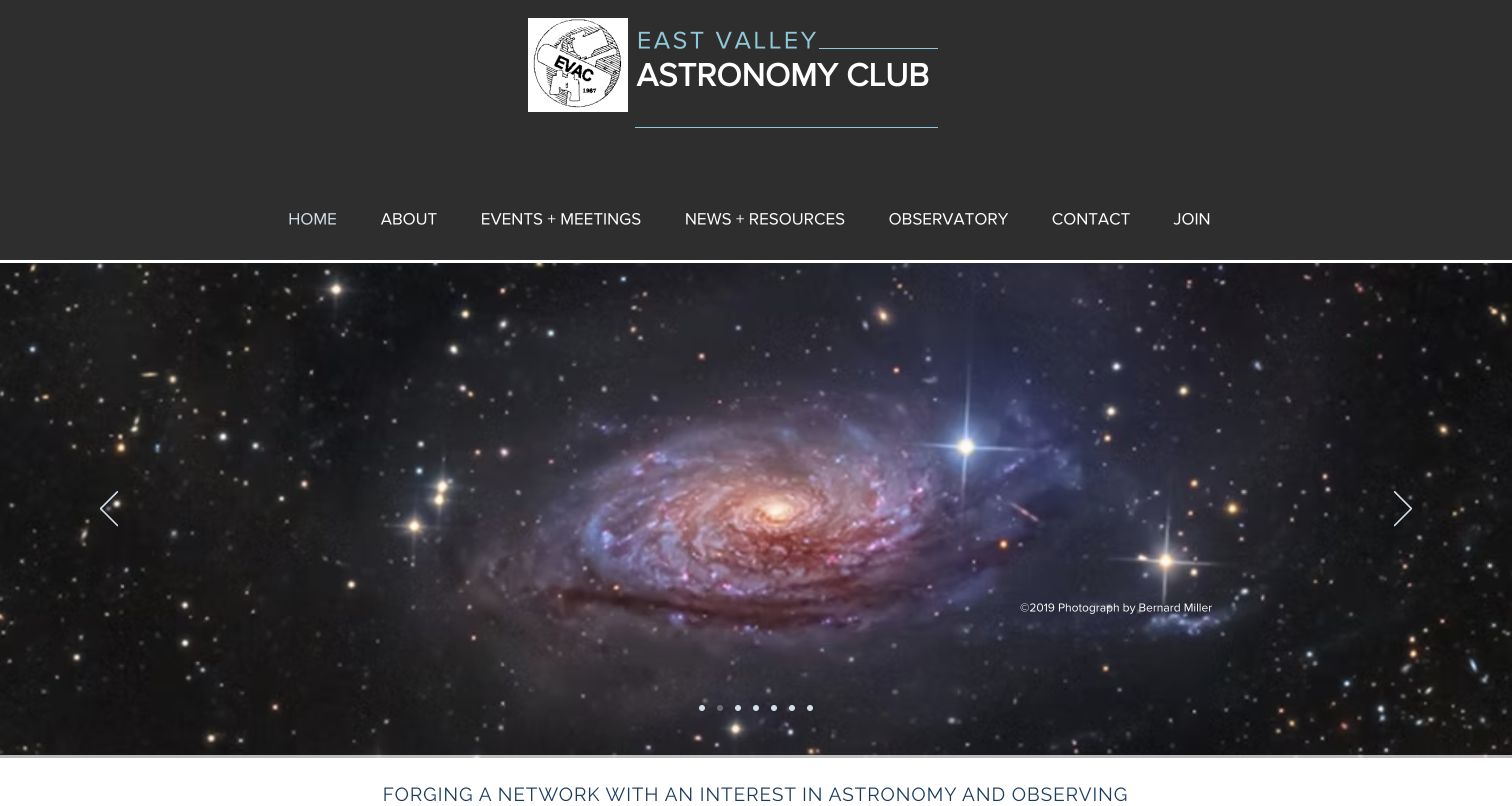
East Valley Astronomy Club opens with credited astrophotography and a restrained dark header. Below, three parallel blocks describe monthly meetings, observing programmes and a virtual beginner's lab. The page then explains the public observatory with its location, hours, cost and weather qualification. This progression turns a broad interest in astronomy into several understandable options. The hero takes considerable vertical space, but the practical sections show how to move from inspiration to a specific visit without assuming that the reader already owns equipment or understands club structures.
What you can learn
Group activities by the visitor's purpose before listing facilities. Learning, meeting others and observing are clearer starting points than a catalogue of committee or equipment names.
Pros
Beginner learning has its own clearly labelled route.
Observatory information includes hours, location and weather dependence.
Cons & considerations
The opening image delays the practical choices on smaller screens.
Repeated More Info labels rely on the surrounding headings for meaning.
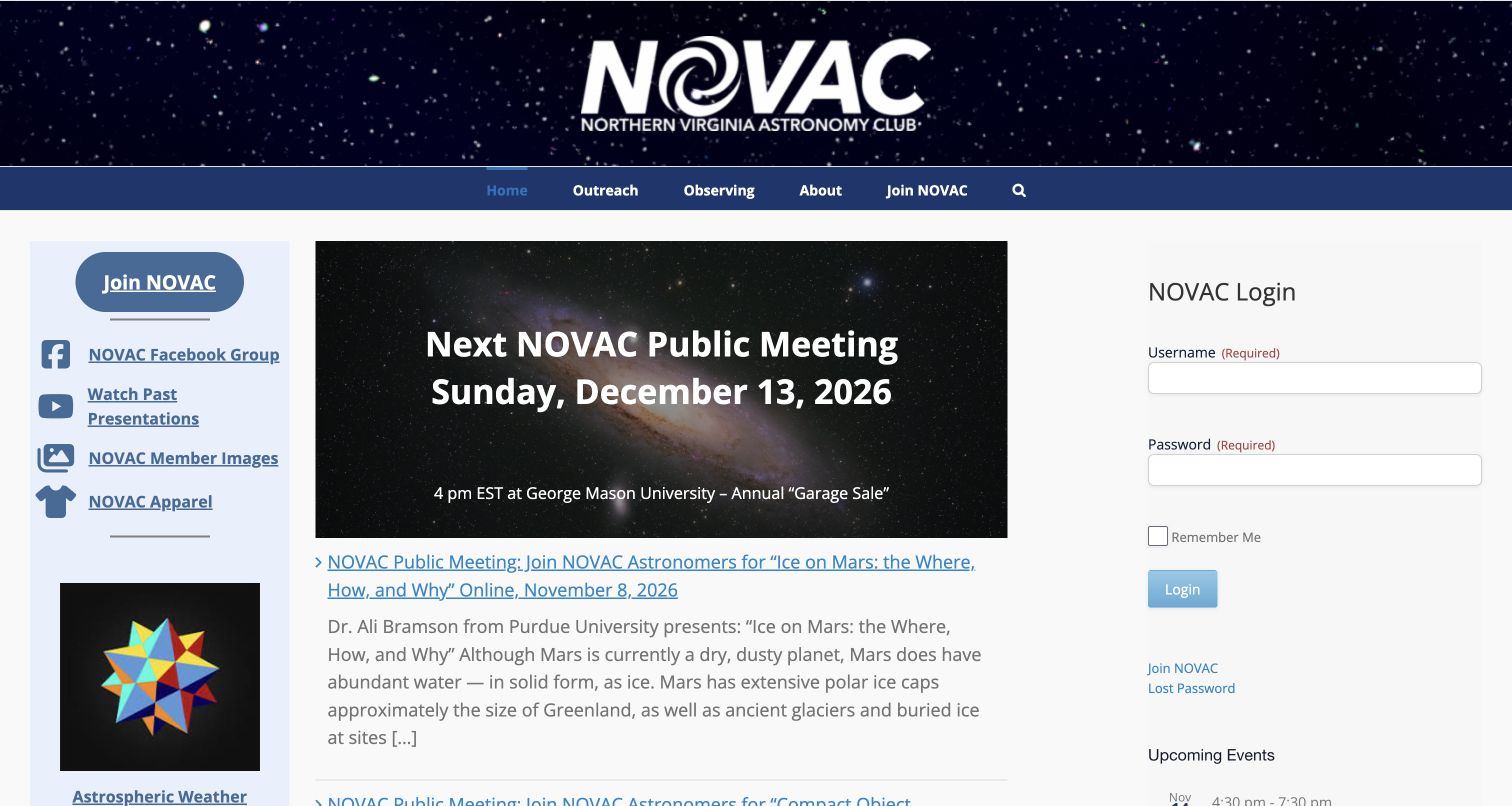
Northern Virginia Astronomy Club places its next public meeting in a central banner, followed by earlier presentation summaries. A small menu limits the primary choices to outreach, observing, background information and joining. Sidebars offer recordings, member images and weather, with member login kept separate. The resulting page works as both a current noticeboard and a record of educational activity. Its central invitation is clear, although the archive and login panel compete for attention after that first message.
What you can learn
Use the next public meeting as the stable starting point, then let past talks demonstrate the range of the club. Keep archive browsing separate enough that old dates cannot be mistaken for upcoming events.
Pros
The main menu uses a small number of understandable destinations.
Past presentation summaries show the breadth of educational topics.
Cons & considerations
The login form occupies prominent space for visitors who are not members.
Long historical summaries can distract from the next actionable event.
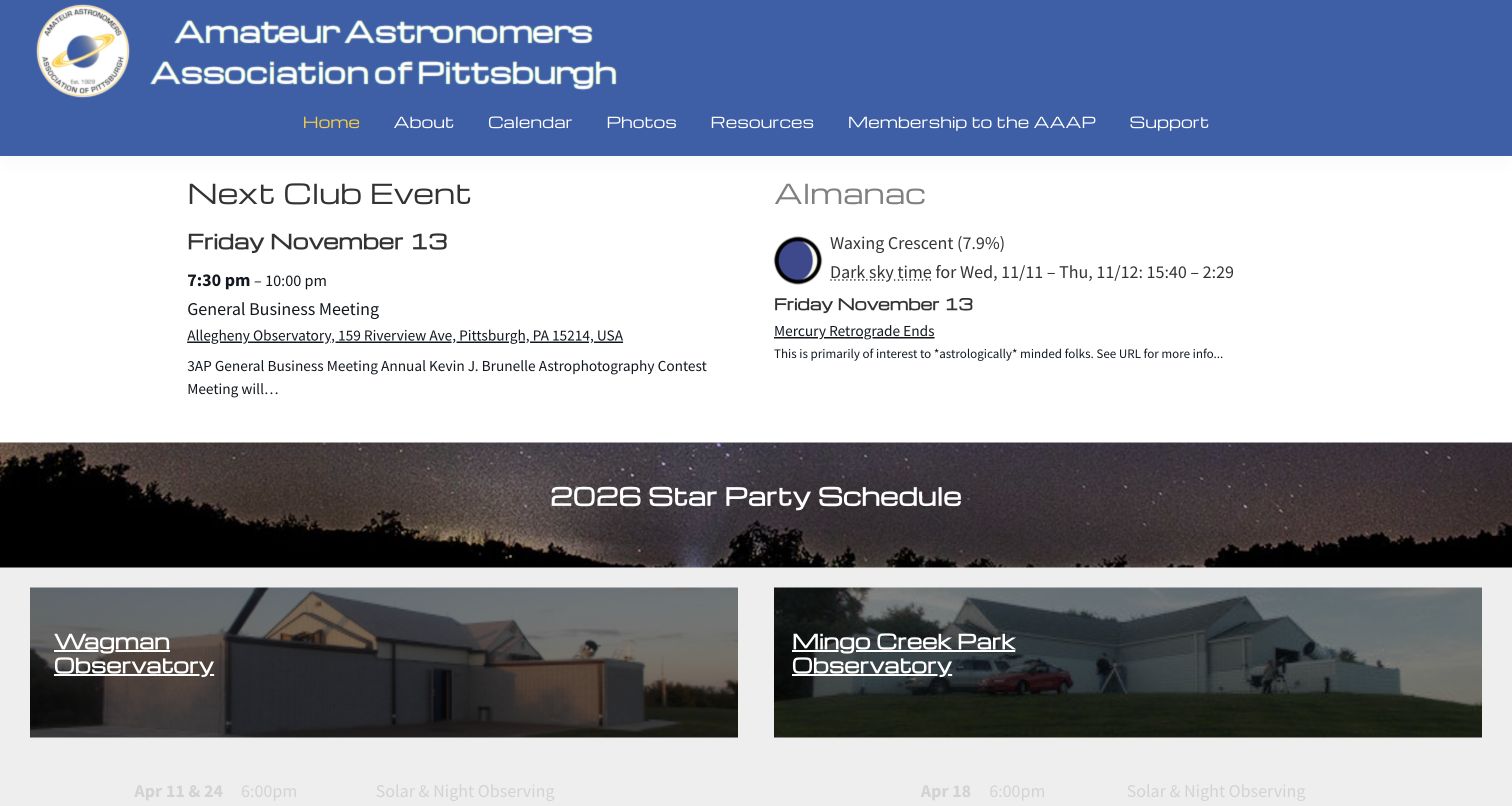
Pittsburgh's association gives the next club event a concise panel, then separates its star-party schedule into Wagman and Mingo Creek Park observatory columns. Each venue has a photograph, a clear title and a table of dates, times and event types. The parallel structure helps visitors choose a location without navigating two unrelated calendars. A sky almanac adds context, but the real planning value comes from keeping venue identity and schedule together. The annual view is useful as long as past dates remain visibly distinguishable from the next available visit.
What you can learn
When a club uses more than one site, organise dates around venue identity. A consistent side-by-side record is easier to compare than a mixed list with unexplained location abbreviations.
Pros
Each observatory has its own image and schedule.
Times and event types appear together in compact tables.
Cons & considerations
An annual table includes many dates that have already passed.
The almanac can compete with the more useful attendance information.
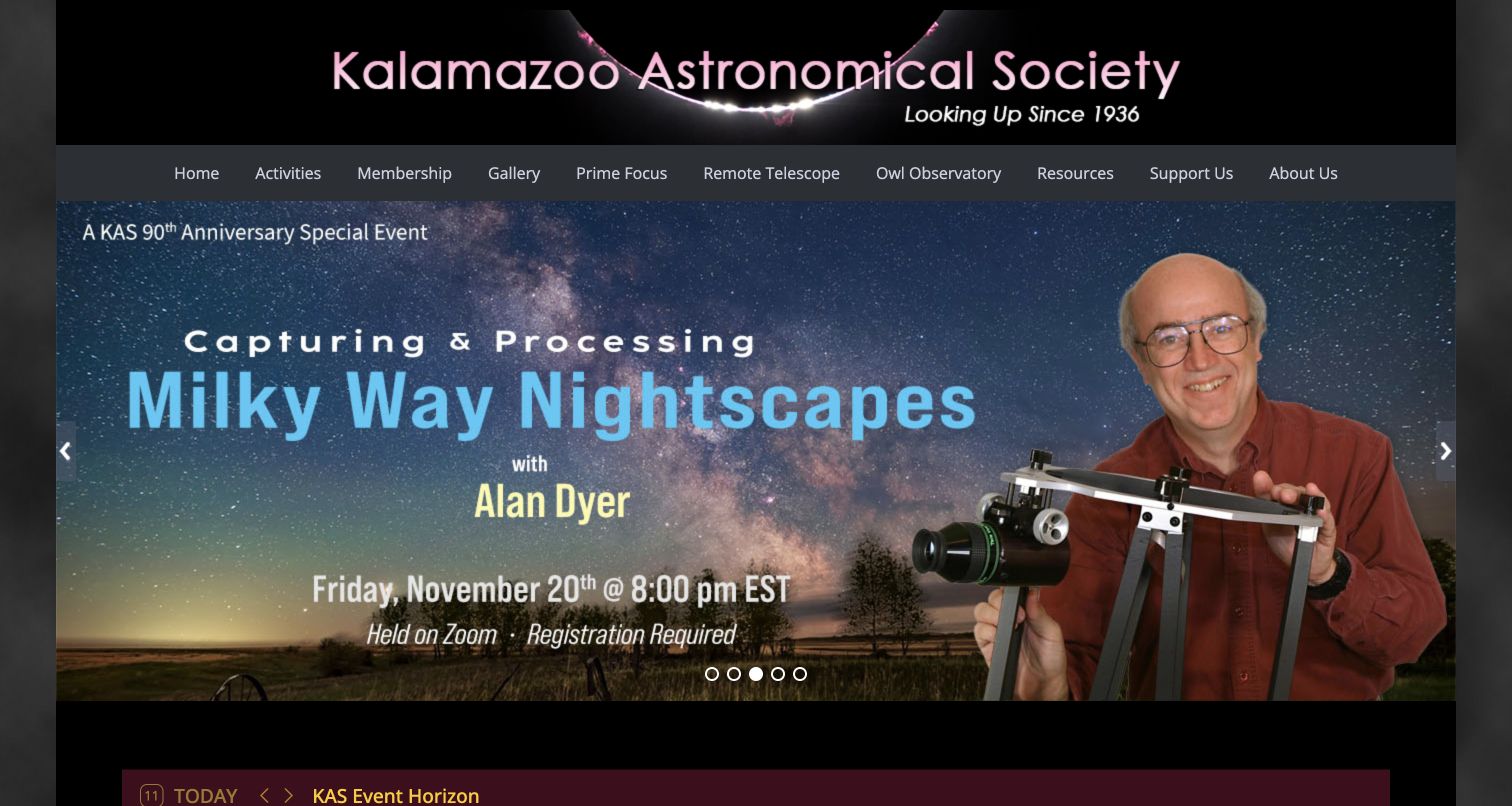
Kalamazoo Astronomical Society uses a large event carousel, then provides compact sections for a monthly star map, joining and general meetings. Its introduction explicitly says that technical knowledge and a telescope are not prerequisites. The menu also separates loan telescopes, a remote telescope and the observatory through topic-specific destinations. The design is traditional, but the copy lowers the perceived barrier to participation. A first-time visitor can see both an interesting talk and resources that make a first observing session feel more achievable.
What you can learn
Say clearly what a newcomer does not need to bring or know. Pair that reassurance with a small practical resource, such as a star map or loan-equipment explanation, rather than relying on a welcome slogan alone.
Pros
The introduction explicitly welcomes people without equipment or technical expertise.
Star maps and meeting information provide useful next steps.
Cons & considerations
Important event details are embedded in a carousel graphic.
Several menu categories require opening submenus to understand the available options.
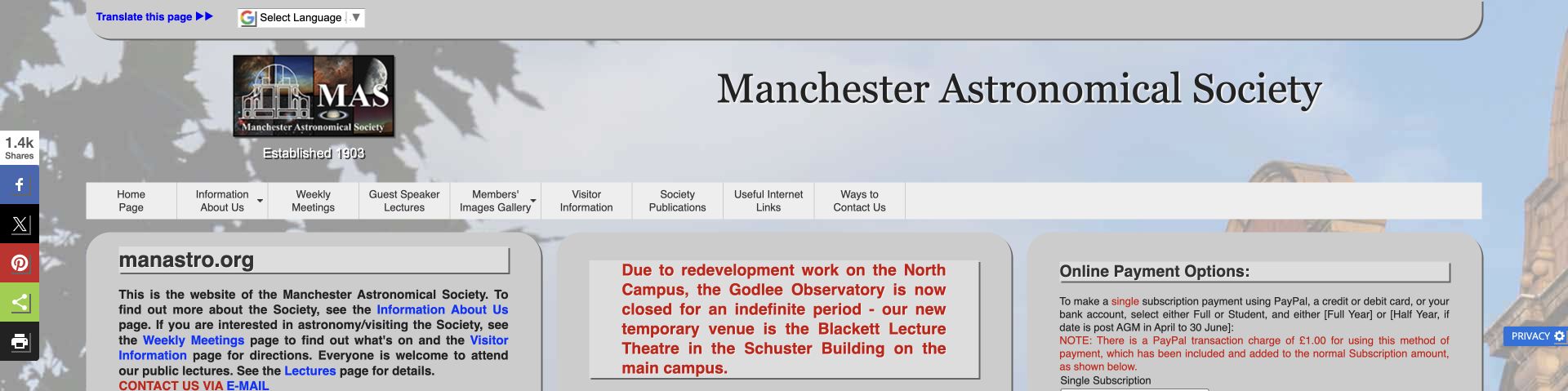
Manchester Astronomical Society presents a traditional multi-column homepage with explicit links for weekly meetings, guest lectures and visitor information. A prominent notice explains the closure of the former observatory venue and identifies the temporary meeting location. Membership payment information is visible in a separate column, while the welcome copy tells readers where to find public lectures. The layout is less polished than newer examples, but the specific operational notice is valuable. It demonstrates why accurate arrival guidance matters more than a decorative astronomy theme.
What you can learn
Treat venue disruption as a primary content update. Explain where to go now, link to directions, and keep that notice consistent across event and visitor pages before promoting membership.
Pros
The temporary venue is identified in a prominent notice.
Weekly meetings and public lectures have separate navigation labels.
Cons & considerations
Three text-heavy columns compete in the opening view.
Payment information is prominent before a new visitor has learned much about participation.
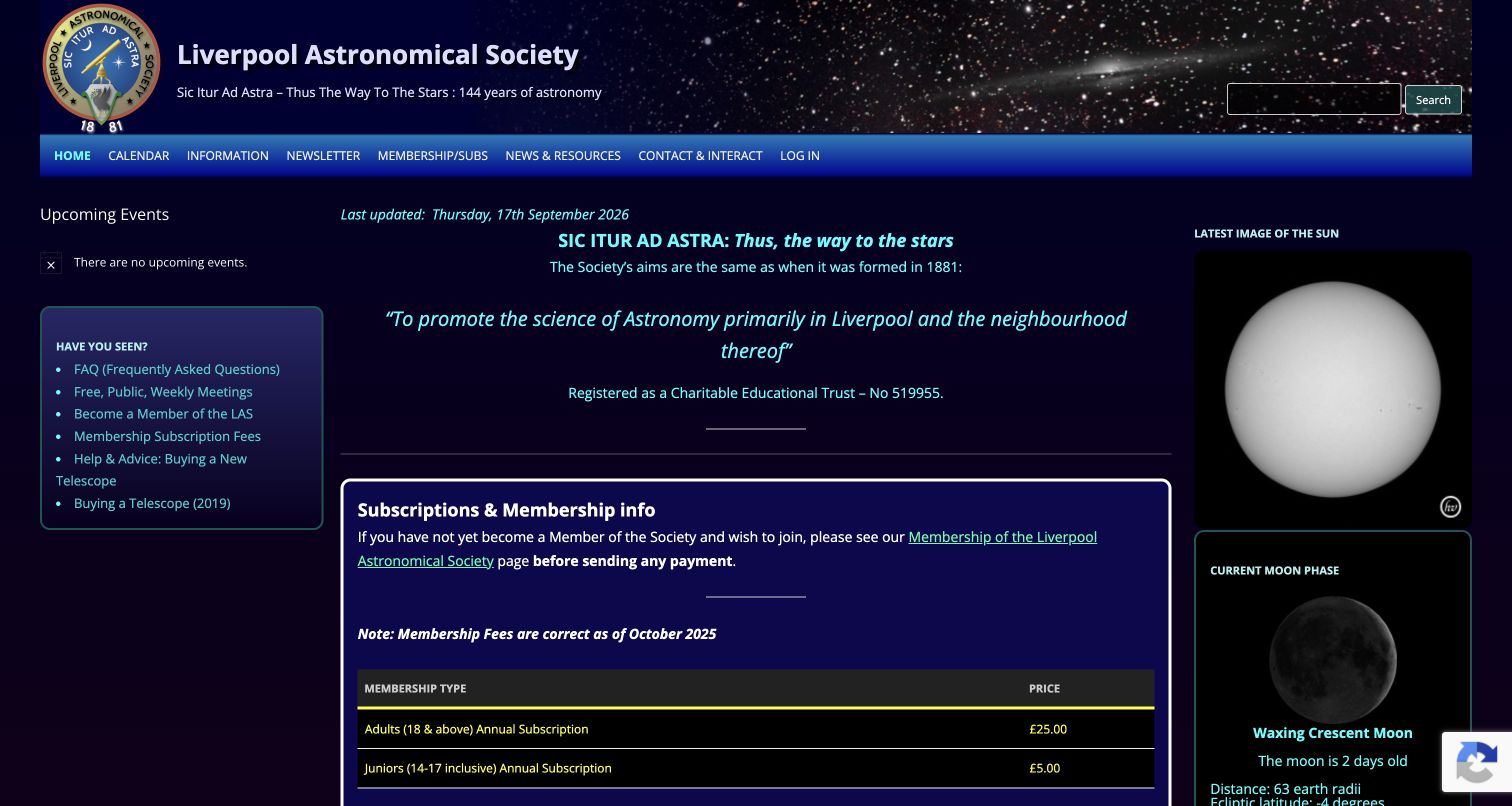
Liverpool Astronomical Society combines an established identity with a dense noticeboard layout. The main panel gives a mission statement and membership information, while sidebars expose FAQs, public weekly meetings, telescope advice and sky information. Subscription details are visibly dated, which helps distinguish a current statement from an undated promise. At the time reviewed, the upcoming-events panel had no entries, so the separate weekly-meeting link was especially important. The example shows the value of a useful fallback when a calendar does not supply an immediate next event.
What you can learn
Do not let an empty calendar become a dead end. Keep a plain explanation of regular meetings and a dated membership record available, with a clear way to confirm the next visit.
Pros
Public weekly meetings and practical FAQs are easy to locate in the sidebar.
Membership pricing is accompanied by a visible effective date.
Cons & considerations
The empty upcoming-events panel gives no immediate next date.
Multiple sidebars and long menus make the page visually crowded.
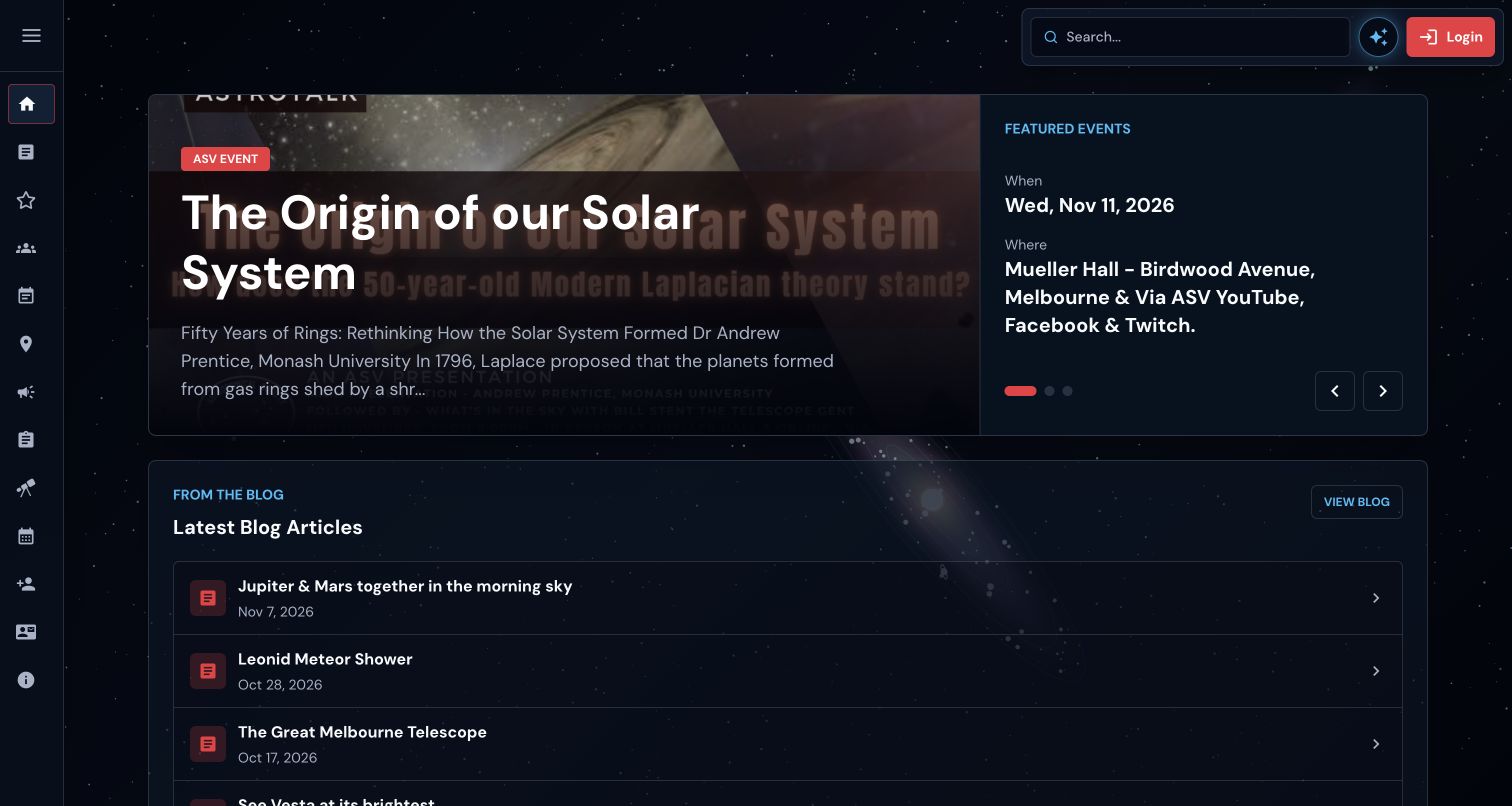
The Astronomical Society of Victoria uses a dark interface with a compact icon sidebar, search and a featured-event panel. The event separates its title and description from a clear When and Where column. A dated article list follows, then a fuller introduction explains facilities, specialist groups and equipment access. The approach gives a substantial organisation a coherent browsing shell. Its trade-off is discoverability: collapsed icons conserve space, but visitors unfamiliar with the society may need the expanded labels to understand the range of sections and services.
What you can learn
A compact interface still needs clear information labels. Structure event dates and locations separately from descriptive copy, and make the meaning of navigation icons available without guesswork.
Pros
Featured-event timing and location form a readable separate column.
Facilities and loan programmes are part of a consistent navigation system.
Cons & considerations
Collapsed sidebar icons can be ambiguous for first-time visitors.
Decorative space imagery needs careful contrast behind smaller text.
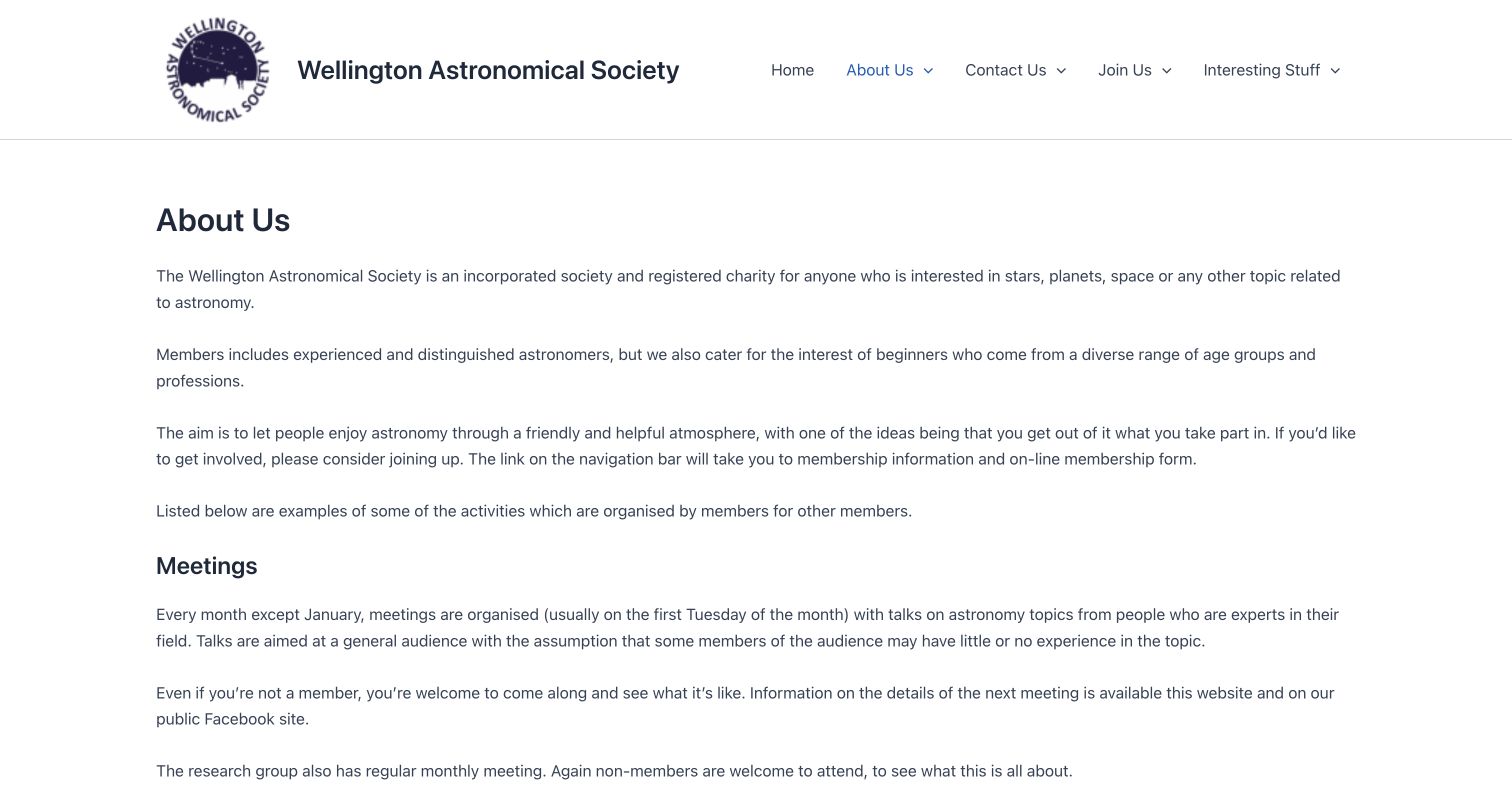
Wellington Astronomical Society's About page uses a simple white layout and readable headings for meetings, newsletters, observing and specialist groups. It explains that beginners are welcome and distinguishes general public participation from member-only dark-site activities. The page also describes the social and educational purpose of the group before discussing research interests. This is a quieter example than the image-led homepages, but it is useful for the questions a cautious newcomer may have. Its strength is explanatory copy; its limitation is a long reading path with few immediate event prompts.
What you can learn
Use an introduction page to answer who can attend and how activities differ. Plain explanations of public and member-only participation can prevent confusion that a calendar alone does not resolve.
Pros
The copy explicitly includes beginners and non-members in relevant activities.
Clear headings separate meetings, observing and research interests.
Cons & considerations
The long text page has little visual guidance toward a first action.
Visitors must move elsewhere to confirm current event dates.
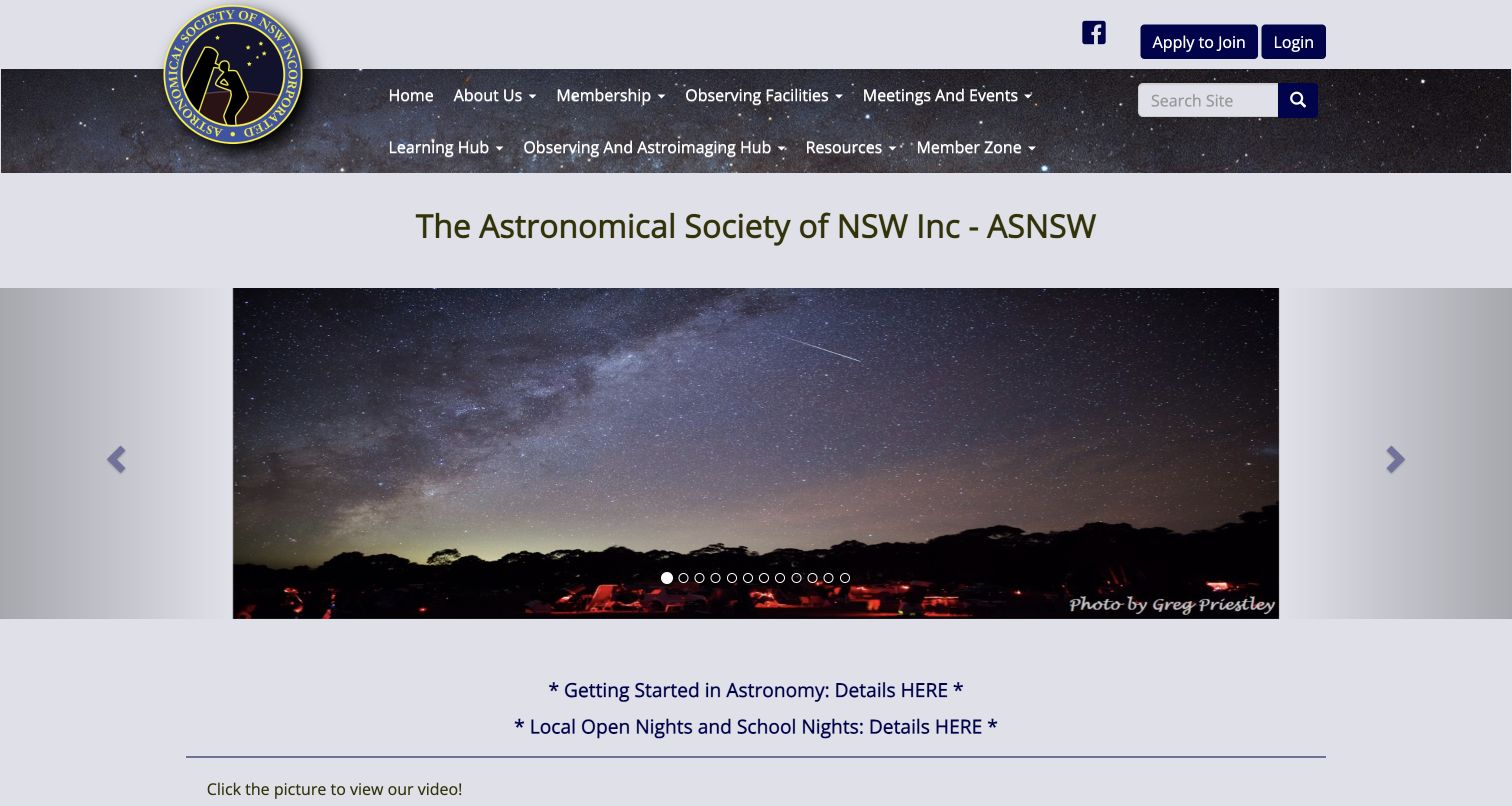
The New South Wales society opens with credited observing-site photography and two explicit links: getting started in astronomy and local open or school nights. Member benefits and regular events follow, with joining and login kept in a utility row. The menu separates a learning hub from observing and imaging resources, which is useful when the audience ranges from curious families to experienced observers. The homepage has substantial administrative content, but the early beginner and outreach links create a clearer entry than a purely member-focused dashboard would.
What you can learn
Put public entry points ahead of administrative reminders. A club can offer a sophisticated member system while still making beginner learning and public observing obvious from its homepage.
Pros
Getting-started and public-night links appear near the top.
Learning and imaging resources are organised as separate destinations.
Cons & considerations
Administrative events and publication deadlines can crowd the main feed.
Two rows of navigation require concise labels and careful smaller-screen treatment.
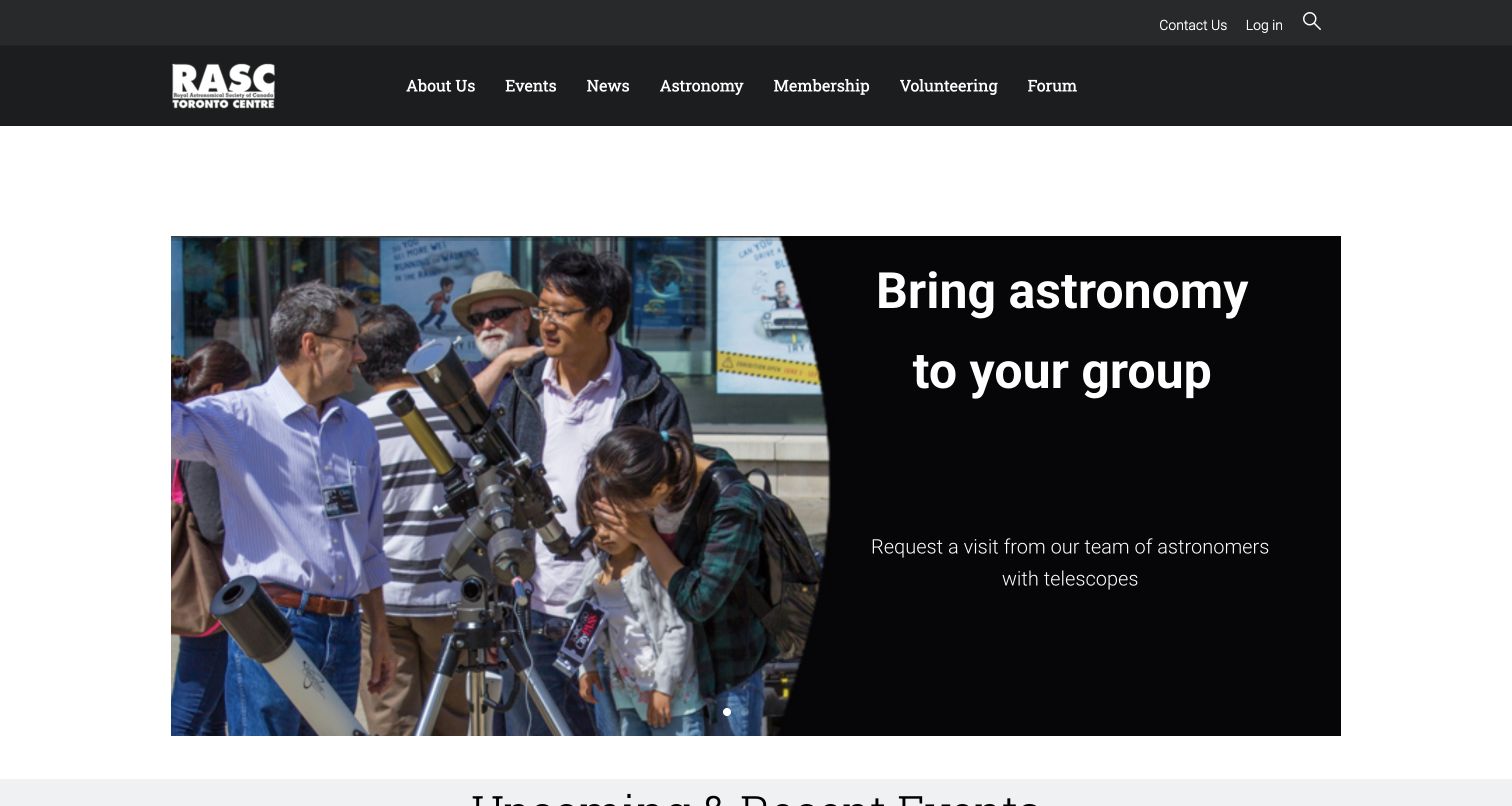
RASC Toronto Centre pairs photographs of people using telescopes with a straightforward invitation to bring astronomy to a group. Its main menu separates events, astronomy resources, membership and volunteering. Below the hero, upcoming and recent events have dates and short descriptions, followed by club news and a sky-tonight section. The page connects public outreach with ongoing member activity without making them identical. A visitor can understand the social purpose of the club, although event acronyms and a large image area still require supporting explanation.
What you can learn
Show the people who benefit from outreach, then connect that invitation to a clear event or request route. Keep volunteering and membership distinct so the visitor can choose an appropriate relationship.
Pros
Community photographs communicate the public-facing purpose of the club.
Event summaries explain the subject rather than listing dates alone.
Cons & considerations
Observatory acronyms need expansion for unfamiliar visitors.
The large hero leaves the next event below the opening screen.
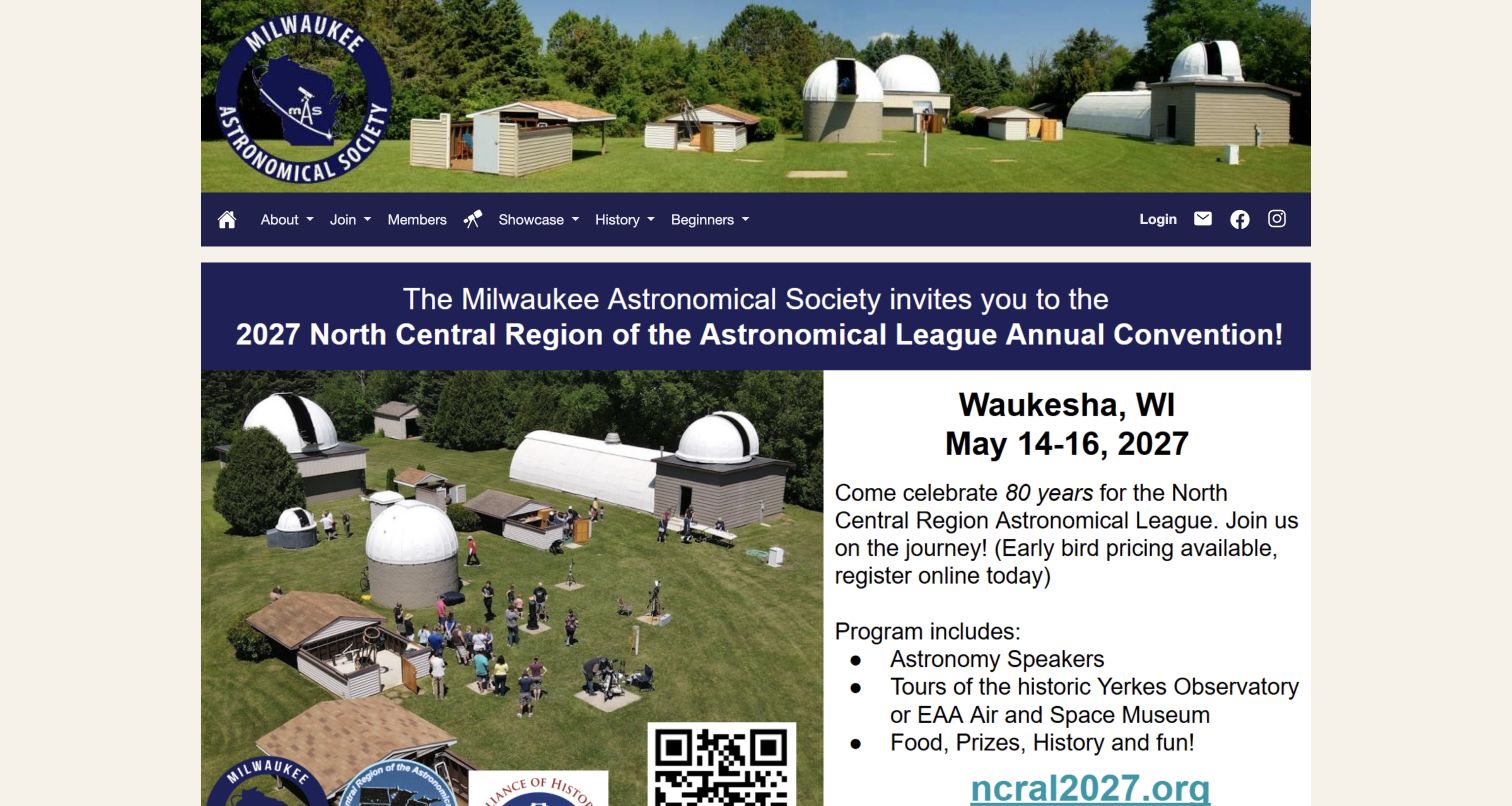
Milwaukee Astronomical Society uses a panorama of its observatory buildings in the header and a large convention promotion in the opening content. Farther down, public observing nights, a beginner's guide, member images and a loan-telescope programme make the facilities useful rather than merely decorative. The site gives an unusually concrete sense of place. Its breadth is helpful, but the oversized promotion can eclipse the simpler questions of when to visit and how a beginner can participate.
What you can learn
Use photographs of the actual observing site to explain the club's resources. Pair them with public access, directions and beginner guidance so the facilities are understandable before someone joins.
Pros
Real observatory imagery establishes a specific local setting.
Beginner guidance and telescope loans provide practical support.
Cons & considerations
The convention promotion dominates the first screen.
Long lists of galleries and historical material can dilute the next-visit message.
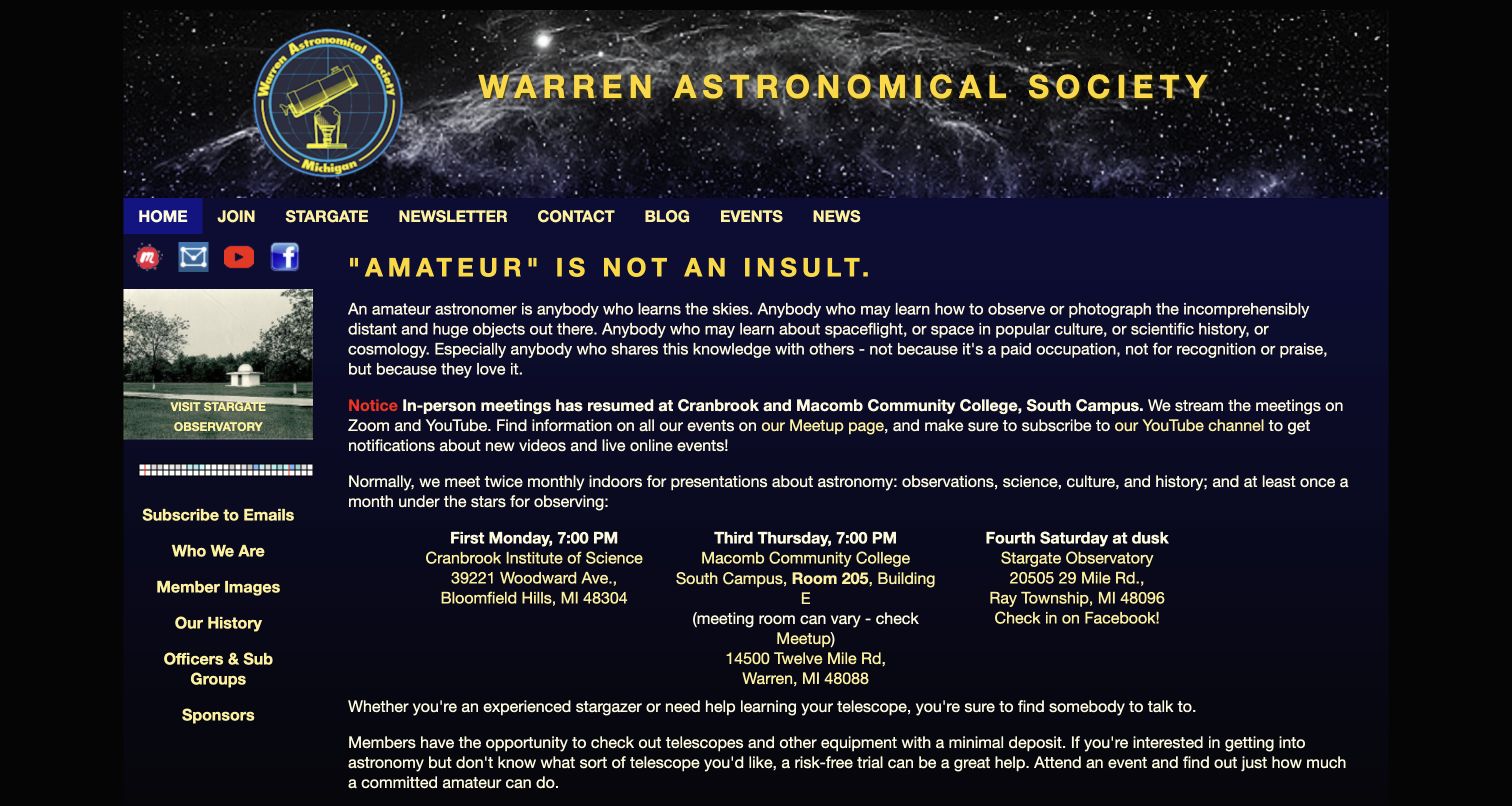
Warren Astronomical Society starts with a direct explanation of what being an amateur astronomer means, covering learning, observing and sharing rather than professional status. Three meeting blocks then supply recurring days, times and locations, with a separate observatory route and weather link. The copy also introduces equipment loans as a way to explore before buying. The dark design is dense, but its structure makes the social invitation tangible: a visitor can understand both why they belong and where they might meet the group.
What you can learn
Answer the emotional barrier as well as the logistical one. Reassure beginners that expertise is not required, then place the recurring meeting locations and equipment-help options close by.
Pros
The introduction defines participation broadly and inclusively.
Recurring meetings are grouped into clear location blocks.
Cons & considerations
Dense text and several side links compete for attention.
Current event confirmation depends partly on external social platforms.
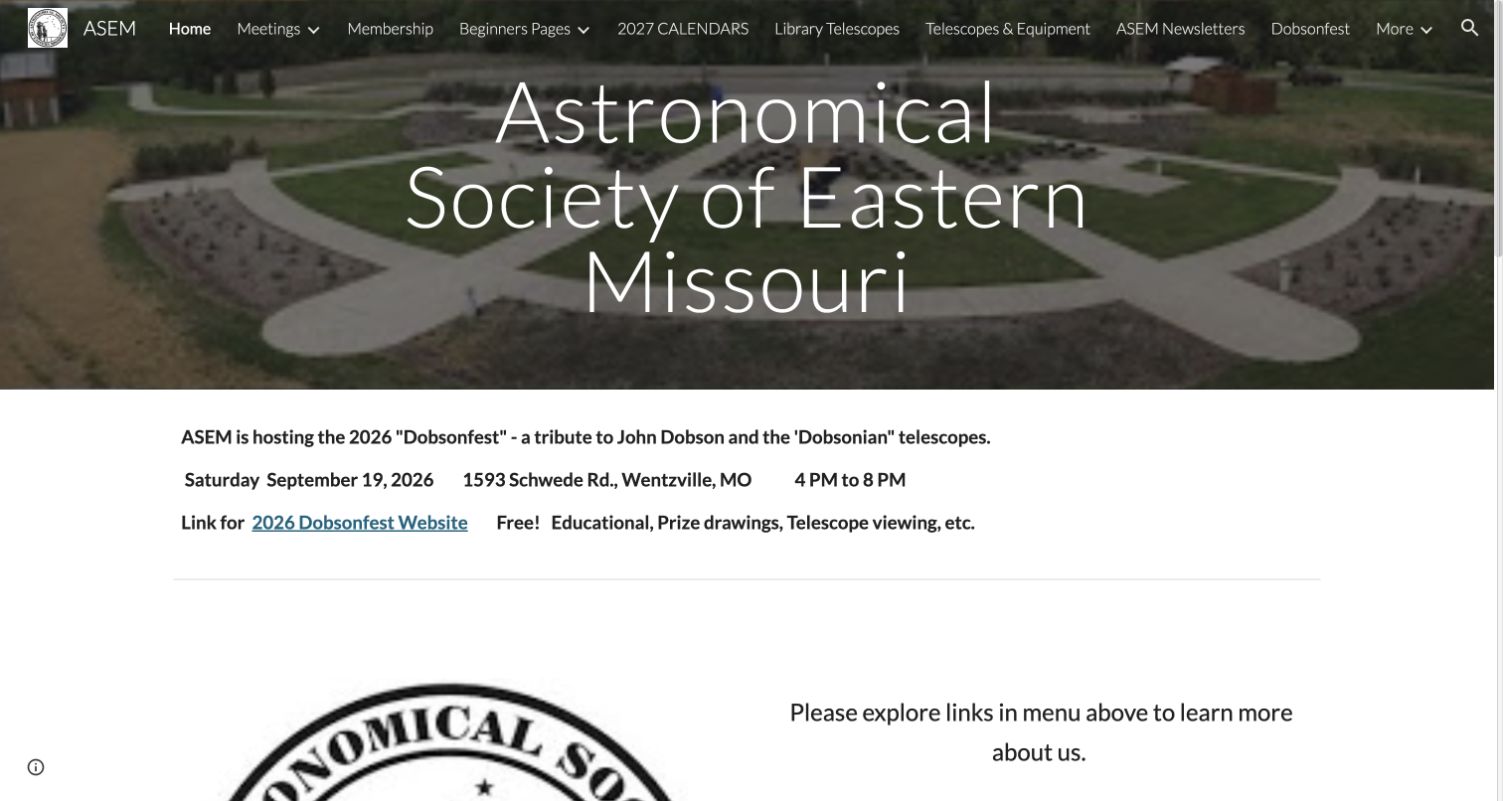
The Astronomical Society of Eastern Missouri uses a straightforward site shell and a prominent event notice above its introduction. The main text explains free public activities, a beginner meeting, digital-imaging sessions and Friday observing at a park astronomy area. Navigation exposes library telescopes and telescope-making material, making the club's practical focus visible. The captured page still leads with a past festival, which illustrates a maintenance issue worth avoiding. Its more durable strength is the specific explanation of what visitors can do throughout an ordinary month.
What you can learn
Separate durable participation guidance from temporary promotions. A past special event should not obscure the recurring open house, beginner session or equipment activity that remains available.
Pros
Public activities are described with recurring times and purposes.
Telescope loans and making provide concrete learning destinations.
Cons & considerations
A past festival remains prominent in the opening view.
The text-heavy introduction would benefit from a concise first-visit summary.
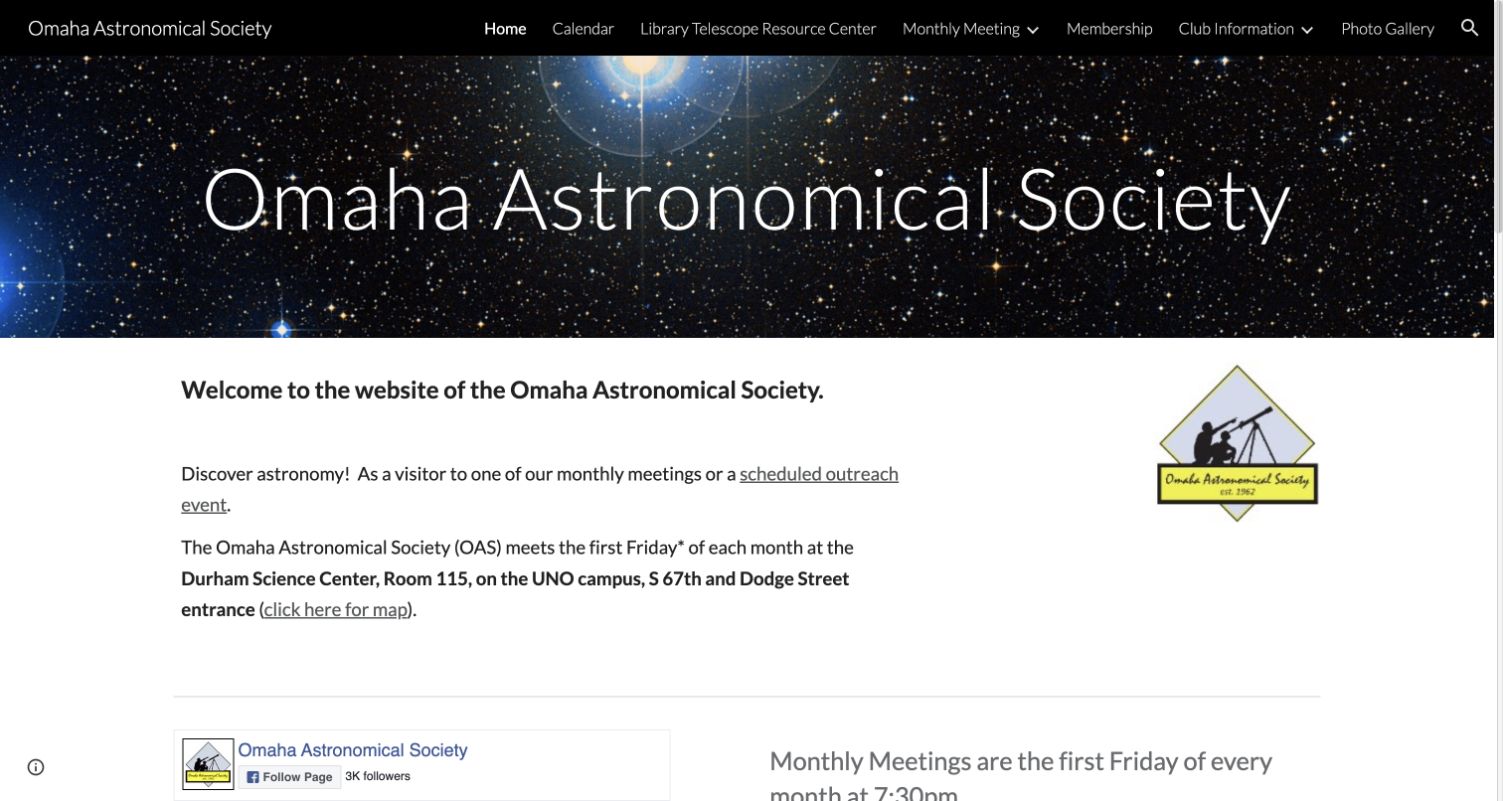
Omaha Astronomical Society keeps its main navigation focused on the calendar, monthly meeting, membership and a library telescope resource centre. The homepage welcome quickly gives the meeting venue and links to a map, rather than asking visitors to search through club history. A star-field header supplies identity without a complicated visual system. Embedded social and calendar material appears farther down. The structure is approachable, though repeated meeting details need consistency and important information should remain usable if those external embeds do not load.
What you can learn
A modest club site can be effective when it answers where, when and how to join in. Keep meeting details in one maintained record and use external embeds as support rather than the only source.
Pros
Meeting location and map access appear early.
The library telescope resource has a prominent navigation label.
Cons & considerations
Repeated venue details create extra maintenance work.
External social and calendar embeds may not be available to every visitor.
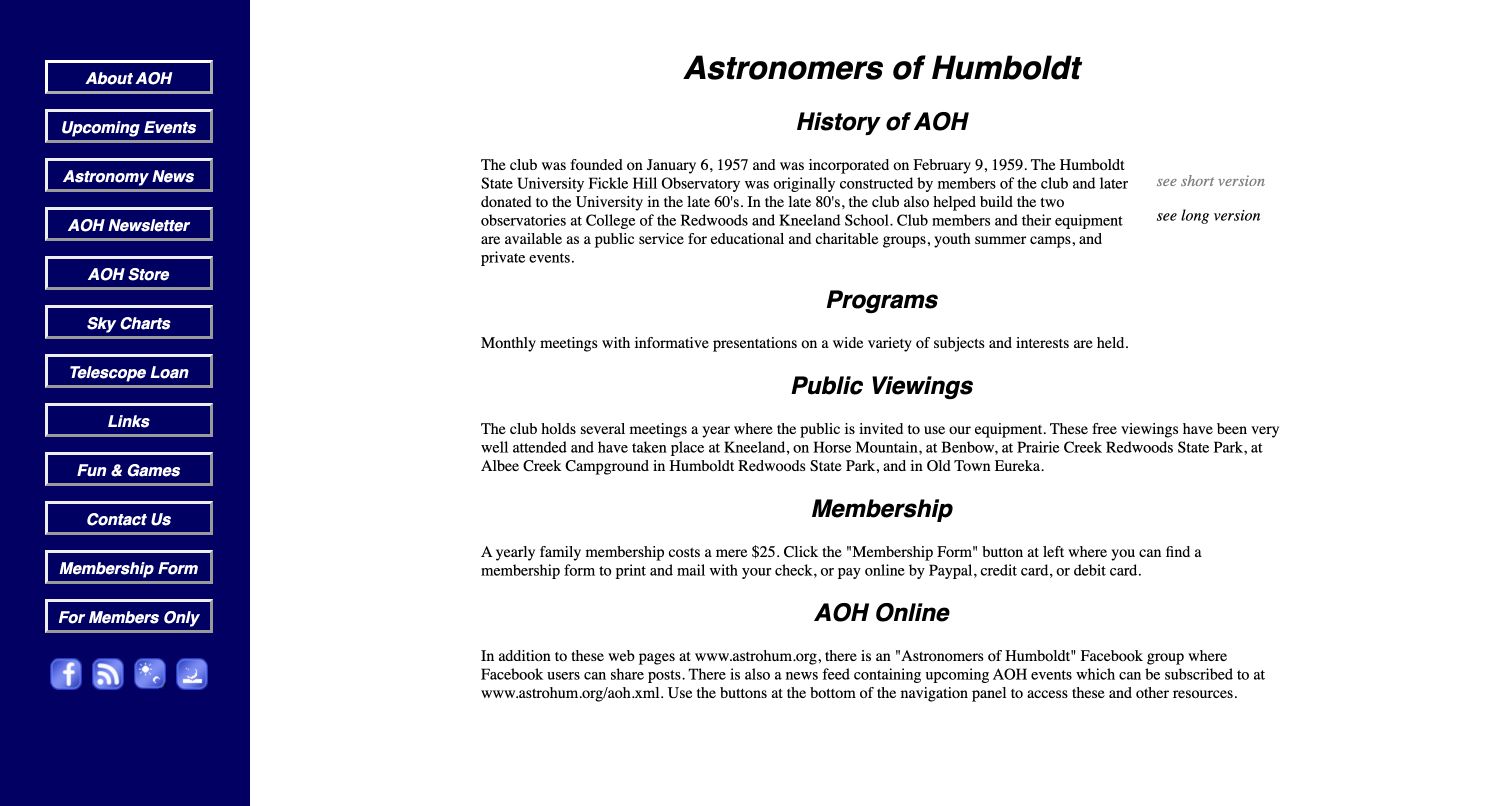
Astronomers of Humboldt's About page places plain headings for history, programmes, public viewing and membership beside a persistent vertical menu. The copy explains the club's local observing work and identifies public viewing as a distinct activity. Telescope Loan and Upcoming Events are visible alongside the membership route, so the page can support a practical next step even with minimal imagery. The design is utilitarian and visually dated, but the concise structure is a useful reminder that a club introduction does not need elaborate media to explain its purpose.
What you can learn
Start with a short, organised explanation of the club and keep practical destinations visible. Simple pages still need current dates and a clear hierarchy, even when the visual treatment is deliberately modest.
Pros
The page separates public viewing from general membership information.
Telescope lending and upcoming events remain visible in the side navigation.
Cons & considerations
The visual treatment offers little hierarchy beyond headings and the side menu.
The introduction supplies no immediate next event date.
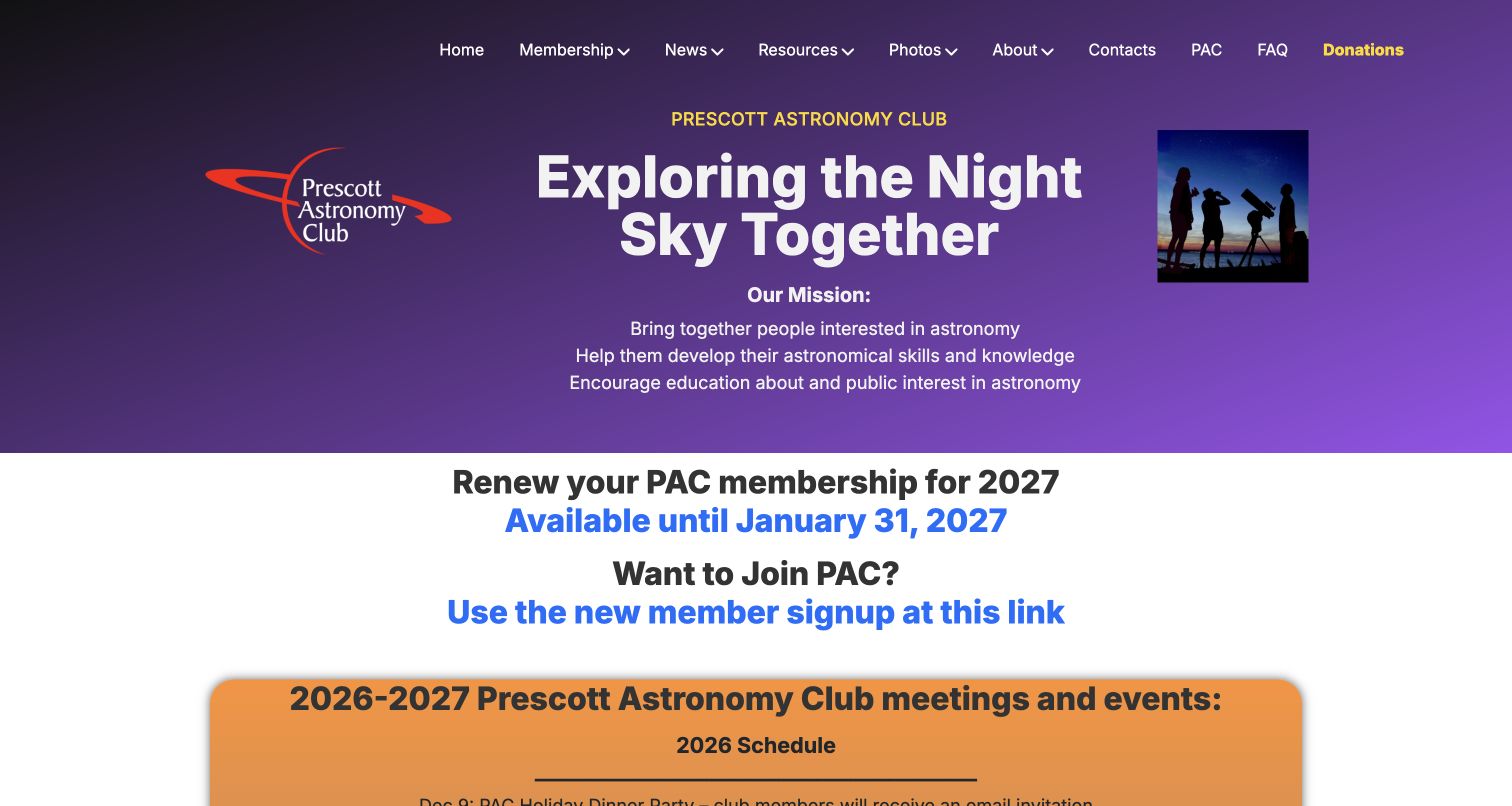
Prescott Astronomy Club uses a purple introduction with a short mission, followed by separate renewal and new-member links. A schedule then explains public meetings, member-only activities and weather-dependent observing. The page is particularly explicit about the difference between ordinary public meetings and a special members-only session. This makes membership status part of the information design instead of an unpleasant surprise at arrival. The large text and strong colour blocks make announcements conspicuous, though the page needs disciplined editing to keep its many notices easy to compare.
What you can learn
State participation rules at the event level. Distinguish public, member-only and weather-dependent activities, and keep new-member joining separate from renewal so each visitor follows the right path.
Pros
New membership and renewal are clearly different actions.
The schedule explains public access and weather cancellation expectations.
Cons & considerations
Large promotional text competes with the event schedule.
Several differently styled notices make the page harder to scan consistently.
Kegan is a freelance web designer and developer with 15+ years of experience helping businesses turn complicated website requirements into clear, maintainable digital experiences. He works directly with clients from planning and design through development, launch, and ongoing support.
For astronomy club website design, his development approach focuses on public observing events, beginner pathways, site access, equipment guidance and clear membership information. The scope can be a targeted improvement or a complete custom build, with responsive layouts, thoughtful content structure, and integrations chosen around the people using and maintaining the site.
Show 3 other astronomy club website designersHide other astronomy club website designers
Plan an astronomy club website around participation
Map the public and member journeys
List the tasks for a first-time visitor, a prospective member, an existing member, a school or community organiser, and a volunteer. Decide which tasks belong on the public site and which need private access. Give the homepage a small set of clear destinations, such as Attend an Event, New to Astronomy and Join, that match the club’s actual activities.
Define one reusable event record
Agree on fields for title, date, local time zone, venue, public or member status, booking requirements, access information, contact and cancellation updates. Let homepage cards and calendar views draw from that same record. This reduces the chance of a room number, meeting time or eligibility rule disagreeing across the site.
Prepare the first-visit explanation
Ask the volunteers who welcome visitors which questions recur. Explain arrival, where to check event status, any equipment expectations and how to request relevant access information. Refer visitors to the club’s approved observing and site rules rather than improvising technical instructions in promotional copy.
Make membership specific
Describe the real benefits, eligibility, fees and renewal process, with a clear distinction between activities open to everyone and benefits reserved for members. If equipment loans, observing sites or specialist groups are offered, link their current terms. Avoid implying that a membership automatically includes unrestricted access to every facility.
Assign ongoing editorial responsibility
Choose who maintains the calendar, checks venue changes, updates board contacts and archives old notices. Set a practical review schedule and a handover process for volunteer changes. A simpler system with clear ownership can serve a club better than an elaborate homepage that nobody can confidently update.
The editing job behind the design
Choose tools that volunteers can keep current
Start with the event and membership workflow. A club may need recurring events, public-versus-member labels, cancellation notices and a small number of trusted editors more than it needs custom visual effects. Keep event records independent of decorative homepage sections so a single correction reaches every relevant view.
Check how calendars, maps, video players and newsletter forms behave when third-party content is blocked or consent has not been granted. Provide readable dates, addresses and useful links outside an embed. Keep membership and payment integrations within their proper privacy and security boundaries, and do not publish private meeting credentials in public page content.
The technology labels in these examples come from bounded public-source audits. A blocked scan, oversized response or incomplete stylesheet read is not evidence of a hidden platform. Choose a maintainable publishing system based on your club’s editors, content and requirements rather than assuming that a visible technology on another site guarantees the same result.
Our WordPress website examples offer a separate look at publishing approaches. A visible platform label is evidence for that named page, not a guarantee that the same system will suit your requirements.
Before the public launch
Astronomy club website launch checklist
State the club’s location and purpose in text that a first-time visitor can understand.
Give beginners a visible route to a suitable introductory activity or explanation.
Show event dates, times, time zones, venues and public or member eligibility together.
Confirm that homepage announcements and calendar entries agree on meeting details.
Identify where visitors should check weather-related changes or cancellations before travelling.
Keep private member documents, meeting credentials and restricted site details out of public pages.
Explain membership fees, renewal and real benefits without implying access the club does not provide.
Provide readable event information when a calendar, map or video embed does not load.
Credit astronomy images and confirm permission for published photographs of participants.
Check navigation, event links, forms and controls with a keyboard and on smaller screens.
Archive expired notices and assign an editor to maintain upcoming events and contact details.
Check the live site’s event links, public documents and membership destinations after migration.
These checks are a project checklist, not a performance, legal, security, or accessibility certification. Test real journeys with the people responsible for the website before making claims about the result.
Sources & editorial method
How this collection was selected and reviewed
The industry target was drawn once before research and remains 26 distinct public website properties. Each example has a genuine browser screenshot and an original review based on the observed public page. All accepted captures were made on November 12 UTC during the November 11 Pacific editorial work date, with actual capture timestamps and dimensions retained. Several examples intentionally use a club’s About or events page rather than its root homepage; the exact source is recorded. Captures were inspected for popup obstruction, and held or unsuitable candidates were excluded without changing the saved target. Minnesota Astronomical Society was selected explicitly after reviewing its homepage and beginner pathway. Each accepted source received a bounded broad technology-audit attempt: 20 completed, one was partial and five were unavailable because of access or response limits. Those limits do not justify inferred technology claims. No memberships, accounts, payments, event registrations or contact forms were submitted, and the reviews do not assess club service quality, observing-site conditions or scientific outcomes.
Each example links to its actual source page. Screenshots are direct browser captures with their own capture dates; moving imagery, announcements and live designs can change. The notes describe observable design choices and conditional tradeoffs, not measured traffic, conversion results, service quality, or accessibility conformance.
Technology labels use public page metadata, asset evidence, or explicitly cited platform documentation. Platform documentation is not a complete current deployment audit. A component reference may be legacy or unused; it is not a complete backend inventory. Unknown stacks are omitted. These sites are editorial examples, not our client portfolio.
Written, Edited and Curated are separate editorial records, not timestamps advanced by a rebuild. Website designs and imagery belong to their owners. See our editorial standards or suggest a correction.
Questions worth asking
Astronomy Club website design questions
What should an astronomy club homepage show first?
Show where the club operates, who can participate and the next useful action. For many clubs that means a public event and a beginner introduction. Keep membership and current-member destinations easy to find, but do not require a newcomer to understand the organisation’s internal groups before learning how to attend.
How should public and members-only events be presented?
Use an explicit audience label on each event and explain any booking or membership requirement beside the date and venue. Public pages can describe member activities without exposing private directions or meeting credentials. Keep the detailed policy on a maintained page so it remains consistent wherever the event is listed.
Does the website need a large embedded calendar?
Not necessarily. A short, maintained list of upcoming events may be easier to use than a crowded calendar. If a calendar is useful, provide readable event details and direct links outside the embed so visitors can still find dates and venues when external content is blocked or unavailable.
How can a club make beginners feel welcome online?
Explain the first visit in plain language and state the club’s actual equipment and experience expectations. Link introductory events, frequently asked questions and an appropriate contact route. Minnesota Astronomical Society provides one example by connecting its beginner invitation to public events and first-star-party information.
How should cancellations and venue changes be handled?
Keep one authoritative event page or clearly identified update channel, and point every listing to it. Put a change notice beside the affected event, with its date and revised details. Archive old notices so a visitor does not mistake a past cancellation or previous venue for current information.
Do these examples establish which astronomy club is best?
No. The collection studies public website design, information structure and presentation. It does not rank observing facilities, membership experience or scientific expertise. Editors Choice identifies a researched website-design example, while the remaining reviews explain useful patterns and visible limitations.
Borrow the patterns that make participation clearer: a welcoming first step, dependable event details and a manageable publishing routine. Give the club’s real activities room to speak without making visitors work through unnecessary complexity.