Best CircleCI Websites of 2026 (20 Real-World Examples)
20 public website examples associated with documented CircleCI engineering, testing or deployment workflows, with practical lessons for delivery and design.
CircleCI helps teams automate work around software changes. The public websites in this collection provide design references, while separate official customer cases explain the supported engineering associations. Study both, without treating the screenshot as a diagram of the production system.
CircleCI is a continuous integration and delivery platform. Its jobs execute steps, and workflows organize jobs and their dependencies. A team can use that machinery to test an application, prepare a release or coordinate deployment while using entirely separate tools for content, hosting and the visible interface. A CircleCI association therefore does not identify a website’s CMS or current backend.
The opening examples are Eventbrite, Dollar Shave Club, Axios, Contentful and Greenhouse. Each has a specific official customer case, but the cases describe different scopes and periods. Some concern product engineering rather than the pictured marketing homepage; others name web publishing or tutorial workflows. Historical adoption dates and undated accounts stay qualified. Reading a public case in November 2026 is not evidence of a new private pipeline execution.
Before the examples
What makes good CircleCI website development in 2026?
Define what a successful change must prove
Start with the application or publishing task: a page must build, a search must return the intended results, or a release must use the expected artifact. Map those requirements to explicit checks and job dependencies. CircleCI workflows organize the order and conditions of jobs; a green status is meaningful only when the configured checks cover the behavior the team cares about.
Keep delivery evidence separate from interface evidence
A public homepage can show strong navigation and product explanation without exposing its deployment process. Record which company, application or named property the engineering case actually discusses. A product team’s use of CircleCI does not establish that its marketing site uses the same pipeline, and an older case does not prove the arrangement is unchanged today.
Give repeated work clear ownership
CircleCI orbs package reusable configuration for common processes and integrations. Reuse can make conventions easier to maintain, but the team still needs to understand what the selected configuration runs, who maintains it and how changes are reviewed. Treat shared automation as maintained software with a responsible owner, rather than an opaque shortcut copied from a prominent customer.
The screenshots support original observations about the visible public properties. The cited CircleCI cases support separate engineering, test or deployment associations. For example, DataSD’s case discusses the named open-data portal, while Greenhouse’s case concerns its recruiting application. That scope matters more than assuming every page from an organization shares one stack.
We start with five recognizable brands or organizations: Eventbrite, Dollar Shave Club, Axios, Contentful marketing website, Greenhouse marketing website. Each attribution applies to the named website property, not every product or website belonging to its organization. This is a curated reading sequence, not a measured ranking.
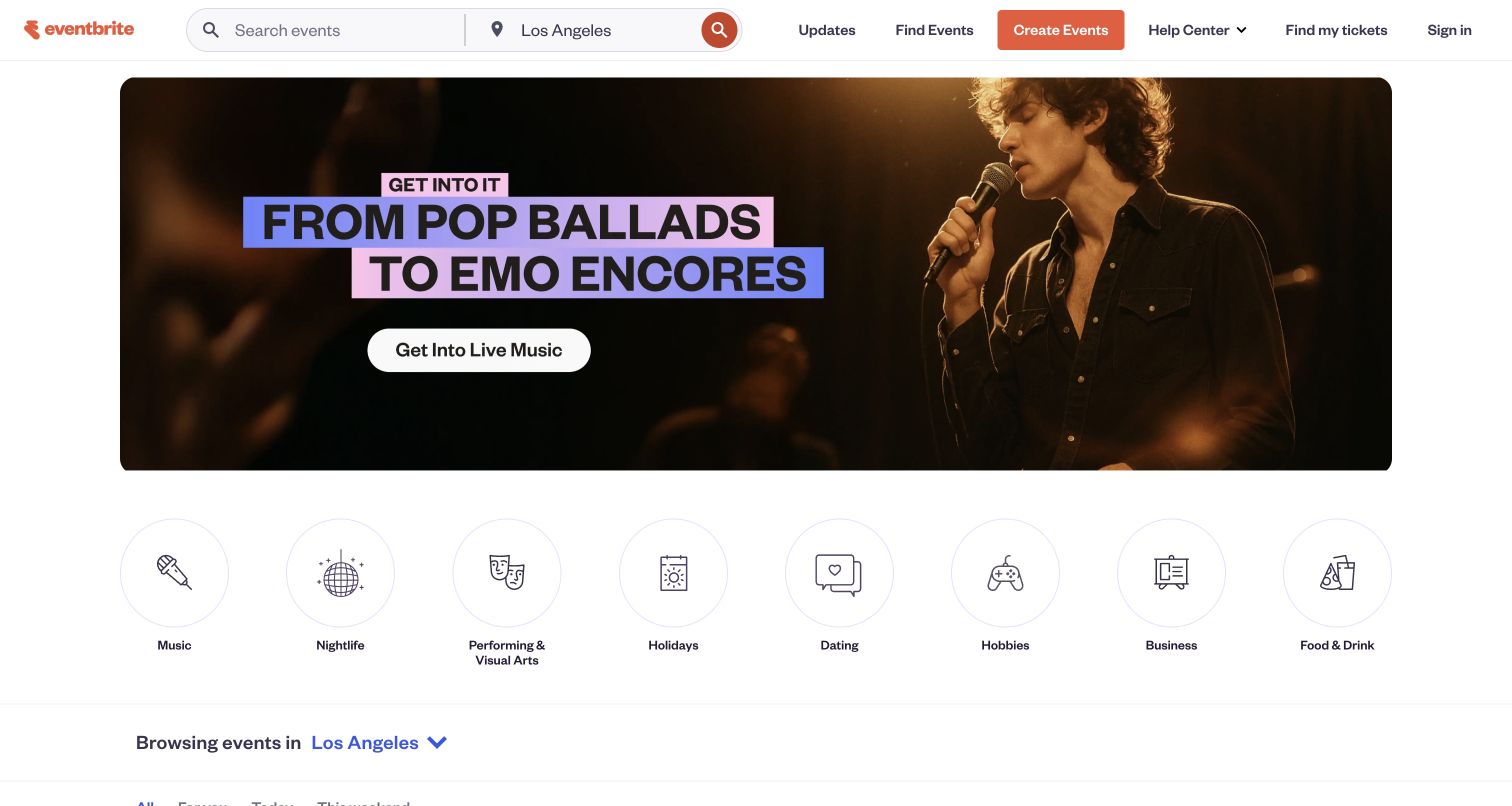
Eventbrite places location and search in the header, then gives a large concert photograph most of the opening screen. Bright type and a white action button make the seasonal promotion feel like an event poster rather than another search result. Circular category icons below restore a broader browsing route. The interface therefore serves visitors with an exact intent and those still looking for inspiration. CircleCI’s undated case documents Eventbrite engineering workflows and shared configuration; it does not establish the current homepage’s deployment pipeline.
What you can learn
Keep the dependable search entry separate from campaign artwork. A release pipeline can check that navigation, category links and search controls survive a promotional change, while editorial review considers whether the new message still fits the discovery experience. The campaign should never become the only way into the catalog.
Pros
Search and location remain visible above the campaign artwork.
Simple category icons offer a second route into a large catalog.
Cons & considerations
The oversized promotion delays individual event listings below the fold.
A location default needs an obvious way for visitors to change it.
Platform source: Official CircleCI customer case — qualified engineering workflow. Engineering organization’s build/test/deployment pipelines, config policies and private orbs. Public ticket-discovery homepage represents the documented product company; case does not identify its current CMS or prove every homepage request uses CircleCI. Undated case; no numeric year established in opened body. Documentary case read on November 10, 2026; this is not a current observation of private CI execution, a complete architecture inventory or a claim that CircleCI is the pictured page’s CMS/backend. Platform evidence is separate from the direct website screenshot and is not a complete current infrastructure audit.
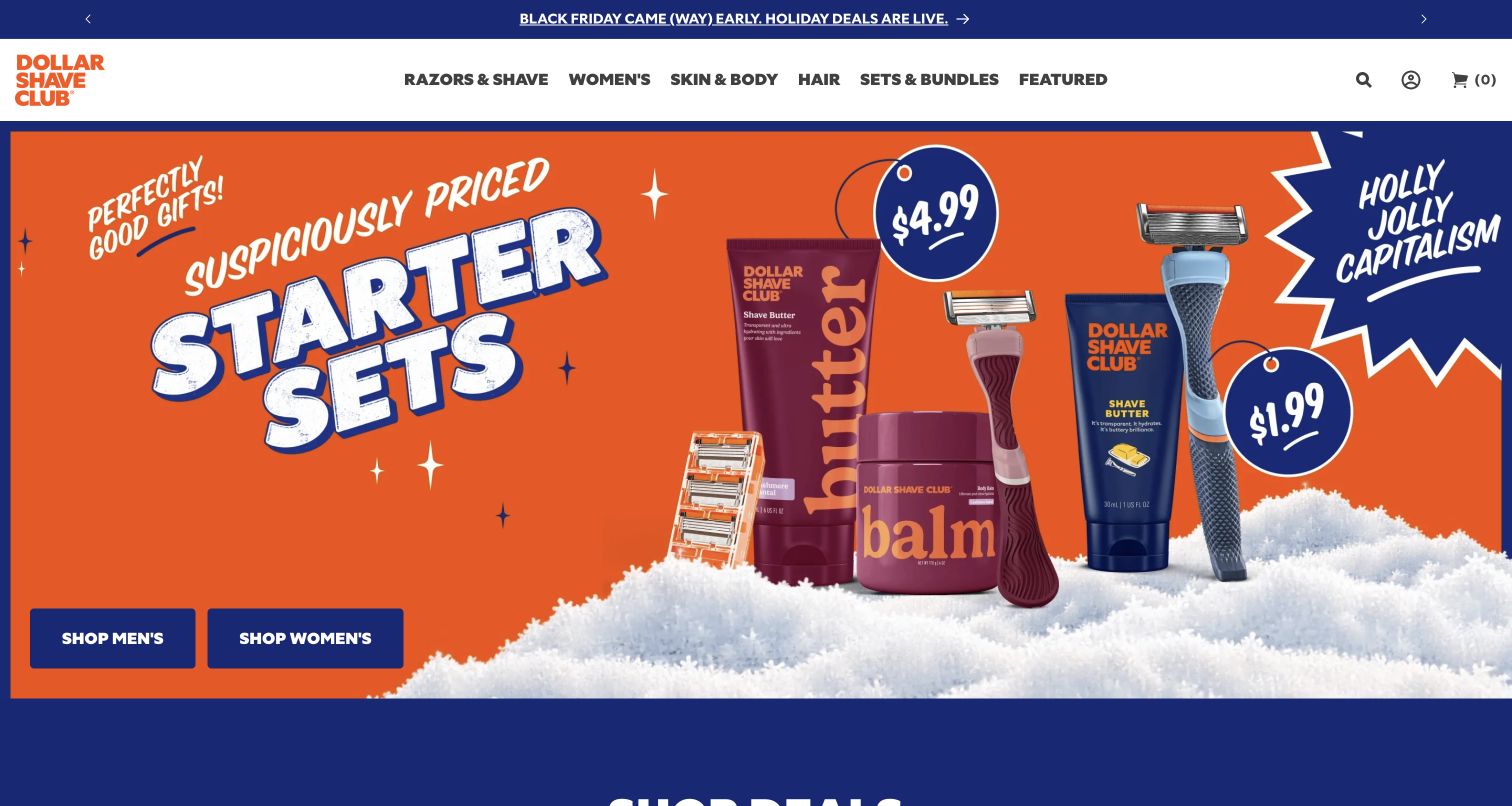
Dollar Shave Club’s US storefront combines a deep navy navigation bar with a vivid orange promotion. Razors and care products sit beside oversized, deliberately angled lettering, making the bundle itself part of the graphic composition. Two dark buttons separate the main shopping paths before visitors encounter a product grid. The tone is informal, but the immediate choice is clear. CircleCI’s case describes adoption at the end of 2014 for web and iOS delivery; that historical account is separate from this current storefront.
What you can learn
Treat seasonal graphics as replaceable content around stable shopping controls. Check the destination of each category action and the readability of promotional copy at common widths. A documented delivery tool can explain an engineering practice, but it cannot prove the price, availability or checkout behavior shown in a later screenshot.
Pros
Product photography makes the offer concrete before visitors start browsing.
Strong button contrast separates the shopping actions from decorative typography.
Cons & considerations
Dense promotional lettering competes with several price and offer messages.
A seasonal composition needs timely replacement when the campaign expires.
Platform source: Official CircleCI customer case — qualified engineering workflow. Historical web/iOS testing and deployment for the grooming subscription business. Case names the legacy www domain, which currently redirects to the US storefront. Do not claim the current storefront’s delivery pipeline is still the 2014 implementation. Case explicitly says adoption at end of 2014; treat as historical documentary evidence. Documentary case read on November 10, 2026; this is not a current observation of private CI execution, a complete architecture inventory or a claim that CircleCI is the pictured page’s CMS/backend. Platform evidence is separate from the direct website screenshot and is not a complete current infrastructure audit.
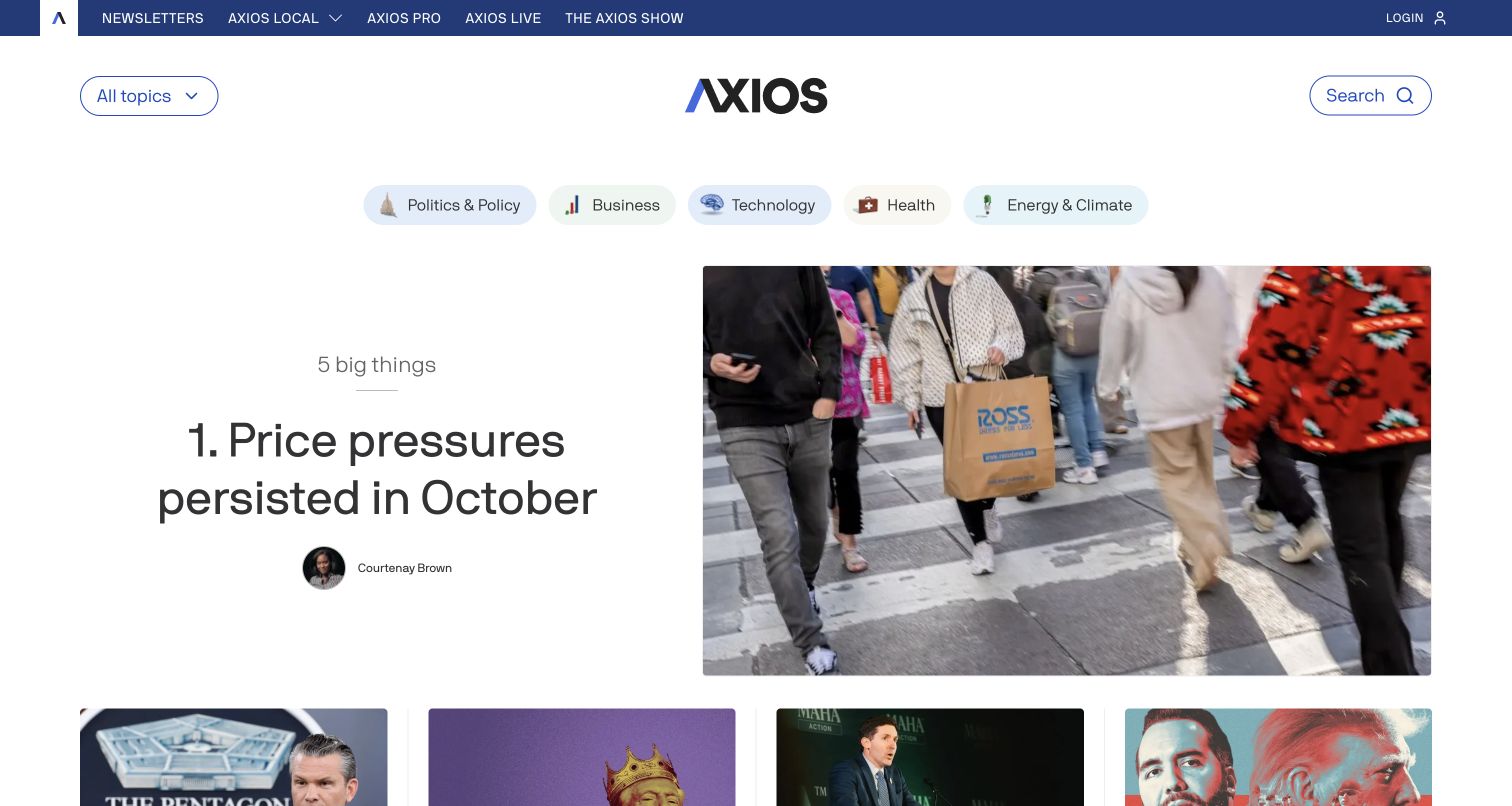
Axios uses a compact dark utility bar above a generous white masthead. Its centered wordmark sits between practical navigation controls, while small topic pills create a second layer of discovery. The lead story pairs a large headline and author information with a broad photograph; smaller story cards form the next level below. Spacing, scale and alignment establish the order before a reader examines the headlines. CircleCI’s pandemic-era customer account describes standardized engineering workflows across websites and applications, without verifying today’s marketing or publishing infrastructure.
What you can learn
Build publishing checks around the hierarchy that readers actually use: headline links, author context, image alternatives and topic routes. Frequent editorial changes should not break those relationships. Keep the technical case’s historical scope explicit, and assess the captured news layout without turning its changing headlines into evergreen factual claims.
Pros
The lead story is distinct from supporting stories without excessive decoration.
Topic pills provide compact access to recurring editorial interests.
Cons & considerations
Several navigation layers can require extra scanning before the first article.
Wide headline blocks need careful wrapping when long stories replace short ones.
Visible tech stack
Earlier / documented evidence
CircleCI
Platform source: Official CircleCI customer case — qualified engineering workflow. Documented deployment workflow across Axios.com, newsletters, mobile, Pro and HQ. Count only the public Axios news property, not separate subdivisions. Current backend/CMS is not established by the case. Undated pandemic-era account; no publication year verified. Documentary case read on November 10, 2026; this is not a current observation of private CI execution, a complete architecture inventory or a claim that CircleCI is the pictured page’s CMS/backend. Platform evidence is separate from the direct website screenshot and is not a complete current infrastructure audit.
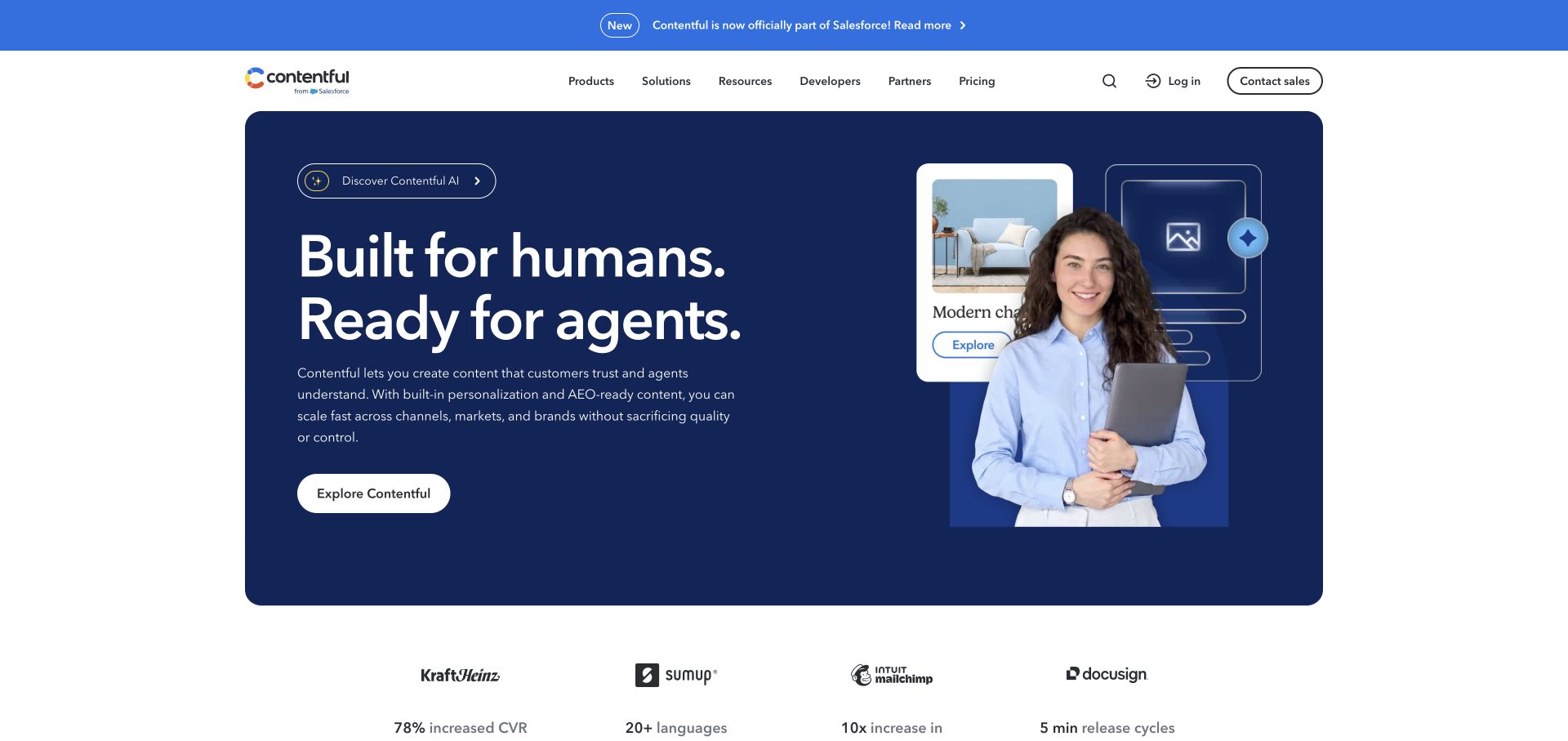
Contentful’s retained homepage capture uses a rounded navy hero within a white page. A large statement and product action occupy the left, while a person and layered content cards give the right side a human focal point. Product, solution, developer and partner navigation separates different visitor needs. Customer references beneath the hero move the story toward evidence. CircleCI’s case describes Contentful’s 2015 switch and platform microservice workflows; this public marketing property is distinct from the application and its internal engineering environment.
What you can learn
Design reusable hero, proof and audience-navigation components so editorial teams can change a story without rearranging the entire site. Delivery checks can exercise links and component states, while an independent preview confirms the intended content. Preserve the date of a retained image instead of presenting an older composition as freshly captured.
Pros
The bounded dark hero makes the introductory story easy to locate.
Distinct audience routes keep developer information near commercial product material.
Cons & considerations
An expansive headline still needs concrete product explanation farther down.
Multiple audience groups require discipline to keep navigation from becoming crowded.
Platform source: Official CircleCI customer case — qualified engineering workflow. Product engineering, microservices, tests and deployments for Contentful’s application platform. Retained marketing homepage is a public product presentation; its current CMS/backend cannot be inferred from this workflow case. Adoption 2015; case describes nine years since 2013 founding, but inferred year is not a verified publication date. Documentary case read on November 10, 2026; this is not a current observation of private CI execution, a complete architecture inventory or a claim that CircleCI is the pictured page’s CMS/backend. Platform evidence is separate from the direct website screenshot and is not a complete current infrastructure audit.
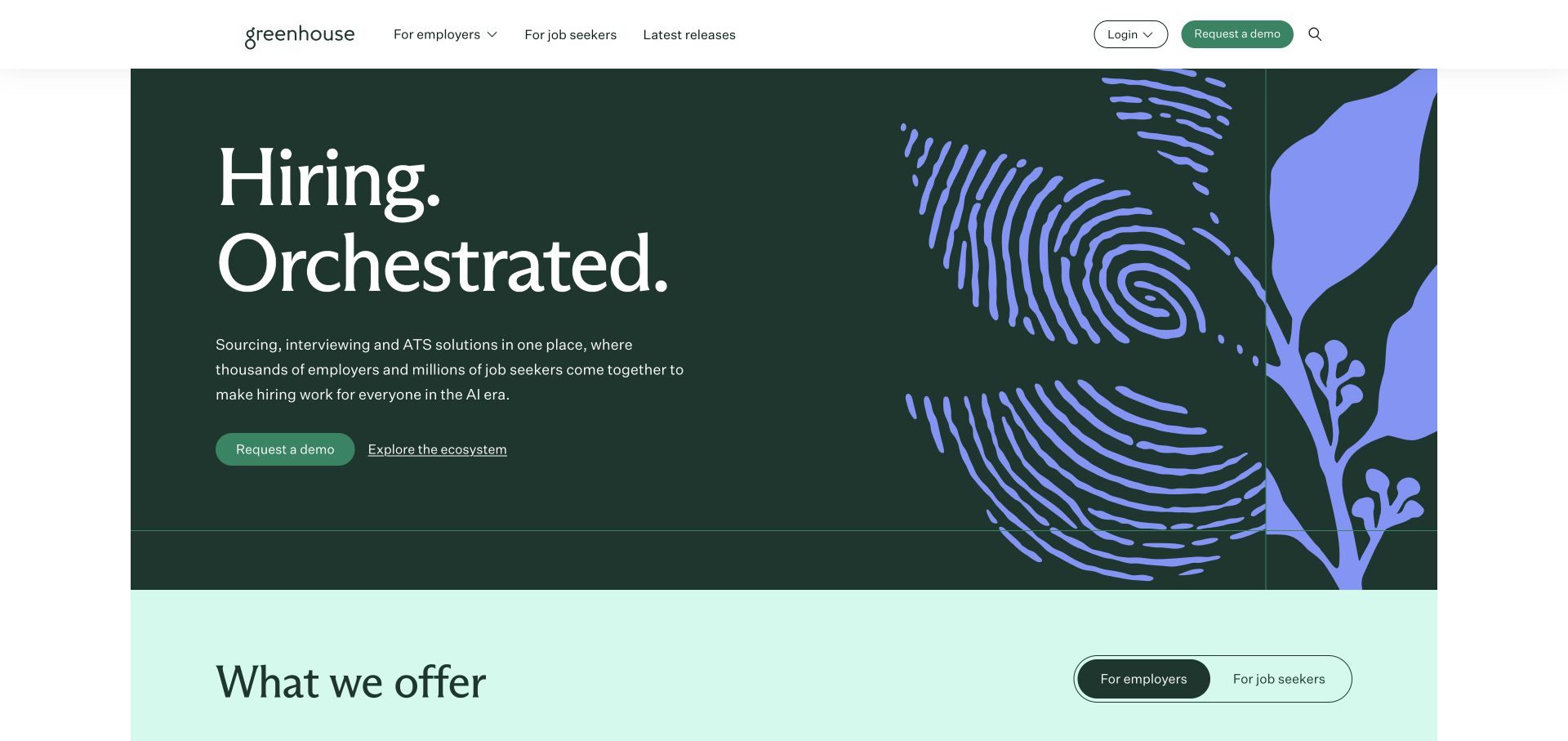
Greenhouse’s retained marketing page balances a dark green field and oversized white serif headline against a pale purple identity illustration. The fingerprint-like artwork supplies a memorable visual device without filling the hero with dashboard detail. A solid demo button and quieter product link establish different levels of commitment. Navigation names employers and job seekers, and the next section continues that audience split. CircleCI’s case documents a 2019 move for the recruiting application’s tests and releases; the pictured marketing website remains a separate public property.
What you can learn
Use audience distinctions as a structural contract throughout navigation, introductory copy and subsequent sections. Automated checks can protect the destinations and interactive states as marketing changes. Do not infer that a marketing CMS controls the recruiting application, or that a historical application pipeline describes every page now carrying the same brand.
Pros
The illustration creates a recognizable identity without overwhelming the copy.
Employer and job-seeker routes acknowledge clearly different visitor tasks.
Cons & considerations
Abstract artwork provides less immediate product detail than a focused interface example.
The demo route may be too large a first step for exploratory visitors.
Platform source: Official CircleCI customer case — qualified engineering workflow. Hiring application’s test/build/release process, including its monolithic recruiting application. The public marketing homepage is separately documented as Webflow in retained research; CircleCI is an engineering-workflow association, not its CMS. Adoption 2019; exact case publication date not displayed. Documentary case read on November 10, 2026; this is not a current observation of private CI execution, a complete architecture inventory or a claim that CircleCI is the pictured page’s CMS/backend. Platform evidence is separate from the direct website screenshot and is not a complete current infrastructure audit.
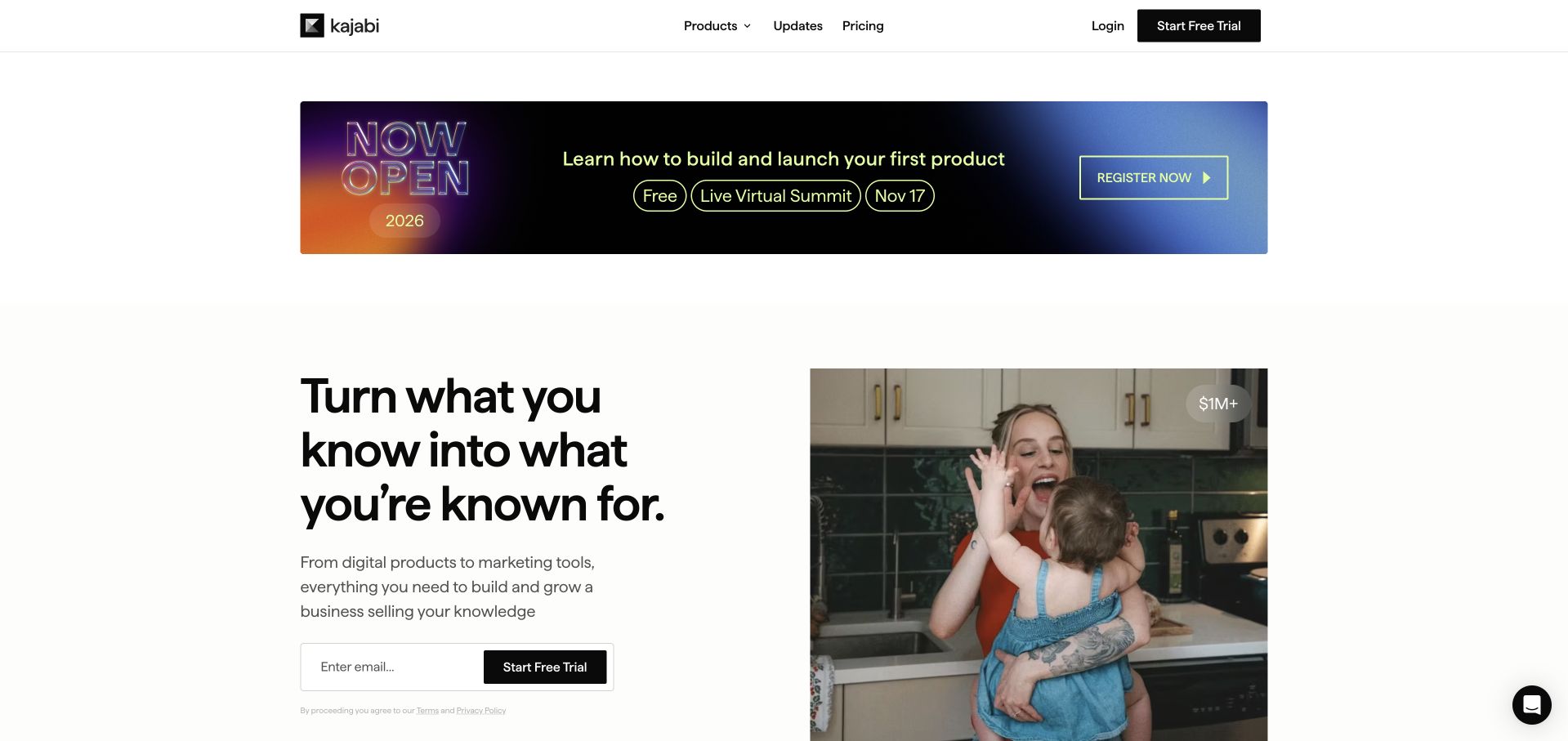
Kajabi’s retained homepage opens with a prominent event announcement above its main product story. Large black text on the left describes a creator identity, while a warm domestic photograph on the right makes the proposition personal. An email trial entry sits directly below the explanation. The composition favors the person building a business over a dense application screenshot. CircleCI’s undated case describes Kajabi returning after a year with another delivery provider and running multiple test suites; it does not identify the pictured marketing page’s current pipeline.
What you can learn
Keep a campaign announcement and an evergreen product introduction independently maintainable. Release checks should cover the trial entry’s labels and destination without creating real accounts or submitting visitor data. A personal photograph can support the brand story, but buyers still need product details and terms before committing to a service.
Pros
Human photography gives the product proposition an approachable context.
The introductory copy leads naturally to a visible trial entry.
Cons & considerations
The large announcement pushes the main product explanation farther down.
Lifestyle imagery alone cannot demonstrate the actual editing or selling workflow.
Platform source: Official CircleCI customer case — qualified engineering workflow. Kajabi platform’s multi-suite testing and production delivery; return after a year using Harness. Does not establish a CircleCI runtime on the pictured marketing homepage. Undated case; relative one-year migration interval only. Documentary case read on November 10, 2026; this is not a current observation of private CI execution, a complete architecture inventory or a claim that CircleCI is the pictured page’s CMS/backend. Platform evidence is separate from the direct website screenshot and is not a complete current infrastructure audit.
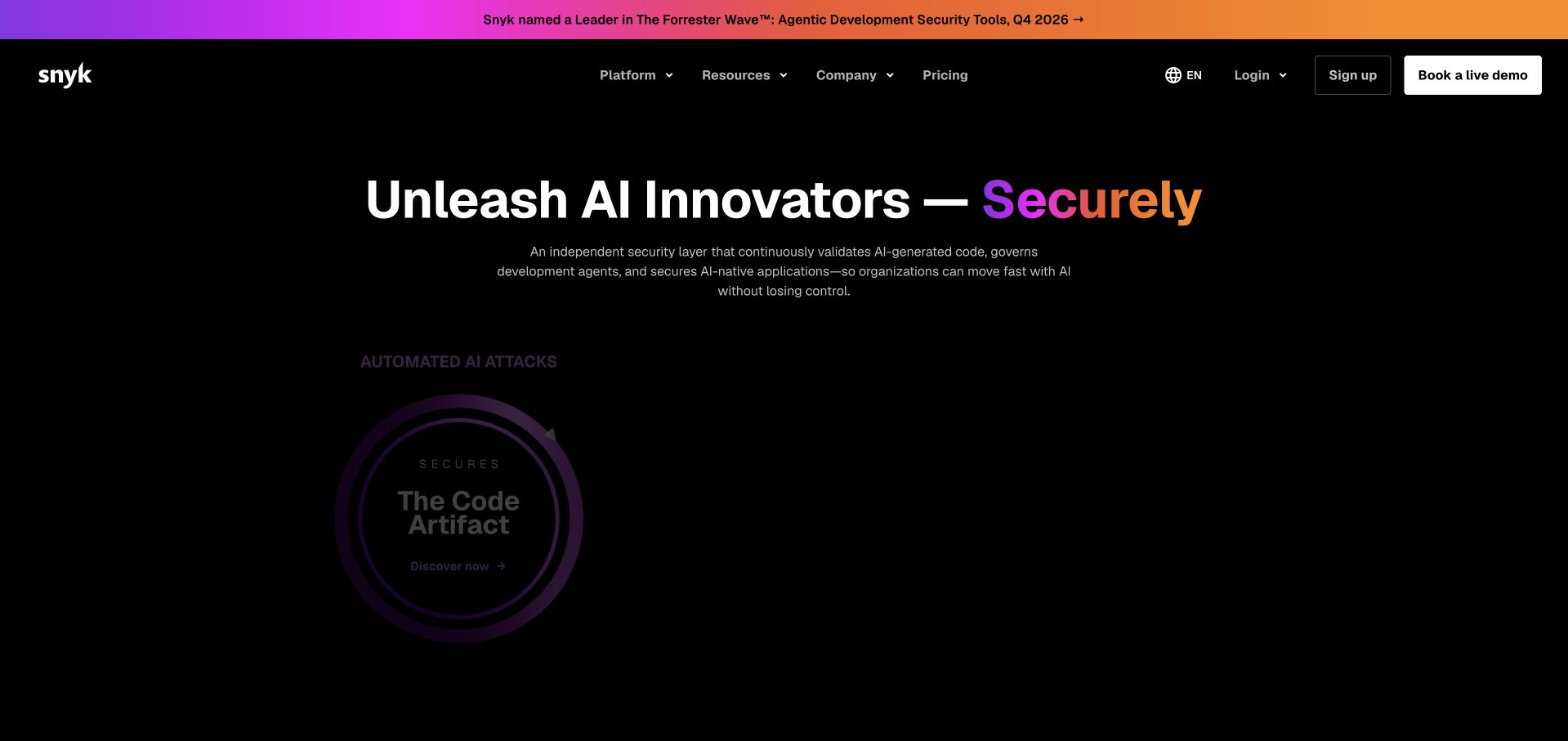
Snyk’s retained homepage places a bright announcement strip above a black navigation and hero. A large centered headline mixes white lettering with a colored accent, while a quieter paragraph carries the broader platform explanation. Signup and demo actions remain visible in the header. A dark diagram begins beneath the introductory copy, suggesting technical depth without becoming the first reading task. CircleCI’s undated customer account concerns Snyk’s own testing and deployment practices, including an internal orb; this is more specific than merely listing a public integration.
What you can learn
Separate an expressive introductory message from the detailed explanation developers need to evaluate a tool. Protect the entry routes and documentation links in automated releases. Keep evidence about internal engineering separate from the public website’s visual stack, and avoid presenting the case’s reported outcomes as measurements of the captured page.
Pros
A concise set of header actions supports two different commitment levels.
The dark visual system gives the main headline a strong focal point.
Cons & considerations
The lower diagram is difficult to distinguish against its dark background.
Broad platform language requires clearer concrete examples deeper in the journey.
Platform source: Official CircleCI customer case — qualified engineering workflow. Snyk product engineering’s testing and internal deployment orb. Distinguish Snyk’s own use from the separate public Snyk integration orb; do not infer marketing-site backend. Undated documentary account; no claim of live CI access. Documentary case read on November 10, 2026; this is not a current observation of private CI execution, a complete architecture inventory or a claim that CircleCI is the pictured page’s CMS/backend. Platform evidence is separate from the direct website screenshot and is not a complete current infrastructure audit.
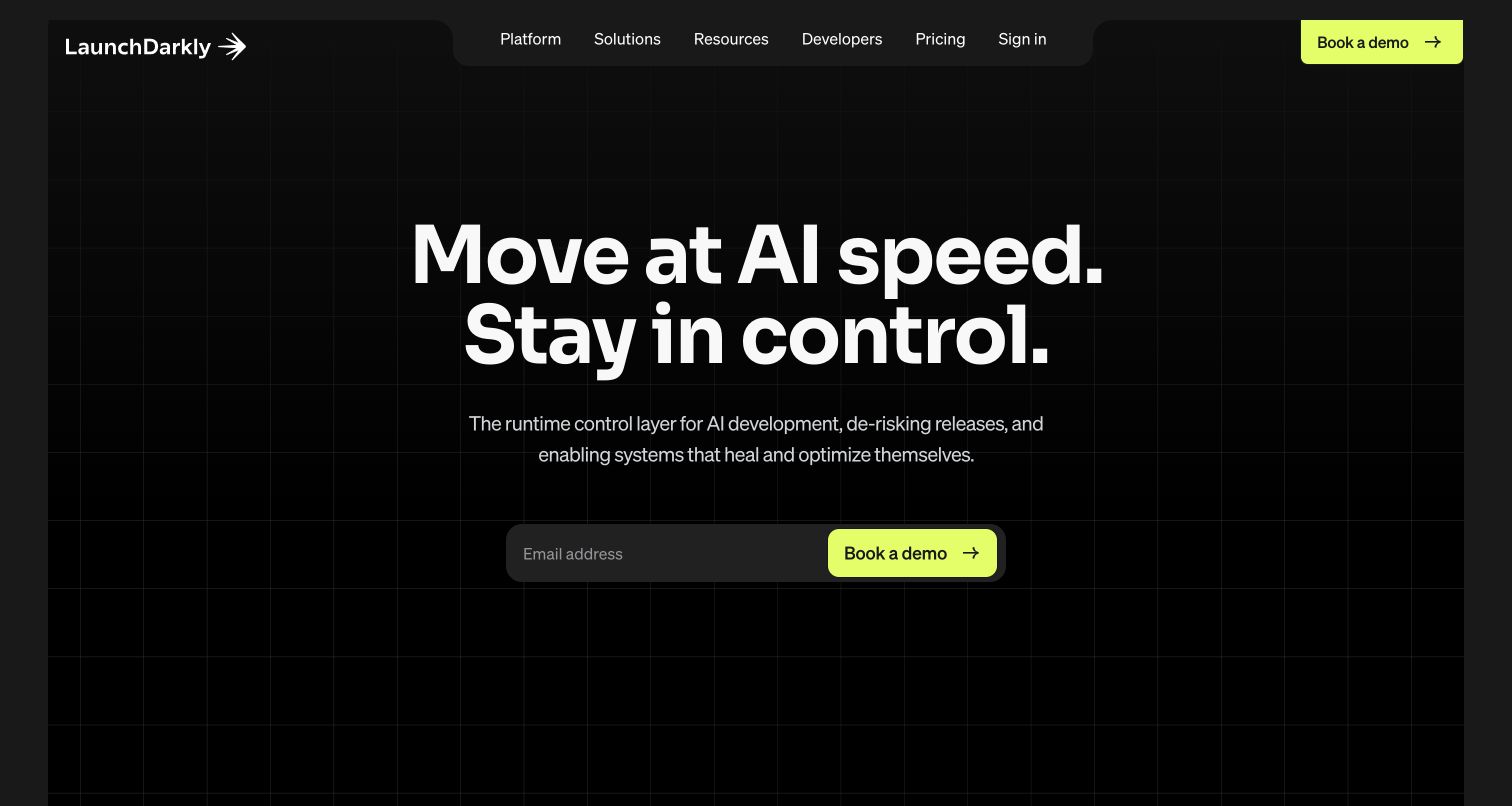
LaunchDarkly’s homepage centers a large white headline over a dark grid. Lime green is reserved for the principal action, making the demo route easy to locate among restrained navigation and supporting text. The grid gives the page a technical character without demanding that visitors understand a system diagram immediately. The opening view prioritizes a proposition over detailed product controls. CircleCI’s undated case describes testing and release practices for the feature-management platform; it provides documentary context rather than a current inspection of the homepage’s deployment system.
What you can learn
Give the principal action a consistent visual treatment, then use supporting sections to explain what the product actually controls. Test navigation and form labels when changing hero copy, without sending a real demo request. Historical delivery evidence should remain attached to its stated platform workflow rather than expanded into an entire company architecture.
Pros
The lime action has a clear place within the dark palette.
Centered type and a quiet grid keep the introductory reading order simple.
Cons & considerations
A headline-led opening provides little concrete interface evidence above the fold.
The demo request is a substantial step for visitors still learning the category.
Platform source: Official CircleCI customer case — qualified engineering workflow. Feature-management platform testing, integration and releases. Public product homepage is the design property, not proof of today’s internal deployment stack. Undated historical account; founding 2014 is context, not a verified case date. Documentary case read on November 10, 2026; this is not a current observation of private CI execution, a complete architecture inventory or a claim that CircleCI is the pictured page’s CMS/backend. Platform evidence is separate from the direct website screenshot and is not a complete current infrastructure audit.
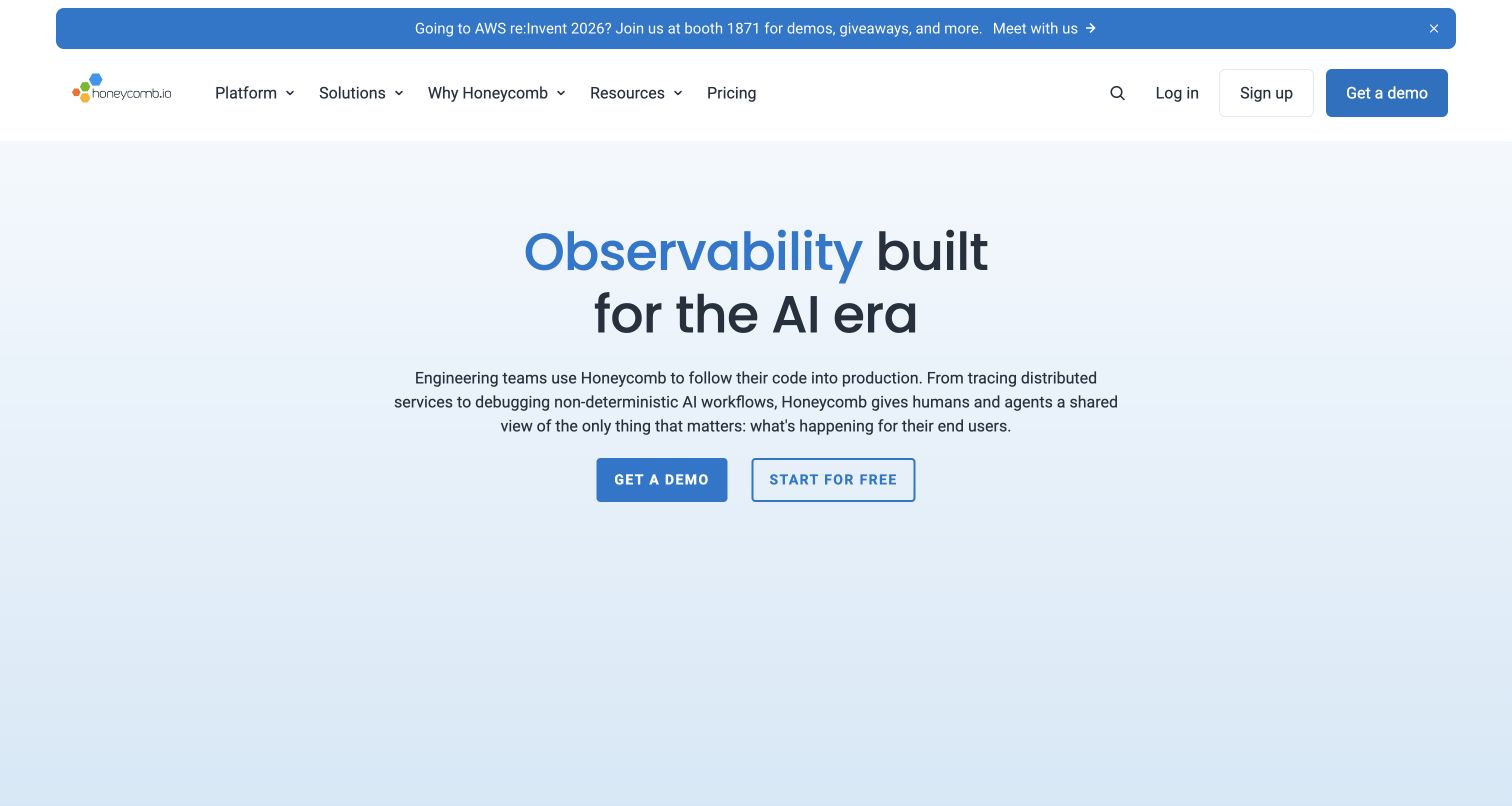
Honeycomb uses a pale blue gradient and generous open space around a centered headline. A blue word within otherwise dark type draws attention to the product category, while a short paragraph supplies the next layer of explanation. Filled and outlined buttons separate a guided demo from a free starting point. An event announcement and conventional navigation sit above the hero. CircleCI’s undated Graviton2 account concerns multi-architecture Docker builds and tests for the observability service, not a detected CMS or private execution visible in this screenshot.
What you can learn
Offer distinct next steps when evaluators have different levels of readiness, and make their destinations predictable. A spacious hero needs useful evidence immediately afterward so the design does not become merely an oversized slogan. Release checks can protect these paths while workload-specific engineering claims remain qualified in the source record.
Pros
Two adjacent actions distinguish guided evaluation from independent exploration.
The restrained palette and spacing make the opening explanation easy to isolate.
Cons & considerations
Much of the initial screen contains space rather than product evidence.
The announcement introduces another priority above the main visitor decision.
Platform source: Official CircleCI customer case — qualified engineering workflow. Observability service’s multi-architecture Docker build/test/deploy workflow using AWS Graviton2 and CircleCI Arm. Homepage represents the product; deployment technology is documentary evidence, not detected in assets. Undated Graviton2 migration account; no current performance claims. Documentary case read on November 10, 2026; this is not a current observation of private CI execution, a complete architecture inventory or a claim that CircleCI is the pictured page’s CMS/backend. Platform evidence is separate from the direct website screenshot and is not a complete current infrastructure audit.
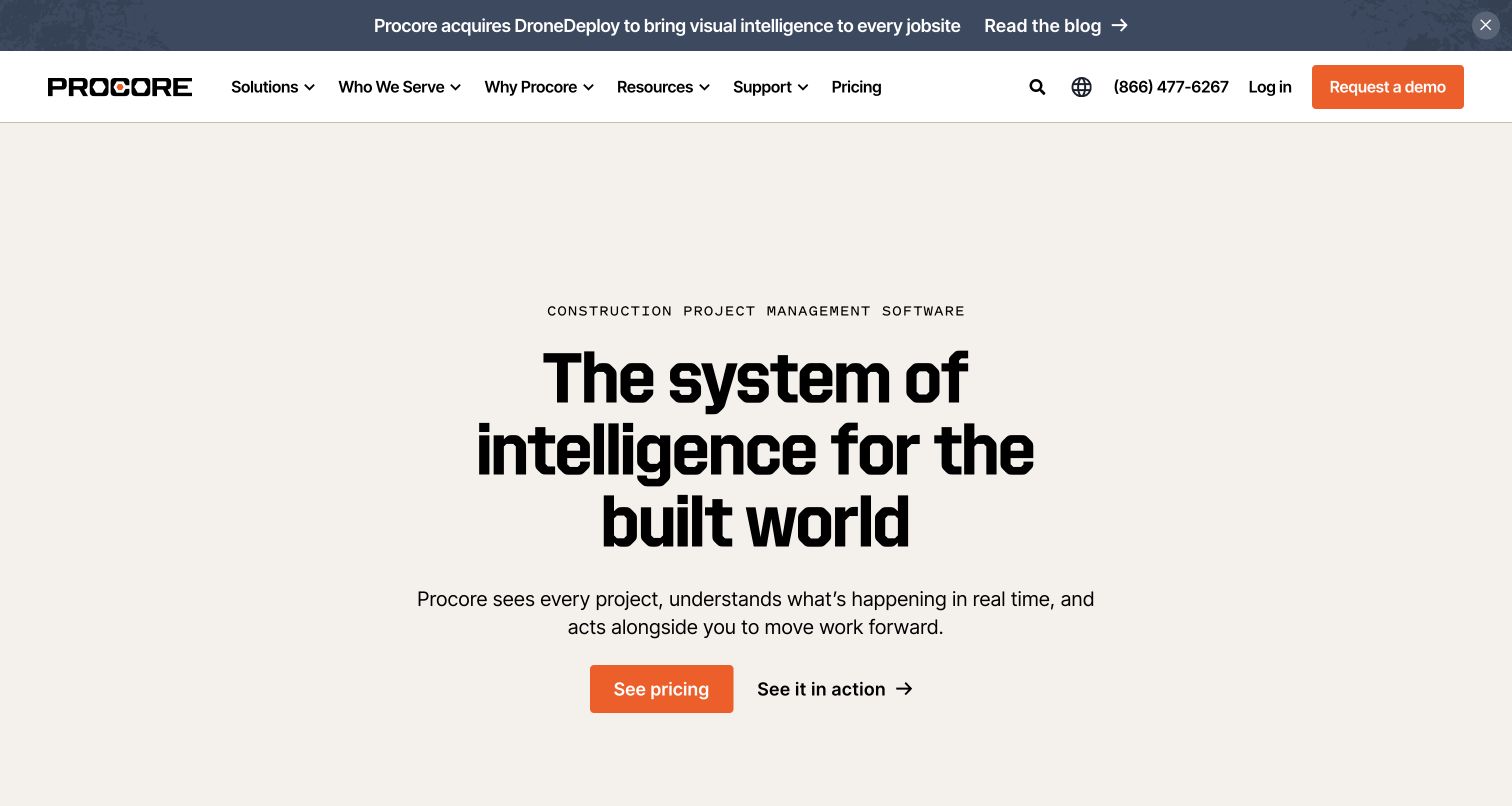
Procore’s English homepage presents a centered black headline on a warm, nearly white background. A small category label frames the statement, followed by a compact explanatory paragraph. The orange pricing action is more prominent than the adjacent product-viewing link. Navigation and an acquisition announcement remain available above, giving returning visitors access to the wider platform. CircleCI’s customer case describes construction-software build, test and deployment practices and references a 2018 feature; it does not establish the current marketing site’s backend or performance.
What you can learn
Keep the category label specific when a hero headline becomes broad. A visitor should understand what kind of product is offered before choosing pricing or a demonstration. Test those destinations across localized pages, record the actual captured locale, and keep a historical engineering case distinct from the marketing page served today.
Pros
The small category label anchors an otherwise expansive product statement.
Pricing and product exploration are visually differentiated without adding many buttons.
Cons & considerations
The opening view offers limited concrete evidence of the software interface.
Announcements and extensive navigation can compete with the main introduction.
Platform source: Official CircleCI customer case — qualified engineering workflow. Construction software engineering’s build/test and automatic deployment practices. Direct Chrome capture served the English homepage at https://www.procore.com/. Case does not establish marketing-site backend. Undated case cites a September 2018 feature; case date not verified. Documentary case read on November 10, 2026; this is not a current observation of private CI execution, a complete architecture inventory or a claim that CircleCI is the pictured page’s CMS/backend. Platform evidence is separate from the direct website screenshot and is not a complete current infrastructure audit.
Outreach’s current public destination uses layered purple curves behind a centered headline, with warmer color drawing attention to the AI-agent phrase. A demo action and a quieter exploration route sit beneath the introduction. Three large numerical proof points create a separate band below, each paired with a deeper-reading link. A cookie notice occupies part of the lower capture. CircleCI’s account discusses engineering tests during the early pandemic period and links the former outreach.io domain; the public site now uses outreach.ai.
What you can learn
Attach prominent results to supporting stories instead of letting large numbers stand alone. Treat them as the site’s own claims until independently checked. When a brand changes domains, preserve the documentary identity and record the current public destination without assuming that the older engineering architecture migrated unchanged with the marketing site.
Pros
Color emphasis creates a clear reading order within a large headline.
Proof-point links give visitors a route beyond the introductory claims.
Cons & considerations
Multiple numerical claims require context before they can inform a comparison.
The lower cookie notice competes with the supporting evidence band.
Platform source: Official CircleCI customer case — qualified engineering workflow. Sales software teams’ tests and delivery pipelines. Case links outreach.io, which currently redirects to outreach.ai. Document legacy case identity and current public property; do not infer current homepage implementation. Account references early 2020 pandemic conditions; no verified publication date. Documentary case read on November 10, 2026; this is not a current observation of private CI execution, a complete architecture inventory or a claim that CircleCI is the pictured page’s CMS/backend. Platform evidence is separate from the direct website screenshot and is not a complete current infrastructure audit.
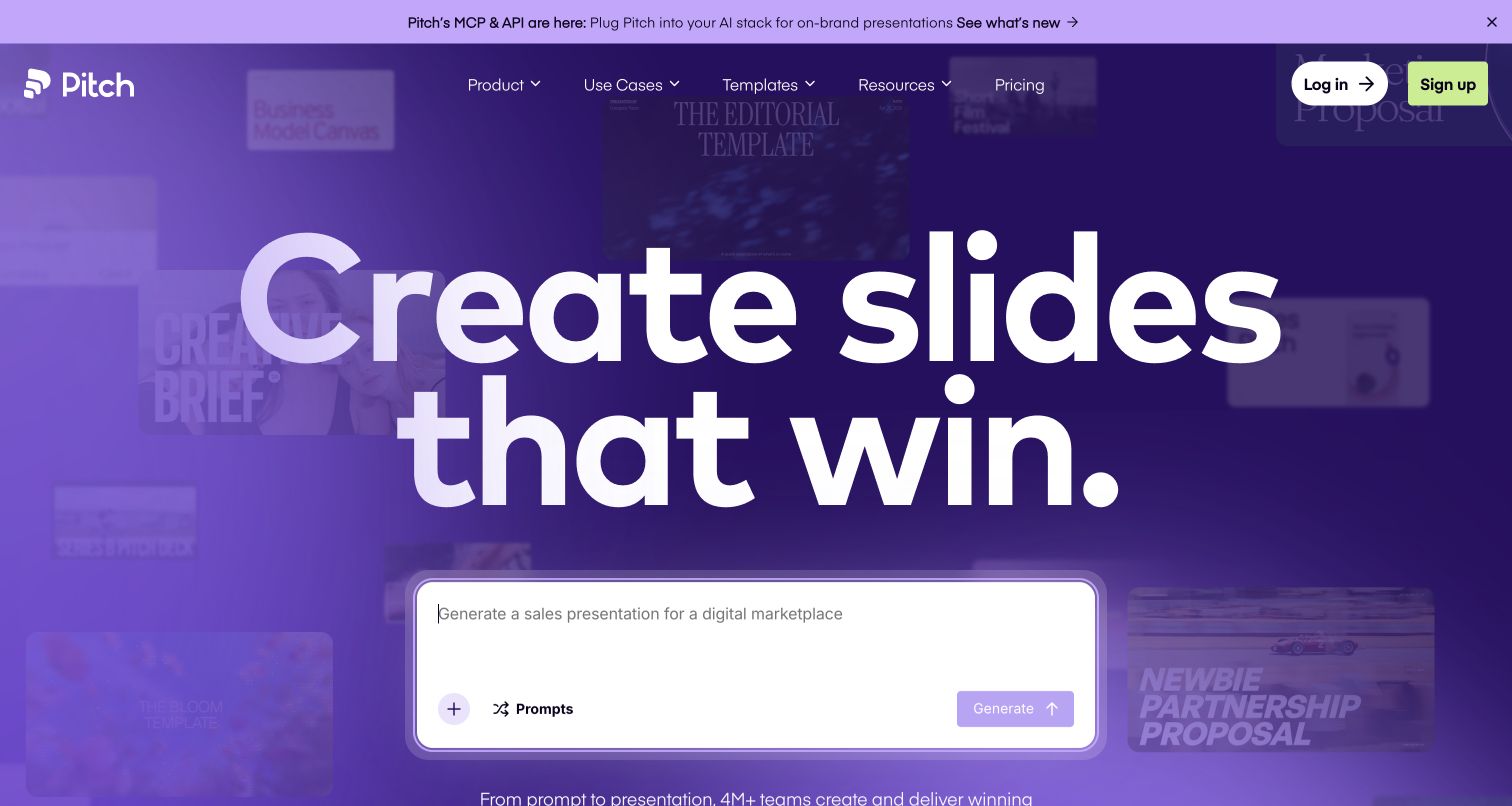
Pitch places a large white headline over a purple gradient with decorative slide imagery. A prominent prompt composer below makes the page resemble a starting workspace rather than a conventional brochure. Sparse navigation and an announcement bar remain secondary to that central entry point. The final capture follows the page’s entrance animation; the initial incomplete frame is retained privately. CircleCI’s case discusses branch previews, caching and releases, including plan changes in 2020 and 2021, rather than proving the current marketing page’s delivery configuration.
What you can learn
A product-like entry point needs clear expectations about what happens next, especially before any account or data submission. Automated releases should check empty and disabled states as carefully as filled ones. Keep animated decoration from delaying the useful content, and preserve the distinction between a historical engineering workflow and a current interface observation.
Pros
The central composer demonstrates the kind of task the product supports.
Decorative slide imagery reinforces the category without requiring lengthy explanation.
Cons & considerations
Entrance animation briefly hides meaningful content from an early capture.
A prompt-first page may leave pricing and product limits less immediately visible.
Platform source: Official CircleCI customer case — qualified engineering workflow. Presentation product’s branch previews, caching and releases. Marketing page is the public design surface; account/product workflow is documentary, not a detected homepage backend. Case records June 2020 and May 2021 plan changes and nearly three years use; no exact publication date. Documentary case read on November 10, 2026; this is not a current observation of private CI execution, a complete architecture inventory or a claim that CircleCI is the pictured page’s CMS/backend. Platform evidence is separate from the direct website screenshot and is not a complete current infrastructure audit.
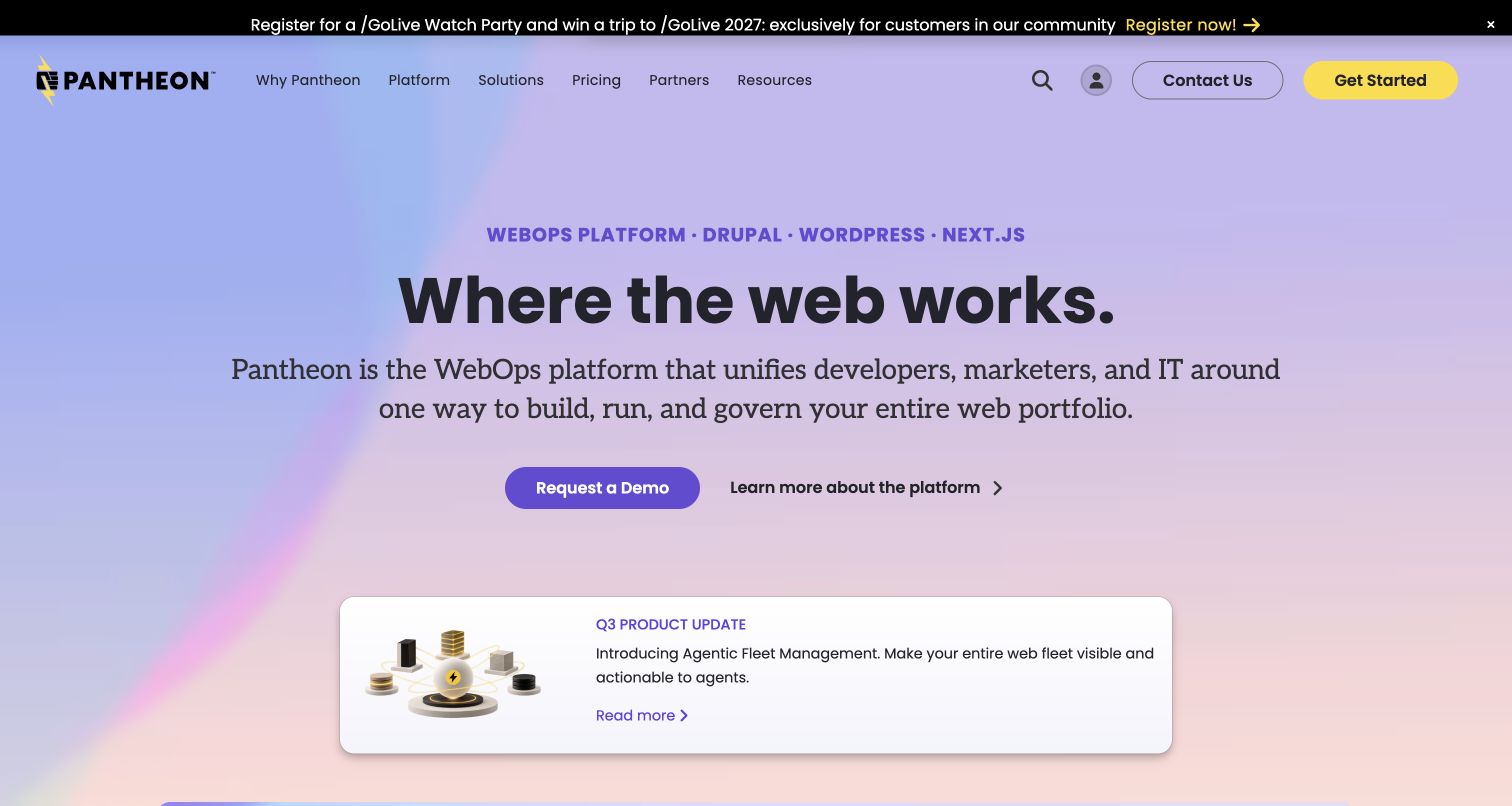
Pantheon combines a pale purple and pink gradient with a bold centered headline. A smaller WebOps line names familiar web technologies, grounding the larger statement in a recognizable category. The primary demo action is paired with a quieter learning link, while a product-update card begins the next section. A dark event announcement adds another entry above the navigation. CircleCI’s undated case describes platform compatibility tests for WordPress and Drupal updates; it does not establish that every customer property or the pictured marketing homepage uses that workflow.
What you can learn
Use a specific category line to support broad brand language, then make deeper explanation easy to reach. A delivery workflow for a hosting platform should test supported integrations and update compatibility. Public examples still need property-level qualifications; a platform’s internal tooling is not automatic evidence for every website hosted on it.
Pros
The category line supplies useful context before the larger promise is interpreted.
Two action styles distinguish a sales conversation from further learning.
Cons & considerations
Several announcements can divide attention across unrelated visitor goals.
The abstract hero needs concrete platform details in following sections.
Platform source: Official CircleCI customer case — qualified engineering workflow. Platform compatibility and smoke tests against WordPress/Drupal updates. This does not make all Pantheon customer sites CircleCI examples, nor prove the marketing homepage’s deployment pipeline. Undated historical platform workflow account. Documentary case read on November 10, 2026; this is not a current observation of private CI execution, a complete architecture inventory or a claim that CircleCI is the pictured page’s CMS/backend. Platform evidence is separate from the direct website screenshot and is not a complete current infrastructure audit.
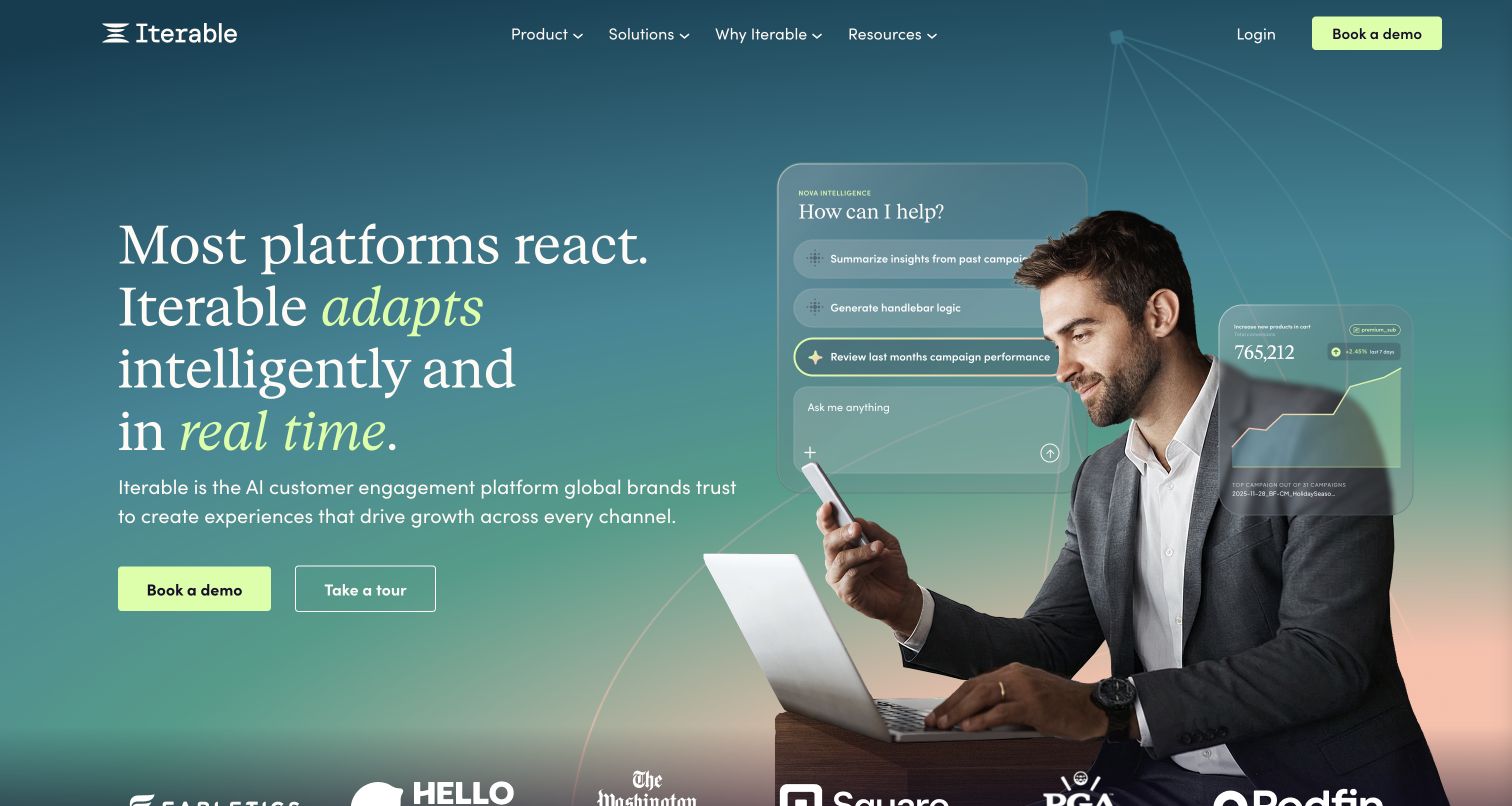
Iterable’s opening screen uses a dark teal field with a large left-aligned serif headline. Lime accents connect selected words to the main demo button, while an outlined tour option offers a lighter commitment. On the right, a person using a phone and laptop sits behind translucent product cards. A customer-logo strip begins the next layer of evidence. CircleCI’s case discusses product-engineering reliability and releases alongside 2023 feature launches; those historical workflow details remain separate from the current public marketing composition.
What you can learn
Combine human context with product fragments only when each element contributes a distinct explanation. Keep the primary and secondary actions stable as illustrations or campaign messages change. Test the routes and labels automatically, and avoid interpreting attractive interface mockups as proof of a working integration, current architecture or measured product outcome.
Pros
Serif typography gives the platform a distinctive tone among technical competitors.
The demo and tour choices support different levels of visitor readiness.
Cons & considerations
Overlapping product cards can become difficult to read at smaller sizes.
The busy image composition competes with an already substantial headline.
Platform source: Official CircleCI customer case — qualified engineering workflow. Product engineering test reliability, release confidence and incident recovery workflow. Public product marketing site is separate from private application and CI environment. Case discusses 2023 feature launches; no verified case publication date. Documentary case read on November 10, 2026; this is not a current observation of private CI execution, a complete architecture inventory or a claim that CircleCI is the pictured page’s CMS/backend. Platform evidence is separate from the direct website screenshot and is not a complete current infrastructure audit.
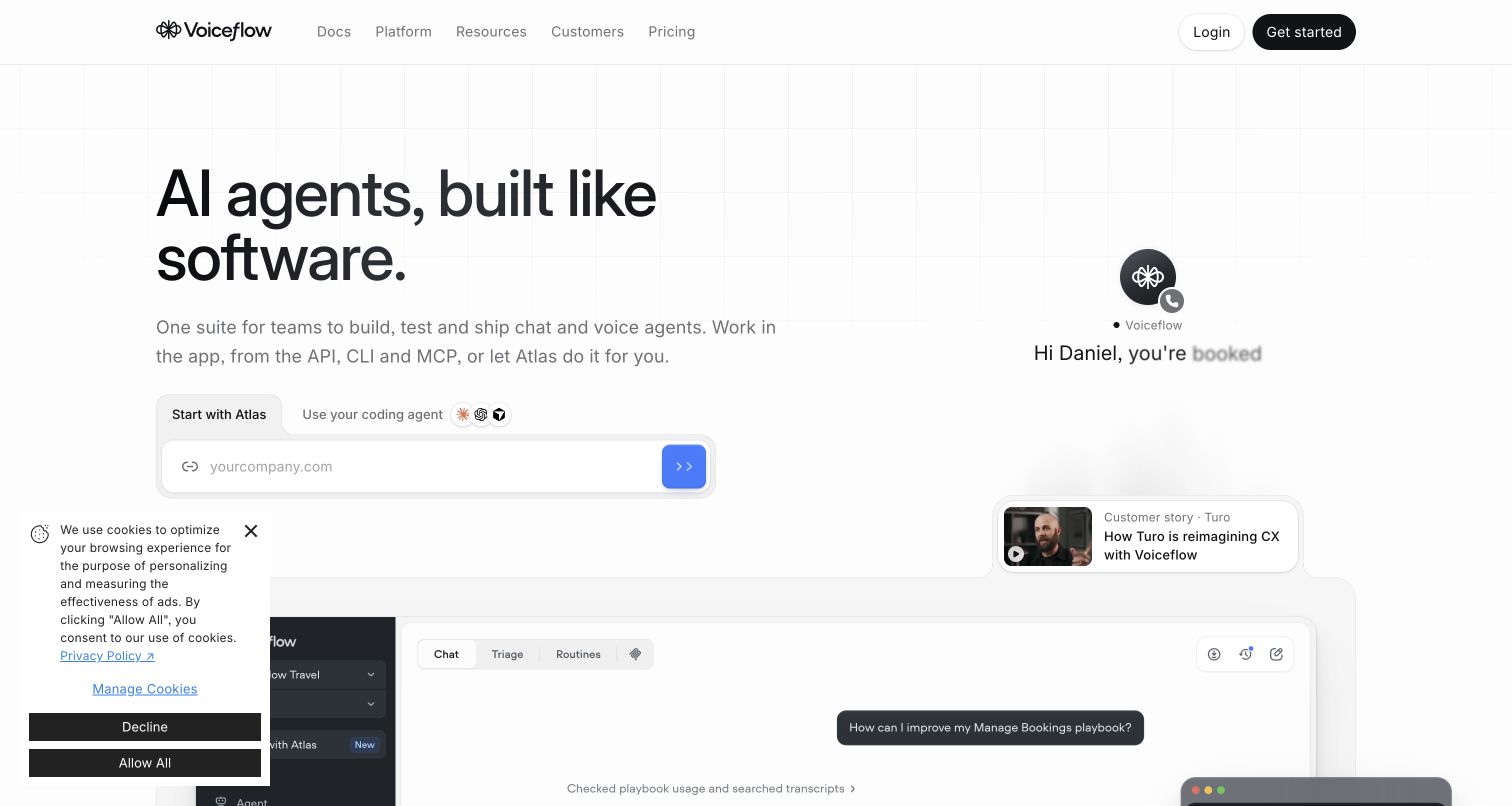
Voiceflow places a large black headline on a pale grid, followed by concise supporting copy and a tabbed starting area. An empty domain field and blue action control make the intended entry task visible. To the right, a conversational demonstration and customer-story card suggest the product’s use without showing a private account. The capture follows a settled entrance animation. CircleCI’s undated case describes frontend, backend, platform and machine-learning workflows; it does not verify the current marketing CMS or every customer deployment arrangement.
What you can learn
Label the starting task precisely and explain the boundary between a demonstration and a live action. Check tabs, empty states and field labels without submitting real information. A moving demo can add context, but the surrounding text must remain useful when the animation is paused, incomplete or unavailable to a visitor.
Pros
The starting area gives a concrete alternative to a generic sales button.
Customer context sits close to the conversational product demonstration.
Cons & considerations
Animation can delay the appearance of the full introductory composition.
The cookie panel and multiple product entry modes add competing visual choices.
Platform source: Official CircleCI customer case — qualified engineering workflow. Documented frontend/backend, platform, developer-experience and machine-learning build/deploy workflows. Does not establish the current marketing homepage’s CMS or a private-cloud deployment for every customer. Undated AI/ML case; 2018 founding is context only. Documentary case read on November 10, 2026; this is not a current observation of private CI execution, a complete architecture inventory or a claim that CircleCI is the pictured page’s CMS/backend. Platform evidence is separate from the direct website screenshot and is not a complete current infrastructure audit.
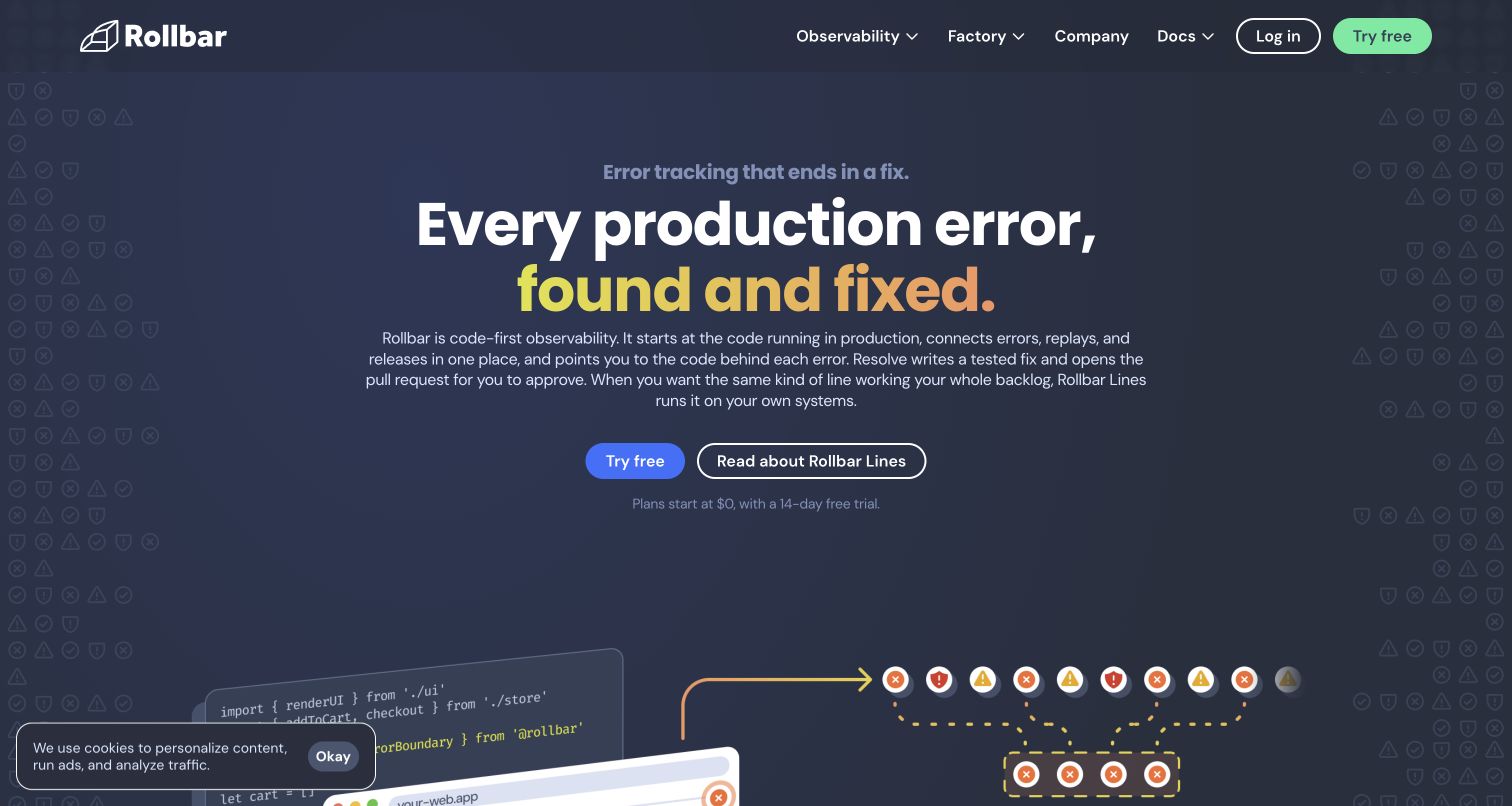
Rollbar’s homepage uses a deep navy hero with small technical motifs around the edges. A large centered headline separates its main statement from a warm gradient accent. Supporting copy leads to a bright trial button and an outlined product route, while a schematic error-and-code flow starts below. A small cookie notice sits at the lower edge. CircleCI’s undated case describes legacy image builds, parallel tests and a Python migration; its reported improvements are historical customer statements rather than current measurements of this page.
What you can learn
Let the introductory promise lead into an understandable workflow diagram instead of relying only on technical adjectives. Release checks should cover trial and documentation routes without creating accounts. Keep reported build improvements tied to the original workload and timeframe, especially when the public product positioning changes after the engineering case was written.
Pros
The two main actions are distinct within a consistent dark visual system.
The emerging workflow illustration suggests a practical explanation beyond the headline.
Cons & considerations
Dense supporting copy asks visitors to absorb several benefits at once.
Low placement leaves much of the technical illustration outside the opening view.
Platform source: Official CircleCI customer case — qualified engineering workflow. Legacy application image builds, parallel unit tests and microservice migration. Historical reported improvements must not become current measured guarantees; public marketing page is a separate design surface. Undated account discusses Python 2 to 3 migration and six-month outcomes. Documentary case read on November 10, 2026; this is not a current observation of private CI execution, a complete architecture inventory or a claim that CircleCI is the pictured page’s CMS/backend. Platform evidence is separate from the direct website screenshot and is not a complete current infrastructure audit.
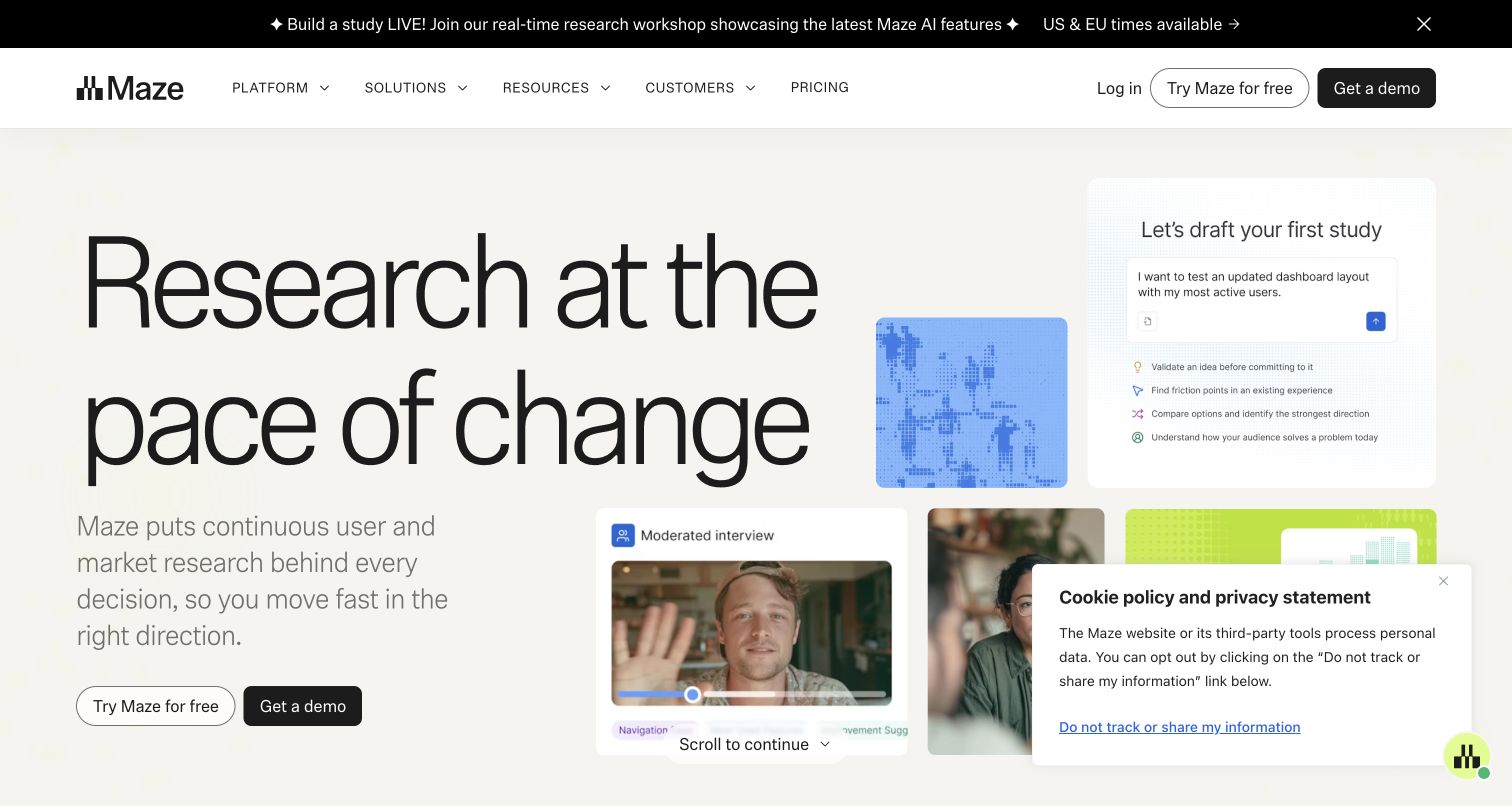
Maze uses a warm white canvas and exceptionally large black type on the left. The right side assembles a study composer, an interview frame and bright graphic fragments, giving the promise a visible research context. Free-trial and demo actions sit beneath the supporting paragraph. A sizable cookie panel covers part of the lower artwork, while an event announcement occupies the top. CircleCI’s case describes a monorepo transition beginning in 2020 and subsequent release workflows, without establishing the current marketing site’s implementation.
What you can learn
Show artifacts that connect a product promise to a recognizable task, but keep the hierarchy useful when overlays cover part of the composition. Delivery checks can protect the trial and demo routes as campaigns rotate. Historical release metrics should remain attributed to their original case instead of becoming fresh performance claims about the public website.
Pros
Research artifacts make the broad introductory promise more concrete.
A generous type scale creates a strong starting point for the page.
Cons & considerations
The cookie panel obscures some of the visual evidence in the capture.
Extremely large text leaves less room for supporting detail above the fold.
Platform source: Official CircleCI customer case — qualified engineering workflow. Product platform’s monorepo tests, dynamic configuration and deployment process. Do not convert the case’s reported release metrics into fresh measurements or a CMS claim. Case mentions 2020 monorepo transition; publication date not verified. Documentary case read on November 10, 2026; this is not a current observation of private CI execution, a complete architecture inventory or a claim that CircleCI is the pictured page’s CMS/backend. Platform evidence is separate from the direct website screenshot and is not a complete current infrastructure audit.
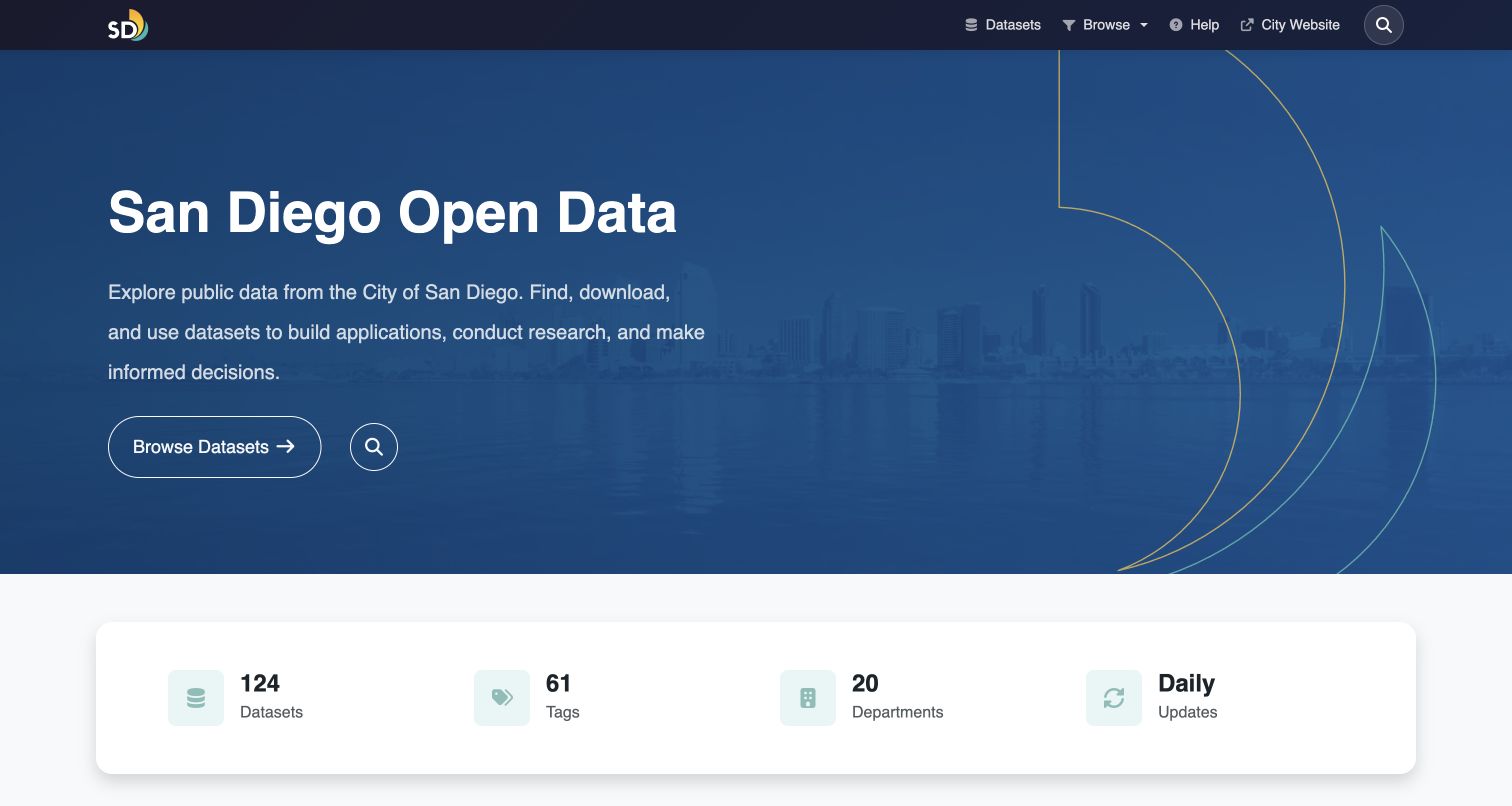
San Diego’s open-data portal uses a restrained blue hero with a faint city photograph behind plain-language introductory copy. Browse and search actions appear together, and the navigation repeats those practical routes. A white statistics panel below summarizes the catalog through labeled counts and update cadence. Decorative linework stays away from the reading area. CircleCI’s case explicitly describes the portal’s February 2017 replacement and its then-current Jekyll deployment process; the present captured design is not evidence that the same implementation remains in place.
What you can learn
Lead with the public task rather than the internal data architecture. Dataset discovery, understandable labels and stable download destinations deserve release checks. Keep catalog statistics maintainable and clearly scoped. When an old engineering case names an exact portal, preserve that useful association while separately recording what the current public audit actually observes.
Pros
Browse and search offer direct paths for different levels of prior knowledge.
The introductory copy explains practical uses before exposing catalog structure.
Cons & considerations
Summary counts need dependable updates to remain useful to visitors.
The introductory hero delays individual dataset examples until farther down the page.
Platform source: Official CircleCI customer case — qualified engineering workflow. Exact DataSD public portal’s documented Jekyll publishing and data deployment workflow via staging/production. Strong exact-property association; retain historical scope, not current detected CI. Case explicitly describes February 2017 portal replacement and subsequent workflow. Documentary case read on November 10, 2026; this is not a current observation of private CI execution, a complete architecture inventory or a claim that CircleCI is the pictured page’s CMS/backend. Platform evidence is separate from the direct website screenshot and is not a complete current infrastructure audit.
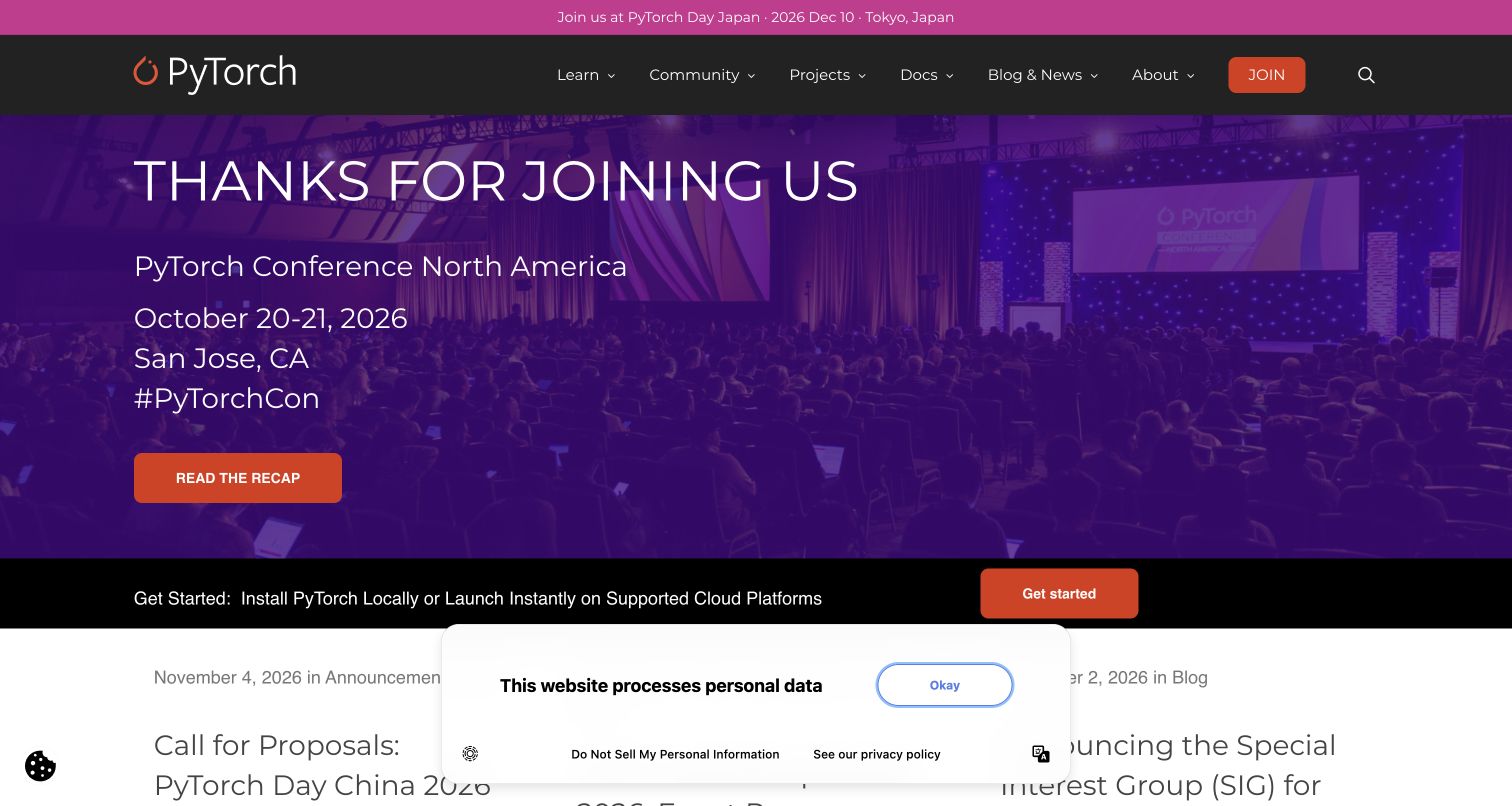
PyTorch’s homepage leads with a conference recap over an audience photograph and purple overlay. A dark navigation bar organizes learning, community, projects and documentation, while a narrow strip below the hero points toward installation and a clear getting-started action. The page therefore balances community activity with a practical developer task. A privacy panel covers some lower news material in the capture. CircleCI’s Facebook-era case discusses contribution checks and website tutorial builds, not the current foundation’s entire delivery system or website backend.
What you can learn
Give events a defined place without losing the permanent onboarding route. Automated releases can protect documentation links and installation guidance as community campaigns change. Treat tutorial builds as their own documented workload, and avoid extending an older organization’s engineering account to every present foundation project or service carrying the same name.
Pros
The getting-started strip preserves a useful task beneath the event promotion.
Navigation separates learning resources from community and project information.
Cons & considerations
The conference recap occupies more initial space than the software explanation.
The privacy panel obscures part of the supporting news area.
Platform source: Official CircleCI customer case — qualified engineering workflow. Open-source project contribution checks and website tutorial builds, in the Facebook-era case. Current foundation homepage is linked official project property; not proof of present foundation CI provider or site backend. Undated Facebook-era account; do not label its organization/counts current. Documentary case read on November 10, 2026; this is not a current observation of private CI execution, a complete architecture inventory or a claim that CircleCI is the pictured page’s CMS/backend. Platform evidence is separate from the direct website screenshot and is not a complete current infrastructure audit.
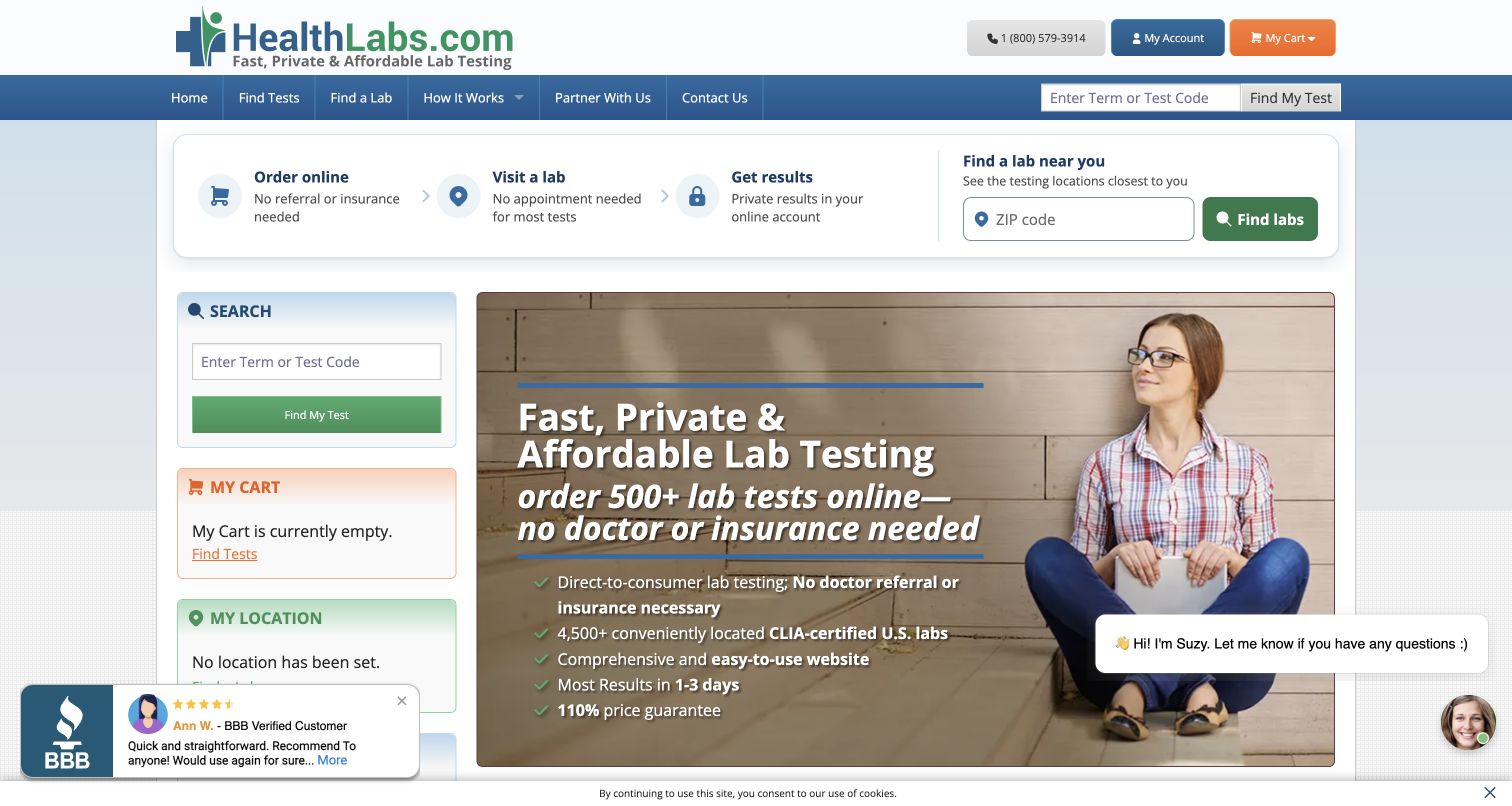
HealthLabs.com places a three-step process strip above a dense catalog-oriented page. Search, account and cart routes are visible in the header, while a separate location field sits beside the process explanation. The main photographic panel carries large promotional text, and the left sidebar repeats search and cart context. Chat and review overlays compete near the bottom. CircleCI’s undated case documents development, testing and production environment consistency using Docker; it is engineering evidence, not an endorsement of the service or its medical claims.
What you can learn
Explain the process before asking visitors to choose from a large catalog, then reduce duplicated controls where possible. Test labels and destination routes without placing orders or entering health information. Keep service claims attributed to the provider and distinguish a documented software workflow from any judgment about clinical suitability, privacy outcomes or care quality.
Pros
The process strip gives visitors a compact orientation before catalog browsing.
Search and location controls are clearly labeled as different tasks.
Cons & considerations
Repeated search controls and sidebar panels create a crowded opening view.
Chat and review overlays compete with promotional copy and lower navigation.
Platform source: Official CircleCI customer case — qualified engineering workflow. HealthLabs development/test/production environment workflow. Case mentions sibling STDcheck and UTItreatment; count only HealthLabs, not three examples from one general company claim. No medical-service quality endorsement. Undated historical documentary account. Documentary case read on November 10, 2026; this is not a current observation of private CI execution, a complete architecture inventory or a claim that CircleCI is the pictured page’s CMS/backend. Platform evidence is separate from the direct website screenshot and is not a complete current infrastructure audit.
Kegan has 15+ years of experience working with small businesses, Fortune 500 companies, and everything in between. No development job is too big or too small: he brings the same hands-on attention to a focused improvement, a complete website, or a custom application.
For CircleCI projects, he can help with content architecture, custom functionality, system integrations, testing, and maintainable handover. He works directly with clients on scope, design, implementation, testing, and handover, with an emphasis on clear communication and a system that remains practical to maintain after launch.
Show 3 other CircleCI developersHide other CircleCI developers
Choose a pipeline approach around the work being shipped
Use a clear fixed workflow for a straightforward project
A site with a predictable build can start with a small, explicit sequence: obtain the approved source, install dependencies, run meaningful checks, produce the deliverable and release it through the authorized process. Define which jobs depend on earlier results and which independent checks can run together. Keep the configuration readable enough that another maintainer can explain why deployment is allowed or blocked.
Introduce dynamic configuration for a demonstrated repository need
A repository containing several applications may need different work for different changes. CircleCI dynamic configuration can assemble or generate configuration at runtime, including decisions based on parameters or file paths. Before adopting it, document shared dependencies and changes that must still trigger broader checks. Selective execution should avoid irrelevant work without quietly omitting tests for code that several applications share.
Choose the execution environment for the actual toolchain
CircleCI jobs can use container or virtual-machine environments. Identify the operating system, build tools, service dependencies and architecture required by the project before choosing an executor. Record the environment alongside the source revision and dependency lockfile. A test passing in one environment does not establish that a separately packaged production application will start or behave identically.
Measure where the suite spends time before increasing parallelism. CircleCI supports splitting tests across execution environments, with options including timing-based allocation. The appropriate command family differs between CircleCI Cloud and Server, so use the documentation matching the installation. Preserve complete test discovery and useful results; a shorter run that accidentally omits work is not an improvement.
Plan the release evidence, data flow and maintenance handover
Trace one change from source to its public result
Choose a representative change before designing the pipeline. It could add a content page, adjust a product component or update a dependency used by several applications. Write down the source revision, the checks that establish correctness, the deliverable produced and the place where that deliverable is released. CircleCI workflows provide the job ordering, but the team must decide what each stage proves. Distinguish a successful test command from a successful build, and distinguish a build from a verified deployment. Make the relationship between the checked revision and the released artifact visible in the records retained by the team. Describe how staging and production differ, including configuration supplied outside the repository. Define the public checks that confirm the expected release, such as representative pages, assets and service responses. Those checks should avoid real purchases, messages or other unintended user actions. Decide who handles a failed stage and how an uncertain deployment is reconciled before another attempt. Finally, give a second maintainer the proposed run record and ask them to identify what changed and what is actually live. If they cannot answer, improve the evidence trail before adding more automation.
Design the movement of files and configuration deliberately
List what each job needs and what it produces. Dependency downloads, compiled output, test reports and release packages serve different purposes and should not be mixed into one unspecified shared directory. CircleCI distinguishes workspaces used between jobs in a workflow, caches reused across runs and artifacts retained after work finishes. Assign each file group to a deliberate mechanism and document its owner, expected lifetime and consumers. Keep sensitive configuration out of public artifacts and diagnostic reports. For dependency caches, choose keys that reflect the relevant lockfile and environment; CircleCI caches are immutable for a given key, so changing the contents requires an appropriate new key. Check the uncached path as well, because a warm cache can conceal missing setup steps. Record how the build receives environment-specific configuration without placing secret values in the repository. Contexts can supply environment variables to jobs, subject to their configured access restrictions. Confirm that release jobs receive only the configuration they need. At handover, ask a maintainer to explain where a build output came from, which later job used it and which records can be retained or removed. Clear data flow makes failures easier to diagnose than a collection of unexplained cache and copy steps.
Rehearse diagnosis and recovery with the maintaining team
Prepare a small set of controlled failure scenarios in an appropriate nonproduction environment. Include a failing test, an unavailable dependency, an incorrect configuration value and a release that does not pass its public verification. For each scenario, identify the expected evidence, the person responsible and the conditions under which work can safely continue. Keep diagnostic records useful without exposing credentials or private customer information. Review any shared orb or generated configuration as part of the application’s maintained code, with a clear process for changes. If the team plans to use CircleCI’s rollback features, check their current integration prerequisites and configure a project-specific recovery path; the product name alone does not provide a working rollback. Also explain limitations outside the application package, such as data changes that require a separate recovery decision. A rehearsal should show how the team identifies the release to recover, checks the resulting state and communicates an unresolved incident. It should not depend on the original builder remembering an undocumented command. End the handover with a concise runbook covering routine updates, evidence locations, ownership and escalation. This turns a successful demonstration into an operating process that another person can maintain.
Ask the actual team to carry out its routine job: publish a realistic update, correct a mistake, preview a narrow screen, and identify who owns an integration failure. For a library or frontend framework, also ask who maintains the content source and deployment. A polished screenshot does not answer those operational questions.
Beyond the screenshot
Before a CircleCI delivery workflow is handed over
Identify the exact repository, application and environments covered by the pipeline.
Define what each test, build and deployment stage proves.
Check job dependencies and the conditions permitting a release.
Record the source revision and identity of the deliverable actually deployed.
Choose an execution environment that matches the project’s toolchain.
Distinguish workspace data, reusable caches and retained artifacts.
Test both warm-cache and clean dependency installation paths.
Review context access and keep secret values out of source and artifacts.
Confirm selective or parallel tests still cover the intended work.
Keep historical customer-case claims separate from current system facts.
Verify representative public pages and assets after deployment without real transactions.
Rehearse failure diagnosis and the project’s authorized recovery process.
Assign owners for shared configuration, integrations and future dependency changes.
Document evidence locations and an escalation path another maintainer can follow.
Test with real content, a keyboard, a small screen, slow or failed requests, and the people who will maintain the system. These are planning checks, not an accessibility, security, performance, or search-ranking certification.
Sources & editorial method
How this CircleCI collection was reviewed
This collection pairs 20 distinct public website properties with official CircleCI customer cases describing engineering, testing or deployment workflows. The public page is the design surface; the case defines the separate technology association. Dollar Shave Club’s case describes adoption at the end of 2014, Contentful’s names 2015 and Greenhouse’s names 2019. These dates remain historical context, not proof of the current pictured implementation. Other cases without verified publication dates remain undated; a contextual event or founding year is not substituted for a publication date. DataSD’s case concerns its named open-data portal, while the PyTorch account describes Facebook-era project and tutorial workflows. Current organization names and public-property redirects are distinguished from those historical accounts. November 10, 2026 is the documentary-source reading date, not a new observation of private CI execution. Captures retain their actual source and capture dates, including reused images. Broad public-source audits remain separate and cannot establish private pipeline state. Reported customer improvements and counts are not presented as current measurements or guarantees.
Every image is an unmodified capture from the actual website, with its source and capture date. Some captures are reused from our shared catalog; their dates remain the original capture dates. None comes from a vendor gallery or a generated reconstruction. Moving imagery and live content can change.
Technology attribution uses public page assets or metadata, official platform documentation, or a cited first-party project case study. Documentary and framework-relationship evidence is identified where used; it is not a complete current backend inventory. A CMS image CDN alone does not establish a full CMS deployment. A library’s presence does not prove which individual controls use it, and a platform label does not establish AI authorship.
The composition notes, lessons, pros and tradeoffs are original editorial observations. We have not measured conversion, traffic, security, performance or accessibility conformance. Website owners retain their brands and imagery; these examples are not our client portfolio. Written, Edited and Curated are independent records, not dates advanced by a build. See our editorial standards or suggest a correction.
Questions worth asking
CircleCI website development FAQs
Is CircleCI a CMS or a website builder?
CircleCI is a platform for automating software work such as builds, tests and deployment workflows. A site can use a separate CMS, frontend and hosting platform. A CircleCI customer case does not identify those layers unless the source explicitly documents them.
Why does this guide show public websites rather than private build dashboards?
The public pages provide design examples that can be directly reviewed and captured. Official customer cases provide the separate engineering association. We do not have access to private jobs, repositories or dashboards, and a screenshot cannot confirm their current state.
Does an official customer case prove the pictured homepage uses CircleCI today?
No. The case may describe a product application, one repository or a historical deployment process. Read the property-specific qualification and source date before interpreting the association. Undated cases stay undated rather than receiving the date on which we read them.
What is the difference between a job and a workflow?
A job contains the steps that perform a unit of work. A workflow organizes jobs, including their ordering, dependencies and conditions. The team still defines which checks are meaningful and what must succeed before a release is permitted.
Are caches, workspaces and artifacts interchangeable?
They serve different purposes. Workspaces pass data between jobs in a workflow, caches reuse data across runs and artifacts retain output after execution. Choose based on how the files are produced and consumed, and keep sensitive information out of public outputs.
Will parallel tests automatically make the project faster?
They may reduce elapsed time when the suite can be divided effectively, but setup overhead, uneven tests and shared dependencies can limit the benefit. Measure the actual project and confirm that the complete intended suite still runs. Historical customer results are not a forecast.
Does a successful pipeline mean the public release is correct?
It means the configured work reported success. The checks may still omit important behavior, and deployment configuration can differ from the test environment. Verify the intended artifact and representative public behavior after release, using checks appropriate to the project.
Borrow a useful presentation pattern from the public examples, then specify the engineering process your own project needs. Clear checks, traceable releases and a maintainable handover matter more than copying a customer’s historical pipeline or assuming a technology label explains the whole website.