Best Matomo Websites of 2026 (20 Real-World Examples)
Twenty real public properties with genuine screenshots, property-specific Matomo evidence and practical ways to measure useful journeys without mistaking analytics for a design system.
The most useful analytics plan starts with a visitor task, not a dashboard. These examples connect visible search, publishing, learning and enquiry patterns with carefully scoped evidence of Matomo.
Matomo is an analytics platform, not a website theme or page builder. Its presence does not explain a site's typography, content-management system or visual performance. An official notice can establish that a public property discloses Matomo; an implementation case can document a deployment. Neither reveals every setting, proves that tracking ran during our visit or authorizes copying the site's data practices.
The collection opens with the ECB Data Portal, CNIL, Amnesty International Austria, UNESCO-UNEVOC Connect and Stockholm University. Each example names the exact public property rather than extending its association across an entire organization. Government information services, environmental resources, software businesses and specialist publishers follow. The reviews offer design questions for your own project, not a ranking of analytics maturity or a compliance endorsement.
Before the examples
What makes good Matomo website development in 2026?
Separate tracking consent from cookie consent
Matomo's developer guide distinguishes withholding all analytics requests until tracking consent from withholding cookies while requests can still be sent. Those are materially different behaviors. Decide the intended behavior with the people responsible for privacy, then test the actual implementation before and after a visitor changes their choice. A cookieless configuration alone does not establish that every legal requirement is met.
Measure meaningful actions, not every interface movement
The JavaScript tracker supports page views, events, goals, site-search reporting and download or outlink tracking. Choose a small vocabulary that corresponds to useful visitor outcomes: finding a publication, selecting a learning route or opening an eligible product guide. Treat an enquiry-button click as an expression of interest, not a completed enquiry. Avoid putting free-form messages or identifying details into event labels.
Matomo's website administration includes domains and aliases, excluded query parameters and a reporting time zone. Make those boundaries explicit before interpreting reports. A public marketing site, member platform and external payment service need not belong to one measurement scope. Separately name who maintains the analytics service, permissions and retention decisions; self-hosting changes operational responsibility rather than eliminating it.
Each screenshot records an actual public page. Its companion evidence distinguishes an official property disclosure from a documented vendor implementation case. Search-heavy public portals sit beside editorial homepages, software catalogues and a role-based guide, showing different measurement questions rather than a single Matomo visual style.
We start with five recognizable brands or organizations: ECB Data Portal, CNIL, Amnesty International Austria, UNESCO-UNEVOC Connect, Stockholm University. Each attribution applies to the named website property, not every product or website belonging to its organization. This is a curated reading sequence, not a measured ranking.
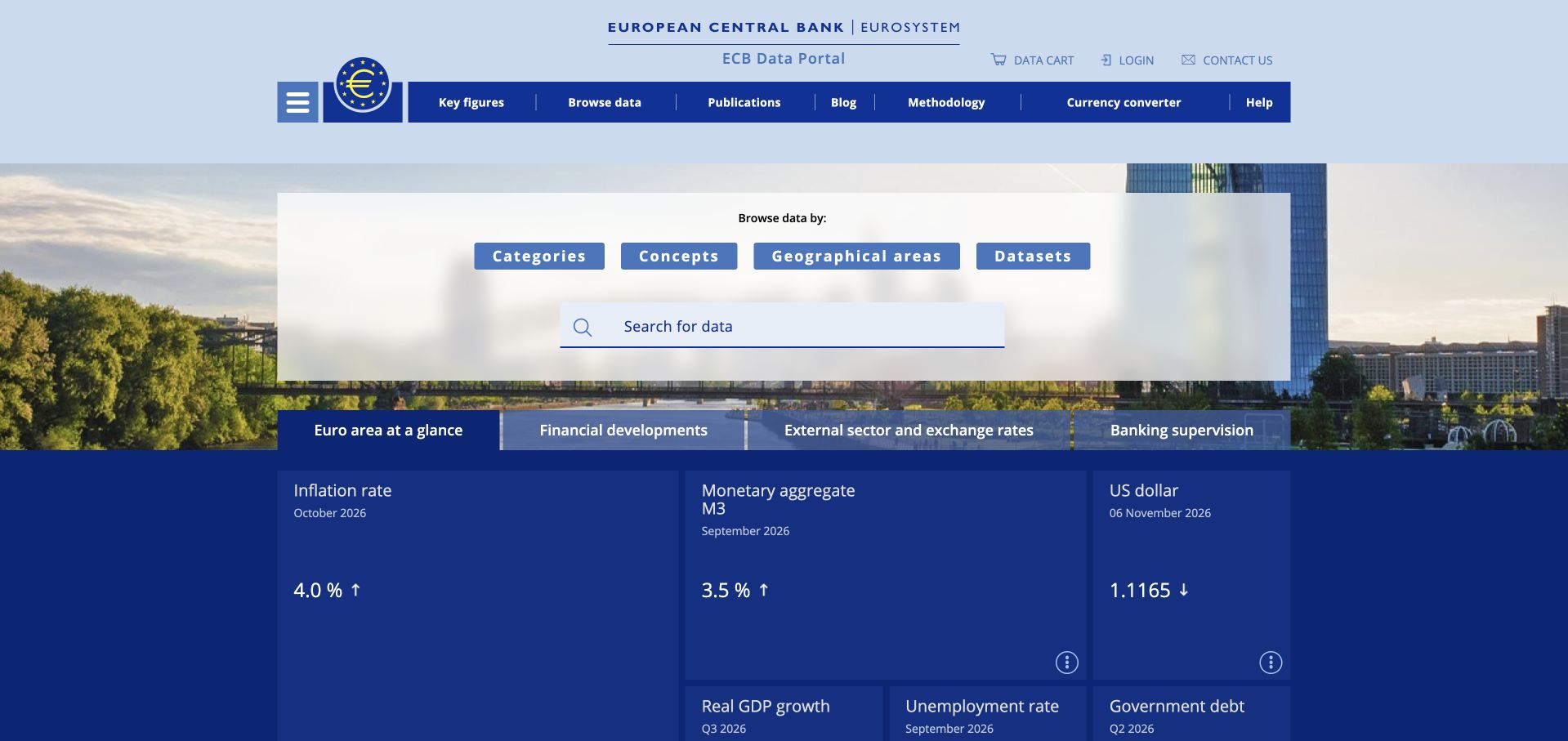
The ECB Data Portal puts a large data-search field beside four browsing concepts: categories, concepts, geography and datasets. A blue navigation band separates key figures, publications, methodology and help. Below, an at-a-glance dashboard pairs each indicator with its reference period, while updates and release information continue the page. Account and data-cart routes sit outside the main discovery choices. The Matomo association comes from the portal's own processing record, not from the appearance of the charts.
What you can learn
Use several understandable entry routes into a complex collection, then measure which route helps readers reach a useful dataset. Keep analytics events at the navigation and content level without collecting private account or download-cart details.
Pros
Reference periods make headline figures easier to interpret as dated observations.
Search and four browsing routes accommodate different levels of statistical familiarity.
Cons & considerations
If a dashboard depends on scripts, provide readable values and an understandable failure state.
Validate analytics against the portal's privacy choices; a page visit alone does not prove which tracking requests were permitted.
Platform source: Official property-specific analytics disclosure. The ECB's official processing record specifically names the ECB Data Portal and describes Matomo as its usage-statistics service, including Matomo Cloud among its processors. This is documentary evidence for the named portal, not for the whole ECB web estate or its private account features. Platform evidence is separate from the direct website screenshot and is not a complete current infrastructure audit.
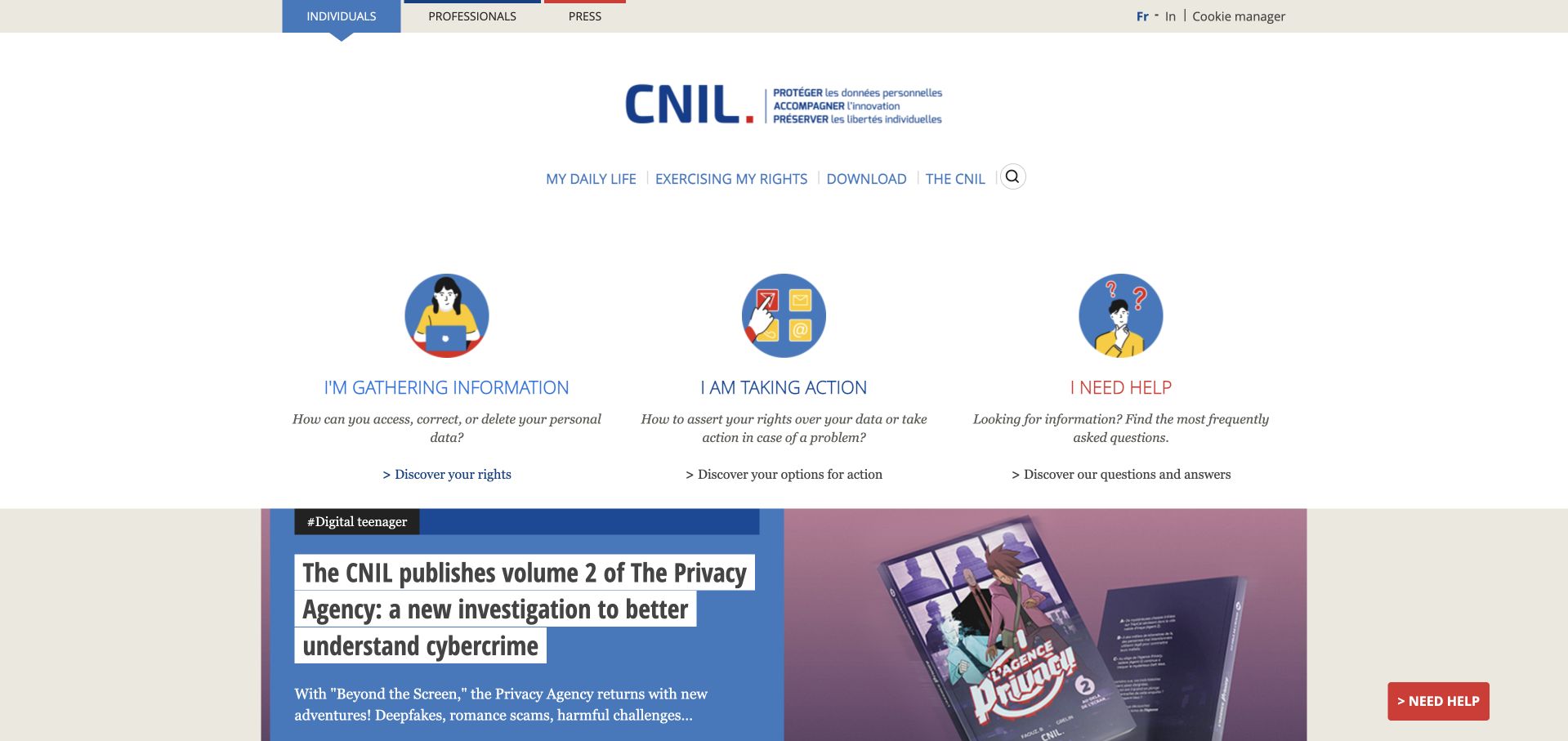
CNIL's public individual-facing page begins with separate audience choices for individuals, professionals and the press. Three illustrated columns then distinguish learning about rights, taking action and finding help. News and educational material follow that stable task structure. The restrained blue, red and cream system gives the site a recognizable identity without making a campaign the only entrance. Its own notice identifies Matomo; the capture is the browser-rendered, translated view of the public French property.
What you can learn
Define success around a reader finding the right kind of help, not simply clicking the most prominent news item. An audience selector and a help shortcut provide useful measurement boundaries without recording the substance of someone's concern.
Pros
Audience routes are visibly separate from the three immediate citizen tasks.
Short explanatory text makes the illustrated actions understandable without interpreting the icons alone.
Cons & considerations
For regulatory content, preserve the official language and source when presenting any translated view.
Keep sensitive complaint details and free-text searches out of analytics event names and URLs.
Platform source: Official property-specific analytics disclosure. CNIL's own data-protection notice explicitly applies to cnil.fr and identifies audience-measurement Piwik (Matomo), with its corresponding cookie names. The association is scoped to the public cnil.fr property; it does not establish its private tele-services or a complete configuration audit. Platform evidence is separate from the direct website screenshot and is not a complete current infrastructure audit.
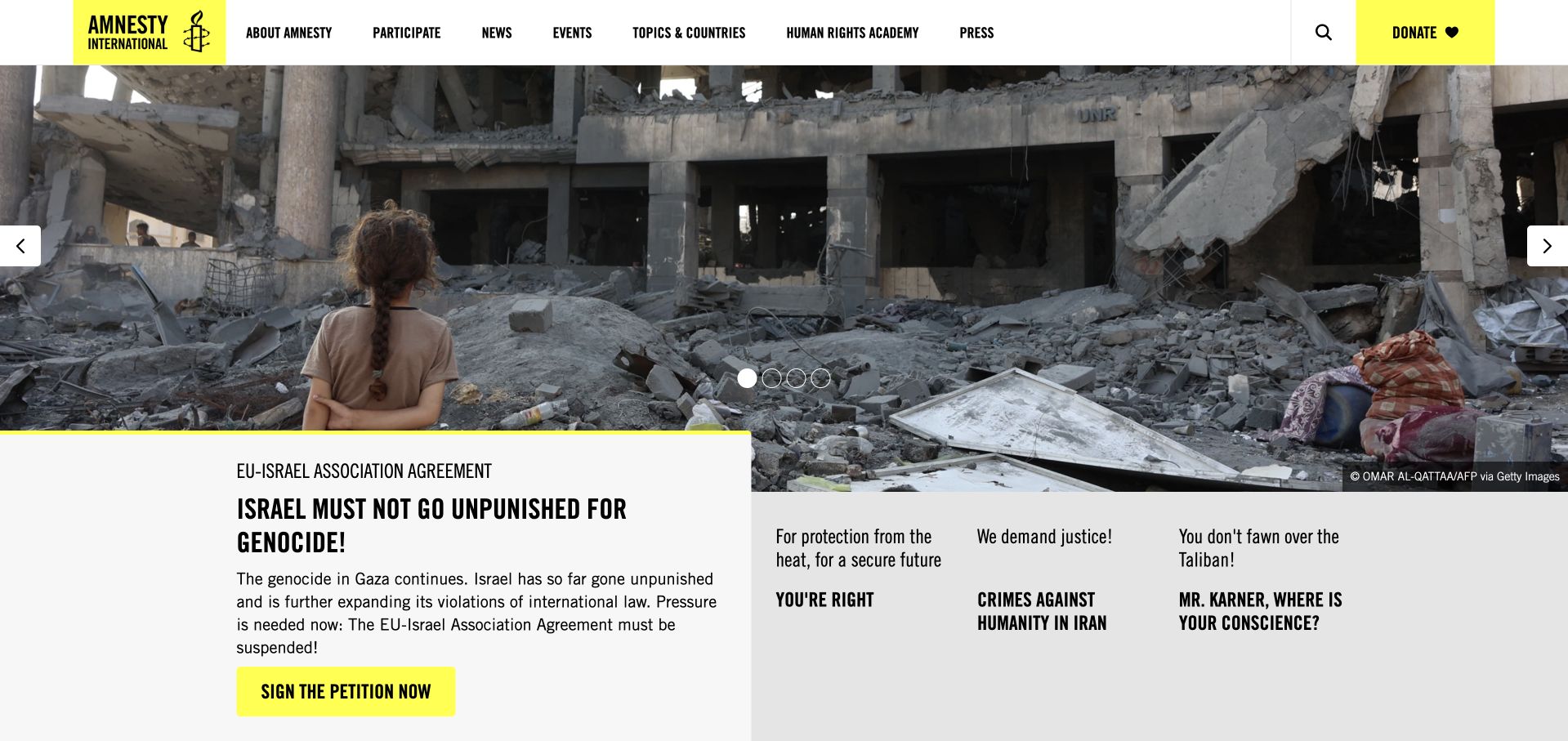
Amnesty Austria uses the organization's yellow identity to frame a large campaign photograph and direct action panel. News, events, topics and participation remain available in a persistent header, while other campaigns form a secondary set of choices. Donation promotion can also appear separately from the underlying homepage. The Matomo evidence belongs to this Austrian property and its privacy notice; it does not establish the analytics used by every national section or the external petition and donation services.
What you can learn
Separate learning, participating and donating in the design and the measurement plan. A campaign click is a different event from completing an action, and an external service requires its own evidence and privacy boundaries.
Pros
The high-contrast identity keeps navigation recognizable around changing campaign imagery.
News, events and topical information remain distinct from the primary appeal.
Cons & considerations
If a donation overlay appears, keep dismissal obvious and preserve access to ordinary information.
Do not send petition text, political-interest labels or donation details into general analytics simply because a tracking tool supports custom events.
Visible tech stack
Earlier / documented evidence
Matomo
Platform source: Official property-specific analytics disclosure. Amnesty International Austria's own privacy notice says it uses Matomo to optimize its web offering and has disabled tracking cookies. This supports the amnesty.at property only, not amnesty.org, its other national sections or the separate donation and petition services. Platform evidence is separate from the direct website screenshot and is not a complete current infrastructure audit.
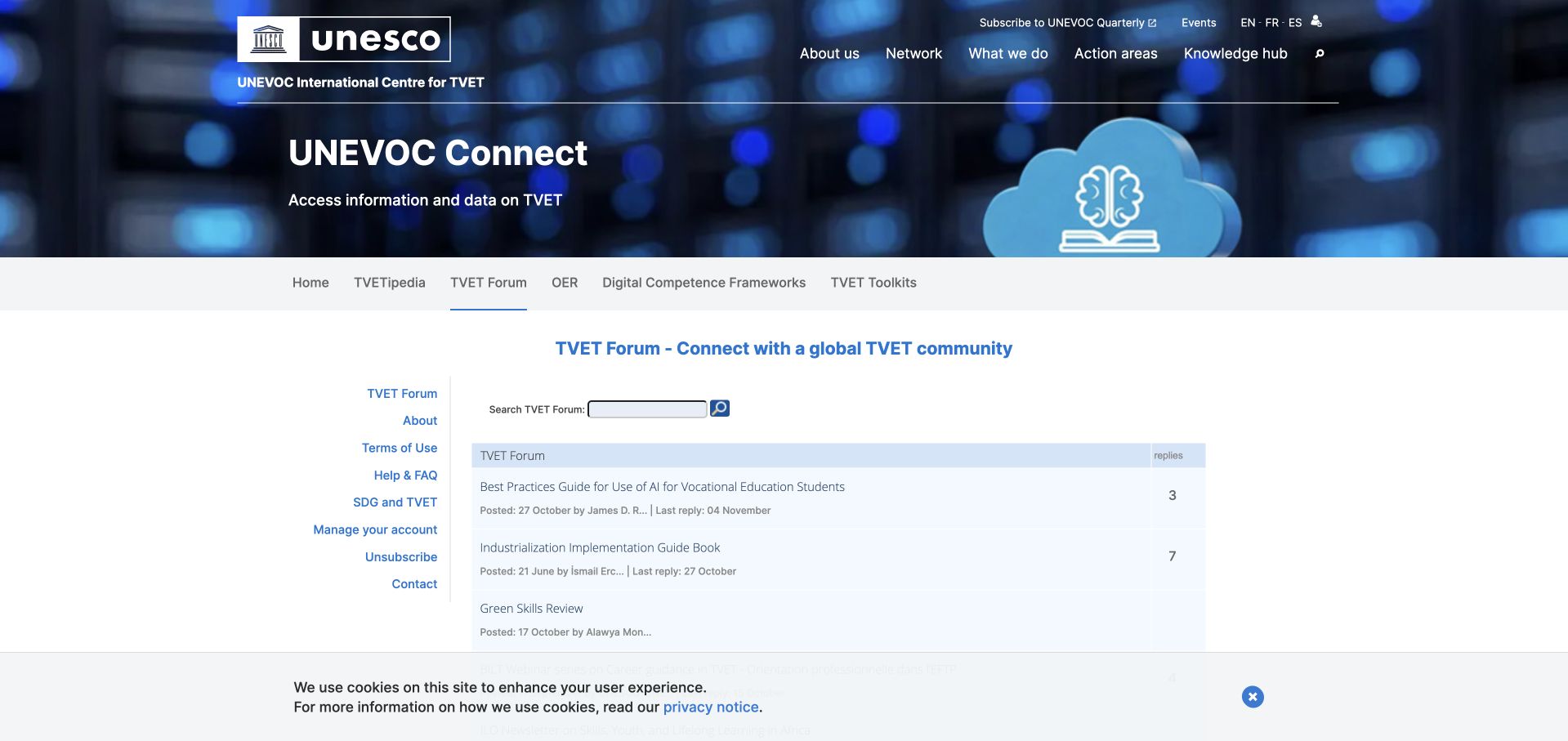
UNESCO-UNEVOC Connect presents its public TVET Forum beneath the institutional identity and a clear knowledge-hub section title. A second navigation layer distinguishes the forum from the glossary, resources and toolkits. The directory pairs topic names with posting activity and reply counts, while a dedicated forum search supports a narrower task than the global search. Participation and account management are separate routes. The Matomo disclosure applies to this Connect property, not the whole UNESCO web estate.
What you can learn
Measure public discovery and movement between knowledge formats without treating forum reading as permission to collect participant identities. Keep public search, account access and contribution journeys separate in both the interface and event taxonomy.
Pros
The local navigation explains where the forum sits within the broader resource hub.
Topic titles, dates and reply counts make the directory useful before authentication.
Cons & considerations
Give small search controls explicit labels and generous targets on mobile and at zoom.
Exclude participant names, discussion text and potentially sensitive search terms from analytics payloads.
Platform source: Official property-specific analytics disclosure. The UNESCO-UNEVOC data privacy notice on the Connect property explicitly identifies Matomo as a third-party website-analytics service and provides an opt-out. The capture is its public TVET Forum directory on that same Connect origin, not the separate UNESCO corporate website or authenticated forum activity. Platform evidence is separate from the direct website screenshot and is not a complete current infrastructure audit.
Stockholm University's English homepage keeps education, research and university information in a short dark-blue header. A large moving scene introduces the institution, followed by focus stories, dated research news and an events calendar. The pause control is visible in the media area. This is useful as a multi-audience academic example because recruitment does not erase research discovery. The university's own tools page explicitly extends its Matomo service to su.se pages; the screenshot does not expose departmental dashboards.
What you can learn
Use a stable content taxonomy to compare public education and research discovery, while keeping individual student or staff activity outside a general marketing measurement plan. Evaluate whether people reach the appropriate resource rather than treating every long visit as success.
Pros
Three persistent academic destinations remain clear while the featured stories change.
Dated news and calendar records distinguish current activity from the enduring institutional introduction.
Cons & considerations
Ensure video has a useful still alternative and remains understandable with motion disabled.
Keep course inquiries, authentication identifiers and student information out of public-site analytics records.
Platform source: Official property-specific analytics disclosure. Stockholm University's official Matomo tools page says its Matomo service measures SU websites and explicitly covers all pages on the su.se domain. The association therefore includes the captured su.se English homepage; it does not disclose the configuration or consent state of an individual visit. Platform evidence is separate from the direct website screenshot and is not a complete current infrastructure audit.
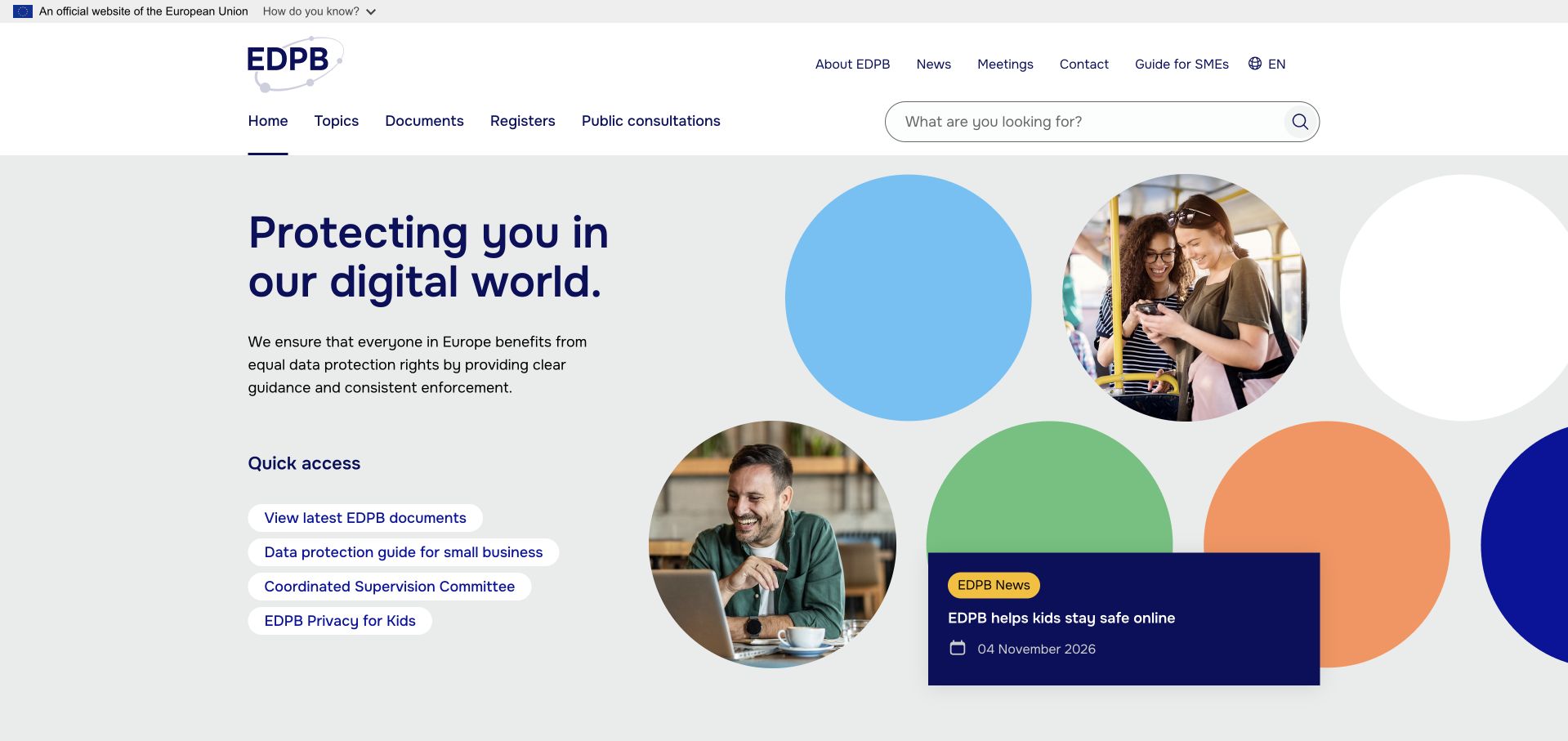
The EDPB combines a short public-facing introduction with quick links to documents, small-business guidance, supervision and children's resources. Its circular photographic composition gives the homepage character without competing with the search field. Separate document and news sections support more specialist readers below. The cookie interface explains the choice between aggregated statistics and essential cookies. Matomo is documented through the EDPB's own Europa Analytics policy, not inferred from its institutional branding.
What you can learn
Measure the usefulness of distinct public-resource routes while preserving the consent state under which a visit occurred. A document download, a guidance visit and a consultation action need different meanings; they should not be flattened into one conversion label.
Pros
Quick-access links make several high-value destinations visible before the longer publication lists.
Search and primary navigation are clearly separated from the featured news card.
Cons & considerations
Test the combined cookie-banner and keyboard-focus state so privacy choices do not obscure resource discovery.
A Matomo disclosure is not evidence that every visitor is tracked; verify the behavior of each consent state in a controlled implementation.
Platform source: Official property-specific analytics disclosure. The EDPB's own cookie policy explicitly identifies Europa Analytics for the EDPB website and names its Matomo platform. It describes consent-dependent aggregated statistics. This is a disclosed analytics association, not a finding that a request was sent during the captured essential-cookie view. Platform evidence is separate from the direct website screenshot and is not a complete current infrastructure audit.
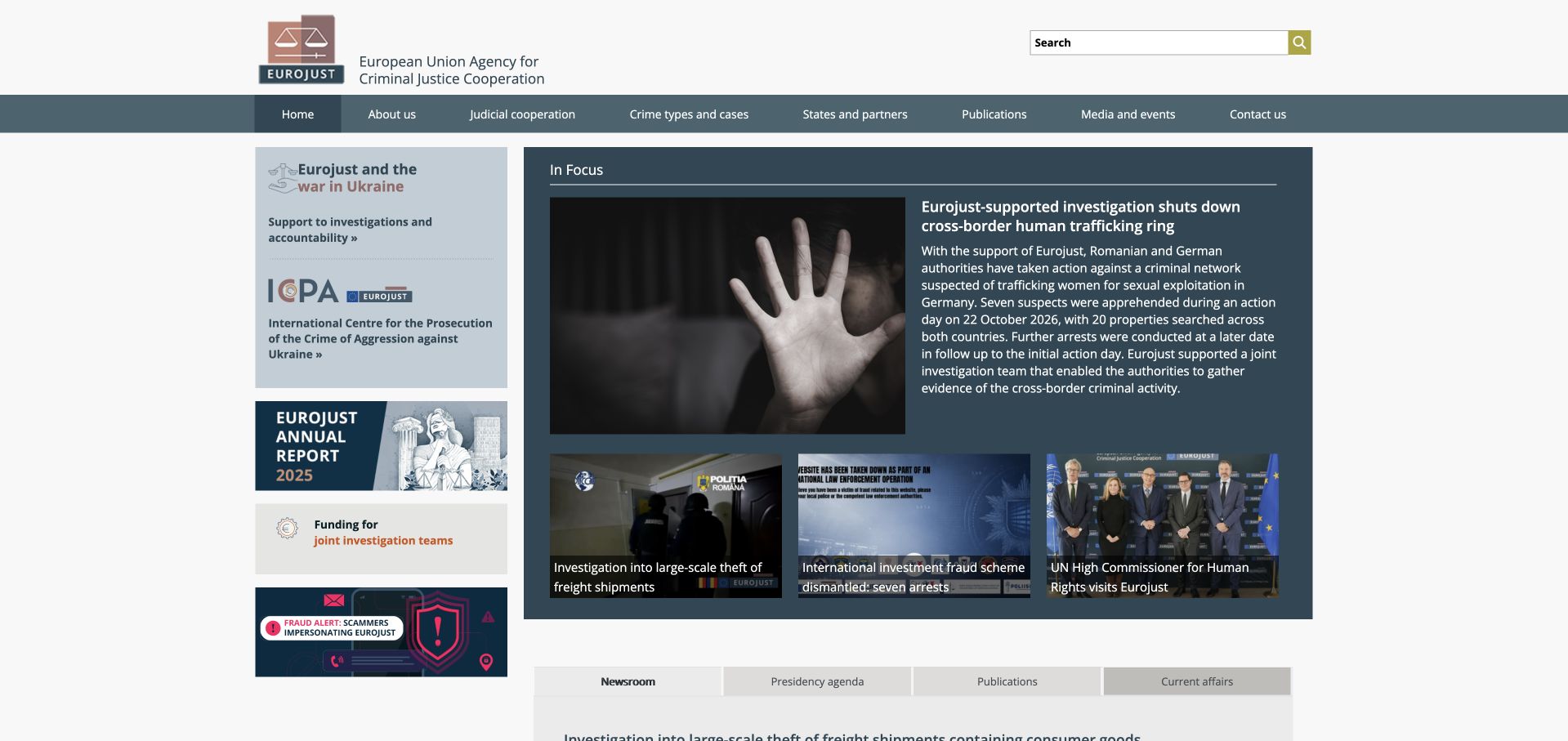
Eurojust places a prominent current-affairs feature beside a column of important initiatives, with a conventional navigation bar for cooperation, cases, partners and publications. A tabbed area distinguishes newsroom, agenda, publications and current affairs. The layout is information-dense but purposeful: several professional audiences can reach different material without entering a private case system. Its website disclaimer identifies Matomo through Europa Analytics. The public homepage offers no basis for conclusions about protected judicial applications.
What you can learn
Choose measurement boundaries around public content types and destination links. Report downloads and topic navigation may be useful signals, but private investigations, case identifiers and operational material should never be copied into general website analytics.
Pros
The initiative column preserves long-running resources beside rapidly changing news.
Tabbed content distinguishes publication and agenda tasks without requiring separate homepage campaigns.
Cons & considerations
Keep tabs keyboard-operable and communicate the selected state beyond color.
Avoid interpreting public interest in a crime topic as an individual profile; aggregate reporting and careful retention are important design constraints.
Platform source: Official property-specific analytics disclosure. Eurojust's official website disclaimer identifies Matomo as the analytics tool managed through Europa Analytics and discusses the website's analytics identifier. The evidence supports the named public Eurojust website, not judicial case systems, protected investigation data or all agency applications. Platform evidence is separate from the direct website screenshot and is not a complete current infrastructure audit.
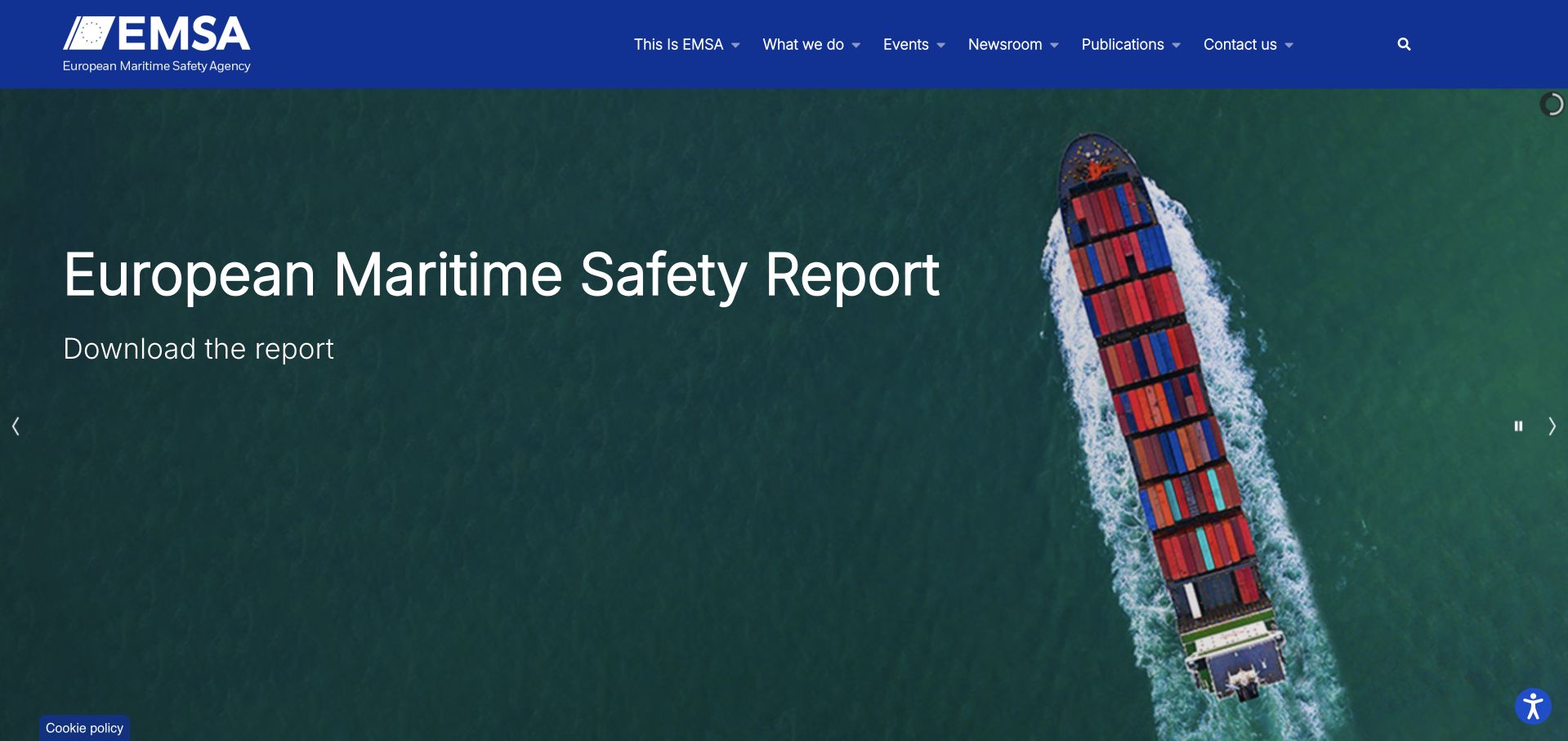
EMSA gives its maritime safety report a large photographic opening with a direct download message. A blue header names the agency and separates its work, events, newsroom and publications. Further sections group monitoring and environmental resources into thematic destinations, while the slideshow exposes pause and navigation controls. The agency's own disclaimer documents Matomo for its public websites. That statement should not be extended to specialized maritime applications or the embedded video service.
What you can learn
Use the major report as an accessible route into the wider knowledge collection. Measure a report download, thematic navigation and an external-service handoff separately, so an attractive campaign does not become the only outcome the analytics recognizes.
Pros
Visible slideshow controls make the opening's movement an explicit interaction.
Thematic resource links provide context beyond a single report promotion.
Cons & considerations
Offer document format and accessibility information before large technical downloads.
Keep website analytics distinct from operational monitoring systems; the public Matomo association says nothing about their data or implementation.
Platform source: Official property-specific analytics disclosure. EMSA's official disclaimer states that EMSA websites use Matomo for web statistics hosted on EMSA servers. This supports the captured public emsa.europa.eu site; it does not imply that every maritime monitoring service, extranet or embedded third-party video uses the same analytics configuration. Platform evidence is separate from the direct website screenshot and is not a complete current infrastructure audit.
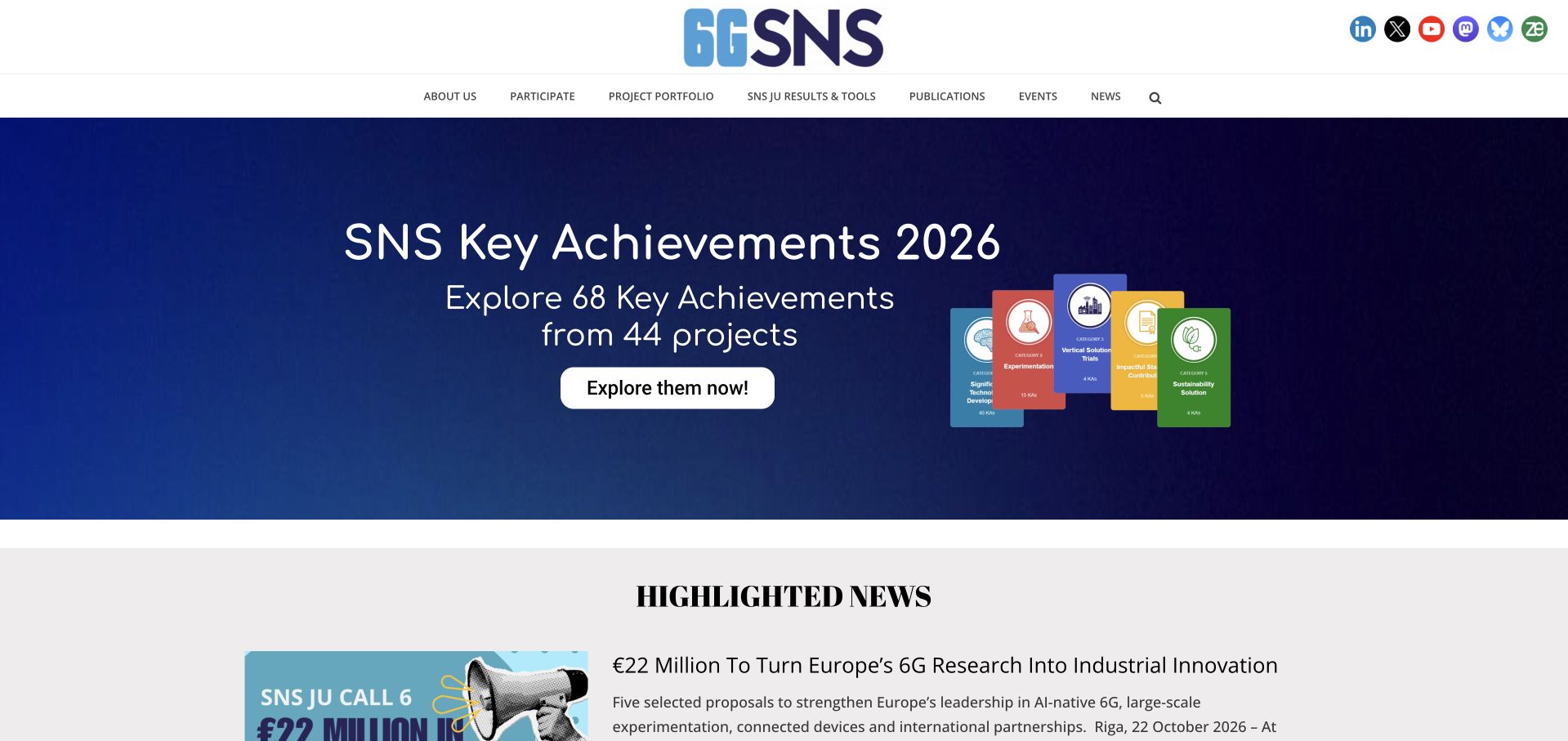
SNS JU uses a large results campaign above a news-led homepage. The header distinguishes participation, the project portfolio, publications and results tools, while the opening points toward a structured set of achievements. A live social feed adds another editorial layer below the site's own news. Its data-protection declaration explicitly identifies Matomo Analytics for WordPress on this public property. The funded projects and linked social platform remain separate properties with their own evidence requirements.
What you can learn
Connect the analytics plan to research-information tasks: finding a project, opening a result or locating a participation route. Keep externally hosted social interactions and partner websites outside the definition of an internal page journey unless the handoff is explicitly modeled.
Pros
The named project portfolio provides a durable destination beneath changing news and campaign banners.
Results and participation have different navigation labels, reflecting different user intentions.
Cons & considerations
If essential results appear in a large banner image, repeat the key information in readable text.
A social feed should supplement maintained program content, with a useful fallback when its provider is unavailable.
Platform source: Official property-specific analytics disclosure. The SNS JU's own data-protection declaration has a Matomo Analytics section expressly describing Matomo for WordPress on this website. This directly supports the smart-networks.europa.eu public property, not the websites of funded projects or its LinkedIn feed provider. Platform evidence is separate from the direct website screenshot and is not a complete current infrastructure audit.
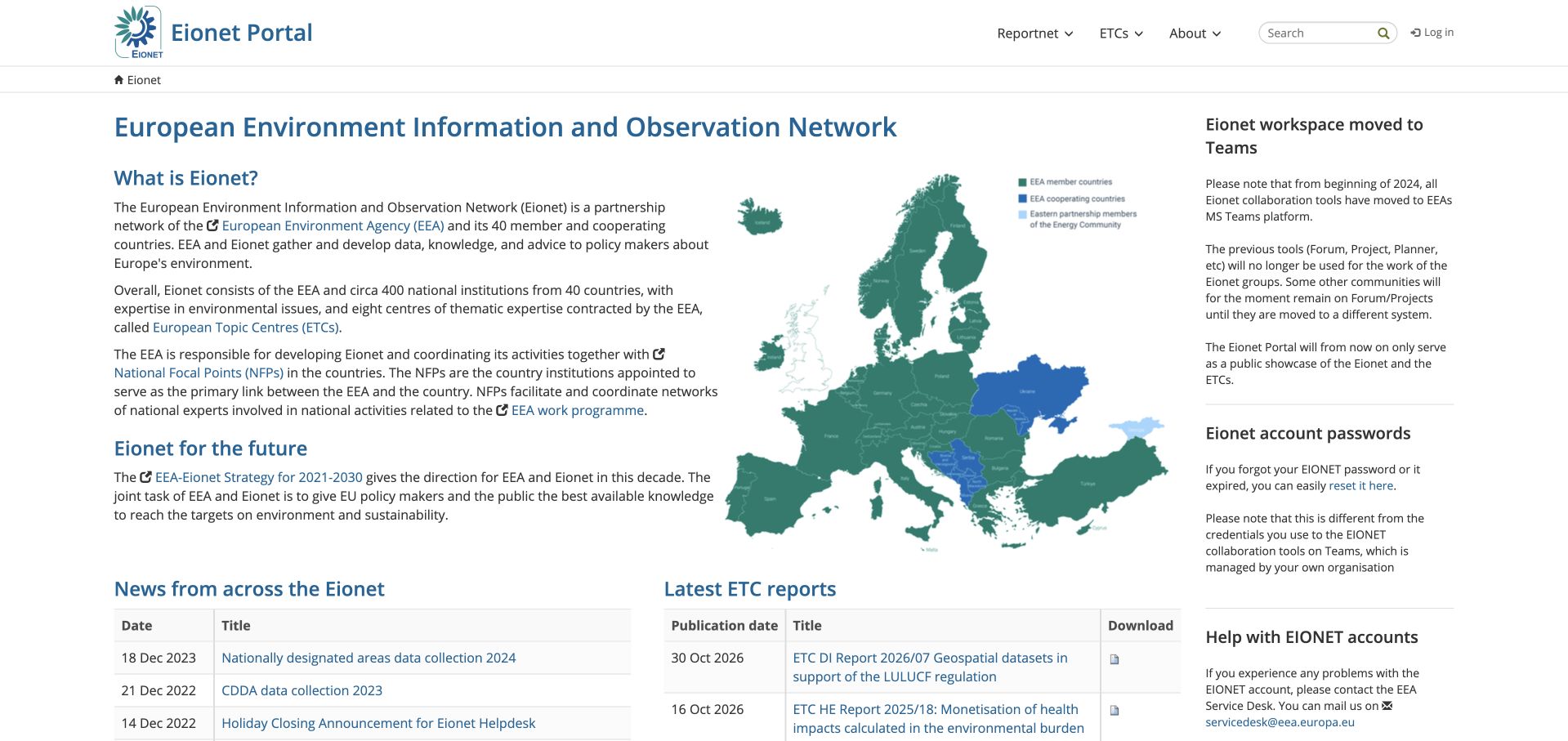
Eionet's homepage combines an explanation of the network with a geographic map, recent reports and a sidebar notice about collaboration tools moving to Teams. Its public purpose is stated plainly rather than disguised behind an outdated community interface. Report listings distinguish publication dates and download links, while navigation keeps Reportnet and topic centers separate. The Matomo evidence comes from Eionet's own website privacy statement, not from the Teams platform or every linked environmental service.
What you can learn
Treat an organizational migration as a content and measurement boundary. Preserve public report discovery while distinguishing old collaboration destinations, current external tools and ordinary website navigation in any event or outlink reporting.
Pros
The sidebar explains the portal's changed role and where collaboration now occurs.
Report dates and download links make the public knowledge collection usable without login.
Cons & considerations
Relabel or archive old news so it does not compete with genuinely current reports.
Separate account-help and password-reset activity from general analytics; do not collect credentials, identifiers or recovery details.
Platform source: Official property-specific analytics disclosure. Eionet's own website privacy statement expressly describes EEA Matomo for the browsing experience of Eionet website visitors. This supports the public eionet.europa.eu portal, not the Teams collaboration platform to which some former community tools have moved. Platform evidence is separate from the direct website screenshot and is not a complete current infrastructure audit.
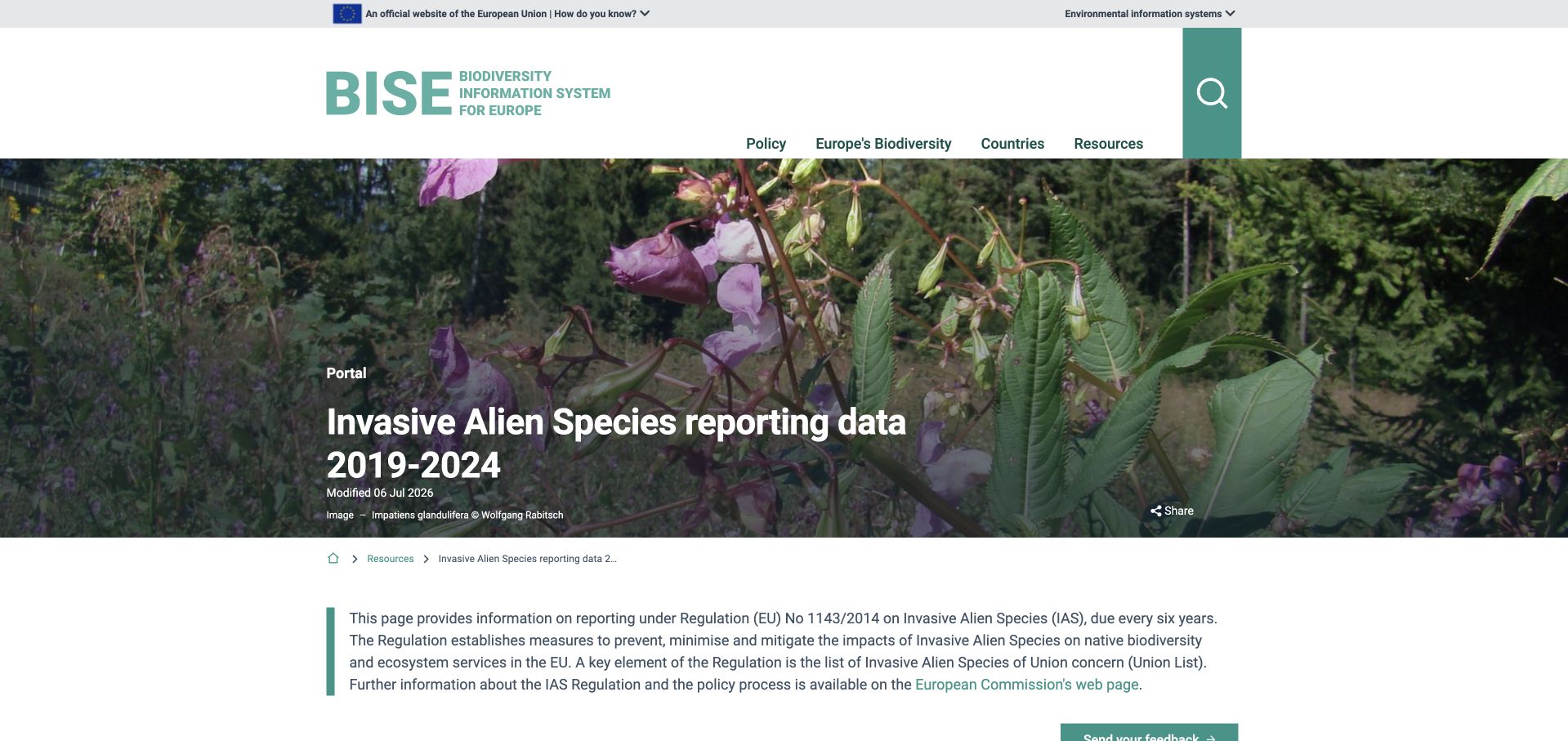
The BISE invasive-species page uses a botanical photograph to frame a clearly named reporting period and modification date. A breadcrumb then leads into explanatory text, headline figures and links to Union-level and national dashboards. The country links make the data collection navigable without requiring readers to begin inside a visualization. The portal-specific privacy statement identifies Matomo, and the public page exposes a matching Matomo script reference. Neither signal establishes the implementation of every embedded dashboard.
What you can learn
Build analytics around the transition from explanation to data: a country selection and a dashboard entry are more meaningful than raw time on a long page. Keep the reporting period and content version visible so usage of different editions can be interpreted correctly.
Pros
The reporting period and modification date establish context before readers encounter the figures.
Country and Union-level destinations provide several explicit routes into the dataset.
Cons & considerations
Audit national links carefully so a country label never points to another country's dashboard.
Provide accessible textual summaries and link descriptions alongside interactive visualizations and their separate loading states.
Visible tech stack
Earlier / documented evidence
Matomo
Platform source: Official property-specific analytics disclosure. The BISE-specific official privacy statement identifies EEA Matomo for the BISE portal. The captured page additionally exposes a public script reference to https://matomo.eea.europa.eu/matomo.js and a Matomo site ID of 12. These identify the public portal's analytics integration, not its data-dashboard backend. Platform evidence is separate from the direct website screenshot and is not a complete current infrastructure audit.
Climeworks opens with a close industrial image and a restrained floating navigation panel. Two prominent actions separate the direct-air-capture technology from the broader removal-solutions offer. The body explains those business areas before introducing partners and further resources. This makes a complex technical subject approachable without reducing the whole homepage to a purchase button. Matomo's case explicitly describes the linked company's website, but its reported outcomes are not independent proof of today's configuration or service performance.
What you can learn
Separate explanatory and commercial journeys before designing the measurement plan. A technology deep dive and a portfolio inquiry answer different questions, so define useful progress for each without treating interest as proof of a purchase or environmental result.
Pros
The two opening actions make distinct business responsibilities legible.
Real equipment imagery grounds an otherwise abstract technical proposition.
Cons & considerations
Keep environmental performance claims attached to their stated evidence and scope.
If the industrial image moves, provide pause controls, a useful still and readable overlay contrast across frames.
Visible tech stack
Earlier / documented evidence
Matomo
Platform source: Matomo's official, property-specific implementation case. Matomo's official Climeworks case links climeworks.com and specifically describes replacing Google Analytics on the company's website with Matomo and a cookieless approach. This is documented implementation evidence for that public web property, not a new audit of current tracker settings or carbon-removal performance. Platform evidence is separate from the direct website screenshot and is not a complete current infrastructure audit.
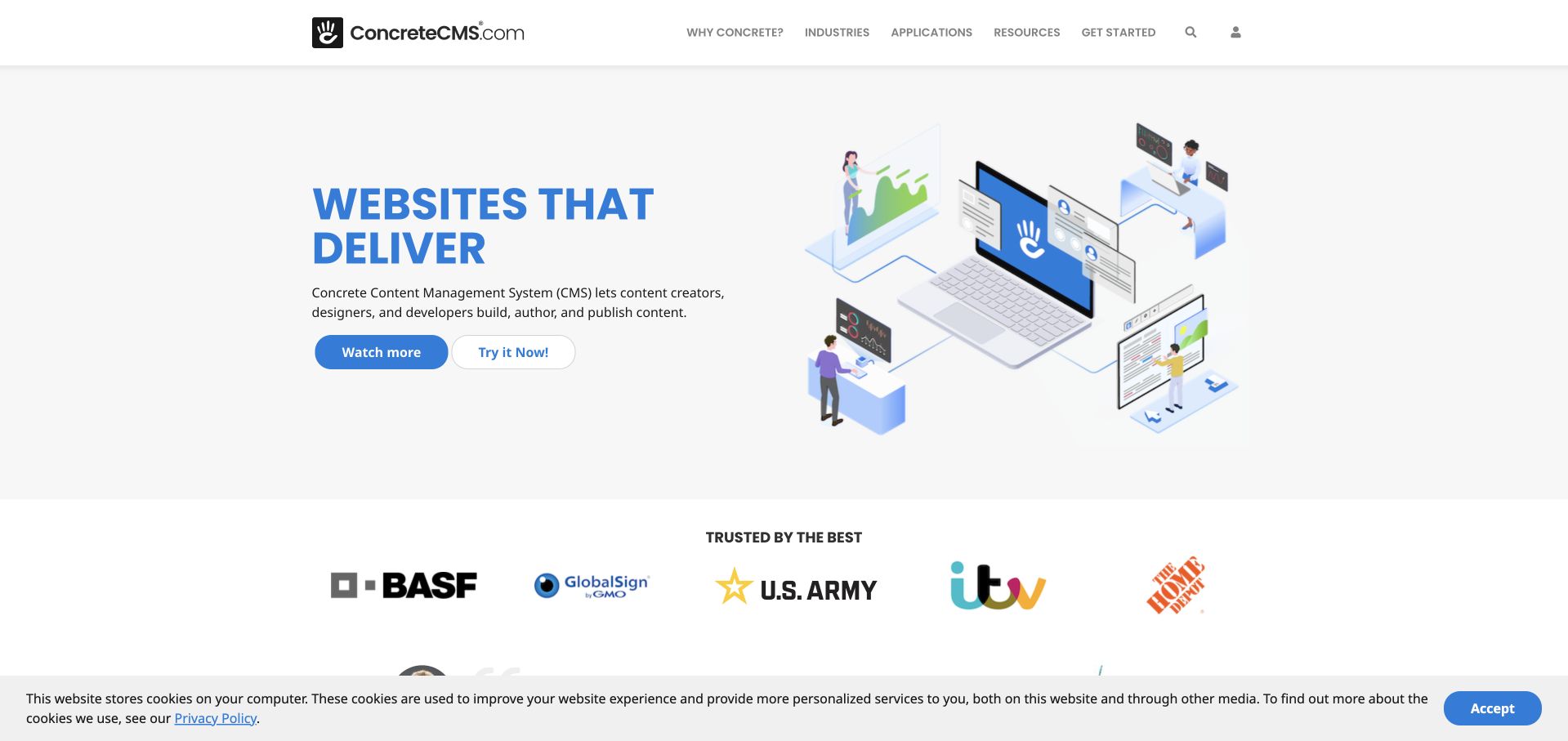
Concrete CMS introduces its product with an illustrative interface scene and a concise statement about building and publishing content. The navigation separates features and audience roles from industries, applications and resources. A trial route, feature details and a scheduled-demo route offer different commitments. Customer stories and support destinations give the page more depth than a simple feature checklist. The Matomo case concerns Concrete's own public website, not every customer implementation built with its CMS.
What you can learn
Measure the decisions your audience actually faces: exploring editor features, reading developer information, trying software or arranging a conversation. Keep those outcomes distinct, and test the public routes without creating an account or submitting a real lead.
Pros
Audience-specific destinations distinguish editorial needs from developer concerns.
Trial, feature and demonstration routes let visitors choose a suitable level of commitment.
Cons & considerations
Avoid using customer logos as proof of the complete technology stack of those organizations.
Review broad security and compliance claims with the relevant evidence, deployment scope and qualified owners before repeating them in a new project.
Platform source: Matomo's official, property-specific implementation case. Matomo's official Concrete CMS case links concretecms.com, shows and discusses the company's website, and describes using Matomo for its website and onboarding analysis. This is documentary association with the named public property; it does not assign Matomo to all customer websites made with Concrete CMS. Platform evidence is separate from the direct website screenshot and is not a complete current infrastructure audit.
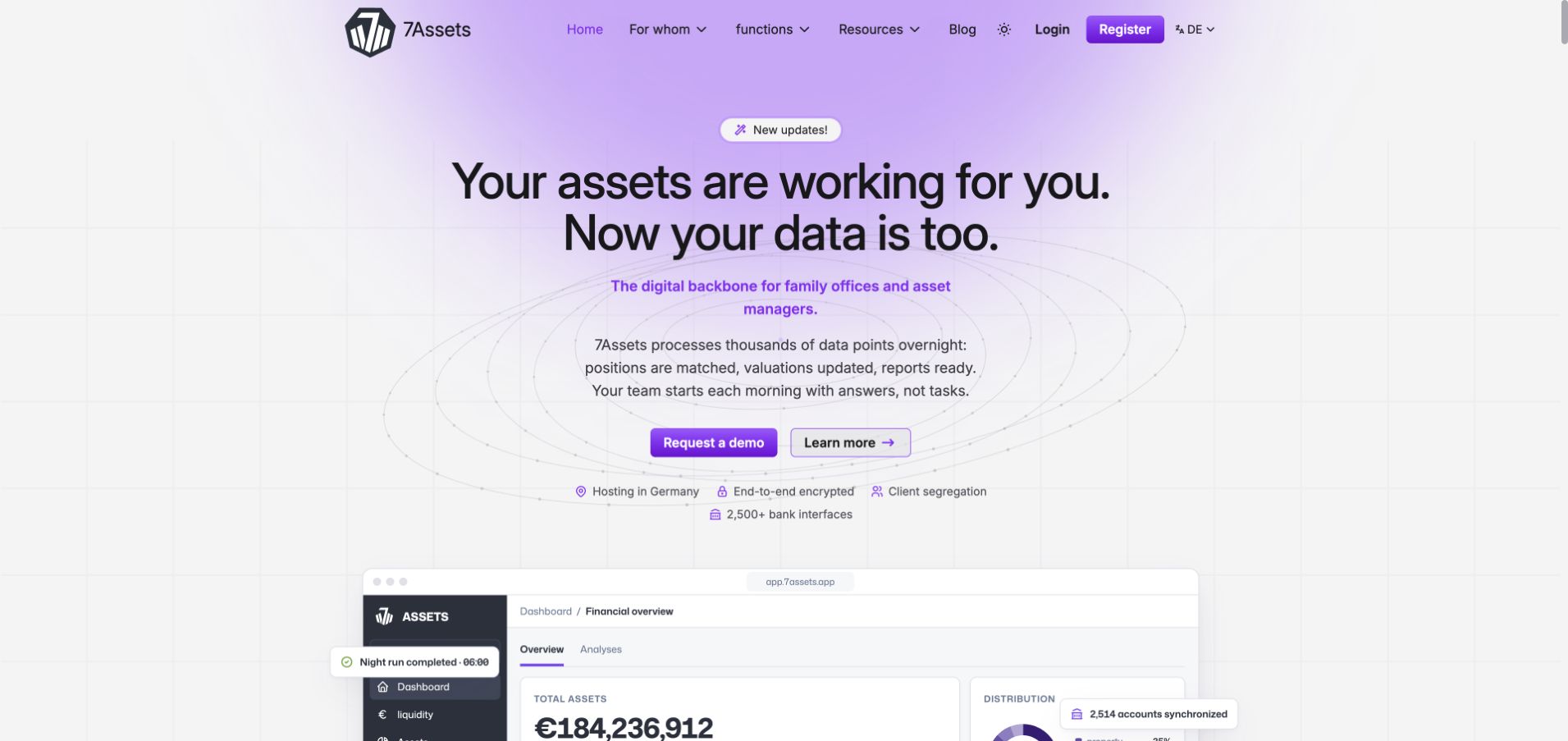
7Assets uses a light grid, purple accents and a large headline to explain its overnight data-processing proposition. The primary actions distinguish requesting a demonstration from learning more, while login and registration sit in the header. A product illustration and sequential workflow content explain what happens between connecting sources and preparing reports. The vendor case explicitly covers the public website as well as a separate platform; this capture shows only the marketing site in its browser-rendered translated view.
What you can learn
Define public content engagement independently from authenticated financial activity. A demonstration inquiry or workflow explanation can be measured without copying portfolio values, account details or customer identifiers into the website analytics layer.
Pros
The two main actions distinguish education from a direct sales conversation.
Workflow sections explain a process rather than presenting only a static dashboard image.
Cons & considerations
Treat marketing security claims as claims to verify, not evidence supplied by the visual design.
Keep private financial information and connection credentials out of URLs, event labels, session recording and other public-site analytics.
Platform source: Matomo's official, property-specific implementation case. Matomo's official 7Assets case links 7assets.app and explicitly distinguishes tracking the company's website and its separate platform with Matomo Cloud. The capture is the linked public marketing property only. Documentary evidence does not establish current private financial-data collection or a freshly verified tracker configuration. Platform evidence is separate from the direct website screenshot and is not a complete current infrastructure audit.
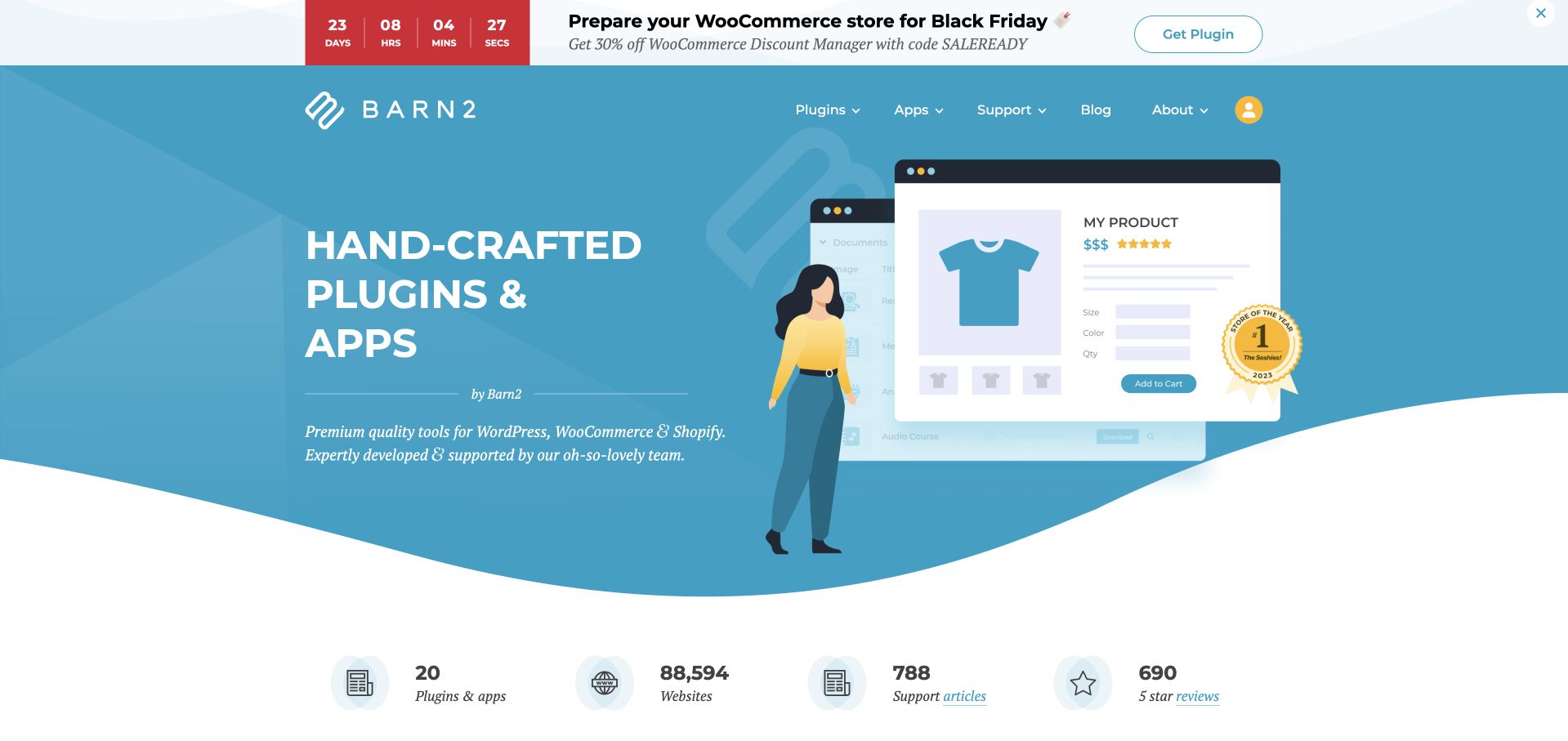
Barn2 uses a bright blue illustrated opening to introduce plugins and apps, followed by individual product sections explaining different website tasks. The header separates the catalog, support, blog and company information. Tutorials and a knowledge base receive their own destinations rather than being treated solely as search-engine content. A seasonal promotion occupies a separate banner. Matomo's implementation case refers to Barn2's own website and acquisition analysis, not analytics embedded by its products on customer sites.
What you can learn
Keep product discovery and support success separate in reporting. A visitor who finds the right documentation and leaves may have completed a useful task even without purchasing; a product comparison needs a different definition of progress.
Pros
Product sections explain use cases instead of asking visitors to choose from names alone.
Knowledge-base and tutorial routes support existing users as well as prospective customers.
Cons & considerations
Date and expire countdown promotions so returning users do not encounter stale urgency.
Check catalog and support navigation on small screens, and avoid recording license keys or customer-support text in analytics events.
Visible tech stack
Earlier / documented evidence
Matomo
Platform source: Matomo's official, property-specific implementation case. Matomo's official Barn2 case links barn2.com and specifically describes using Matomo to study the company's website design, blogs, referrals and conversions. This is a documentary implementation association for Barn2's own public site, not evidence that its WordPress plugins install Matomo on customer sites. Platform evidence is separate from the direct website screenshot and is not a complete current infrastructure audit.
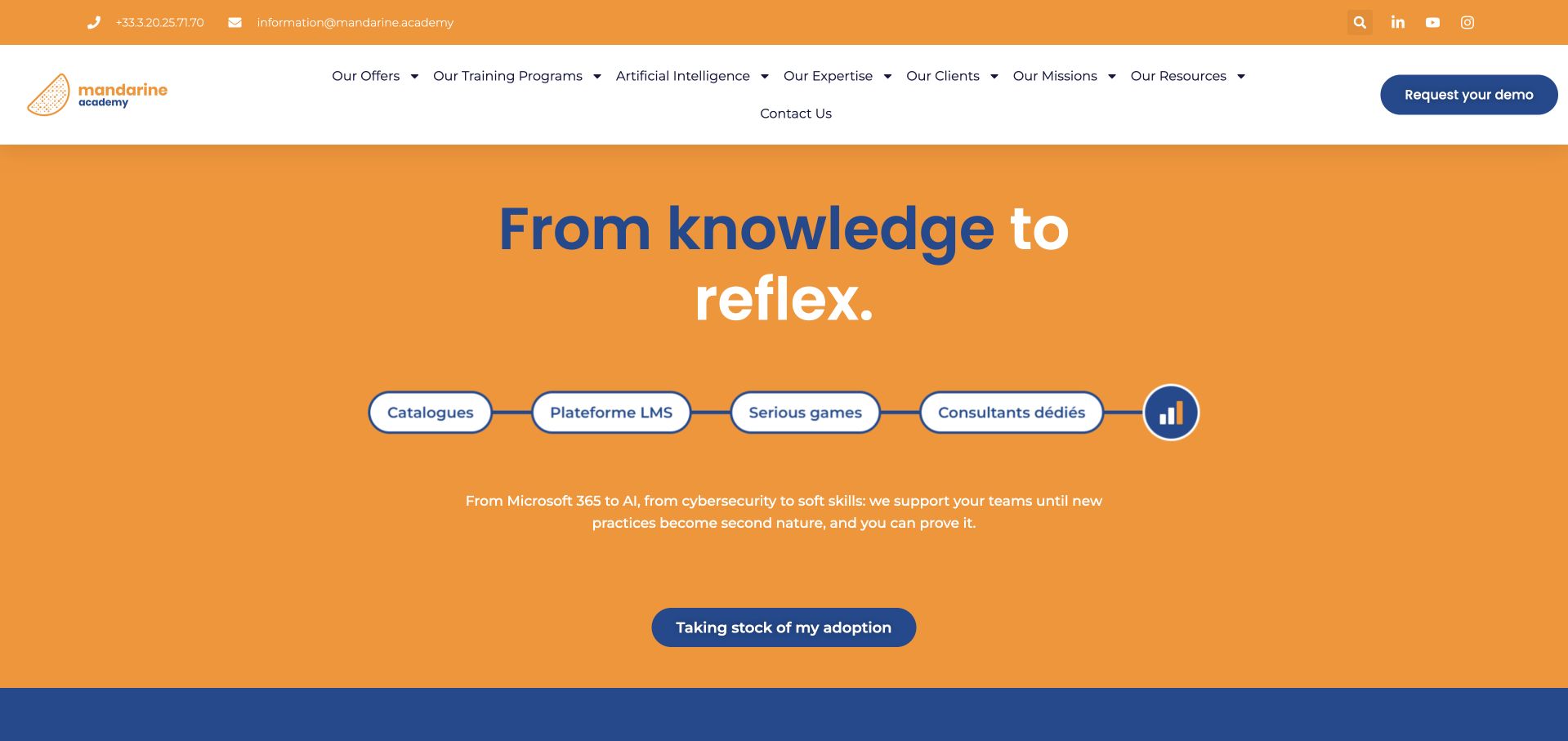
Mandarine Academy uses an orange opening with blue and white typography, a simple process graphic and a distinct assessment-oriented action. Its broad navigation separates offers, training subjects, expertise, clients and resources. Contact information and a demonstration route remain visible above the editorial introduction. The captured view is browser-translated; Matomo's official case explicitly concerns the linked Academy website and its user-experience analysis, not every learning platform or external lead form.
What you can learn
Translate a broad training offer into distinct discovery tasks before measuring it. Topic exploration, understanding the adoption method and requesting a demonstration are different intentions; a useful event taxonomy should preserve that difference without exposing learner or employee details.
Pros
The strong color system gives a text-led proposition an unmistakable identity.
Training, expertise and resources receive different navigation roles rather than one undifferentiated course list.
Cons & considerations
Audit placeholder image descriptions in client carousels so assistive readers receive meaningful names.
Keep a clear boundary between public marketing analytics and employee learning records or externally hosted inquiry forms.
Platform source: Matomo's official, property-specific implementation case. Matomo's official case links mandarine.academy and explicitly describes the integration of Matomo on the Mandarine Academy site to analyze its navigation and user experience. This is documentary evidence for the linked public web property, not a fresh audit of every learning platform or the separate lead-capture subdomain. Platform evidence is separate from the direct website screenshot and is not a complete current infrastructure audit.
Property Investments UK pairs a large headline with two different actions: browse properties or read the research. A founder introduction and publication references sit below, followed by service cards, location guides and beginner resources. The restrained cream and navy design makes the content hierarchy easy to scan. Its Matomo case explicitly discusses the linked public website and page-flow reporting. The analytics association does not validate the headline's investment figures, customer outcomes or suitability claims.
What you can learn
A research visit and a commercial inquiry should not be treated as interchangeable conversions. Measure movement between public guides and service explanations while keeping financial circumstances, budget details and inquiry text outside general analytics.
Pros
The research action gives cautious readers a route that does not immediately require a sales commitment.
Location guides organize a large content collection into recognizable geographic destinations.
Cons & considerations
Present investment claims with their methodology, dates, limitations and appropriate qualified review.
Avoid using analytics engagement as a proxy for a visitor's financial suitability or expected investment result.
Platform source: Matomo's official, property-specific implementation case. Matomo's official case links propertyinvestmentsuk.co.uk, depicts its website and describes Matomo Users Flow and page reporting for visitors moving through that site. This is documentary analytics evidence only, not validation of investment claims, performance, product suitability or the exact current tracking setup. Platform evidence is separate from the direct website screenshot and is not a complete current infrastructure audit.
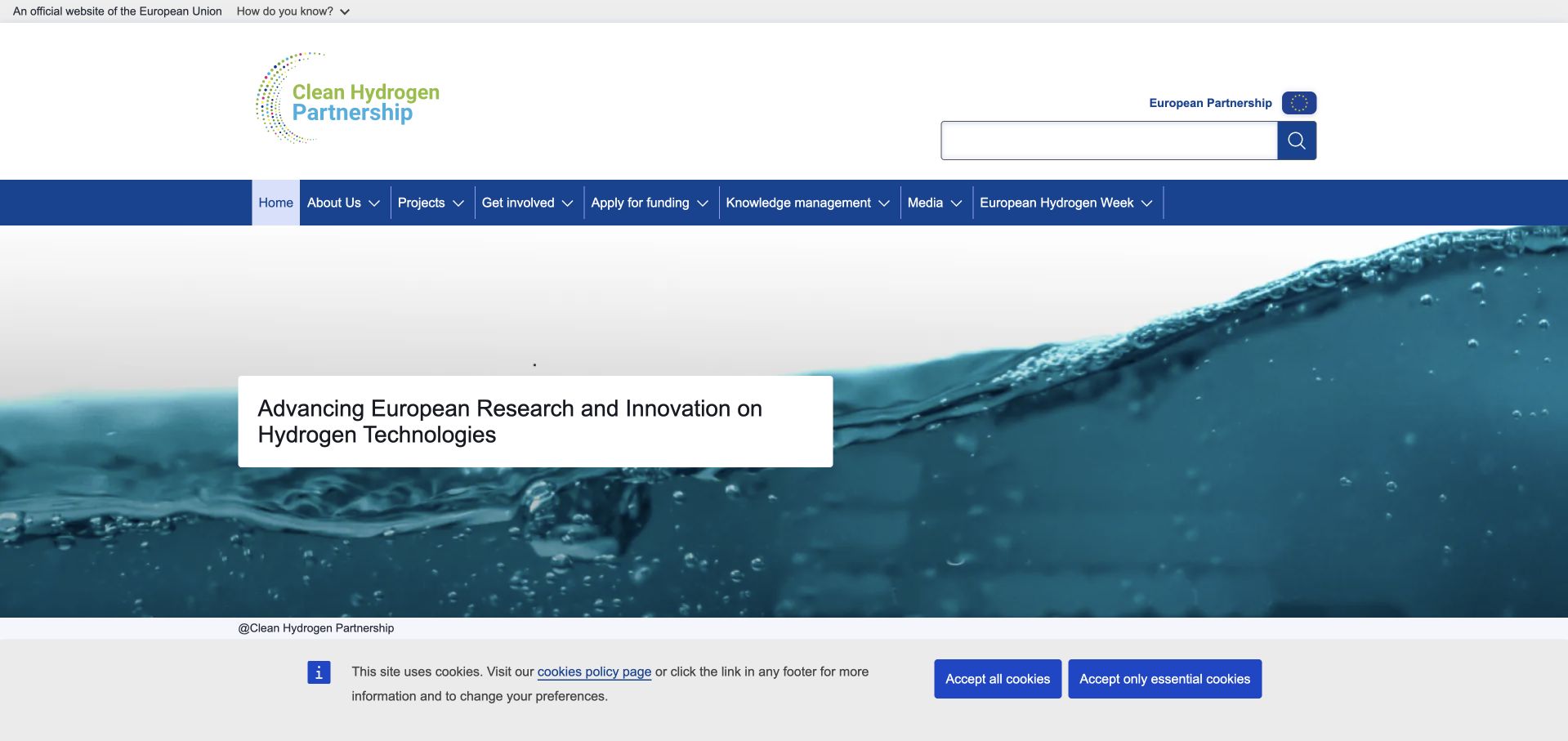
The Clean Hydrogen Partnership opens with an understated water image and a concise research-and-innovation statement. A blue navigation band separates projects, involvement, funding and knowledge management. Further down, dashboard, repository and success-story routes explain different ways to explore the program's output. The official cookie document identifies Matomo through Europa Analytics, while the page contains a property-scoped analytics configuration. Those signals concern the public website rather than every funded project's own tools.
What you can learn
Decide whether a visitor needs a funding opportunity, a project record or a learning resource, then give each task a distinct destination and measurement definition. A dashboard visit and an application submission should never share an ambiguous success label.
Pros
Project dashboard, repository and success stories are explicitly distinguished.
Funding and participation remain visible alongside the site's publication responsibilities.
Cons & considerations
Archive expired consultations and event promotions so old deadlines do not appear actionable.
Measure only the authorized public handoff to application systems; do not copy applicant identities or proposal material into general website analytics.
Platform source: Official property-specific analytics disclosure. The official Clean Hydrogen JU cookies document explicitly identifies Matomo through Europa Analytics for its website. The captured public page also declares the Webtools piwik analytics utility with siteID 218 and sitePath www.clean-hydrogen.europa.eu. This combines documentary Matomo identification with a current property-scoped integration marker. Platform evidence is separate from the direct website screenshot and is not a complete current infrastructure audit.
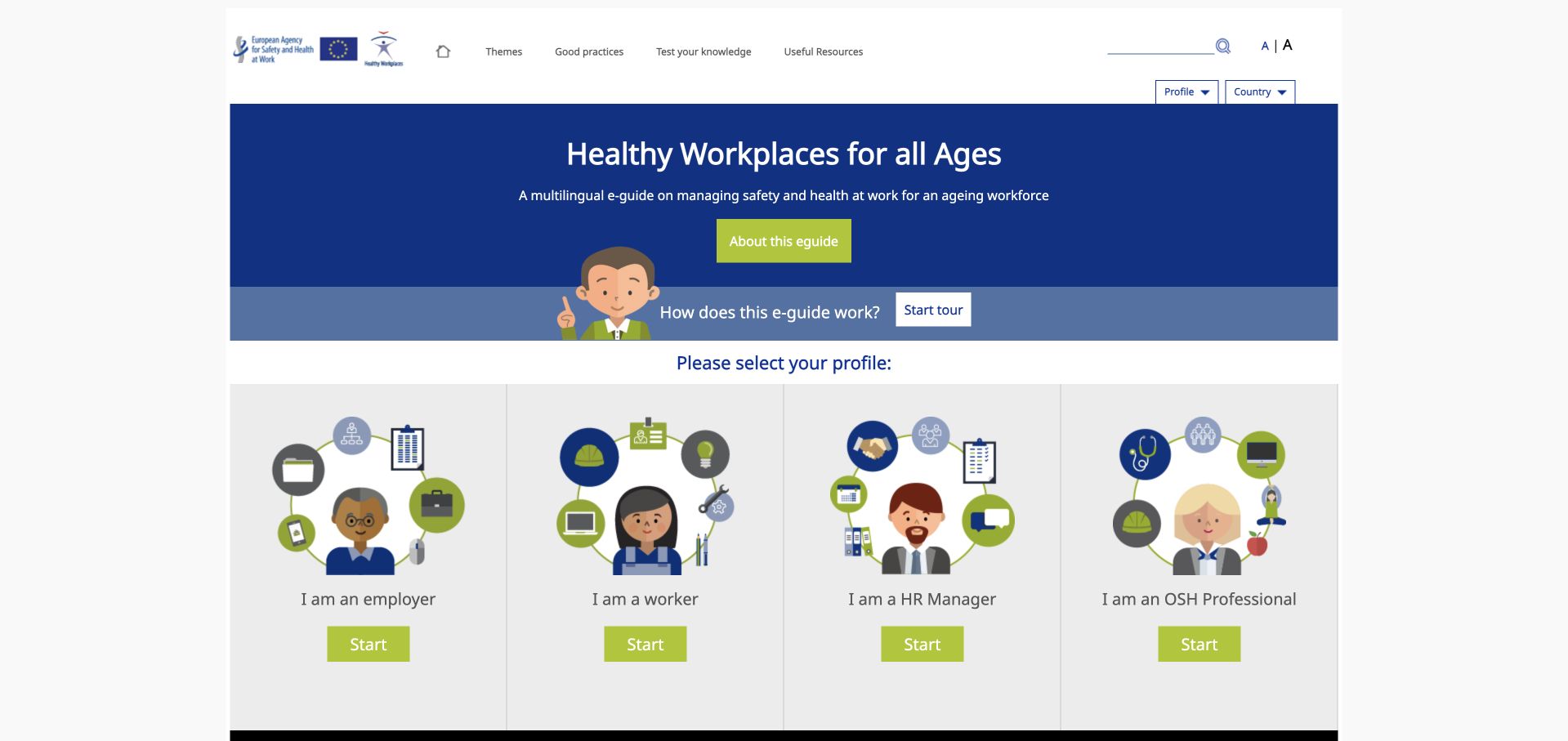
EU-OSHA's All Ages e-guide presents four illustrated starting routes for employers, workers, HR managers and safety professionals. A short introduction explains the subject, while a tour and resource navigation offer other ways in. The page is a useful example of role-based content discovery, not evidence that its guidance is current: a notice states that the resource is no longer actively maintained. Its own e-guide privacy policy identifies Matomo for web statistics.
What you can learn
Use audience routes to tailor information without turning a selected role into a detailed personal profile. Preserve the maintenance status and content date in both the interface and reporting, so visits to archived guidance are not mistaken for use of a current service.
Pros
Four role choices translate the guide's audience model into obvious starting actions.
The optional tour explains the interface before asking readers to navigate the full resource.
Cons & considerations
Keep the no-longer-maintained notice available after dismissal and direct readers to current authoritative material.
Do not collect health circumstances, workplace incidents or free-text questions as part of ordinary guide analytics.
Platform source: Official property-specific analytics disclosure. The e-guide's official privacy policy explicitly states that this website collects web statistics with Matomo hosted on EU-OSHA servers. The screenshot shows the same all-ages e-guide's public role selector. The site displays a no-longer-actively-maintained notice; the association is not a claim that its guidance remains current. Platform evidence is separate from the direct website screenshot and is not a complete current infrastructure audit.
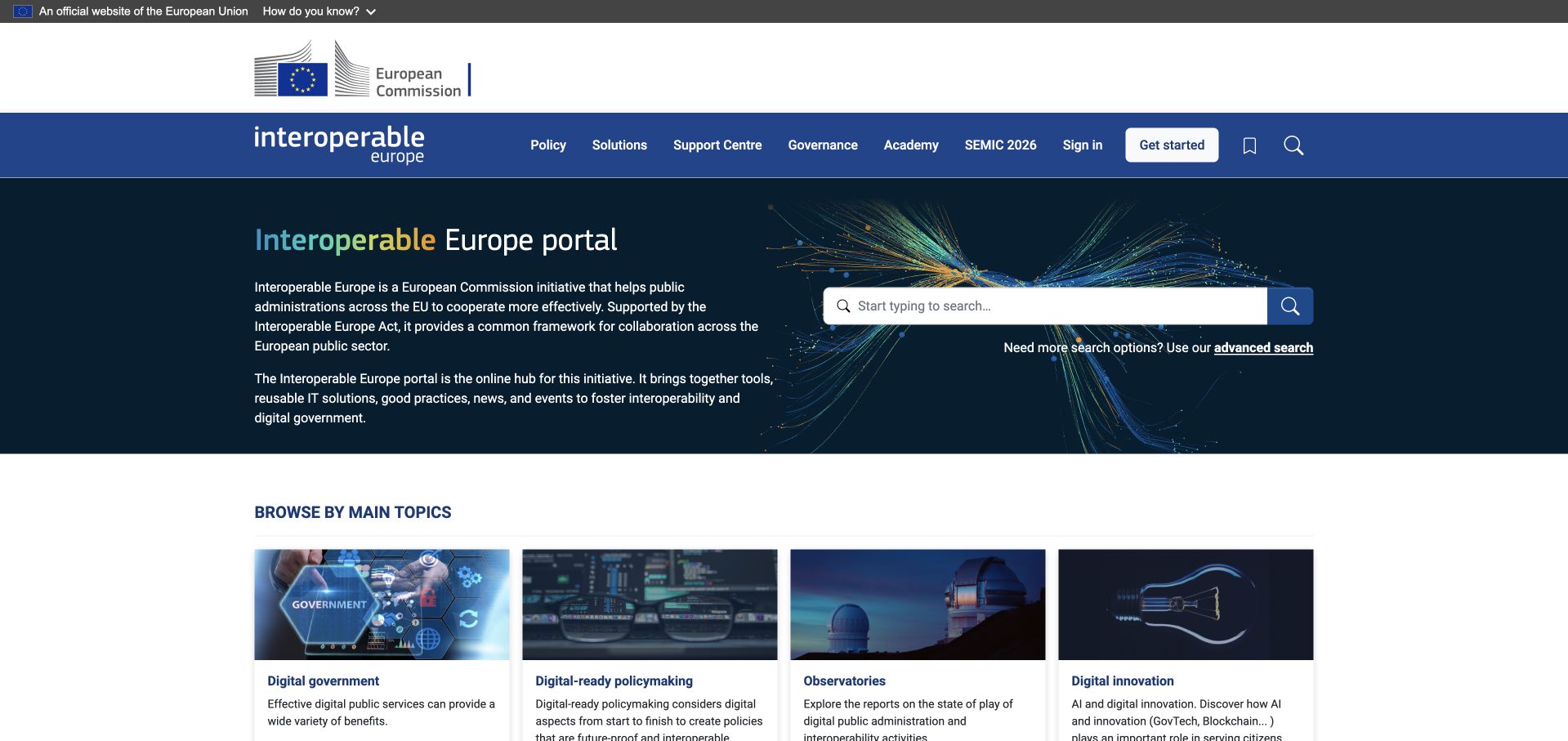
Interoperable Europe places a large search field beside a short explanation of the portal's purpose, then offers a grid of topics beneath it. The header separates policy, solutions, support, governance and the academy. News, events and community collections continue the page, while sign-in remains distinct from public discovery. Its official privacy statement names Matomo through Europa Analytics, and the public configuration names this exact portal. That evidence does not extend to every linked software solution or private EU Login interaction.
What you can learn
Model searching, browsing a topic and opening a reusable solution as separate public tasks. Define what useful discovery means before instrumenting community activity, and keep identity or contribution data outside a general marketing dashboard.
Pros
Search and topic browsing provide complementary entrances to a broad collection.
The navigation distinguishes policy context from practical solutions and training.
Cons & considerations
Test keyboard focus and empty-result recovery in the prominent search interface.
Document cross-property handoffs explicitly; a link to a solution is not evidence of its installation, use or underlying analytics stack.
Platform source: Official property-specific analytics disclosure. The official portal privacy statement identifies Europa Analytics / Matomo for non-registered visitors. The captured page also declares the public Webtools piwik utility with the exact interoperable-europe.ec.europa.eu sitePath. This supports this portal, not every Commission website or private EU Login activity. Platform evidence is separate from the direct website screenshot and is not a complete current infrastructure audit.
Kegan has 15+ years of experience working with small businesses, Fortune 500 companies, and everything in between. No development job is too big or too small: he brings the same hands-on attention to a focused improvement, a complete website, or a custom application.
For Matomo projects, he can help with website integrations, form and campaign connections, analytics implementation, testing, and clear ownership after launch. He works directly with clients on scope, design, implementation, testing, and handover, with an emphasis on clear communication and a system that remains practical to maintain after launch.
Show 3 other Matomo developersHide other Matomo developers
Choose the question your public website should answer
Public information and resource discovery
The ECB, Eionet and BISE examples suggest measuring discovery routes rather than rewarding raw page volume. Ask whether a visitor can reach an appropriate dataset or document through search, a topic category or an audience route. An additional page view may represent useful exploration or needless friction; interpretation needs the journey context.
Editorial understanding and participation
CNIL, Amnesty Austria and Stockholm University combine topical stories with practical routes. Decide which content helps a reader understand the organization and which supports a next task. Keep campaign interaction distinct from a completed donation, application or public service, especially when that action continues on a different property.
Product learning and qualified enquiries
Barn2, Concrete CMS and Mandarine Academy illustrate public product or training explanations before a commitment. Compare the clarity of use-case routes and supporting information, not the apparent size of a conversion number. Build a definition of a qualified outcome with the relevant team before creating reports around prominent buttons.
From references to requirements
Write the measurement brief before adding tags
Map one ordinary journey and one difficult journey
Start with a person arriving directly at a detail page, then a person who does not yet know the site's terminology. Sketch how each could reach useful information without creating an account. Record the points where navigation wording, search results or missing context could interrupt them. These are candidate design questions, not automatic instructions to track every step.
Create a compact measurement dictionary
For each proposed observation, write its plain-language question, trigger, stable name and expected interpretation. Distinguish a resource link opening from confirmed file consumption, and a lead-form route from a successful submission. Use controlled labels rather than copied text fields. Remove observations that have no owner or no plausible decision attached.
Keep sensitive material outside the analytics payload
Review URLs, page titles, search inputs and custom labels for information that should not leave the page. A public search can still contain a person's name or a private question. Define how such values will be omitted or reduced before collection, and verify that decision in a controlled test. Do not rely on a later report filter as the whole protection.
Specify visitor-choice states as acceptance tests
Describe the expected behavior before any choice, after acceptance, after refusal and after withdrawal, including a return visit. Check the analytics request and cookie behavior against those expectations using an authorized test environment. Keep the site's essential reading and navigation available when optional analytics is unavailable. Have the responsible privacy specialist review the intended configuration and wording.
Reconcile page identity and property boundaries
List the exact hostnames, language sections and external handoffs in scope. Choose a consistent reporting time zone and a policy for query parameters so one resource is not fragmented into many accidental identities. Keep campaign attribution separate from personal identifiers. Document where measurement deliberately stops instead of silently assuming that an external form or application shares the same integration.
Give reports a maintenance and decision cycle
Assign someone to investigate unexpected changes, review instrumentation after redesigns and retire unused observations. Record when a content migration or consent change affects comparability. Pair aggregate signals with accessible usability testing and editorial feedback. A low-traffic specialist resource may still serve an important public purpose, and analytics alone cannot decide whether that resource should disappear.
A useful handover demonstration
Ask the actual team to carry out its routine job: publish a realistic update, correct a mistake, preview a narrow screen, and identify who owns an integration failure. For a library or frontend framework, also ask who maintains the content source and deployment. A polished screenshot does not answer those operational questions.
Beyond the screenshot
Matomo website measurement checklist
Name the exact public property, not only the parent organization.
Separate analytics evidence from claims about the site's CMS or design.
Write a visitor question and decision owner for every proposed observation.
Distinguish a button click, an external handoff and a completed outcome.
Use stable, controlled event labels rather than personal or free-form content.
Inspect URLs, titles and search terms for unintended sensitive information.
Document domain aliases, excluded query parameters and the reporting time zone.
Specify expected request and cookie behavior for every visitor-choice state.
Test refusal, withdrawal and a returning visit in an authorized environment.
Keep reading and essential navigation usable when analytics cannot load.
Record changes that interrupt comparison across reporting periods.
Assign ongoing service, permission and measurement-quality responsibilities.
Test with real content, a keyboard, a small screen, slow or failed requests, and the people who will maintain the system. These are planning checks, not an accessibility, security, performance, or search-ranking certification.
Sources & editorial method
How this Matomo collection was reviewed
All twenty properties were independently inspected in a normal browser and captured directly on 6 November 2026 UTC; the source records retain actual capture timestamps, URLs and image dimensions. No vendor-showcase image, generated preview, logged-in screen or gated content was substituted. CNIL, Amnesty Austria, 7Assets and Mandarine Academy preserve browser-translated English views. The EU-OSHA All Ages e-guide is an explicitly archived design reference: the site says it is no longer actively maintained. Matomo associations use exact-property official disclosures or Matomo's own property-specific implementation cases; the latter are documentary associations, not fresh audits of current tracking settings. BISE, Clean Hydrogen and Interoperable Europe also had current public integration markers inspected. A screenshot does not establish analytics requests, lawful configuration, measured outcomes or every subdomain's stack. Privacy, investment, environmental and workplace-safety claims were not independently certified.
Every image is an unmodified capture from the actual website, with its source and capture date. Some captures are reused from our shared catalog; their dates remain the original capture dates. None comes from a vendor gallery or a generated reconstruction. Moving imagery and live content can change.
Technology attribution uses public page assets or metadata, official platform documentation, or a cited first-party project case study. Documentary and framework-relationship evidence is identified where used; it is not a complete current backend inventory. A CMS image CDN alone does not establish a full CMS deployment. A library’s presence does not prove which individual controls use it, and a platform label does not establish AI authorship.
The composition notes, lessons, pros and tradeoffs are original editorial observations. We have not measured conversion, traffic, security, performance or accessibility conformance. Website owners retain their brands and imagery; these examples are not our client portfolio. Written, Edited and Curated are independent records, not dates advanced by a build. See our editorial standards or suggest a correction.
Questions worth asking
Matomo website development FAQs
Does Matomo give these sites their visual design?
No. Matomo is the analytics association being documented. The screenshots show independently designed public interfaces. Their navigation, typography, photography and content strategy should not be attributed to Matomo.
Do these sources prove tracking ran during the captured visit?
No. A policy identifies a disclosed association, while a case study documents an implementation. Even a public script or integration marker does not prove that every optional analytics request ran in a particular visitor-choice state. The source records keep those evidence types scoped.
Does cookieless Matomo automatically remove the need for consent?
No. The cookie and tracking-consent modes have different request behavior, and a cookie choice is not a universal legal assessment. The appropriate configuration and notice depend on the actual processing and applicable requirements; obtain qualified privacy review for your own implementation.
Should every visible action become a conversion goal?
No. Choose the few observations that can answer a useful question. Opening a menu or leaving for an external form can help explain a journey, but should not be reported as a completed application, donation, purchase or enquiry without appropriate confirmation.
Why include an archived guide and documented historical implementations?
The collection is a dated design and measurement reference, not a certification of current product or policy status. The EU-OSHA guide is explicitly marked as no longer actively maintained. Vendor cases establish their stated property relationship without implying a freshly audited configuration; current captures show the public interface separately.
Use these examples to define what a visitor should accomplish, then collect only the observations needed to improve that journey. Keep evidence, visitor choices and the limits of interpretation visible in the brief.