Definitive guide · DigitalOcean website development
Best DigitalOcean Websites of 2026 (20 Real-World Examples)
Twenty public design references paired with scoped DigitalOcean customer, hosting and workload evidence, including clearly identified historical cases.
DigitalOcean can support very different workloads. Choose the operating model around your application and team, not the visual style of a familiar customer’s homepage.
A managed web application, a multiplayer game server and a GPU inference fleet have different operating requirements even when they use the same cloud provider. This collection deliberately includes that variety while keeping the evidence narrow. Workato’s AI Research Lab, Laravel VPS, Rust hosting at Double Eleven and Jomashop’s internal product-data agents are specific documented contexts. They do not establish the infrastructure of every public page associated with those brands.
A useful website brief begins with the work the team must operate after launch. Identify who publishes content, who deploys code and who responds when a background job stops. A visually polished page can run on many platforms; the stronger decision is the one that leaves your team able to understand, maintain and recover the actual service.
Before the examples
What makes good DigitalOcean website development in 2026?
Choose the responsibility boundary deliberately
DigitalOcean’s App Platform documentation describes a managed service that builds and deploys applications from repositories or container images. That is a different operating arrangement from managing a virtual machine or a Kubernetes environment. Write down which work the provider handles and which work remains with your team, including application updates, secrets, data and recovery.
Separate public delivery from specialized workloads
The marketing site, account application, asynchronous workers and GPU inference service may have different deployment needs. Avoid forcing them into one architecture because a customer case mentions a particular product. Keep the interface between components explicit so that a model-serving failure does not unnecessarily remove public documentation or basic account information.
Design for operational visibility
A deployment is not complete merely because the homepage returns a successful response. Define useful checks for the tasks customers perform: a queued job completing, an uploaded file becoming available or a status update arriving on time. Give operators protected diagnostic information and users clear recovery guidance rather than raw infrastructure errors.
The collection · 20 examples
20 DigitalOcean website examples worth studying
Recognizable enterprise and developer-platform organizations open this 20-example collection. Current visible declarations, historical customer references and specific application cases are distinguished; none is treated as a full independent audit of a company’s stack.
We start with five recognizable brands or organizations: Workato, Laravel, Ghost, jQuery, HackerRank. Each attribution applies to the named website property, not every product or website belonging to its organization. This is a curated reading sequence, not a measured ranking.
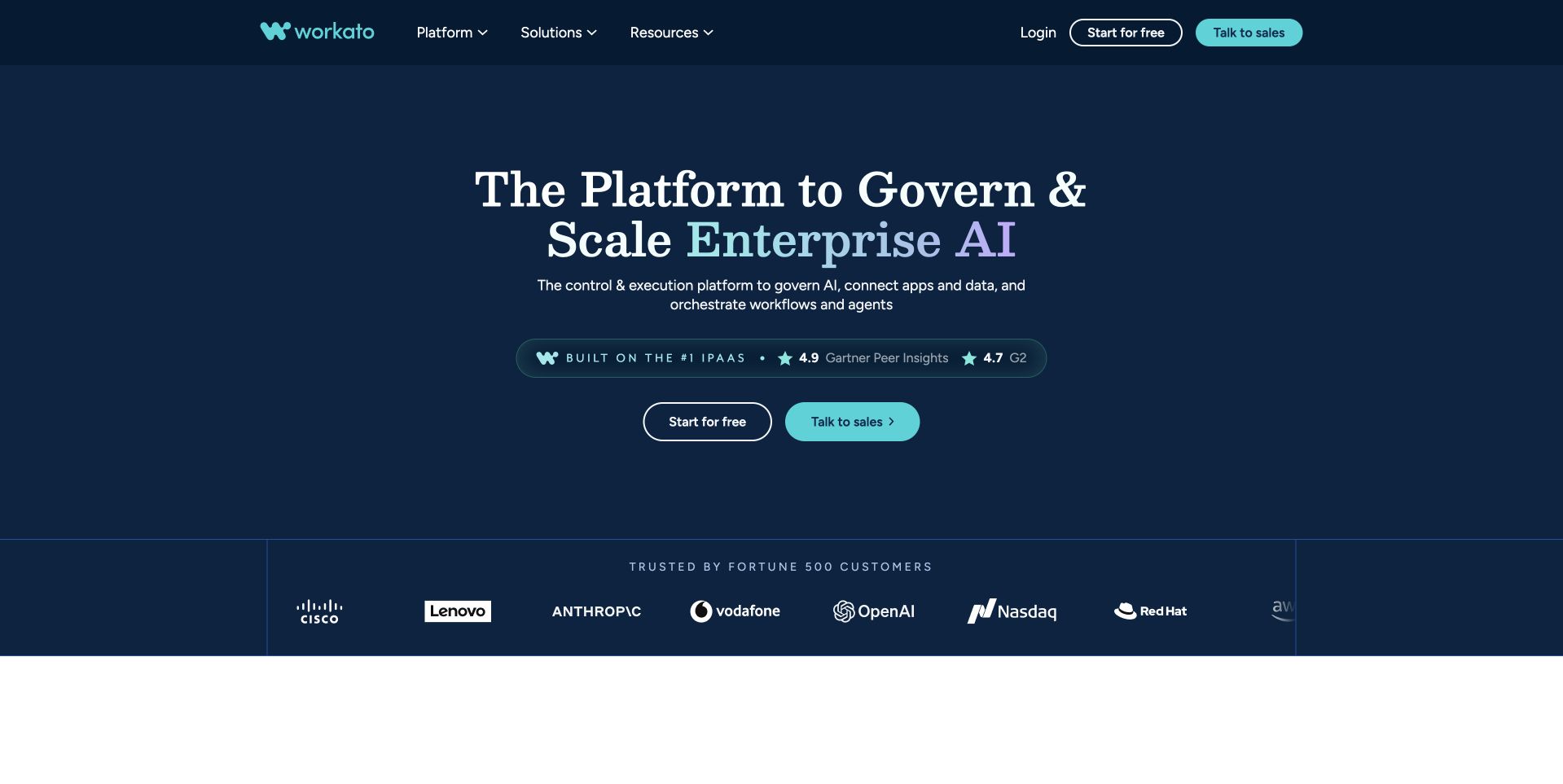
Workato uses a deep navy field, a centered serif headline and a narrow line of supporting copy to frame its enterprise AI proposition. Rounded aqua actions and a compact ratings strip create a restrained path through the opening. Recognizable customer logos appear directly below, separated from the primary message by a fine rule. DigitalOcean’s case specifically concerns Workato’s AI Research Lab using H200 GPU Droplets and managed Kubernetes. It does not identify the corporate homepage’s runtime or establish that every Workato service uses that infrastructure.
What you can learn
Let the first screen explain the business boundary, then provide technical proof in a second layer. A research team’s infrastructure choice can illustrate one workload without becoming a blanket product architecture claim. Match any implementation recommendation to the actual team, resource needs and operating responsibilities.
Pros
The centered composition keeps a complex enterprise proposition visually calm and easy to locate.
Ratings, actions and customer logos occupy distinct levels rather than competing in one dense block.
Cons & considerations
The broad governance claim needs a concrete workflow example before unfamiliar visitors can evaluate it.
Small supporting text and logo labels are less readable than the large decorative headline.
Platform source: Official technology-specific customer or workload source. DigitalOcean’s case specifically identifies Workato AI Research Lab using NVIDIA H200 GPU Droplets and managed Kubernetes for research and inference. It does not identify all Workato products. This evidence establishes only the stated product, workload, organization or historical association. It does not prove that the pictured public page uses the technology, reveal its CMS/frontend, establish a complete current architecture or independently verify vendor-reported outcomes. Platform evidence is separate from the direct website screenshot and is not a complete current infrastructure audit.
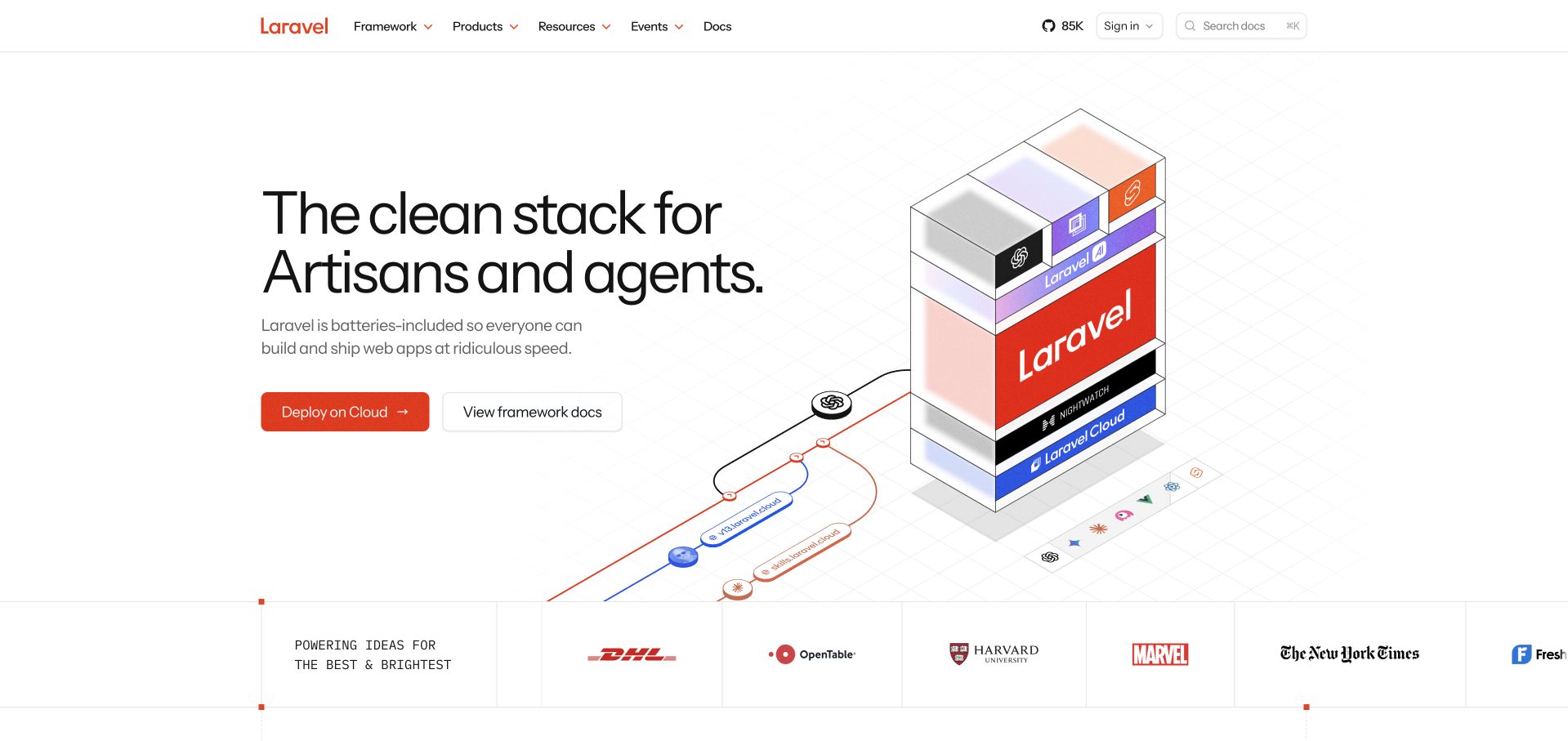
Laravel presents an isometric stack of branded components beside a short explanation and two clear routes: cloud deployment and framework documentation. The red brand block anchors a mostly white composition, while fine connector lines suggest supporting tools without becoming the main reading task. A customer-logo strip follows below. DigitalOcean documents Forge integration and DigitalOcean-powered Laravel VPS provisioning. That specific deployment partnership does not establish that every Laravel Cloud service or the public laravel.com homepage runs on DigitalOcean.
What you can learn
Show how products relate, but preserve a visible distinction between learning a framework and purchasing infrastructure. A deployment brief should identify the exact hosting product, ownership of server updates and rollback expectations. A familiar framework logo is not enough to determine which operating model a project needs.
Pros
The diagram makes a broad ecosystem more tangible while maintaining one recognizable brand anchor.
Documentation and deployment actions respect the different intentions of learners and ready-to-launch developers.
Cons & considerations
Smaller ecosystem labels are difficult to understand without prior familiarity with the framework.
A polished stack illustration can imply simpler operational decisions than a real production deployment requires.
Platform source: Official technology-specific customer or workload source. DigitalOcean documents Laravel Forge integration and DigitalOcean-powered Laravel VPS provisioning using pre-warmed Droplets. This is not a claim about every Laravel Cloud service. This evidence establishes only the stated product, workload, organization or historical association. It does not prove that the pictured public page uses the technology, reveal its CMS/frontend, establish a complete current architecture or independently verify vendor-reported outcomes. Platform evidence is separate from the direct website screenshot and is not a complete current infrastructure audit.
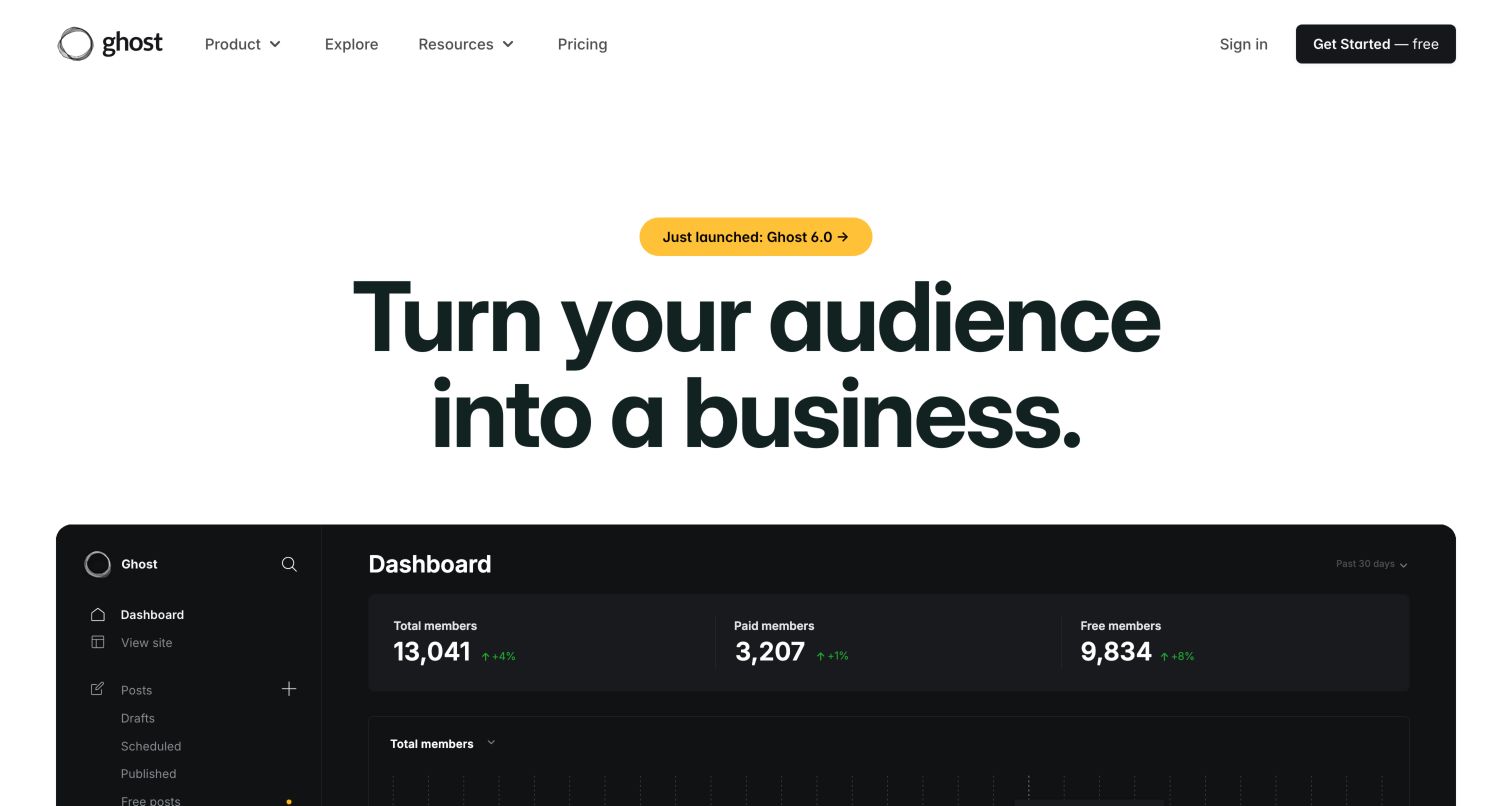
Ghost pairs an oversized audience-to-business headline with a dashboard preview. The white header, release notice and limited opening copy give the product interface a supporting role. Membership and revenue metrics in the preview explain the business context without requiring a long feature list. DigitalOcean’s source is a historical account of Ghost(Pro) moving from dedicated servers to Droplets, including older operating-system details. It should not be read as a current inventory of every Ghost service or proof about this exact marketing page.
What you can learn
Explain the outcome first, then show the operational workspace behind it. If a platform has changed over time, treat its migration story as a dated lesson in cutover planning rather than a current topology diagram. Inventory, database replication and rollback remain useful questions even when individual products change.
Pros
The dashboard preview links a simple publishing promise to recognizable membership and revenue tasks.
Generous space and a short header prevent the opening from resembling a dense administration screen.
Cons & considerations
The broad business promise does not immediately explain the publishing workflow for a first-time reader.
A historical hosting case cannot determine the right deployment or maintenance arrangement for a new Ghost project.
Platform source: Official technology-specific customer or workload source. DigitalOcean’s historical Ghost(Pro) migration account describes moving dedicated-server infrastructure to Droplets; older Ubuntu 14.04 configuration in the source is retained as historical context, not current guidance. This evidence establishes only the stated product, workload, organization or historical association. It does not prove that the pictured public page uses the technology, reveal its CMS/frontend, establish a complete current architecture or independently verify vendor-reported outcomes. Platform evidence is separate from the direct website screenshot and is not a complete current infrastructure audit.
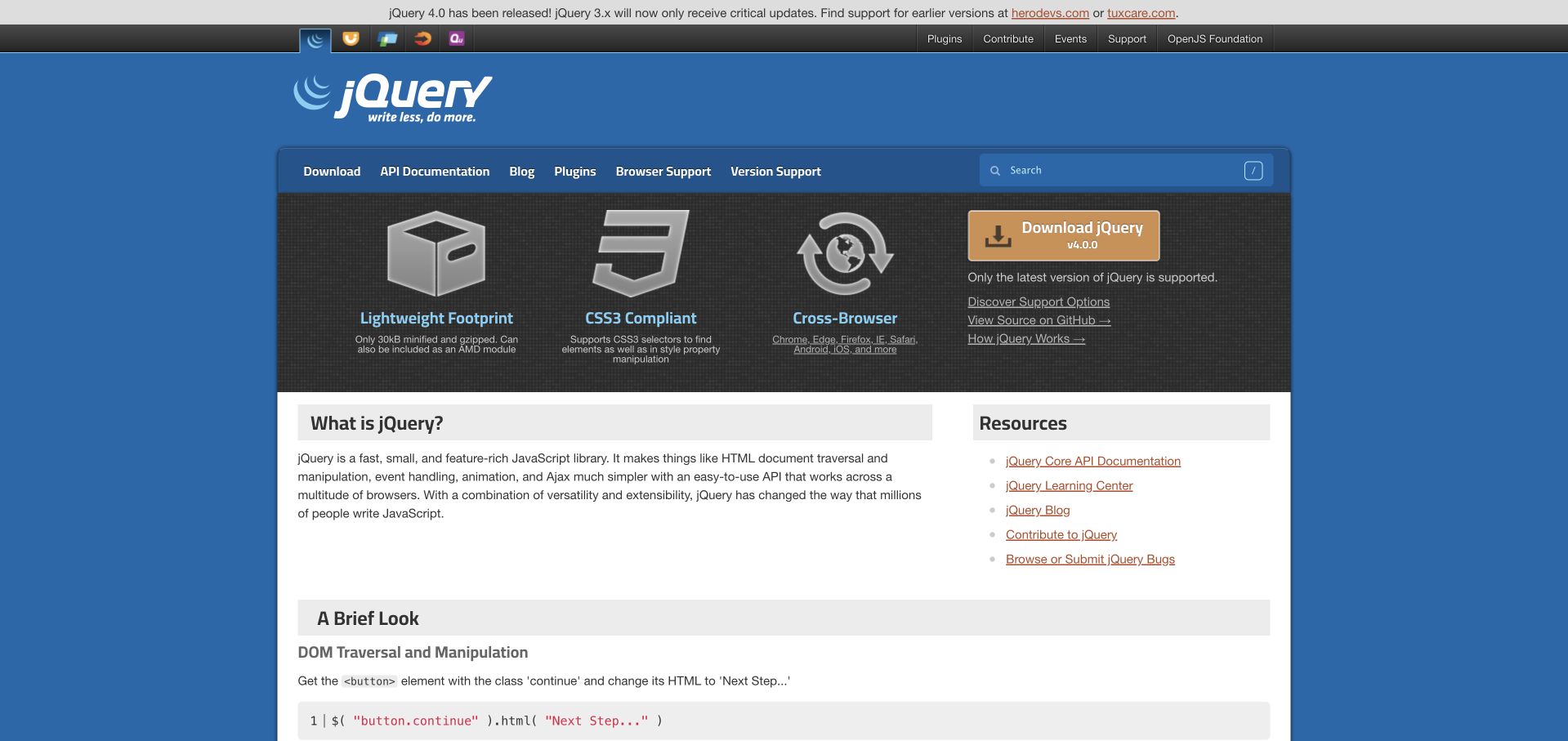
jQuery’s blue page combines a familiar wordmark, compact navigation and a dark feature strip with a prominent download block. Reference links and a code example begin quickly, making the page feel like a working resource rather than a campaign site. DigitalOcean’s historical Foundation case describes web-server migration. More directly, this inspected public page’s footer explicitly states Web hosting by DigitalOcean. That is a hosting declaration for this property, not evidence that every project in the wider foundation uses an identical stack.
What you can learn
For a mature developer resource, fast access to reference material can matter more than an elaborate introduction. Keep version and support information conspicuous, and distinguish the library being documented from the technologies hosting the documentation. A page can use several infrastructure and publishing services at different layers.
Pros
Download, documentation and support routes are immediately available within a compact, predictable structure.
The introductory code example gives technical visitors useful context without requiring a separate product tour.
Cons & considerations
Dense small text and a narrow central layout can feel dated on a large desktop display.
Version notices and older examples require careful maintenance so visitors do not mistake legacy material for current guidance.
Platform source: Official technology-specific customer or workload source. DigitalOcean’s historical jQuery Foundation case describes web-server migration. Separately, the newly inspected jquery.com footer explicitly declares Web hosting by DigitalOcean. This evidence establishes only the stated product, workload, organization or historical association. It does not prove that the pictured public page uses the technology, reveal its CMS/frontend, establish a complete current architecture or independently verify vendor-reported outcomes. Platform evidence is separate from the direct website screenshot and is not a complete current infrastructure audit.
HackerRank’s captured homepage opens with a short apologetic campaign statement, a small black action and an understated logo over a faint field of characters. The design leaves most of the screen empty, deliberately withholding a conventional feature grid or navigation-heavy introduction. DigitalOcean named HackerRank as a customer in a June 14, 2017 company article. That is a historical organization-level association only: it identifies neither a current workload nor the infrastructure behind the campaign shown here.
What you can learn
A provocative opening works only when the next step explains what has changed. Keep a descriptive route for visitors who do not recognize the reference. Historical customer evidence can justify studying an organization in a collection, but cannot responsibly support a present-tense hosting recommendation.
Pros
The sparse composition makes the campaign statement difficult to overlook amid more conventional software homepages.
A single small action preserves the intended sequence from curiosity to explanation.
Cons & considerations
Visitors unfamiliar with interview-practice culture receive little immediate explanation of the actual service.
The opening relies heavily on the following interaction to communicate product scope and practical value.
Platform source: Official technology-specific customer or workload source. DigitalOcean’s June 14, 2017 article explicitly names HackerRank among customers in India. It establishes only a historical organization-level customer relationship, with no specific current workload identified. This evidence establishes only the stated product, workload, organization or historical association. It does not prove that the pictured public page uses the technology, reveal its CMS/frontend, establish a complete current architecture or independently verify vendor-reported outcomes. Platform evidence is separate from the direct website screenshot and is not a complete current infrastructure audit.
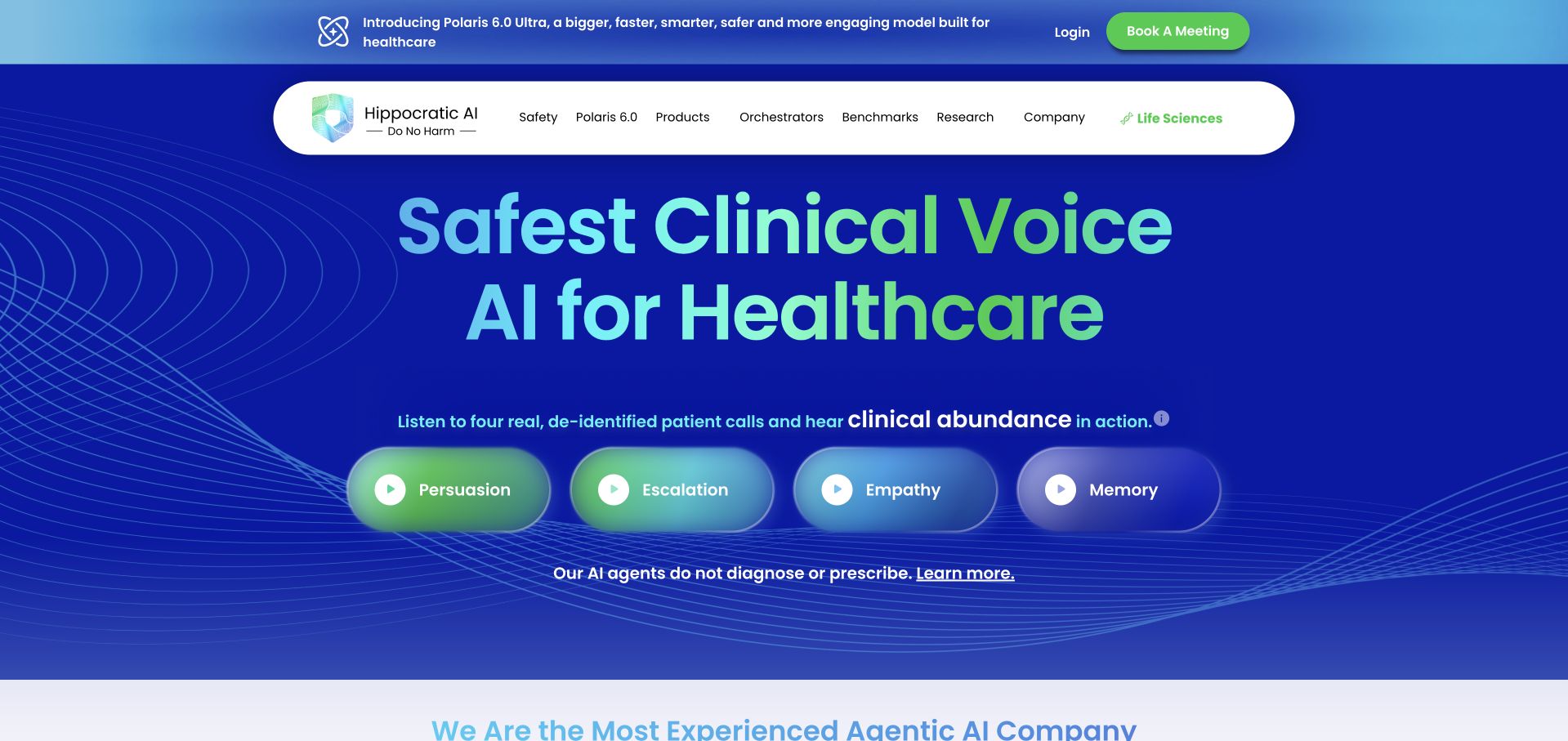
Hippocratic AI uses a saturated blue field, large green headline and four rounded audio-example controls. The white capsule navigation and slim announcement strip keep the product’s corporate routes visible. A nearby sentence says the agents do not diagnose or prescribe, an important boundary within an otherwise assertive presentation. DigitalOcean’s case concerns GPU infrastructure for production inference and clinical-call workloads. Its vendor-reported safety and performance figures are not independently validated by this design review, and the public homepage’s hosting remains a separate question.
What you can learn
Place limitations near the examples that could otherwise be misunderstood. For a healthcare AI brief, distinguish marketing demonstrations, clinical validation, operational escalation and infrastructure performance. A fast model-serving platform does not by itself establish safe clinical behavior or determine which tasks a system should be allowed to perform.
Pros
Labeled audio examples make an unfamiliar conversational product more concrete without a long initial explanation.
The visible diagnostic boundary gives readers useful context close to the promotional claim.
Cons & considerations
Strong superlatives require deeper evidence than the opening screen can provide on its own.
Multiple glowing controls and dense navigation create several competing points of attention.
Visible tech stack
Earlier / documented evidence
DigitalOcean
Platform source: Official technology-specific customer or workload source. DigitalOcean’s case identifies GPU infrastructure for Hippocratic AI production inference and clinical-call workloads, including NVIDIA hardware. Safety and performance outcomes remain vendor-reported, not independently verified. This evidence establishes only the stated product, workload, organization or historical association. It does not prove that the pictured public page uses the technology, reveal its CMS/frontend, establish a complete current architecture or independently verify vendor-reported outcomes. Platform evidence is separate from the direct website screenshot and is not a complete current infrastructure audit.
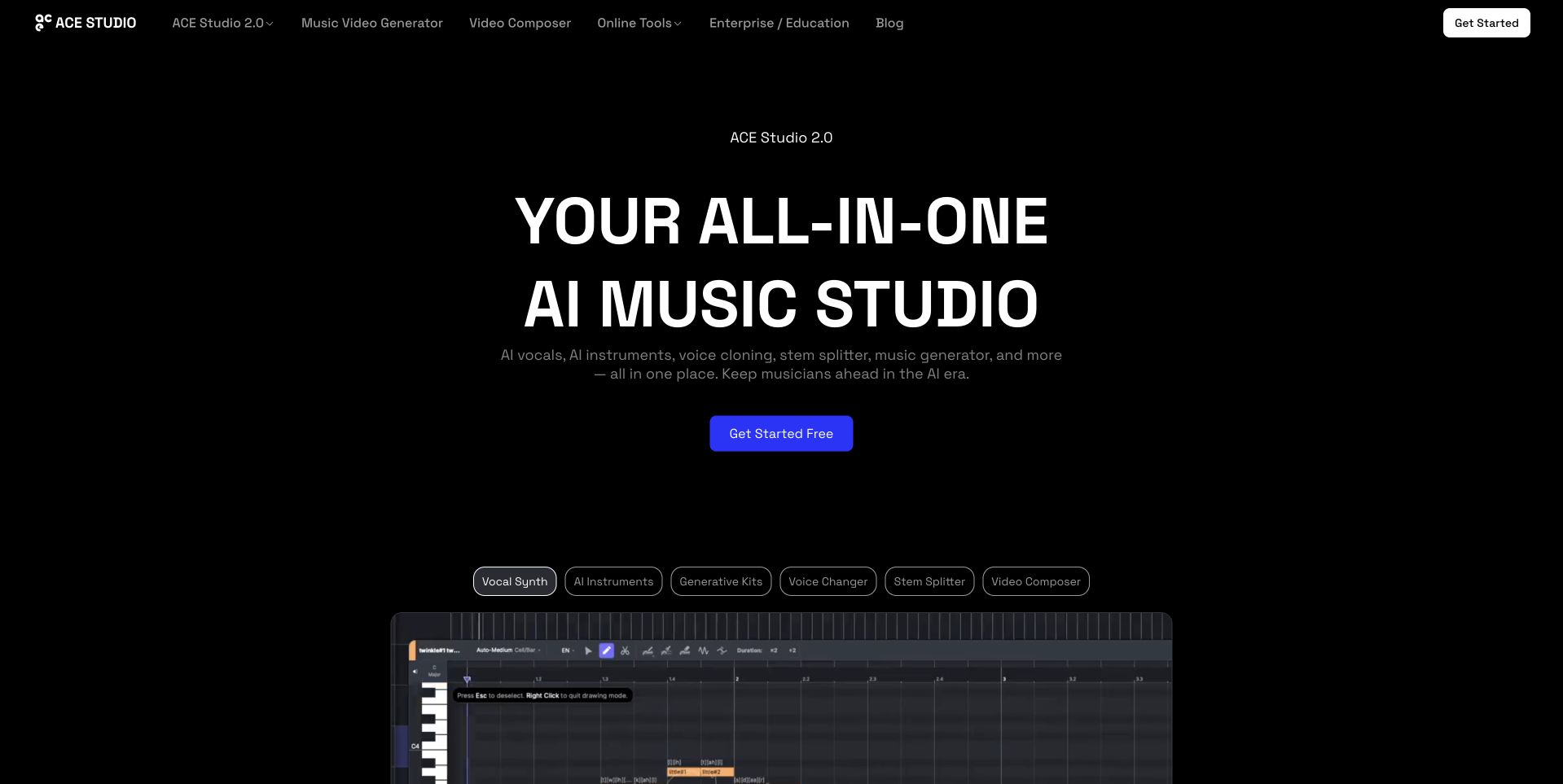
ACE Studio uses a black canvas, a large white headline and one violet start button. A short row of outlined capability labels leads into the workstation preview below, making vocals, instruments and related tools feel like parts of one environment. The narrow header leaves the introduction visually concentrated. DigitalOcean documents ACE Studio using AMD-powered GPU inference for music-generation workloads. That association concerns model-serving infrastructure, not proof that this marketing page uses App Platform or that every audio-processing task runs on the same hardware.
What you can learn
Group capabilities around the work a creator is trying to complete, then reveal enough of the workspace to explain the relationship. A technical brief should separate latency-sensitive interactive inference from background processing, storage and account services. They may need different capacity, failure handling and deployment arrangements.
Pros
A restrained color palette allows the music-workstation preview to feel like the central product evidence.
Capability chips summarize the breadth of the tool without filling the hero with explanatory paragraphs.
Cons & considerations
Small gray supporting copy has less visual presence than the large headline and may be overlooked.
The broad all-in-one claim requires further detail about control, licensing and output suitability.
Platform source: Official technology-specific customer or workload source. DigitalOcean identifies ACE Studio model inference using AMD Instinct GPU infrastructure for music-creation workloads. This evidence establishes only the stated product, workload, organization or historical association. It does not prove that the pictured public page uses the technology, reveal its CMS/frontend, establish a complete current architecture or independently verify vendor-reported outcomes. Platform evidence is separate from the direct website screenshot and is not a complete current infrastructure audit.
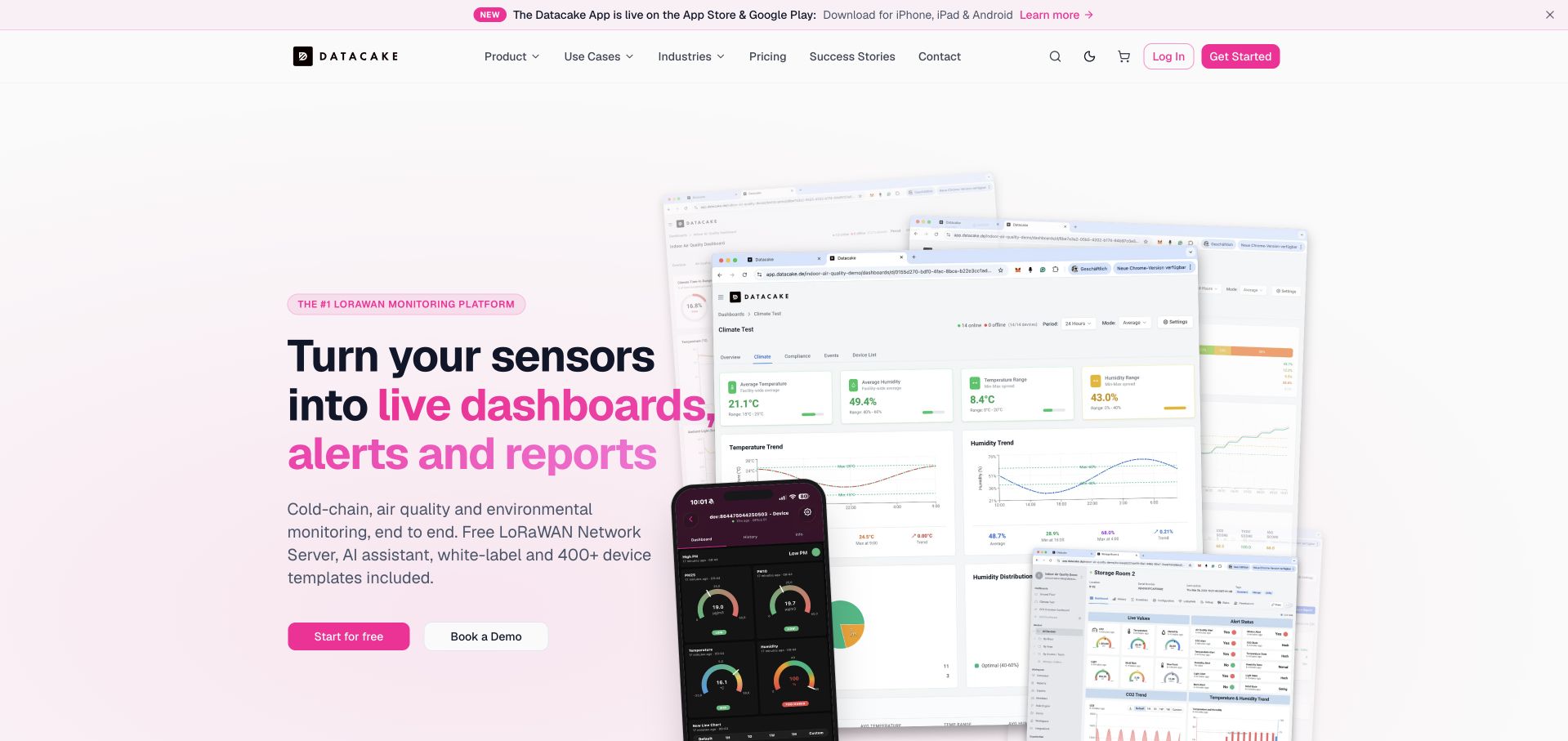
Datacake places overlapping desktop dashboards and a phone screen next to a pink-accented monitoring headline. The familiar gauges and charts communicate the end result of connecting sensors more clearly than abstract network artwork would. A small platform label and two contrasting actions establish trial and demo routes. DigitalOcean’s case names managed Kubernetes, PostgreSQL and Valkey within Datacake’s application environment. It does not establish that the pictured marketing homepage itself runs on those services or identify every upstream sensor and network component.
What you can learn
Lead with the operational view a customer receives, then explain how devices, ingestion, alerts and reports connect. Define what happens when data is late or missing before choosing infrastructure. A dashboard that looks current needs a reliable freshness contract, not merely an attractive set of gauges.
Pros
Layered screenshots reveal several monitoring contexts while maintaining a recognizable product interface.
Trial and demo routes accommodate both hands-on evaluation and more complex organizational purchasing.
Cons & considerations
The overlapping dashboard collage comes close to the headline and can crowd the text area.
A broad collection of capabilities needs deeper explanation of device compatibility and responsibility for alert handling.
Platform source: Official technology-specific customer or workload source. DigitalOcean identifies managed Kubernetes, PostgreSQL and Valkey in Datacake’s IoT application environment. This evidence establishes only the stated product, workload, organization or historical association. It does not prove that the pictured public page uses the technology, reveal its CMS/frontend, establish a complete current architecture or independently verify vendor-reported outcomes. Platform evidence is separate from the direct website screenshot and is not a complete current infrastructure audit.
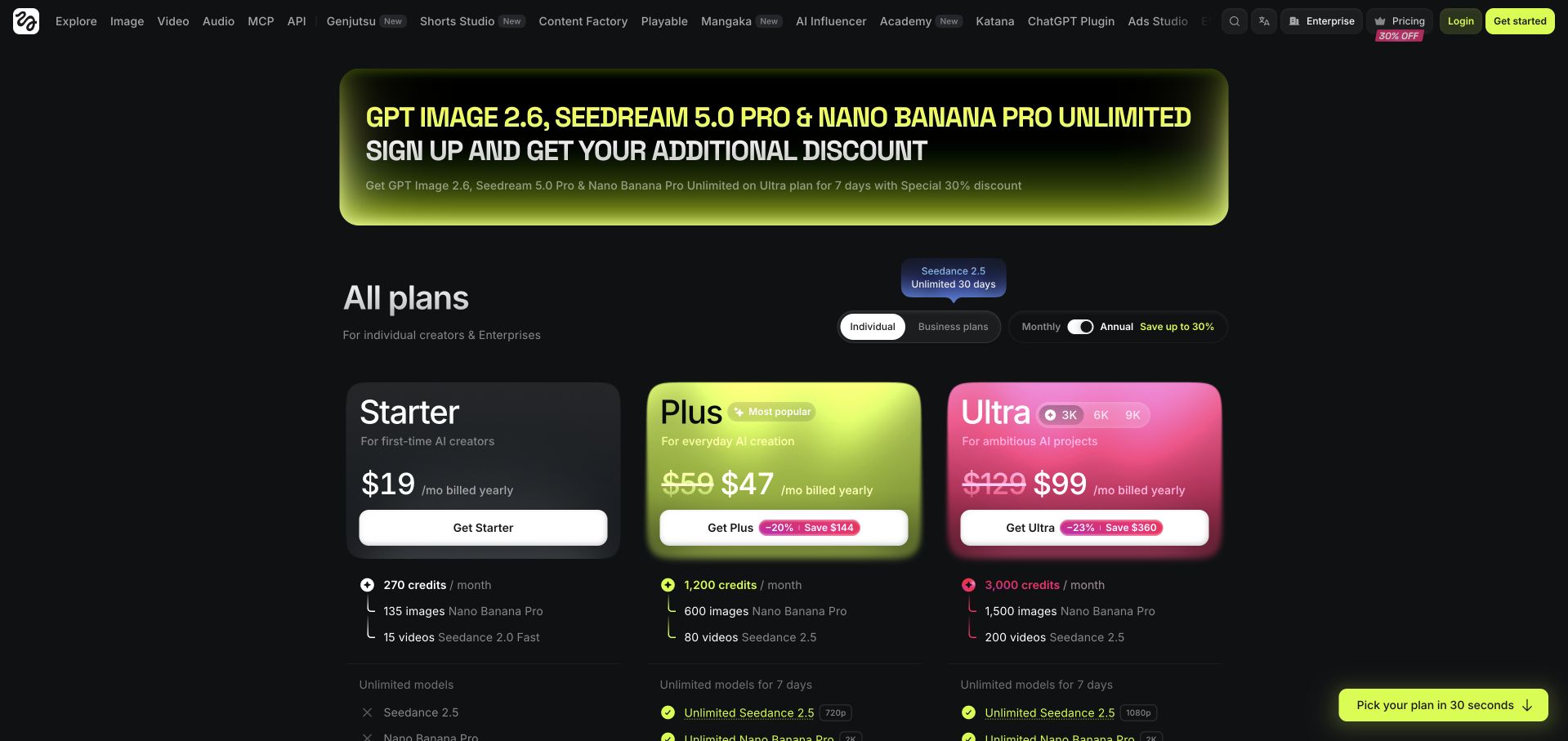
Higgsfield’s public pricing page uses a dark background and three visually distinct plan cards. A bright lime middle tier and pink higher tier create a strong comparison hierarchy, while audience tabs and billing controls sit directly above. Credit allocations and feature lists continue below the first price row. This static page replaces homepage preview videos that contained embedded demonstration pointers. DigitalOcean’s case specifically describes enterprise workloads routed to its GPU infrastructure; it does not establish the hosting of this pricing page or every model available through Higgsfield.
What you can learn
A comparison should explain the unit customers are buying before emphasizing discounts. Separate recurring billing, credit allowances and temporary model access in both copy and implementation. Do not infer plan capacity or a universal backend architecture from a vendor’s account of one enterprise workload.
Pros
Consistent card structure makes it possible to compare starting actions and allowances across tiers.
Audience and billing controls are positioned close to the prices they affect.
Cons & considerations
Discounts, temporary offers and credits create several overlapping concepts for a new buyer to evaluate.
Highly saturated tier treatments can draw attention away from important differences in the smaller feature text.
Visible tech stack
Earlier / documented evidence
DigitalOcean
Platform source: Official technology-specific customer or workload source. DigitalOcean’s Higgsfield case specifically describes enterprise requests routed to its GPU infrastructure for the stated availability requirements. It does not establish every model or the public pricing page runtime. This evidence establishes only the stated product, workload, organization or historical association. It does not prove that the pictured public page uses the technology, reveal its CMS/frontend, establish a complete current architecture or independently verify vendor-reported outcomes. Platform evidence is separate from the direct website screenshot and is not a complete current infrastructure audit.
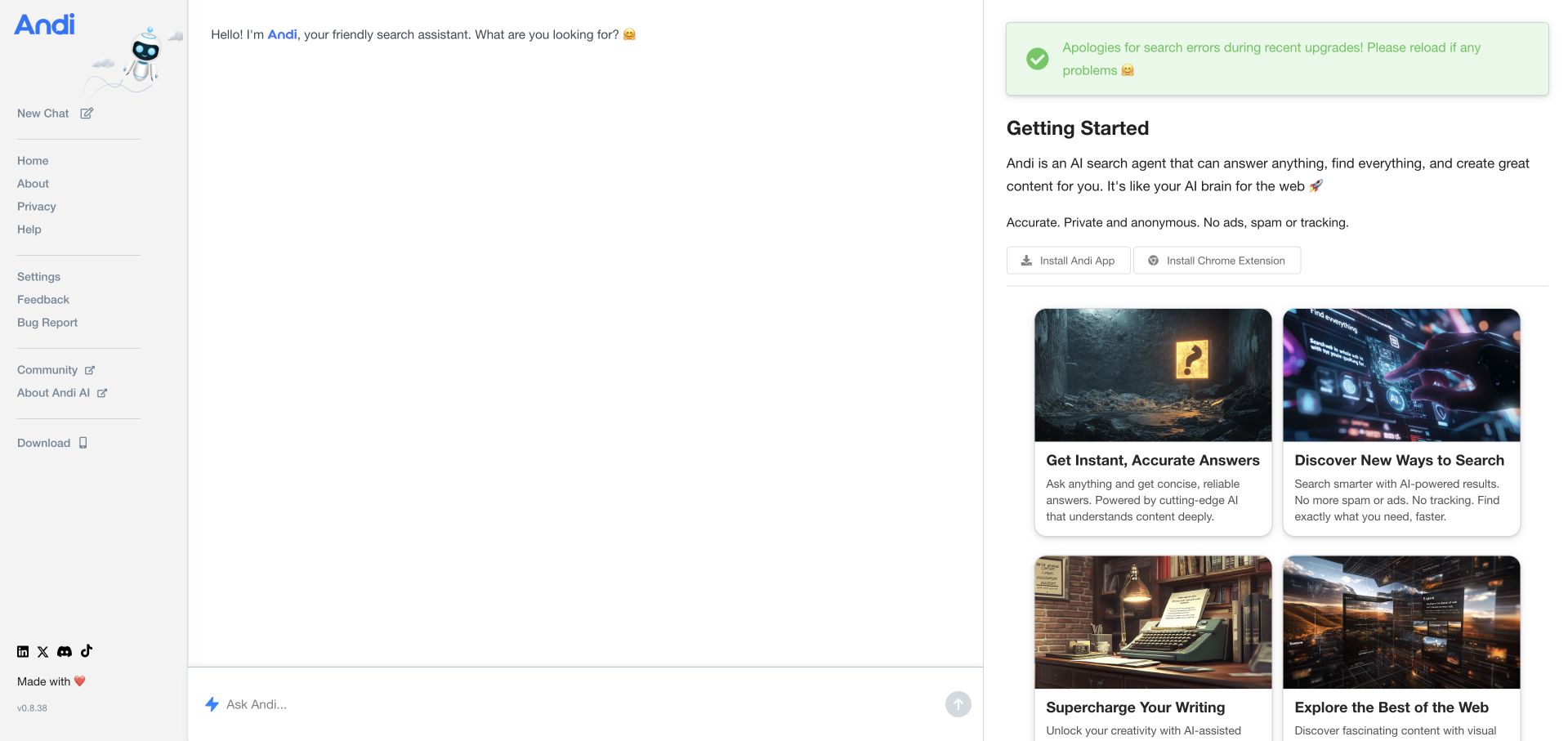
Andi shows the product itself: a large empty conversation area, a small input at the bottom and a right-hand panel explaining useful tasks. A narrow left rail holds navigation and community routes. The white workspace feels open, although a visible service notice acknowledges recent search errors. DigitalOcean’s case identifies Droplets and Spaces supporting Andi’s search-index infrastructure. That is specific workload evidence, not an independent uptime measurement or proof that all generation, retrieval and frontend components use one provider.
What you can learn
Make the first action obvious without forcing an account decision, and provide examples that explain what a query can accomplish. Operational notices should be clear but not dominate the empty state. Plan for retrieval failure and degraded responses before treating fast infrastructure as a complete user-experience solution.
Pros
The large conversation area makes the product’s main interaction available immediately rather than behind a tour.
Getting-started cards provide concrete possibilities without submitting a query on the visitor’s behalf.
Cons & considerations
The empty central field occupies substantial space while the useful guidance is confined to a side column.
A service-error notice can undermine confidence unless it clearly explains the present limitations and recovery path.
Platform source: Official technology-specific customer or workload source. DigitalOcean documents Droplets and Spaces supporting Andi AI’s search index and associated application infrastructure. Reported uptime and speed are not independently reproduced. This evidence establishes only the stated product, workload, organization or historical association. It does not prove that the pictured public page uses the technology, reveal its CMS/frontend, establish a complete current architecture or independently verify vendor-reported outcomes. Platform evidence is separate from the direct website screenshot and is not a complete current infrastructure audit.
Double Eleven opens with a large photograph of colleagues and a bold statement about making games together. An outlined final word creates a recognizable typographic rhythm without adding another content block. The minimal corner branding and menu leave the people at the center of the composition. DigitalOcean’s case specifically concerns Droplets hosting Rust game instances and related scaling activity. It does not establish the studio marketing site’s backend, the infrastructure of every title or a guarantee about future game-server capacity.
What you can learn
A studio site can prioritize the working culture while keeping project discovery accessible. Keep the operational story equally precise: game sessions, matchmaking, content delivery and corporate publishing are separate workloads. Capacity planning for a multiplayer launch should be tested against real player behavior rather than inferred from a successful customer quotation.
Pros
The candid team photograph gives the studio a human identity beyond game logos and technology lists.
Bold typography remains readable over the subdued photo treatment.
Cons & considerations
Minimal visible navigation makes the route to a specific game less obvious at first glance.
A large culture-led opening provides limited immediate detail about the studio’s services or production specialisms.
Platform source: Official technology-specific customer or workload source. DigitalOcean identifies Droplets hosting Double Eleven’s Rust game instances, including scaling for a console-generation launch. This is not the public studio site or every game title. This evidence establishes only the stated product, workload, organization or historical association. It does not prove that the pictured public page uses the technology, reveal its CMS/frontend, establish a complete current architecture or independently verify vendor-reported outcomes. Platform evidence is separate from the direct website screenshot and is not a complete current infrastructure audit.
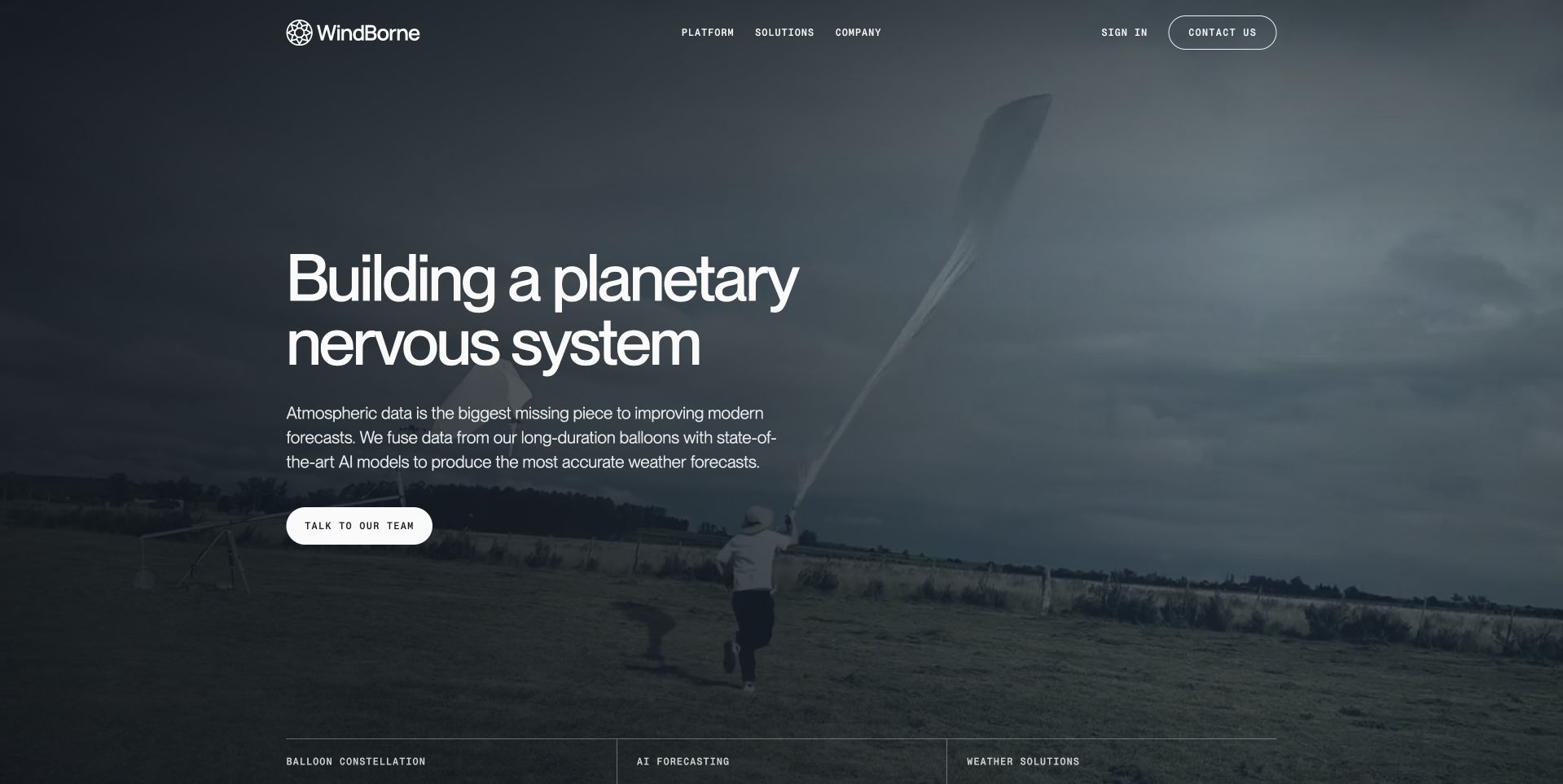
WindBorne places a weather-balloon setting behind a large white statement and a concise explanation of atmospheric data and forecasts. The dark photographic treatment gives the copy a quiet reading surface. Three product routes along the lower edge connect observations, forecasting and weather solutions. DigitalOcean’s case identifies bare-metal GPUs for WeatherMesh model training, with CPU and storage resources supporting the described environment. It does not identify the public homepage’s renderer or independently establish forecast accuracy.
What you can learn
Use a physical context to explain what the data represents, then separate collection, modeling and delivered products. A training infrastructure brief should specify data movement, checkpoint storage and interconnect needs as well as GPU capacity. These considerations are different from the requirements for serving a public marketing page.
Pros
The balloon scene gives an abstract weather-data mission a concrete source and sense of scale.
Distinct product routes clarify that observations and forecasts are related but different offerings.
Cons & considerations
A broad planetary metaphor needs the smaller supporting copy to explain the actual customer benefit.
Subtle navigation and a dark image treatment can make secondary controls easy to miss.
Platform source: Official technology-specific customer or workload source. DigitalOcean identifies bare-metal GPUs for WindBorne WeatherMesh training and supporting compute and storage workloads. This evidence establishes only the stated product, workload, organization or historical association. It does not prove that the pictured public page uses the technology, reveal its CMS/frontend, establish a complete current architecture or independently verify vendor-reported outcomes. Platform evidence is separate from the direct website screenshot and is not a complete current infrastructure audit.
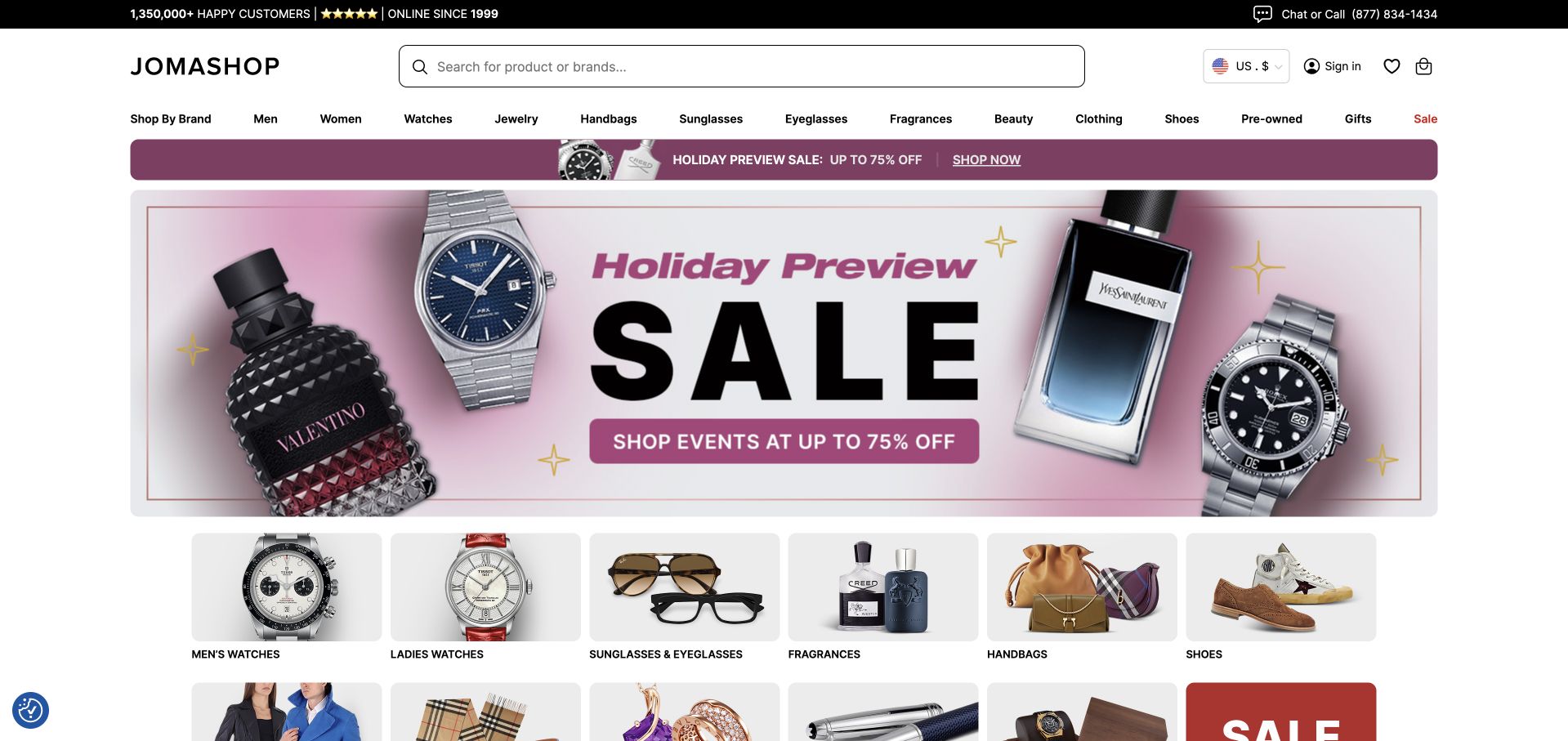
Jomashop combines a prominent product search field, many category links and a large promotional banner filled with recognizable watches and fragrance packaging. Smaller category tiles start immediately below, giving shoppers another route into the inventory. The result is commercially direct rather than editorially restrained. DigitalOcean’s case concerns internal product-data enrichment agents, Droplets and managed MongoDB supporting product feeds. It does not establish that the commerce frontend or checkout runs on DigitalOcean, and no SEO improvement is independently measured in this review.
What you can learn
A broad store needs both search and recognizable product categories, but reliable product information is an equally important design dependency. Separate the publishing and approval pipeline from the shopping runtime. AI-enriched descriptions should retain validation and correction paths instead of automatically turning generated text into customer-facing facts.
Pros
The large search field supports shoppers who know a brand or product before arriving.
Numerous sale messages and navigation labels compete for attention before the visitor reaches individual products.
A promotion-led opening provides little immediate explanation of product provenance, warranty or condition.
Visible tech stack
Earlier / documented evidence
DigitalOcean
Platform source: Official technology-specific customer or workload source. DigitalOcean’s Jomashop case concerns internal product-data enrichment agents, Droplets and managed databases including MongoDB for product feeds, not a claim about the commerce frontend or checkout. This evidence establishes only the stated product, workload, organization or historical association. It does not prove that the pictured public page uses the technology, reveal its CMS/frontend, establish a complete current architecture or independently verify vendor-reported outcomes. Platform evidence is separate from the direct website screenshot and is not a complete current infrastructure audit.
Plan to Eat places a cooking photograph behind a short meal-planning promise and a phone interface preview. A cool blue overlay protects the text while preserving the household context. The two main actions separate an explanation of the process from a free trial, with app-store routes below. DigitalOcean’s case documents Droplet-based application and database servers for staging and production, supported by Crafty Penguins. It does not establish the implementation of every page or independently verify the case’s availability claims.
What you can learn
Show the relationship between planning a meal and generating the next practical output. A product walkthrough should follow that sequence rather than presenting unrelated features. Operationally, keep test and production environments distinct and rehearse rollback, especially when a small team depends on a managed infrastructure partner.
Pros
The phone preview connects a familiar cooking situation to a specific software workflow.
How-it-works and trial actions offer clear alternatives without filling the hero with forms.
Cons & considerations
Text over photography needs careful cropping so readability survives changes in screen size.
The opening only hints at how imported recipes, planning and grocery-list updates stay synchronized.
Visible tech stack
Earlier / documented evidence
DigitalOcean
Platform source: Official technology-specific customer or workload source. DigitalOcean identifies Droplet-based application and database servers for Plan to Eat staging and production, with Crafty Penguins operational support. This evidence establishes only the stated product, workload, organization or historical association. It does not prove that the pictured public page uses the technology, reveal its CMS/frontend, establish a complete current architecture or independently verify vendor-reported outcomes. Platform evidence is separate from the direct website screenshot and is not a complete current infrastructure audit.
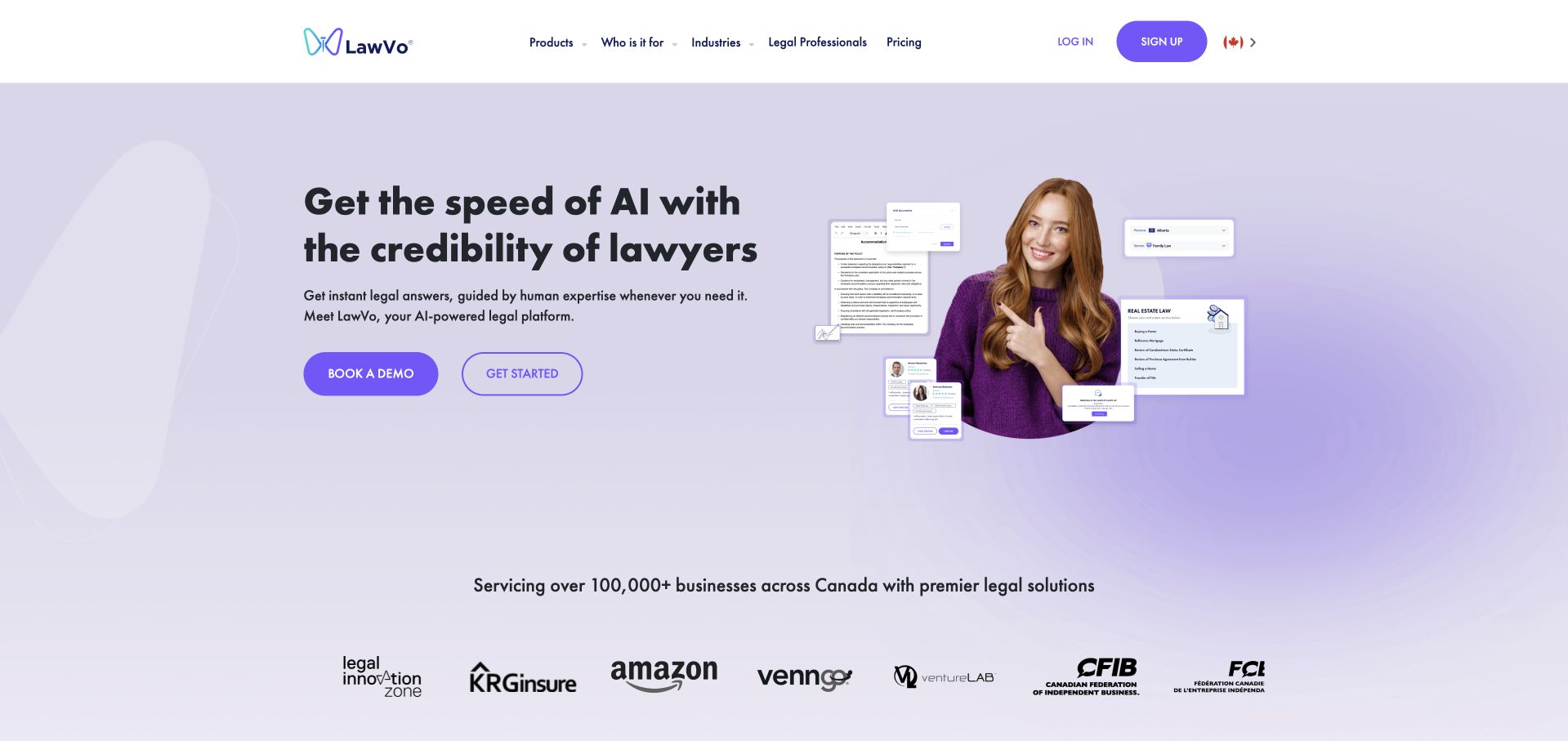
LawVo places a lawyer portrait and small document fragments beside a large headline about AI speed and legal credibility. A pale violet background and rounded actions create a softer presentation than a dense legal portal. Organization logos below supply contextual reassurance. DigitalOcean’s case identifies Canadian infrastructure, storage and AI-related workloads for LawVo. It does not verify legal advice quality, prove that every request stays in one region or establish the public page’s complete runtime and compliance arrangements.
What you can learn
Explain the boundary between automated assistance and a professional’s involvement before asking someone to share a legal problem. Hosting location is only one part of data governance. A real implementation also needs clear access controls, retention decisions, escalation and an accountable review process for material legal outputs.
Pros
The visible professional and document imagery make the intended human-service relationship easy to understand.
The two main actions distinguish an introductory conversation from exploring the available plans.
Cons & considerations
Broad credibility language needs specific explanations of who reviews what and under which circumstances.
Small supporting claims and partner logos cannot substitute for clear service terms and jurisdiction boundaries.
Visible tech stack
Earlier / documented evidence
DigitalOcean
Platform source: Official technology-specific customer or workload source. DigitalOcean’s LawVo case identifies Canadian infrastructure and AI, compute and storage workloads in the legal-service application environment. It does not independently establish legal quality or full compliance. This evidence establishes only the stated product, workload, organization or historical association. It does not prove that the pictured public page uses the technology, reveal its CMS/frontend, establish a complete current architecture or independently verify vendor-reported outcomes. Platform evidence is separate from the direct website screenshot and is not a complete current infrastructure audit.
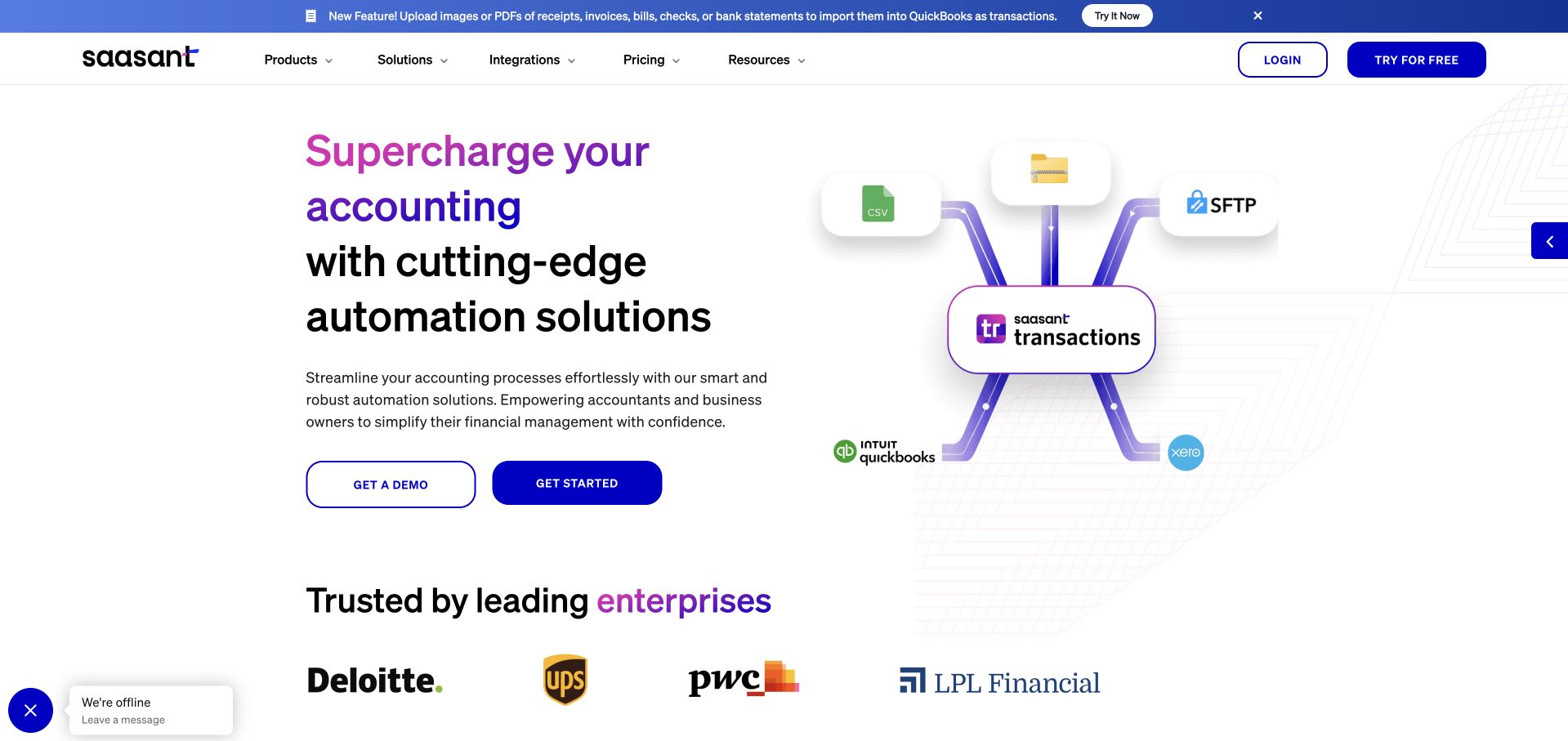
SaasAnt pairs its accounting-automation headline with a branching illustration of files entering a central product and flowing toward QuickBooks and Xero. The mostly white layout uses violet accents to connect the text and diagram. Demo and starting actions remain separate, with enterprise logos following below. DigitalOcean’s case describes a Kubernetes-based application environment, storage and networking for SaasAnt’s microservices. It does not establish the marketing page’s frontend or guarantee compatibility and correctness for every accounting import.
What you can learn
Draw the data’s direction rather than merely displaying integration logos. Explain validation, failed rows and reconciliation alongside the happy path. Infrastructure scale is useful, but an accounting workflow also needs an auditable record of what changed and a safe way to correct or retry partial failures.
Pros
The flow illustration quickly connects ordinary input files to recognizable accounting destinations.
A small number of actions keeps the broad automation message from becoming an overwhelming integration directory.
Cons & considerations
Several nearby product and solution menus may be difficult to distinguish before the workflow is understood.
The simplified illustration omits the validation and exception-handling steps that matter in financial data transfer.
Platform source: Official technology-specific customer or workload source. DigitalOcean describes Kubernetes, storage and networking supporting SaasAnt’s microservice application environment. This evidence establishes only the stated product, workload, organization or historical association. It does not prove that the pictured public page uses the technology, reveal its CMS/frontend, establish a complete current architecture or independently verify vendor-reported outcomes. Platform evidence is separate from the direct website screenshot and is not a complete current infrastructure audit.
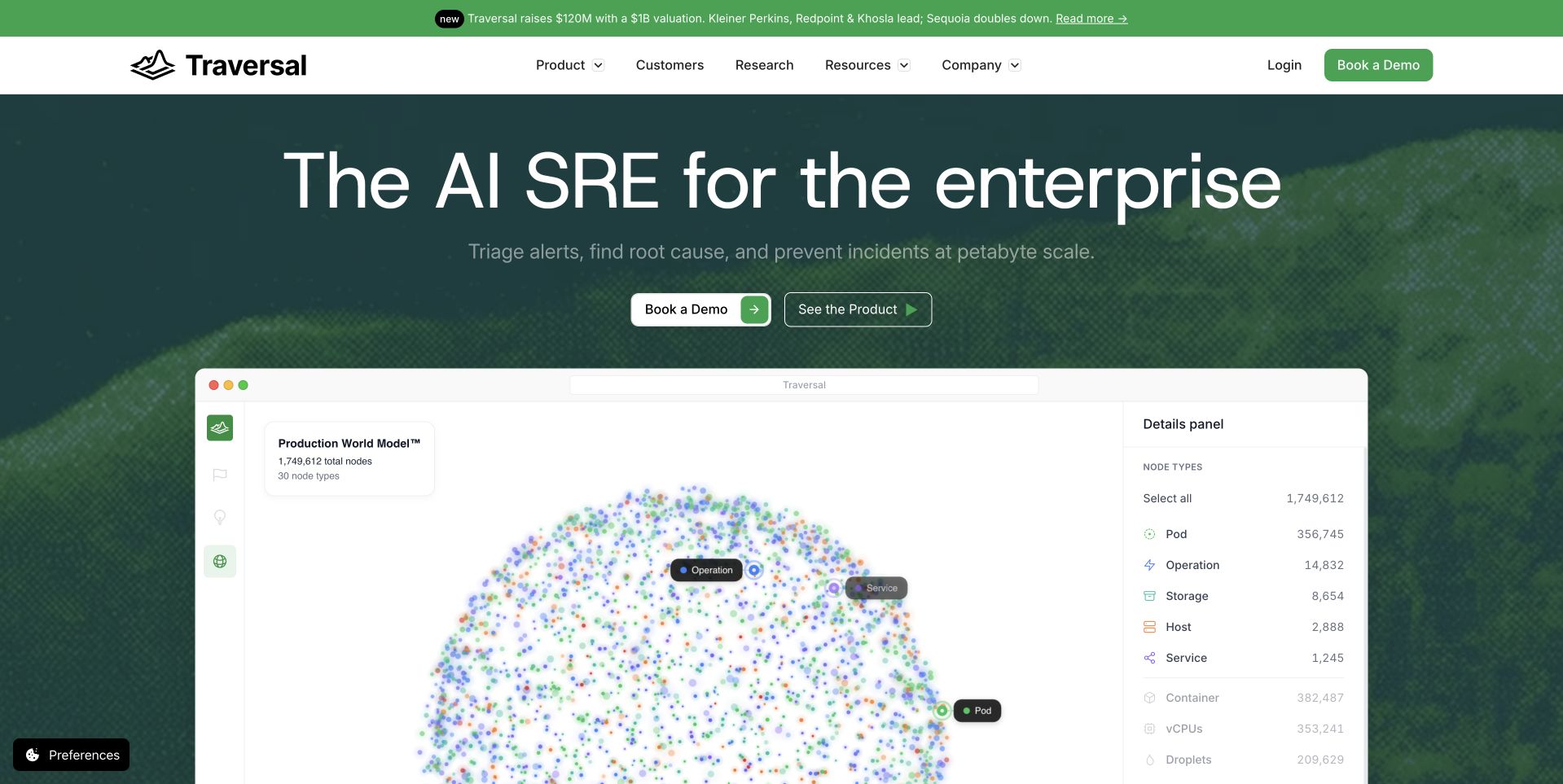
Traversal puts a large production-topology view directly beneath a concise AI SRE introduction. The screenshot’s node cloud and details panel make the scale of the problem tangible without requiring visitors to read every label. A muted green background ties the product preview to the header and announcement strip. DigitalOcean’s case identifies Kubernetes, GPU resources and inference services within Traversal’s research and production context. It does not establish that the marketing homepage itself uses those services or independently verify root-cause findings.
What you can learn
Show the evidence surface an operator will inspect, not only the promise of an automated answer. A production brief should define read access, permitted actions and human approval before choosing inference infrastructure. An agent that can describe a topology should not automatically have authority to change it.
Pros
The product view makes the operations problem specific rather than relying on abstract AI imagery.
Two distinct actions let readers choose a product explanation or a sales conversation.
Cons & considerations
The enormous node visualization is impressive but too dense for detailed understanding at hero size.
The AI SRE label needs additional explanation of operational boundaries and responsibility during an incident.
Platform source: Official technology-specific customer or workload source. DigitalOcean identifies Kubernetes, GPU and inference resources in Traversal’s research and production application context. This evidence establishes only the stated product, workload, organization or historical association. It does not prove that the pictured public page uses the technology, reveal its CMS/frontend, establish a complete current architecture or independently verify vendor-reported outcomes. Platform evidence is separate from the direct website screenshot and is not a complete current infrastructure audit.
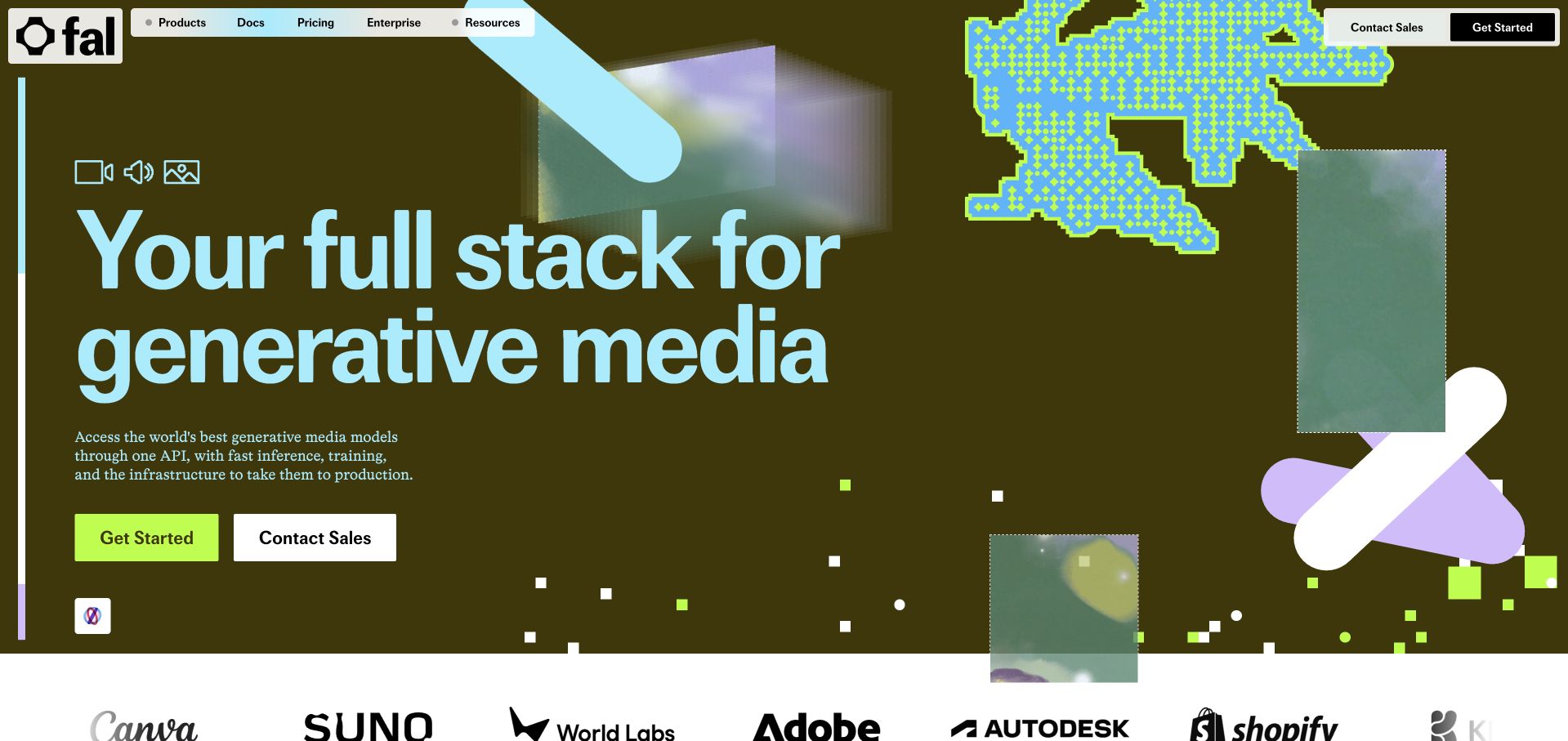
fal uses a large aqua headline, lime actions and layered generative artwork over an olive-toned background. Small media-type icons help frame the product category, while a recognizable customer-logo row begins beneath the hero. The opening is expressive, but the supporting copy still identifies an API and infrastructure proposition. DigitalOcean’s case names Droplets, GPUs and storage supporting fal’s model-serving workloads. It does not establish the public homepage’s runtime or imply that every model and customer request uses the same cloud provider.
What you can learn
A developer platform can have a distinctive visual identity while keeping its integration boundary explicit. Separate model inference, training, storage and application hosting when planning costs and failure handling. A public API is an interface to a service, not a complete explanation of the infrastructure behind each possible request.
Pros
The distinctive palette and artwork differentiate an infrastructure product without abandoning a readable hierarchy.
The supporting explanation connects the visual media theme to an actionable API-based product.
Cons & considerations
Animated and layered artwork can distract from the relatively small technical description.
A broad full-stack promise requires deeper documentation before teams can evaluate operational responsibilities and limits.
Platform source: Official technology-specific customer or workload source. DigitalOcean identifies Droplets, GPUs and storage supporting fal’s model-serving workloads. It does not establish the infrastructure of every available model. This evidence establishes only the stated product, workload, organization or historical association. It does not prove that the pictured public page uses the technology, reveal its CMS/frontend, establish a complete current architecture or independently verify vendor-reported outcomes. Platform evidence is separate from the direct website screenshot and is not a complete current infrastructure audit.
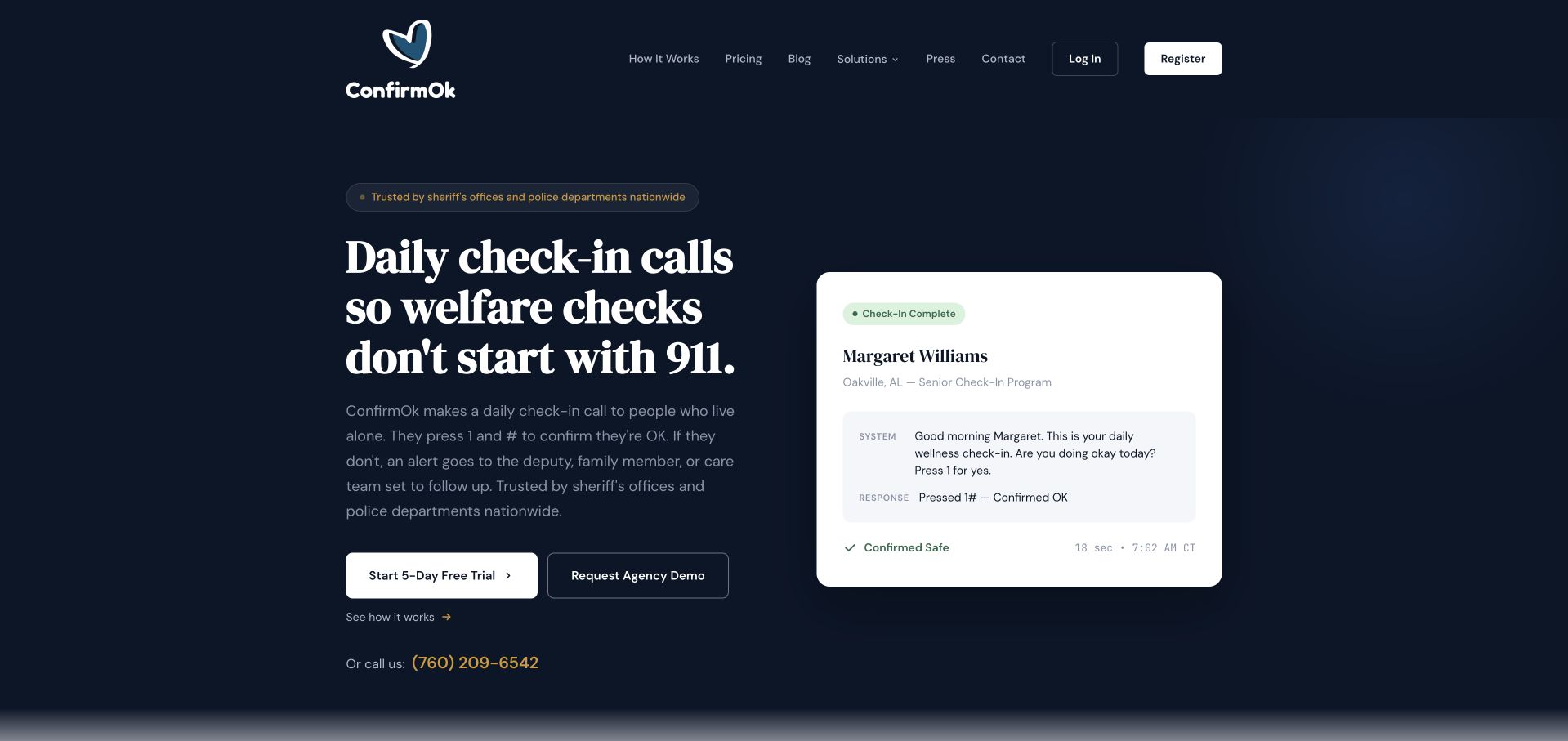
ConfirmOk pairs a plain-language daily-call explanation with a small example card showing a completed check-in. The dark blue field, restrained white actions and readable serif headline keep the presentation focused. The sample names and dialogue illustrate the interaction rather than documenting an actual individual’s health status. DigitalOcean’s case identifies App Platform, PostgreSQL and background workers handling calls and alerts. It does not independently establish emergency-service effectiveness or prove that every operational dependency is hosted on the same platform.
What you can learn
Show the routine interaction and explain what happens when it fails. For a welfare-check workflow, retries, missed responses, alert ownership and escalation deserve explicit rules. Infrastructure reliability supports those rules but cannot replace an accountable human response or justify promising that an automated check-in guarantees someone’s safety.
Pros
The example card makes the daily interaction understandable without requiring a live call or signup.
The headline describes a specific use case rather than a vague automation platform.
Cons & considerations
Trust claims about public agencies require supporting detail beyond the compact opening description.
The reassuring completed state needs an equally clear explanation of missed calls and escalation responsibilities.
Visible tech stack
Earlier / documented evidence
DigitalOcean
Platform source: Official technology-specific customer or workload source. DigitalOcean identifies App Platform, managed PostgreSQL and workers supporting ConfirmOk calls, check-ins and alerts. It does not independently establish emergency-service effectiveness. This evidence establishes only the stated product, workload, organization or historical association. It does not prove that the pictured public page uses the technology, reveal its CMS/frontend, establish a complete current architecture or independently verify vendor-reported outcomes. Platform evidence is separate from the direct website screenshot and is not a complete current infrastructure audit.
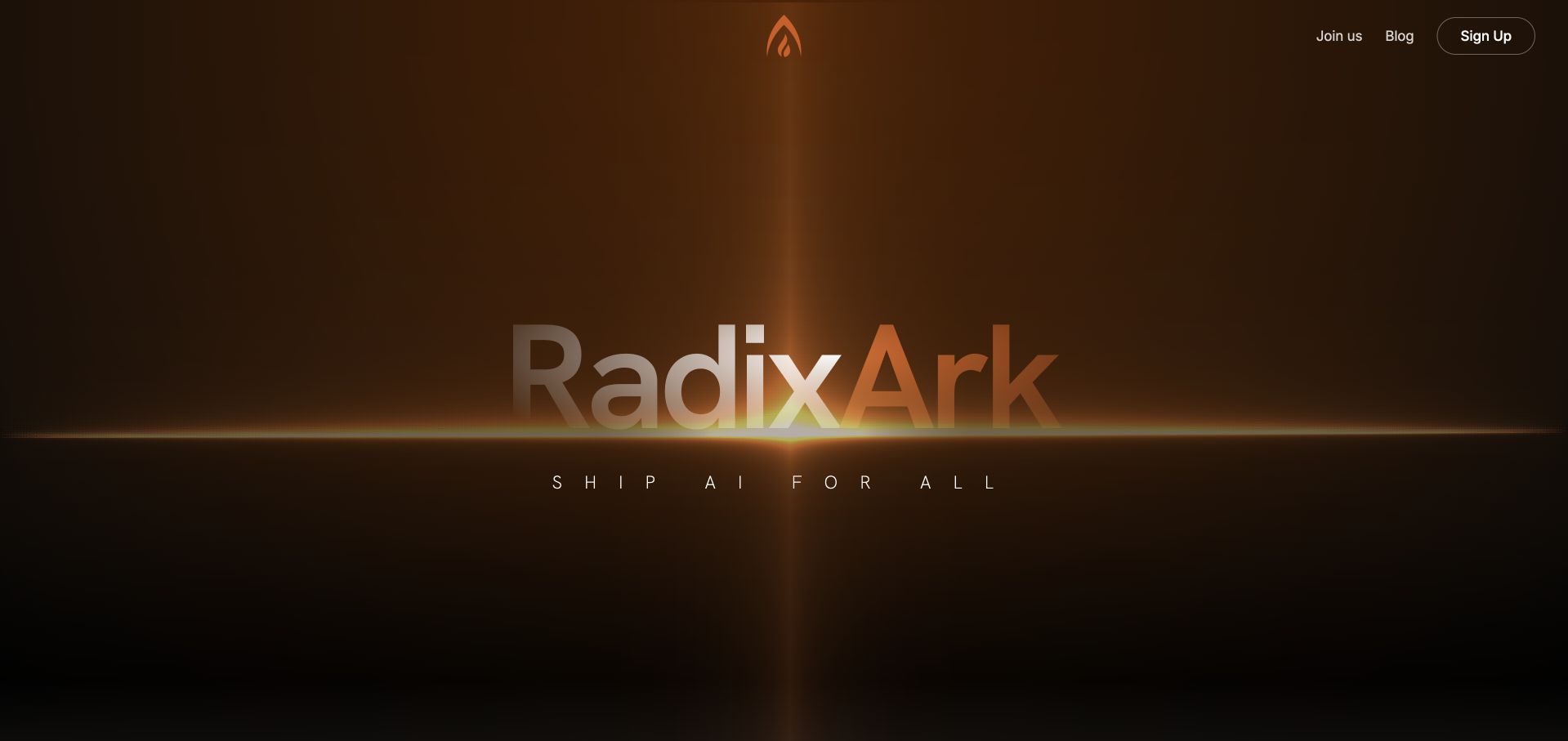
RadixArk begins with a dark amber scene, a large central wordmark and a widely spaced short mission phrase. Only a few navigation choices sit in the upper corners, creating a deliberately sparse first impression. The detailed explanation of open inference and training systems appears further down. DigitalOcean’s case specifically describes AMD GPU capacity for SGLang and DeepSeek V4 development and production validation. That evidence does not establish the homepage’s hosting, independently reproduce benchmark results or identify every RadixArk system.
What you can learn
An atmospheric opening needs a nearby technical explanation that names what the organization actually builds. When studying infrastructure performance, retain the model, hardware, precision and workload context of a benchmark. A headline throughput figure cannot be transferred unchanged to another model or treated as a general website performance guarantee.
Pros
The restrained navigation and amber visual language create a clear identity without crowding the opening.
The sparse composition leaves room for a detailed engineering explanation later in the page.
Cons & considerations
The first screen provides little practical explanation for readers unfamiliar with the company or its projects.
A minimal mission statement delays discovery of specific documentation, products and operational evidence.
Platform source: Official technology-specific customer or workload source. DigitalOcean describes AMD GPU capacity for RadixArk’s SGLang and DeepSeek V4 development and production validation. Published benchmark figures remain scoped vendor claims. This evidence establishes only the stated product, workload, organization or historical association. It does not prove that the pictured public page uses the technology, reveal its CMS/frontend, establish a complete current architecture or independently verify vendor-reported outcomes. Platform evidence is separate from the direct website screenshot and is not a complete current infrastructure audit.
Kegan has 15+ years of experience working with small businesses, Fortune 500 companies, and everything in between. No development job is too big or too small: he brings the same hands-on attention to a focused improvement, a complete website, or a custom application.
For DigitalOcean projects, he can help with content architecture, custom functionality, system integrations, testing, and maintainable handover. He works directly with clients on scope, design, implementation, testing, and handover, with an emphasis on clear communication and a system that remains practical to maintain after launch.
Show 3 other DigitalOcean developersHide other DigitalOcean developers
For a conventional application, evaluate App Platform against the actual language, build, service and worker requirements. Keep environment configuration separate from source code and use a staging workflow. Verify supported runtimes and current limits in the documentation rather than copying a years-old tutorial or assuming every framework deploys without adjustment.
An explicitly operated server or container platform
When a virtual machine or managed Kubernetes environment is justified, name the person responsible for configuration, patching, deployment and incident response. Decide how applications discover dependencies and how persistent data survives replacement. Kubernetes can be useful for the right workload, but it does not automatically make a small website easier to maintain.
A bounded AI or high-throughput service
For GPU and specialized processing, specify the model, latency, concurrency, storage and availability needs before selecting capacity. Distinguish a batch training job from an interactive inference request. Keep a fallback or an understandable pending state in the customer interface, and validate performance with the actual workload rather than transferring a vendor benchmark unchanged.
From references to requirements
Make deployment, data and recovery part of the brief
Inventory the complete service
List public pages, authenticated routes, databases, uploaded files, scheduled tasks and external dependencies. Include email, payments and administrative tools even if they are hosted elsewhere. Identify the source of truth for each record and the consequences of delayed processing. This inventory is more useful than choosing a cloud plan from the anticipated number of homepage visitors alone.
Test the release and rollback path
Build a reproducible deployment with realistic configuration and data. Rehearse a failed build, a bad release and a dependency outage. Confirm that rolling back code does not silently undo or corrupt a database change. Keep a record of the release, responsible reviewer and recovery decision so the next operator does not need to reconstruct the service from memory.
Set a measurable operating budget
Estimate ordinary and peak usage across compute, storage, databases and specialized resources. Include backups, logs and external-service costs rather than only the visible application instance. Assign budget alerts and a regular review. A predictable starting plan is valuable only if the team can explain which changes in customer behavior could increase the bill.
A useful handover demonstration
Ask the actual team to carry out its routine job: publish a realistic update, correct a mistake, preview a narrow screen, and identify who owns an integration failure. For a library or frontend framework, also ask who maintains the content source and deployment. A polished screenshot does not answer those operational questions.
Beyond the screenshot
A DigitalOcean website project checklist
List public, private and background workloads.
Choose managed application, server or container responsibilities.
Confirm supported runtimes and build requirements.
Keep secrets out of public code and logs.
Separate staging and production configuration.
Define data ownership and persistent storage.
Test real peak traffic and job concurrency.
Rehearse a failed release and rollback.
Verify backups through an actual recovery exercise.
Assign application and infrastructure monitoring owners.
Set cost alerts across all resource types.
Document regions, external dependencies and escalation paths.
Test with real content, a keyboard, a small screen, slow or failed requests, and the people who will maintain the system. These are planning checks, not an accessibility, security, performance, or search-ranking certification.
Sources & editorial method
How this DigitalOcean collection was reviewed
Actual public pages were inspected and captured through Chrome, with image dimensions, redirects and capture dates retained. Official DigitalOcean cases support specific workloads and historical associations; the public jQuery footer independently declares its hosting. No screenshots were inferred to reveal a complete backend, and vendor outcomes were not independently reproduced.
Every image is an unmodified capture from the actual website, with its source and capture date. Some captures are reused from our shared catalog; their dates remain the original capture dates. None comes from a vendor gallery or a generated reconstruction. Moving imagery and live content can change.
Technology attribution uses public page assets or metadata, official platform documentation, or a cited first-party project case study. Documentary and framework-relationship evidence is identified where used; it is not a complete current backend inventory. A CMS image CDN alone does not establish a full CMS deployment. A library’s presence does not prove which individual controls use it, and a platform label does not establish AI authorship.
The composition notes, lessons, pros and tradeoffs are original editorial observations. We have not measured conversion, traffic, security, performance or accessibility conformance. Website owners retain their brands and imagery; these examples are not our client portfolio. Written, Edited and Curated are independent records, not dates advanced by a build. See our editorial standards or suggest a correction.
Questions worth asking
DigitalOcean website development FAQs
Do these screenshots prove DigitalOcean hosts the public pages?
Not generally. Most evidence concerns a specified application or workload. jQuery’s inspected footer makes an explicit hosting declaration, while other cases remain separately scoped.
Is a managed platform always preferable to a virtual machine?
No. Compare the application requirements and the team’s operating capacity. The important decision is a clear, supportable division of responsibilities.
Should a small site start with Kubernetes?
Not without a concrete need. The additional coordination and operating work should be justified by the service, not by the presence of Kubernetes in another company’s case study.
Can a GPU customer case predict my application’s speed?
No. Model, hardware, data movement, concurrency and implementation all affect the result. Test the specific workload and keep vendor-reported measurements qualified.
Why retain older customer references?
They provide dated context about a documented decision. Ghost’s migration and HackerRank’s 2017 customer mention are not presented as current complete architecture claims.