Best Symfony Websites of 2026 (20 Real-World Examples)
Twenty public websites associated with Symfony through documented Drupal components or Sylius implementations, with original design reviews and genuine source captures.
A useful website makes its underlying complexity understandable. These examples show public information, specialist retail and service-booking patterns while keeping Symfony’s documented role separate from the design you can see.
Symfony provides a PHP framework and reusable packages. Those are related but different ways of using the project. Drupal documents Symfony components in its CMS architecture; Sylius documents a commerce framework built on Symfony. This collection follows those specific relationships through eight Drupal public properties and twelve named Sylius implementations. It does not present a screenshot as proof of a hidden server runtime or an installed version.
The visible examples range from institutional publishing to configurable products and airport services. Their useful lessons concern navigation, content structure and the decisions a visitor must make. A shared technical foundation does not impose one visual style. Choose the visitor’s task and the operational requirements first, then decide whether a CMS, a commerce platform or a custom application is the appropriate way to support them.
Before the examples
What makes good Symfony website development in 2026?
Name the layer that actually needs Symfony
A custom application, a CMS using selected components and a commerce platform built on the framework create different responsibilities. State the required role before choosing an implementation. The official Symfony documentation separates application architecture from standalone packages, while the Drupal and Sylius sources explain their own relationships. Do not turn a dependency into a claim about an entire organization’s systems.
Keep the public task smaller than the internal system
A visitor may need a policy document, a compatible furniture front or a parking duration. None requires an introduction to the internal data model. Use clear categories and concrete labels to help people make the next decision. Keep complex business rules behind those decisions, with explanations when a rule affects price, eligibility, availability or the meaning of a submission.
Separate editorial freedom from operational truth
Campaign imagery and page composition can change frequently. Product identifiers, service conditions and authoritative content need dependable ownership. Define which information editors may compose freely and which comes from maintained records or services. A visually flexible site still needs consistent addresses, search results, accessible labels and a sensible response when a dependency is unavailable.
Plan failure and permissions alongside the happy path
Symfony’s official documentation includes validation, authorization, forms, errors and testing. Use the relevant guidance for the actual application rather than assuming a familiar framework makes every workflow safe. A quote request, account change and confirmed purchase have different consequences. Explain failures clearly and avoid making a repeated click silently repeat a consequential action.
Read these examples as distinct public experiences with explicit dependency evidence. The opening organizations provide different publishing and retail contexts; the later specialists show narrower catalogue, configuration and service decisions.
We start with five recognizable brands or organizations: UNICEF, World Food Programme, US Environmental Protection Agency, European Commission, HBX. Each attribution applies to the named website property, not every product or website belonging to its organization. This is a curated reading sequence, not a measured ranking.
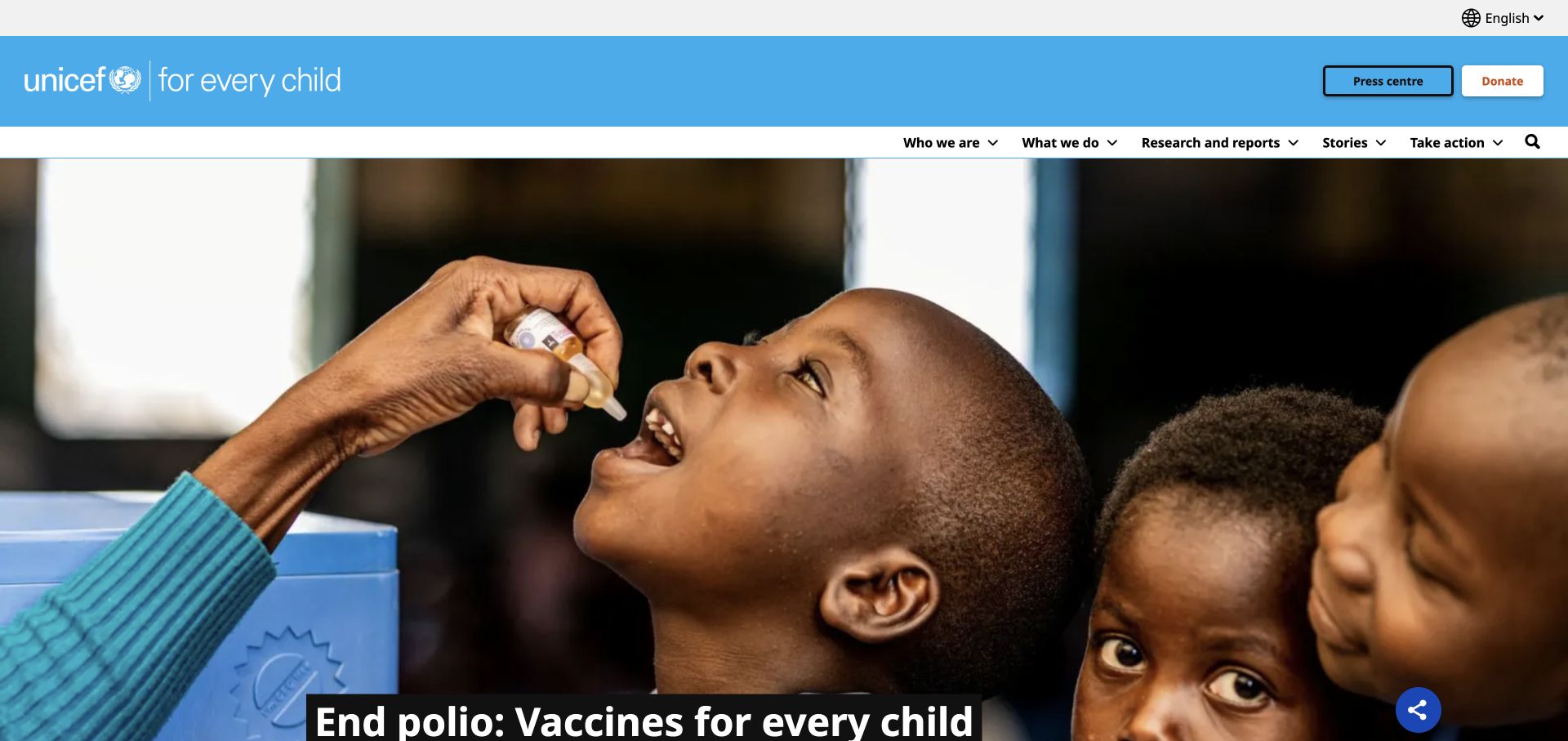
UNICEF gives the campaign photograph room to establish a human subject while its blue identity and navigation hold the page together. That separation matters on a large institutional website: the lead story can change without forcing visitors to relearn where the organization’s work and practical information live. The retained source records Drupal settings and core assets on this exact public property. Symfony belongs here through Drupal’s documented component architecture, not as a directly observed application or an explanation for the photograph, typography or campaign performance.
What you can learn
Give editors a clear space for a changing story, then keep the surrounding navigation and institutional identity dependable. A reusable content system should make those responsibilities easier to maintain without flattening every campaign into an identical message.
Pros
A recognizable blue frame keeps the organization visible around a large editorial image.
The photograph creates a specific entry point before the visitor explores broader institutional material.
Cons & considerations
Image-led campaigns need useful text alternatives and careful treatment across smaller screens.
The visible homepage cannot establish how donation systems or other UNICEF properties are implemented.
Platform source: Official Symfony dependency documentation, with retained exact-property evidence. Symfony components as the documented foundation of the Drupal CMS associated with this exact public page. Retained source exposes Drupal core assets/settings; both Drupal and Symfony document the CMS dependency. This explicit evidence-chain association does not establish direct Symfony PHP execution, a full Symfony application, an installed version, or other services of this organization. Symfony runtime and installed version were not independently observed. Dependency documentation reviewed November 11, 2026; prior page and project observations retain their original dates. Platform evidence is separate from the direct website screenshot and is not a complete current infrastructure audit.
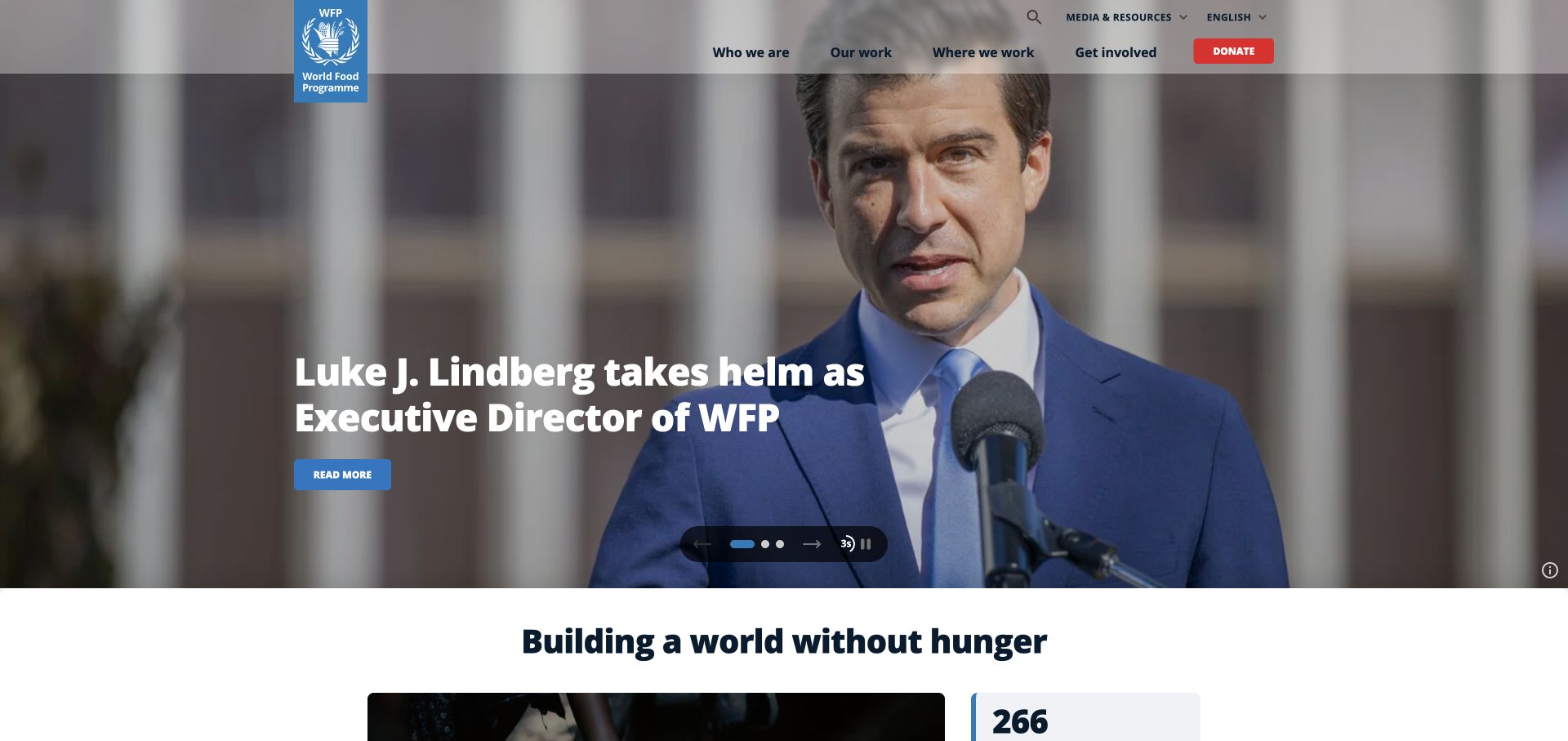
The World Food Programme pairs a strong blue identity with a large editorial photograph. The opening feels like an active publication rather than a directory of departments, yet the persistent header gives readers a route back to the broader organization. This is useful for a site whose important stories change while its role remains stable. The retained exact-page evidence includes Drupal settings and core resources. The Symfony connection is therefore a documented Drupal component relationship; it does not identify the software behind every campaign, donation service or operational system.
What you can learn
Build a clear distinction between the story being promoted today and the information visitors need repeatedly. Let editorial images carry attention while consistent navigation carries orientation, especially when several teams publish into the same public site.
Pros
The institutional color and visible identity keep a broad campaign presentation anchored to its publisher.
A large photographic lead provides a focused starting point within a substantial content estate.
Cons & considerations
A carousel needs deliberate content order and understandable controls, not just additional slides.
Photographic prominence can push less visual but essential information farther down the page.
Platform source: Official Symfony dependency documentation, with retained exact-property evidence. Symfony components as the documented foundation of the Drupal CMS associated with this exact public page. Retained source exposes Drupal core assets/settings; both Drupal and Symfony document the CMS dependency. This explicit evidence-chain association does not establish direct Symfony PHP execution, a full Symfony application, an installed version, or other services of this organization. Symfony runtime and installed version were not independently observed. Dependency documentation reviewed November 11, 2026; prior page and project observations retain their original dates. Platform evidence is separate from the direct website screenshot and is not a complete current infrastructure audit.
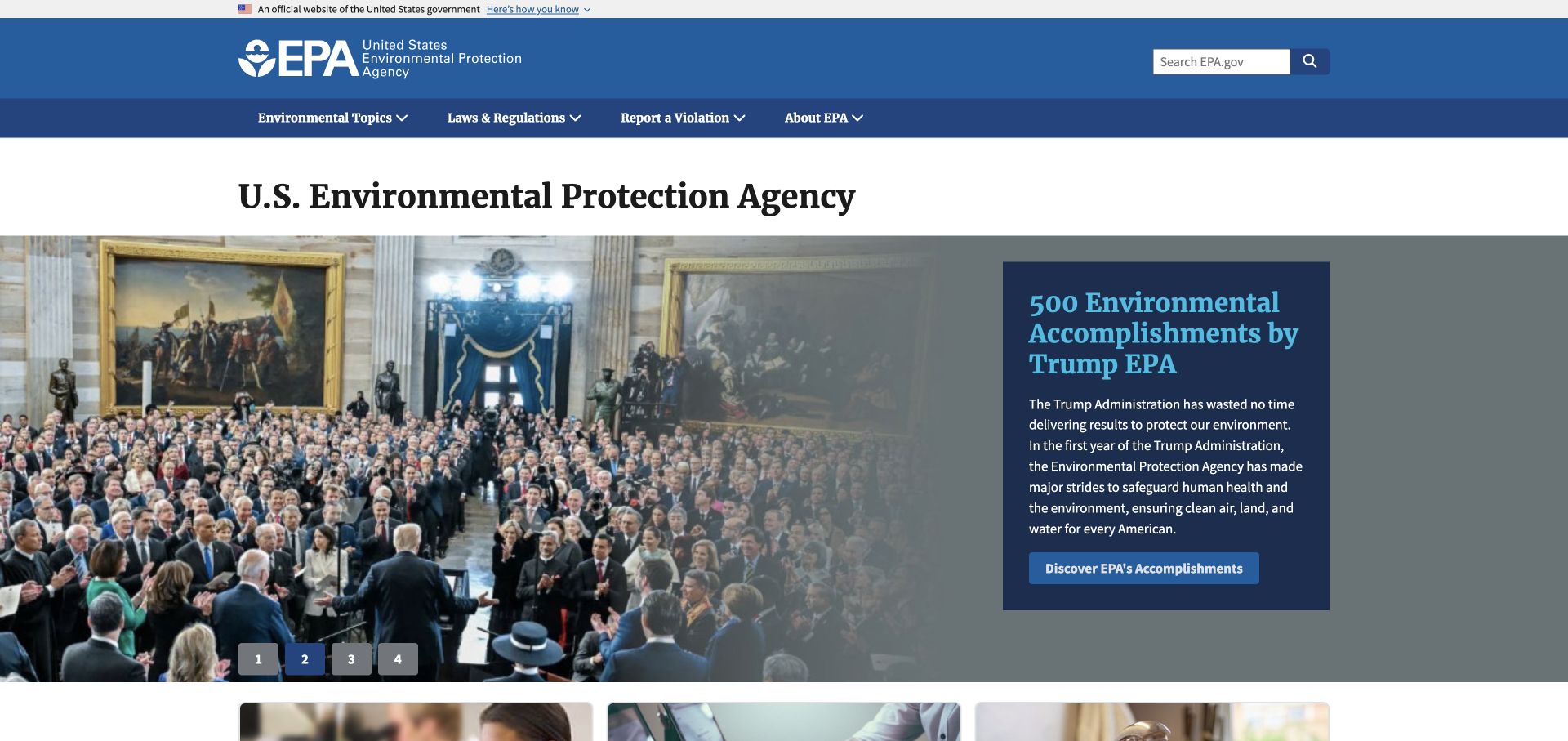
The EPA homepage uses an unmistakable agency header above a large photographic feature and a readable editorial card. The composition separates the official identity from the current message, making the featured content feel like one part of a larger public information service. Its design is worth studying for hierarchy rather than for the substance of any particular announcement. Retained source evidence names Drupal core scripts on this exact page. Symfony is associated through Drupal’s documented components, without a claim about the agency’s other applications or its complete server environment.
What you can learn
Keep the authority and navigation of a public service consistent while allowing individual announcements to use a strong visual treatment. A feature card should have a clear title and destination without becoming the only way into the site’s permanent resources.
Pros
The agency identity remains distinct from the changing visual feature beneath it.
A contained text card gives the editorial message a readable boundary against photography.
Cons & considerations
Large features require a plan for urgent information that should not wait behind a slide.
An official visual identity alone does not establish accessibility, accuracy or service reliability.
Platform source: Official Symfony dependency documentation, with retained exact-property evidence. Symfony components as the documented foundation of the Drupal CMS associated with this exact public page. Retained source exposes Drupal core assets/settings; both Drupal and Symfony document the CMS dependency. This explicit evidence-chain association does not establish direct Symfony PHP execution, a full Symfony application, an installed version, or other services of this organization. Symfony runtime and installed version were not independently observed. Dependency documentation reviewed November 11, 2026; prior page and project observations retain their original dates. Platform evidence is separate from the direct website screenshot and is not a complete current infrastructure audit.
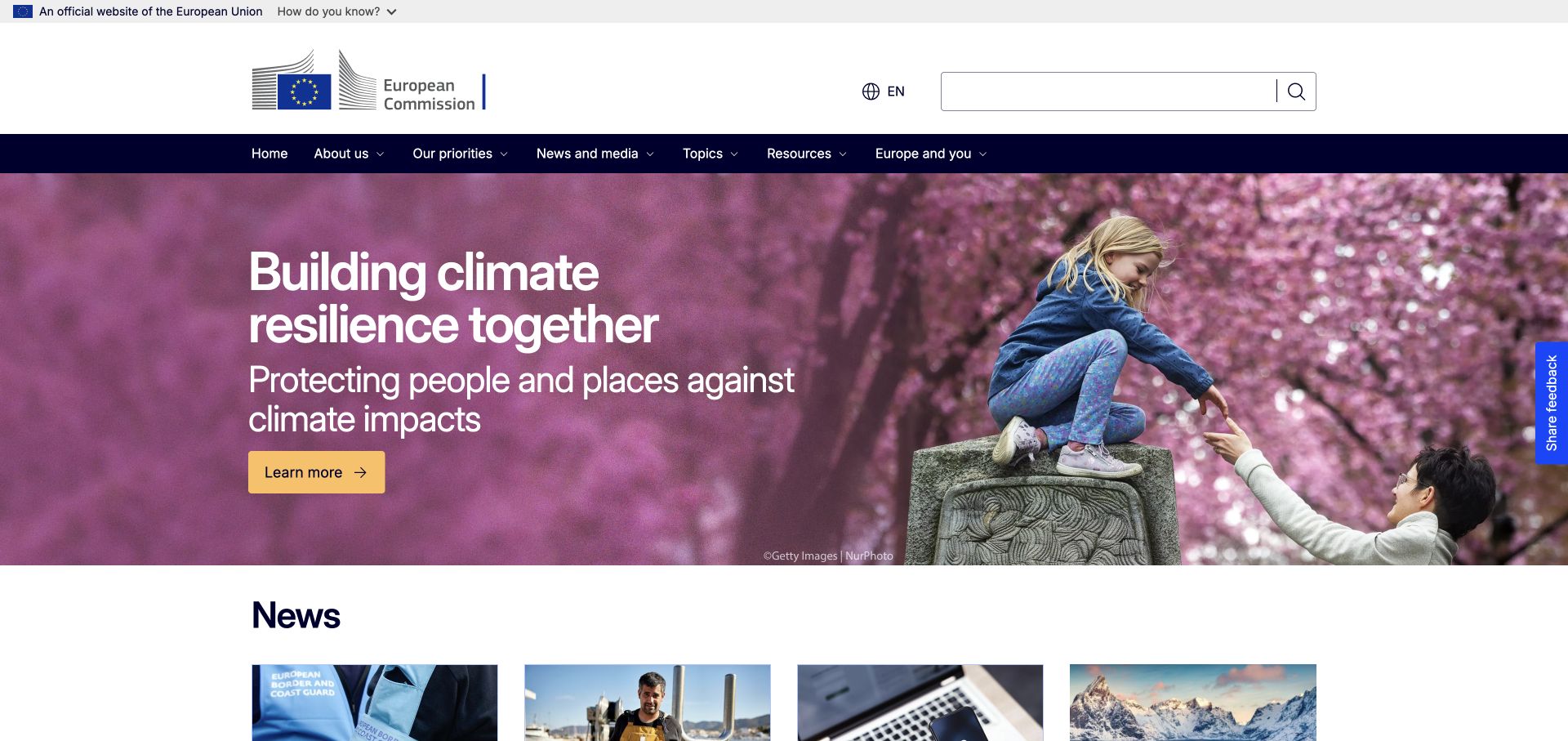
The European Commission’s English entry combines a restrained institutional header with a vivid climate feature and a news row immediately below. The photograph supplies a recognizable human situation, while the headline and button explain the subject without turning the entire opening into a menu. Search and language controls remain part of the surrounding frame. The retained audit links this exact page to Drupal assets, including its core resources. Symfony’s role is the documented component foundation of that CMS, not a direct finding about every European Union website or service.
What you can learn
Give a large institution more than one reading speed: a clear featured story for exploration, stable navigation for repeat visitors and an immediately visible news structure for scanning. Keep language selection close to that persistent orientation system.
Pros
The themed hero and compact news row establish both a lead story and additional entry points.
Language and search controls sit with the institutional identity instead of competing inside the campaign.
Cons & considerations
A wide navigation vocabulary needs testing with people unfamiliar with the organization’s structure.
The large photograph needs careful cropping so the text remains legible in different layouts.
Platform source: Official Symfony dependency documentation, with retained exact-property evidence. Symfony components as the documented foundation of the Drupal CMS associated with this exact public page. Retained source exposes Drupal core assets/settings; both Drupal and Symfony document the CMS dependency. This explicit evidence-chain association does not establish direct Symfony PHP execution, a full Symfony application, an installed version, or other services of this organization. Symfony runtime and installed version were not independently observed. Dependency documentation reviewed November 11, 2026; prior page and project observations retain their original dates. Platform evidence is separate from the direct website screenshot and is not a complete current infrastructure audit.
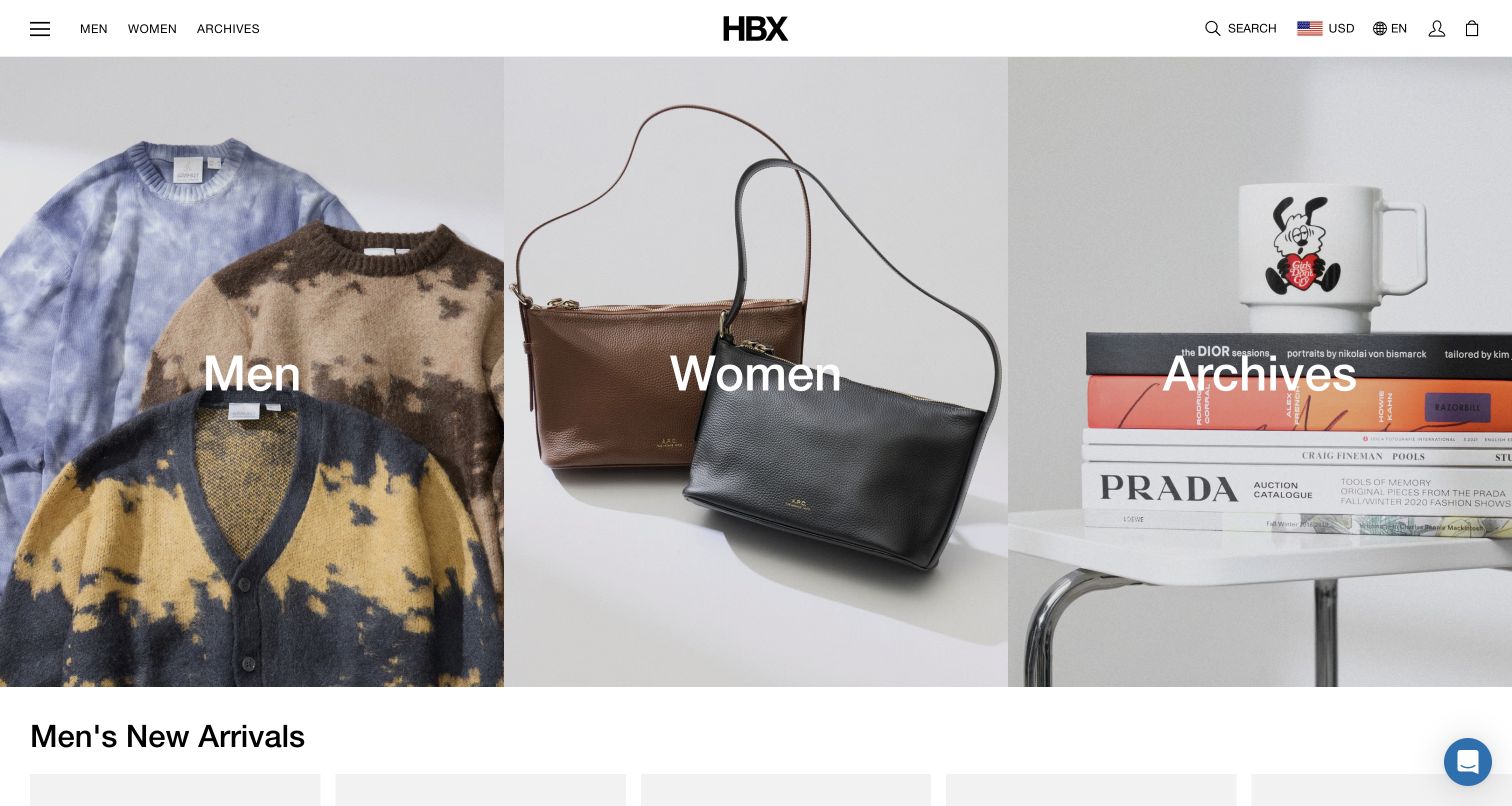
HBX reduces its opening decision to three large visual areas for Men, Women and Archives. The white retail header stays quiet while the images give each route a distinct mood. This makes the page useful as a catalogue entrance rather than asking every shopper to interpret a brand manifesto first. The official Sylius case concerns the HBX retail property specifically. Symfony is a documented framework dependency of that commerce implementation; the association does not extend to Hypebeast’s media sites or establish the current software behind every visible storefront feature.
What you can learn
When the first useful decision is a collection, make that decision visually obvious and keep the supporting retail controls available. A flexible commerce backend should support a clear catalogue structure rather than requiring customers to understand its internal product model.
Pros
Three strong image areas make the main shopping routes easy to compare at a glance.
The restrained header leaves room for fashion imagery without losing basic retail orientation.
Cons & considerations
Image-dependent categories still need clear labels and meaningful alternatives for nonvisual browsing.
A collection-first opening may need a separate prominent route for visitors seeking one exact product.
Platform source: Official Symfony dependency documentation, with retained exact-property evidence. Official exact HBX retail-property showcase, not the Hypebeast media estate. Symfony is a documented framework dependency of this named Sylius implementation, limited to its case-defined role and exact property. This does not establish that the captured frontend or every current backend service is Symfony, or identify an installed version. Symfony runtime and installed version were not independently observed. Dependency documentation reviewed November 11, 2026; prior page and project observations retain their original dates. Platform evidence is separate from the direct website screenshot and is not a complete current infrastructure audit.
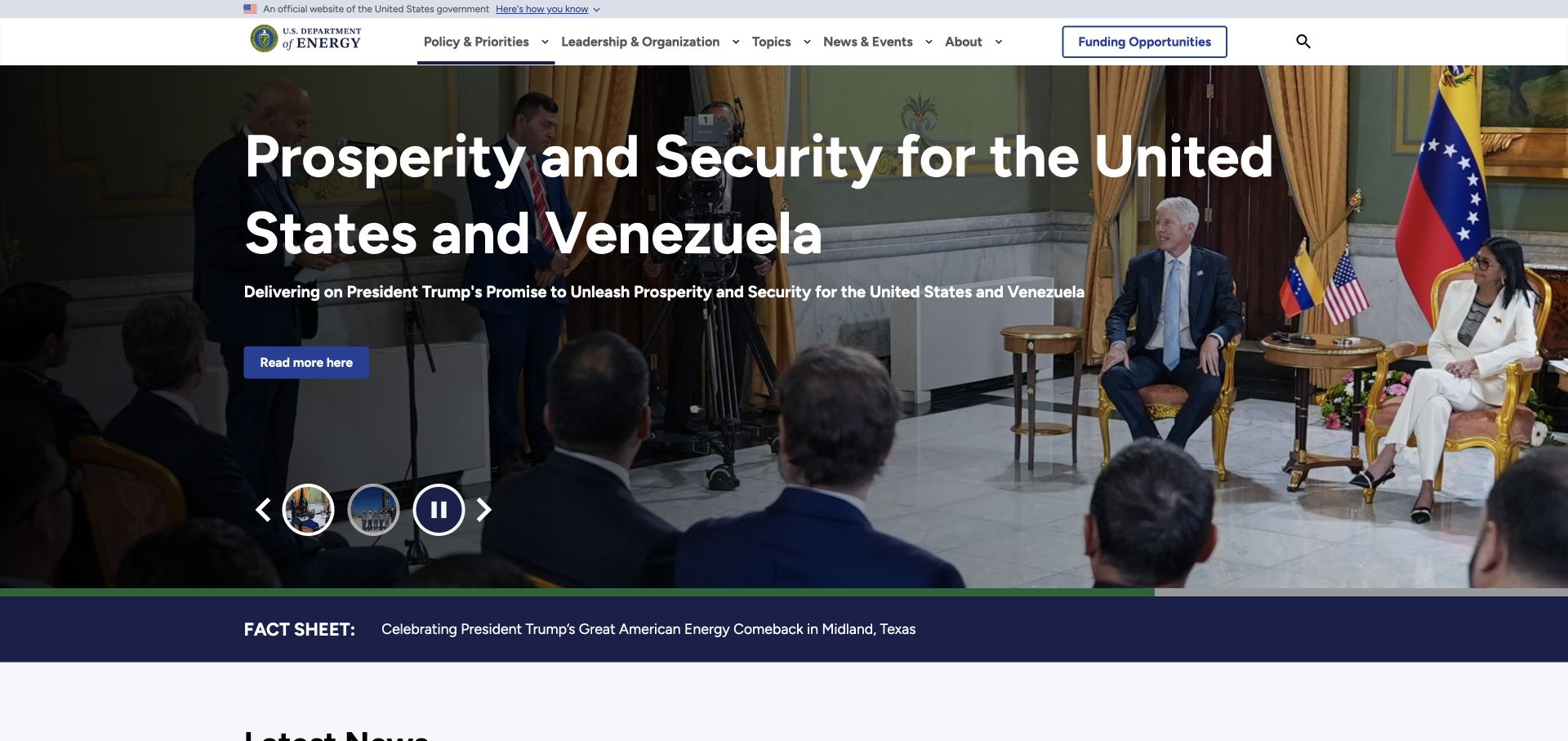
The Department of Energy opening gives a single announcement considerable space, using a darkened photograph, a large white headline and a clear action. The official header and a separate fact-sheet strip provide other layers of orientation. The visual treatment shows how an institutional publisher can distinguish a featured message from the site’s wider information structure. Its retained audit records Drupal resources from the exact public homepage, including core assets. The Symfony relationship is limited to Drupal’s documented components; the image does not prove a particular Symfony application or installed version.
What you can learn
Decide which messages deserve the large feature area and which belong in a persistent resource route. A content platform benefits from explicit editorial rules for priority, headline length and replacement dates, especially when several announcements compete for the same opening.
Pros
High-contrast headline treatment gives the featured announcement a defined visual position.
The official header and fact-sheet strip create useful layers outside the main image.
Cons & considerations
A long headline can dominate the viewport and needs realistic narrow-screen testing.
Multiple rotating announcements should not hide essential information behind timing or motion.
Platform source: Official Symfony dependency documentation, with retained exact-property evidence. Symfony components as the documented foundation of the Drupal CMS associated with this exact public page. Retained source exposes Drupal core assets/settings; both Drupal and Symfony document the CMS dependency. This explicit evidence-chain association does not establish direct Symfony PHP execution, a full Symfony application, an installed version, or other services of this organization. Symfony runtime and installed version were not independently observed. Dependency documentation reviewed November 11, 2026; prior page and project observations retain their original dates. Platform evidence is separate from the direct website screenshot and is not a complete current infrastructure audit.
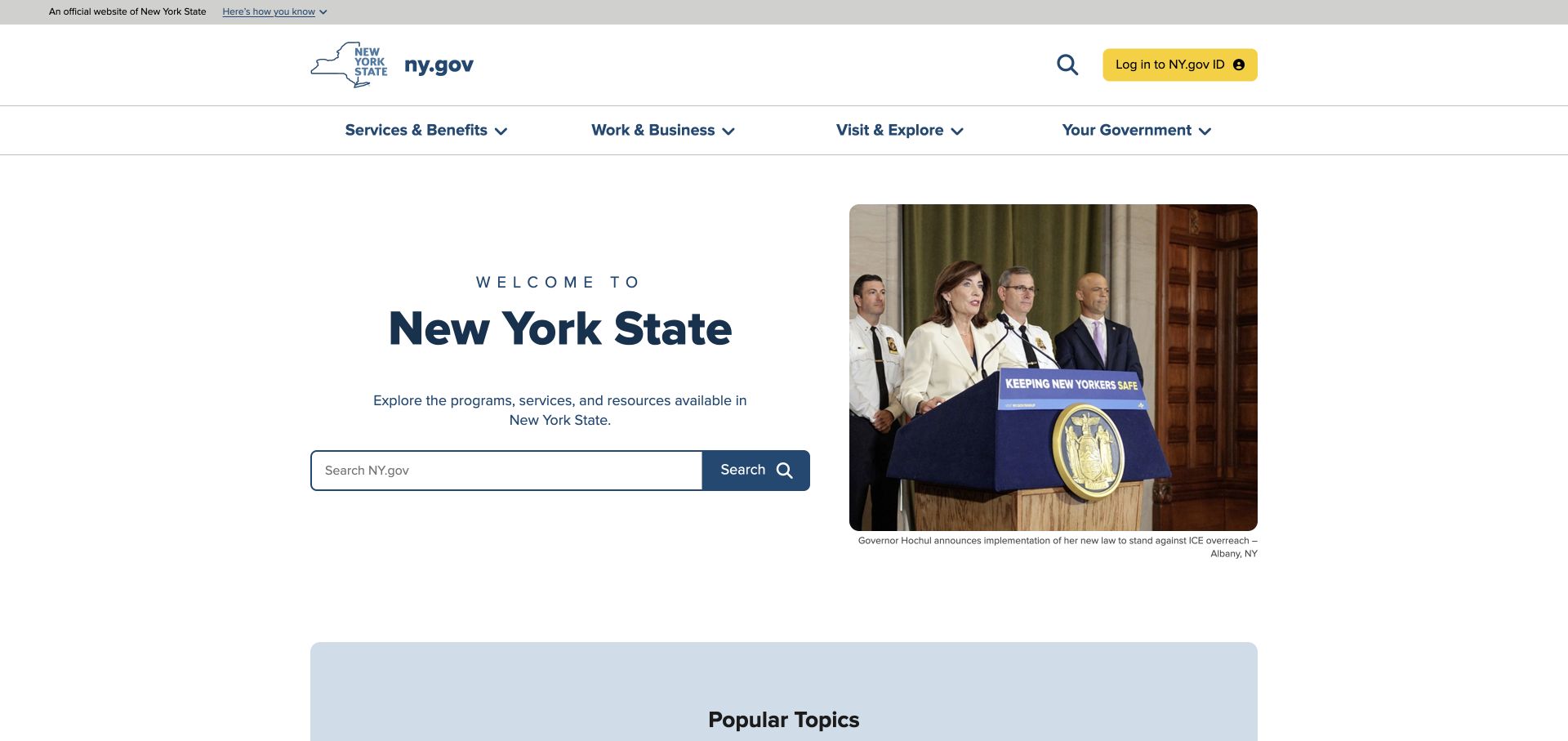
New York State’s homepage uses generous space around a short welcome, a search field and a contextual photograph. The persistent navigation groups services, work, visits and government information, giving people several ways to begin without crowding the opening. Search is presented as an ordinary part of the public-service task rather than an afterthought. Retained source and audit evidence identify Drupal on this exact page and include its core resource path. Symfony is documented through that CMS dependency; the connection does not establish the technology of the separate NY.gov identity or application services.
What you can learn
Give visitors who know their task a direct search route while keeping a small set of understandable categories for everyone else. Separate account access from informational browsing so people can orient themselves before deciding whether a sign-in is necessary.
Pros
The split introduction gives search a clear position without removing the human context of the photograph.
A small number of service-oriented navigation groups supports different starting intentions.
Cons & considerations
Search quality depends on maintained content and useful results, which a screenshot cannot demonstrate.
Government terminology needs review with residents who do not know departmental ownership.
Platform source: Official Symfony dependency documentation, with retained exact-property evidence. Symfony components as the documented foundation of the Drupal CMS associated with this exact public page. Retained source exposes Drupal core assets/settings; both Drupal and Symfony document the CMS dependency. This explicit evidence-chain association does not establish direct Symfony PHP execution, a full Symfony application, an installed version, or other services of this organization. Symfony runtime and installed version were not independently observed. Dependency documentation reviewed November 11, 2026; prior page and project observations retain their original dates. Platform evidence is separate from the direct website screenshot and is not a complete current infrastructure audit.
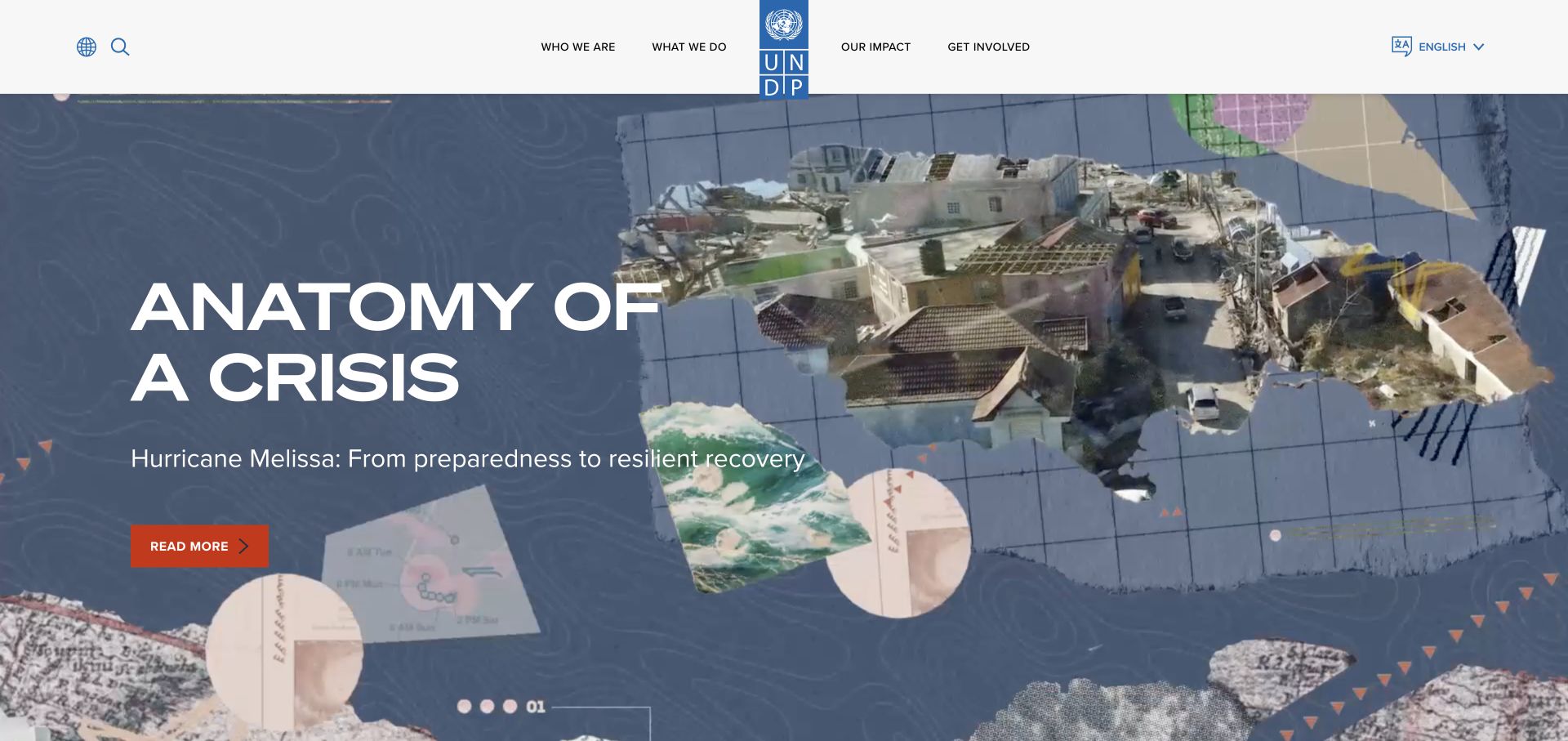
UNDP centers its tall blue mark within a compact navigation bar and lets the opening story occupy most of the screen. The illustrated photographic composition gives the crisis feature a distinct editorial character while the large headline explains its subject. It is a useful contrast with institutional sites that make every entry point equally prominent. The retained public source exposes Drupal selectors and core resources. Symfony is associated through Drupal’s documented components, not through a direct inspection of UNDP’s private systems or an assumption that the visual storytelling depends on Symfony itself.
What you can learn
A focused lead story can make a broad institutional site approachable when its surrounding navigation remains stable. Define the editorial purpose of motion, imagery and headline placement before deciding how the content platform will let teams assemble those elements.
Pros
The centered identity creates a clear institutional anchor above an expansive campaign image.
A large headline and distinct action provide a comprehensible first step into a complex subject.
Cons & considerations
An image-heavy first screen needs careful text alternatives and loading behavior.
Carousel content needs a reliable non-rotating route to important stories and supporting information.
Platform source: Official Symfony dependency documentation, with retained exact-property evidence. Symfony components as the documented foundation of the Drupal CMS associated with this exact public page. Retained source exposes Drupal core assets/settings; both Drupal and Symfony document the CMS dependency. This explicit evidence-chain association does not establish direct Symfony PHP execution, a full Symfony application, an installed version, or other services of this organization. Symfony runtime and installed version were not independently observed. Dependency documentation reviewed November 11, 2026; prior page and project observations retain their original dates. Platform evidence is separate from the direct website screenshot and is not a complete current infrastructure audit.
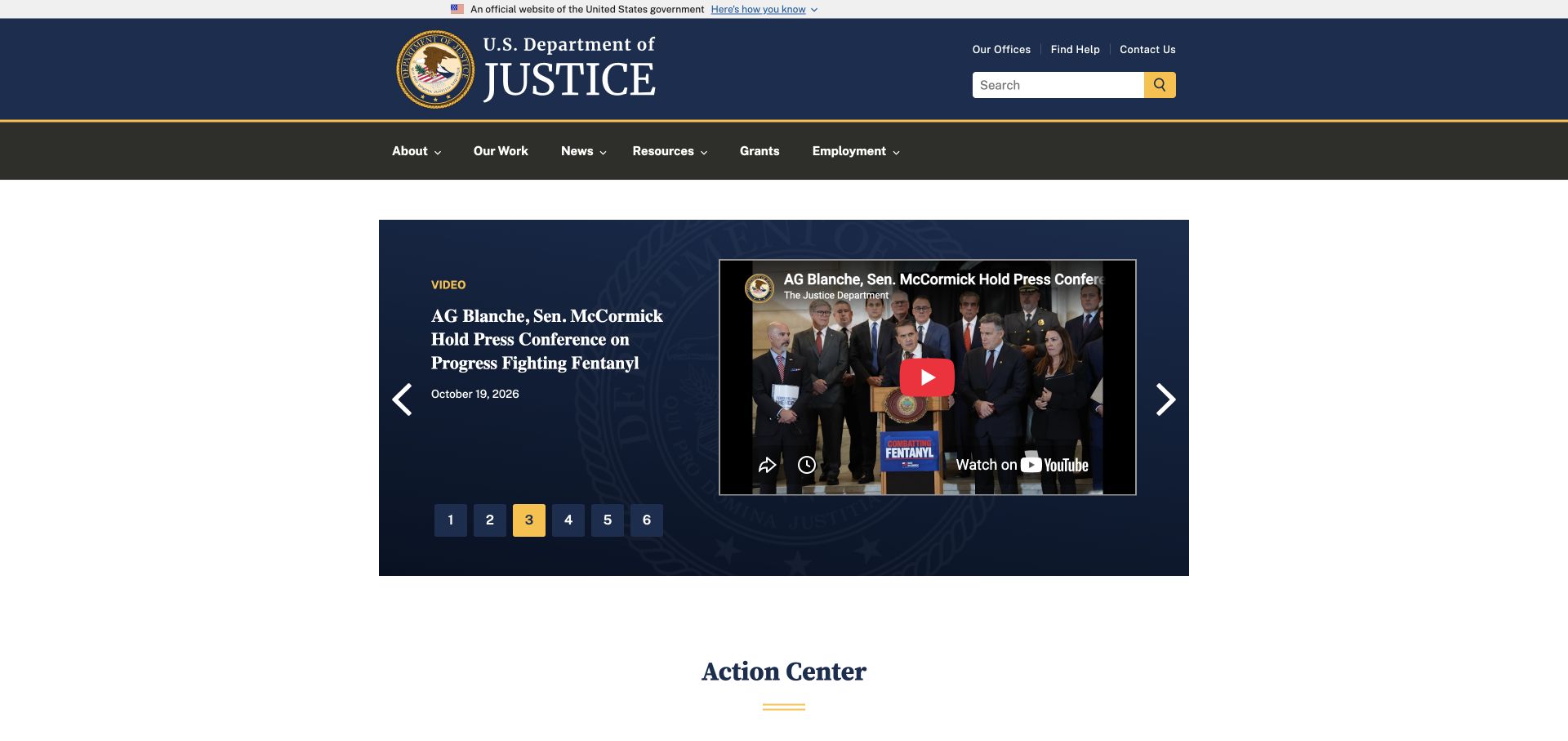
The Department of Justice puts its seal, name and primary navigation in a strong institutional frame, then contains the featured video inside a separate editorial panel. A headline, date and numbered carousel controls make the media area feel like a selected item rather than the whole site. The visible Action Center heading below signals a different kind of next step. Retained source evidence and core resource references establish the exact page’s Drupal association. Symfony is included through Drupal’s documented component foundation, without attributing the embedded video service or other departmental applications to that framework.
What you can learn
Give editorial media a clear boundary, title and context, then provide ordinary task routes outside it. A publishing system should support useful text alongside video so the page remains understandable before playback and when embedded content is unavailable.
Pros
The contained media panel keeps the agency header and navigation visually independent.
Numbered controls and a dated headline make the selected feature easier to identify.
Cons & considerations
A video thumbnail alone cannot communicate all information needed by people who cannot play it.
Several carousel items require careful ordering so important public tasks remain easy to find.
Platform source: Official Symfony dependency documentation, with retained exact-property evidence. Symfony components as the documented foundation of the Drupal CMS associated with this exact public page. Retained source exposes Drupal core assets/settings; both Drupal and Symfony document the CMS dependency. This explicit evidence-chain association does not establish direct Symfony PHP execution, a full Symfony application, an installed version, or other services of this organization. Symfony runtime and installed version were not independently observed. Dependency documentation reviewed November 11, 2026; prior page and project observations retain their original dates. Platform evidence is separate from the direct website screenshot and is not a complete current infrastructure audit.
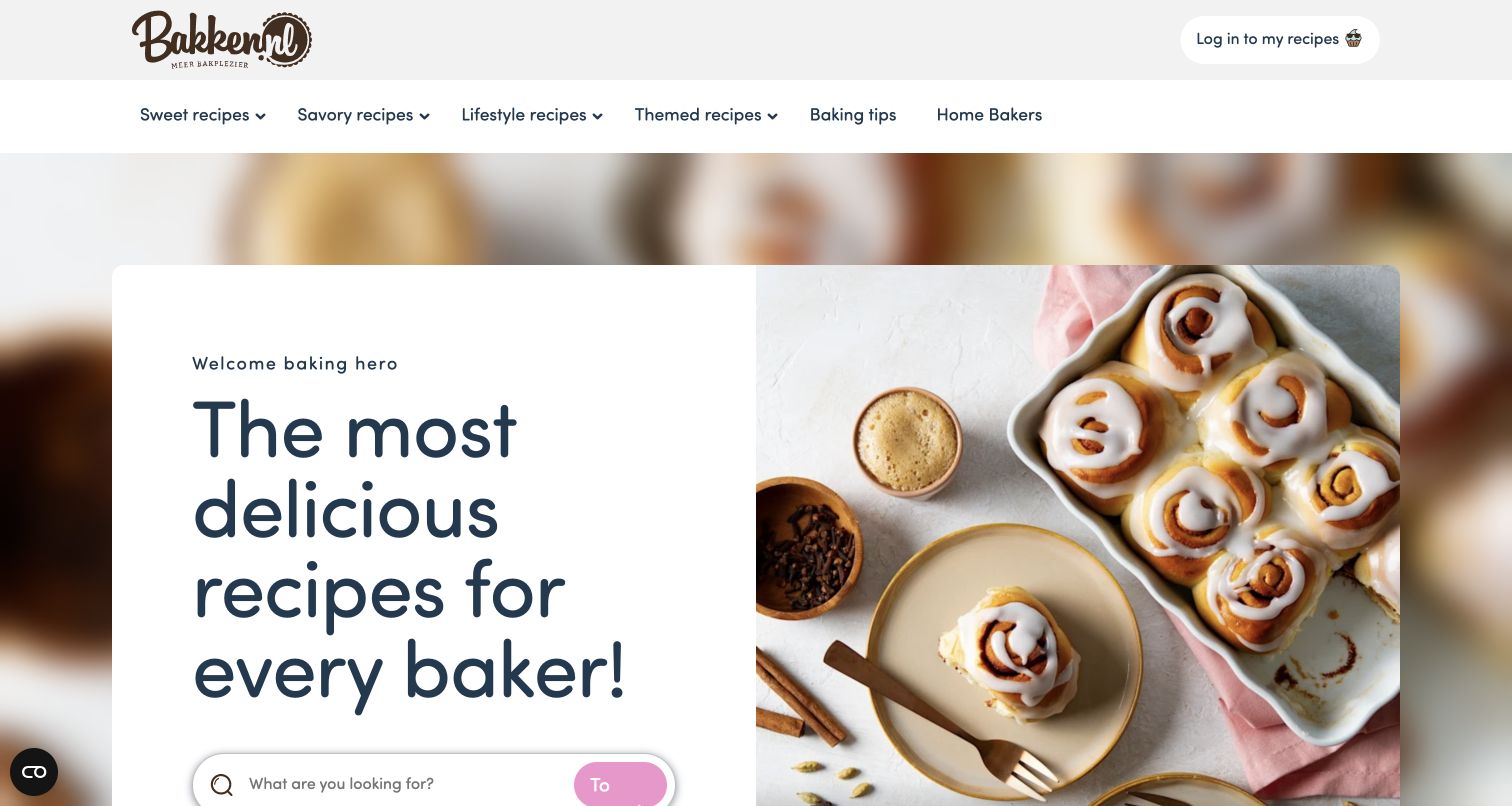
Bakken.nl welcomes visitors with a large food photograph, a friendly headline and a visible recipe-search entry. Categories distinguish sweet, savory and themed recipes before the page asks anyone to consider a membership action. The useful design idea is to make the everyday content task attractive on its own. The official Sylius case names Dr. Oetker’s Bakken project and scopes Sylius Plus to loyalty and backend work alongside separate content and frontend technology. Symfony’s documented relationship follows that limited Sylius role; it does not make Symfony the recipe CMS or describe Dr. Oetker’s worldwide infrastructure.
What you can learn
Keep the public content experience valuable before introducing loyalty features. Map recipe discovery, saved content and membership responsibilities separately so a commerce or loyalty service can support the experience without becoming a confusing prerequisite for ordinary browsing.
Pros
The food image and clear recipe language make the purpose immediately understandable.
Category navigation and search offer both exploratory and directed ways to find something useful.
Cons & considerations
Large display text needs realistic testing with translated labels and longer recipe titles.
The attractive public page does not reveal how membership data or rewards are managed.
Platform source: Official Symfony dependency documentation, with retained exact-property evidence. The official Sylius case explicitly names Dr. Oetker-owned Bakken.nl and documents Sylius Plus in a loyalty/backend role alongside Contentful and Vue.js. The public recipe page is the reviewed property; this does not establish Sylius as its recipe CMS or as the platform for Dr. Oetker worldwide. Symfony is a documented framework dependency of this named Sylius implementation, limited to its case-defined role and exact property. This does not establish that the captured frontend or every current backend service is Symfony, or identify an installed version. Symfony runtime and installed version were not independently observed. Dependency documentation reviewed November 11, 2026; prior page and project observations retain their original dates. Platform evidence is separate from the direct website screenshot and is not a complete current infrastructure audit.
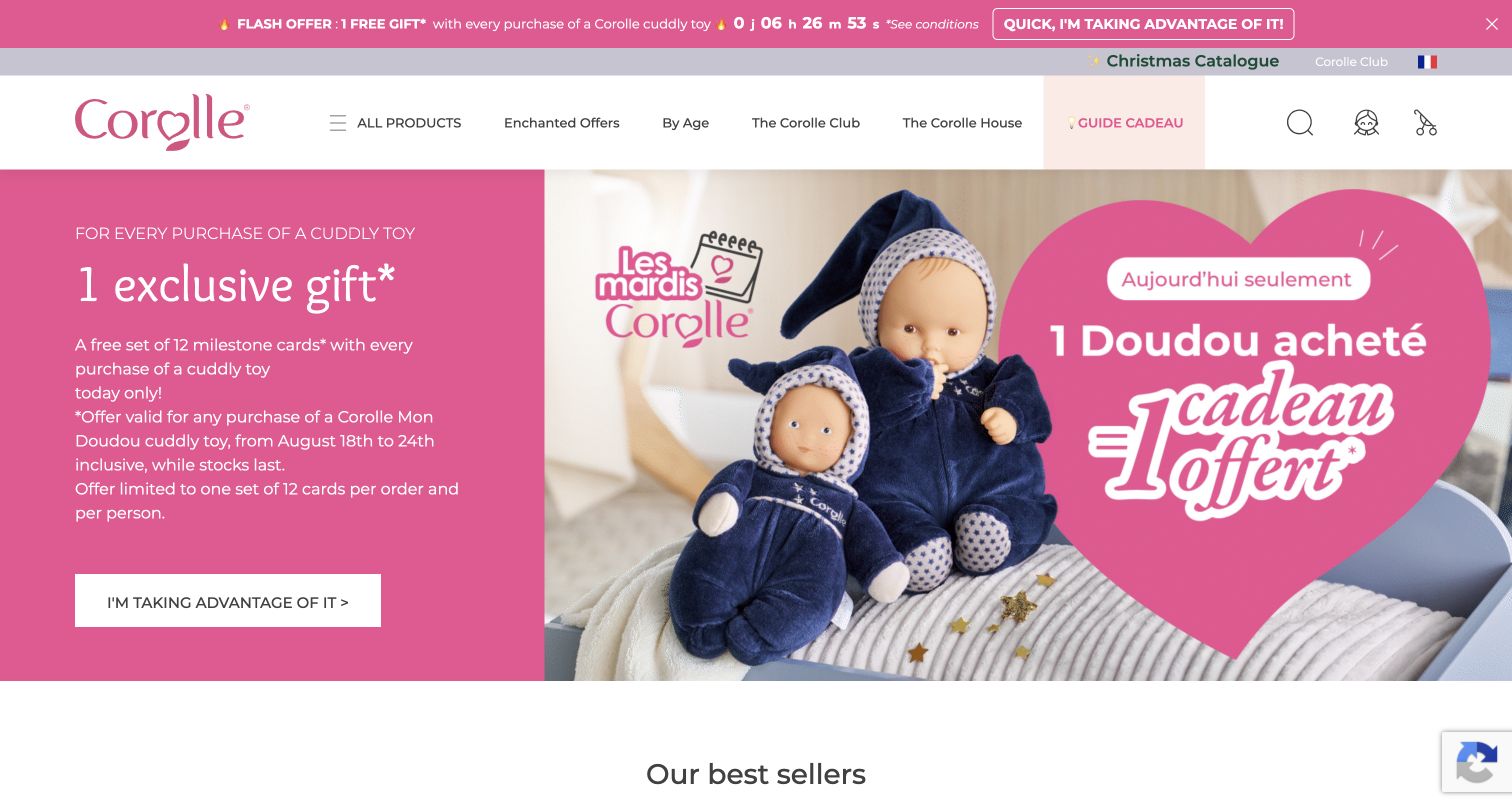
Corolle’s opening uses a pink doll campaign to establish a recognizable product world while its header supplies ordinary shopping orientation. The seasonal offer sits in a narrow strip rather than replacing the main story. This combination keeps the page recognizably commercial without reducing it to a grid of prices. The official Sylius case documents the French brand’s direct-store commerce and configurator work. Symfony is associated through that documented Sylius framework relationship, not through an assumption about every Corolle system or a direct observation of the implementation behind the campaign image.
What you can learn
Let a specialist brand’s visual language support the catalogue, then make the practical retail routes easy to recognize. Keep campaign content, product information and configuration rules as separate responsibilities so changing one does not make the other two harder to maintain.
Pros
A consistent color and product theme give the opening a clear identity.
The narrow offer strip adds retail context without obscuring the main campaign or navigation.
Cons & considerations
Campaign artwork needs careful localization when text is embedded inside the image.
Configuration quality and product availability cannot be judged from the homepage presentation alone.
Platform source: Official Symfony dependency documentation, with retained exact-property evidence. Official case identifies French toy brand D2C store and Sylius-based custom commerce/configurator. Symfony is a documented framework dependency of this named Sylius implementation, limited to its case-defined role and exact property. This does not establish that the captured frontend or every current backend service is Symfony, or identify an installed version. Symfony runtime and installed version were not independently observed. Dependency documentation reviewed November 11, 2026; prior page and project observations retain their original dates. Platform evidence is separate from the direct website screenshot and is not a complete current infrastructure audit.
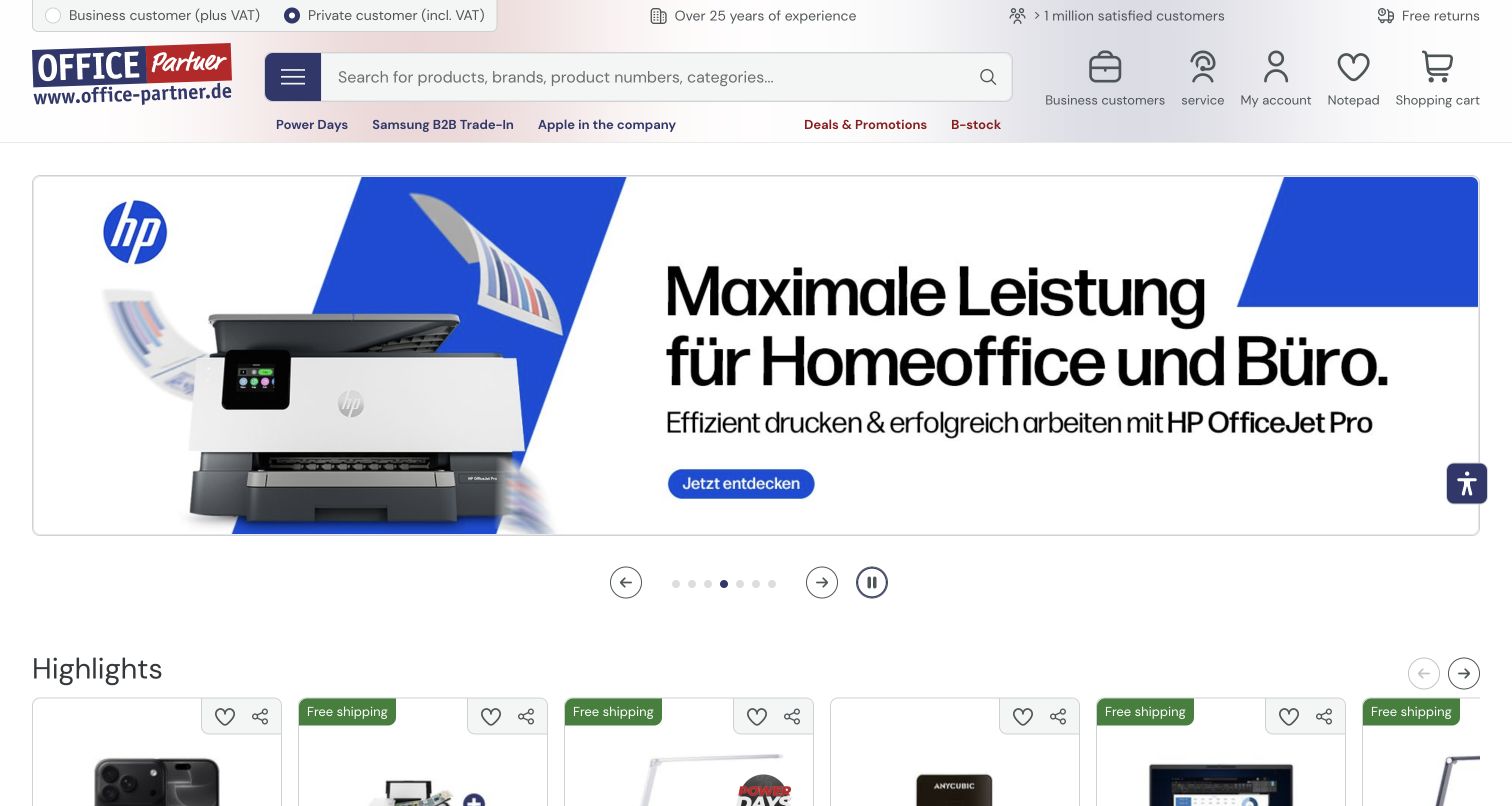
Office Partner gives search and retail orientation substantial room before introducing its printer campaign. The B2B and B2C context matters because a similar product can involve different purchasing expectations, support needs and account requirements. The opening makes that distinction visible without turning the entire page into an enterprise software diagram. Its official project case describes a completed Sylius commerce core with a custom headless frontend. Symfony is the documented framework dependency of that commerce implementation; it does not establish the frontend framework from appearance or make the printer manufacturer’s own website part of this example.
What you can learn
Define what business and consumer shoppers genuinely need to do differently, then reflect those differences in navigation and product information. Keep the commerce rules authoritative while allowing the storefront to present a simple, familiar route to search and comparison.
Pros
Prominent search supports visitors arriving with a specific model or product requirement.
The campaign gives a concrete shopping context below a practical and recognizable retail header.
Cons & considerations
Audience distinctions can become confusing if pricing and account requirements change without explanation.
A headless architecture still needs coherent error, availability and handover behavior across services.
Platform source: Official Symfony dependency documentation, with retained exact-property evidence. Official completed Sylius core with custom headless frontend; one property, not additional Playox entry. Symfony is a documented framework dependency of this named Sylius implementation, limited to its case-defined role and exact property. This does not establish that the captured frontend or every current backend service is Symfony, or identify an installed version. Symfony runtime and installed version were not independently observed. Dependency documentation reviewed November 11, 2026; prior page and project observations retain their original dates. Platform evidence is separate from the direct website screenshot and is not a complete current infrastructure audit.
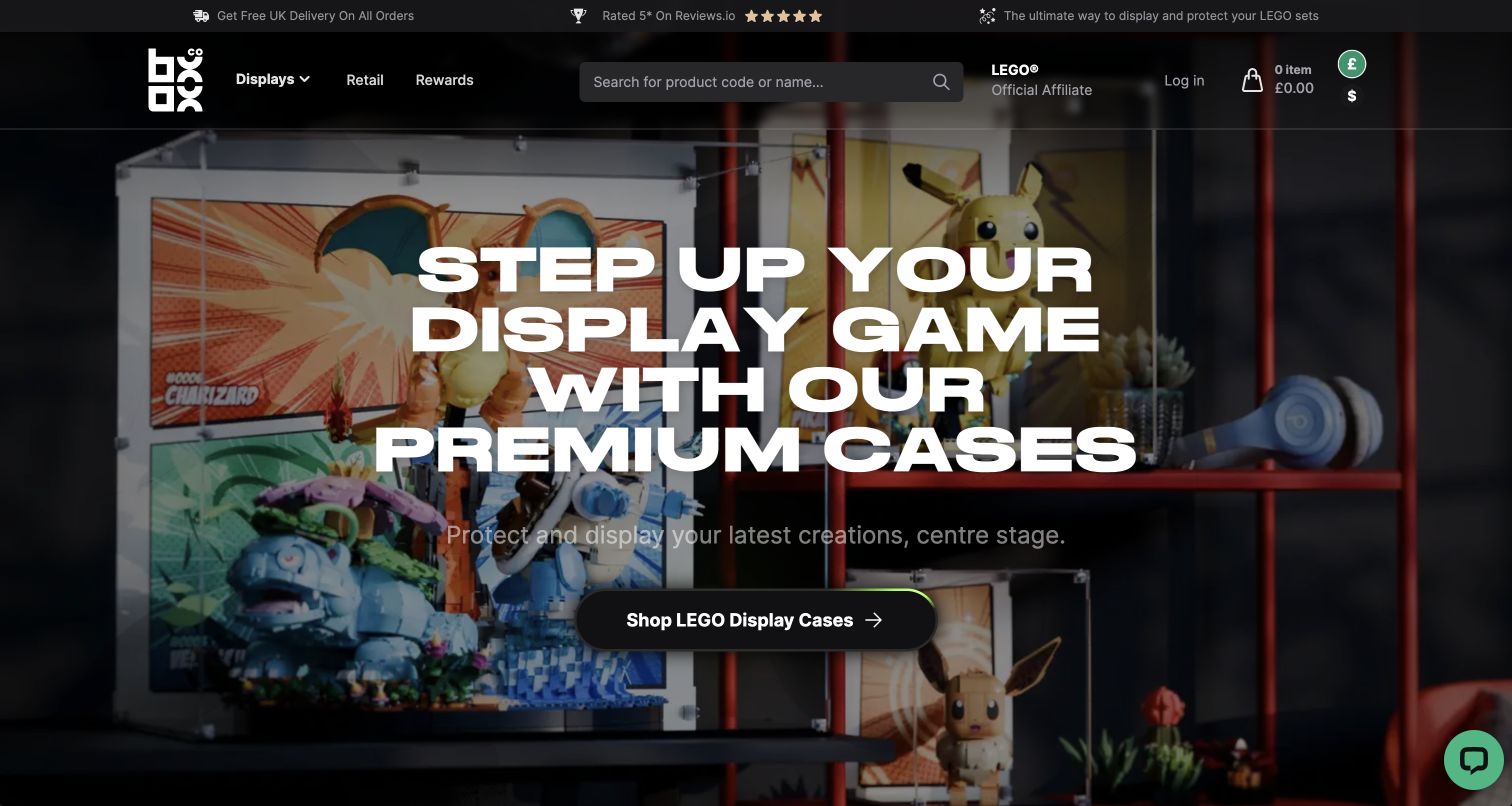
BOXXCO uses a black and green visual system around display-case imagery, making its specialist offer legible before a visitor explores the catalogue. Showing the cases with recognizable collections helps explain the product’s purpose more efficiently than a long technical introduction. The useful pattern is the relationship between an accessory and the object it protects or displays. The official Sylius case documents this particular store. Symfony is associated through Sylius’s framework foundation, without implying that LEGO’s own infrastructure is involved or that every visible effect on the storefront is implemented by Symfony.
What you can learn
Explain a specialist product in the context where someone will use it, then support that explanation with precise dimensions and compatibility information. The commerce model should distinguish the item being sold from the illustrative objects shown with it.
Pros
A restrained dark palette keeps the display products and their contents prominent.
Contextual product imagery communicates the use case before detailed specifications become necessary.
Cons & considerations
Compatibility claims need clear written detail beyond recognizable objects in promotional images.
Dark presentations require deliberate contrast and image treatment across product and support content.
Platform source: Official Symfony dependency documentation, with retained exact-property evidence. Official completed custom display-case public store; not LEGO brand infrastructure. Symfony is a documented framework dependency of this named Sylius implementation, limited to its case-defined role and exact property. This does not establish that the captured frontend or every current backend service is Symfony, or identify an installed version. Symfony runtime and installed version were not independently observed. Dependency documentation reviewed November 11, 2026; prior page and project observations retain their original dates. Platform evidence is separate from the direct website screenshot and is not a complete current infrastructure audit.
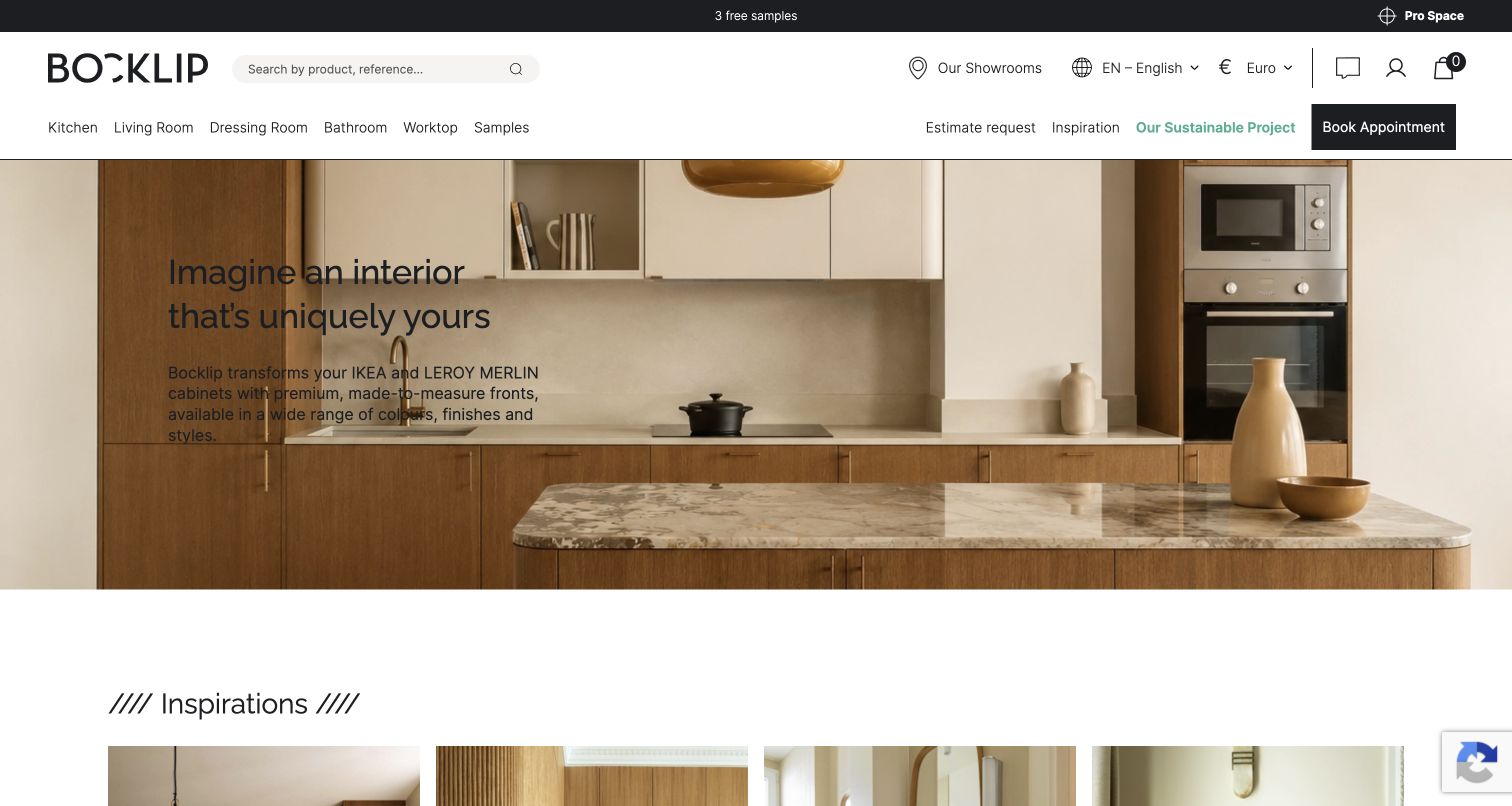
Bocklip opens with a completed kitchen rather than an isolated component, then explains its made-to-measure furniture-front offer. Product search, room categories and showroom links give visitors several ways to move from inspiration toward a practical selection. The page is useful for showing a finished result while still acknowledging a product with compatibility constraints. The official Sylius case documents this specific furniture-front store. Symfony’s association is the framework foundation of that Sylius implementation, not evidence about IKEA or Leroy Merlin systems and not proof of how the photographed room was designed.
What you can learn
Connect inspiration to the decisions a customer must eventually make: the room, existing cabinet system, finish and measurements. Keep those requirements explicit in the product model while allowing editorial imagery to show why the choices matter.
Pros
A complete interior gives context to products that would be harder to understand in isolation.
Showroom and appointment routes complement search for visitors who need practical guidance.
Cons & considerations
Text placed over a detailed interior photograph needs careful contrast and cropping.
A compelling room image cannot replace accurate compatibility, measurement and installation information.
Platform source: Official Symfony dependency documentation, with retained exact-property evidence. Official completed guided furniture-front store; not IKEA or Leroy Merlin platforms. Symfony is a documented framework dependency of this named Sylius implementation, limited to its case-defined role and exact property. This does not establish that the captured frontend or every current backend service is Symfony, or identify an installed version. Symfony runtime and installed version were not independently observed. Dependency documentation reviewed November 11, 2026; prior page and project observations retain their original dates. Platform evidence is separate from the direct website screenshot and is not a complete current infrastructure audit.
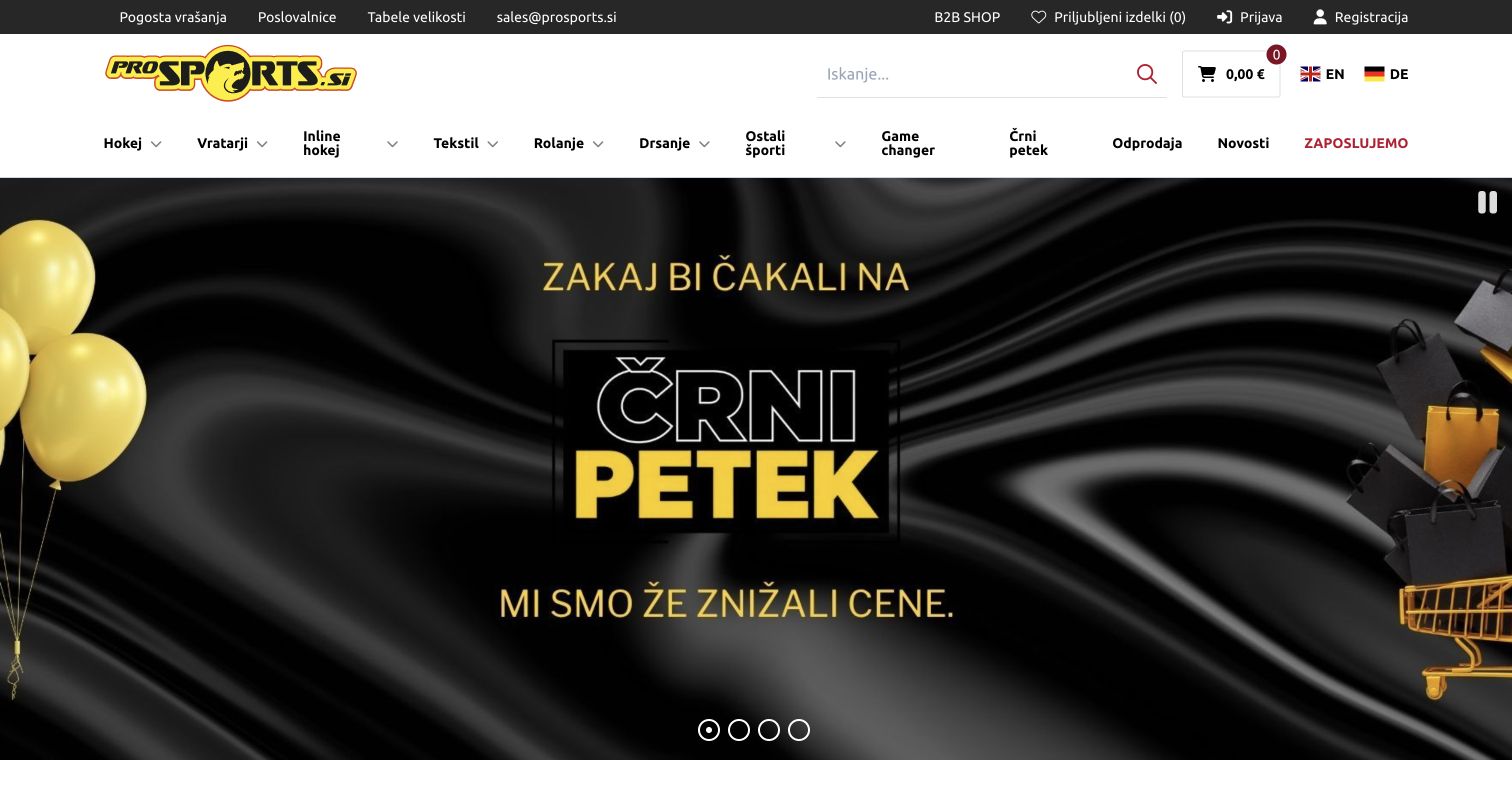
ProSports places its search, basket and detailed sporting categories above a bold seasonal campaign. The high-energy graphic changes the mood of the page while the surrounding navigation keeps the catalogue’s structure available. That is a useful division for a retailer whose promotions move faster than its product taxonomy. The official Sylius case describes the public store alongside a B2C and B2B integration. Symfony is the documented foundation of that Sylius commerce work; this example concerns the public consumer storefront and does not establish the behavior of private wholesale accounts or every connected system.
What you can learn
Let campaigns change without changing the customer’s basic route through the catalogue. Define product categories around recognizable shopping tasks, then give promotions a dedicated area that can be replaced without disrupting search, account context or product navigation.
Pros
The substantial category bar preserves a direct route to specific sporting interests.
The campaign has strong visual contrast while remaining below familiar retail controls.
Cons & considerations
A crowded category row needs a clear small-screen strategy and readable labels.
Promotional graphics should not be the only place where prices or offer conditions appear.
Platform source: Official Symfony dependency documentation, with retained exact-property evidence. Official Sylius B2C/B2B integration; public B2C storefront only. Symfony is a documented framework dependency of this named Sylius implementation, limited to its case-defined role and exact property. This does not establish that the captured frontend or every current backend service is Symfony, or identify an installed version. Symfony runtime and installed version were not independently observed. Dependency documentation reviewed November 11, 2026; prior page and project observations retain their original dates. Platform evidence is separate from the direct website screenshot and is not a complete current infrastructure audit.
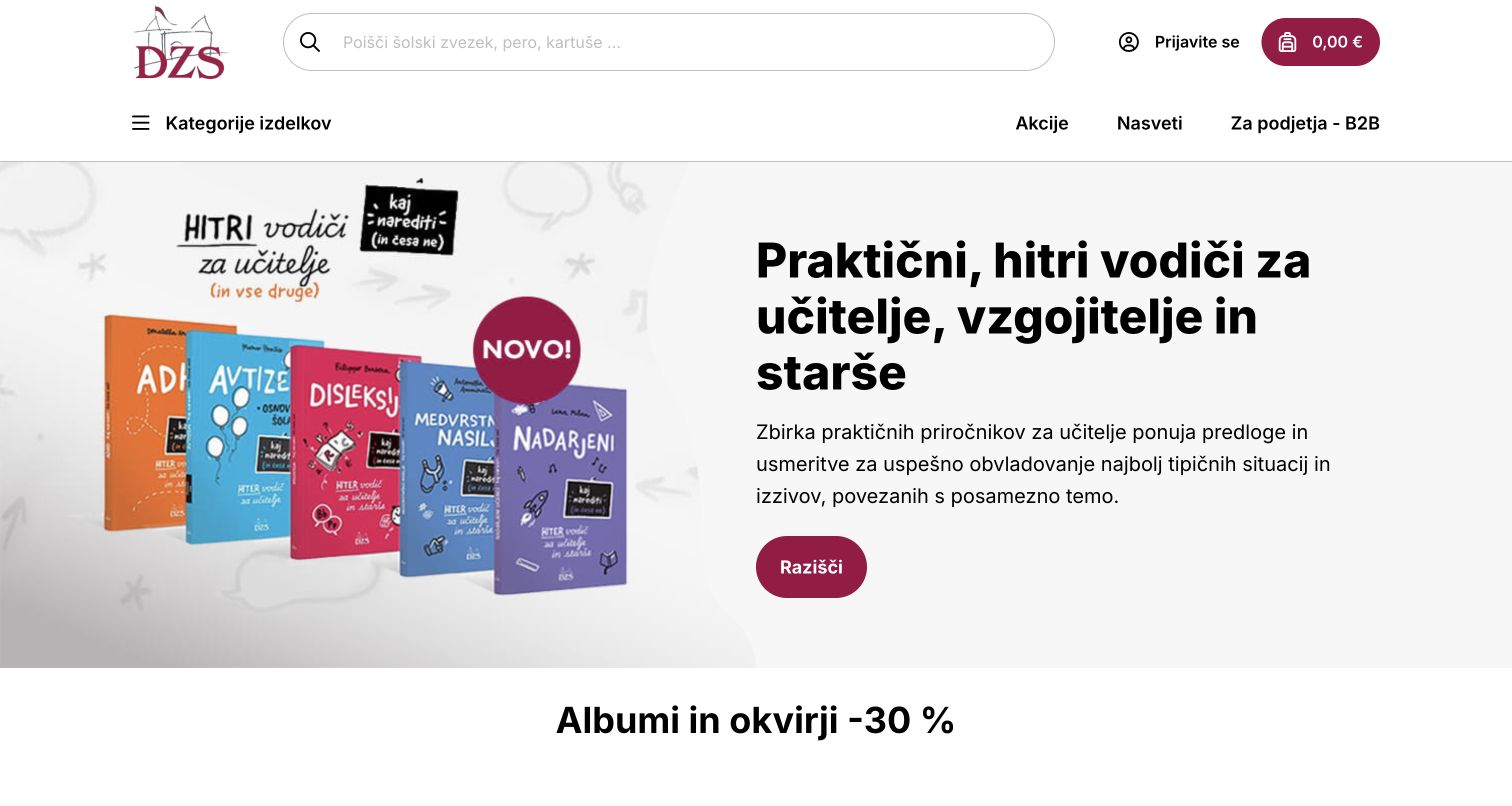
DZS gives its search field and product categories a clear retail frame, then leads with practical guides for teachers, educators and parents. The campaign uses recognizable book covers beside an explicit audience statement, making the offer more specific than a generic seasonal sale. It illustrates how a broad school-supplies catalogue can begin with a useful need. The official Sylius case documents the public store’s implementation. Symfony is associated through that framework relationship, not through a claim about private school accounts, educational systems or the software used to produce the books themselves.
What you can learn
Use editorial campaigns to connect products with a real audience and situation, then keep the wider catalogue accessible. Model audience labels and product relationships carefully so useful groupings remain maintainable when new editions, school years or seasonal needs arrive.
Pros
Book imagery and audience language make the featured offer concrete and easy to interpret.
Prominent search supports visitors who already know the item or school supply they need.
Cons & considerations
Educational categories need consistent terminology across products, campaigns and search results.
A homepage campaign cannot establish suitability for a particular classroom or curriculum.
Platform source: Official Symfony dependency documentation, with retained exact-property evidence. Official completed school-supplies public store; no teacher/student/private account actions. Symfony is a documented framework dependency of this named Sylius implementation, limited to its case-defined role and exact property. This does not establish that the captured frontend or every current backend service is Symfony, or identify an installed version. Symfony runtime and installed version were not independently observed. Dependency documentation reviewed November 11, 2026; prior page and project observations retain their original dates. Platform evidence is separate from the direct website screenshot and is not a complete current infrastructure audit.
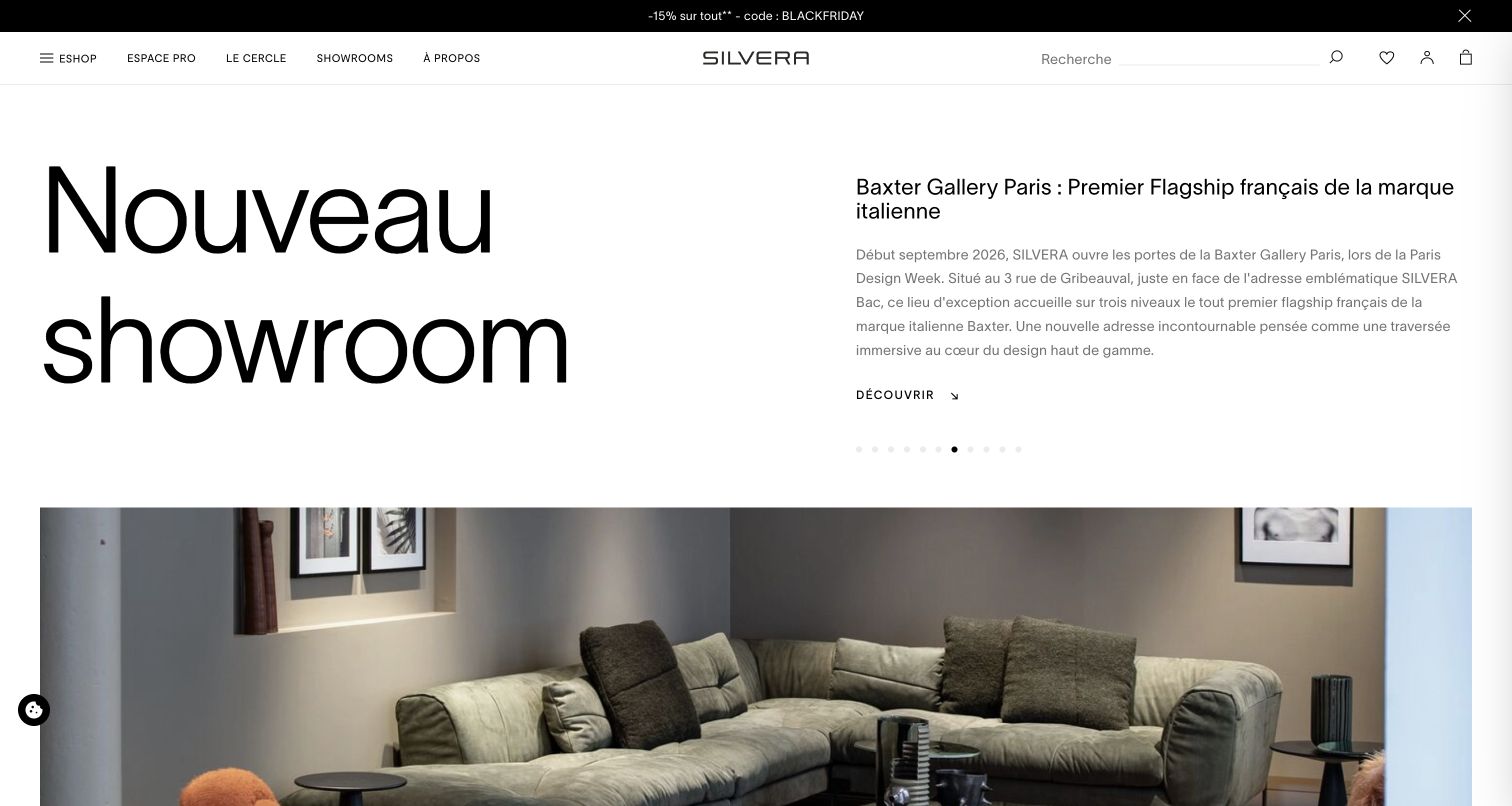
Silvera gives a new showroom announcement the scale of an editorial cover: a large headline, concise supporting copy and generous white space above a furniture photograph. Shopping, professional and showroom routes remain available in the header. This gives the store a cultural and physical context without making the page feel like a trade catalogue alone. The official case describes a completed Sylius Plus migration for the named retail estate. Symfony’s association is limited to that documented commerce foundation and this French public property, not every designer brand represented in the imagery.
What you can learn
Use editorial space to explain the retailer’s point of view, then keep a clear path to the products and places behind that story. A commerce platform should support both product accuracy and curated presentation without requiring the two to share identical page structures.
Pros
Large typography and white space give the showroom story a deliberate editorial rhythm.
Separate shopping and professional routes acknowledge different reasons for visiting the site.
Cons & considerations
An editorial opening still needs an obvious route for shoppers seeking a specific item.
Long announcements need clear expiry ownership so old events do not dominate the homepage.
Platform source: Official Symfony dependency documentation, with retained exact-property evidence. Official completed Sylius Plus multi-store migration; exact French public property only. Symfony is a documented framework dependency of this named Sylius implementation, limited to its case-defined role and exact property. This does not establish that the captured frontend or every current backend service is Symfony, or identify an installed version. Symfony runtime and installed version were not independently observed. Dependency documentation reviewed November 11, 2026; prior page and project observations retain their original dates. Platform evidence is separate from the direct website screenshot and is not a complete current infrastructure audit.
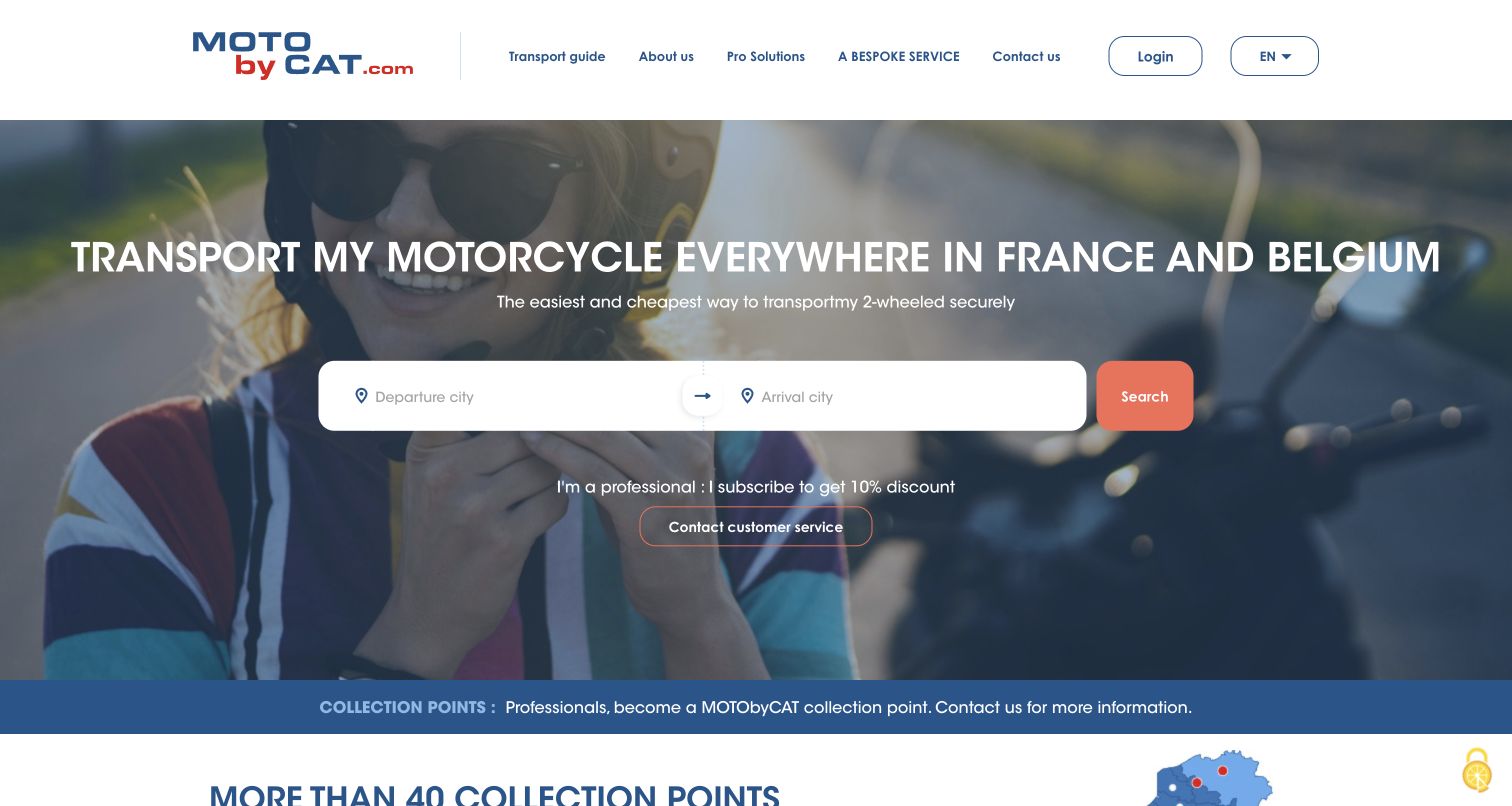
MOTO by CAT puts the central task directly into its opening: choose a departure and arrival location for motorcycle transport. The photograph gives the service a recognizable context, while the large search panel makes the next decision visible. Supporting routes for professionals and collection points sit around that primary task. The official Sylius case documents this transport website and checkout. Symfony is associated through the documented Sylius foundation; the review does not extend that relationship to every CAT Group system or claim that an unused search form proves a completed booking workflow.
What you can learn
Ask for the smallest information that makes a service request meaningful, and explain what happens after it is supplied. Keep route availability, quotation and confirmed booking as separate states so customers understand when they are exploring and when they are committing.
Pros
Departure and arrival labels turn an abstract service into a concrete first question.
Professional and collection-point information has a distinct place outside the main search panel.
Cons & considerations
Location entry needs useful suggestions and clear handling of unsupported routes.
An inviting search panel cannot establish transport availability, price accuracy or service quality.
Platform source: Official Symfony dependency documentation, with retained exact-property evidence. Official completed transport website/checkout; not all CAT Group infrastructure. Symfony is a documented framework dependency of this named Sylius implementation, limited to its case-defined role and exact property. This does not establish that the captured frontend or every current backend service is Symfony, or identify an installed version. Symfony runtime and installed version were not independently observed. Dependency documentation reviewed November 11, 2026; prior page and project observations retain their original dates. Platform evidence is separate from the direct website screenshot and is not a complete current infrastructure audit.
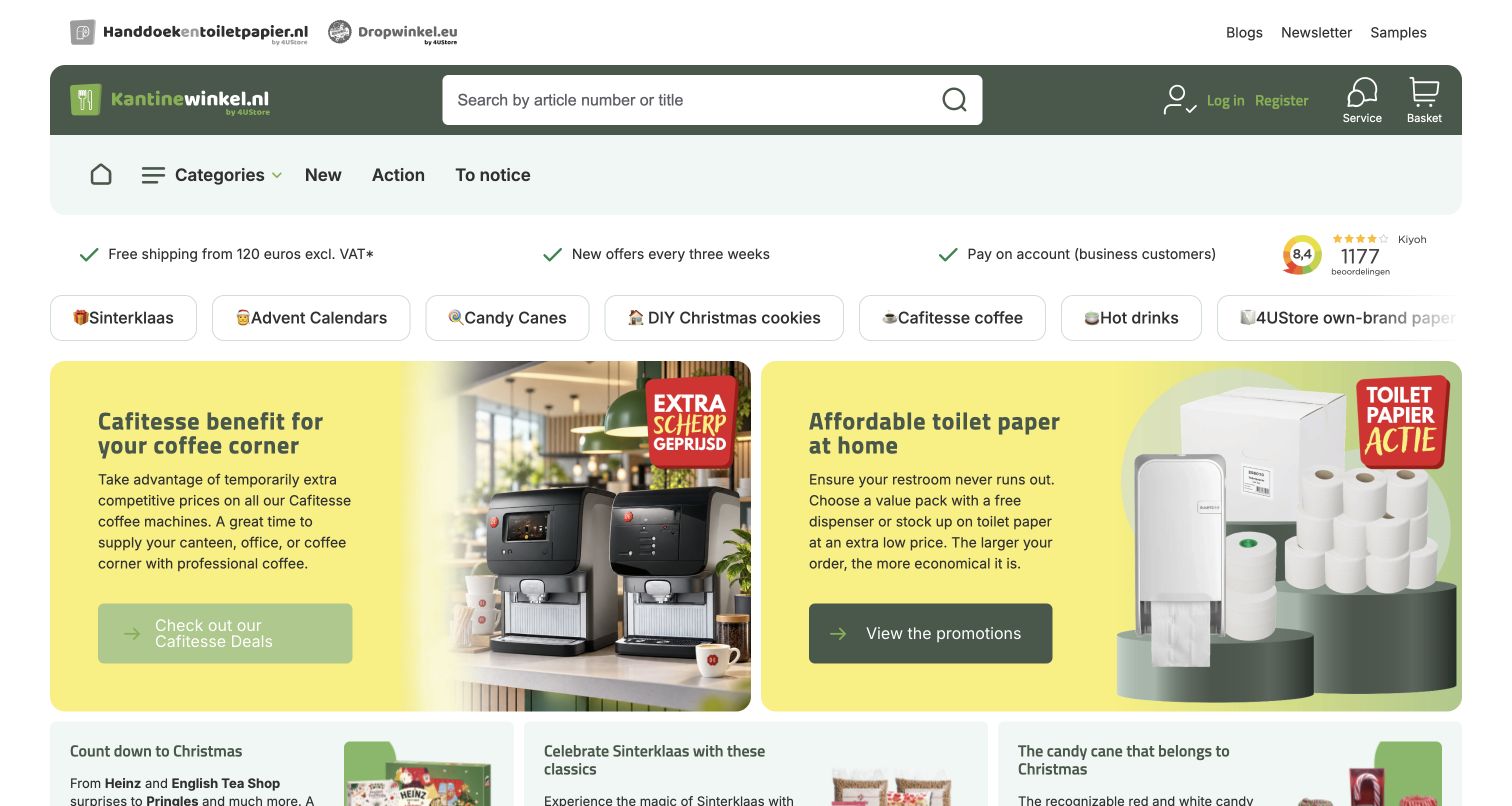
Kantinewinkel puts an article-number search field at the center of its retail header, then uses friendly campaign cards to introduce coffee and paper products. The arrangement accommodates both a repeat buyer with a precise requirement and someone comparing routine workplace supplies. Short service notes sit between navigation and campaigns without turning into a full promotional wall. The official 4Ustore case explicitly includes this one public store in its Sylius migration. Symfony is associated through that named commerce implementation; the other stores in the case are not counted as additional examples or automatically assigned the same public-page evidence.
What you can learn
Support repeat purchasing and discovery as distinct but compatible tasks. Keep identifiers, categories and commercial conditions consistent while allowing editorial cards to explain product use. Shared commerce infrastructure should not erase the context of an individual storefront.
Pros
Article-number search recognizes a practical repeat-purchase behavior rather than only broad browsing.
Two focused campaign cards make ordinary supplies easier to scan without overwhelming the catalogue.
Cons & considerations
Service conditions need clear applicability across consumer and business purchasing contexts.
Translated labels and dense category chips need editorial review to remain natural and understandable.
Platform source: Official Symfony dependency documentation, with retained exact-property evidence. Official 4Ustore migration case explicitly links this one public store; no eight-store duplicate count. Symfony is a documented framework dependency of this named Sylius implementation, limited to its case-defined role and exact property. This does not establish that the captured frontend or every current backend service is Symfony, or identify an installed version. Symfony runtime and installed version were not independently observed. Dependency documentation reviewed November 11, 2026; prior page and project observations retain their original dates. Platform evidence is separate from the direct website screenshot and is not a complete current infrastructure audit.
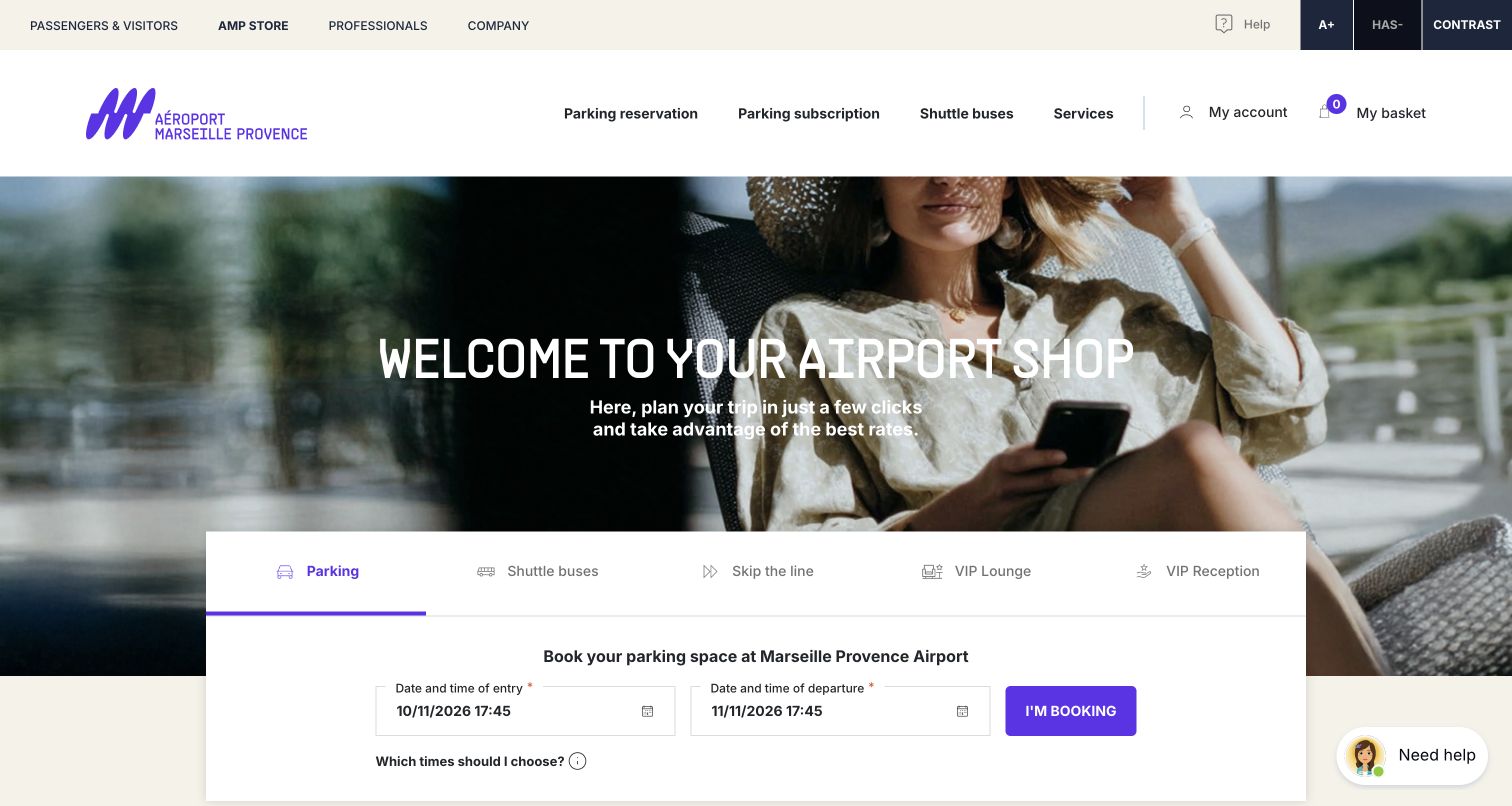
Marseille Provence Airport’s store introduces parking, subscriptions, shuttle services and other travel extras within a recognizable airport identity. The central panel groups parking, queue and lounge choices before showing a dated parking form. This makes the page feel like a service planner rather than an undifferentiated product catalogue. The official Sylius case documents the airport-services storefront. Symfony is associated through that specific commerce implementation, not the airport’s flight systems or entire corporate web estate. The displayed fields were reviewed as part of the captured design, without treating their preset values as a tested reservation.
What you can learn
Organize related services around the traveler’s decisions while keeping each service’s terms and confirmation state clear. A shared checkout can simplify presentation, but parking duration, lounge eligibility and queue access still need distinct rules and understandable explanations.
Pros
Service tabs make several airport extras visible without mixing their input requirements immediately.
The airport identity and practical navigation provide context before the visitor enters travel details.
Cons & considerations
Preset dates need careful labeling so visitors do not mistake them for a chosen itinerary.
A public booking panel cannot establish live availability, final pricing or successful fulfillment.
Platform source: Official Symfony dependency documentation, with retained exact-property evidence. Official airport services store migration, parking/queue/lounge booking only, not airport corporate or flight systems. Symfony is a documented framework dependency of this named Sylius implementation, limited to its case-defined role and exact property. This does not establish that the captured frontend or every current backend service is Symfony, or identify an installed version. Symfony runtime and installed version were not independently observed. Dependency documentation reviewed November 11, 2026; prior page and project observations retain their original dates. Platform evidence is separate from the direct website screenshot and is not a complete current infrastructure audit.
Kegan has 15+ years of experience working with small businesses, Fortune 500 companies, and everything in between. No development job is too big or too small: he brings the same hands-on attention to a focused improvement, a complete website, or a custom application.
For Symfony projects, he can help with responsive interfaces, reusable components, custom functionality, API connections, and performance-minded implementation. He works directly with clients on scope, design, implementation, testing, and handover, with an emphasis on clear communication and a system that remains practical to maintain after launch.
Show 3 other Symfony developersHide other Symfony developers
Choose a CMS, commerce foundation or custom application
Content-led publishing through Drupal
A public institution often needs structured articles, durable navigation and many editorial contributors before it needs custom transactional behavior. Drupal is one possible content platform, with a documented Symfony component foundation. Use the examples to discuss content ownership, campaign priorities and useful search. Do not confuse that component relationship with a requirement to build the entire site as a standalone Symfony application.
A retailer or service operator may need product rules, a catalogue and a checkout with more specific requirements than a simple brochure site. Sylius documents its Symfony foundation and the ability to pair commerce with separate frontends. Start with the actual product and service model. Keep configuration, pricing, availability and confirmation understandable even when several services participate.
A custom application can be appropriate when the workflow itself is the product. Describe the users, permissions, records and state changes before deciding which framework features are needed. Compare the maintenance commitment with a suitable existing CMS or commerce platform. These public examples are references for design decisions; they are not evidence that every organization chose the same application architecture.
From references to requirements
Turn the reference into a maintainable brief
Write the visitor’s decision sequence
List what the person needs to know before each meaningful action. A service booking might require dates and eligibility; a configurable item might require dimensions and compatibility. Mark the point where browsing becomes a commitment. Include an understandable route backward, a useful empty state and the information needed to recover from an interrupted request.
Identify the authoritative record
For each price, policy, schedule or product attribute, name the system and person responsible for it. Explain how the page behaves when that information is missing or stale. Avoid maintaining competing copies simply because the visual design has several places to display a value. Editorial flexibility should not create uncertainty about which answer is correct.
Plan content changes and translations
Use real headlines, long product names and realistic translated labels while defining the layout. Establish how promotions expire, how old documents remain discoverable and which URLs must continue to work. Give editors a clear preview and correction process. A dependable publishing routine matters as much as an impressive first page.
Make the handover demonstrate ordinary work
Ask maintainers to update a record, correct an error and explain a failed integration. Document deployment ownership, dependency updates and the boundary between the website and connected services. Check the application with meaningful scenarios rather than treating an attractive screenshot or a framework name as evidence of performance, accessibility or reliability.
A useful handover demonstration
Ask the actual team to carry out its routine job: publish a realistic update, correct a mistake, preview a narrow screen, and identify who owns an integration failure. For a library or frontend framework, also ask who maintains the content source and deployment. A polished screenshot does not answer those operational questions.
Beyond the screenshot
A practical Symfony website brief
State whether the project uses Symfony directly, through Drupal components or through a commerce platform.
Name the exact public property and scope of each technology claim.
Define the visitor’s first useful decision before planning the interface.
Identify authoritative sources for products, prices, policies and availability.
Separate browsing, enquiries, account changes and confirmed transactions.
Plan clear loading, empty, unavailable and error states.
Keep permissions and consequential validation on the appropriate server-side boundary.
Give meaningful content and results stable, understandable URLs.
Test realistic long labels, translations and narrow-screen layouts.
Preserve useful text context around video and image-led campaigns.
Assign ownership for dependency maintenance, integrations and editorial expiry.
Document recovery behavior so repeated requests do not create accidental duplicate actions.
Test with real content, a keyboard, a small screen, slow or failed requests, and the people who will maintain the system. These are planning checks, not an accessibility, security, performance, or search-ranking certification.
Sources & editorial method
How this Symfony collection was reviewed
We reviewed twenty retained original public-page captures for this collection on November 11, 2026. The eight Drupal images keep their November 2 capture dates and original source observations; the twelve Sylius images keep their November 10 dates and documented project evidence. Existing broad source-audit outcomes remain unchanged, including unavailable checks. Drupal attribution uses exact-page Drupal settings or core-resource evidence together with the official Drupal and Symfony documentation. The resulting Symfony claim concerns CMS components, not a directly inspected full Symfony application. Each Sylius association retains its exact official project case and is combined with Sylius’s documented Symfony foundation. Bakken.nl is specifically a loyalty/backend implementation alongside separate content and frontend systems. No installed Symfony version, complete current backend, measured performance or conversion result is inferred. The dependency documentation was reviewed for this collection; that does not make the earlier captures or observations newly recorded.
Every image is an unmodified capture from the actual website, with its source and capture date. Some captures are reused from our shared catalog; their dates remain the original capture dates. None comes from a vendor gallery or a generated reconstruction. Moving imagery and live content can change.
Technology attribution uses public page assets or metadata, official platform documentation, or a cited first-party project case study. Documentary and framework-relationship evidence is identified where used; it is not a complete current backend inventory. A CMS image CDN alone does not establish a full CMS deployment. A library’s presence does not prove which individual controls use it, and a platform label does not establish AI authorship.
The composition notes, lessons, pros and tradeoffs are original editorial observations. We have not measured conversion, traffic, security, performance or accessibility conformance. Website owners retain their brands and imagery; these examples are not our client portfolio. Written, Edited and Curated are independent records, not dates advanced by a build. See our editorial standards or suggest a correction.
Questions worth asking
Symfony website development FAQs
Are these all custom Symfony applications?
No. Eight examples have a documented Symfony component relationship through Drupal. Twelve have named Sylius implementations, and Sylius documents its Symfony framework foundation. Those scopes are different from proving that the entire pictured website is a custom Symfony application.
Does a screenshot reveal a website’s backend?
No. The screenshots support the design observations. Technology associations come from separate exact-page source evidence and primary documentation. The reviews do not infer a private backend, installed version or full organization-wide stack from appearance.
Why include Drupal websites in a Symfony collection?
Drupal and Symfony both document the CMS’s use of Symfony components. The selected examples also have retained exact-page Drupal core or settings evidence. The collection identifies that dependency explicitly rather than calling Drupal a full Symfony application or applying the relationship to any generic historical Drupal label.
What is different about the Bakken.nl example?
Its official Sylius case describes a loyalty/backend role alongside other content and frontend technology. Symfony’s association follows that specific Sylius role. The example does not identify Symfony as the recipe CMS or as the platform for every Dr. Oetker website.
Why are the screenshots older than this guide?
They are genuine captures of the exact reviewed properties, retained with their original dates and new collection-specific analysis. Publication and documentary review do not change when a screenshot or source observation was recorded.
What should I borrow from these examples?
Borrow a useful decision sequence, a clear information hierarchy or an understandable catalogue structure. Decide separately which technical approach fits your content, rules, team and maintenance needs. The examples are editorial design references, not endorsements or measured rankings.
Choose the task, the information owner and the operating model first. Then use Symfony directly or through an appropriate platform where its documented role fits the work, while keeping the public experience clear.