Definitive guide · Ruby on Rails website development
Best Ruby on Rails Websites of 2026 (20 Real-World Examples)
Rails-backed Discourse communities with clear product and participation boundaries
These 20 examples are public Discourse community properties. Discourse’s official source identifies a Ruby on Rails backend API and a separate Ember frontend. The guide studies that scoped application layer, not the brands’ corporate websites, private products, or complete infrastructure.
A framework example should identify an actual application rather than attaching a company’s engineering reputation to its marketing homepage. These public communities provide that concrete boundary: the named property exposes Discourse platform evidence, and Discourse documents its Rails backend. The interface itself also includes a separate frontend layer, themes, and integrations.
NVIDIA, Shopify, Asana, Epic, and Cloudflare open the collection. Their communities illustrate different ways to organize a product domain, connect maintained documentation, welcome contributors, and keep recent discussion usable. The remaining examples range from open-source project coordination to creative portfolios and specialist technical support. None of the reviews claims to inspect private moderation, account integration, or application performance.
Before the examples
What makes good Ruby on Rails website development in 2026?
Define the application boundary precisely
Document what Rails owns and what it does not. In these examples the evidence concerns Discourse’s backend API, while the browser interface, identity provider, documentation, and product systems can be separate layers. A shared logo does not erase those boundaries.
NVIDIA’s product families, Steinberg’s applications, and OpenStreetMap’s regional communities expose different dimensions of organization. Decide which concepts belong in categories, tags, versions, or linked resources before developing custom navigation.
Treat participation and resolution as product behavior
A posting limit, trust level, solved state, or support entitlement affects what a person can do. Give those states understandable explanations and preserve their meaning through search, upgrades, and migrations instead of relying on visual badges alone.
The collection · 20 examples
20 Ruby on Rails website examples worth studying
Each review concerns one named public community. Rails is evidenced through Discourse’s documented backend architecture combined with that property’s platform evidence; it is not a claim that every visible interface element is rendered by Rails or that an entire company shares this stack.
We start with five recognizable brands or organizations: NVIDIA Developer Forums, Shopify Community, Asana Community, Epic Developer Community — Unreal Engine Forum, Cloudflare Community. Each attribution applies to the named website property, not every product or website belonging to its organization. This is a curated reading sequence, not a measured ranking.
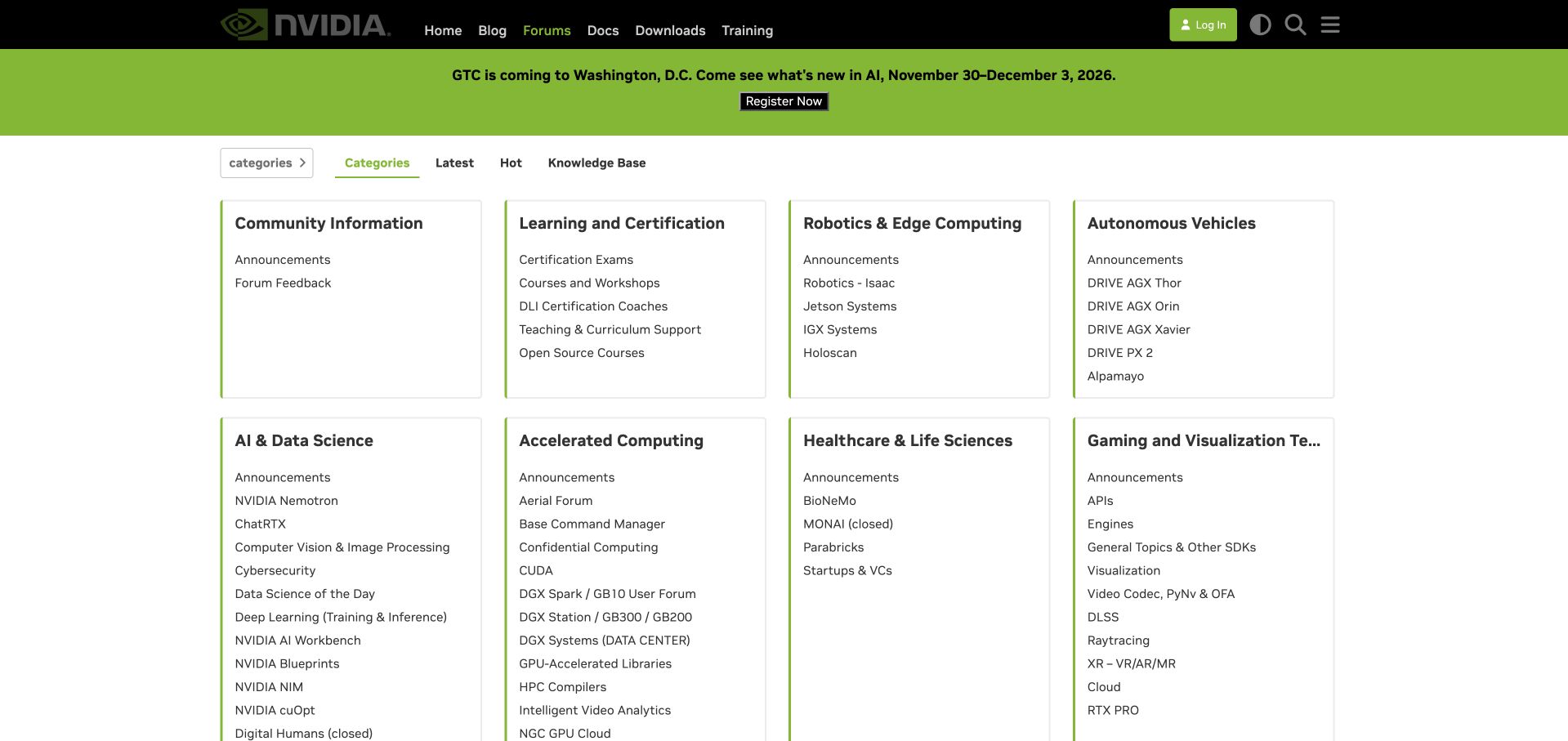
NVIDIA’s developer community opens with a dense grid of product families, from learning and robotics to accelerated computing. Each column exposes narrower destinations immediately, while a separate navigation row offers recent activity and the knowledge base. The corporate masthead connects the community to documentation, downloads, and training. The Rails association is specifically Discourse’s backend API on this forum property, not an attribution of NVIDIA’s main website or computing products.
What you can learn
A Rails-backed community needs a durable domain model as much as a branded theme. Distinguish product families, versions, and discussion types before customizing the directory, and provide redirects when product names change so older technical answers remain findable.
Pros
Visible product groupings let experienced developers choose a relevant technical area without first searching across an unrelated global feed.
Documentation and download routes remain near the forum, acknowledging that a discussion is only one part of the support journey.
Cons & considerations
The extensive grid assumes familiarity with product names and abbreviations, which can make a first visit demanding for newcomers.
Promotional event material above the directory needs restraint so the recurring support task remains immediately visible and easy to reach.
Platform source: Discourse official backend architecture. The named public community is evidenced as Discourse. Discourse’s official source documents a Ruby on Rails backend API and a separate Ember frontend. This association is limited to the community application, not the organization’s other websites or products. Platform evidence is separate from the direct website screenshot and is not a complete current infrastructure audit.
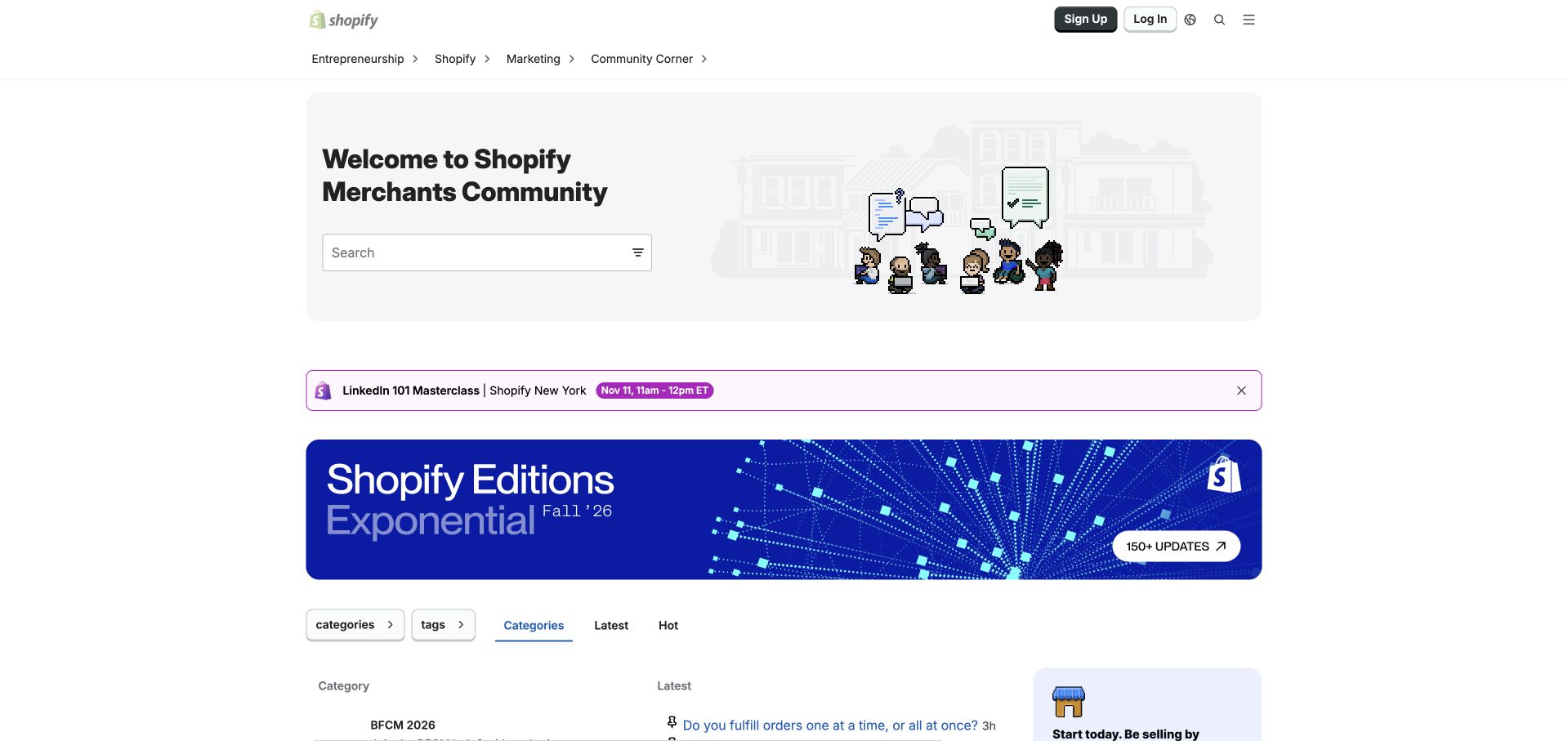
Shopify’s community combines a search-led welcome, event promotion, and a prominent edition announcement before the category directory begins. The surrounding white space and restrained header give these different content types distinct places. Navigation recognizes entrepreneurship, the platform, marketing, and community activity. This is a Rails-backed Discourse community example; it does not establish the technology of Shopify’s corporate marketing site, merchant storefronts, checkout, or private administration screens.
What you can learn
Separate promotional content from the records people return to search. In a Rails community implementation, events and announcements can be different content types from questions, with their own expiry rules, access patterns, and editorial owners.
Pros
The search field is placed directly in the welcome area, making an answer-seeking task available before promotional content is explored.
Community and product announcements receive recognizable visual treatments instead of being mixed indistinguishably into ordinary merchant discussion rows.
Cons & considerations
Multiple banners push the discussion directory downward and can slow visitors who already know which subject they need to reach.
A community account and a commerce account may have different boundaries; a public homepage cannot establish how identity or permissions are integrated.
Platform source: Discourse official backend architecture. The named public community is evidenced as Discourse. Discourse’s official source documents a Ruby on Rails backend API and a separate Ember frontend. This association is limited to the community application, not the organization’s other websites or products. Platform evidence is separate from the direct website screenshot and is not a complete current infrastructure audit.
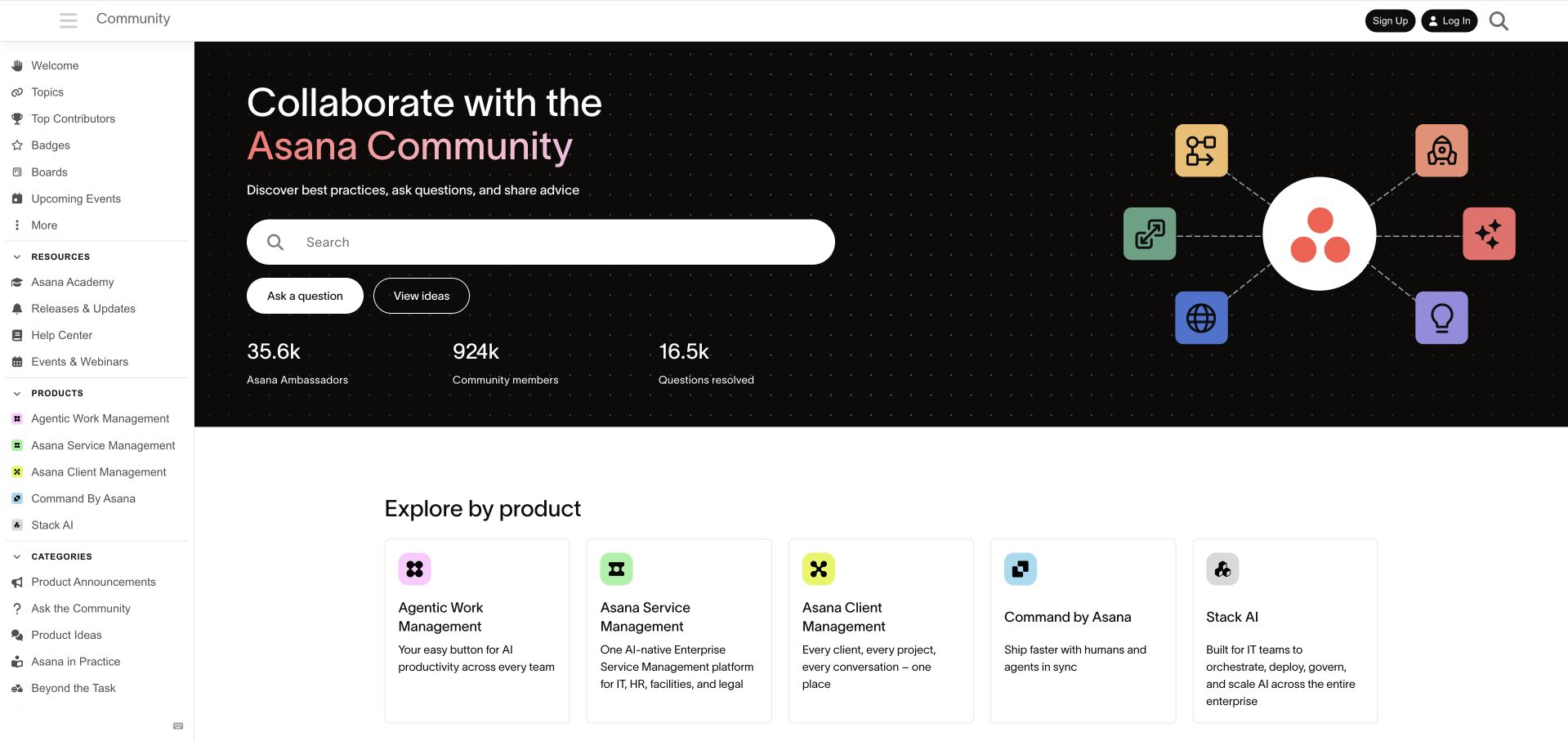
Asana’s community presents a dark welcome panel with search, a question route, an ideas route, and an illustrated product ecosystem. A persistent sidebar separates community destinations from resources and products, while the main area introduces product-specific cards. The page is more of a service entrance than a raw stream of posts. Ruby on Rails is associated with the Discourse community backend only, not the separate Asana work-management application.
What you can learn
Translate the application’s domain boundaries into community navigation. A Rails integration should preserve which product a question belongs to and distinguish an idea from a support request; do not rely on a general text field to capture those differences.
Pros
Separate question and ideas actions tell contributors that different kinds of participation have different destinations and expectations within the community.
The product cards explain the audience and purpose of each area, giving the taxonomy meaning beyond a list of product names.
Cons & considerations
The illustrated hero and headline statistics take substantial space before visitors reach the actual product discussion lists and recent answers.
Community counts are contextual snapshots, not proof of response quality, customer satisfaction, or how effectively the underlying support operation is staffed.
Platform source: Discourse official backend architecture. The named public community is evidenced as Discourse. Discourse’s official source documents a Ruby on Rails backend API and a separate Ember frontend. This association is limited to the community application, not the organization’s other websites or products. Platform evidence is separate from the direct website screenshot and is not a complete current infrastructure audit.
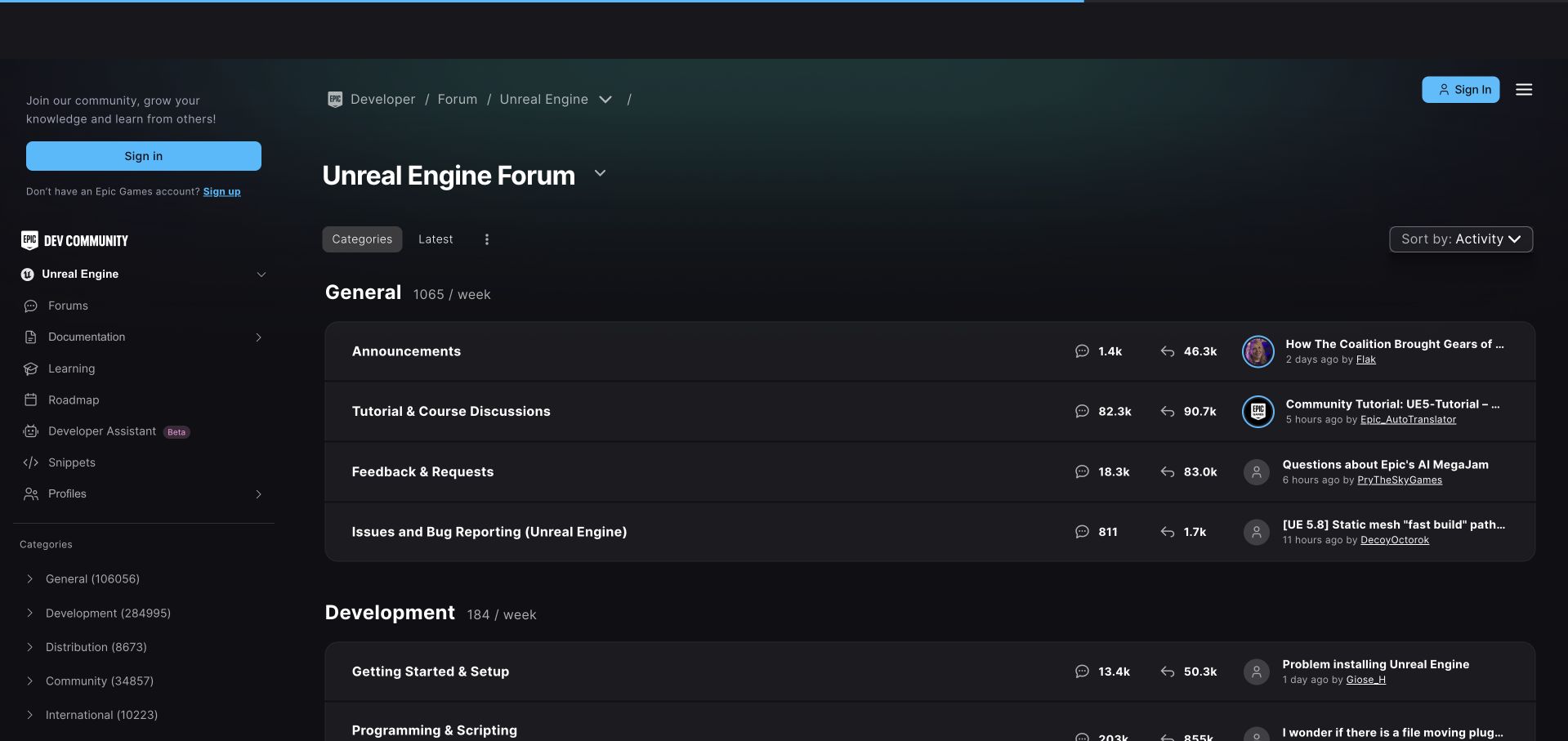
The Unreal Engine forum uses a dark interface and ecosystem sidebar to connect discussion with documentation, learning, roadmaps, and resources. Category groups distinguish general conversation from development topics, while recent activity remains visible beside the directory. The pictured property is the Epic developer community’s Unreal Engine area. Its Rails association comes through Discourse’s backend, not through Unreal Engine itself, Epic’s games, or every property in the surrounding developer network.
What you can learn
Keep product context in the route and navigation, not merely in a page heading. A Rails-backed discussion system should preserve category and product identifiers through search, shared links, and migrations so a useful answer retains its technical context.
Pros
The ecosystem sidebar makes neighboring reference and learning resources available without requiring users to leave the technical context and start again.
Grouped categories and visible recent topics help readers distinguish the subject structure from the conversations currently active within that structure.
Cons & considerations
A large developer ecosystem can overwhelm occasional visitors unless the selected product and current forum location remain unmistakable on narrow screens.
Activity counters do not identify answer accuracy or software compatibility, so individual topics still need version and resolution context where relevant.
Platform source: Discourse official backend architecture. The named public community is evidenced as Discourse. Discourse’s official source documents a Ruby on Rails backend API and a separate Ember frontend. This association is limited to the community application, not the organization’s other websites or products. Platform evidence is separate from the direct website screenshot and is not a complete current infrastructure audit.
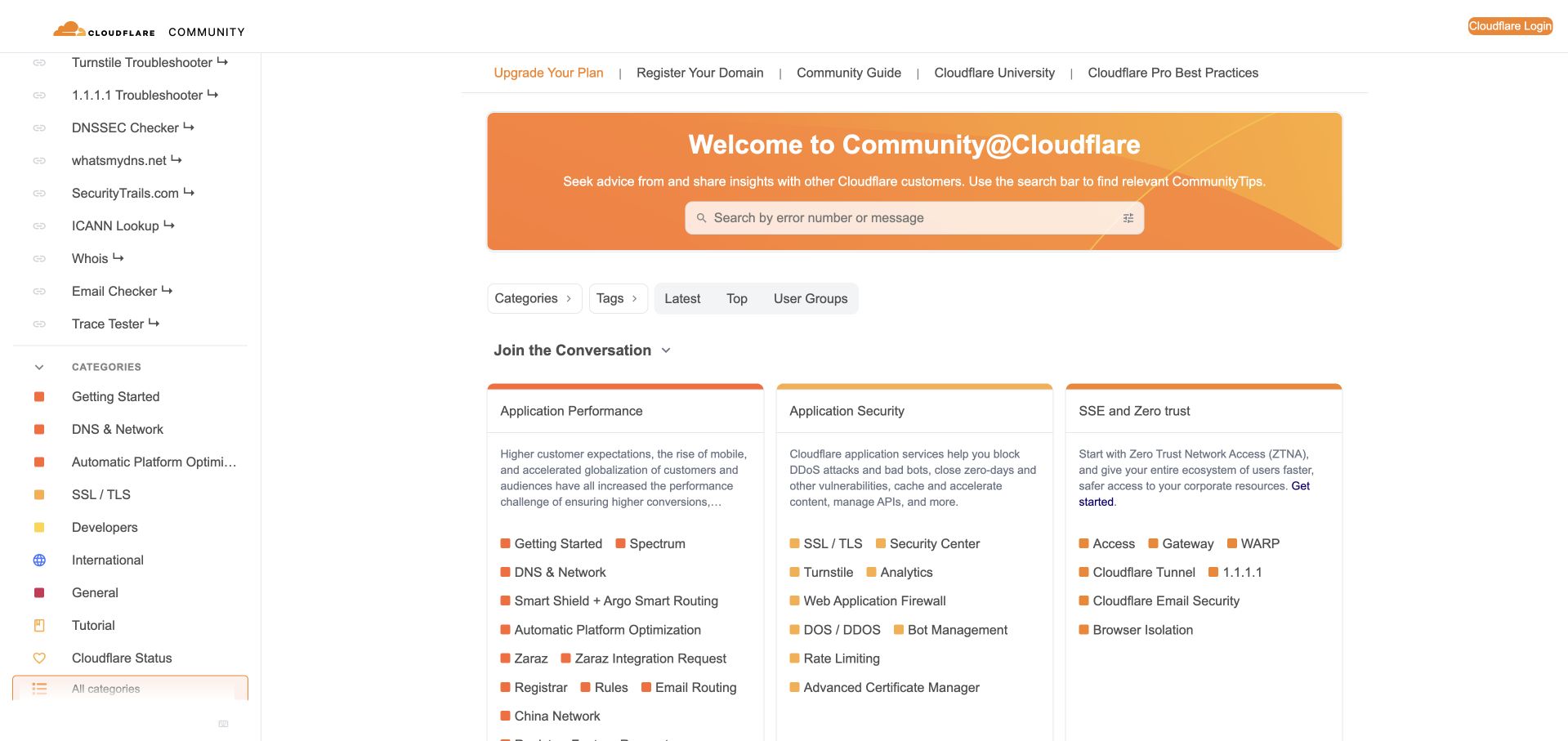
Cloudflare’s community makes a broad search field the center of an orange welcome panel, then groups discussion into application performance, application security, and zero-trust subjects. The sidebar includes troubleshooting utilities and product categories, while the header connects broader customer resources. This review concerns the community property’s Rails-backed Discourse API. It is not evidence about the systems serving Cloudflare’s network, customer dashboards, or main commercial website.
What you can learn
Treat a support community as a structured knowledge interface. When extending a Rails-backed forum, preserve product and error context in the content model and search experience, while keeping diagnostic utilities visibly separate from ordinary user-generated answers.
Pros
The search prompt recognizes that visitors may arrive with an error message rather than a clear understanding of the product taxonomy.
The grouped product map provides an alternative to search for users who know their service area but not the exact terminology.
Cons & considerations
A long utility sidebar adds navigational weight and needs careful prioritization when the available viewport becomes narrow or text is enlarged.
Community discussion and official operational guidance require clear distinctions; familiar branding alone does not make every posted answer authoritative or current.
Platform source: Discourse official backend architecture. The named public community is evidenced as Discourse. Discourse’s official source documents a Ruby on Rails backend API and a separate Ember frontend. This association is limited to the community application, not the organization’s other websites or products. Platform evidence is separate from the direct website screenshot and is not a complete current infrastructure audit.
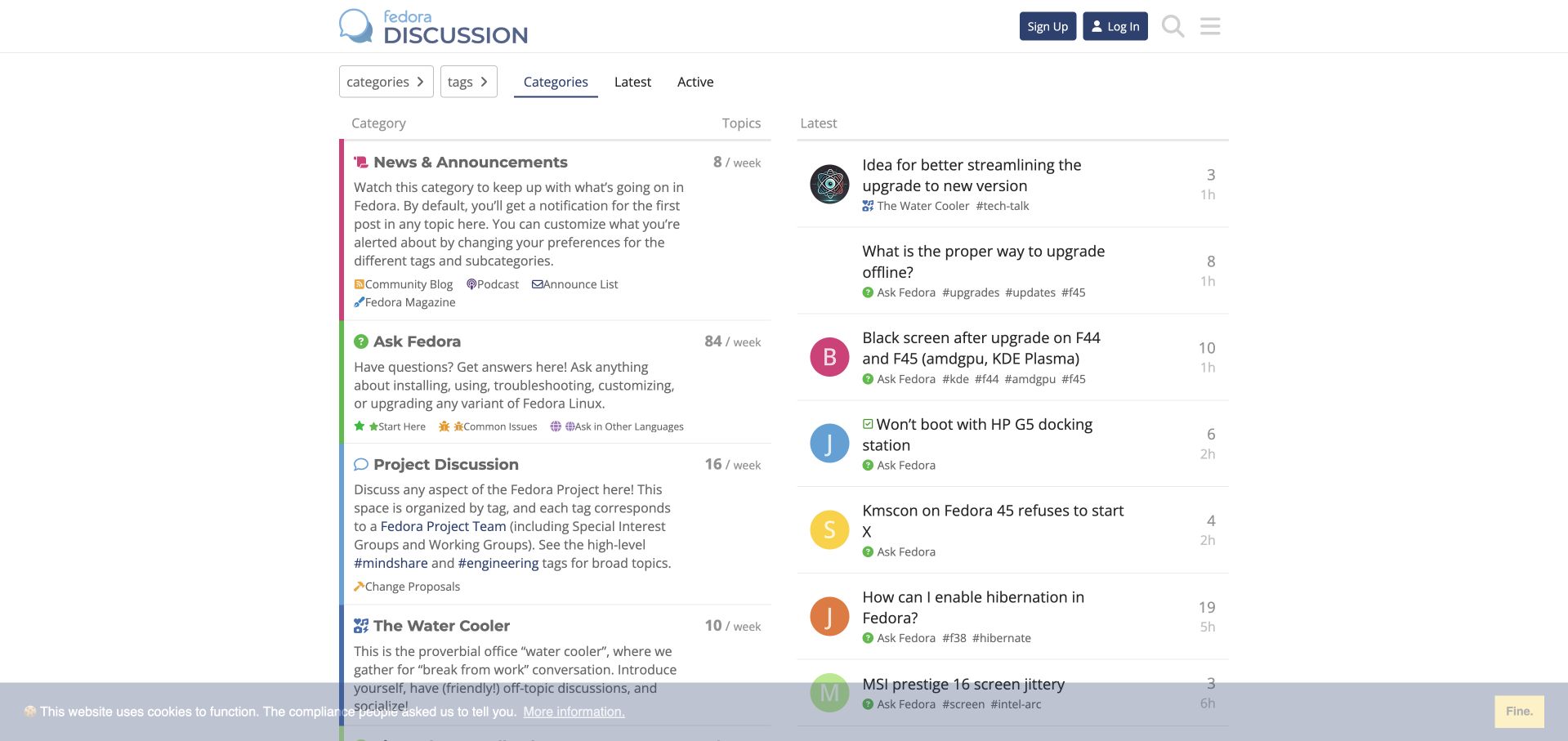
Fedora Discussion places explanatory category descriptions beside a list of recent topics. News and announcements, user questions, project discussion, and informal conversation have visibly different purposes. Links within the descriptions point to neighboring project resources instead of assuming that every visitor should post immediately. The Rails-backed layer in this example is Discourse on the discussion property; Fedora’s operating system, package infrastructure, and other public websites are outside that attribution.
What you can learn
Use content types and permissions to reflect community responsibilities. In a Rails application, announcements, help requests, and governance discussion should not become indistinguishable records simply because they share a topic list and visual template.
Pros
Category descriptions explain expected participation, helping visitors choose between asking for practical help and joining broader project work or conversation.
Recent topic titles sit beside the category structure, giving a concrete impression of the questions and announcements each area currently contains.
Cons & considerations
The directory contains many embedded references that may become difficult to scan when descriptions grow or project terminology changes over time.
Release-specific questions need clear version context, since a visually similar answer can concern a substantially different operating-system state or support period.
Platform source: Discourse official backend architecture. The named public community is evidenced as Discourse. Discourse’s official source documents a Ruby on Rails backend API and a separate Ember frontend. This association is limited to the community application, not the organization’s other websites or products. Platform evidence is separate from the direct website screenshot and is not a complete current infrastructure audit.
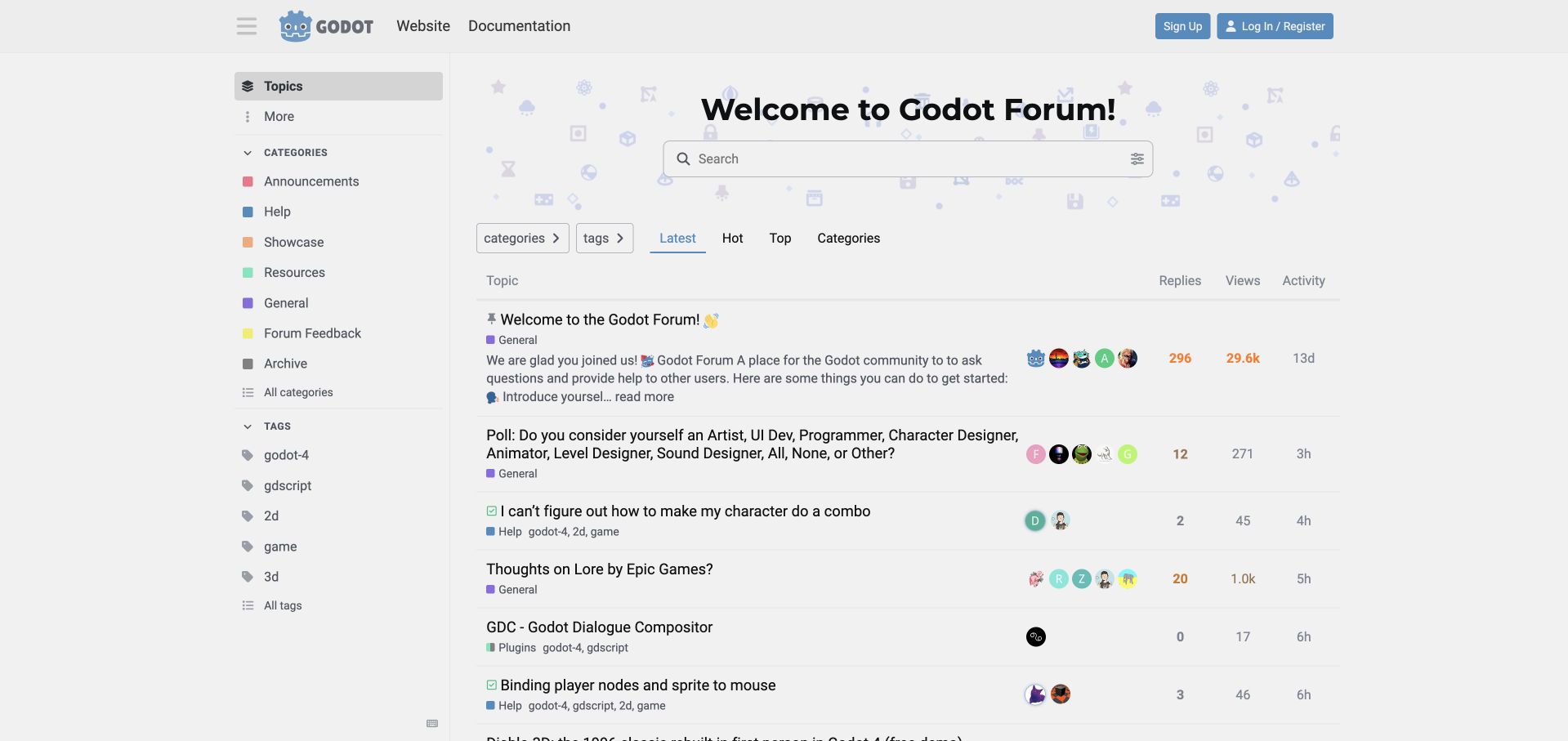
Godot’s forum combines a search panel with recent topics and a sidebar of categories and tags. Website and documentation links remain in the top bar, while the main controls offer several ways to browse discussions. A pinned topic explains participation before the feed continues. Rails is evidenced here through Discourse’s server-side API, not as the implementation of the Godot engine or its separate documentation website.
What you can learn
Preserve both structured categories and flexible topic metadata when connecting a Rails community to a creative tool. A question can need an engine version, platform, language, and subject without forcing those concepts into one increasingly deep category tree.
Pros
The documentation link is always near the forum identity, helping readers move from conversation to maintained reference material when that is appropriate.
Category and tag controls support different discovery needs without making every technical distinction a separate top-level destination on the homepage.
Cons & considerations
The prominent topic feed can mix beginner questions, project discussion, and opinion, so content labels must carry meaningful distinctions for readers.
Pinned onboarding material needs active maintenance; a welcome topic can remain visually prominent long after its examples or participation instructions become outdated.
Platform source: Discourse official backend architecture. The named public community is evidenced as Discourse. Discourse’s official source documents a Ruby on Rails backend API and a separate Ember frontend. This association is limited to the community application, not the organization’s other websites or products. Platform evidence is separate from the direct website screenshot and is not a complete current infrastructure audit.
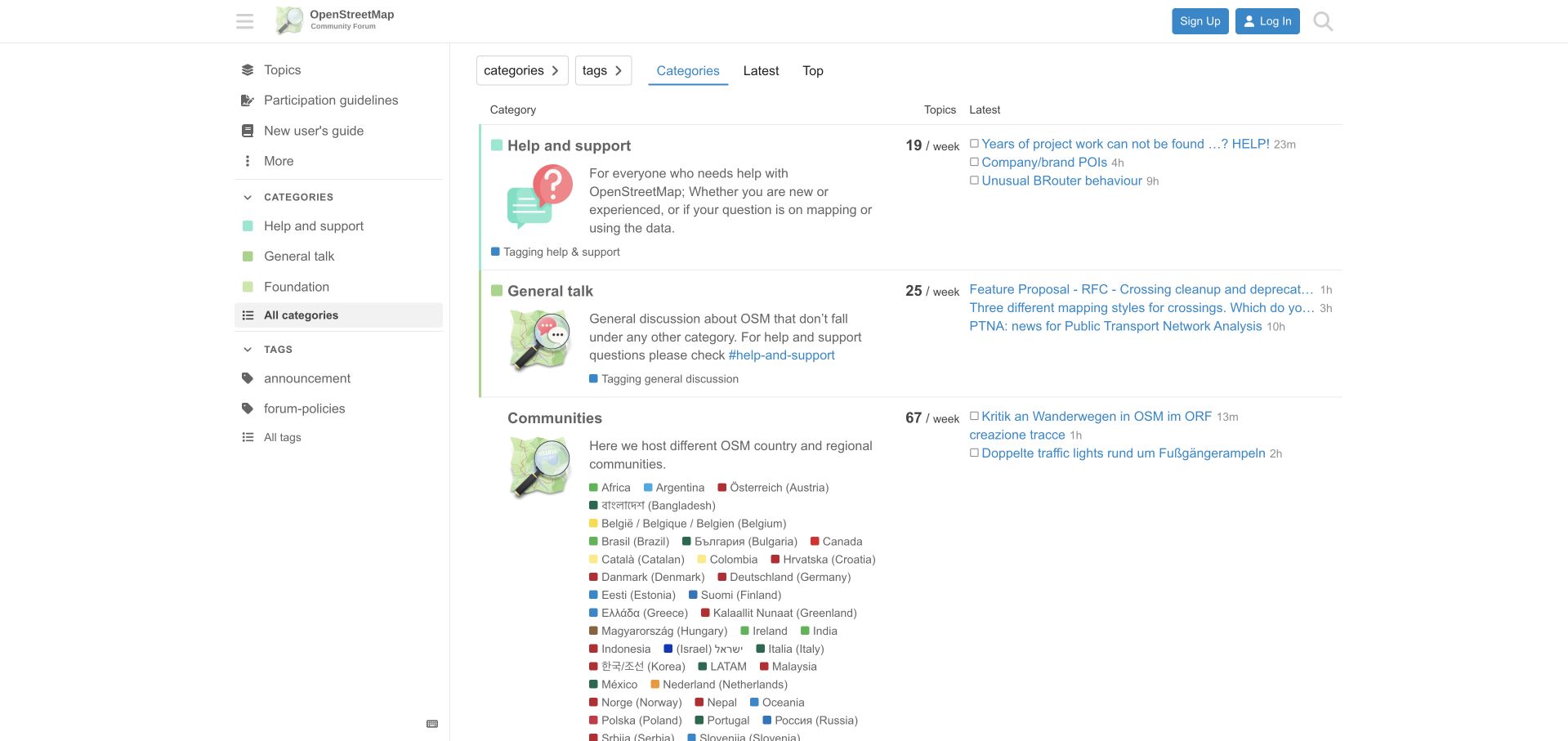
OpenStreetMap’s directory explains help, general conversation, and regional communities beside recent topics. Country and language destinations appear inside the community category, giving local participation a place within the global project. A participation-guidelines link sits in the sidebar. This is the Rails-backed Discourse forum layer only; the evidence does not attribute OpenStreetMap’s map rendering, editing tools, or main website to the same application.
What you can learn
Model geography, language, and discussion purpose as distinct concerns. A Rails community can maintain a shared identity while routing people into local areas, but search, permissions, and redirects need to respect those boundaries rather than flattening everything into one feed.
Pros
Regional destinations are visible without hiding the shared help and general-discussion routes that connect the wider community across national or language boundaries.
The concise descriptions make it clear why someone would choose a support area instead of a local community or broader project conversation.
Cons & considerations
A growing list of geographic links becomes difficult to scan and should retain usable grouping and search support as communities are added.
Local activity varies, so a regional label alone cannot promise a response language, moderation coverage, or a particular level of ongoing participation.
Platform source: Discourse official backend architecture. The named public community is evidenced as Discourse. Discourse’s official source documents a Ruby on Rails backend API and a separate Ember frontend. This association is limited to the community application, not the organization’s other websites or products. Platform evidence is separate from the direct website screenshot and is not a complete current infrastructure audit.
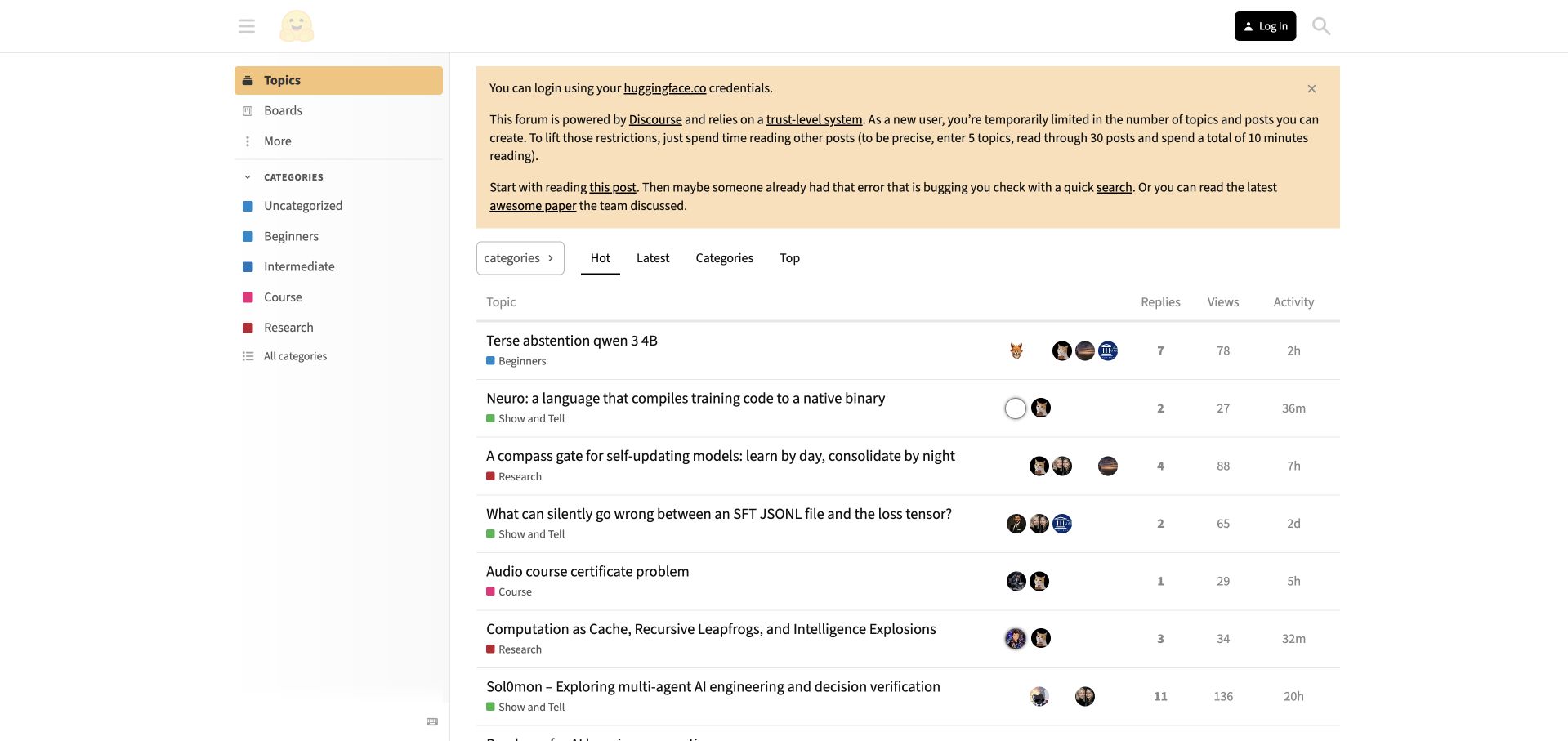
Hugging Face’s forum places a substantial notice above the topic list explaining login, trust levels, and where to begin. The sidebar separates beginner, intermediate, course, research, and showcase areas, while row metadata reveals conversation activity. The design makes the forum’s operating rules part of the entry experience. The Rails association concerns Discourse’s backend for this discussion property, not the Hub, hosted models, datasets, or separate Hugging Face application services.
What you can learn
Make contribution rules understandable before an application enforces them. Rails-backed community workflows should give actionable explanations for posting limits and permissions, while keeping account identity, trust progression, and topic categorization conceptually separate for users.
Pros
The onboarding notice explains participation restrictions in ordinary language rather than leaving a new contributor to discover them through failed actions.
Experience-level and subject categories create several sensible starting points for a technically broad audience that includes both learners and researchers.
Cons & considerations
A large persistent notice can delay access to the current discussion list for returning readers who already understand the participation model.
Fast-changing technical subjects need versioned references and moderation; recent activity alone does not show that an answer remains accurate for current tools.
Platform source: Discourse official backend architecture. The named public community is evidenced as Discourse. Discourse’s official source documents a Ruby on Rails backend API and a separate Ember frontend. This association is limited to the community application, not the organization’s other websites or products. Platform evidence is separate from the direct website screenshot and is not a complete current infrastructure audit.
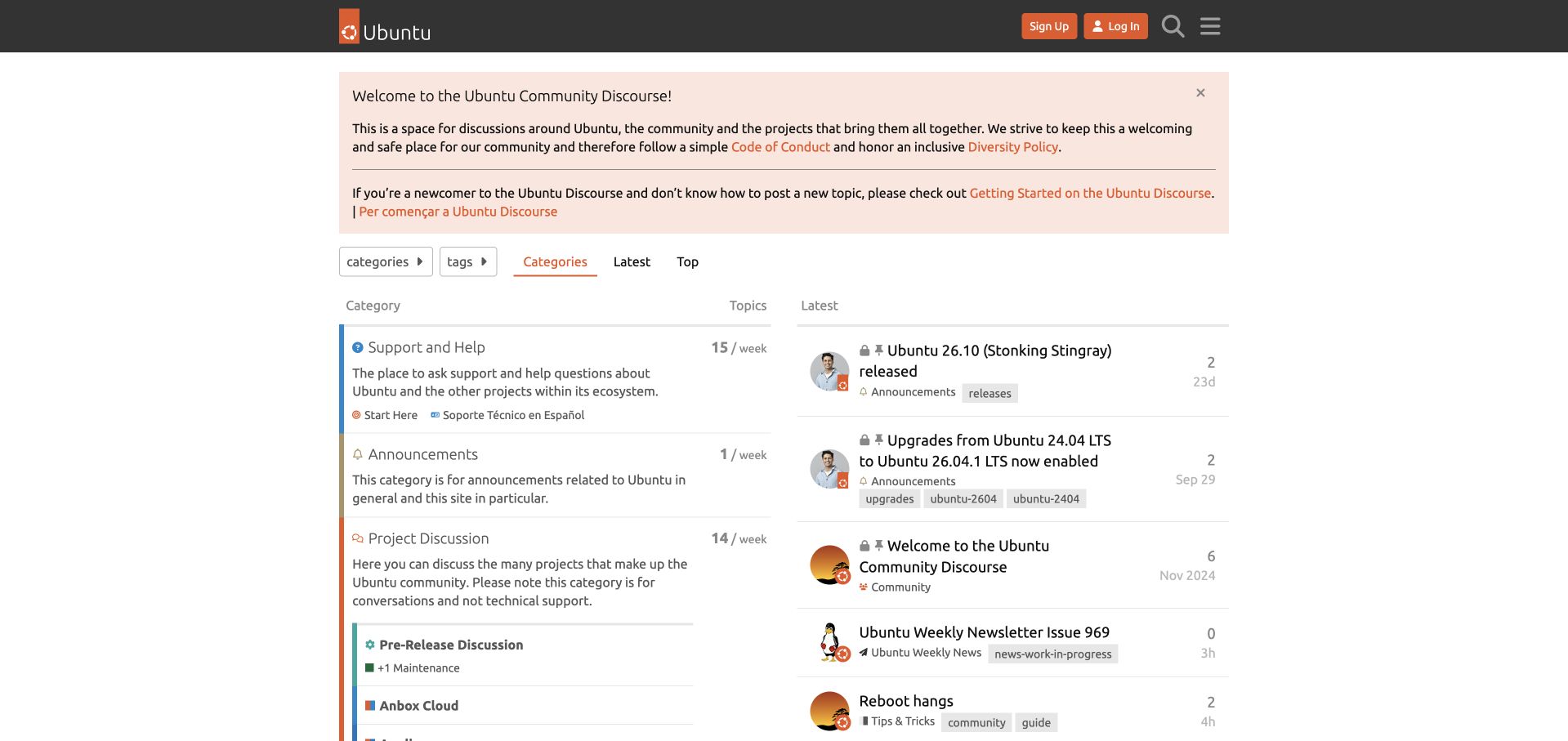
Ubuntu’s community opens with a notice linking its code of conduct, diversity policy, and first-post guide. The directory distinguishes support, announcements, project discussion, and prerelease work, beside recent topics. The orange identity is restrained around a practical reading interface. This property uses Discourse’s Rails-backed community layer; the operating system, package repositories, and other Ubuntu or Canonical services are not covered by that association.
What you can learn
Treat releases and participation policy as first-class content context. A Rails community should make the difference between current support, prerelease investigation, and project coordination visible in routes and metadata, instead of requiring readers to infer it from a title.
Pros
The welcome area connects community values to concrete participation instructions, providing both expectations and a practical next step for new contributors.
Prerelease discussion is named separately from general support, which helps avoid mixing experimental behavior with guidance for an established release.
Cons & considerations
Long welcome text can become repetitive on return visits and needs a presentation that does not permanently overshadow the actual discussions.
Release-specific guidance may remain searchable after support conditions change, so older topics require contextual labeling and links to maintained reference sources.
Platform source: Discourse official backend architecture. The named public community is evidenced as Discourse. Discourse’s official source documents a Ruby on Rails backend API and a separate Ember frontend. This association is limited to the community application, not the organization’s other websites or products. Platform evidence is separate from the direct website screenshot and is not a complete current infrastructure audit.
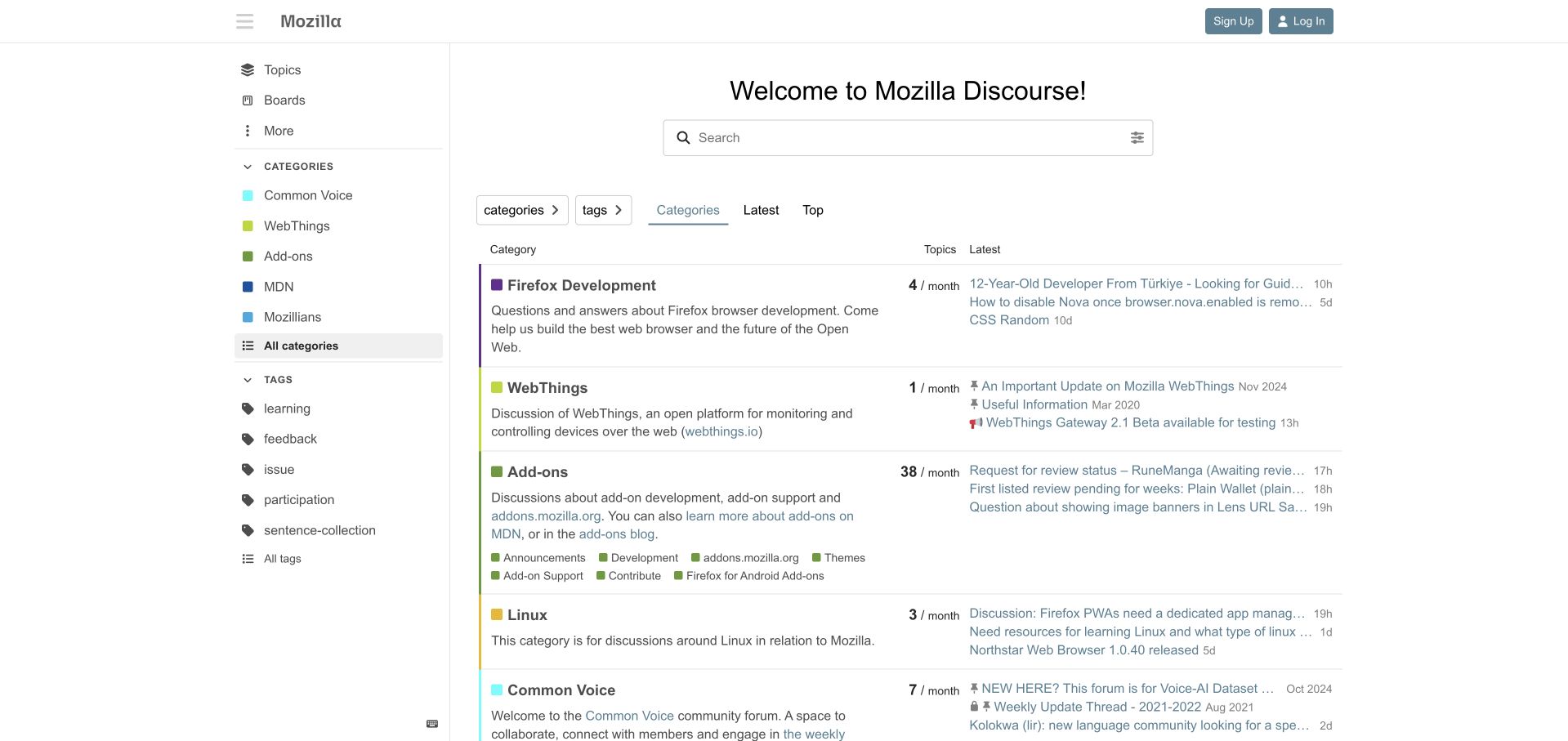
Mozilla Discourse uses a welcome and search area above categories covering Firefox development, WebThings, add-ons, Linux, and Common Voice. The sidebar offers recurring destinations and tags. Descriptions connect project names with appropriate conversations. Rails is associated with this Discourse community backend only; it does not describe Firefox, the add-ons service, or every Mozilla publishing property.
What you can learn
Keep project identities explicit when several products share one Rails-backed discussion installation. Separate category ownership, account access, and link destinations so a question does not acquire the wrong support expectations merely because the community uses a common brand header.
Pros
The project descriptions identify the intended subject of each area, which is useful when a shared organization has several technically different communities.
A compact global search and consistent topic controls provide a familiar reading model across the otherwise distinct projects represented in the directory.
Cons & considerations
Legacy projects can remain visible beside active ones, so lifecycle and support status need more explanation than a familiar project name alone.
The shared brand does not imply one moderation policy or response commitment across every category, particularly where communities have different maintainers or audiences.
Platform source: Discourse official backend architecture. The named public community is evidenced as Discourse. Discourse’s official source documents a Ruby on Rails backend API and a separate Ember frontend. This association is limited to the community application, not the organization’s other websites or products. Platform evidence is separate from the direct website screenshot and is not a complete current infrastructure audit.
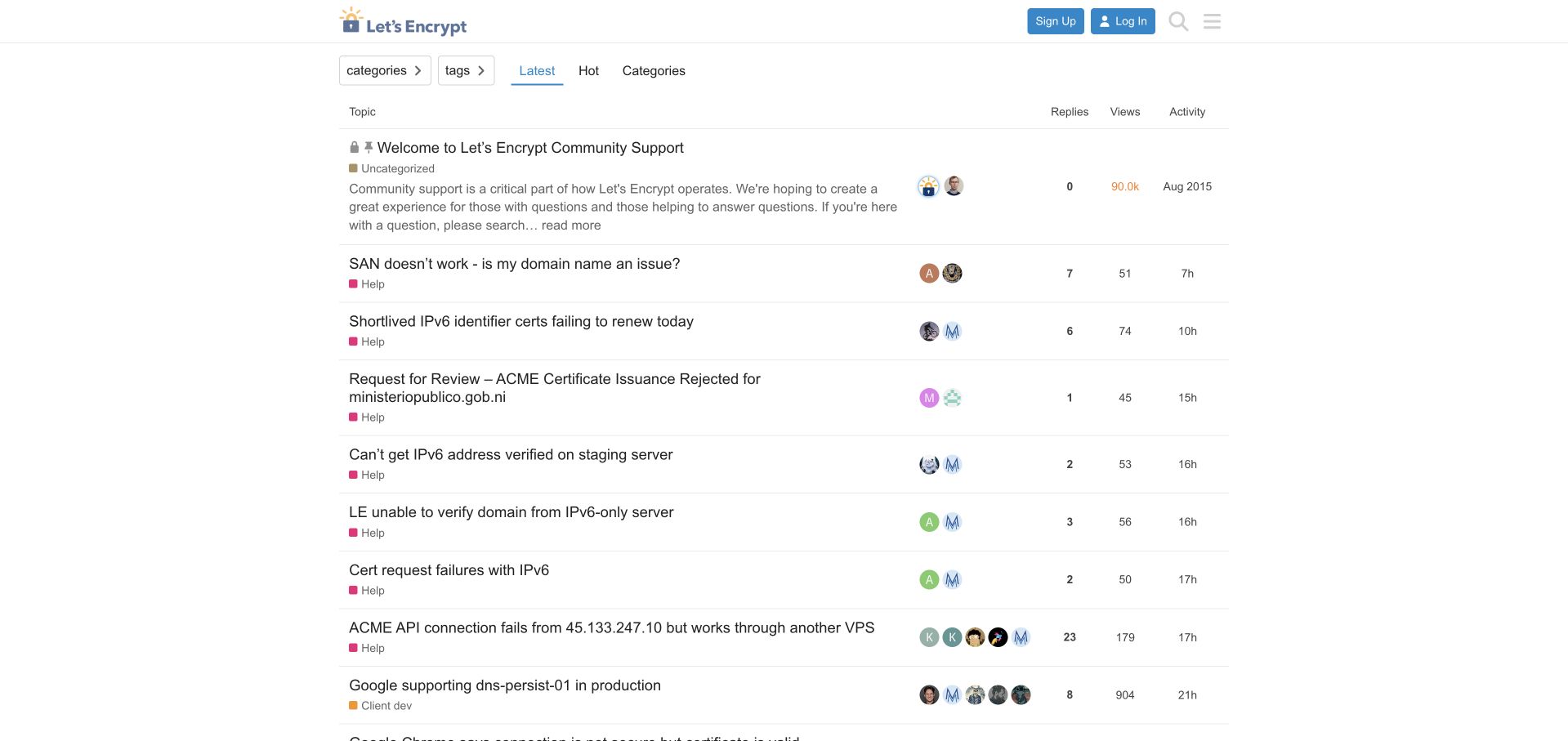
Let’s Encrypt Community Support puts a pinned introduction above certificate and validation questions. Rows show subjects, participants, replies, views, and activity without promotional decoration. Search and category filters remain near the header. This public Discourse community’s backend API is built on Rails; the certificate authority’s issuance infrastructure and other services are not established by that forum association.
What you can learn
Design technical discussion around the information needed to reproduce a problem. A Rails-backed support workflow should guide users toward relevant versions, errors, and public diagnostics, while avoiding requests for secrets, private keys, or unnecessary personal data.
Pros
The concise topic list makes current troubleshooting subjects easy to scan and keeps the main support-reading task close to the page opening.
The pinned introduction provides a stable place for participation guidance rather than scattering essential instructions across unrelated category descriptions or promotional modules.
Cons & considerations
Highly specific error titles can be opaque to newcomers unless search results and onboarding help them distinguish a comparable problem from a merely similar phrase.
A public support interface requires careful privacy guidance because useful troubleshooting detail can sit close to credentials and other information that should not be posted.
Platform source: Discourse official backend architecture. The named public community is evidenced as Discourse. Discourse’s official source documents a Ruby on Rails backend API and a separate Ember frontend. This association is limited to the community application, not the organization’s other websites or products. Platform evidence is separate from the direct website screenshot and is not a complete current infrastructure audit.
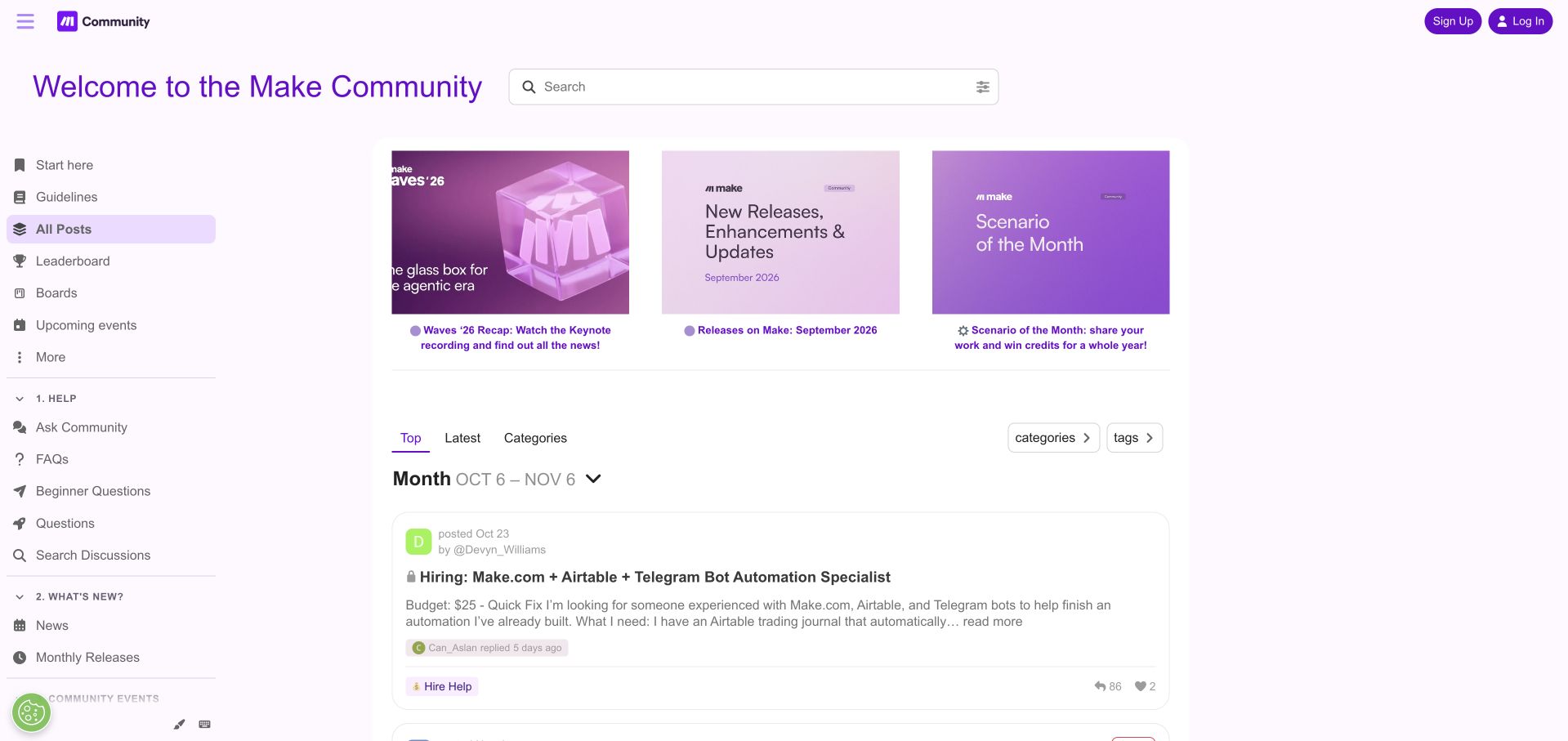
Make Community opens with search and three editorial cards before the discussion view. Its sidebar distinguishes help, beginner questions, frequently asked questions, news, releases, and events. Purple accents connect the forum to the product. The Rails association is limited to Discourse’s community backend here, not to Make’s automation execution platform or any connected third-party applications.
What you can learn
Keep shared examples distinct from account-specific operational help. A Rails-backed community for automation software should preserve topic types and safe sharing guidance so reusable workflows do not accidentally expose connection details, private records, or credentials in public conversation.
Pros
Beginner and frequently asked question destinations are named separately, helping a new user find material before composing a broad or underspecified request.
Featured cards give product news and community inspiration their own location rather than relying exclusively on a chronological stream to surface them.
Cons & considerations
Editorial cards and a selected ranking period can hide the most recent help requests unless the active view is clear to a returning reader.
Workflow examples may depend on changing external products, so a useful forum answer still needs dates, version context, and appropriate handling of private connection information.
Platform source: Discourse official backend architecture. The named public community is evidenced as Discourse. Discourse’s official source documents a Ruby on Rails backend API and a separate Ember frontend. This association is limited to the community application, not the organization’s other websites or products. Platform evidence is separate from the direct website screenshot and is not a complete current infrastructure audit.
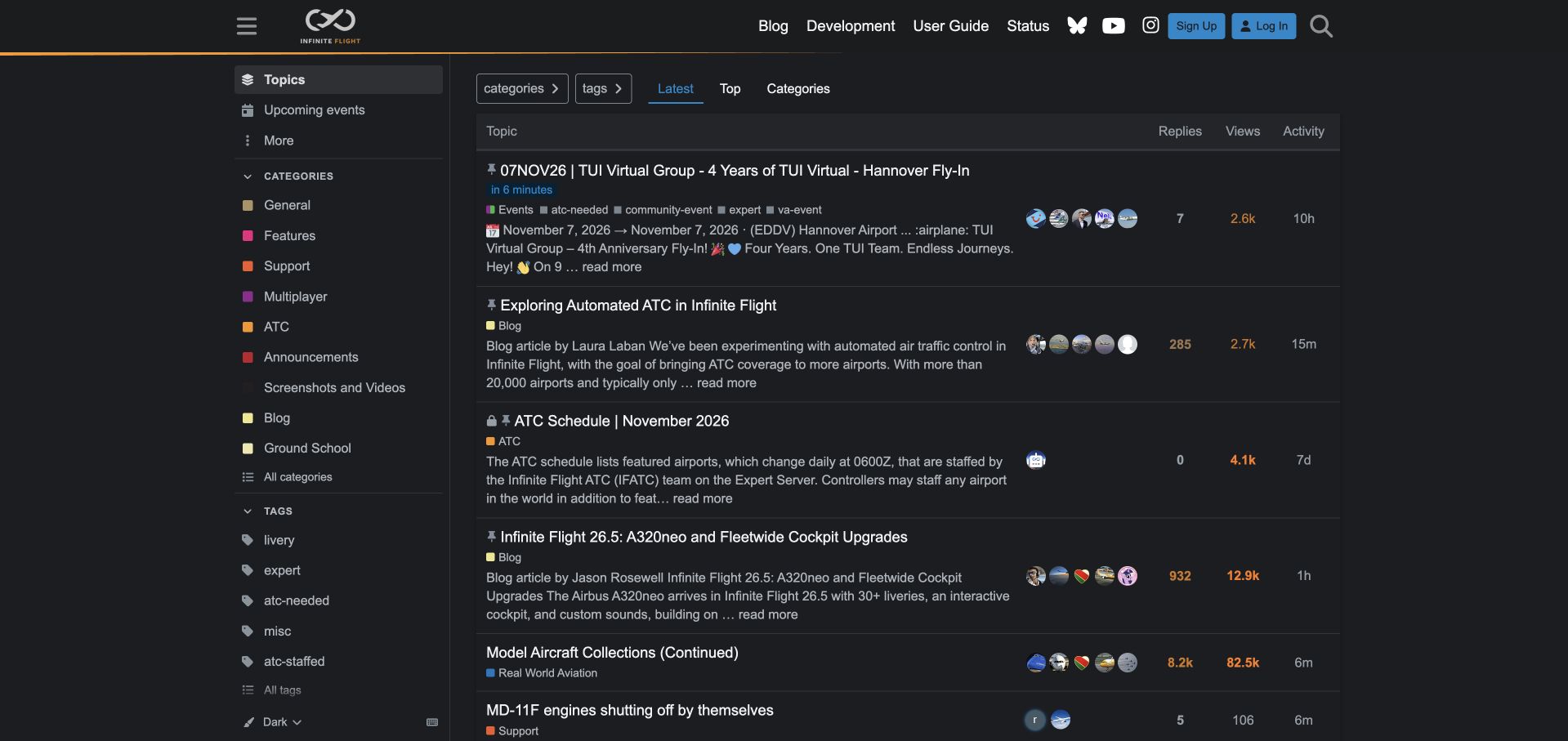
Infinite Flight’s community uses a dark feed and product categories. Navigation links the blog, development information, user guide, and service status. Event and schedule posts appear alongside simulator updates and community work. This review’s Rails connection is the Discourse forum backend; it does not identify the implementation of the flight simulator, multiplayer services, or other Infinite Flight systems.
What you can learn
Time-sensitive community records need different lifecycle rules from evergreen help. In a Rails-backed forum, preserve event dates, time zones, status labels, and related product versions so an old schedule does not look like a current operational instruction.
Pros
The user-guide and status links acknowledge important destinations outside the discussion platform, reducing the temptation to treat every operational question as another topic.
The category sidebar exposes different participation modes, including support, events, and shared work, without requiring separate community identities for each of those activities.
Cons & considerations
A chronological feed can mix expiring events with longer-lived technical explanations, so subject labels and dates must remain legible and consistently maintained.
Dark themes need deliberate contrast and text-size testing, especially for secondary labels and long excerpts that can become visually subordinate to titles or avatars.
Platform source: Discourse official backend architecture. The named public community is evidenced as Discourse. Discourse’s official source documents a Ruby on Rails backend API and a separate Ember frontend. This association is limited to the community application, not the organization’s other websites or products. Platform evidence is separate from the direct website screenshot and is not a complete current infrastructure audit.
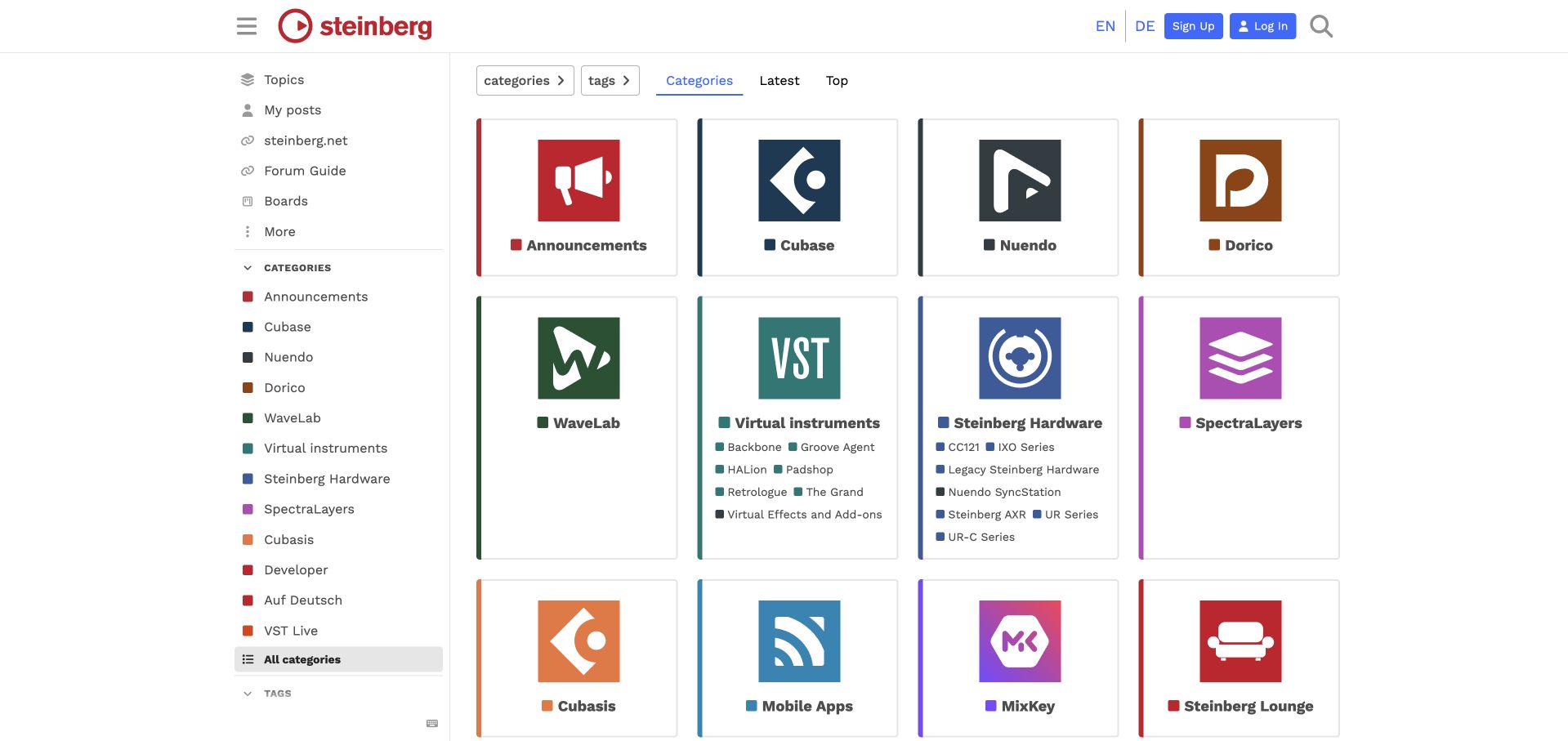
Steinberg’s forums use product icons to distinguish Cubase, Nuendo, Dorico, WaveLab, instruments, hardware, and other areas. The grid makes the portfolio legible before individual discussions. A sidebar repeats destinations and provides a forum guide. This is a Rails-backed Discourse community property, not evidence that Steinberg’s audio applications, licensing infrastructure, or corporate website use the same technology stack.
What you can learn
Align a Rails community’s category records with the product catalogue without making the catalogue the only organizing principle. Versions, platforms, hardware relationships, and common technical subjects may need tags or cross-links that continue working as products are renamed.
Pros
Distinct product marks make the directory recognizable to existing customers and reduce dependence on reading every category label in a long undifferentiated list.
The forum-guide route remains in the sidebar, providing a persistent place to explain conventions without filling every product card with repeated participation instructions.
Cons & considerations
A visually attractive product grid can still be difficult for visitors who do not know which application or subsystem is responsible for their problem.
Product icons need accompanying names and useful category structure; color or artwork alone should not carry the information needed to choose a support destination.
Platform source: Discourse official backend architecture. The named public community is evidenced as Discourse. Discourse’s official source documents a Ruby on Rails backend API and a separate Ember frontend. This association is limited to the community application, not the organization’s other websites or products. Platform evidence is separate from the direct website screenshot and is not a complete current infrastructure audit.
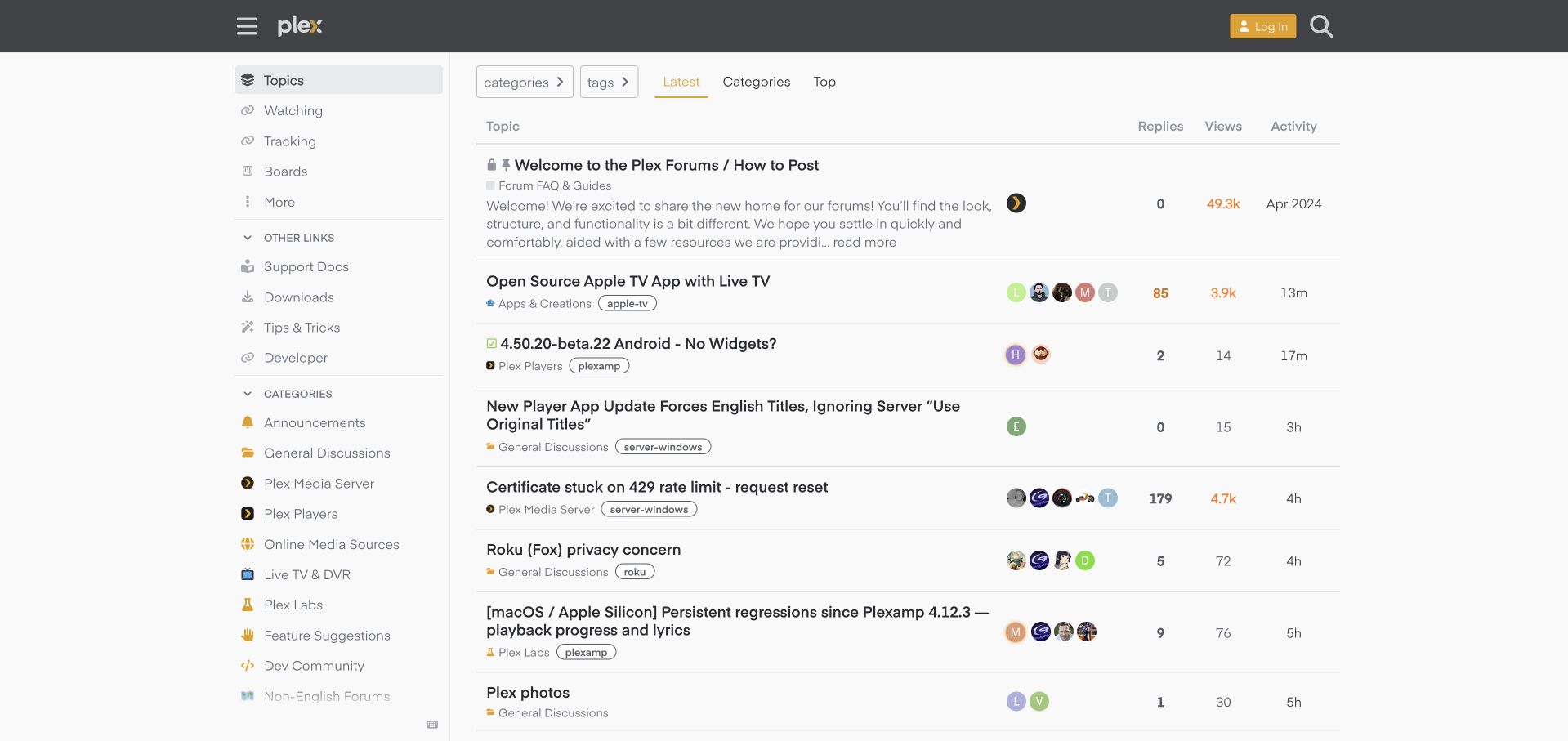
Plex’s forum puts a posting guide above recent topics, with product labels beneath titles. The sidebar separates the server, players, online sources, live television, experimental work, and suggestions, alongside documentation and downloads. Rails is associated with this Discourse forum backend only; the media server, playback applications, and commercial Plex website are separate systems outside this example’s scope.
What you can learn
Use the content model to preserve the environment behind a support request. A Rails-backed software community needs product, platform, and version context that survives edits and search indexing, otherwise superficially similar playback problems can become misleading matches.
Pros
Product labels beneath topic titles provide useful context without requiring every author to cram the complete device and application environment into the title itself.
Documentation and download links remain distinct from community categories, making it easier to recognize a maintained reference destination instead of another user-generated discussion.
Cons & considerations
An active feed can emphasize unresolved complaints or experimental releases unless the chosen view and topic status are understandable to occasional visitors.
The public forum cannot establish private account integration or support entitlements, so interface branding should not be treated as proof of a guaranteed response channel.
Platform source: Discourse official backend architecture. The named public community is evidenced as Discourse. Discourse’s official source documents a Ruby on Rails backend API and a separate Ember frontend. This association is limited to the community application, not the organization’s other websites or products. Platform evidence is separate from the direct website screenshot and is not a complete current infrastructure audit.
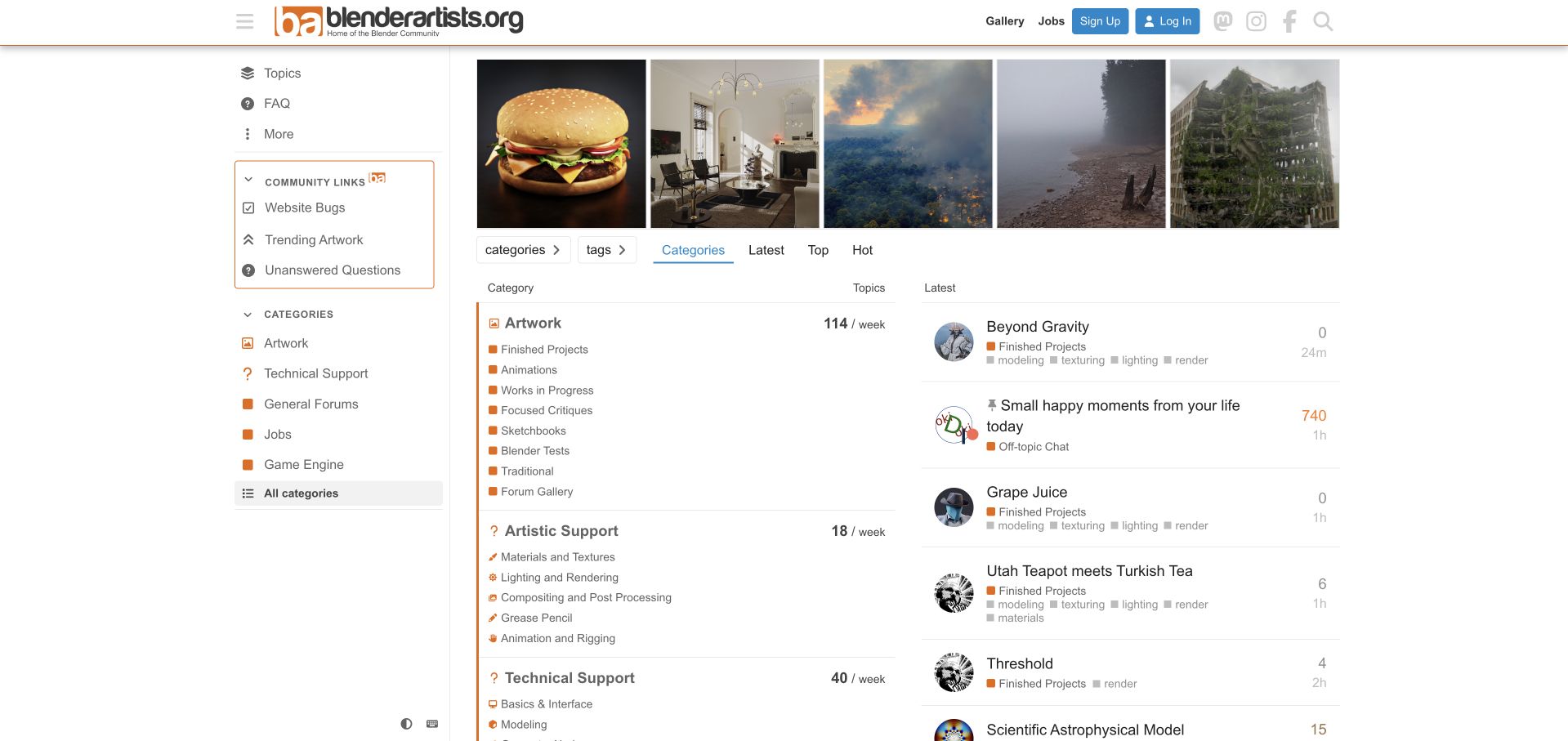
Blender Artists pairs a horizontal gallery of finished images with a category directory and recent-topic column. The sidebar distinguishes artwork, artistic support, technical support, and broader conversation, while utility links include unanswered questions. The visual work makes the community’s subject immediately tangible. The Rails connection is Discourse’s backend on this independent community property, not the Blender application or a blanket claim about the Blender project’s official websites.
What you can learn
A Rails-backed creative community needs to model media and conversation together without treating them as identical objects. Preserve artwork attribution, attachment handling, topic purpose, and moderation responsibilities alongside the category and reply structure.
Pros
The artwork strip shows the kind of community output visitors can expect before they read the category explanations or open an individual discussion.
Separate artistic and technical support areas acknowledge that a creative problem and a software malfunction need different contexts, participants, and expectations.
Cons & considerations
Large media previews introduce additional loading and attribution responsibilities that a text-only discussion template does not address automatically or resolve through branding.
An independent community’s relationship to the software project should remain explicit so visitors do not confuse peer advice with official product support or endorsement.
Platform source: Discourse official backend architecture. The named public community is evidenced as Discourse. Discourse’s official source documents a Ruby on Rails backend API and a separate Ember frontend. This association is limited to the community application, not the organization’s other websites or products. Platform evidence is separate from the direct website screenshot and is not a complete current infrastructure audit.
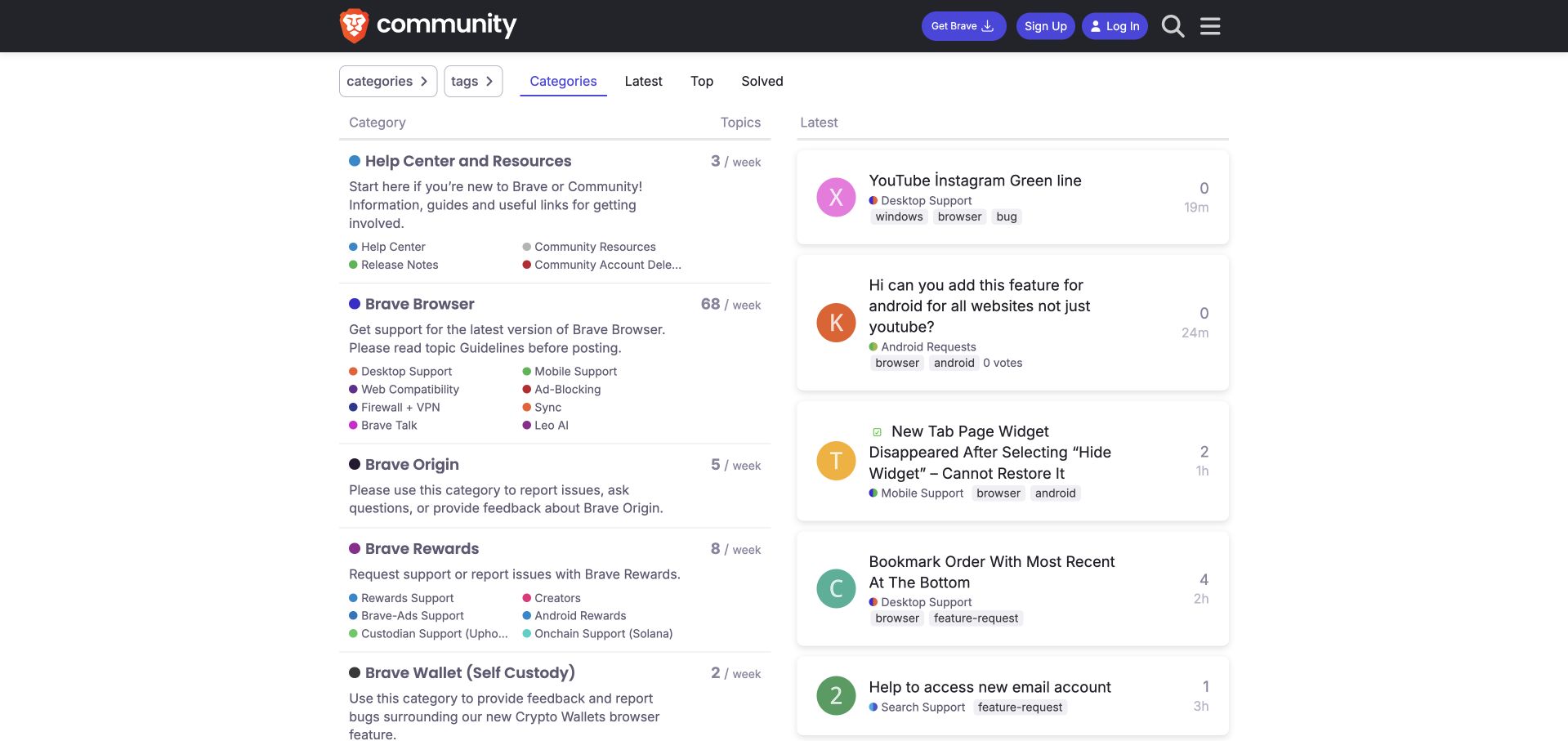
Brave Community presents product descriptions beside recent discussion cards. Browser support, rewards, wallet, and other areas remain distinct, with a solved-content option alongside browsing controls. The header separates obtaining the browser from joining the community. Ruby on Rails is associated with the Discourse backend serving this forum, not Brave’s browser implementation, advertising systems, wallet services, or marketing website.
What you can learn
Resolution state should be application data, not a word in a title. A Rails-backed support system can expose solved content as a discovery route, while preserving who marked it and whether the answer applies to the same product context.
Pros
The solved-content route offers an alternative to recency, valuable when a visitor wants a reusable answer rather than an active conversation.
Short category descriptions explain related Brave services separately, helping users avoid treating the browser, wallet, and rewards programme as one undifferentiated product.
Cons & considerations
A solved label does not guarantee that an answer remains applicable after software changes, so dates and environmental details still matter when reading older topics.
Multiple related services create a substantial support taxonomy, and the page must keep reporting and account-help boundaries clear without requesting sensitive information in public.
Platform source: Discourse official backend architecture. The named public community is evidenced as Discourse. Discourse’s official source documents a Ruby on Rails backend API and a separate Ember frontend. This association is limited to the community application, not the organization’s other websites or products. Platform evidence is separate from the direct website screenshot and is not a complete current infrastructure audit.
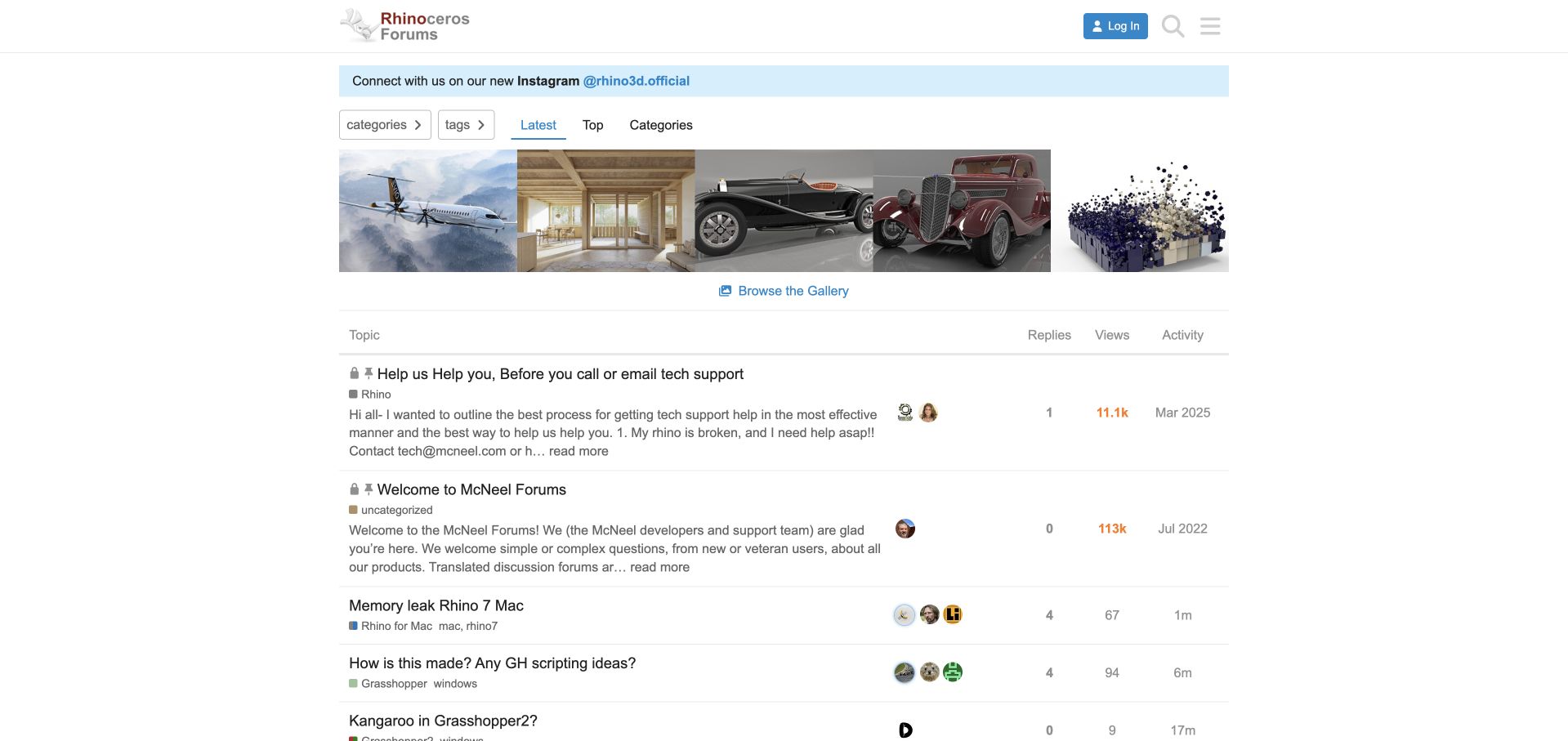
McNeel’s Rhino forum places project imagery above pinned support material and recent topics. Restrained controls connect the page to professional modelling work without creating a separate portfolio catalogue. Topic labels add product and platform context. The Rails-backed component is the Discourse community API; Rhino’s modelling engine and McNeel’s other product and service properties are not attributed here.
What you can learn
Keep visual inspiration connected to a structured technical conversation. Rails community extensions should preserve attachment ownership, product-version metadata, and clear support boundaries while allowing a gallery to point readers toward work and discussions that explain it.
Pros
The project images connect the discussion to real modelling output, giving newcomers immediate context for the community beyond a list of software problems.
Pinned help material and product labels support both first-time participation and precise technical reading without forcing a completely different interface for each audience.
Cons & considerations
A gallery strip adds media weight above the practical support feed, so image loading and small-screen presentation need their own verification alongside the text layout.
Professional modelling questions may include private client work or proprietary files; the public posting guide needs to make those sharing risks clear before attachments are added.
Platform source: Discourse official backend architecture. The named public community is evidenced as Discourse. Discourse’s official source documents a Ruby on Rails backend API and a separate Ember frontend. This association is limited to the community application, not the organization’s other websites or products. Platform evidence is separate from the direct website screenshot and is not a complete current infrastructure audit.
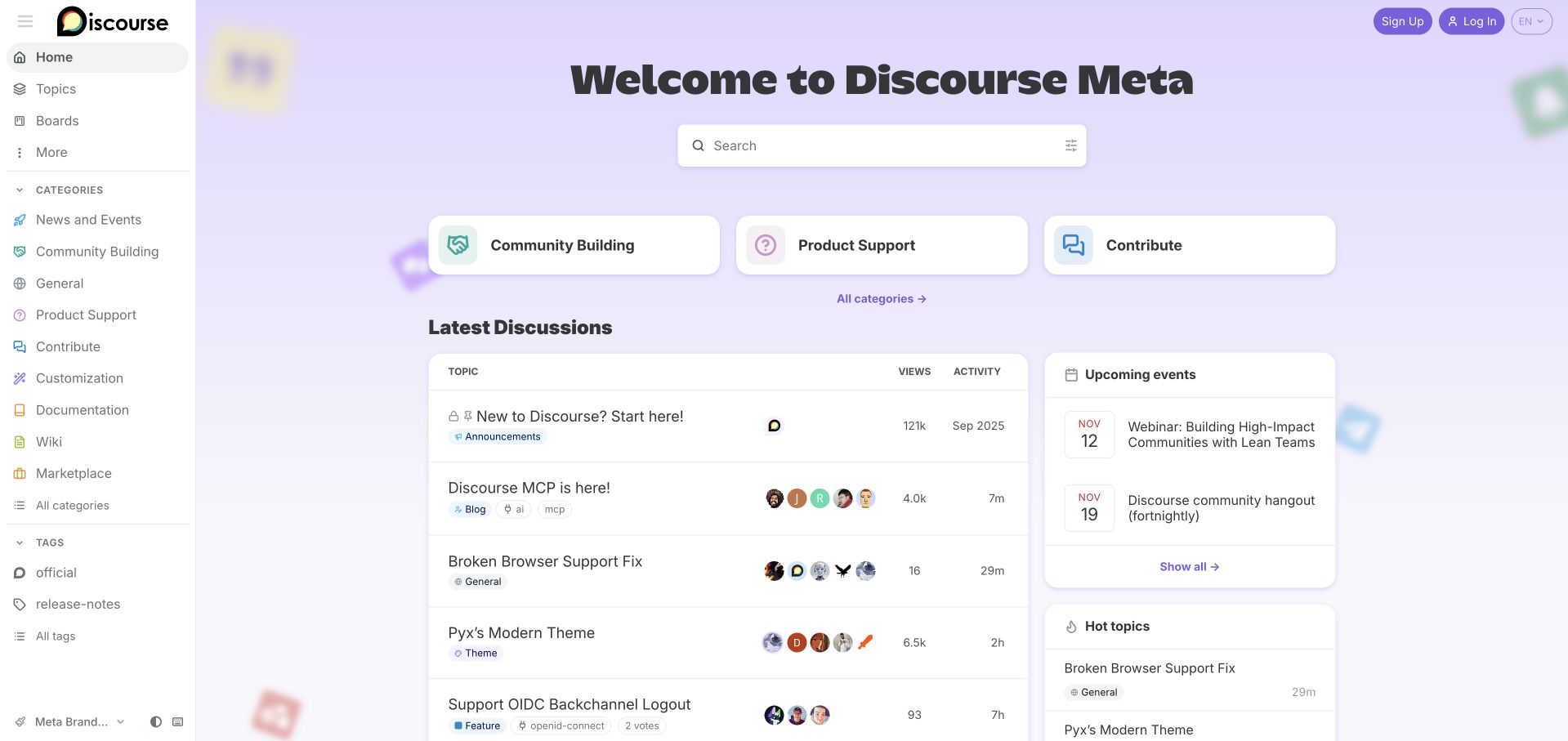
Discourse Meta hosts support, development, feature requests, and knowledge sharing. Its categories, activity views, and search model are patterns organizations can adapt on their installations. Product discussion and platform guidance coexist in a real public property. The Rails evidence applies to Discourse’s backend API here; the frontend and linked demonstrations remain distinct layers, not a purely Rails-rendered interface.
What you can learn
Evaluate a Rails-backed platform through journeys your team must maintain: finding an answer, understanding a category, following a discussion, and recognizing official guidance. Source availability explains architecture, but the public interface reveals the content and governance decisions users actually encounter.
Pros
The official project community provides a direct route from evaluating the platform to maintained discussions about implementation, changes, and practical operating questions.
A live topic collection demonstrates how support, feature requests, and development conversation can share an application while retaining distinct organizational roles and discovery routes.
Cons & considerations
An expert product community can assume familiarity with its terminology, so a new installation may require a simpler onboarding model than this reference uses.
The public interface cannot reveal another organization’s private configuration, staffing, or upgrade process; those operational requirements need separate project-specific evaluation and testing.
Platform source: Discourse official backend architecture. The named public community is evidenced as Discourse. Discourse’s official source documents a Ruby on Rails backend API and a separate Ember frontend. This association is limited to the community application, not the organization’s other websites or products. Platform evidence is separate from the direct website screenshot and is not a complete current infrastructure audit.
Kegan has 15+ years of experience working with small businesses, Fortune 500 companies, and everything in between. No development job is too big or too small: he brings the same hands-on attention to a focused improvement, a complete website, or a custom application.
For Ruby on Rails projects, he can help with content architecture, custom functionality, system integrations, testing, and maintainable handover. He works directly with clients on scope, design, implementation, testing, and handover, with an emphasis on clear communication and a system that remains practical to maintain after launch.
Show 3 other Ruby on Rails developersHide other Ruby on Rails developers
Choose a Rails approach that matches the product responsibility
Configure an established community application
If the main need is discussion, evaluate the existing platform’s category, search, moderation, and identity model before building replacements. Favor restrained configuration until a concrete user journey demonstrates why custom application behavior is needed.
Integrate around stable boundaries
Connect product documentation, status pages, or identity systems through supported interfaces and explicit ownership. Verify authorization on the server and plan for an external service to be unavailable without granting broader access or losing content context.
Build a custom Rails product when the domain requires it
Rails also supports applications beyond forums, but this collection does not prove those unrelated implementations. For a custom product, model the real records, permissions, and state transitions, then choose frontend behavior around the task rather than copying a forum screen.
From references to requirements
Plan content, permissions, migrations, and ongoing operations
Preserve discussion context during migration
Map topic addresses, category changes, authorship, attachments, and redirects. Test a deep link to an old technical answer, not merely the new homepage. Keep version and platform metadata attached when subject names change.
Review public and private boundaries separately
Read-only public browsing is different from posting, moderation, staff tools, and account-linked support. Test authorized workflows in an appropriate environment and never infer private permissions from the appearance of the public interface.
Set rules for safe technical troubleshooting
Support communities can accidentally collect keys, private logs, client files, or financial details. Publish useful guidance about safe examples and redaction, and assign a process for handling inappropriate disclosures without encouraging more public sharing.
Maintain the whole operating application
Plan framework and platform updates, background jobs, data backups, uploads, search, and observability with defined owners. A branded theme is a small part of the long-term responsibility and does not prove that operational controls are in place.
A useful handover demonstration
Ask the actual team to carry out its routine job: publish a realistic update, correct a mistake, preview a narrow screen, and identify who owns an integration failure. For a library or frontend framework, also ask who maintains the content source and deployment. A polished screenshot does not answer those operational questions.
Beyond the screenshot
Rails-backed community project checklist
Document the backend and frontend boundary.
Choose categories, tags, versions, and status fields deliberately.
Keep documentation and service-status routes available.
Explain posting and account restrictions clearly.
Define public versus private authorization rules.
Preserve deep links, authorship, and attachments in migrations.
Record resolution without implying permanent correctness.
Give time-sensitive events explicit dates and time zones.
Publish safe troubleshooting and attachment guidance.
Test long topics, media, code, and narrow screens.
Plan background jobs, backups, and dependency updates.
Assign content, moderation, and operational ownership.
Test with real content, a keyboard, a small screen, slow or failed requests, and the people who will maintain the system. These are planning checks, not an accessibility, security, performance, or search-ranking certification.
Sources & editorial method
How this Ruby on Rails collection was reviewed
Twenty distinct public Discourse community properties have direct source-site captures and original Rails-focused design reviews. Nineteen captures are reused from their existing same-source records with original timestamps intact; one official project-community capture is new. The first five are explicitly selected recognizable organization-owned communities. Public Discourse platform evidence is combined with the official project source documenting its Rails backend API and separate frontend. This is a scoped architectural association, not a direct audit of private server deployment, a purely Rails-rendered interface claim, or a corporate-wide technology attribution. Editorial review, capture, and technology-observation dates remain independent. A separate broad audit is the publisher’s responsibility.
Every image is an unmodified capture from the actual website, with its source and capture date. Some captures are reused from our shared catalog; their dates remain the original capture dates. None comes from a vendor gallery or a generated reconstruction. Moving imagery and live content can change.
Technology attribution uses public page assets or metadata, official platform documentation, or a cited first-party project case study. Documentary and framework-relationship evidence is identified where used; it is not a complete current backend inventory. A CMS image CDN alone does not establish a full CMS deployment. A library’s presence does not prove which individual controls use it, and a platform label does not establish AI authorship.
The composition notes, lessons, pros and tradeoffs are original editorial observations. We have not measured conversion, traffic, security, performance or accessibility conformance. Website owners retain their brands and imagery; these examples are not our client portfolio. Written, Edited and Curated are independent records, not dates advanced by a build. See our editorial standards or suggest a correction.
Questions worth asking
Ruby on Rails website development FAQs
Why does this Rails collection contain Discourse communities?
They provide identifiable public application properties. Discourse’s official source documents its Rails backend, and the property records independently identify Discourse. That is narrower and more defensible than assigning a corporation’s entire website to Rails.
Is Discourse’s browser interface entirely Rails-rendered?
No. The official project describes a Rails backend API and a separate Ember frontend. Themes and integrations add further layers. The reviews preserve that distinction.
Does the forum evidence apply to a company’s main product?
No. A community can use a different stack from the organization’s marketing site, customer application, network, or operating software. Only the named community property is included here.
Should a team build a custom Rails forum?
First establish which requirements an existing platform cannot meet through supported configuration. Custom behavior brings long-term ownership of permissions, migrations, search, moderation, and upgrades, not just a different visual design.
Can public topic activity prove support quality?
No. Public counts and recent discussion are snapshots. They cannot establish response commitments, moderation staffing, answer accuracy, private account workflows, or customer satisfaction.
Use the framework boundary as the beginning of the design conversation. A useful Rails-backed community depends on clear content structure, safe participation, durable links, and defined operational ownership.