Best Ruby Websites of 2026 (20 Real-World Examples)
Twenty public communities with documented Ruby dependencies through Discourse and Rails, real screenshots and lessons for planning a useful web application.
Ruby sits behind application behavior, not a single visual style. These community websites show how a documented Ruby-based platform can support very different navigation, participation and editorial needs.
Ruby is a programming language; Rails is a framework built for it, and Discourse is a particular community application. Those distinctions matter when studying a website. A category grid, search field or discussion table does not reveal a programming language on its own. The examples here have retained evidence for their exact Discourse communities, supported by official documentation of the platform's Rails backend and Ruby dependency.
This is a focused collection of public community properties. It does not attribute Ruby to the corporate websites, desktop software, games, models or infrastructure of the organizations involved. The association is derived from documented application dependencies rather than an independent inspection of each live server. The captured browser interface also has its own frontend technology and design decisions.
That scope still leaves useful patterns to compare. Some communities organize their entrance around products, others around problems, regions or contribution types. A successful Ruby project needs similarly clear decisions about its users, data and routine work. Borrow the explanations and navigation that fit your task, then evaluate the actual application and its maintenance needs separately.
Before the examples
What makes good Ruby website development in 2026?
Separate the language from the application you are choosing
Ruby supplies programming-language tools, while a framework or packaged application supplies additional conventions and behavior. Decide whether your project needs a custom workflow or an established community product before choosing a visual reference. The official Ruby overview describes its object model and language features; those features do not prescribe a homepage layout or replace product requirements.
Describe the records and actions behind the interface
A forum contains more than pages: topics, replies, categories, users and permissions have relationships that must stay understandable as content grows. Write down those relationships and the actions each person may take. Rails introduces a model, view and controller structure, but the team's responsibility is to define the actual behavior and boundaries of its application.
Let people understand the community before they contribute
Make reading, searching and choosing a category useful on their own. Explain the difference between a question, an announcement, an idea and a support request where that decision occurs. The examples show how short descriptions and pinned guidance can communicate those distinctions without exposing implementation details or forcing every visitor into an account flow.
Treat permissions and untrusted content as product requirements
Decide which content is public, who can edit or remove it, and how uploads and administrative actions are controlled. Rails' security guidance covers sessions, request forgery, injection and file handling. Framework protections support the implementation, but the team still needs explicit authorization rules and checks for the particular application; a polished interface is not evidence that those controls work.
These 20 exact public communities demonstrate category maps, search entrances, topic feeds, visual galleries and participation guidance. All Ruby attributions are qualified dependencies of documented Discourse and Rails relationships; none is a direct measurement of a private runtime.
We start with five recognizable brands or organizations: NVIDIA Developer Forums, Shopify Community, Asana Community, Epic Developer Community — Unreal Engine Forum, Cloudflare Community. Each attribution applies to the named website property, not every product or website belonging to its organization. This is a curated reading sequence, not a measured ranking.
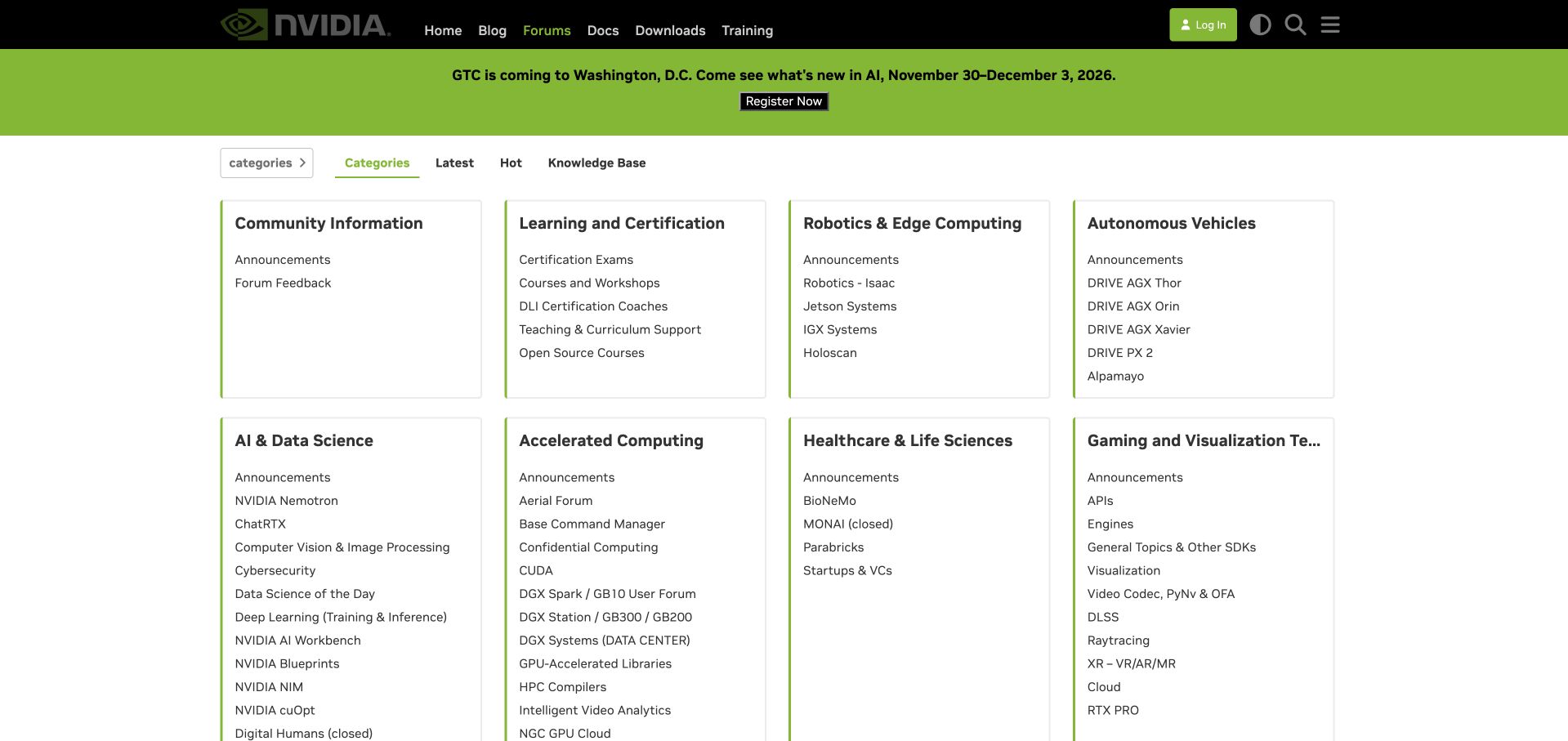
NVIDIA's developer forum opens with a grid of substantial category panels. Each heading names a technical area, then exposes more specific destinations without requiring a separate discovery step. The green accents connect the discussion application to the parent brand, while the conference banner remains distinct from the category map. This exact forum has retained Discourse evidence; Ruby is an associated dependency through the platform's documented Rails backend. That relationship concerns the community application, not NVIDIA's hardware, corporate website or private systems. The screenshot shows navigation structure rather than measured search quality or support outcomes.
What you can learn
For a Ruby application serving several specialist groups, make the domain structure visible before asking people to contribute. Clear categories help explain what belongs where, while application rules can address posting and access separately. A language choice does not make those editorial decisions.
Pros
Specific subcategory names expose useful routes without hiding everything behind a search field.
Repeated panel structure gives a broad technical taxonomy a consistent visual rhythm.
Cons & considerations
The large taxonomy demands substantial scanning from someone unfamiliar with the product families.
The event banner occupies space before the community's primary navigation begins.
Platform source: Official Discourse architecture and Rails language dependency. NVIDIA Developer Forums has retained exact-page Discourse evidence dated 2026-11-07. Ruby is an associated dependency of Discourse's documented Rails backend, not independently observed on this live server. The language, framework and browser frontend remain separate; this is not a Ruby version claim or an attribution to the organization's other websites or products. Platform evidence is separate from the direct website screenshot and is not a complete current infrastructure audit.
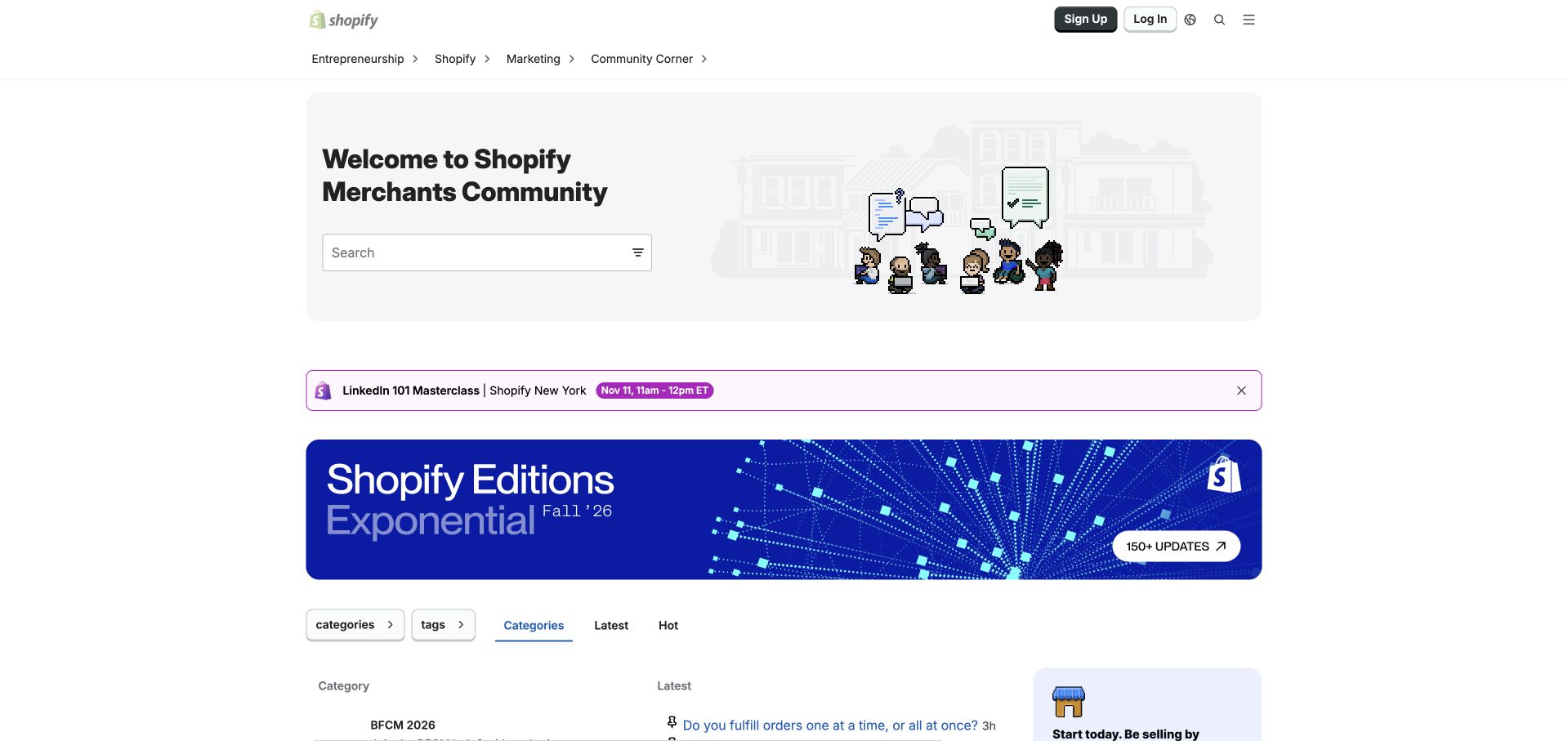
Shopify's community places a large search field inside a friendly illustrated welcome panel. The first view then moves through an event notice and a prominent product announcement before reaching the category controls. That sequence presents the forum as a broader destination for merchants, although it gives current promotions considerable space. The reviewed property is community.shopify.com, with a retained Discourse association. Its Ruby attribution follows the documented Rails dependency of that community software; it is not a claim about every Shopify storefront or the commerce platform's current infrastructure. No signed-in merchant workflow was reviewed.
What you can learn
Give a community application an obvious reading and searching route before requiring participation. When building with Ruby, plan the editorial balance between evergreen support and temporary announcements. The homepage should remain useful after a campaign ends and for readers who only need an answer.
Pros
The welcome panel states the audience and places search where newcomers can find it.
Distinct visual treatments separate community navigation from events and product news.
Cons & considerations
Two promotional regions push the actual discussion categories toward the bottom of the view.
A broad search invitation offers little immediate guidance for unusually specific merchant problems.
Platform source: Official Discourse architecture and Rails language dependency. Shopify Community has retained exact-page Discourse evidence dated 2026-11-07. Ruby is an associated dependency of Discourse's documented Rails backend, not independently observed on this live server. The language, framework and browser frontend remain separate; this is not a Ruby version claim or an attribution to the organization's other websites or products. Platform evidence is separate from the direct website screenshot and is not a complete current infrastructure audit.
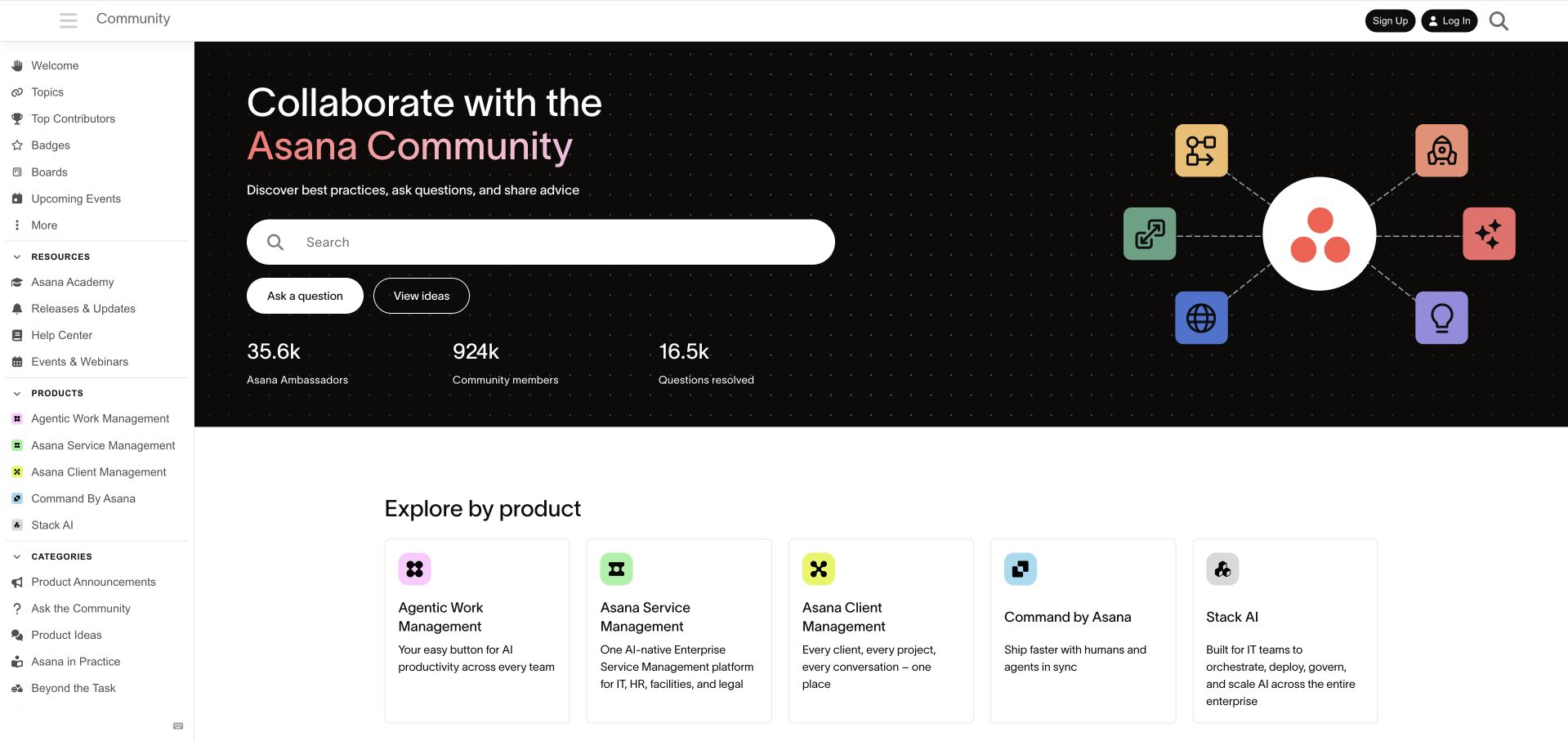
Asana's community uses a dark illustrated hero to separate search, asking a question and viewing ideas. Product cards begin immediately below, while the persistent sidebar offers resources, events and category routes. The result gives a visitor several ways to enter without treating every contribution as the same kind of post. Visible membership figures belong to the dated capture and are not evidence of response quality. Ruby is a qualified dependency association for this Discourse community through its documented Rails backend, not an independently observed implementation of Asana's main work-management product or corporate site.
What you can learn
Define contribution types before designing the form that creates them. A Ruby-backed community can share account and discussion foundations while giving questions, suggestions and announcements different labels and expectations. The interface should communicate those distinctions without requiring users to understand its internal data model.
Pros
Separate question and idea actions clarify two common reasons to join the conversation.
Product cards and persistent resources provide useful routes beyond the large hero.
Cons & considerations
The hero consumes considerable space before specific discussions become visible.
Community activity figures do not tell a newcomer which route will receive appropriate attention.
Platform source: Official Discourse architecture and Rails language dependency. Asana Community has retained exact-page Discourse evidence dated 2026-11-07. Ruby is an associated dependency of Discourse's documented Rails backend, not independently observed on this live server. The language, framework and browser frontend remain separate; this is not a Ruby version claim or an attribution to the organization's other websites or products. Platform evidence is separate from the direct website screenshot and is not a complete current infrastructure audit.
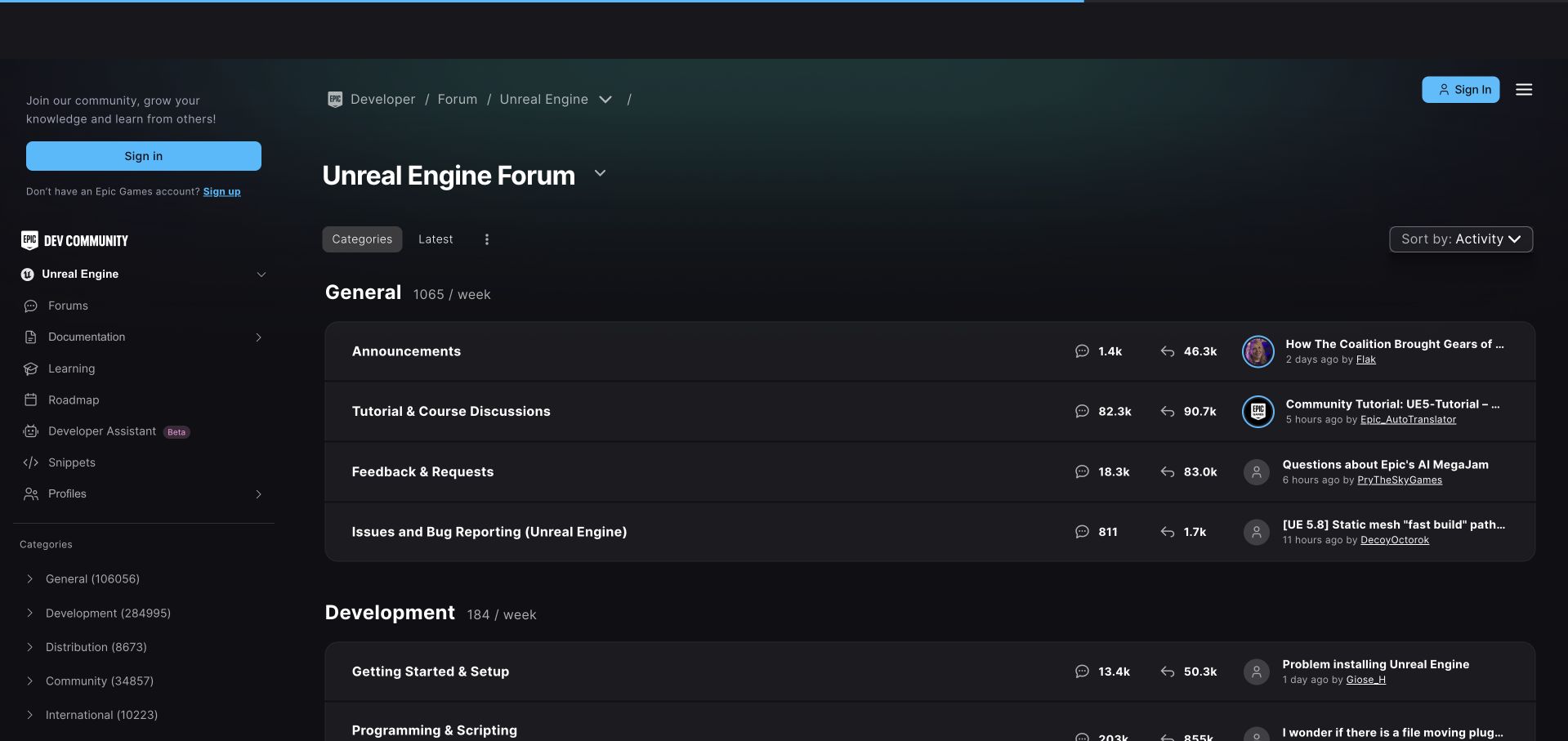
The Unreal Engine forum uses a dark, compact category table within Epic's developer-community navigation. General discussion separates announcements, tutorials, feedback and issue reporting; each row pairs its label with activity figures and a recent topic. The sidebar keeps documentation, learning and related community destinations available. Those visible categories support different tasks without replacing the forum with a marketing page. The exact public forum is associated with Discourse, whose documented Rails backend provides the qualified Ruby relationship. This does not identify the implementation of Unreal Engine itself, Epic's games or its other services.
What you can learn
Name categories after the contribution a visitor needs to make. For a Ruby application, requirements should distinguish reporting a reproducible problem from sharing a tutorial or requesting a feature. The taxonomy and moderation process deserve explicit design alongside account and persistence decisions.
Pros
Category rows expose both the intended conversation and signs of recent activity.
The developer sidebar connects discussion with documentation and learning resources.
Cons & considerations
Multiple numeric columns can overwhelm visitors who simply want to locate the right category.
Several similarly technical routes require familiarity with the community's vocabulary.
Platform source: Official Discourse architecture and Rails language dependency. Epic Developer Community — Unreal Engine Forum has retained exact-page Discourse evidence dated 2026-11-07. Ruby is an associated dependency of Discourse's documented Rails backend, not independently observed on this live server. The language, framework and browser frontend remain separate; this is not a Ruby version claim or an attribution to the organization's other websites or products. Platform evidence is separate from the direct website screenshot and is not a complete current infrastructure audit.
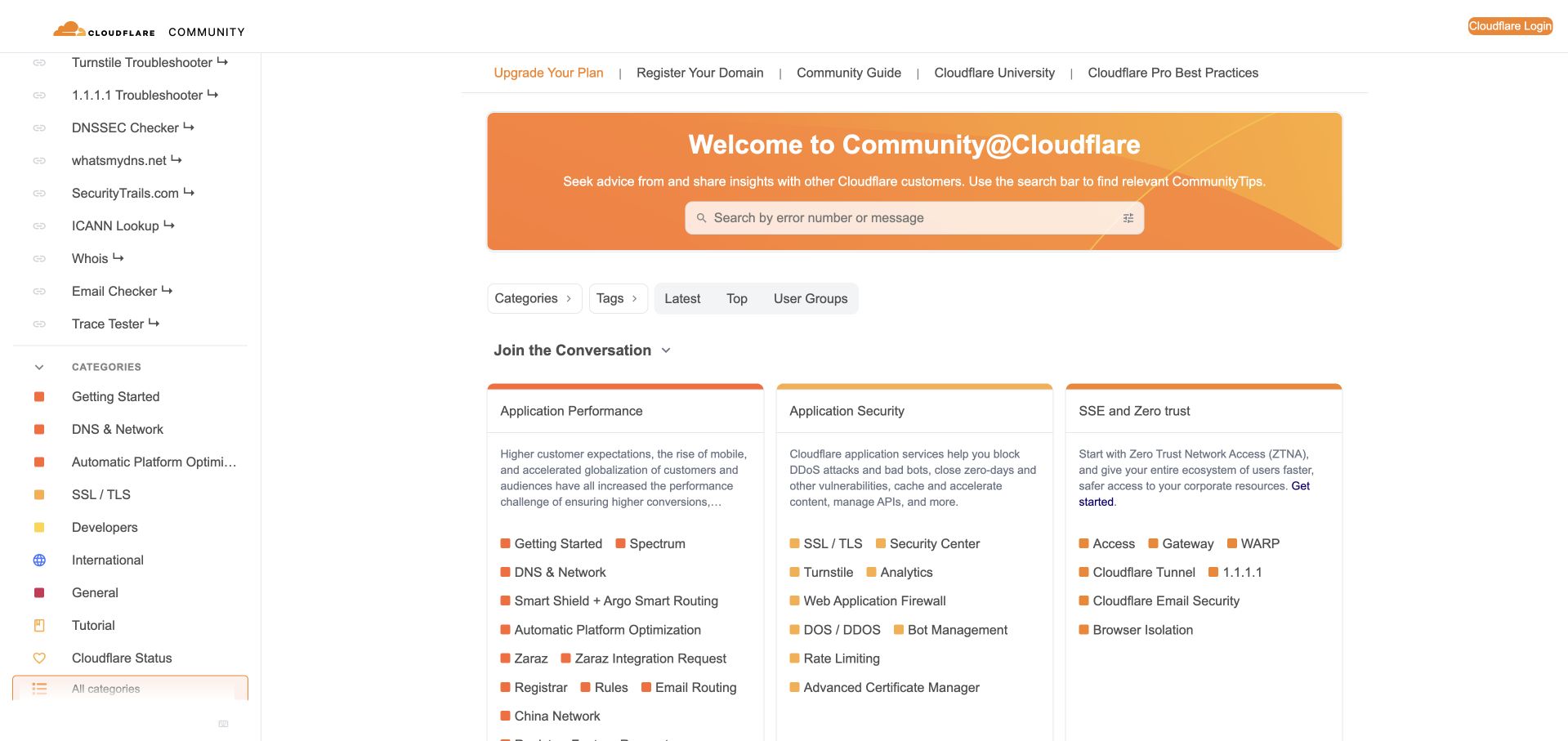
Cloudflare's community welcomes visitors with a search field that explicitly asks for an error number or message. Below it, large cards group application performance, security and network-access subjects, each with more specific routes. The left sidebar includes diagnostic resources as well as community categories. This pairing acknowledges that a reader may need both an explanation and a practical tool. The retained page evidence identifies this community as Discourse. Ruby is associated through its documented Rails dependency, not through an observation of Cloudflare's edge network, customer applications or other infrastructure products.
What you can learn
Use the visitor's problem language in the first interaction. A Ruby-based support application should make error context, product area and the next diagnostic step easy to express. Keep references to external tools distinguishable from community conversations so users understand where their next action leads.
Pros
The error-message search prompt gives a more concrete starting point than a generic welcome.
Grouped cards connect broad technical areas with specific products and topics.
Cons & considerations
Long lists of tools and product names create a demanding first view for beginners.
Search and category navigation still rely on readers recognizing relevant technical terminology.
Platform source: Official Discourse architecture and Rails language dependency. Cloudflare Community has retained exact-page Discourse evidence dated 2026-11-07. Ruby is an associated dependency of Discourse's documented Rails backend, not independently observed on this live server. The language, framework and browser frontend remain separate; this is not a Ruby version claim or an attribution to the organization's other websites or products. Platform evidence is separate from the direct website screenshot and is not a complete current infrastructure audit.
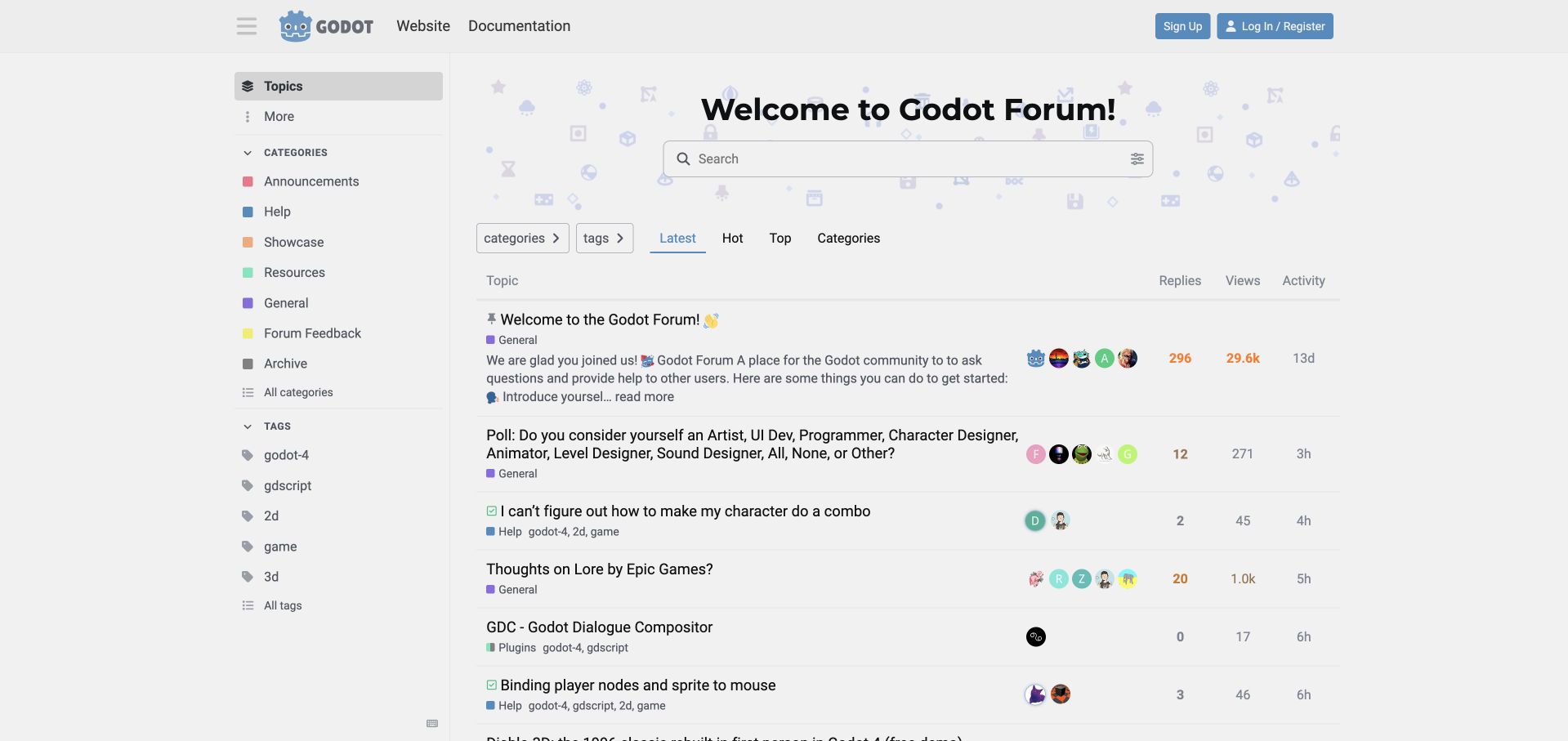
Godot's forum keeps its welcome short, with a search field above the main discussion table. A pinned introduction explains the community's purpose, while category colors and tags add context to individual topics. The persistent sidebar separates help, showcases, resources and general discussion without competing with the content column. The restrained interface expects reading to lead toward participation. The Ruby connection is a documented dependency of the site's evidenced Discourse platform through Rails. It is not an attribution to the Godot engine or to games created with it.
What you can learn
Keep the default view useful before personalization or login. In a Ruby application, public reading, member posting and staff moderation may require different rules, but the page should make the first useful action obvious. A concise pinned introduction can support those rules without dominating every visit.
Pros
A brief welcome leaves most of the screen available for actual community topics.
Category labels and tags help readers distinguish support questions from other conversations.
Cons & considerations
A mixed latest feed can make narrowly focused technical questions harder to locate.
Several tags may require prior knowledge of engine terminology before they become useful filters.
Platform source: Official Discourse architecture and Rails language dependency. Godot Forum has retained exact-page Discourse evidence dated 2026-11-07. Ruby is an associated dependency of Discourse's documented Rails backend, not independently observed on this live server. The language, framework and browser frontend remain separate; this is not a Ruby version claim or an attribution to the organization's other websites or products. Platform evidence is separate from the direct website screenshot and is not a complete current infrastructure audit.
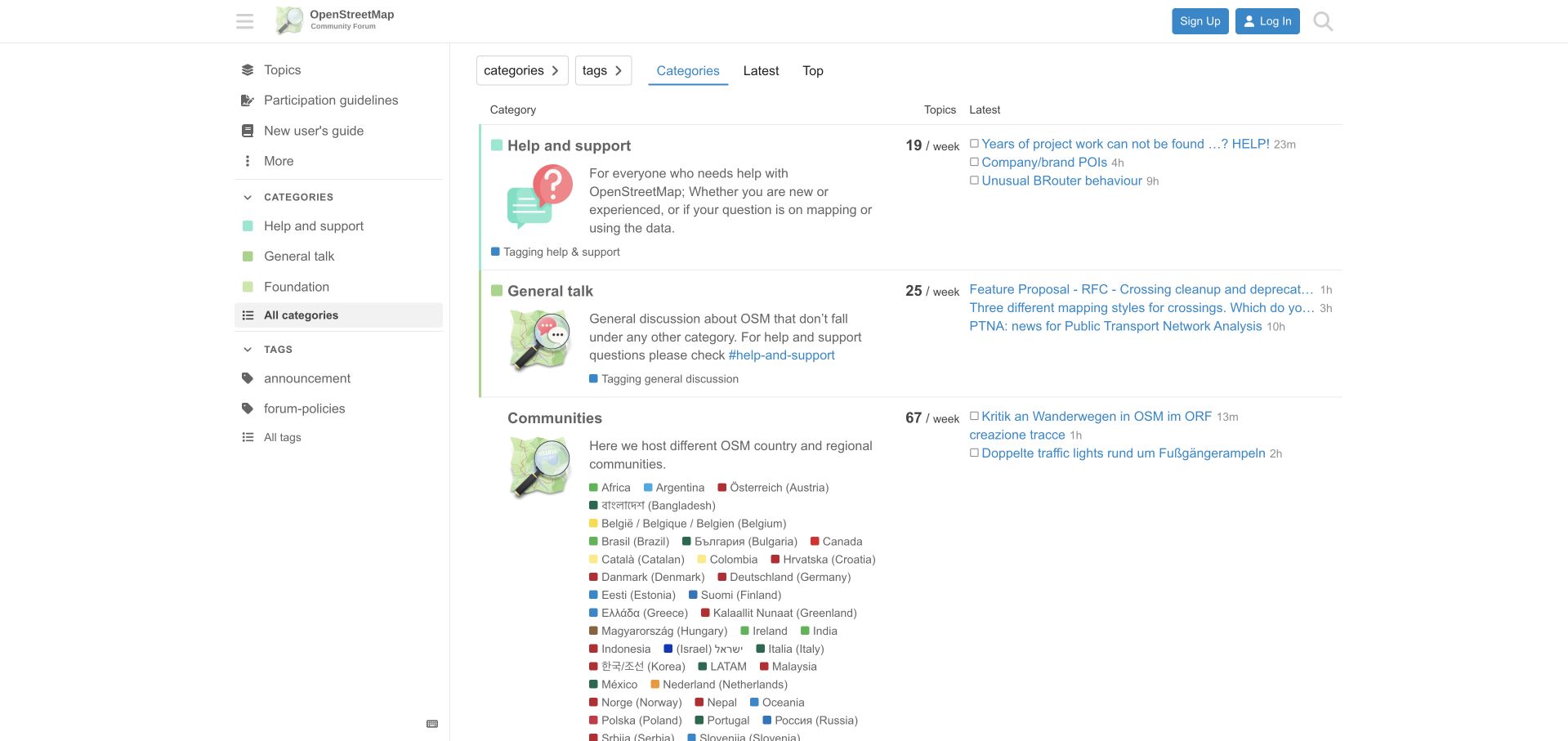
OpenStreetMap's community forum gives category descriptions substantial room beside recent topics. Help, general discussion and regional communities are explained in plain language rather than presented as unexplained labels. The regional section lists many countries and languages, making the scope of participation visible within the main column. A sidebar keeps guidelines and new-user support close by. This exact forum has a retained Discourse association, which supports Ruby only as a dependency through the documented Rails backend. It does not establish the architecture of the mapping service, editing tools or every OpenStreetMap property.
What you can learn
Design the application around how contributors organize themselves. A Ruby community project should account for local terminology, language routes and shared rules from the start. A single global feed is not always enough; meaningful groupings can help people find context without fragmenting every conversation into isolation.
Pros
Category descriptions explain where a discussion belongs before a user opens it.
Regional and language links acknowledge the community's international structure directly.
Cons & considerations
The long regional list adds considerable density to the initial category view.
Some recent-topic text is truncated, limiting context before a reader opens the conversation.
Platform source: Official Discourse architecture and Rails language dependency. OpenStreetMap Community Forum has retained exact-page Discourse evidence dated 2026-11-07. Ruby is an associated dependency of Discourse's documented Rails backend, not independently observed on this live server. The language, framework and browser frontend remain separate; this is not a Ruby version claim or an attribution to the organization's other websites or products. Platform evidence is separate from the direct website screenshot and is not a complete current infrastructure audit.
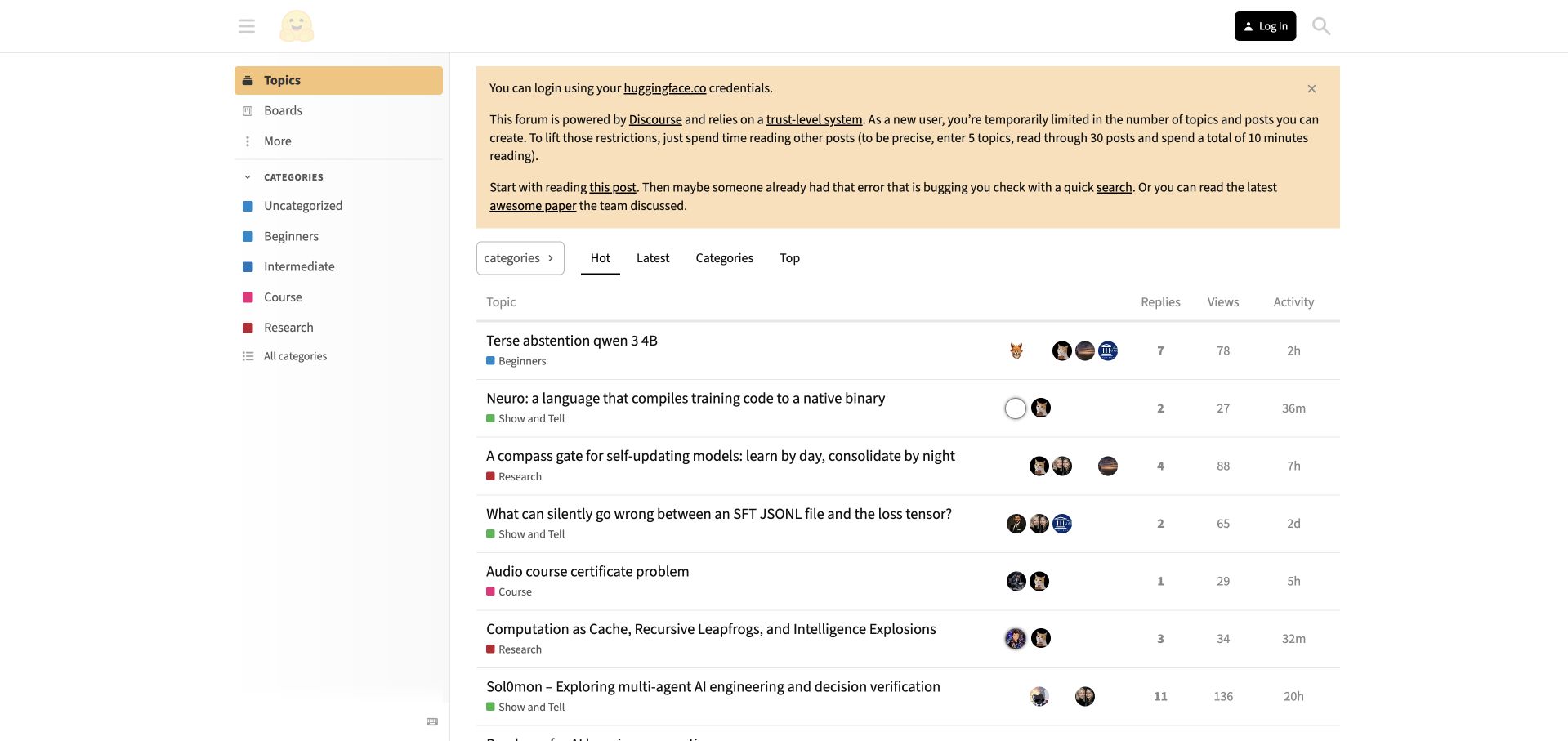
Hugging Face's forum opens with an inline orientation panel explaining account access and limits for new participants. It encourages reading existing discussions before posting, then leads into the topic table and its category controls. The sidebar separates levels and subject areas, including beginners, courses and research. This makes community expectations part of the interface rather than an obscure policy destination. Ruby is a derived dependency of the retained Discourse community association through Rails. The evidence does not identify the implementation of Hugging Face model hosting, repositories, training systems or its other public applications.
What you can learn
Explain participation constraints before they surprise someone during a write action. A Ruby application can have carefully designed permissions and still feel arbitrary if the interface hides their purpose. Put a short explanation near the task, then link to fuller guidance for readers who need it.
Pros
The orientation panel makes new-member expectations explicit before the posting journey begins.
Subject and experience-level categories give a technical audience several useful entry points.
Cons & considerations
The lengthy opening notice occupies space that returning visitors may prefer for discussions.
Trust-level details add concepts a newcomer must understand alongside the technical subject matter.
Platform source: Official Discourse architecture and Rails language dependency. Hugging Face Forums has retained exact-page Discourse evidence dated 2026-11-07. Ruby is an associated dependency of Discourse's documented Rails backend, not independently observed on this live server. The language, framework and browser frontend remain separate; this is not a Ruby version claim or an attribution to the organization's other websites or products. Platform evidence is separate from the direct website screenshot and is not a complete current infrastructure audit.
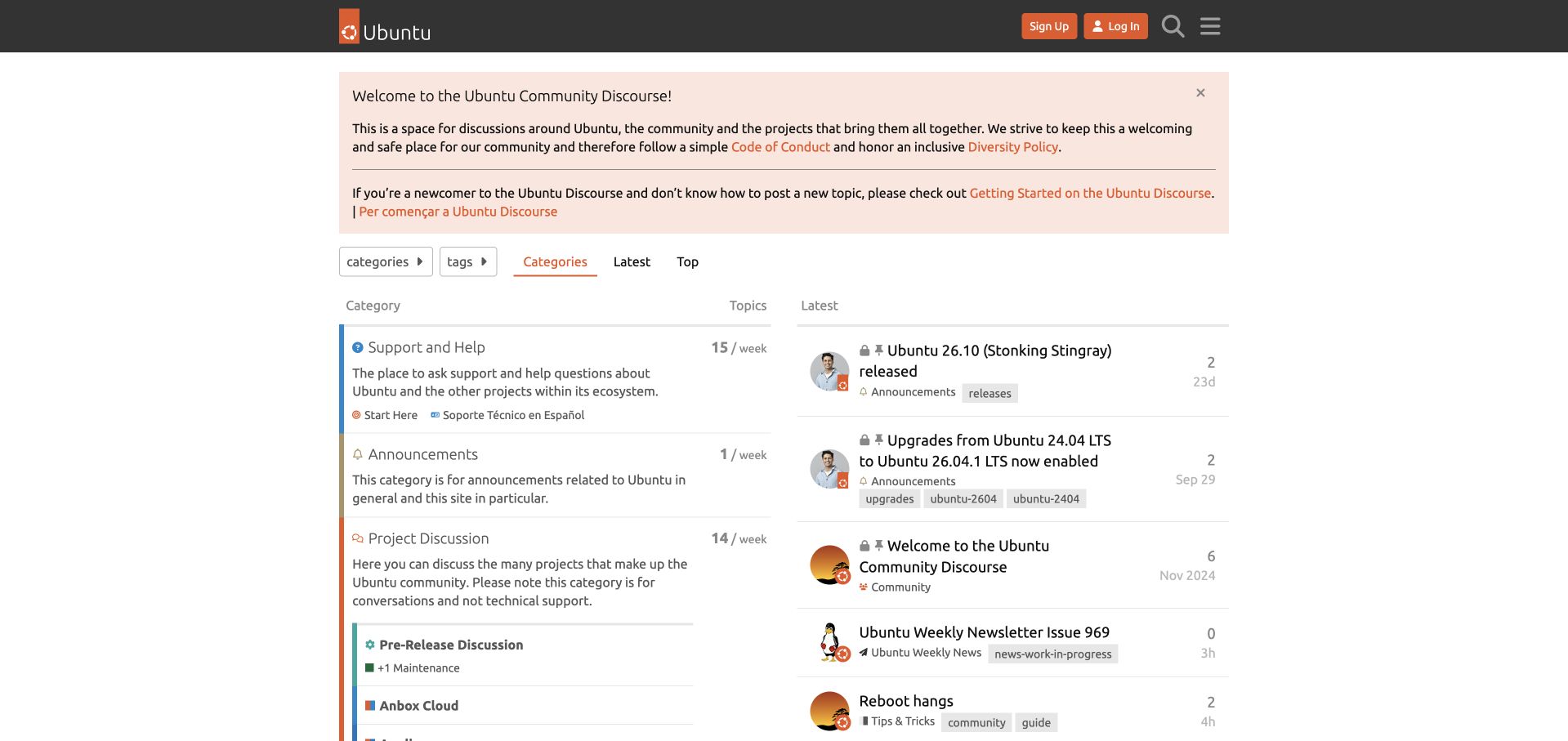
Ubuntu's community view begins with an inline welcome that explains the space and links to conduct and participation guidance. Categories occupy the left side of the main area, while recent topics appear on the right. Support, announcements and project discussion have distinct descriptions, helping readers avoid treating every post as a technical-support request. The captured notices and release names are historical content, not current upgrade recommendations. The exact community is evidenced as Discourse; its Rails architecture supports a qualified Ruby dependency, without making claims about Ubuntu's operating system or unrelated Canonical services.
What you can learn
Separate a community's social contract from its technical subject categories, but keep both discoverable. For a Ruby application, define which conversations are public, which require moderation and how newcomers get help. Clear text and navigation can make those rules understandable before the software has to enforce them.
Pros
Short category descriptions distinguish support from wider project and community discussion.
The two-column layout exposes both the structure and current activity of the forum.
Cons & considerations
The introductory notice delays access to discussion content on the first screen.
A chronological recent-topic list may not surface the most relevant answer for a specific problem.
Platform source: Official Discourse architecture and Rails language dependency. Ubuntu Community Discourse has retained exact-page Discourse evidence dated 2026-11-07. Ruby is an associated dependency of Discourse's documented Rails backend, not independently observed on this live server. The language, framework and browser frontend remain separate; this is not a Ruby version claim or an attribution to the organization's other websites or products. Platform evidence is separate from the direct website screenshot and is not a complete current infrastructure audit.
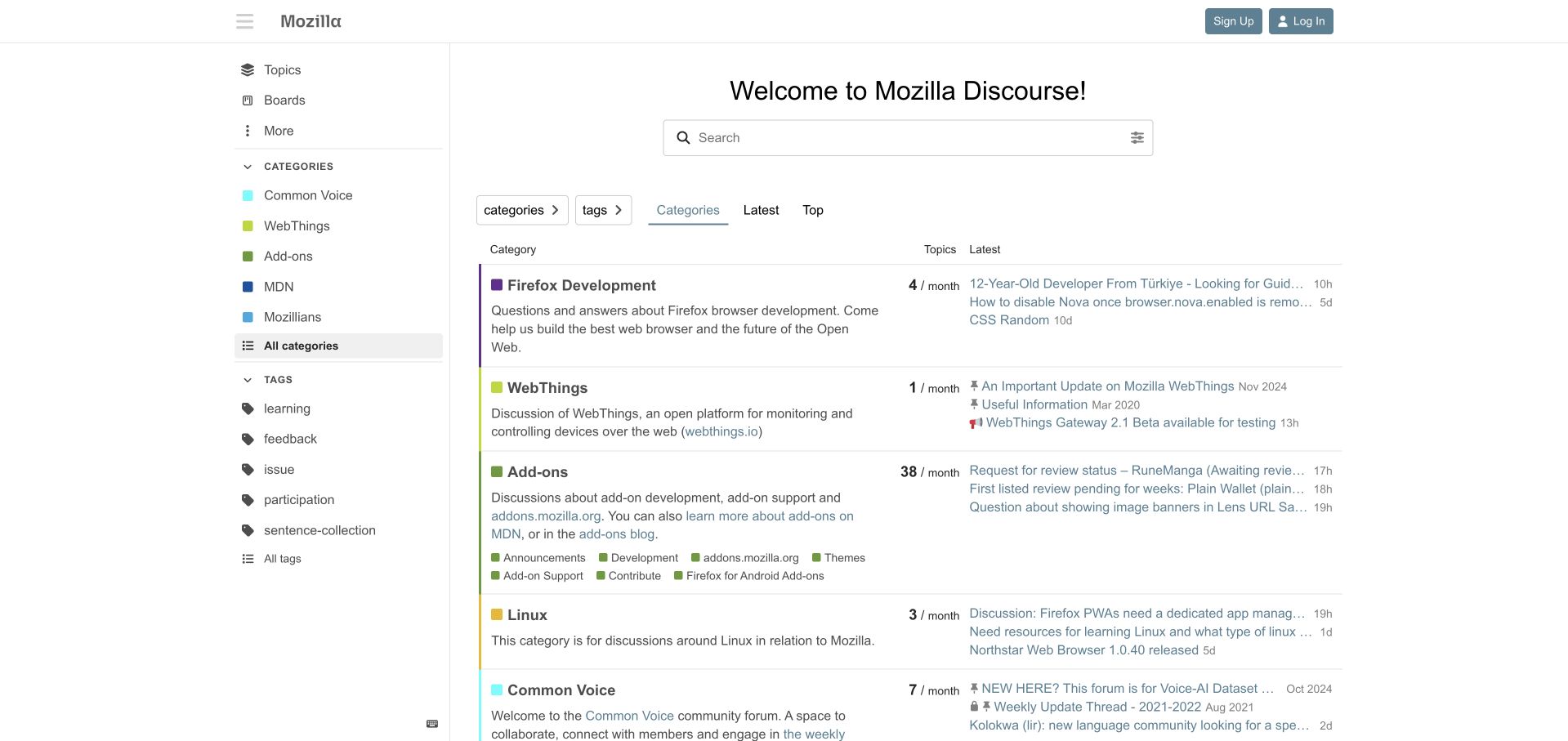
Mozilla's Discourse entrance combines a search field with category descriptions. Firefox development, WebThings and add-ons appear as areas, each with an explanation and recent discussion alongside it. The sidebar offers additional project routes and tags without turning the top of the page into a large promotional region. This is useful for a community whose members may know one project well and be unfamiliar with the rest. Ruby is associated with this exact Discourse property through its Rails dependency. The browser, add-on ecosystem and other Mozilla websites have separate implementation questions.
What you can learn
Treat category descriptions as interface content that deserves maintenance. In a Ruby community application, a stable database category can outlive the project or team it originally described. Review labels, introductions and archived areas so the navigation continues to explain the organization users encounter today.
Pros
Descriptive category text helps readers distinguish projects beyond their names and logos.
Search and project navigation remain visible without a large marketing interruption.
Cons & considerations
A broad project list can make the community feel fragmented to a first-time visitor.
Mixed activity dates require readers to judge whether an area is appropriate for a new question.
Platform source: Official Discourse architecture and Rails language dependency. Mozilla Discourse has retained exact-page Discourse evidence dated 2026-11-07. Ruby is an associated dependency of Discourse's documented Rails backend, not independently observed on this live server. The language, framework and browser frontend remain separate; this is not a Ruby version claim or an attribution to the organization's other websites or products. Platform evidence is separate from the direct website screenshot and is not a complete current infrastructure audit.
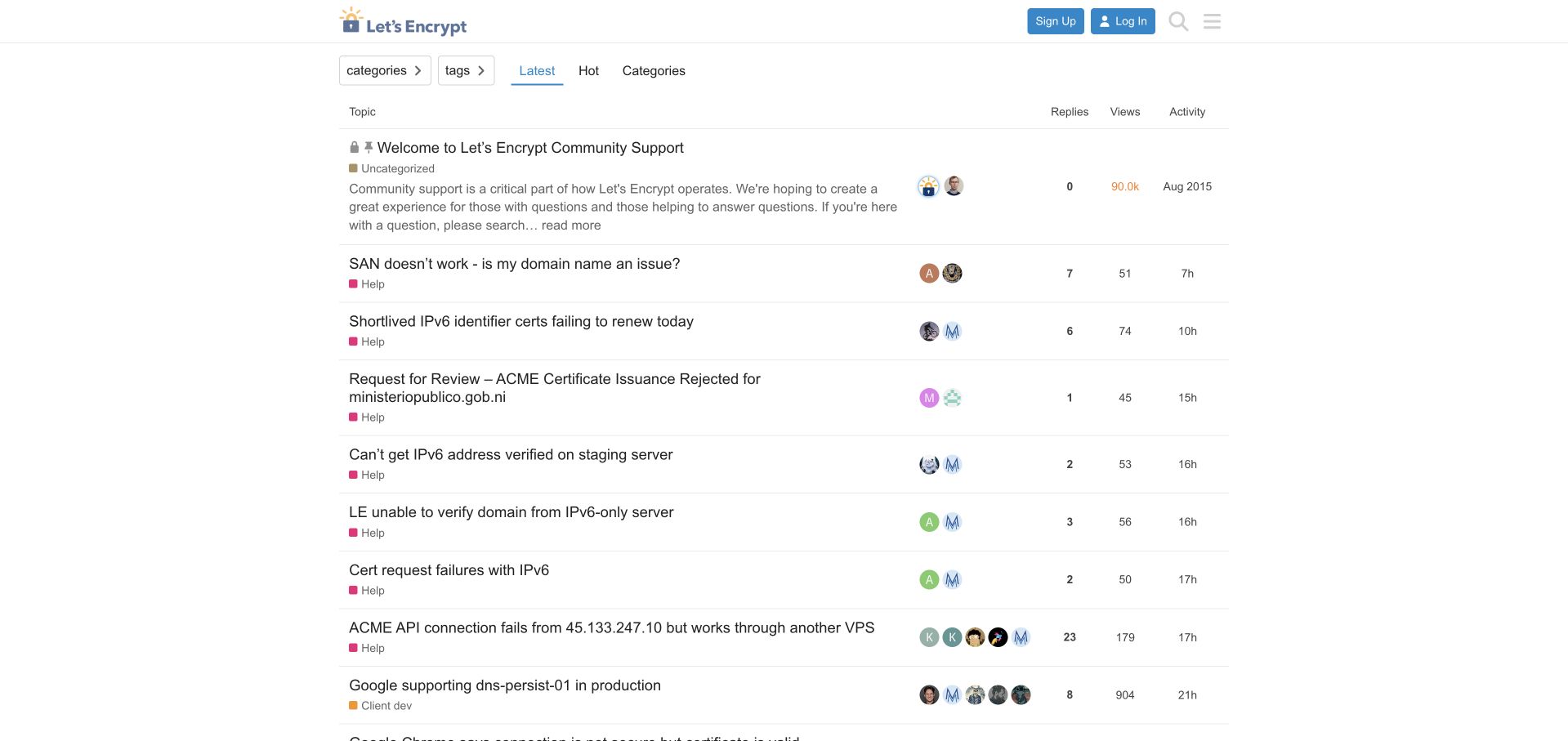
Let's Encrypt's support community gives the entire first view to a topic list. A pinned welcome introduces the community, while subsequent rows expose certificate and domain problems through titles. Reply counts, views and activity sit in narrow columns beside the questions, with small category labels supplying additional context. The page feels closer to an indexed support archive than a product campaign. Its Ruby association is derived from the retained Discourse evidence and documented Rails backend. It does not establish the certificate authority's issuance systems or independently verify any security property.
What you can learn
For a Ruby support application, the quality of the topic title is part of the data model's practical value. Encourage precise questions and preserve discoverable histories. Useful search and clear categorization depend on understandable contributions, not merely on choosing a capable framework or database.
Pros
The sparse layout prioritizes real support questions over decorative introductory content.
Descriptive titles and compact metadata make the list useful as an archive of recurring issues.
Cons & considerations
Specialist terminology can make the opening feed difficult for readers unfamiliar with certificates.
Activity and view counts do not establish whether a particular answer is correct or resolved.
Platform source: Official Discourse architecture and Rails language dependency. Let's Encrypt Community Support has retained exact-page Discourse evidence dated 2026-11-07. Ruby is an associated dependency of Discourse's documented Rails backend, not independently observed on this live server. The language, framework and browser frontend remain separate; this is not a Ruby version claim or an attribution to the organization's other websites or products. Platform evidence is separate from the direct website screenshot and is not a complete current infrastructure audit.
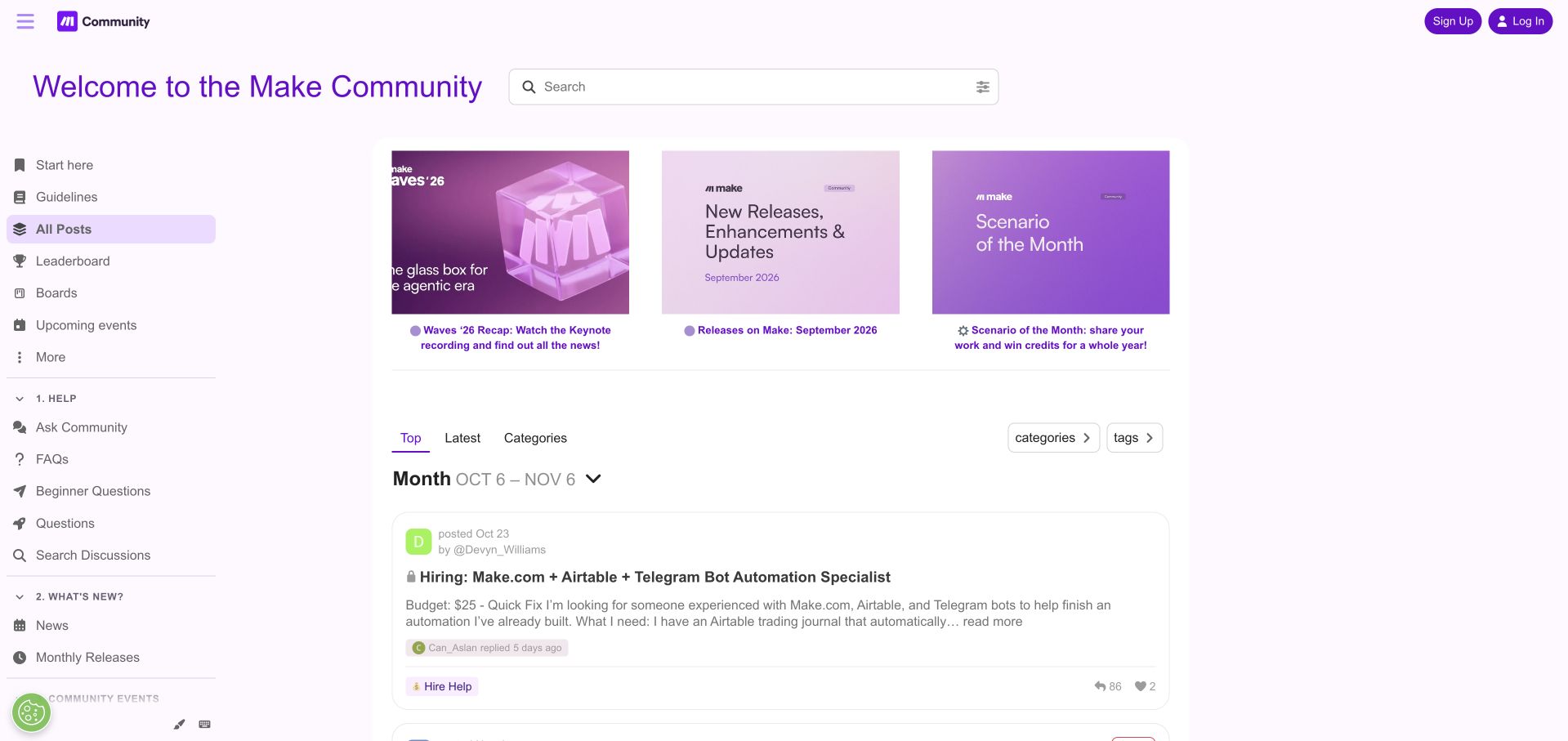
Make's community uses a purple visual system to connect featured update cards, navigation and discussion controls. The row highlights a keynote, release information and a recurring scenario feature, while the sidebar separates help from news and community events. A monthly topic view gives the lower section an editorial rhythm beyond a simple latest-post list. The retained screenshot shows the public community, including a small collapsed preference control rather than an open consent panel. Ruby is a qualified dependency through its documented Discourse and Rails relationship, not an attribution to Make's automation execution service.
What you can learn
Plan recurring editorial work as part of the application requirements. A Ruby community can support time-sensitive highlights, but someone must select, expire and replace them. Keep those modules separate from permanent help routes so the homepage remains understandable when a particular campaign or monthly feature changes.
Pros
Featured cards provide a deliberate route to updates and member-oriented community activities.
The sidebar distinguishes help resources from news and events using clear section headings.
Cons & considerations
The featured content delays the first discussion in the view.
A monthly popularity view can emphasize activity over the relevance of a specific support answer.
Platform source: Official Discourse architecture and Rails language dependency. Make Community has retained exact-page Discourse evidence dated 2026-11-07. Ruby is an associated dependency of Discourse's documented Rails backend, not independently observed on this live server. The language, framework and browser frontend remain separate; this is not a Ruby version claim or an attribution to the organization's other websites or products. Platform evidence is separate from the direct website screenshot and is not a complete current infrastructure audit.
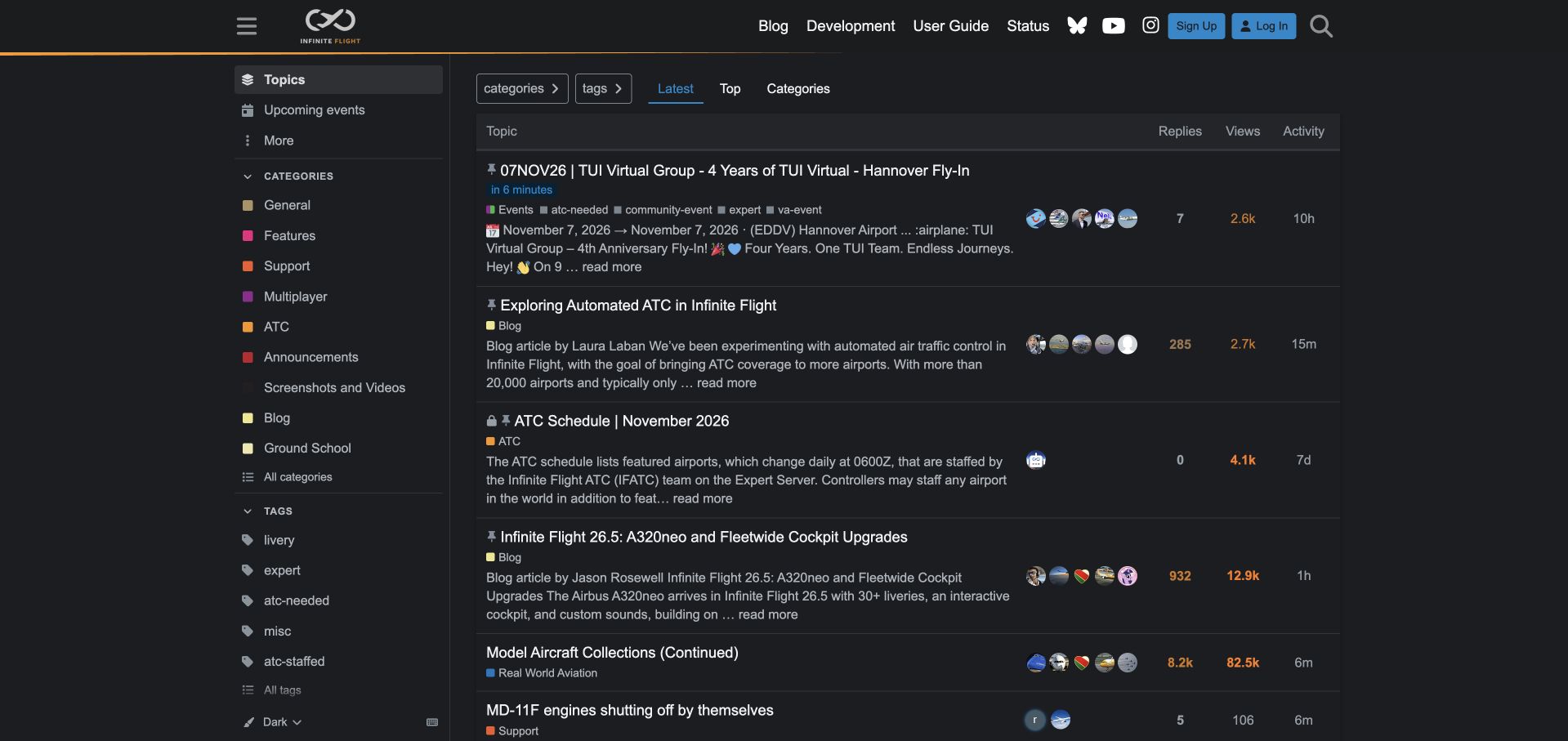
Infinite Flight's dark community interface places rich topic rows at the center of the page. Pinned events include dates and descriptions, while product announcements and member discussions share the same readable timeline. Category labels and a persistent sidebar distinguish support, multiplayer topics and other interests. The captured activity is useful design evidence, not a current schedule or participation recommendation. Ruby is associated with this exact Discourse community through its documented Rails backend. That dependency does not establish the flight simulator's implementation, multiplayer infrastructure or the behavior of any downloaded application.
What you can learn
Give time-sensitive content enough structure to be understood outside its title. A Ruby community application may need dates, categories and pinned states alongside ordinary discussion text. Plan how old event information is identified and archived so an active-looking page does not accidentally promote an expired activity.
Pros
Event descriptions and category labels provide context without requiring every topic to be opened.
The restrained dark palette keeps a dense discussion timeline visually consistent.
Cons & considerations
Pinned items compete with newer topics for space at the top of the list.
Event and product terminology can be difficult to interpret without existing community knowledge.
Platform source: Official Discourse architecture and Rails language dependency. Infinite Flight Community has retained exact-page Discourse evidence dated 2026-11-07. Ruby is an associated dependency of Discourse's documented Rails backend, not independently observed on this live server. The language, framework and browser frontend remain separate; this is not a Ruby version claim or an attribution to the organization's other websites or products. Platform evidence is separate from the direct website screenshot and is not a complete current infrastructure audit.
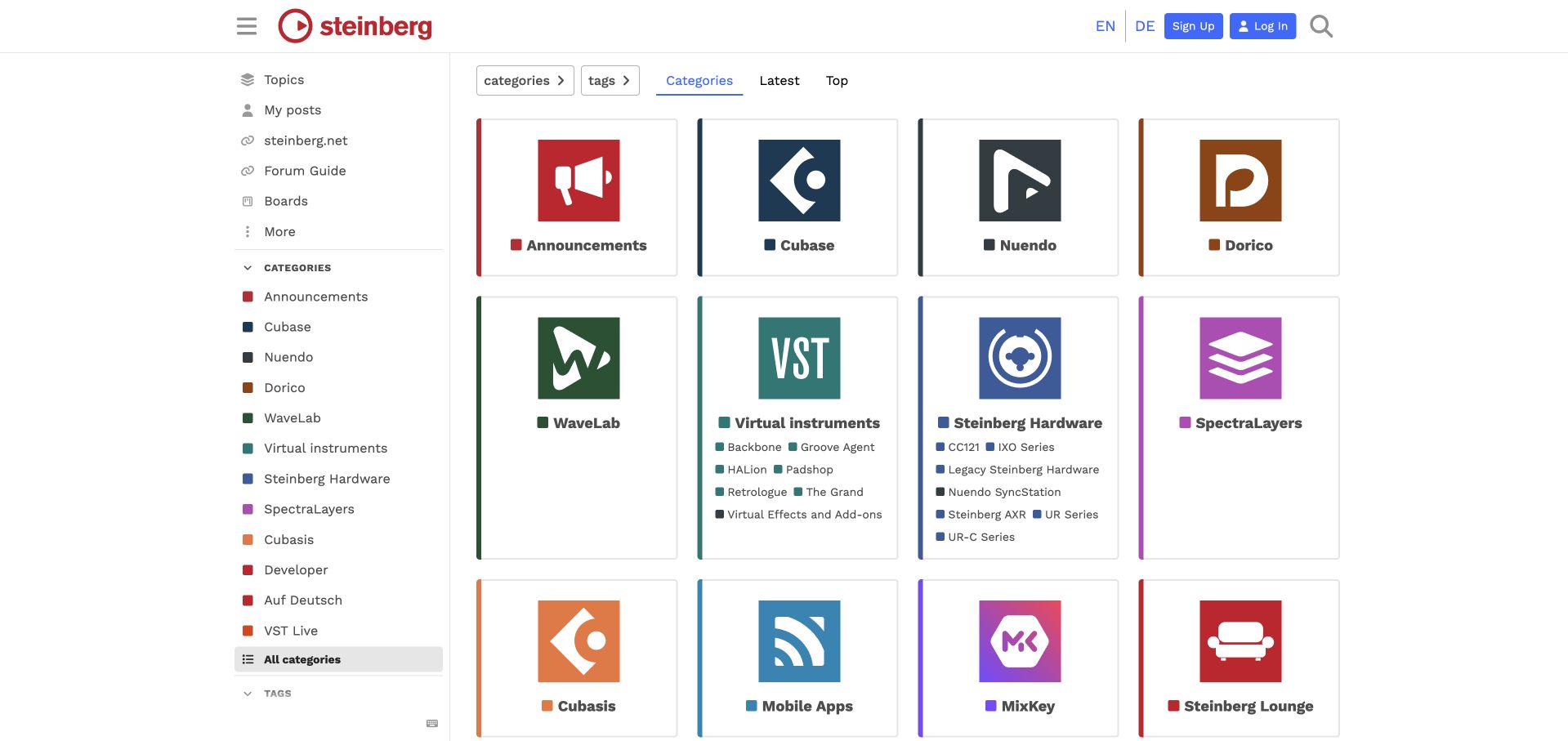
Steinberg's forum uses large product tiles instead of opening with an undifferentiated discussion stream. Cubase, Nuendo, Dorico and other destinations have their own color and mark, while related subcategories appear within the relevant panels. A conventional sidebar remains available for readers who prefer a text route. This composition treats product recognition as an information-architecture aid rather than merely decoration. The reviewed forum has retained Discourse evidence, supporting Ruby as a documented Rails dependency. It does not reveal how Steinberg's music applications, hardware or commerce properties are implemented, nor does it measure support quality.
What you can learn
When a Ruby application serves several product audiences, reflect that structure in navigation and permissions without making every area feel like a separate site. Pair recognizable imagery with clear text labels, and define who maintains each category as products and support responsibilities change.
Pros
Distinct product tiles let experienced users identify their destination without reading every topic.
Subcategory links expose related hardware and instrument areas inside the appropriate panel.
Cons & considerations
Logo-led navigation is less helpful for visitors who do not yet recognize the product names.
Large tiles trade immediate discussion visibility for a stronger category overview.
Platform source: Official Discourse architecture and Rails language dependency. Steinberg Forums has retained exact-page Discourse evidence dated 2026-11-07. Ruby is an associated dependency of Discourse's documented Rails backend, not independently observed on this live server. The language, framework and browser frontend remain separate; this is not a Ruby version claim or an attribution to the organization's other websites or products. Platform evidence is separate from the direct website screenshot and is not a complete current infrastructure audit.
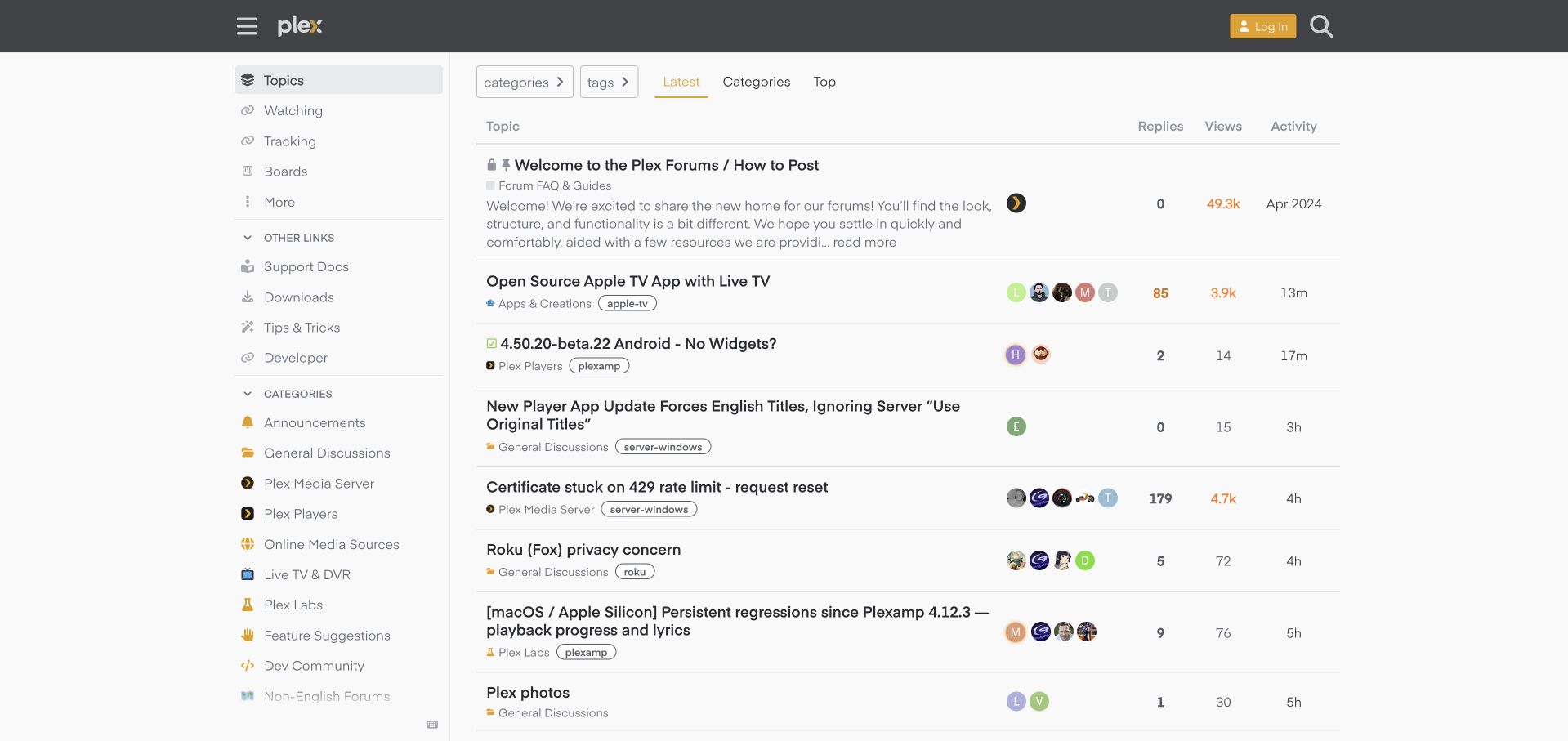
Plex's forum places a pinned orientation message above a tightly structured topic table. The sidebar keeps support documents, downloads, tips and product categories separate from the chronological discussion feed. Individual rows include device or feature tags, giving otherwise broad titles more context. This arrangement recognizes that visitors may need documentation, software or another person's experience rather than the same kind of answer every time. The exact forum is associated with Discourse and, through its documented Rails backend, Ruby. The evidence does not identify Plex's streaming infrastructure or the implementation of its media applications.
What you can learn
Keep different kinds of support destination visibly distinct. In a Ruby-backed community, a question, a download and an official document may be connected but have different ownership and update cycles. Navigation should help users understand those differences instead of treating every problem as a reason to post.
Pros
Support resources remain available while the reader scans current community questions.
Device and feature tags add useful context to concise topic titles.
Cons & considerations
The large category list requires product familiarity to choose the most relevant destination.
A latest-topic feed can mix general discussion with urgent-looking reports without indicating resolution.
Platform source: Official Discourse architecture and Rails language dependency. Plex Forums has retained exact-page Discourse evidence dated 2026-11-07. Ruby is an associated dependency of Discourse's documented Rails backend, not independently observed on this live server. The language, framework and browser frontend remain separate; this is not a Ruby version claim or an attribution to the organization's other websites or products. Platform evidence is separate from the direct website screenshot and is not a complete current infrastructure audit.
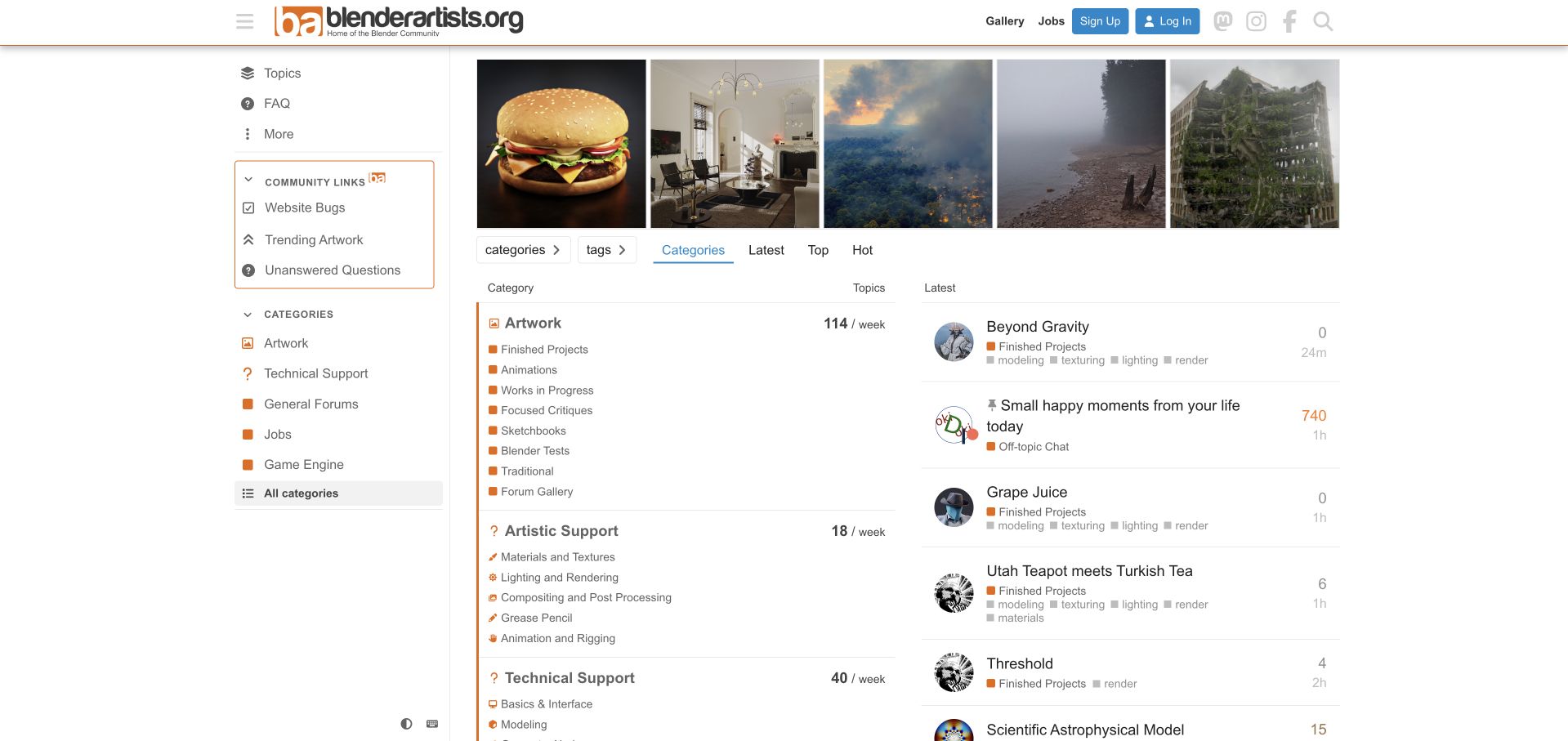
Blender Artists opens with a horizontal strip of member imagery before moving into category descriptions and recent discussions. The images establish the community's creative purpose, while the navigation distinguishes finished work, ongoing projects, critique and technical support. An additional sidebar points to unanswered questions and other useful community routes. The result gives the discussion software a clear subject identity without abandoning familiar forum structure. Ruby is an associated dependency of this Discourse community through Rails. It is not a claim about the Blender desktop application's code, image-rendering engine or every linked artist portfolio.
What you can learn
Make the content people produce visible, then give it an understandable place to live. A Ruby community application needs more than uploads: it needs distinctions between sharing, requesting critique and troubleshooting. Those intentions affect labels, moderation expectations and how a reader interprets the discussion below an image.
Pros
The gallery strip communicates the community's creative focus before the reader reaches a menu.
Category descriptions distinguish completed work from feedback requests and technical questions.
Cons & considerations
Visual highlights can attract attention away from important support topics.
Several overlapping creative categories may require newcomers to read the posting guidance carefully.
Platform source: Official Discourse architecture and Rails language dependency. Blender Artists has retained exact-page Discourse evidence dated 2026-11-07. Ruby is an associated dependency of Discourse's documented Rails backend, not independently observed on this live server. The language, framework and browser frontend remain separate; this is not a Ruby version claim or an attribution to the organization's other websites or products. Platform evidence is separate from the direct website screenshot and is not a complete current infrastructure audit.
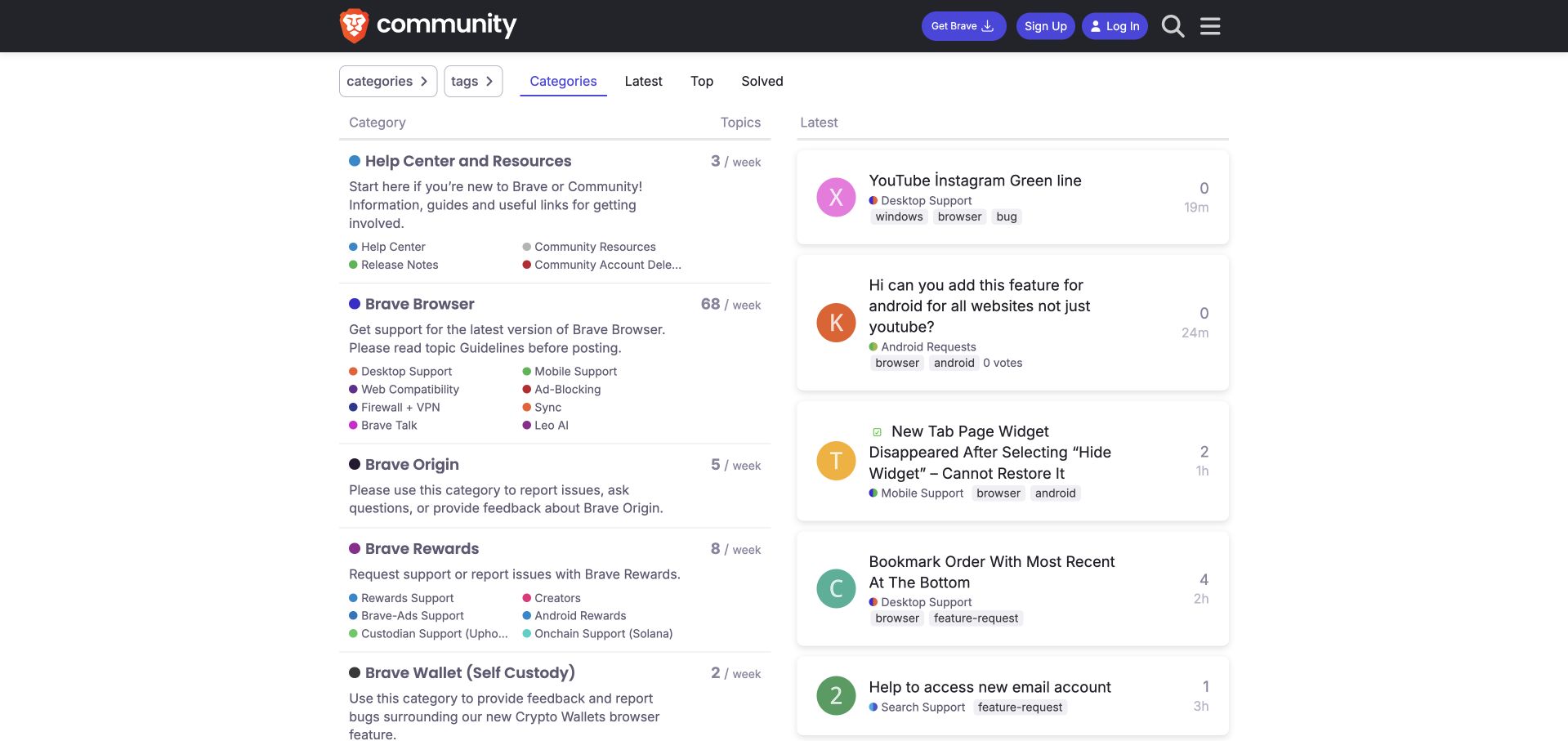
Brave's community combines category blocks with a column of recent discussion cards. Browser support is divided into recognizable areas, while category explanations tell readers what belongs in the section. The card treatment gives recent questions more separation than a tightly ruled table, and the top navigation offers both categories and a solved view. This exact community has a retained Discourse association. Ruby follows as a qualified dependency through the platform's Rails backend; it does not identify the browser application's language, advertising systems or the infrastructure of other Brave products.
What you can learn
Use layout to distinguish the structure of a community from its immediate activity. For a Ruby application, category information and topic status should be understandable together. If a solved route exists, define its editorial meaning clearly rather than allowing it to imply that every displayed answer is authoritative.
Pros
Separate discussion cards improve visual distinction between recent questions in the right column.
Category descriptions and a solved route offer alternatives to browsing purely by recency.
Cons & considerations
The split view presents several competing paths before a newcomer chooses one.
Product and platform subdivisions can require careful reading to avoid posting in an adjacent category.
Platform source: Official Discourse architecture and Rails language dependency. Brave Community has retained exact-page Discourse evidence dated 2026-11-07. Ruby is an associated dependency of Discourse's documented Rails backend, not independently observed on this live server. The language, framework and browser frontend remain separate; this is not a Ruby version claim or an attribution to the organization's other websites or products. Platform evidence is separate from the direct website screenshot and is not a complete current infrastructure audit.
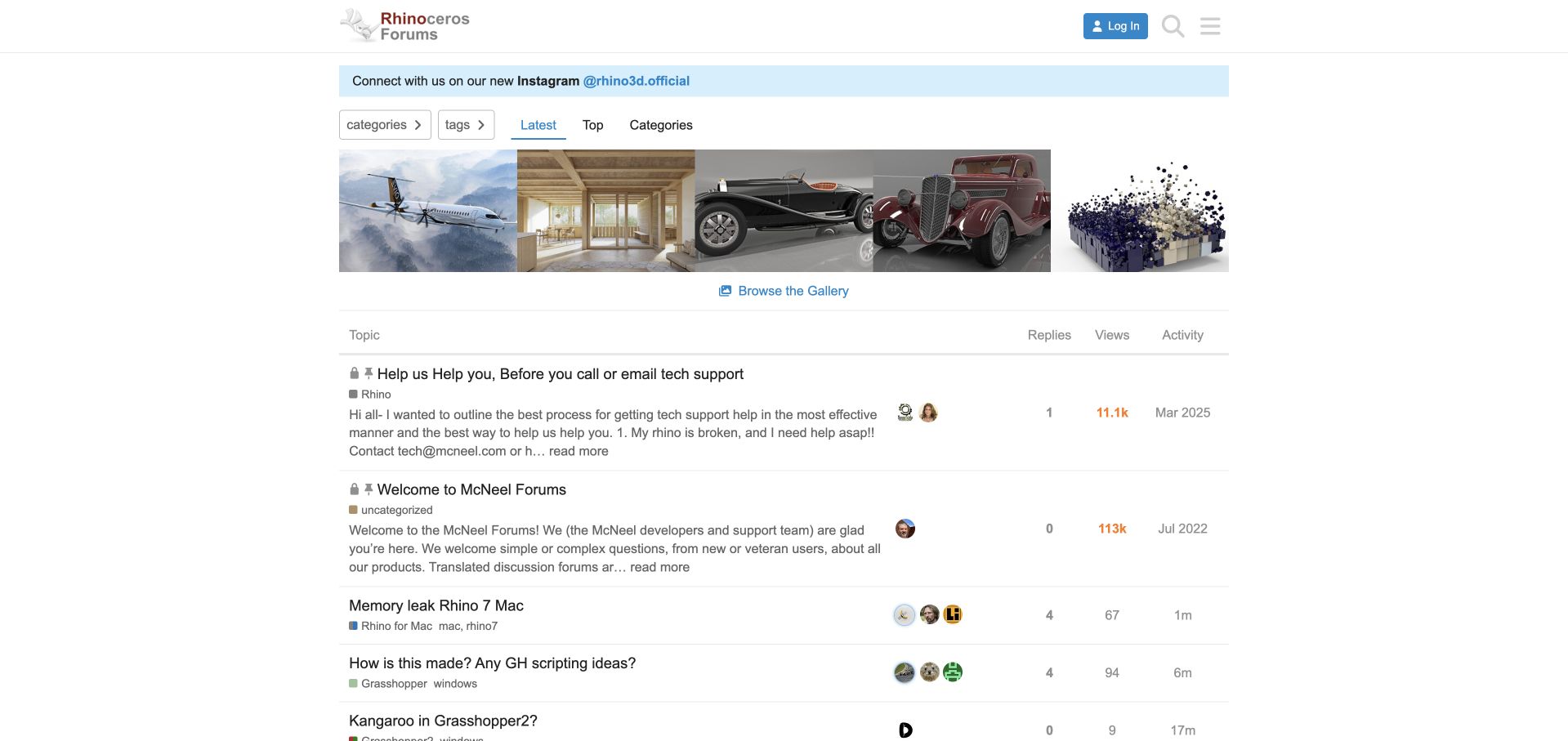
McNeel's Rhino forum introduces the community with a gallery strip of varied design work. A gallery link then gives way to pinned support guidance and the latest technical discussions. The visible first topic asks people to help the support process, placing expectations where a new question might begin. This balance connects aspirational output with the less glamorous work of diagnosing a problem. The Ruby relationship is derived from this exact forum's evidenced Discourse platform and its documented Rails dependency. It does not describe the Rhino application's implementation or the software behind the pictured projects.
What you can learn
Place guidance for a useful contribution near the point where someone decides to ask. A Ruby support application can validate fields, but a good explanation of context, reproduction steps and expectations often does more for the eventual conversation than an elaborate interface alone.
Pros
The project gallery demonstrates the community's subject without replacing the discussion list.
Pinned guidance makes the process of requesting useful technical help visible early.
Cons & considerations
The gallery and inline social notice delay the first full technical discussion in the view.
Specialist product terms in topic titles assume a degree of experience with the software.
Platform source: Official Discourse architecture and Rails language dependency. McNeel Rhino Forums has retained exact-page Discourse evidence dated 2026-11-07. Ruby is an associated dependency of Discourse's documented Rails backend, not independently observed on this live server. The language, framework and browser frontend remain separate; this is not a Ruby version claim or an attribution to the organization's other websites or products. Platform evidence is separate from the direct website screenshot and is not a complete current infrastructure audit.
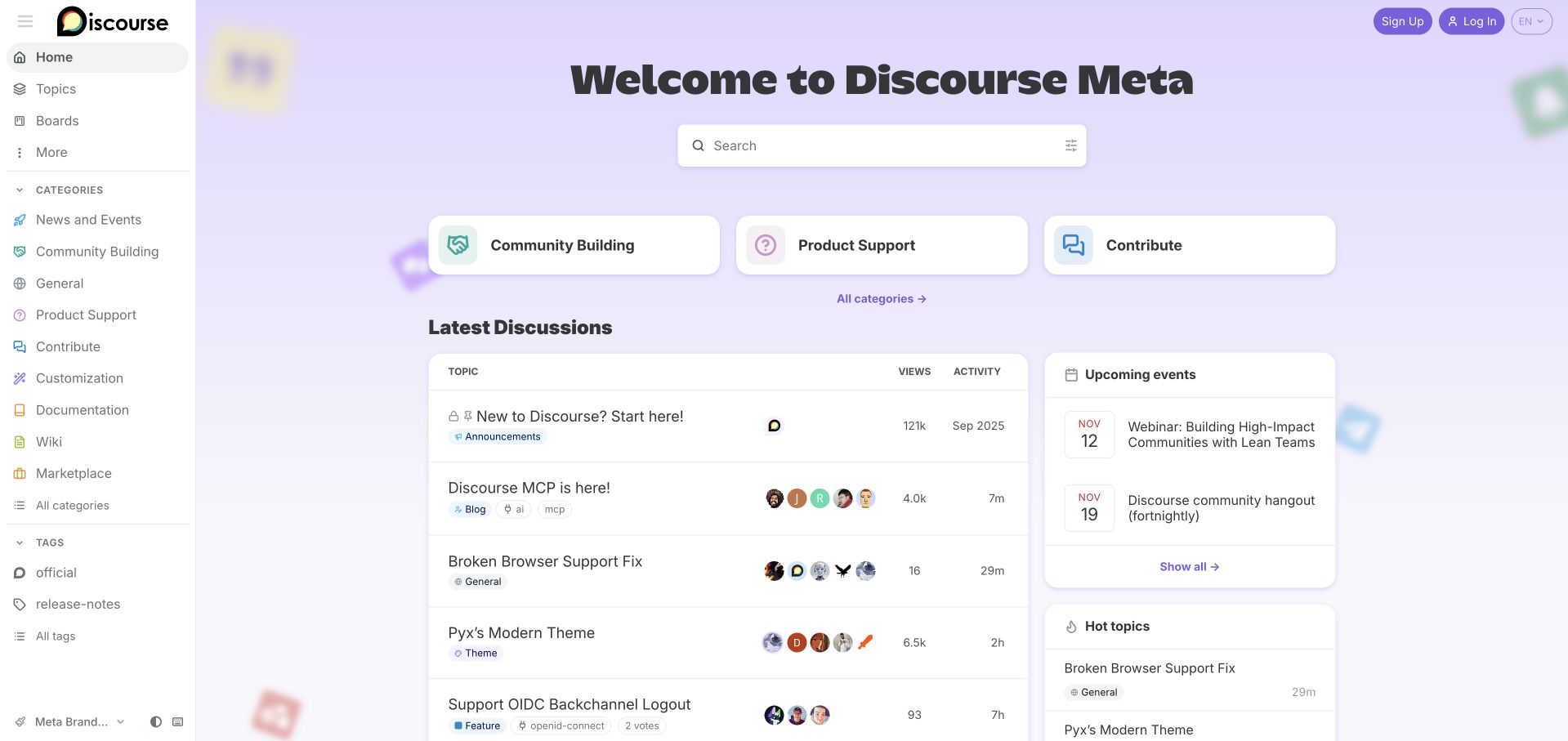
Discourse Meta presents three entry cards beneath a welcome and search region: community building, product support and contribution. Below, a latest-discussion table sits beside an events panel, giving the page operational and participatory roles. The lavender visual system differs from many other communities in this collection while retaining recognizable discussion structures. The official Discourse repository identifies Meta as its support community and documents the Rails backend. Ruby is therefore a qualified platform dependency, not an independently measured runtime version or a claim that the browser frontend is written in Ruby.
What you can learn
Use the application's own community to demonstrate clear audience separation. A Ruby platform project may serve administrators, end users and contributors with different needs. Shared navigation can keep those groups connected while giving each a starting route that matches the work they came to do.
Pros
Three intention-based cards give newcomers a concise choice before the detailed discussion list.
The events panel adds a participation route alongside asynchronous support and conversation.
Cons & considerations
The large welcome area reduces how many complete discussions fit in the first view.
Several audiences share the latest feed, so specific technical work still requires category filtering.
Platform source: Official Discourse architecture and Rails language dependency. Discourse Meta has retained exact-page Discourse evidence dated 2026-11-09. Ruby is an associated dependency of Discourse's documented Rails backend, not independently observed on this live server. The language, framework and browser frontend remain separate; this is not a Ruby version claim or an attribution to the organization's other websites or products. Platform evidence is separate from the direct website screenshot and is not a complete current infrastructure audit.
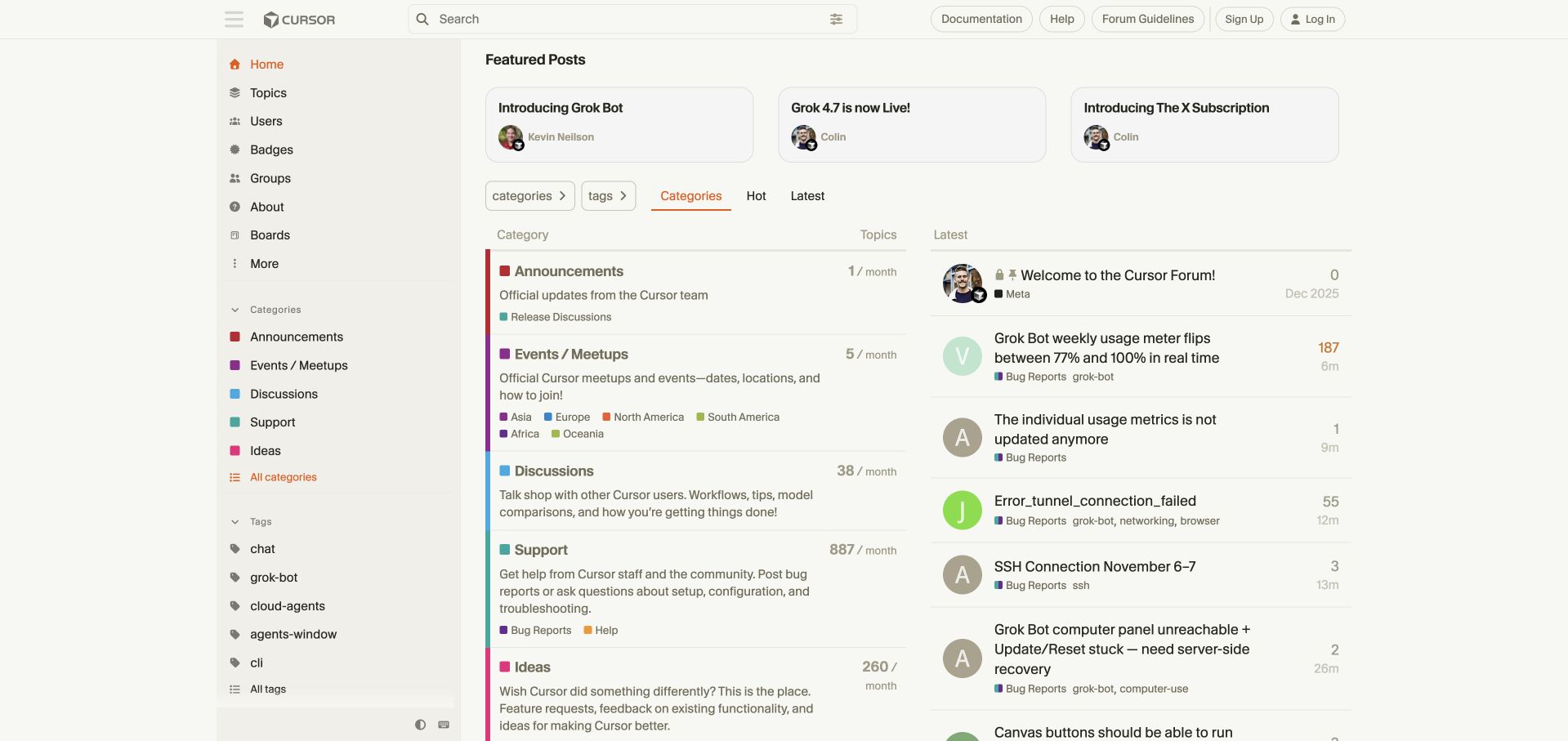
Cursor's forum places featured-post cards above a two-column category and latest-topic area. The sidebar keeps community navigation persistent, while the top bar separates documentation, help and forum guidance. Category descriptions explain announcements, meetups, discussions, support and ideas in terms of the contribution each area expects. The dated featured content is part of the captured interface, not a current product announcement. The retained exact-page evidence identifies Discourse; its documented Rails backend provides the qualified Ruby dependency. This says nothing about the implementation of Cursor's editor, models, agent tools or other private application services.
What you can learn
Keep release communication, troubleshooting and feature ideas distinct even when they share one Ruby-backed community. Clear category descriptions can reduce misdirected posts, while a small featured region gives announcements a predictable home. Review that region regularly so old promotions do not crowd out ongoing member needs.
Pros
Brief category descriptions explain the difference between support, discussion and product ideas.
Documentation and forum guidance remain accessible above the community's own navigation.
Cons & considerations
Featured announcements can distract from the support task that brought a visitor to the forum.
The mixed latest-topic column requires additional filtering for readers focused on a single problem.
Platform source: Official Discourse architecture and Rails language dependency. Cursor Forum has retained exact-page Discourse evidence dated 2026-11-07. Ruby is an associated dependency of Discourse's documented Rails backend, not independently observed on this live server. The language, framework and browser frontend remain separate; this is not a Ruby version claim or an attribution to the organization's other websites or products. Platform evidence is separate from the direct website screenshot and is not a complete current infrastructure audit.
Kegan has 15+ years of experience working with small businesses, Fortune 500 companies, and everything in between. No development job is too big or too small: he brings the same hands-on attention to a focused improvement, a complete website, or a custom application.
For Ruby projects, he can help with responsive interfaces, reusable components, custom functionality, API connections, and performance-minded implementation. He works directly with clients on scope, design, implementation, testing, and handover, with an emphasis on clear communication and a system that remains practical to maintain after launch.
Show 3 other Ruby developersHide other Ruby developers
Choose the application approach before the language label
Use an established community application
When the main job is public discussion, support and moderation, evaluate a community product's existing behavior before commissioning every feature from scratch. Discourse documents a Rails backend with a separate Ember frontend. That architecture is useful context, while the practical choice still depends on moderation, migration, hosting and the team's ability to maintain its chosen setup.
A custom workflow may need records and actions that do not fit a standard forum. Begin with a small useful path and model its data carefully before expanding the interface. Rails provides a structured route from models to requests and views; use that foundation to express the actual task instead of recreating a familiar product solely because its screenshots look appealing.
Keep background work separate from the immediate interaction
Notifications, scheduled processing and other lengthy tasks may need a queue rather than a long-running page request. Rails' Active Job interface describes background execution and failed-job handling. Specify what the visitor sees when work is pending or fails, and who investigates it. This is a planning option for a new application, not a claim about which queue any pictured community uses.
Plan the records, contribution paths and operating responsibilities
Start with one realistic contribution journey
Describe how a newcomer finds existing information, chooses a category, prepares a useful contribution and understands what happens next. Include the staff member who reviews or corrects it. Test those decisions with representative content before adding many categories or customization options. The interface should reflect the community's work, not an internal organization chart.
Define access boundaries before building administration
List the actions available to visitors, members, moderators and administrators. Check each action against the actual content owner and context, including attachments and private material. Use the framework's security guidance as implementation support, while treating the application's permission rules as explicit requirements that need testing.
Budget for language, framework and dependency updates
Record the supported runtime and framework versions for your own project, then plan how changes will be tested and released. The Rails upgrade guide separates Ruby-version considerations, test coverage and the upgrade process. Keep application tests and a recovery procedure ready before a change, rather than discovering compatibility work during an urgent production update.
Assign ownership to delayed work and editorial modules
Decide who maintains featured posts, event notices, archived categories and background notifications. Specify how failed jobs are surfaced and which work can safely be repeated. Active Job's monitoring and error-handling guidance is a useful starting point for a custom Rails application, but the team's own delivery rules and operating procedures still need to be written down.
Ask the actual team to carry out its routine job: publish a realistic update, correct a mistake, preview a narrow screen, and identify who owns an integration failure. For a library or frontend framework, also ask who maintains the content source and deployment. A polished screenshot does not answer those operational questions.
Beyond the screenshot
A Ruby application planning checklist
Identify the exact application and public property the project concerns.
Distinguish Ruby, its framework and any packaged product in the technical brief.
Define the main records, relationships and permitted actions.
Make reading and searching useful before requesting participation.
Explain category purpose and contribution expectations near the relevant action.
Separate public, member, moderator and administrator capabilities.
Review uploads, untrusted text and private information against those boundaries.
Specify pending, failed and completed states for delayed work.
Name the owner of notifications, featured content and old event notices.
Test essential user and staff workflows with representative data.
Plan dependency upgrades, backups and a practiced recovery procedure.
Check navigation and controls with a keyboard and at narrow screen widths.
Test with real content, a keyboard, a small screen, slow or failed requests, and the people who will maintain the system. These are planning checks, not an accessibility, security, performance, or search-ranking certification.
Sources & editorial method
How this Ruby collection was reviewed
The November 11, 2026 editorial review examined the exact retained community screenshots and their original Discourse evidence, then checked official Discourse and Rails documentation for the Ruby dependency. Original captures remain dated November 7 or November 9, and prior broad-audit outcomes and observation dates remain unchanged. Ruby is presented as an associated application dependency, not an independently observed live language version or a claim about any organization's other websites and products. The comparison focuses on visible navigation, contribution guidance and content organization. It does not measure support quality, security, performance or community outcomes.
Every image is an unmodified capture from the actual website, with its source and capture date. Some captures are reused from our shared catalog; their dates remain the original capture dates. None comes from a vendor gallery or a generated reconstruction. Moving imagery and live content can change.
Technology attribution uses public page assets or metadata, official platform documentation, or a cited first-party project case study. Documentary and framework-relationship evidence is identified where used; it is not a complete current backend inventory. A CMS image CDN alone does not establish a full CMS deployment. A library’s presence does not prove which individual controls use it, and a platform label does not establish AI authorship.
The composition notes, lessons, pros and tradeoffs are original editorial observations. We have not measured conversion, traffic, security, performance or accessibility conformance. Website owners retain their brands and imagery; these examples are not our client portfolio. Written, Edited and Curated are independent records, not dates advanced by a build. See our editorial standards or suggest a correction.
Questions worth asking
Ruby website development FAQs
Are Ruby and Ruby on Rails the same thing?
No. Ruby is a programming language. Rails is a web framework built for Ruby. Discourse is a particular application with a documented Rails backend. A site can have a relationship to these layers without the names being interchangeable.
Why does this Ruby collection show public forums?
The exact community properties have retained Discourse evidence, and official project documentation establishes the Rails and Ruby dependency. That provides a specific, qualified association. It does not attribute Ruby to the organizations' main websites or unrelated products.
Was Ruby detected directly on every live server?
No. The Ruby attribution is derived from the documented platform relationship. Public captures and earlier broad audits have their own recorded dates and limits. The review does not inspect private deployment configuration or determine a current Ruby version.
Does Ruby determine how these websites look?
No. Their visible layouts involve frontend software, themes, content and editorial choices. The examples share an application family while using different category structures, branding and homepage priorities. The language does not prescribe a particular visual treatment.
Should a new community use an existing product or a custom application?
Start with the work it must support. An established product may cover discussion and moderation needs, while an unusual workflow may justify custom development. Evaluate migration, permissions, staff tasks and maintenance responsibilities before deciding from appearance alone.
What belongs in a useful Ruby project brief?
Name the users, records, permissions, main contribution paths and operational owners. Include expected failure states, update responsibilities and recovery needs. Distinguish the chosen language and framework from the behavior the finished application must provide.
Borrow a clear category explanation, a helpful search prompt or a contribution path that makes sense. Then choose and maintain the application architecture that supports your own community's work.