Best Ember.js Websites of 2026 (20 Real-World Examples)
Twenty public community websites with Ember.js frontend associations through Discourse, genuine screenshots and carefully qualified design analysis.
A useful web application keeps people oriented as they search, filter, read and return. These twenty public communities illustrate that problem through varied Discourse interfaces. Discourse’s official project identifies Ember.js as its frontend framework; this collection treats Ember as a documented platform dependency, while preserving each forum’s original source observation and screenshot date.
The same underlying application can support a dense technical directory, a welcoming product community or a visual showcase. The useful lessons are in the decisions around information hierarchy, active views, navigation and participation. Start by deciding what a person needs to understand at each step, then make the interface communicate that state clearly. A recognizable brand or framework name does not remove the need to design those decisions deliberately.
The opening five are NVIDIA Developer Forums, Shopify Community, Asana Community, Epic’s Unreal Engine forum and Cloudflare Community. Every selected property is a public forum with retained direct Discourse evidence. These are not corporate homepage substitutions or claims about the brands’ main products. The original November 7 captures remain unchanged; the Ember relationship and new collection-specific reviews were assessed on November 10, 2026.
Before the examples
What makes good Ember.js website development in 2026?
Make the current view understandable
Search results, categories, recent activity and popular discussions are different views of the same information. Label the selected view clearly and preserve the context that explains what the visitor is seeing. Ember’s routing model connects destinations with application state, making route design part of the user experience. Plan direct arrival, reload and back navigation alongside the visible controls. A useful route should explain its destination even when someone arrives without passing through the homepage.
A topic row, category card and search field should behave consistently wherever they appear. Decide which information is essential, how long labels wrap and what happens when an image or value is missing. Ember’s component model provides a way to organize recurring interface elements, but the design responsibility remains with the team. Use realistic content to define the boundaries of each component, and avoid making a visually similar element behave differently without an understandable reason.
Separate local interaction from shared application responsibilities
Some information belongs to a single panel; other state must remain coherent across several parts of an application. Identify that difference before distributing behavior among components. Ember services can hold shared state and long-lived connections, but they should have a specific purpose and an explicit owner. Keep authorization and private-data decisions on the appropriate trusted boundary. The visible interface should explain a change without becoming the only source of truth about what the system accepted.
These twenty original reviews use unchanged November 7 public forum captures and their retained Discourse observations. The official Discourse project supplies the Ember frontend relationship. Broad audits retain their November 8 dates: nineteen checked and one unavailable. No new runtime scan or source capture is claimed for this collection.
We start with five recognizable brands or organizations: NVIDIA Developer Forums, Shopify Community, Asana Community, Epic Developer Community — Unreal Engine Forum, Cloudflare Community. Each attribution applies to the named website property, not every product or website belonging to its organization. This is a curated reading sequence, not a measured ranking.
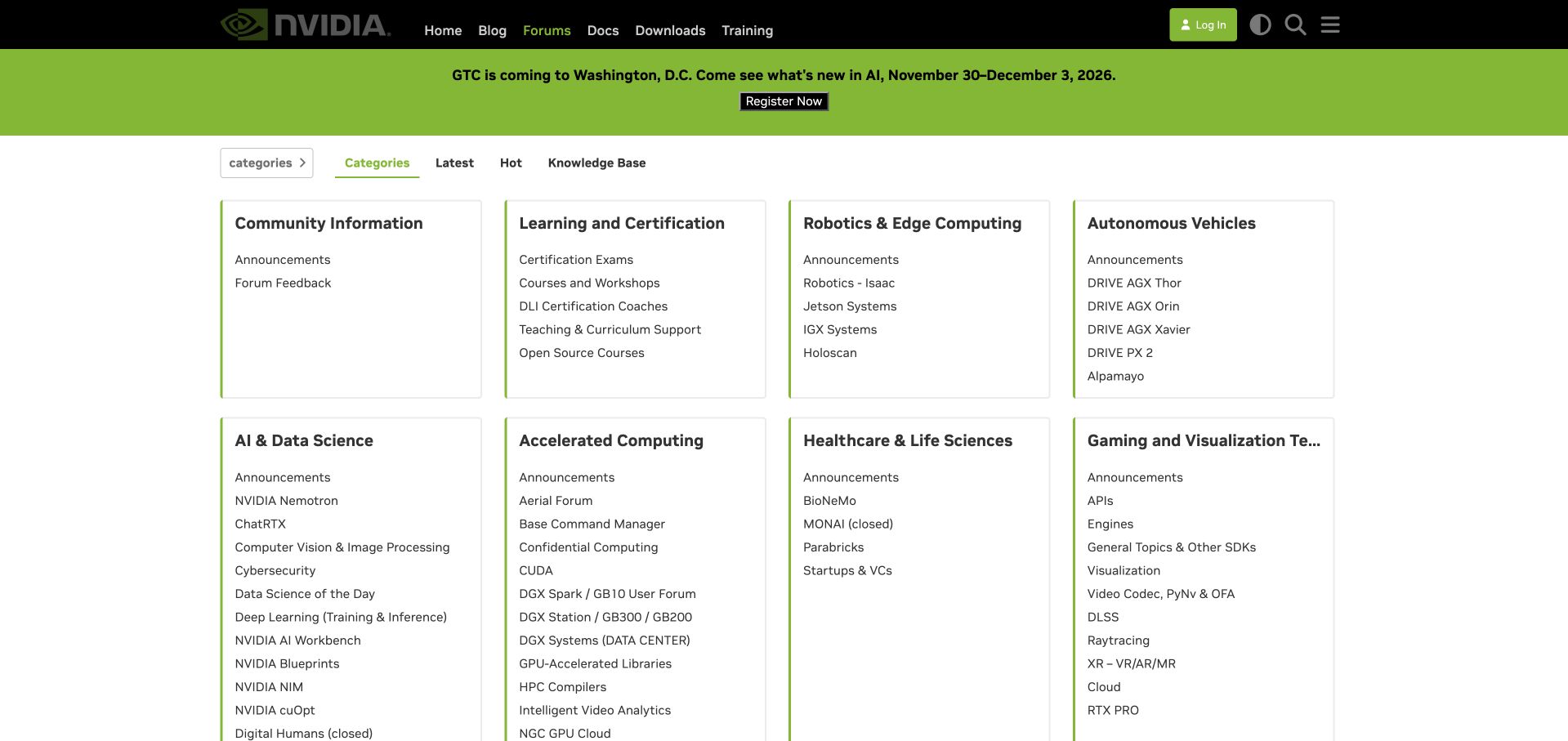
NVIDIA Developer Forums uses a regular card grid to organize a broad technical community. Each card has a clear heading and a compact list of subareas, while tabs above distinguish category browsing from recent and popular activity. A green announcement band sits outside the directory, preserving a separate place for a current event. The retained capture documents the public forum, with its original Discourse observation preserved. Ember is an expected frontend dependency through Discourse, not an independently observed implementation of NVIDIA’s corporate site or products.
What you can learn
A large application needs a coherent first choice before it needs elaborate interaction. Use recurring components to make related destinations comparable, and keep temporary announcements outside the structure people rely on when they return for a specific technical subject.
Pros
Consistent card spacing and heading treatment help visitors scan a large number of destinations.
Alternative activity views are grouped above the directory rather than mixed into individual categories.
Cons & considerations
Some long category names truncate, making the full destination harder to distinguish at a glance.
A large announcement band can reduce the space available for the directory on shorter screens.
Platform source: Official Discourse project: Ember.js frontend. NVIDIA Developer Forums public forum frontend: Ember.js is an expected dependency through the retained Discourse platform observation dated 2026-11-07; not independently observed. The dependency relationship was reviewed against the official Discourse project on November 10, 2026. Expected dependency of the independently documented Discourse public forum; not independently observed Ember runtime. The official Discourse project identifies its frontend as an Ember.js application. This does not identify an installed Ember version or extend to the organization’s main site, private backend or other products. Original forum observations and captures retain their earlier dates. Platform evidence is separate from the direct website screenshot and is not a complete current infrastructure audit.
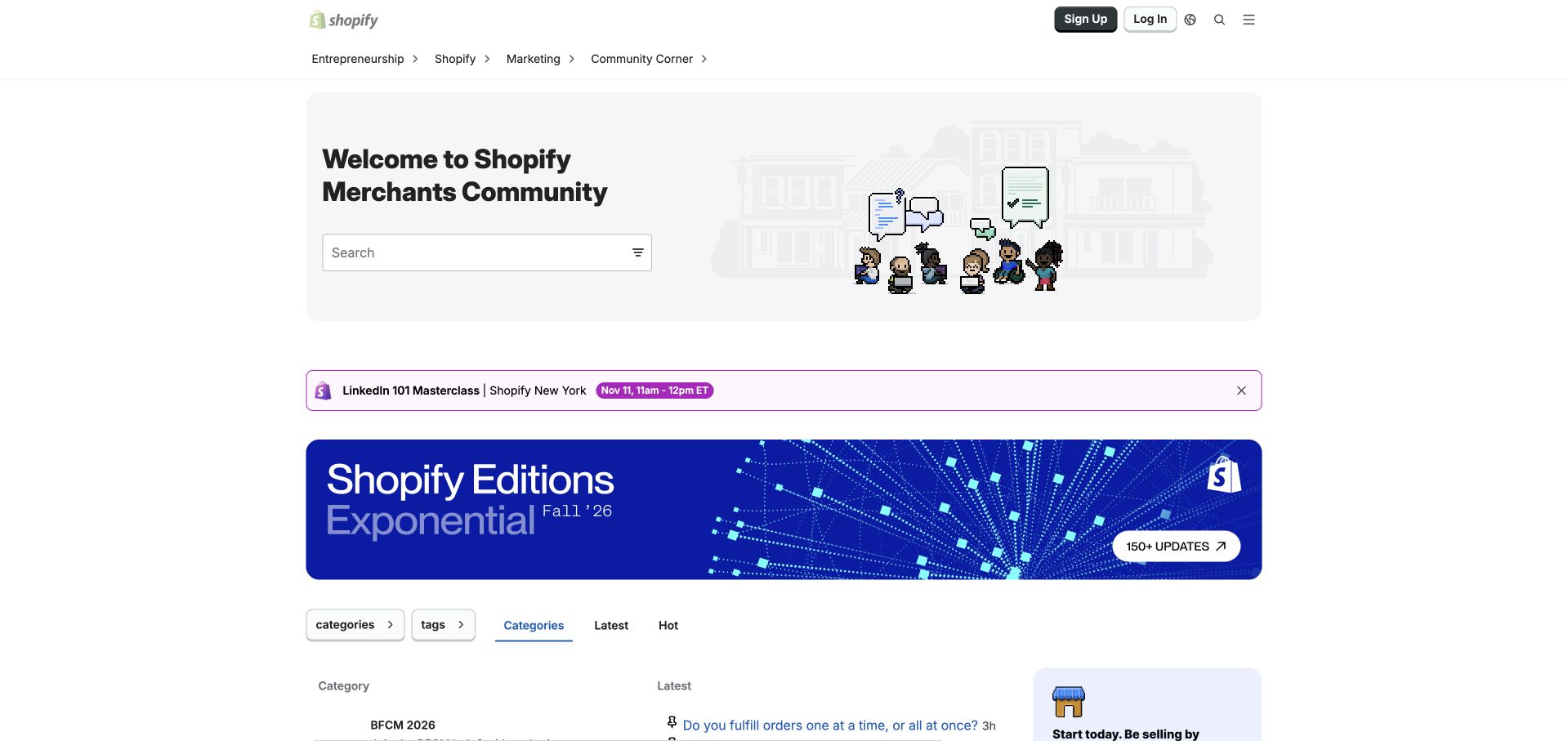
Shopify Community introduces its merchant audience through a prominent welcome panel, search field and small illustrated group. A narrow event notice and a larger product campaign sit between that introduction and the category controls. The result blends a branded landing experience with a conventional discussion application. The actual November 7 capture and Discourse declaration remain dated evidence. The Ember relationship is limited to the forum frontend through the documented Discourse architecture, not storefronts, merchant administration or Shopify’s wider platform.
What you can learn
An application entrance can welcome new visitors without discarding the navigation patterns returning users expect. Keep search, category browsing and activity views recognizable, and control the amount of campaign content placed between the introduction and the underlying information people came to use.
Pros
The welcome panel names the audience and places a usable discovery route directly beside that explanation.
Discussion filters retain familiar positions beneath the campaign material, providing a clear transition into the application.
Cons & considerations
Multiple promotional bands can delay access to discussions for visitors who already understand the community.
Search labels should explain whether results cover forum posts, help documentation or the wider product ecosystem.
Platform source: Official Discourse project: Ember.js frontend. Shopify Community public forum frontend: Ember.js is an expected dependency through the retained Discourse platform observation dated 2026-11-07; not independently observed. The dependency relationship was reviewed against the official Discourse project on November 10, 2026. Expected dependency of the independently documented Discourse public forum; not independently observed Ember runtime. The official Discourse project identifies its frontend as an Ember.js application. This does not identify an installed Ember version or extend to the organization’s main site, private backend or other products. Original forum observations and captures retain their earlier dates. Platform evidence is separate from the direct website screenshot and is not a complete current infrastructure audit.
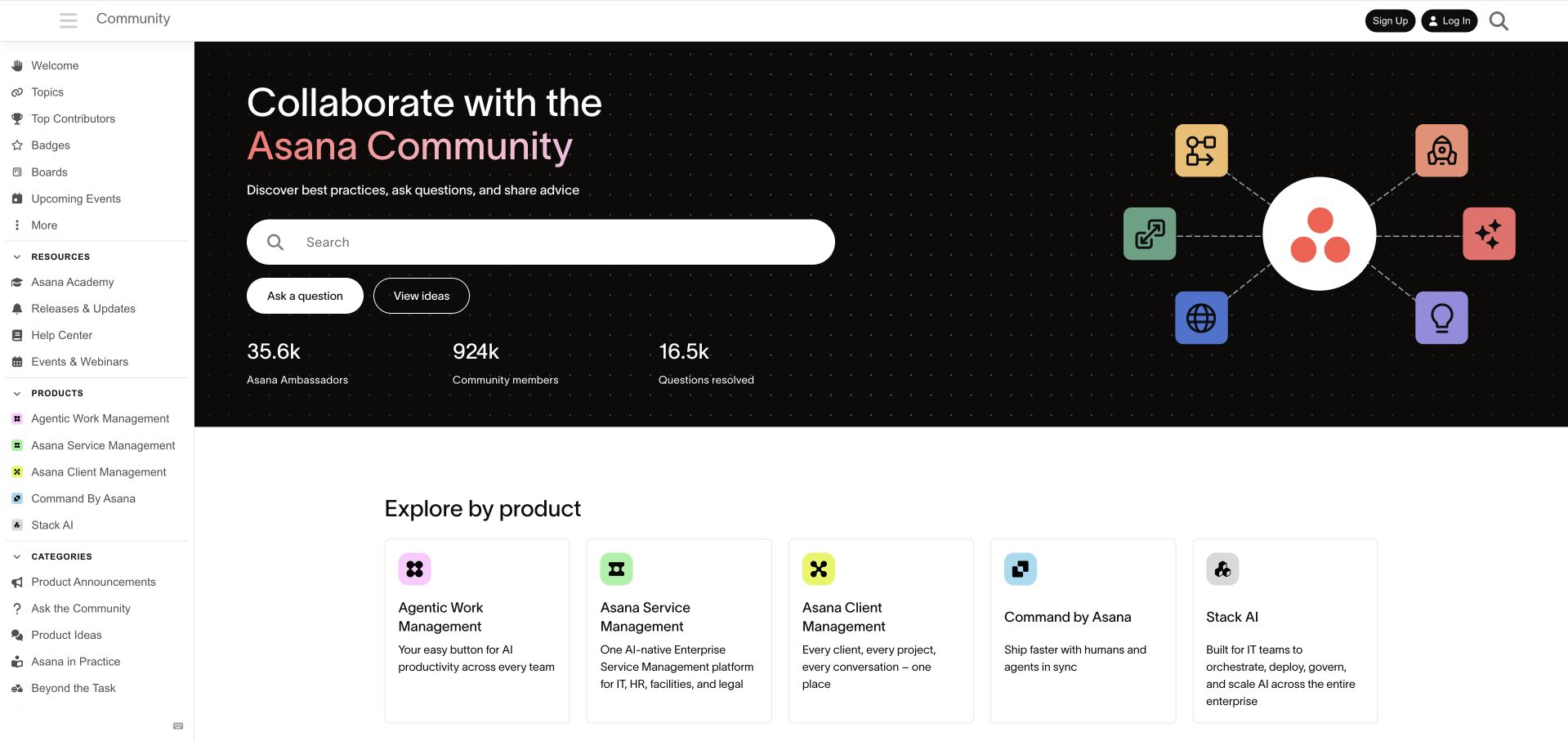
Asana Community combines a persistent left navigation with a large dark introductory panel. Search is followed by separate question and idea routes, while product cards below offer another way into the community. The sidebar groups resources, products and categories instead of treating every destination as one flat list. Numerical community claims are visible but are not independently measured here. This retained public forum has dated Discourse evidence; Ember is its documented platform dependency, not a claim about the Asana work-management application.
What you can learn
Separate different intentions before asking someone to interpret the whole information structure. A reader looking for an answer, a person proposing an idea and someone exploring a product need distinct starting points that can still share the same stable application navigation.
Pros
Question and idea actions make two different participation goals explicit within the introductory panel.
Sidebar grouping helps distinguish learning resources from product areas and discussion categories.
Cons & considerations
A prominent introduction and metrics row can push the actual discussion stream well below the opening screen.
Repeated product links in the sidebar and cards need consistent labels to avoid suggesting different destinations.
Platform source: Official Discourse project: Ember.js frontend. Asana Community public forum frontend: Ember.js is an expected dependency through the retained Discourse platform observation dated 2026-11-07; not independently observed. The dependency relationship was reviewed against the official Discourse project on November 10, 2026. Expected dependency of the independently documented Discourse public forum; not independently observed Ember runtime. The official Discourse project identifies its frontend as an Ember.js application. This does not identify an installed Ember version or extend to the organization’s main site, private backend or other products. Original forum observations and captures retain their earlier dates. Platform evidence is separate from the direct website screenshot and is not a complete current infrastructure audit.
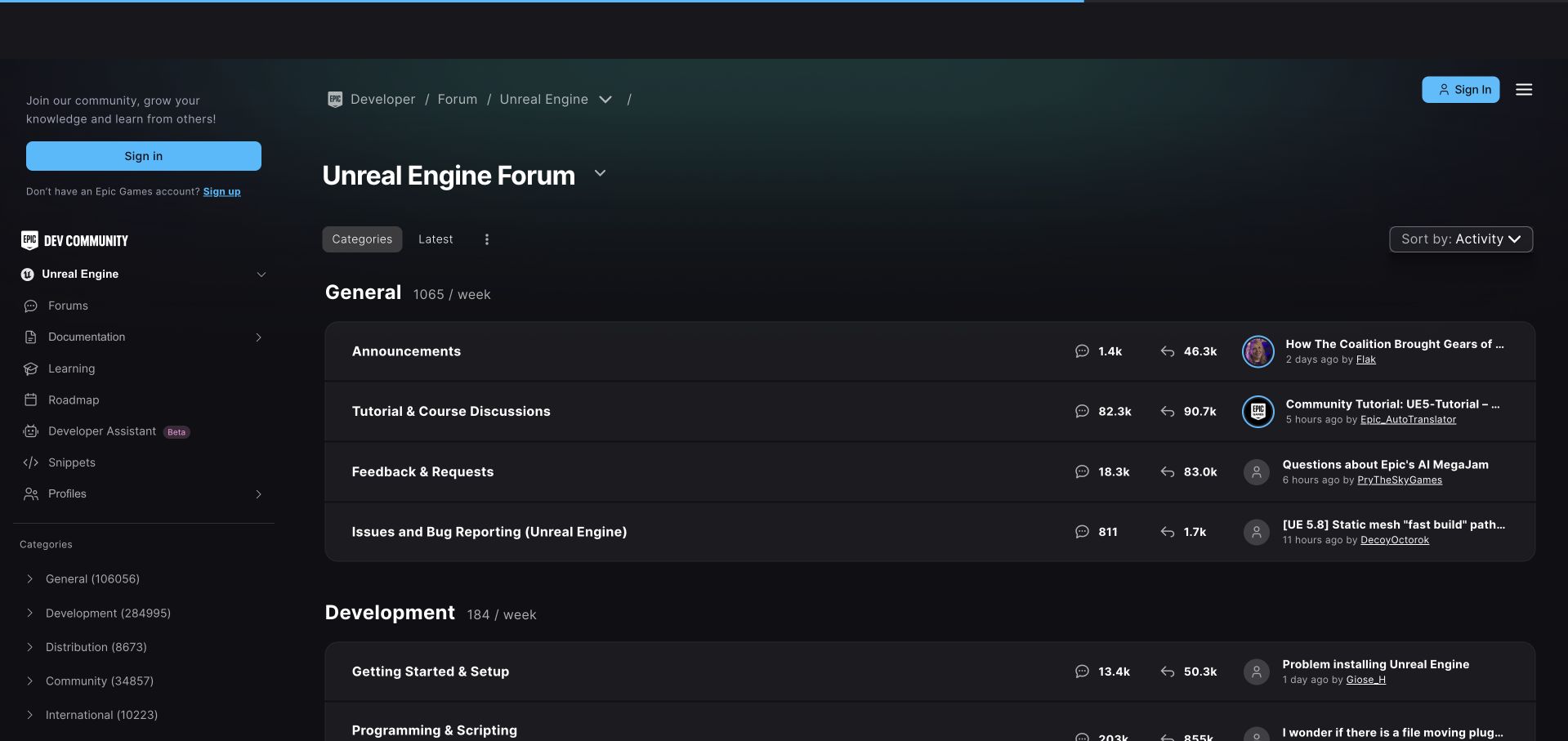
Epic’s Unreal Engine forum uses a dark interface, a visible developer-to-forum breadcrumb and a product selector above the discussion categories. Rows group announcements, tutorials, feedback and bug reporting, with activity information aligned to the right. The persistent sidebar provides routes into documentation, learning and other developer resources. The retained capture is the exact public Unreal Engine category view, including its original query context. Ember is associated through its observed Discourse platform, not with the Unreal Engine editor, games or unrelated Epic services.
What you can learn
When an application sits inside a larger ecosystem, show both the current product context and the route back to broader resources. Keep category names and activity summaries visually distinct so visitors can choose by subject without losing sight of what is happening.
Pros
The breadcrumb and forum heading make the current product-specific destination easy to identify.
Category rows give technical discussions a consistent structure without requiring a separate promotional introduction.
Cons & considerations
Dense numerical and avatar information can compete with category labels in narrow layouts.
Several nested navigation levels require clear active states so visitors know which product and section they are viewing.
Platform source: Official Discourse project: Ember.js frontend. Epic Developer Community — Unreal Engine Forum public forum frontend: Ember.js is an expected dependency through the retained Discourse platform observation dated 2026-11-07; not independently observed. The dependency relationship was reviewed against the official Discourse project on November 10, 2026. Expected dependency of the independently documented Discourse public forum; not independently observed Ember runtime. The official Discourse project identifies its frontend as an Ember.js application. This does not identify an installed Ember version or extend to the organization’s main site, private backend or other products. Original forum observations and captures retain their earlier dates. Platform evidence is separate from the direct website screenshot and is not a complete current infrastructure audit.
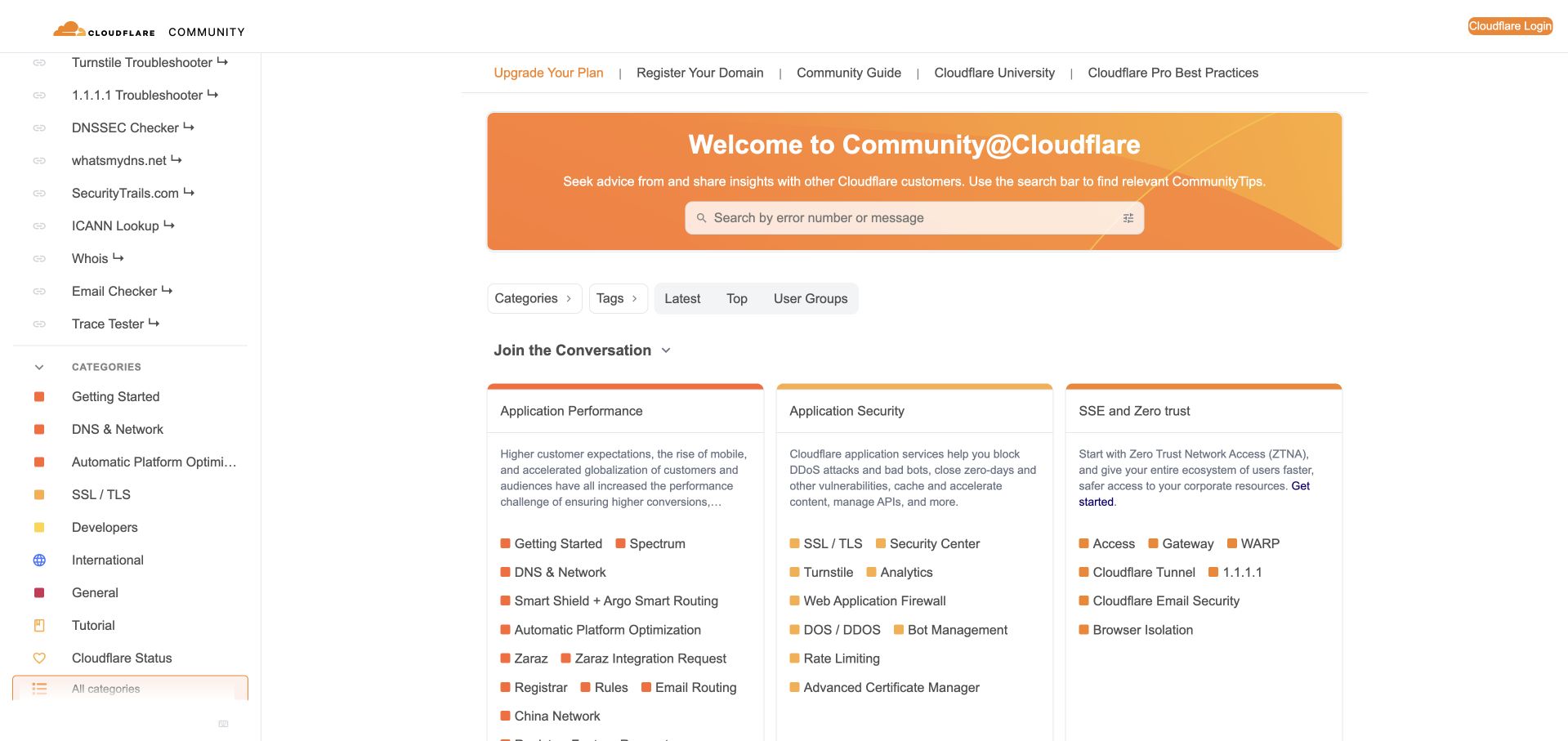
Cloudflare Community gives search a specific prompt: use an error number or message. Its orange welcome panel sits above category controls and three broad product groupings, while the sidebar includes troubleshooting tools and category links. This recognizes that visitors may arrive with either an error or a general concern. The November 7 forum observation is retained alongside the later unavailable broad scan. Ember remains an expected Discourse frontend dependency, not a claim about Cloudflare’s network, dashboard or security products.
What you can learn
A technical application should support the information visitors actually have in hand. Offer a direct route for a known error and a separate taxonomy for exploratory browsing. Keep those choices visible without implying that a community answer is equivalent to an official operational diagnosis.
Pros
The search prompt offers a concrete example of what to enter instead of relying on a generic label.
Product groupings provide an alternative when a visitor cannot yet name the exact problem.
Cons & considerations
The extensive sidebar and card lists can produce a demanding first screen for a new user.
Community, troubleshooting and commercial links need clear boundaries so visitors understand the type of help available.
Platform source: Official Discourse project: Ember.js frontend. Cloudflare Community public forum frontend: Ember.js is an expected dependency through the retained Discourse platform observation dated 2026-11-07; not independently observed. The dependency relationship was reviewed against the official Discourse project on November 10, 2026. Expected dependency of the independently documented Discourse public forum; not independently observed Ember runtime. The official Discourse project identifies its frontend as an Ember.js application. This does not identify an installed Ember version or extend to the organization’s main site, private backend or other products. Original forum observations and captures retain their earlier dates. Platform evidence is separate from the direct website screenshot and is not a complete current infrastructure audit.
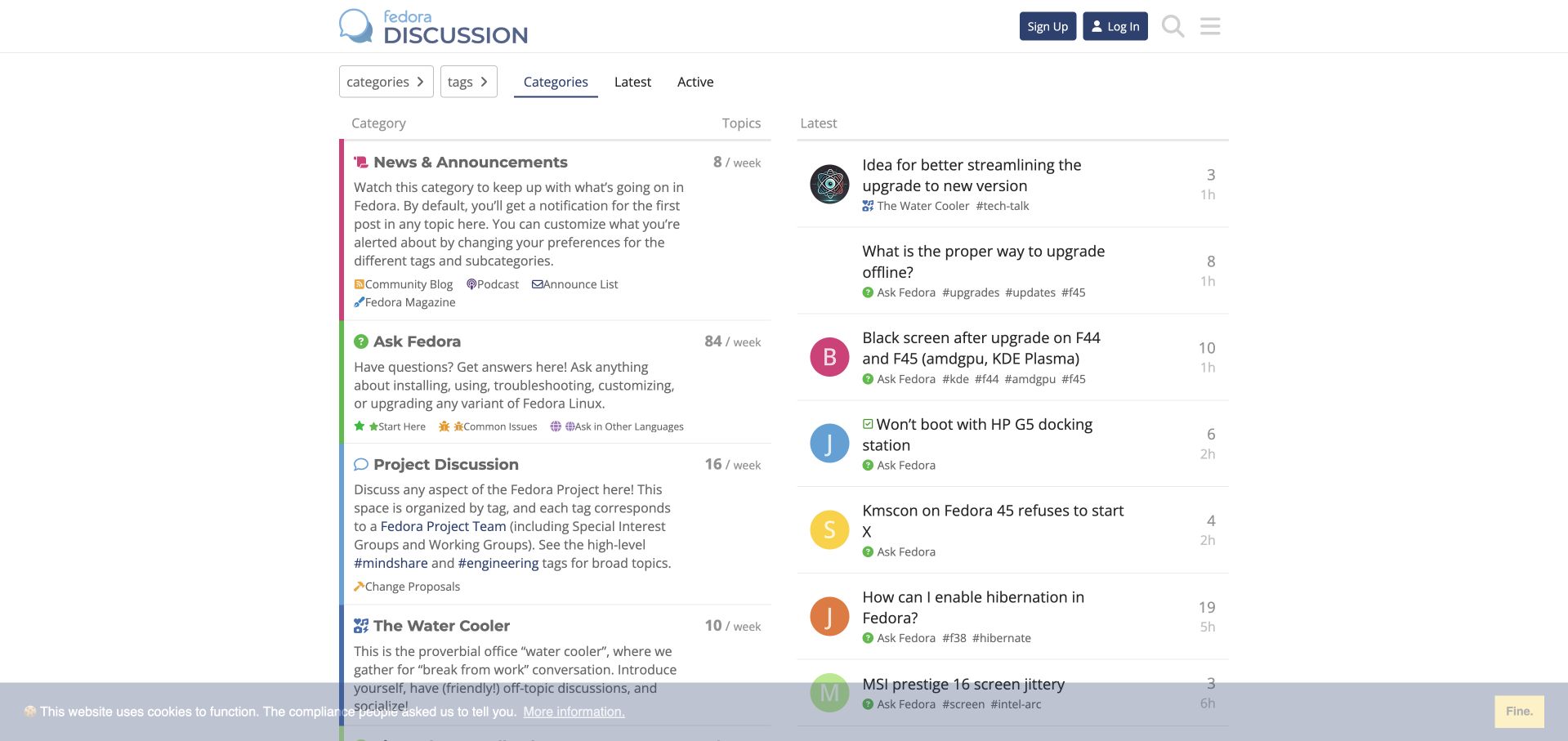
Fedora Discussion places category descriptions in one column and recent topics in another. Colored borders and small supporting links differentiate announcements, help, project discussion and informal conversation. The latest stream adds visible examples of the subjects being discussed, so category names do not have to carry the full explanation alone. A privacy notice occupies the lower edge of the retained capture. The forum’s Discourse observation is dated separately from this new review; Ember is the documented frontend dependency, not Fedora’s operating-system technology.
What you can learn
Use a structured directory and a changing activity stream for different jobs. Descriptions help people understand where a discussion belongs, while recent examples show how the space is actually used. Keep the relationship clear as content changes and participation patterns evolve.
Pros
Category descriptions provide context that short technical labels would not communicate on their own.
The adjacent topic stream helps newcomers see examples before choosing where to read or contribute.
Cons & considerations
Long descriptions can make the category column substantially taller than the neighboring activity stream.
A bottom notice can obscure useful content unless the interface accounts for its real occupied space.
Platform source: Official Discourse project: Ember.js frontend. Fedora Discussion public forum frontend: Ember.js is an expected dependency through the retained Discourse platform observation dated 2026-11-07; not independently observed. The dependency relationship was reviewed against the official Discourse project on November 10, 2026. Expected dependency of the independently documented Discourse public forum; not independently observed Ember runtime. The official Discourse project identifies its frontend as an Ember.js application. This does not identify an installed Ember version or extend to the organization’s main site, private backend or other products. Original forum observations and captures retain their earlier dates. Platform evidence is separate from the direct website screenshot and is not a complete current infrastructure audit.
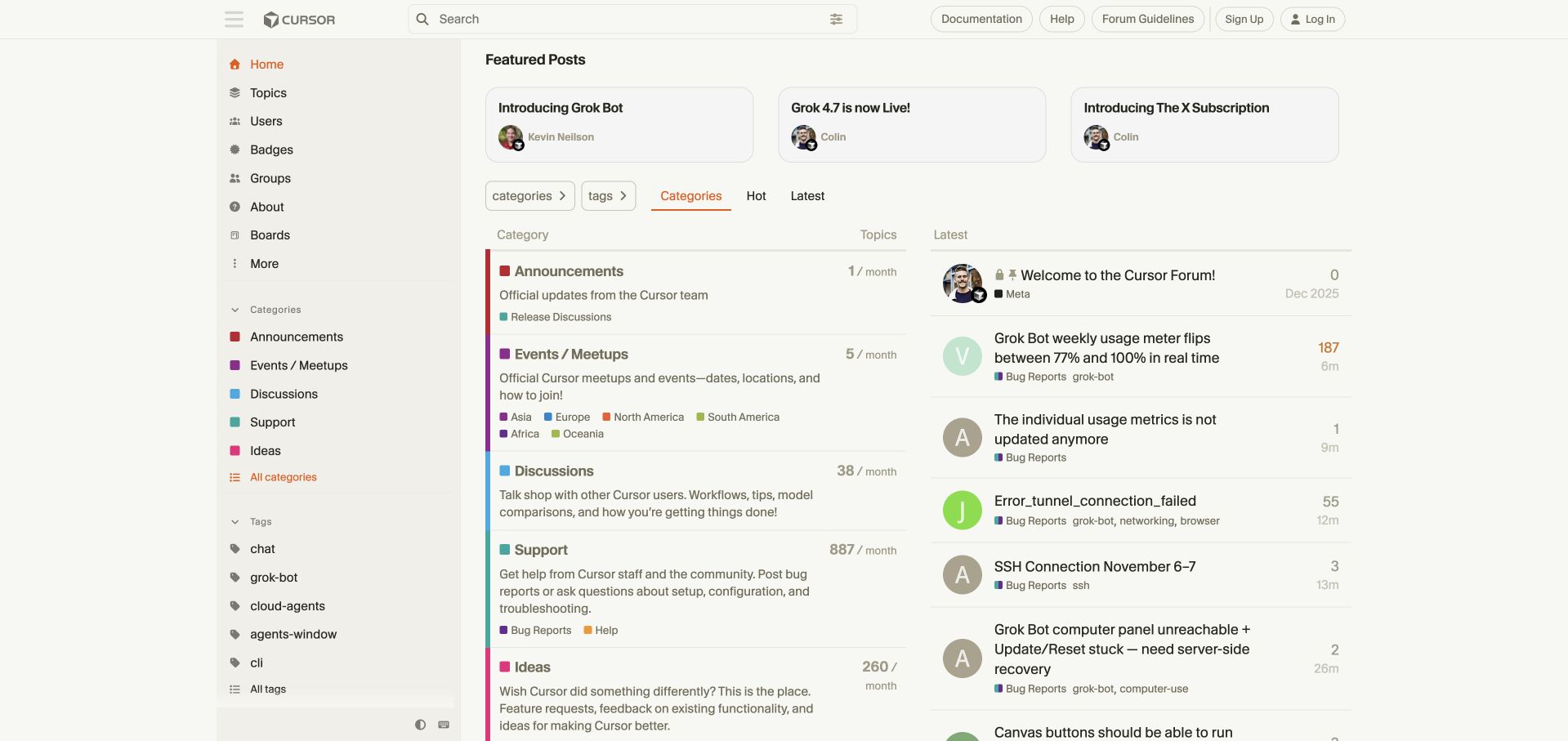
Cursor Forum uses a subdued background, a persistent sidebar and three featured-post cards above its discussion controls. Category descriptions occupy the left side of the main area, with recent topics on the right. The sidebar gives frequent categories and tags their own sections, while documentation and help remain in the header. The retained screenshot is evidence of this public forum’s presentation. Its original Discourse declaration supports a qualified Ember dependency relationship, not a claim about the Cursor editor or any linked model service.
What you can learn
Treat featured material as a deliberate editorial layer above the application’s stable structure. Keep category names, tags and activity filters consistent so the interface remains understandable after the selected announcements change. A visitor should not need to read every promotion to navigate the community.
Pros
Featured cards are visually separated from the category directory and ongoing discussion list.
Header links distinguish external documentation and help from the forum’s internal browsing controls.
Cons & considerations
The combination of categories, tags and featured material creates several competing starting points.
Truncated or technical discussion titles may need sufficient surrounding context to remain useful outside the thread.
Platform source: Official Discourse project: Ember.js frontend. Cursor Forum public forum frontend: Ember.js is an expected dependency through the retained Discourse platform observation dated 2026-11-07; not independently observed. The dependency relationship was reviewed against the official Discourse project on November 10, 2026. Expected dependency of the independently documented Discourse public forum; not independently observed Ember runtime. The official Discourse project identifies its frontend as an Ember.js application. This does not identify an installed Ember version or extend to the organization’s main site, private backend or other products. Original forum observations and captures retain their earlier dates. Platform evidence is separate from the direct website screenshot and is not a complete current infrastructure audit.
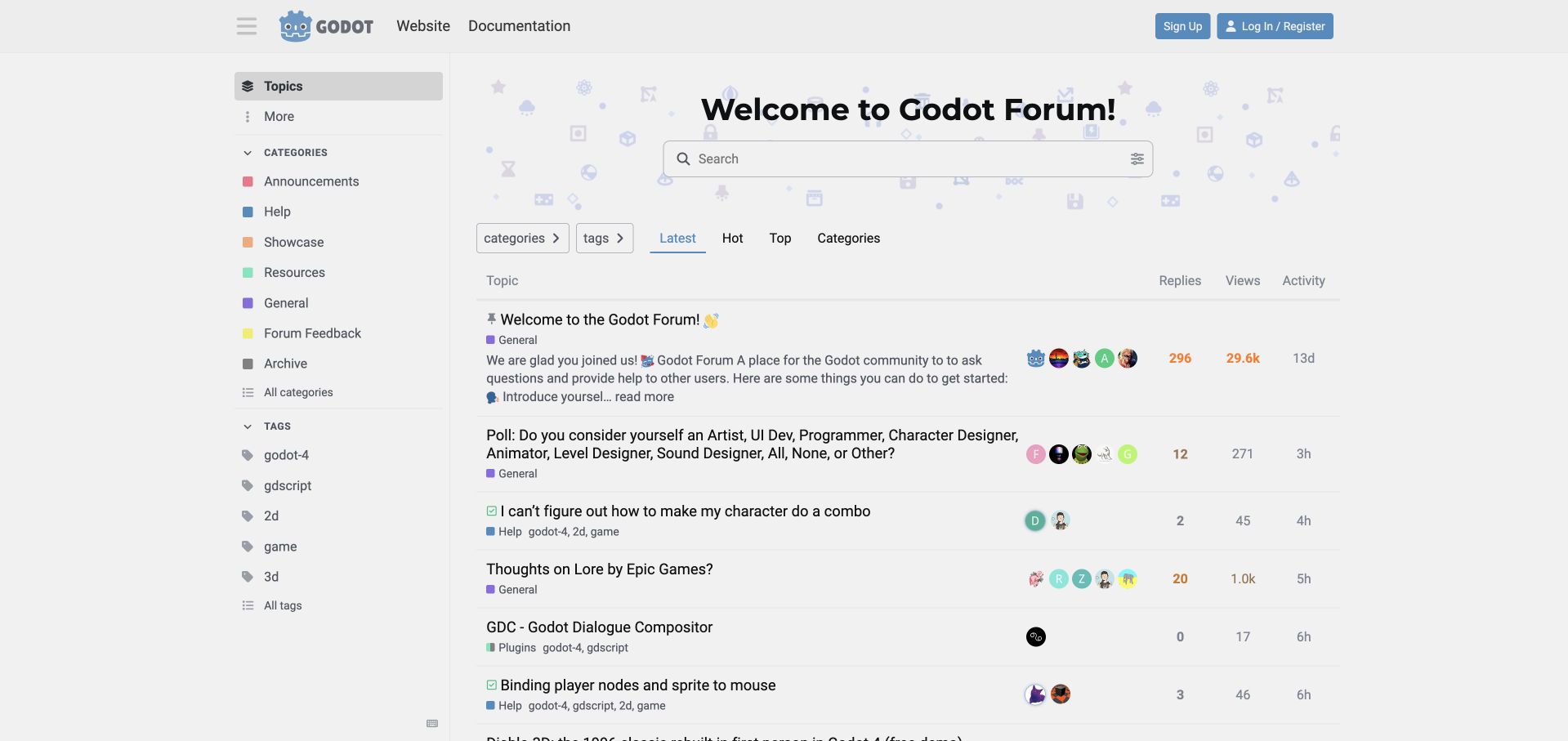
Godot Forum places a welcoming title and broad search field above a list of discussions. A patterned background gives the introduction identity without becoming a large marketing feature. The sidebar separates categories from tags, and the topic rows show subjects, category context, participation and activity. A pinned welcome message provides further explanation within the same structure as other discussions. Ember is associated through the forum’s retained Discourse evidence, not through the Godot game engine or its exported games.
What you can learn
An application introduction can be brief when the interface itself explains the next steps. Keep search close to the main content, use a pinned orientation item for deeper guidance, and make the difference between a category and a tag clear in both labels and behavior.
Pros
The opening search route remains close to the discussion list rather than being separated by multiple campaigns.
A pinned welcome topic introduces community context using the same visual structure as ordinary content.
Cons & considerations
Several small metadata fields can make each row visually busy even when the overall layout is restrained.
Technical tags should have consistent meanings so they help narrow a topic instead of duplicating broad categories.
Platform source: Official Discourse project: Ember.js frontend. Godot Forum public forum frontend: Ember.js is an expected dependency through the retained Discourse platform observation dated 2026-11-07; not independently observed. The dependency relationship was reviewed against the official Discourse project on November 10, 2026. Expected dependency of the independently documented Discourse public forum; not independently observed Ember runtime. The official Discourse project identifies its frontend as an Ember.js application. This does not identify an installed Ember version or extend to the organization’s main site, private backend or other products. Original forum observations and captures retain their earlier dates. Platform evidence is separate from the direct website screenshot and is not a complete current infrastructure audit.
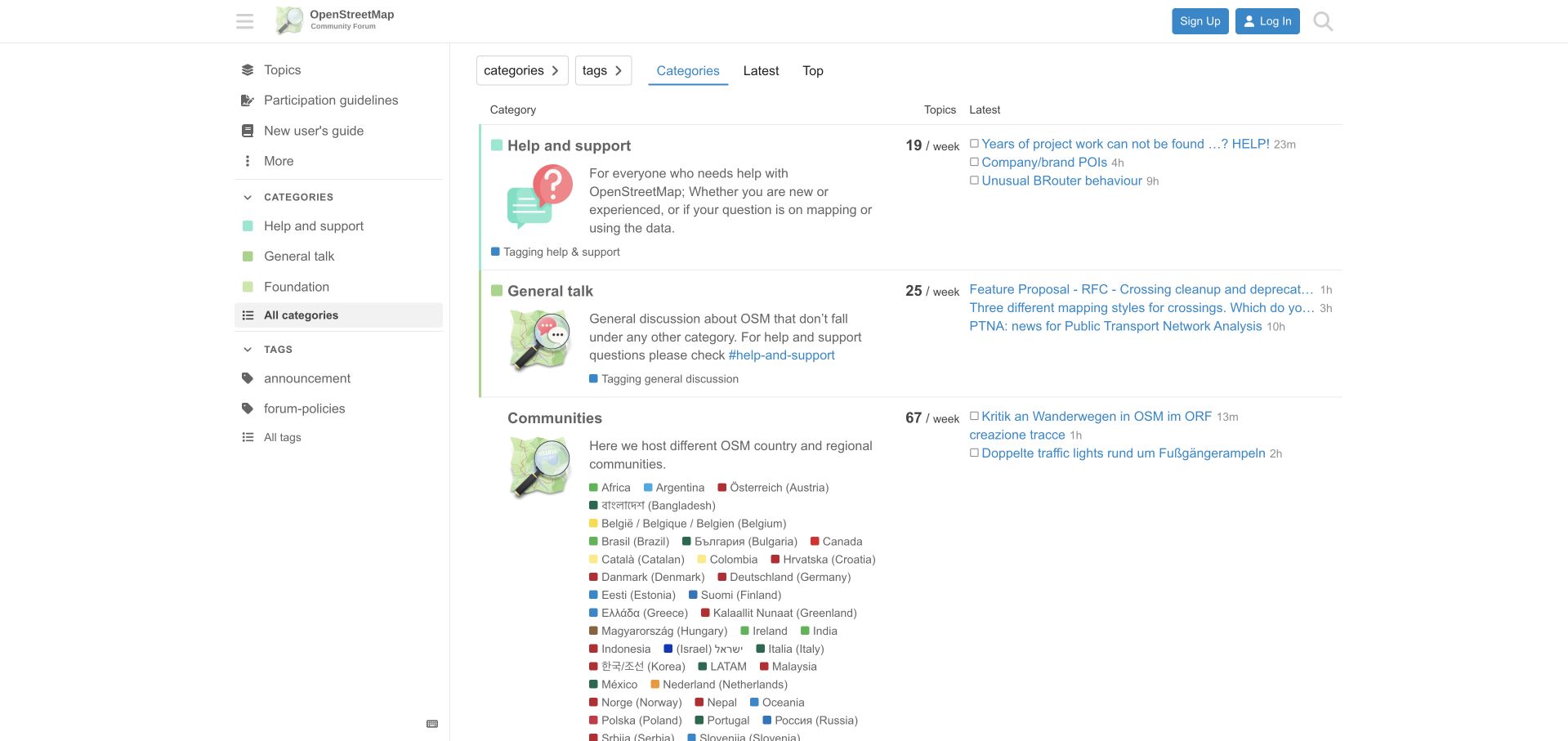
OpenStreetMap Community Forum combines broad help and general-discussion categories with an extensive list of country and regional communities. Small illustrations introduce the larger sections, while recent topic links sit alongside them. Participation guidance and a newcomer resource have dedicated sidebar positions. The retained design shows how a single forum can present both shared and local spaces. The Ember evidence is a qualified dependency of the observed Discourse frontend, not an attribution of the map renderer, editing tools or the wider OpenStreetMap infrastructure.
What you can learn
When one application serves local groups, make the relationship between shared help and regional discussion explicit. Use consistent destination labels and preserve a recognizable surrounding interface so moving between communities does not feel like entering an unrelated system.
Pros
Regional destinations are visible within the main directory instead of being hidden behind an unexplained selector.
Guidance for participation and new users has a stable position outside the changing discussion stream.
Cons & considerations
A long list of regional links can dominate the screen and requires careful ordering and search support.
Similar language and geographic labels need precise wording so visitors choose the intended local community.
Platform source: Official Discourse project: Ember.js frontend. OpenStreetMap Community Forum public forum frontend: Ember.js is an expected dependency through the retained Discourse platform observation dated 2026-11-07; not independently observed. The dependency relationship was reviewed against the official Discourse project on November 10, 2026. Expected dependency of the independently documented Discourse public forum; not independently observed Ember runtime. The official Discourse project identifies its frontend as an Ember.js application. This does not identify an installed Ember version or extend to the organization’s main site, private backend or other products. Original forum observations and captures retain their earlier dates. Platform evidence is separate from the direct website screenshot and is not a complete current infrastructure audit.
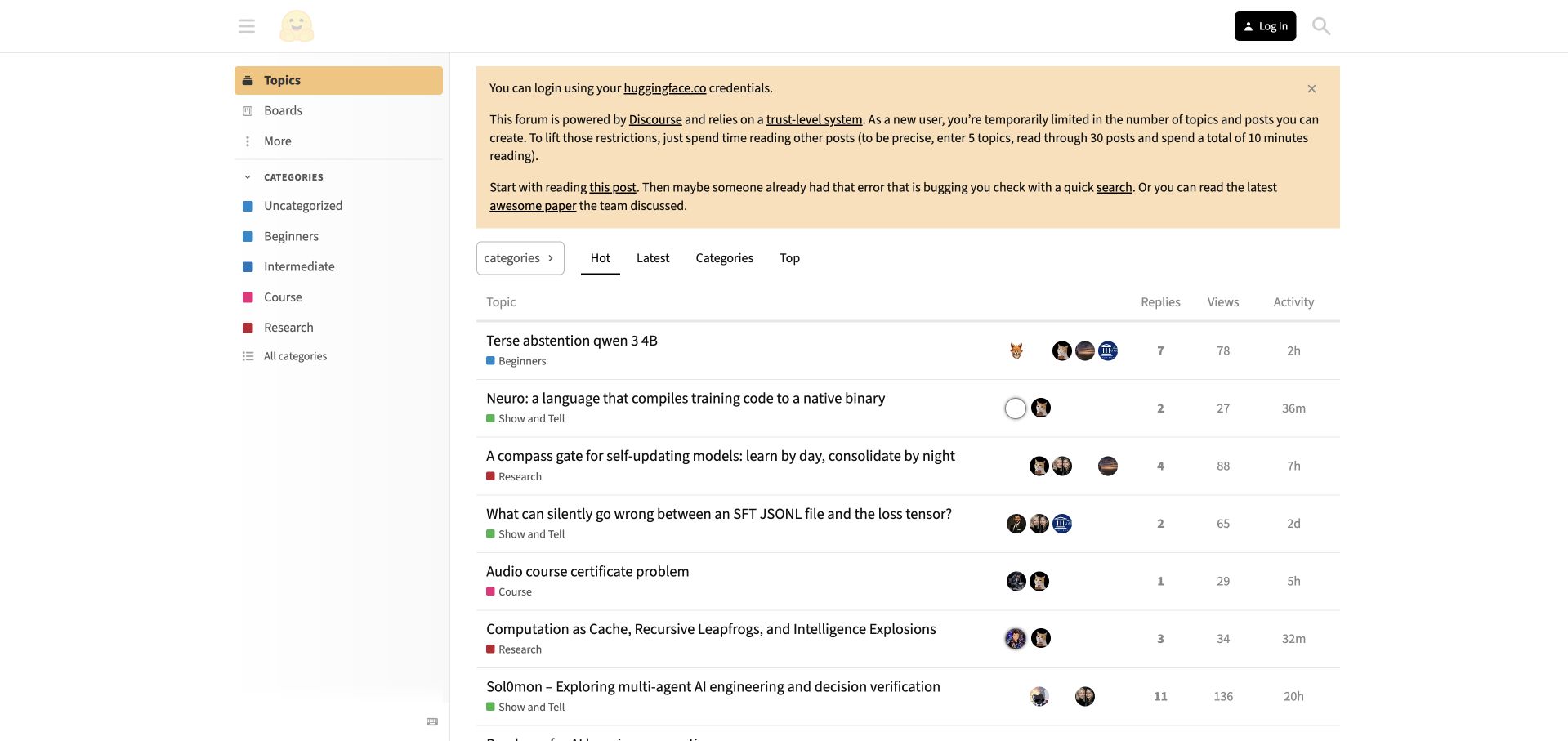
Hugging Face Forums opens with a warm-colored notice explaining sign-in and initial participation limits. The page then moves directly into topic controls and a discussion list, with a compact category sidebar. The notice makes reading and searching part of the suggested path for newcomers rather than presenting account creation as the only useful action. The original public Discourse observation and capture remain unchanged. Ember is the expected frontend dependency of this forum, not an implementation claim about model hosting, inference or the main Hugging Face site.
What you can learn
Explain meaningful participation constraints before they become surprising errors. Keep the explanation near the relevant application entry point, provide useful read-only actions, and distinguish a temporary account limitation from a failure of the underlying service.
Pros
The introductory notice explains the relationship between reading, account access and participation in plain language.
The discussion list remains available beneath the notice, preserving a useful path without immediate signup.
Cons & considerations
A long persistent notice can become repetitive for returning readers if it lacks appropriate dismissal behavior.
Participation rules need accurate maintenance so the interface does not promise access that the service no longer provides.
Platform source: Official Discourse project: Ember.js frontend. Hugging Face Forums public forum frontend: Ember.js is an expected dependency through the retained Discourse platform observation dated 2026-11-07; not independently observed. The dependency relationship was reviewed against the official Discourse project on November 10, 2026. Expected dependency of the independently documented Discourse public forum; not independently observed Ember runtime. The official Discourse project identifies its frontend as an Ember.js application. This does not identify an installed Ember version or extend to the organization’s main site, private backend or other products. Original forum observations and captures retain their earlier dates. Platform evidence is separate from the direct website screenshot and is not a complete current infrastructure audit.
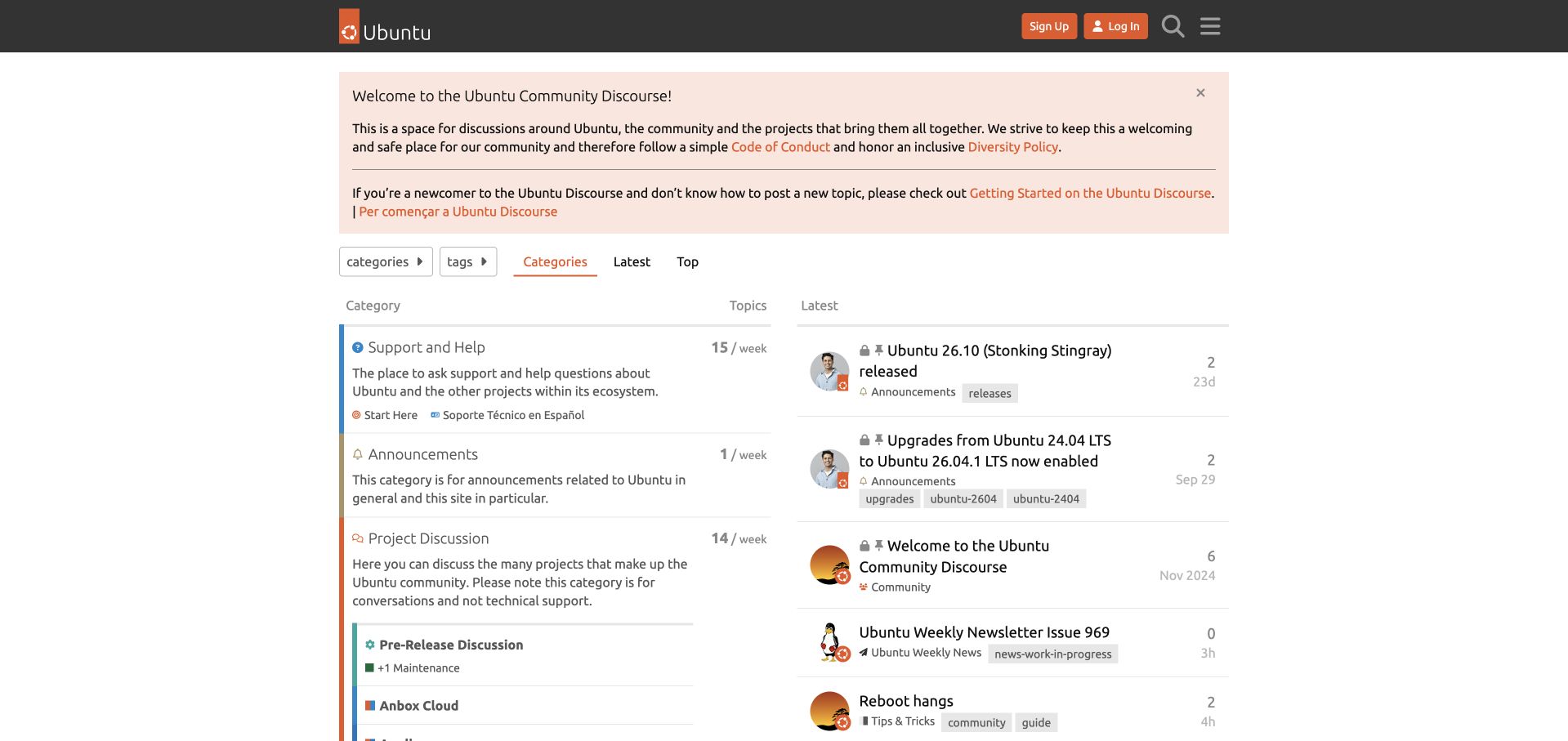
Ubuntu Community Discourse uses a pale welcome panel beneath its dark branded header, with links to participation guidance and a newcomer introduction. Below, category descriptions distinguish support, announcements, project discussion and development-related areas, while a neighboring stream shows recent subjects. The category copy explicitly helps separate technical help from broader project conversation. The retained source establishes this public Discourse forum on its original observation date. Ember is a frontend dependency relationship, not a claim about Ubuntu software or Canonical’s other web properties.
What you can learn
A community application needs to explain differences that its regular members may already take for granted. Give each major conversation type a concise purpose, then use examples and guidance to help a newcomer choose a suitable destination before composing a contribution.
Pros
The welcome panel provides a clear place for orientation and participation expectations.
Category descriptions distinguish support needs from broader project conversation rather than relying on names alone.
Cons & considerations
Multiple guidance links can overwhelm newcomers if they are presented without an obvious reading order.
The introduction should remain compact enough that current discussions are visible without extensive scrolling.
Platform source: Official Discourse project: Ember.js frontend. Ubuntu Community Discourse public forum frontend: Ember.js is an expected dependency through the retained Discourse platform observation dated 2026-11-07; not independently observed. The dependency relationship was reviewed against the official Discourse project on November 10, 2026. Expected dependency of the independently documented Discourse public forum; not independently observed Ember runtime. The official Discourse project identifies its frontend as an Ember.js application. This does not identify an installed Ember version or extend to the organization’s main site, private backend or other products. Original forum observations and captures retain their earlier dates. Platform evidence is separate from the direct website screenshot and is not a complete current infrastructure audit.
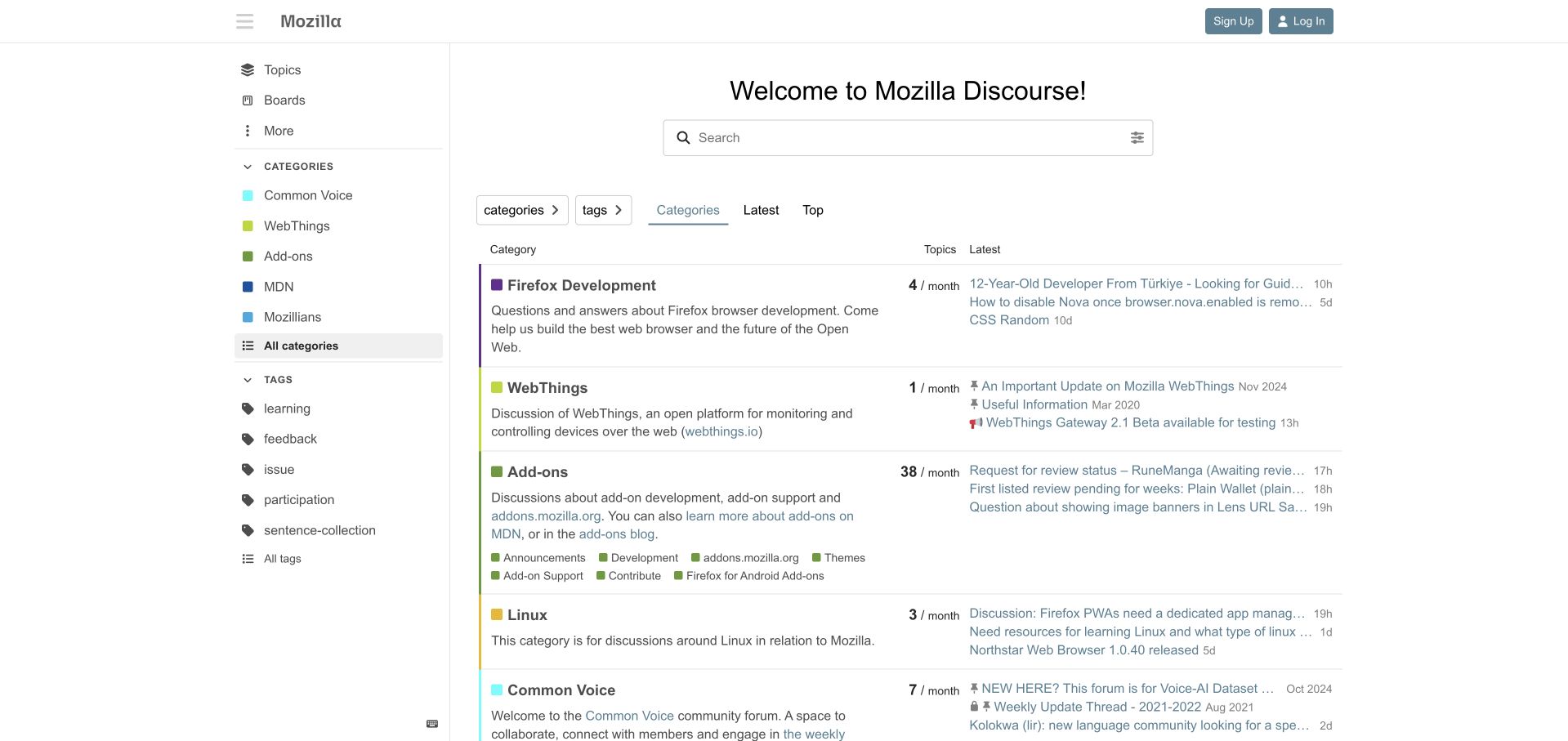
Mozilla Discourse places a large search field beneath a simple welcome heading, with project categories and recent topics below. The left navigation gives selected communities and tags stable positions. Within the main directory, descriptions explain areas such as browser development, connected devices and add-ons, while smaller links expose useful subareas. The captured public forum and original platform evidence retain their dates. The Ember relationship comes through Discourse’s documented frontend architecture, not Firefox itself or every Mozilla website and service.
What you can learn
For a multi-project application, combine a common discovery tool with clear local context. Search can serve people who know a phrase, while category descriptions explain which project owns a question. Keep that ownership understandable without requiring familiarity with the organization’s structure.
Pros
The prominent search field gives visitors a direct alternative to understanding the entire project directory.
Category descriptions and sublinks provide useful context for areas with specialized names.
Cons & considerations
A long project list needs consistent description length to avoid uneven and difficult scanning.
Similar categories and tags should be differentiated so the application does not expose two competing taxonomies.
Platform source: Official Discourse project: Ember.js frontend. Mozilla Discourse public forum frontend: Ember.js is an expected dependency through the retained Discourse platform observation dated 2026-11-07; not independently observed. The dependency relationship was reviewed against the official Discourse project on November 10, 2026. Expected dependency of the independently documented Discourse public forum; not independently observed Ember runtime. The official Discourse project identifies its frontend as an Ember.js application. This does not identify an installed Ember version or extend to the organization’s main site, private backend or other products. Original forum observations and captures retain their earlier dates. Platform evidence is separate from the direct website screenshot and is not a complete current infrastructure audit.
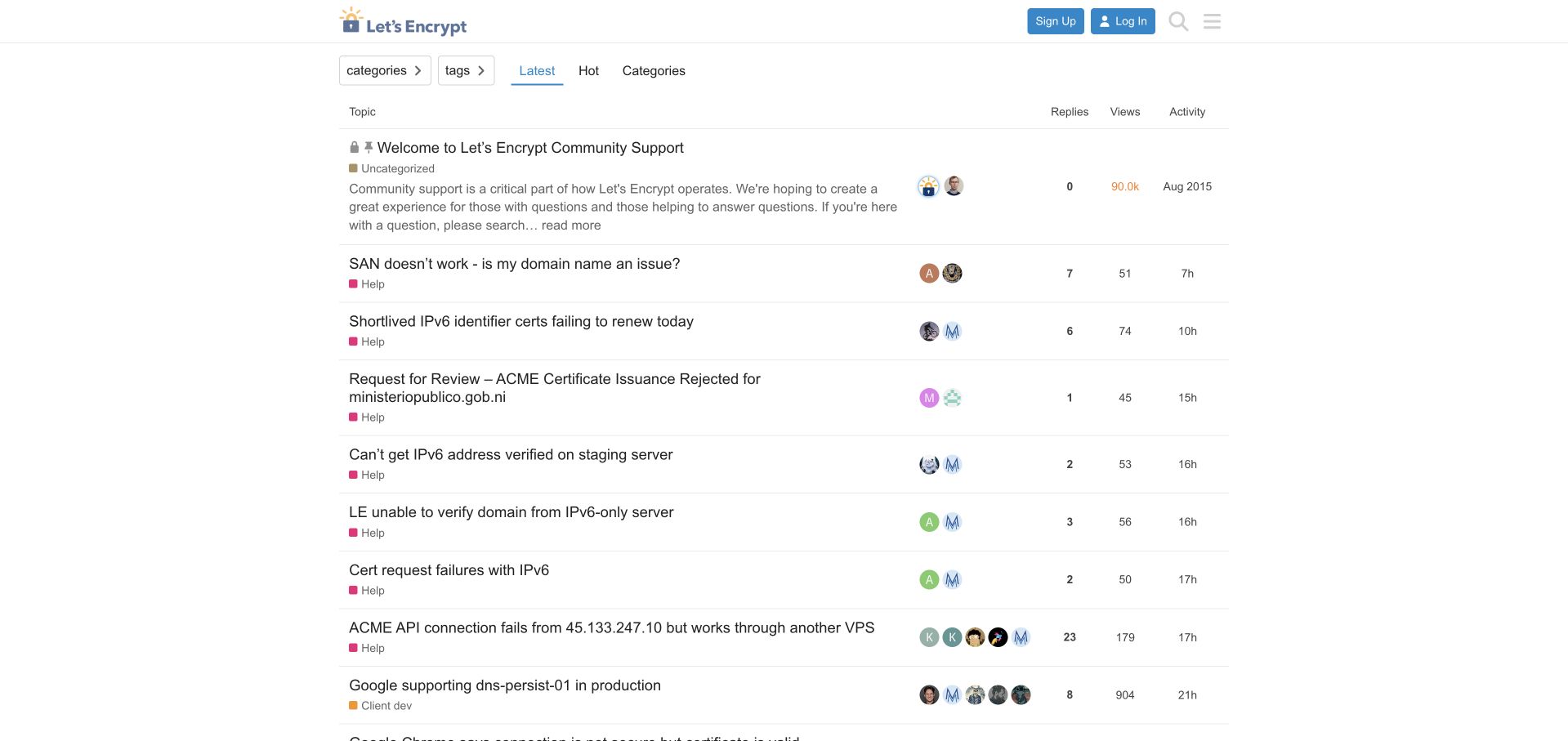
Let’s Encrypt Community Support uses a restrained header and a broad topic table with little decorative material. A pinned welcome item explains the purpose of the community, followed by specific technical questions with category labels, participants and activity information. The sparse treatment puts the subject of each request ahead of a promotional introduction. The retained November 7 source declares Discourse. Ember is a qualified dependency of that public forum frontend, not evidence about certificate issuance, validation infrastructure or private support tools.
What you can learn
A technical support application benefits from clear subject lines and a predictable row structure. Keep orientation available without letting it overwhelm the queue, and provide enough category and activity context to help readers decide which discussion is relevant before opening it.
Pros
The wide topic column gives detailed technical questions room to remain understandable.
The pinned introduction provides a consistent entry point for people unfamiliar with the community.
Cons & considerations
Long question titles can still require careful wrapping when the interface becomes narrow.
Activity and reply counts indicate conversation, not whether a technical recommendation is correct or suitable.
Platform source: Official Discourse project: Ember.js frontend. Let's Encrypt Community Support public forum frontend: Ember.js is an expected dependency through the retained Discourse platform observation dated 2026-11-07; not independently observed. The dependency relationship was reviewed against the official Discourse project on November 10, 2026. Expected dependency of the independently documented Discourse public forum; not independently observed Ember runtime. The official Discourse project identifies its frontend as an Ember.js application. This does not identify an installed Ember version or extend to the organization’s main site, private backend or other products. Original forum observations and captures retain their earlier dates. Platform evidence is separate from the direct website screenshot and is not a complete current infrastructure audit.
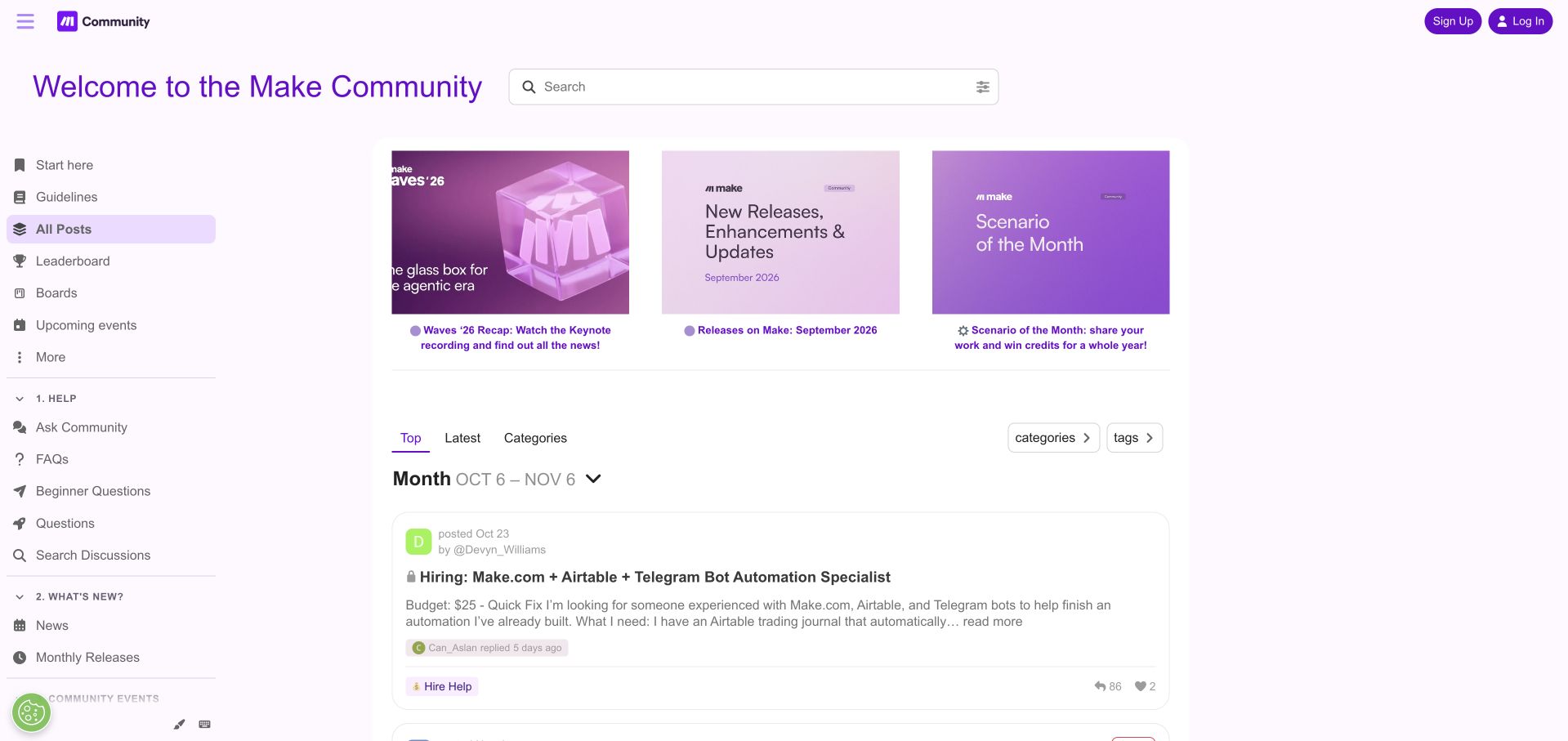
Make Community uses a purple visual identity, a prominent welcome heading and search, followed by three large editorial cards. Below them, the selected activity view includes an explicit time period, while the sidebar separates help, updates and community functions. The first discussion card shows a preview rather than only a title, giving the feed a more editorial rhythm. Ember is associated through the public forum’s retained Discourse declaration. That evidence does not attribute the automation builder, connected services or execution infrastructure to Ember.
What you can learn
If an application mixes selected resources with ongoing discussions, give each layer a distinct role. Show the current feed mode and time window explicitly, and make the route back to help or documentation stable even as featured material and popular topics change.
Pros
The active time period makes the meaning of the selected discussion view more concrete.
Sidebar sections distinguish help resources from news and community activities.
Cons & considerations
Large editorial cards can delay access to the feed for people returning with a specific question.
Preview-heavy rows need sensible length limits so a small number of discussions do not fill the whole screen.
Platform source: Official Discourse project: Ember.js frontend. Make Community public forum frontend: Ember.js is an expected dependency through the retained Discourse platform observation dated 2026-11-07; not independently observed. The dependency relationship was reviewed against the official Discourse project on November 10, 2026. Expected dependency of the independently documented Discourse public forum; not independently observed Ember runtime. The official Discourse project identifies its frontend as an Ember.js application. This does not identify an installed Ember version or extend to the organization’s main site, private backend or other products. Original forum observations and captures retain their earlier dates. Platform evidence is separate from the direct website screenshot and is not a complete current infrastructure audit.
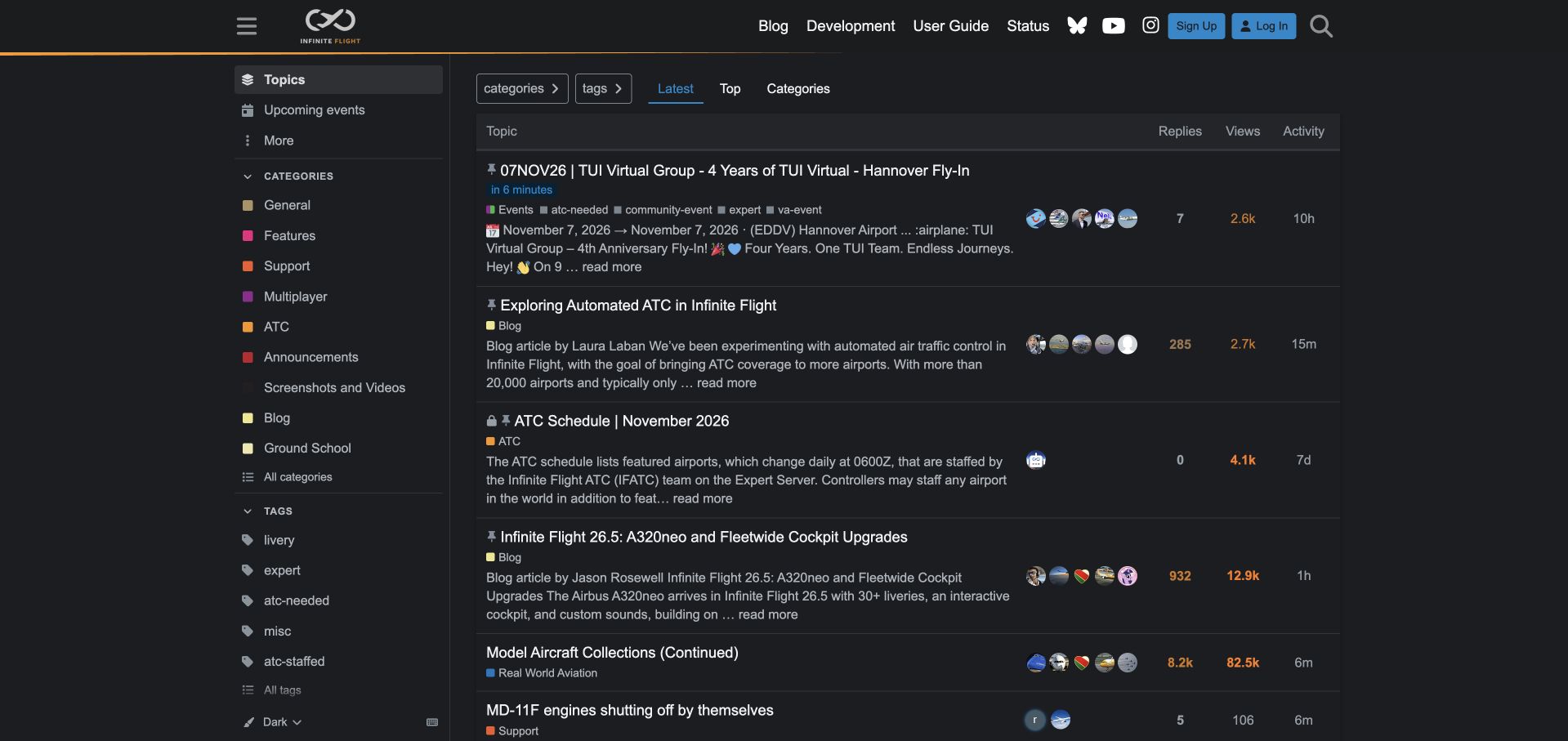
Infinite Flight Community uses a dark interface with clear topic rows, category markers and short previews. The opening list combines scheduled events, development announcements and support discussions, while a sidebar groups topics such as multiplayer, training and screenshots. The top navigation keeps documentation and service status separate from the discussion application. This public forum’s original capture and Discourse evidence remain dated. Ember is the documented frontend dependency, not a claim about the flight simulator, multiplayer servers or any aircraft simulation system.
What you can learn
A community that organizes events needs to distinguish time-sensitive activity from evergreen help. Use clear labels and dates, keep the general resource navigation stable, and make the selected activity view understandable when old announcements remain pinned above newer discussions.
Pros
Category labels and preview text give each topic more context than a title alone.
Documentation and status destinations remain available in the header without being mixed into the topic list.
Cons & considerations
Several pinned items can occupy much of the first screen before ordinary discussions appear.
Muted text on a dark background needs deliberate contrast, especially for secondary dates and metadata.
Platform source: Official Discourse project: Ember.js frontend. Infinite Flight Community public forum frontend: Ember.js is an expected dependency through the retained Discourse platform observation dated 2026-11-07; not independently observed. The dependency relationship was reviewed against the official Discourse project on November 10, 2026. Expected dependency of the independently documented Discourse public forum; not independently observed Ember runtime. The official Discourse project identifies its frontend as an Ember.js application. This does not identify an installed Ember version or extend to the organization’s main site, private backend or other products. Original forum observations and captures retain their earlier dates. Platform evidence is separate from the direct website screenshot and is not a complete current infrastructure audit.
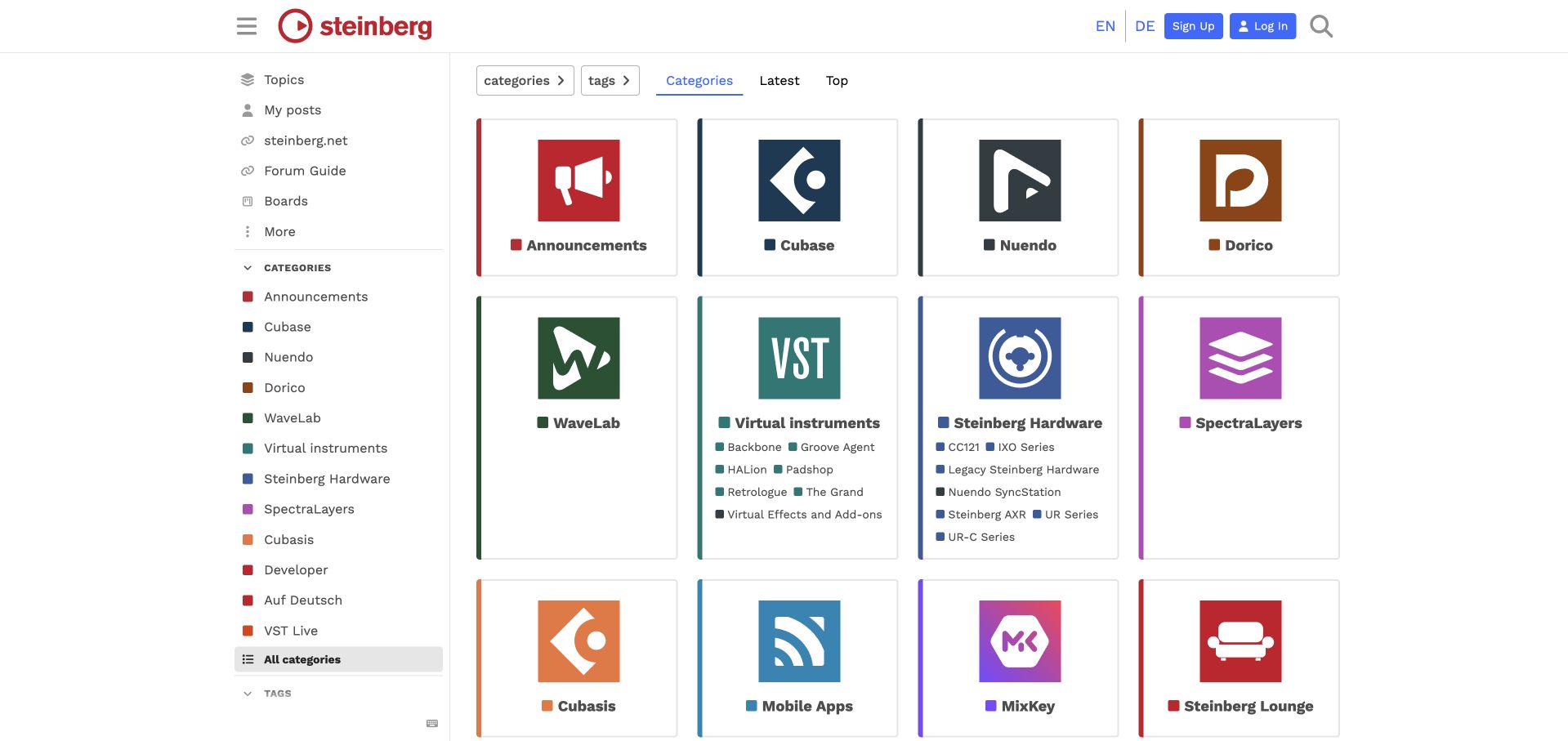
Steinberg Forums presents a grid of large product cards, each combining a recognizable mark, a name and a colored edge. Some cards include subproducts, while the sidebar offers a compact text version of the same overall directory. Language choices sit in the header alongside account access. The design makes product selection the first substantial decision. The retained public Discourse observation supports Ember as a qualified forum dependency, not an implementation claim about Steinberg’s audio software, plugins or hardware.
What you can learn
A multi-product application can use recognizable product identities to reduce the effort of choosing a section. Keep textual names beside the artwork, and ensure that the compact navigation and larger cards describe the same destinations rather than creating two incompatible structures.
Pros
Large product cards provide clear targets and recognizable context for existing customers.
The sidebar preserves a compact alternative for visitors who prefer scanning text rather than a visual grid.
Cons & considerations
Product artwork alone cannot explain the difference between closely related tools to a newcomer.
Uneven numbers of sublinks can make cards harder to compare unless the layout accommodates their different heights.
Platform source: Official Discourse project: Ember.js frontend. Steinberg Forums public forum frontend: Ember.js is an expected dependency through the retained Discourse platform observation dated 2026-11-07; not independently observed. The dependency relationship was reviewed against the official Discourse project on November 10, 2026. Expected dependency of the independently documented Discourse public forum; not independently observed Ember runtime. The official Discourse project identifies its frontend as an Ember.js application. This does not identify an installed Ember version or extend to the organization’s main site, private backend or other products. Original forum observations and captures retain their earlier dates. Platform evidence is separate from the direct website screenshot and is not a complete current infrastructure audit.
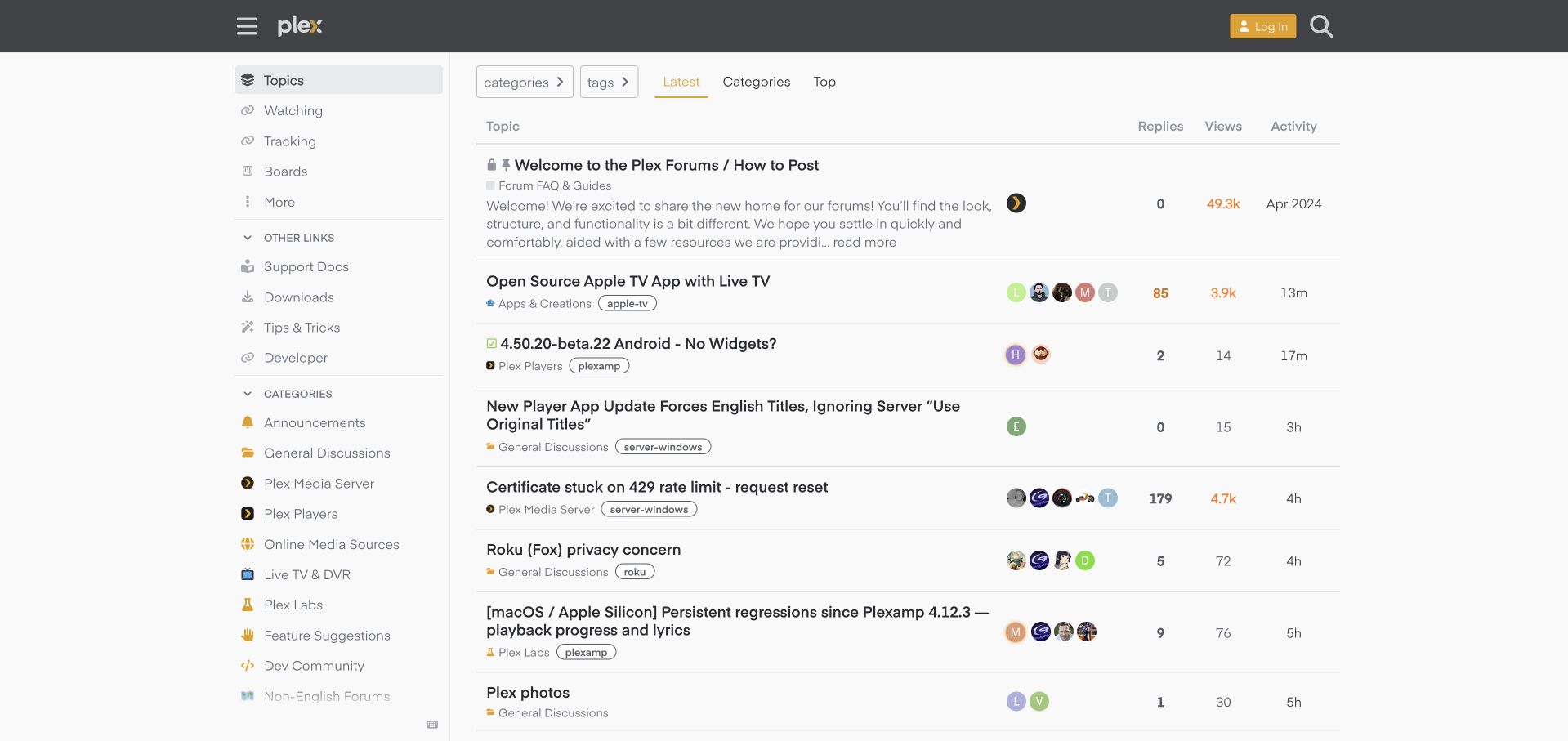
Plex Forums places a broad topic list beside a sidebar containing discussion views, support documentation, downloads and product categories. A pinned orientation topic introduces posting guidance, while ordinary rows combine titles, tags, participants and activity. The restrained gray header uses a yellow login action and the familiar Plex mark for identity. The retained screenshot and Discourse declaration describe this public forum. Ember is the platform’s documented frontend dependency, not an attribution of Plex streaming, media-server software or account infrastructure.
What you can learn
A support community should make the distinction between peer discussion and official reference material easy to follow. Keep both accessible from a stable navigation area, and use tags and product labels to give each question useful context before a reader enters the thread.
Pros
Formal documentation and downloads have dedicated routes outside the changing discussion list.
Product categories and tags help contextualize questions that would otherwise require opening each topic.
Cons & considerations
A long sidebar can make low-priority destinations difficult to discover near the bottom.
Activity metrics should not visually outweigh the topic and product context needed to judge relevance.
Platform source: Official Discourse project: Ember.js frontend. Plex Forums public forum frontend: Ember.js is an expected dependency through the retained Discourse platform observation dated 2026-11-07; not independently observed. The dependency relationship was reviewed against the official Discourse project on November 10, 2026. Expected dependency of the independently documented Discourse public forum; not independently observed Ember runtime. The official Discourse project identifies its frontend as an Ember.js application. This does not identify an installed Ember version or extend to the organization’s main site, private backend or other products. Original forum observations and captures retain their earlier dates. Platform evidence is separate from the direct website screenshot and is not a complete current infrastructure audit.
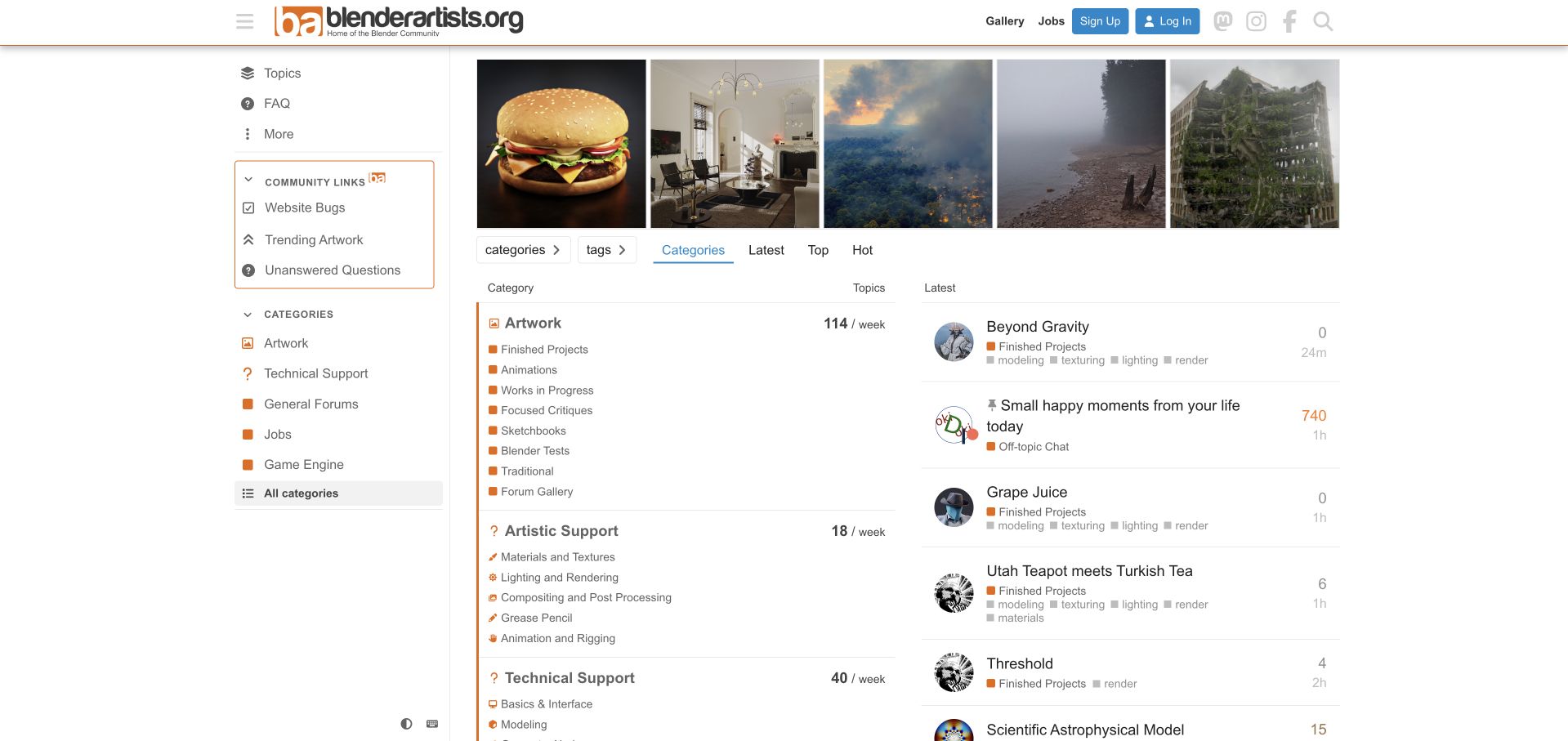
Blender Artists places a row of artwork thumbnails above its category controls and discussion layout. The main directory distinguishes finished work, artistic support and technical help, while a sidebar highlights community resources and unanswered questions. This gives the public forum an immediate visual connection to the work its members make. Blender Artists is an independent community identity; the retained source records Discourse. Ember is a qualified dependency of that forum frontend, not evidence about Blender’s application code or the Blender Foundation’s websites.
What you can learn
When a community produces visual work, show that output without allowing the gallery to replace useful navigation. Separate showcase, critique and technical help clearly, and keep unanswered-question routes available so the interface supports participation as well as browsing.
Pros
Artwork thumbnails communicate the community’s subject before a visitor reads the category descriptions.
Distinct showcase and support areas help separate appreciation, critique and problem-solving intentions.
Cons & considerations
A changing image strip needs meaningful alternatives and careful loading behavior to remain useful to all visitors.
Large visual material can compete with practical help routes if it grows beyond a bounded introductory role.
Platform source: Official Discourse project: Ember.js frontend. Blender Artists public forum frontend: Ember.js is an expected dependency through the retained Discourse platform observation dated 2026-11-07; not independently observed. The dependency relationship was reviewed against the official Discourse project on November 10, 2026. Expected dependency of the independently documented Discourse public forum; not independently observed Ember runtime. The official Discourse project identifies its frontend as an Ember.js application. This does not identify an installed Ember version or extend to the organization’s main site, private backend or other products. Original forum observations and captures retain their earlier dates. Platform evidence is separate from the direct website screenshot and is not a complete current infrastructure audit.
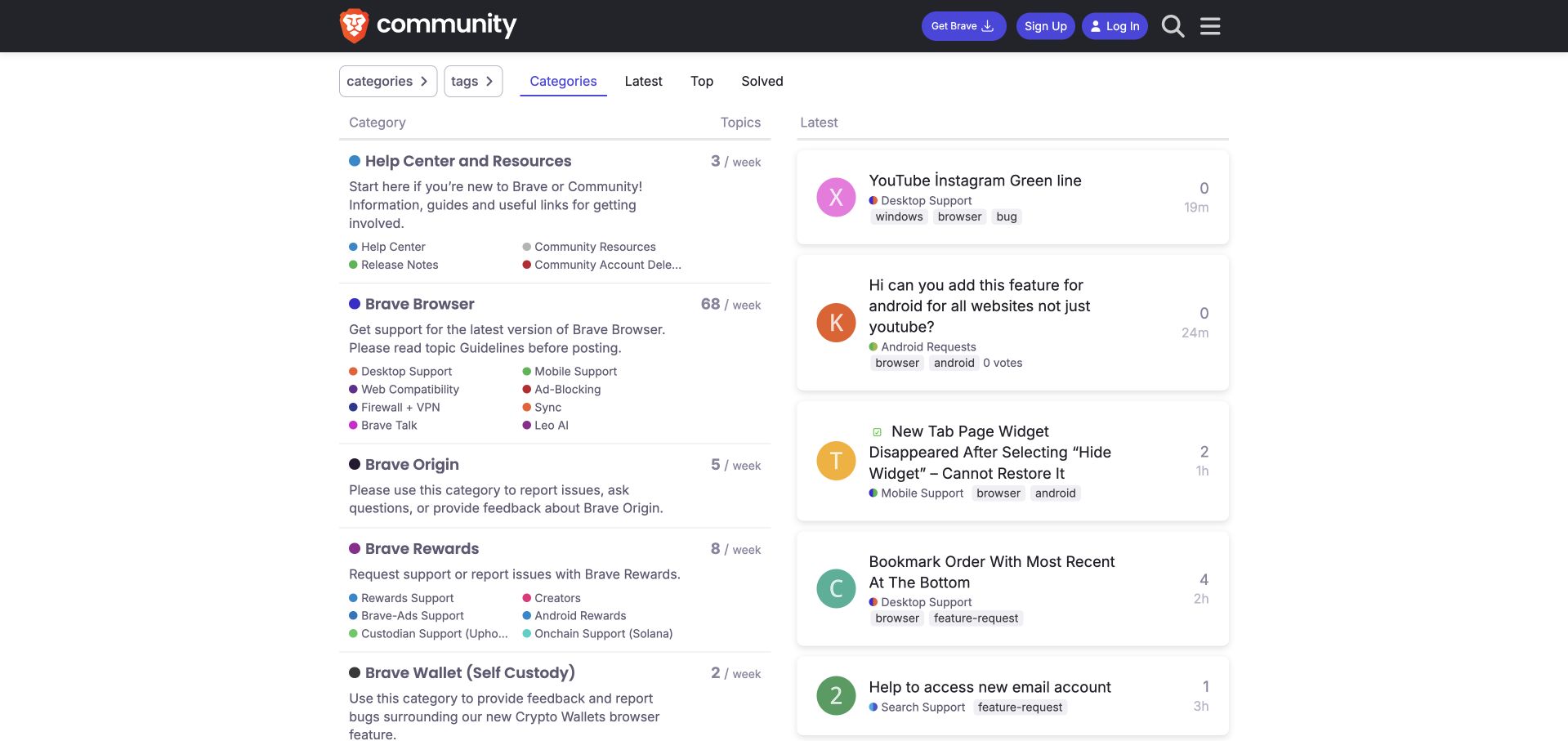
Brave Community combines category descriptions on the left with recent discussions displayed in distinct cards on the right. The dark header carries a download route and account actions, while a solved view appears alongside the standard discussion controls. Category sublinks distinguish desktop, mobile and other product areas without making every item a full card. The retained observation identifies the public Discourse forum. Ember is its expected frontend dependency, not a claim about the Brave browser, wallet, search engine or related services.
What you can learn
A discussion application can vary its visual treatment while keeping familiar navigation concepts. Use descriptions to explain product boundaries, give outcome-oriented views such as solved topics a clear label, and maintain enough consistency that returning users can quickly recognize the current mode.
Pros
Card boundaries make individual recent discussions easy to distinguish in the neighboring activity stream.
Descriptive product sections explain the purpose of support areas beyond their brand names.
Cons & considerations
The two-column structure needs a deliberate reading order when stacked on a smaller screen.
A solved label indicates a community state and should not be presented as a universal guarantee of correctness.
Platform source: Official Discourse project: Ember.js frontend. Brave Community public forum frontend: Ember.js is an expected dependency through the retained Discourse platform observation dated 2026-11-07; not independently observed. The dependency relationship was reviewed against the official Discourse project on November 10, 2026. Expected dependency of the independently documented Discourse public forum; not independently observed Ember runtime. The official Discourse project identifies its frontend as an Ember.js application. This does not identify an installed Ember version or extend to the organization’s main site, private backend or other products. Original forum observations and captures retain their earlier dates. Platform evidence is separate from the direct website screenshot and is not a complete current infrastructure audit.
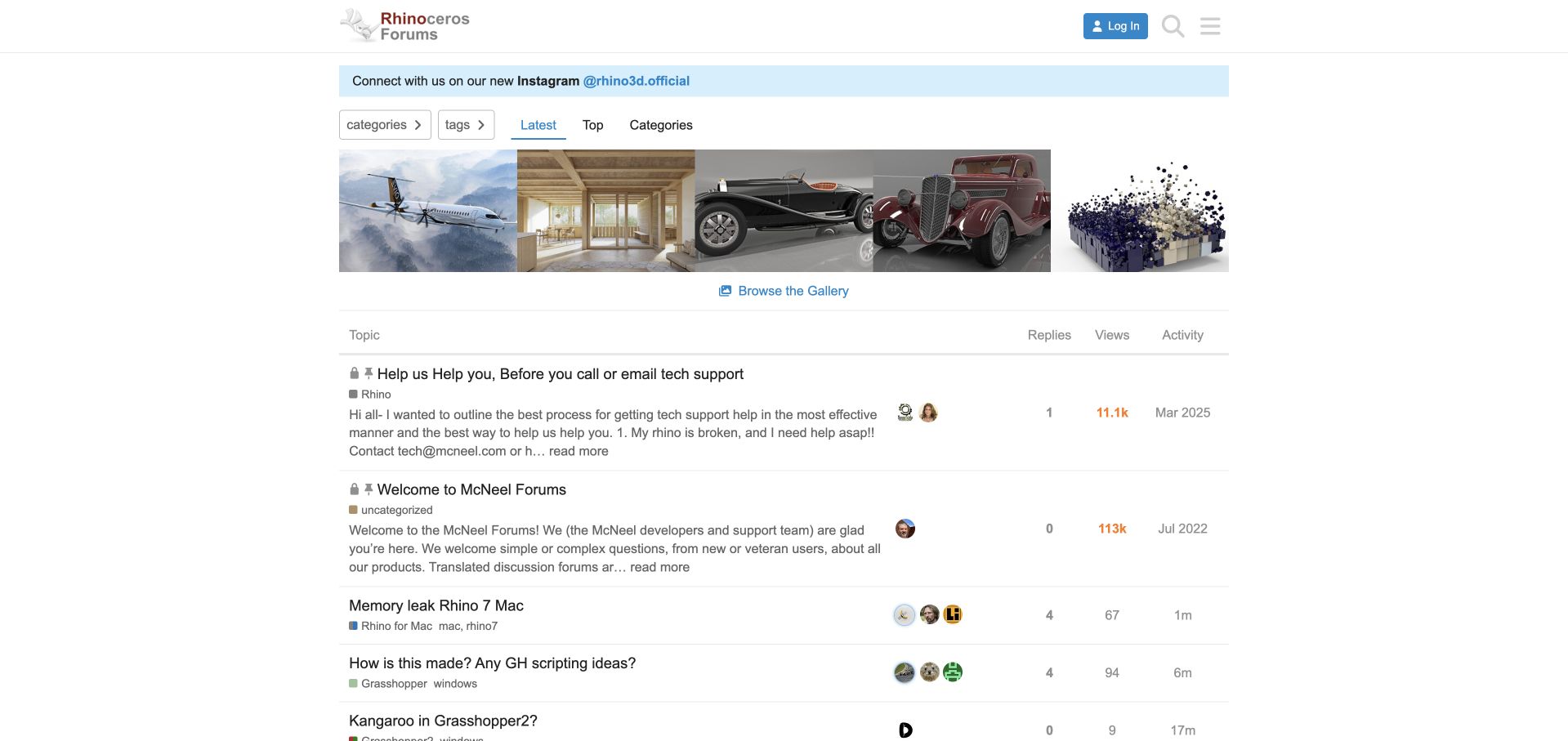
McNeel’s Rhino Forums places a gallery strip above the discussion list, followed by pinned guidance about obtaining useful technical support and joining the community. Category and activity controls remain above the imagery, while a simple header provides identity and account access. The page connects examples of finished work with a practical help environment. The original source observation establishes Discourse on the public forum. Ember is a documented platform dependency, not evidence about Rhino’s modeling application, rendering tools or private customer systems.
What you can learn
In a specialist creative application, inspiration and support can reinforce one another when their roles are explicit. Give the gallery a bounded place, keep the discussion controls recognizable, and use concise orientation topics to explain what makes a useful request for help.
Pros
The gallery introduces the range of work discussed without replacing the forum’s main controls.
Pinned support guidance provides context before visitors encounter a long list of specific technical questions.
Cons & considerations
Multiple pinned introductions can occupy substantial space before current discussions become visible.
A gallery needs a clear destination and descriptive context so images function as more than decoration.
Platform source: Official Discourse project: Ember.js frontend. McNeel Rhino Forums public forum frontend: Ember.js is an expected dependency through the retained Discourse platform observation dated 2026-11-07; not independently observed. The dependency relationship was reviewed against the official Discourse project on November 10, 2026. Expected dependency of the independently documented Discourse public forum; not independently observed Ember runtime. The official Discourse project identifies its frontend as an Ember.js application. This does not identify an installed Ember version or extend to the organization’s main site, private backend or other products. Original forum observations and captures retain their earlier dates. Platform evidence is separate from the direct website screenshot and is not a complete current infrastructure audit.
Kegan has 15+ years of experience working with small businesses, Fortune 500 companies, and everything in between. No development job is too big or too small: he brings the same hands-on attention to a focused improvement, a complete website, or a custom application.
For Ember.js projects, he can help with responsive interfaces, reusable components, custom functionality, API connections, and performance-minded implementation. He works directly with clients on scope, design, implementation, testing, and handover, with an emphasis on clear communication and a system that remains practical to maintain after launch.
Show 3 other Ember.js developersHide other Ember.js developers
Choose an Ember.js approach around the application you need
Extend an established platform within its boundaries
If the required experience fits an existing platform, begin with its supported customization model. Discourse offers themes and components for its frontend; use the platform’s guidance to understand which changes can be maintained safely. Keep custom presentation separate from assumptions about private server behavior. Define what must survive upstream updates and verify those tasks when the platform changes. A consistent public identity should not require duplicating every part of an application’s established navigation and interaction model.
Build a dedicated application around durable tasks
For a custom application, start with a small number of complete tasks rather than a large catalog of screens. Identify the information needed for each step, the state that must persist and the destinations people may share. Plan the transitions between reading and acting, including what remains useful without an account. Give each task a coherent success and failure path. Choose component and service boundaries that the team can explain and maintain as requirements evolve.
Improve an existing Ember application incrementally
For an established application, identify the workflows that cause confusion before proposing a broad replacement. Inventory routes, integrations, recurring interface elements and areas with unclear ownership. Improve a bounded task while preserving useful behavior and public destinations. Keep dependency work separate from speculative visual changes so the effect of each release is understandable. A framework association in another organization’s forum is design context, not evidence that your own application should adopt the same architecture.
From references to requirements
Plan the states around the screen
Describe discovery and direct arrival together
A visitor may begin with a search query, a saved link, a category or a shared discussion. Describe each arrival with representative content and make the current location understandable. Decide which filters and view choices belong in the public URL and which information should remain private. Check that a useful page does not require an unexplained sequence of earlier interactions. Persistent navigation should support orientation without consuming so much space that the actual content becomes secondary.
Use real content to define component limits
Gather examples of short and long titles, empty categories, missing images, translated labels and unusually active discussions. Decide how each recurring element handles them before treating the layout as complete. Establish which metadata helps a person choose and which can be revealed later. Do not assume that every number deserves equal visual weight. The forum examples show how small differences in descriptions, previews and grouping can change the experience even within a shared application model.
Verify transitions and maintenance responsibilities
A finished screen is only one state of an application. Check loading, empty results, unavailable services, invalid input and changes in access. Decide how people recover without losing useful context. Record ownership of dependencies, content and integrations, and preserve dated evidence when reviewing another site. A screenshot proves what was visible at one moment; it does not establish every interaction, current version or private system behind the interface. Release checks should reflect the tasks people actually rely on.
A useful handover demonstration
Ask the actual team to carry out its routine job: publish a realistic update, correct a mistake, preview a narrow screen, and identify who owns an integration failure. For a library or frontend framework, also ask who maintains the content source and deployment. A polished screenshot does not answer those operational questions.
Beyond the screenshot
A practical Ember.js application checklist
Define the main tasks and the information needed to complete them.
Label the active view, sort mode, category and relevant time period clearly.
Plan direct URLs, reload and back navigation alongside visible controls.
Define recurring components with realistic content and missing-data states.
Separate local component behavior from shared application responsibilities.
Document public reading, account access and participation boundaries.
Provide useful loading, empty, invalid and unavailable states.
Keep temporary promotions separate from stable navigation and content.
Check keyboard access, focus behavior and understandable control labels.
Assign dependency maintenance, integration support and release-verification ownership.
Test with real content, a keyboard, a small screen, slow or failed requests, and the people who will maintain the system. These are planning checks, not an accessibility, security, performance, or search-ranking certification.
Sources & editorial method
How this Ember.js collection was reviewed
Twenty distinct public forum properties were selected for the original November 9 evening batch. Stable authoring facts came from the existing Discourse research, preserving each direct November 7, 2026 screenshot, exact capture instant, source URL, image bytes and original platform-evidence date. All twenty retained images were visually inspected for this new collection. The broad audit records retain their November 8 observations: nineteen checked and one unavailable, with no rescan or retry. Discourse’s official project documentation was reviewed on November 10 and identifies Ember.js as its frontend framework. This is recorded as an expected platform dependency, not independently observed current Ember runtime, an exact installed version or a complete backend inventory. Twenty new original reviews and the guide content were authored on November 10. The Ember company logo wall was not used as public-homepage proof. No forms, accounts, votes or messages were submitted. This guide is unaffiliated with the Ember project; Ember is a trademark of Tilde Inc., and its mark does not imply endorsement.
Every image is an unmodified capture from the actual website, with its source and capture date. Some captures are reused from our shared catalog; their dates remain the original capture dates. None comes from a vendor gallery or a generated reconstruction. Moving imagery and live content can change.
Technology attribution uses public page assets or metadata, official platform documentation, or a cited first-party project case study. Documentary and framework-relationship evidence is identified where used; it is not a complete current backend inventory. A CMS image CDN alone does not establish a full CMS deployment. A library’s presence does not prove which individual controls use it, and a platform label does not establish AI authorship.
The composition notes, lessons, pros and tradeoffs are original editorial observations. We have not measured conversion, traffic, security, performance or accessibility conformance. Website owners retain their brands and imagery; these examples are not our client portfolio. Written, Edited and Curated are independent records, not dates advanced by a build. See our editorial standards or suggest a correction.
Questions worth asking
Ember.js website development FAQs
How is Ember.js associated with these twenty websites?
Each named public forum has retained direct evidence of Discourse. The official Discourse project identifies its frontend as an Ember.js application. This guide therefore records an expected framework dependency through Discourse, rather than claiming a newly observed Ember runtime on every property.
Does this mean the brands’ main products use Ember?
No. The evidence is limited to the named public forum. It does not establish the technology of corporate websites, native applications, games, payment systems, infrastructure or other products linked from those communities.
Why reuse earlier screenshots?
The existing captures are genuine direct images of the exact public properties being discussed. Their original dates, source URLs and bytes are preserved. The new reviews examine those recorded designs from an application-interface perspective; they do not claim that the images were captured again.
Why not rely on Ember’s company logo wall?
The official page explains that listed organizations may use Ember somewhere other than their main web properties. A company-level association alone is therefore insufficient to identify a public website implementation. This collection uses the more specific Discourse relationship instead.
What does the unavailable Cloudflare Community audit mean?
The retained bounded broad scan could not establish a complete new observation. Its unavailable status remains unchanged. Earlier direct Discourse evidence is still dated and qualified, and no access control was bypassed or scan retried for this guide.
What should guide an Ember application design?
Start with useful tasks, clear application state, durable destinations and consistent recurring components. Plan how local interaction relates to shared state and trusted services. A successful screenshot is only one part of the experience; loading, failures, account boundaries and maintenance also need deliberate design.
Borrow the clear application states, useful navigation and deliberate component patterns in these public communities. Keep the framework evidence scoped to the forum frontend, and build around the tasks and maintenance responsibilities of your own application.