Best Eleventy Websites of 2026 (20 Real-World Examples)
Eleventy publishing patterns, from engineering archives to component documentation
Twenty real public properties show how Eleventy-associated sites organize documentation, editorial collections, product explanations, and long-lived archives. Associations are property-specific and may be documentary rather than detectable in the delivered HTML.
Eleventy generates web pages from templates, content, and data. That makes the content model and publishing workflow more important decisions than a particular visual style. The examples here range from restrained engineering archives to animated product pages; static generation does not prescribe either appearance.
The opening properties are Google’s V8 publication, Font Awesome Blog, Getty Quire, ESLint, and Lit. Official repositories and the Eleventy showcase connect the named properties to the generator; Font Awesome Blog also declares Eleventy in its current public metadata. Those records do not identify every embedded application or establish that an entire organization uses the same stack. The 18F and Atom community examples are explicitly preserved or archived properties, not claims of current institutional product support.
Before the examples
What makes good Eleventy website development in 2026?
Model the collection before designing the archive
Choose the fields that make a document useful outside its original page: title, description, date, edition, topic, owner, and status. V8’s article tags and Blog Awesome’s product filters show why these fields should not live only inside free-form prose.
Publish headings, useful navigation, and the core explanation as readable HTML. GSAP’s animation layer and Web Awesome’s component demonstrations have different responsibilities from the surrounding document. Test the initial frame and reduced-motion state as real designs.
Make publishing context visible
Versioned documentation, event editions, and preserved archives need explicit labels. Pelican’s previous-edition link and the 18F archive banner address different situations, but both prevent historical content from silently presenting itself as current guidance.
The collection · 20 examples
20 Eleventy website examples worth studying
These are distinct public properties with direct browser captures. Official showcase or repository associations are distinguished from live generator markers; interactive components and linked subproperties are not automatically attributed to Eleventy.
We start with five recognizable brands or organizations: Google V8, Font Awesome — Blog Awesome, Getty Quire, ESLint, Lit. Each attribution applies to the named website property, not every product or website belonging to its organization. This is a curated reading sequence, not a measured ranking.
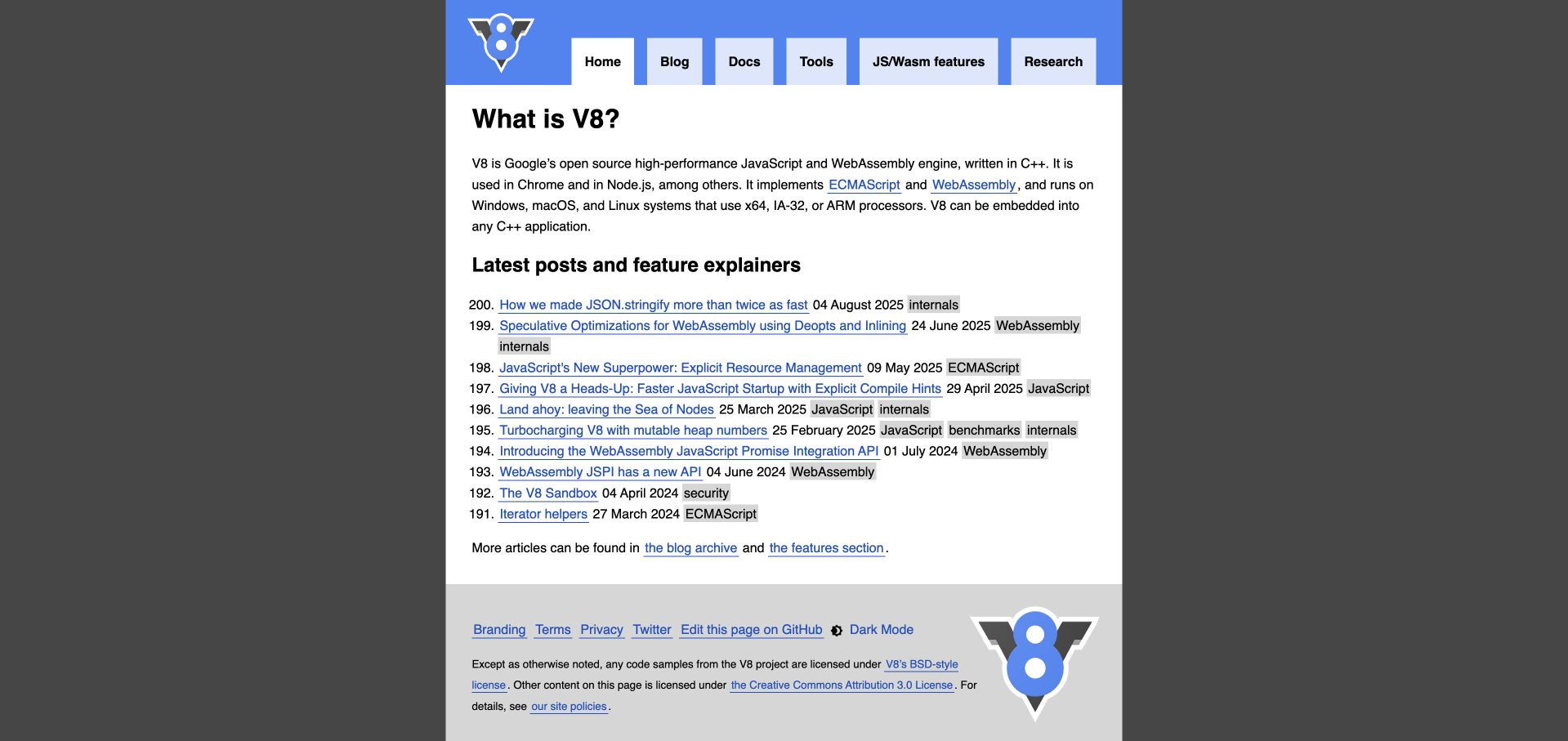
V8 gives its homepage to a brief explanation of the engine and a dated list of technical articles. The blue masthead, tabbed navigation, and restrained reading column make this feel like a maintained engineering publication rather than a product launch. Tags sit directly beside headlines, while the archive and language-feature collections provide separate routes into older material. The footer keeps licensing and editing links visible.
What you can learn
Borrow the distinction between a short orientation and a substantial archive. An Eleventy collection can generate dates, topic links, and archive pages from the same article records, but the taxonomy still needs editorial ownership as terminology changes.
Pros
Article dates and subject tags help returning readers distinguish a new implementation note from a general introduction.
The visible GitHub editing link connects published documentation to an understandable contribution route without interrupting ordinary reading.
Cons & considerations
The compact, mostly textual opening expects visitors to recognize technical topics before choosing an article to read.
A long chronological archive also needs useful topic destinations so older foundational explanations remain discoverable over time.
Visible tech stack
Earlier / documented evidence
Eleventy
Platform source: Official property-level Eleventy association. The official V8 website repository includes Eleventy configuration for v8.dev. Platform evidence is separate from the direct website screenshot and is not a complete current infrastructure audit.
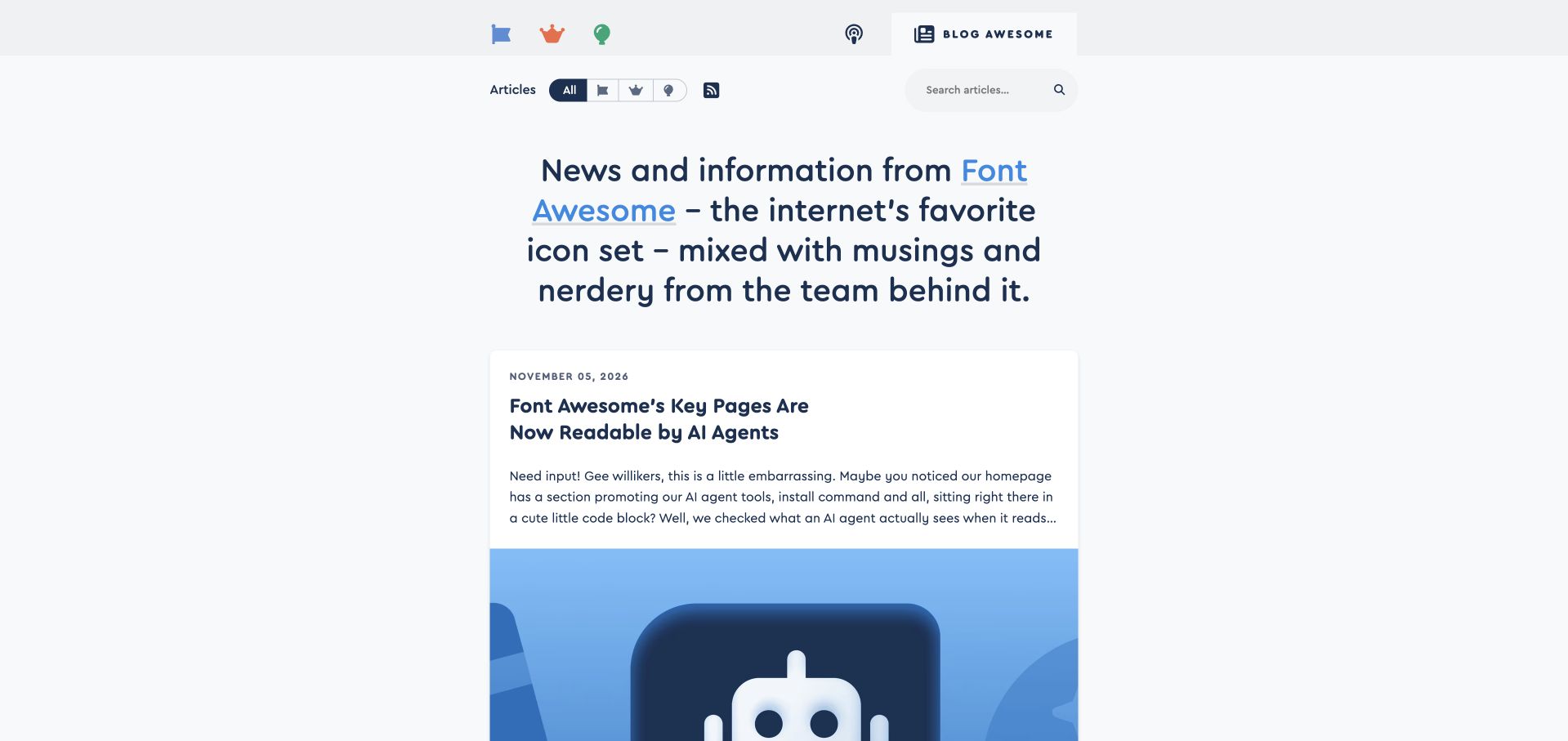
Blog Awesome gives related products a compact upper navigation band, then places article filters, search, and the publication introduction in a centered reading layout. Article cards display a date, a strong title, an excerpt, and supporting imagery. Product-specific filters distinguish Font Awesome, Web Awesome, and Build Awesome rather than creating separate disconnected editorial sites. The visual personality comes through rounded typography and iconography while the basic reading structure remains familiar.
What you can learn
Keep publication identity and product taxonomy as separate layers. Eleventy can generate filtered archives from front matter, but an article still needs a stable canonical address and a useful description when it appears in several navigation contexts.
Pros
The article filters acknowledge distinct product audiences while keeping a unified publication and a consistent set of reading patterns.
Dates and excerpts give returning readers useful context about recent changes before they commit to opening a full article.
Cons & considerations
A large introductory statement pushes the latest article lower on the first screen, which may slow a frequent reader’s scanning task.
Several related product names can be difficult to distinguish until navigation labels and article metadata explain their different roles consistently.
Platform source: Official property-level Eleventy association. The official Eleventy showcase independently names blog.fontawesome.com, and that exact public blog currently declares Eleventy v3.1.7 in its generator metadata. The association is limited to this publication, not every Font Awesome property. Platform evidence is separate from the direct website screenshot and is not a complete current infrastructure audit.
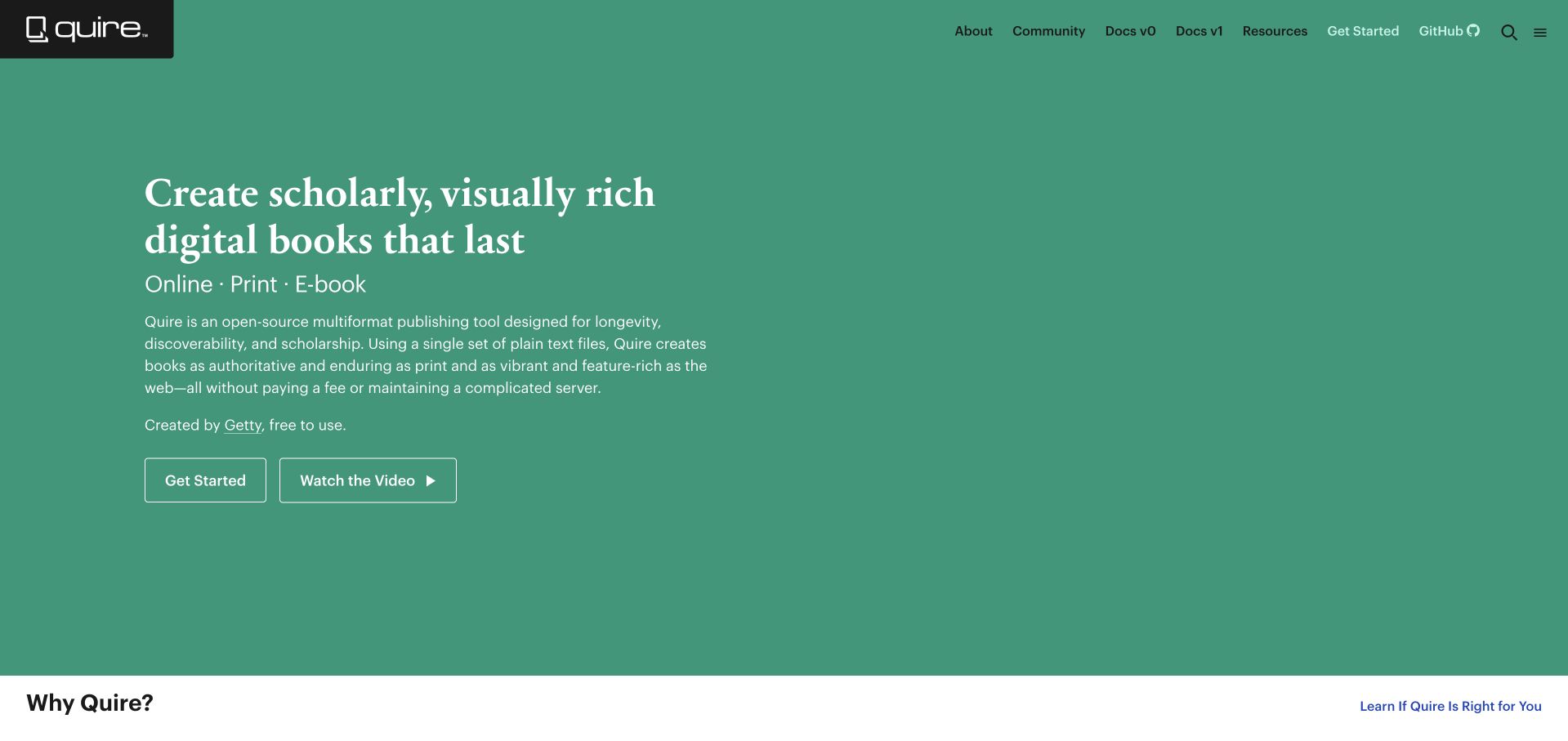
Quire leads with the kinds of publications it enables, then explains its plain-text, multiformat approach in a narrow text column. The green opening uses typography instead of a complicated interface demonstration. Two different documentation versions remain explicit in the header, alongside community resources and a prominent getting-started link. Further down, publication examples identify their institutions and formats, helping readers see how a technical tool becomes a finished scholarly object.
What you can learn
Make the output understandable before explaining the pipeline. For an Eleventy-based publishing project, separate the public product explanation, versioned author documentation, and actual publications so readers do not mistake one edition's instructions for another.
Pros
The opening identifies online, print, and e-book outcomes in language that is useful to editors as well as developers.
Named publication examples turn an abstract static-publishing proposition into recognizable institutional use cases and concrete reading destinations.
Cons & considerations
The broad promise of durable publishing still requires a separate explanation of maintenance responsibilities and preservation practices.
Two documentation versions create a choice that newcomers must resolve before confidently following installation or authoring instructions.
Platform source: Official property-level Eleventy association. The official Eleventy showcase names quire.getty.edu; the association applies to the Quire publishing-tool website, not every Getty property. Platform evidence is separate from the direct website screenshot and is not a complete current infrastructure audit.
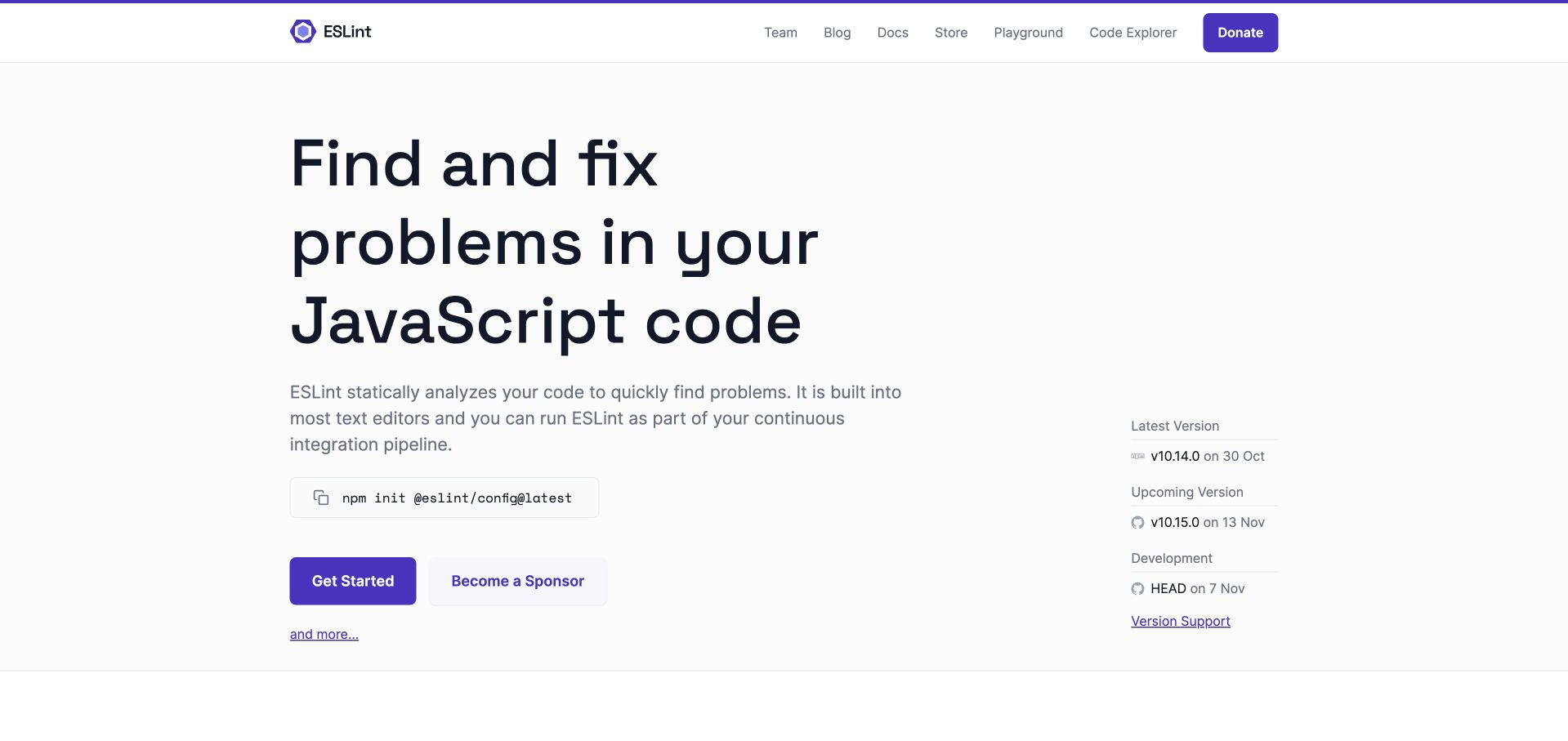
ESLint combines a large problem-focused headline with a copyable installation command and a clearly distinguished getting-started button. Release information occupies a compact adjacent column rather than taking over the page. Documentation, playground, and code explorer links sit together in the header, while sponsorship is offered as a separate action. The result supports both someone evaluating the tool and an experienced developer who only needs the current entry point.
What you can learn
Keep adoption tasks close to the explanation, then model releases separately from promotional content. Eleventy data files can support current and upcoming versions, but those records need a reliable update process rather than being repeated manually across templates.
Pros
The command is presented as a usable interface element instead of being buried in a paragraph of setup prose.
Distinct documentation and interactive exploration links acknowledge that readers learn through both reference material and working examples.
Cons & considerations
The animated headline needs a complete readable resting state because an early capture can show only partial words.
Installation, sponsorship, releases, and project navigation compete for attention unless their visual hierarchy stays carefully restrained.
Platform source: Official property-level Eleventy association. The official ESLint website repository identifies eslint.org and includes its Eleventy configuration. Platform evidence is separate from the direct website screenshot and is not a complete current infrastructure audit.
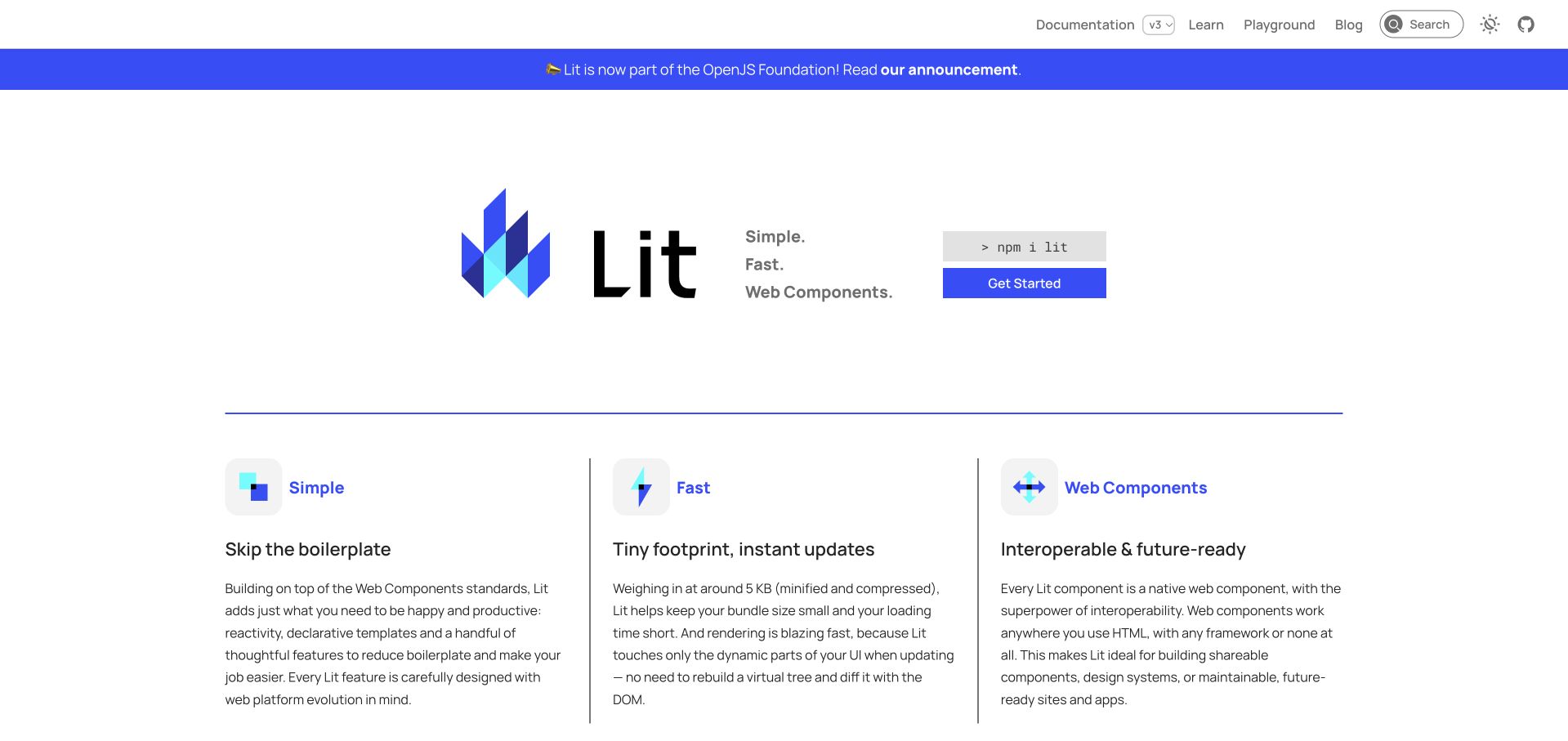
Lit places its mark, a three-part proposition, an installation command, and a getting-started route in a generous white opening. The next row explains simplicity, speed, and web components as separate ideas, with rules dividing the columns. A foundation announcement is visible but contained in a narrow strip. Below the opening, a code-and-explanation section connects the proposition to an actual component rather than leaving visitors with slogans alone.
What you can learn
Use a compact conceptual model to organize the page, then prove it with material readers can inspect. Eleventy can publish the explanatory shell while interactive examples remain separate components; those layers should not be described as the same technology.
Pros
The three-column explanation creates a memorable structure for a technically unfamiliar product without hiding its standards-based context.
Version selection, search, learning material, and playground access are all available from the same restrained primary navigation.
Cons & considerations
The large logo and generous opening spacing postpone some of the practical detail until readers move farther down.
Claims about bundle size or rendering behavior require their own technical context and should not become blanket site-performance promises.
Platform source: Official property-level Eleventy association. The official Lit website repository documents its Eleventy build tools and production content build. Platform evidence is separate from the direct website screenshot and is not a complete current infrastructure audit.
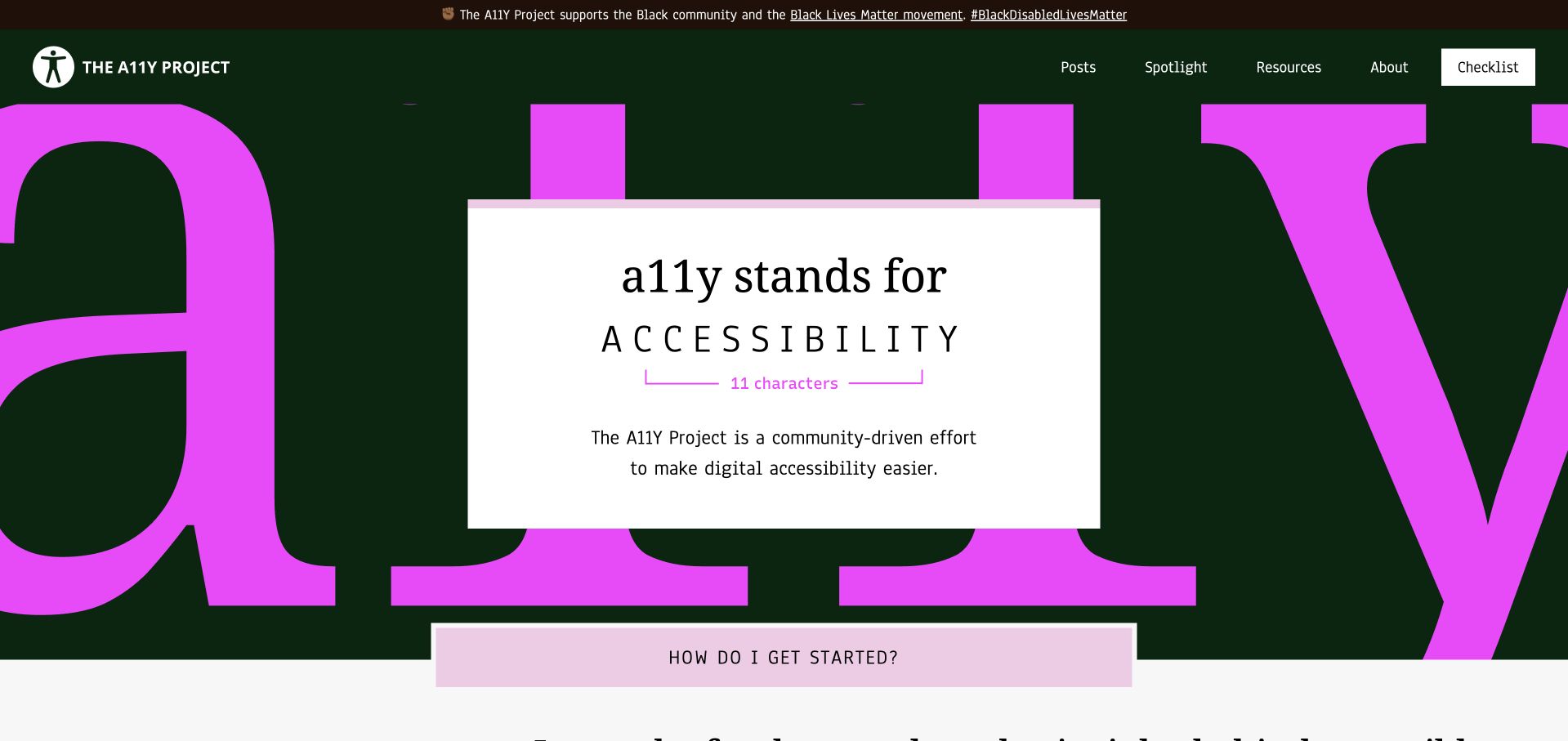
The A11Y Project makes its name understandable with an oversized typographic illustration showing how the abbreviation is formed. A centered explanatory panel sits over the graphic, and a wide getting-started link provides the next step. The header separates posts, community spotlights, resources, background information, and the checklist. Lower-page sections group learning, auditing, and community activity, giving the site more structure than a reverse-chronological accessibility blog would provide.
What you can learn
Explain insider language before using it as navigation. An Eleventy resource collection benefits from explicit content types and a small set of task-based landing pages; the same article can support several reader journeys without needing duplicate copies.
Pros
The numeronym explanation turns a potential naming obstacle into a distinctive and relevant part of the visual identity.
The checklist has its own persistent navigation treatment, making a practical recurring task easier to locate on return visits.
Cons & considerations
The large opening artwork occupies substantial vertical space before the detailed resource collections come into view for readers.
A resource directory needs continuing editorial review because external courses, links, and accessibility guidance can become outdated independently.
Platform source: Official property-level Eleventy association. The official Eleventy showcase names this exact public property; this is a documentary generator association, not a complete current runtime inventory. Platform evidence is separate from the direct website screenshot and is not a complete current infrastructure audit.
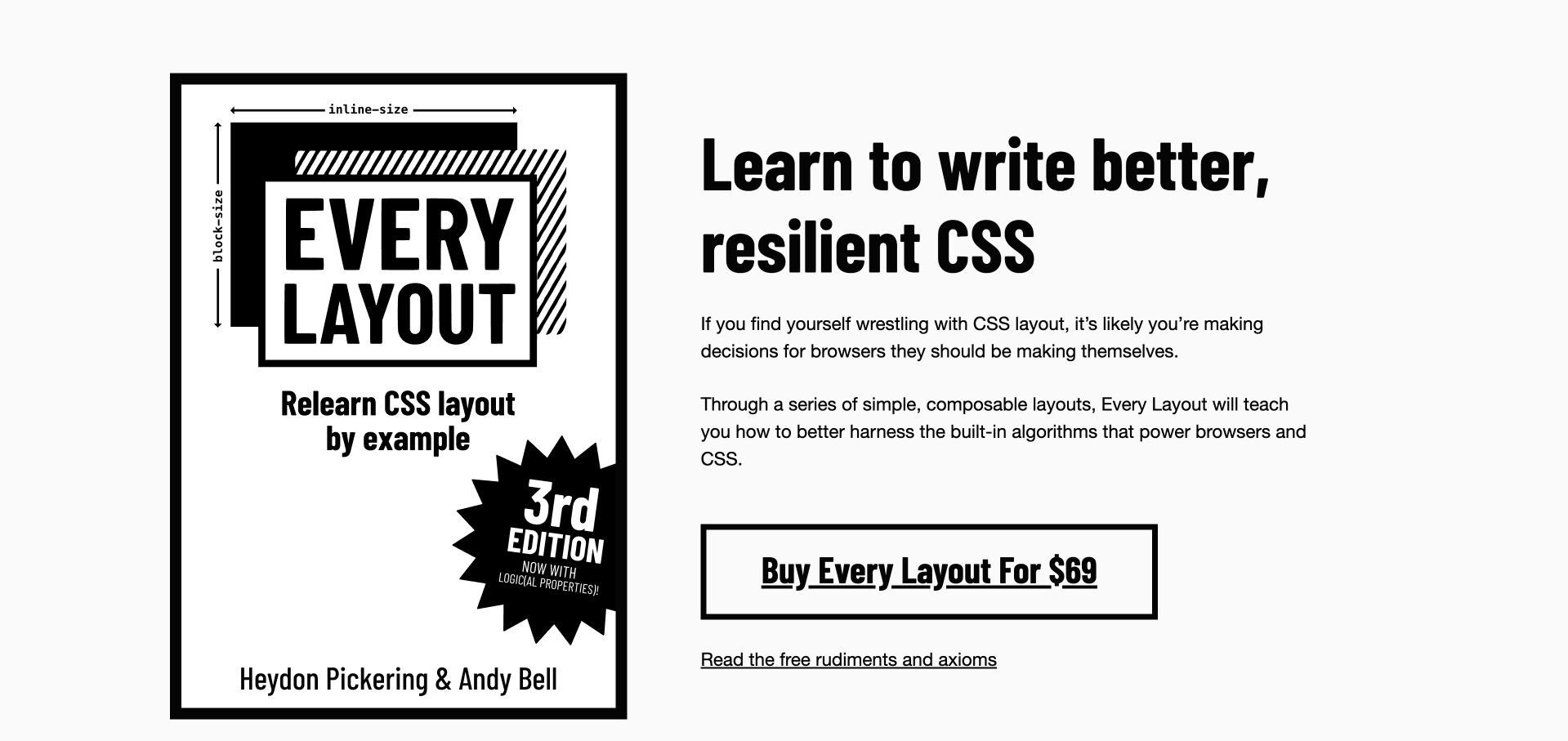
Every Layout presents a large book cover beside a direct explanation of the CSS problems the material addresses. The purchase action is visually dominant, but the free introductory material remains a plainly underlined alternative beneath it. The third-edition label is part of the cover, and named authors reinforce that this is a specific authored publication. Supporting testimonials and organizational logos appear later, after the basic product and learning proposition have been established.
What you can learn
Give evaluation content a real place beside the transaction. Eleventy is suitable for the public chapters and product explanation, while purchase and access recovery can remain separate services with clearly described ownership and failure handling.
Pros
The cover, edition marker, and author names make a digital educational product feel like a defined publication with scope.
The free-reading link gives uncertain visitors a useful next step without forcing an immediate purchase or account decision.
Cons & considerations
The strong purchase framing may overshadow the distinction between included chapters, components, updates, and other product materials initially.
Access recovery is a separate workflow that should be tested beyond the public landing page before judging the complete experience.
Platform source: Official property-level Eleventy association. The official Eleventy showcase names this exact public property; this is a documentary generator association, not a complete current runtime inventory. Platform evidence is separate from the direct website screenshot and is not a complete current infrastructure audit.
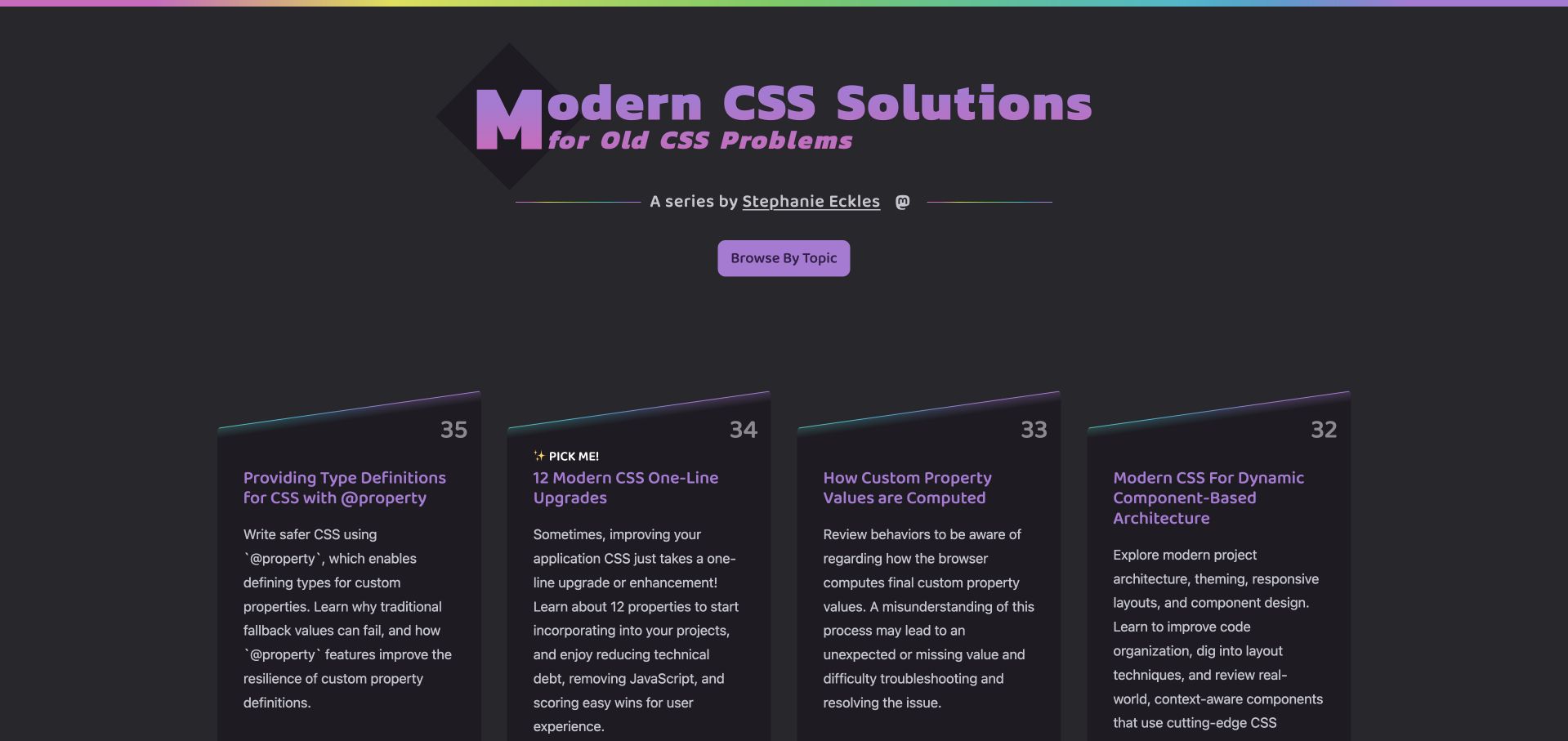
Modern CSS Solutions uses a dark canvas, purple typography, and subtly angled article panels to give a long-running tutorial series a coherent identity. The heading states both the subject and the practical problem-solving angle. Author attribution and topic browsing sit above numbered articles, whose descriptions explain the concepts covered before a reader clicks. A related smaller-snippet project is introduced within the collection rather than disguised as another article in the sequence.
What you can learn
Make a series understandable as a series. Numbering, topic metadata, and concise descriptions can come from structured Eleventy content, but the visual hierarchy should still let readers choose by problem rather than assuming everyone begins with the first installment.
Pros
Article descriptions provide enough technical context to judge whether a lesson addresses a current implementation problem before opening it.
The visible author and consistent presentation connect individual tutorials to an identifiable editorial perspective and broader body of work.
Cons & considerations
Perspective effects and narrow cards need careful responsive testing so long technical titles do not become awkward to scan.
A numbered series can imply a prescribed reading order even when some tutorials are useful as independent references.
Platform source: Official property-level Eleventy association. The public page declares Eleventy in its generator metadata. Platform evidence is separate from the direct website screenshot and is not a complete current infrastructure audit.
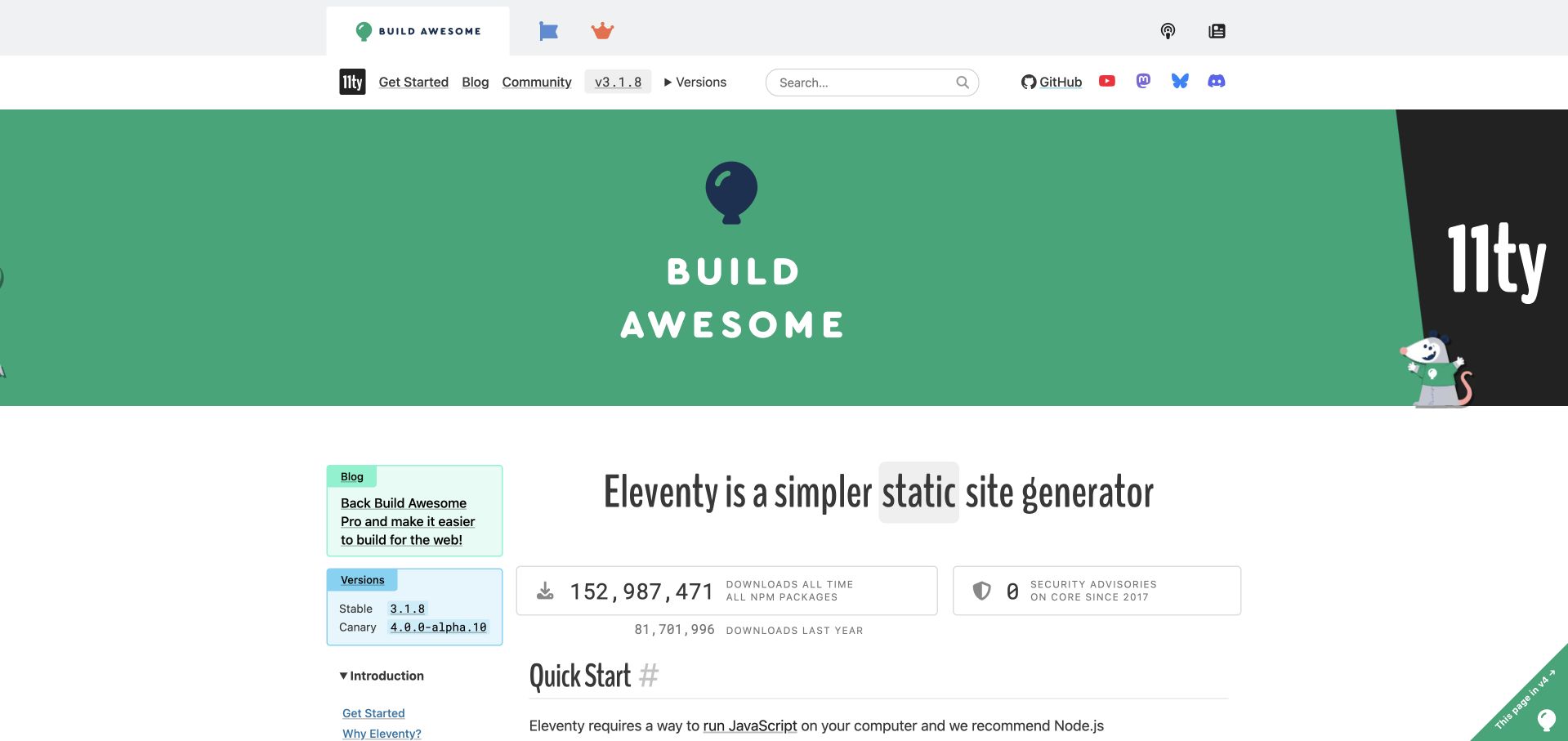
Eleventy's own site places project identity, stable and experimental release information, search, and getting-started navigation around a documentation-led layout. A green illustrated banner introduces the current Build Awesome identity, while the main column moves quickly into a practical introduction. The sidebar exposes a large amount of supporting material, and the wider page contains examples, project rationale, and community links. It is an example of documentation and advocacy sharing one publishing system.
What you can learn
Decide which parts of a project homepage should behave like reference material. An extensive Eleventy site can share templates and navigation across marketing and documentation, but users still need to distinguish stable guidance, experimental releases, and community contributions.
Pros
Stable and canary releases are visibly separated, helping technically confident visitors avoid confusing experimental software with the recommended version.
Search, sidebar navigation, and direct getting-started links accommodate several levels of familiarity without requiring a separate marketing journey.
Cons & considerations
The combination of project branding, release details, metrics, and a deep sidebar can make the initial screen visually busy.
A changing product identity needs careful explanatory copy so existing Eleventy readers recognize continuity rather than assume an unrelated tool.
Platform source: Official property-level Eleventy association. The public page declares Eleventy in its generator metadata. Platform evidence is separate from the direct website screenshot and is not a complete current infrastructure audit.
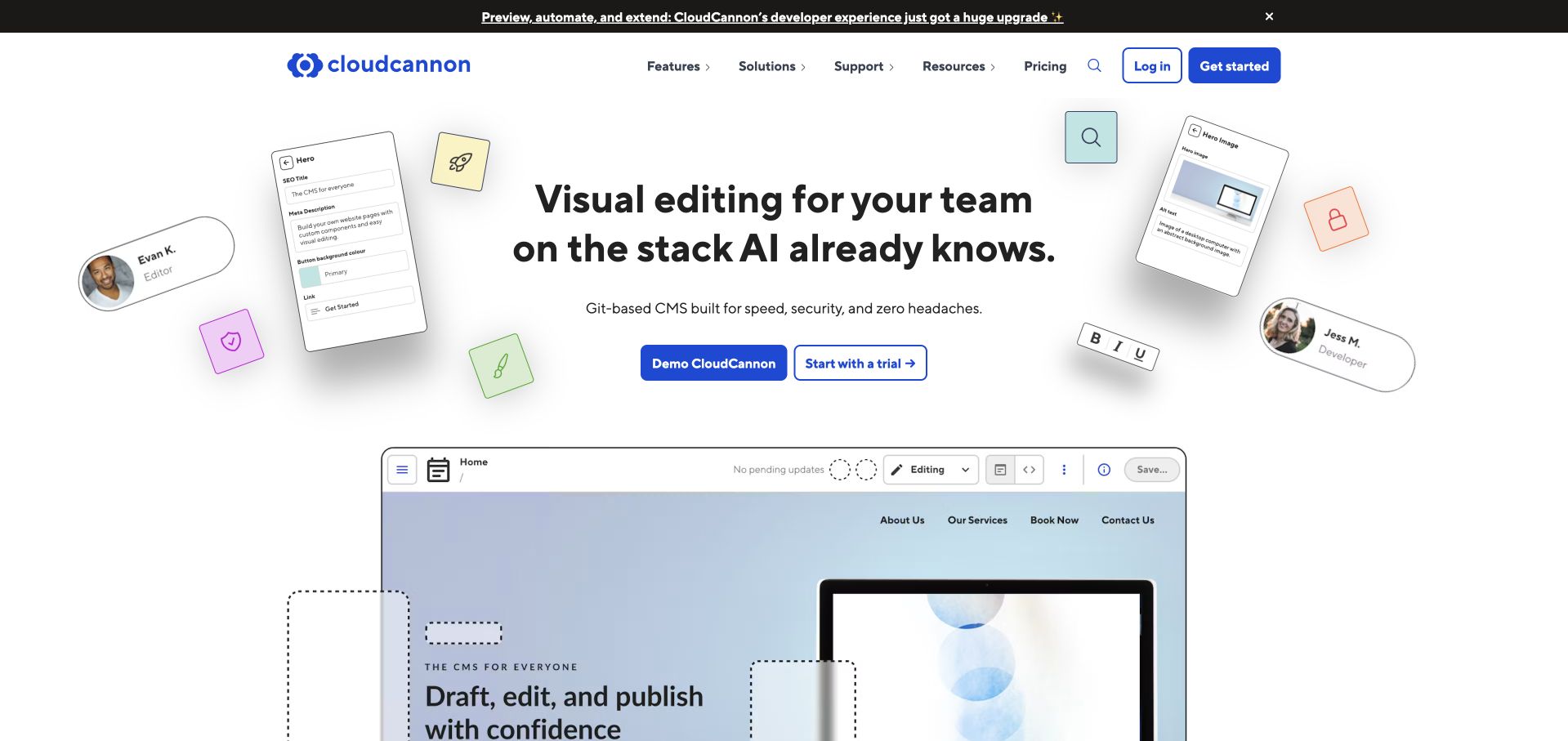
CloudCannon centers a plain-language editing proposition above a large product interface image. Floating field and collaborator illustrations extend the explanation without replacing the central software view. Trial and demonstration routes are paired, while the navigation distinguishes features, solutions, support, resources, and pricing. Framework links below the hero acknowledge the technical audience, but the opening language speaks first to the people who need to update and publish content.
What you can learn
Match the explanation to both sides of a publishing workflow. On an Eleventy marketing site, concrete interface imagery and editorial language can coexist with deeper implementation references, provided supported frameworks are not confused with the technology of every customer property.
Pros
The main illustration shows editing controls in context, making an otherwise abstract content-management proposition easier to understand visually.
A trial and a demonstration offer different evaluation routes without burying either option inside a large navigation menu.
Cons & considerations
Decorative interface fragments need clear hierarchy so visitors can tell which image is the actual product and which is illustration.
Framework compatibility does not establish a customer’s implementation, so case studies need their own property-specific technical evidence and dates.
Platform source: Official property-level Eleventy association. The official Eleventy showcase names this exact public property; this is a documentary generator association, not a complete current runtime inventory. Platform evidence is separate from the direct website screenshot and is not a complete current infrastructure audit.
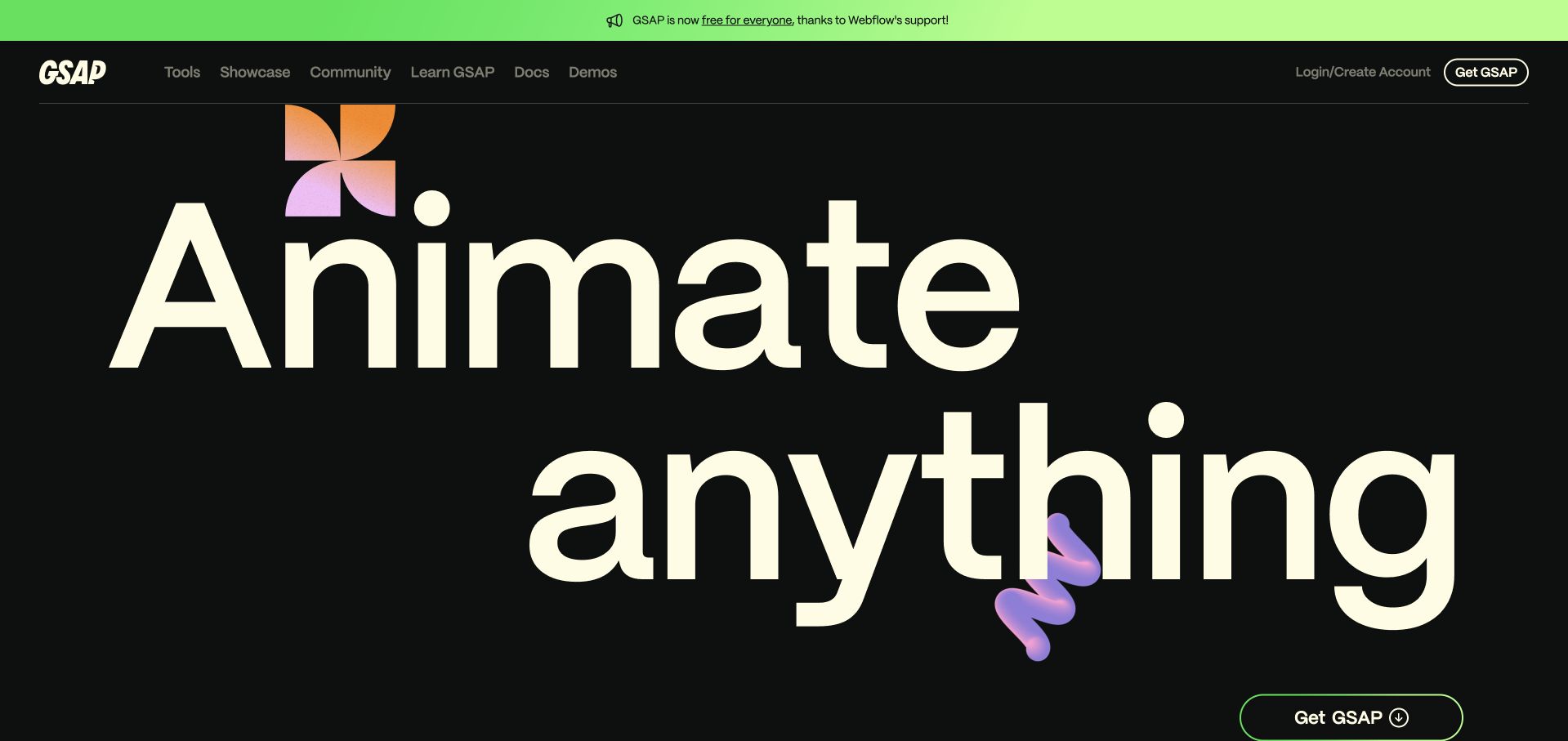
GSAP uses a dark stage, a large animated headline, and vivid green accents to make motion the subject of the opening. The header offers tools, examples, community material, learning, and documentation without requiring an account first. Lower sections divide the library's possibilities into scrolling, SVG, text, and interface interactions. This is a public marketing and documentation property, not evidence that every showcased brand uses the same generator or complete frontend stack.
What you can learn
Treat animation as a progressive layer around a readable document. Eleventy can generate the content and example taxonomy while GSAP handles movement; the reading order, reduced-motion state, and useful first frame still need deliberate design.
Pros
The product categories translate a broad animation library into recognizable creative tasks rather than an undifferentiated catalogue of APIs.
Documentation and examples remain direct destinations in the main navigation for visitors who already understand what the library does.
Cons & considerations
The animated opening can initially appear sparse while the headline resolves, making first-frame and reduced-motion design especially important.
Showcase imagery is inspiring but cannot by itself explain implementation difficulty, accessibility behavior, or the maintenance effort behind an effect.
Platform source: Official property-level Eleventy association. The official Eleventy showcase names this exact public property; this is a documentary generator association, not a complete current runtime inventory. Platform evidence is separate from the direct website screenshot and is not a complete current infrastructure audit.
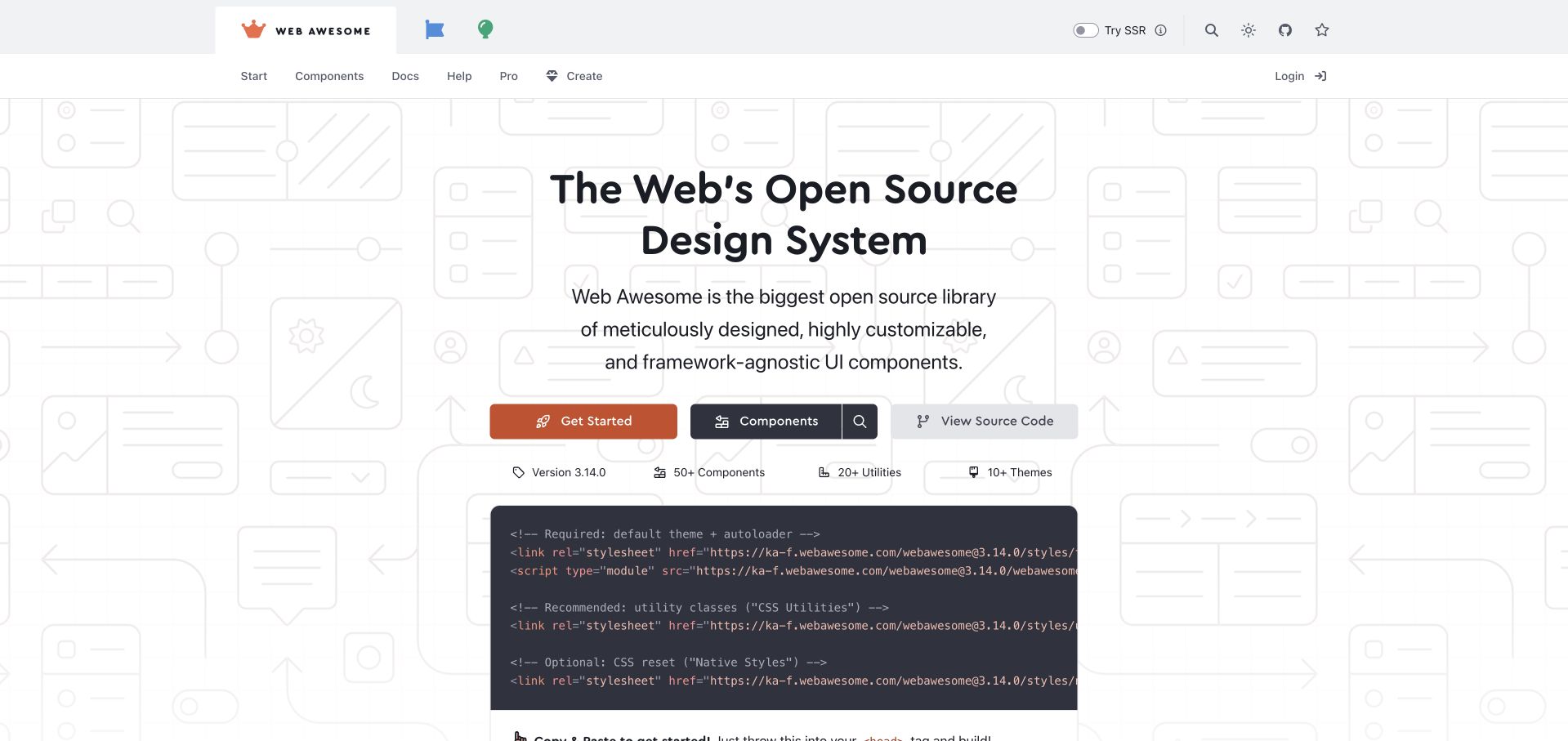
Web Awesome brings its design-system proposition, component browsing, source code, release information, and a quick-start snippet into the same opening sequence. A pale pattern of interface shapes gives the page character without obscuring the text. The header includes search and an explicit server-rendering demonstration toggle, while product-family links are kept in a separate upper band. The site feels like a usable reference entrance rather than a brochure that delays technical detail.
What you can learn
Keep the documentation shell distinct from the component system being documented. An Eleventy build can publish examples and reference pages while custom elements provide demonstrations; test the generated document and the enhanced states separately.
Pros
The installation snippet follows the main explanation immediately, allowing a reader to move from evaluation to a concrete next step.
Component browsing and source access are both prominent, supporting visual exploration as well as inspection by experienced implementers.
Cons & considerations
Several product-family links and utility controls make the upper navigation comparatively dense before readers have learned the main offering.
An interactive rendering toggle needs an understandable state and explanation so a demonstration does not masquerade as a site-wide guarantee.
Platform source: Official property-level Eleventy association. The official Eleventy showcase names this exact public property; this is a documentary generator association, not a complete current runtime inventory. Platform evidence is separate from the direct website screenshot and is not a complete current infrastructure audit.
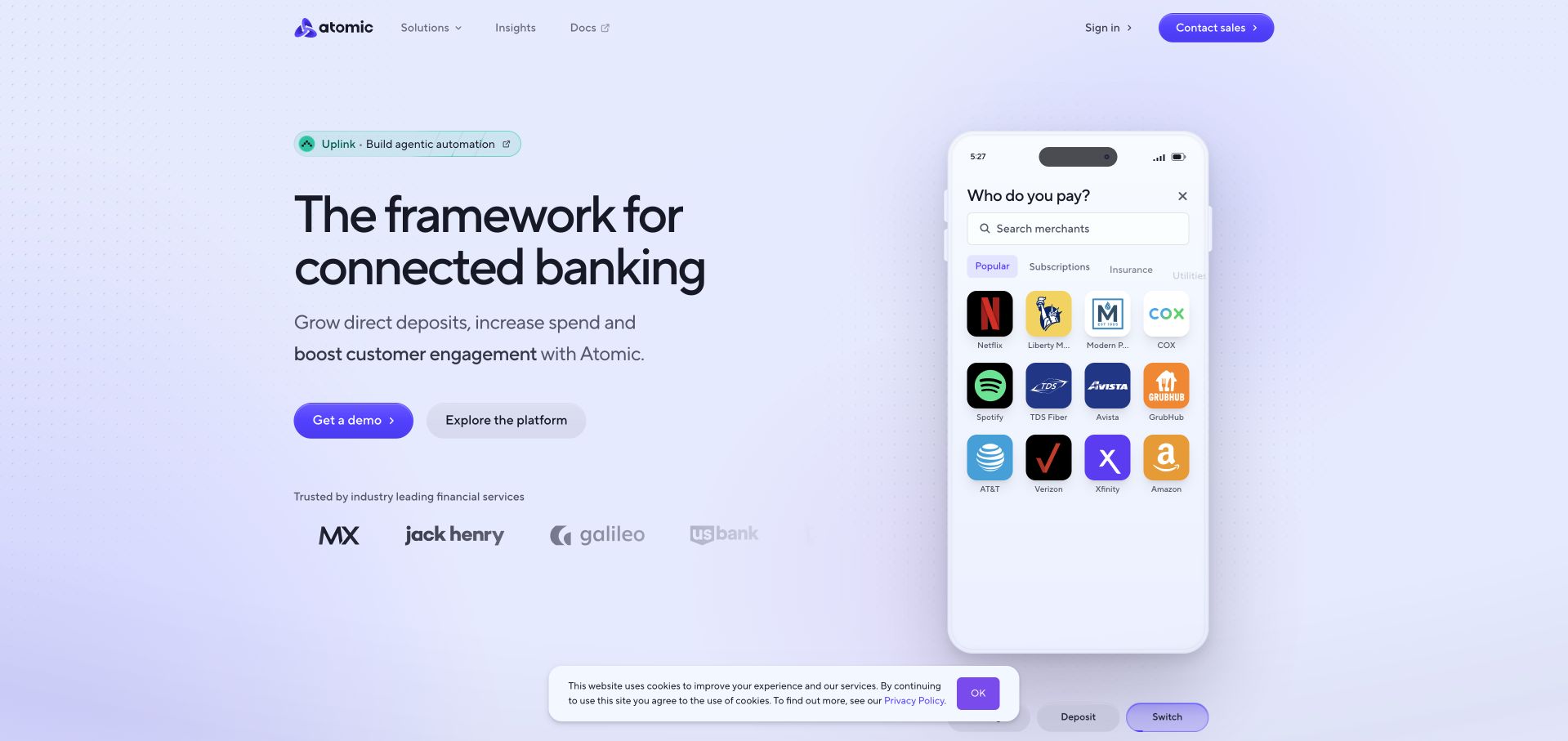
Atomic's opening combines a short connected-banking proposition with a phone-shaped product demonstration and two distinct evaluation routes. The pale violet background and subdued dotted texture make the large headline the primary anchor. Customer logos sit below the introductory copy, while the next section separates subscription management, deposits, payment switching, and authentication. The public marketing site is the documented Eleventy property; it does not reveal the implementation of private banking integrations or customer applications.
What you can learn
Translate infrastructure into tasks before asking visitors to study architecture. Eleventy page data can organize related solutions consistently, but each page should identify the user outcome, integration boundary, and next evaluation step instead of repeating the homepage proposition.
Pros
The solution categories make a broad financial platform easier to approach through specific product needs and recognizable banking workflows.
Documentation and sign-in links are kept available without confusing those existing-user routes with the main contact and exploration actions.
Cons & considerations
A device demonstration that loads after the surrounding copy needs a meaningful initial state rather than an empty phone frame.
Customer logos are introductory trust cues, not substitutes for property-specific case studies or evidence about integration scope and outcomes.
Platform source: Official property-level Eleventy association. The official Eleventy showcase names this exact public property; this is a documentary generator association, not a complete current runtime inventory. Platform evidence is separate from the direct website screenshot and is not a complete current infrastructure audit.
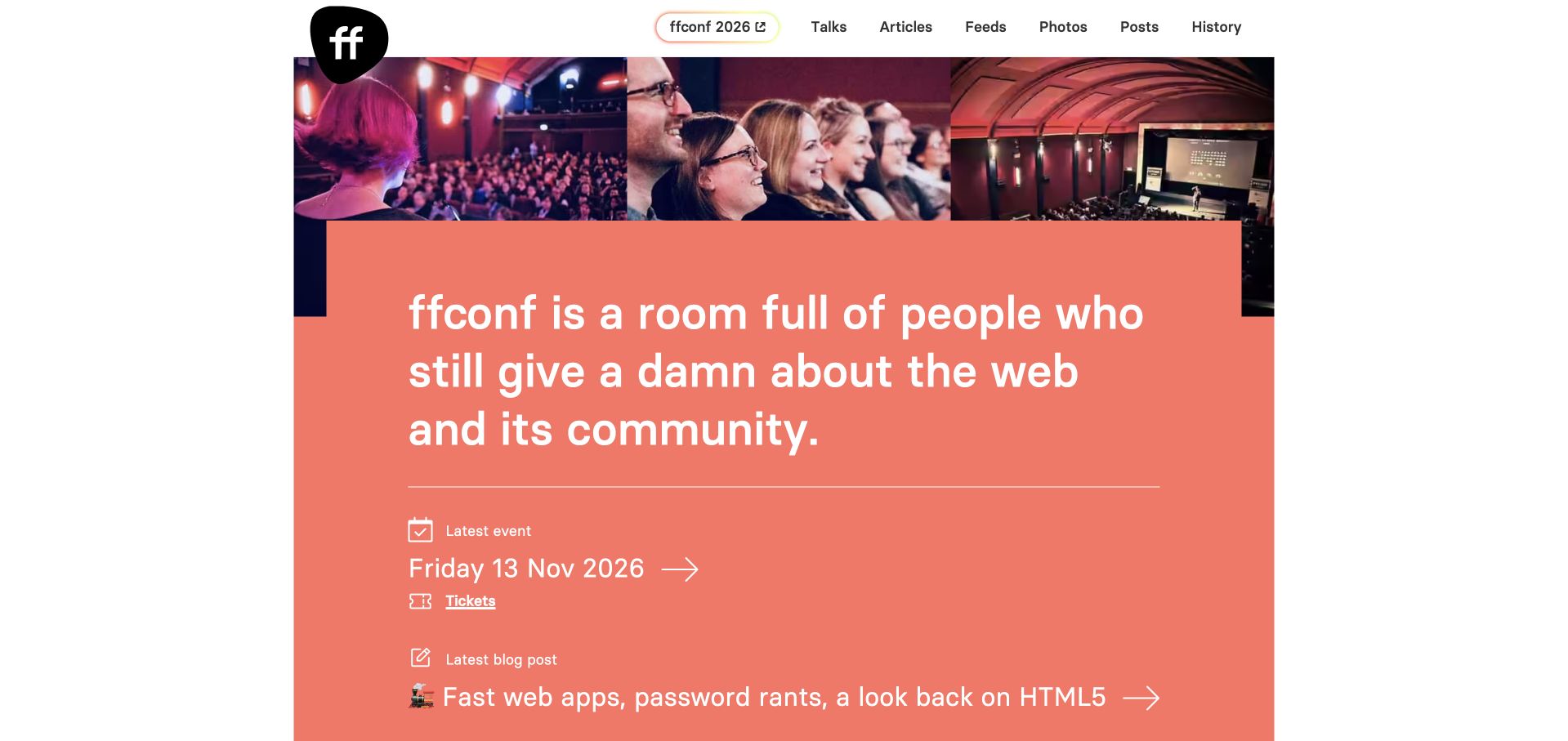
FFConf pairs conference photography with a statement about its web community, then places the next event and ticket route directly below. The main navigation treats talks, articles, photos, posts, and history as enduring collections, while the current edition is identified separately. Archive links preserve previous years rather than flattening every edition into the latest campaign. The page connects an upcoming gathering to a longer editorial record without requiring a visitor to start with ticket purchasing.
What you can learn
Model the ongoing organization and individual event editions separately. Eleventy collections can preserve talks and articles across years, but dates, ticket destinations, and archived edition labels should remain explicit so old material never looks like the current event.
Pros
The event date appears beside its next-step link, reducing ambiguity about which edition a prospective attendee is considering.
Talks and other archive content have permanent discovery routes that remain useful even when ticket sales are not the visitor’s task.
Cons & considerations
An emotional community statement still needs practical location, access, and programme details within an easy-to-follow journey for first-time attendees.
Links into separate yearly properties create navigation boundaries that should be checked whenever an edition changes or ticketing closes.
Platform source: Official property-level Eleventy association. The official Eleventy showcase names this exact public property; this is a documentary generator association, not a complete current runtime inventory. Platform evidence is separate from the direct website screenshot and is not a complete current infrastructure audit.
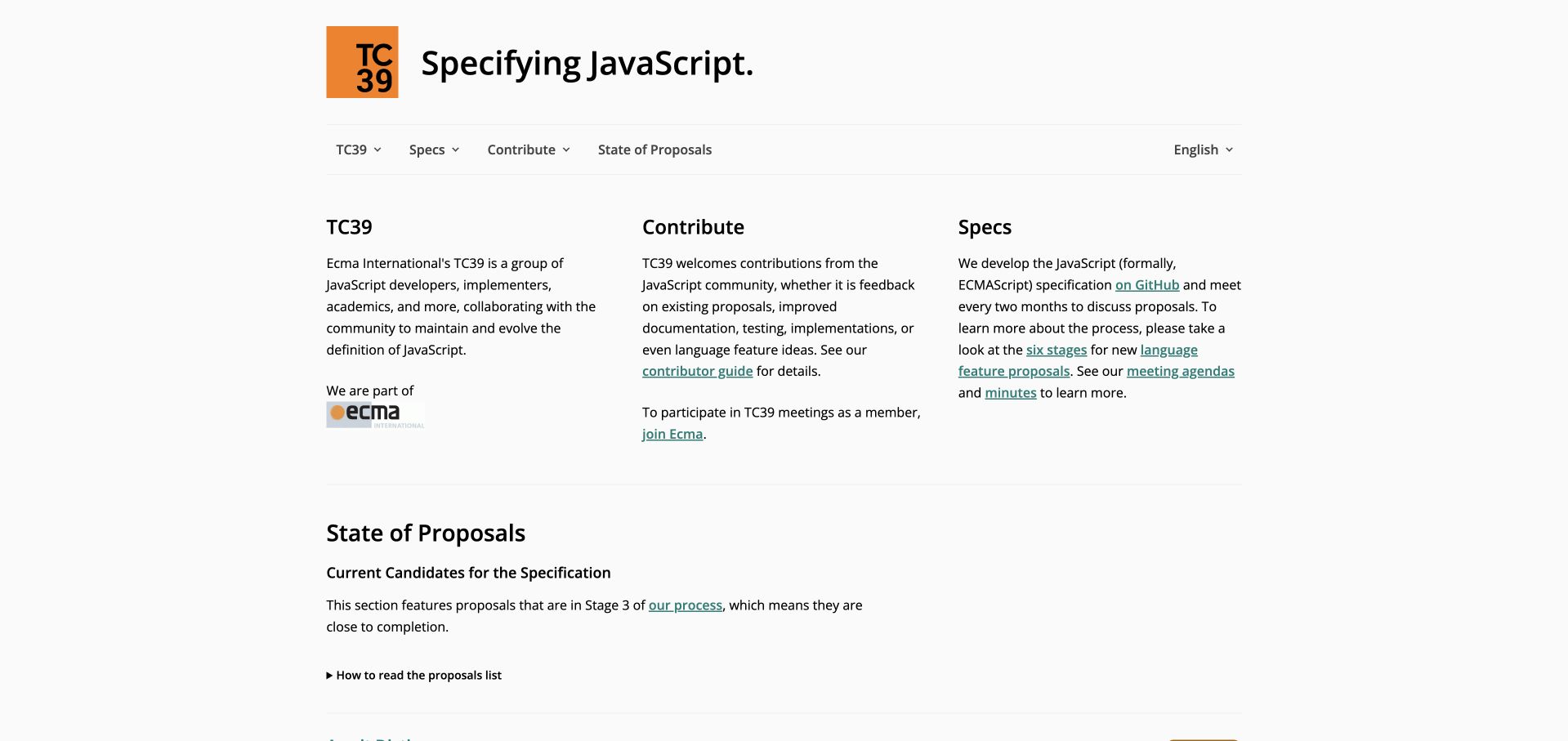
TC39 introduces its purpose with a brief heading and three adjacent explanations of the group, contribution, and specifications. The warm square mark and restrained typography keep attention on the material. Below, a state-of-proposals section identifies candidate work with authors, champions, descriptions, and specification links. Menu categories cover the committee, specifications, contribution, and language selection. The homepage is the Eleventy-associated property, not a claim about how every linked specification is generated.
What you can learn
Publish status as structured information rather than embedding it inconsistently in prose. Eleventy can assemble proposal records and explanatory pages, while the editorial model must distinguish a candidate, a process stage, and an adopted specification accurately.
Pros
The three introductory columns explain who participates, where the work happens, and how an interested reader can contribute.
Proposal entries connect descriptions to responsible people and source material, helping readers move beyond a bare list of feature names.
Cons & considerations
Terms such as candidate and process stage need accessible explanations because a newcomer may mistake a proposal for an available feature.
The long proposal list needs continued curation and dependable status updates; an elegant template cannot establish that information is current.
Platform source: Official property-level Eleventy association. The official Eleventy showcase names this exact public property; this is a documentary generator association, not a complete current runtime inventory. Platform evidence is separate from the direct website screenshot and is not a complete current infrastructure audit.
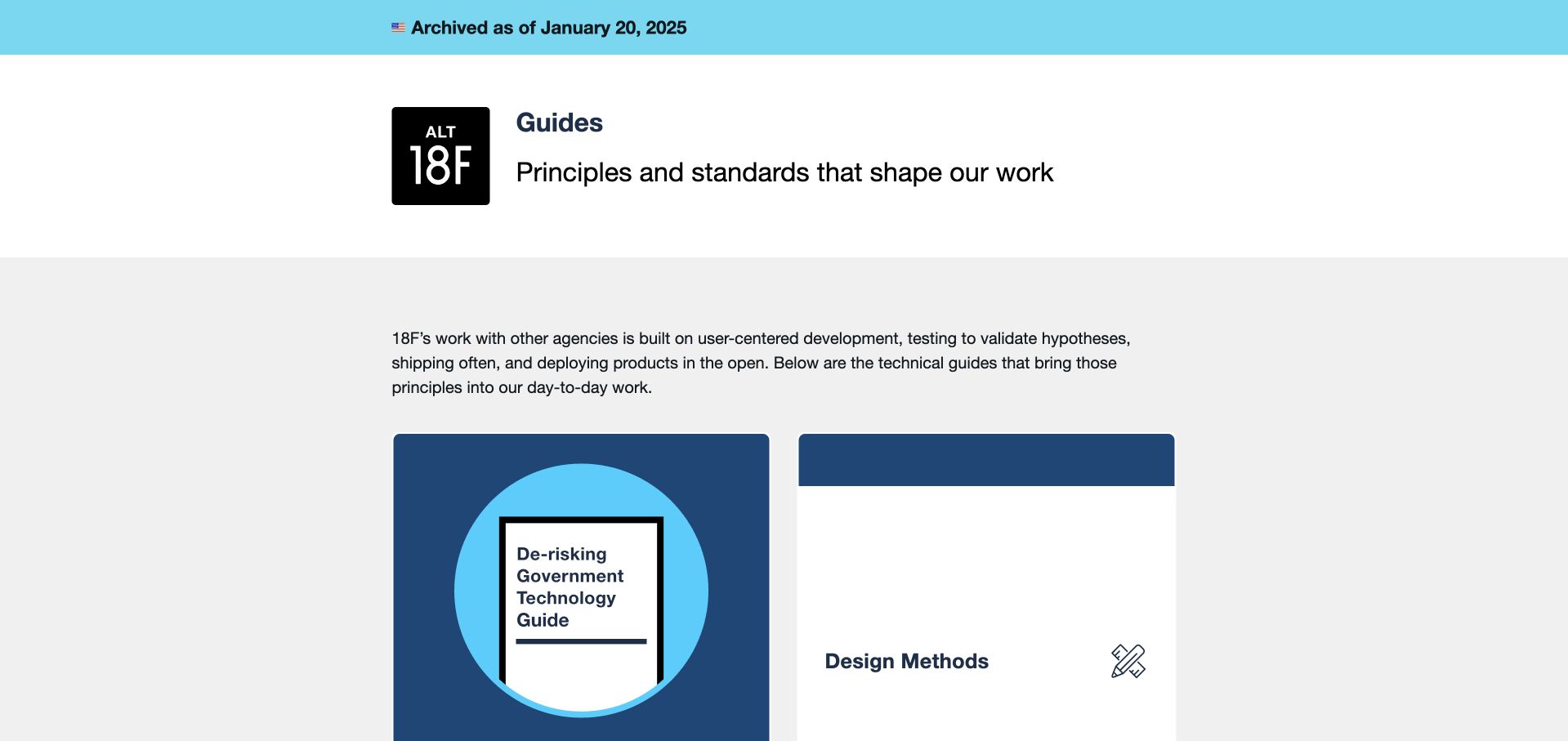
This 18F Guides property explicitly identifies itself as an unofficial archive as of January 20, 2025. Beneath that banner, the page presents a clear title, a short explanation of the guidance, and large cards for areas such as de-risking, design methods, accessibility, and engineering. It remains a useful design reference for a structured knowledge collection, but the archive status is fundamental to its identity and should not be hidden behind familiar former government branding.
What you can learn
Put preservation context at the top of an archived Eleventy site. Retained material needs an edition date, ownership explanation, stable internal links, and a clear distinction between historical guidance and services that are still maintained elsewhere.
Pros
The archive banner is visible before the main title, making the historical scope difficult to miss during an ordinary visit.
Task-oriented guide descriptions explain the practical purpose of each collection without demanding familiarity with an internal organizational taxonomy first.
Cons & considerations
Historic branding can still suggest current institutional authority unless archive and unofficial-status wording remain consistent on individual guide pages.
External references and formerly active service links require separate checking because preserving the archive does not keep their destinations maintained.
Platform source: Official property-level Eleventy association. The official Eleventy showcase names this exact public property; this is a documentary generator association, not a complete current runtime inventory. Platform evidence is separate from the direct website screenshot and is not a complete current infrastructure audit.
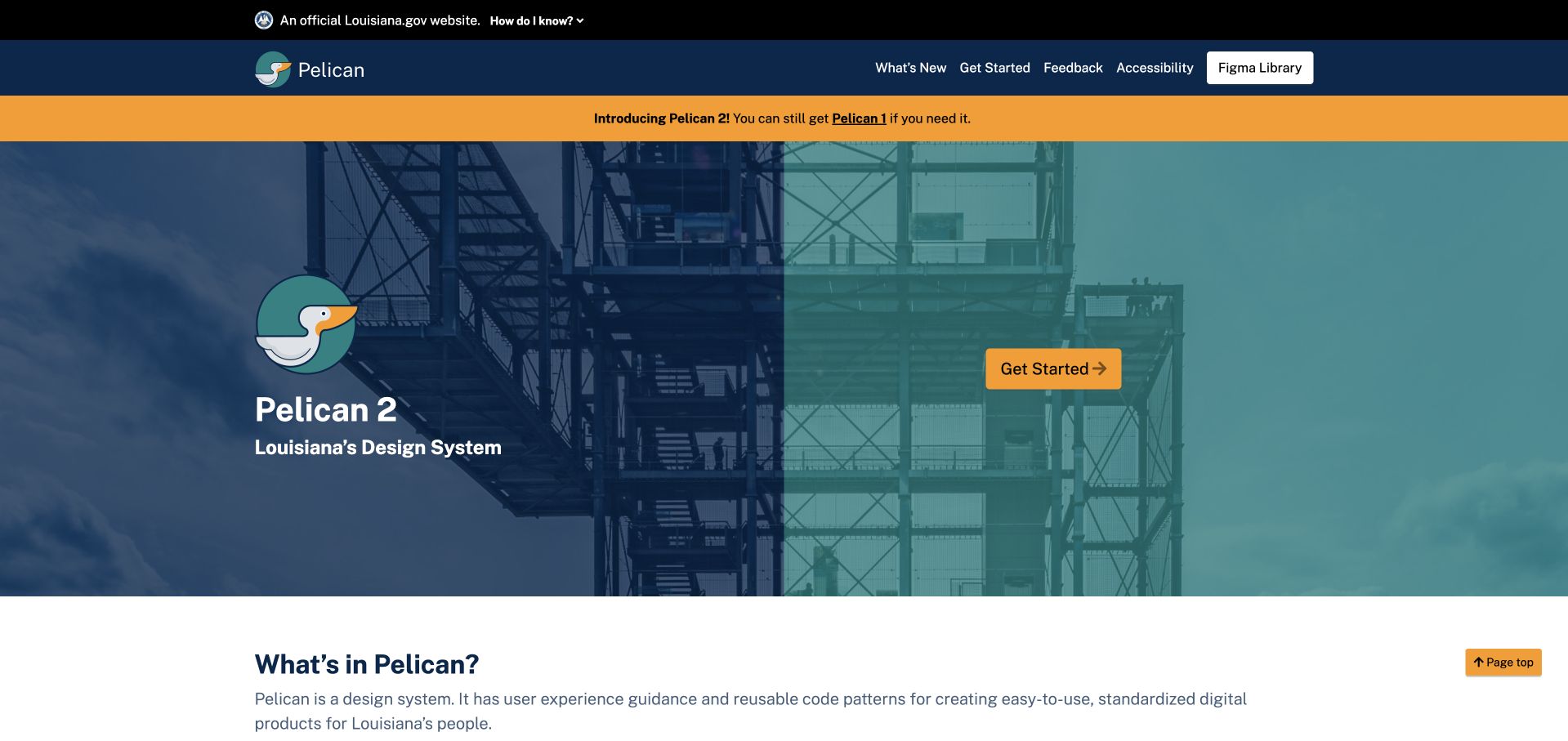
Pelican starts with an official Louisiana identity strip, then introduces the current design-system edition over a photographic blue-and-teal hero. A separate announcement preserves access to the previous edition, while a yellow getting-started button gives the page a clear primary action. Below, foundations, accessibility, and components are explained as different kinds of work. The page connects reusable interface patterns to public-service goals instead of presenting a component gallery without context or audience.
What you can learn
Treat design-system versions as publishing requirements from the beginning. Eleventy can produce documentation for multiple editions, but shared navigation must identify the selected version and keep older implementation instructions from appearing to be current recommendations.
Pros
The older edition remains explicitly named and reachable, which helps teams maintaining existing services locate the guidance they actually need.
Accessibility is given equal conceptual weight to foundations and components rather than appearing only as a small compliance link in the footer.
Cons & considerations
The prominent hero and announcement consume substantial space before a developer reaches individual implementation patterns or code examples.
A shared design system still needs project-specific testing; the appearance of official guidance cannot establish every consuming service’s accessibility.
Platform source: Official property-level Eleventy association. The public page declares Eleventy in its generator metadata. Platform evidence is separate from the direct website screenshot and is not a complete current infrastructure audit.
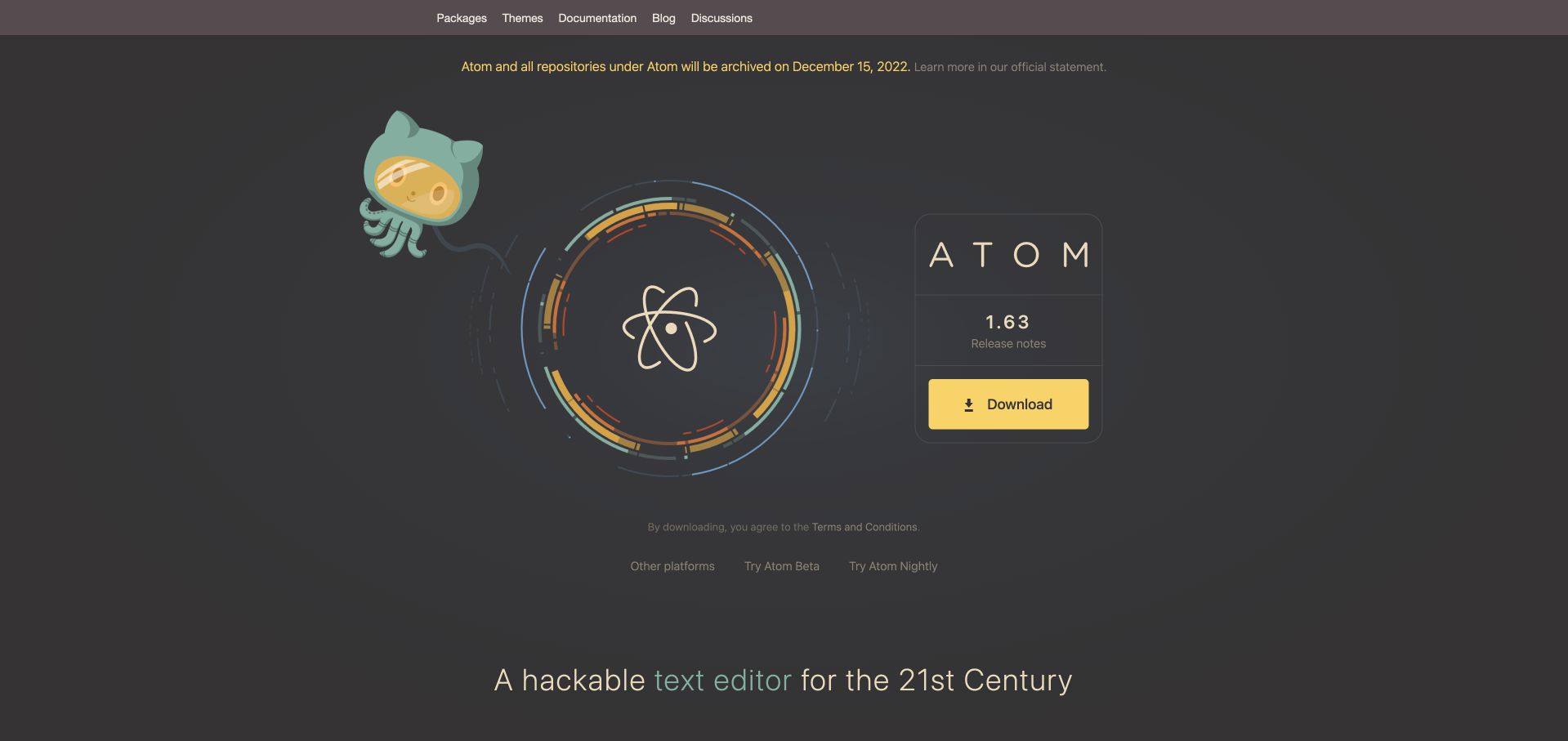
The Atom community property preserves the editor's familiar dark palette, large emblem, version panel, and product explanation. A notice above the opening points to the original retirement statement, while navigation offers packages, themes, documentation, and discussion. The design remains useful as a product-reference layout, but the dated retirement context matters more than the prominent download treatment. This Eleventy-associated community property should not be described as a current GitHub product launch or maintained editor offering.
What you can learn
A preserved Eleventy site needs an honest operational layer, not just copied historical styling. Identify the maintainer, distinguish archived downloads from supported releases, and keep the retirement context attached to pages visitors can reach directly from search.
Pros
The retirement notice precedes the main promotional material, giving readers essential context before they choose a download or related destination.
The version panel and release-notes link show a defined historical software artifact rather than an unspecified collection of files.
Cons & considerations
The visually dominant download action can still imply current support unless the archive’s community-maintained status is explained consistently throughout.
Old package and collaboration descriptions may refer to services that no longer operate, so they need destination-level checking before reuse.
Platform source: Official property-level Eleventy association. The public page declares Eleventy in its generator metadata. Platform evidence is separate from the direct website screenshot and is not a complete current infrastructure audit.
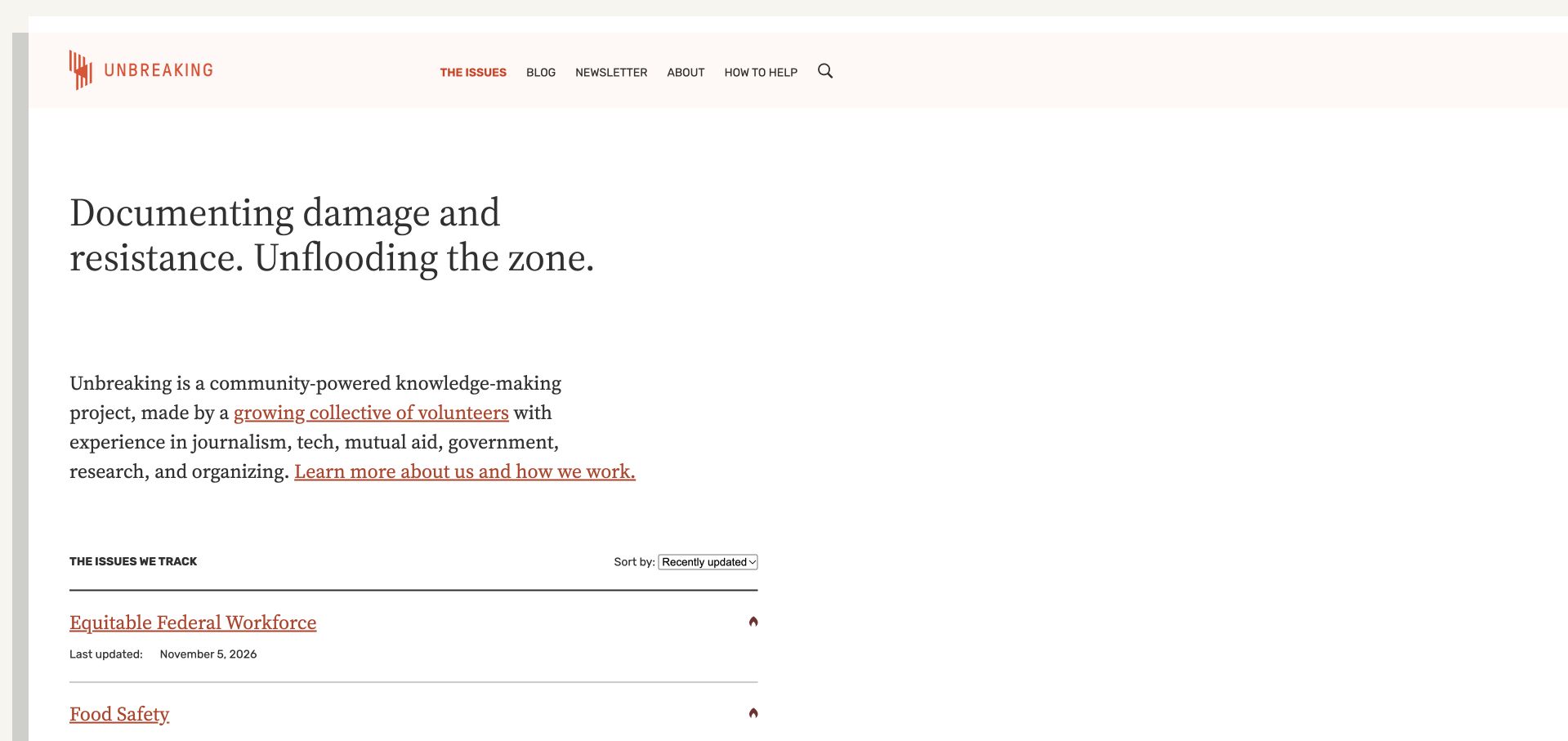
Unbreaking introduces its purpose in a serif headline, identifies the volunteer collective, and moves into a list of tracked issues. The list includes last-updated dates and intensity indicators, with a sorting control beside its heading. An orange-and-cream palette gives the publication identity without making every issue look like a promotional card. About and methodology routes are available for readers who want to understand the editorial process behind the collection.
What you can learn
Separate publication metadata from the opinion or reporting itself. An Eleventy issue collection can generate dates and sort options, but indicator definitions, update rules, and source attribution need explicit editorial policies rather than unexplained visual urgency.
Pros
Visible update dates help readers assess the freshness of individual issue records instead of relying only on a site-wide publication claim.
The short collective introduction and linked team information provide an identifiable editorial context for a broad and evolving subject collection.
Cons & considerations
Intensity icons require a clear definition so readers do not confuse editorial categorization with a measured or universally agreed risk scale.
Sorting by recent updates can bury foundational topics, so additional topic discovery and explanatory landing pages remain important as the collection grows.
Platform source: Official property-level Eleventy association. The public page declares Eleventy in its generator metadata. Platform evidence is separate from the direct website screenshot and is not a complete current infrastructure audit.
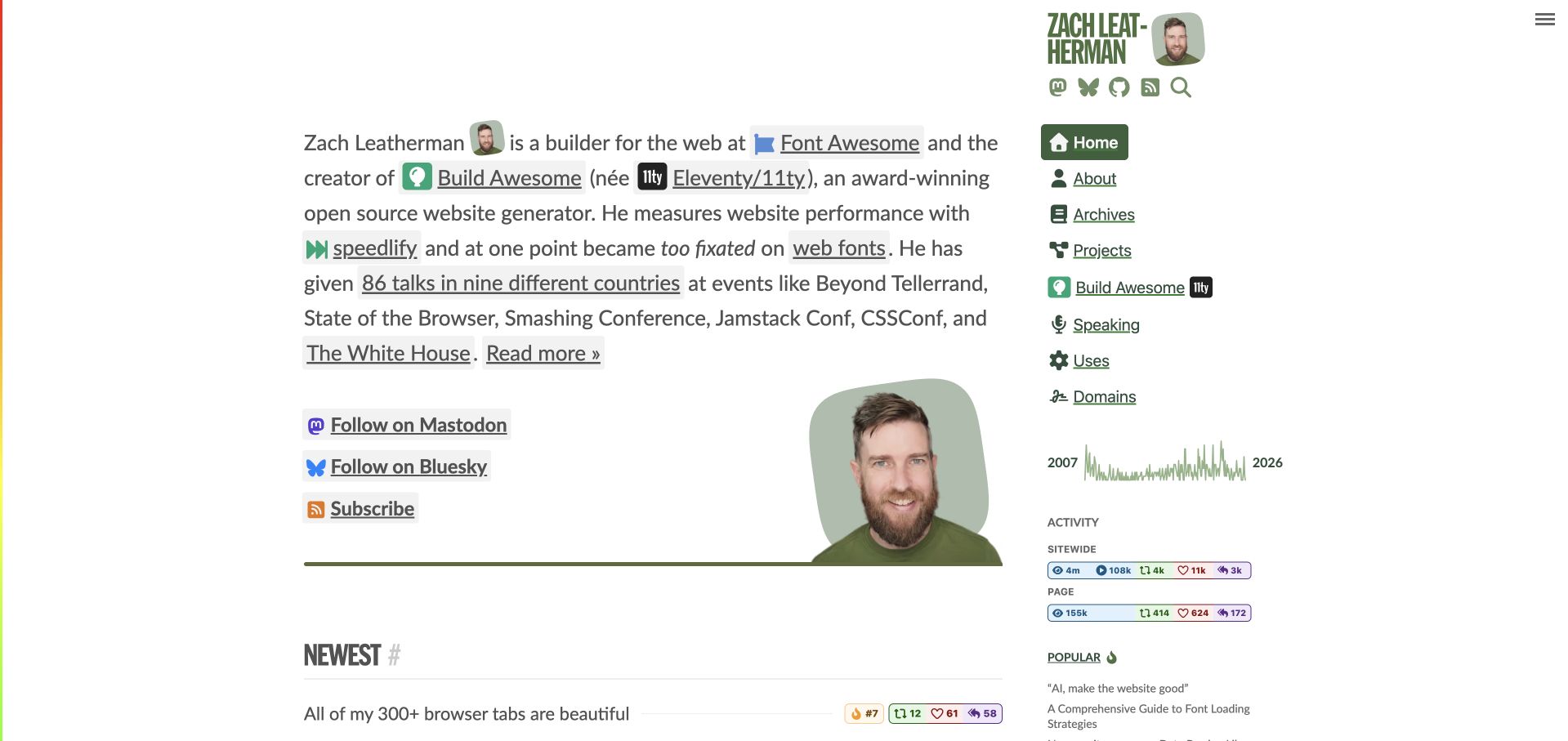
Zach Leatherman’s homepage gives a substantial introduction the main reading column, with a compact portrait, social links, and a right-hand navigation sidebar. A sparkline summarizes the publication’s history, while newest and popular material provide different entry points into the archive. Its public generator metadata explicitly names Eleventy, with Build Awesome branding alongside it. This is evidence for the named personal publication, not a claim about every linked employer, project, or external social service.
What you can learn
A long-running personal site needs more than a chronological feed. Model articles, projects, talks, topics, and authorship so an Eleventy build can generate useful archive routes while retaining the site’s own voice and preserving older addresses through changes in professional identity.
Pros
Archive, projects, and speaking have distinct destinations, making different kinds of professional material easier to find.
Newest and popular content offer complementary routes beyond the introductory biography without forcing every reader through the same sequence.
Cons & considerations
Dense inline links and activity counts can compete with the introductory text unless reading hierarchy remains controlled.
Public engagement counts need context and should not be treated as independent evidence of article quality or professional results.
Platform source: Official property-level Eleventy association. The public page declares Eleventy in its generator metadata. Platform evidence is separate from the direct website screenshot and is not a complete current infrastructure audit.
Kegan has 15+ years of experience working with small businesses, Fortune 500 companies, and everything in between. No development job is too big or too small: he brings the same hands-on attention to a focused improvement, a complete website, or a custom application.
For Eleventy projects, he can help with responsive interfaces, reusable components, custom functionality, API connections, and performance-minded implementation. He works directly with clients on scope, design, implementation, testing, and handover, with an emphasis on clear communication and a system that remains practical to maintain after launch.
Show 3 other Eleventy developersHide other Eleventy developers
Choose the Eleventy architecture around the editing workflow
Use templates and front matter for a bounded publication
For a technical series or project archive, start with a small set of layouts and explicit metadata. Generate topic pages from the same records. Keep navigation data understandable to the people responsible for adding and correcting material.
Add a CMS when editorial work requires it
A Git-based or external CMS can provide editing and review, but it introduces its own roles, previews, and integration boundaries. Decide who can change content, who can alter templates, and how an unpublished draft is safely previewed.
Isolate interactive demonstrations
A chart, component playground, purchase flow, or animated hero may need client-side code or a separate service. Publish a useful explanation around it and record which team owns its loading, accessibility, error, and upgrade behavior.
From references to requirements
Plan the content lifecycle and production build
Define URL and edition rules
Choose permanent document addresses before migration. Separate a current-edition alias from archived versions, retain intentional redirects, and test deep links into headings as well as the homepage.
Design previews and review boundaries
Decide what a reviewer must see before publication: draft text, navigation changes, transformed images, and interactive examples. A successful local template render is not evidence that an external search or payment integration is working.
Budget the build and browser separately
Measure build duration with realistic content and image volumes, then test the delivered pages independently. Eleventy’s static output does not remove the cost of large images, fonts, animation, or third-party scripts.
Assign maintenance to content types
Releases, events, policy notices, resource directories, and archive banners become stale in different ways. Give each a named maintenance responsibility and do not refresh editorial dates merely because the site was rebuilt.
A useful handover demonstration
Ask the actual team to carry out its routine job: publish a realistic update, correct a mistake, preview a narrow screen, and identify who owns an integration failure. For a library or frontend framework, also ask who maintains the content source and deployment. A polished screenshot does not answer those operational questions.
Beyond the screenshot
Eleventy project checklist
Choose stable content types and metadata.
Separate publication date from review and build dates.
Define canonical URLs and redirect rules.
Label archived and versioned material clearly.
Make navigation work without client-side enhancement.
Test the initial animation frame and reduced motion.
Provide useful descriptions for archive entries.
Check long titles, code samples, and narrow screens.
Verify draft previews and editorial permissions.
Measure representative production builds.
Optimize actual image and font payloads.
Assign ownership for external links and integrations.
Test with real content, a keyboard, a small screen, slow or failed requests, and the people who will maintain the system. These are planning checks, not an accessibility, security, performance, or search-ranking certification.
Sources & editorial method
How this Eleventy collection was reviewed
Twenty distinct public website properties were reviewed from direct browser captures. The first five are recognizable organizations or established technical brands selected explicitly, not inferred from appearance or traffic. Official Eleventy showcase entries and property repositories provide documentary associations; live generator metadata is identified where observed. Documentary evidence is not a complete current runtime inventory. Archived properties retain explicit historical labels. Captures, editorial reviews, and technology observations have independent dates. Broad stack auditing belongs to the publisher’s separate validation pass; no private account, purchase, or administration workflow was inspected.
Every image is an unmodified capture from the actual website, with its source and capture date. Some captures are reused from our shared catalog; their dates remain the original capture dates. None comes from a vendor gallery or a generated reconstruction. Moving imagery and live content can change.
Technology attribution uses public page assets or metadata, official platform documentation, or a cited first-party project case study. Documentary and framework-relationship evidence is identified where used; it is not a complete current backend inventory. A CMS image CDN alone does not establish a full CMS deployment. A library’s presence does not prove which individual controls use it, and a platform label does not establish AI authorship.
The composition notes, lessons, pros and tradeoffs are original editorial observations. We have not measured conversion, traffic, security, performance or accessibility conformance. Website owners retain their brands and imagery; these examples are not our client portfolio. Written, Edited and Curated are independent records, not dates advanced by a build. See our editorial standards or suggest a correction.
Questions worth asking
Eleventy website development FAQs
Does Eleventy require a JavaScript application in the browser?
No. Eleventy builds pages from templates and content. You can add browser-side behavior where it serves the task, but it is a separate design and maintenance decision.
Can an Eleventy site use a visual CMS?
Yes. The editing workflow can be supplied by a Git-based or external CMS. Verify preview behavior, publishing permissions, and how content changes reach the production build.
Does an official showcase entry prove the current complete stack?
No. It documents a property-level association. The page may contain other components, separate services, or later changes that are not exposed by the showcase record.
How should documentation versions be published?
Give editions explicit labels and stable routes. Make the current recommendation distinguishable from older instructions, while preserving useful historical links and intentional redirects.
Does static generation guarantee a fast page?
No. Images, fonts, animation, third-party code, and interaction design still affect what readers experience. Measure the delivered pages with representative content and devices.
Start with a durable document and a clear publishing model. Add interactivity where it improves a reader’s task, and keep edition, archive, and maintenance responsibilities visible.