An Optimizely website needs more than an attractive set of blocks. Its content types, regional rules, previews and publishing responsibilities should make the site understandable to visitors and manageable for the people updating it.
These 20 examples focus on Optimizely as a website content management platform. Each has a primary implementation source that identifies CMS use for the pictured property or a clearly named regional website estate. Companies that only use Optimizely experimentation, analytics or another unrelated product are not treated as CMS examples.
The collection spans vehicle brands, manufacturers, financial organizations, venues and consultancies. Their public layouts show different editorial priorities: a campaign, a product family, an audience choice or a useful search entry. Study those decisions alongside the documented platform relationship, while keeping the public website separate from private accounts and operational systems.
Before the examples
What makes good Optimizely website development in 2026?
Specify the CMS product and implementation scope
Optimizely has distinct CMS offerings and related products. Record whether the project uses CMS 12, CMS SaaS or an existing implementation with its own constraints, and name the actual websites covered. Features, integrations and editing behavior depend on the selected product and configuration; a general vendor relationship is not a substitute for that inventory.
Design content types around recurring editorial work
Inventory campaigns, products, services, locations, articles, people and events before drawing an unrestricted page builder. Define the fields and relationships that let editors reuse reliable information. Separate a permanent product record from a temporary homepage promotion, and give time-sensitive content an owner and a retirement rule.
Make a preview answer the editor’s real questions
A useful preview shows the intended content, audience, language and linked destinations. CMS SaaS provides Visual Builder and a separate content-delivery model; the implementation team still needs to make its chosen frontend and preview workflow work together. Include long titles, missing images and expired campaigns in the demonstration.
Compare the visitor task in each opening view with the content structure needed to maintain it. The source notes establish scoped CMS associations; the screenshots independently record the actual public page reviewed.
We start with five recognizable brands or organizations: Mazda USA, Electrolux UK, Goodwood, Yamaha Boats, Bendigo Bank. Each attribution applies to the named website property, not every product or website belonging to its organization. This is a curated reading sequence, not a measured ranking.
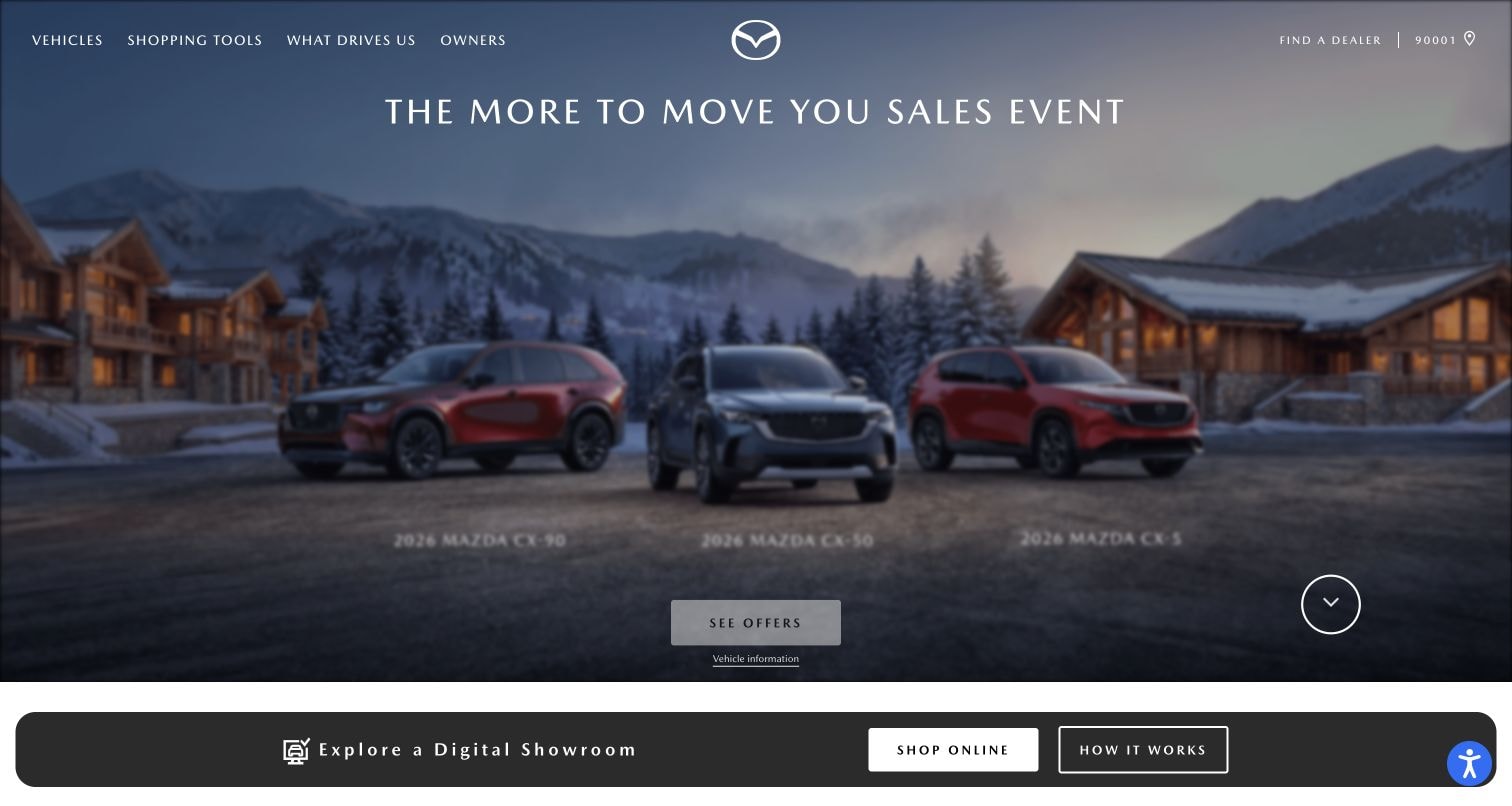
Mazda USA puts a seasonal vehicle campaign across a wide photographic stage, with three cars carrying the story before the visitor reads the offer. The restrained upper navigation keeps model research, shopping and ownership routes separate, while the small dealer locator acknowledges that the next step may happen locally. White uppercase type gives the campaign a recognizable voice without introducing a different site structure. The source case concerns Mazda's North American CMS website; the screenshot shows its public marketing surface, not the systems behind inventory, finance or an owner account.
What you can learn
For an Optimizely project, model the campaign as a replaceable editorial unit with a headline, image, offer destination and expiry. Keep those fields separate from persistent model and dealer navigation, and preview the same unit with shorter copy and alternative photography before publishing.
Pros
The large image communicates vehicle context without a lengthy introductory paragraph.
Shopping and owner destinations remain identifiable above the changing campaign content.
Cons & considerations
Small white navigation can compete with lighter areas of an active photographic background.
The seasonal message gives limited immediate detail for someone comparing individual models.
Visible tech stack
Referenced on the public page
Swiper
Vimeo
OneTrust
reCAPTCHA
Earlier / documented evidence
Optimizely
Public source checked November 3, 2026. References may be embedded or legacy—not a complete backend inventory.
Platform source: Optimizely CMS customer implementation story. Optimizely documents the North American consumer vehicle website as a CMS implementation, including vehicle research and dealer discovery. Documentary CMS implementation evidence for this named public property or regional estate. It is not a complete current backend inventory, a claim about private accounts, or proof that every linked service uses Optimizely. Platform evidence is separate from the direct website screenshot and is not a complete current infrastructure audit.
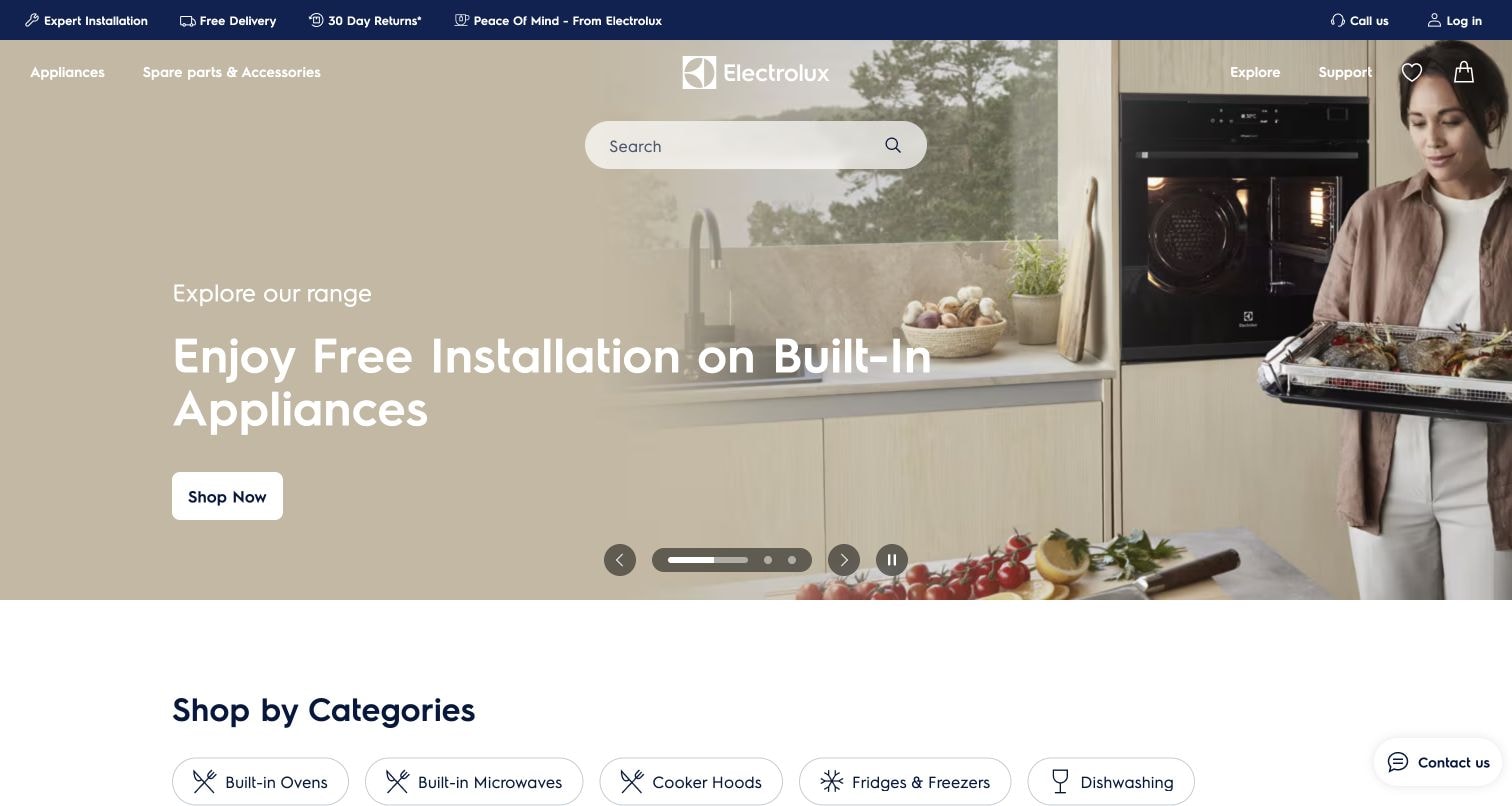
Electrolux UK's homepage balances a practical promotion with a domestic kitchen photograph. A large search field occupies the center of the header, and the promise of free installation appears in a clear left column beside a person using an oven. The neutral palette lets the product environment feel familiar while dark blue service messages create a separate information layer. Category shortcuts begin below the main campaign. Optimizely's evidence describes the European content and commerce estate, which includes this UK property; it does not establish an identical platform arrangement for Electrolux in every country.
What you can learn
Build the editorial model around a shopper's actual questions: which appliance, which offer and which support route. Let regional teams replace a promotion without rewriting persistent service claims, and assign ownership to installation wording, availability and the linked terms before treating the hero as ready.
Pros
Prominent search supports visitors who already know the appliance or category they need.
The split layout keeps the promotional claim readable beside a detailed domestic image.
Cons & considerations
Several service messages and shopping utilities compete for attention within the header area.
The homepage promotion cannot replace the product-specific checks required before purchase.
Visible tech stack
Earlier / documented evidence
Optimizely
Earlier cited evidence retained; no current scan result. References may be embedded or legacy—not a complete backend inventory.
Platform source: Optimizely CMS customer implementation story. Optimizely documents Electrolux's pan-European brand websites on its content and commerce platform. The pictured UK appliance storefront is within that European estate; this does not describe Electrolux's US properties. Documentary CMS implementation evidence for this named public property or regional estate. It is not a complete current backend inventory, a claim about private accounts, or proof that every linked service uses Optimizely. Platform evidence is separate from the direct website screenshot and is not a complete current infrastructure audit.
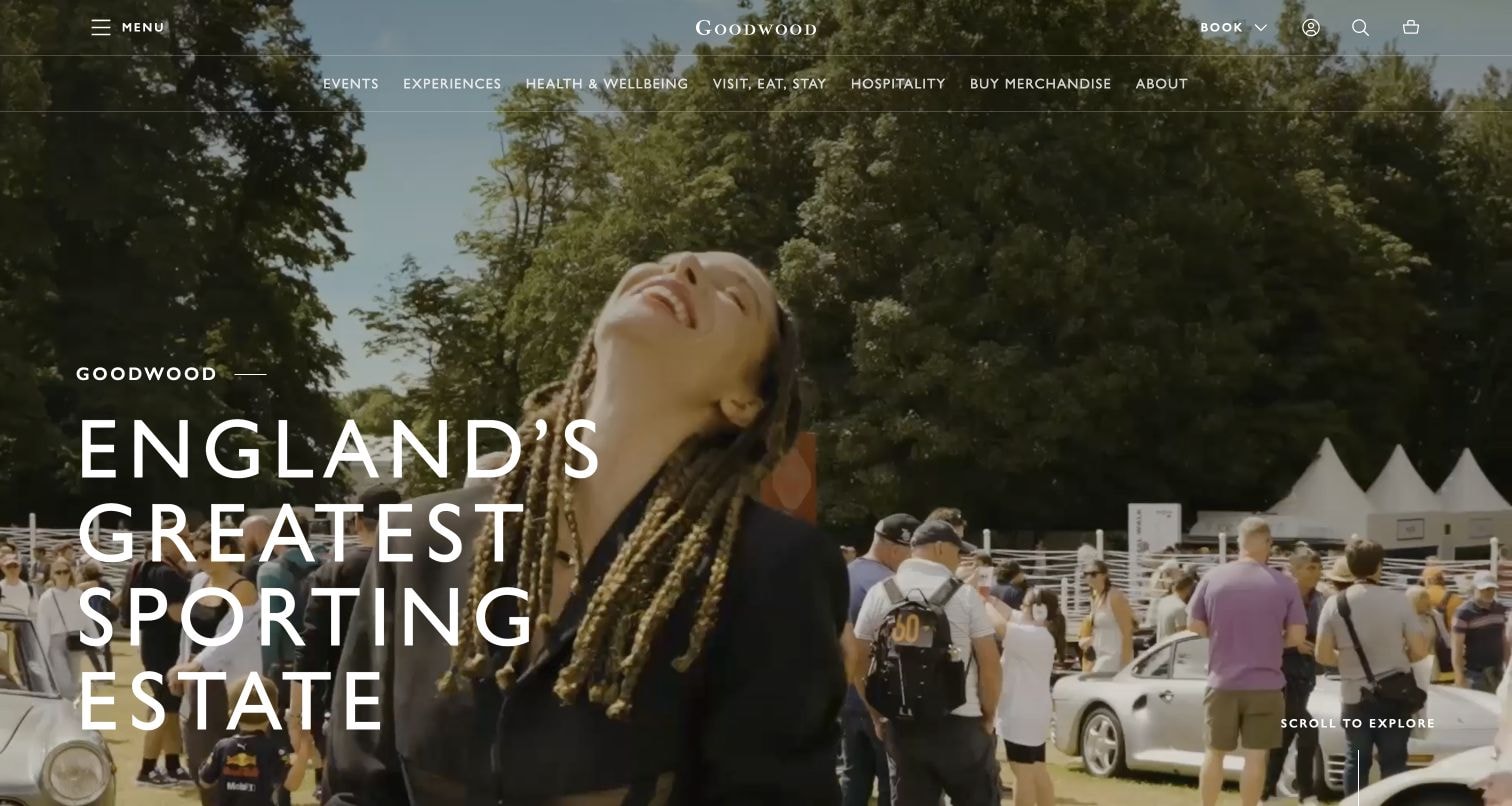
Goodwood opens with a broad event scene and a large statement about the estate, making atmosphere the first piece of information. Transparent navigation overlays the imagery, with booking utilities above a second row of experiences, events and hospitality choices. The page must introduce a place that supports several different reasons to visit, while preserving distinct visitor tasks. Its official implementation story names CMS 12 and reusable content blocks for the flagship website. The composition illustrates that estate; a moving hero cannot establish how events are personalized or scheduled.
What you can learn
Define event and experience records with dates, availability, audience and booking destinations, then let the homepage feature those records through controlled blocks. Give editors a preview that reveals expired events and awkward image contrast. The content model should preserve practical trip information when the featured visual changes.
Pros
The wide event image makes the scale and character of the venue immediately apparent.
Separate experience categories acknowledge that visitors arrive with substantially different intentions.
Cons & considerations
White overlay navigation depends on the changing image maintaining adequate visual separation.
Practical details such as dates and availability sit beyond the introductory brand statement.
Public source checked November 3, 2026. References may be embedded or legacy—not a complete backend inventory.
Platform source: Optimizely CMS customer implementation story. Optimizely documents the flagship Goodwood website redesign and migration to CMS 12, with content blocks, visual editing and event publishing. Documentary CMS implementation evidence for this named public property or regional estate. It is not a complete current backend inventory, a claim about private accounts, or proof that every linked service uses Optimizely. Platform evidence is separate from the direct website screenshot and is not a complete current infrastructure audit.
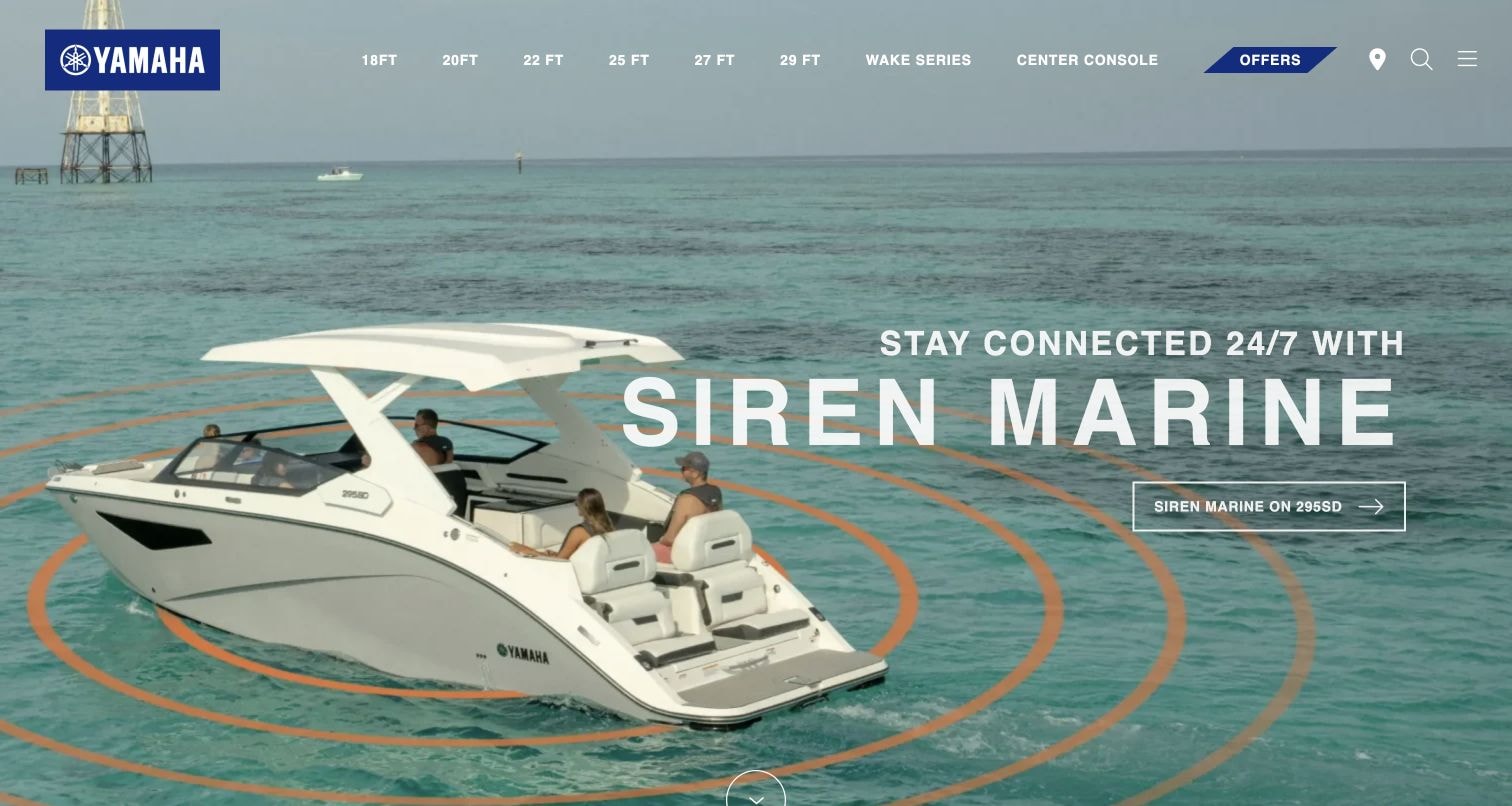
Yamaha Boats combines a water-focused hero with a navigation system organized around boat sizes and specialist ranges. The captured feature promotes connected boating, while the permanent header still offers a route into the physical product lineup. The campaign supports ownership while the permanent menu preserves model discovery. Optimizely's WaterCraft case explicitly covers the US Boats and WaveRunners properties, and this example is limited to the Boats site. Public EPiServer Forms markup corroborates that implementation history without revealing private customer or dealer systems.
What you can learn
Treat the model family as structured content with consistent labels and durable destinations. Place service and ownership campaigns in separate editorial modules that can change seasonally. When reviewing a CMS preview, check that someone interested in a specific size can bypass the campaign without having to interpret its marketing message first.
Pros
Size-based navigation gives returning shoppers a compact way to orient themselves.
The water imagery keeps a service promotion connected to the experience of using the product.
Cons & considerations
The hero's light text competes with bright portions of the photographic scene.
New visitors may need additional explanation of differences between the named boat ranges.
Public source checked November 3, 2026. References may be embedded or legacy—not a complete backend inventory.
Platform source: Optimizely CMS customer implementation story. Optimizely's Yamaha WaterCraft Group case explicitly covers the US Yamaha Boats and WaveRunners websites as CMS implementations. This example is the Boats property only. Documentary CMS implementation evidence for this named public property or regional estate. It is not a complete current backend inventory, a claim about private accounts, or proof that every linked service uses Optimizely. Platform evidence is separate from the direct website screenshot and is not a complete current infrastructure audit.
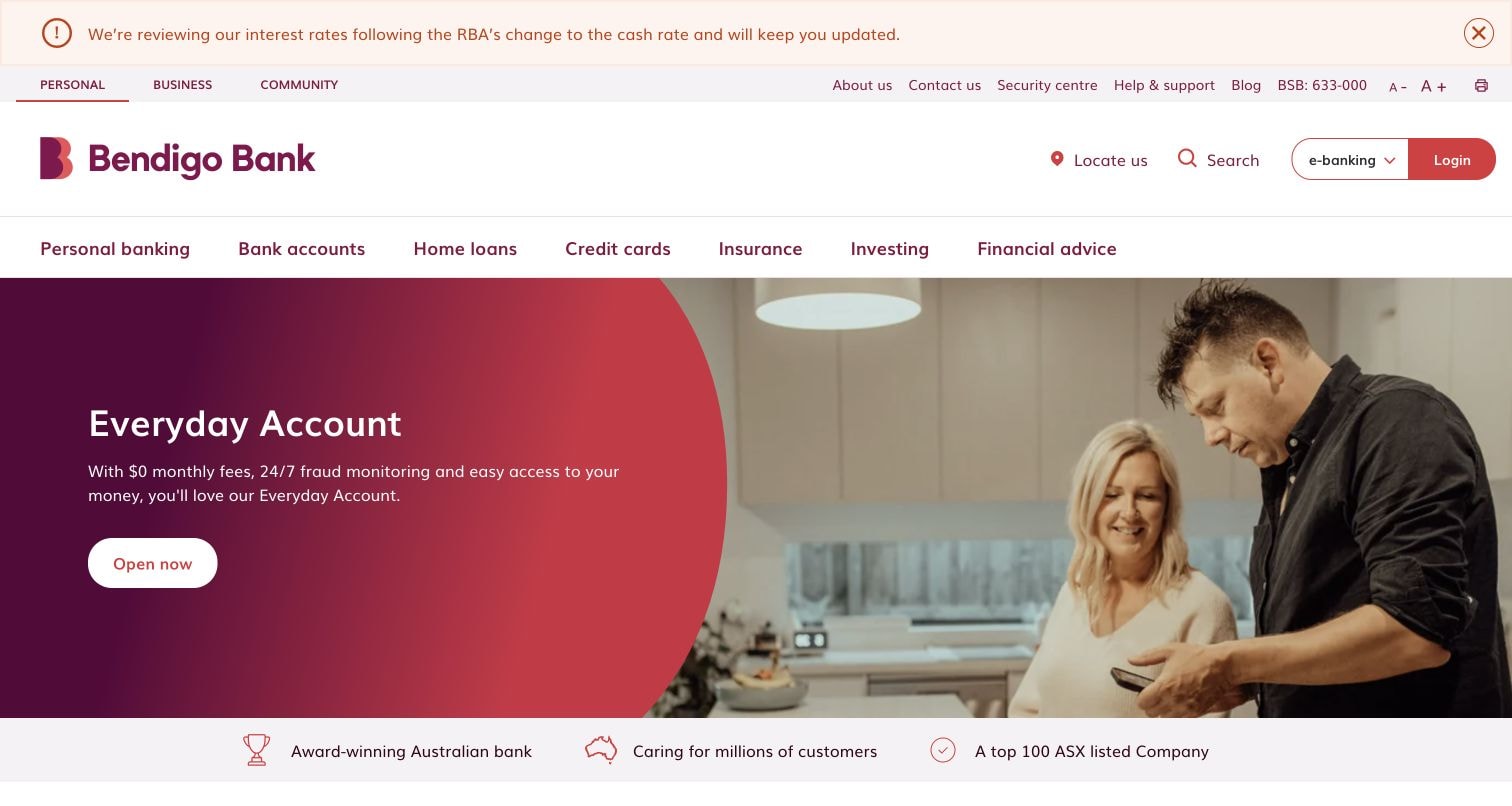
Bendigo Bank's public homepage uses a strong burgundy campaign panel beside a photograph of customers at home. The main offer is readable as a self-contained module, while several navigation levels separate audiences, products and everyday banking utilities. A public notice sits above the promotional area, giving time-sensitive information a distinct location. The documented Optimizely association concerns the shared public website estate; neither the screenshot nor a CMS case study describes the systems that authenticate customers or execute transactions.
What you can learn
Give public notices, product campaigns and persistent service navigation different content types and approval rules. A rate announcement should not depend on replacing the hero, and a withdrawn offer needs a defined removal path. Preview the page with both a notice and a campaign present so editorial priorities remain understandable during busy periods.
Pros
The contrasting campaign panel keeps the account message legible beside lifestyle photography.
A separate notice area accommodates urgent public information without changing the overall navigation.
Cons & considerations
Multiple navigation rows create a considerable amount of information before the main offer.
The introductory campaign cannot communicate all eligibility conditions or product details on its own.
Public source checked November 3, 2026. References may be embedded or legacy—not a complete backend inventory.
Platform source: Optimizely CMS customer implementation story. Optimizely documents the Bendigo Bank retail brand website as part of the bank's shared Content Cloud CMS estate. The public marketing site is reviewed, not authenticated banking services. Documentary CMS implementation evidence for this named public property or regional estate. It is not a complete current backend inventory, a claim about private accounts, or proof that every linked service uses Optimizely. Platform evidence is separate from the direct website screenshot and is not a complete current infrastructure audit.
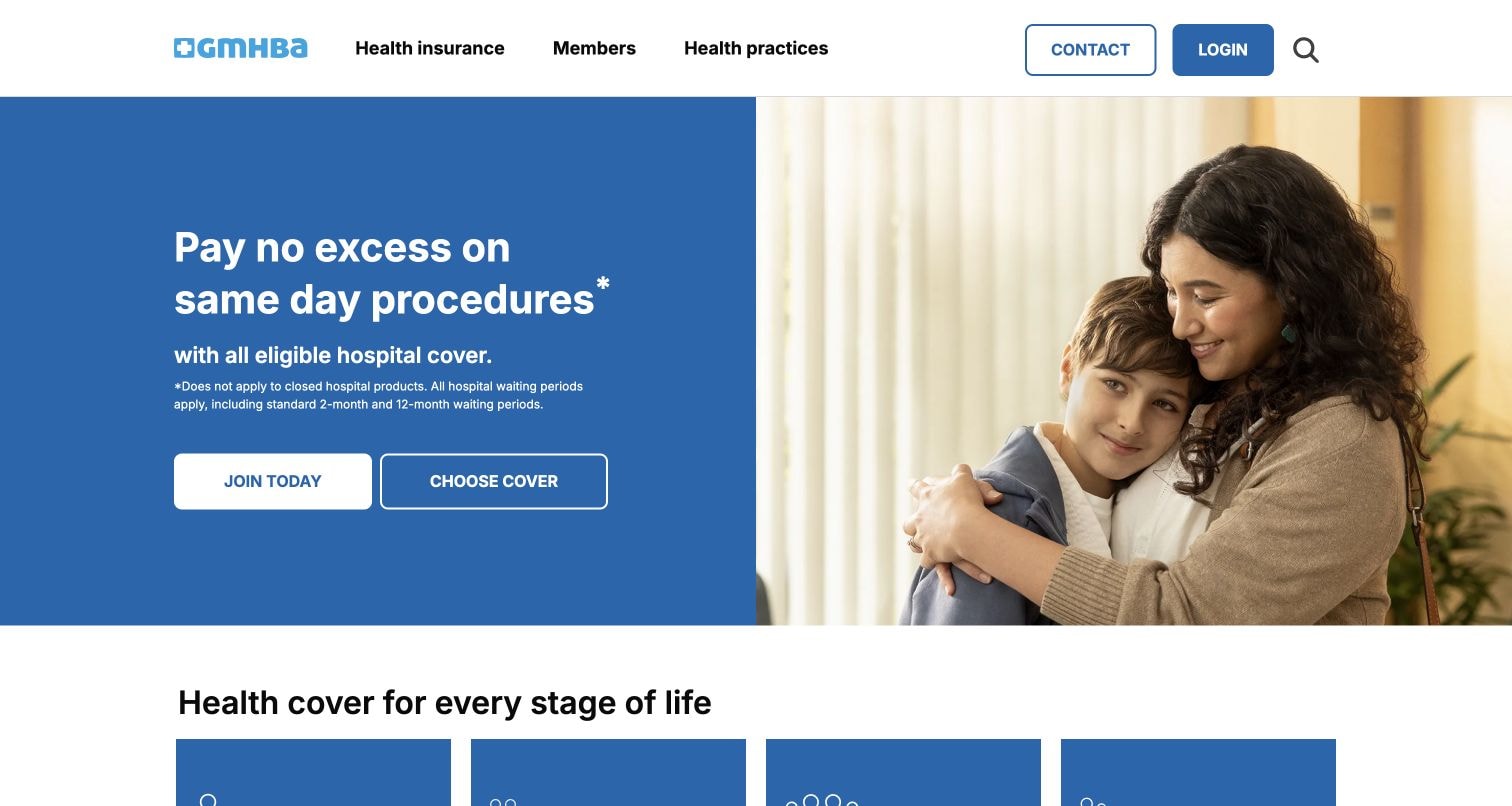
GMHBA's homepage pairs a deep blue text panel with a bright family photograph. The left side names hospital cover directly and gives two clearly separated next steps, while a short set of top-level navigation groups keeps the first screen relatively contained. Qualification text sits close to the promise. Its official CMS case discusses consolidation and editorial control for the public website; this review does not extend that association to private member records or evaluate its advertised cover.
What you can learn
In an Optimizely content model, keep the main claim, qualifying copy and destination together so an editor cannot accidentally update one while leaving the others behind. Create distinct modules for service categories and member assistance. Rehearse publishing a less promotional service notice as well as a favorable campaign, since both need the same clear hierarchy.
Pros
The blue panel provides a consistent reading surface independent of the accompanying photograph.
Two explicit actions distinguish learning about cover from taking the next practical step.
Cons & considerations
Small qualification text needs careful checking when the layout narrows or the copy grows.
The lifestyle image introduces warmth but offers little information about differences between cover options.
Public source checked November 3, 2026. References may be embedded or legacy—not a complete backend inventory.
Platform source: Optimizely CMS customer implementation story. GMHBA's digital product manager describes the public site and its consolidation onto Optimizely CMS. This review covers the public insurance information homepage only. Documentary CMS implementation evidence for this named public property or regional estate. It is not a complete current backend inventory, a claim about private accounts, or proof that every linked service uses Optimizely. Platform evidence is separate from the direct website screenshot and is not a complete current infrastructure audit.
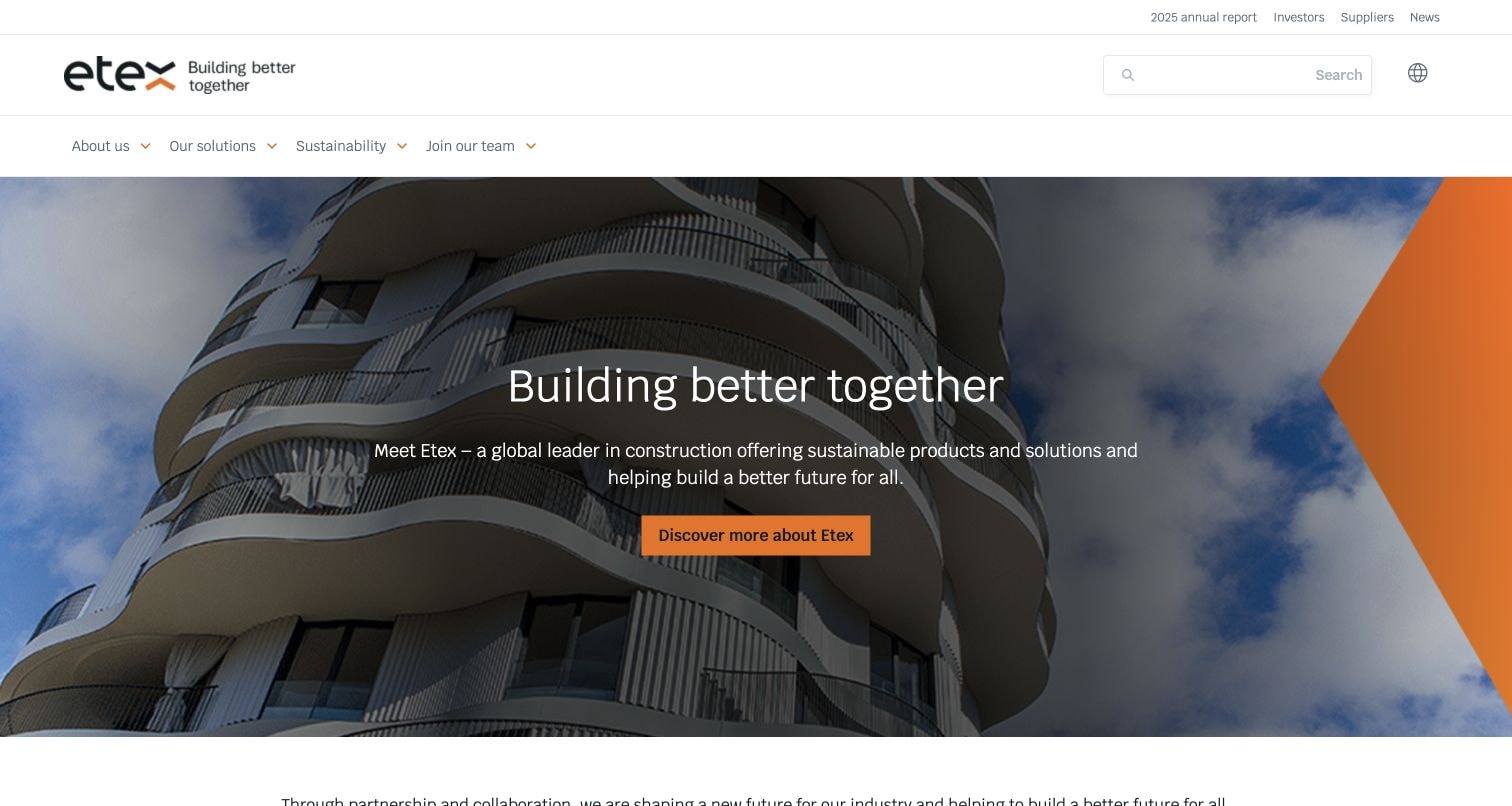
Etex uses a large architectural photograph to introduce its corporate story, with a concise white headline centered over the curved building. Orange accents identify the main action and connect it to the brand, while a broad white header provides conventional corporate navigation, search and language access. Optimizely documents a shared CMS migration across Etex's corporate and brand estate. That establishes the content-platform context; it does not mean every regional brand uses identical page templates, asset systems or publishing permissions.
What you can learn
Plan shared corporate blocks around purpose, business areas, news and local destinations. Allow regional teams to vary meaningful content while preserving common labels and navigation rules. Give architectural imagery its own crop and text-position guidance so a dramatic new photograph does not undermine the readability of the headline placed over it.
Pros
Architecture provides a concrete visual connection to an otherwise broad corporate message.
The orange action is easy to distinguish from the white headline and navigation.
Cons & considerations
The broad purpose statement requires subsequent pages to explain particular materials and applications.
Overlay text needs another visual check whenever editors choose a different building photograph.
Public source checked November 3, 2026. References may be embedded or legacy—not a complete backend inventory.
Platform source: Optimizely CMS customer implementation story. Optimizely documents Etex's migration from Sitecore to a shared CMS platform for its corporate and brand web estate, including multilingual content and shared components. Documentary CMS implementation evidence for this named public property or regional estate. It is not a complete current backend inventory, a claim about private accounts, or proof that every linked service uses Optimizely. Platform evidence is separate from the direct website screenshot and is not a complete current infrastructure audit.
Studio Science makes its current point of view the hero. A black background, large white typography and lime supporting text introduce AI implementation in a strongly editorial composition. The next section begins with a prominent partner graphic, creating a visible transition from the argument to a named relationship. The primary case specifically concerns Studio Science's own Optimizely CMS website, rather than merely its status as an implementation agency; current public media references provide supporting context for that documented relationship.
What you can learn
Give a consultancy's CMS more structure than an unrestricted page canvas. Separate the main service argument, supporting explanation, proof item and contact destination so editors can refresh a theme without weakening the sequence. Preview unusually long practice names and distinguish an editorial partnership story from a claim about the technology behind the visitor's eventual project.
Pros
Strong typographic contrast makes the main editorial argument the first point of attention.
A clear section change helps separate the introductory proposition from supporting partnership material.
Cons & considerations
Large display text consumes substantial space before detailed examples of the work appear.
The current specialist theme may require additional navigation for visitors seeking a different practice.
Public source checked November 3, 2026. References may be embedded or legacy—not a complete backend inventory.
Platform source: Optimizely CMS customer implementation story. Optimizely specifically documents Studio Science using its CMS for the consultancy's own website, beyond the agency's role as an implementation partner. Documentary CMS implementation evidence for this named public property or regional estate. It is not a complete current backend inventory, a claim about private accounts, or proof that every linked service uses Optimizely. Platform evidence is separate from the direct website screenshot and is not a complete current infrastructure audit.
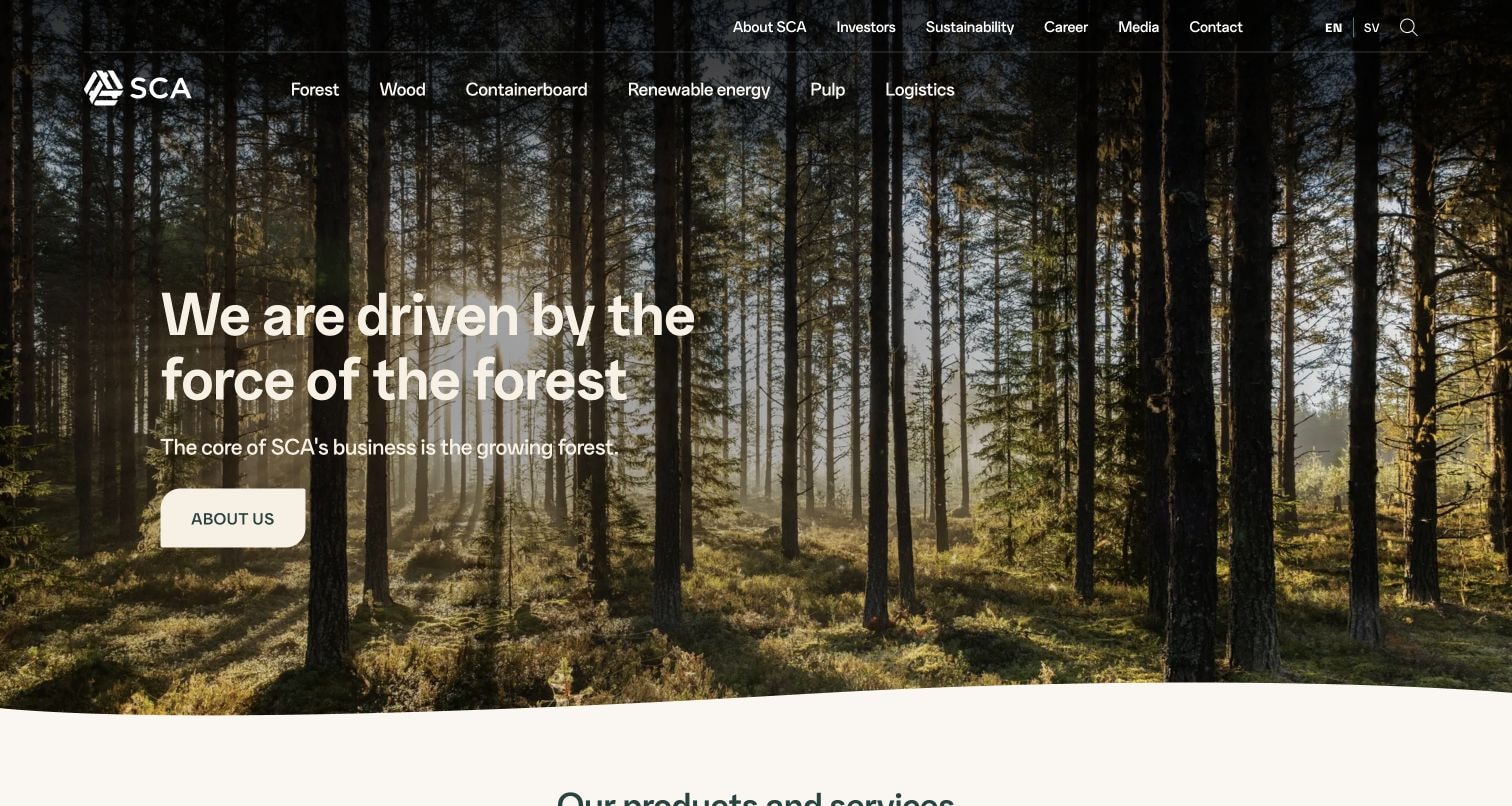
SCA's global English homepage opens on a forest landscape with a warm, pale headline and a restrained action button. The scene gives the company's forest-based identity an immediate setting, while the upper navigation distinguishes business areas from wider corporate information. A curved lower edge adds a deliberate transition into the content that follows. Optimizely's case names SCA.com, CMS 12 and a Content Delivery API alongside a separate React presentation layer. This specific evidence concerns the public implementation, not every underlying service or editorial workflow.
What you can learn
Use structured records for business areas and corporate topics, with the immersive image serving as an introduction rather than the only explanation. If content is delivered through an API, include the preview and fallback states in the editorial brief. Test headline placement against a representative selection of forest images before allowing unrestricted campaign changes.
Pros
The landscape establishes a clear relationship between the brand and its operating context.
Separate navigation groups accommodate commercial visitors and people seeking corporate information.
Cons & considerations
The broad introductory language offers limited guidance for a visitor seeking a particular product.
Image-dependent text contrast needs attention as photography and seasonal campaign material change.
Public source checked November 3, 2026. References may be embedded or legacy—not a complete backend inventory.
Platform source: Optimizely CMS customer implementation story. The official case explicitly names SCA.com as a website using Optimizely CMS 12 and the Content Delivery API with a separately built React presentation layer. Documentary CMS implementation evidence for this named public property or regional estate. It is not a complete current backend inventory, a claim about private accounts, or proof that every linked service uses Optimizely. Platform evidence is separate from the direct website screenshot and is not a complete current infrastructure audit.
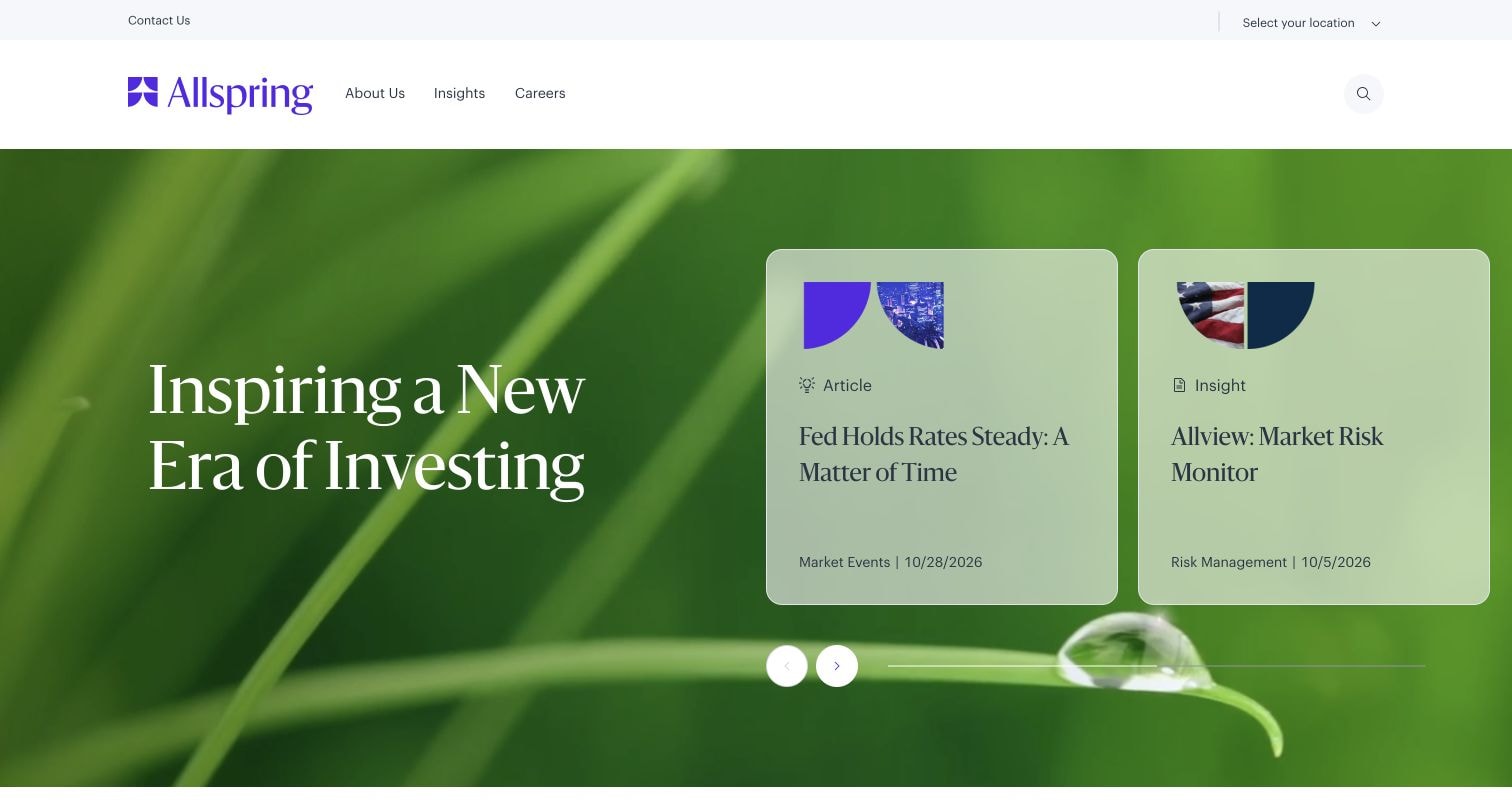
Allspring's public corporate homepage uses a close view of a green leaf as the backdrop for its introductory statement. A serif headline occupies the left side, while two translucent editorial cards bring current insights into the same opening view. Dates and category labels identify those cards as publications. Minimal navigation leaves room for content, with region information handled separately. Optimizely documents the public website rebuild; the pictured general homepage does not expose investment accounts, portfolio tools or the private intranet mentioned in the wider program.
What you can learn
Model insight cards as editorial records with a title, topic, date, destination and audience. Let the homepage select those records without manually duplicating their metadata. Keep region and audience rules explicit, and review what a general visitor sees before any professional-client eligibility decision or account access takes place.
Pros
The opening view combines a clear institutional message with concrete routes into recent writing.
Dates and categories give the insight cards useful context before the reader follows a link.
Cons & considerations
Translucent cards depend on the background image retaining enough separation from small text.
The general corporate view does not answer audience-specific questions about individual investment products.
Public source checked November 3, 2026. References may be embedded or legacy—not a complete backend inventory.
Platform source: Optimizely CMS customer implementation story. Optimizely documents Allspring's public website rebuild on its CMS, launched in March 2024. The public corporate homepage is reviewed; private investment accounts and the intranet are outside scope. Documentary CMS implementation evidence for this named public property or regional estate. It is not a complete current backend inventory, a claim about private accounts, or proof that every linked service uses Optimizely. Platform evidence is separate from the direct website screenshot and is not a complete current infrastructure audit.
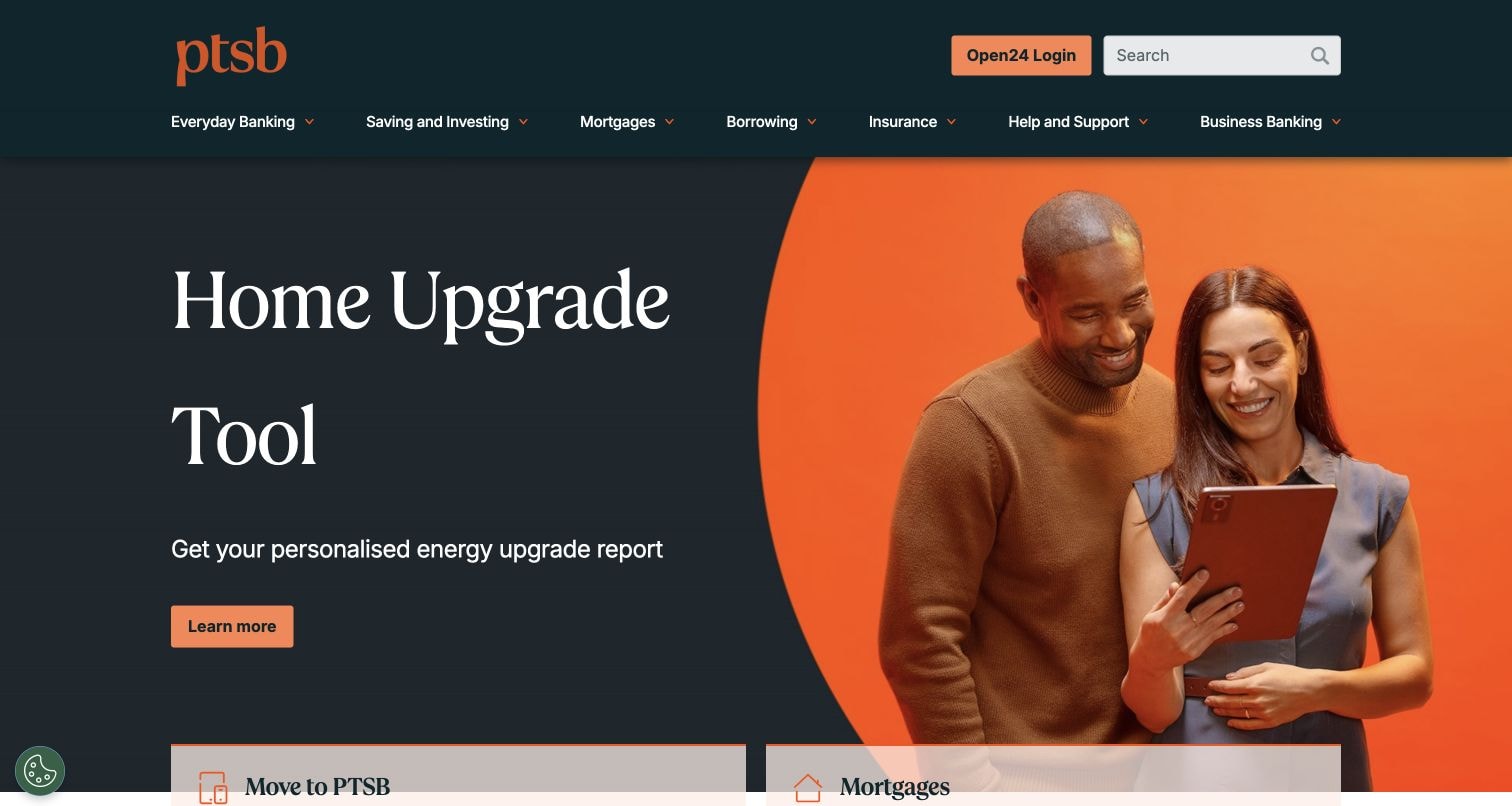
PTSB places its home upgrade tool inside a distinctive charcoal, teal and orange composition. A large serif heading introduces the task on the left, while an orange-framed photograph shows people considering information together. The upper navigation retains conventional product categories, so the featured tool does not become the only route into the bank's public content. The official CMS case documents PTSB's website rebrand with UNRVLD; that public content-platform evidence does not establish how authenticated banking or any financial calculation is implemented.
What you can learn
Build the homepage feature around a clear task record with explanatory copy, imagery and an explicit tool destination. Keep product navigation and service messages outside that record. During editorial review, check the introductory promise against the destination's actual purpose, and make space for necessary public notices without obscuring the user's next step.
Pros
The unusual color combination gives the page a strong identity while separating text and image.
The featured task is specific enough for a visitor to understand why they might continue.
Cons & considerations
Several product categories still compete for attention above the prominent homepage feature.
The hero alone cannot explain the assumptions or limitations of the linked planning tool.
Visible tech stack
Earlier / documented evidence
Optimizely
Earlier cited evidence retained; no current scan result. References may be embedded or legacy—not a complete backend inventory.
Platform source: Optimizely CMS customer implementation story. Optimizely documents PTSB's public digital rebrand and website delivered with UNRVLD on its CMS. This is evidence about the content platform, not proof of the authenticated banking backend. Documentary CMS implementation evidence for this named public property or regional estate. It is not a complete current backend inventory, a claim about private accounts, or proof that every linked service uses Optimizely. Platform evidence is separate from the direct website screenshot and is not a complete current infrastructure audit.
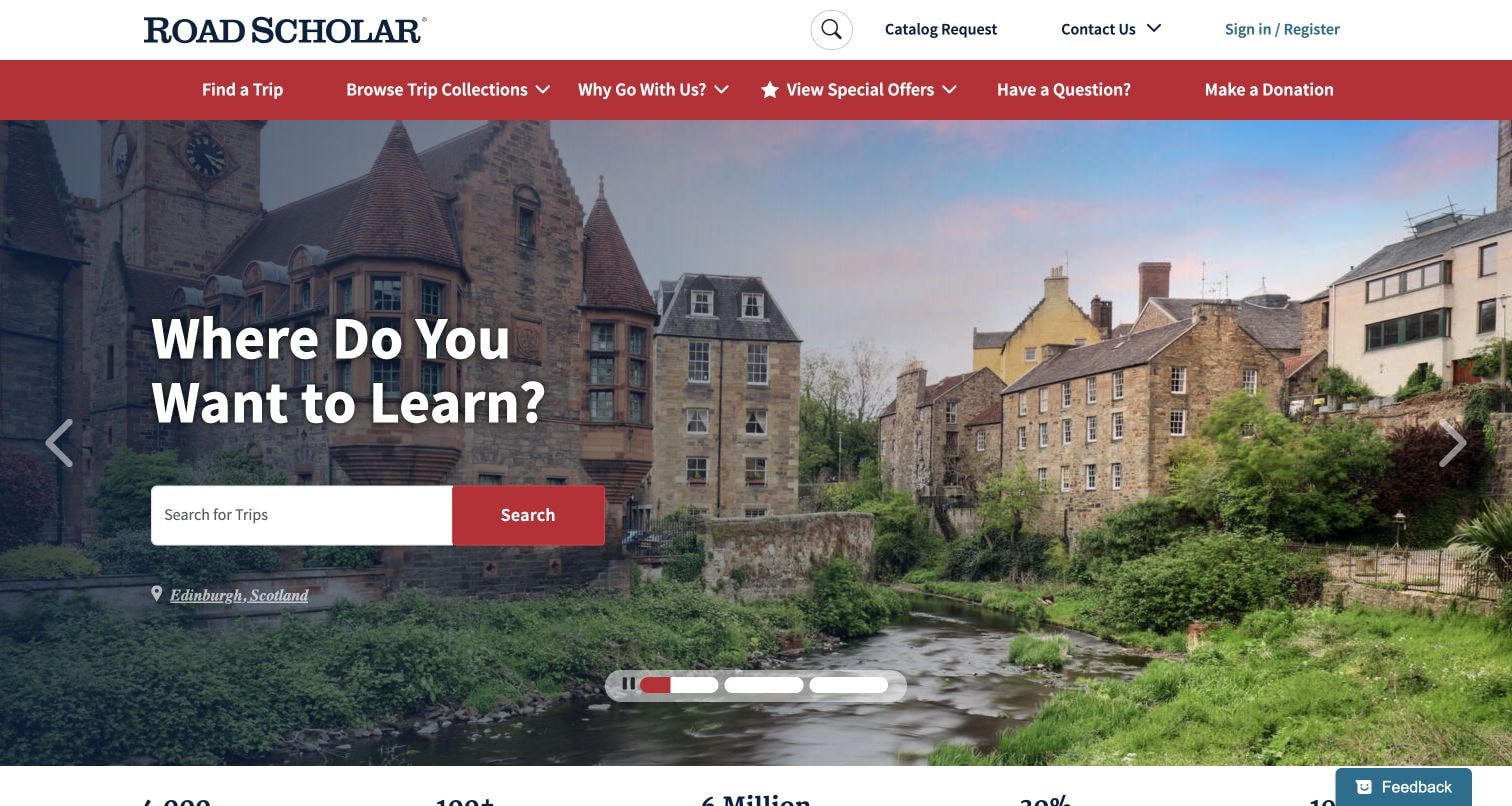
Road Scholar lets a destination photograph occupy most of the opening screen, but the central task remains explicit: choose where to learn. A substantial search field and red action button sit directly under the headline, while the red navigation strip and utility links provide alternative ways to explore the organization. The implementation case separately identifies Optimizely CMS and other marketing products. This example therefore rests on documented content-platform use, not on an experimentation relationship being mistaken for the CMS.
What you can learn
Treat destinations, programs and editorial stories as connected records with stable identifiers and clear availability ownership. Let homepage editors feature a destination through those records, and test the search entry with long place names and ambiguous queries. A campaign should invite exploration while preserving a route to reliable program details and support.
Pros
Search occupies the center of the experience and matches the visitor's likely planning task.
Destination photography gives the otherwise functional search prompt a clear sense of place.
Cons & considerations
White text over a detailed city scene requires careful image selection and responsive positioning.
The first screen offers limited comparison information for someone choosing between specific programs.
Public source checked November 3, 2026. References may be embedded or legacy—not a complete backend inventory.
Platform source: Optimizely CMS customer implementation story. The official case separately describes Road Scholar's website rebuild using Optimizely CMS and its other marketing and experimentation products. CMS inclusion does not rest on experimentation alone. Documentary CMS implementation evidence for this named public property or regional estate. It is not a complete current backend inventory, a claim about private accounts, or proof that every linked service uses Optimizely. Platform evidence is separate from the direct website screenshot and is not a complete current infrastructure audit.
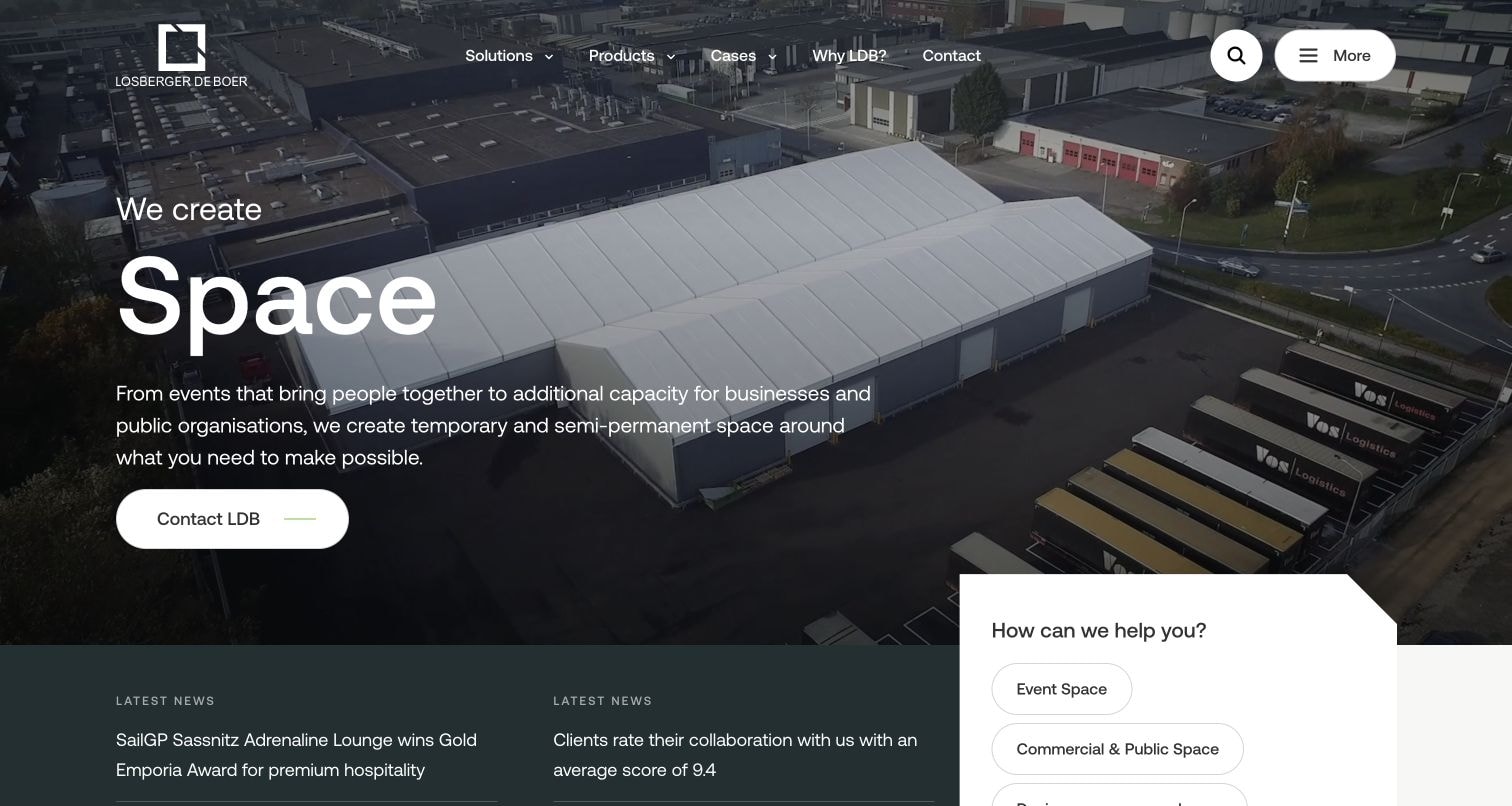
Losberger De Boer's global homepage uses an expansive view of an industrial building to support a short capability statement. White text and a rounded contact action sit over the image, with an overlapping lower panel beginning to divide the offering into different space requirements. The navigation remains relatively restrained despite the international scope. Optimizely's case describes international website consolidation with regional content and forms; the review covers the global English property pictured here.
What you can learn
Structure reusable service records around the type of space, likely application, region and relevant inquiry destination. Keep the visual introduction brief, then let those records provide concrete choices. Regional editors need to know which claims and contact routes they may change, and a preview should reveal what happens when a service is unavailable in a market.
Pros
The aerial image makes the physical scale of the company's work immediately visible.
An overlapping task panel begins translating the broad message into more specific visitor needs.
Cons & considerations
The introductory wording needs deeper service pages to explain particular capabilities and constraints.
Overlay navigation and copy depend on the image remaining visually calm behind them.
Public source checked November 3, 2026. References may be embedded or legacy—not a complete backend inventory.
Platform source: Optimizely CMS customer implementation story. Optimizely documents the public international website consolidation delivered by iO on its CMS, with regional content and forms. The global English homepage is pictured. Documentary CMS implementation evidence for this named public property or regional estate. It is not a complete current backend inventory, a claim about private accounts, or proof that every linked service uses Optimizely. Platform evidence is separate from the direct website screenshot and is not a complete current infrastructure audit.
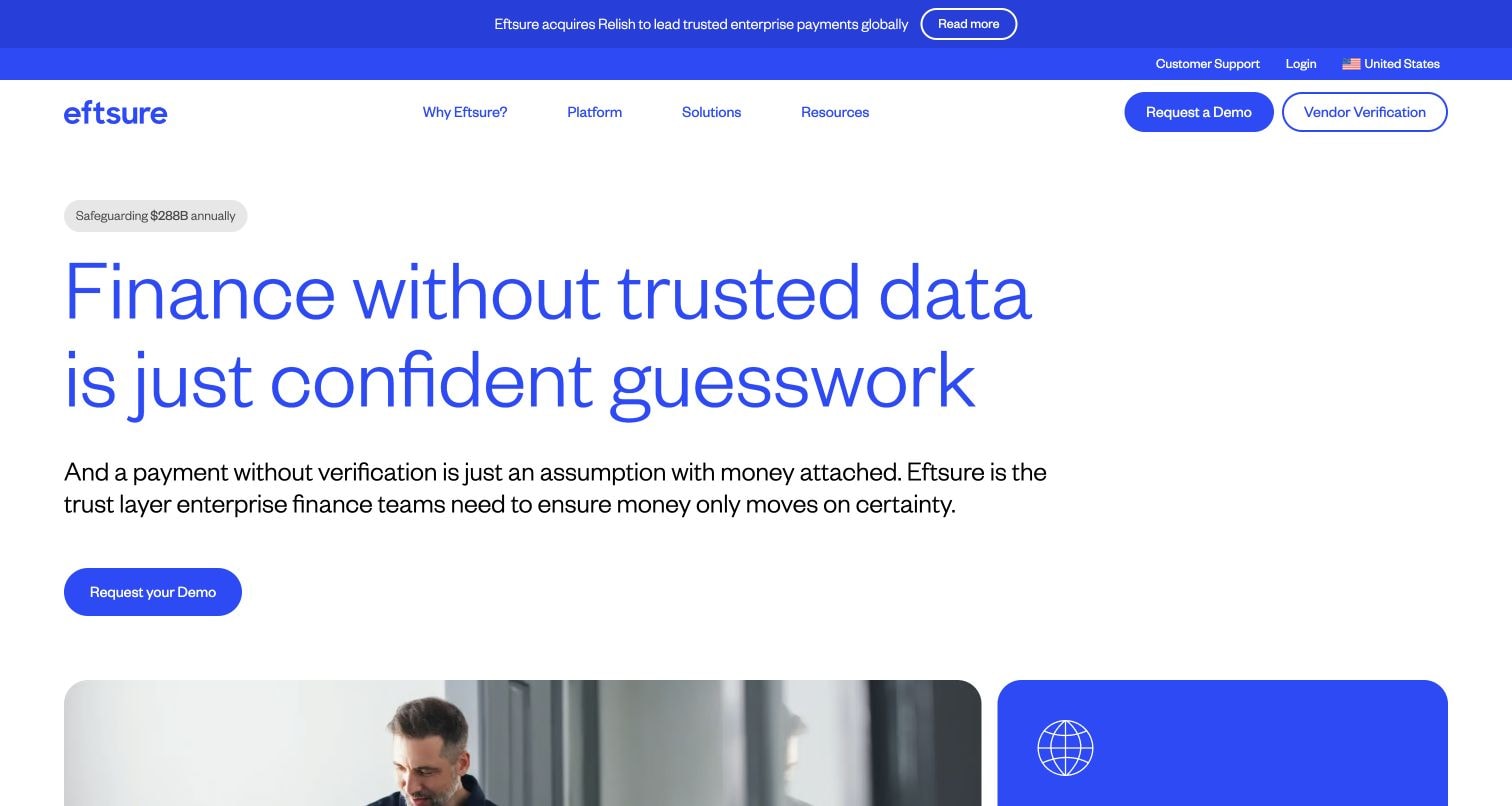
Eftsure opens with a large electric-blue argument about trusted financial data on a white background. The composition makes the issue legible before introducing a detailed platform explanation, while a narrow announcement strip and a short menu provide additional context above it. The official implementation story identifies CMS SaaS, Graph and a separate Next.js frontend for the marketing website. The evidence concerns public content delivery, not the payment verification product or its fraud-prevention claims.
What you can learn
For a specialist software site, model the problem statement, product explanation, evidence and sales destination as separate editorial responsibilities. Give campaign editors enough freedom to sharpen the argument while keeping regulated or sensitive claims subject to review. Preview long headlines and announcement banners together, since both compete for limited space before the product story begins.
Pros
The large blue headline creates a clear reading order without relying on decorative imagery.
The short navigation and persistent sales actions provide obvious routes beyond the opening argument.
Cons & considerations
The strongly worded proposition needs supporting detail before a reader can assess its relevance.
An announcement strip adds another editorial item that must be maintained alongside the main campaign.
Visible tech stack
Earlier / documented evidence
Optimizely
Earlier cited evidence retained; no current scan result. References may be embedded or legacy—not a complete backend inventory.
Platform source: Optimizely CMS customer implementation story. Optimizely documents Eftsure's global marketing website on CMS SaaS with a Next.js frontend and Graph integration. The payment verification product itself is outside this website review. Documentary CMS implementation evidence for this named public property or regional estate. It is not a complete current backend inventory, a claim about private accounts, or proof that every linked service uses Optimizely. Platform evidence is separate from the direct website screenshot and is not a complete current infrastructure audit.
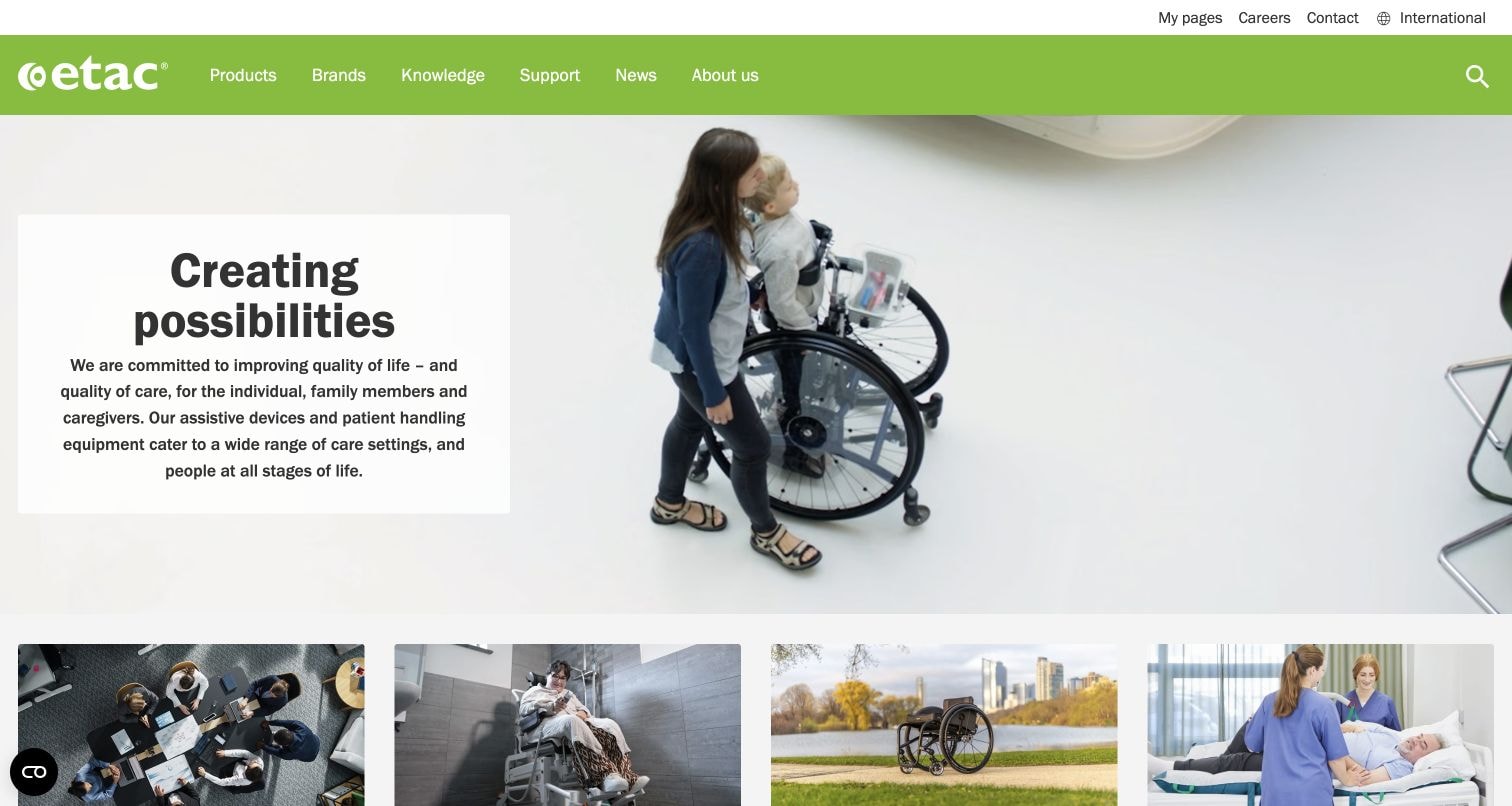
Etac pairs a white introductory panel with a photograph of a caregiver and a wheelchair user, grounding its broad purpose in a recognizable situation. A green navigation bar supplies direct routes into products and related information, while the next row of photographic cards begins below the main feature. Optimizely's case explicitly identifies Etac.com as a consolidated CMS website alongside a separate product information system. Editorial imagery does not establish the source of every specification or local availability rule.
What you can learn
Define who owns product facts, editorial descriptions and regional guidance before designing reusable blocks. Link the CMS content to authoritative product records rather than copying technical details into several campaign pages. Preview the global experience and country handoffs so a visitor can understand which information applies locally without losing the context of the product they were exploring.
Pros
The photograph gives a concrete human setting to the otherwise broad introductory statement.
The green navigation creates a stable visual frame for product and informational destinations.
Cons & considerations
The general purpose statement offers little immediate help comparing specific product categories.
International content needs clear local routing before visitors can rely on availability or service information.
Public source checked November 3, 2026. References may be embedded or legacy—not a complete backend inventory.
Platform source: Optimizely CMS customer implementation story. Optimizely's case explicitly names Etac.com as the consolidated global product website using its CMS alongside a separate InRiver product information system. Documentary CMS implementation evidence for this named public property or regional estate. It is not a complete current backend inventory, a claim about private accounts, or proof that every linked service uses Optimizely. Platform evidence is separate from the direct website screenshot and is not a complete current infrastructure audit.
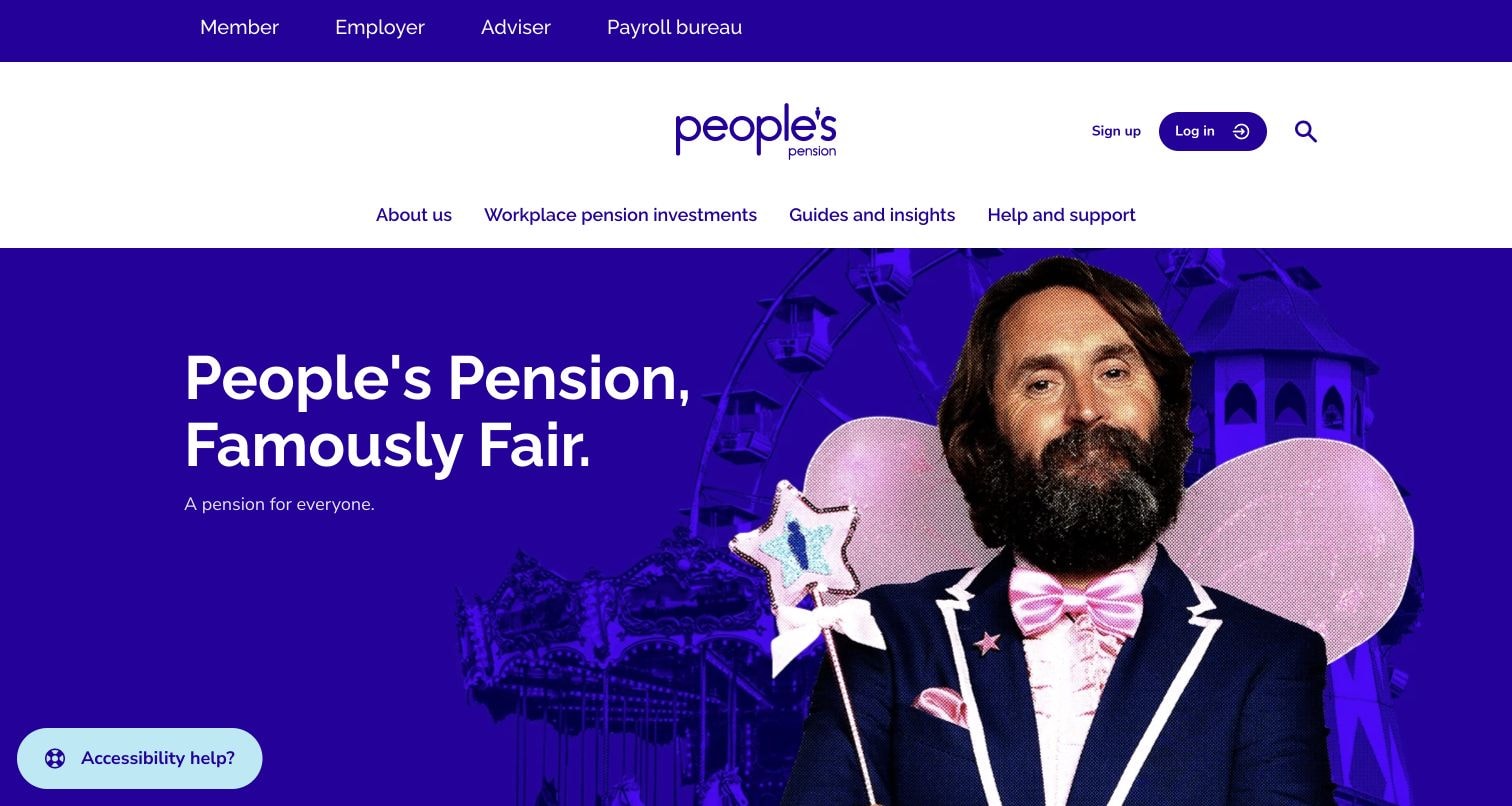
People's Pension makes its campaign identity prominent through a purple background, a bold fairness message and a playful costumed character. Above that campaign, audience labels separate members, employers, advisers and payroll bureaux, acknowledging that these groups arrive with different tasks. Optimizely's official case describes replacement of the public WordPress site with CMS and separate audience journeys. The screenshot does not include private pension information or establish anything about the systems behind a member login.
What you can learn
Make audience labels part of the information architecture rather than changing them casually within campaign copy. Define content ownership for each role and reuse shared explanations only where their meaning remains the same. A CMS preview should test a quiet service update as well as an expressive campaign so important practical information retains a clear route.
Pros
Explicit audience choices help visitors distinguish their route before engaging with the campaign.
The coordinated purple palette and character make the public message visually memorable.
Cons & considerations
The large campaign treatment provides limited immediate detail about everyday pension administration tasks.
Several audience routes require careful editorial governance to prevent duplicated or contradictory explanations.
Visible tech stack
Earlier / documented evidence
Optimizely
Earlier cited evidence retained; no current scan result. References may be embedded or legacy—not a complete backend inventory.
Platform source: Optimizely CMS customer implementation story. The official case documents the public People's Pension website replacing WordPress with Optimizely CMS and distinct member, employer and adviser journeys. Private pension accounts are not reviewed. Documentary CMS implementation evidence for this named public property or regional estate. It is not a complete current backend inventory, a claim about private accounts, or proof that every linked service uses Optimizely. Platform evidence is separate from the direct website screenshot and is not a complete current infrastructure audit.
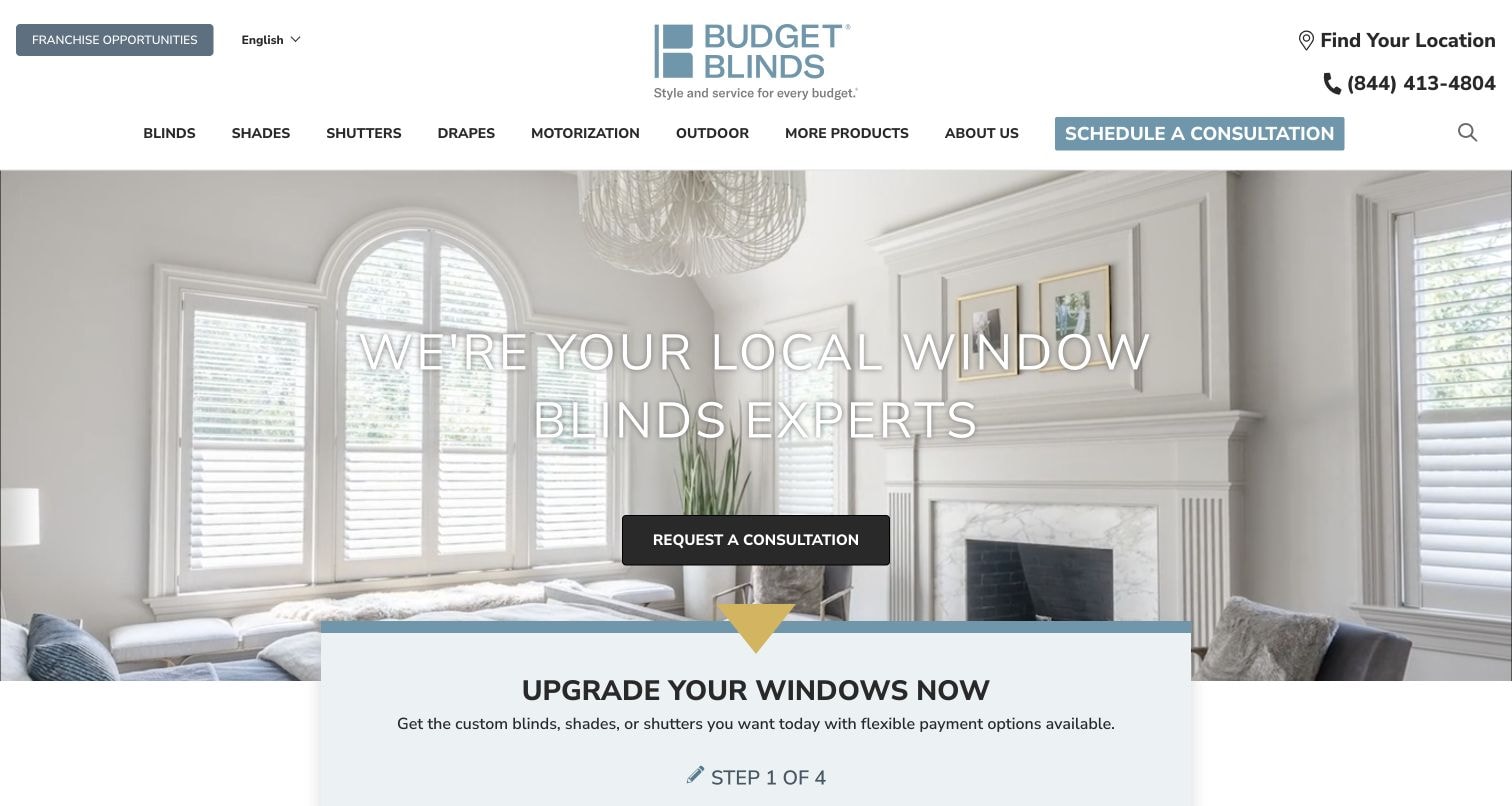
Budget Blinds opens with a broad interior photograph and a direct statement about local window-blind expertise. The large white header combines product categories, a location route, a telephone number and a consultation action. Below the hero, a pale blue panel extends the invitation to plan an upgrade. The source case explicitly names budgetblinds.com within the Home Franchise Concepts CMS implementation. The useful pattern is shared national content with local service discovery; franchises may have different offers and operational systems.
What you can learn
Separate reusable brand and product content from franchise records containing service areas, contact details and locally approved offers. Make location handoffs visible before visitors invest time in an inquiry. In the CMS, give national editors and local operators clear boundaries, and preview long franchise names or incomplete location information alongside the shared campaign.
Pros
The room photograph shows the product in a setting a homeowner can immediately recognize.
Location and consultation routes connect the national brand story to a practical local next step.
Cons & considerations
Two navigation rows and several contact options make the header visually demanding.
The introductory image cannot explain product differences or confirm which local services are available.
Public source checked November 3, 2026. References may be embedded or legacy—not a complete backend inventory.
Platform source: Optimizely CMS customer implementation story. Optimizely's Home Franchise Concepts case explicitly identifies budgetblinds.com as an Episerver/Optimizely CMS implementation combining national content with localized franchise information. Documentary CMS implementation evidence for this named public property or regional estate. It is not a complete current backend inventory, a claim about private accounts, or proof that every linked service uses Optimizely. Platform evidence is separate from the direct website screenshot and is not a complete current infrastructure audit.
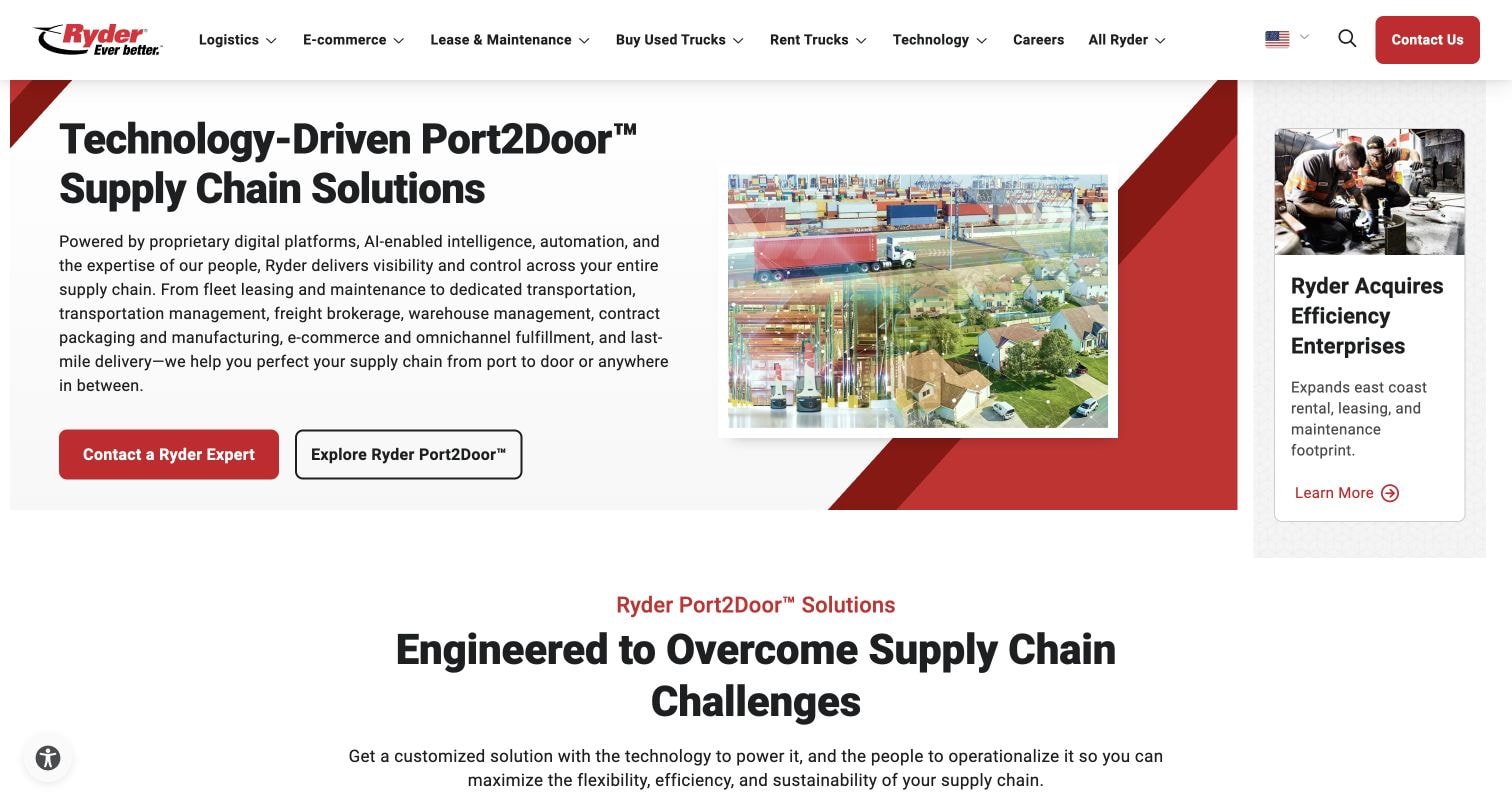
Ryder's homepage combines a dense, bold statement about its supply-chain capabilities with port imagery, red brand accents and two distinct actions. A news rail introduces another stream of corporate information on the right, while navigation exposes the broader business. Optimizely's case documents a move from Sitecore to its CMS for the public B2B experience across business lines. It does not establish the software behind fleet operations, shipment visibility or customer account tools that may be linked from the public site.
What you can learn
Organize a large service estate around stable business records and clear visitor tasks. Let the homepage feature a cross-company message, but preserve direct paths to the specific service and region a buyer needs. Govern news and campaign modules separately, and test their combined density with realistic headlines before approving another item for the first screen.
Pros
Port imagery provides an immediate physical reference for the broad supply-chain proposition.
Separate actions distinguish a direct commercial conversation from further exploration of the offering.
Cons & considerations
The news rail, large headline and navigation create several competing points of attention.
The expansive introductory claim requires deeper pages to clarify service scope and geographic coverage.
Public source checked November 3, 2026. References may be embedded or legacy—not a complete backend inventory.
Platform source: Optimizely CMS customer implementation story. Optimizely documents Ryder's move from Sitecore to its CMS for a public B2B digital experience spanning its business lines, including reusable translated components and lead forms. Documentary CMS implementation evidence for this named public property or regional estate. It is not a complete current backend inventory, a claim about private accounts, or proof that every linked service uses Optimizely. Platform evidence is separate from the direct website screenshot and is not a complete current infrastructure audit.
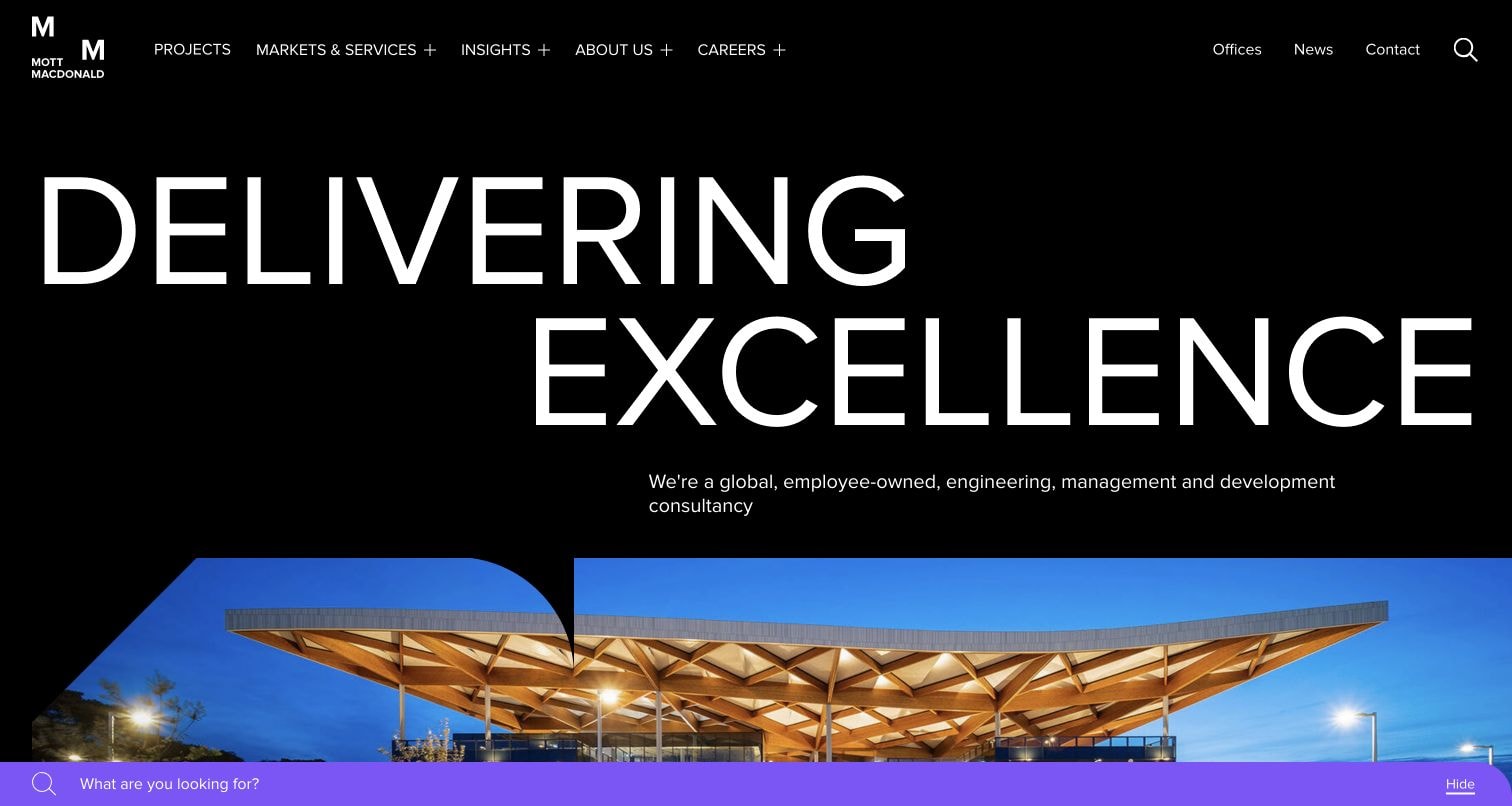
Mott MacDonald uses a black background and very large white display type to create a confident opening statement. Supporting copy sits to the right, with an architectural image entering the lower portion of the view and a purple search treatment adding a contrasting utility. Optimizely's case documents migration of the public website from a bespoke platform to CMS 12. The association concerns that content estate; it does not identify every internal collaboration tool or system used to deliver consulting projects.
What you can learn
Create coherent records for projects, expertise, people and careers before deciding which one leads the homepage. Use controlled relationships to connect a project to its sectors and services without manually repeating facts. Preview the oversized headline with realistic localization and long editorial copy, and ensure search remains useful once visitors move beyond the brand introduction.
Pros
The strong black-and-white treatment gives the introductory statement a clear visual hierarchy.
Search provides a practical route into a corporate estate that may be difficult to summarize.
Cons & considerations
The expansive display text delays concrete project evidence until farther down the page.
The broad statement needs descriptive navigation to serve visitors with specific technical or career goals.
Public source checked November 3, 2026. References may be embedded or legacy—not a complete backend inventory.
Platform source: Optimizely CMS customer implementation story. Optimizely documents the engineering consultancy's public website migration from a bespoke CMS to CMS 12. Marketing automation and AI products are separate parts of the broader program. Documentary CMS implementation evidence for this named public property or regional estate. It is not a complete current backend inventory, a claim about private accounts, or proof that every linked service uses Optimizely. Platform evidence is separate from the direct website screenshot and is not a complete current infrastructure audit.
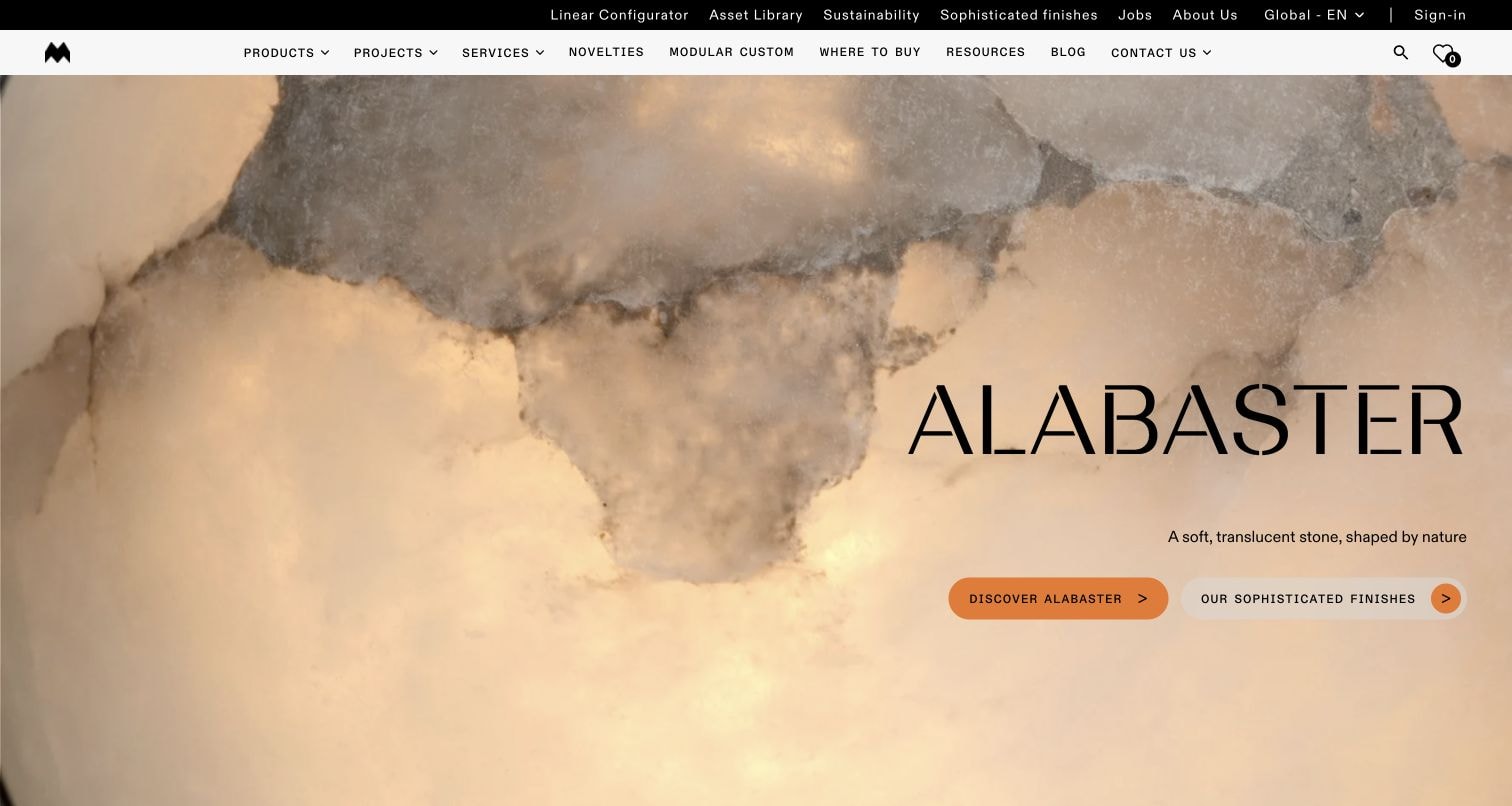
Modular Lighting Instruments uses a close view of alabaster as the dominant surface of its homepage. A large, thin display heading names the material, while two compact actions distinguish the particular story from the wider collection of finishes. Black utility and white navigation strips frame the warm photographic field. Optimizely's CMS case describes the brand's public website and connections to separate product information and asset systems; the image does not by itself reveal how individual specifications are managed.
What you can learn
Model finishes, product families, projects and downloadable resources as related but distinct content. A material story should link to the relevant products without duplicating their technical records. Give editors image crop guidance and short action labels, and check that the professional resource paths remain easy to find when the featured campaign becomes especially visually dominant.
Pros
Close material photography makes texture and translucency the central subject of the opening view.
Separate navigation layers accommodate both inspirational browsing and direct access to professional resources.
Cons & considerations
The dramatic material feature offers limited immediate context for visitors seeking a specific luminaire.
The number of header destinations requires careful responsive design to preserve a clear hierarchy.
Public source checked November 3, 2026. References may be embedded or legacy—not a complete backend inventory.
Platform source: Optimizely CMS customer implementation story. Optimizely documents the architectural lighting brand website as a CMS implementation delivered with Delaware and connected to separate product information and digital asset systems. The global English website is pictured. Documentary CMS implementation evidence for this named public property or regional estate. It is not a complete current backend inventory, a claim about private accounts, or proof that every linked service uses Optimizely. Platform evidence is separate from the direct website screenshot and is not a complete current infrastructure audit.
Choose a content architecture that matches the organization
A shared corporate and regional website estate
Start with a common set of records and navigation conventions, then define which regions can adapt text, images, offers and contact routes. Shared content should have a clear source and owner. Preserve useful local differences rather than assuming that translating a global homepage creates a complete regional experience.
A public product site connected to specialist systems
Keep product facts, editorial descriptions and commercial rules distinct. The CMS may manage a story while a product information system owns specifications and a commerce service owns availability or checkout. Document the relationship between those records, the visible failure state and the team responsible for correcting each kind of information.
A separately rendered marketing experience
For an API-driven implementation, plan the frontend, content retrieval, preview and publication lifecycle as a complete workflow. CMS SaaS separates content management from presentation and uses Graph to retrieve content. That separation creates responsibilities for the project team; it does not establish a particular visual style or automatically verify the resulting site.
Plan what happens after the first page is published
Rehearse approvals with real content and real roles
Identify who drafts, checks and publishes each content type, including shared media and local-language variants. CMS 12 approval sequences can apply to pages and asset folders, with inheritance rules that affect their children. Test the configured workflow with an ordinary edit and a correction, so ownership is clear before a busy campaign period.
Map existing URLs, retained content, redirects, media and relationships before moving records. Sample high-value pages and awkward old content, including withdrawn products, long titles and obsolete downloads. Check the resulting public routes as well as the import report, and retain a clear record of what was deliberately removed.
Give shared components a controlled evolution path
A changed block can affect many pages and regions. Maintain representative examples that reveal long text, different images and unexpected combinations. Review keyboard behavior, focus, responsive layouts and image contrast on those examples, and record how the team restores the previous presentation if a shared change creates a problem.
A useful handover demonstration
Ask the actual team to carry out its routine job: publish a realistic update, correct a mistake, preview a narrow screen, and identify who owns an integration failure. For a library or frontend framework, also ask who maintains the content source and deployment. A polished screenshot does not answer those operational questions.
Beyond the screenshot
An Optimizely website planning checklist
Name the CMS product, implementation version where known and exact websites in scope.
List recurring content types, required fields and relationships between records.
Separate shared corporate content from regional choices and local service details.
Assign ownership to claims, product facts, offers, translations and campaign expiry.
Demonstrate preview with real content and the intended frontend.
Check permissions and approval behavior for pages, shared blocks and media.
Map retained URLs, redirects and deliberately retired content before migration.
Test navigation, search entry points, keyboard access and responsive image contrast.
Record integration owners and public fallback states for unavailable data.
Rehearse a content correction and a shared-component rollback before handover.
Test with real content, a keyboard, a small screen, slow or failed requests, and the people who will maintain the system. These are planning checks, not an accessibility, security, performance, or search-ranking certification.
Sources & editorial method
How this Optimizely collection was reviewed
We selected 20 distinct public website properties with primary sources explicitly documenting Optimizely CMS implementations, then captured and visually reviewed each public page on November 3, 2026. Evidence is scoped to the named website or regional estate and preserves the limits of historical implementation stories; public markup was retained as supporting evidence where available. We excluded experimentation-only relationships, gated pages and incomplete renders. The screenshots show public content after routine cookie or region notices were handled, without entering private accounts, submitting inquiries or accepting contractual gates. These are original editorial design reviews, not audits of performance, security, accessibility or commercial outcomes.
Every image is an unmodified capture from the actual website, with its source and capture date. Some captures are reused from our shared catalog; their dates remain the original capture dates. None comes from a vendor gallery or a generated reconstruction. Moving imagery and live content can change.
Technology attribution uses public page assets or metadata, official platform documentation, or a cited first-party project case study. Documentary and framework-relationship evidence is identified where used; it is not a complete current backend inventory. A CMS image CDN alone does not establish a full CMS deployment. A library’s presence does not prove which individual controls use it, and a platform label does not establish AI authorship.
The composition notes, lessons, pros and tradeoffs are original editorial observations. We have not measured conversion, traffic, security, performance or accessibility conformance. Website owners retain their brands and imagery; these examples are not our client portfolio. Written, Edited and Curated are independent records, not dates advanced by a build. See our editorial standards or suggest a correction.
Questions worth asking
Optimizely website development FAQs
Does using Optimizely experimentation mean a website uses its CMS?
No. Experimentation, analytics and content management are different roles. This collection requires explicit CMS implementation evidence for the pictured website or a clearly matched website estate.
Does an Optimizely CMS website have to look a particular way?
No. The content model, component design and presentation implementation determine the visible experience. The examples show markedly different layouts built around different visitor tasks.
Are CMS 12 and CMS SaaS interchangeable project choices?
Treat them as distinct offerings with different architecture and implementation considerations. Confirm the selected product, supported workflow and migration requirements with the team before copying advice from another project.
Does a CMS case study prove the entire current stack?
No. It documents an implementation relationship at a particular scope and time. Other public properties, private accounts, commerce services and operational systems can use different technology, and subsequent changes may not be described in the original story.
What should an editorial handover demonstrate?
Show an editor creating a realistic record, previewing it, obtaining the required review, publishing it and correcting or retiring it. Include a shared component and a regional variant where those are part of the actual project.
Borrow the useful editorial pattern, then define the records, responsibilities and review process that will keep your own version accurate after launch.